



Abstract
For all its wretched ways, COVID:19 has installed new possibilities to the way we do ethnographic research. Due to pandemic restrictions, my research on how digital activists in Sri Lanka acquire influence on social media fell into three distinct phases: (i) digital ethnography from London, (ii) datafied approaches in Helsinki and (iii) traditional fieldwork in Colombo. The article’s objective is not to provincialise the three cases, but to demonstrate how each phase is tightly bound together and serve to imagine new possibilities in research design. Vlad Glăveanu contents that ‘human beings live “amphibious” lives – at once in the realm of the actual and the possible’ to emphasis the misty line between what is real and what can be manifested by innovation and action. Not dissimilar to this amphibiousness, I argue that human beings also live ‘augmented’ lives, at once in the realm of in real life (IRL) and online spaces and experiences mediated by digital technologies. My fingers, ears and eyes, while in London, Helsinki or Colombo, were always partly submerged in digital worlds, and it was this augmentation that enabled the long-term engagement that good ethnography demands.
An article about the methodological possibilities that evolved out of the unprecedented restrictions placed on us of all during the COVID:19 pandemic feels like it should begin with an inspirational quote about crisis management. Maybe something Albert Einstein conjured up about humanity not being about to solve its problems with the same thinking that we used to create them. I will resist, however, paraphrasing Milton Friedman who claimed crises are the opportunity for real change given that we know that his laissez faire economics have caused greater calamities than solutions. The point of contention remains, COVID:19, for all its wretched ways, may have installed new possibilities to the way we do ethnographic research.
My PhD research began in October 2020, around the time the United Kingdom had the highest death toll in Europe and the second highest in the world after the United States (Duncan & Barr, 2022). Beyond leaving the house for one hour of permitted exercise or grocery shopping, public activities were strictly off-limits, and the first year of my research were vague attempts at ‘pandemic-proofing’ my methods; a term I came to use regularly in online seminars and discussions with my peers and supervisors to demonstrate I was forging novel, mainly digitally-meditated methodologies, that compiled with social-distancing protocol and ethical best practices, whilst not delimiting the scope of the project, and maintaining a critical eye on the digitalisation of ethnographic practices. The conspicuous problem I had, given this was long before a vaccine-solution was even being tabled, was three-fold. First, my research is about media and resistance in Sri Lanka and international travel was prohibited for anything other than essential travel. Second, my disciplinary training in social anthropology and our highly regarded ethnographic methods rely on long-term engagement with the field site to build relationships and bonds of trust with research participants, and time to observe the ‘silence of the social’ (Hirschauer, 2006). Third, the rhythm of the crisis of the virus and the solution of the vaccine were operating on two different temporalities between the UK and Sri Lanka. While Sri Lanka and much of South Asia was relatively unscathed by the first wave of COVID:19 in 2020, it hit hardest through 2021, towards the end of which, the UK and most of Europe was becoming successfully inoculated. Therefore, when it became possible to safely leave UK, Sri Lanka remained unsafe for ethnographic fieldwork.
Three years on, and I am relieved to report that the research did get done, and, surprisingly, across three field sites, in three different countries, possibilities that appeared unfathomable at the beginning. After 6 months of digital ethnography from my apartment in London (Oct 21–Mar 22), when pandemic restrictions lifted, I took up a research placement at the University of Helsinki (Apr 22–Sep 22) to learn computational approaches to social sciences. At this point, I was still ‘pandemic-proofing’ my research by technically upskilling in a new discipline and developing a datafied approach to ethnography. Finally, in October 2022, I embarked on 6-month excursion to Sri Lanka to collaborate alongside activists in what could be labelled traditional ethnographic methods. The critical enabler to this unorthodox research process – notwithstanding virus inoculation and a lift in pandemic restriction – were the accessibility of digital technologies and my decision to research digital activism through the mediating technologies that afford the phenomena’s existence. Glăveanu (2023) writes in the Possibility Studies’ Manifesto that, ‘we human beings live “amphibious” lives – at once in the realm of the actual and the possible’ (p. 3) to emphasis the misty line between what is real and around us, and what can be manifested by innovation and action. Not dissimilar to this amphibiousness, I would also suggest that we human beings live ‘augmented’ lives, at once in the realm of in real life (IRL) and what is around us, and online spaces and experiences mediated by digital technologies. My fingers, ears and eyes, while in London, Helsinki or Colombo, were always partly submerged in digital worlds – much like my research participants in Sri Lanka – and it was this augmentation that enabled the long-term ethnographic engagement that my research demanded.
In this article, I want to outline the three distinct phases of my research on how digital activists in Sri Lanka acquire influence on social media and how they use their platform to politically participate. The plan, however, is not to provincialise the three cases, but to demonstrate how each phase is tightly bound together and serve to imagine new possibilities in the research design. To begin, I introduce COVID:19 and what this has meant for ethnographic research methods, and in concert with the amphibiousness of possibilities studies, how novel research methodologies have not only been actualised but standardised due to pandemic restrictions. The main body of the article is then separated into three sections. First, I want to demonstrate that investing in remote research via digital technologies prior to traditional in situ fieldwork provides fresh possibilities because the essential practice of visibility labour on social media helped ingratiate me into my participants worlds and build bonds of trust long before I arrived in Sri Lanka. Second, I want to illustrate how critical engagement with digital data via upskilling training at the University of Helsinki has encouraged me to break through walls between computational research and ethnography. Third, I want to exemplify that the accessible and democratising nature of online, video-based focus groups meant that choosing digitally mediating methodologies was preferential over in-person modalities, even when pandemic restrictions were lifted, and I was in situ in Sri Lanka. Taken together, I want to argue that despite the limitations of each discreet research methodology, when corroborated, their weaknesses can be offset by each other to create new and invaluable ethnographic possibilities.
In tandem with making these cases, I also want to consider some questions that arose through the research process. As I became increasingly aware that my research was highly reflective of the restrictive conditions installed by COVD:19, I want to reflect on whether my research methods have a specific pandemic-register. Or, more precisely, I would like to query whether my ‘innovative’ research methods and decision-making are valid in their own right, or are they purely a reflection of the time and legitimate only in response to the restrictions of the pandemic? Having contemplated these questions, I will make the case for an augmented ethnography, one that was neither back in London, over in Helsinki or somewhere in Colombo. Due to the amorphous, ubiquity of me and my participants digital existences, I content that to achieve my research goals, I approached my research in a ‘post-digital condition’ that takes the mediating of everyday life via digital technologies as a given, not the exception, thereby allowing for new ethnographic potentialities and possibilities.
Research in the pandemic
COVD:19, biological in nature, was also social and deeply political as it ruptured and surfaced existing inequalities. In the multi-ethnic borough of Lewisham in South East London where I was living at the beginning of the pandemic, the people on the frontline in hospitals, the labourers maintaining the city in lockdown and the people stacking shelves in supermarkets were disproportionally from black and ethnic minority backgrounds, were immigrants and/or working class, and they were most likely to catch the virus due to underlying health conditions, their public facing work and dependency on public transport. Another asymmetrically distributed phenomena of the pandemic were the increased take up and reliance on digital technologies. Access to the internet became essential for health information disseminated by the government, but ‘by facilitating remote working only for a section of population, thus shielding them from the virus and allowing them to maintain their professional lives and income, digital technologies become part of a larger assemblage that perpetuates and increases social inequalities’ (Madianou, 2020, p. 2).
From a possibilities studies’ perspective, the proliferation of digital technologies into even the most discreet areas of social life during COVID:19, and the opportunities they afford and the inequalities it fosters, set up an interesting conundrum. The people we study were having their social relationships changed in unpredictable and dynamic ways by digital technologies, but pandemic restrictions disallowed the traditional modes of ethnographic engagement. Yet the possibilities of technological pervasiveness may also allow for novel, perhaps even, groundbreaking research methods. Was this the time for all ethnographers to go digital in some way or another, and what are the precedents for social-distanced, digitally mediated research methodologies that comply with pandemic restrictions?
Ethnographic processes have been deviating a way from the standard in situ engagement in one fixed field site for some time and, increasingly, into digital worlds. In what follows I outline three digitally mediated research processes that were enforced by COVID:19 restrictions but ultimately came to underpin my study in invaluable ways: (i) digital ethnography, (ii) datafied approaches to ethnography and (iii) online, synchronous, video-based focus group interviews. My underlying argument is that not only did COVID:19 restrict what was possible in ethnography but made the gambit of what is ethnographically possible wider.
Digital ethnography: In-line with the rapid and near seduction of humanity to digital technologies, in no more than 30 years, ethnographic approaches to the internet have undergone significant developments, jettisoning, for example, a raft of prefixes and associated practices including ‘cyber’, ‘virtual’ and ‘online’, to land on the contemporary paradigm of ‘digital’ ethnography (Haverinen, 2015). Underpinning this shift to digital ethnography is the breakdown of the faux distinction between the internet-enabled experiences and those perceived to be in real life because ‘humanity is not one iota more mediated by the rise of the digital’ (Horst & Miller, 2012, p. 3); an anthropological imposition that implies all cultural phenomenon, from generational gift economies to instantly shareable GIFs, are equally mediating forces. But if the notion of a digital ethnography, with all its boundless entanglements, sounds antithetical to the tradition situatedness of the ethnographic field site, conducting ethnographic research from a remote location has been an increasingly common practice, especially in the multi-sited field site thesis put forward by Marcus (1995) to deal with an increasingly globalised world. Indeed, digital ethnography has become a matter of recourse because, ‘as growing numbers of people around the globe take up telematic media such as webcams, live streaming, or live tweeting, “being there” from afar is becoming an ever more integral part of daily life’ (Postil, 2017, p. 67). Hine’s (2015) exhaustive resource for the ethnographic study of the internet emphasises how the digital experience is ‘embedded’ in diverse contexts and frames of reference, it is ‘embodied’ into the user experience, and it is ‘everyday’ insofar as the digital should not be considered as exceptional. As follows, I recognise that online encounters are not so divergent to offline encounters insofar as they are equally experienced in the ‘body’ and it is therefore the ethnographer’s task to incorporate a strong reflexive dimension into their observations to comment on how digitally-mediated practices challenge or conform to our expectations of experience.
Datafied ethnography: The datafication of everyday life is an opaque practice that has underpins our contemporary engagement with digital technologies. The way smartphones, laptops and all manner of digital-connected devices survey, extract and store data on users and how it is then appropriated to install preferential content or experience, or sold for profit, may sound like science-fiction, but it the fundamental business model of the world’s most wealthiest companies (Couldry & Mejias, 2019). Data's opacity leads to data being broadly misunderstood. It is not ‘big’ as common parlance may suggest because data sets, such as national censuses from the pre-digital era, have always been large in scale (boyd & Crawford, 2012). Data is also never ‘raw’ because this implies a position of neutrality, but data has been collected with a purpose, on purpose, ensuing that any apparent rawness only reflects a need for data to be refined. What, then, does this mean for anthropologists, the researchers charged with documenting and understanding what it means to be human in a datafied world?
In 2021, a collaborative special issue suggested that there are two ways that anthropology can engage with data (Douglas-Jones et al., 2021). First, through ethnography with ‘data-communities’; those groups who have an explicit relationship with data such the Indian citizens of Nair’s (2021) study whose biometric identification data offers new pathways to resource access, or the British climate-conscience activists who study and tweak their home smart metres for productive gains (Knox, 2021). Second, there are ‘accidental ethnographers’ who happen upon data whilst in the field, like TallBear’s (2013) research on the dialectic between Native American kinship and local obsessions with genetic databases. It strikes me that there is a third way for anthropology to engage with data: by accessing the digital traces our research participants produce through interaction with and through platforms and other digital tools. For example, when researching a digitally mediated phenomena, such as digital activism, technically upskilling and acquiring the skills to extract data from the social media platforms that digital activists are using may establish novel avenues into the research subject. Moreover, research may be elevated by being made to confront the intractablity of digital data, providing opportunities to ethnographically engage with a phenomenon that has an ambiguous and indisputable role in how the contemporary social world is organised, and that has been difficult in the past for ethnographers to engage with.
Online, synchronous, video-based focus groups: The normalisation of video conferencing, both for personal and professional communications, was arguably one of the most notable technological proliferations incurred due to the restrictions enforced by the pandemic, as essential societal institutional practices, from school teaching to mental health therapy, went remote via digitally mediating technologies. The video conferencing tool, Zoom, was one of the major beneficiaries in this boom in video-based communications, becoming a household name, as its profits grew from $21 million in 2019 to an extraordinary $671 million in 2020 (BBC, 2021). The zoomification of daily activities has outlasted pandemic restrictions and the reason video conferencing has established itself as a preferred method of communication in a variety of settings, but especially in a professional environment, is because it reduces travel, and therefore saves time and money, including carbon-heavy flights for international communications which makes it is, ostensibly, ecologically more conscientious.
What does this imply for the role of video focus groups in scholarship and ethnographic practices? Ethnography has had an ambivalent relationship with in-person focus groups because the staged setting is antithetical to participation observation and the ethnographic emphasis on engaging participants in their natural environment (Agar & MacDonald, 1995). That being said, scholars have argued that focus groups can be useful additional to the ethnographers’ toolkit because they can foster novel interactions between disparate individuals and groups, and they are also a useful method for discussing highly sensitive topics that may be taboo in ‘natural environments’. For example, Hautzinger’s (2012) research about domestic violence in Bahia, Brazil, found that preparators and victims did not want to discuss their experiences 1-2-1, but the opportunity of dedicated safe spaces in a focus group setting allowed for people to candidly share with less fear of retribution. Online, synchronous, video-based focus groups add another layer of possibility. Digitally-mediated focus groups can potentially broaden the reach of studies, enabling for geographically diverse or hard to reach participants to join (Forrestal et al., 2015; Kite & Phongsavan, 2017). Additionally, participants can opt for having their camera turned off, therefore increasingly anonymity and potentially fostering a safer, or more discreet research environment. Obvious criticism against video-based focus groups is that they likely exclude those with limited internet access or those who cannot freely talk from their home, plus, implicit cues from body language and other codified communications practices may be lost or weakened in the digitally-mediated transmission (Forrestal et al., 2015; Kite & Phongsavan, 2017).
Notwithstanding careful consideration of the benefits and shortcoming of a relatively novel ethnographic modularity such as online, synchronous, video-based focus groups, embracing new methods was almost made an imperative during the pandemic, especially towards the beginning when restrictions were at their most severe and being in the same room as someone outside of one’s household was unpermitted. The challenge for the ethnographer is to tightly knit together the different methods that were feasible for their own studies and carefully offset the limitations of one methodological practice by using them in conjunction with other research techniques. With a measured approach, myriad methodological processes can coalesce to ‘meaningfully improve the depth, validity and collaborative aspects of traditional ethnographic work’ (Hautzinger, 2012, p. 22). In addition, given the novelty of digitally-mediated methodologies, maintaining highly reflective accounts of the challenges encountered and how they were overcome (if they were at all), will contribute to the wider prism of possibilities studies and the prevailing sense that innovation in research can come in response to unprecedented and difficult circumstances.
Researching digital activism(in a pandemic)
The article proceeds by exploring how the three methodological choices mentioned above have gone on to underpin my research, and how despite being firmly footed in three distinct locations and temporalities, they corroborated to enable new possibilities and more critically engaged research.
Digital ethnography and visibility labour
Over 8,000 km from Sri Lanka, I began my ethnographic fieldwork sat at a laptop in a small flat in London, consuming content on my Twitter newsfeed. The headlines that morning were fresh revelations from the Panama Papers, the worldwide scandal that implicated scores of corrupt leaders and wealthy elites in tax evasion and financial corruption. From a Sri Lankan perspective, the data leak had embroiled parliament member, Nirupama Rajapaksa, cousin of the incumbent president and prime minister, of holding $18 million in assets in offshore holdings. I had infrequently used twitter for several years, so I was familiar with the user interface, but rarely had I the confidence to express myself, and I had used it mainly as a tool to follow fellow researchers. For my ethnographic study, my goal was to somehow insert myself in the Sri Lanka Twittersphere and connect with digital activists in Sri Lanka. That would involve producing relevant content, interacting with active users and trying to accrue followers.
The user leading the debate on the ministerial corruption was an activist I came to know very well over the next 18 months. Having over 14,000 followers I took notes on his content and made plans to contact him. From following his timeline and others in his network, I learnt that, since the beginning of the pandemic, Sri Lanka followed a global pattern of backsliding on its democratic processes. Asia’s oldest democracy shifted from a parliamentary democracy to a new presidential authoritarian model with the unveiling the 20th Amendment to the Constitution in September 2020 (Uyangoda, 2021). President Gotabaya Rajapaksa had devolved parliamentary power under his whip and transferred all power to the presidential office.
Having previously engaged in the scholarship on social media, I understood that influencers and microcelebrities engage in ‘visibility labour’ to get their content seen and accrue followers (Abidin, 2016). Even simple tasks that most social media users will be familiar with, such as untagging certain photos or checking in to some locations and not others, is an exercise in visibility labour (Mavroudis, 2019). ‘Building the self as brand’ is a quintessential practice on social media, an expectation imprinted on users via the neoliberal logic that underpins the platform’s political economy. Marwick’s (2013)Status Update ethnography established self-branding as a tactical practice amongst the avid early adaptors of Twitter in the San Francisco Bay area who constructed highly personalised profiles and marketed themselves like brands to be consumed by an audience or ‘fan base’. She argues that Twitter and other platforms provide the tools that promote the market logics of deregulation and the privatisation of social spaces. For example, the common practice of ‘life-streaming’– that is, documenting the minutiae of the everyday on social media, from breakfast habits to board-meeting – promotes a sense of 27/4 availability, a blurring of the distinction between work and play, and future-performance based on prior-analytics. In sum, Twitter promotes neoliberalism by encouraging users to display neoliberal behaviours.
I was not surprised to find I was expected to adopt these ‘Silicon Values’ (York, 2021) and subscribe to the market logics of visibility and self-branding in order to conduct digital ethnography. While I stopped short of sharing my photos of my breakfast, the strategy I adopted to increase my visibility to digital activists in Sri Lanka was to produce interesting and slightly satirical political content about Sri Lanka. My intention was to never say anything too strong or controversial but simply to add value to the Sri Lanka Twittersphere and represent myself as someone who may be worth following, and someone a digital activist may wish to engage with.
One piece of particularly successful content that I produced was called ‘Politically [Auto]Correct’ where I published eye-catching slides comparing Google’s search engine autocomplete suggestions between Sri Lanka, China, India, UK and USA (see Figure 1). I specifically chose these four additional countries for comparison due to their historic and geopolitical relations with Sri Lanka and sought to illustrate how these different countries view each other and how they view themselves in a fun and eye-catching way in keeping with meme culture on social media. For example, one of the top-ranking autocomplete questions on Google across Indian, British and American users, was `Why is Sri Lanka not part of India?' a point of contention that I was sure to catch the attention of Sri Lankan Twitter user. Another piece of content I prepared was on ‘Decolonising Wikipedia’, where I illustrated how the bibliographic references on the `Sri Lanka' Wikipedia page were predominantly from Western news sources. The suggestion was that even Wikipedia, a website remarkable for its democratic participation and decentralised organisation, skewered towards US-Euro centric information sources (see Figure 1). In both cases I deployed tactics that I observed digital activists use to presumably increase their visiblity, for example, adding the hashtag #lka (shorthand for ‘Lanka’) to the posts as the hashtag performs a default filtering system for all content about Sri Lanka.
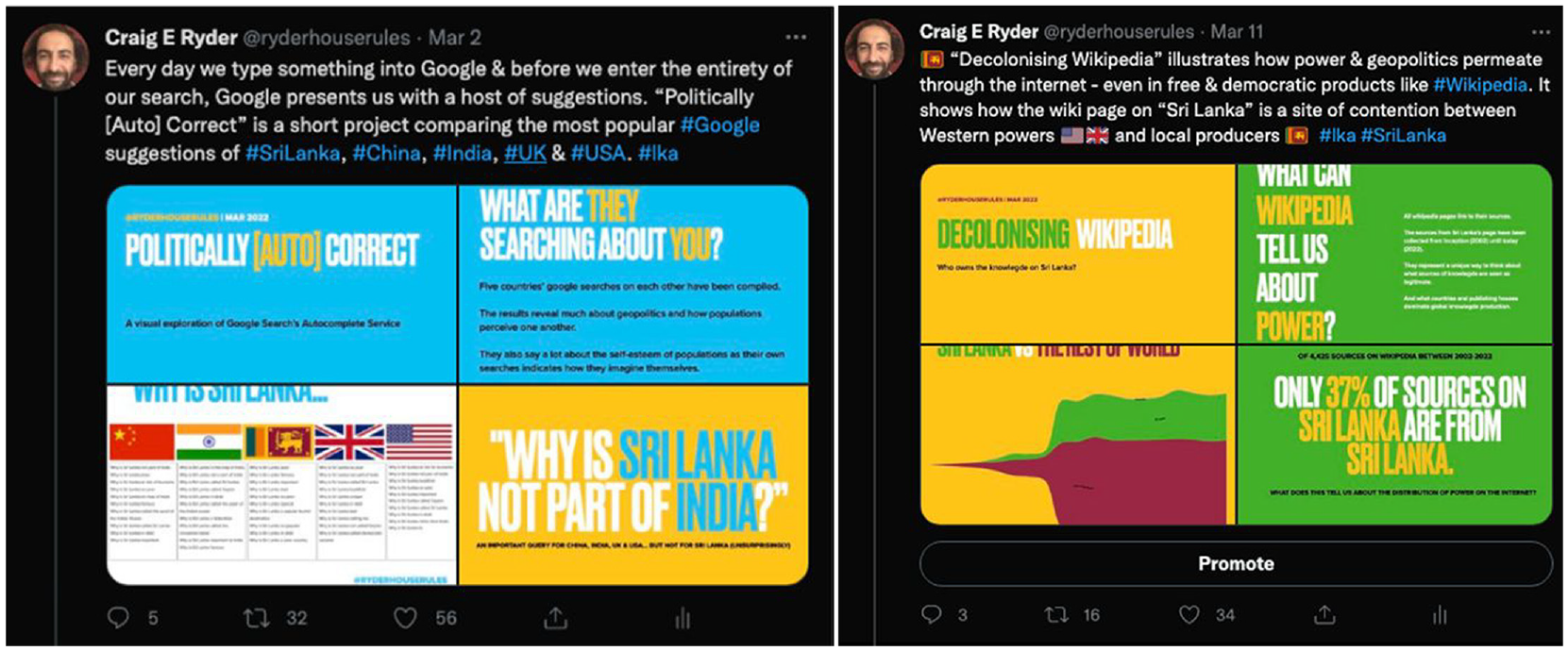
Politically [Auto] Correct (left) and Decolonising Wikipedia (right) were two examples of content made to increase the ethnographer's visibility in the Sri Lankan Twittersphere.
In terms of visibility and building myself as a brand, the data analytics that Twitter provided under each post showed that the Politically [Auto] Correct was a resounding success, generating 14,203 impressions, 1,396 engagements, 32 retweets and 56 likes. The Wikipedia piece was less popular receiving 6,910 impressions, 16 retweets and 34 likes, but it continued my exercise of building my brand on social media and ingratiating me into my research participants newsfeeds. In both cases, I generated followers and engagement with the kinds of people – journalists, bloggers, influencers and self-determined activists – who I was interested in connecting with for participant observation and ethnographic interviews. I felt pure joy when a journalist with over 100,000 followers retweeted my google search engine expose. Another activist who I admired commented ‘this is a pretty cool post’ and, once again, I was thrilled.
To complement my visibility labour, I ensured that my Twitter profile page represented accurate information about me, an affable profile picture and hyperlinks to my professional website where I had laid out my research objectives in clear terms (i.e. no academic jargon) so potential research participants could understand my research and provide their informed consent if they chose to participate. This was a long-winded but ultimately fulfilling ethnographic exercise in what anthropologists have called, ‘getting in’ (Leigh et al., 2021), where being present in the culture studied and gaining trust with potential participants is an essential rite of passage that good ethnography relies on.
In the longer term, what was so profoundly beneficial about conducting digital ethnography was that it forced me to confront the platforms and processes that the digital activists of my study were also facing. By grappling with the opacity of how the Twitter algorithm rewards certain user behaviours, and by trying to maximise my international visibility and acquire followers, I was experiencing and emulating the protocols and challenges that digital activists adopt for their political participation in the Sri Lankan Twittersphere. For example, when I came to interview an activist who I had met via twitter, she told me that she selectively uses the #lka hashtag because sometimes, ironically, she does not want her content to be seen by ‘everyone’. As a liberal Muslim woman critical of state oppression, there are times when she wants to avoid pro-government and Sinhala nationalists, so she opts not to use the #lka hashtag. Similarly, a female Sinhalese activist told me that she updates her profile pictures regularly, and especially when her engagement is low, as an image change is a sure-fire way to achieve a raft of likes and comments, thereby boosting her algorithmic visibility with the platform.
I am not suggesting that their confirmation of tactics to gain visibility enhanced my digital ethnography; rather I am reflecting that by sharing similar experiences of my participants, I developed a highly nuanced and empathic perspective for my future conversations with them. Now I understood from first-hand experience how struggling to achieve visibility and building the self as a brand were quintessential practices to achieve one’s social media goals. Moreover, months later when I was to finally arrive in Sri Lanka and start participant observation with digital activists, several my colleagues referenced the Politically Auto Correct content as something that caught their attention or ‘where they remember me from’.
Developing a datafied approach
Following the lift of pandemic restrictions across Europe, I arrived at the University of Helsinki in April 2022 and from there I watched on social media something extraordinary happening in Sri Lanka. The Aragalaya (or ‘the struggle’ in local language Sinhala) saw thousands of people take to the streets and protest for a country on the cusp of collapse. Lengthy daily powers cuts and a critical shortage in food, fuel and medicine bought Sri Lanka’s diverse ethnicities together culminating in a 4-month long occupation of Galle Face Green in downtown Colombo, the large public green space between the ocean and a glut of 5-star hotels and the prime minister’s official residency. The largely peaceful protests managed to the do the unthinkable and dislodge the ruling Rajapaksa big men from power. Prime Minister Mahinda Rajapaksa resigned in May 2022 and his brother and president Gotabaya Rajapaksa fled the country in the July and has since lived in exile.
I had come to Helsinki knowing that travel to Sri Lanka was unlikely and I was therefore continuing my mission of completing my research under pandemic restrictions. My objective was to learn basic computational coding and a technical process of extracting data from social media platforms such as Twitter, to then visualise the data sets and evaluate debates and social networks between highly influential operators. Surprisingly, the global media attention on the Aragalaya protests and the ousting of despotic leaders was insubstantial, but my Twitter feed, having had 6 months of interactions with local activists via digital ethnography, was alive to the minute-by-minute events as they unfolded on the ground in Sri Lanka. The first activist who had caught my attention with the Panama Papers’ discussion posted video content of protestors being water cannoned. Another activist shared photos of one devastating night when a small fraction of the protestors turned to violence and burned the (second) homes of 38 Sri Lankan MPs to the ground (Athas & Mogul, 2022).
The technical process I was to learn was to primarily extract data via the twitter API (Application Programming Interface) that acts as a technical meditator between the researcher and the social media system (Pariah et al., 2020). Having followed the Aragalaya protests on Twitter for several months, I compiled search queries made up of relevant hashtags relating to the protests on social media (e.g. #aragalaya; #srilankaprotests). These hashtags were instructively selected due to their specificity to the Sri Lankan protests of 2022 and informed by my months of engagement via digital ethnography. Searching arbitrary hashtags such as #srilanka or #protest would have not demarcated the site of inquiry accurately enough and the search queries would prompt the retrieval of large swathes of unrelated data, for example tweets from tourists about #srilanka or #protests happening in Hong Kong. For further specificity, the dataset was filtered down to a 4-month time-phase, from 21 March 2022 to 31 July 2022, to cover the period of active occupation of Galle Face Green in downtown Colombo.
The hashtag datasets were visualised using open-source software, Gephi, that relies on spatialisation techniques for visual network analysis (See Figure 2). In data visualisation technical jargon, users are called ‘nodes’ and interactions are known as ‘threads’. If nodes have interacted, they are connected by a thread (a thin line connecting them on the graph). A Force Atlas algorithm is applied to the graph charging all the nodes with a repulsive force and all the edges with an attractive force (Jacomy et al., 2014). What occurs is that the nodes that have many threads – or in other words, users that interact a lot together – are pulled closer together, thereby creating community clusters, and the users with fewer interactions are dispersed. Size variables are added to the nodes so the nodes with lots of threads (interactions) are enlarged on the network making the size of a node an instructive indicator of how influential a user is.
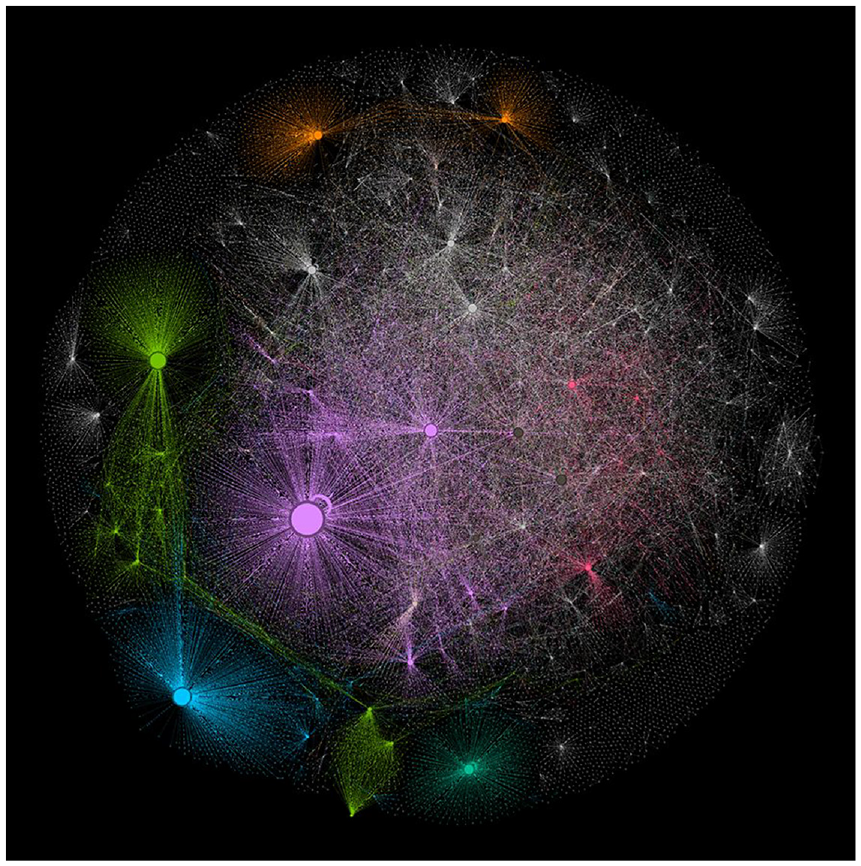
The #aragalaya hashtag extracted from the Twitter API and visualised using Gephi. Spatialisation techniques highlight and enlarge the most influential users, a procedure used to identify potential research participants.
In August 2022, as the Aragalaya dispersed following the installation of a new president and a deal signed with the IMF so the government coffers could purchase essential medicine, food and fuel, international travel was permitted once more to Sri Lanka and I made plans to arrive in October 2022. From an anthropological perspective, the limitation of VNA is how the methodology presents a snapshot of social media activity in a visually ambiguous way but claims ‘objective reality’ and therefore relies on big data’s ‘aura of truth’ (boyd & Crawford, 2012). Given the opacity of the dataset and the black box of the Force Atlas algorithm, I do not know if the visualisations are a fair representation of reality. To counteract this limitation of the graphs, I wanted to actively involve Sri Lankan digital activists who were identified by the visual network analysis and ask them to make sense of the visualisations and co-produce knowledge with me.
Co-producing knowledge of social media data visualisations with the people identified by the datafied approach is a methodological innovation installed and inspired by the restrictions of the pandemic. Previously, ethnographers have approached data from two distinct ways, either by engaging directly with data communities who are actively interacting with the data or by accidentally happening upon data in the field (Douglas-Jones et al., 2021), but the possibilities installed by the pandemic has presented a third way. Having had my hand forced into the learning a new technical procedure during the pandemic-proofing process of my research, I was equipped to access the data my participants produce when they interact on, and with, Twitter, and reproduce the data in visually appealing graphics. When I presented the data visualisations to my fieldwork participants for their inspection, it transpired that the digital activists in Sri Lanka had highly discursive perspectives on the data visualisations, propagating what data anthropologists have called ‘multiple data realities’ (Knox, 2021, p. 108). Participants identified by the data visualisations had conflicting opinions on truth, surveillance and danger, underpinning the manifold ways data is actively interpreted as something subjective, ambiguous and emergent, contributing to the dissolution of data as being somehow objective or neutral.
Staying digital with online based focus groups
One relatively fixed entity in my research process had been the platform Twitter, the main English-language platform where Sri Lankan activists posted dissent, news and opinion. Towards the end of October 2022, as I arrived in Colombo for traditional ethnographic fieldwork, another extraordinary occurrence transpired that would have dramatic consequences for my study. Elon Musk, the world’s richest man, controversially acquired twitter in a deal worth $ 44 billion (Conger & Hirsch, 2022). Unsurprisingly, amongst my research participants who were all avid social media users, Musk’s acquisition was a hotbed of debate. From a research perspective, I needed to understand how this upheaval of the social media landscape was going to affect my informants’ lives, the ethnographic ‘field site’ that I was actively participating in, and, how the wider public experiences, circulates and trusts information on Twitter.
Even without any COVID:19 restrictions in place, my research methodology of choice to understand the acquisition of Twitter was a video-based focus group. By the time I arrived in Sri Lanka, it had been one year seen I began my digital ethnography and my exercises in visibility labour. As such, I had quite a sustainable following on Twitter, mostly Sri Lankan, and felt my name and research was well-known enough that I could promote the focus group and obtain a solid group of participants. I proposed to collaborate with one of Sri Lanka’s foremost experts on social media, who was being very vocal on Twitter at the time, telling activists and any other sensitive groups, including journalists, women in public office and those in the LGTB community, to urgently check their Twitter privacy settings as the platform has been compromised due to the Musk’s sudden drive for profitability. The mass staff walkouts and sackings of entire departments that were normally dedicated to fighting disinformation, hate speech and providing ethical oversight was making Twitter an unsafe place for vulnerable groups. Together, we agreed that a video-based focus group on the popular video conferencing tool Zoom was the most democratic and accessible way to host an open conversation and to welcome the most people of interest into the ‘Zoom room’. We considered the constraints of Zoom, including the necessary requirement of a smart device with internet connectivity, and we judged that given our cohorts’ specific interest and high usage of digital communications, that they would have invested in personal mobile technology and data plans, and, therefore, could freely participate.
On reflection, I suspect that the ease at which we came to a decision to host an online video-based focus group, as opposed to an in-person one, was sanctioned by the previous restrictions installed by the pandemic. Seemingly overnight – but more accurately over the course of the past two or three years – some of the practicalities of how we can most accessibly and proactively do research have been digitalised. I am almost certain that had I been organising an ethnographic focus group in Sri Lanka in 2019 it would have been in a physical setting but given the standardisation of video conferencing into all manner of personal and professional activities, a Zoom-based focus group was not only feasible, but preferential.
That is not to say that video-based focus groups do not bring new and unpredictable challenges. I had framed the discussion as an open conversation with the social media expert; the two of us deciding in advance four salient questions that I would ask and for him to then discuss in the hope that together we could inspire a rich, informed conversation with the other guests. In the ‘zoom room’ were 10 to 20 individuals sprawling the intersection of activist interests in Sri Lanka, including a digital rights lawyer, a cybersecurity expert, a libertarian crypto enthusiast and a handful of recognisable social media activists who were becoming some of my closest research informants. One of the biggest challenges was that several attendees did not talk, some had their cameras off, and there were a handful who I never had any contact with before or after, so I could not gauge their personhood or political interest. Not only was this engagement not ethnographic at all, but I am also certain it would have been easier for me to communicate with all the guests if the focus group was in a physical setting. Another challenge was not knowing the exact number of guests on the video-based call at any one point because the attendance numbers were constantly in flux as some guests would suddenly arrive and others would ‘drop off’ unannounced, as I discovered is customary in video conference calls at scale in Sri Lanka.
Following Hautzinger (2012), above I have previously described how the limitations of focus groups can be offset when corroborated with other ethnographic methodologies. The clearest advantage of an online focus group is bringing together a large group of diverse participants together, regardless of location, and because there is no additional travel time and costs, there are fewer barriers to attendance. Another explicit advantage is how the online focus group provided a professional and public opportunity to promote my research interests and build rapport with various potential participants in one 60-minute sitting. From the one focus group, that was only indirectly related to my research objective, I was able to meet many participants who I had had limited contact with previously, thereby fast-tracking our relationship-building. With interested and interesting individuals, I followed up the focus group with casual in-person catch ups, that were much more ethnographic in spirit, to dig deeper into points of interest. The video-based online focus group was more efficient and accessible than its in-person counterpart because it is more inclusive, and when corroborated with traditional physical methods, proved to be a meaningful addition to the ethnographic toolkit. The underlying factors to the online focus group’s applicability and usefulness is how pandemic restrictions normalised a research method that scholarship would have deemed inferior before the transformations installed by the restrictions set in 2020.
Conclusion: Towards an augmented ethnography
I began this article by musing on popular quotes by historic thought-leaders and the possibilities to be found in moments of crisis, and my argument has gone to demonstrate that the crisis of the global COVID:19 pandemic provided improbable modalities to my research methodologies. The gap between the actual and possible was often difficult to envisage because what materialised into data science training in Helsinki, and video-based focus groups in Colombo, were literally thousands of miles and hours away from my starting point in London, and the worldwide-subscription to desk-based inertia in the first year of the pandemic.
Via this article I wanted to think through the quirks of my research methods and question whether, while clearly installed by pandemic restrictions, do they retain a specific pandemic-register, or are they legitimate research methods in their own right? The underlying hero of the three research possibilities that were actualised through the 18 months of extended fieldwork was digital technologies. Without the global proliferation of wireless internet connectivity and smartphone usage over the past 20 years, including to seemingly underdeveloped countries such as Sri Lanka, my research options would have been significantly fewer. Moreover, thanks to the pandemic standardising certain mediums and applications of digital technologies, such as Zoom-based video conferencing, the possibilities of how I could appropriately connect with participants in ways more democratic and accessible than previously imaginable was enhanced.
Following the new possibilities installed by COVID:19, my position is to argue towards an augmented approach to ethnography that encompasses a blend of digital ethnography, datafied approaches and IRL methods to the research design, regardless of whether pandemic restrictions are in play or not. I should acknowledge that due to my research area of interest being activism and social media, my research participants were digitally-savvy and lived what could be described as ‘digital-lives’. However, I would suggest that following the past 20 years of technological proliferation and the global pandemic, that most human beings live a digitally ‘augmented’ life, at once in the realm of the IRL and what is around us, whilst simultaneously also involved and participating in online spaces and experiences mediated by digital technologies. Like my research participants in Sri Lanka, who I discovered would use their smartphones for over 10 hours a day, and some who would check and therefore be partly submerged in their preferred social media platform every 10 to 15 minutes, my fingers, ears and eyes, while in London, Helsinki or Colombo, were also partly immersed in digital worlds, and it was this augmentation that enabled the long-term ethnographic engagement that my research demanded.
In a working paper published on 31st January 2020, therefore days before the world was plunged into a global pandemic, scholar Matti Pohjonen speculated on what an augmented ethnography might look like. He wrote: computational methods were not used to test statistical models or hypotheses as is commonly done in computational analyses. Rather, they were used heuristically to augment the digital ethnographic exploration of the research. The use of computational models and large-scale datasets thus served as a kind of an external research prosthesis, a magnifying lens, to help the research identify new problem areas and new questions of interest that qualitative engagement did not allow on its own (Pohjonen, 2020, p. 14)
I suggest in a post-pandemic, digitally-mediated world, using big data heuristically to augment the digital ethnographic exploration could become a given rather than an exception. To achieve my research goals, I approached my ever-evolving field site in what I call a ‘post-digital condition’; one that takes the mediating of everyday life by digital technologies as a certainty. Where my research advances the initial idea of an augmented ethnography is that rather than a datafied approach acting strictly as a kind of an external research prosthesis or a magnifying lens, the data and the digital methods of my research are in continuous dialogue with analog or real-world methodologies and relationships. Inspired by Glăveanu’s amphibious’ metaphor of the how humans live at the intersection of the real and the possible, the augmentation promised by digital technologies provides a new frontier between what is the real, and what is possible, in ethnographic research.
