



Abstract
In creative domains such as art, design and science, the generation of novel possibilities is highly desirable. However, most human activity takes place outside of domains where the generation of novel possibilities is prescriptively optimal, and indeed to do so may be undesirable. In this paper, evidence for the paucity of possibility generation will be described, even in instances where generation of multiple possibilities might be desirable. Conversely, the value of focussing on currently explored rather than novel possibilities is demonstrated with reference to a computational model of insight problem-solving. It is suggested that, in domains where generation of creative possibilities is a task requirement, strategies acquired though domain expertise are needed to push thinking into new possibility spaces. These strategies are illustrated by case studies and data from domains of insurance fraud and police investigations, educational task design and puzzle solving.
Many years ago, I was supervising a study on the cognitive psychology of planning at a UK university summer school. The task faced by participants, all visitors to the campus, was to ‘locate the IT help desk’ somewhere on the University campus, without using a map, telephone, computer or by asking anyone. Only one person out of 50 solved the task before giving up, by walking in ever-expanding circles around a central starting point. All the others failed, and for essentially the same reason: they looked where they already knew. They looked in their hall of residence where they slept, in the refectory where they had their meals, in the theatres where they had their lectures, on the path between the train station and the University reception, and so on.
Many theoretical explanations for this failure to generate exploratory possibilities present themselves. It might be the operation of heuristics like representativeness and availability (Kahneman & Tversky, 1972). It might be the application of a pseudo-optimal cognitive foraging strategy (e.g. Addicott et al., 2015). Or perhaps it is the result of a form of bounded rationality, trying to limit the search space to the most likely places (Newell & Simon, 1972). Whatever the explanation, I contend that the generation and exploration of possibilities is much rarer than one might expect. It holds a strong presence in studies of human thought and activity because of its prescriptive optimality in domains that require novelty and invention, not because of its descriptive reality in everyday thought. It shares this inflated status in studies of human thought alongside topics such as analogy, planning, and logical thought. All these topics have, at some point in the past 50 years, been considered as fundamental aspects of human thinking, and central to effective ideation and decision-making, yet the evidence that people routinely engage in them is much more limited that one might expect. Unless a researcher tells their participants explicitly to analogise, plan or think logically, participants rarely engage spontaneously and/or successfully in doing so. They don’t, because each of these processes is cognitively challenging, error prone and often unnecessary. The same holds for the generation of multiple new possibilities.
In principle, the space of possibilities that an individual might access is unlimited and unguided. Yet somehow people can restrict the generation of ideas to a set that is relatively small but relevant to the task at hand. How is it possible to restrict your thinking of things that you haven’t thought of before to those that are relevant without knowing whether they are novel or useful? By analogy, retrieval from memory suffers the same problem. George Mandler (e.g. Mandler & Boeck, 1974) argues that the concept of ‘searching’ one’s memory makes no sense: If you don’t know what an item you are looking for in your memory is, how do you know when you have found it, but at the same time, if you know what it is, you don’t need to search for it. The same problem besets the idea of generating relevant possibilities. This is the essence of the frame problem in philosophy and artificial intelligence (Dennett, 2006; Hayes, 1981), that is, how the mind determines from potentially infinite quantities and types of information what is relevant and irrelevant.
In recent work, we (Ormerod et al., 2023) have proposed a computational model that solves the frame problem in the case of generating possibilities to solve insight problems. Our proposal is that, rather than seeking new possibilities that the solver has not yet considered (e.g. by retrieving items from memory or by scanning the external task environment for stimuli to trigger new thinking), the solver inspects the properties of the possibilities they have already generated and that have failed to solve so far. We describe this model and its application to solving a classic insight problem, the nine-dot problem (Maier, 1930), in the first third of the paper.
In the next third of this paper, I shall argue with empirical illustration that, most of the time, most peoples’ thinking about possibilities is limited; dull even – sensibly, intelligently dull. At times this is beneficial, as outlined in the first third, but at other times with a more complex set of circumstances, the limit on possibility generation is less useful. In the final third, I examine how it is that, despite the restricted nature of possibility generation in everyday thinking, both sensibly and not so sensibly, people are, when circumstances require it, able to come up with novel, innovative and useful possibilities that they, and maybe others, have not conceived of before. I suggest that the generation of creative possibilities is mediated by strategic knowledge, that is, knowledge about when, where, and how to seek new ideas. This strategic knowledge is a feature of expertise acquired through experience in, and reward for, exceptional performance in a domain of application.
The value of exploring the known before the unknown
Expanding the possibility space is generally considered to be a positive. Glăveanu (2023, p. 1) writes ‘Possibility Studies invites us to consider how people, cultures and nature are transformed by becoming aware of, engaged with and active within an expanded field of psychological, social, economic, political, material, technological and artistic possibilities’. and Ross (2023a) shows how across all the contributions, the benefits of possibility are unquestioned. The first part of this paper makes the counter argument: Limiting the space of possibilities to a fraction of those available usually makes sense. This fits in with the framework of cognitive psychology. As Newell and Simon (1972) state:
“The problem difficulty lies in answering the ill-defined question: “What can I do that I haven’t tried?” This question is likely to be answered successfully only if the problem solver has an appropriate set of generators and selective heuristics for obtaining a few possibilities in a larger space” (1972, p. 440).
They emphasise the importance of generating only a
There is another, more encouraging, reason in addition to cognitive load as to why people do not frequently generate truly creative possibilities: completely new ideas are less likely to contain information of relevance to the thinker’s current goal. There’s a reason I limit my breakfast imaginings to the routine and familiar: I know that these items contain within them information that will be relevant to my current goal. If I start my search for breakfast by opening an unlimited space of new ideas that includes alligators and cardboard, there is little guarantee that I will generate possibilities that meet my current needs.
The problems of cognitive load and information framing suggest that ‘leaps into the unknown’ in the generation of possibilities might be problematic, if achievable at all. If opening new spaces to explore for possibilities is risky, how do people find new ideas? One concept we have explored in studies of insight problem-solving is that individuals use the properties of their failed attempts to discover new ideas (Ormerod et al., 2023, under review). Consider the nine-dot problem (Maier, 1930; Figure 1), in which the task is to draw four straight lines such that each of nine dots arranged in a 3 × 3 grid is cancelled by a line, without removing one’s pen from the page while drawing the solution. The problem is a classic in insight research, and allegedly gave rise to the expression ‘Think outside the box’, since solutions require drawing lines outside the boundary implied by the square box of dots. Figure 1b shows a solution to this problem. Typically, solution rates are below 5%, and although many participants do generate solution ideas that include lines that go beyond the implied square boundary, they generally revert to drawing lines within the square. For both humans and computers, the solution requires generating a new possibility: moving lines outside the implied boundary. The way this cognitive shift happens is what is of interest here.
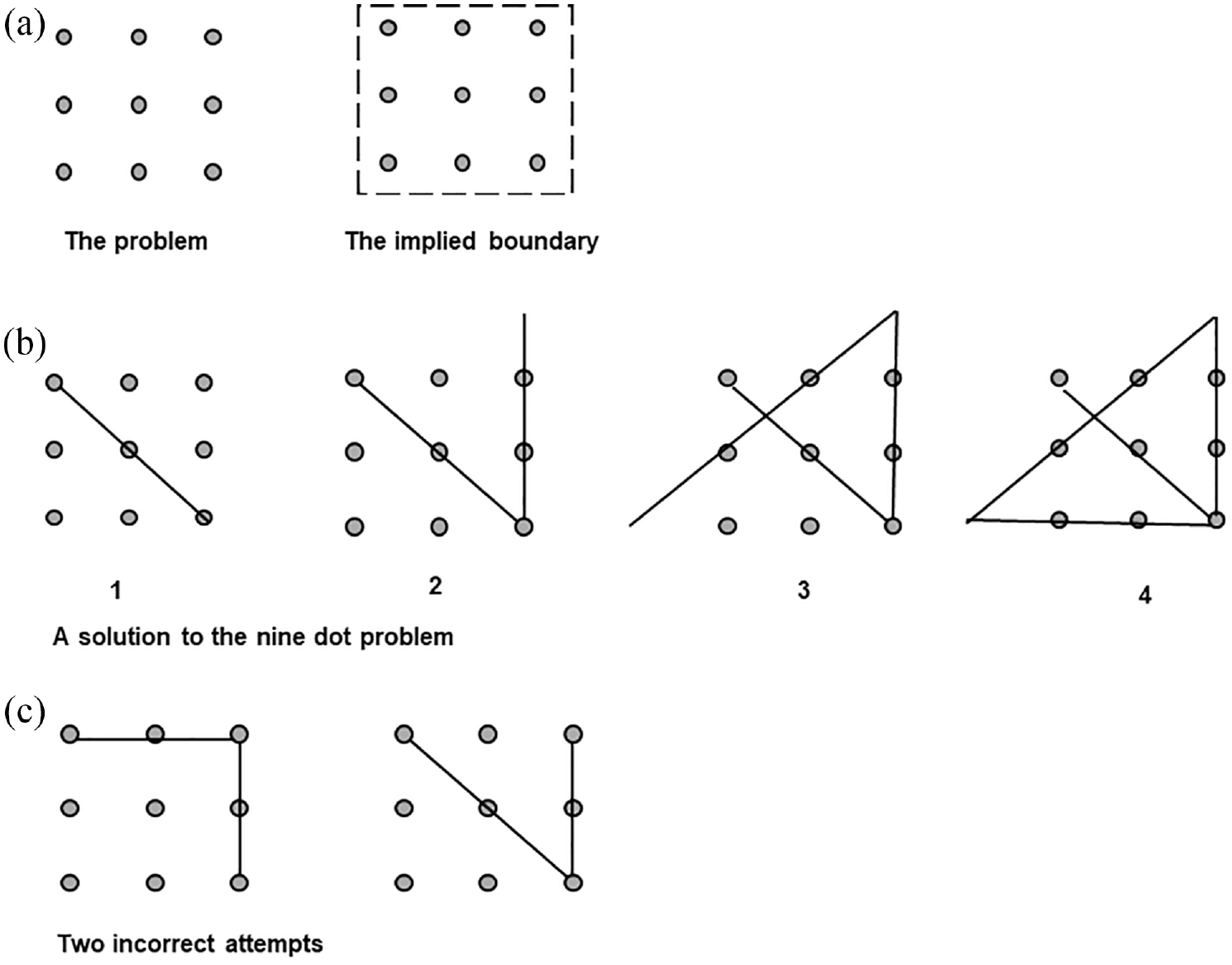
(a) The nine dot problem and the implied boundary, (b) the solution to the nine dot problem, and (c) two incorrect answers differing in length and direction.
We have developed a theory and computational model to explain and predict performance on variants of the nine-dot problem, which we call PRODIGI (PROgress and Discovery In Generating Insights). The model, implemented in the computational modelling environment ACT-R (Anderson, 2014), attempts to solve variants of the problem using two mechanisms. The first is a progress-monitoring heuristic. This operates to select moves according to a criterion of satisfactory progress. At the outset, there are nine dots to be cancelled by four lines, so each attempt must cancel at least two dots. Thus, possibilities are considered or rejected based on the progress they make towards a hypothesised solution.
The second is an idea discovery process. When the model runs out of move attempts that meet the criterion for satisfactory progress it reaches impasse, when it can find no new possible attempts. At this point the model does not know about the existence of space outside the dot array; it only knows the relative positions of the nine dots, so to solve it needs to discover new possibilities. To do so, it revisits failed attempts (i.e. moves that were sampled that failed to yield a solution) and examines how attempts differ to identify properties that can be used to construct new moves. Figure 1c shows two solution attempts, each of two lines, each cancelling five dots, neither part of the correct solution. They have a lot in common, but also differ according to three properties: line length, angle between lines, and line trajectory. PRODIGI contains a library of basic properties that would be available to a visual perceptual system, so it can map the properties of move attempts onto properties stored in this library. When it finds a property that differs across two moves, it iterates through two processes; move replacement, where for example it might replace the shorter line that goes between dots 3 and 9 in the left-hand attempt of Figure 1c with the longer line that goes between dots 1 and 9 in the right-hand attempt. This won’t solve, and nor will any line substitutions at this point. So, it tries a second process of line combination. Again, it doesn’t work initially, but in iterating through combinations of enough previous attempts it will eventually discover a line length that provides a line that is exactly the right length to allow discovery of a line that cancels two more dots, thereby meeting the criterion and allowing moves to progress.
The model provides a reasonable fit to human performance on the nine-dot problem, yielding a solution rate of around 3.5%. It also solves 10, 11, 12 and 13 dot variants at the same level that humans solve them (e.g. MacGregor et al., 2001). A surprising prediction that arises from the model is that it is less likely to solve if it is told to start from a fixed point, the top left dot. We had assumed that fixing the starting point would reduce the search space and therefore increase the speed with which the model would find solutions, in other words, reducing the number of possibilities that must be sampled before a correct solution path is found. It turned out, in subsequent explorations of adult participant performance with a fixed starting point, that human solution rates decreased to almost zero. Our explanation is that PRODIGI needs to experience all the failed attempts that humans dismiss without implementing because they fail to meet the criterion for satisfactory progress (e.g. drawing a first line from the centre dot to any of the other dots). In essence, PRODIGI learns from its heroic failures, building up a knowledge of properties that might inspire new move attempts constructed from differences between failed attempts.
We have also applied the same model to the Cards problem (Cunningham & MacGregor, 2008), an analogue of Mendeleev’s development of the periodic table of chemical elements. The problem is to arrange the four Kings, Queens, Jacks and 10s from an ordinary pack of playing cards on a grid such that each suit appears only once in each row and each column. The solution requires gaps to be left between cards. This is the same insight that Mendeleev reached when discovering how to arrange known elements according to their chemical properties, which was to leave gaps for as-yet undiscovered elements (Akin & Akin, 1998). PRODIGI solves the Cards problem by initially failing to solve, because at first it does not have the concept of space between cards. It acquires the concept by comparing card layouts from its failed attempts and noticing that cards can be placed diagonally in a way that creates horizontal and vertical separations between cards.
We believe PRODIGI to be the first computational model that can solve an insight puzzle without being given any information at the outset about the solution. There have been proposals for other computational frameworks for solving insight puzzles (e.g. Hélie & Sun, 2010; Öllinger et al., 2014), but these operate by providing solutions, partial solutions, or solution cues from the outset. In essence, PRODIGI discovers its own relevant possibilities, where other approaches provide a set of possibilities from which the correct ones must be discriminated. We don’t think this latter is how creative thought works. PRODIGI solves the frame problem by limiting its search for new possibilities to picking over the detritus of its previous attempts. It does not immediately set out to explore new territory, either within a long-term memory or in the outside world, because it has no indication that it will find relevant possibilities out there.
So far, we have limited our modelling attempts to puzzles that are knowledge-lean, that is, puzzles that can in principle be solved without addition of knowledge or resources from beyond the problem statement. We recognise this represents a very limited set of creative thinking domains, and that people do come up with possibilities from memory and from exploring their environment. Nonetheless, we suggest that the way in which they control the exploration of possibilities in memory and in the environment is likely to be governed by similar principles that link idea discovery to the existing products of their own failed thoughts.
The limited nature of possibility generation
The previous section indicates the cognitive benefits of the failure to generate new possibilities when doing so might be of value. However, when we move outside the psychologist’s laboratory, situations are more complex and the generation or not of possibilities can have different consequences. What is clear from empirical evidence I have collected, is that beneficial or not, the generation of possibilities is rare (see also Ross, 2023b).
In 2007, Madeline McCann, a 3-year old child was abducted from a hotel suite by unknown assailants while her parents were apparently enjoying a meal in a nearby restaurant. The case attracted huge media interest, and sadly Madeline has never been found. At one point in the investigation, the Portuguese police made Madeline’s parents suspects, in part based on the following piece of evidence: 25 days after Madeline’s disappearance, the parents hired a minivan in the town of Praia da Luz. The police subsequently reported finding DNA evidence of Madeline in the back of the minivan. and drew the conclusion that this was evidence that implicated the parents in Madeline’s disappearance. The assumption was that this DNA evidence came from Madeline’s body, which had been transported in the minivan by her parents who were disposing of her body to hide her death at their hands.
The inference of parents’ involvement that was apparently drawn by the Police is only one of four possibilities that might be generated to explain the evidence. A second possibility is that the DNA evidence was invalid, either because it was not from Madeline or because it had been transported from things belonging to Madeline and had not come from her body being in the van. If this was the case, then one possibility that follows is that the McCanns were not involved in Madeline’s disappearance. There is another possibility consistent with invalid DNA evidence: The McCanns might still be implicated in her disappearance, but the minivan was irrelevant to events. A fourth possibility might also be discovered: the DNA did indeed come directly from Madeline’s body, but the McCanns were not implicated in her disappearance. The validity of this possibility requires consideration of the fact that Praia da Luz is a small town with few minivans available to hire. It is conceivable that the McCanns hired the same vehicle used previously by the real perpetrator of the crime who had used the vehicle to transport Madeline (see Figure 2).
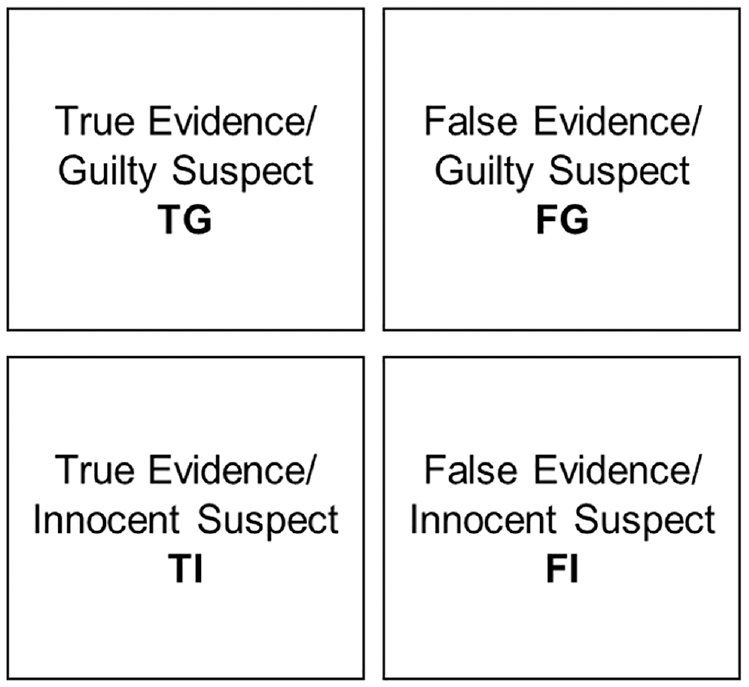
An exhaustive set of general hypotheses to explain a piece of evidence.
It is generally assumed in police investigations that it is optimal to generate all possible explanations for a piece of evidence, but it is also known that police decision-making is frequently characterised by a failure to do so and instead to focus on a specific hypothesis at the expense of others. This is generally described as a confirmation bias (e.g. Ask & Granhag, 2005), in which investigators collect evidence in support of their current hypothesis and fail to consider alternative explanations or collect evidence that might falsify the current explanation.
To be prescriptively optimal, investigators ought, for any piece of evidence, to generate exemplars of at least four possibility types: the evidence is valid so the suspects are implicated (true evidence/guilty suspect, or TG as in Figure 2 above), the evidence is invalid so the suspects are exonerated (false evidence/innocent suspect, or FI), the evidence is invalid but the suspects are nonetheless implicated (FG), and the evidence is valid but the suspects are nonetheless exonerated (TI). To explore whether this confirmation bias was present in cases such as Madeline McCann described above, my PhD student Alex Sandham (Sandham, 2012) conducted a series of experimental studies of hypothesis generation across a range of familiar and unfamiliar investigative cases; murders/abductions (e.g. the McCann case), bombings (e.g. the Manchester Arena bombing) and accidents (e.g. Princess Diana’s death) that were either covered extensively in the news or were invented by the researcher. She compared members of the public with experienced police officers as to the extent to which they were able to generate all the possibilities that might arise given a piece of evidence for each scenario.
Figure 3 shows the number of possible explanations for a given piece of evidence generated in Sandham’s studies by members of the public and by police officers. The familiarity of the case (e.g. Madeline McCann vs. a fictional murder) made little difference to the number of possibilities generated of each type, except for a slight decrease in possibilities consistent with the evidence being false for familiar cases, so familiarity data are not shown here. What stands out is that the possibilities generated were invariably incomplete. Few participants generated all four possibilities compatible with the evidence. Almost all generated a TG possibility (i.e. that the evidence is true, and the suspect is guilty) irrespective of the nature of the case. Participants of both types generated the TI possibility (i.e. the evidence is true, but the suspect is innocent) for murder/abduction cases but not for bombings and accidents. Participants of both types were least likely to generate the FG possibility (that the evidence was false, but the suspect was nonetheless guilty). This result is particularly surprising with the police sample, for whom building a case against a suspect typically requires consideration of multiple sources of evidence for guilt. Indeed, police officers were less likely that members of the public to generate FG and FI cases, perhaps evidence of a professional bias to assume the truth of presented evidence. Also notable is the variability in possibilities generated according to case: for murders/abductions, participants generated possibilities consistent with the truth of the evidence but not its falsity. For bombing and accident cases, participants showed more attention to possibilities in which the evidence was deemed false.
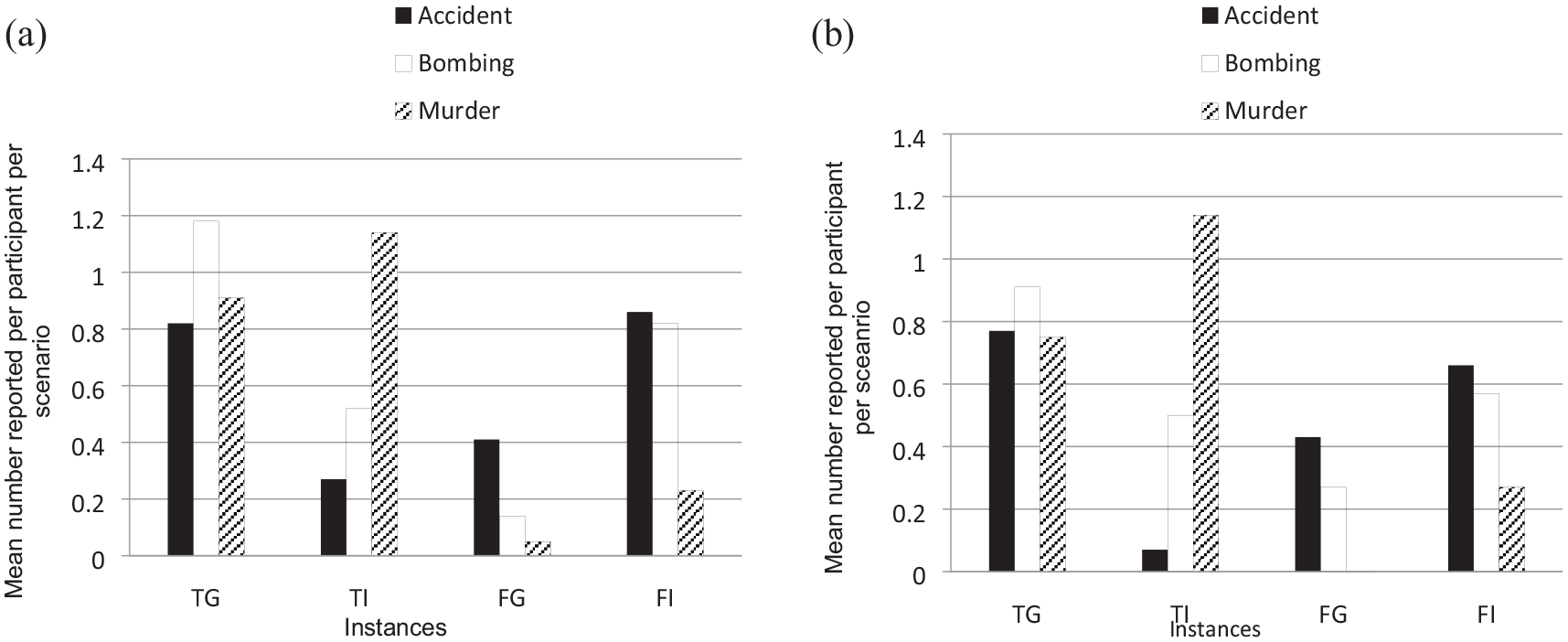
Mean number of possibilities generated by (a) members of the public and (b) experienced police officers for accident, bombing and murder events (from Sandham, 2012).
The takeaway message of Sandham’s studies is that people do not generate all available possibilities even when, as is the case with police investigators, it is both within their abilities and available knowledge, prescriptively optimal and sometimes part of their training to do so. Why might this be the case? Sandham’s explanation follows the mental models theory of Johnson-Laird (1983), in which the likelihood of drawing possibilities to mind is a function of the ease with which a model of the events they describe can be constructed in the mind. The TG possibility is generated by almost everybody because it is accessible from the statement of the case and requires no inferential thought. The FI possibility should be generated, according to mental models theory, simply as a negation of the TG case, but will not be done by everyone because it requires an inference (or ‘fleshing out’ of an alternative model, in Johnson-Laird’s jargon). In Sandham’s data, the generation of the FI possibility is affected by case type, suggesting that this possibility is not accessed simply by inference but is affected by belief in the idea that evidence in a case might be false or invalid.
The TI and FG cases should, according to mental models theory, be the least likely to be generated because they involve a search for possibilities that deny the truth of one of the bits of information assumed in the initial TG possibility. Again though, the variability across cases suggests that the search for these cases is affected by more than simply availability of the instances that come to mind. In some cases, a possibility has more value than in others. For example, the possibility of an innocent person being framed by strong evidence is of greater concern in a murder than it is in an accident or a bombing. The lack of TI possibilities is concerning, particularly for police officers, because it is one of the more useful possibilities, a lead that might open new channels of investigation.
Going beyond the known in seeking possibilities
Any artist or designer who reads this paper may by now have given up in frustration, since the account I have offered so far of the generation of possibilities does not appear to leave space for the leaps of special creative genius that characterise their lived experience (e.g. Barzun, 1989; Sternberg, 1996; but see Ross & Vallee-Tourangeau, 2018; Weisberg, 2006 for more prosaic accounts of creative expertise). My contention is that generating creative or novel possibilities is a relatively rare activity, and one that is triggered by requirements of the domain. Engineers, scientists, critical decision-makers, and of course artists and poets, mostly do not need to generate creative possibilities. But sometimes they do. So, if most thinking is routine and governed by general mechanisms such as progress monitoring, memory retrieval and reuse of failed attempts, how can these leaps of creative genius arise? I suggest that they are mediated strategically by experience within a domain; domain experts know how and when to perturb the search space in ways that create opportunities for the discovery of new possibilities.
Consider, again, the domain of investigation. In one study (Ormerod et al., 2012), we explored how experienced fraud managers investigate potentially suspicious insurance claims. The account of expertise we offered for this domain highlighted two aspects of strategic control of possibility generation that characterise fraud investigation expertise. The first we described as procedural decision-making, which comprised decisions about when and how to open new lines of enquiry. Typically, procedural decisions were characterised by attempts to limit the space of possibilities that might be explored, such as in the following quote from a field note of a conversation between an experienced fraud investigator and a less-experienced telephone call handler to whom a claim is reported:
Call handler: do you reckon it’s worth looking at the wife’s previous claim as well, he says its straight up but, I don’t know, I mean…
Investigator: Unless it’s got similar, things, in terms of, I mean, just to prove that the wife has a previous claim doesn’t prove that this claim is fraudulent (from Ormerod et al., 2012, p. 374).
Here, the experienced investigator is delaying the search for additional data, keeping the search space as small as possible and expanding it only when they have a specific reason to do so. Opening a space of new possibilities as suggested by the call handler is not seen as pragmatically valuable. Thus, we see evidence for the strategic control to limit the space of possibilities.
The second kind of strategic control we observed has precisely the opposite effect, which is to generate creative possibilities. In the following fieldnote quote, an experienced investigator is telling a colleague about a case he is working on. He has been handed a case of a claim for a vehicle that has allegedly been stolen in Spain. The case has been raised because of an anomaly in which the UK registration for the vehicle was originally for a commercial van but the claim is for a family car:
“So his friend takes the vehicle out to Spain, that may be subject to hire purchase. Gets it out there doesn’t want to take it back, throws it in as a debt, and then our man may well have found out its true pedigree and thinks how am I going to get out of this one it’s subject to hire purchase” (from Ormerod et al., 2012, p. 376)
What the investigator has done is to create a narrative story, that is, a plausible account that might explain why a vehicle originally registered in the UK has been stolen in Spain. None of the information about the vehicle changing ownership through paying off a debt or being subject to a previous hire purchase agreement is contained within the case file: it is a scenario imagined by the investigator as a possible scenario in which the anomalous event may have arisen, whose construction reflects his experience of similar cases. The use of narratives such as this pervades the field notes and is particularly associated with cases where there is minimal evidence in the case file, as in the current example. Narrative construction serves to open new possibility spaces that can be pursued in understanding complex cases. Thus, we see evidence for the strategic control to broaden the space of possibilities when few are available in the immediate environment.
Another example of the strategic control of expertise comes from a study of decision logs, records that senior investigating officers (SIOs – police leads on major crime) are required to keep during major crime investigations (Dando & Ormerod, 2017). We examined 80 decision logs and counted the number of times and the quartile within the decision log (e.g. first 25% of logs is the first quartile, representing the early case exploration) in which officers recorded hypotheses or explored evidence associated with them, and compared these measures across experienced (5 years + leading investigations) and less experienced (less than 3 years) officers. While the modal number of hypotheses generated or pursued in each quartile was 1, experienced SIOs generated on average 2.84 hypotheses in the first quartile compared to an average of 1.38 for less experienced officers. Also, experienced officers collected evidence that compared multiple hypotheses at the same time, whereas inexperienced officers tended to collect evidence that tested a single hypothesis, the latter showing confirmation bias in their exploration of possibilities.
We see effects of expertise on the generation of creative possibilities in other domains. For example, Ormerod et al. (1999) examined the process of creating new educational tasks for teaching Mathematics and English as a Second Language to high school students. In one study, we collected sets of mathematics examination tasks, and gave them groups of experienced maths teachers and to professional maths task designers (typically remarkably wealthy textbook authors with many years of teaching experience followed by extensive experience in designing and selling tasks). We asked our participants to sort the tasks according to any dimensions that were most meaningful to their expertise.
Usually in studies of expertise, the most experienced experts sort items according to their conceptual features and underlying abstract structures whereas less experienced people sort according to superficial characteristics. In our study, the opposite occurred: teachers sorted according to deep mathematical concepts inherent in the tasks, while designers sorted according to superficial characteristics (e.g. ‘these tasks use transportation like boats and cars as content’). The study indicates how expertise mediates the space of possibilities that people consider in undertaking creative thinking tasks. Teachers need to focus on the pedagogic possibilities accessed by the conceptual structures in educational task, while designers need to differentiate their tasks from those of others, provide ‘interest and imagination’, and protect their copyright. In this sense, the generation of creative possibilities is both driven and constrained by goal-directed thinking.
Conclusions
Returning once more to puzzles, I want to describe a final study that pulls the themes of avoiding possibilities, learning from failed possibilities, and seeking new ideas through strategic expertise together. Ormerod and Gross (2023) examined how experienced designers (architects, product designers, etc.) and financiers (bankers, investment managers, etc.), all with over 20 years of experience in their respective domains, fared in solving visual insight problems like the nine-dot problem compared with verbal insight problems like the 54BC coin problem (‘A dealer is offered a rare coin by a customer. On one side it has a Roman emperors head, on the other side the date 54BC. The dealer has bought from the customer before, but this time she calls the police. Why?’). We gave our groups five of each puzzle type and looked at how many they solved and how they went about solving them.
Our results showed that, while there was no difference between the designers and the financiers in solving verbal problems, designers solved more visual problems than financiers. This result is uninteresting: people experienced in visual problem solving are better at solving visual problems than less experienced visual problem-solvers. What was interesting was, first, that designers made the same early attempts as financiers and entered a state of impasse (when they paused having run out of possibilities to try), suggesting that the advantage for designers was not that they had more rapid access to solution-relevant possibilities than financiers. Second, once they had reached a state of impasse, designers started doing different things to financiers. Financiers typically sat there and thought a bit, repeated earlier attempts, or gave up. Designers, in contrast, started undertaking physical activities, such as moving, reorienting or even tearing the problem sheet, drawing lines, squiggles, and other shapes over the problems, waving their hands around, moving their bodies, etc. By undertaking these actions, they perturbed the space of available possibilities, and in many cases were able to discover new ideas that led to solution.
The theme of limited possibility generation is captured in the similarity of initial attempts of our two groups. Designers possess very different knowledge and skills from financiers, yet both groups initially did the same thing: they used the initial representation of the problems to proscribe the space of possibilities that they searched, delaying the invocation of any specialist knowledge they possessed. When they got stuck, the designers invoked a range of behaviours that reflected re-evaluations of the failed attempts so far (e.g. tearing the paper on which nine-dot problem attempts were drawn to separate the lines into individual objects). When they allowed a search for new possibilities, they played physically with the objects and spaces they had created, using their expert knowledge of visualisation and spatial reasoning to come up with novel ideas that were relevant to the task at hand.
This, I contend, is the essence of creative possibility generation: you initially try stuff that is suggested by the descriptions of your goal that you are presented with. When you fail to make sufficient progress, you look at the nature of your failures, and rearrange them into concepts that might allow new ideas. Then you take these concepts and seek new possibilities that link to the things you have already tried. This is a naïve theory of creativity, and deliberately so: You try things, if they seem to work you keep trying. If you don’t, you look at them, see what the properties are, and then seek new possibilities that embody these properties. There is less genius and more grunt work, clever grunt work, that lies behind the generation and implementation of clever possibility thinking than one might have imagined. Not that one would imagine, if one wasn’t guided there by one’s failures.
Footnotes
Declaration of conflicting interests
The author declared no potential conflicts of interest with respect to the research, authorship, and/or publication of this article.
Funding
The author received no financial support for the research, authorship, and/or publication of this article.