



Abstract
Humans tend to automatically imitate others. This tendency is generally explained by a common representation of observed and executed actions. However, people do not imitate each and any behavior they observe. Instead, they have different possibilities in terms of when, what, and whom they imitate. Here, we review the literature on the various factors that modulate imitative behavior to get an overview of these possibilities. While the reviewed literature supports the idea of possibilities in terms of how people imitate, this overview also emphasizes that the evidence for most factors has been rather mixed or preliminary. This calls for more replication studies, both conceptual and direct, before firm conclusions can be made for each modulating factor.
Humans automatically imitate others (Heyes, 2011). That is, people tend to replicate the postures (LaFrance, 1982), mannerisms (Chartrand & Bargh, 1999), gestures (Cracco, Genschow, et al., 2018), speech-related characteristics (Neumann & Strack, 2000), and more, of their interaction partner. Reminiscent of the expression “imitation is the highest form of flattery,” such imitation has been shown to function as a social glue (Kavanagh & Winkielman, 2016) as it increases liking for each other (e.g. Chartrand & Bargh, 1999; Kulesza et al., 2022; Sparenberg et al., 2012), pro-social behaviors (e.g. Van Baaren et al., 2004), as well as feelings of affiliation (Lakin & Chartrand, 2003) and closeness (Stel & Vonk, 2010)—to name a few examples.
This automatic tendency to imitate others is typically explained by a shared representation of observed and executed action (e.g. Chartrand & Bargh, 1999; Chartrand et al., 2005; Greenwald, 1970; Jeannerod et al., 1995; Prinz, 1990, 1997). For example, the perception–behavior link (e.g. Chartrand & Bargh, 1999; Chartrand et al., 2005) puts forward that observing an action leads to a similar mental representation as when executing the action. The shared representation between observing and executing an action, in turn, increases the likelihood that the observation results in the execution of the same action. Likewise, ideomotor theory (e.g. Greenwald, 1970; Jeannerod et al., 1995; Prinz, 1990, 1997) argues that the visual representation of an action is an integral part of its motor representation. As a result, the observation of an action primes its execution. Over the past decades, the prediction that merely observing an action evokes similar motor plans as when executing the action has been verified in several studies such as behavioral experiments (e.g. Brass et al., 2000, 2001), fMRI investigations (e.g. Gazzola & Keysers, 2009), motor TMS experiments (e.g. Fadiga et al., 1995), and single-cell recordings (Mukamel et al., 2010).
While the above-reviewed literature suggests that humans automatically and directly imitate each and any behavior they observe, other research suggests that people do not imitate in each context every action and person in the same manner. That is, imitative behavior is much more flexible than originally assumed, indicating that when interacting with others, individuals have different possibilities in terms of how they imitate. The set of possibilities depends upon situational factors (Baumeister & Alquist, 2023), as we will discuss in the remainder of this article. This exploration of how possibilities shape behavior aligns with recent research that investigates the ways in which people have multiple paths to deal with events in the present, future, and past (Glăveanu, 2023). In the subsequent sections, we first give a short overview of how imitative behavior is measured. Afterward, we review the possibilities in terms of when, what, and how individuals imitate others. At the end, we review different theoretical accounts that may explain the findings covered, and then critically reflect on the reviewed research in the discussion.
Measuring imitative behavior
Imitative behavior is mainly measured using behavioral mimicry and automatic imitation tasks. Behavioral mimicry is most often studied within the social psychology field by means of action-observation paradigms (e.g. Chartrand & Bargh, 1999). In such paradigms, researchers videotape interactions between a participant and a confederate to determine whether the participant mimics the behaviors of the confederate (Lakin et al., 2008; Stel, Blascovich, et al., 2010; Stel, Van Baaren, et al., 2010; Van Baaren et al., 2003). Alternatively, researchers videotape participants watching a video of a confederate (e.g. Genschow & Brass, 2015; Genschow et al., 2017; Lakin & Chartrand, 2003; Yabar et al., 2006). The confederate, depending on the condition, engages in one of two target actions, such as touching their nose or their hair. After data collection, coders observe the videos made during the test session to count the number of times the participants mimicked the confederate’s behaviors. The typical finding of such paradigms is that participants more often touch their hair than their nose when the confederate does so, and vice versa, when the confederate touches their nose.
Automatic imitation is most often studied by means of stimulus-response compatibility tasks, the most popular being the imitation-inhibition task (Brass et al., 2000). In this task, participants are instructed to lift one of two fingers depending on a visual cue presented on the computer screen. For example, participants have to lift their index finger in response to the number 1, and their middle finger in response to the number 2. This visual cue is shown in between a model’s middle and index finger (see Figure 1). The key manipulation relates to whether the cue is congruent or incongruent with the action of the model. In congruent trials, the response coupled with the cue corresponds with the movement of the model. In incongruent trials, the response coupled with the cue does not correspond with the movement of the model. With reference to the so-called congruency effect, the typical finding in such a task is that participants respond faster and with fewer errors to congruent as compared to incongruent trials. This congruency effect is assumed to be a measure of automatic imitation, as incongruent (as compared to congruent) trials interfere with the automatic tendency to engage in the same action as another person (Brass et al., 2000, 2001).
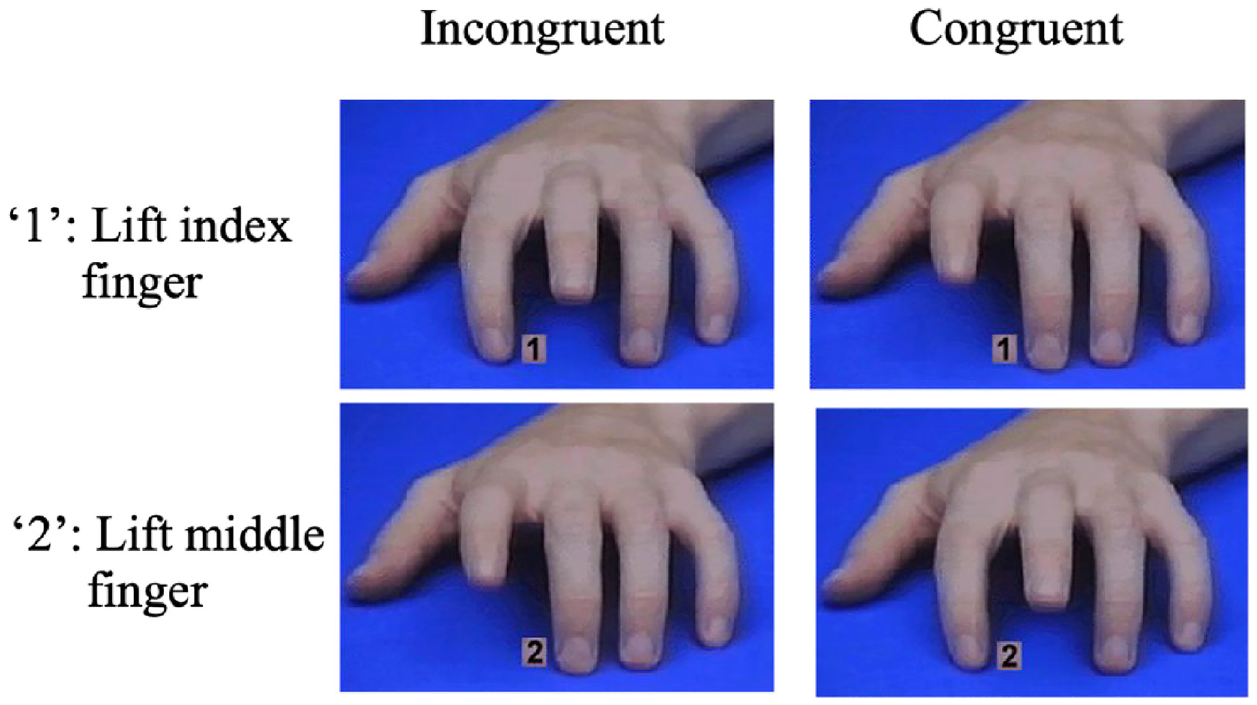
Overview of the two different trials of the imitation-inhibition task. Figure adapted from Genschowet al. (2017; published under a CC BY license).
In principle, three different mechanisms could contribute to the automatic imitation effect: Movement, effector, and/or spatial compatibility. Movement compatibility refers to the overlap between the type of movement made by the model and the type of movement the participant executes (e.g. opening or closing movements). Effector compatibility refers to the overlap between the body part moved by the model and the body part the participant moves (e.g. hand or mouth movements). Spatial compatibility refers to participants responding faster to stimuli presented at a spatially congruent location. For example, responding with the right index finger while observing a finger movement on the left side of the computer screen creates a spatially congruent scenario. Previous research has shown that automatic imitation is explained by the presence of movement compatibility and effector compatibility. That is, automatic imitation can occur by movement compatibility alone, where the observed and executed actions share similar movement characteristics, even if they involve different effectors. For example, participants respond faster to opening movements than closing movements when observing opening movements in another person even if the effectors differ (e.g. when a person executes an opening movement with the hand after observing another person executing an opening movement with the mouth; Leighton & Heyes, 2010). Similarly, in case of effector compatibility, where the observed and executed actions involve the same body part, automatic imitation can occur even if specific movement characteristics differ. For example, participants respond faster with hand movements when observing hand movements (as compared to mouth movements) even if the movement (e.g. whether it is an opening or closing movement) differs. In sum, both movement and effector compatibility contribute to automatic imitation. Interestingly, research that controlled for spatial compatibility revealed that while spatial compatibility can contribute to the automatic imitation effect, effector and movement compatibility effects are detected even if the observed actions are presented spatially incompatible (Catmur & Heyes, 2011). This indicates that automatic imitation cannot be reduced to merely observing actions in a spatially congruent manner.
To conclude, both behavioral mimicry and automatic imitation tasks are used to measure aspects of imitation behavior. Where behavioral mimicry involves mirroring in a (semi) natural environment, automatic imitation refers to the involuntary tendency of individuals to imitate the movements they observe. Note that recent research indicated that the imitation-inhibition task produces stronger (Cracco, Bardi, et al., 2018) and more reliable effects (Genschow et al., 2017) than typical behavioral mimicry tasks.
Possibilities in terms of when, what, and how we imitate
Despite the widespread idea that people automatically imitate others, individuals do not imitate in each context every action and person in the same manner, indicating that individuals have different possibilities in terms of when, what, and whom they imitate. To give an example of how context matters, imitation is likely to be influenced by the mode of interaction. That is, contrary to face-to-face interactions, imitation of lower-body postures is not relevant during a video call where the lower half of the body is not seen. There are also many possibilities in terms of what types of actions individuals imitate even if the context were the same. For example, individuals may not imitate anti-social gestures as much as pro-social gestures. Lastly, there are many possibilities in terms of who individuals imitate. For example, imitative behavior might depend on liking for the other person.
Context
Bonding motives
Using a behavioral mimicry paradigm, Lakin and Chartrand (2003) found that individuals mimic another person more often when they have a goal to bond. In their experiment, one group of participants were given an explicit goal to bond. Prior to watching videos of the confederate, this participant group was told that they would soon be working with the person in the video on a cooperative task for which it is important to get along. Another group of participants were unconsciously primed to bond (with words such as “affiliate,”“friend,”“partner,”“together”) before they watched the video. A third group of participants was given no goal. The results showed that the two groups that were given a goal to bond mimicked the confederate in the video more compared to the group given no goal. A second behavioral mimicry experiment by Lakin and Chartrand (2003) demonstrated that recent failures to bond with someone can lead to an increase in mimicry. In this experiment, one group was unconsciously primed to bond, while the other group did not receive such a goal. Both groups had to go through two interactions with two different confederates. The confederate in the first interaction acted either positively or negatively to elicit a feeling of successful or unsuccessful bonding respectively, whereas the confederate in the second interaction always acted neutrally. Participants in the primed group showed a greater percentage of time spent mimicking following a failure to bond during the first interaction compared to those who succeeded. No such effect was found for the unprimed group.
Along the same vein, previous studies have also found that social exclusion increases behavioral mimicry, in line with research suggesting that social exclusion motivates people to form bonds (DeWall, 2010). For example, in a study of Lakin et al. (2008), participants completed a Cyberball game (i.e. a ball-tossing game; Williams & Jarvis, 2006) before they had an interaction with a confederate. During the Cyberball game, one group of participants was gradually excluded by the avatars, that is they no longer received any ball tosses. No exclusion took place in the other group. This study found that excluded participants mimicked a subsequent interaction partner more than included participants.
Pro-social versus anti-social mindset
Several studies assessing automatic imitation, explored whether a pro-social mindset versus an anti-social one enhances imitative behavior. In these studies, mindset is often primed with two versions of a Scrambled Sentence Priming Task: one including pro-social sentences, one including anti-social sentences. Experiments with such manipulations produced rather mixed results. That is, some studies found that priming participants with a pro-social mindset increases imitative behavior in comparison to priming an anti-social mindset (Cook & Bird, 2011; Leighton et al., 2010), whereas other studies found the opposite effect (Wang & Hamilton, 2013), and yet others found no difference of mindset on imitation (Newey et al., 2019). Interestingly, Wang and Hamilton (2013, 2015) investigated pro- versus anti-social mindsets but also manipulated the self-relatedness of the primes. Their studies revealed that pro-social primes increase imitative behavior only when the primes are self-related whereas anti-social primes increase imitative behavior only when the primes are self-unrelated. Taken together, it remains unclear for now whether a pro-social mindset (vs. an antisocial one) per se enhances imitative behavior. However, preliminary evidence suggests that the influence of mindset on automatic imitation may be more nuanced than originally assumed and contingent on how the specific mindset is induced (i.e. self-relatedness of a prime).
Self-other focus
To imitate someone else, one would assume that people need to focus on the other person. Van Baaren et al. (2003) investigated this idea empirically with a behavioral mimicry experiment. To shift orientation to the self or other, participants were primed with either first-person or third-person pronouns. Participants mimicked the confederate more strongly after they were primed with third-person pronouns, compared to when they were primed with first-person pronouns.
Besides behavioral mimicry studies, there are automatic imitation studies that investigated the influence of self-other focus on imitation. For example, Spengler et al. (2010) used an evaluative statement task to induce self-focus. Statements were either self-referential or required retrieval from semantic memory. The results showed that after working on self-focused statements participants showed a reduced congruency effect in the imitation-inhibition task. In a different experiment, (Spengler et al., 2010), the researchers used mirrors to induce self-focus. Similar to their other experiment, they found that participants imitated less strongly while concurrently seeing themselves in a mirror compared to when the mirrors were turned back-wards. However, a more recent study could not replicate this latter finding (Khemka et al., 2021). All in all, preliminary evidence suggests that a focus on others results in more mimicry behavior whereas a self-focus might reduce automatic imitation, and that using a mirror to manipulate self-focus may not be a robust approach.
Type of action
Pro- versus anti-social gestures
If imitation serves as a social glue, the type of action should also matter. This has been illustrated by Cracco, Genschow, et al. (2018). In a series of experiments, the authors investigated whether humans imitate pro-social gestures more strongly than anti-social gestures. In a first experiment they adapted the classic imitation-inhibition task in such a way that participants either had to lift their thump up (pro-social) or their middle finger (anti-social), while a model on the screen performed either a congruent or incongruent gesture. The results showed that participants imitated the antisocial gesture less strongly than the prosocial gesture. Interestingly, in two further studies (of which the second preregistered), the authors found that the difference between pro- and anti-social gestures was reduced when participants were primed with an anti-social mindset. This indicates that depending on context, individuals more or less strongly imitate others’ pro- versus anti-social gestures.
Similar findings can be found in the literature on emotional mimicry. For example, Fischer et al. (2012) investigated mimicry of disgust and pride—two easily identifiable emotions. In their experiment, one participant (expressor) was exposed to either a vile smell or a compliment to evoke disgust or pride. Another participant (observer) was sitting opposite of the expressor, simply observing. They found that participants mimic pride, but not disgust; supposedly, because the mimicry of such an expression can be perceived as offensive. Going one step further, Kastendieck et al. (2021) found that the degree to which individuals mimic different emotions depends on the social context. For example, sad expressions are more likely mimicked in the context of a funeral (as compared to a wedding) whereas happiness is more likely mimicked in the context of a wedding (as compared to a funeral).
Who we imitate
Humans versus non-humans
With reference to the so-called animacy effect, several studies have investigated whether human actions are more strongly imitated than non-human actions. Such research manipulated animacy either bottom-up or top-down. In experiments applying bottom-up manipulations, animacy information is derived from direct sensory input. For example, Press et al. (2005) had participants observe actions of a human hand or a robot hand and found a stronger automatic imitation response to the human hand. This finding has been supported by several independent studies and a meta-analysis (Cracco, Bardi, et al., 2018). In experiments using top-down manipulations, animacy is manipulated through higher-level cognitive processes. These experiments examine whether simply believing that the presented stimuli involve a human agent, rather than a non-human one, is sufficient to modulate automatic imitation. Liepelt and Brass (2010), for example, applied a classic imitation-inhibition task but with images of a gloved hand. Participants who were led to believe the hand was a human hand, imitated more strongly than participants that were led to believe the hand was a wooden one. However, this top-down animacy effect has since been difficult to replicate (Cracco et al., 2023; Press et al., 2006). Taken together, there is strong evidence supporting the modulation of automatic imitation by bottom-up animacy, while current evidence does not suggest the same for top-down animacy.
In versus out-group members
An often-assumed modulator of imitative behavior is group membership. Yabar et al. (2006), for example, showed videos of a Christian confederate (made evident by jewelry) and an atheist confederate to atheist participants. They found that participants mimicked the out-group member (i.e. Christian confederate) less strongly than their in-group member (i.e. atheist). Similarly, Stel (2005) found that Dutch participants mimicked an out-group member (i.e. a Moroccan confederate) less strongly than an in-group member (i.e. Dutch confederate) when their attitudes toward Moroccans were more negative compared to their attitudes toward Dutch individuals.
Gleibs et al. (2016) tested whether automatic imitation is influenced not only by group membership, but also by the nature of an expected interaction situation (competitive vs. cooperative). The results showed that participants imitated in-group members more strongly than out-group members when they believed that they had to cooperate with the other person later in the experiment (for similar findings, see Genschow & Schindler, 2016). In contrast to these findings, more recent research could not find evidence for the idea that group membership influences automatic imitation. For instance, Genschow et al. (2022) conducted a series of experiments with the imitation-inhibition task in which they included different hands to manipulate group membership (i.e. hand from an American, German, or Chinese person; black or white person). Across six high-powered experiments (total N = 1,538) they found no effect of group membership on automatic imitation (for similar findings, see De Souter et al., 2021; Rauchbauer et al., 2015, 2016).
Based on these highly mixed results, no strong overall conclusion can be made on whether in-group members are imitated more strongly than out-group members. The influence of group membership on imitation may be more nuanced and contingent on how imitation is measured (behavioral mimicry vs. automatic imitation), or the nature of interaction (e.g. competitive vs. cooperative).
Liking
Imitation has been shown to influence liking (Chartrand & Bargh, 1999; Kulesza et al., 2022; Sparenberg et al., 2012) in the sense that people who mimic others are perceived as more likeable. Based on this research, it is reasonable to assume that the reverse may also be true. Stel, Van Baaren, et al. (2010) directly examined this question. They manipulated liking by giving participants either positive, negative, or neutral background information about a confederate they would then show in a video. They found that participants imitated the confederate more strongly when they believed to be interacting with a likable person, as compared to a non-likeable person or a person that they felt neutral about.
Theoretical explanations
The above-reviewed literature makes clear that individuals have a natural tendency to imitate others, but they do not do so randomly. Instead, imitative behavior seems to be modulated by factors such as context, type of actions, and our conversation partners. A notable feature of the literature reviewed here is that researchers initially investigated social variables in a rather exploratory manner, and only later provided post-hoc explanations for the findings. These explanations led to the development of different theories that can be roughly divided into motivational theories and self-other overlap theories. Interestingly, these two theories yield similar predictions regarding the influence of most social modulators on imitative behavior. However, the two theories differ in their explanations of how social modulation takes place.
Motivational theories of imitation suggest that imitation is used as a social strategy to affiliate with others (Wang & de Hamilton, 2012; Wang & Hamilton, 2015). As previously stated, imitation can work as a social glue (Kavanagh & Winkielman, 2016) to, for example, increase liking. As a consequence, individuals may use imitation as a tool for self-advancement, because they expect pro-social benefits from this kind of behavior. Following this theory, humans do not imitate randomly, but use subtle contextual signals instead to evaluate when and who to mimic in an adaptive manner. However, it remains unclear to what extent this is done consciously, if at all.
Self-other overlap theories (Brass & Heyes, 2005; Greenwald, 1970; Heyes, 2011; Prinz, 1990) build upon the explanation that when individuals perceive other’s actions, their own neural representations related to those actions are activated. The self-other overlap theories suggest that individuals’ motor plans are triggered more strongly when they perceive a greater degree of similarity or overlap between themselves and others.
Remarkably, previous research has neglected to rigorously test the extent to which the two proposed processes directly contribute to imitative behavior. Specifically, research so far has not tested whether perceived similarity or the goal to affiliate predicts imitative behavior. This calls for the formalization and testing of an (integrative) theory of social modulation. Such a theory should take into account that feelings of affiliation and perceived similarity are likely correlated. That is, we can assume that people tend to feel stronger affiliation toward similar people and perceive others as more similar when they have an affiliation goal toward them. This raises the question of how much variance perceived similarity and the goal to affiliate explain independently of each other. Given that both factors explain at least some unique variance, one may predict that contexts that increase similarity as well as affiliation goals should have the strongest influence on imitative behavior. In line with this assumption are studies that tried to find social modulation by experimentally manipulating different processes simultaneously. For example, Gleibs et al. (2016) manipulated participants’ goal to affiliate by priming either a competitive or cooperative mindset. The results indicated that similar in-group (as compared to dissimilar out-group) members were imitated stronger in a cooperative than in a competitive mindset. Future research could test this interpretation of the results in more detail.
Discussion
Humans have a natural tendency to imitate others, and in daily life, there are plenty of opportunities to do so. However, observing an action does not always lead to imitation. Why does imitation occur sometimes but not at other times? Here, we reviewed the literature on modulators of imitation to get a better understanding of when individuals imitate and when they do not. All in all, people’s tendency to imitate appears to be flexible. That is, people have possibilities in terms of when (context), what (type of action), and whom they imitate. More specifically, there is evidence that people tend to imitate more in a context in which they have a goal to bond. Preliminary evidence further shows that contexts in which we focus on others result in more mimicry behavior, whereas a self-focus might reduce automatic imitation. Additionally, a pro-social mindset, when primed via self-related statements, appears to enhance imitative behavior. There is also preliminary support that the type of action influences imitation. This evidence comes from studies showing that pro-social gestures and pro-social facial expressions are imitated more strongly. Lastly, there is evidence showing that imitative behavior depends on who the interaction partner is. The strongest evidence comes from the bottom-up animacy literature showing that human actions are more strongly imitated than non-human actions. Furthermore, preliminary evidence shows that likable persons are imitated more strongly.
That said, it is important to note that the investigation into the various modulators discussed here, which may explain when, how, and whom we imitate, should continue. That is, apart from strong cumulative evidence for bottom-up animacy modulating automatic imitation, the other investigated modulators have, thus far, yielded moderate, preliminary (e.g. few replications, small samples), or mixed evidence. This warrants both conceptual and direct replications which, in turn, opens the door of gathering meta-analytic evidence to examine the cumulative evidence for other modulators than bottom-up animacy (see meta-analysis of bottom-up animacy: Cracco, Bardi, et al., 2018). For example, the modulator “bonding motive” has been investigated using slightly different paradigms (e.g. using social exclusion and unsuccessful bonding attempt), resulting in a few successful conceptual replications, but still needs (direct) replications before strong conclusions can be made. Similarly, the modulator “liking” and the category “type of action” have not received enough research attention and have, so far, only been studied with a behavioral mimicry paradigm (Stel, Van Baaren, et al., 2010). Evidence for the modulator “self-other” focus is slightly mixed, with some reason to believe that the mixed results might be explained by how self-other focus is manipulated. Research is needed to understand if the type of manipulation is indeed the contributing factor explaining the mixed results. Such research investigating the factors contributing to the differences in results could, in turn, help us get a better understanding of the modulator itself. Similarly, the modulator “pro-social versus anti-social mindset” has resulted in mixed findings, with the studies by Wang and Hamilton (2013, 2015) suggesting that the influence of mindset on automatic imitation may be more nuanced and contingent on the self-relatedness of the primes used to manipulate the mindset, warranting more research. Lastly, the modulator “in versus outgroup” resulted in highly mixed results. Taking the different studies on this modulator together, it seems that group membership mainly (but not solely) emerges as a modulating factor in those studies that measured behavioral mimicry. In this respect, a study measuring both behavioral mimicry as well as automatic imitation within the same sample might be interesting. Such a study would allow testing whether the paradigm used (behavioral mimicry vs. automatic imitation) to measure imitation indeed matters.
Besides replication studies, other factors should also be explored as the factors that contribute to the complex nature of imitative behavior are likely not limited to the factors discussed here. That is, imitative behavior is realistically influenced by a myriad of possible social influences, contexts, and conditions, echoing the vast variety and complexity of social situations humans encounter in daily life. Thinking from a perspective of possibilities in terms of when, how, and whom we imitate might help researchers to identify more modulators that might affect our imitative behavior. To name a few examples: questions around how imitation is influenced by nowadays technology (i.e. videocalls), numerosity (e.g. the number of people included in the interaction), and awareness (e.g. how does knowing that imitation acts as a social glue influence subsequent imitative behavior? To what extent do people use the possibilities they have in terms of imitation consciously?) remain unexplored. The latter example being particularly interesting from the perspective of motivational theories that proposes that we use imitation strategically, and being aware of one’s possibilities can be highly adaptive (Baumeister & Alquist, 2023). As aforementioned, there is also a need to formulate and test an integrative theory of social modulation. Current research has primarily focused on examining whether different social variables modulate imitative behavior without directly testing whether these social variables actually influence the proposed processes (i.e. perceived similarity and affiliation goal). To formulate a theory of social modulation, it is crucial to empirically test whether social variables impact one or both proposed processes. In a next step, one could then test the extent to which such changes in perceived similarity and affiliation contribute to the increase in imitative behavior. By establishing a relationship between perceived similarity/affiliation and imitative behavior, researchers may be able to derive precise predictions regarding the influence of different variables on imitative behavior simply by understanding their effects on perceived similarity and/or affiliation.
To conclude, previous research suggests that people have an automatic tendency to imitate others. Some studies imply that individuals automatically imitate any kind of action they see. However, the literature reviewed here presents a more nuanced perspective, illustrating that people, in fact, have many possibilities regarding when, how, and whom they imitate. Only a few of these possibilities result in actual imitation, indicating that imitation is a rather flexible behavior. At the same time, the reviewed research suggests that the scientific evidence for many of the factors previously assumed to modulate imitative behavior is not very strong. Future research may thus aim not only to establish the occurrence of imitation but also to elucidate why people imitate certain behaviors in particular situations over others.
Footnotes
Declaration of conflicting interests
The author(s) declared no potential conflicts of interest with respect to the research, authorship, and/or publication of this article.
Funding
The author(s) disclosed receipt of the following financial support for the research, authorship, and/or publication of this article: OG was supported by a grant from the German Research Foundation (DFG; project number: 497678237).

