



Abstract
A laboratory procedure employing insight problems allows researcher to capture how new ideas are discovered or constructed. Insight problems are relatively simple riddles designed to encourage an initially incorrect interpretation of the problem that leads to an impasse: Researchers are then poised to capture the moment the impasse is overcome, that is when a new productive interpretation of the problem is developed resulting in the solution. Researchers call this process ‘restructuring’: while the term describes the phenomenon, it is not clear how it explains it nor how restructuring comes about. The case study we describe here reveals the micro-processes involved in restructuring by using an interactive problem-solving procedure involving matchstick arithmetic problems. Originally developed by Knoblich et al., these problems present a simple but false arithmetic expression using Roman numerals: Participant must discover which matchstick can be moved and where to turn it into a true expression. The participant can manipulate matchsticks, and in doing so creates a dynamic object, the behaviour of which triggers new actions and cues new hypotheses about the solution. We present the case-study data in the form of a video of a participant instructed to narrate hunches and hypotheses as she interacts with a physical model of the solution, over three separate problems. On the basis of a granular coding of the participant’s verbal protocol along with an equally granular coding of the changes to the object (using ELAN; https://archive.mpi.nl/tla/elan), the case study is the first to clearly reveal the restructuring process that results in the phenomenon of ‘outsight’, that is when the behaviour and polymorphic changes to the object qua model of the solution guides the participant to the solution.
The cognitive psychology of problem solving leaves objects out of its account of the process of problem solving. Understandably, the disciplinary moniker both encourages and constrains a focus on cognitive capacities and aptitudes which translates into descriptions of mental processes that operate on mental representations of the world (notwithstanding the etymology of cognition that relates to knowledge, not where it takes place or how it is obtained). Consider trying to explain, in real time, the dynamic problem solving of a footballer in terms of cognitive capacity and mental processes with no consideration of the behaviour of the ball. Of course, there’s something about the size of the pitch (literally) and the complex and contingent social space configured by the 22 players on it that makes it difficult to distil the phenomenon into a controlled laboratory preparation, but that’s not the point we wish to make here. Rather, we want to zoom-in on the dynamic coupling between player and ball; even the other 21 players without the ball still need to position themselves relative to where the ball is. Whatever the position of the ball in relation to the players, agency is distributed and emergent across the pitch. Clearly, ball and player are different ontological things, made of different stuff, each with its own set of features and behavioural repertoire. We are not attributing agency to the ball: we simply point out that the movement of the ball cues and triggers certain behaviours from the players. The ball’s movement has agentic consequences for the dynamic unfolding of the behaviour of all the players and of the game as a whole.
Rather than assuming agency to be the exclusive property of humans or attributing it elsewhere, what we explore in this paper is a cognitive psychology of problem solving that adopts a symmetrical approach, treating human and non-human actants as contributors to the construction of a new idea, as co-creators of the solution to a problem (Vallée-Tourangeau, 2023). We adopt this perspective as a working method, to explore its benefits with no commitment to a stronger ontological position about human and non-human actants. 1 Rather than working out which one has the power, we wish to focus on their connection, their entanglement, and how new thoughts are formed through relatedness. We seek to expand the methodology of problem-solving research by developing a procedure where objects play a constitutive role, which in turn yields data that expand the theoretical scope of a psychology of problem solving, one that does not always forefront the causal relevance of mental representations in problem solving, in other words, a post-cognitivist account of discovery and creativity (see Kimmel & Groth, 2024). In order to do so we need to populate the problem-solving space with objects that can do things. The procedure is interactive, where participants are invited to construct a physical model of the solution. In the process, the object changes over time and space, offering feedback and guidance for the participants’ next action in a recursive process of discovery.
Mobilising creative problem solving
Insight problems offer an interesting laboratory procedure for capturing the origins of a new idea. These problems are relatively simple riddles designed to create an impasse, to stump: Researchers are then poised to capture the moment the impasse is overcome, that is when a new productive interpretation of the problem is developed resulting in the solution. Technically, researchers call this process ‘restructuring’ but it is not at all clear how it explains the breakthrough nor, more specifically, how restructuring comes about.
Matchstick arithmetic problems were developed by Knoblich et al. (1999). They are presented as simple but false arithmetic expressions using Roman numerals, such as I = II + II: both operands and operators are constructed with identical ‘sticks’ (see Figure 1), even sometimes made to look like matchsticks (e.g. Kizilirmak et al., 2021 and their Figure 1, p. 703). Note, here, the slightly unorthodox alignment with the equation’s result on the left followed by the operands and operator (an alignment that disorients some participants initially). The participants’ task is to turn the expression into a true one with the following exacting constraint: moving but not removing one stick, a single movement that results either in a new operand or a new operator (or both). In the case of the problem I = II + II participants experience an impasse because they first seek to transform an operand, a numeral. If participants do experience a breakthrough (that proceeds from the deconstruction of the plus operator), a cognitivist account is formulated in terms of mental restructuring: in this particular case, the relaxation of an implicitly assumed constraint that operators cannot be decomposed, changes the conceptual space (Boden, 2004) and facilitates the production of new ideas that lead to the solution. Thus, a cognitivist account sets itself a double explanatory challenge: How is a constraint relaxed or abandoned, and how this mental process of constraint relaxation eventuates in the restructuring of the problem interpretation.
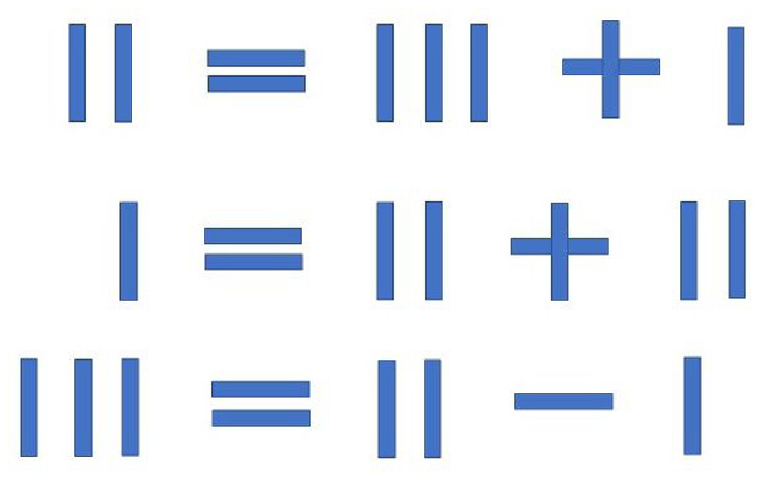
Three matchstick arithmetic problems.
Few participants can solve these problems upon presentation, sometimes taking minutes rather than seconds to solve them. The solution can be evinced through an analytic process, selecting a stick and determining what possible locations might result in a true expression but, of greater interest for some researchers, is the observation that the solution sometimes presents as a form of ‘insight’, operationalised in terms of three dimensions, namely (i) suddenness, (ii) immediately preceded by an analytic strategy diametrically different or a protracted impasse, (iii) accompanied by phenomenological markers of joy and relief.
For all their physical affordancing—touching, lifting, moving—matchstick problems are typically not presented in a manner that actualises these affordances: that is, they are presented on a monitor as a static image and participants stare at them until they can articulate a solution to a researcher (e.g. Kizilirmak et al., 2021; Knoblich et al., 1999; Öllinger et al., 2008; but see Danek et al., 2016, where a matchstick arithmetic problem is presented with movable artefacts although the nature of the interaction is not recorded by these researchers). Methodologies are performative, and here what they perform is a type of explanation, a mental one, that draws exhaustively on mental skills – visual imagery, working memory – and if insight is experienced, subconscious processes are thrown into the mix. Whatever the exact details and components of such a model of problem-solving, the proposal is cognitive in nature, the explanation couched in terms of the agency of the participant, or more specifically, their brain. Let’s call this type of cognitive explanation hermetic since it cannot spill out into the environment, in fact it is not equipped to formulate an explanation beyond the cognitive processes entombed in the participant’s skull.
Open system
In art, design, and engineering, physical prototyping is the norm (Böhmer et al., 2017; Buchman, 2021). Innovation and creative problem-solving proceeds, not through mentally simulating the world, but by making stuff in a provisional way and reacting to it. Whatever the object, a draft, a sketch, a maquette, a demo, its evolving appearance, form and behaviour are so embedded in perceptual experience that together they ideate the next iteration in the creative cycle (see Baggs & Steffensen [2023] on the importance of perception in problem solving and reflections on the link between Gibsonian direct perception and the distributed cognition perspective). To understand, then, the development of a creative or innovative solution or product, as it happens outside the laboratory, it is necessary to curate these developmental steps, these different objectified ideational incarnations on their journey to the final state. Doing so sheds light on how both object and creators are transformed along that developmental trajectory; leaving out these intermediary embodiments would be like excluding the ball from an analysis of a footballer’s behaviour.
While a cognitivist explanation of problem-solving acknowledges the importance of the external environment, its influence is explained in terms of its impact on the mental representation of the problem space. There’s a deeply ingrained asymmetry in the treatment of human and non-human actants in the cognitive scenography of creativity: humans have thoughts, agency, intentionality, while objects don’t, and hence only the former should be the focus of the explanation, the latter the passive substrate moulded and kneaded into shape (Latour, 2005; Malafouris, 2020). In contrast, the case study we present here illustrates the mingling of human and non-human development; how together they promote a physical modelling of a proto-solution that morphs its way towards a normative configuration. We can simultaneously understand the mingling as a double process of becoming: the participant’s developmental appreciation of the correct answer co-evolves alongside the material transformation of the physical model of the problem. Each morphs the other into a shape that gradually approximates the normative correct configuration. 2 Therefore, to ignore the behaviour of the non-human object would be to ablate a large chunk of the explanation; objects and thoughts go together.
The case study offered in this paper relates the activities of a participant in a laboratory task, working on the three problems shown in Figure 1. The sticks configure (represent) operands and operators and they can be selected and moved to make new symbols and thereby new objects. The intermediate expressions that result vary in quality; some offer no productive pathway towards constructing the normative configuration, others are helpful in a negative sense in that they contain information suggesting the transformation and the resulting model are incorrect (see Figure 2a). Other constructions, such as those illustrated in Figure 2b, produce objects that offer more positive guidance.
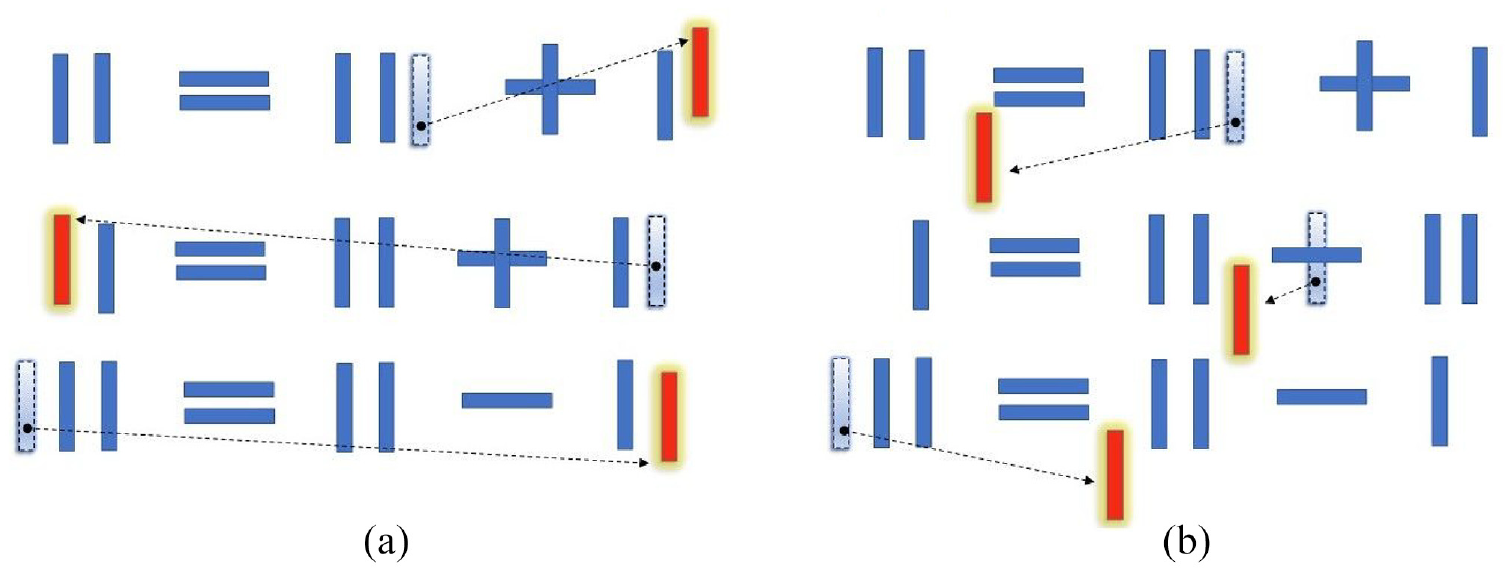
Matchstick movement: The transparent stick is the starting position, the red highlighted stick is the space where stick movement ends. (a) Illustrates how some movements produce new object-models of the solution that are far removed from the solution and (b) Illustrates how new objects approximate more closely the solution.
In the preparation employed in this study, participants are allocated 5 minutes to solve each of the three problems illustrated in Figure 1. Participants rarely solve the problems quickly, within the first 30 seconds. Instead, they have to work at it. Some do so by readily engaging with the artefacts, intuitively delegating some of the decision making to the object, allowing it to do different things and reacting to its behaviour (something akin to a playful attitude, homo ludens rather than homo faber to adapt Goldstein, 1989). Others are more reluctant, preferring to remain immobile and ‘think things through’ before moving a stick. Others still appear lost, stumped, their behaviour sluggish. They find it difficult to solve the problem mentally nor are they convinced that interacting with the object could yield any benefit. Why participants behave differently is an interesting question, but not one that we will address in this paper. Instead, we purposefully chose a participant for the case study who readily interacted with the sticks and hence transformed the object-qua-possible-solution fluidly. On the basis of her concurrent verbal protocol, we can also trace the hunches and strategies and make an assessment of the extent to which strategies guided the movement, vice-versa or both. As we will show, some of object transformations are more clearly anticipated and guided by a problem-solving strategy, others much less so. Many transformations appear to reflect playful manipulation of the objects: in the playful cases, whether the movement is strategic as well as playful is uncertain, but what the participant expresses in the verbal protocol is that the result of the movement is rarely simulated mentally; rather, the participant changes the object, observes the transformation, and reacts to the change in the object (just like moving letter tiles in Scrabble to try and make a word). It’s the dynamic nature of the object that is the ideational source, the inspiration and guidance (see Ross & Vallée-Tourangeau, 2021). The solution to the problem emerges from the tight coupling of object and thought, a dynamic process that eventuates in the object adopting a configuration that corresponds to the solution. The participant’s understanding and appreciation of the solution arrives after the object has displayed the solution. In this case study, the strategic intentions of the participant, and the extent to which they guided behaviour is only part of the explanation of how the three problems got solved. The data reveal the possibility of developing a post-cognitivist systemic account of ideational breakthrough.
The case study
The case study follows a participant recruited as part of a larger experiment that explored the role of interactivity in problem solving. The protocol was developed during the pandemic and the experiment was conducted online through Zoom. The experimental material – a set of PowerPoint slides showcasing the three matchstick arithmetic problems – was emailed to participants at the start of the session. When they opened the PowerPoint file, they kept the slides in edit mode and shared their screen. At that point, the experimenter started recording the session. Participants were allowed up to 5 minutes to solve each of the three problems. Using the mouse, participants could select and drag a stick that configured either an operand or an operator and move it on the slide to transform one object into another. Participants were also asked to concurrently narrate their strategies and thoughts. The session recording was edited into three shorter videos, one for each of the three problems. Each of these shorter videos were coded using ELAN (https://archive.mpi.nl/tla/elan; Max Planck Institute for Psycholinguistics, The Language Archive, Nijmegen, The Netherlands; see also Wittenburg et al., 2006). The participant’s verbal protocol as well as the experimenter’s prompts were transcribed (the full transcript for each of the three problems can be found in the Appendix). We coded the timing and nature of the movement of each stick along with the resulting change in the object. Thus, we obtained two data streams along with their temporal juxtaposition: when participants said what, and how the objects changed and when. In this way, we could identify the strategies and hunches that anticipated the movement of a stick and how that transformed the arithmetic problem matchstick configuration. We could also capture the participant’s reactions that were triggered by the creation of new objects and how these movements and reactions produced a breakthrough solution.
In problem solving, the idea that corresponds to the solution of the problem (e.g. decomposing the plus operator in I = II + II) must be discovered. Where and how does this idea come from? A non-interactive procedure can only perform a mental origin explanation. A procedure wherein people interact with objects can enact a different explanation for the origin of a new idea. The innovative research procedure outlined here offers a method of integrating information about participants’ internal mental reflections with concomitant external changes in the world. It offers a coding methodology that enables the timing and nature of both to be precisely measured. The coding of the integrative relationship reveals the dialogue that takes place between a problem solver and things. In summary, the procedure generates two streams of data: (i) verbal protocol from the participants and (ii) physical changes to the model of the solution and the originality and significance of the project lies at the intersection of these two streams of data. Their temporal juxtaposition is particularly informative: It thus gives us a way to ascertain whether and how the verbal protocol anticipates the movement of the object, how the protocol responds to unanticipated changes to the object, and a third possibility, whether and how thinking and object-change are co-determined, as reflected in the synchronisation of ideation with object-change. While previous research has mined verbal protocol for participants’ strategies and hypotheses (e.g. Fleck & Weisberg, 2013) few employ a procedure that permits interaction with a physical model of the solution, and crucially this is the first attempt coordinate object-change and thought and to map the dialogue between them.
Solution processes
Traditionally, in the problem-solving literature, researchers have identified two broad classes of process that lead to solutions (e.g. Fleck & Weisberg, 2013): Analytic and insight. The first, analytic, reflects a deliberate, quasi-systematic exploration of a hypothesis. For example, the participant’s hypothesis, as revealed through verbal protocol and matchstick movement, might focus on decomposing an operator. Here we would see and hear the participant narrate the movement of the vertical stick from the plus operator (creating a new, minus operator in the process) and then placing the free stick next to each of the other operands in turn in a systematic hypothesis testing procedure. The second, insight, concerns the sudden appearance of the solution either after a sustained impasse or immediately following working through a hypothesis or strategy diametrically different from the solution that followed. To all intents and purposes insight presents as largely sub-conscious, characterised by a gestalt-like perceptual clarity (Gilhooly & Webb, 2018; Wiley & Danek, 2024) but one which is evinced through a cognitive mechanism that is inaccessible to introspection. An insight is also typically accompanied by phenomenological markers of aha! such as joy and relief. What is important to stress is that, when using an interactive procedure as we do here, that is one where participants construct a physical model of the solution, an insight solution is not one created by a specific object movement that makes the solution. An insight solution anticipates the movement that then demonstrates its veracity (or verification in Wallas’s [1926] stage model).
The significant contribution of an interactive procedure is that it can make manifest a third yet unexplored phenomenon, one we call
Method
Participant
The case study is based on one participant (self-identified as, female, 23 years of age, P29 henceforth), selected from an opportunity sample of 56 participants recruited for an experiment on the role of interactivity in problem solving; the participants were allocated to one of two conditions, an interactive one where participants could move the sticks to create physical models of the solution, and a non-interactive condition where participants could not. Of the 28 participants in the interactive conditions, we looked for a participant who solved all three problems, and for which there was evidence of outsight for all three problems. Three participants solved all three problems with outsight. The evidence for what we called ‘post hoc’ outsight was clearest in the case of P29 – hence the choice for this case study.
Procedure
The procedure designed and employed for P29 was no different from that used for all participants in the sample. P29 was tested remotely through Zoom. She participated while sitting in a quiet room in her home; the experimenter was also in a quiet space at home. The participant was sent a link to a short Qualtrics survey where answers for informed consent questions were collected as well as basic demographic questions (gender and age; the informed consent and demographic questions survey as well as the PowerPoint slide deck employed in this study can be found on the OSF: https://osf.io/a6kjy/?view_only=121b89fa76d34921a5436ff2dd5dc765). 3
Once the survey was completed, the participant was emailed a deck of slides. Each slide, save for the first one, was obscured by a grey screen which could be deleted to reveal the contents underneath. The participant was instructed to launch the PowerPoint application and open the file; at this point the participant was asked to share their screen and the recording of the session began (and the experimenter turned off their camera). The participant viewed the deck of slides in edit mode.
Participants were given the following instructions, adapted from Perkins (1981; see also Fleck & Weisberg, 2013) that asked them to narrate aloud their thoughts and to comment on their actions while they tackle the problems: While solving the problems you will be encouraged to think aloud. When thinking aloud you should do the following. Say whatever’s on your mind. Don’t hold back hunches, guesses, wild ideas, images, plans, or goals. Speak as continuously as possible. Try to say something at least once every five seconds. Speak audibly. Watch for your voice dropping as you become involved. Don’t worry about complete sentences or eloquence. Don’t over explain or justify. Analyze no more than you would normally. Don’t elaborate on past events. Get into the pattern of saying what you’re thinking about now, not of thinking for a while and then describing your thoughts. Though the experimenter is present you are not talking to the experimenter. Instead, you are to perform this task as if you are talking aloud to yourself.
All participants, including P29 were then given 3 minutes to practice speaking their thoughts while they engaged in a simple word search puzzle. They used the drawing tools in PowerPoint to select a highlighter with which to trace target words from the letter matrix. The experimenter prompted the participant to articulate their search strategy, where they were looking at or what they were looking for. With the practice session completed, the next phase of the procedure introduced the matchstick arithmetic problems. P29 was told that three simple arithmetic expressions would be presented in turn; each was an incorrect expression in Roman numerals that could be turned into a correct one by moving one matchstick. Before the first problem was presented, the participant was trained to move three vertical sticks from the top left corner of the slide into one of three vertical slots in the middle right of the slide (see Figure 3): They did so by selecting/clicking on each of the sticks and dragging it into the target location in turn. As Figure 3 illustrates the work surface for this training exercise, as well as the one employed for each of the three problems, was a 3 × 18 grid: Columns were labelled A through R, and the rows AA to CC. The procedure was thus instrumentalised to facilitate the precise coding of the movement of a stick during the problem-solving task.
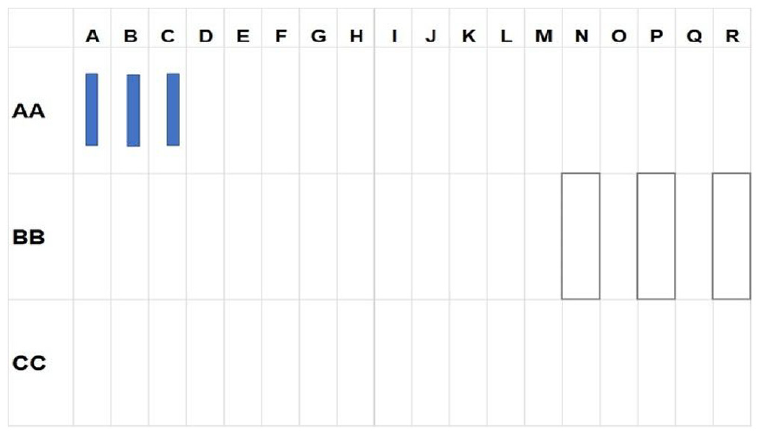
The practice work surface where the participant selected and dragged sticks from their location in the top left corner to each one of the landing rectangles on the right of the surface.
With training complete, the three problems were then presented in turn and in the order illustrated in Figure 4: First

Test procedure, starting with informed consent questions, followed by a verbal protocol training exercise for 3 minutes, and then the presentation of the three matchstick arithmetic problems (the participant allocated up to 5 minutes to solve each problem).
Results
Problem 1
When the grey screen is removed, revealing the false expression, P29 is perplexed. Despite having read the instructions concerning the nature of the task involving false arithmetic expressions with Roman numerals, P29 is surprised by the appearance of the problem
4
: 11.16: Um, I was not expecting this. I thought it was like Roman numericals [sic] and 19.47: I don't know what this is. Ermmm
P29 is at a loss.
35.69: Oh gosh, I don't really know what I'm doing
For the next 20 seconds, P29 moves a number of sticks around eventually creating 83.11: I just don't... I don't understand what I'm looking at 86.92: (Laughs)
The experimenter reminds P29 that the expression and its solution involve simple Roman numerals (88.69) and invites P29 to read out the equation, which she does: 104.38: so these... ok so two equals three plus one
P29 moves a vertical stick from the 127.96: I'm just going to put that there and that... three equals two plus one
P29 realises or confirms the realisation that they have solved the problem: 132.48: That’s fine, I think (laughs) 135.10: (laughs)
The experimenter asks whether P29 obtained the solution before creating it physically (139.57). P29 first answers that she did (145.62) but then corrects her answer: 150.95: but it was pretty much at the same time, it was just as I was reading it out
P29 adds 166.76: Yeah, so I kind of visualised it
Although this statement could be interpreted as P29 claiming that she mentally visualised the answer before the movement, in light of her previous statement – that the solution occurred to her as she was reading out the expression that was configured by the object –‘visualising’ here more plausibly means ‘seeing’; that is, P29 perceived the answer rather than mentally creating it. This is what we call, outsight as defined in the introduction. It is difficult to say whether this example is of the enacted type whereby the solution and movement developed in close tandem or whether outsight only occurred once the movement was completed, that is a post hoc outsight.
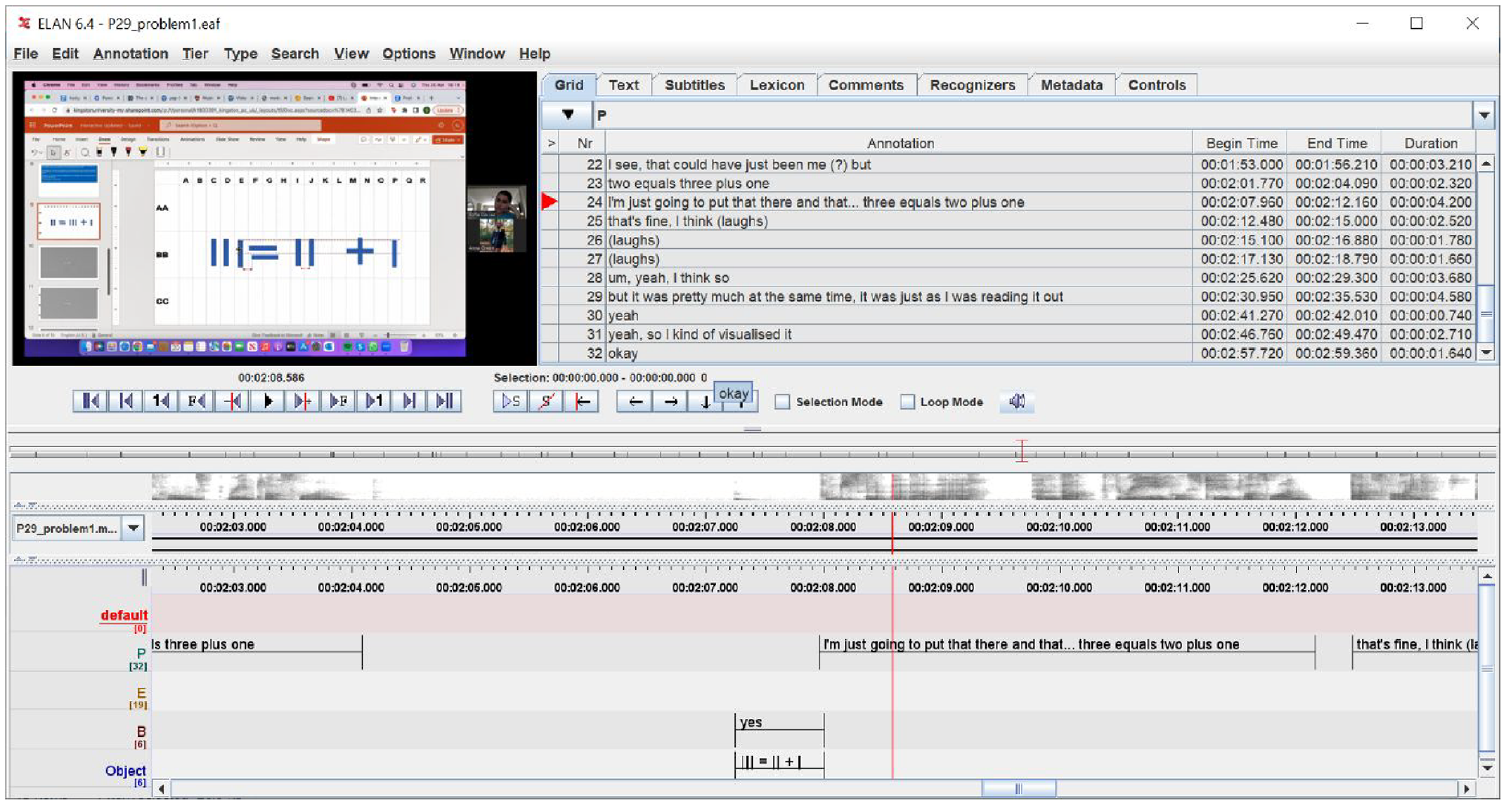
ELAN screenshot of the movement that led to the correct configuration of the object. Note the movement precedes the description of the new object which is followed by the realisation that the problem was solved. The full ELAN video can be accessed on the OSF: https://osf.io/a6kjy/?view_only=121b89fa76d34921a5436ff2dd5dc765.
Problem 2
The nature of the task is now understood by the participant, and the initial engagement with the second problem is not marked by the incomprehension that heralded work on the first problem. Still, the problem stumps her: 10.44: um, one equals two plus two, I have absolutely no thoughts in my brain right now
Yet, she understands the one-stick constraint from the start, the first move deconstructs an operand (38.33) to create 50.07: I.... have no 57.76: no...clue
These moves suggest that her exploration is not random, selecting an operand, then an operator and observing the appearance of the object post transformation. The experimenter asks P29 if she has a strategy in mind (71.99) and P29 laughs 75.90: I don't... I don't think so (laughs) I am just winging it
Yet, P29 is strategic, and both her narrative as well as her transformation of the object reflect some thoughtful exploration (unlike the initial moves for the first problem). For example, she says that the solution can’t involve decomposing the equal sign 120.46: and I don't really want to move these ones 131.74: these ones [points at equals] 133.22: (laughs) I just feel like they're stuck there, but I wouldn't know what to do if I …
But P29 doubts her strategy, and proceeds to decompose the equal (141.02), and remains unimpressed with the results 143.75: No
This is evidence that the movement is guided by some ideas, proceeds along some plan. This is also clearly revealed following the experimenter’s question (Where are you looking? 165.00) 167.46: I think I'm concentrating too much on the equals, so I'm looking at the equals sign (laughs) I don't know why
Shortly after this exchange, the move at 195.81 deconstructs the plus operator again, although this time the vertical stick from the plus is not moved all the way to the left of the equal, but rather is moved slightly to the left, producing an object that more clearly spells out the solution (namely,
208.77: in my head it's in a fixed position [she means the equal sign] so it has to be one or something equals plus something or 215.09: something minus something, ahhh (sighs)
Nonetheless, P29 returns to deconstructing the equal sign, creating objects like the one at 141.02, namely
251.23: Oh! (laughs)
253.03: Oh, I somehow... I think yeah, that's it (laughs)
258.50: (laughs) that is so funny (laughs)
The experimenter prompts P29 to explain how she solved the problem (274.90): 281.26: I just... I just kind of moved the stick, and I just realised, oh 287.90: three minus two is one, but I had to actually accidentally put it in that place to find that out 295.87: (laughs)
This is clearly a moment of post hoc outsight: the object is configured into the correct answer, a delay ensues, and then joy and relief in the realisation that the answer is right in front of her eyes. Yet there’s also perhaps some Pasteurian preparedness here that helped P29 appreciate the fruitfulness of deconstructing the plus operator into a minus. P29 focused on the equal sign, but none of the transformations motivated by this hypothesis yielded encouraging constructions. Then P29 voices something about the solution involving ‘something minus something’ (215.09), followed by tentative deconstructions of the plus operator (246.80 and 248.49) which leads to the realisation that the new object spelled out the answer.
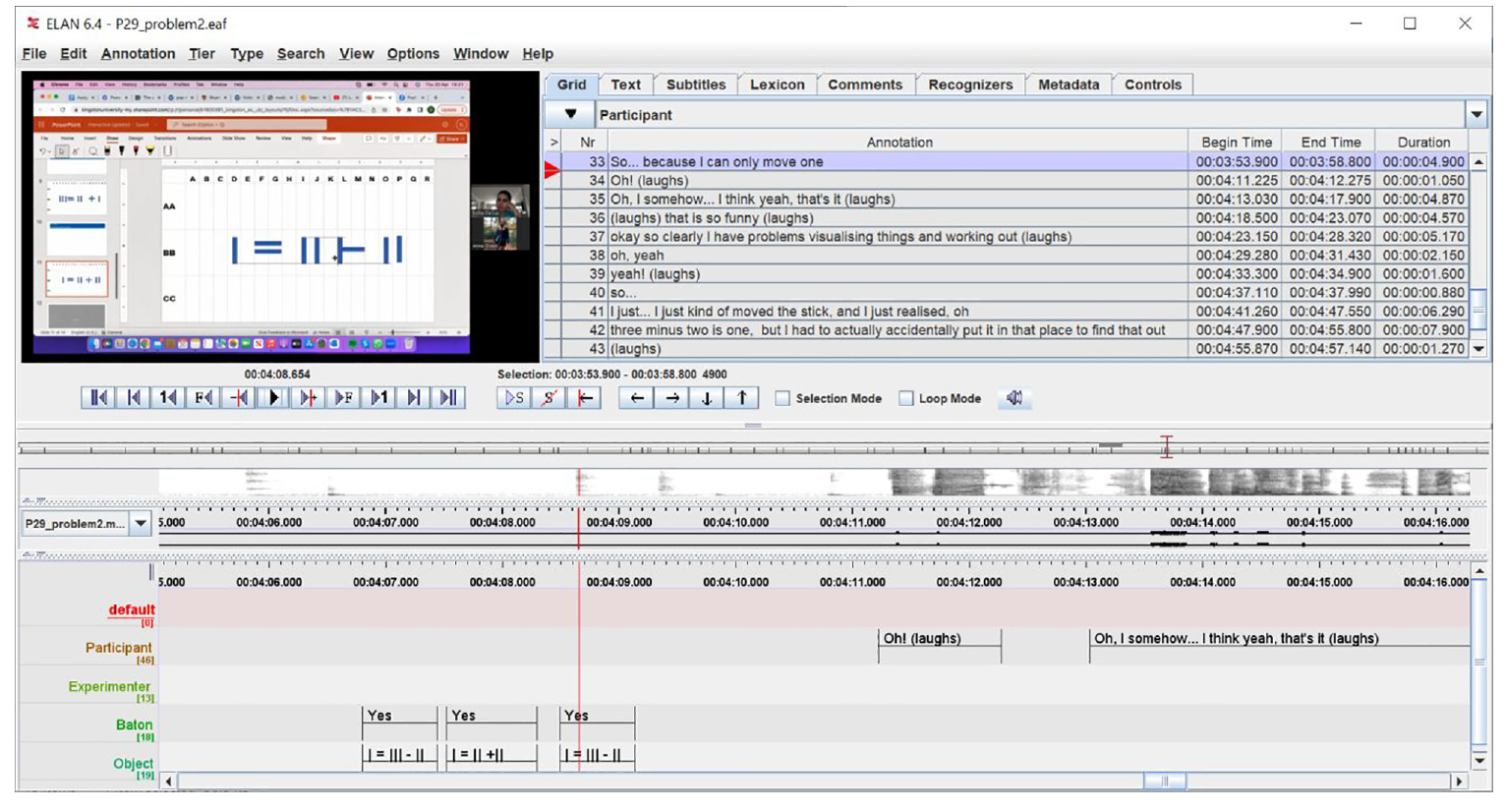
ELAN screenshot of P29 deconstructing the plus operator that creates the solution, twice in close succession, after working on deconstructing the equal sign. After some delay, the participant realises that the new object configures the solution; this is a post hoc outsight. The full ELAN video can be accessed on the OSF.
Problem 3
The participant is more settled, familiar with the task, and possibly more confident after having solved the first two problems. Note the absence of self-deprecating comments in the verbal protocols as she starts working on the problem. P29 gets going exploring the object and its transformation. She first changes the minus operator by moving a stick from the 32.12: two plus one is three so that's not right, um
P29 experiences an impasse, as she had for the previous two problems: 48.40: oh, I don't know
She works on changing the operand, creating
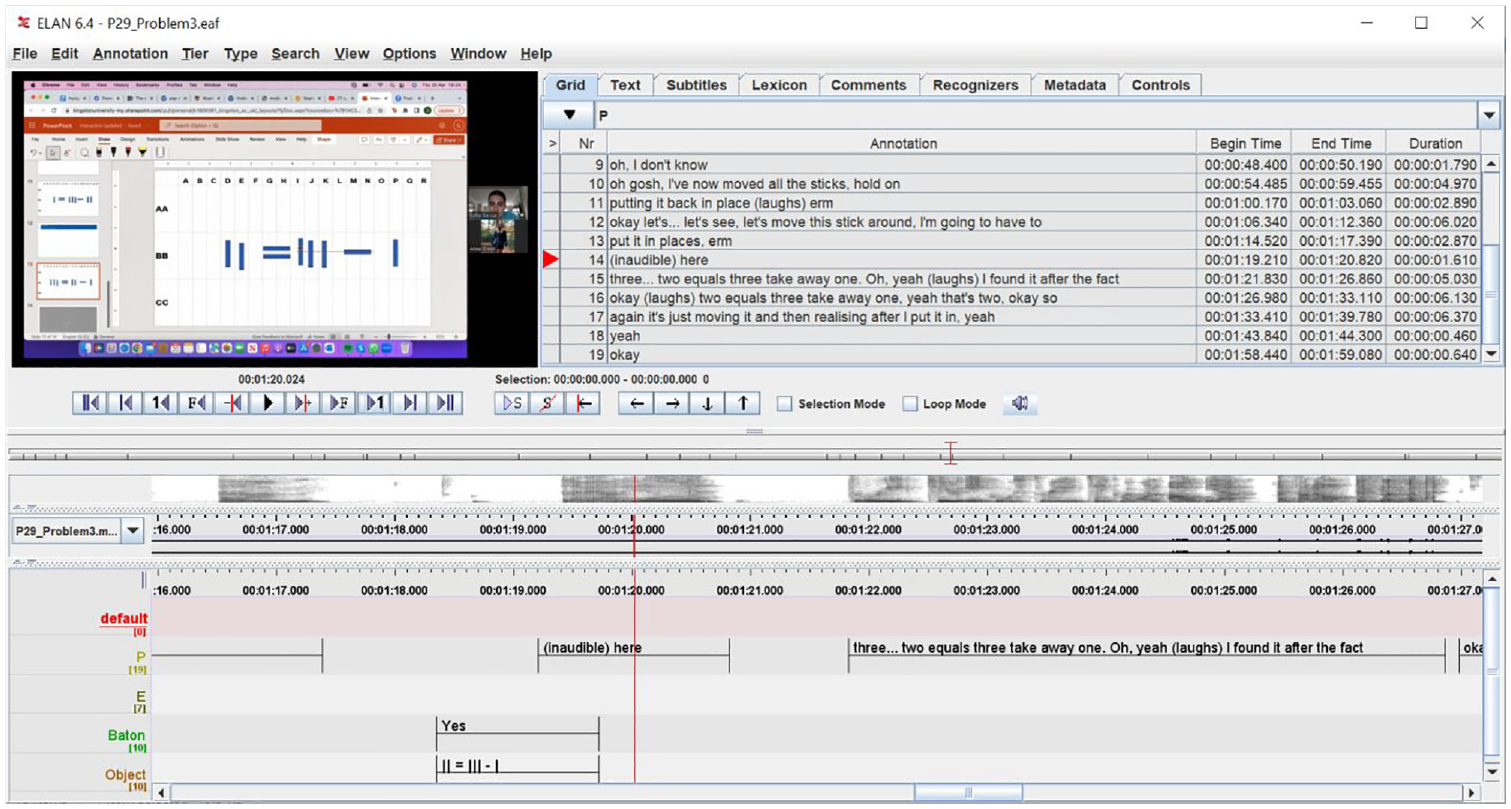
ELAN screenshot of the creation of the correct configuration; it is not predicated by a strategy. It is discovered by exploration, and the realisation that the problem is solved only occurs as the correct configuration is read out. The full ELAN video can be accessed on the OSF.
It is only when P29 reads out the object-change that she realises that she has constructed the solution. Problem 3, like Problem 2 is a clear case of outsight, of the post hoc kind.
81.83: three... two equals three take away one. Oh, yeah (laughs) I found it after the fact 86.98: okay (laughs) two equals three take away one, yeah that's two, okay so 93.41: again it's just moving it and then realising after I put it in, yeah.
Discussion
The participant in this case study discovered the solution to each of the three problems, but not easily, and never through mental simulation of the answer. During each of the three problems, the participant experienced an impasse (a conceptual one, but not one that led to a cessation of exploratory behaviour), and the solution was constructed through a systemic, human/non-human interaction. The new idea that led to the solution was discovered in the world, not in the participant’s head. This finding has significant implications for understanding problem-solving because it means that the restructuring necessary to reveal the solution of the problem is not buried in the unconscious workings of the mind but is visible in the transforming configurations of a bunch of sticks.
On seeing the first problem, the participant was not even clear about what needed to be done, nor understood the one-stick constraint. Once the nature of the task was better appreciated, the first problem was quickly solved, not by a flash of insight but through the movement of a stick that happened to pay off: the new configuration revealed the answer. There is some evidence from the post-solution interview that the movement and solution coincided, resembling the type of outsight we are calling enacted.
Problem 2 required nearly 4 minutes of work before it was solved. Here the verbal protocol is richer, revealing the hypotheses and strategies that guided the exploration and from them we see that the participant never anticipates the fruitfulness of these hypotheses before transforming the object. The equal sign attracted attention, but the participant does not or cannot articulate why or whether she thinks intervening there holds the solution. The protocol also reveals that the participant identified that dismantling the plus operator might be the route to the solution (which it was) but again does not specify how or why it might be. The loosening of a constraint, as Knoblich et al. (1999) call it, is enacted here through a relatively unsystematic process of elimination by exploration: The plus operator is eventually deconstructed, but the participant has no clear idea of the consequence of doing so. Her approach was quasi-strategic but she never predicts specifically what the outcome of the exploration might yield. This is supported by the spontaneous display of surprise, joy and relief that she expresses only after the transformed object reveals the solution; a clear demonstration of post hoc outsight.
As for Problem 3, while the participant expresses a feeling of being at a loss for ideas and strategies, she nonetheless explores changes to operators and operands despite the absence of specific predictions concerning the consequences of these actions. The correct configuration is constructed and the realisation that the problem is solved follows rather than precedes the movement which, like Problem 2, indicates post hoc outsight.
The detailed coding of the video using the ELAN platform provided two data streams: The verbal protocol and the changes to the object qua model of the solution. What is also particularly important is their temporal juxtaposition, as illustrated in the transcript and in Figures 5 to 7. Consider, for example, the influential paper by Fleck and Weisberg (2013). They obtained verbal protocols while participants worked on five different insight problems. Some of these problems were presented with artefacts which participants could use to model the solution (e.g. the triangle of coins problem). Fleck and Weisberg used the protocols to identify strategies, hypotheses and moments of impasse, as well as to trace instances of restructuring. But, as they did not video record their participants interacting with the artefacts, their analysis could not proceed – as ours could – by closely intersecting changes in the artefact with the process of thinking, as revealed by the participants’ verbal protocol.
Dialogue with the experimenter
Verbal protocols have methodological strengths and weaknesses, and it is important to consider the implications of how they were used in this case study, and to reflect on the nature of the post-solution interview questions that were posed to better understand the participant’s explanation of how she solved the problem. The verbal protocols and the manner with which they were elicited during the problem-solving session are more like what Ericsson and Simon (1998) call a Level 3 type, that is ‘socially directed speech’ with a present or imaginary interlocutor. The exact cognitive mechanisms that undergird the formulation of a strategy was not the focus of our work, and our aim by collecting these verbal protocol data was to identify one of three solution processes, analytic, outsight, and insight. If anything, such Level 3 verbal protocols may have even mitigated the manifestation of outsight, by encouraging a more analytic way of solving the problem. As Ericsson and Simon (1998, p. 182) write ‘(…) when participants are asked to describe and explain their thinking, their performance is often changed—mostly it is improved’.
The reviewers of a previous version of this manuscript expressed concerns that the post-solution interview questions were leading the participant to propose what we called an outsight process. However, after the solution of Problem 1, the experimenter’s first question was ‘did you get the solution before you moved it?’. This question might have encouraged the participant to claim that the solution preceded the movement. And indeed she agrees, but then corrects herself without the experimenter prompting her to do so. The participant says (in words that suggested an enacted outsight) ‘but it was pretty much at the same time, it was just as I was reading it out’. The experimenter did not press or push her to express herself in this manner, and if anything, the experimenter’s first question encouraged a more traditional ‘idea first, movement second’ which this naïve participant actually corrects, describing an enacted form of outsight. Note also the experimenter’s question after the solution to Problem 2: ‘What happened there?’, a question that is carefully neutral.
There remains a possibility that the participant might have guessed that the experimenter was particularly interested in outsight as a solution process, and that her problem-solving behaviour for Problems 2 and 3 was guided by a desire to please the experimenter and confirm that expectation. This line of reasoning suggests that the participant would have implicitly (or consciously) engaged with the task such as to recreate an outsight solution process, that in fact she solved Problems 2 and 3 in her head, but then pretended to engage in fruitless quasi strategic explorations, then created the solution physically and then faked the relief and acknowledgement that she created the solution without fully realising that she had done so, in order to please the experimenter and confirm the researcher’s hypothesis. This interpretation of the video evidence is implausible: the genuine protracted impasse for Problem 2, the self-deprecating comments, the stubborn application of unproductive strategies, the emphatic relief from recognising the correct configuration once it was produced, all attest to a participant genuinely engaging with a task and struggling to discover the answer and experiencing genuine positive affect from the breakthrough.
Conclusion: On the origin of a new idea
The detailed qualitative analysis we offer provides a clear view of how a new idea develops and reveals the restructuring process that evinced it. A post-cognitivist account is not a non-cognitive one: To be sure, people have hazy hunches or sharper ideas, and they can articulate them. There might also be interesting individual differences that moderate people’s engagement with the task and their ability to articulate hypotheses and formulate strategies. For example, engagement with numerical insight problem might be moderated by maths anxiety, or creative self-efficacy more generally (e.g. Karwowski & Lebuda, 2017).
Verbal protocols give us access to the content of the participant’s thinking, her hunches and doubts. And by charting the transformation of the object we illustrate how changes to it guide and inform the participant’s thinking. Ross and Vallée-Tourangeau’s (2021) kinenoetic perspective is relevant here: knowledge obtained through the movement of an object in time and space. The object is a ‘gnomon’ of sorts, to adapt Serres (1989), an object that is a source of knowledge and the basis of inferences and actions (see also Latour, 2007). In contrast, cognitivist accounts of creative problem solving are generally hylomorphic in nature (Ingold, 2010). That is a change in the object, here the model of the solution, is preceded by a change in an internal mind: the starting assumption of these models is that a solution is physically implemented on the basis of an idea, the causal directionality here goes from mind to matter. Such hylomorphic accounts are simply blind to the phenomenon of outsight as documented in the case study reported here.
Theories and methods are co-determined; methodologies are designed to test and validate certain theoretical assumptions. In this respect, methodologies are performative, they enact certain phenomena and other others (Law, 2004). Outsight is othered or rendered invisible if the methodology employed to investigate creative problem solving does not permit interacting with an object. We are not arguing that creative problem solving without interactivity – what Vallée-Tourangeau and March (2020) refer to as second order problem solving – is impossible or theoretically irrelevant. Clearly people can make plans and have thoughts without the support of 3D models or pen and paper and that type of internal planning can and must only be explained in terms of internal mental processes. However, what we question is whether such second-order, non-interactive procedures are representative of the majority of everyday problem-solving situations that people find themselves tackling outside the psychologist’s laboratory. Our case study demonstrates a situation in which mental processes are not simply scaffolded or augmented through the manipulation of external representations, they are transformed by them (Kirsh, 2010). If, as we are suggesting, objects format and authorise much of real-world thinking then a psychology of problem solving that ignores the transactional nature of the object-mind co-constitution, a psychology that shuns what Malafouris (2020) calls ‘thinging’, soon paints itself in a corner of irrelevance. To make room for the constitutive role of objects and yet maintains the primacy of ideation decoupled from the world yields a science of the mind akin to the Ptolemaic retrograde epicyles necessary to account for the movement of celestial bodies.
Footnotes
Appendix
Acknowledgements
We thank Michael Hanson and two anonymous reviewers for their thoughtful comments on a previous version of this manuscript.
Declaration of conflicting interests
The author(s) declared no potential conflicts of interest with respect to the research, authorship, and/or publication of this article.
Funding
The author(s) received no financial support for the research, authorship, and/or publication of this article.