



Abstract
The transition to green hydrogen offers a critical opportunity for Ghana to achieve its decarbonisation and sustainable energy objectives. However, its widespread adoption faces significant barriers. This study seeks to identify, prioritise, and propose strategies to overcome these barriers through an integrated multicriteria decision-making (MCDM) framework tailored to Ghana's context. The methodology combined a systematic literature review with expert consultations. The CRITIC method was applied to derive objective weights for barriers. Thereafter, four MCDM techniques, namely, TOPSIS, EDAS, MOORA, and COPRAS, were employed to rank strategies. These methods were deliberately selected since each method captures distinct dimensions of decision-making. Integrating multiple techniques enhanced the robustness and reliability of rankings by allowing cross-validation of results. The final rankings were validated using Spearman's correlation and T-statistic, ensuring statistical consistency across methods. The results highlight barriers such as limited international collaboration, inadequate financing options, and public acceptance challenges. Conversely, prioritised strategies include infrastructure development, training local expertise, and implementing financial incentives. These findings emphasise the importance of strategic infrastructure and capacity building investments to unlock Ghana's green hydrogen potential. The study provides actionable insights for policymakers, emphasising the need for clear regulations, robust incentives, and international collaboration. Addressing these barriers can facilitate the adoption of green hydrogen and position Ghana as a leader in sustainable energy innovation. These strategies align with Ghana's energy transition targets and present an opportunity to bolster economic growth and reduce carbon emissions.
Keywords
Introduction
Green hydrogen adoption has attracted global attention due to the urgent need to decarbonise energy systems (Chowdhury et al., 2025) and mitigate climate change (Elegbeleye et al., 2025). Recognised as a clean and versatile energy carrier, green hydrogen has the potential to revolutionise the energy sector (Akpasi et al., 2025). The “green” designation indicates that renewable energy resources power the technology and emit no carbon during production. Typically, green hydrogen is generated via water electrolysis, a process that electrochemically splits water into its basic constituents hydrogen and oxygen, using an electric current (Amini Horri and Ozcan, 2024).
Hydrogen itself can be classified into the following colour categories: green, blue, aqua, white, grey, brown, black, yellow, turquoise, purple, pink, and red depending on the production process, energy source, production costs, and associated emissions (Arcos and Santos, 2023). However, global hydrogen production depends mainly on fossil fuels (Szablowski et al., 2025). Using fossil fuels defeats Sustainable Development Goal 7, emphasising the need for clean energy. From this perspective, green hydrogen stands out above all other types, warranting adoption across multiple fields of application.
In practice, hydrogen finds use in multiple sectors: it powers fuel cell vehicles (Agyekum et al., 2024), generates electricity for grid storage (Risco-Bravo et al., 2024), supports ammonia production for fertilisers (Pagani et al., 2024), and enables the creation of synthetic fuels (Alsunousi and Kayabasi, 2024). Within industry, hydrogen is integral to steel production, glass manufacturing, and chemical processing (Fragapane et al., 2024; Shen et al., 2024). Its clean-burning properties make it essential for decarbonising heavy industry and the transportation system.
Despite these benefits, significant barriers hinder the widespread adoption of green hydrogen. Among these challenges is the high capital cost of establishing green hydrogen production plants (Al-Ghussain et al., 2023). Additional obstacles include limitations in scaling up production, the lack of robust hydrogen transportation and storage infrastructure, and shortages of skilled personnel to operate and maintain hydrogen facilities (León et al., 2023; Müller et al., 2023; Vives et al., 2023).
Globally, various strategies are being implemented to accelerate hydrogen deployment. These include national hydrogen strategies, targeted investments and funding, international alliances and agreements, standardisation and certification protocols, and supportive government incentives and regulations. For example, the European Union aims to establish an open and competitive hydrogen market by 2030. This plan targets installing at least 6 GW of green hydrogen electrolysers by 2024, to produce 1 million tonnes of green hydrogen. The strategy's second phase, running between 2030 and 2050, envisions the development of 100 MW electrolysis plants near major hydrogen demand centres (De Tommasi and Lyons, 2022).
In Africa, green hydrogen adoption efforts are progressing steadily, though at a slower pace than developed regions. Five countries, Algeria, Egypt, Morocco, Namibia, and South Africa have developed comprehensive green hydrogen strategies (Dickie and Wardell, 2023). According to Lahnaoui et al. (2025), South Africa, Lesotho, Ghana, Nigeria, Angola, and Namibia have unique strengths and challenges for green hydrogen development. Establishing such economies requires region-specific strategies and strong inter-country cooperation. Namibia recently signed a $10 billion contract with German company Hyphen Energy to produce green hydrogen (Angula, 2023).
Within the West African context, regional studies reveal specific opportunities and challenges. For example, Odoi-Yorke et al. (2025) explored solar PV and wind-based green hydrogen projects across the Economic Community of West African States (ECOWAS) region. The findings identified Niger, Mali, and Cape Verde as the most promising countries due to high renewable energy resources and lower levelized costs of hydrogen. Winkler et al. (2025) conducted participatory mapping of local green hydrogen cost potentials in Sub-Saharan Africa (SSA). The results show that hydrogen production costs could start at €1.6/kg in Mauritania, with about 259 TWh/yr producible at under €2/kg by 2050. However, two-thirds of the region would require desalination due to groundwater limitations, and socio-economic barriers such as limited energy access, low labour costs in West Africa, and varying labour potential could hinder deployment in certain areas.
Ghana has the potential for green hydrogen development. A recent study by Asare-Addo (2023) revealed that about 85% of the country's land is suitable for green hydrogen projects, with the potential to generate 14,196 Mt/yr of hydrogen via solar energy and 10,123 Mt/yr via wind energy. Osei et al. (2024) found that the current levelized cost of hydrogen is about $9.49/kg, comparable to other SSA estimates, but projected to decline to $5–6.5/kg by 2030 and $2-2.5/kg by 2050, positioning solar PV-based green hydrogen as a competitive alternative to fossil fuel-based hydrogen for Ghana's clean energy future. Tanyi et al. (2024) revealed that centralised biomass gasification offers the lowest hydrogen cost at $2.68/kg and centralised and distributed proton exchange membrane electrolysis cost $4.35/kg and $5.56/kg respectively, in Ghana. In the work of Odoi-Yorke et al. (2024), the authors found that solar PV-based green hydrogen for cooking is about 89% more expensive than electricity, 155% more than liquified petroleum gas, and 190% more than charcoal in Ghana. Mensah et al. (2025) found that a solar PV mini grid can produce about 609.26 kg of hydrogen annually using redundant solar energy in Ghana.
The Government of Ghana has demonstrated a strong commitment to energy transition and decarbonisation objectives. Under the United Nations Paris Agreement, Ghana committed to increasing energy access and renewable energy use and reducing absolute greenhouse gas emissions by 64 MtCO2e by 2030 (Ahakwa et al., 2023). In addition, the government's recently published national energy transition plan aims to power over 70% of road vehicles with electricity and hydrogen fuel by 2050, with all road and rail mobility powered by electricity and hydrogen by 2070 (Ghana Ministry of Energy, 2022). These ambitious targets position green hydrogen as essential for achieving the country's sustainable development objectives. Nevertheless, various technical, economic, regulatory, and societal barriers could hinder Ghana's adoption of green hydrogen technologies. Therefore, identifying and addressing these barriers is essential to unlocking the potential benefits of green hydrogen for the country's energy sector.
Multicriteria decision-making (MCDM) approaches are commonly employed in the literature to analyse various aspects of green hydrogen adoption, production, and infrastructure. For instance, Trivedi and Gharib (2023) used the Decision-Making Trial and Evaluation Laboratory approach to identify key challenges in the green hydrogen sector. Dixit et al. (2024) employed the Fuzzy Interpretive Structural Modelling approach to identify and analyse the barriers hindering the adoption of green hydrogen in India's transportation sector. Sahebi et al. (2025) applied fuzzy Best Worst Method (BWM) to analyse key challenges associated with Mexico's green hydrogen supply chain. The work of Hosseini Dehshiri et al. (2025) used hybrid fuzzy methods of BWM and Combined Compromise Solution to prioritise the key challenges of hydrogen storage systems. Similarly, spatially integrated MCDM-Geographic Information System frameworks have been used to identify optimal sites for green hydrogen hubs in India (Thekkethil et al., 2024), solar-driven hydrogen production in Tunisia (Rekik and El Alimi, 2024), Morocco (Taoufik and Fekri, 2023), and Thailand (Ali et al., 2022), as well as hybrid solar-wind systems for hydrogen in Cameroon (Fotsing Metegam, 2025).
However, comprehensive MCDM-based analyses of green hydrogen adoption barriers and strategies remain notably absent for Ghana and the broader West African region. The unique socio-economic, technological, and institutional contexts of developing countries in SSA, characterised by different energy access patterns, financial constraints, infrastructure limitations, and governance structures, necessitate region-specific approaches that cannot be directly extrapolated from studies conducted in developed or other emerging economies. The green hydrogen context in Ghana differs from more commonly studied regions in several critical aspects. The country's energy system is characterised by rural-urban inequalities in electricity access, dependence on traditional biomass for cooking, and potential for decentralised renewable energy solutions that differ from centralised approaches common in developed nations. Furthermore, Ghana's position within the broader West African economic and political landscape offers unique opportunities for regional cooperation and export potential that are absent in landlocked countries. The interplay between domestic energy needs, regional integration through ECOWAS, and potential international export partnerships creates a complex decision-making environment requiring analytical approaches.
In this context, the study's main contribution lies in its contextual relevance and application of a structured decision-making model tailored to Ghana. This distinction is significant because, though numerous MCDM-based studies have been applied in developed and emerging economies, very few address the realities of SSA, where socio-economic, infrastructural, and governance conditions differ substantially. By situating the analysis within Ghana's unique energy transition pathway, this study fills a critical regional knowledge gap in the green hydrogen literature and provides a framework that aligns international methodological rigour with local applicability.
To address these identified gaps, this study represents the first comprehensive application of integrated MCDM to prioritise barriers and propose practical strategies for developing Ghana's green hydrogen sector. The main contributions include: (1) identifying and categorising key barriers and proposing effective strategies tailored to Ghana's green hydrogen adoption context; (2) prioritising these barriers and strategies using integrated MCDM methods adapted for the Ghanaian context; and (3) validating the prioritised barriers and strategies using correlation tests and T-statistic to ensure methodological rigour.
The study findings provide crucial insights for stakeholders, policymakers, and investors developing Ghana's green hydrogen sector to consolidate efforts and achieve sustainable energy transition objectives. This study contributes to the limited body of knowledge on green hydrogen development in SSA and provides a methodological framework that can be adapted for similar developing country contexts. The remaining parts of the study are outlined as follows:
Research methodology
This section highlights the methods used to conduct this study. The study approach comprises three stages, as shown in Figure 1. Stage 1 comprises the identification of barriers and strategies. This is done by conducting a thorough literature review to gather information on potential barriers and strategies for green hydrogen development. In addition, it involves discussion with experts to refine the identified barriers further and determine strategies to overcome them. The output of this stage is a final list of barriers and strategies. Stage 2 is the application of MCDM methods. In this stage, the identified barriers are analysed using the criteria importance through intercriteria correlation (CRITIC) method to determine their weights or relative importance. Thereafter, various MCDM methods like the technique for order of preference by similarity to ideal (TOPSIS), evaluation based on distance from average solution (EDAS), multi-objective optimisation on the basis of ratio analysis (MOORA), and complex proportional assessment (COPRAS) are employed to rank the strategies based on their weights from CRITIC. Stage 3 focuses on validating the rankings obtained using statistical tests. The rankings obtained from the MCDM methods in Stage 2 are further validated using a rank correlation test. In view of this, Spearman's correlation coefficient is calculated to measure the degree of agreement between the rankings from different MCDM methods. Also, a t-statistic test is performed to evaluate the significance of the correlation coefficient. The final output is a validated set of optimal rankings for the strategies related to green hydrogen development in Ghana.

Framework illustrating the study approach for evaluating barriers and strategies to green hydrogen development in Ghana.
Data collection
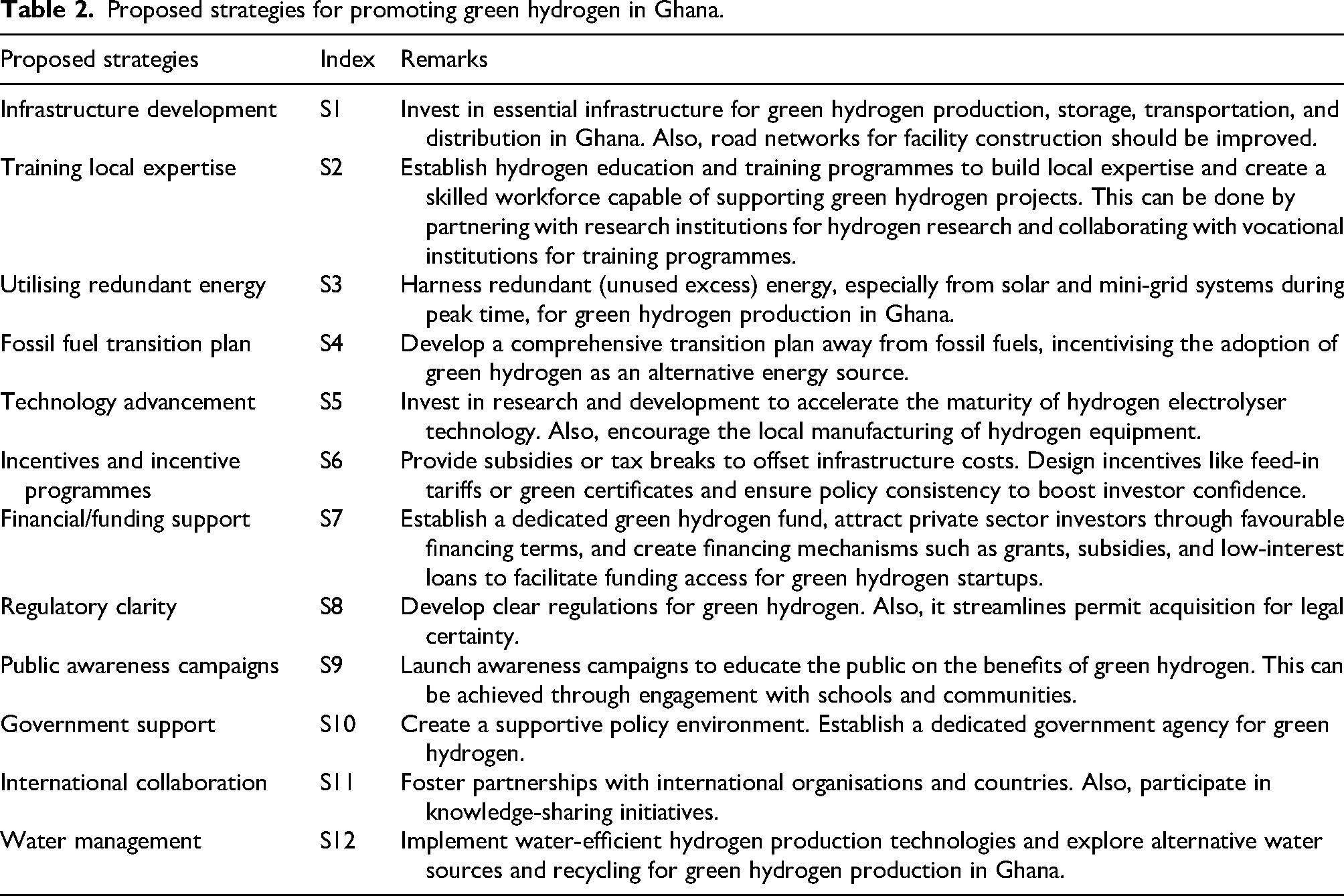
This study combined a comprehensive literature review and expert interviews to identify and categorise potential barriers and strategies for green hydrogen development in Ghana. The authors designed a questionnaire and sent it to 10 experts in Ghana (Academia = 3, Non-profit organisations = 2, Industry professionals and practitioners = 2, Government agencies or regulatory bodies = 3) with significant knowledge of green hydrogen to rank the potential barriers and strategies identified. The experts ranked the barriers to each strategy on a 5-point Likert scale, with 5 being very high and 1 being very low. It is significant to point out that discussion with experts is crucial, but expert opinions can sometimes be biased or limited by their individual experiences and perspectives. Therefore, identified barriers, sub-barriers, and strategies may be influenced by the experts’ own biases and assumptions, which could potentially skew the results. Consequently, to guarantee the strength and reliability of the conclusions drawn, the study employed various MCDM methods in the decision-making process. Table 1 presents the identified barriers. The strategies proposed are also presented in Table 2.
Salient barriers identified for evaluating green hydrogen development in Ghana.

Proposed strategies for promoting green hydrogen in Ghana.
Multicriteria decision-making (MCDM) methods
This section outlines the MCDM methods employed, including CRITIC, EDAS, TOPSIS, MOORA, and COPRAS, to prioritise the barriers and strategies. This study adopted multiple MCDM methods due to the following reasons: (i) to increase the complexity of the decision-making process, as each method may have different assumptions (Haddad and Sanders, 2018); (ii) to produce divergent results, as each method may prioritise different alternatives (Cinelli et al., 2020); and (iii) to improve the robustness of the decision-making process (Alshamsi et al., 2023). The proposed hierarchy for prioritising Ghana's barriers and strategies for green hydrogen development is shown in Figure 2. Sections 2.2.1 to 2.2.5 highlight the detailed description and optimisation processes that each MCDM method adopts to rank alternatives.

Proposed hierarchy for prioritising Ghana's barriers and strategies for green hydrogen development.
CRITIC method
The CRITIC method is an objective weighting method used in MCDM problems. It determines objective weights for criteria based on the statistical variance of the data (Adalı and Işık, 2017; Diakoulaki et al., 1995). CRITIC weights criterion with higher contrast intensity and conflicts with other criteria more. This aspect makes the CRITIC method suitable for many real applications (Krishnan et al., 2021). The CRITIC technique uses
TOPSIS method
TOPSIS is used to evaluate the performance of alternatives through their similarities with the ideal solution (Liang et al., 2023). TOPSIS chooses the alternative closest to the positive ideal solution and farthest from the negative ideal solution. The positive ideal solution is formed as a combination of the best points of each criterion. In contrast, the negative ideal solution combines the worst points of each criterion (Uzun et al., 2021). TOPSIS is easy to apply, universal, and considers distances to an ideal solution. Equation (A6) to Equation (A12) are adopted in the TOPSIS approach to rank the strategies (Han et al., 2025; Odoi-Yorke et al., 2022a):
MOORA method
MOORA is used for material selection, decision-making, and solving optimisation problems with multiple objectives. It involves optimising two or more conflicting criteria (objectives) under certain constraints (Karande and Chakraborty, 2012). MOORA uses ratio analysis to rank alternatives based on their performance against multiple criteria (Thakkar, 2021). It is a simple, easy-to-implement method involving the fewest computational steps (Chakraborty et al., 2023). The MOORA method applied
EDAS method
EDAS is a versatile method that can be applied in different domains for evaluation, selection, and ranking purposes. It uses a distance-based measurement approach that determines the ranking score based on average solution-based distance rather than well-known measures such as Euclidean distance (Phan and Nguyen, 2022; Zhang et al., 2019). The EDAS method applies
COPRAS method
COPRAS is one of the most commonly applied methods, which ranks available choices based on their performance in multiple criteria (Patil et al., 2022). It is a preference ranking method that assumes direct and proportional dependence on priority. It accommodates the direct and proportional dependence of the significance and utility degree of the available choices. The COPRAS method adopts equation (A23) to equation (A27) to rank alternatives (Odoi-Yorke et al., 2022b):
Spearman correlation coefficient, t-statistic test, and p-value
The Spearman correlation coefficient is applied to evaluate the strength and direction of the monotonic association between ranks for each pair of techniques. At the same time, the T-statistic determines if the correlation coefficient is significant, and the p-value determines the significance. A statistically significant correlation is shown by a p-value < 0.05. The rank correlation coefficient is computed using equation (1)

The p-value was calculated using the t-distribution (TDIST) function in Microsoft Excel. The TDIST function takes three arguments: t, df, and x*, where x* represents the number of tails in the distribution, df represents the degrees of freedom, and t represents the T-statistic.
Results and discussions
This section presents the results obtained and discusses their significant implications. It prioritises the barriers and proposes strategies for green hydrogen adoption and development in Ghana. In addition, it provides recommendations for policymakers, stakeholders, and investors on promoting green hydrogen adoption for Ghana's energy transition.
Potential barriers to hinder green hydrogen adoption and development in Ghana
The study's first stage was to systematically identify potential barriers hindering green hydrogen adoption and development in Ghana. In view of this, 28 sub-criteria (sub-barriers) categorised under 6 criteria (main barriers) were identified as potential barriers after a comprehensive literature review combined with expert consultations (Table 1). Table 3 presents the ranking of the barriers based on the CRITIC method. In light of this, equation (A2) was used to compute the barriers’ standard deviation. Also, the quantity of information (Cj) for each barrier was computed using equation (A4). Finally, equation (A5) was applied to determine each barrier's weight and rank the barriers afterwards.
Prioritised barriers to green hydrogen adoption in Ghana.

The barrier total weight is 1, as shown in Table 3. It can be seen that the weight distribution among the barriers is nearly equal to each other and also comparable to the average weight, as shown in Figure 3. For instance, the difference between the highest and lowest weights is about 0.031. The fact that the variation of weights among barriers is nearly equal suggests that experts consider the barriers identified as equally important. This implies that the experts are not heavily biased towards one specific barrier and are trying to strike a balance between various factors. The relatively small difference between the highest and lowest weights indicates that changes in the criteria's relative importance may not dramatically impact the overall decision. In some cases, this could be seen as a positive attribute, as minor adjustments to the criteria might not lead to significant shifts in the decision outcome.

Distribution of weight among barriers.
It is worth mentioning again that the CRITIC method ranks the barriers based on their weight. The barriers descending order of rank is as follows: B28 > B10 > B22 > B8 > B23 > B27 > B24 > B14 > B13 > B9 > B20 > B4 > B19 > B17 > B16 > B26 > B6 > B18 > B21 > B15 > B7 > B2 > B3 > B5 > B11> B25 > B1 > B12. This ranking indicates that the top 10 barriers that could hinder the adoption and development of green hydrogen are lack of international collaboration (B28), limited funding and financing options (B10), public awareness (B22), lack of credit facilities (B8), public acceptance (B23), lack of government support (B27), skilled workforce (B24), market development (B14), global supply chain dependencies (B13), and high capital investment (B9).
Potential strategies to promote green hydrogen adoption and development in Ghana
This section discusses the results obtained from each MCDM method. Besides, it highlights the performance of each strategy based on the MCDM method applied. The optimisation outcome from the TOPSIS method is presented in Table 4. equation (A10) and equation (A11) were applied to compute the
Strategies ranking from the TOPSIS method.
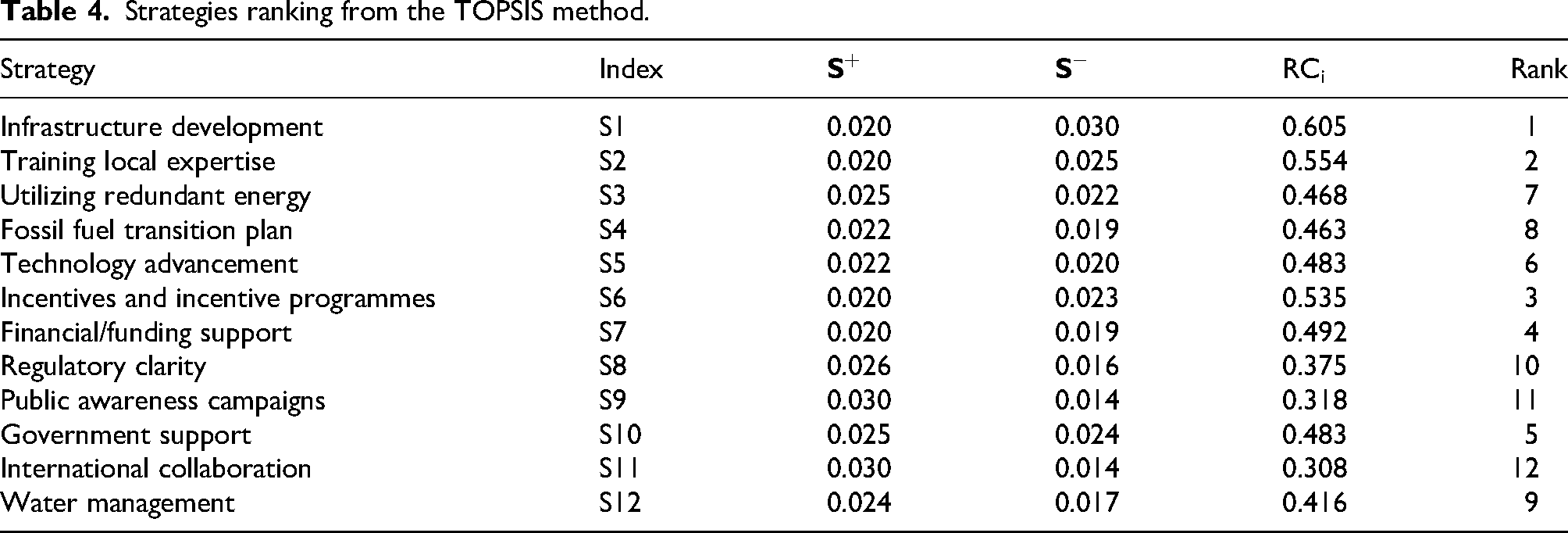
The optimisation outcome based on the EDAS method is presented in Table 5. Equation (A18) and equation (A19) were used to compute the SPi and SNi values, respectively. The SPi and SNi values were adopted in Equations (20) and (21) to estimate the NSPi and NSNi values, respectively. The performance score ASi used to rank the strategies was estimated using equation (A22). The ASi score indicates that the top five strategies are S1, S2, S6, S7, and S10. This result is consistent with the findings reported by TOPSIS.
Strategies ranking from the EDAS method.

The performance of each strategy based on the MOORA method is presented in Table 6. The assessment score used to rank the strategies was estimated using equation (A14). The final ranking of the strategies is as follows: S1 > S2 > S6 > S10 > S7 > S4 > S5 > S3 > S12 > S8 > S9 >S11. The top five strategies obtained by MOORA are comparable to the ones obtained by TOPSIS and EDAS. The COPRAS method used equation
Strategies ranking from the MOORA method.

Strategies ranking from the COPRAS method.

Validation of rankings
Figure 4 summarises the ranks obtained by each strategy based on the MCDM methods used. It can be noticed that some strategies’ ranks are similar to those of other MCDM methods and vary with other methods. For instance, S3 ranks seventh in the TOPSIS method but eighth in the other MCDM methods. Also, S5 ranks sixth in the TOPSIS method but seventh in the other methods. Likewise, S7 ranks fourth in TOPSIS and EDAS but fifth in MOORA and COPRAS. In this context, the study conducted statistical tests such as correlation coefficients and T-statistic to solve this inconsistency and validate the final ranks.
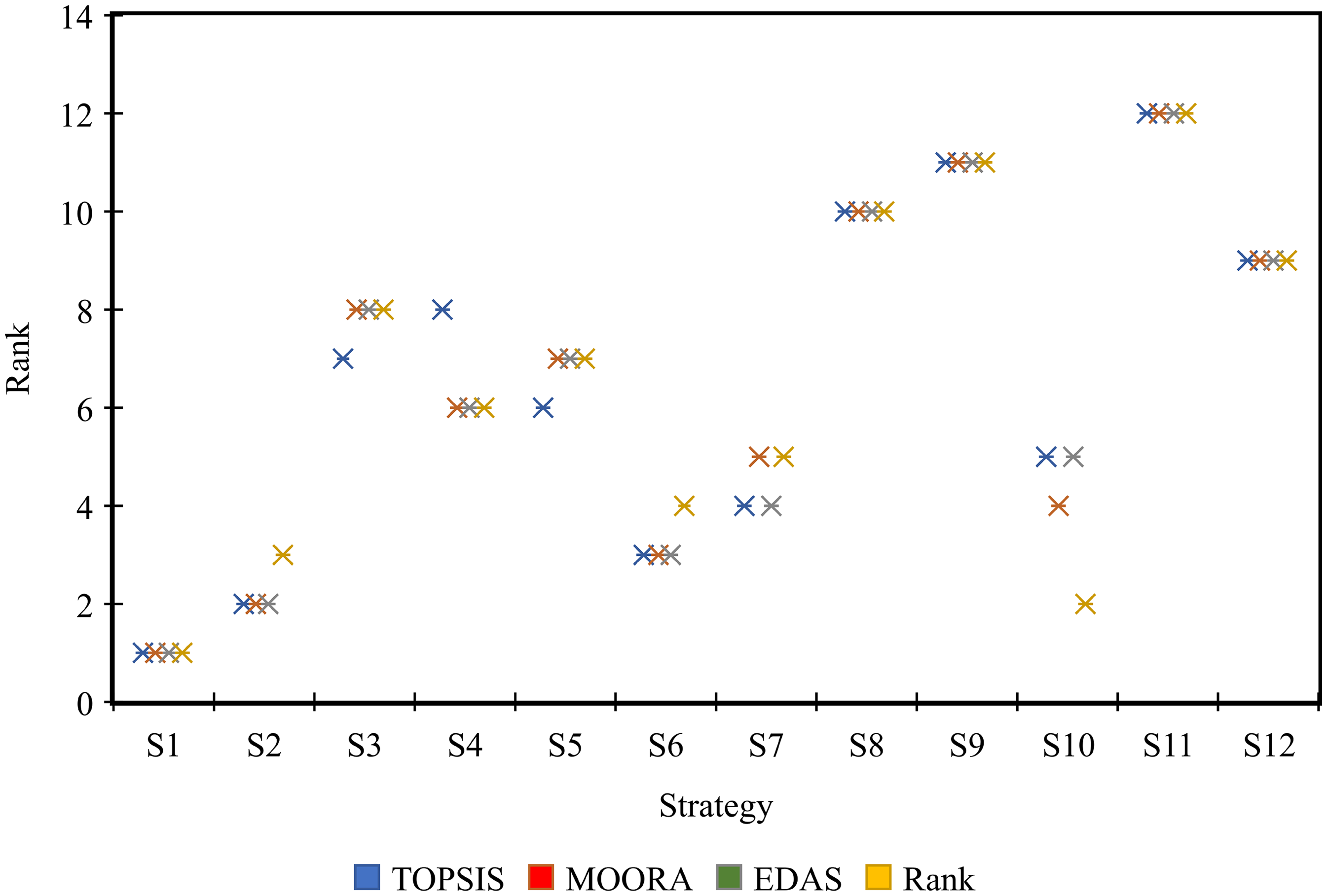
Summary of strategies rankings from MCDM methods.
Statistical test on the performance of MCDM methods.

The strong positive correlation between TOPSIS and MOORA suggests that these methods produce similar results. If one method yields favourable results, the other will likely do the same. Similarly, TOPSIS and EDAS also show a strong positive correlation, indicating their similarity in outcomes. Although MOORA and EDAS are positively correlated, the coefficient is slightly lower, suggesting a somewhat weaker relationship between these two methods than the previous pairs. The coefficient value between MOORA and EDAS implies a strong positive correlation, indicating that these methods yield similar results. MOORA and COPRAS also show a strong positive correlation, indicating their similarity in outcomes. Also, EDAS and COPRAS show a strong positive correlation, suggesting they produce similar results. All the p-values are very small, indicating strong evidence against the null hypothesis. This suggests that the differences between the methods are statistically significant, and the results are unlikely to be due to random chance.
It is worth noting that all the methods are highly correlated based on the coefficient values and p-values, and their differences are statistically significant. However, MOORA and EDAS have the highest coefficient values (0.993). This suggests that these two methods are the most similar in terms of the results they produce. Therefore, the findings from either MOORA or EDAS are validated at the optimal ranking for the strategies. In view of this, S1 > S2 > S6 > S10 > S7 > S4 > S5 > S3 > S12 > S8 > S9 >S11 is chosen as the best ranking for decision-making. This attests to the fact that infrastructure development (S1) has been identified as the most promising strategy for promoting Ghana's adoption of green hydrogen.
Infrastructure development is often the foundation for economic growth and improvement in the quality of life. Investments in green hydrogen infrastructure can stimulate Ghana's economic activity and create jobs. Also, developing green hydrogen infrastructure can help expand energy access, improve energy security, and reduce reliance on fossil fuels (Ashrust, 2023; Yohannes and Diedou, 2022). Similarly, infrastructure development could enable the establishment of a resilient hydrogen supply chain. This includes investing in hydrogen energy infrastructure, such as hydrogen production facilities and storage systems, and developing a comprehensive standards system for hydrogen technologies (Mneimneh et al., 2023). In addition, infrastructure development could facilitate the integration of green hydrogen into the transportation and shipping sectors by providing the necessary infrastructure for refuelling stations and hydrogen-powered vehicles (IEA, 2022).
In several regions, urban pilot projects deploying hydrogen-powered vehicles such as buses, taxis, and municipal fleets have served as practical demonstrations to emphasise the feasibility, reliability, and environmental benefits of hydrogen mobility. Countriea like South Korea, Japan, the United States of America and Germany have introduced limited-scale fleets in public transport systems, supported by visible refuelling infrastructure, to familiarise the public with the technology, reduce perceptions of risk, and highlight improvements in air quality and noise reduction. These initiatives often attract media attention, engage local stakeholders, and provide policymakers with concrete data on operational performance, costs, and maintenance requirements, thereby reducing uncertainty and fostering confidence in larger-scale rollouts. By involving transport authorities, technology providers, and community groups, such pilots create a coalition of support that strengthens the political will to invest in hydrogen infrastructure. For Ghana, implementing similar small-scale, high-visibility projects in urban centres like Accra or Kumasi could help bridge the gap between policy ambition and public acceptance. Demonstrating hydrogen-powered buses on high-traffic routes or integrating fuel cell vehicles into municipal services could not only build public awareness and trust but also provide valuable local performance data to inform regulations, investment decisions, and partnerships. Moreover, these pilots could position Ghana as a regional leader in clean transportation innovation, attracting international funding, fostering local technical expertise, and aligning with national goals for reducing greenhouse gas emissions and urban air pollution.
Integrating hydrogen-powered mobility into Ghana's national energy transition plan target of having over 70% of road vehicles powered by electricity and hydrogen by 2050 (Ghana Ministry of Energy, 2022) requires a coordinated approach that links infrastructure development with the transport sector. Lessons from European and Asian hydrogen strategies, as well as studies such as Turoń (2020) demonstrate that urban public transport and logistics provide a strategic entry point for hydrogen adoption, given their high visibility, structured operational patterns, and contribution to urban emissions. In Ghana, embedding hydrogen refuelling infrastructure within major urban corridors and transport hubs could not only facilitate the gradual integration of hydrogen buses, taxis, and delivery vehicles, but also support broader supply chain development for hydrogen production, storage, and distribution. This would require careful planning for fleet adaptation, including the retrofitting or phased replacement of internal combustion vehicles, investment in maintenance facilities and technician training, and alignment with urban mobility policies.
Hydrogen-powered vehicles can serve as highly visible symbols of decarbonisation, building societal awareness and public acceptance of clean energy technologies, an effect observed in South Korea, Japan, the United States of America and Germany. Moreover, coupling hydrogen transport initiatives with green hydrogen production from excess renewable energy could enhance system efficiency and energy security and reduce lifecycle emissions. Such an integrated approach would make the findings of hydrogen infrastructure planning more directly relevant to ministries responsible for transport, energy, and environment, as well as municipal agencies tasked with smart city development. In Ghana's context, this alignment could accelerate both the decarbonisation of the transport sector and the establishment of a domestic hydrogen economy, positioning the country as a regional leader in sustainable urban mobility.
In addition to broad regulatory clarity (S8) and increased government support (S10), the development of Ghana's hydrogen economy would greatly benefit from the introduction of sector-specific regulations tailored to the transport sector, where hydrogen adoption has the potential to reduce urban emissions and dependence on imported fossil fuels. This includes the establishment of clear, enforceable standards for hydrogen vehicle safety, comprising tank design, pressure tolerance, crash resilience, leak detection, and fire suppression systems, in line with internationally recognised benchmarks such as ISO 19880 for hydrogen refuelling stations (Schneider et al., 2016) and United Nations Economic Commission for Europe regulations for hydrogen-powered vehicless (United Nations, 2023). Equally important is the codification of refuelling protocols to ensure interoperability across infrastructure providers and vehicle manufacturers, thus preventing market fragmentation and ensuring public safety. Integrating hydrogen-powered buses and municipal service vehicles into public procurement frameworks can accelerate fleet transition, create initial demand certainty, and stimulate private sector investment in refuelling infrastructure.
Furthermore, introducing robust certification and licensing mechanisms for hydrogen-powered transport operators would ensure that only qualified service providers operate within the market, improving public confidence and mitigating early-stage operational risks. These targeted measures would create a regulatory bridge between upstream infrastructure development such as electrolyser deployment and refuelling stations, and downstream end-use sectors, enabling a coordinated, demand-driven rollout of hydrogen mobility solutions and ensuring that infrastructure investment is matched by safe, standardised, and reliable end-user adoption.
The findings of this study are comparable to those of similar studies reported across different regions of the world. For instance, identifying lack of international collaboration as the top-ranked barrier aligns closely with recent studies by Shahzad et al. (2026) and Algburi et al. (2025), who emphasised the critical role of international cooperation in overcoming green hydrogen deployment challenges. Similarly, Khasawneh et al. (2025) highlighted international partnerships for technology transfer and market access as essential strategies for Jordan's hydrogen development, reinforcing the global nature of hydrogen economy challenges. The significance of limited funding and financing options and lack of credit facilities in Ghana's context mirrors findings across other studies, including Bolz et al. (2024), who identified flaws in funding systems as primary barriers in Northern Germany, and Komorowski and Grzywacz (2024), who noted financing challenges as obstacles in African countries. This convergence suggests that financial constraints are a universal barrier surpassing geographical boundaries, though the specific manifestations may vary by region's economic development level. The ranking of public awareness and public acceptance barriers in Ghana resonates with Sahebi et al. (2025) findings in Mexico, where uncertainties regarding public acceptance were identified as critical social and policy issues, and Rawat et al. (2024) emphasis on low consumer awareness as a key barrier in India's hydrogen fuel vehicle adoption.
It is worth noting that this study's identification of infrastructure-related barriers, such as a limited skilled workforce, weak market development, and high capital investment, closely aligns with findings reported in international studies. For example, Dixit et al. (2024) identified technological immaturity and inadequate regulatory frameworks as foundational barriers in India's transportation sector, and Khasawneh et al. (2025) highlighted underdeveloped transport infrastructure and gaps in hydrogen storage infrastructure in Jordan. The consistency of infrastructure challenges across diverse geographical contexts from Ghana to Germany (Bolz et al., 2024), India (Rawat et al., 2024), and Algeria (Boudghene Stambouli et al., 2024) underlines the universal nature of these foundational requirements for hydrogen economy development. However, the specific infrastructure gaps vary by region, with Ghana's focus on general infrastructure development contrasting with more specialized concerns in developed economies like Germany's distribution infrastructure limitations.
The strategic prioritisation emerging from this study's MCDM analysis shows significant alignment with global best practices identified in literature. Infrastructure development ranking as the top strategy across all four MCDM methods strongly correlates with recommendations from multiple studies, including (Su et al., 2025) emphasis on infrastructure investments for China's green hydrogen scaling, and (Khasawneh et al., 2025) focus on infrastructure development in grid integration, desalination, and storage systems for Jordan. The second-ranked strategy of training local expertise directly addresses human capital development concerns raised by Bolz et al. (2024) regarding network building and stakeholder enhancement, and aligns with broader capacity-building recommendations found throughout the literature. Ranking of incentives and incentive programmes as the third-ranked strategy resonates with policy recommendations from Evro and Tomomewo (2025), who advocated for tiered subsidies and clear policy support, and Khasawneh et al. (2025) emphasised policy instruments including subsidies and investment guarantees.
Interestingly, though this study ranks international collaboration lowest among strategies, this apparent contradiction with the high ranking of lack of international collaboration as a barrier reflects a nuanced understanding of implementation priorities. The literature suggests that although international collaboration is crucial or long-term success, foundational domestic capabilities must be established first. This interpretation aligns with Dixit et al. (2024) recommendation to prioritise resolving foundational barriers to create positive cascading effects, and Boudghene Stambouli et al. (2024) emphasis on developing techno-economic foundations before widespread deployment.
Policy implications and recommendations
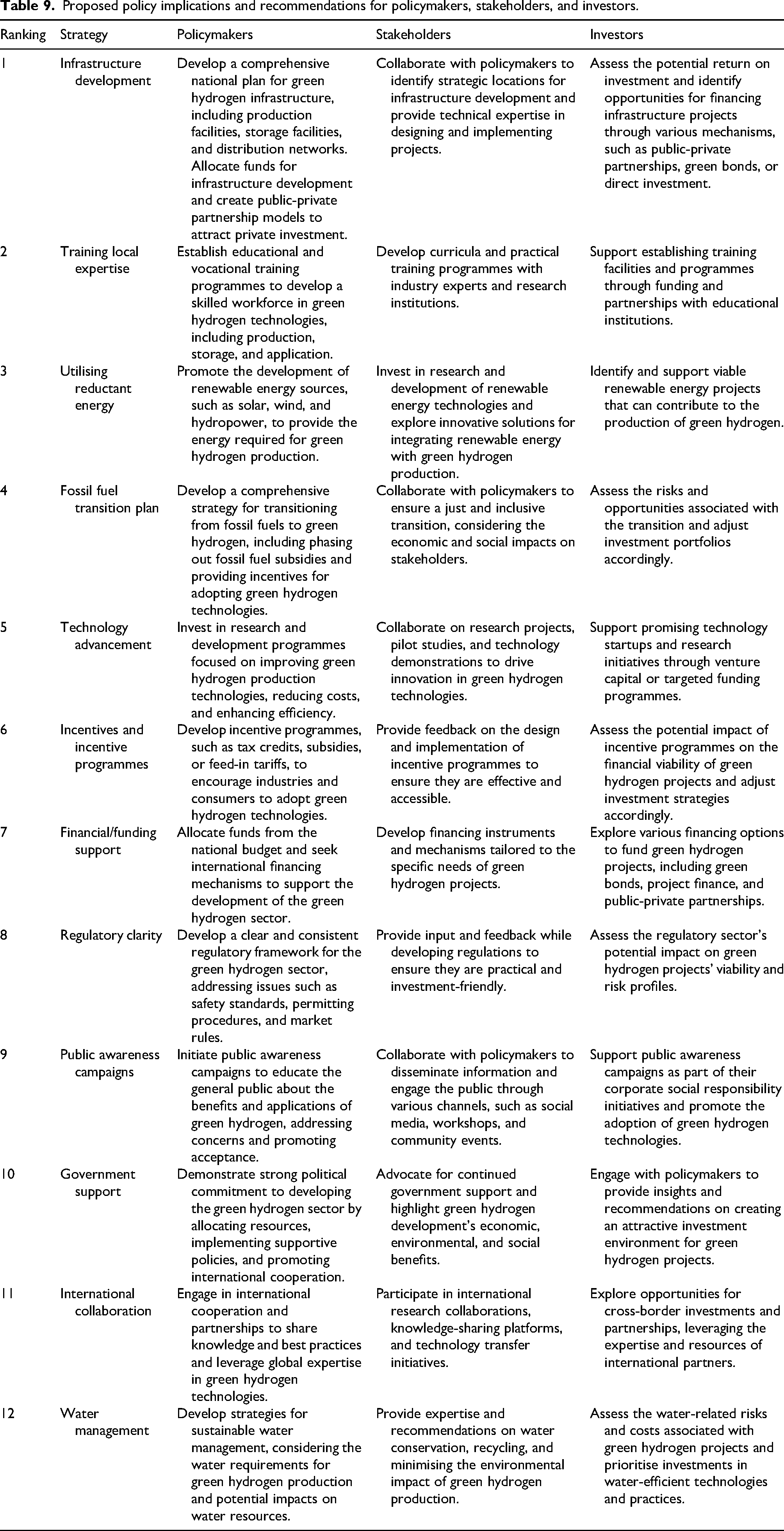
This section highlights the policy implications and recommendations proposed for policymakers, stakeholders, and investors to help develop Ghana's green hydrogen sector (Table 9). The strategic recommendations for green hydrogen development in Ghana can be explicitly linked to the country's existing policy frameworks and institutional structures, demonstrating strong alignment with current energy governance mechanisms. For instance, Ghana's National Energy Transition Framework, launched in 2023, provides the main policy framework for transitioning to cleaner energy sources (Ghana Ministry of Energy, 2022; Sefa-Nyarko, 2024). This directly supports recommendations for infrastructure development, fossil fuel transition planning, and government support strategies. Likewise, the Energy Commission of Ghana, which regulates and manages the development and utilisation of energy resources, has already developed the Ghana Renewable Energy Master Plan (Energy Commission, 2019) that aligns with recommendations for utilising renewable energy and training local expertise through its mandate to ensure affordable energy supplies are reliably and efficiently.
Proposed policy implications and recommendations for policymakers, stakeholders, and investors.
Similarly, the Ministry of Energy's recent approval of a $3.4 billion renewable energy programme (Antwi, 2025) shows institutional commitment to infrastructure development and financial support recommendations, as well as the Ministry's expressed policy to promote green hydrogen in the long term and encouragement of research institutions to engage in this area (Export Initiative, 2024) directly supports technology advancement and public awareness campaign strategies. The regulatory clarity recommendation finds a foundation in Ghana's existing energy regulatory framework, which is managed by the Energy Commission, which has established Power Purchase Agreements with distribution utilities, the Electricity Company of Ghana, and Northern Electricity Distribution Company for renewable energy integration. Current renewable energy projects, including solar PV plants by BXC Company Limited and VRA, demonstrate existing mechanisms for private sector engagement (Oduro et al., 2020) that support the recommendations for incentive programmes and stakeholder collaboration.
The “incentives and incentive programmes” recommendation for green hydrogen development aligns with the Ghana Investment Promotion Centre's (GIPC) core mandate and existing investment promotion framework. Under the GIPC Act 2013 (Act 865), the Centre is specifically responsible “to provide for the creation of an attractive incentive framework and a transparent, predictable and facilitating environment for investments in Ghana (GIPC, 2025) which perfectly supports the recommendation to develop incentive programmes such as tax credits, subsidies, or feed-in tariffs for green hydrogen technologies.
The water management strategy aligns with Ghana's broader environmental policies, and international collaboration recommendations are reinforced by Ghana's participation in global energy transition initiatives and partnerships with organisations like the European Union and German development agencies for green hydrogen project development. The recommended training and skills development initiatives can be delivered through Ghana's existing educational institutions and vocational programmes, utilising the Ministry of Education's technical and vocational education framework. It is noteworthy that achieving these strategies requires a collaborative effort among policymakers, stakeholders, and investors, as well as a long-term commitment to developing the green hydrogen sector in Ghana.
Conclusions
Green hydrogen energy is significant in decarbonising the hydrogen value chain from generation to usage. It can support regional sustainability and the United Nations Sustainable Development Goals. However, numerous barriers hinder its progress, and practical strategies are needed to overcome them. Ghana, like many other countries, has recognised the potential of this technology and is taking steps to explore its feasibility. Nevertheless, Ghana's situation in green hydrogen development might differ from other nations due to its unique circumstances and challenges. To address this challenge, this study systematically reviewed barriers and strategies suitable for developing Ghana's green hydrogen sector to transition to sustainable energy. Subsequently, multiple MCDM methods, including CRITIC, TOPSIS, EDAS, MOORA, and COPRAS, were applied to prioritise the barriers and strategies.
The results highlight Ghana's five most significant challenges to green hydrogen adoption: insufficient international collaboration, inadequate funding and financing mechanisms, low public awareness, limited access to credit facilities, and a lack of robust government backing. Conversely, the five key strategies identified to promote green hydrogen adoption include developing necessary infrastructure, building local expertise through training, implementing incentives and incentive programs, enhancing government involvement, and improving financial and funding opportunities. These results attest that promoting green hydrogen adoption for Ghana's energy transition requires a collaborative effort from policymakers, stakeholders, and investors. Several countries have already significantly developed green hydrogen energy in this context. For instance, Germany has been at the forefront of this effort, with its National Hydrogen Strategy aiming to establish a comprehensive green hydrogen industry (Federal Ministry for Economic Affairs and Climate Action (BMWK), 2023). The country has invested heavily in research and development, pilot projects, and international collaborations to accelerate the adoption of green hydrogen. Similarly, Japan has launched its Green Innovation Fund, which supports the development of green hydrogen technologies and aims to establish a global supply chain for hydrogen (METI, 2023). Australia, with its abundant renewable energy resources and proximity to potential export markets in Asia, has also positioned itself as a potential leader in green hydrogen production (COAG Energy Council Hydrogen Working Group, 2019).
Ghana's efforts in this area are still in their early stages. The country has recognised the potential of green hydrogen and has taken some initial steps to include it in its recently published national energy transition plan for 2050 and 2070. However, implementing concrete projects and developing a comprehensive strategy are still required to accelerate the country's adoption and development of green hydrogen. Despite the possible barriers, Ghana has several opportunities to capitalise on the potential of green hydrogen energy. The country's growing energy demand and commitment to reducing greenhouse gas emissions and achieving sustainable development goals create a favourable environment for exploring green hydrogen solutions. This study's proposed policy implications and recommendations outline the importance of a holistic and integrated approach involving government policy, technological advancements, and societal engagement to overcome the barriers and unlock the immense potential of green hydrogen in the country's sustainable energy transition. The authors believe this research outcome will inform decision-makers, stakeholders, and investors in crafting effective strategies to accelerate Ghana's journey toward a greener, more sustainable energy future.
Future research could investigate using other MCDM methods, such as WASPAS, SAW, VIKOR, and PROMETHEE, to address some of the current methods’ limitations. This could also include sensitivity analyses to assess the robustness of the rankings. Furthermore, instead of a static approach, further studies can develop a dynamic model that can account for changes in barriers, strategies, and relationships over time. This could involve incorporating feedback loops and adaptability into the methodology. Furthermore, similar studies could be conducted in other regions, and findings could be compared to identify common or unique barriers and strategies. This could lead to the development of more generalisable frameworks or best practices.
Footnotes

Funding
The authors received no financial support for the research, authorship, and/or publication of this article.
Declaration of conflicting interests
The authors declared no potential conflicts of interest with respect to the research, authorship, and/or publication of this article.
Data availability statement
The datasets generated during and/or analysed during the current study are available from the corresponding author on reasonable request.