




Abstract
Climate change continues to pose a serious threat to energy systems, with rising temperatures directly influencing the performance of solar photovoltaic (PV) technologies. This study evaluates the effect of increasing ambient and cell temperatures on PV energy generation through experimental data collected from operating solar power plants in India. Performance variations across different PV technologies—monocrystalline, polycrystalline, and bifacial modules—were analyzed, with results showing that cell temperature, rather than ambient temperature alone, plays a decisive role in efficiency reduction. A comparative assessment further examined advanced configurations such as agrivoltaics and floating PV, which demonstrated lower operating cell temperatures (by 4–8 °C) and higher relative efficiency compared to conventional ground-mounted systems. The methodology combined field measurements, temperature–efficiency correlation analysis, and comparative case studies to evaluate the technical and economic viability of these solutions. The findings indicate that next-generation PV installations integrating bifacial, agrivoltaic, and floating systems offer resilience against climate-induced thermal stress while contributing to land and water resource optimization.
Introduction
Climate change is often debated lately and has become a buzzword. All living beings, including plants, are affected by the consequences of climate change, yet some individuals disagree with this concept. Whether we like it or not, climate change is becoming real, and its consequences are getting worse day by day. Recent incidents show climate change is not only affecting living beings and the environment, but it also affects renewable energy generation, particularly solar photovoltaic energy generation.
The performance and efficiency of photovoltaic (PV) modules are significantly influenced by their operating temperature and external environmental conditions. Several studies have explored these dependencies and proposed predictive models to better understand and mitigate performance degradation.
Rahaman et al. (2023) investigated the thermal behavior of floating PV modules and found that cell temperature plays a crucial role in determining efficiency. Their study showed that for every 1°C increase in cell temperature, the power output reduces by approximately 0.4% to 0.5%, highlighting the importance of thermal management in PV systems (Rahaman et al., 2023). Aoun (2022) proposed a simplified thermal model to predict ground-mounted PV panel temperature based on actual and estimated weather data. The model demonstrated an accuracy of ±5°C for various module configurations, making it a valuable tool for planning and performance evaluation in PV installations (Aoun, 2022).
Lamers et al. (2018) analyzed the temperature effects on bifacial PV modules and observed that the heat input increases with rear irradiance. Their findings indicated that when the rear irradiance exceeds 15%, bifacial modules can become hotter than monofacial modules. Nevertheless, the additional rear-side generation still results in higher net energy output due to bifacial gain (Lamers et al., 2018).
In broader environmental analyses, Jackson et al. (Jackson and Gunda, 2021) reported that snowfall had the most significant impact on PV plant performance in the U.S., causing up to 54.5% reduction. Alshawaf et al. (2020) found that sandstorms with PM10 levels exceeding 2700 ppb led to a 57% drop in daily irradiance in Kuwait. Cole et al. (2020b) revealed that high PV penetration increases vulnerability to snowfall-induced outages, affecting up to 93% of winter days. During hurricanes, PV systems operated at just 18–60% of their sunny day capacity (Cole et al., 2020a). Furthermore, Kahoul et al. (2017) highlighted degradation in monocrystalline silicon PV performance in desert climates, while Frank et al. (2021) evaluated how PV could counterbalance wind power variability, noting that simultaneous extremes in solar and wind were rare in Europe. These studies collectively highlight the critical need for effective temperature management, environment-specific system design, and resilience planning in PV deployment.
In Norway, Seljom et al. (2011) assessed the long-term effects of climate change on the national energy system using ten climate experiments. The study found a notable decline in heating demand due to warmer winters and an increase in hydropower potential driven by greater precipitation. Wind power showed limited sensitivity to climate variables, but overall energy system costs were reduced, and the economics of electric vehicles improved under future climate scenarios (Seljom et al., 2011).
In Algeria, Mokhtara et al. (2021) explored the optimal configuration of off-grid hybrid renewable energy systems under various climate change and building energy efficiency scenarios. The results revealed that regional climatic variations had a substantial influence on system design. For instance, locations with high solar irradiance such as Adrar and Tindouf were best suited for PV/wind/diesel/battery systems, while Biskra and Tamanrasset supported fully renewable PV-battery solutions due to improved energy performance and consistent solar availability (Mokhtara et al., 2021).
In Brazil, Escobar et al. (2011) analyzed the potential consequences of climate variability on the country's large hydropower-dependent energy system. Their study projected a decrease in hydroelectric generation capacity in key basins such as the São Francisco River due to changes in rainfall patterns and temperature. These variations could significantly affect energy reliability, requiring greater integration of wind and solar to balance supply (da Guarda et al., 2020).
In the Iberian Peninsula, Jerez et al. (2015) investigated how projected temperature and irradiance changes under RCP8.5 scenarios would affect solar PV performance. The results suggested that despite temperature-induced efficiency losses, increased solar irradiance could enhance PV output, particularly in southern Spain and Portugal. However, regional disparities were evident, emphasizing the need for localized adaptation measures to ensure the resilience of solar investments (Costoya et al., 2022).
A comparative analysis of these case studies indicates that the effects of climate change on renewable energy systems differ significantly by region. In colder places like Norway, climate change lowers the need for heating and raises the potential for hydropower. In hot, dry places like Algeria, on the other hand, system design changes to hybrid setups to handle extreme solar and thermal conditions. Brazil relies a lot on hydropower, so it could lose some of its hydroelectric generation if the amount of rain changes. This shows how important it is to diversify into solar and wind power. The Iberian Peninsula, on the other hand, gets more solar irradiance, even though it loses efficiency. This shows that climate change can be both a problem and an opportunity. These regional insights collectively highlight the necessity for location-specific adaptive strategies, customized system design, and diversified renewable portfolios to strengthen resilience against climate variability.
Though renewable energy use has come a long way, climate change brings new risks that aren't always considered in current system designs. These include rising cell temperatures, extreme weather events, and changes in climate across regions. This commentary emphasizes these significant deficiencies and integrates adaptive strategies, including agrivoltaics, floating photovoltaic systems, and green hydrogen, which collectively provide possibilities for resilience.
To understand the effects of global warming, the global land-ocean temperature index (L-OTI) anomaly (https://data.giss.nasa.gov/gistemp/tabledata_v4/GLB.Ts+dSST.csv [Last accessed: June 06, 2024]) presented in Figure 1. It shows that the average global temperature is rising. As per available temperature anomaly data since 1880, the year 2023 recorded the highest temperature anomaly as 1.17 °C annually and 1.02 oC for January–April (JFMA). For the same period, the year 2016 recorded a 1.25 oC anomaly as the highest. However, as per the latest data, the year 2024 recorded a 1.34 oC anomaly for JFMA, which is higher than 2016. If this trend persists, 2024 has the potential to easily surpass the previous high. Which means the consequences of climate change may accelerate and lead to a global warming catastrophe.

Global temperature anomaly since 1880.
Impact of climate change on renewable energy systems
By promoting the share of renewable energy generation in the total generation mix, scientists, policymakers, and other stakeholders like the UN are working unitedly and tirelessly to reduce global warming. This reduction in carbon dioxide (greenhouse gas) emissions can decelerate global warming and climate change. In the global renewable energy mix, presently, solar photovoltaics (PV) and wind energy share 6.7% and 8.6% of renewable energy generation, respectively (https://www.iea.org/energy-system/renewables [Last accessed: June 06, 2024]).
On an average sunny day, India receives approximately 5.3 kWh/day of solar insolation. Solar panels are rated for AM1.5 radiation with 1000 W/m2 and 25 oC and for 800 W/m2 at the nominal operating cell temperature (NOCT), which is 45 ± 2 oC. However, both of these conditions do not represent the real-time operating conditions in tropical regions because the panel temperature is beyond NOCT and solar radiation may be higher during most of the operation period. The solar cells are made of semiconductor material, which has a negative temperature coefficient, which causes their power output to decrease with temperature. This, in turn, causes a decrease in PV efficiency. The PV panel temperature is around 50 oC on an average sunny day in India, and this temperature may reach 70 oC during the summer. During the real-time operating condition, the panel temperature depends on the incident solar radiation, ambient temperature, and wind speed.
The increase in solar radiation and ambient temperature causes the panel temperature to rise, but the increase in atmospheric wind speed can decrease the panel temperature due to increased heat removal from the solar panel.
To validate the influence of temperature on the solar PV power systems, the daily average solar radiation, panel temperature, and energy produced from three solar power plants (P1–104 kW, P2 and P3-52 kW each) installed at the SRM Institute of Science and Technology located in Kattankulathur, Chennai, India, from December 2023 until May 2024 are presented in Figure 2. It shows that the solar radiation and panel temperature increased during this period, reached their maximum in April, and then decreased. However, during this period, the energy output from all three power plants increased until March and then decreased in April, even though the solar radiation was higher in April. Because in April, the solar radiation and panel temperature were higher, this caused the energy output to decrease by 10.50% from March, even with a 2% increase in solar radiation from March. This clearly proves that the increase in temperature is negatively impacting the energy output from the solar power plant. For example, based on 2023 data on the global installed capacity of solar photovoltaics of 1413 GW, with an average of 5 full sunshine hours for 200 days of the year, the energy loss would be higher than 4.23 TWh for every 1 oC rise in the temperature (assuming a temperature coefficient of 0.3%/oC). This loss is almost the same as the weekly energy consumption of the United Kingdom.
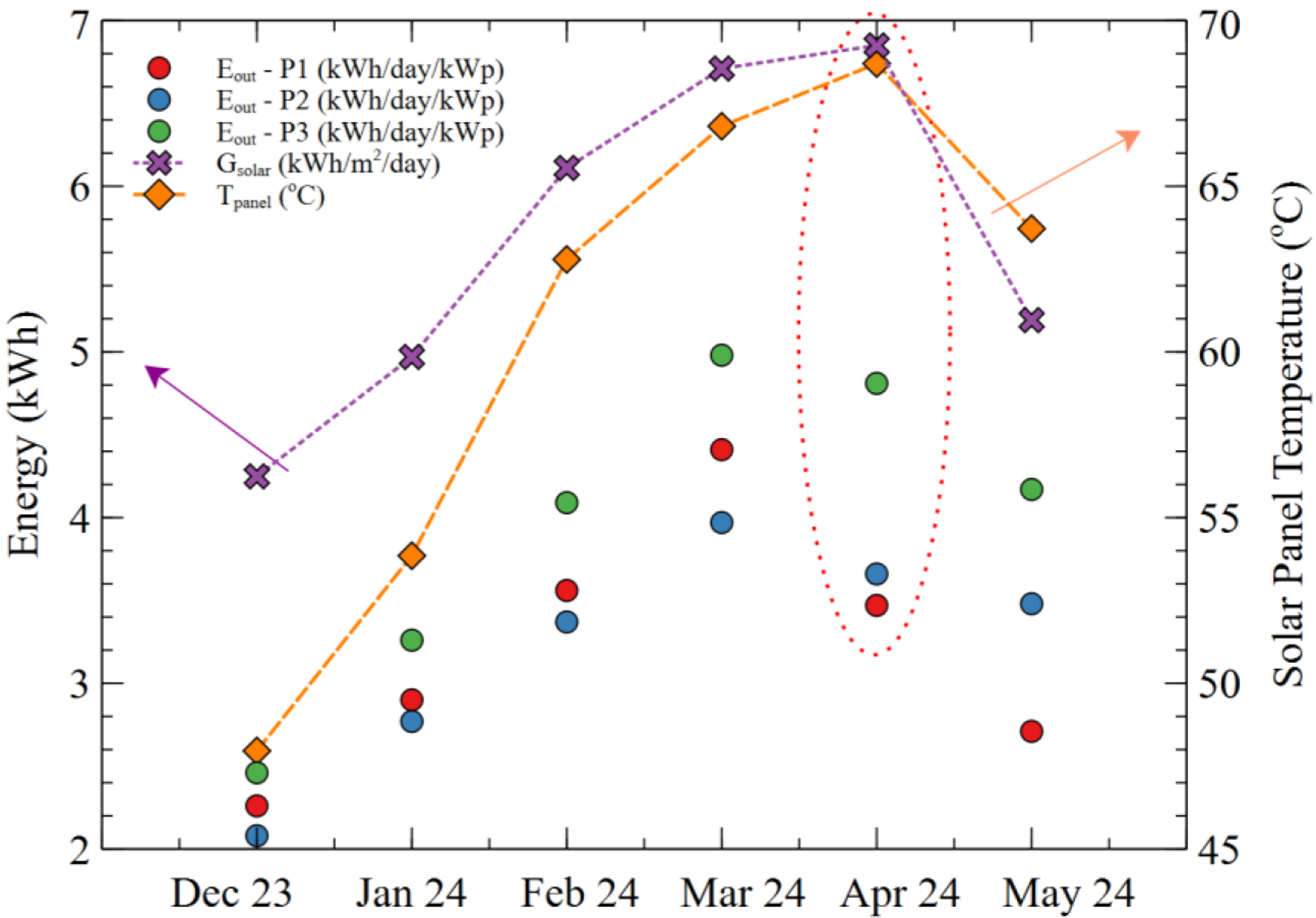
Energy input, output, and temperature of solar panels in three power plants located in Chennai, India.
The maximum recorded ambient temperature in April 2024 in Chennai is 44 oC, but in Rajasthan, the temperature reached 52 oC. In such conditions, the energy loss is much more pronounced than in Chennai. If this rise in global temperature continues, ground-mounted power plants will perform poorly in the future. Furthermore, the dust deposition in the panels also increases in the summer season because of the local soil and weather conditions. With the high atmospheric and panel temperatures combined with the soiling and bird droppings in the panels create a hotspot, which can lead to serious fire accidents. This is true even without high ambient temperatures. This rise in temperature in PV panels may be controlled using phase-change materials, hybrid PV thermal systems, and radiative cooling systems.
The immediate solution to reducing the global temperature rise is first to create awareness to reduce energy consumption (all energy-related activities), improve the energy efficiency of equipment and even renewable energy generation, and then plant more trees. Apart from these solutions, for solar power plants, the following solutions can be adapted.
Impact of human error on renewable energy systems
In addition to the effects of climate change, improper installations, loose electrical connections, poor maintenance practices, and equipment failures can also cause fire in the solar power plants. Heavy winds with substandard supporting structures also accelerate the damage and faults in ground-mounted PV power plants and PV panels installed in buildings. Even floating PV power plants are affected by storms if the panel floating structures are not moored properly, as shown in Figure 3. Similar damage was observed for wind turbines as well due to fire because of increased ambient temperatures and storms, as shown in Figure 4.

(a) Floating solar power plant damaged due to storm (https://timesofindia.indiatimes.com/city/indore/storm-damages-worlds-biggest-floating-solar-plant/articleshow/109231119.cms [Last accessed: June 06, 2024]), (b) solar power plant damaged due to storm (https://x.com/SolarInMASS/status/1796979130866565428/photo/1 [Last accessed: June 06, 2024]), (c) solar power plant caught fire (https://ar.pinterest.com/pin/857091372861156959/ [Last accessed: June 06, 2024]).
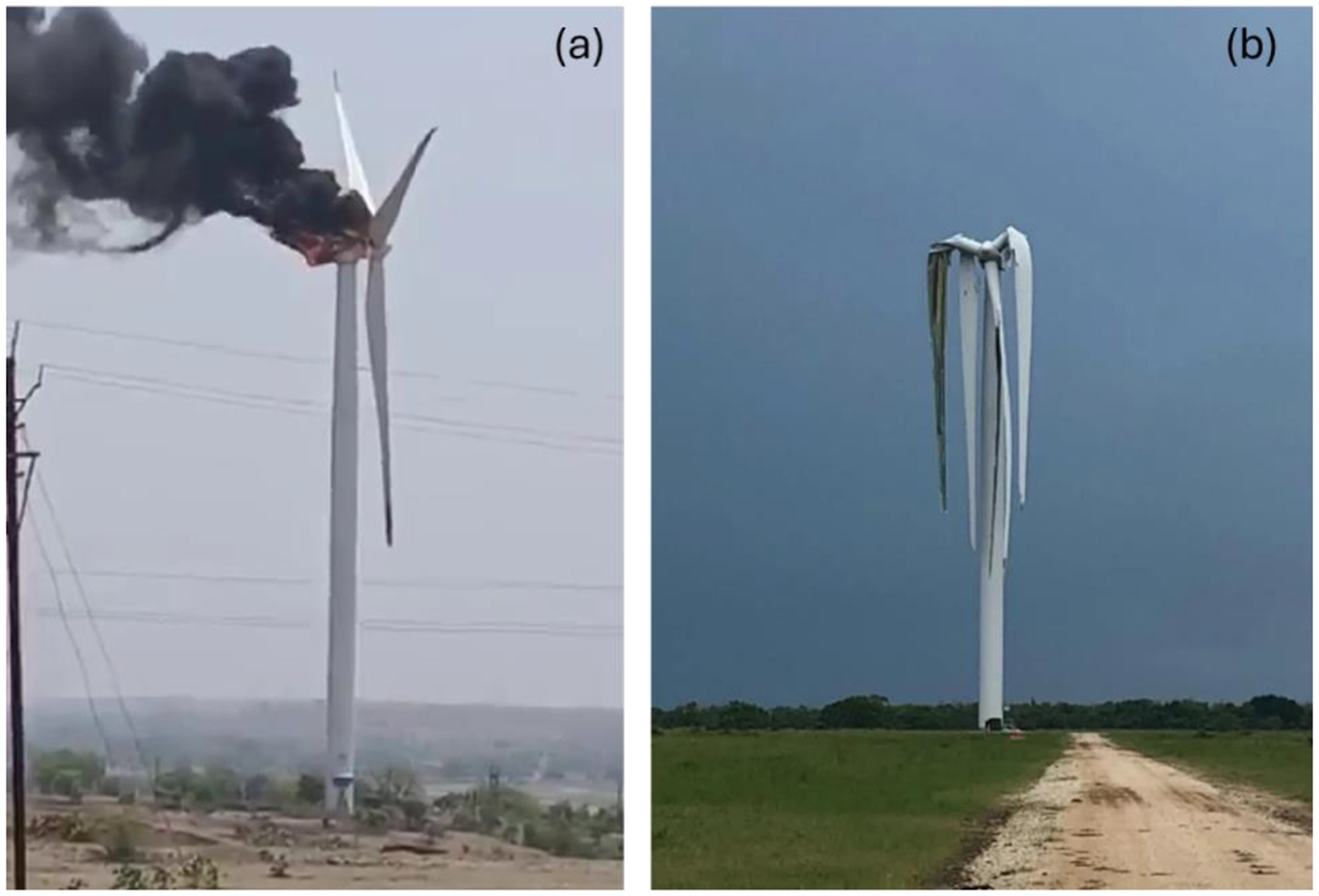
Wind turbine damaged: (a) due to excess heat (https://timesofindia.indiatimes.com/city/jaipur/windmill-catches-fire-in-jaisalmer-due-to-extreme-heatwave/articleshow/110491353.cms [Last accessed: June 06, 2024]), (b) due to storm (https://www.reddit.com/r/ThatLookedExpensive/comments/u5gqqy/wind_turbine_after_being_hit_by_a_tornado_in_texas/?rdt=49602 [Last accessed: June 06, 2024]).
Such human errors can result in accidents causing severe damage to power plants. These risks can be significantly reduced through proper training, regular skill enhancement, and capacity building of the workforce, which are essential to achieving the ambitious renewable energy and sustainability targets set by nations.
Sustainable solutions to tackle climate change
Bifacial PV power systems
Bifacial photovoltaic technology represents a significant advancement in solar energy systems, capable of capturing sunlight on both the front and rear sides of the panel. Unlike traditional monofacial PV systems that absorb light only on one surface, bifacial PV systems utilize reflected and diffused sunlight, resulting in higher energy output per unit area. This dual-sided operation increases efficiency and contributes to grid stability, especially under varying climatic conditions.
The key features of bifacial PV technology are as follows:
Globally, bifacial PV technology is gaining market share, with adoption rates projected to exceed 70% within the next few decades. Its implementation in India can play a pivotal role in achieving renewable energy targets and reducing carbon emissions.
Agrivoltaics
Solar PV may not work better in shades, but plants can be grown under the shades of a photovoltaic power plant, as shown in Figure 5(a-c). This concept of dual land use for energy generation and crop cultivation is called agrivoltaics. Studies on agrivoltaics proved that the plants under the PV panel create a microclimate, which reduces the temperature of the panels by 6–8 oC compared to ground-mounted PV power plants (Williams et al., 2023). Since the plants grow under partial shading conditions, they perspire and evaporate less water, thereby reducing their water consumption. This technique can generate electricity, conserve water, and increase farm produce, thereby contributing to the targets of Sustainable Development Goals 2, 7, and 13.

Agrovoltaic power plants: (a) cattle farming (https://www.agrisolarclearinghouse.org/solar-sheep-an-example-of-multifunctional-land-use/ [Last accessed: June 06, 2024]), (b) apple farms (https://britishornamentals.org/wp-content/uploads/2024/02/Jonathan-Scurlock.pdf [Last accessed: June 06, 2024]), (c) pear farming (https://bramvandepoel.wixsite.com/vandepoel-lab/single-post/2017/12/08/combiningagriculture-with-sustainable-energy-production [Last accessed: June 06, 2024]). (d-e) floating solar power plant (https://arka360.com/ros/solar-power-generation-india [Last accessed: June 06, 2024]).
Recent experimental and comparative investigations further demonstrated that agrivoltaic systems outperform both monofacial and bifacial rooftop PV systems under Indian climatic conditions. Specifically, the agrivoltaic configuration achieved a higher normalized daily power output (59.88 W) and efficiency (16.89%) compared to bifacial (56.35 W, 14.45%) and monofacial (47.18 W, 12.49%) systems. Importantly, the Land Equivalent Ratio (LER) of 1.85 confirmed superior land use efficiency, while the levelized cost of energy (0.039 USD/kWh) and shorter payback period (6 years) highlighted its economic viability. Moreover, the agrivoltaic panels exhibited enhanced reliability, with a mean time between failure (40.21 years) surpassing conventional PV systems (Anusuya et al., 2024). These findings validate agrivoltaics not only as a sustainable dual-use strategy but also as a technically and economically advantageous solution compared to conventional installations.
Floating solar PV power plants
Floating photovoltaic (FPV) systems are an innovative form of solar energy generation where solar panels are mounted on floating platforms on bodies of water, such as lakes, reservoirs, or coastal waters, as shown in Figure 5(d-e). These systems offer a unique advantage by utilizing water surfaces that would otherwise remain unused for energy production, making them especially valuable in regions with limited available land for traditional solar installations. Furthermore, the cooling effect of water can enhance the performance of solar panels, making FPV systems more efficient than their land-based counterparts in some climates. These systems are installed in water bodies, their panel temperature is around 2–6 oC lower than that of conventional ground-mounted PV systems (Micheli, 2022). FPV systems contribute to sustainability in several ways. First, they generate renewable electricity, reducing dependence on fossil fuels and helping mitigate climate change. Second, floating panels reduce water evaporation in reservoirs, conserving valuable water resources, particularly in arid regions. They can also limit the growth of algae, improving water quality by reducing nutrient levels and blocking sunlight from penetrating the water's surface. By integrating renewable energy with water conservation, floating PV systems represent a dual-purpose, environmentally friendly solution that supports sustainable energy development while addressing the challenges of water scarcity and land use.
A comparative study of FPV and ground-mounted PV systems in four diverse Indian climatic zones confirmed that FPV modules consistently maintain 4–7 °C lower operating temperatures and deliver 6–7% higher power output than their ground-mounted counterparts. Although financial analysis showed ground-mounted systems with marginally better LCOE and shorter payback, FPV demonstrated strong potential for long-term sustainability, particularly in water-scarce regions where water savings can exceed billions of liters annually (Anusuya and Vijayakumar, 2024). This performance advantage highlights FPV as a practical solution to India's dual challenges of limited land and rising energy demand, directly supporting the nation's renewable energy and SDG commitments.
Green hydrogen
Renewable energy sources will power the production of green hydrogen through electrolysis, which will help address climate change. The hydrogen produced during the daytime or during the excess availability of solar radiation can be stored for a longer period than that stored in a battery. Opting for hydrogen-fueled vehicles and/or hydrogen fuel cell (HFC)-based vehicles can reduce the carbon footprint of the transportation sector. Further, HFC can act as a range extender for electric vehicles, which can reduce the reliance on batteries. Green hydrogen-based energy storage systems can address intermittency issues associated with renewable energy sources like solar and wind. Green hydrogen, which stores excess renewable energy as hydrogen and converts it back to electricity when needed, could facilitate the integration of more renewables into the grid with reliability.
Results and conclusion
The field analysis from three PV plants in Chennai demonstrated that while solar radiation increased by 2% between March and April 2024, the corresponding energy output decreased by 10.5% due to elevated panel temperatures. This confirms that thermal stress, rather than irradiance alone, is the decisive factor in PV efficiency reduction. Extrapolating globally, for the installed capacity of 1413 GW in 2023, every 1 °C rise in PV cell temperature could result in losses exceeding 4.23 TWh annually, equivalent to the weekly energy consumption of the United Kingdom. These findings highlight the urge to address climate-induced temperature effects on PV performance.
Comparative international case studies further revealed that climate change impacts are highly location dependent. In Norway, warmer winters reduce heating demand and enhance hydropower potential, whereas in Algeria, hybrid PV–wind–diesel–battery systems are necessary to cope with extreme heat and solar variability. Brazil faces declining hydroelectric capacity due to rainfall variability, demanding diversification into solar and wind. In contrast, the Iberian Peninsula benefits from higher solar irradiance despite efficiency losses, illustrating that climate change can create both challenges and opportunities. Collectively, these results highlight that climate resilience requires region-specific adaptive strategies and diversified renewable portfolios.
Emerging solutions provide pathways forward. Agrivoltaics reduce panel temperature by 6–8 °C while improving land use efficiency and crop yield; floating PV systems consistently operate 4–7 °C cooler than ground-mounted plants and conserve significant water resources; bifacial modules deliver up to 30% higher yields under suitable conditions; and green hydrogen offers long-duration storage to counter intermittency. Together, these technologies demonstrate the technical and economic potential for building resilience against climate variability.
Going forward, three actions are essential: bring climate-smart technologies like agrivoltaics, floating PV, and bifacial modules into the mainstream; reinforce storage and grid systems to manage variability; and design adaptation strategies that reflect regional climate realities. With these steps, renewable energy can remain a strong and reliable driver of global decarbonization despite rising climate risks.
Footnotes
Acknowledgments
All authors acknowledge the Directorate of Campus Life and Electrical Maintenance, SRM IST, for the solar power plant data assistance.

Funding
The authors received no financial support for the research, authorship, and/or publication of this article.
Declaration of conflicting interests
The authors declared no potential conflicts of interest with respect to the research, authorship, and/or publication of this article.
Data availability statement
Data can be made available upon request