



Abstract
In East Africa, Tanzania’s musical expressions are rich and varied, and typically a combination of music and dance. A description of Nindo, a multipart vocal music form of the central Tanzanian Wagogo community, is provided, and a tribute is offered to the legacy of an important village artist, Mchoya, of the musical form that is begin continued by his progeny. A learning pathway, following the dimensions of World Music Pedagogy, is outlined for experiencing Nindo, and resources and references are recommended for teachers to facilitate listening, viewing, singing and dancing, and developing intercultural understanding.
For well over a century, American music education’s emblematic character is shaped by the successes of its performances by students in ensembles and classroom activities; however, in recent decades, many teachers have leaned into prospects for offering students an array of culturally diverse musical experiences (Kang, 2016; McCarthy, 1997). In fact, the National Association for Music Education stipulated, in the 2014 National Music Standards, that school music curricular offerings should promote “awareness of, respect, and responsiveness to the variety and diversity of cultures” (https://nafme.org/my-classroom/standards/core-music-standards/). Many nations look to and learn from the extent to which concert programming and lesson planning in American-based schools historically have been turning toward an array of expressive practices from Asia, Africa, and its diaspora, Latin America, Europe, and the Pacific Islands (Anderson & Campbell, 2010; Volk Tuohey, 2004), and some have modeled their own growing intercultural music programs on the American model (Ho, 2016). Yet, despite the strides made by American music educators in diversifying school repertoire, there is a gnawing sense that (a) many more musical cultures deserve a place in the curriculum, and (b) students gain immeasurably in understanding music as cultural identity and social power (in addition to its sonic features).
Although it has not yet made its appearance, we contend that the music of the Wagogo of Tanzania will fit well into school music classes, and that the form known as Nindo is particularly appealing to first-timers and practiced musicians. It is vocally powerful music, sometimes performed in unison, or in two-part harmony, or with simultaneous polyphonic vocal layers, and it is mesmerizing for the vigorous movement of the singers. Nindo is contemporary Wagogo musical expression, in current practice today, as it is also deeply rooted in Wagogo cultural aesthetics and folk practices. It is riveting music that appeals to students’ own energies and preferences for music that moves, that is, melodic, rhythmic, and with harmonies that are learnable by singers from an early age. It is music of people of a nation, Tanzania, with a long-standing American alliance. In fact, Tanzania and the United States share a long history of international cooperation in economic and political spheres (Askew, 2002). Many Americans trace their ancestry to Tanzania or other neighboring East African nations such as Kenya, Uganda, Rwanda, and Burundi; they add an important demographic to the U.S. mosaic of cultures by way of a shared language (Swahili) and an attention to the importance of family and community.
This article is one of a series on the topic of Teaching Music Culturally. It is an acknowledgment of the convergence of music, education, and culture in K–12 and undergraduate curriculum and instruction, and of the pressing professional need to give accent to intercultural understanding through experience and study of global cultures. We offer a brief description of the music of Tanzania, and of Wagogo music, and of the recently deceased master Wagogo musician, Mchoya. We next turn to featuring a Learning Pathway based on the five dimensions of World Music Pedagogy (WMP) so that students can learn the music via listening, participatory musicking, and creative involvement, and understand the uses, functions, and meanings of the music, Nindo, by the Wagogo of Tanzania. We will make the point of teaching music and culture, in tandem, and will suggest resources and learning pathways for supporting students in their journey of becoming musically attuned and culturally compassionate.
Preparations
The Music
Among the Wagogo people of central Tanzania, music and dance are conceived of together as ngoma. Music is danced, and dance is musical, and the expressions of musicians frequently include simultaneous singing, dancing, and playing instruments. There are many forms of ngoma, and among them is Nindo, an expression of a vast spectrum of emotions in the mother-tongue language of Cigogo. People perform Nindo from June to December, a period of freedom from the hard laboring of planting and harvesting, when they can join together to express secular and sacred sentiments that range from sadness to joy. It is choral music, where men and women sing together, and separately, at times in unison or in multiple parts. The men wrap rattles around their legs that resound as they dance, and the women insert high-pitched vocal trills, moving their tongues up and down in their mouths in a process known as ululation. In Cigogo-style Nindo, the music is performed chorally and in the absence of other standard instruments of the culture such as drums, fiddles, and thumb pianos. A lead singer stands out in full view, moving from side to side as he sings a phrase or two that then draws the response of the singers who are lined up behind him. Nindo is highly energized, and compelling to watch and listen to. Because of its complexity, it shines out as a showcase genre in which, as much as Cigogo music tends to be welcoming of others to participate, requires technique and skill—and plenty of experience together as a group (Mapana, 2007; Mnyampala, 1995; Mpepo, 2015).
The Culture
Just over one million people constitute the ethnic and cultural group known as the Wagogo, in a country of distinctive groups of more than 120 languages. Sometimes referred to as the Gogo, their local language is Cigogo, while Swahili, the official language of government and education, is also widely spoken. The Wagogo people live in arid high country, with mountains rimming the region, several small seasonal rivers, and baobab and acacia trees rising out of fields of sage. Despite frequent periods of drought, the Wagogo cultivate grain and maize, and are successful herders of cattle, sheep, and goats. Their traditional large market town, Dodoma, was named the capitol of Tanzania in the 1970s, and a new presidential palace was recently built in the nearby village of Chamwino Ikulu. Many Wagogo continue to live in their traditional villages, but some have re-situated themselves where the jobs are, on plantations and in urban areas. The expressive culture of the Wagogo has drawn musicians and scholars to experience the ngoma, and leading Wagogo musicians and educators such as Hukwe Zawose, Godfrey Mngereza, and Kedmon Mapana have drawn documentarians and music fans to area festivals (Mapana et al., 2016; Temu, 2011).
The Master
The featured ensemble, Nyati, has come to be through the brilliance of its master musician, Mchoya. Born in 1943 in the Dodoma region of Central Tanzania, in Nzali village, Mchoya’s birth name was Chilangazi Mtachi. His father worked in agriculture and animal-keeping, while Mchoya was drawn to music from an early age. He performed mulokwe (genre) at boys’ initiation ceremonies, singing with another male singer and wearing rattles on his legs as he danced. Soon after, he joined a musical group led by Msilimu liso, also of Nzali village, and as they traveled throughout the region to perform Mchoya readily learned other Wagogo musical genres and was soon recognized for his extraordinary talent. He was promoted to lead the development of the village group’s performance of the Nindo genre, perpetuating traditional songs while also creating new songs that were performed by men wearing rattles (on one leg) while women danced, sang, and sounded their high-pitched emotive ululations. He stepped into full leadership of the Nzali village group, which took the name Nyati Mchoya, serving as master musician and teacher while offering opportunities for villagers to contribute not only their musicianship but also their own leadership roles as assistant teachers and officers of the group. The Nyati group has performed by invitation throughout Tanzania, at the 2010 World Games in South Africa, in Germany, Belgium, Switzerland, Spain, France, and India. Mchoya passed away in 2017, at which point the leadership was turned over to his son, John Mchoya Mtachi, whose singing and dancing bears the imprint of Mchoya’s artistic mastery.
A WMP Learning Pathway for Wagogo Nindo Music
WMP is a way forward to developing student knowledge of culturally unfamiliar music through carefully crafted listening experiences, and to evolving their cultural and intercultural understanding (Campbell, 2018). WMP is not “just” listening, by any means, and yet listening is underscored as core to learning the music of oral traditions and cultures. Through repeated listening opportunities, students are drawn into the music, so that they become familiar with its elemental features, even as their curiosity grows as to why the music sounds the way it does, who the musicians are, and how the music functions within a given cultural community. The first three (of five) dimensions are distinguished in these ways: Attentive Listening is directed and focused through a teacher’s questions on musical features, while Engaged Listening is the active participation by a listener in some extent of music making (by singing a melody, tapping a rhythm, moving to a dance pattern). Enactive Listening is the performance of a work such that through intensive listening, the music is re-created in as stylistically accurate a way as possible. Listening is the foundational base of other experiences, including musical participation, performance, and creative activities, all of which is enhanced and made more purposeful through the integration of language, stories, and cultural meanings serve to wrap the musical experiences into a more holistic understanding of music’s cultural significance (Campbell & Lum, 2019). To these three dimensions are added Creating (World Music), the invention of new music in the style of musical model through variation, extension, composition, or improvisation, and Integrating (World Music), in which students learn the cultural meaning of the music, its history and social function, and various contextual matters relevant to the music and musicians.
The five dimensions of WMP come together to offer students a full slate of musical involvement, in which learning is musical and intercultural in both process and outcome. What follows are suggestions for the application of WMP in teaching and learning Nindo, one of the gemstones of Wagogo artistic cultural practice. This Nindo work was created by John Mchoya Mtachi in 2018, to convey to members of the Nyati group that Mchoya, the master, still lives on with them in the art of the music and dance that they perform.
1. Attentive Listening. Listen to and view Nindo, https://youtu.be/yyusMQlZ6D8 0’01–4’21. Take comments and questions following the first experience with this musical form. Students may wonder:
Q: Who are these people? (A: Wagogo musicians from the village of Nzali, in central Tanzania.) Q: What is the lead singer wearing? (A: A headdress made of the fur/hair of the mbega monkey, and mbega fur/hair on his arms, too.) Q: Why are they performing without shoes? (A: Because they can move more easily without shoes, and because they only wear shoes when they are going out to work in the fields, or into the city for shopping, or to church.)
Encourage students to share their observations of the musicians and the music.
2. Attentive Listening. Listen and view again, this time with the guide posted below. Repeat opportunities to listen while following the guide.
Note 1: The bracketed numbers [#] indicate precise time at which the musical event occurs. Note 2: The video can be stopped about 3’11’, since the music begins to repeat.
[1] 0’16”–0’50” Single male singing introduction (with choral interpolations). Note: the singer is the man dressed in a leopard print outfit, from the men’s group, while the group leader, John in the headdress, is moving right and left behind the singer. [2] 0’46”–0’50” Male choral voices on “yah-yah-yah-yah,” as a response to the solo male singer’s message. [3] 0’51”–0’53” Single male voice (Group leader, John, offers his short/single introductory phrase). [4] 0’54”–1’20” Choral “block” sound of women’ singers (See Figure 1 [notation]) [5] 1’21”–1’42” Choral block sound intermingled with John’s phrases [6] 1’43”–1’46” Woman’s high-pitched ululation cries (“lu-lu-lu-lu-lu”) [7] 1’45”–2’07” John’s softer singing as group reforms/re-shapes its visual design; some soft group singing [8] 2’08”–2’33” Women-dominated choral song, with two lead women dancers arriving in front (headdresses on, rotating their heads and crooking their necks); John’s emerges front and center, while male singers are dancing with sticks, interjecting “hey” and “huh” (See Figure 2 [notation]) [9] 2’34”–2’39” Women’s ululation cries is followed by John’s softer singing [10] 2’40–2’47” Male-dominated softer singing ensues, along with dance by two male “leads” [11] 2’48”–3’10” Women-dominated choral sound returns, with male calling/singing “huh” while hopping/jumping ------------------------------ [12] 3’11”–4’21” Following women’s ululation cries comes further women-dominated song; men calling/singing “hey” and “huh,” and repletion of earlier sections.
3. Attentive Listening. Listen to and view repeatedly a brief excerpt of the same Nindo piece (0’54”–1’20”). Before each listening occasion, ask only one question to focus the attention of the students. Continue the opportunities for students to listen to the segment, each time responding to yet another question Some exemplary questions follow:
Q: What instruments are being played? (A: There are no instruments in this Nindo performance, although there are the powerful singing voices and the sound of tinkling ankle bells worn by the men.) Q: Who is singing? (A: Solo male singers, with men and women in choral response) Q: Are they singing together, on the same pitch, at the same time? (A: The choral singers are rhythmically in sync as they sing, and at various times they sing in unison, in octaves, or in several simultaneous parts.) Q: Do you hear any particular syllables from the singers? (A: “yah-yah,” “mchoya”) Q: How would you describe the movement of the performers? (A: They begin standing together, women in front of men, then add gestures [their arms raised, index-finger pointing to the sky, waving], and later begin to step into new formations. There are notable gendered distinctions in the dancing: women on two sides with men facing front, lead women dancers twisting their necks and heads, men with long sticks, periodically hopping and jumping, lead men dancers flapping feathered arms of the mbega monkey. The lead male dancer, prominent throughout the performance, is John Mchoya Mtachi, son of Mchoya, the long-standing leader of the Nyati ensemble.)
4. Engaged Listening. As viewing and listening continues to the brief Nindo excerpt (0’54”–1’20”), invite students to begin to “sing what they hear.” No notation is necessary, but over the course of continued listening to the brief excerpt, they can hear pitches, rhythms, and phonemes (the syllables of the sung words), and may even involuntarily find themselves singing. Consider these “invitations” to the students to enter into “participatory listening”:
*Listen and “sing inside” and not aloud what you hear. (Repeat) *Listen and sing very quietly whatever small phrases you can decipher. (Repeat) *Add some volume to one or more small phrases that you feel confident singing. (Repeat) *Share the meaning of the song, in which the Nyati group members are expressing their pride in the artistic and cultural legacy of their long-time leader, the master called “Mchoya.” Their exuberance of song and dance is attributed to him, and to his creativity as a musician, dancer, poet, choreographer, and leading citizen of their central Tanzanian village of Nzali. The song praises not only Mchoya but also the past and present performers of the Mchoya group. The singers boast that their music is without parallel, noting that the people of the Nzali village, whether children, youth, elders, or adults, are fully confident that their music is unmistakably of the highest caliber. They describe their music to be “as sharp as a knife” and “as powerful as a buffalo.” They sing that their music should be known far and wide as representative of the beauty and strength of Wagogo culture, and that no other performers can compete with the music and dance of Mchoya’s Nyati group.
5. Enactive Listening. With their ears tuned to the melody, rhythm, and words, and with an introduction now to the notation for enhancing the listening, students can be invited to join in singing the full section of the Nindo excerpt (0’54”–1’20”). Share the notation and Cigogo words of the song, and offer students continuing opportunities to sing with the recording, When they’ve become comfortable with sounding the music, challenge students to sing without the recording. Return often to having students sing with the recording, until they have mastered the music. (See Figure 1 for Choral “block” sound.)
6. Enactive Listening. Students may be drawn to view the dance movements in the Nindo segment 1’55”–2’35” multiple times, studying the quality of the “moves”: by the two women with headdresses, the lead male dancer John Mchoya Mtachi, the lines of women on each of the two sides of center, and the line of men at the back. Note the movement of their torsos, their arms, legs, feet, heads and necks. Students may want to select out just one movement to follow, and then to attempt to produce it, comparing their initial attempts with the practiced movements of the Nindo performers.
7. Creating Nindo. When students have listened hard and had opportunities to join in with the musicians of the Nindo segment (as it appears on the recording), they can move next to creating a brief composition of their own in the style of Nindo. They’ve learned that the melodic components consist of four pitches (l-d-r-m), and the musical rhythms tend to follow the rhythms of speech. Meanwhile, the vocal quality of the singing is characteristically full-bodied, vibrant, and resounding. With the teacher’s support, students can create Nindo, following these items:
*Choose a message or theme, for example, “respect,” “friendship,” “support,” “collaboration” *Write 2–4 sentences, rhymed or unrhymed, that describe or expand upon the meaning of the chosen theme *Together, speak the sentences, find the accents, the fast-moving syllables, the sustained syllables *Repeat the rhythmic speech of these sentences, striving for a unison sound *Using four pitches, l-d-r-m, explore possibilities of singing the sentences that are now rhythmically intact; Sing the four pitches, ascending, descending, and mixed in patterns such as these: “l-d-r-m,” “m-r-d-l,” “ll-dd-rr-m,” “m-rm-d-l,” “l-dl-dr-m,” “ld-rm-dl-dm,” “mr-dm-dr-dl.” *Create a melody for each sentence, adding pitches to the earlier invented speech rhythms *Sing the newly created Nindo melodies, slowly and softly at first followed by a full-bodied vocal quality.
8. Cultural integration. Students can grasp the deeper meaning of Nindo as they come to know the function of it within the village, the importance of a message that is conveyed through song and movement by the Nyati performers, who keep alive the cultural values of the Nzali villagers and the Wagogo people at large. Nindo songs can pay tribute to the cultural identity of villagers, to express the joys of a successful planting or a good harvest, to celebrate a marriage, to comment on a social issue, or to offer praise to a deceased member of the village. This Nindo song celebrates the remarkable legacy of Mchoya, whose spirit lives on in the particular stylistic expressions of the singing and dancing. The following video links will usher students into a sense of Tanzania and Tanzanians, their history and multiple linguistic and cultural groups, and the expressive practices of music and dance as shaped by various populations, including the Wagogo.
*Journey through black-and-white historic photos to an understanding of Tanzania, from its status as a colony of Germany and England to its modern image as an independent republic. https://www.youtube.com/watch?v=_GBR8dqHZNc *Learn, through the guidance of a child, in her own voice and with her own words, aspects of life in Tanzania. https://www.youtube.com/watch?v=CTz3e_67yhw *View the great Mchoya, leader of the Nyati group, in a performance in 2012, that features singers, dancers, a two-stringed fiddle (zeze), players of thumb pianos (ilimba), plucked lutes, flute, and percussion https://www.youtube.com/watch?v=jQWVsTXG6no *View Peter Masima, Wagogo musician, in his presentation of a workshop to schoolchildren. https://www.youtube.com/watch?v=AZqbZ4RIet8
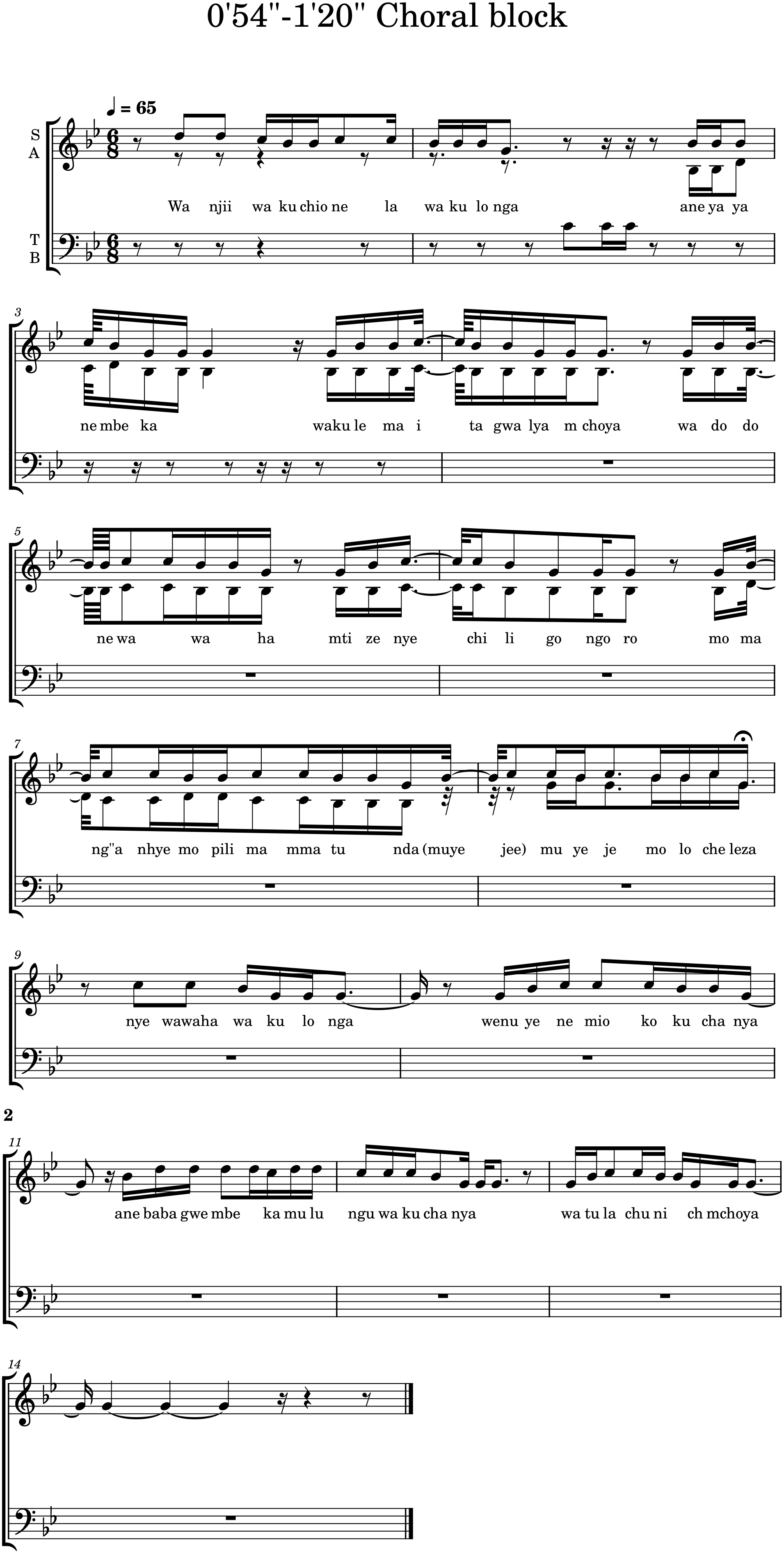
Choral Block.
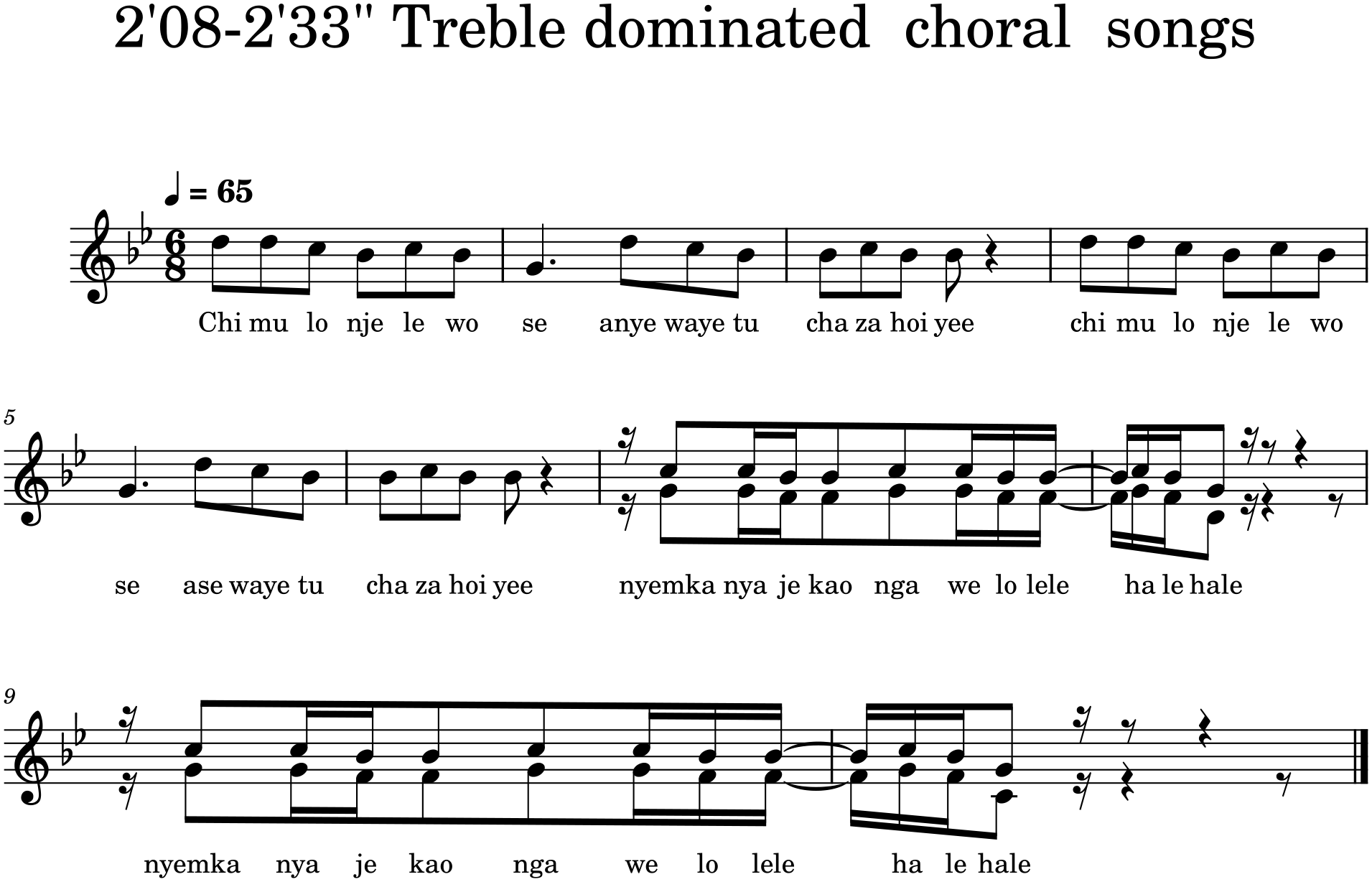
Treble-Dominated Choral Songs.
Learning Cultural Knowledge Through Wagogo Music
There is both musical and cultural knowledge to be gained through experiences in the Nindo form of Wagogo music, particularly when teachers foster a progression of events meant to deepen student experience in the music’s sonic structures and socicultural meaning. As they listen repeatedly to a musical selection, learners grow musically, intellectually, and emotionally, particularly when they progress from listening (and viewing) into the performative practice of powerful and full-bodied singing. Perhaps they will attempt to emulate some of the moves of the skilled performers and venture into the invention of new musical possibilities based within the musical features and cultural aesthetics of the music. When cultural considerations are given attention, music then becomes a holistic experience as well, with students discovering answers to questions like “Where does the music come from?” “What is the purpose of the music?” “How old (or new) is it?” “When/Where is it performed?” and “Who are the performers, the composers, and the master musicians?” Ultimately, music becomes more meaningful to learners when its sonic experiences are wrapped into knowing how it reflects people’s beliefs, behaviors, and values.
With this WMP Learning Pathway, students can grow to know Nindo and Wagogo culture, which may pave the way to study of the historical and cultural aspects of the East African nation of Tanzania at large. With its attention to repeating rhythms and melodic phrases, a communal singing quality that is intense and thoroughly in sync, Nindo represents the Wagogo penchant for honoring traditional culture. In this contemporary rendition of the genre, when the singing voices are complemented by the elaborate and dynamic movement of the dancing bodies, the identity of the Wagogo people is fully inscribed as one of people supporting people, of a sense that there is strength in the act of people joining together to make something beautiful. In school music classes, experiences in Nindo guarantee both the musical and intercultural understanding of students who progress through the five dimensions of WMP.
Footnotes
Acknowledgements
The authors are grateful to Kevin Stanislaus for his transcription of the two excerpts featured in this article.
Declaration of Conflicting Interests
The author declared no potential conflicts of interest with respect to the research, authorship, and/or publication of this article.
Funding
The author received no financial support for the research, authorship, and/or publication of this article.
