



Abstract
As mathematical modelling problems often allow for a variety of approaches and thus various difficulties can arise, it is particularly important that teachers spontaneously perceive and interpret students’ individual solutions and difficulties and come to a decision about their reaction. In this study, teacher noticing—namely perception, interpretation, and decision-making—is promoted in a modelling seminar. Pre-service teachers’ abilities to notice modelling processes are assessed before and after the seminar using a video-based instrument. The criteria breadth of perception, depth of interpretation and nature of decision-making are used to identify different types of competence profiles, which describe the differences and similarities in the ability to notice mathematical modelling processes. Furthermore, the individual development is evaluated. The analysis reveals tendencies to change in different facets of noticing regarding mathematical modelling processes: Instead of an overall improvement in noticing, the participants mostly develop regarding one facet of noticing (perception, interpretation or decision-making).
Keywords
Introduction
The relevance of the teacher for the quality of teaching and students’ learning process is generally undisputed. The empirical evidence is much more complex and relates to certain competence facets and their influence. For example, it was shown that mathematical pedagogical content knowledge influences the quality of teaching, which in turn effects the learning success of students (Blömeke et al., 2022; Yang & Kaiser, 2022).
Competence is defined as knowledge as well as the motivation, willingness and ability to apply it (Weinert, 2001). Competence models, which are widely employed in the present field of research (e.g., Blömeke et al., 2015), also assign a central role to teacher noticing: Based on knowledge and affective-motivational components, classroom situations are perceived and interpreted depending on the specific situation and decisions are weighed up that lead to an action. This ability develops only slowly (Schoenfeld, 2011). While a lot of interventions in pre-service teacher education last one semester, they show mixed results (Amador et al., 2021). However, in a large-scale study a comparison of pre-service teachers with teachers at the beginning of their careers showed a significant difference between novices and experts, with teachers with more teaching experience showing no further positive development (Bastian et al., 2022).
As there are only limited opportunities for practical experiences during the first phase of teacher education, videos are used in a wide variety of formats (recordings of own or other teachers’ lessons or videos provided by others) to simulate teaching situations and train in a protected environment. Furthermore, videos are an integral part of most measurement instruments for teacher noticing (Santagata et al., 2021; Weyers et al., 2023).
Since teacher noticing refers to specific situations and is closely linked to the respective context, it is assumed to be domain-specific. In this study, the focus is on the context of mathematical modelling. Mathematical modelling describes the process of solving real, authentic, and open-ended problems using a wide variety of mathematical methods. Due to the open nature of modelling problems students may consider and follow different approaches to solve the problem and encounter various difficulties along the way (Blum et al., 2011; Galbraith & Stillman, 2006; Maaß, 2006), where every phase of the modelling cycle poses potential barriers (Stillman, 2011). With this variety of sometimes unforeseen solution approaches as well as difficulties that the teacher may not have anticipated, the teachers’ precise perception, interpretation and decision is of particular importance for an adaptive intervention. These adaptive interventions should aim at supporting students’ autonomy in solving the modelling problem (Stender & Kaiser, 2015; Tropper et al., 2015). Therefore, noticing students’ use of metacognitive strategies or a lack thereof is also essential in the context of mathematical modelling in order to enable students to overcome problems themselves and foster their independent work on modelling problems (cf. Stillman's (2011) concept of meta-metacognition).
Although teacher noticing seems to be highly relevant when teaching mathematical modelling, little research has been done on teacher noticing in the context of mathematical modelling, yet (see section 2.2). In this study, we therefore systematically analyze pre-service teachers’ abilities to notice students’ modelling processes with a standardized video-based instrument. By developing a distinction of different types of pre-service teachers’ abilities and we aim to provide insights into the multifaceted structure of teacher noticing in a mathematical modelling context and facilitate understanding of their development, which has consequences for teacher education such as providing targeted support.
Literature review
In the following, the current state of research regarding teachers’ competencies will be described. Specifically, two topics are central to this work and will be considered in detail: firstly, teacher noticing as an essential component of teachers’ competencies, and secondly, mathematical modelling as a complex teaching field, in which situation-specific perception and interpretation of students’ activities is essential for adaptive action.
Teacher noticing
Conceptualizing teacher noticing
Teacher noticing has gained great importance in the last decade. Although there is no consensus on the conceptualization of noticing, it can generally be described as the situation-specific processes required to deal with a complex situation, for example in a classroom: A teacher is confronted with an overwhelming amount of sensory information during teaching and thus needs to perceive what is relevant in the moment, interpret the perceived aspects while drawing on knowledge, experience and beliefs, and weight up different options on how to react (e.g., Jacobs et al., 2010; Sherin et al., 2011; Schack et al., 2017). In a systematic literature review, König et al. (2022) examined different conceptualizations of noticing and identified four perspectives: the cognitive-psychological, the socio-cultural, the discipline-specific and the expertise-related perspective. Although these perspectives set different foci on examining noticing, they overlap and enrich each other: The socio-cultural perspective focuses on the social practices needed to form a common understanding of noteworthy aspects and their interpretation in the context; thus identifying and interpreting relevant situations is seen as a social act and analyzing these social practices is at the core of this perspective (e.g., Goodwin, 1994; Louie et al., 2021). In contrast, from a discipline-specific perspective noticing is seen as a holistic construct, where the emphasize is on noticing as a discipline that enables professionals to reflect and improve their own practice (Mason, 2002). From an expertise-related perspective noticing is examined in terms of different levels of expertise that are compared to reason about skill development and components of expertise of a particular profession (e.g., Berliner, 2001; Sabers et al., 1991). Lastly, the cognitive-psychological perspective deals with the cognitive processes needed to react in a classroom situation. As we are particularly interested in the interplay of the facets of noticing, their characteristics concerning mathematical modelling as well as changes to these cognitive processes, in this paper, we adopt a cognitive-psychological perspective on noticing.
Noticing from the cognitive-psychological perspective is defined through a set of cognitive processes happening in the teacher's mind. It draws on seminal works by Van Es and Sherin (2002), who organized video clubs to facilitate teachers’ ability to notice and developed the learning to notice framework as theoretical basis. According to it, noticing can be distinguished into selective attention and knowledge-based reasoning (Sherin & van Es, 2009). With the framework for professional noticing of children's mathematical thinking (Jacobs et al., 2010) a third facet of noticing was introduced: deciding how to respond. In the process model competence as a continuum, situation-specific skills are embedded to connect teachers’ dispositions with performance, i.e., based on cognition and affect-motivation teachers need to use perception, interpretation and decision-making as situation-specific cognitive processes, which are then expressed through performance. Noticing (named as situation-specific skills in this model) thus forms a central part of teachers’ competencies. Within the TEDS research program, Kaiser et al. (2015) used this model and refined teachers’ situation-specific skills with respect to the concept of noticing. They (Kaiser et al., 2015) understand noticing as “(a) Perceiving particular events in an instructional setting, (b) Interpreting the perceived activities in the classroom and (c) Decision-making, either as anticipating a response to students’ activities or as proposing alternative instructional strategies” (Kaiser et al., 2015, p. 374), This conceptualization thus pays attention to the entanglement of the ability to notice with the underlying dispositions and their enactment in a specific situation. In this study, the cognitive perspective and especially the competence as continuum model form the basis for the theoretical framework and adaption for the context of mathematical modelling.
Although there exist different conceptualizations of noticing depending on the focus, which may include one, two or three facets, the theoretical distinction in different facets has hardly been confirmed empirically to date. Bastian et al. (2022)—as part of the TEDS-M 1 research program (Kaiser et al., 2017)—showed that it was possible to measure the three facets separately, although they were closely connected. From a theoretical stance, the facets perception, interpretation and decision-making are closely intertwined and influence each other (Jacobs et al., 2010; Santagata & Yeh, 2016; Sherin et al., 2011): While it seems necessary to perceive something in order to interpret it, an interpretation can also lead to perceiving new aspects as relevant and noteworthy. Similarly, a decision is usually based on an interpretation but can also generate new ways of interpreting.
Fostering teacher noticing
Interventions to foster teacher noticing are manifold and showed mixed results with no clear preference for a particular educational program (Amador et al., 2021). Nevertheless, the results of video-based interventions indicated positive developments (Santagata et al., 2021). In van Es and Sherin's video clubs (van Es & Sherin, 2002), teachers analyzed pre-selected excerpts of recordings of their own teaching, while other studies used comics (Herbst et al., 2011) to minimize the represented information, for example the characteristics of individuals. Furthermore, written transcripts or students’ solutions are also included as they might allow for deeper reflection due to their detachment from time constraints. These diverse methods, including a variety of video-based approaches with differing emphasis, offer different strengths and benefits in preparing teachers to cope with the complexities of teaching in specific content areas.
While videos are often used in interventions to foster teacher noticing, they also serve as stimulus to assess teacher noticing. To measure teacher noticing, videos are most commonly used to approximate real classroom practices, which could be recordings of one's own or other's teaching or staged videos (Wei et al., 2023; Weyers et al., 2023). Students’ written solutions or other text formats are less popular as they might represent the ability to notice less realistically, but they are sometimes also used in combination with videos (e.g., Jacobs et al., 2010). Various studies showed that the ability to notice could be improved, although changes are supposed to happen only slowly (Schoenfeld, 2011). A literature survey by Stahnke et al. (2016) suggests that novices tend to have difficulties perceiving or interpreting student work, which apparently can be improved by video-based professional development programs. With a large-scale study within the TEDS-M program, Bastian et al. (2022) showed, that a development from pre-service to beginning in-service teachers could be found with a slight decrease concerning experienced teachers, while the data analyses by Yang et al. (2021) using the same but adapted instrument in China showed almost a linear growth. Jacobs et al. (2010) identified various growth indicators, which qualitatively describe the development of noticing concerning students’ mathematical thinking. They call for long-term professional development to fully develop teachers’ noticing, especially decision-making.
Teacher noticing has been studied in various contexts (König et al., 2022; Weyers et al., 2023): Studies have focused on general pedagogical topics, such as classroom management (e.g., Steffensky et al., 2015), or on subject-specific topics, such as students’ mathematical thinking (e.g., Jacobs et al., 2010) or multiple representations (Dreher & Kuntze, 2015), to examine how teachers notice in complex settings. However, teacher noticing in the context of mathematical modelling has hardly been addressed, yet.
Mathematical modelling
Mathematical modelling plays a role in the curricula of many countries around the world, for example in the US Common Core Standards in Mathematics (CCSS-M) or the Chinese standards for upper secondary level. In the German educational standards mathematical modelling is named as one of the six general mathematical competencies, which should be developed across all school levels and forms in accordance with a progressive curriculum (e.g., KMK, 2022).
However, it poses many challenges as each step of the modelling cycle could be a potential barrier for students (Stillman, 2011). In order to teach mathematical modelling and support students to successfully solve mathematical modelling problems in a goal-oriented manner, various competencies are needed (see section 2.2.2). Specifically, noticing mathematical modelling processes requires to notice various modelling-specific aspects, which are described in the following section.
Characteristics and modelling competencies
In an idealized form, mathematical modelling is understood as a cyclical process in which students translate between reality and mathematics (and back) in order to solve real-world problems (e.g., Blum et al., 2011; Kaiser et al., 2007). The phases of the modelling process can serve as a basis to define sub-competencies of mathematical modelling. These are required to successfully master each step in the modelling process (Kaiser et al., 2007; see also Maaß, 2006). Furthermore, global modelling competencies are needed to successfully go through the entire modelling process, which include cognitive strategies, social competencies and metacognitive competencies (Kaiser et al., 2007; Maaß, 2006). Metacognition is understood as “one's knowledge concerning one's own cognitive processes and products or anything related to them … [and] the active monitoring and consequent regulation and orchestration of these processes” (Flavell, 1976, p. 232). Metacognitive modelling strategies as part of metacognition consist of strategies for organizing and planning, for monitoring and regulation, and for evaluating. The use of metacognitive strategies is crucial to independently solve modelling problems in a goal-oriented way and overcome barriers. Thereby, each phase of the modelling process can be a potential barrier to students (Stillman, 2011). Difficulties can arise due to missing extra-mathematical knowledge (e.g., difficulty in understanding the real-world context and identifying the relevant information; Galbraith & Stillman, 2006), missing meta-knowledge about mathematical modelling (e.g., not knowing that it is necessary to make assumptions; Maaß, 2006), missing mathematical knowledge (e.g., failing to select and apply the appropriate mathematical tools; Niss & Blum, 2020) or students’ motivation (e.g., Schukajlow et al., 2012).
If students cannot overcome these difficulties themselves or are not able to use metacognitive strategies to monitor and regulate their process, the teacher may need to intervene and support them.
Competencies for teaching mathematical modelling
Generally valid principles for good teaching also apply to teaching mathematical modelling, such as cognitive and metacognitive activation of learners, classroom management, student orientation and the use of challenging content (Niss & Blum, 2020). Specific competencies for teaching mathematical modelling are presented by Borromeo Ferri and Blum (2010) in a theoretically developed model that distinguishes necessary knowledge and skills in four content-structured dimensions: the theoretical, the task-related, the instructional and the diagnostic dimension. While the theoretical dimension includes, for example, knowledge about modelling cycles, the task-related dimension comprises the ability and knowledge to solve, analyze and develop modelling tasks. The instructional dimension comprises, for example, lesson planning and interventions and the diagnostic dimension focuses on recognizing phases in the modelling process as well as identifying difficulties. Based on the competence model of the COACTIV study (Kunter et al., 2013), Klock and Wess (2018) developed a specific model for teaching mathematical modelling that integrates the four dimensions of Borromeo Ferri and Blum (2010), but also extends them to include affective-motivational components, such as beliefs about the application of mathematical modelling. Eames et al. (2018) also developed theoretical principles for teaching mathematical modelling, which contain six competencies and five beliefs. These principles partly overlap with the dimensions of Borromeo Ferri and Blum (2010). For example, Eames et al. (2018) emphasize that teachers should respond to the questions raised implicitly or explicitly by learners, thus emphasizing the importance of responding appropriately to what is happening in the classroom.
To support students in working independently on modelling problems, it is also important to monitor and promote the use of metacognitive strategies to empower students to work independently. Therefore, the teacher acts on a meta-level (meta-metacognition; Stillman, 2011).
As noticing has been recognized as an essential component of teacher professionalization (see section 2.1), we pose the question regarding which role it plays in the context of mathematical modelling. As elaborated above (see section 2.2.1), students can usually adopt different approaches to solve a modelling problem and may encounter a variety of obstacles on their way, which leads to great uncertainties for teachers, as it can be difficult to anticipate the students’ process. Thus far, little research has been done in this regard. As a first step, Galbraith (2015) theoretically distinguishes three types of noticing, where the third type “noticing as a mentor” matches our understanding of teacher noticing in this study, i.e., taking the role of a teacher to notice students’ learning (teacher noticing). He highlights that noticing as a mentor is distinct in a modelling context as teachers are confronted with specific demands in a modelling situation (e.g., encouraging students to validate and refine their model without compromising their independence) and that teachers’ anticipation of modelling processes and students’ actions plays an important role.
Also focusing on teacher noticing, Zuo et al. (2024) used a video-based instrument based on Sherin et al.'s (2011) conceptualization of noticing before and after a seminar on teaching mathematical modelling to assess pre-service teachers’ noticing in the context of mathematical modelling. They found a shift towards focusing more on students than on teachers (selective attention) and improvements regarding reasoning (less descriptive comments, more evaluative and interpretative statements), which is in line with video-based studies in other content areas (e.g., Van Es & Sherin, 2002). Because of their conceptualization of noticing, decision-making was not examined. Cai et al. (2022) compared pre-service and expert teachers’ analysis of students’ written solutions and found differences in their decision-making, where most expert teachers tried to prompt students to extend their view and think about the problem again, while only about a third of the pre-service teachers did so.
All in all, it is evident that further research is needed to gain a comprehensive understanding of teacher noticing in the context of mathematical modelling as an important component of teachers’ competencies for teaching mathematical modelling. In addition to theoretical developments, empirical studies using standardized video-based instruments are required to assess teacher noticing in the context of mathematical modelling and understand the distinctive characteristics of noticing in the context of mathematical modelling and the developmental patterns by going beyond general results and considering individual strengths and weaknesses. In the presented study, we aim to contribute to filling this research gap.
Theoretical framework of the study
Noticing is understood as the cognitive processes taking place in a specific situation (see the cognitive perspective of noticing according to König et al., 2022) and situations, in which mathematical modelling is taught and learnt, entail some specific characteristics (as described in section 2.2.1):
The openness of the modelling problem may allow for various possible and plausible approaches to solving the problem depending on the individual preferences and abilities (Borromeo Ferri et al., 2023). A variety of modelling-specific difficulties may arise along the different phases of the modelling cycle (Blum et al., 2011; Galbraith & Stillman, 2006; Maaß, 2006). The use of metacognitive strategies is all the more important for students to overcome barriers themselves, organize the working process in a group and thus work as independent as possible (Hidayat et al., 2018; Stillman, 2011).
Because of these specific features of mathematical modelling processes, it is particularly important that the teacher adapts to the specific situation and unique challenges modelling processes may pose, even if they did not anticipate it, and act on a sound theoretical basis. Following the competence as continuum model by Blömeke et al. (2015; see also Kaiser et al., 2015), situation-specific skills are based on knowledge and affective-motivational aspects. With regard to mathematical modelling, modelling-specific knowledge needs to be applied when noticing mathematical modelling processes. According to the model, noticing (named as situation-specific skills) can be distinguished into the sub-facets perception, interpretation and decision-making. We thus extend and specify this model according to the characteristics and demands of mathematical modelling such as the openness of modelling problems and the barriers for solving them (for more details see Alwast & Vorhölter, 2021a, 2021b). More specifically, we understand it as
the perception of modelling-specific aspects (as described above), such as indicators for the phase of the modelling process the students are at, the solution approach they selected, the barriers they might experience and the metacognitive strategies they possibly lack. In order to perceive these modelling specific aspects, knowledge about the teaching and learning of mathematical modelling is required. the interpretation of the perceived aspects based on knowledge and beliefs in line with theoretical concepts (as outlined in section 2.2.1 and 2.2.2), such as the ideal-typical modelling cycle and the modelling routes students might take in reality or typical difficulties that could occur depending on the phase of the modelling process (e.g., stopping the work on the modelling problem after finding a mathematical solution). Interpreting the perceived situation based on sound meta-knowledge about modelling is crucial in order to understand reasons for the obstacles that students experience, which could emerge not only from missing inner-mathematical knowledge or capabilities but also from a lack of meta-knowledge about modelling, of modelling competencies, of metacognitive strategies or of extra-mathematical knowledge. the decision-making through weighing up of different options for further actions and adaptive interventions. Based on the interpretation, particular support is needed in mathematical modelling aiming at enabling students to solve the problem as independently as possible and supporting them to follow their individual approach, which could also be done by, for example, fostering their metacognitive strategies.
To illustrate this process, the following example is provided: A teacher might perceive that a student group used the numbers mentioned in the modelling problem to start with a calculation straight after reading the task (i.e., the teacher draws on knowledge about possible ways to solving the problem and the phases of the modelling process to realize that something is going wrong and needs attention). The interpretation—given more details are perceived—could be that the students jumped straight into calculations as they fell back on patterns they used for word problems and do not know that they need to pay close attention to the real-world context and make assumptions (i.e., the teachers attributes their behavior to lacking metaknowledge about mathematical modelling and not their mathematical capabilities). To make a decision on how to intervene (or not), the teacher might consider that explaining the modelling cycle would enable the students to reconsider their approach and find a new way to solve the problem themselves (i.e., the teacher weights up different options with the goal to maximize the students’ independence and might decide to offer the modelling cycle as a metacognitive aid).
Research questions
Preparing pre-service teachers for acting spontaneously on a sound basis is essential for high quality instruction. As discussed in section 2, the concept of noticing offers a framework for describing and analyzing the cognitive processes of perceiving, interpreting and deciding about further actions in a classroom situation. Especially, when teaching mathematical modelling teachers are confronted with a variety of messy and unforeseen situations, where adaptive interventions based on perceiving and interpreting relevant incidents are important. Thus, in this study we are interested in the development of pre-service teachers’ competencies within a modelling seminar, specifically focusing on their ability to notice during mathematical modelling instruction.
Previous findings indicated a positive developmental trend in teacher noticing of mathematical modelling processes for pre-service teachers. A more detailed analysis of three cases using the growth indicators by Jacobs et al. (2010) showed that pre-service teachers perceived and interpreted the modeling-specific content in very different ways and that the development was diverse and individual, and differed in regard to the topic area, the strength of justification and the quality of providing evidence connected to modelling-specific concepts and theories. While the aggregated quantitative data already offered an overview of the trends, in this paper, we aim for a differentiated in-depth analysis to do justice to the diversity of competence and development profiles.
As learning to notice is a complex process, in this article, we will focus on the individual competencies as well as the growth process of pre-service teachers. In order to analyze this in a differentiated and individualized but transparent and clear way, we will try to group pre-service teachers into different types of competence profiles.
In more detail, the following research questions are examined in this paper:
Which types of pre-service teachers regarding noticing mathematical modelling processes can be identified? How do these types develop during a mathematical modelling seminar?
By answering these questions, we hope to gain a greater understanding of how pre-service teachers individually develop their ability to notice when teaching mathematical modelling and support them accordingly with respect to their individual learning paths.
Method
Design and sample
A video-based instrument was used to assess pre-service teachers’ ability to notice modelling processes and was implemented in a pre-posttest design (see Figure 1). A university seminar on mathematical modelling, in which noticing mathematical modelling processes was promoted in various ways, served as the intervention.

Design of the study.
55 pre-service teachers took part in the modelling seminar and were assessed before and after it. Most of them were in the first semester of their master's degree and were studying to become teachers for primary, secondary, vocational or special education schools. As part of their bachelor's degree, they had already attended a lecture (one session) on mathematical modelling, but apart from that, they had no prior experience with learning and teaching mathematical modelling. Their average age is 25.7 with about 75% female and 20% male (3 unknown), which represents the usual gender distribution in teacher education at the university where this study took place. Further socio-demographic information was not collected or included in the analysis to ensure anonymity.
The modelling seminar is rooted in the university's long-standing tradition of modelling projects and seminars and has regularly been subject to evaluation and development (see Vorhölter & Freiwald, 2022). It takes place during the first semester of the Master's program for mathematics teachers across all school types and is designed to promote the teaching and learning of mathematical modelling. The modelling seminar consists of 13 weekly sessions with 2.5 h each over the course of one semester.
The content and structure of the modelling seminar are based on two concepts: First, it is based on the four dimensions of knowledge and skills for teaching mathematical modelling by Borromeo Ferri and Blum (2010): With regard to the theoretical dimension, the participants were introduced to a variety of aspects of modelling, including its characteristics, aims, modelling cycles, modelling competencies, tasks, digital tools, and (meta-)cognitive strategies. Concerning the task dimension, pre-service teachers had to solve diverse modelling problems of varying complexity themselves to develop their modelling competencies. Furthermore, they analyzed modelling problems in terms of potential obstacles for students and adapted and didactically reduced them for a specific target group. The instructional dimension involved planning a modelling project or a modelling lesson considering how to introduce mathematical modelling and a modelling problem, how to structure these activities and how to adaptively intervene. With regard to the diagnostic dimension students’ phases in the modelling cycle and their difficulties should be identified, which links to the concept of noticing.
The concept of teacher noticing constitutes the second theoretical basis for the modelling seminar. The pre-service teachers worked with several student artifacts, for example posters of students’ solutions, written students’ work, transcripts as well as recorded and staged videos. These artifacts were discussed and analyzed from different perspectives in order to raise pre-service teachers’ awareness for noteworthy aspects in students’ modelling processes (breadth of perception), to support them in drawing on theoretical knowledge when interpreting students’ modelling processes (depth of interpretation) and to prepare them to make informed decisions for teaching that foster students’ autonomy (decision-making). Therefore, in line with the theoretical distinction of sub-facets of noticing (Kaiser et al., 2015), pre-service teachers’ perception, interpretation and decision-making were elicited through video analysis and reflection of other types of students’ work. In particular, pre-service teachers analyzed a variety of videos of students’ modelling processes and were guided through the steps of perceiving, interpreting and decision-making, which was intensively discussed and reflected in the group in order to enhance pre-service teachers’ ability to perceive broadly, interpret in depth with respect to theory and come to a decision that aligns with minimal help. In each session of the seminar, a different focus was set, depending on the respective topic, e.g., metacognition, difficulties, and interventions, and videos and other student artifacts were used in order to connect theoretical aspects with teacher noticing through the engagement with various topics involved in modelling. Overall, the modelling seminar combined theoretical and practical elements to foster pre-service teachers’ noticing specifically for mathematical modelling by considering the situation-specific application of modelling-specific knowledge for adaptive teaching.
The instrument
The instrument consists of two staged videos with seven open questions in total. The two videos were staged to create content that is dense and includes important incidents. However, these incidents were based on real-life situations as captured by recordings of students’ group work on mathematical modelling problems on the one hand 2 . On the other hand, a literature review of common difficulties that occur during mathematical modelling processes served as basis.
The two staged videos display four students who work on the modelling problem “Uwe Seeler's foot”, which asks students to verify a newspaper statement about the dimensions of a statue of a famous football player's foot. The videos show two different phases of the modelling cycle. For each of these two videos, there exists two versions, which are equal in content as the student actors follow the exact same script. These two versions solely differ in terms of the student actors who perform the scene in the video. Before and after the modelling seminar, the two staged videos were used in these different versions to reduce memory effects.
Seven open questions guided the participants to think about students’ difficulties, their use of metacognitive strategies to solve those and their different ideas and approaches to solve the problem (e.g., Figure 2). Moreover, they were asked to weigh up different options to react.
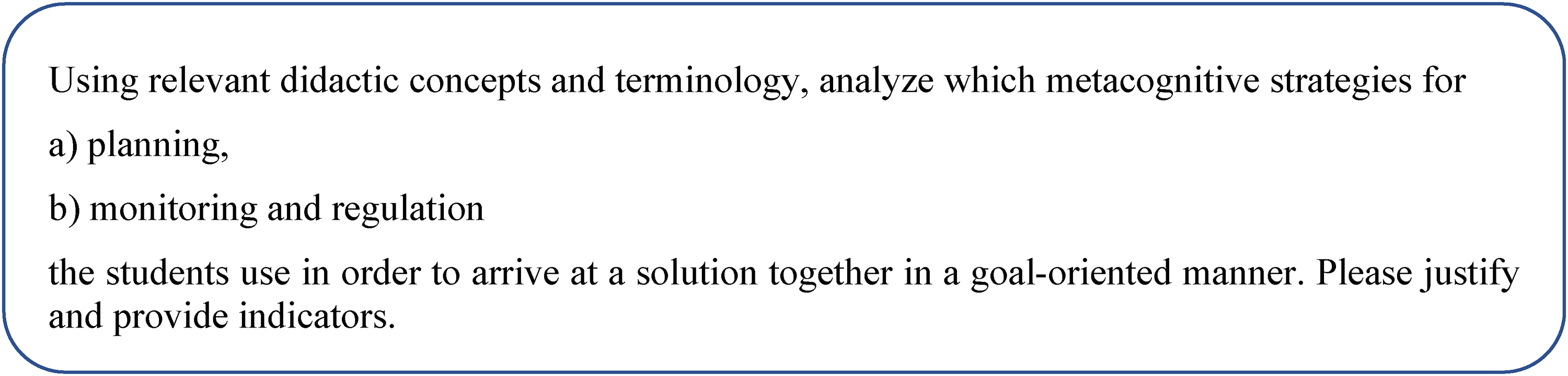
Exemplary item regarding perceiving and interpreting students’ metacognitive strategies.
The instrument was implemented before and after the modelling seminar (see Figure 1). At first, the modelling problem “Uwe Seeler's foot” was solved by the pre-service teachers themselves and discussed with the lecturer to prepare them as this would also be their knowledge base if they had to prepare a real lesson. A few concepts were also briefly explained to them, such as metacognition, to enable them to understand the questions of the instrument. Then, the participants were allowed to read the questions, and afterwards they watched the videos, which they could only do once. This procedure was chosen to simulate the demands that a real classroom situation on teachers: Teacher know the lesson goal and the specific focus of the lesson; therefore, participants had the possibility to read the questions first. However, teachers have to notice class activities spontaneously without the option of pausing and rewinding; therefore, participants watched the videos only once. Afterwards, they replied to the questions in writing.
The instrument that we used in this study had been intensively evaluated in terms of validity (for more details see Alwast & Vorhölter, 2021a). Content validity was assessed through expert ratings and a pilot study with the target group, which demonstrated that the instrument adequately covered key aspects for teaching mathematical modelling. In terms of elemental validity, it could be shown that participants’ reasoning aligned with the coded levels of interpretation differences were observed between groups with varying competence levels. Construct validity was examined through a confirmatory factor analysis, which showed a good fit for a single factor, “noticing competence.” Overall, the analyses provided satisfactory evidence for the instrument's validity.
The data consists of pre-service teachers’ written answers to the seven open questions regarding the two staged videos as described in section 4.2. First, the data were evaluated by following Kuckartz’ (2014) method of the evaluative qualitative content analysis. Second, based on that, a type-building qualitative content analysis (Kuckartz, 2014) was used to identify different patterns of noticing mathematical modelling processes.
Evaluative qualitative content analysis
The evaluative qualitative content analysis aims at the assessment, classification and evaluation of content (ibid., 2014; cf. Mayring, 2010 3 ). Categories (in the form of codes) are created and their characteristics are evaluated or ranked (in the form of sub-codes), resulting in an ordinal scale. The coded material can be used for further analysis and should help to gain an in-depth interpretation of the material.
Each utterance (several content-related sentences) was coded regarding the specific topic, which could be a certain student difficulty (e.g., difficulty in solving an underdetermined problem), a particular metacognitive strategy (e.g., monitoring the process) or one of the three different ways of solving the modelling problem. This resulted in 14 codes, which show what pre-service teachers perceived in the videos. Sub-codes for each code indicate how pre-service teachers interpreted the perceived incident: We distinguish three levels of interpretation, where an interpretation on level 1 is rather descriptive and general (e.g., “The students don't understand the task”), while a level-2 interpretation contains some analytical components (e.g., “They have difficulty simplifying the real problem; they do not know what information they need or which information they should use.”) and a level-3 interpretation is more comprehensive (“At first, the students seem to have difficulty with the underdetermined nature of the task. They are initially unaware that they need to identify and determine/research/ assume missing information. One indicator of this is that …”).
With the last question, the participants were asked to think about a possible intervention and reason about it. Thereby, the type of intervention (see Zech, 2002) was coded as well as their reasoning with three sub-codes similar to the process described above. Based on the classification of interventions by Zech (2002), we label interventions as rather strategic, if they are diagnostic, motivational, providing feedback or strategic, or as rather content-based, if they are content-oriented strategic or content-oriented. When elaborating and justifying a decision on how to intervene, this could be either done without giving reasons, reasoning by referring to details of the situation or in more differentiated manner, where different options are weighted.
A minimum of 80% of the data was coded by two different coders. The coding was conducted using the consensual coding approach (Kuckartz, 2014): Parts of the material were coded in parallel and if any discrepancies occurred in the double coded material, these were discussed immediately until a consensus was reached. If necessary, the coding scheme was then refined to eliminate any ambiguities. This procedure enabled complete agreement to be achieved at last.
Type-Building qualitative content analysis
The aim of the type-building-qualitative content analysis (Kuckartz, 2014) is to find multi-dimensional patterns in a methodically controlled way. We thus chose it as second step for the data analysis in order to describe and analyze the data in as much detail as possible but in a standardized and effective way. The type-building qualitative content analysis offers a tool to reduce the complexity of the material but also to recognize patterns in the data and identify what is typical (Kuckartz, 2014). After defining the distinguishing characteristics, groups can be formed, defined and described, so that types can be created that are internally as homogeneous as possible and as heterogeneous as possible between each other (see Kuckartz (2014) for a description of polythetic types).
In the following, the process of the type-building analysis will be described: First, we distinguish three characteristics (see Table 1). These align with the theoretical model of noticing as described in section 2.1 (see also Kaiser et al., 2015): perception, interpretation, and decision-making are based on the theoretical framework as described in section 2.3.
Characteristics used for the type-building analysis.
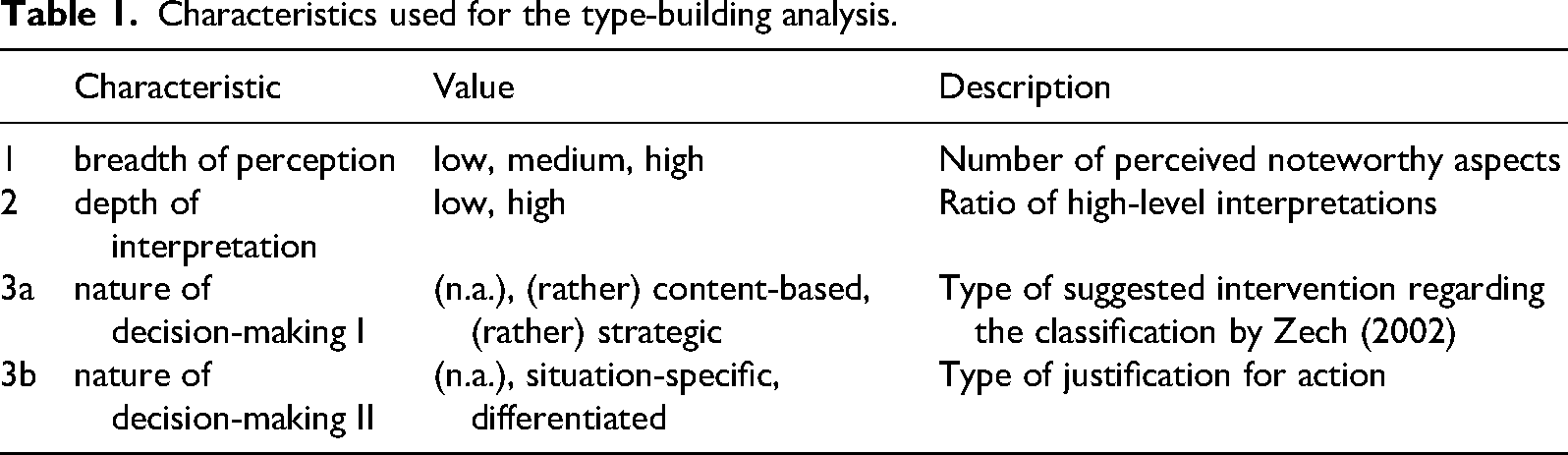
Characteristics used for the type-building analysis.
The first characteristic is the number of perceived noteworthy aspects, which we call the breadth of perception. The breadth of perception is classified as low, medium or high. The limits of these classifications can be justified both theoretically and empirically: If about half of the total of 14 noteworthy aspects, namely 6 or 7, were perceived, this is understood as a medium breadth of perception, as it is a challenge for inexperienced teachers to perceive many aspects at once or focus on different topics at the same time (see for example Jacobs et al., 2010, for a discussion of the challenge to perceive significant aspects of students’ thinking). Empirically, the accumulation of participants, who perceived 6 or 7 aspects (more than a third), and the mean value of 6.6 perceived aspects supports this classification (see Figure 3).
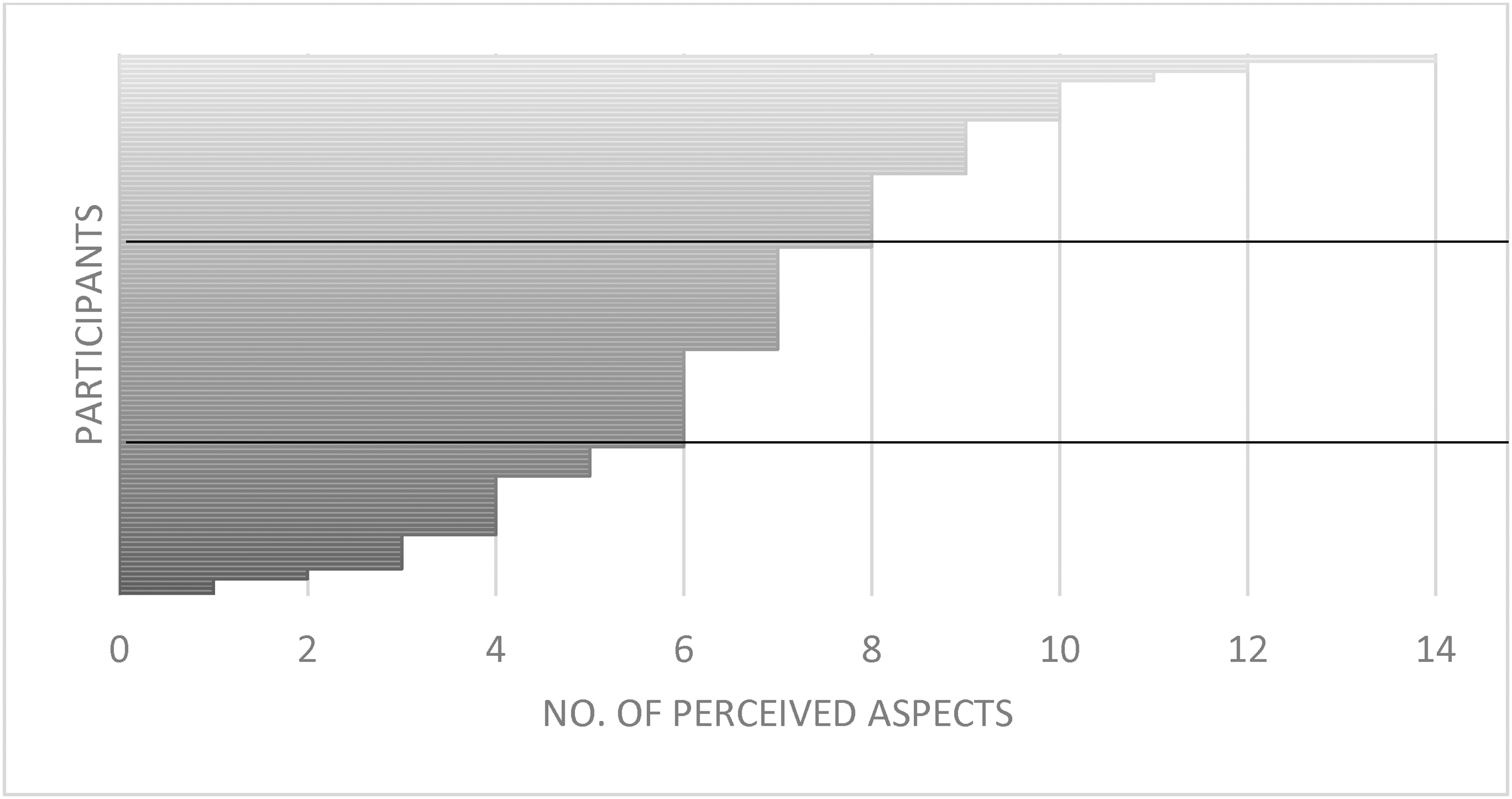
First characteristic: Breadth of perception.
As a second characteristic we define an overall score for the second facet of noticing and call it the depth of interpretation. As described in 4.4.1, a sub-code was assigned for each perceived aspect, which describes the level of interpretation. Therefore, for each participant, several codes for the level of interpretation had been assigned (one for each noteworthy aspect). To classify each participants’ overall ability to interpret, the following procedure was chosen to generate a total score for the depth of interpretation that is independent of the number of the perceived aspects (see Orschulik, 2021, for a similar approach): Either a low or a high depth of interpretation was assigned following these rules:
As a prerequisite, it is regarded necessary that a participant has perceived more than three aspects that could be interpreted to show a high depth of interpretation. Otherwise, the depth of interpretation is evaluated as low. For a classification of a high depth of interpretation one of the following conditions must be met:
There are more interpretations on level 2 and 3 than on level 1. There are at least 2 interpretations on level 3.
Rule 1 ensures that a substantial amount of data regarding a participant's interpretation is available for classification and it prevents a participant from being allocated to a high level of interpretation if he or she does only offer a single good interpretation. Rule 2 provides a way of classifying the depth of interpretation without taking the number of perceived aspects into account. As level-3 interpretations were rarely achieved (only 9% of all interpretations), criteria 2b offers a way to value participants that performed extraordinarily well in a few specific aspects.
As a third characteristic, the nature of decision-making is considered. On the one hand, the participant's decision can tend to interventions, which are (a) rather content-based or rather (b) strategic (see Zech, 2002). Furthermore, we can distinguish decisions, (a) which refer to the specific situation (e.g., students’ difficulties), and (b) which are differentiated, i.e., take into account various possibilities as well as consider cause and effect (see Kaiser et al., 2015).
Table 1 displays a summary of the above-mentioned characteristics and their values, which shows the great variety possible for creating different types.
Therefore, as a second step of the type-building content analysis, the complexity has to be reduced by combining different characteristics and forming types (see Table 2). Kuckartz (2014) describes this process of merging different characteristics to construct polythetic types as a semi-structured process. Through arranging the cases along their characteristics and combining those most similar, types can be construed that are clearly separable. Following this procedure, it would have been possible to create 12 types by combining the above-mentioned characteristics (breadth of perception×depth of interpretation×nature of decision-making). To reduce this number to a manageable amount of types, these 12 possible types are compared and contrasted, their differences and similarities are discussed in a group of experts with regard to the chosen characteristics of noticing, and their specific characteristics are highlighted by asking what makes this type special. Subsequently, the ones demonstrating the most similar characteristics are grouped in order to differentiate them from the other types. All in all, six types are created (see Table 2) and each case could be assigned to a type by following the outlined characteristics, which will be illustrated in the following section.
Illustration of the six types and their characteristics.
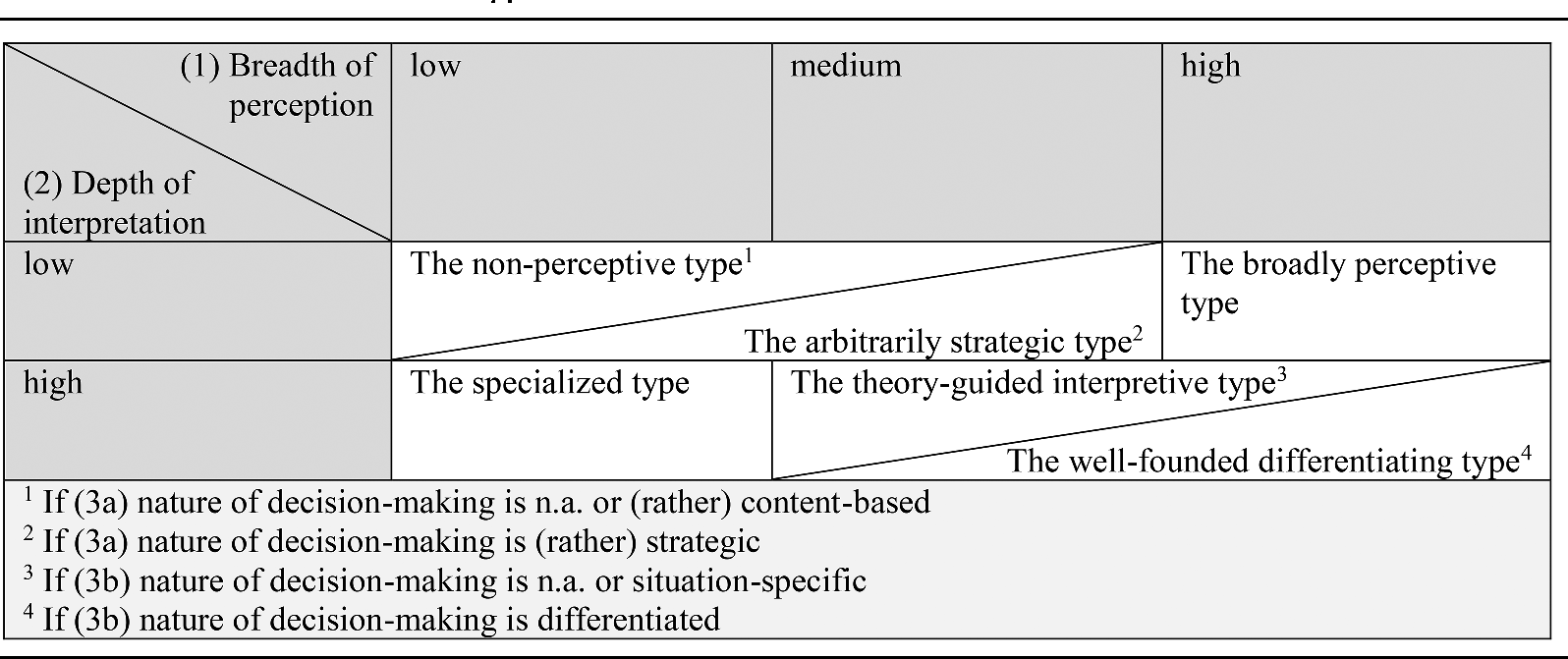
The six types of noticing mathematical modelling processes
The combination of the characteristics presented above results in six types, which differ in their ability to notice mathematical modelling processes (see Table 3). The six types are presented below, each illustrated with an exemplary case.
Overview of the six types of noticing mathematical modelling processes and their distinctive characteristics.
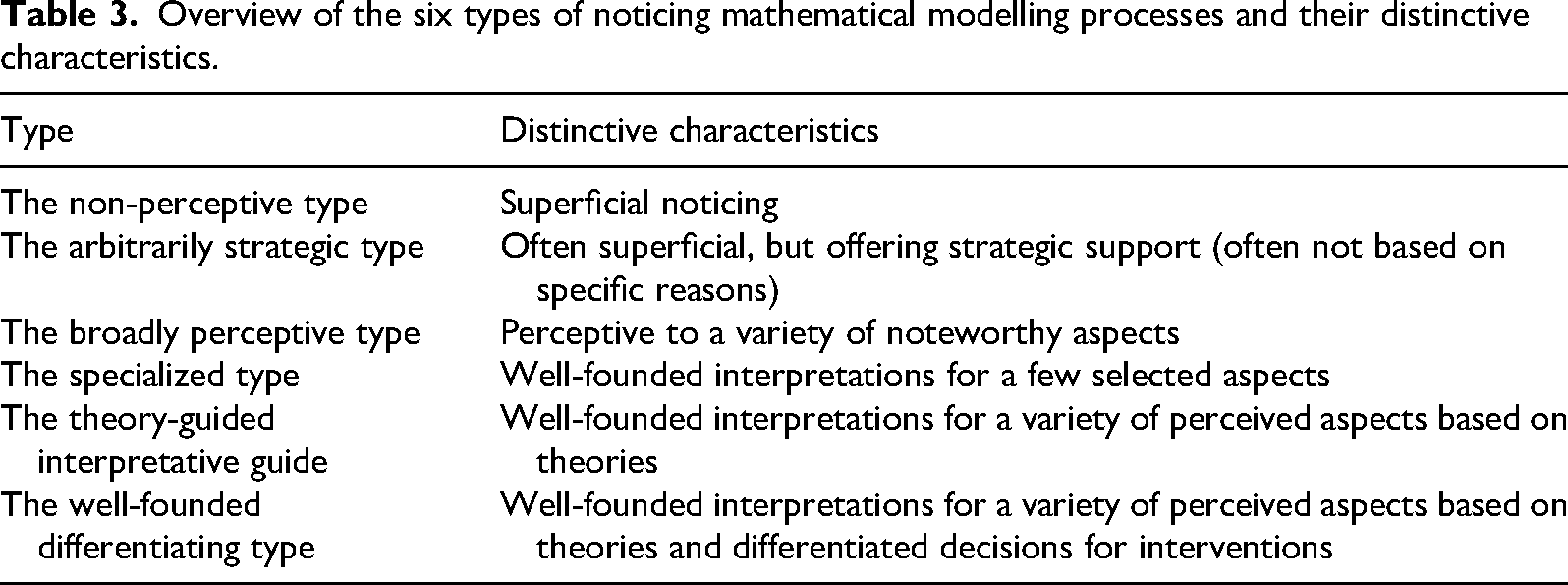
Overview of the six types of noticing mathematical modelling processes and their distinctive characteristics.
This type only perceives a small number of aspects despite the large variety of aspects that could be perceived in a modelling situation. Even though the open questions frame the participants’ focus, this type only perceives a few selected aspects. He or she perceives these few aspects superficially and can hardly interpret them in depth. This type therefore rather tends to describe the few perceived aspects than to interpret them or provide reasons for these aspects to be relevant. If this type offers a possibility to act, the intervention is (rather) content-based, e.g., explaining to the students to use the correct units. This is rarely accompanied by justifying reasons, neither by drawing back to the goal of the intervention.
Example: Max 4
Max correctly perceives and describes a few situations, which are relevant. For example, he briefly describes the students’ monitoring and regulation strategy, when a problem arises. “After the first attempt failed, the two students in front checked the result and chose a different strategy to solve the problem.”
The arbitrarily strategic type
Just like the non-perceptive type, this type only selectively perceives the situation and interprets the perceived aspects superficially. In contrast to the aforementioned type, the arbitrary strategic type offers (rather) strategic help, when asked to decide about actions. However, this is only rarely based on reasons, too.
Example: Jenny
“Checking the task; checking the given data; checking the assumptions”
Jenny apparently has a rough concept of metacognition—as this would be a prerequisite to be able to give these notes about metacognition in the first place—and perceives actions of the students as metacognitive. However, she can neither justify why she has chosen this classification, nor which details in the video lead her to this conclusion or what consequences follow from them. “‘It's great that you've already put so much thought into it. [name of a student], maybe you could explain to me again what the aim of the task is.’”
The broadly perceptive type
The outstanding feature of this type is his/her perception of a wide variety of aspects that are relevant in the context of mathematical modelling. However, this type provides—only to a limited extent—explicit interpretations of the perceived aspects that go beyond a mere description. However, since the perception of aspects relevant to the question also requires knowledge of the significance of these aspects in order to recognize them as relevant in the situation, this knowledge seems to be rather implicit.
Example: Gonca
Gonca recognizes 11 out of 14 aspects that were relevant to the questions. This shows that she can recognize which aspects are relevant for mathematical modelling in a classroom situation. For example, she mentions various difficulties such as “calculating with different units” and “incorrect assumptions → size of the foot”, but remains on the surface by naming these difficulties without referring specifically to the situation or recognizing the causes. For example, she could have added that the pupils in this specific situation equate the shoe size 42 with a length of 42 cm. Therefore, it could be concluded that they lack extra-mathematical knowledge, which is often required in mathematical modelling and the lack of it is therefore a typical difficulty that can occur in mathematical modelling. However, it should be emphasized that Gonca, as a broadly perceiving type, at least mentions, i.e., perceives, almost all relevant aspects—despite the large variety.
The specialized type
The specialized type is characterized by its high depth of interpretation, while he or she perceives a selective number of noteworthy aspects (five at most). This type often focuses on a specific topic, such as metacognitive strategies, and perceives a lot in this area, but neglects other areas. The strength of this type lies in the highly analytical interpretation of the selected aspects, which is connected to the specific situation and classifies it with regard to known theoretical concepts.
Example: Gaby
While Gaby mentions and describes particular aspects of metacognition and students’ approaches, she provides the most in-depth interpretations in relation to the group's difficulties. For example, she describes the behavior of the group of students in detail, draws conclusions about their emotions and differentiates between the individual group members. This, in turn, provides the basis for her conclusion that in this situation the lack of motivation causes the difficulties in the work process: “The students’ problem clearly lies in collusion and motivation. One person in the group works and does the math for the whole group. The person sitting next to her is trying to keep up, but has probably got lost somewhere in the process. The other girls are not interested in the task and accept an incorrect result.”
The theory-guided interpretive type
This type perceives a variety of relevant aspects (medium to high) and thus broadens his/her view with a wide range of topics that could be relevant for teaching. He/ she also manages to offer well-founded interpretations of what he/ she perceives, which consider the individual situation and are based on theoretical concepts. Combining both the perception of a broad range of aspects and the in-depth interpretation of them, this type creates a solid basis for decision-making. While this type refers to the circumstances of the specific situation when reasoning about a decision, he/ she does not discuss alternatives or different options and consequences. However, this type excels in perception and interpretation and makes goal-oriented decisions.
Example: Marc
Marc mentions a variety of difficulties that occur as well as metacognitive strategies, the students use to solve these problems such as planning the solution process or questioning each other for monitoring, and different approaches the students use to solve the modelling problem. Moreover, these aspects are interpreted with respect to the specific situation and the consequences, for example: “[…] Now they are between the phases of mathematical work and interpretation. This is because they have not yet carried out all the necessary calculations (volume of the foot and ratio of the volumes to each other). Some of the students even think that they have already successfully solved the task. However, they lack the correct interpretation and validation of their results, otherwise they would have realized that the solution to their calculation is not the solution to the task.” “[…] I would try to get the students to find the solution themselves. They are already close and just need a little help. They have the basic ideas, as they have already shown”
The well-founded differentiating type
The well-founded differentiating type is closely related to the theory-guided interpretative type. In addition to his/her broad perception and in-depth interpretation, this type is characterized by his/her decision-making process following the interpretation of the situation: this type weighs up various options against each other and describes possible scenarios, relating them to the specific situation and basing them on the interpretation.
Example: Karen
Karen accurately locates the problems with regard to the modelling cycle and refers to relevant details of the situation. She considers the possible cause of students’ difficulty and its consequences (the problem leads the students to the next challenging situation). Again, she draws connections to common difficulties (using an approach for text tasks) and reasons about the probable cause in this situation.
When talking about her ideas on how to intervene, Karen says: “I would first ask the question ‘Which of you would like to present your solution process again?’ to get the pupils to present their formula and their calculation process to me in detail. In this way, they may realise for themselves that they have not thought about the fact that the units used for the two volumes are different and that they first have to use the same unit for both volumes, either cubic centimetres or cubic metres, before they can arrive at a comprehensible result. If the pupils do not notice the error by explaining their own calculation method, I would draw their attention to the volumes and the different units by having them look at the volumes in comparison again with the second comment ‘Take another close look at the volumes you have calculated’. However, this would already be a strategic help in terms of content, which I would only use if the first intervention is not successful.”
Development of pre-service teachers’ noticing of modelling processes
As the pre-service teachers took part in a pre- and posttest, it is possible to assign them to a type for each measurement point. Their development of noticing mathematical modelling processes can thus be described by their change of type (see Figure 4).
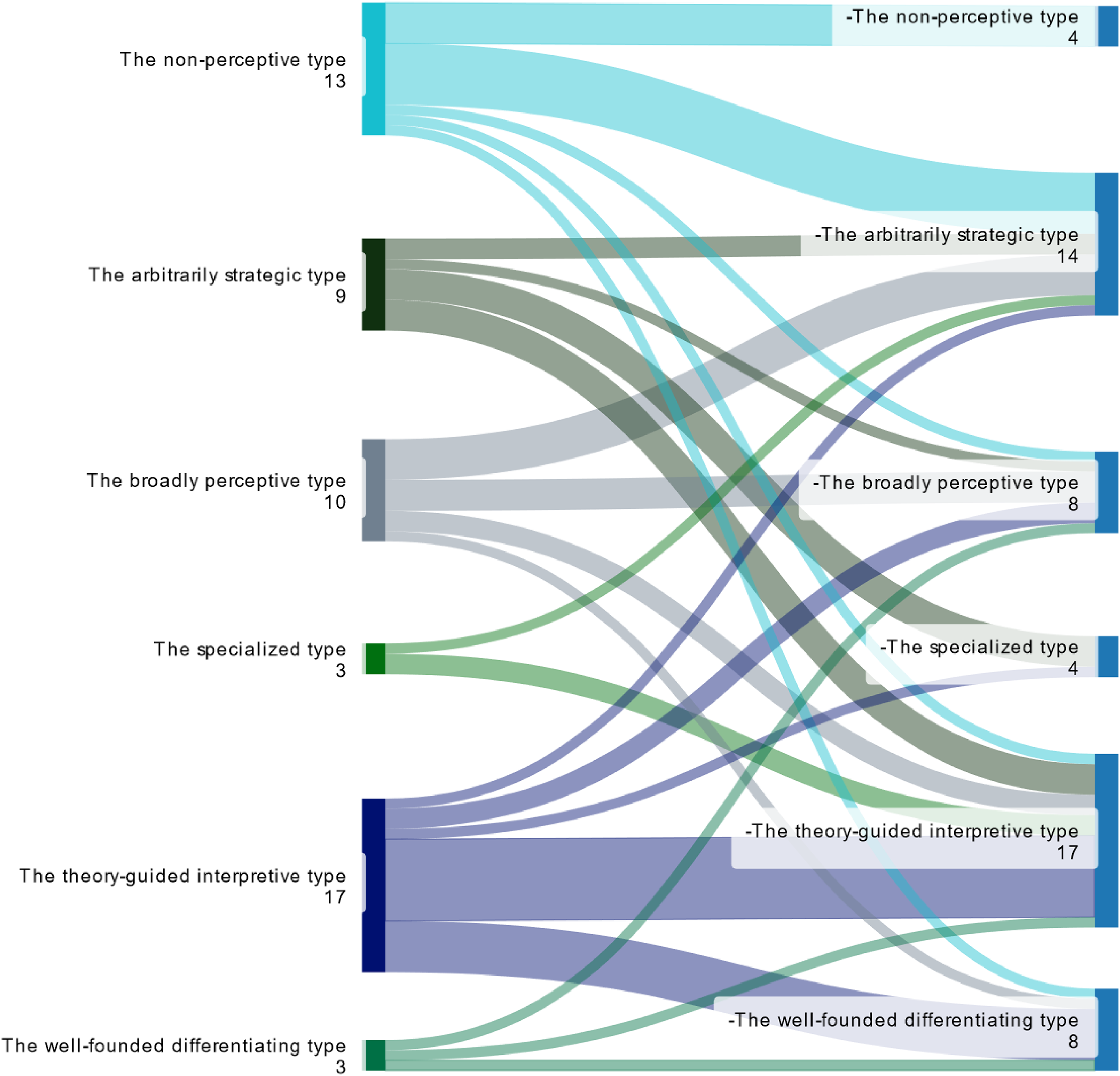
Development of types.
The Sankey diagram (see Figure 4) illustrates the change of type during the modelling seminar. It highlights that many participants (38%) who belong to the non-perceptive type at first develop towards the arbitrarily strategic type during the modelling seminar. Although they still only perceive few aspects and do not interpret them thoroughly, yet, they change their decisions regarding interventions towards a more strategic approach. As interventions, especially strategic support, was discussed in the seminar, these participants might have understood the relevance of strategic interventions without being able to reason about their use in the specific situation, yet (see also Stender & Kaiser, 2015). While few participants also develop towards other types from there, none of them develop towards the non-perceptive type, if classified as something else in the pre-test. 31% percent of the participants also stayed in this type. These participants might have gained knowledge on mathematical modelling during the intervention in a first step but the threshold to applying this knowledge for noticing still seemed to have been too high for them (see for example Hino & Funahashi, 2022, for the relevance of pedagogical content knowledge for decision-making).
From the arbitrarily strategic type there are mainly (two thirds) developments towards the specialized and the theory-guided interpretative type (while some also stay in their group). Both of these developments have in common, that the depth of interpretation increases. As hypothesized before, the arbitrarily strategic type might not have been able to apply knowledge to a real situation, but was offered opportunities to learn in the seminar through repeated video analysis and thus, the ability to interpret developed.
Participants classified as broadly perceptive type mainly stay constant (30%) or develop towards the arbitrarily strategic type (40%). Their strength is still mainly perception and they keep focusing on this facet of noticing. This outcome emphasizes that perceiving something relevant does not automatically mean that it can be correctly interpreted (supporting the conceptualization as two different facets, e.g., Kaiser et al., 2015).
The specialized type is not widely represented (about 5% in the pre-test). A few participants of this type develop towards the theory-guided interpretative type keeping their interpretative character and extending their perception, while others show a decrease in their ability to interpret developing towards the arbitrarily strategic type. As the transfer of knowledge to different modelling contexts is challenging (Niss & Blum, 2020), this type specified in a certain area and facet of noticing.
Already at the beginning of the modelling seminar, there was a group of participants regarded as theory-guided interpretative type. They already perceive a sufficient amount of aspects and can interpret them guided by theory. A great number of them (47%) also remain in this group during the modelling seminar, while another large part (29%) changes their decision-making towards a more differentiated approach, which leads to the classification as well-founded differentiating type. This supports the claim of decision-making being the most challenging to master for pre-service teachers (see Stahnke et al., 2016), although it was frequently addressed in the modelling seminar. In line with this argument, the well-founded differentiating type includes only a small number of participants before the modelling seminar. Moreover, mostly the theory-guided interpretative type develops towards this type, which excels in all three facets of noticing.
All in all, the Sankey diagram shows that there is a tendency to develop in such a way that a least one facet of noticing is improved, which will be discussed in the next sections.
Teaching mathematical modelling is a challenging task due to the complexity, openness and broad range of mathematical and extra-mathematical knowledge needed. It requires teachers to not only be competent in solving mathematical modelling problems themselves, but also to be able to perceive and interpret noteworthy modelling-specific aspects in order to decide on appropriate and adaptive interventions. With this study, we try to contribute to understanding the specification of pre-service teachers noticing competencies for mathematical modelling and their development in order to provide further implications for teacher education.
Distinguishing six types of noticing mathematical modelling processes
Concerning the first research question, we identified six types of noticing mathematical modelling processes, which differ in breadth of perception, depth of interpretation and nature of decision-making. In the following, we will highlight and discuss their strengths and weaknesses.
The non-perceptive type only selectively and superficially notices, yet, while the closely related arbitrarily strategic type also perceives a limited number of noteworthy aspects and mainly uses descriptive comments, but still offers (rather) strategic help. The number of participants belonging to these two types demonstrates how challenging it can be for pre-service teachers to apply their knowledge in real-time instructional contexts. Even when teachers know the solutions to modelling problems—having previously discussed the solution approaches—accurately perceiving and interpreting specific classroom situations under time pressure remains a significant challenge. This could be either due to a lack of applicable knowledge about mathematical modelling, on which noticing is based—in line with the competence model by Blömeke et al. (2015)—, or the limited teaching experience of pre-service teachers. Thus, this finding emphasizes the importance of practice-based experiences for the implementation of theoretical knowledge into practice mediated by teacher noticing (see also Bastian et al., 2022). In contrast, the distinctive feature of the arbitrarily strategic type lies in the unfounded (rather) strategic interventions that are stated. Therefore, this type seems to know the relevance of strategic interventions to support students’ mathematical modelling processes, but as he or she cannot give reasons for the use in a particular situation, this knowledge seems to be rather tacit (cf. Neuweg, 2004). This finding is in contrast to a study by Leiß (2007), where even experienced teachers often offered content-based interventions to support students in mathematical modelling. Nevertheless, pre-service teachers of this type seemed to resort to strategic interventions reflexively, which might be due to their discussion in the modelling seminar. Similarly, Jacobs et al. (2024) identified a profile of emerging noticing, which is characterized by rather low scores of perception and interpretation but relatively high scores for deciding on follow-up questions.
The outstanding feature of the broadly perceptive type is the wide range of perceived aspects in all areas—students’ difficulties, their use of metacognitive strategies and their approaches to solve the problem. It seems that the diagnostic dimension described by Borromeo Ferri and Blum (2010), is already well developed concerning for example the identification of students’ difficulties. However, these aspects, perceived as noteworthy, are not interpreted or connected to theoretical concepts; they are thus not linked to the theoretical dimension (see Borromeo Ferri & Blum, 2010) to reason about causes and relations. Nevertheless, some kind of conceptual understanding of mathematical modelling seems to be required to identify, what is worth noting.
The specialized type selectively perceives a few noteworthy aspects often regarding one topic, for example metacognition, and comprehensively interprets these aspects (see meta-metacognition; Stillman, 2011)—this might lead to a narrowed view on the classroom situation but also to great insights concerning his specialty. Moreover, this type might extend his view with more experience, similar to the change of topic focused on in the study by Zuo et al. (2024).
The theory-guided interpretive type and the well-founded differentiating type both possess strengths in their wide range of perception and sound interpretation. Thus, these types already excel in two facets of noticing in comparison to their peers. With the close entanglement of perception and interpretation (Santagata & Yeh, 2016) these two types seem to be the most coherent in their noticing (see also Thomas et al., 2021). In comparison, the well-founded differentiating type is also able to decide upon his actions in a more differentiated and balancing way, which is in line with the taxonomy of support by Zech (2002) broader concepts of scaffolding in mathematical modelling (Stender & Kaiser, 2015).
Distinguishing these six types emphasizes the diversity of abilities regarding noticing mathematical modelling processes. Similarly, Jacobs et al. (2024) identified three competence profiles (emerging, mixed and accomplished noticing) through quantitative analysis, which fit our results and also highlight the multifaceted nature of noticing.
Developmental patterns
The distinction of different types of competence profiles with their respective strengths and weaknesses also allows for an analysis of developments during the modelling seminar. For all types except for the specialized type, there are some participants, who stay in this type, which emphasizes the challenge to develop the ability to notice. Many studies have shown that noticing develops slowly and is sometimes only visible over a long period of time, such as in expert-novice comparisons (e.g., Bastian et al., 2022; Jacobs et al., 2010). However, the highest percentage of participants, who stay constant, can be found in the theory-guided interpretative type (47% of this type), who already show high levels in perception and interpretation. In line with other studies on noticing (e.g., Cai et al., 2022), decision-making (here in the form of differentiated ideas for intervention) seems to develop last. Some developments should also be noted as decrease in the ability to notice: About 10% of the participants developed towards the arbitrarily strategic type, while about 5% showed a decrease towards the broadly perceptive type. Especially the development towards the arbitrarily strategic type seems surprising, as it contrasts the aforementioned challenges in developing decision-making. Although the arbitrarily strategic type usually does not give reasons for an intervention, a strategic intervention is offered. Similarly, in a study by Stender & Kaiser (2015) teachers often offered strategic help after an intervention, especially asking students to explain their work. As mentioned before, the participants of this study might have remembered that asking strategic questions is useful without being able to explain why with regard to the specific situation.
Moreover, the analysis showed that for most participants there is a tendency to develop in such a way, that at least one facet of noticing is improved. Perception became broader, interpretation less descriptive and more theory-driven, or decisions were made weighing up different possibilities (see also Alwast & Vorhölter, 2021b). Improvements in all facets of noticing at the same time were less common. Drawing back on the competence model by Blömeke et al. (2015), there is a variety of underlying factors, which influence this development, such as modelling-specific, mathematical and extra-mathematical knowledge and beliefs (see Borromeo Ferri & Blum, 2010). The study shows that giving pre-service teachers the opportunity to both acquire knowledge about mathematical modelling but also practice noticing, for example through video analysis, can improve their ability to notice modelling processes.
Limitations and further perspectives
This study contributes to the discussion on noticing and its development in the context of mathematical modelling. However, future research should consider quantitative methods to support these results on a larger scale. Moreover, new technological tools (e.g., 360-degree video recordings; see Buchbinder et al., 2021) might offer new ways of assessing noticing and different approaches to the concept of noticing from a different perspective. In addition, developmental patterns might have been more distinct, if the intervention would had lasted longer. Either a longer intervention, which is often not feasible in teacher education, or a comparison with experienced teachers (similar to Bastian et al., 2022) would enhance our understanding of the development of teacher noticing in a mathematical modelling context. Despite the study being situated within the German educational context, which has a well-developed tradition of research in the field of teacher education, the transferability of our findings may still be shaped by its system-specific characteristics. Therefore, our findings should not be presumed to be applicable directly, and should be transferred and replicated with caution in diverse educational settings. Finally, the ability to notice in real-life teaching situations can only be approximated through a video-based instrument and an intervention, in which practice-related artifacts are discussed, although some studies indicate a degree of transferability (e.g., Stockero, 2021).
The study highlights and reinforces the importance of implementing opportunities to learn and practice teacher noticing early on in teacher education programs (see König et al., 2022). The identification of different types of noticing mathematical modelling processes may inform personalized learning opportunities for pre-service teachers. In addition, the creation of different types of noticing also provides a way to characterize the multi-dimensional concept of teacher noticing in a comprehensive way (see also Jacobs et al., 2024). By describing pre-service teachers’ competence profiles, it is possible to understand their strengths and weaknesses in noticing mathematical modelling processes and pre-service teachers can receive tailored support that enhances their overall ability to notice in the classroom. Furthermore, this study contributes to the discussion on competencies for teaching mathematical modelling and emphasizes the relevance of noticing in this context. Teachers’ support in modelling activities should be aimed at enabling students to work as independently as possible and therefore, adaptive interventions are particularly important (e.g., Stender & Kaiser, 2015). These adaptive interventions require a broad perception and sound interpretation in order to come to well-founded decisions. Understanding individual differences in noticing mathematical modelling processes is thus a condition for teacher education that supports individual development.
Footnotes

Ethical Considerations
Not applicable
Consent to Participate
Participation was voluntary.
Consent for Publication
Not applicable
Informed Consent
Informed consent was obtained from all subjects involved in the study.
Author Contributions
The first author conducted the research and drafted the manuscript. The second author carried out the intervention and added important ideas to the implementation of the study and of the paper. Both authors read and approved the final manuscript.
Funding
The authors received no financial support for the research, authorship, and/or publication of this article.
Declaration of Conflicting Interests
The authors declared no potential conflicts of interest with respect to the research, authorship, and/or publication of this article.
Data Availability
The datasets generated during and/or analyzed during the current study are not publicly available due to pending further data analysis, but are available from the corresponding author on reasonable request.