



Abstract
A significant gap exists, as research has revealed that teaching mathematics in classrooms is usually unrelated to the sociocultural contexts of the learners. This multiple case study explored the challenges mathematics teacher educators face in integrating ethnomathematical perspectives into geometry teaching in the Ghanaian college classroom. Eight mathematics teacher educators were included in the study through purposive sampling. The data obtained through interviews and focus groups were analyzed using reflexive thematic analysis. The mathematics teacher educators’ accounts revealed college and educator-related challenges, including inadequate/lack of cultural examples in the geometry curriculum, cultural diversity, financial constraints, time constraints, and gender discrimination. In all, the findings obtained from this qualitative investigation revealed differences among male and female mathematics teacher educators regarding what they perceive as challenges in integrating ethnomathematical perspectives into geometry teaching. For instance, male mathematics teacher educators reported inadequate/lack of cultural examples in the geometry curriculum, whereas female mathematics teachers identified gender discrimination as a challenge to their effort to integrate ethnomathematical perspectives into geometry teaching. Implications for teaching and future research are reported.
1. Introduction
Classrooms or learning spaces must remain interconnected with the communities in which they are situated. Classrooms are integral components of a community that encompasses unique cultural customs. Upon entering school, students carry their beliefs, standards, and concepts, predominantly mathematical, which they acquired during their upbringing (Adam, 2004). Nevertheless, it is worth noting that the mathematical concepts incorporated in the school curriculum may not necessarily align with the pupils’ cultural understanding of mathematics.
Teaching geometry in a deductive manner has seldom been effective in creating such an atmosphere, as conventional curricular methods do not allow students to create their mathematical concepts independently; rather, they are often imposed upon them (Stathopoulou et al., 2015). To address human needs in a culturally sensitive and responsive manner, D’Ambrosio (2016) argues that individuals from different cultural backgrounds have consistently developed methods, processes, tactics, styles, arts, and techniques (techné/tics) for both practical and cognitive purposes. For instance, some African cultures used spatial patterns, whereas Indian cultures introduced the mathematical concept of zero. This is connected to understanding and adapting to the natural, social, and cultural contexts (ethno). Ethnomathematics, a field that examines the arts and techniques employed in mathematics within diverse cultural contexts, is a key part of this process of understanding and adapting to the natural, social, and cultural contexts (Kyeremeh et al., 2023; Rosa & Orey, 2021).
National Council for Curriculum and Assessment of Ghana (NaCCA) (2019) advocates that teachers’ instructional pedagogy be consistent with the set of values and help create a cultural identity among students by inculcating a strong sense of social and environmental awareness. However, a significant gap exists as research has revealed that teaching mathematics in classrooms is usually unrelated to the sociocultural contexts of the learners (Soares, 2009). Thus, most mathematics teachers appear to employ instructional pedagogies that are considered inappropriate and cannot link school mathematics to the students’ cultural backgrounds and environment. This affirms what Garii and Silverman (2009) found in their study about mathematics teachers’ (especially those in the United States of America) inability to either bring outside-school mathematics into the classroom or help students explore the connections between the mathematics students experience outside the school and the school mathematics they encounter in the classrooms. By incorporating ethnomathematical perspectives into mathematics teaching, teachers cannot only bridge this gap but also enhance students’ understanding and engagement with mathematics.
The study conducted by Sunzuma and Maharaj (2019) examined the obstacles faced by teachers in Zimbabwe when incorporating ethnomathematics approaches into geometry instruction. They employed a convergent mixed methods design for their study. Several obstacles were identified in the study, including a deficiency in understanding ethnomathematics techniques and their integration into geometry instruction, teachers’ limited knowledge of geometry, teachers’ perspectives on geometry taught in schools, and teachers’ proficiency in teaching geometry. The study's findings indicate that many mathematics teachers in Zimbabwe lack sufficient training in ethnomathematics techniques. Consequently, they have lacked the expertise to effectively incorporate ethnomathematics approaches into teaching geometry. This finding aligns with the observations made by Naresh (2015) in their study, which indicated a lack of ethnomathematics courses in most teachers’ training institutions. We contend that educators are inclined to employ instructional methodologies that align with their existing knowledge or have been exposed to during their professional development.
In Maldives, it is atypical for teachers to actively participate in mathematical explorations due to the influence of examinations on the curriculum (Adam, 2004). A proclivity exists to prioritize the preparation for assessments and tests, often resulting in a concerted effort to cover the content material outlined in the syllabus. This lacks motivation for teachers to explore mathematical concepts or pedagogical methods, such as implementing cooperative learning strategies that foster problem-solving, reasoning, and communication abilities among students. The tenets of ethnomathematics require that the acquisition of mathematical knowledge should encompass active engagement with cultural practices in real-life contexts and intentionally exploring these practices inside a structured classroom setting (D’Ambrosio, 2001). Utilizing cultural practices to illustrate mathematical concepts necessitates engaging in deliberation, inquiry, collaborative efforts, and applying students’ existing knowledge. The use of these cultural traditions in the classroom may result in certain students possessing greater knowledge about the subject than the teacher, particularly if the teachers do not share the same social and cultural background as their students.
In a case study conducted by Sunzuma and Maharaj (2020), they examined the perspectives of Zimbabwean instructors about factors that hinder the incorporation of ethnomathematics perspectives in geometry instruction. The study's results indicate that several factors hinder incorporating ethnomathematics approaches in the instruction and acquisition of geometry. These factors include learners’ attitudes towards ethnomathematics approaches and geometry, their limited understanding of cultural examples, cultural diversity, and resistance to change. In their recent study in a similar context, Sunzuma and Maharaj (2021) examined the various issues within schools that hinder the incorporation of ethnomathematics perspectives into geometry teaching. The findings from this mixed methods study indicate that the integration of ethnomathematics perspectives into geometry teaching is hindered by many problems linked to the curriculum. These challenges include a shortage of resources, such as textbooks, and a scarcity of cultural examples and activities within the curriculum. One of the issues about the curriculum is the lack of clarity regarding the application of ethnomathematics perspectives in geometry teaching.
Over time, there has been a debate on whether the conventional applications of the school curriculum effectively cultivate a sincere inclination for practical mathematics in students. Orey and Rosa (2007) acknowledged the challenge of integrating the objectives and principles of ethnomathematics with the academic benchmarks, norms, and objectives associated with achieving high scores on standardized exams that rely on conventional school mathematics. Orey and Rosa (2007)reported that many mathematics educators are reluctant to relinquish their conventional authority in favor of collaborative work. Some reported challenges also have to do with the issues of insufficient time for planning and delivering ethnomathematics lessons. According to Orey and Rosa (2007), a prevalent viewpoint among educators is that implementing an ethnomathematical approach in school curricula may hinder students’ acquisition of mathematical knowledge. Consequently, they contended that this perspective challenges the accountability of both students and teachers in standardized examinations.
D’Ambrosio and Rosa (2017) noted that insufficient proficiency in mathematics skills is a significant factor contributing to social exclusion in geometry education. The use of ethnomathematical concepts in teaching geometry in the classroom presents challenges because, there are difficulties in instructing fundamental geometric shapes that are important in all cultural contexts. Effective mathematical learning is facilitated by social communication and cultural engagement, which involve teachers and students engaging in discourse and negotiating the meaning of symbolic representations (D’Ambrosio & Rosa, 2017). The ethnomathematics curricular model necessitates that teachers possess both adaptability and expertise in the subject matter, as they are responsible for choosing instances relevant to students’ cultural backgrounds and immediate surroundings. The moral option of including or excluding variations and mathematical traditions introduced by students within the school community necessitates careful consideration by governments, curriculum developers, and implementers. This highlights the importance of considering instructors’ beliefs regarding incorporating ethnomathematics methodologies in the instruction and acquisition of geometric knowledge.
Rosa's (2013) study revealed that teachers in California had unfavorable attitudes toward using ethnomathematics methodologies. Some educators maintained the perspective that the content of geometry taught in schools lacks cultural sensitivity due to the inclusion of foreign examples, and language in textbooks, as well as the inherent characteristics of geometry. This finding corroborates the traditionalist perspective on mathematics, which posits that mathematics is instructed as an academic subject devoid of cultural sensitivity. These perspectives advocate for the use of teacher-centered methodologies and instructional strategies in the field of geometry education. Consequently, the integration of ethnomathematics techniques is unlikely to be achieved within these particular geometry classes. Mogari (2004) observed that the curriculum lacks emphasis on the practical parts of mathematics and assessment for these practical components.
The case study conducted by Fungai (2013) aimed to investigate and analyze the integration of ethnomathematics into formal mathematics education in Zimbabwe. The study focused on enhancing the teaching of geometrical concepts such as shear and stretch transformation. The findings highlighted several challenges, including the issue of large class sizes. This challenge is particularly relevant given that ethnomathematics is rooted in the constructivism theory. This finding aligns with the findings of Mogari (2004), which highlighted that some educators expressed concerns regarding the impact of large class sizes on integrating the ethnomathematics approach. Teachers voiced apprehensions about the lack of engagement in the curriculum inside the school system.
Based on the available literature, there appear to be very few existing studies (Fungai, 2013; Mogari, 2004; Rosa, 2013; Sunzuma & Maharaj, 2019, 2020, 2021) that have investigated mathematics teachers’ perceived challenges in the incorporation of ethnomathematical perspectives into school geometry in the classroom. Studies that specifically target mathematics teacher educators are especially lacking. This study aimed to address the existing gap in the literature by presenting empirical evidence from the viewpoint of mathematics teacher educators regarding the challenges involved in integrating ethnomathematical perspectives into geometry teaching. Given this, we sought to explore the challenges mathematics teacher educators face in integrating ethnomathematical perspectives into geometry teaching in the Ghanaian classroom. The study attempts to answer the research question: What do mathematics teacher educators perceive as challenges to integrating ethnomathematical perspectives into geometry teaching? Based on the study's findings, stakeholders in mathematics education, including policy-makers, curriculum developers, and educators, may utilize the data from these studies to inform their policy-making processes when developing curricula for teacher preparation and professional development.
2. Methodology
2.1 Study design
In this study, we employed a multiple case study in search of an in-depth understanding of the phenomenon under study (Merriam & Tisdell, 2016; Yin, 2018). The male and female mathematics teacher educators who teach geometry courses at either the foundational or specialty levels in the Ghanaian colleges of education were treated as cases. Each case involved a sample of mathematics teacher educators at the colleges of education that run the 4-year common Bachelor of Education (B.Ed.) curricula. These 4-year B.Ed. mathematics curricula demand that teacher educators employ culturally relevant pedagogies (ethnomathematical perspectives) to develop student teachers who can integrate informal learning and cultural knowledge in instruction to meet the needs of the learners and broaden the curriculum (Ghana Ministry of Education, 2017, 2018a, 2018b). From the literature, it is anticipated that mathematics teacher educators’ engagement in ethnomathematical thinking and practices could be influenced by demographic factors, including gender (Kyeremeh et al., 2024; Pradhan, 2023; Thakur, 2019). Due to some similarities and uniqueness of the cases, this study focused on literal and theoretical replications. According to Yin (2014), multiple case study is often chosen to investigate particular phenomena through several studies to predict similar and/or contrasting results.
2.1.1 Participants
In this study, we purposefully sampled eight mathematics teacher educators: four males (Mr. A, Mr. S, Mr. M, and Mr. J) and four females (Ms. E, Ms. T, Ms. V, and Ms. A) for the interview after reaching data saturation (Gerson & Damaske, 2020). These mathematics teacher educators are considered information-rich because they teach geometry courses at either the foundational or specialty levels in the Ghanaian colleges of education at the time of the study. The same mathematics teacher educators were also put into two focus groups based on gender, with four mathematics teacher educators per group. Kandil (2022) recommended the determination of a focus group composition based on shared characteristics among the members of the group to facilitate productive discussion due to their shared interests or experiences. The views of these individual groups will help augment the views of the other so that varying explanations or interpretations can be derived. This study aimed to obtain male and female educators’ differing views on the challenges they face in integrating ethnomathematical perspectives into geometry teaching in the classroom to generate valuable information.
2.1.2 Method of data collection
In this present study, we employed two data sources, telephone interviews and virtual focus groups, thereby providing triangulation to gain a larger perspective on the phenomenon under investigation (Yin, 2018).Using a telephone interview, we could effectively manage our influence as interviewers, unlike what we could have done in a face-to-face mode due to the widened physical separation between the researchers and the participants (Scheuren, 2004). The telephone interview was guided by a semi-structured protocol of seven items. A semi-structured interview guarantees that the interview stays on topic in line with the research objectives. We utilized a virtual focus group to uncover opinions that may not arise from individual interviews through the interaction among participants on Zoom (Graham & Bryan, 2022). The virtual focus groups were hosted on Zoom to replicate the experience of in-person focus groups. The focus group protocol consisted of four questions with an introduction and ground rules.
2.2 Trustworthiness of the study
In ensuring the trustworthiness of the qualitative data, efforts were made to provide a more comprehensive and impartial description of the phenomenon by selecting appropriate participants and including rich, descriptive details. In this direction, we presented justifications for the theoretical, methodological, and analytical procedures employed for readers to comprehend the rationale behind the judgments. We also conducted an audit trail where detailed descriptions of activities and decisions made throughout the study were documented. Moreover, peer debriefing was conducted among the co-authors to review audit logs and give feedback.
2.3 Data collection procedure
We commenced the data collection after obtaining site authorization and ethics approval from the Humanities and Social Sciences Research Ethics Committee of Kwame Nkrumah University of Science and Technology for using human subjects. The principal author's position as a teacher educator in the field of mathematics at a college of education provided contacts with some heads of the Department of Mathematics & Information and Communications Technology. We began the data collection by contacting the principals and heads of mathematics departments in the targeted colleges of education to seek authorization to conduct research in the colleges and among mathematics teacher educators. With the help of department heads, we reached out to selected participants by phone to confirm their participation in the study, seek their consent, and discuss their daily schedules to fix the date and time for the telephone interview and virtual focus groups. During the phone call, we also discussed their access to Zoom technology.
A prior appointment and cover letter were sent to respondents to enhance the response rate and length of the interview. Prompts were served to remind participants fairly after agreeing on the date and time. We reiterated the purpose of note-taking and audio-recording as the interview was conducted. The outline of questions in the interview protocol guided the interviews. After the telephone interviews, the same participants were put into two focus groups (male and female) to participate in virtual focus groups hosted on Zoom. To keep the group “focused,” we guided the discussion using the outline of questions in the focus group protocol. After reaching the end of all questions, we thanked the participants and ended the meeting. The interview and focus groups lasted 45 to 60 min each.
3. Data analysis
We employed reflexive thematic analysis to analyze the garnered data. We analyzed the data using Braun and Clarke's (2022) methodology flexibly and recursively. First, we studied firsthand data to understand the issues. This immersion involved reading, listening, and watching recorded videos to understand the data and find patterns. We identified crucial concepts during familiarization. We then verbatim transcribed interviews and focus group accounts. Next came transcript coding. We used QSR NVivo to organize codes and themes throughout all the data obtained. After collating the first coding, we found themes in the data set and sorted the codes into themes for another coding session. We identified themes, subthemes, and data extract codes.
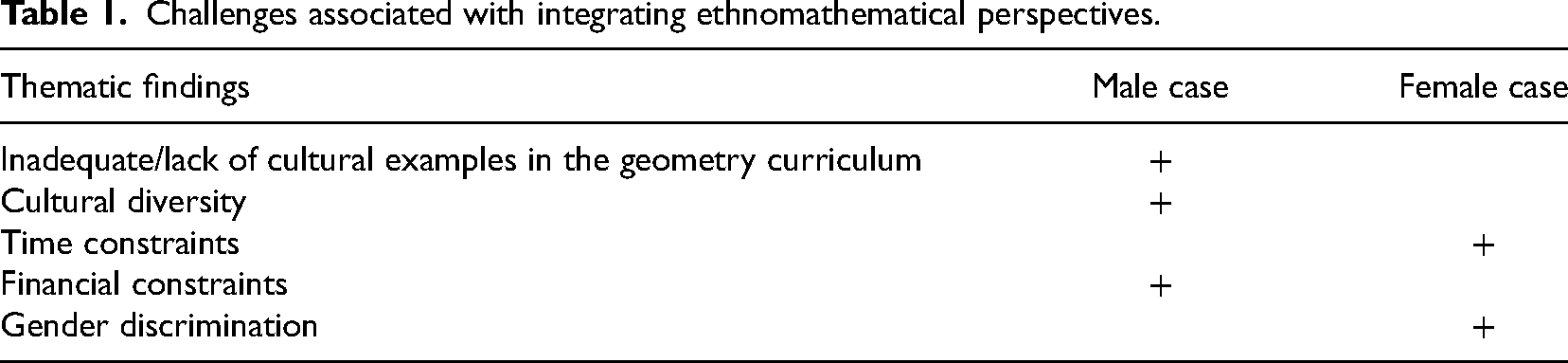
The potential themes were reviewed and refined to discover if they were true themes and whether they needed to be fractured or collapsed. After creating a sufficient thematic map for the data, we defined and changed the analytical themes and examined the data inside them by determining the essence and element of each theme. Final analysis and report composition followed theme completion. This features a compelling narrative of the data within and across several themes with adequate evidence. The themes derived from the reflexive thematic analysis are summarized in Table 1 as follows.
Challenges associated with integrating ethnomathematical perspectives.
4. Results/findings
For a contextual, in-depth understanding of what mathematics teacher educators at the colleges of education perceive as challenges associated with integrating ethnomathematical perspectives into geometry teaching in the classroom, interviews, and focus groups were employed. The theme of college-related challenges associated with integrating ethnomathematical perspectives into geometry teaching was delineated into three subthemes: inadequate/lack of cultural examples in the geometry curriculum, cultural diversity, and time constraints. Among the challenges exclusive to the male mathematics teacher educators’ accounts regarding the associated challenges include inadequate/lack of cultural examples in the geometry curriculum and cultural diversity. During interviews and focus groups, the male mathematics teacher educators bemoaned the inadequate or lack of cultural examples in the geometry curriculum as one of the major challenges confronting them in their effort to integrate ethnomathematical perspectives into the teaching of geometry. Mr. J recounted: …if you look at the local books written by our local authors or our people, it seems they don’t incorporate in them a lot of examples that are in our society. In fact, there are at times you barely see examples so if you are explaining…the concepts to your students, it becomes abstract to them. And that also you have to talk, and talk and talk before you can get some of them to appreciate, understand or pursue what you are trying to put across. (Male Interview; June 12, 2023) Mr. M added: One major challenge…is like we are trying to learn from books. And most of these books are written from outside [written by foreigners], so we try to picture the mathematics outside our culture. People are in Ghana, they know nothing about what is happening in Ghana. You get to the classroom, you cite examples and they are not aware that those things are happening in the environment. They don’t see anything… it is like what they are learning are not part of us. Some people also teach the same way…they teach abstractly – they don’t link it. So, they are not seeing what is in the environment in the books we are learning. So, they go and learn and come home and try to do a different thing altogether. (Male Interview; June 22, 2023) Mr. S also stated, ‘If you look at the course outline, most of them… some of the topics do not look at what is happening in the students’ environment. They are foreign to them. So, sometimes we have the challenge of finding replacements for those things’ (Male Interview; June 25, 2023). Even with some of the books that you will even find, you will realize that they [authors] use things which are peculiar to them which might not also be known to your learners. But there are times you are forced to use some of them to make the meaning of the concepts that you want to teach. So, there are at times the resource we use is also a challenge. And especially with regard to the textbooks we write, most of the time you will see that the examples given out are almost always foreign. (Male focus groups; June 29, 2023)
Male mathematics teacher educators stated issues of cultural diversity as one of the challenges confronting them in integrating ethnomathematical perspectives into the teaching of geometry. The following excerpts capture this: Mr. A: The language too has become a barrier: We don’t have a common language in Ghana here. So, because of that, though I want to use this culture to teach it but I don’t understand the students’ language. So, the language has become a difficult thing because…the only medium instruction is the English language. So, if the child is coming from the northern part of Ghana or the southern part such as the Volta Region, and the person doesn’t understand Twi, I want to use Twi to explain certain concepts, it will become very difficult for the child to get the concepts. So, the language has become a barrier because of the multilingual state that we are in. It has become a barrier for me to implement ethnomathematics fully in the classroom. (Male Interview; June 10, 2023) Mr. S: Alright, some of the challenges include how to get meanings of geometrical terms and concepts in Twi or translate them into what the students know already is difficult. So, what we normally do is that… sometimes what is stated in the book we have to go outside that, and then replace it with what the students are aware of… in the curricula, there should be a balance of culture in terms of examples that are cited. Because students in colleges of education come from different cultural backgrounds. (Male Interview; June 25, 2023)
The above quotes suggest that cultural diversity hinders mathematics teacher educators’ efforts in integrating ethnomathematical perspectives into the teaching of geometry. Cultural diversity was also re-echoed by male mathematics teacher educators in the focus groups: You see, [Name of participant] was talking about our farming, the way we make our mounds and some of those things. Some of our learners have not even seen some of these things before, so when you are relating them to the conical shapes, they don’t know the mounds so they can’t link them. They can only link them to the things they see in the modern or urban areas, the modern houses, the modern things that we see… So, if they are been related to the conical and the round type of building that we have in the northern region, some of them might have not seen some before and so relating them becomes a little bit difficult. (Male focus groups; June 29, 2023) In the classrooms, we have a lot of cultural diversities and it becomes…a challenge to address this wide range of cultural backgrounds effectively… but because they [teacher educators] lack the knowledge of integrating these aspects of math into these cultural diversities, they will not even touch it or mention anything because it may happen that the teacher teaching is limited in terms of resources. What he knows within his environment is different from what the students know from the outside. So…if you want to integrate this kind of pedagogy in a classroom setting, it means that you should know a lot of culture, the cultural background of your students which is not easy to accomplish. So I see that this cultural diversity is a challenge when it comes to the integration of this kind of mathematics in the classroom setting. (Male focus groups; June 29, 2023)
During interviews and focus groups, the female mathematics teacher educators bemoaned the time constraint as one of the challenges confronting them in their effort to integrate ethnomathematical perspectives into the teaching of geometry. Ms. T recounted: The challenges have to do with time allocation for each lesson. So, if you want to…it would have been better if we could cite different artefacts in different cultural environment that will be teaching the same concept so that each student will benefit. It is not like using only those from the northern to teach concepts to those who come from the south. Those from the South may not have such examples before and so if we could use examples from the South that will be beneficial to all students, but time factor wouldn’t permit me to use all those artefacts from different cultural setup that teach the same or similar concept in mathematics. (Female Interview; July 15, 2023) Ms. V also reported: One challenge I can always talk of is time constraints, Ok? Because the time that we have to teach a particular concept is not enough, so if a tutor wants to use a lot of activities or concrete materials for them to understand because of the time constraint you can’t use them. (Female Interview; June 11, 2023)
The above quotes reflect that time constraint hinders mathematics teacher educators’ efforts in integrating ethnomathematical perspectives into the teaching of geometry. Time constraints were also re-echoed by female mathematics teacher educators in the focus groups: One of the challenges I experienced over years is time. The time for teaching this course. Most often I want to practicalize these concepts but I realized that it is not helping because of time. And most often you are not the only person teaching that year batch. So, you will find out that other members are ahead of you, and then you are lagging. (Female focus groups; July 17, 2023)
The female group added: The course is structured in such a way that is time-bound so you cannot go beyond the allocated for specific lesson. And as such to do this effectively, then we will have to use examples in different cultures… different situations so that people will have a wider range to relate to or to relate the concept with but the time factor will not allow me to use different situations. For example, in a class we have students with different indigenous background where it could have been better if we could cite examples in various ethnic groups that we have in the class so that they can relate with it very well. But because of time, at times you can only use it as an introduction and that's all. (Female focus groups; July 17, 2023)
Two subthemes were also established to explore the theme of educator-related challenges regarding integrating ethnomathematical perspectives into geometry teaching: financial constraints and gender discrimination. Male mathematics teacher educators noted financial constraint as one of the challenges confronting them in their quest to integrate ethnomathematical perspectives into the teaching of geometry during interviews. This is captured by the excerpts below: Mr. M: Sometimes too some of the places you have to move and visit. And going there also becomes difficult for the classroom teacher to take the learners there maybe sometimes the cost you can’t bear it. So, you can maybe mention about it but maybe they have not seen it. (Male Interview; June 22, 2023) Mr. A: And also, the materials that we use to design such teaching-learning materials that embody the concepts, and these materials come from… it is difficult to come by. Example, the ‘atumpan’ that I made an example of, it is not all the communities in Ghana which are making use, only few sections of it. But few people know that in our community. (Male Interview; June 10, 2023)
The above quotes showed that financial constraint hinders mathematics teacher educators’ efforts in integrating ethnomathematical perspectives into the teaching of geometry. From the interviews, a female mathematics teacher educator stated gender discrimination as one of the challenges that hinders their effort in integrating ethnomathematical perspectives into the teaching of geometry. Ms. E reported: Another [challenge] will be the case of non-acceptance. I don’t know how to explain this one but there are some communities where if you are a woman you are not allowed to talk or visit certain places. And if you are found to be a woman teaching certain concepts, you might not be in a position to visit those places to really ascertain what benefits those places could be to you. A clear example is in a Muslim communities a woman is not expected to go certain places, ok. So if for instance, the shrine or the mosques or the palace has some wonderful geometric features that you could use for your lessons. You have no idea of how they are because you cannot go there. (Female Interview; June 12, 2023)
She added: There are sometimes things or places about certain religions that women are not allowed to speak about. They consider it as a haram. So, if I am teaching a geometry concept and I want to make reference to these things or places, I won’t be able to do that. (Female Interview; June 12, 2023)
The above quotes reflect that gender discrimination hinders female mathematics teacher educators’ efforts in integrating ethnomathematical perspectives into the teaching of geometry. In all, the findings obtained from the qualitative investigation revealed differences among male and female mathematics teacher educators regarding what they perceive as challenges regarding the integration of ethnomathematical perspectives.
5. Discussion
This study explored the challenges mathematics teacher educators face in integrating ethnomathematics perspectives into geometry teaching in the Ghanaian classroom. In all, the findings obtained from this qualitative investigation revealed differences among male and female mathematics teacher educators regarding what they perceive as challenges regarding the integration of ethnomathematical perspectives. Among the challenges that were exclusive to the male case were inadequate/lack of cultural examples in the geometry curriculum, cultural diversity, and financial constraints, and that of the female case were time constraints and gender discrimination. Interestingly, research (e.g. Kyeremeh et al., 2024; Thakur, 2019) suggests that there is no significant difference between male and female mathematics teachers in their incorporation of ethnomathematical perspectives into geometry teaching. Kyeremeh et al. (2024) conducted a study among mathematics teacher educators and found gender not a viable predictor of mathematics teachers’ ethnomathematics incorporation practices in geometry teaching. This suggests that mathematics teachers’ challenges are more likely to be related to their training, experience, and attitudes toward change than their gender.
From the study's findings, mathematics teacher educators faced significant challenges in incorporating ethnomathematical perspectives into geometry teaching, primarily due to a lack of culturally relevant examples. This perceived challenge hinders their ability to make mathematical concepts relatable and engaging for students from diverse backgrounds. It was discovered that this perceived challenge was not uniform across all cases (male and female mathematics teacher educators). Mathematics teacher educators from the male case reported inadequate/lack of cultural examples in the geometry curriculum as a challenge to integrating ethnomathematical perspectives into geometry teaching. This finding corroborates the findings of some previous studies (e.g. Rosa, 2013; Sunzuma & Maharaj, 2021). Sunzuma and Maharaj's (2021) findings showed that integrating ethnomathematics perspectives into geometry teaching is hindered by many problems linked to the curriculum, including the scarcity of cultural examples and activities within the curriculum. In Rosa's (2013) study, some educators maintained the perspective that the content of geometry taught in schools lacks cultural sensitivity due to the inclusion of foreign examples and the language employed in curricula. This deficiency in cultural congruence within the curricula could be a potential cause for students’ low achievement in mathematics. In the face of this challenge, mathematics teachers, especially teacher educators, recognize the importance of linking culture and mathematics but struggle to find examples that resonate with their students’ experiences. This challenge is particularly pronounced in geometry, where connecting abstract concepts to real-world cultural applications can be crucial for student understanding and engagement.
Mogari (2004) observed that the curriculum lacks emphasis on the practical parts of mathematics, and there is a lack of assessment for these practical components. Studies have described school mathematics as lacking authenticity, primarily focused on procedures and calculations, separated from meaningful interpretation, passive, formulaic, algorithmic, formal, taught through rote memorization, and missing a distinct goal (Swanson & Williams, 2014). They contend that this observation highlights not only the limited connection between concrete concepts and abstract formal systems in school mathematics but also the inadequate consideration of the systemic nature of these systems. They argue that school curricula frequently fragment topics and restrict the potential for establishing systemic connections within mathematics. As mentioned earlier, the critiques of mathematics education have prompted endeavors to include tangible aspects of the external world into mathematics curricula to foster more significant and intentional engagement within educational institutions. Given this, mathematics curriculum developers must take advantage of the sociocultural-historic elements of mathematics when developing the curricula. This can be achieved by incorporating these elements and instructional methodologies that foster student curiosity and facilitate active participation. By taking into account cultural, political, and social elements in the context of mathematics education, it becomes feasible to enhance the experience of individuals involved while also stimulating their understanding and beliefs about mathematics.
Mathematics teacher educators also face significant challenges when incorporating ethnomathematics into their teaching practices, particularly in relation to cultural diversity. Related to the challenges associated with integrating ethnomathematical perspectives, mathematics teacher educators from the male case reported cultural diversity as a challenge that hinders their effort to integrate ethnomathematical perspectives into geometry teaching. This finding is consistent with the prior studies on challenges integrating ethnomathematics perspectives (Sunzuma & Maharaj, 2020). One of the issues about the curriculum reported by Sunzuma and Maharaj (2020) was the issue of cultural diversity among students.
Time constraints also pose another substantial challenge for mathematics teacher educators in integrating ethnomathematical perspectives into geometry teaching. This finding concurs with prior studies (e.g. Orey & Rosa, 2007). Orey and Rosa's study reported teachers’ issues with insufficient time for planning and delivering ethnomathematics lessons. Incorporating ethnomathematics can be time-consuming, both in terms of lesson planning and delivery. This additional time requirement may deter some educators from fully embracing ethnomathematics, especially when faced with the pressure of covering standardized curriculum content.
For female mathematics teachers, gender discrimination was identified as a challenge to their effort to incorporate the mathematics found outside of school into geometry teaching in the Ghanaian classroom. This finding was expected given Gilsdorf's (2015) observation of the enduring pattern in Western culture of marginalizing women and their pursuits in mathematics in his study about gender, culture, and ethnomathematics. He noted that the marginalization of women in mathematics within Western society has persisted over centuries. He recounted instances where women were specifically excluded from formal mathematical activities solely based on their gender. Gilsdorf lamented the persistence of those in contemporary society who believe that women and mathematics are incompatible. This phenomenon is prevalent throughout various domains of mathematical development, encompassing the topic of ethnomathematics as well. Consequently, gender possesses the inclination to impact how teacher educators integrate extracurricular mathematical concepts into their geometry instruction within the classroom setting.
6. Conclusion
This multiple case study explored the challenges Ghanaian mathematics teacher educators face in integrating ethnomathematical perspectives into geometry teaching in the Ghanaian classroom. From the study, we concluded that several challenges confront Ghanaian mathematics teacher educators at the colleges of education in integrating ethnomathematical perspectives into the teaching of geometry. Among these challenges are inadequate/lack of cultural examples in the geometry curriculum, cultural diversity, financial constraints, time constraints, and gender discrimination. Given the increasing number of students from varied ethnic backgrounds in schools, the curriculum should represent these students’ social and cultural learning. Also, it is imperative to implement a significant modification in mathematics training to address the evolving student demographics. Mathematics as a discipline contributes to establishing democratic conditions by cultivating the understanding of both educators and students. This is achieved by integrating mathematical concepts’ social and cultural significance into the curriculum and promoting a teaching and learning approach that encourages open and critical communication between teachers and students (Alangui & Rosa, 2016). The degree to which mathematics and mathematics education contribute to the establishment of democratic and egalitarian societies and the cultivation of critical thinking skills among individuals continues to present a significant issue.
Mathematics teacher educators at the colleges of education bemoaned the cultural diversity issues in integrating ethnomathematical approaches into geometry teaching. Hence, we recommend that teacher education institutions introduce ethnomathematics programs or courses to enhance student teachers’ knowledge and pedagogical experience regarding integrating ethnomathematical perspectives into mathematics teaching. This also includes organizing professional development workshops, online resources, and mentoring programs to train in-service mathematics teachers on how to incorporate sociocultural elements into geometry teaching. Also, mathematics teacher educators at the colleges of education reported inadequate/lack of cultural examples in the geometry curriculum as a major challenge that confronts them in the integration of ethnomathematical perspectives into the teaching of geometry. Given this, curriculum developers, in their future revision endeavors should consider including relevant cultural examples to enhance the applicability and relevance of school geometry and mathematics in general for students. By addressing the inadequate/lack of cultural examples in the geometry curriculum, we can create a more inclusive and equitable learning environment for all students. When students see themselves and their cultures reflected in the geometry curriculum, they are more likely to be interested and invested in learning.
7. Study's limitations
The following limitations of the study should be taken into consideration when interpreting the results/findings:
Although the telephone interviews among selected individual participants were audio-recorded, the study still lost nonverbal information and observational data (such as body language and facial expression) that might add value to the overall data collected. The study employed a qualitative case study with a few participants’ engagements. This implies that the findings of the research cannot be extrapolated to the mathematics teacher educators under investigation.
Footnotes
Acknowledgements
The authors wish to acknowledge the mathematics teacher educators in the Colleges of Education in Ghana who accepted and participated in this study.
Note on Contributors
Consent to participants
The authors obtained informed consent from all participants.
Declaration of conflict of interest
The authors declared no potential conflicts of interest with respect to the research, authorship, and/or publication of this article.
Ethical considerations
This article is based on the principal author's doctoral thesis under the co-authors’ supervision. The study also received approval from the Humanities and Social Sciences Research Ethics Committee of Kwame Nkrumah University of Science and Technology for using human subjects with approval number HuSSREC/AP/104/VOL.1.
Funding
The authors received no financial support for the research, authorship, and/or publication of this article.
Authors biographies
