



Abstract
Investigation into preservice teachers’ classroom discourse trajectories is important in understanding the effect of teacher education on their future practices. Despite this importance, the area remains largely understudied. This qualitative study adopted a case study design to explore classroom discourses of preservice teachers during a mandatory teaching practicum at rural basic schools in Ghana. A purposive sample of seven preservice teachers from one college of education participated in the study. Data were gathered through video recordings and observations of lessons delivered by participants. The discourse patterns were analyzed and interpreted via a dialogical discourse trajectory framework. The results revealed that the lessons delivered by two preservice teachers followed a univocal trajectory, where teaching dominated learning. Three preservice teachers exhibited a partially univocal trajectory, while two preservice teachers demonstrated an emerging dialogical trajectory in their lessons. None achieved the dialogical discourse currently advocated in the basic school mathematics curriculum. The study concludes that the observed discourse trajectories subordinate learning to teaching, potentially hindering learners’ development of quality mathematical communication skills. The study recommends that college tutors should use lesson study to promote preservice teachers’ dialogical discourse skills by recording mathematics lessons and using them as case studies to exemplify effective classroom discourses.
Background
Quality mathematics education is globally recognized as essential due to the increasing demand for workers with strong mathematical skills (Ministry of Education, 2022; Ministry of Education, 2020; World Economic Forum, 2016). To support this, mathematics education curricula worldwide are being reformed to foster learner-centered approaches and global mathematics skills development. The Ghanaian mathematics curriculum, for example, is aimed at making Ghana a mathematics learning nation (MOE-G, 2018). Mathematics teachers play a crucial role in ensuring that students graduate with these skills. This explains why Professional Development Sessions including lesson studies (Fujii, 2019), microteaching (He & Yan, 2022), peer coaching (Kocaballi & Terzi, 2021), reflective journals, and portfolios (McGregor, 2019) among other initiatives and are so vital and noticeable in recent times. Lesson study, for example, is viewed as a suitable strategy for transforming mathematics teacher education and training.
In Ghana, teacher education reforms aim to equip graduates with the necessary mathematical knowledge and global skills. The Transforming Teacher Education and Learning (T-TEL) has been supporting these reforms since 2016, particularly in transitioning Colleges of Education from diploma to degree programmes and transforming existing pedagogies deemed less effective. T-TEL also provides weekly Professional Development Sessions (PDS) to train tutors (educators) in creative pedagogies such as “Talk for Learning” (T-TEL, 2018). The Talk for Learning pedagogies introduced at the colleges of education is consistent with the new pre-tertiary curriculum demands for the development of effective mathematical communication and collaboration among students. The primary focus is to help foster discourse communities and mathematical communication in classrooms (MOE-G, 2019). This focus aligns with recently reviewed mathematics curricula in several developed countries, including Australia (ACARA, 2022), China (Ministry of Education, 2022), Japan (MEXT, 2020), Singapore (Ministry of Education Singapore, 2021), and Canada , and emphasize mathematical reasoning, communication, and discourse elements. These elements are increasingly recognized as essential for fostering 21st century skills including collaborative problem-solving and global mathematics education.
Since 2019, the college tutors through the PDS have been applying the talk for learning pedagogies in training the preservice teachers at the colleges of education in Ghana. This involved the use of a blend of disputational, cumulative, and exploratory talk strategies structured around five key levels: (1) Initiating talk for learning; (2) building on what others say; (3) managing talk for learning; (4) structuring talk for learning; and (5) expressing oneself with new words (T-TEL, 2016). These strategies were systematically integrated by tutors into a semester-long series of lesson studies, culminating in intensive lesson planning and preparation sessions to equip the preservice teachers for their mandatory teaching practicum. Upon graduation, the preservice teachers are expected to influence the long-established univocal discourse in the Ghanaian basic school mathematics classrooms and ensure a shift toward dialogical discourse which stimulates student mathematical communication skills (Demszky & Hill, 2022; Klette et al., 2017).
Despite the implementation of the Talk for Learning module over the past 5 years, there is little empirical evidence on its impact on preservice teachers’ discourse practices in mathematics classrooms. This study seeks to examine how well preservice teachers implement the strategies in real classroom settings using the discourse trajectory framework (Martin, 2018). In other words, the purpose of this qualitative study is to examine key classroom discourse patterns exhibited by preservice teachers during their mandatory practice teaching sessions in Ghanaian basic schools. Specifically, the study was guided by the following research question: What types of discourse trajectories (categories) can be witnessed in the mathematics classrooms of preservice teachers who experienced Talk for Learning PDS?
Examining these skills is crucial for improving mathematics teacher education programmes. As a qualitative study, the objective is not to generalize findings to the population under study, but rather to provide insight into how Talk of Learning initiative equips preservice teachers in readiness to implement discourse strategies in their teaching practices. It is hoped that the findings would reveal what kinds of discourse trajectories can be witnessed in preservice teachers’ mathematics classroom as an upshot of the Talk for Learning. The study would also help mathematics tutors at the colleges of education to examine their approaches toward developing preservice mathematics teachers’ skills to effectively facilitate classroom discourses. The findings would contribute to the global body of research by providing insights into the implementation of discourse strategies in a developing country context. The study would also highlight how Talk for Learning pedagogies align with curriculum prescriptions to inform similar initiatives in Sub-Saharan Africa and other regions with similar educational challenges.
Discourse framework
This study frames classroom discourse within the sociocultural theory. The theory emphasizes the importance of communication and language in developing mathematical understanding (Kranzfelder et al., 2019; McLeod, 2018; Vygotsky, 1978). Verbal interactions between teachers and students facilitate thinking processes and allow learners to progress beyond their existing level of understanding (Bakker, 2020; Bakker et al., 2015). Within the sociocultural learning, the study underscores the importance of Zone of Proximal Development (ZPD) (Vygotsky, 1978). The ZPD describes the state at which students internalize new concepts and interactions in the presence of a knowledgeable person. Teachers facilitate learning through appropriate tasks and dialogue to promote reasoning over memorization (Tuck, 2018) and direct students’ learning within their ZPD (Chapin et al., 2009). Then, the students can perform the task with or without guidance. The ZPD is of interest in this study as it allows for an assessment of what the individual preservice teachers can do in classrooms without guidance after working with their peers and the tutors on planning Talk for Learning.
Classroom discourse can take various trajectories (Boaler, 2015; Rumsey & Langrall, 2016). For example, it can be a low trajectory, emphasizing teacher-centered (Gattegno, 1976) and procedural understanding, or a high trajectory, focusing on student participation for conceptual understanding (Imm & Stylianou, 2012; Miller, 2018). Discourse can also follow initiation response evaluation (IRE) or initiation response feedback (IRF) paths (Estaji & Mirzaei, 2022). However, for this study, four discourse trajectories form the framework: univocal, partial univocal, emerging, and dialogical discourse trajectories (Martin, 2018; Rezaie & Lashkarian, 2015).
The univocal discourse entails the teacher informing learners without eliciting or promoting their participation. Its features include explicitly explaining and demonstrating a mathematical task directly to the learners with little teacher–learner or learner–learner contact. This subordinates learning to teaching (Jang, 2010; Martin, 2018). It is noted that teachers who employ this discourse trajectory believe in ensuring clarity, coherence, and consistency in conveying a particular topic or concept rather than allowing learners to correct each other (Cole & Griffin, 2018; Kuo et al., 2018). While the univocal discourse can be successful in transmitting information, it may not ensure deeper comprehension or critical thinking (Gattegno, 1976; Setianingsih et al., 2018).
The partially univocal discourse is characterized by an unequal allocation of speaking turns between the teacher and the learners, with the teacher dominating the dialogue and the learners having few opportunities to contribute meaningfully. Its features include the teacher directing the conversation and providing most information, while the learners expressing their own thoughts and participate with brief replies. This discourse not only allows for limited learner talk but also decreases their engagement, motivation, interactional feedback, and diminished learning results (Jang, 2010; Martin, 2018). It should be noted that if learners know that they would be sharing their work with the rest of the class, they tend to be more responsible (Gutiérrez, 2013).
The emerging dialogic discourse is a dynamic and interactive process of meaning-making between teachers and learners. It is characterized by a shift from a teacher-centered to a more learner-centered and inquiry-based approach. In such a discourse, the teacher facilitates, guides, directs, and encourages active listening while responding to and fostering metacognition, critical thinking, collaboration and inclusive learning environment (Bakker, 2020). The teacher however controls largely the discourse with input and open-ended questions. The dialogical discourse, as described by Bakker (2020), emphasizes full class participation, the exchange of ideas, and reflective dialogues among learners. This approach fosters collaboration, critical thinking, creativity, and innovation. In particular, the approach ensures that the learners are encouraged to engage in critical thinking and explanation of their reasoning, while the teachers assume a more equal role, sharing authority with the learners (Cui & Teo, 2023), and facilitating a process of joint construction of knowledge (Bakker, 2020). To promote dialogical discourse, teachers need to have the ability to facilitate and guide collaborative learning using strategies such as interactive groups and reflective journals (Boheim et al., 2022; Mercer & Littleton, 2007). These interactions help in creating a zone of proximal development where learning is enhanced through shared experiences and perspectives. In this study, we focus on how preservice teachers exhibit these discourses in their mathematics classrooms.
Studies on classroom discourse
The emphasis on the need for teacher education to facilitate classroom discourse is supported by its impact on learning (Belbase, 2014; Davis, 2018). Prior research has documented various ways in which classroom discourse trajectories impact student engagement and learning in mathematics (Hayden et al., 2024). Tuck (2018) found that when students are involved in generating mathematical ideas, they become more responsible for their own learning which in turn promotes meaningful learning and achievement. Monrat et al. (2022) found that open-ended questioning in mathematics classrooms promotes critical thinking and encourages students to explore multiple solution strategies. In a similar vein, Abdulrahim and Orosco (2020) conducted a study on the use of mathematical discussions and concluded that student participation in mathematical discussions positively impacted on their learning outcomes.
Legesse et al. (2020) examined the effect of discourse-based instruction on eleventh-grade students’ procedural and conceptual understanding of probability and statistics. They concluded that when appropriately designed and implemented, the approach can increase students’ understanding of mathematical topics. An earlier study by O'Connor et al. (2017) however revealed that while discourse-based instruction fosters mathematical learning for the group as a whole, the number of words spoken by individual students does not necessarily correlate with their learning. They concluded that in an established discourse community, active participation in classroom discussions should also involve listening attentively without speaking. The literature reviewed suggests that when students are actively engaging in classroom discourse, they develop a deeper understanding of mathematical concepts and become more confident in their problem-solving abilities.
While research in discourse trajectories is still been documented, it is evident that discourse use in mathematics teaching is being emphasized in recent years. For instance, Hunter et al. (2018) emphasize the importance of teachers adjusting their discourse patterns based on classroom conditions and the content being taught. This flexibility allows for the optimization of student learning outcomes. Truxaw et al. (2008) also underscore the significance of discourse patterns, highlighting that the choice of a trajectory can significantly impact student learning outcomes. Tuck (2018) further emphasizes the benefits of both teachers and students actively contributing to mathematical discourse. While enabling teachers to gain deeper insights into students’ thought processes, misconceptions, and understanding of mathematical concepts, it also promotes students’ critical thinking and problem-solving skills.
Studies have highlighted various methods of developing preservice and practicing teachers’ discourse in mathematics classrooms. Fernandez and Yoshida (2004); and Lewis and Hurd (2011) described how lesson study and professional learning communities can enhance teachers’ strategies for implementing discourse. Vrikki et al. (2017) analyzed teacher discussions during lesson study using video-based methods and concluded that such collaborative reflective dialogue enhances professional development. Vrikki and Evagorou (2023) explored teacher questioning in dialogic lessons and found that open-ended questions promote deeper learning, while closed questions limit engagement. Herbel-Eisenmann and Otten (2011) examined classroom discourse in mathematics and how teacher-led interactions shape understanding of mathematical concepts. They concluded on the need for more student-centered approaches to improve mathematical comprehension and participation in classroom discourse. Lim et al. (2018) suggested the use of technology-based scripting tasks to help preservice teachers facilitate mathematical discourse in the classroom. Additionally, Ivars et al. (2020) emphasized the use of learning trajectories as scaffolds to support teachers in understanding and responding to students’ mathematical thinking. Moschkovich (2015) advocated for the integration of multimodal and biliteracy approaches to enhance communication and discourse in mathematics classrooms.
The review of literature above suggests that lesson study has not been adequately documented in most developing sub-Saharan countries. It is also clear that there are several methods used in teacher education and professional sessions which have not been studied to understand how they impact on preservice and practicing teachers’ discourse use in mathematics classroom. In this study, preservice teachers’ discourse use in mathematics classroom is being explored following their lesson study sessions which utilized “Talk for Learning module.”
Methodology
Study design and approach
This qualitative study employed a conversation analytic case study design to explore and analyze the discourse trajectories of preservice mathematics teachers at a college of education in the Upper East Region of Ghana. Conversation analysis, a method rooted in sociocultural theory, was chosen for its effectiveness in examining the interactions between preservice mathematics teachers and students with focus on how discourse shapes and is shaped by the educational context (Sidnell, 2010). The case study approach allowed for an in-depth examination of these discourse patterns within the real-world setting of teacher education. This helps to provide a rich contextual perspective into how preservice teachers develop and apply discourse strategies in their practice (Yin, 2018). The focus on discourse trajectories is important, as it sheds light on the dynamic nature of classroom interactions and how preservice teachers navigate and influence these interactions through their teaching practices.
A two cycle lesson study on talk for learning
The study employed a two-cycle lesson study framework to integrate Talk for Learning strategies into a 14-week semester long pedagogical course (one 3-h session per week), to prepare final year preservice mathematics teachers for a mandatory teaching practicum. In the first cycle, the preservice teachers were introduced to the four stages of Lesson Study. Stage 1 (1–3 weeks) involved collaborative planning of 30-min lessons on topics in basic school mathematics curriculum. Three sessions of collaborative Lesson Planning were conducted where preservice teachers were put into groups of seven to plan how to (1) initiate talk for learning (2) build on what others say; (3) manage talk for learning; (4) structure talk for learning; and (5) express oneself with new words (T-TEL, 2016). This was followed by design of lessons that would encourage active student participation, dialogue, and critical thinking. Stage 2 (4–5 weeks) was about Teaching and Observation of lessons. Two peer teaching sessions were conducted where one member of the seven groups delivered the lessons. In all, seven lessons were presented to colleagues who acted as students. Stage 3 (Week 6) comprised Reflection on each lesson where preservice teachers who delivered the lesson shared their experiences on how well they implemented Talk for Learning. The reflections emphasized successful dialogue, questioning techniques and areas for improvement. The last stage 4 (week 7) was on Revising and Sharing, where the groups collectively revised their plans and shared them among themselves. The revised lessons were also documented as case studies to inform future cohorts of preservice teachers.
In the second cycle, stage 1 (8–9 weeks) involved preservice teachers choosing their preferred topics and planning individual lessons. For stage 2 (10–12 weeks), they were assigned to different basic schools (primary and junior high) as part of their practicum, where each preservice teacher delivered their planned lessons. The lessons covered various mathematical topics, such as fractions, ratios, and integers and were observed by the researchers. The observations focused on discourse patterns and the extent to which Talk for Learning strategies were applied. Video recordings of the lessons were made to capture both verbal and nonverbal communication cues to ensure rich data for analysis. Stages 3 and 4 (13–14 weeks) were later followed. This present study reported on the teaching and observation stages.
Participants
The entire cohort of 49 preservice teachers majoring in basic school (primary and junior high) mathematics teaching who were exposed to Talk for Learning was the target for the study. Even though all 49 study were on their teaching practicum, one group of seven preservice mathematics teachers were selected for the study because of accessibility, consent and willingness to participate
The inclusion of Nyama, Hassana, Misbau, and Abunga was based on their personal interest, impressive grades and strong foundation in the mathematics. Hence, understanding how their interest and competency manifest in their classroom discourse would provide better insights into the training program (Yopp et al., 2019). Donkor's inclusion in this study provides a unique perspective, as he studied the Business program at the senior high school but still performed strongly in mathematics. Moreover, his inclusion was to shed light on the ongoing debates on the admission of Business students into Colleges of Education. Finally, Nashiru and Sauda’s positive attitude and perseverance toward mathematics also accounted for their inclusion. Both females expressed their initial interest in mathematics even though their previous performance was quite poor.
Data collection
The study collected data through video recordings and classroom observations. All seven preservice teachers’ lessons were recorded to capture both verbal and nonverbal communication cues. Participant observation guide was prepared and used to map out indicators of discourse patterns in the classrooms. Prior to the actual study, a pilot study was conducted with three preservice teachers teaching in a rural setting in a different district. The results of the pilot study were used to refine the design of the actual study. Adjustments were made to (1) the camera positioning and recording setups to better capture both teacher and student interactions, (2) accept blend of local and English language use for class interactions, (3) limit the lesson time to 30-min, and (4) allow addition of any indicators to the observation guide to account for unexpected. It was also found that school authority would only allow topics found in their school scheme of work for that academic term. These ensured that the data collection process in the main study was more aligned with the research objective. The main data collection for the study began in the second week of the third term of the basic school academic calendar.
To conduct the study, we followed a strict protocol for obtaining permission from college principal and district education directorate, Pusiga. Permission letters were sent to the Head teachers while verbal consent was sought from respective participants. Once we received the approvals, we proceeded with the data collection phase, which involved recordings and observation. To capture the most accurate and comprehensive data possible, we utilized both video and audio recording techniques and later transcribed the footage.
To ensure that the research study was rigorous and ethical, various measures were taken. Peer reviews were done to increase the credibility of the study, while audit trails were established to ensure the dependability of the study results over time. In order to make the findings transferable, detailed descriptions and purposive sampling were used. Impartiality was also maintained in presenting research findings while participants’ anonymity were taken into account.
Analytic framework for classroom discourse trajectories
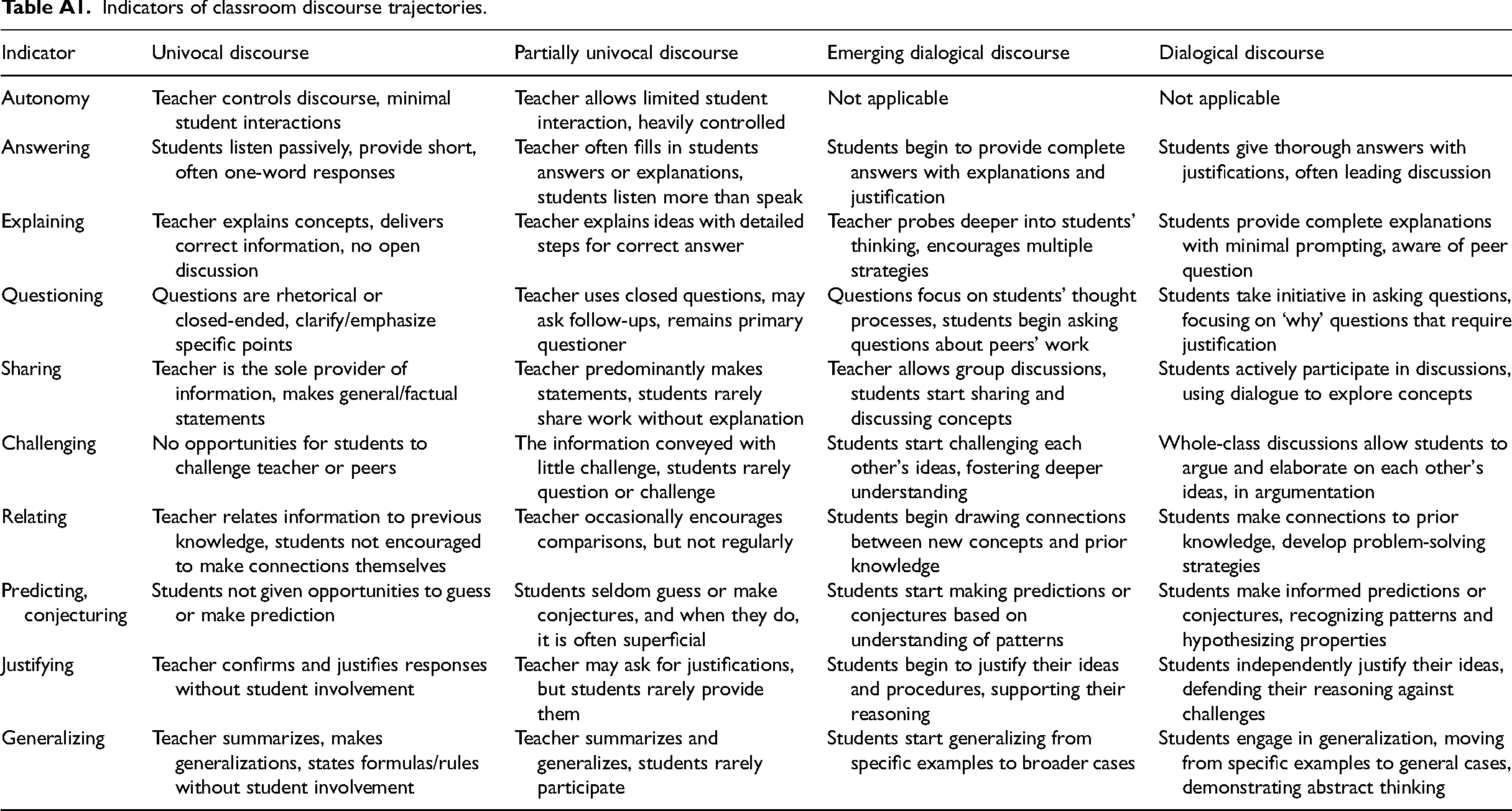
The study explored the classroom discourse trajectories of preservice teachers during their teaching practice to understand how they transfer their knowledge of “talk for learning” in a typical classroom. In their collaborative lesson planning, the preservice teachers employed The Talk for Learning strategies that emphasize dialogic engagement, critical questioning, and active learning. These strategies informed the analytic framework's categories of the classroom discourse trajectories with each category increasingly aligned with these pedagogical principles. Consequently, the analytic framework, outlined in Table A1 (see Appendix) was used to categorize their classroom discourse into four distinct trajectories: univocal, partially univocal, emerging dialogical and dialogical discourses. This framework is essential for understanding the dynamics of interactions between preservice teachers and their learners in the classroom, as it highlights the varying degrees of learner engagement and participation. Each indicator in Table A1 represents a continuum of discourse patterns grounded in sociocultural theory which emphasizes the role of dialogue in cognitive development. For example, at the univocal discourse level, the teacher maintains control, resulting in minimal learner interaction. In contrast, the dialogical discourse trajectory exemplifies an ideal state where learners are not only actively engaged but also initiate questions and justifications in a collaborative environment. The indicators serve as benchmarks for answering our research question regarding the types of discourse categories that are emerging in preservice teachers’ mathematics classrooms. The data collected allows us to provide a better understanding of how preservice teachers’ experiences in Talk for Learning PDS are reflected in their classroom discourse practices.
The data obtained from participants lessons were organized and analyzed qualitatively by systematically searching, noticing and arranging textual and non-textual data into discourse patterns and drawing meaning from data (Wong, 2008). First, the recorded lessons were watched several times by the researchers to get to understand the data patterns. This was followed by noticing and tagging key indicators with exemplars and reviewing them multiple times to make sense of the trajectory. Each trajectory was mapped up into ten indicators of univocal-dialogical framework, i.e., autonomy, answering, questioning/asking, explaining, sharing/making statement, challenging, relating, predicting, justifying, and generalizing (see Table A1 in Appendix). The indicators were then categorized into four thematic discourse trajectories viz. univocal, partial univocal, emerging dialogical, and dialogical in line with the literature. Finally, with the aid of key indicators and exemplars, each participant's lesson discourse was interpreted using the conversational analytic approach (Nowell et al., 2017). The names (pseudonyms), ages, levels, and classes taught by the seven preservice teachers involved in the study are displayed in Table 1.
Names, ages, level, and class taught by the preservice teachers.
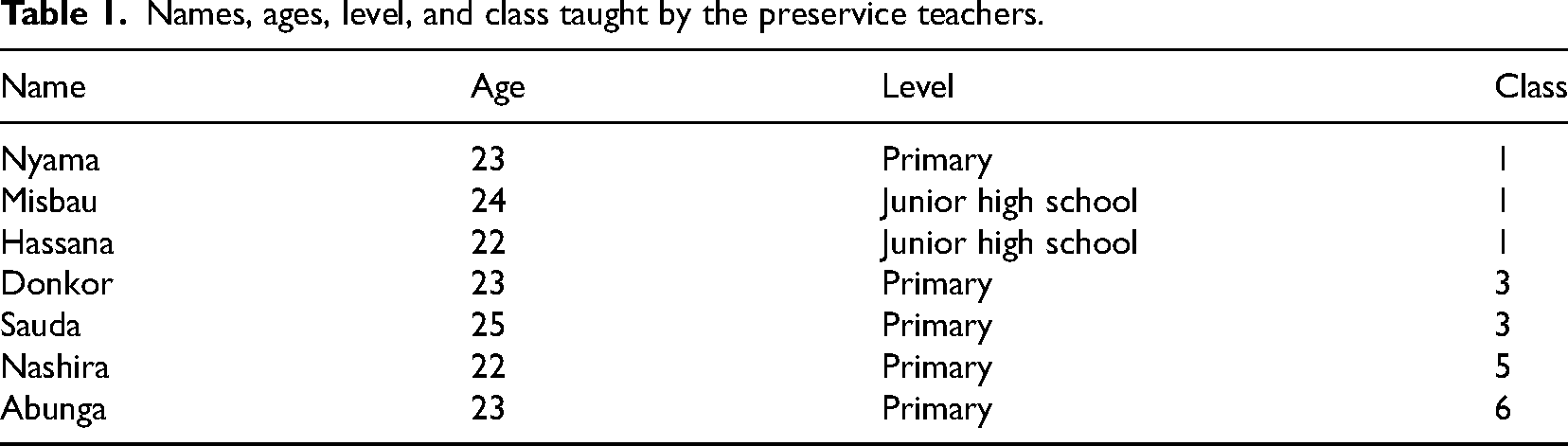
Names, ages, level, and class taught by the preservice teachers.
As shown in Table 1, two of participants had their teaching practices with the first year learners at the Junior High School while the rest taught at different classes at the primary school level. The result of the analysis of each participant's discourse trajectory is presented as follows.
This lesson was delivered largely in the local language called Kusaal, to class 1 learners and the objective was for learners to compare weights of different objects. From the lesson observed, five discourse indicators were noticed, namely answering, sharing, explaining, questioning, and relating. However, there was no evidence of justifications and generalization of mathematics facts. In terms of answering pattern, the lesson was characterized by either whole class repeating after the teacher in chorus, giving short responses or affirming “yes madam.” This is exemplified in the extract from the expressions in Kusaal language juxtaposed with English translation as follows. [32] Teacher Nyama: Mmh! Mboye so keni kpe [I want someone to come out here! And compare these two objects and tell which one is heavier and which one is lighter]. So I want you to come and hold these two things … Yeeesss. Graham kima gbai gos. (Graham come and hold the two items and feel their weights) [34] Teacher: Din tipsi diya? [Which one is heavier?] [35] Graham: Raised the heavier ruler (in silence) [36] Teacher: Din pu tipsi diya? [Which is lighter?] [37] Graham raised the other ruler without talking
In the entire lesson observed, we noticed 23 of such ways of responding to teacher Nyama's questions by gesture and signing of their answers.
The second indicator observed was sharing of ideas. The teacher did not give ample time for learners share their thought completely. This was noticed in many instances including the following excerpts. [38] Teacher: Graham is saying that this (yellow) rule is heavier than this (white) rule. Clap for Graham. [30] Teacher: Heavier than. Everybody heavier than, heavier than, heavier than, heavier than … [31] Learners (repeated after teacher) heavier than …
From the above excerpts, instead of encouraging learners to independently express their ideas, the teacher often completed their thought processes for them.
The third indicator noticed was how the teacher explained and clarified issues in the discourse process. It was observed from the lesson that all explanations offered by the teacher were either immediately or subsequently clarified by the teacher herself but not the learners. An instance of this is captured in the following excerpts. [7] Teacher: Baya ye weight ah! [If they say weight, weight ah!] Weight in Kusaal means “Tipsim”. Ya mi tipsim eeh? [Do you know weight eeh?] [17] Teacher: When you are talking about weight, we are talking about … Lighter than and heavier …
The fourth indicator observed was the nature of questioning. All questions were asked by the teacher. Also, we noticed that the large proportion of the questions were polar or rhetoric types emphasizing correct answers. We counted 30 of such question type in the lesson. A typical example is displayed as follows. [7] Teacher: Ya mi tipsim eeh [Do you know weight? [17] Teacher: … Ayine na mori b⊃? Mood tipsim gat ayine … (One will be what? Heavier than the other …)
The fifth and final indicator of the discourse trajectory exhibited by the teacher was her way of relating to the learners and also the content to real life. First, we noticed that she saw herself as the sole source of authority and created a power gap between herself and the learners. Second, the teacher related the concepts of heavier than, lighter than and equal to with concrete demonstrations. This is exemplified in the following excerpt. [114] Teacher: Yes, ba mori got tipsum. [It is used to measure/compare weight]. If you don’t want to feel it and see which one is heavier and which one is lighter, you can simply use the balance. Di wusa ane yeni ko [They are both equal]. Fo ya nok siel nin kpe [If you put something here ah!]. It will … do like this let's see … Deni tipsaa na be tingin ka’ deni pi tipsaa na be zugun [You will get to realize that the one that is heavier will be down and the lighter one will be up]
On the whole, teacher Nyama's lesson was characterized by univocal classroom discourse and was dominated by initiation-response-feedback pattern. Nyama neither challenged the ideas of her learners, nor did the learners challenge each other's ideas. There were no use of why or open-ended/divergent questions throughout the lesson. There was also a lack of opportunity for learners to predict, conjecture, justify, and generalize their notions.
Misbau's discourse trajectory in the mathematical relations lesson
This lesson was delivered to first year learners at a Junior High School. The topic was on types of relations and the objective was to enable learners establish various types of relations. From the lesson observed, five discourse indicators were demonstrated, namely answering, sharing, explaining, questioning, and relating. In terms of answering, learners either replied to the teacher's questions with short responses or chorus answers. The following excerpts show these instances. [119] Teacher: What is relation? Who knows what relation is … ? [120] Learners: Closed relation [121] Learners: Open relation [122] Teacher: Yes, what is the relationship between the father and you? The father is alone, having how many children? [123] Class: Chorused, three children
In terms of sharing, the teacher demonstrated over 15 counts of authoritativeness. [137] Teacher: If you know raise up your hand. [182] Teacher: I will be giving you trials, you are going to form your own types of what, Relation, and then I will go round and see what you have done.
This authoritative approach hinders open communication, critical thinking and learners’ actively participation.
In terms of explanations and clarifications, only teacher Misbau explained, while the learners listened and watched in all the 17 of such instances. This is typified as follows. [135] Teacher: … one-to-one relation. When your father gave birth to only you alone, no brother, no sister. You are the only son of your father. Your father maps to only one child. On this relation, let's map them, Awini's daughter is Theresa. Therefore, Awini will map to what? Theresa and Mohammed will also map to what? Hikima as his daughter. [137] Teacher: What is the domain in the above relation? If you know raise up your hand. Yes, Samadu? [138] Samadu: 1 and 2
Regarding questioning, all observed questions originated from the teacher and comprised closed and rhetorical queries. [142] Teacher: The next type of relation is what? We have one-to-many relation, one-to-one relation, the next one will be many-to-one relation.
When it comes to building connections, teacher Misbau made efforts to engage with the learners by incorporating real-life scenarios in the following manner. [126] Teacher: One person having how many children? 2 children i.e., one-to-many relations … The father is one and the children are what many. Let's present it.
Using two learners’ volunteer families, Misbau illustrated the relation of father to son or daughter. Teacher Misbau leading the discussion, mapped each element in the domain to corresponding elements in the co-domain based on the relation is the ‘father of’. He seemed to lack the skills to step back to let learners struggle and instead acted like a “mother hen,” frequently intervening to rescue them. In summary, the discourse employed by Misbau was teacher-led univocal discourse which limited critical thinking by learners. Throughout the lesson, there was a noticeable absence of dialogical discourse such as predicting, conjecturing, justifying, and generalizing.
Hassana's discourse trajectory in the integer lesson
Hassana delivered her lesson to first year learners at a Junior High School. The objective was for learners to be able to state the properties and operations involving integers. The analysis of the discourse in the lesson indicates a partially univocal pattern with few instances of emerging dialogical interactions. Throughout the lesson, teacher Hassana assumed an authoritative role, taking lead in providing statements and explanations. This gave the learners limited opportunity to actively participate or share their own ideas in the discourse. This can be seen in the following exemplars: [225] Teacher: Okay, a number line is a number containing both positive and negative numbers, but on this number line, I can't see any negative number. Can you see any negative number? [228] Class: No [360] Teacher: Okay, so apart from the less than and greater than sign, when we are comparing numbers and such numbers are the same, we do not use less than or greater sign but we rather use the equal to sign.
In this example, teacher Hassana's questions received largely chorus answers. Regarding sharing, all 15 identified instances came from the teacher. For example, the teacher shared information about the use of the equal sign when comparing numbers. There were no instances of learners sharing their views or ideas. There was limited engagement and collective involvement among the learners. It was teacher Hassana who continually provided explanations and clarifications. Questioning in the lesson followed the initiation, response, feedback pattern, with most questions posed by teacher Hassana. Learners had limited opportunities to ask questions and also did not answer any open-ended questions asked by teacher Hassana. This is illustrated in these excerpts. [208] Teacher: Example of negative numbers? [209] Maria: Negative one. [210] Teacher: Another example of numbers on a number line. Yes, Naziru? [211] Naziru: Positive numbers.
From the excerpt, there was partial engagement from learners as they contributed with their answers. While instances of learners asking questions were limited, an example of a learner question that stood out was when he expressed confusion about the inequality 2 < 5, stating, [338] Naziru: I didn’t understand why 2 < 5.
It is worth noting that learner engagement in terms of questioning was relatively low throughout the lesson. In terms of divergent or open-ended questioning, there was only one exemplar in the lesson, which came from teacher Hassana. [247] Teacher: Okay, why are they not the same, the numbers here: +2 and −2, what makes them different?
This question encouraged critical thinking and allowed for different perspectives. Rhetoric questions such as the one stated below were less prevalent in the discourse. [278] Teacher: When we are moving towards the right direction, what is the next number? 1, and she has one here.
This question stimulated reflective thinking and prompted learners to consider the progression on the number line. However, the overall dominance of teacher-led questioning reflects a partially univocal pattern. Relating the concept of increasing and decreasing to real-life instances was primarily done by teacher Hassana. Learners did not have significant opportunities to relate the lesson to their own experiences or perspectives. This further causes Hassana's lesson to follow partially univocal discourse trajectories as demonstrated below. [248] Teacher: Okay, Baraka, come out. Nashiru, follow. Majeed, come and stand behind Nashiru. Sadat, come and stand behind Majeed. Okay, look at them. Are their heights the same?
Here, teacher Hassana related the concept of increasing and decreasing by using real-life instances of heights of the learners. While this introduced some element of emerging dialogical engagement, the limited interaction from learners and the teacher's control over the activity reverted the lesson back to a partially univocal discourse trajectory. Generalizations were made solely by teacher Hassana, with no instances of learners contributing. Consider the following excerpt; [330] Teacher: So looking in general, what we've learned today, we've learned that on the number line, we have what? Two sets of numbers. Numbers moving to the left are called negative numbers, and numbers moving to the right direction are positive numbers. When we combine everything, we term it as integers.
On the whole, the analysis suggests that teacher Hassana played a dominant role in providing information, explanations, and questions, while learner participation and contributions were relatively limited. Hassana also presented summary and generalization of key points to the learners but maintained an authoritative role making the discourse partially univocal.
Abunga's discourse trajectory in the ratio and proportion lesson
This lesson was on “Ratio and Proportions” in Class 6. The objective of this lesson was to enable learners to develop a strong understanding of ratios and proportions, enhance their problem-solving skills, and apply these mathematical concepts to real-life situations. The lesson was characterized by teacher answering, questioning/asking, explaining, sharing/making statements, challenging, relating, predicting, justifying, and generalizing. For instance: [527] Teacher: The chalk was one whole and I broke it into 3 equal parts and I gave one to Sachira. So she has taken one. In fractions what do we say she has taken? [536] Zenab: one-half [537] Bukari: 3 over 1 [538] Angela: one over 3.
These short oral responses signaled partially univocal pattern and demonstrated how individual learner provided answers to the teacher's questions. There was however some chorus responses at sometimes in Abunga's lesson as reflected here. [558] Teacher: So we say A is in the ratio B is equal to … [559] Class: 1 is to 3.
The chorus response signified a partially univocal trajectory. The entire class response in unison, suggested a collective understanding or agreement on the given ratio.
Statement and sharing, identified as partially univocal, is supported by the exemplars: [511] Teacher: The next time we move to what? Proportion. So fractions, we want to revise on fractions [581] Teacher: Yes, keep quiet, if you are answering a question keep quiet and put up your hand because if you talk I will not mind you, I may even punish you.
Here, the teacher exerted control by trying to clarify the rules of engagement expected behavior and potential consequences. On questioning, a combination of closed and open questioning was witnessed as shown in the following exemplars. [603] Teacher: Kofi's mother bought 10 eggs for his sister and 6 for himself. So what will be the ratio for Kofi and his sister? [604] Sachira: 6 is to 4. [571] Teacher: The ratio of C to D is 2 is to 6 or 1 is to 3. So this one and this one are the same. Can you tell me why they are the same? [46] Teacher: But the demonstration you made, can you explain it?
This portrays an emerging dialogical discourse even though the teacher did not exercise waiting time for learners to think and respond. On the whole, the lesson oscillated from univocal to partially univocal discourse where the teacher provided both guidance and explanations.
Nashira's discourse trajectory in the fraction lesson
The lesson was titled Adding like fractions. The objective was to enable learners demonstrate the concept of addition of like fractions. In this lesson, the learners’ role was supplying short answers questions to the teacher's questions as shown in the following exemplars; [615] Teacher: Who can tell me the type of fractions we looked at? [616] Denis: Equivalent fractions [617] Zelia: Improper fractions
These short individual responses showed how the learners provided answers to Nashira's questions. This feature occupied the most part in the lesson. In the same way, sharing and explaining/clarifying were largely univocal. For instance; [620] Teacher: … This morning we are going to look at how to add fractions. Are you getting me? [621] Class: Yes [622] Teacher: I hope you all know what addition talks about? When we say addition, I hope you know what we are trying to say? It means what? Summing up what numbers, and this time around not just numbers we are going to be looking at fractions and we will be concentrating on what addition of fractions not just any fractions but what liked fractions. We are trying to what? Add two fractions and one of the fractions is what, [637] Teacher: … Other one is what, [641] Teacher: So it's simple, it is trying to tell us that in fractions, when you are adding fractions are you all listening to me? When you are adding fractions and the denominators are the same it means those particular fractions are what? Like fractions and since they are like fractions we are expected to add the numerators. We are expected to add the numerators.
Starting with teacher Nashira sharing the lesson objectives to set the stage by explaining about adding like fractions, she largely chatted a univocal trajectory. Similarly, the questioning style followed an IRE format with few divergent questions. Nashira posed questions related to like fractions, and in response, Evans, one of the students, provided an answer. This pattern of teacher questioning and learners responding continued for some time. [623] Teacher: Like fraction, anybody in the class who can give me an example of a like fraction? Example yes Evans? Evans: [651] Teacher:
However, she did not exercise waiting time thereby losing the chance to push the discourse beyond partial univocality. In terms of pushing for justifications of learners’ opinions/answers, it was still at a partially univocal: [632] Teacher: “… Why do we say these are what? Like fractions, why do we say these two fractions on the board are liked fractions? Yes Suraju?” [633] Suraju: “Because the denominators are the same.”
Here, Suraju provided a response Nashira's question and once she evaluated it to be correct, she did not challenge or ask Suraju to justify. As for generalizing, teacher Nashira provided a general rule related to adding like fractions as in: [655] Teacher: … So we say that when you are going to add liked fractions what you need to do is to what? Is to add the top numbers which, are the numerators and maintain the denominator. Are you getting me? Are you getting me? Okay!
Instead of facilitating learners through discourse to generalize, she did not thereby render the discourse typically one directional. In summary, the discourse trajectories in this lesson oscillated between univocal to partially univocal.
Donkor's discourse trajectory in the multiplication lesson
The objective of the lesson was to enhance learners’ understanding of multiplication as repetitive addition, and proficiency in solving multiplication problems. The lesson focused on developing learners’ mathematical skills and fostering a deeper comprehension of the concept of multiplication.
The discourse also included statements and sharing of information. As a demonstration, Donkor uses an example to illustrate the concept of multiplication: [367] Teacher: Multiplication is repetitive addition of a number. E.g., 2 × 3 = 2 + 2 + 2.
This statement serves as an explanation and provides a general understanding of the concept. Regarding explaining and clarifying, the excerpts showcase both teacher and learner explanations. Amina explains her solution; [387] Amina: 4 × 4 = 16
She further clarifies her calculation by illustrating it on the chalkboard: [389] Amina: 4 × 4 = 4 + 4 + 4 + 4 = 16.
These explanations contribute to the understanding of the multiplication concept. In terms of questioning, the discourse included examples of polar questioning. In [391], Donkor instructs Group 2 to choose a group member to solve a problem on the board, and subsequently, Minawara presents their solution: [391] Minawara: 5 × 3 = 5 + 5 + 5 = 15.
This closed question sought a specific response. However, there were no examples of open or divergent questioning in the lesson. Furthermore, there were no instances of rhetoric questions, indicating Donkor's willingness to chat genuine dialogue and critical thinking. Rhetoric questions can also create an imbalance of power in a conversation, as the questioner exerts control over the narrative and may discourage alternative perspectives or genuine exploration of ideas.
In terms of challenging, there was a case of a learner challenging an answer proposed by another learner. In [428], Wadud disagreed with the answer provided by Group 8: [428] Wadud: No.
However, Donkor did not utilize this disagreement to plunge the lesson into a more dialogic discourse but quickly provided clarification, which brought a resolution to the challenge.
This lesson also ceded autonomy to learners than previously observed in other lessons. While there were instances of partially univocal agreement through chorus and written responses, there were also moments where both teacher Donkor and the learners engage in explanation and clarification. This suggests the emergence of a dialogical discourse trajectory, characterized by active participation and engagement in mathematical concepts. Although, there were limited examples of challenging and open questioning, indicating a movement toward a more dialogical approach, they were not as prevalent in the given excerpts. Therefore, the discourse trajectory of the lesson can be described as partially univocal with elements of emerging dialogical interactions.
Sauda's discourse trajectory in the equality lesson
This analysis focused on Sauda's discourse trajectory in the lesson “Equal to and Not Equal to” in primary 3. The objective of the lesson was to introduce and develop learners’ understanding of the concepts of equality and inequality in mathematical comparisons.
In the lesson, there was a mix of communication patterns, ranging from partially univocal to emerging dialogical interactions. One indicator was the limited number of short oral responses provided by the teacher and learners. Out of the 27 responses observed, only four originated from teacher Sauda, as evident here. [446] Teacher: Pick your bottle tops, let's remove first box is how many? One person in each group should remove 3 and keep it aside, remove another 2 bottle tops and add it to the first 3 bottle tops. We have the first box 3 and second box 2. Now, the box at this side is 5. So if I may ask, what would we put here because the two and the three, they said plus. 2 + 3, what would we get? Zakari? [447] Zakari: 5 [448] Teacher: Put your hands down. 5. So 2 + 3 = 5, and now the other box is also 5. So what are we using there? What are we using? Is it same as or not same as? Or are we using equal to or not equal to? Alhassan? [449] Alhassan: Is the same.
These instances reflected a more teacher-centered lesson, where learners primarily responded to the teacher's prompts. However, there were also instances of emerging dialogical exchanges within the classroom. Teacher Sauda initiated dialogue to inform the learners about the lesson. [438] Teacher: Today, we will look at the concepts of “equal to” and “not equal to.”
By involving the learners, Sauda encouraged a more participatory and dialogical atmosphere within the classroom. Furthermore, there were attempts at explaining and clarifying the concepts using local language phrases to make the meaning of “same as” or “equal to” more accessible. [442] Teacher: If you hear the word same as or equal to, is the as same. Di wusa ane zinzima [both side are equal]. Di wusa ane bo? Zinzima [both sides are what? Equal]. And what if you hear the word not equal to, not equal to. The first one was equal to and this one is not equal to. Alima? [443] Alima: Deni pu’zima [not equal to]
The teacher's use of local language phrases to explain the concepts of “same as” or “equal to” demonstrated an effort to connect with learners at their linguistic and cultural level thereby acknowledging and valuing learners’ backgrounds. The above interactions also showcased a mutual exchange of ideas and understanding attributed to teacher Saudia’ use of the initiation–response–evaluation questioning format in a more thought-provoking manner, as further demonstrated here: [439] Teacher: If you hear the word equal to, if you hear the word equal to, what comes to mind? Equal to, equal to? Abdullah? [440] Abdullah: Zinzima [equal/equal to/same as]
The approach encouraged active participation from the learners and promoted dialogue by eliciting responses and encouraging them to think critically to express their views. This fostered a sense of autonomy and shared responsibility for learning. Additionally, Sauda engaged in generalizing the concepts “equal to” and “not equal to.” Learners were encouraged to draw connections and apply their knowledge to different examples. This way of generalizing promoted higher-order thinking skills and the application of learning to real-world contexts.
Discussion of findings
The focus of this present study was to understand the discourse trajectories exhibited by preservice mathematics teachers during their teaching practicum after Talk for learning PDS. On the dialogic discourse framework, the study found that the preservice teachers’ lessons reflected either univocal, partial-univocal, or emerging dialogical trajectories, in lieu of recommended dialogical discourses (see Figure 1). Univocal discourse trajectory subordinates learning to teaching (Gattegno, 1976). This is where the teacher dominates in explaining, clarifying, answering, justifying, and directing learners while the learners only receive information transmitted by the teacher with little questions or clarifications.
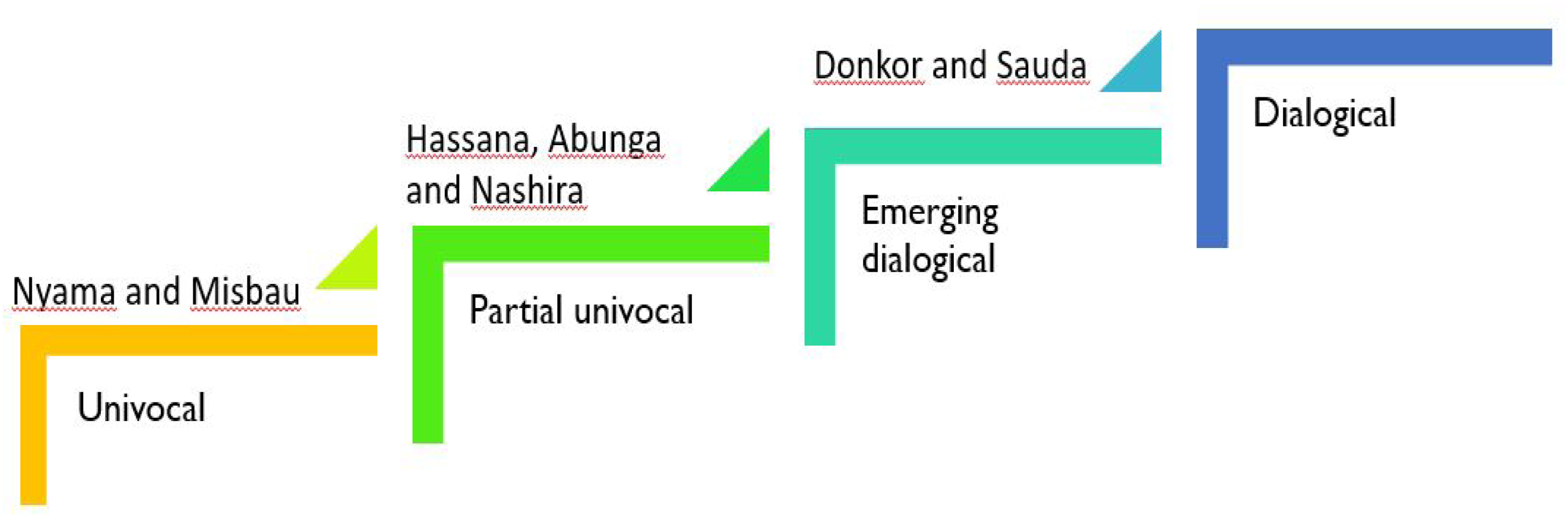
Types of discourse trajectories exhibited by preservice teachers (no need for colour print).
Among the seven preservice teachers engaged in this study, it was found that the lessons delivered by two of them were characterized by univocal discourses. In particular, Nyama and Misbau's lessons were focused on explanations and clarifications of concepts tailored at enabling learners to answer questions correctly. These preservice teachers were largely authoritative in the classrooms and were seen directing and controlling pupils throughout their lessons. They were also seen mostly in front of the class, telling, and showing learners on the chalk board how to do mathematics. There was no opportunity for learners to present their own mathematical ideas. The learners exhibited their mathematical thinking through gesticulations and repetition of short phrases after the teachers. The responsibility for learning was vested largely on the preservice teachers, who frequently explained and generalized learners’ answers. Most learners’ responses to questions posed by the teachers were oral and followed initiate-response-evaluate format. The learners’ ideas were not challenged nor explored further through group discussions or whole-class thought provoking probes. Again, though learners engaged in some amount of practice, it was more of what Bakker et al. (2015) describe as scaffolding, and perhaps, an avenue to provide further corrections. Learners’ errors in such practices were observed but not explored, as learners’ learning depended greatly on the teachers. This findings may not be surprising for preservice teachers who are novice and beginning to form their own didactic trail. As observed by Martin (2018), even many practicing teachers struggle to orchestrate student-centered discourse in their classrooms because they find it difficult pacing back to observe learners develop their own ideas. Perhaps, encouraging these preservice teachers to engage in reflective practice of their own lessons and discussing challenges with tutors and colleagues may help improve their future discourse practices.
The study also revealed that the lessons delivered by three of the seven preservice teachers (Hassana, Abunga, and Nashira) oscillated between univocal and partially univocal trajectories. Key features in these lessons were explaining and clarifying concepts, showing how to perform mathematical tasks and directing learners to demonstrate their answers. On questioning for instance, there were 63 questions Hassana asked in the lesson, but no learner asked any question. As many as 60 of the questions asked were largely closed-end, purported to funnel learners’ thinking. This finding is not in line with the recent curriculum shift highlighted by Monrat et al. (2022) and MOE-G (2019), where open-ended questions are advocated in mathematics classrooms to allow learners explore multiple strategies and enhance their critical thinking. Though, Hassana for example probed learners’ thinking and supported them to articulate their thoughts, the intent was more of clarifying rather than creating mathematical communication, as no learner-to-learner dialogue was observed. Teacher Abunga's lesson followed a similar trajectory as Hassana's. Teacher Nashira's discourse trajectory also resonated with partially univocal discourse. She was an explainer and questioner who mostly posed questions to elicited basic knowledge rather than provoking debate. She was largely seen as the source of mathematical ideas and did not allow learners to explain and state their own new strategies. The consequential effect of this kind of discourse trajectory is that the development of learners’ mathematical thinking will be ill-nurtured and knowledge growth stunted (Tuck, 2018).
Finally, the study also revealed that the lessons delivered by two other preservice teachers (Donkor and Sauda) followed an emerging dialogical trajectory. Their lessons received the most teacher-learners oral interactions. There were plenty of written communications and learner-to-learner discussions. Their lessons involved the most hands-on activities among the seven preservice teachers. The learners explained their answers through chalkboard illustrations, small group discussions and presentations on the chalkboard. Through these engagements, the learners took responsibility for their learning. The formation of small groups also enabled the creation of mini-discourse communities (Martin, 2018; Tuck, 2018). However, as a novice teacher, Donkor had challenges in addressing disagreements among learners, initiating voluntary appointment of group leaders, and taking actions to promote learner autonomy. Despite these challenges, the demonstrations of such features as even distribution of written and oral responses and stimulating group interactions rendered the lesson discourse an emerging dialogical one. The trajectory of Sauda's lesson fluctuated from univocal through partial univocal to emerging dialogical. First, Sauda was largely in charge of explaining and questioning yet allowed whole-class discussions which were characterized by her own initiations, directions, and control. Second, though she provided opportunity for learners to accept each other's views, her questioning style were polar in nature and did not support dialogic discourse. Third, she used dialogue, characterized by probing questions, to help learners understand mathematical concepts, but these were all lower-order questions. Learners were seen solving mathematical tasks in small groups and reporting their works through whole-class sharing. As Gutiérrez (2013) observed, where the learners shared their work with the rest of the class, they tend to create a sense of community and the depth of their understanding. Donkor and Sauda's discourse trajectories could therefore be viewed as exemplifying an effort to implement talk for learning in mathematics classrooms.
The study of the preservice teachers’ lessons revealed differing trajectories of classroom discourse, in which none attained complete dialogical level of discourse trajectory suggested in the literature (Hunter et al., 2018; Robinson, n.d.) and recommended in the pre-tertiary education curriculum in Ghana. The effective use of discourse in mathematics classrooms is an essential aspect of learning mathematics. It involves creating a learning environment that encourages learners to participate actively in formulating and testing hypotheses, posing questions, and expressing agreement or disagreement in line with the sociocultural thinking. By doing so, learners can learn the fundamental aspects of what it means to do mathematics. Hence, the local language used by preservice mathematics teachers with their learners in classrooms was expected to promote discourse among the pupils. Unfortunately, from the seven classroom lessons studied, the local language was used to subordinate learners as active constructors of meaningful ideas. Learners were not encouraged to make predictions, conjectures, and generalizations. This situation does not provide fertile grounds for critical thinking as it is at variants with the tenets of the sociocultural learning philosophy which requires learners to construct their mathematical knowledge through shared interactions in classroom discourse.
Discourse in mathematics classroom is of utmost importance in shaping the mathematical comprehension of learners. As a sequel, preservice teachers need to recognize how to create a learning environment that fosters classroom discourse and active participation by learners in the learning process. Shifting from univocal to dialogic discourse enables learners to actively participate in conjecture-making, questioning, and expressions of ideas. This shift fosters a deeper understanding and appreciation of mathematical concepts, effective collaboration, thereby creating discourse. As novice teachers, these preservice teachers could not exhibit dialogical discourse trajectories to ensure learners develop quality mathematical communication abilities. However, their practices provide empirical evidence of the potential and the challenges of implementing talk for learning model at the colleges of education. The study also demonstrates how lesson study during preservice teachers’ practicum has the potential of revealing information needed to improve the teacher education and professional competencies toward dialogical discourse in the classroom.
There are some theoretical contributions and practical implications associated with evidence from this study. This study extends the sociocultural theory in mathematics education by offering empirical insights into the Zone of Proximal Development (ZPD) and the impact of teacher-learner interactions on cognitive engagement. It also refines discourse trajectory frameworks by identifying univocal, partially univocal, emerging dialogical, and dialogical patterns, and highlighting the challenges preservice teachers face in adopting student-centered approaches. The research further contributes to multilingual education by examining the use of local languages and showing how univocal discourse patterns can persist without adequate teacher training. Through the lesson study and reflective practices, the study offers practical solutions to enhance dialogical skills in teacher education, particularly within the context of developing countries like Ghana, where traditional, teacher-centered practices dominate.
The practical implication includes encouraging tutors at the college level to regularly provide opportunities for preservice teachers to engage in peer teaching and reflective practices before, during and after their practicum. The college tutors also need to model their own lesson sessions to demonstrate how dialogical discourses are conducted in classroom setting. Finally, during their teaching, it is useful for tutors to record lessons delivered by preservice teachers for learning analytics and case studies on discourse patterns. These practices will help boost preservice teachers’ confidence and skills in dialogical discourse modes.
Limitations
The limitation of the study lies in the small sample size used, the lack of longitudinal data, and the context-specific observations made. First, the study involved seven preservice teachers, which may not be representative or generalizable to the broader population of preservice mathematics teachers in Ghana. Second, the study focused on the preservice teachers’ discourse practices during a single mandatory teaching practicum. Without longitudinal data, it is difficult to assess the long-term impact of the “Talk for Learning” module on their teaching practices and student outcomes. Third and final, the findings are based on observations from specific classroom settings and may not capture the full range of discourse practices in different schools or regions. This context-specific nature of the study may limit the applicability of the results to other educational settings. Despite these limitations, this study provides a lens for understanding the intricacies of achieving dialogical discourse use in mathematics classrooms. A tracer study using longitudinal data or mixed methods approaches may help clarify further the findings of this study.
Footnotes
Acknowledgements
We sincerely express our gratitude to the preservice teachers of the Gbewaa College of Education, Pusiga, for their active participation in this study. Our appreciation also extends to the basic school heads in the Pusiga District, whose cooperation and support were invaluable during the preservice teachers’ practicum. Furthermore, we are grateful to the Pusiga District Education Directorate for their guidance and assistance throughout the study. Their collective contributions were instrumental in making this research possible.
Contributorship
Peter Akayuure conceptualized the research, conducted the data analysis and authored the discussion and conclusion sections. Edmund Anamboi Aduko reviewed the literature and handled the data collection including recording and transcribing classroom observations. Both authors jointly designed the two cycle lesson study on Talk for Learning, collaborated in writing the methodology, proof-read the manuscript, and approved the final version for submission.
Data availability
The data for the study have been duly incorporated into the results section of this article. However, the entire data are available in transcripts and recordings upon request.
Declaration of conflicting interests
The authors declared no potential conflicts of interest with respect to the research, authorship, and/or publication of this article.
Funding
The authors received no financial support for the research, authorship, and/or publication of this article.
Informed consent
Informed consent was obtained from all subjects involved in the study.

Appendix
Indicators of classroom discourse trajectories.
| Indicator | Univocal discourse | Partially univocal discourse | Emerging dialogical discourse | Dialogical discourse |
|---|---|---|---|---|
| Autonomy | Teacher controls discourse, minimal student interactions | Teacher allows limited student interaction, heavily controlled | Not applicable | Not applicable |
| Answering | Students listen passively, provide short, often one-word responses | Teacher often fills in students answers or explanations, students listen more than speak | Students begin to provide complete answers with explanations and justification | Students give thorough answers with justifications, often leading discussion |
| Explaining | Teacher explains concepts, delivers correct information, no open discussion | Teacher explains ideas with detailed steps for correct answer | Teacher probes deeper into students’ thinking, encourages multiple strategies | Students provide complete explanations with minimal prompting, aware of peer question |
| Questioning | Questions are rhetorical or closed-ended, clarify/emphasize specific points | Teacher uses closed questions, may ask follow-ups, remains primary questioner | Questions focus on students’ thought processes, students begin asking questions about peers’ work | Students take initiative in asking questions, focusing on ‘why’ questions that require justification |
| Sharing | Teacher is the sole provider of information, makes general/factual statements | Teacher predominantly makes statements, students rarely share work without explanation | Teacher allows group discussions, students start sharing and discussing concepts | Students actively participate in discussions, using dialogue to explore concepts |
| Challenging | No opportunities for students to challenge teacher or peers | The information conveyed with little challenge, students rarely question or challenge | Students start challenging each other's ideas, fostering deeper understanding | Whole-class discussions allow students to argue and elaborate on each other's ideas, in argumentation |
| Relating | Teacher relates information to previous knowledge, students not encouraged to make connections themselves | Teacher occasionally encourages comparisons, but not regularly | Students begin drawing connections between new concepts and prior knowledge | Students make connections to prior knowledge, develop problem-solving strategies |
| Predicting, conjecturing | Students not given opportunities to guess or make prediction | Students seldom guess or make conjectures, and when they do, it is often superficial | Students start making predictions or conjectures based on understanding of patterns | Students make informed predictions or conjectures, recognizing patterns and hypothesizing properties |
| Justifying | Teacher confirms and justifies responses without student involvement | Teacher may ask for justifications, but students rarely provide them | Students begin to justify their ideas and procedures, supporting their reasoning | Students independently justify their ideas, defending their reasoning against challenges |
| Generalizing | Teacher summarizes, makes generalizations, states formulas/rules without student involvement | Teacher summarizes and generalizes, students rarely participate | Students start generalizing from specific examples to broader cases | Students engage in generalization, moving from specific examples to general cases, demonstrating abstract thinking |
Author biographies
Both authors have collaborated on multiple research projects aimed at improving mathematics teaching and learning through evidence-based practices.