



Abstract
Constructing conjectures is a major challenge in learning geometry. However, there are still gaps in our understanding of the knowledge about geometric figures that students use when they construct a conjecture. This article explores the understanding of ninth-grade students, aged 14 to 15, about geometric figures during the process of constructing conjectures. The study's data consists of the students’ responses to two geometry tasks in a questionnaire. The first task does not include an associated drawing, while the second task contains an incomplete drawing. Both tasks aim at the construction of conjectures. The research results highlight the influence of students’ knowledge of geometric figures on the stages of constructing conjectures in geometry. The findings indicate that students’ difficulties arise from inconsistencies in their cognitive structures regarding the figures used in conjecture construction. Students often rely on inappropriate prototypical figures when the task is not accompanied by an associated drawing. Additional findings reveal that informal arguments emerge when drawings are used to support these arguments, which are subsequently validated through experimental verification.
Introduction
In mathematics education, Parzysz (1988) defines a geometric figure as the geometric object described by the text that defines it, an idea, a creation of the mind, while the drawing is its representation. Laborde and Capponi (1994) consider the geometric figure as the establishment of a relationship between a geometric object and its possible representations. In both acceptations, there is, on the one hand, an ideal object, for which properties can be stated and on which reasoning is based, and, on the other hand, representations of this object. The geometric figure occupies an important place in activities related to the construction of conjectures in geometry at Secondary School. These conjectures help students to develop and refine their reasoning skills, allowing them to explore new ideas and formulate hypotheses based on proof and observation. According to Pedemonte (2002), a conjecture has three components: a statement, an argumentation, and a set of concepts needed to construct the argumentation. In geometry, students construct their conjectures from figures, but the statements of these conjectures are not always consistent with established theory (Pedemonte & Balacheff, 2016). This raises questions about the knowledge students express about figures when constructing conjectures in geometry.
Research has been conducted on geometric figures in secondary school geometry. The results indicate that students are rarely engaged in the process of constructing definitions of geometric figures, and that drawing is a primary source of students’ difficulties (Duval, 2005; Tchonang, 2021). For instance, Tchonang (2021) reports that the way in which the drawing of two parallel lines is presented to students can explain the following misconception: ‘two parallel lines are two horizontal lines’. Some research on conjecture in geometry reports that learners’ thinking is often limited to the visual image of a figure and rarely includes conceptual properties of the geometric figure (Chen & Herbst, 2013; Laborde, 1994; Parzysz, 1988). At times, they concentrate on aspects of the drawings that are irrelevant to the problem's context (Mariotti, 2001; Moore, 1994; Pedemonte & Balacheff, 2016). These findings clearly indicate that students’ understanding of figures does not always align with theoretical expectations. Given this situation, we argue that this discrepancy could significantly impact the construction of other knowledge related to these figures.
There are studies in the field of mathematics education that examine the cognitive dimension associated with the geometric figure (Duval & Godin, 2005; Richard, 2004). However, there are still gaps in our understanding of the knowledge about figures that students mobilise when they construct a conjecture, as defined by Pedemonte (2002). Therefore, this study aims to understand this phenomenon in depth, which leads us to the research question: How does students’ understanding of geometric figures influence their ability to construct conjectures in secondary school? By addressing this question, we aim to explore students’ understanding of figures when representing and interpreting them, as well as when constructing arguments. Findings from this research may provide guidance on how to promote students’ coherent understanding of geometric figures.
To answer this question, the article begins with a literature review that examines the use of figures, drawings, arguments, and conjectures in geometry. We present the theoretical framework of our study, which is based on Vinner's theory of concept image and concept definition. In addition, we incorporate Toulmin's model of argumentation as our methodological approach. We then provide an overview of the methodology of our study. We then present and analyse our findings. Finally, we discuss the implications and conclusions of our study.
Literature review and conceptual framework
Prior research on the concepts of figure and conjecture in geometry
Previous research in mathematics education has investigated the knowledge that students use when solving problems involving geometric figures (Fischbein, 1993; Fischbein & Nachlieli, 1998; Haj-Yahya, 2020; Laborde, 1994; Vodušek & Lipovec, 2014). According to Fischbein (1993), a geometric figure is characterized by conceptual properties (the theoretical properties of the figure) and sensory properties (the visual or perceptual properties of the object). It has been observed that students’ difficulties often arise from the dominance of the figure's sensory properties over its conceptual properties (Fischbein & Nachlieli, 1998). In this sense, the research study of Vodušek and Lipovec (2014) reveals that learners’ mental images of the square tend to dominate conceptual properties in problem solving. Laborde (1994) identified difficulties that students face when manipulating the drawings representing geometric figures. These difficulties include non-recognizing the invariances of the figure in different positions of the drawing and the perceptual attraction of certain aspects of the drawing. That difficulty hinders a geometric analysis adapted to the solution of the problem by hiding by contrast combinations of parts of the figure. Haj-Yahya (2020) reported that the use of self-attributes of a single presented drawing, instead of the critical attributes of the figure, and the use of prototypical or non-prototypical examples affect students’ justification and the process of problem-solving. Furthermore, the position of the drawing attached to the assignment also affects students’ construction of justification. Moreover, Duval and Godin (2005) distinguish three different approaches for the analysis of a figure in geometry: based on shapes (or figural units), based on the conceptual properties of the figure, and based on the instruments that can be used to reproduce and construct figures. According to them, the analysis of figure as figural units tends to dominate the geometric analysis of the figure among students. This tendency can be reversed by manipulating the variables offered by the instruments used in the reproduction of the figure.
According to Ogan-Bekiroglu and Eskin (2012), students’ conceptual knowledge significantly influences their engagement in constructing arguments. Similarly, research has found that students’ ability to construct conjectures and their creativity in mathematics are closely tied to their approach to understanding geometric figures (Garuti et al., 1998; Gridos et al., 2022). These findings suggest that there is a close relationship between students’ knowledge of geometric figures and their ability to construct arguments during the process of conjecture construction in geometry.
Concept image, concept definition
Concept image consists of all cognitive structures in an individual's mind that is associated with a given concept (Tall & Vinner, 1981; Vinner, 1983). It includes mental picture associated with the properties and process. Geometric figures are conceptual entities. However, they are accessible through their drawings, which are their representations of different media (Parzysz, 1988). Working on a geometric figure may require an individual to analyze the figure in terms of figural units, geometric properties, and tools they can use to reproduce or construct the figure (Duval, 2005). In this process, they are led to express their concept-image of the figure. Therefore, the mental picture of a figure comprises the set of all images that have previously been associated with that figure in an individual's mind. This can encompass shapes, colors, function curves, and symbols. The portion of the concept image which is activated at a particular time is the evoked concept image (Tall & Vinner, 1981). The concept image of an individual on a figure may not be coherent and may have aspects that are very different from the formal theory in geometry. Various studies report that individual concept image differs from the formal theory and contains factors that cause cognitive conflicts (Bingolbali & Monaghan, 2008; Tall & Vinner, 1981; Tchonang, 2021). For example, the first encounter with the drawing of two parallel lines which usually are two segments may contain the germ of future conflicts because of the images it evokes among students. One of the wrong properties retained by students is that “two parallel lines have same length”, it is part of their concept image (Tchonang, 2021). Concept definition is a set of words used to specify the concept and is related to the concept as a whole. It can also be the student's personal reconstruction of a definition. In this case, these are words that the student uses for his own explanation of his evoked concept image.
According to Tall and Vinner (1981), the student's concept image on a concept can be coherent as well as not coherent. The concept image of an individual is considered as coherent when it contains no contradictions with the formal theory of the figure. Viholainen (2008) suggested some criteria that characterize the level of coherence of a concept image:
- The concept image has a clear personal conception of the concept. In other words, the individual must have an intelligible conception, free from doubt and hesitation. - All conceptions, cognitive representations and mental images concerning the concept are connected to each other. - The concept image has no internal contradictions. An internal contradiction arises when an individual mentions two properties that contradict each other or cannot be satisfied by a concept. - The concept image does not include conceptions that are in contradiction with the formal axiomatic system of mathematics. The third criterion is also a component of the last. However, an individual's concept image may not have internal contradictions and include conceptions that contradict the formal theory.
In light of the theory of concept image (Vinner, 1983), we believe that a coherent concept image should not include inappropriate procedures for reproducing or constructing a geometric figure; for example, using straight lines to represent a figure in a figure construction problem. Another one is checking of properties with instruments and measurements on drawings. In a problem-solving situation leading to the construction of a conjecture in geometry, students express their concept image of the figures described in the problem. These components of their concept image enable them to act, formulate, and justify their choices. Vinner's (1983) theory will allow us in this study to interpret and describe the students’ evoked concept image in a conjecture construction process.
The Toulmin model of argument
Toulmin's model of argumentation is a model derived from the language science. It is used in mathematics education to describe and analyze students’ arguments. Decomposing an argument allows the analysis of its reference system (conceptual, linguistic and framework aspects) (Pedemonte, 2002). Toulmin (2003) proposes the following general schema for an argument:
Figure 1 represents the transition from data to claim in an argument. The claim is the statement that an individual wants to prove to the other person. In other words, this is the main argument. For example, suppose a student claims to his or her classmate that a line (D1) is parallel to another (D2), the claim might be: “line (D1) is parallel to line (D2)”. The data is the information that helps to support the claim. It can be facts or logical reasoning. Returning to our example, the student evoked the following information as the data: “we see that the two lines do not touch”. In this model, the transition between data and claim is authorized by warrant (rules, laws, principles that authorize inference from data to conclusion). For example: “ two straight lines are parallel when they do not touch”. The warrant is supported by the Backing (set of rules, taxonomic systems that legitimize the warrant), which can be qualified or refuted. In our example, the Backing of the student's argument seemed to be based on the definition of parallel lines. Most of the time, this backing is revealed when the warrant is questioned by the interlocutor. It provides additional support to the warrant by answering different questions.
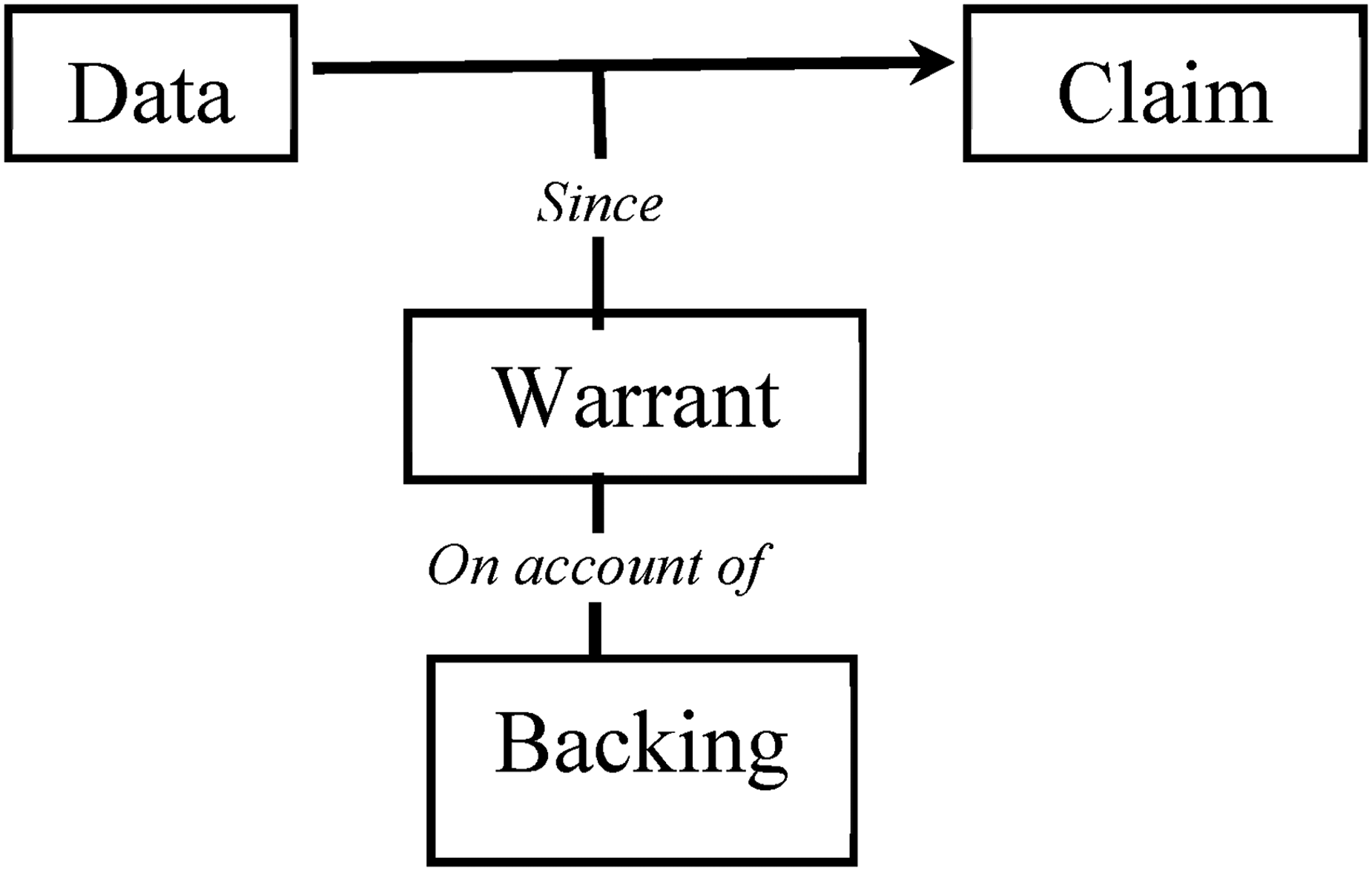
Representation of the components of an argument in Toulmin's model.
Toulmin's model has been used in mathematics education for various reasons. On one hand, Pedemonte (2002) used this model to analyze students’ arguments in terms of structure and reference system. On the other hand, Krummheuer (2015) used this model to analyze the interaction process in mathematics classes. Students construct arguments to justify their conjectures. In this study, we employ the Toulmin model (Toulmin, 2003) to analyze the components of these arguments. This approach will subsequently allow us to examine the influence of students’ concept image of the figure on their conjectures. Identifying the information that students in Cameroon context use as data, claim and the warrants they use to legitimize the transition from data to claim in an argument will provide a better understanding of the influence of the geometric figure on the construction of the conjecture.
This research is an exploratory study that aims to clarify students’ concept-images of figures described in a problem statement or whose drawings are associated with the problem expressed in the process of constructing conjectures in geometry. This will allow a better understanding of the influence of geometric figures on students’ conjectures, particularly on the arguments they construct to justify their choices.
3.1 Participants
The first cycles of secondary education (students aged 11 to 15) in Cameroon consist of two sub-cycles: the observation sub-cycle (for students aged 11 to 13) and the orientation sub-cycle (for students aged 13 to 15). For this study, the participants consisted of eighty students from orientation sub-cycle (students aged 14 to 15). These are students who have willingly agreed to participate in the study. They have not been subjected to any pressure. They have studied the properties of plane geometry, such as the perpendicular bisector of a segment, the median in a triangle, as well as altitudes. They have learned to represent the drawings of triangles, quadrilaterals, and other plane figures in plane geometry. They have studied the elements of theory related to these figures, including the properties of triangles inscribed in a circle.
In the observation sub-cycle, students studied instrumental geometry using tools such as the ruler, compass, square, etc. Besides their role in drawing representation, these tools also served as validation instruments through experimental verification on the drawings. In the orientation sub-cycle, student study theoretical geometry, with a focus on the use of definitions and rules and properties to legitimize their arguments. We informed the participants about the research objective, and that their information would not be disclosed.
3.2 Data collection
Two tasks were used to gather data for this study. The tasks correspond to open problems that require the construction of a conjecture, as described by Arsac et al. (1988) and Pedemonte (2002). The execution of these various tasks should lead them into a research phase where they will use visualization and experience on the drawings (Duval & Godin, 2005). For this purpose, they should articulate their knowledge related to the figures described in the problem statements or represented by associated drawings (triangles and circles). One aspect of the didactical contract Brousseau (2002), which is thought to be part of the culture of our participants and which was emphasized before the start of the experiment, states that when solving a geometric problem involving a triangle, it is wiser to represent the drawing of a non-specific figure in the absence of details. Participants were informed that their discussions would be recorded and that they needed to provide justification for their choices for each of the two tasks and that they could be approached to explain their production (Pedemonte, 2007).
3.2.1 Task 1 (area of a triangle and median)
The first task involves two triangles with equal areas. We proposed to our participant a problem in a textual form without an associated drawing. We allow students to choose the type of triangle they wanted to represent in their investigation. This is to enable them to express their concept image on two triangles with equal areas and to justify their choice with arguments. The objective is to assess whether the concept image expressed for the initial triangle is relevant to the situation and, furthermore, whether the evoked mental picture expressed for two triangles of the same area is consistent with the theory. The text of the first task in the questionnaire is as follows: “Consider a triangle ABC. How can you construct a line (D) such that it divides the triangle ABC into two triangles of equal area?”
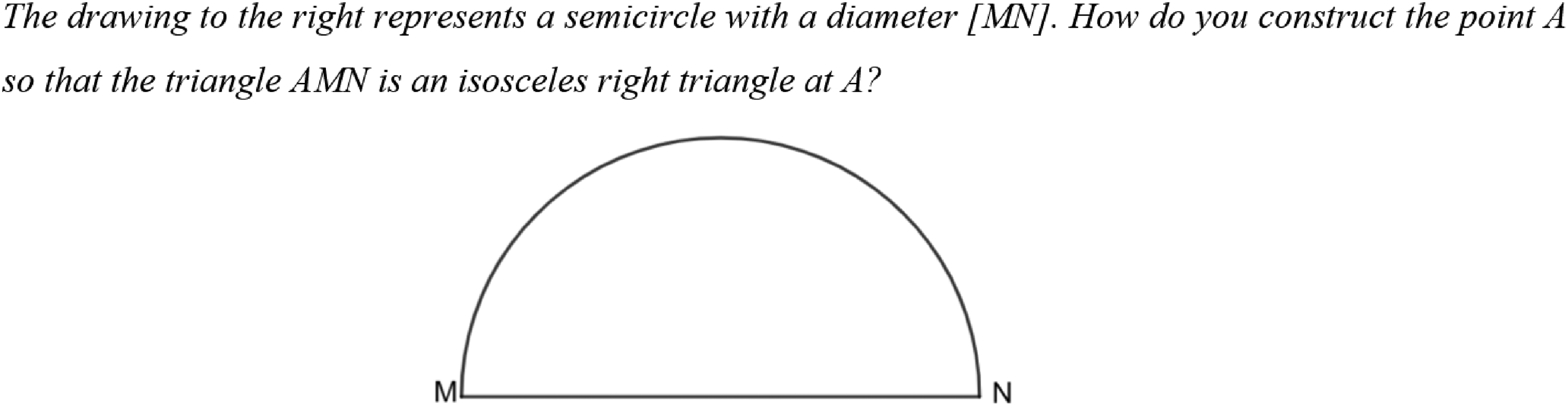
The text of the statement for the second task and its associated drawing.
Our participants are familiar with triangles, which is the type of geometric figure described in the problem statement. In the Cameroonian education system, students’ study two categories of triangles: the particular triangles (isosceles triangle, equilateral triangle, right triangle) and the non-particular triangles. The student is expected to conclude and justify that a median split a triangle into two triangles of equal area.
3.2.2 Task 2 (the inscribed isosceles right triangle in a semicircle)
The second task (Figure 2) a problem which involves an isosceles right triangle inscribed in a semicircle. We associated a drawing to the statement of the problem. This drawing represents a semi-circle and has a representative function in that it represents the geometric figure described in the problem text. The aim of this problem is to explore the knowledge expressed by students regarding right-angled triangles inscribed in a circle, as well as isosceles triangles in the context of constructing a conjecture. Associating a drawing with the problem, we anticipated that all participants would be prompted to work on the same configuration. The expected knowledge here is that which enables students, on one hand, to work on the drawing to complete the figure and formulate a conjecture, and on the other hand, the properties of the figure, whether explicitly stated or not, serve as warrant for their arguments construct to justify their choices.
Written argumentation and drawing produced by student S12.
The task is to construct an isosceles right triangle with the diameter of the circle as its hypotenuse. The isosceles right triangle and circle are part of the participants’ culture, having studied them in previous classes. We presented this problem to two mathematics teachers, who examined the content of the tasks and determined whether the tasks fitted the objectives of the study. It was decided that students should work directly on the provided drawing to prevent them from using the lines on their sheets to represent the figure. The experiment spanned a duration of 60 min, strategically scheduled outside of regular school hours to minimize ambient noise interference. A sheet of paper with the two problems was given to each participant.
3.3 Data analysis
For this research, we employed a mixed-methods approach to analyze students’ responses to the aforementioned tasks. This means that we utilized both quantitative and qualitative methods, as recommended by Stecher and Borko (2002). Our analyses focused initially on the students’ drawings, followed by their conjectures, and ultimately, the arguments constructed to justify their choices. In the quantitative approach, we analyzed the data from these sources by calculating the frequency counts of the different student responses to the two tasks. The qualitative approach involved analyzing the content of some of the students’ productions.
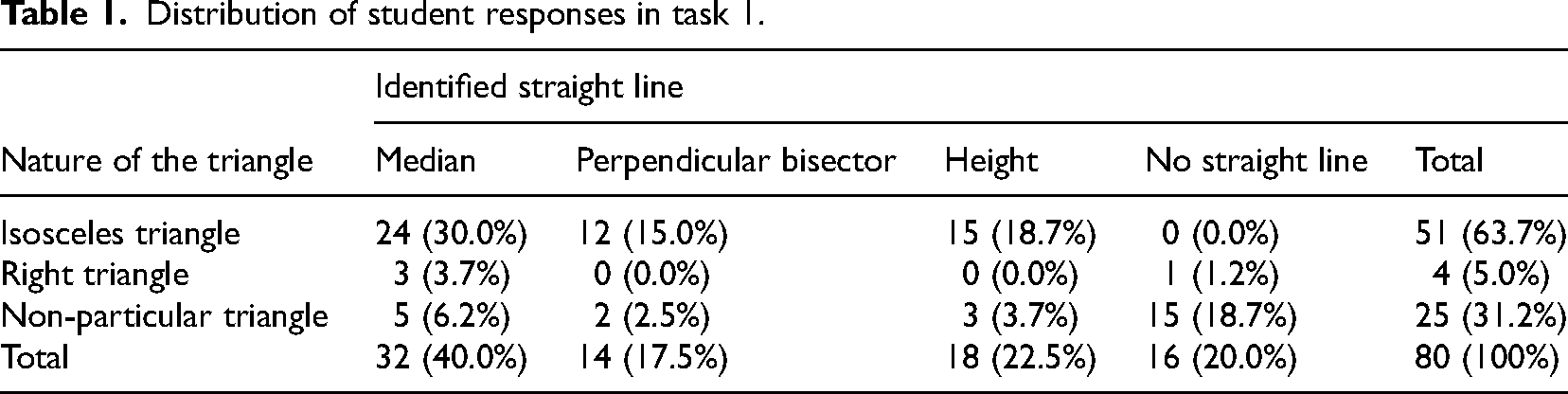
To formulate the response categories, we based our approach on preliminary analyses of the questionnaire responses provided by 20 students (Haj-Yahya et al., 2023). Then, we analyzed and coded all of the students’ responses, consolidating our different categories. For example, for the first task, we created categories for the drawing of triangles represented by students: isosceles, equilateral, right triangle, and non-particular triangle. We also categorized the nature of the straight lines: median, perpendicular bisector, height, and no line (see Table 1). Concerning students’ justifications, we created three types of justifications based on their arguments. The following categories were identified: formal justification (structured and rigorous arguments accepted in secondary school), informal justification (contains unacceptable arguments), and no-justification (when students did not provide any justification) (see Tables 1 and 2). The qualitative data were analyzed using content analysis. We examined the written productions, which consisted of the answers to the questionnaire. We scrutinized the participants’ evoked concept image of the geometric figure and the drawings they represented. To reduce the subjectivity of our analyses, we contacted the students whose work is examined in the qualitative analysis section to obtain their explanations regarding their productions. This allowed us to validate our interpretations of their work and to gain a deeper understanding of the knowledge they utilized to construct their arguments.
Distribution of student responses in task 1.
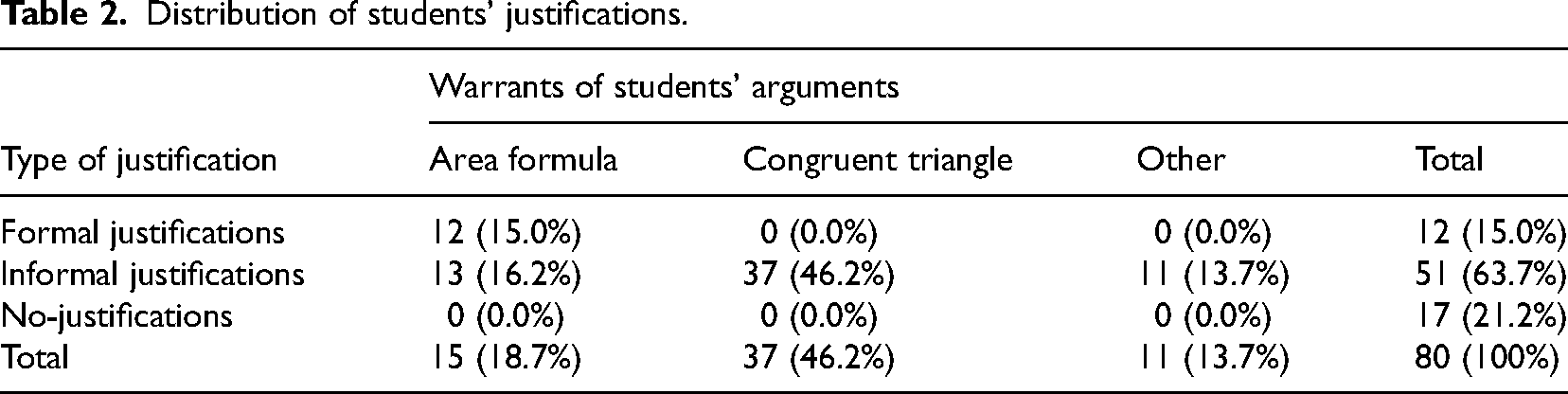
Distribution of students’ justifications.
The participants’ drawings to the task 2.

The students’ productions were transcribed and translated from French into English. The Toulmin model was used to analyze the components of the constructed arguments. Then, we utilized Vinner's theory to analyze students’ concept images associated with a geometric figure.
In this section, students’ productions are analysed. The results highlight the influence of the concept image that students have of the figure on the construction of a conjecture in geometry.
4.1 Task 1 relationship between the median and the area of a triangle
4.1.1 Quantitative data
Table 1 below shows that all students completed the first task of the questionnaire. We can see that 51 (63.7%) students drew a drawing that represents an isosceles triangle. Among these students 24 (30.0%) students identified the median as the straight line that divides a triangle into two triangles with the equal area. However, 15 (18.7%) students identified the height and 12 (15.0%) students mentioned the perpendicular-bisector. This is due to the particular character of the isosceles triangle, in which the median, the height and the perpendicular bisector, which pass through the main vertex, are all the same.
In Table 1, one can see that 25 (31.2%) students drew a non-particular triangle. Among them, 5 (6.2%) students recognized the median as the line that divides a triangle into two equal-area triangles. Further 2 (2.5%) students represented the perpendicular bisector of one side of the triangle, while 3 (3.7%) students represented one height of the triangle. Most of them, 15 (18.7%) students, estimated that the triangle cannot be divided into two triangles of the same area by a straight line. As we shall see in the following analysis, the students in this category wanted to split the initial triangle into two equal triangles without success.
In Table 2, we present the students’ justifications according to the type of argument they constructed. Table 2 shows that only 12 (15.0%) students constructed formal justifications. These arguments are validated by the formula for the area of a triangle; the students compared the formulas and successfully justified their equality. It is also observed that 51 (63.7%) students constructed informal justifications. The warrants of their arguments are based on an incoherent concept image. For example, “two triangles have the same area when they are equal”. On the other hand, their productions seem to indicate that they proceeded by experimental verification on the drawing. Among these students, the majority (37 out of 51, i.e., 46.2%) relied on the idea that two triangles of equal areas are two congruent triangles, while 11 (13.7%) students proposed an ambiguous construction plan. We categorized it among the informal justifications.
The results presented in the tables above show that some concept image expressed by students about a triangle divided into two triangles of equal area form a prototype figure. The isosceles triangle is the figure evoked by these students, which is observed both in their drawings and in their reasoning. The use of this figure to construct their conjecture leads them to error. This can be seen when they concluded that the line dividing a triangle into two triangles of equal area is the perpendicular bisector or the height. The predominant warrants activated in their concept image to legitimize their argument is that two triangles with the same area are equal. This statement does not conform to the theory of triangles with equal areas since it excludes other types of triangles that possess this property. It can be asserted that the concept image of these students about triangle with equal area is not coherent (Viholainen, 2008).
Some of the students’ work that illustrates the previous results has been qualitatively analysed.
4.1.2 Qualitative data
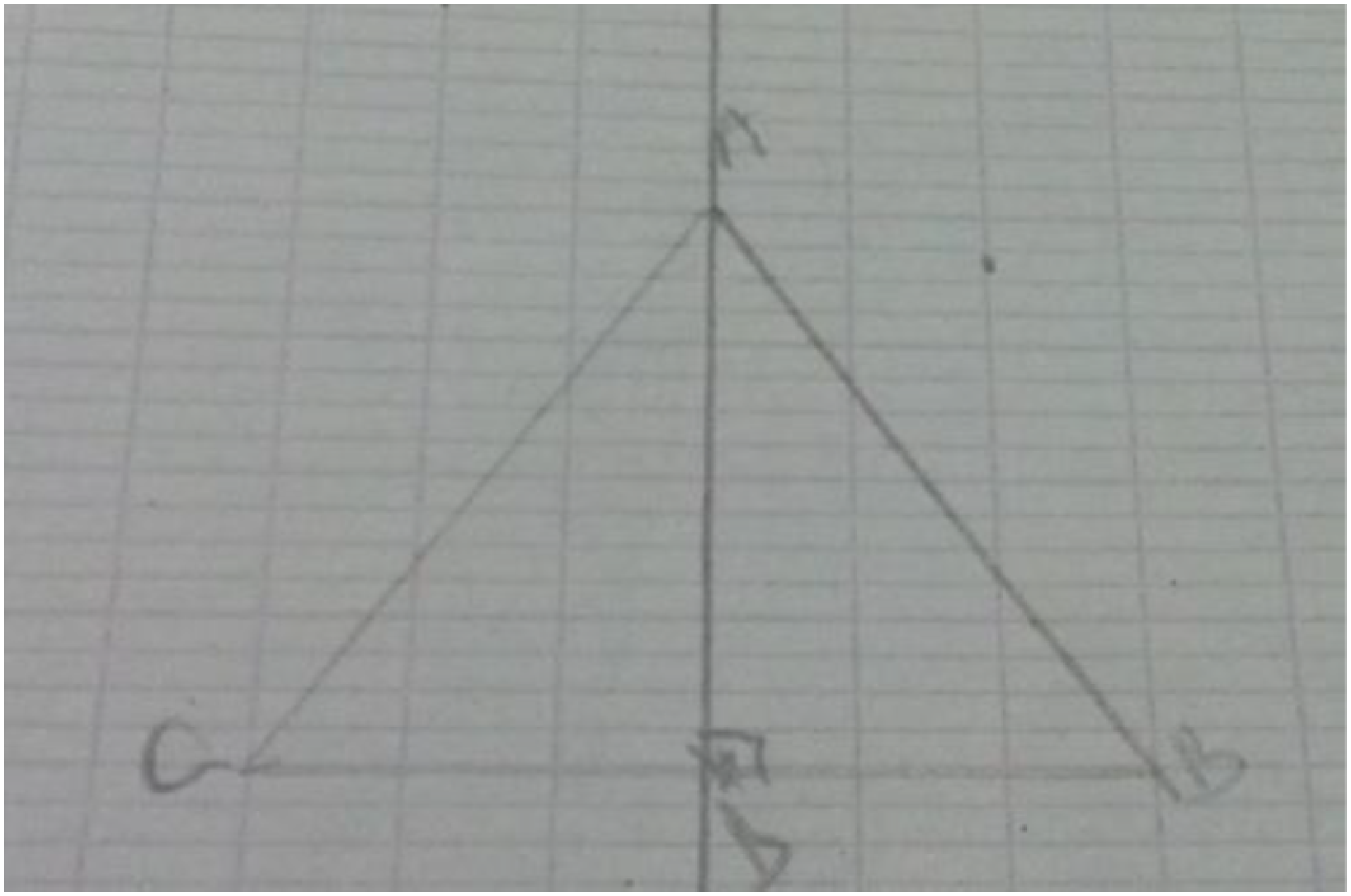
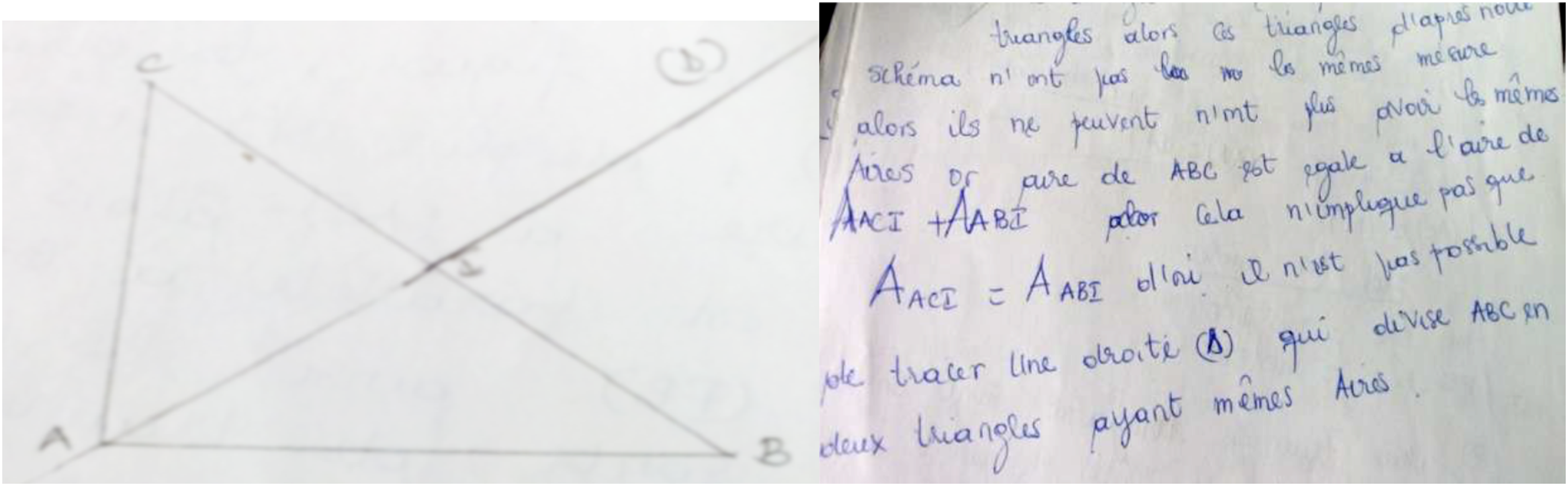
As shown in Table 1, some students constructed an isosceles triangle ABC and then drew a line through the vertex A and the midpoint of segment [BC]. This led them to conclude that the line dividing the triangle into two triangles of equal area is the median or the perpendicular bisector or the height of the triangle. One of the works illustrating this idea is that of student S17. His drawing suggests that he used the lines on his worksheet to represent the triangle. The main vertex is directed towards the top of the sheet, and the segment [AI] is supported by a line on the sheet (Figure 3).
Written argumentation and drawing produced by student S12.
Observing the drawing reveals two triangles that are symmetrical with respect to the line (AI), which suggests that this student might have considered the fact that two symmetrical triangles are equal, even though they did not mention it in their justification. Many students use this type of drawing to represent the giving geometric figure. The student concept image that seems to be expressed here is a mental picture, in particular, a prototype figure of the isosceles triangle. This prototype figure is not appropriate in this context because the perpendicular bisector does not divide a non-triangle into two triangles of equal area. The analysis of the student's argument can be summarized as follows: D: (AI) is a perpendicular bisector of [BC], the triangles ACI and AIB are equal; C: The triangles ACI and AIB have de same area; W: Since, if two triangles are equal (congruent), then they have the same area.
The participant appears to have used the geometric property of the isosceles triangle and axial symmetry to establish the equality of the triangles. The warrant is a true property in geometry. However, the way in which the participant conceptualizes two triangles with the equal area is incoherent because it is possible for two triangles to have the same area without being congruent.
Some participants also concluded that there is no straight line that divides two triangles into two triangles of equal area. The following example illustrates the reasoning of one of such students, S12 (see Figure 4).
Written argumentation and drawing produced by student S21.
From Figure 4 the drawing that supports, student's justification seems to represent a non-particular triangle, and a straight line (D) which passes through the vertex A and a point I on segment [BC]. S12's written arguments make it possible to observe that the drawing is an element of their justification. One can decomposed is argument as follow: D: The triangles ABI and ACI do not have the same measures (i.e., they are not congruent); C: ABI and ACI do not have the same area; W: Since if two triangles do not have the same measure then they do not have the same area.
The data seem to be information's coming from abusive interpretation of the drawing. There is no information in the task statement to confirm this. The analysis of the second argument, D: C: (D) does not exist. W: Since if the area of a triangle is equal to the sum of the areas of the two triangles that make it up, then it does not mean that the two triangles are congruent.
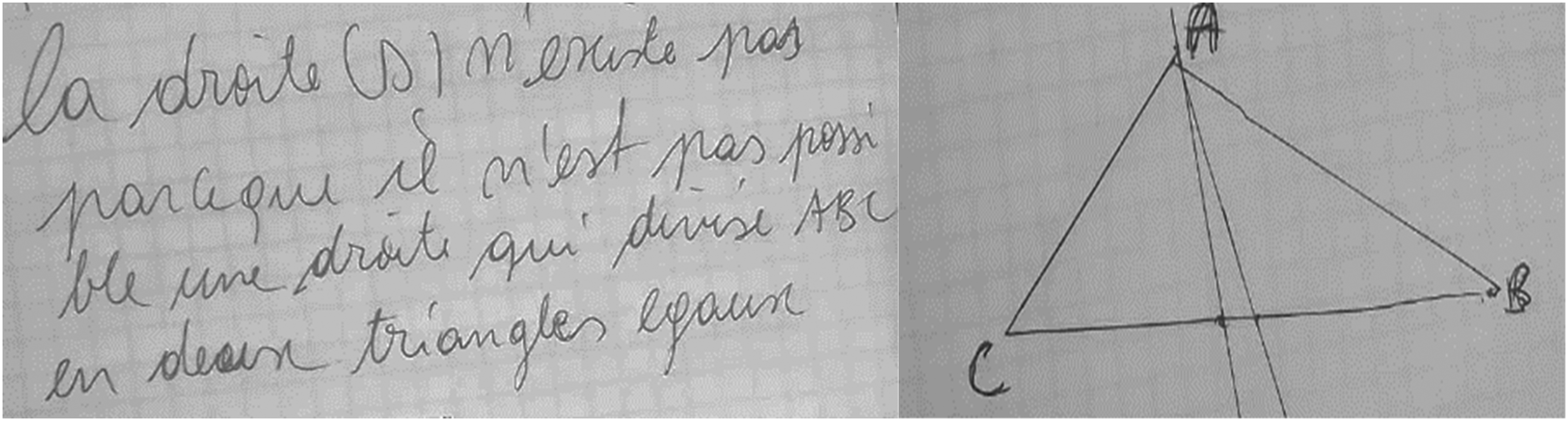
The data is an implication; it consists of information introduced by the students. The warrant of this argument seems to be coherent; it is a personal concept image of these students. For these students, two triangles of equal area are two congruent triangles. One observes that these students’ justification is an informal justification; the argument of this justification is supported by the drawing. Another similar reasoning is as submitted by S21 (Figure 5).
A written response by S23 to the second task.
The student's argumentation can be analyse using Toulmin's model as follows: D: It is no possible to draw a straight line that divide triangle ABC into two equal triangles; C: The straight line (D) does exist; W: Since two triangles have the same area if and only if they are equals (congruent).
The data for this argument seems to be a recycled claim of a previous argument obtained by experimental verification on the drawing. The evoked concept image which serves as a warrant is supported by the theory about two triangles with equal areas. In fact, two triangles with equal areas can be non-congruent triangles. The concept image of these students about two triangles with equal areas is not coherent.
To conclude, the obtained results show that the evoked concept image of student on two triangles with equal areas influences the construction of their conjecture. The difficulties stem from the incoherence of the concept image about two triangles with equal areas. On the one hand, the mental image of the isosceles triangle evoked does not always give a result that can be generalized to all triangles because of its particularity. On the other hand, the property about two triangles with equal areas used as warrant (that “two triangles of the same area are two congruent triangles”) in the students’ arguments is not supported by the theory.
4.2 Task 2 relationship between the circle and isosceles right triangle
4.2.1 Quantitative data
In this section, we present the results of students’ productions to the task 2. The results of the analysis on the students’ drawings show that 67 (83.7%) of them drew an isosceles right triangle, with the vertex A on the semicircle (see Table 3). Of these 37 (46.2%) presented A as the intersection point of the perpendicular bisector of the segment [MN] and the semicircle (see Figure 6). Further, 32 (40.0%) students had drawings that do not present a perpendicular bisector of segment [MN] (see Figure 7). In addition, drawings from 13 students indicated an isosceles right triangle in M or N.
Table 4 reveals that a significant proportion of students (85.0%) construct a justification to support their choice. Only 12.5% of the students constructed formal justifications, utilizing their understanding of both the perpendicular mediator and the right triangle inscribed in a circle. Again, the findings show that 58 (72.5%) students constructed informal justifications. Among them, 42 (52.5%) students constructed arguments whose data seemed to come from experimental verifications on the drawings, such as measuring lengths and verification of perpendicularity. Furthermore, 5 (6.2%) students used perpendicular bisector properties to support their arguments, while 4 (5.0%) students used the Pythagorean property, which is not relevant to solving this problem. The students who did not provide a justification proposed a construction program for vertex A, which accounts for 15.0% of the total.
The participants’ justification in task 2.
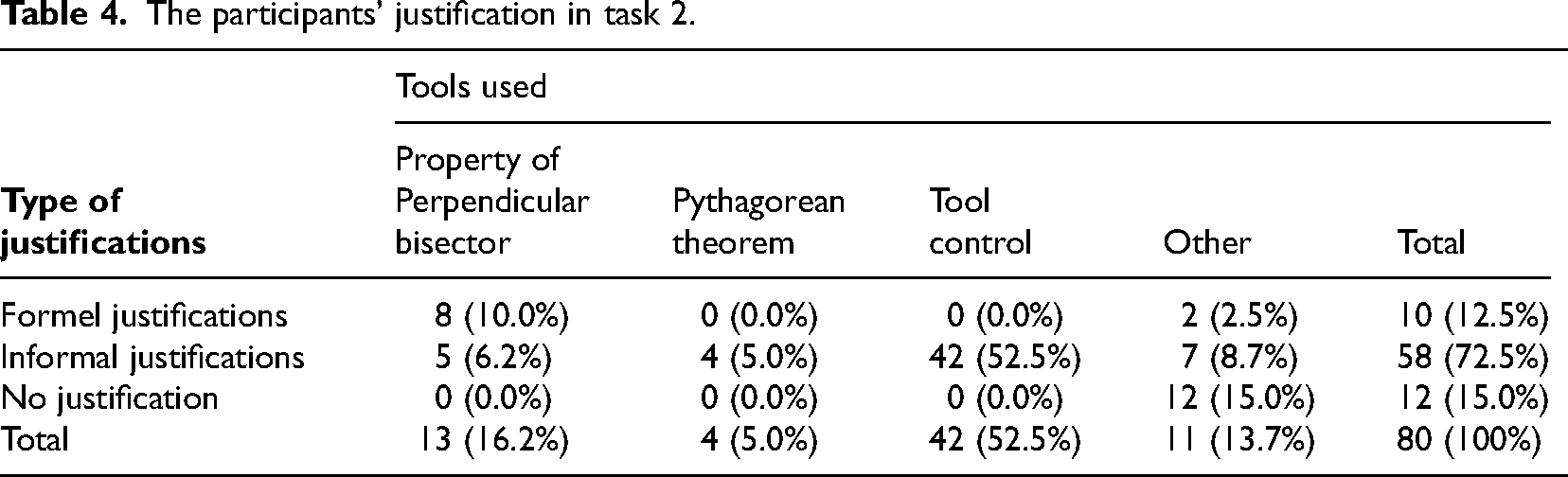
Table 4 shows that the students had difficulties solving this task which manifested in their construction of the figures as well as in the justifications they provided to support their choices. The students’ evoked concept-images of the figures are not pertinent for solving this task. It can be seen that the analysis of the figure in terms of figural units dominates the geometric analysis in the students’ reasoning (Duval, 2005).
4.2.2 Qualitative data
This section presents the results of the analysis of some selected students’ responses to task 2, based on the fact that such responses illustrate the influence of their evoked concept image of the figure on the process of constructing the conjecture. The examples we propose to analyses are those in which the students’ expressed difficulties in solving the problem.
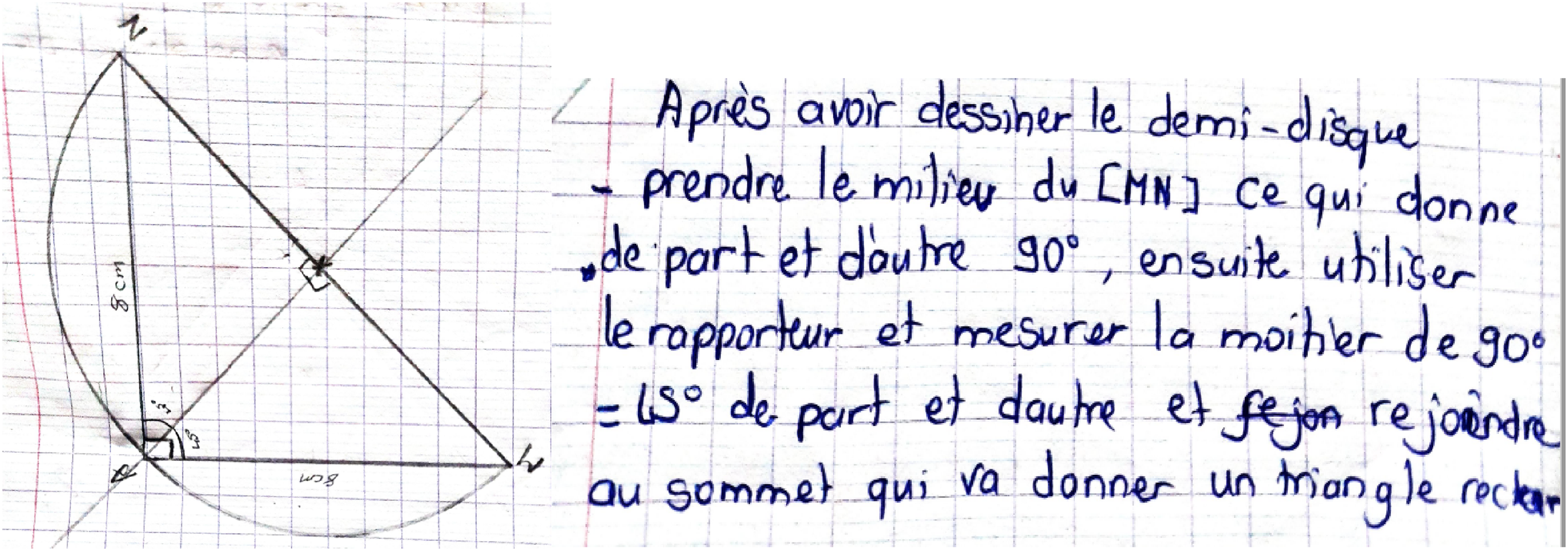
Some students chose to represent their own drawing from which they constructed their conjecture. Their drawings seem to indicate that they used the lines of the sheet to represent the right triangle. Such drawings also show that students’ have measured the lengths of the sides and the value of angle. S23's Written response (Figure 6) is a typical example of such responses with a set of instructions.
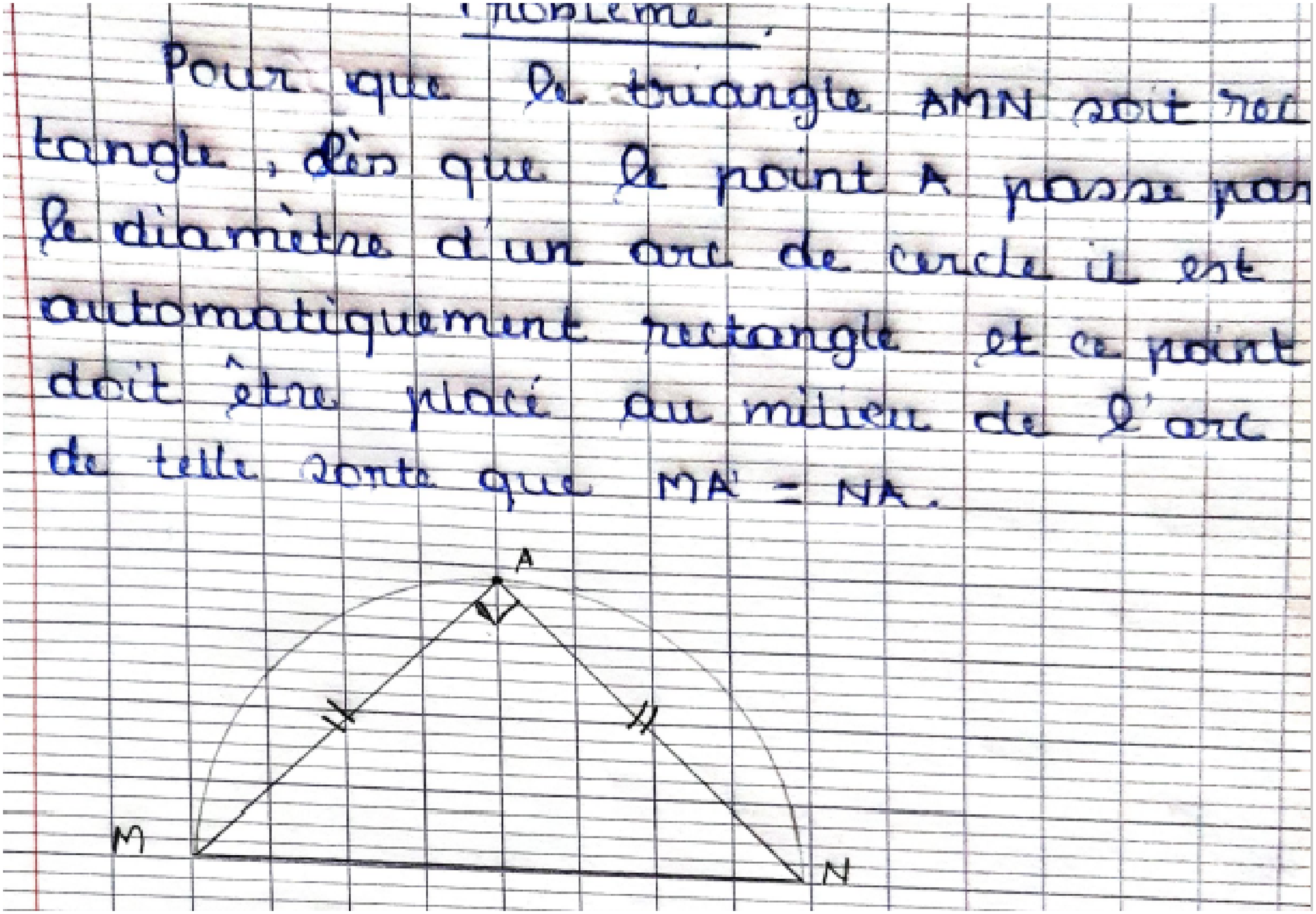
Drawing and justification of student S17 in the second task.
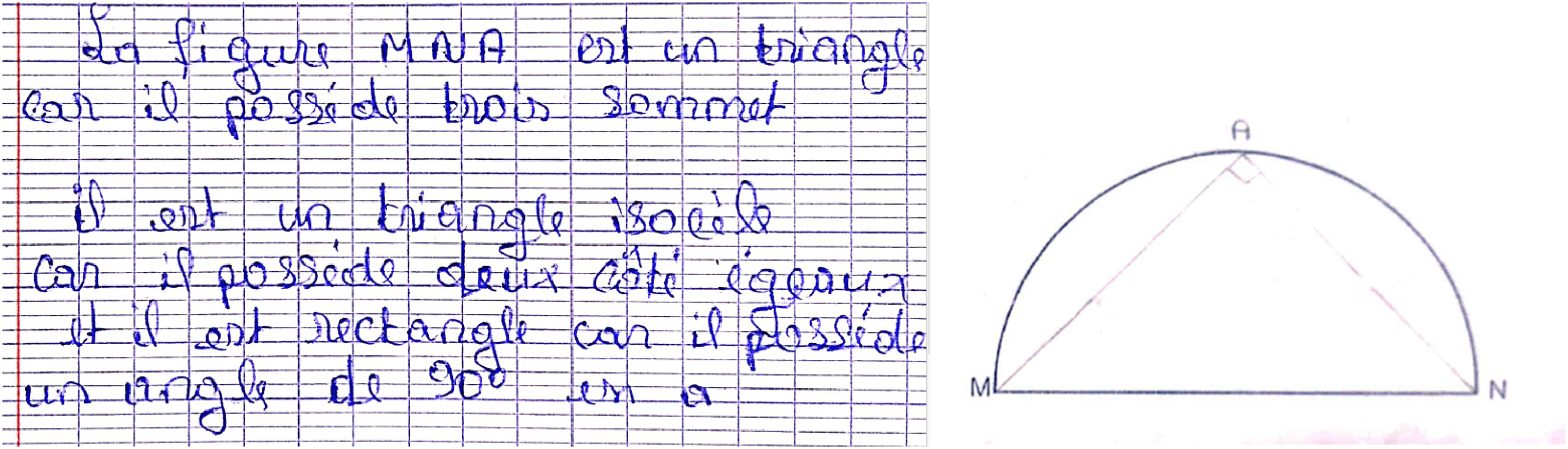
Written production of S32 for the second task.
Student S23 used a geometric tool, the protractor, to draw the perpendicular bisector of the segment [MN]. He could have chosen a more appropriate tool, such as a square. It is notable that S23 did not mention the perpendicular bisector, suggesting that his mental representation of this figure is not coherent. The fact that there is no indication in the drawing of how the midpoint of the segment was constructed suggests that he measured and calculated the length of the end at the midpoint. From this production, it can be inferred that S23 validated the nature of isosceles right triangle by experimental verification on the drawing. In conclusion, this student's difficulties seem to stem from the incoherence of his concept image of right triangles inscribed in a circle, as well as the link between an isosceles triangle and the perpendicular bisector of a segment.
The next example of student S17 illustrates a production in which the perpendicular bisector has not been represented. The drawing shows that the student used the lines on his worksheet and consequently, did not show the midpoint of the segment [MN]. He used point A as the midpoint of the arc of the circle MN and finally, he justified it (Figure 7).
The analysis of the figure represented by this participant in terms of figural units and geometric properties clearly shows that it is an isosceles right triangle inscribed in a semicircle. However, no construction lines are visible. The drawing suggests that the participant utilized the lines on the paper and their properties, a fact he confirmed upon our questioning. The student's justification is informal. Indeed, the analysis of the argument using Toulmin's model gives the following decomposition: D: Point A is on the diameter of an arc; Point A is at the center of arc MN and C: The student concludes that triangle AMN is a right triangle. W: The center of the arc of a semicircle forms an isosceles right triangle with the endpoints of the diameter of this arc.
The data contains ambiguous terms, such as “diameter of the arc” and “center of arc MN.” One might believe that the center of arc MN refers to the center of the circle from which the arc is derived. The results indicate that the students have an incoherent concept image of both the midpoint of an arc and the diameter. Although the isosceles nature of the triangle is not explicitly mentioned in the Claim, it is implied in the drawing by the equal lengths of two sides. This suggests that the students are using the drawing as part of their justification.
Another example came from student S32 (Figure 8). He used the drawing suggested on the sheet. We can see that he positioned the point A on the circle and illustrated the coding of the right angle at the vertex A of the triangle AMN. The drawing does not show any lines indicating the representation of the perpendicular bisector of the segment [MN] or any other procedure used to place point A. This student then constructed an argument to justify his choice.
One can observe three arguments in the student's justification. First, he argued that the figure AMN is a triangle, then that this triangle is isosceles, and finally that it is a right triangle. His first argument can be interpreted as follows: “AMN is a triangle because it has three vertices.” The warrant for this argument can be interpreted as follows: a triangle is a figure that has three vertices. This warrant is not correct or is incomplete because it relies on an inconsistent image concept. In fact, a triangle is a figure that has three sides and three angles. The warrants for the second and third arguments (respectively, “the triangle is isosceles because it has two equal sides” and “the triangle is a right triangle because it has a 90° angle at A”) are correct. These warrants are based on a definition of an isosceles triangle and a right triangle. However, the problem lies in the origin of the data. It seems that these data come from a verification carried out on the drawing. This result suggests that this student's conceptual picture of the triangles in the task is not coherent.
In the light of the above analysis, it can be seen that the difficulties students have in constructing a conjecture about a right isosceles triangle inscribed in a semicircle stem from the incoherence in students’ concept images of the right isosceles triangle and the semicircle. These results suggest that there is no real connection between the properties of the perpendicular bisector of a segment and the isosceles triangle, and between the right triangle and the semicircle in students’ concept images. The informal justification that students construct is related to incorrect warrants as well as the inappropriate procedures they use in their concept image.
In this study we investigated how students’ understanding of a geometric figure influences the construction of conjectures in geometry. We achieved this objective by, using an exploratory approach to examine the drawings and written arguments that students produced in their response to two tasks in a questionnaire. The results revealed difficulties at several stages of the construction of the conjecture.
Firstly, difficulties were observed in the choice of the geometric figure to support their conjectures. When the drawing is not associated with the problem statement, students tended to represent an inappropriate prototype figure that is evoked in their mental image expressed in their productions. For example, in the first task on triangles of equal area, the students drew an isosceles triangle with the same orientation (see the drawing of S17). The choice of this triangle led them to identify the perpendicular bisector or the height as a straight line dividing a triangle into two triangles of equal area. This is a mistake because the conjecture is not true for all triangles. Difficulties with prototype figures have also been highlighted in previous studies (Fischbein & Nachlieli, 1998; Vodušek & Lipovec, 2014).
Another difficulty that students encountered is linked to the incoherence of their evoked concept image of the figures described in the problem statements. For example, in the task involving triangles of equal area, the students considered that two triangles of the equal area were necessarily congruent. This led the students who represented a non-specific triangle to wrongly conclude that the straight line which divides a triangle into two triangles of the same area does not exist, which is an error. One might have expected that the evoked concept image that was expressed would be the formula for the area. These findings corroborate those of Gridos et al. (2022), as well as those of Vodušek and Lipovec (2014), who highlighted the difficulties associated with the dominance of mental picture over the conceptual properties of the figure in problem solving. These findings are also consistent with those of Haj-Yahya (2020), who suggested that prototypical examples of figures have a negative impact on students’ construction of justifications. This result also reinforces Duval's (2005) observation that students’ analyzing the figure in terms of figural units took precedence over analyzing it in terms of properties.
The students in this current study also expressed difficulties related to the procedures they used to draw of the geometrical figures involved in the given tasks. The practical knowledge used to represent the figures graphically was inappropriate and even ambiguous. For example, in the task involving an isosceles right-angled triangle inscribed in a semicircle, the students used the lines on their worksheets to represent the triangle. The findings revealed that some of drawings give no information about the construction process. These difficulties arise from the incoherence of the student's evoked concept image of the procedure for constructing an isosceles triangle, but also to the incoherence of the students’ evoked concept image about the relationship between the perpendicular bisector and the isosceles triangle.
The findings also revealed the difficulties that the students encountered in constructing arguments to justify their choices. The informal arguments provided by the students were characterised by the inclusion of irrelevant data and the use of inappropriate warrants. The students drew their claim based on the properties of their drawing, obtained by verifying the measures of lengths and even orientations. This approach was observed repeatedly in the students’ productions in both tasks, as shown by S17 and S23 in their work. These informal arguments are based on misconceptions about the figure used in the process of conjecturing. These results are in line with previous studies which have shown that the students’ misconceptions about the geometric figure influence their justification(Koedinger, 2012; Ogan-Bekiroglu & Eskin, 2012; Pedemonte, 2002; Tchonang Youkap et al., 2019). These studies have shown that the informal justifications presented by students in geometry problem solving result from a lack of understanding of the relationship between the conceptual properties and the sensory properties of the figures. This aspect has been demonstrated by the students in this current study where their evoked concept image of the geometric figures described in the problem statement was not coherent.
This study has some limitations and recommendations: First, we analysed the students’ written productions. It is anticipated that inclusion of video data could have provided additional information about how students produced their drawings. To deepen this research, it is essential to integrate video data to reduce the subjectivity of the results and to capture classroom interactions more accurately, including the gestures and expressions of students and teachers. A more thorough analysis, with an increased number of discussions and sessions, would also strengthen the external validity of the conclusions. In particular, the use of dynamic geometry software (DGS), such as the Web Geometry Laboratory (WGL), studied by Santos and Quaresma (2022), represents a promising approach to overcoming difficulties in learning conjectures and enhancing the understanding of geometric objects. They have shown that DGS allows learners to visually manipulate geometric objects, thereby promoting the formulation and validation of conjectures in an exploratory context. An interesting future research direction would be to compare the practices of geometry teachers using DGS in Asian contexts, where teaching may be influenced by specific cultural approaches, with those observed in France, in order to evaluate the impact of these tools on the understanding of geometric transformations and the ability of students to argue.
Certain recommendations can be made in relation to teaching practice in geometry. It is recommended that teachers use dynamic geometry software to illustrate the invariance of figure properties. This will allow students to focus on the relevant geometric properties rather than on spatial features such as the orientation of drawings. It is also advisable to create conditions conducive to debates between students in order to develop their argumentation skills. Textbook authors are also encouraged to present a variety of drawings (with different orientations) of the same figure in order to avoid the fixation of prototypes in the students’ concept image.
Footnotes
Contributorship
Author A (Tchonang Youkap Patrick) conceptualized the research problem and methodology, conducted data collection and analysis, and drafted the manuscript. Author B (Stephen Rowland Baidoo) contributed to the development of the research problem, validated the methodology, and provided revisions, as well as translating the manuscript into English.
Declaration of conflicting interests
The authors declared no potential conflicts of interest with respect to the research, authorship, and/or publication of this article.
Ethical considerations
The researchers explained the nature and the purpose of the research study to participants, and informed them that participation was not obligatory. To protect and respect personal data, students were informed that their names would not appear in the documents and would be replaced by pseudonyms.
Funding
The authors received no financial support for the research, authorship, and/or publication of this article.
Informed consent
Participants provided informed consent, having been informed about the use of the collected data and assured of the anonymity of their responses.
