




Abstract
Quality mathematics learning is more than just the acquisition of mastery in different topical themes; rather, it involves successful acquisition of mathematical proficiency, which espouses a number of cognitive attributes—for example, a student's critical insight of a mathematical concept (e.g., productive disposition). Despite the pivotal role of mathematical proficiency in mathematics curriculum, syllabus requirements fall short of highlighting the design of appropriate instructional approaches that could specifically facilitate the acquisition of different mathematical proficiency strands. The present conceptual analysis article discusses the design of comparative instructional approaches that are based on two well-documented learning theories: (1) learning by comparison theory, such as the active comparison of isomorphic example pairs, and (2) cognitive load theory, such as the use of worked examples to reduce the negative impact of cognitive load imposition on learning. We premise that appropriate instructional approaches, informed by the use of both learning by comparison theory and cognitive load theory, may help to facilitate successful acquisition of multifaceted proficiency strands in mathematics learning. As revealed in the latter sections of the article, our proposed theoretical contention is significant, potentially establishing grounding for future research development and to help complement constructivist learning in the acquisition of mathematical proficiency strands.
Keywords
Introduction
Mathematics, as a “hard pure theoretical” subject (Becher, 1987, 1994), is relatively difficult for some students to comprehend and understand. Mathematics educators have introduced mathematical “proficiency strands” in school mathematics curriculum (e.g., Australian Curriculum: Mathematics) to promote mathematics learning. Acquisition of sound mathematical proficiency, indeed, is an important area for teaching and research development. Mathematical proficiency is more than just the acquisition of formal mathematics knowledge (e.g., know in detail about the concept of algebra). Instead, mathematical proficiency entails a student's ability to reason, to solve, to justify, and to apply, where appropriate. As such then, one line of research development may consist of the provision of pathways, which could enhance students’ mathematical proficiency. For example, we query whether appropriate instructional designs (Kalyuga et al., 1998; Phan et al., 2017; van Gog et al., 2005), situated within the framework of cognitive load theory (Sweller et al., 2011, 2019), could facilitate the acquisition of mathematical proficiency.
The focus of the present conceptual analysis article is to explore the importance of “mathematical proficiency” (e.g., what is it that would assist a secondary school student to attain an adequate level of mathematical proficiency in algebra?). Using philosophical psychology as a theoretical discourse (Phan et al., 2024; Thagard, 2014, 2018), we explore the nature of mathematical proficiency, especially in terms of cultivation—that is, how educators could use relevant theories to generate pedagogical practices to facilitate the sound acquisition of mathematical proficiency. In the latter section of our discussion, in particular, we explore the design of specific instructional approaches that are guided by learning comparison theory (Alfieri et al., 2013; Richland et al., 2004) and cognitive load theory (Sweller et al., 2011, 2019) for acquisition of mathematical proficiency purposes.
The importance of quality mathematics learning
“Quality” mathematics learning is not simply concerned with a student's high academic results in weekly quizzes, monthly tests, and final exams (Phan & Ngu, 2019). Such discourse (e.g., exceptional performance in a half-yearly Year 10 exam) may merely reflect a student's ability to memorize, rote learn, and to regurgitate (Biggs, 1991). Moreover, a student's high mathematics achievements do not necessarily indicate any in-depth, meaningful understanding of the subject matter. For example, asking a student to solve “What is x for the linear equation of 15%x = 300?” is somewhat different from asking him or her to solve “Explain how the linear equation of ‘15%x = 300, solve for x’ is used in real-life context.” The latter presentation is more meaningful as it seeks to appreciate the importance of “application”—that is, a student's ability to apply his or her understanding of a mathematics concept to an everyday life context (e.g., “15% of my monthly income is 300, what is my monthly income?”). As such, then, the notion of quality mathematics learning may reflect and indicate a number of interrelated attributes—namely, for example, a student's deep engagement in mastery of different topical themes, and her capability to apply mathematical knowledge meaningfully in real-life contexts.
It is noteworthy to mention that the tenet of mathematical proficiency connotes a certain level of measurement in progress of cognitive competence. In other words, a student's appropriate level of “mathematical proficiency” would closely align with his or her testament of quality “mathematics learning experience.” This premise contends that “evidence” of a student's quality mathematics learning experience, in fact, showcases his or her ability to demonstrate a certain level of mathematical proficiency. The student's level of mathematical proficiency, likewise, illustrates his or her mathematics learning experience. For us, theoretically, quality mathematics learning is about the acquisition of deep, meaningful mathematical knowledge, which one may use and apply in real-life contexts. Moreover, as our theoretical contention suggests, quality mathematics learning requires the inclusion of the concept of mathematical proficiency, potentially helping students to employ different types of mathematical strategies to make informed decisions when faced with familiar and/or unfamiliar real-life situations (e.g., how should I revise my budget in light of an increase in the interest rate?).
Quality teaching of mathematics has evolved to connote a different meaning altogether. Rather than just focusing on exceptional results, which may not necessarily indicate deep, meaningful understanding of the subject matter, quality teaching has prioritized to include an important focus on the teaching of different mathematical proficiency strands. Where possible, for example, an educator may wish to encourage students to develop increasingly sophisticated proficiency skills, such as understanding, fluency, reasoning, and problem-solving skills. It is argued by many that such acquired proficiency skills could, in fact, help students later on in life with their career choices, study courses, and/or life trajectories.
The nature of mathematical proficiency
Mathematics education research has provided comparative insights into the underlying nature of mathematical proficiency. Our theoretical overview, as shown later, indicates that mathematical proficiency is multifaceted and may consist of different “proficiency-related components” that students may acquire and demonstrate—for example, the ability to reason and to justify. An analysis of the existing literatures shows comparable theoretical insights of mathematical proficiency strands. For example, in terms of the U.S. learning context, the National Research Council (2001) considers five mathematical proficiency strands for development:
Conceptual understanding—comprehension of mathematical concepts, operations, and relations. Procedural fluency—skill in carrying out procedures flexibly, accurately, efficiently, and appropriately. Strategic competence—ability to formulate, represent, and solve mathematical problems. Adaptive reasoning—capacity for logical thought, reflection, explanation, and justification. Productive disposition—habitual inclination to see mathematics as sensible, useful, and worthwhile, coupled with a belief in diligence and one's own efficacy.
A brief analysis of the U.S. proposition of mathematical proficiency strands suggests that “proficiency” in mathematics learning, as we previously alluded, is more than just testament of recall of facts and/or information without any serious consideration (e.g., I know how to solve x + 5 = −10). Rather, the aforementioned mathematical proficiency strands highlight several important “cognitive attributes” that are integral to the experience and successful accomplishment of mathematical proficiency—know principal knowledge (e.g., conceptual understanding), judge procedural flexibility (e.g., procedural fluency), contemplation (e.g., strategic competence), logical reasoning (e.g., adaptive reasoning), and critical insight (e.g., productive disposition). We rationalize that successful acquisition of mathematical proficiency strands would assist a student to practice mathematics-related cognitive attributes (e.g., logical reasoning).
Similar to the U.S. proposition of mathematical proficiency strands, the Australian Curriculum (https://www.australiancurriculum.edu.au/resources/mathematics-proficiencies/) considers four distinct mathematical proficiency strands:
Understanding: students build a robust knowledge of adaptable and transferable mathematical concepts. Fluency: students develop skills in choosing appropriate procedures; carrying out procedures flexibly, accurately, efficiently, and appropriately. Problem solving: students develop the ability to make choices, interpret, formulate, model and investigate problem situations, and communicate solutions effectively. Reasoning: students develop an increasingly sophisticated capacity for logical thought and actions, such as analyzing, proving, evaluating, explaining, inferring, justifying, and generalizing.
A comparison of the above descriptions indicates comparable postulations and understandings between the U.S. proposition and the Australian proposition of mathematical proficiency strands—for example: (1) conceptual understanding versus understanding, both of which emphasize the acquisition of conceptual knowledge, (2) procedural fluency versus fluency, both of which highlight the acquisition of procedural knowledge, and (3) strategic competence and adaptive reasoning versus problem solving and reasoning, respectively. However, interestingly, it appears that the Australian proposition does not have a parallel strand for productive disposition, which emphasizes appreciation of mathematics in everyday experiences. Despite this shortcoming (i.e., five mathematical proficiency strands vs. four mathematical proficiency strands), an inspection of the U.S. overview (i.e., five mathematical proficiency strands) and the Australian overview (i.e., four mathematical proficiency strands) suggests an important point of commonality—namely, that students acquire, develop, and practice mathematics-related cognitive attributes when learning mathematics (e.g., logical reasoning).
More recently, some mathematics education researchers have defined mathematical proficiency as the “acquisition” of both conceptual knowledge and procedural knowledge (Baroody et al., 2007; Hiebert & Lefevre, 1986; Ngu & Phan, 2016; Rittle-Johnson & Schneider, 2015; Star, 2005). Conceptual knowledge, in brief, is associated with the principle knowledge that connects interrelated mathematical concepts, whereas procedural knowledge is associated with the step-by-step procedures to solve mathematics problems (Rittle-Johnson et al., 2001). Extrapolating and/or comparing this overview with the National Research Council (2001) overview (i.e., five mathematical proficiency strands) and the Australian Curriculum overview (i.e., four mathematical proficiency strands), we can surmise the following: that conceptual knowledge is “equivalent” to conceptual understanding or understanding, and procedural knowledge is “equivalent” to procedural fluency or fluency. Furthermore, it would appear that conceptual knowledge and procedural knowledge include elements of strategic competence and adaptive reasoning, which closely associate with problem solving and reasoning.
According to Rittle-Johnson et al. (2015), there is a bi-directional relationship between conceptual knowledge and procedural knowledge. In this sense, the acquisition of conceptual knowledge would help facilitate the acquisition of procedural knowledge and, likewise, vice versa. For example, the acquisition of conceptual knowledge of decimals leads to a higher accuracy rate in the placing of a decimal on a number line (Rittle-Johnson et al., 2001). In contrast, students demonstrate better understanding of the “=” sign concept if they have greater procedural knowledge in solving linear equations (e.g., 7 + 4 = 5 + [__]) (Rittle-Johnson & Alibali, 1999). Interestingly, the authors noted that the influence of conceptual knowledge upon the acquisition of procedural knowledge is greater than the reverse.
Previous research and teaching practices indicate that there was tendency for mathematics education researchers to place greater emphasis on the acquisition of conceptual knowledge rather than procedural knowledge (Baroody et al., 2007; Rittle-Johnson & Alibali, 1999). In the late 1990s, however, Wu's (1999) research indicated a contrasting position: that there was a pervasive need to strengthen the acquisition of basic algorithmic skills (i.e., procedural knowledge), which then would help facilitate deep conceptual understanding of mathematical concepts. In particular, according to Wu (1999), basic algorithmic skills are not void of logic; rather, they are based on sound mathematical principles, which serve to provide a solution path for students to solve problems. For example, drawing an analogy between a learned problem (e.g., 12 ÷ 4 = 3) and a new problem (e.g., 2/3 ÷ ¼ = a) would assist students to learn the latter, which in this case involves the manipulation of fractions. More recently, several mathematics education researchers have shifted their focus to the importance of developing “procedural flexibility” (Rittle-Johnson & Star, 2007; Star, 2005). The Australian Curriculum: Mathematics, for instance, espouses different mathematical proficiency strands for learning, one of which details the acquisition of procedural fluency where students are expected to solve problems flexibly, accurately, and efficiently.
Overall, then, mathematical proficiency strands are distinct but interrelate with each other (Kilpatrick et al., 2001), forming a multifaceted structure of mathematical proficiency. We reason that successful mathematical proficiency experiences, reflecting quality mathematics learning, would require personal undertaking of what we term as “mathematics-related cognitive attributes” (e.g., logical reasoning). A holistic approach emphasizing inclusiveness is preferred by which educators consider classroom practices that could facilitate understanding and development of all mathematical proficiency strands.
A focus on the development of not one or two but all mathematical proficiency strands is logically sound and appropriate. Such a “holistic approach” may serve to highlight the active “intertwinement” of different mathematical proficiency strands. For example, teaching a student conceptual understanding of algebra (i.e., the conceptual understanding strand) may assist him or her to recognize, and to provide a logical explanation of how this topical theme could apply to a daily life context (i.e., the adaptive reasoning strand)—“John has twice as much money as Mary. Together they have $150. How much money does John have?” In a similar vein, the teaching of knowledge and skill to solve a set of percentage problems (i.e., the strategic competence strand) may provide a student with critical insights (e.g., perceived value in terms of usefulness) of this topical theme (i.e., the productive disposition strand)—“I pay $300 for my weekly rent which represents 20% of my weekly wage. What is my weekly wage?” Teaching mathematical proficiency strands separately, in contrast, would serve to negate holistic understanding of the subject matter. Knowing about procedural fluency and nothing else, for instance, may restrict or limit a student's knowledge and understanding of the importance of mathematical proficiency.
Issues about mathematical proficiency
Up to this point, we argue that quality mathematics learning experiences, and by the same token, quality teaching, reflect the successful acquisition of mathematical proficiency. In other words, from our viewpoint, quality learning of mathematics focuses on acquired mathematical proficiency. Having overviewed this important perspective, we recognize that there are several questions for consideration:
Is there an issue with current mathematics education in relation to the acquisition of mathematical proficiency? Does a teacher education program, at present, offer sound preparation in training knowledge of mathematical proficiency? Do researchers consider mathematical proficiency as an important focus for research development? Do existing texts, policy papers, and so on provide adequate balance in analysis, scope, and/or coverage of different instructional approaches that could impact the acquisition of mathematical proficiency?
We propose the aforementioned questions as our recent review of the literature indicates an interesting discourse: education policy makers in the U.S.A. and elsewhere advocate the use of “problem-based studies” (e.g., inquiry-based, discovery, problem-based, and investigation) (Zhang et al., 2022). For example, the Australian Curriculum: Mathematics for secondary school mathematics highlights the constructivist approach for learning with emphasis on inquiry-based learning, consisting of group work, negotiation, and sharing of mathematical ideas to facilitate mathematics learning. In a similar vein, we noted from our overview of the Australian Curriculum: Mathematics another dilemma for consideration: that syllabus requirements stipulate the teaching of marking rubrics that could help assess mathematical proficiency, but falls short of highlighting the design of appropriate instructional approaches that could specifically target the acquisition of different mathematical proficiency strands.
To our knowledge, existing mathematics textbooks (e.g., Smith et al., 2011) place limited emphasis on teaching students how to acquire mathematical proficiency (e.g., understanding, fluency, reasoning, and problem-solving skills). Therefore, from our point of view, it is timely for mathematics educators, textbooks, relevant sources, and so on explore appropriate instructional approaches that could help students acquire mathematical proficiency strands. Before we discuss how to promote mathematical proficiency strands via means of appropriate instructional approaches, which are underpinned by learning by comparison theory and cognitive load theory that could potentially complement the constructivist approach, we want to review existing research development of pedagogical practices and mathematical proficiency.
Prior research on pedagogical practices and mathematical proficiency
Research undertakings into the nature of mathematical proficiency, in general, have one common goal for accomplishment: to seek theoretical understanding into the nature of mathematical proficiency, especially in terms of its explanatory account of students’ behaviors and quality learning experiences. This premise is intuitive as it helps to support the specific recommendation that calls for the inclusion of mathematical proficiency strands in mathematics teaching and curriculum development. To date, regrettably, limited research undertakings have been conducted to improve mathematical proficiency strands (Corrêa & Haslam, 2021). According to Ally (2011), less than 20% of the mathematics lessons taught in schools actually address the tenets of mathematical proficiency that have been firmly advocated (e.g., Kilpatrick et al., 2001). This observation is insightful as it highlights a major deficiency in priorities and teaching practices in schools. In other words, perhaps, there is less emphasis on the addressing of mathematical proficiency strand and more emphasis, in contrast, on the teaching of content knowledge. Given the pivotal role of mathematical proficiency in mathematics curriculum, what can we learn from prior research pertaining to mathematical proficiency?
Prior research has investigated different educational outcomes in relation to mathematical proficiency. For example, research has examined classroom data such as video recordings and students’ written work (e.g., misconceptions of mathematical concepts) with respect to mathematical proficiency, which could provide relevant feedback to improve the design of instructional methods (Groth, 2017). One interesting article by Groves (2012) documented the in-class teaching of the proficiency strand of conceptual understanding in a Japanese school in Australia. The goal of the lesson was to ensure that students would understand the concept of a circle. The teacher launched the lesson with the following question: “How can we make the game fair?” (p. 126). This question was posed in relation to the context of a learning activity—that is, for students to stand at different positions around the classroom and then to throw rings into a vertical pole. Where should they stand? The purpose of this learning activity was to allow students to explore where they should stand so that they were at the same distance from the vertical pole. The teacher asked several questions to stimulate students’ mathematical thinking skills (e.g., “Look at the different positions. What do you notice?,” p. 127), targeting the reasoning proficiency. Students worked in pairs to discuss and share mathematical ideas with each other, which in turn would promote reasoning and problem-solving proficiencies. This teaching inquiry reinforces one fundamental element: that learning, specifically situated to an authentic context, can facilitate understanding proficiency (i.e., understand that the circle is a locus).
Teaching inquiries in other sociocultural settings have also showcased insightful information for effective instructional designs and pedagogical practices. In the U.S. learning context, for example, Suh (2007) designed a teaching program known as “Modeling Math Meaningfully” for usage. This teaching program highlights the specific use of multiple modes, or multiple modalities, to present mathematical concepts that could, in turn, assist elementary school students to learn additions of fractions with unlike denominators and decimals. Asking a student to draw a picture would help facilitate her understanding and allow the teacher to gauge into the student's conceptual understanding and reasoning of the addition of two fractions, for example (e.g., ½ + ¾). In a similar vein, but different from the concept of drawing, asking a student to write a real-life story about fractions (e.g., addition of two fractions) would introduce and/or strengthen the strategic competence and adaptive reasoning strands of mathematical proficiency.
The case of the Sweden learning context is also relevant for its similar focus, which may assist educators in their teaching pedagogies of mathematical proficiency experiences. For example, Samuelsson (2010) compared two contrasting teaching methods to assist elementary school students to acquire mathematical proficiency across different topics: traditional teaching method versus problem-solving approach. The traditional teaching method involved a teacher explaining a specific mathematics concept to the students, using unit materials and/or textbooks as guides. The teacher's explanation is likely to assist students to acquire understanding proficiency. Students were then asked to solve a set of problems individually, which would expect to assist them acquire fluency proficiency. The problem-solving approach (e.g., problem-based inquiry), in contrast, reflected the tenets of constructivism (Almala, 2006; Jonassen, 1991; White, 2002), and involved students working in small groups, discussing and negotiating mathematical ideas. Such group work would expect to help students acquire strategic competence and adaptive reasoning proficiencies. Overall, students’ performance outcomes favored the problem-solving approach for conceptual understanding, strategic competence, and adaptive reasoning, but not the procedural knowledge (Samuelsson, 2010). Presumably, having attended a teaching session, followed by solving a set of problems individually, students in the traditional teaching method outperformed their counterparts in the problem-solving approach for the fluency proficiency strand.
Corrêa (2021) investigated the use of mathematical modeling tasks to enhance the acquisition of mathematical proficiency. Grade 11 students (N = 12) were divided into three groups and they investigated four different modeling tasks in real-life contexts (e.g., “How much of an impact a change in price will have on consumer's willingness to buy the item?,” p. 115). The teacher did not teach the content knowledge prior to students investigating the modeling tasks. However, the teacher and the researcher provided relevant scaffolds, when required. Data collected (e.g., audio, video recordings, etc.) were coded using the five mathematical proficiency strands (e.g., build a strategy to represent the problem reflected the demonstration of strategic competence, p. 118). The results indicated that mathematical modeling tasks were effective, helping the students to acquire mathematical proficiency strands, even though some had not completed the modeling tasks.
In summary, the preceding sections have cited and reviewed several important studies that are of relevance, providing evidence to indicate the significance of teaching and research inquiries of mathematical proficiency experiences. We note from our analysis an interesting point of commonality—namely, that many educators choose to use the tenets of constructivism (Almala, 2006; Jonassen, 1991; White, 2002) (e.g., the use of problem-based inquiry) for their designs of instructional approaches and/or pedagogical practices. Note that in this conceptual analysis paper, we used problem-based inquiries to denote the constructivist approach.
Cultivating mathematical proficiency
The preceding sections have emphasized an important point for discussion—namely, the promotion and cultivation of mathematical proficiencies in mathematics teaching (e.g., how do we encourage and cultivate mathematical proficiency experiences?). This noting acknowledges and emphasizes the importance of application and implementation: that is, to design and implement specific educational programs that could encourage, motivate, and/or facilitate students to strive toward successful acquisition of mathematical proficiency. Our research development, to date, has provided robust empirical evidence and theoretical insights into the operational functioning and effectiveness/ineffectiveness of different instructional designs for mathematics learning. Our research undertakings, empirically and conceptually, have involved the design principles of learning by comparison (Alfieri et al., 2013; Ngu & Phan, 2020, 2023; Star et al., 2015) and cognitive load theory (Ngu et al., 2014, 2018; Sweller, 2010) for teaching.
Empirically, for example, using cognitive load theory, we compared the unguided problem-solving approach, the worked examples approach, and the analogy approach for learning to solve trigonometry problems (sin 50° =
It should be noted that unlike the productive failure approach (Kapur, 2014), which requires learners to solve problems first and then be taught how to solve the problems, we did the opposite for the unguided problem-solving approach, which is based on cognitive load theory (Sweller et al., 2011, 2019). That is, we provided instruction first and then we asked the students to solve the practice problems. Kapur (2014) argues that the productive failure approach is effective because exploration of different solutions in the problem-solving phase enables students to detect their knowledge gaps, thereby helping them to bridge such gaps in the subsequent instruction phase. Interestingly, Kapur (2014) found that the productive failure group outperformed the direct instruction group for the transfer test. It should be noted that the design of the direct instruction (Kapur, 2014) is similar to the unguided problem-solving approach, both of which provide instruction to the students first before they are asked to solve the practice problems.
The crux of our conceptual analysis contends that there are learning theories, similar and/or different in nature, that may facilitate the acquisition of mathematical proficiency. Importantly, from our point of view, appropriate instructional approaches may use other learning theories apart from constructivism (Piaget, 1963; Vygotsky, 1978). It is poignant that as educators, we consider the capitalization and use of comparable and contrasting learning theories for effective instructional designs. The premise here is not for educators to compare (e.g., which theory is better: constructivism or cognitive load?) but instead to consider holistic understanding of learning theories for quality teaching and learning purposes. In the next section, we examine two learning theories that educators could consider for their teaching practices: (1) learning by comparison (Rittle-Johnson et al., 2017), an emerging theory that builds on learning by analogy theory (Gentner, 1983) and (2) worked examples that is based on cognitive load theory (Sweller et al., 2011, 2019).
Learning by comparison has received considerable attention due to its positive learning effects on enhancing mathematics education (Lynch & Star, 2014; Rittle-Johnson et al., 2017). The NSW Education: Centre for Education Statistics & Evaluation (2017), for instance, has advocated the use of evidence-based cognitive load research to help inform sound and effective educational practices, especially in the areas of science, technology, engineering, and mathematics education. Accordingly, we argue that the two mentioned learning theories may inform and assist in the design of appropriate instructional approaches, which could complement the constructivist approach to acquire mathematical proficiency, such as understanding, fluency, reasoning, and problem-solving skills.
The importance of learning theories
There are numerous learning theories that may offer meaningful insights to help facilitate cognitive growth and quality learning experiences. Our individual and collective research experiences indicate that no single learning theory is unique. That it is a noteworthy feat, instead, for researchers, educators, and so on to consider a combination of learning theories that could, in effect, provide complementary insights for design and development of appropriate instructional approaches. For example, a secondary school teacher may wish to use sociocultural constructivism (Lave & Wenger, 1991; Sluss & Stremmel, 2004; Vygotsky, 1978), include triadic learning experiences where students discuss, debate, and negotiate. As noted earlier, research inquiries to date which include our prior work have acknowledged the relevance and applicability of two learning theories, which we consider for discussion.
Learning by comparison
Building on the structure mapping theory (Gentner, 1983) to foster analogical transfer (Alfieri et al., 2013; Ngu & Yeung, 2012; Richland et al., 2004), recent research inquiries in mathematics have explored the potential positive effects of an instructional approach known as “learning by comparison” (Rittle-Johnson et al., 2017; Ziegler & Stern, 2014). There are different types of comparison learning approach (Rittle-Johnson & Star, 2011). Learning by comparison, in brief, is concerned with a student's comparison of two solution procedures for a specified problem—for example, a teacher may present a student with two solution procedures of a linear equation. What researchers have noted is that comparing solution procedures of a problem may, indeed, help students with the development of procedural fluency (Rittle-Johnson & Star, 2009). To highlight this potentiality, consider the following: solve 3(x − 4) = 15. There are two different solution procedures where they differ in the first solution step:
Divide both sides by 3 resulting in (x − 4) = 5. Expand the brackets which gives rise to 3x − 12 = 15.
From the above, the number of subsequent solution steps depends on the first one, which is a critical procedural step. The acquisition of procedural fluency occurred, as evident, by the use of the solution procedure that has fewer solution steps (i.e., divide both sides by 3 as the first step) (Rittle-Johnson & Star, 2009). In fact, a comparison between two worked examples in which one of them has fewer solution steps than the other is regarded as a “Which is better?” worked example pair (Lynch & Star, 2014).
It is also interesting for us to note the power of comparison to facilitate learning of algebraic expressions. In particular, research inquiries have found that a comparison of two algebraic expressions (e.g., x2 + x2 = 2x2 vs. y2 × y2 = y4) may help students to distinguish the main difference between “+” (i.e., addition) and “×” (i.e., multiplication) of indices (Ziegler & Stern, 2014). Moreover, students who are able to compare algebraic expressions simultaneously, side-by-side, are more likely to outperform those students who study and learn algebraic expressions sequentially. In essence, comparing two algebraic expressions side-by-side is advantageous as it ensures that students are capable of distinguishing superficial similarities (e.g., x2 vs. y2) and conceptual differences of mathematical operations (e.g., + vs. ×). Accordingly, considering the similarities and differences between these two algebraic expressions, one could regard such comparison as a “How do they differ?” worked example pair (Lynch & Star, 2014).
More recently, some educators and researchers have advocated the practice of comparison of both correct and incorrect examples, which in turn may help students overcome conceptual barriers that could limit their acquisition and understanding of relevant schemas for a particular problem type (Barbieri & Booth, 2020; Booth et al., 2013; Durkin & Rittle-Johnson, 2012; Große & Renkl, 2007). This type of comparison learning approach helps reduce misconception errors and increase subsequent use of a correct method. For example, in relation to the learning of the magnitude of a decimal, students who compare correct and incorrect (i.e., correct vs. incorrect) examples side-by-side outperform those students who compare two correct (i.e., correct and correct) examples side-by-side (Durkin & Rittle-Johnson, 2012). Apparently, studying correct and incorrect examples (i.e., correct vs. incorrect) concurrently allows students to detect misconceptions, thereby strengthening and deepening their understanding of conceptual knowledge and procedural knowledge of the magnitude of decimals. Overall, then, examining why the correct worked example works and the incorrect worked example does not work could be regarded as a “Why does it work?” worked example pair (Lynch & Star, 2014).
As shown in Table 1, another type of comparison commonly used emphasizes “analogical comparison” between a pair of isomorphic worked examples (e.g., 2x = 6 vs. 10%x = 30) that shares a similar problem structure. We could consider this type of analogical comparison as a problem structure comparison. The main focus here is to help students transfer a general solution procedure appropriately to solve a new problem. In other words, this analogical comparison aids the understanding of transfer by providing an opportunity for a learner to extract key problem features (or problem structures) and, thus, avoiding the tendency of being tied to overly specific problem features.
Explanation of examples.
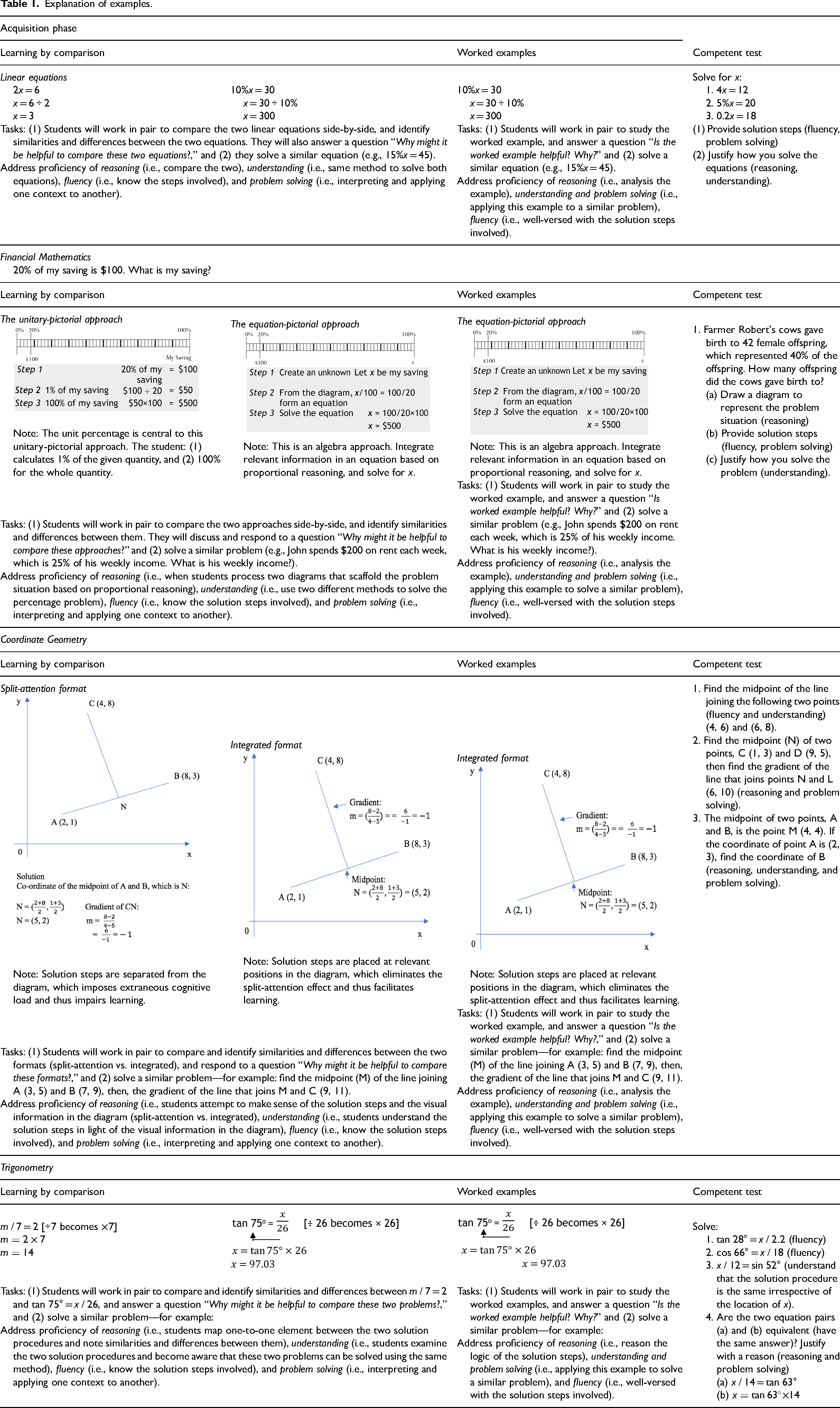
Explanation of examples.
Overall, then, there is empirical evidence to support the in-class use of the pedagogical practice of learning by comparison. Comparing correct and incorrect examples, for example, may offer analytical insights that serve to scaffold students’ comprehension and understanding (e.g., detecting potential misconceptions). Moreover, as noted earlier, learning by comparison may facilitate the acquisition of conceptual knowledge and procedural knowledge, both of which could serve to account for a student's successful experience of mathematical proficiency. Significantly, as existing teaching and research inquiries have shown, the pedagogical practice of learning by comparison not only facilitates procedural fluency (Durkin & Rittle-Johnson, 2012; Rittle-Johnson & Star, 2009), but also assists students to gain greater conceptual knowledge of mathematics (Booth et al., 2013; Ziegler & Stern, 2014).
Since its inception about four decades ago, cognitive load theory has evolved to be a prominent instructional design theory that has a wide range of implications across different domains of functioning (Sweller et al., 2011, 2019). Cognitive load theory, in particular, considers the relevance of a person's long-term and working memory—for example, the working memory is constrained by both its capacity (Miller, 1956) to process novel information (i.e., process about four elements at a time) and duration (Peterson & Peterson, 1959) to retain information (i.e., information will disappear within 20 s without being rehearsed). Long-term memory, in contrast, has a huge capacity to store acquired knowledge in the form of schemas (Tricot & Sweller, 2014). The perspective of instructional design, situated within the framework of cognitive load imposition (Sweller et al., 2011, 2019), contends that it is important to not overload the working memory so as to ensure that learning would occur.
Arising from cognitive load theory (Sweller et al., 2011, 2019) is the appropriate framing of instructional designs that may help reduce the negative impact of cognitive load imposition on a person's learning experience. A convoluted instructional design (e.g., a diagram with redundant information included), for example, may impose high cognitive load, giving rise to a persons’ difficulty to comprehend the unit material. In the context of mathematics learning, say, a worked example provides detailed solution steps that may assist a student with her solving of a problem. The solution steps of a worked example, in this case, consist of a schema, which is defined as domain-specific knowledge for a category of problems (Tricot & Sweller, 2014). A student studying a worked example would direct his or her cognitive resources to study the problem state(s) and problem-solving operators, resulting in a low level of cognitive load and, hence, the effective acquisition of new schemas. Consider the following worked example that may assist with the solving of the linear equation of “x − 7 = 11, solve for x.” The solution steps are: (1) x− 7 + 7 = 11 + 7, and (2) x = 18. Having studied the above worked example, a student may now be asked to solve a similar practice problem (i.e., equation), say: “x− 5 = 13, solve for x.” Worked examples, reflecting the use of cognitive load theory (Sweller et al., 2011), are effective as they scaffold and guide students to identify a similar structure between a worked example (e.g., worked example: x− 7 = 11) and a similar practice problem that one has to solve (e.g., x− 5 = 13).
There is extensive research to affirm and support the benefit of using worked examples to facilitate learning (Lu et al., 2020; Renkl, 2014; Sweller et al., 2011; van Gog et al., 2019). Of particular interest, in this case, is extent to which the use of worked examples could help students to develop increasingly sophisticated mathematical proficiency in understanding, fluency, reasoning, and/or problem-solving for different topical themes in mathematics. For example, would a worked example have relevance, applicability, and/or effectiveness for the topic of “Number and Algebra” versus the topic of “Measurement and Geometry”? This comparative inquiry or exercise is useful as it could offer insightful information into the notion of consistency in relevance and application of operational functioning of instructional designs for different topical contexts.
Conceptualization: Learning by comparison and worked examples
The preceding discussions so far have provided logical insights into the operational functioning of instructional designs that are underpinned by both learning by comparison theory and cognitive load theory. One notable line of inquiry for consideration entails a combination of contrasting instructional designs. We commonly use this approach in our own teaching and research development, where we would include a number of sequential steps—for example:
The teaching phase (∼10 min). A teacher introduces a topic (e.g., geometry) based on the unit material (see Table 1 for details). The acquisition phase (∼30 min). Students work in pairs to complete several activities (Rittle-Johnson & Star, 2009). In relation to learning by comparison, students study a pair of examples and then solve a practice problem. We suggest that students study six pairs of examples and solve six practice problems. Our design reflects the work of Loibl et al. (2020) and includes the use of practice problems, which could help facilitate the acquisition of procedural knowledge. In relation to learning by worked examples, likewise, students are asked to complete six “worked example–practice problem” pairs. For each pair, a student studies a worked example and then solves a practice problem. It should be noted that there are variables other than instructional design (e.g., ability level of students, complexity of the learning materials, etc.), which could influence mathematics learning. Therefore, mathematics teachers should use their discretion to provide appropriate number of examples and practice problems to optimize their students’ mathematics learning.
We speculate that the teaching phase is likely benefit students (e.g., students learn and acquire knowledge about a particular concept). However, having said this, we contend that students’ main learning is likely to occur after they have completed the learning activities in the acquisition phase. This postulation, from our conceptualization, indicates the following association:

3. The competent test phase (∼25 min). Having completed the activities in the acquisition phase, students then sit for a competent test. The design of test items in the competent test, in this case, targets successful experience and accomplishment of different mathematical proficiency strands (see Table 1 for details).
An example: Learning financial mathematics
Central to the present conceptual analysis paper is the emphasis on the significance of both cognitive load theory (Sweller et al., 2011, 2019) and learning by comparison theory (Rittle-Johnson et al., 2017; Ziegler & Stern, 2014), which differ from the theory of constructivism (Lave & Wenger, 1991; Piaget, 1963; Sluss & Stremmel, 2004; Vygotsky, 1978). As outlined earlier in our overview, the constructivist approach (i.e., problem-based inquiry) emphasizes group work in which students explore solutions for a given problem, negotiate and share mathematical ideas. The teacher, likewise, acts as a facilitator who may provide relevant scaffolds (e.g., ask questions to encourage reasoning) (e.g., Groves, 2012). The main premise of constructivism, in this case, is social participation and the active construction of knowledge. It has been noted from existing research that group work promotes conceptual understanding, strategic competence, and adaptive reasoning proficiencies (Corrêa, 2021; Groves, 2012; Samuelsson, 2010). How group work actually facilitates the acquisition of procedural knowledge, however, is less clear (Samuelsson, 2010). The previous section also details the potential benefits of using learning by comparison and learning by worked examples for mathematics learning. As we detail next, explicit instructional guidance, coupled with students working in pair to respond to specific prompts and then solving the practice problems, would expect to facilitate the acquisition of mathematical proficiency strands.
Table 1 shows a detailed account of an example of different topical themes in mathematics. Specifically, in terms of the uniqueness or the distinctive characteristics of a topical theme, we include four topics:
Linear equations (e.g., 10%x = 30, solve for x). Financial mathematics (e.g., 20% of my saving is $100. What is my saving?). Coordinate geometry (e.g., find the midpoint (M) of A [2, 1] and B [8, 3]). Trigonometry (e.g., tan 75° = x/26, solve for x).
The four aforementioned topics are somewhat different in terms of their objectives, underlying characteristics, and focus of mathematical concepts. Our description, in detail, showcases the benefits of learning by comparison and the use of worked examples for the topic of Financial Mathematics. As shown in Table 1, the objective is to highlight two specific ways (i.e., non-algebra approach vs. algebra approach) that one could use to solve percentage problems (e.g., “20% of my saving is $100. What is my saving?”) via learning by comparison condition. The unitary approach is a non-algebra approach, whereas the equation approach is an algebra approach. In line with prior research (Jitendra et al., 2011), both the unitary approach and equation approach has a diagram to scaffold the problem structure. The diagram depicts the proportion concept, aligning percentage with quantity (e.g., align 20%: $100, and 100%: my saving). The equation approach shares a similar diagram to the unitary approach except that the former uses a variable (x) to represent “my saving.” It should be noted that the two approaches differ in the solution procedure. The key concept of the unitary approach is the unit percentage concept and its solution procedure consists of the following: (1) calculate 1% and (2) calculate 100% to obtain the solution. In contrast, based on the mathematical relationship as portrayed by the proportional concept in the diagram, the equation approach forms an equation such as x/100 = 100/20, and solve for x.
Research has advocated the use of three specific types of “prompt” to encourage students to participate in appropriate discussions when comparing two worked examples side-by-side (Star et al., 2015). First, the “understand prompt” (e.g., How did Mary solve the problem?) aims to assist students to understand each worked example separately. Second, the “compare prompt” (e.g., What are the differences and similarities between Mary's and John's methods?) encourages students to compare the two worked examples. Third, the “How do they differ? prompt” aims to assist students to understand the key principles that underlie the respective solution procedure of each of the two worked examples. It is important to note that researchers have also used other comparable prompts, such as “Mandy and Erica solved the problem differently, but they get the same answer, why?” (Rittle-Johnson & Star, 2007, p. 564) to encourage students to actively participate in the discussion of a worked example pair.
Accordingly, we propose students working in pairs and responding to the “Why might it be helpful to compare these approaches?” prompt, followed by solving a practice problem (Barbieri & Booth, 2020). We postulate this pedagogical approach could potentially help students to acquire the four mathematical proficiency strands (Table 1): reasoning (i.e., process the two diagrams), understanding (i.e., able to use two different methods to solve the problems), problem-solving (i.e., solve the problem in a new context), and fluency (i.e., learning two ways of solving the same percentage problem would expect to assist students to solve the percentage problems flexibly and efficiently).
Prior research has demonstrated the effectiveness of the equation approach for learning to solve percentage change problems from a cognitive load theory perspective (Ngu et al., 2014). Accordingly, as shown in Table 1, we use the equation approach, which is exactly the same as one of the examples in the learning by comparison condition. The worked example not only provides a diagram that scaffolds the proportion concept related to the problem structure, but it also provides a step-by-step solution procedure that may assist students to obtain the correct solution. The worked example, in this case, would impose low cognitive load as attention is directed toward the learning of both conceptual knowledge (i.e., proportion concept in the diagram) and procedural knowledge (i.e., the solution procedure). Discussing the prompt of “Is worked example helpful? Why?” would encourage deep analysis of the diagram as well as the solution procedure, which would target the reasoning and understanding strands. Solving a practice problem that shares a similar problem structure but a different context, in contrast, would facilitate the acquisition of fluency and problem-solving strands (Table 1).
We encourage the use of a competent test to help attain evidence of successful comprehension and understanding. Similar to our previous inquiries, a competent test may enable students to undertake the following: (1) demonstrate their ability to draw a diagram to represent the problem structure (i.e., reasoning), (2) solve the percentage problems accurately (i.e., fluency and problem solving), and (3) provide logical reasons to justify their answers (i.e., understanding), all of which assess the extent to which students have acquired the four mathematical proficiency strands.
Discussion
Overall, then, the present conceptual analysis article has provided theoretical insights and useful information for quality teaching and learning purposes. The notion of “quality,” in this case, does not simply mean academic achievement in mathematics (e.g., achieving exceptional marks for weekly quizzes). Rather, quality espouses the tenet or the attribute of deep, meaningful understanding and sound acquisition of mathematical proficiency strands. Mathematical proficiency, a priority for many jurisdictions at present, is somewhat different from the notion of learning (e.g., rote learning and memorization) and “acquiring facts” for later recall (e.g., in a final exam). “True” quality mathematics learning, as we discussed, entails and/or consists of other learning-related attributes other than just the acquisition of content knowledge of different topical themes—for example, a student's appreciation and ability to achieve, experience, and demonstrate several important “cognitive attributes”—namely, know principle knowledge (e.g., conceptual understanding), judge procedural flexibility (e.g., procedural fluency), contemplation (e.g., strategic competence), logical reasoning (e.g., adaptive reasoning), and critical insight (e.g., productive disposition).
Quality teaching in mathematics, likewise, consists of several important elements. One notable element, from our point of view, is related to the teaching and acquisition of “mathematical proficiency,” which allows students to learn and acquire different types of cognitive attributes—for example, the ability to demonstrate conceptual understanding of a mathematics concept. As such, then, quality teaching does not emphasize the “imparting” of subject knowledge for recall purposes (e.g., to be memorized and used for an exam). A teaching approach that is extremely popular with many educators is constructivism (Lave & Wenger, 1991; Piaget, 1963; Sluss & Stremmel, 2004; Vygotsky, 1978), which involves versatile hands-on activities, pair discussions, debates, and group projects (Groves, 2012; Samuelsson, 2010; Suh, 2007).
By all accounts, it is plausible for educators to also consider learning theories other than constructivism when designing quality teaching pedagogies—namely, in this case, learning by comparison theory (Ngu & Phan, 2020; Star et al., 2015) and cognitive load theory (Ngu et al., 2014, 2018; Sweller, 2010). The two comparative learning theories, as we overviewed, demonstrate their potent effects by helping to facilitate effective learning experiences. There is a plethora of research studies, empirically and conceptually, that have delved into the intricacies of each of the learning theories—for example, how do we use cognitive load theory to complement the effectiveness of constructivist teaching (Lave & Wenger, 1991; Piaget, 1963; Sluss & Stremmel, 2004; Vygotsky, 1978)?
We firmly believe and contend that using a combination of instructional approaches, based on different learning theories (e.g., a combination of constructivism and cognitive load theory) may assist students to acquire mathematical proficiency strands, such as understanding, fluency, problem solving, and reasoning skills. Moreover, our analysis suggests that acquisition of different strands of mathematical proficiency, using diverse instructional approaches may transcend across different topical themes (e.g., linear equations, financial maths, coordinate geometry, and trigonometry). This theoretical premise emphasizes the importance of what we term as holistic experience of mathematical proficiency.
Policy makers, institutions, educators, and so on may wish to focus on initial teacher education training for pre-service teachers and professional development for in-service teachers that draw their attention to the importance of mathematical proficiency. That quality teaching in mathematics, for pre-service and/or in-service teachers, also entails understanding and appreciation of the acquisition of mathematical proficiency. Poignant then from this mentioning is the “teacher training” of instructional approaches, based on well-documented learning theories (i.e., learning by comparison theory and cognitive load theory), that could help facilitate successful accomplishments of multifaceted mathematical proficiency strands. Pre-service teachers, in this sense, may benefit from the quality learning of different learning theories (e.g., what is the difference between constructivism and cognitive load theory in terms of effectiveness?).
Directions for consideration
Having discussed our analysis and summary of the topic of mathematical proficiency, we want to turn our attention to a related issue: namely, the nature of existing research development (e.g., limitations) that provides grounding for further advancement. Our theoretical analysis of mathematical proficiency is based on curriculum development and scholarly writings that are situated within Western learning-sociocultural contexts (e.g., U.S.A. and Australia). Our research interests in the study of anthropological groundings and cultural differences have led to our examination of the literature of Asian students and their academic endeavors (Guo et al., 2022; Hsin & Xie, 2014; Tam, 2016). In general, Asian students outperform Western students in Program for International Student Assessment (Thomson et al., 2010). Why is this the case? There have been numerous accounts proposed to explain why Asian students do so well academically. For example, some scholars have mentioned the concept of filial piety (Chen & Ho, 2012; Chow & Chu, 2007; Hui et al., 2011), denoted as “孝,” to explain Asian students’ educational successes. Advancing this line of reasoning, we consider another research lens—namely, the use of “variable teaching” (bianshi), commonly described in Chinese Mathematics Curricula (Leung, 2023). Central to this variable teaching approach is an emphasis on two types of “variation” that have the potential to enhance mathematical proficiency: (1) conceptual variation that uses multiple examples to learn mathematical concepts, and (2) procedural variation that scaffolds problem-solving skills. We contend that other learning-sociocultural perspectives (e.g., the Chinese perspective of “variable teaching”) may complement and provide relevant insights for theoretical understanding.
Follow-up empirical undertakings are needed to validate the potentiality of educators using comparative instructional approaches (e.g., learning by comparison vs. cognitive load theory) to assist with the acquisition of mathematical proficiency. This recommendation (e.g., an empirical research study that compares two contrasting instructional approaches) is significant and may, indeed, help to substantiate our existing philosophical analysis: that comparative learning theories, in tandem with constructivist theories (e.g., sociocultural constructivism), may complement and act to facilitate sound acquisition of mathematical proficiency. For example, it would be of interest for researchers to explore and identify the relative efficiency of a particular instructional approach (e.g., learning by comparison).
Conclusion
In summary, then, our theoretical overview of mathematics learning indicates that quality learning is more than just exceptional achievement of the subject matter. Rather, as the present conceptual analysis article has shown, quality teaching and learning may consist of an important element—namely, the successful acquisition of mathematical proficiency experiences. Mathematics proficiency, reflecting our analysis and subsequent proposition, espouses a number of “cognitive attributes”—for example, a student's critical insight of a mathematical concept (e.g., productive disposition). As such, we contend that contemporary teaching of mathematics at different academic levels acknowledge the importance of cultivating “mathematical proficiency.” Acquisition and/or cultivation of mathematical proficiency may, in this case, involve the use of appropriate instructional designs and/or pedagogical approaches.
Footnotes
Contributorship
Both authors, BN and HP, contributed equally to the conceptualization, articulation, writing, and revision of the philosophical analysis article.
Data availability statement
Data sharing not applicable to this article as no datasets were generated or analyzed during the study.
Declaration of conflicting interests
The authors declared no potential conflicts of interest with respect to the research, authorship, and/or publication of this article.
Funding
The authors received no financial support for the research, authorship, and/or publication of this article.
