



Abstract
Lesson study is recognised as a cultural activity and its implementation in a context different from Japan is a complex process. Researchers’ role in this process is assumed to be critical, although this has rarely been investigated. In this paper, we analyse a teaching experiment to introduce lesson study into a professional development course for prospective teachers at an Italian university, focusing our investigation on a group of researchers acting as teacher educators (didacticians). Using the anthropological theory of the didactic and meta-didactical transposition frameworks, we investigate their dual position as researchers and as teacher educators. We observe the evolution of the didacticians’ teacher-education praxeology (a model of practice and knowledge) during their interactions with prospective teachers. The results indicate that the didacticians’ teacher-education praxeology is distinguished, shaped, and actively influenced by their research praxeology. The results also imply that coordinating the two theoretical frameworks may guide the design and analysis of teachers’ professional development courses.
Keywords
Introduction
Lesson study (LS) is internationally acknowledged (Isoda, 2007) as a promising teacher professional development (TPD) model, promoting collaboration between teachers. There are reports of successful attempts at exporting LS (Huang & Shimizu, 2016; Huang et al., 2019; Quaresma et al., 2018), but others highlight the difficulties of the process (Demir et al., 2012; Fernandez et al., 2003). Most reports on LS originate from western countries, particularly Anglo-American states (White & Lim, 2008). They consider LS as an isolated practice in the Japanese TPD context, but the reality is different (Miyakawa & Winsløw, 2013, 2019). As LS is a cultural practice, to introduce it into a different country, there must be careful consideration of its origin and the context in which it is to be introduced (Stigler & Hiebert, 2016): studies clarify that its efficacy in Japan is largely due to the cultural context (Krainer, 2011; C. Lewis, 2016).
In this paper, we focus on the people mediating between LS and the teachers. Past studies have investigated the facilitators or teacher educators (Boles et al., 2020; Restani et al., 2019; Schwarts et al., 2021; Seino & Foster, 2021). Few studies (e.g., Goos, 2014) have focused on the researchers who play complex roles as researchers and as teacher educators. The purpose of this paper is to investigate the researchers acting also as teacher educators (didacticians) (Jaworski & Potari, 2021), who introduced LS into the Italian TPD context. We study the evolution of didacticians’ practices and their impact on the TPD course to gain insights into the implementation of teachers’ LS practices in a context different from Japan.
Lesson study and professional development
Research on lesson study
It is no simple task to export LS: Fernandez et al. (2003) and Demir et al. (2012) show that LS exists in Japan due to Japanese culture, and it might be rejected if cultural aspects are not carefully considered in other countries. This has been clear since the very beginning of research on LS (Stigler & Hiebert, 1999). Yet, at least for the first decade, the many attempts to translate Japanese LS in other countries ‘have tended to rely on a simple dissemination model with no attempt to address its cultural compatibility’ (Ebaeguin & Stephens, 2014, p. 199).
Some studies investigate why LS is prominent in Japan, and the cultural context provides a crucial contribution (Krainer, 2011; C. Lewis, 2016). There are positive experiences of LS for in-service (e.g., Clivaz & Ni Shuilleabhain, 2019) and pre-service (e.g., Nakamura, 2019) TPD in several countries, revealing that LS can take different forms depending on the implementing institution, even in Japan (for primary school, see Fernandez & Yoshida, 2004; for secondary school, see Miyakawa & Winsløw, 2013; for pre-service teachers see Elipane, 2012).
The role of external persons involved in the LS process can also be questioned. In Japan, while LS often involves knowledgeable others (Fujii, 2019; Takahashi, 2014), their role is not necessarily crucial (Seino & Foster, 2021): LS is introduced by teachers for teachers. In contrast, this role may be crucial in other contexts. Facilitators can act as a link between researchers and teachers in LS (e.g., J. M. Lewis, 2016). The responsibility of implementing LS in contexts outside of Japan lies with the researchers (Ponte et al., 2018), as in the case of our project. Further investigation is required to understand how they manage their role in TPD with LS.
Teacher professional development in Italy
Italian TPD is traditionally conducted by researchers collaborating with teachers since the 1970s and ‘80 s, organised into local and national research groups of teachers and researchers, financed by the National Research Council, and situated in various universities (Arzarello & Bartolini Bussi, 1998). Many remain today, supported by the Ministry of Education. They perform research in mathematics education, TPD, and engage schools in new projects. There are numerous TPD programmes and design of resources for TPD (e.g., m@t.abel, and Piano Nazionale Lauree Scientifiche, Licei Matematici) (Arzarello et al., 2021; Branchetti et al., 2019) and the collaboration between researchers and teachers is central to these programmes (e.g., Cusi & Malara, 2015; Robutti et al., 2020, 2021).
Today, Italian teachers need a work environment that enables sharing experiences and professionalism with colleagues (Blandino, 2008). The Ministry of Education states that the overall quality of professional development programmes is compromised by the ‘low quality of [some] models and methodologies’ (law 107/2015). The Ministry recognises that quality TPD programmes can be found in the academia, albeit difficult to identify in the vast offer of more than five hundred attested agencies (Minisola & Manolino, 2022). Finally, there is greater institutional demand for ‘permanent and strategic’ TPD in ‘collaborative networks’ (law 107/2015).
The Italian educational context seems suitable for the implementation of LS. Since previous Italian studies on LS are contextualised in primary schools (Bartolini Bussi et al., 2020; Bartolini Bussi & Ramploud, 2018), we approach LS in the context of pre-service secondary school teachers.
Theoretical framework
Institutional perspective and transposition
TPD is influenced and shaped by the context in which teachers and didacticians are immersed (Presmeg, 2007). The term culture is significant (Hatano & Inagaki, 1998), often linked with the concepts of society and organisation (e.g., Freimuth, 2006).
To address this cultural aspect of implementing foreign practices in TPD, we adopt the institutional perspective proposed within the Anthropological Theory of the Didactic (ATD; Chevallard, 2019). The notion of institution is interpreted in a broader sense, including ‘any created reality of which people can be members’ (Chevallard & Bosch, 2020, p. xxxi). In our case, the institutions involved are the classroom of the TPD course at the university, the Italian community of didacticians, the Italian community of prospective teachers, and the Japanese community of mathematics teachers.
The implementation of LS in Italy is a process of transposition (Chevallard, 1985, 2019) of teachers’ practices from the Japanese institution of mathematics teachers to the classroom of Italian TPD, or to the Italian prospective teachers.
In an institution, a person occupies a certain position in relation to an object (e.g., a didactician and a prospective teacher occupy distinct positions with respect to LS in TPD). One hypothesis of ATD is that people's practices and knowledge are influenced or shaped by institutional conditions and constraints, prevailing in the institution to which people belong, and depending on the position they occupy. ATD focuses, in the case of mathematics teaching, on the institutional conditions and constraints in the classroom and outside of it (Bosch & Gascón, 2006). The institutional perspective of ATD allows for the cultural aspect of human practices to be investigated.
Praxeology: A model of human activity
The transposition process of LS concerns several different practices: didacticians in the positions of teacher educators and researchers, prospective teachers in the positions of teachers and learners, and so forth. The dual position of the didacticians is due to the complexity of their practices, and the same applies to teachers. To address this complexity, we adopt the notion of praxeology (Chevallard, 2019).
‘The anthropological principle states that any human activity can be described in terms of praxeologies’ (Bosch et al., 2020, p. xiv). A praxeology is more than just a model of practice or knowledge: it consists of two blocks, know-how (praxis) and know-why (logos – discourses that justify the know-how). Praxis is made up of two elements: a type of tasks assigned to a certain position in an institution and a technique to solve this type of tasks. Logos also consists of two elements: a technology (the discourse that justifies the technique) and a theory (which supports the technology) relevant to the institution. The mathematical praxeology refers to the mathematical practices and knowledge related to the solution of a mathematical task. The didactical praxeology models the practices and knowledge involved in teaching to bring out mathematical praxeology in the classroom. The paradidactical praxeology models the practices and knowledge involved in teachers’ work outside of the classroom.
Various praxeologies can be identified and differentiated regarding the introduction of LS in a TPD course at the university. In the TPD context, a teacher is in the position of the learner who learns didactical praxeology and/or mathematical praxeology. The teacher's activity as a learner could be modelled by other kinds of praxeologies related to the professional learning of the teacher. One specific aspect of TPD consists of the fact that there are teacher educators, who are in the position of educators to support teachers’ learning (in terms of LS, this is the role played by the knowledgeable others). Their teaching activity could be modelled by teacher education praxeology (Asami-Johansson et al., 2020). Teacher educators may also play the role of researchers in relation to teachers’ practices, as in our experimentation where didacticians take on this dual position (in this paper, they study LS at meta-level). The researchers deepen the understanding of the didactic system (the system of institutions involved in mathematics teaching, see Chevallard, 2019). The knowledge and practices related to the research could be modelled by research praxeology (Artigue & Bosch, 2014).
The meta-didactical transposition (MDT) framework (Arzarello et al., 2014; Robutti, 2020) was created to manage the complexity of didacticians’ positions in the case of TPD projects, also considering their collaboration with teachers. Using MDT, the activities and knowledge of teachers and didacticians are also modelled with the notion of praxeology: they are called meta-didactical praxeologies as they refer to knowledge about the didactic system. Teachers praxeologies and didacticians praxeologies are different instances of meta-didactical praxeologies (Figure 1): teachers praxeologies develop in accordance with classroom practice, whether didacticians praxeologies develop in accordance with certain theoretical frameworks. During professional development, didacticians introduce the teachers to new practices and knowledge. Teachers experience a double dichotomy that is established between two dialectical levels: the didactical level is developed within the classroom, between the personal meaning that students attribute to the teaching situation and its shared scientific meaning; the meta-didactical level lies between the interpretation given to the classroom dialectic by teachers and that given by didacticians, both based on the beliefs and praxeologies of their respective institutions. The meta-didactical level arises from the tensions that develop from the encounter between the components of the praxeologies promoted by the didacticians and those of teachers, and vice versa. Teachers praxeologies and didacticians praxeologies may evolve over time, through interactions between teachers and didacticians, with elements of these praxeologies being transposed from didacticians’ institutions to teachers’ institutions and vice versa. The result may be a shared praxeology (Figure 1) in the context of TPD. The hypothesis of MDT is that a shared praxeology is achievable over time, as increasing elements of didacticians praxeologies and teachers praxeologies are shared. Because didacticians and teachers belong to different institutions, at the end of a TPD programme these shared elements will lead to new praxeologies internal to each institution.
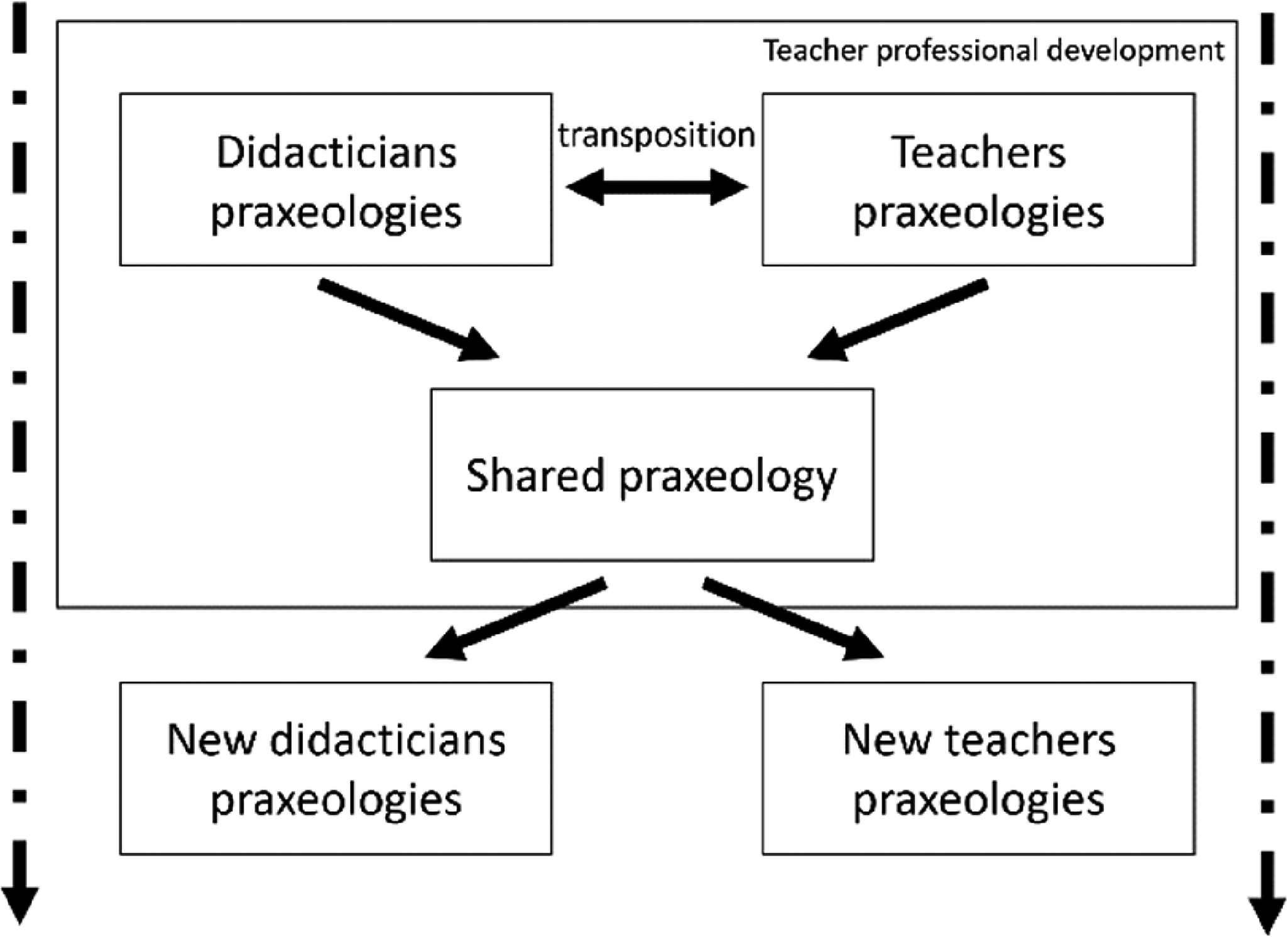
The emergence of a shared praxeology in MDT.
These praxeologies aim to clarify the different practices and knowledge related to the didacticians’ and teachers’ work, and TPD. In this paper, we investigate with a theoretical background of these diverse kinds of praxeologies a case of TPD organised by the didacticians for prospective teachers, expecting to provide better understanding of the above-mentioned complexity in terms of the praxeologies.
The purpose of this paper is to investigate the complex positions of the didacticians as they critically examine their practice and generate new knowledge on the introduction of LS in the context of TPD. We analyse the evolution of their praxeologies and the impact of this evolution on the TPD course. Therefore, we will address the following research questions (RQ):
How do the praxeologies of didacticians evolve in the process of implementing LS, through the interaction with prospective teachers? How do teacher-education praxeologies and research praxeologies of didacticians reciprocally influence and shape their evolution?
A teaching experiment was planned to introduce LS to prospective teachers within a TPD course at an Italian university, as an exploratory study of the introduction of LS into different institutional contexts. The aim was to identify positive and critical aspects of our approach to the implementation of LS in a TPD course. A qualitative analysis was conducted on the data collected during this TPD course.
Implementation of lesson study
This paper is part of a larger project aimed at studying the introduction of Japanese Lesson Study into the context of Italian TPD, which involved many experiences of collaboration between teachers and between teachers and researchers (Arzarello & Bartolini Bussi, 1998). The aim is twofold: to obtain theoretical insights on LS while providing scientific knowledge on the introduction of LS in the Italian cultural and institutional context; and to foster collaboration between teachers in the Italian TPD context. The first step, which is reported in this paper, is to analyse how Italian communities of researchers and teachers involved in TPD react to a new element.
Context: The EMAS course
The experiment is part of a participatory study, as the first and second authors are two of the three didacticians involved. It was conducted within the Elementary Mathematics from an Advanced Standpoint (EMAS) course for prospective secondary school teachers at master's degree level at the University of Turin, in Italy, in 2018/19. This 48-hour course focuses on continued fractions: 30 hours are dedicated to continued fractions from the epistemological and historical standpoints, sixteen to didactical approaches, and two to another project. In the 16 hours, prospective teachers are encouraged to use their acquired mathematical knowledge to design a teaching activity to introduce continued fractions in one class (grade 6 to 11).
Our experiment was conducted during these 16 hours. Twenty-nine prospective secondary school teachers were enrolled on the course and participated in the experiment. They had no experience of real classroom teaching, although some had already engaged in mathematics education courses, and they were aware that their participation in the experiment would be evaluated (as opposed to the non-evaluative context of LS, this is expected to produce bias in the data).
Up until the 2017/18 academic year, the prospective teachers on the EMAS course had been asked to design individually an activity in a written document and submit it for evaluation by the didacticians. In the 2018/19 academic year, they were asked, for the first time, to: design collaboratively an activity and a 20-minute lesson based on it and enact the lesson in front of their peers as a mock lesson.
Details of the experiment
The 16 hours of didactic approach in the TPD course consist of two lectures (Lecture 1 and 2) and teachers’ activities (design of teaching activities and mock lessons). The design of the prospective teachers’ activities within this course relies on the Japanese LS process. The epistemological and historical introduction to continued fractions formed part of the study of teaching materials (kyōzaikenkyū). One implementation of the research lesson was included in the cycle. For the materials to include in the course, examples of LS implementations in Europe (e.g., Dudley, 2014) and in Italy (Bartolini Bussi & Ramploud, 2018) were considered while designing the experiment, but they were later excluded due to incompatibility with the time constraint, structure of lessons and education levels. Therefore, the didacticians decided against proposing materials adapted from other LS implementations. After further deliberation, the didacticians also decided not to provide examples of lesson plans: this was motivated by the desire of creating a structure for Lesson Plans suitable for future experiments, building from the lesson plans collected from the prospective teachers.
During the first 1-hour lecture (Lecture 1), two didacticians (first and second author) introduced Japanese LS with a set of six slides (Slides Set 1). These slides contained information on the Japanese historical and institutional context (five slides), and the LS (one slide). They were developed based on the first author's master thesis (2016). For example, Figure 2(a) shows the slide on the Japanese historical context, Figure 2(b) shows a picture of the staff room of a Japanese high-school, Figure 2(c) shows the slide introducing the process of LS.

Slide 3/6 (a), Slide 5/6 (b) and Slide 6/6 (c) from Slides set 1 (translated into English).
During Lecture 1, the prospective teachers were divided into eight self-organised groups to work collaboratively in a LS setting. In this experiment, the five phases in Figure 2(c) were merged into three, and the prospective teachers were asked to work as follows:
Planning phase (1–2): Study and design a teaching activity on continued fractions and write an activity report plus a lesson plan for a mock lesson. Implementing phase (3): Teach and observe this mock lesson in front of their peers and didacticians. Reflecting phase (4–5): Collaboratively discuss within the group the efficacy of the lesson and individually reflect on the discussion.
The planning and reflecting phases were organised autonomously by the prospective teachers outside of the course hours, without supervision or intervention by the didacticians. The implementing phase took place at the university, during the course hours, and was supervised by the didacticians.
The activity report was introduced by the second author. It is a written document containing a description of a teaching activity to be conducted in the classroom (usually over a prolonged period, ranging from 6 to 12 hours) and is used as a resource for national TPD projects in Italy (e.g., m@t.abel, in Arzarello et al., 2021). It consists of introduction, the task(s) for the students, an extended description of the teaching activity phases, and the corresponding teaching strategies. Examples of activity reports were given to the prospective teachers via the m@t.abel repository. Each group produced an activity report: an example is given in Figure 3.
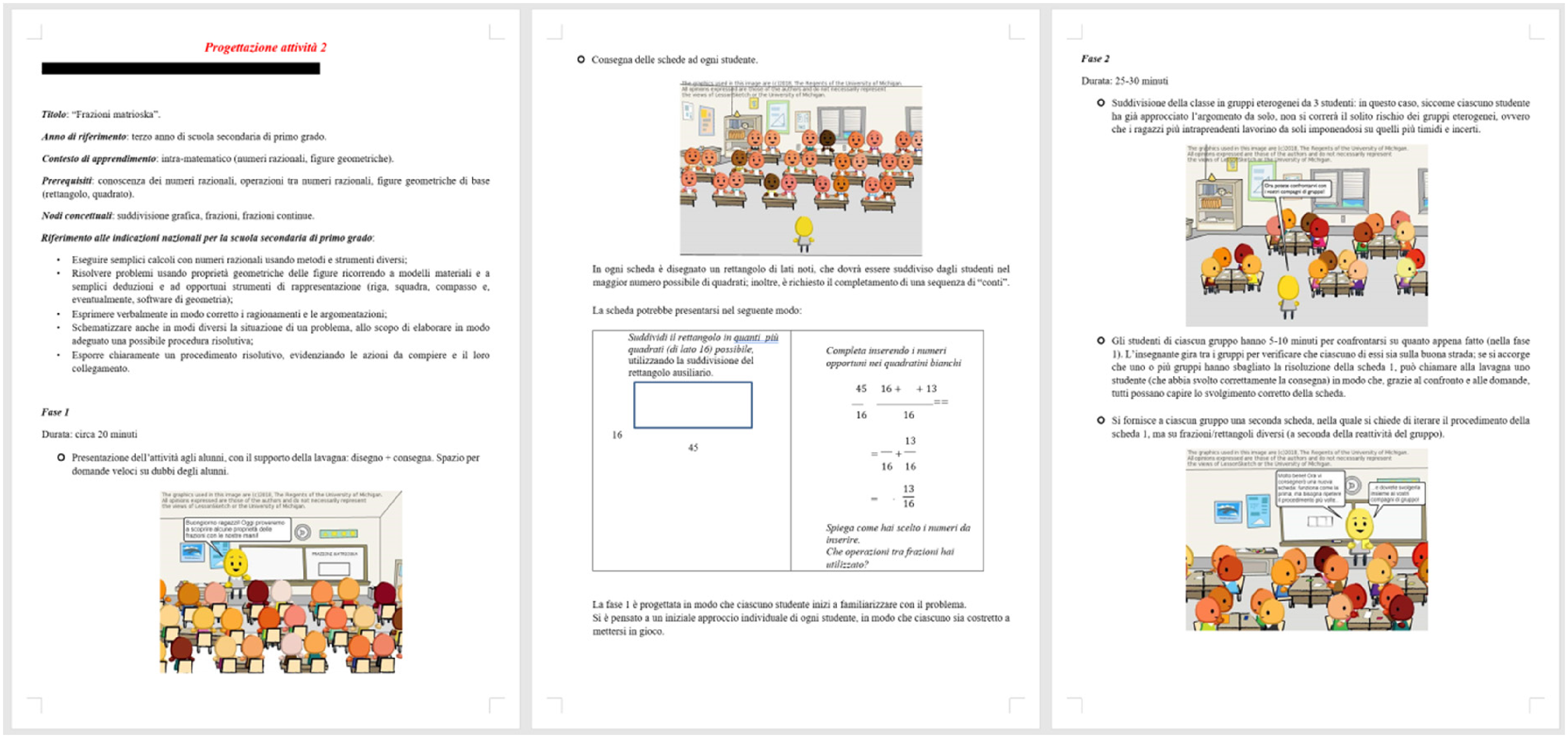
The first three of six pages of Group 1’s activity report.
The brief introduction provides the target school grade (Grade 11), didactical aims according to the national curriculum, resources and artefacts, and prerequisites (rational numbers, and area of rectangles and squares). This activity is intended to connect the process of dividing a rectangle into squares with the algebraic form of a continued fraction (Figure 4).

Transcription of a part of Group 1's activity report (our English translation).
The lesson plan was introduced by the first author. It is also a written document, and a specific tool of LS. Its structure may vary, however we specified, while assigning the task to the prospective teachers, that a Lesson Plan should at least contain: a detailed description of the task for the students, detailed time planning for each lesson phase, and predictions of reactions by students to the teachers’ actions. No group produced a lesson plan.
The mock lessons were implemented over the course of three meetings: one member of the group acted as implementing teacher, the other members acted as observers, and the teachers from the other groups acted as pupils. At the end of each meeting, the mock lessons were discussed by all the prospective teachers. The didacticians were also present to supervise the process but did not intervene in the discussion of the mock lessons. The meetings were video recorded, but audio from the discussion is inaudible because of technical issues.
After the mock lessons, the didacticians asked the prospective teachers to fill in an Anonymous Survey (AS) to explore the teachers’ understanding of LS. The didacticians were interested in investigating why the groups produced no lesson plan, while also studying LS as an object. Two surveys were prepared, one for the implementing teachers and one for the observers. The survey was anonymous to avoid self-report bias.
Another 2-hour lecture (Lecture 2) was prepared after the above-mentioned process in the course. This lecture was originally aimed at discussing the activity reports, the lesson plans, and the discussions and reflections developed by the groups after the mock lessons. However, the analysis of the answers to the survey prompted the didacticians to modify its contents: 1 hour was dedicated to a class discussion on LS, coordinated by the didacticians, and 1 hour was spent analysing the activity reports with each group. The didacticians used a new set of ten slides (Slides Set 2), eight of which discussed the phases of LS, stressing the meaning of the term lesson in the LS context, the difference with the term teaching activity, and detailing what a lesson plan is and how it could be produced (Figure 5); one slide discussed the Japanese institutional context, and one slide proposed some differences between the Japanese and Italian school contexts.
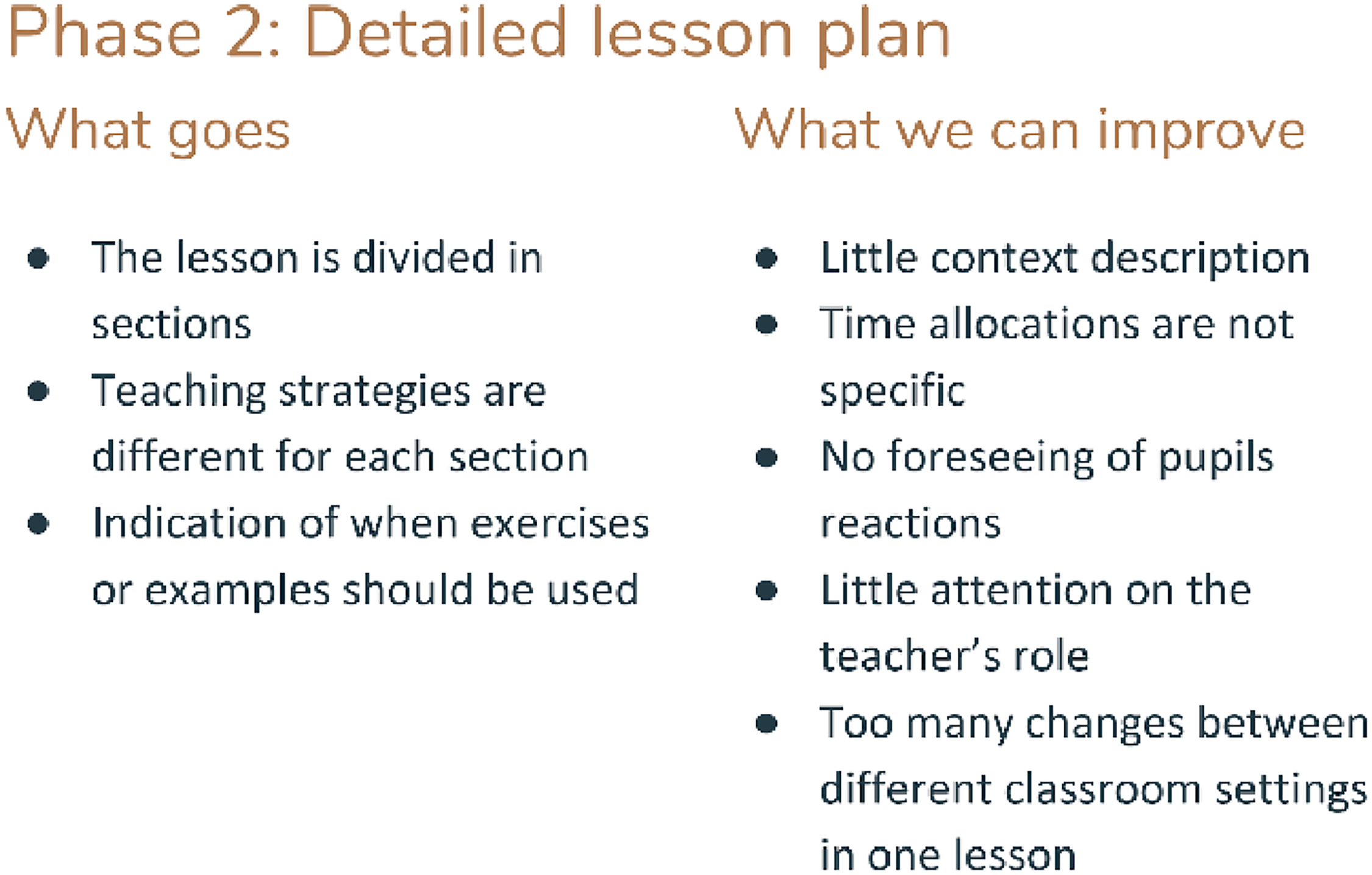
Slide 5/10 from Slides Set 2.
At the end of the 16 hours, the prospective teachers were asked to fill in the Final Questionnaire (FQ), designed to investigate the prospective teachers’ understanding of LS and their reaction to the discussion on their activity.
We collected diverse kinds of data relating to the didacticians and to the prospective teachers (Table 1). Regarding the didacticians, we collected the slides and materials (e.g., website, Moodle platform) used in the TPD course and the research report written by them. The research report is a 16-page online document in Italian, written collaboratively during the experiment, containing: research goals, data, and research-related observations. Regarding the prospective teachers, we collected activity reports, answers to the survey and questionnaire, and partially videotaped the mock lessons.
Data collection.
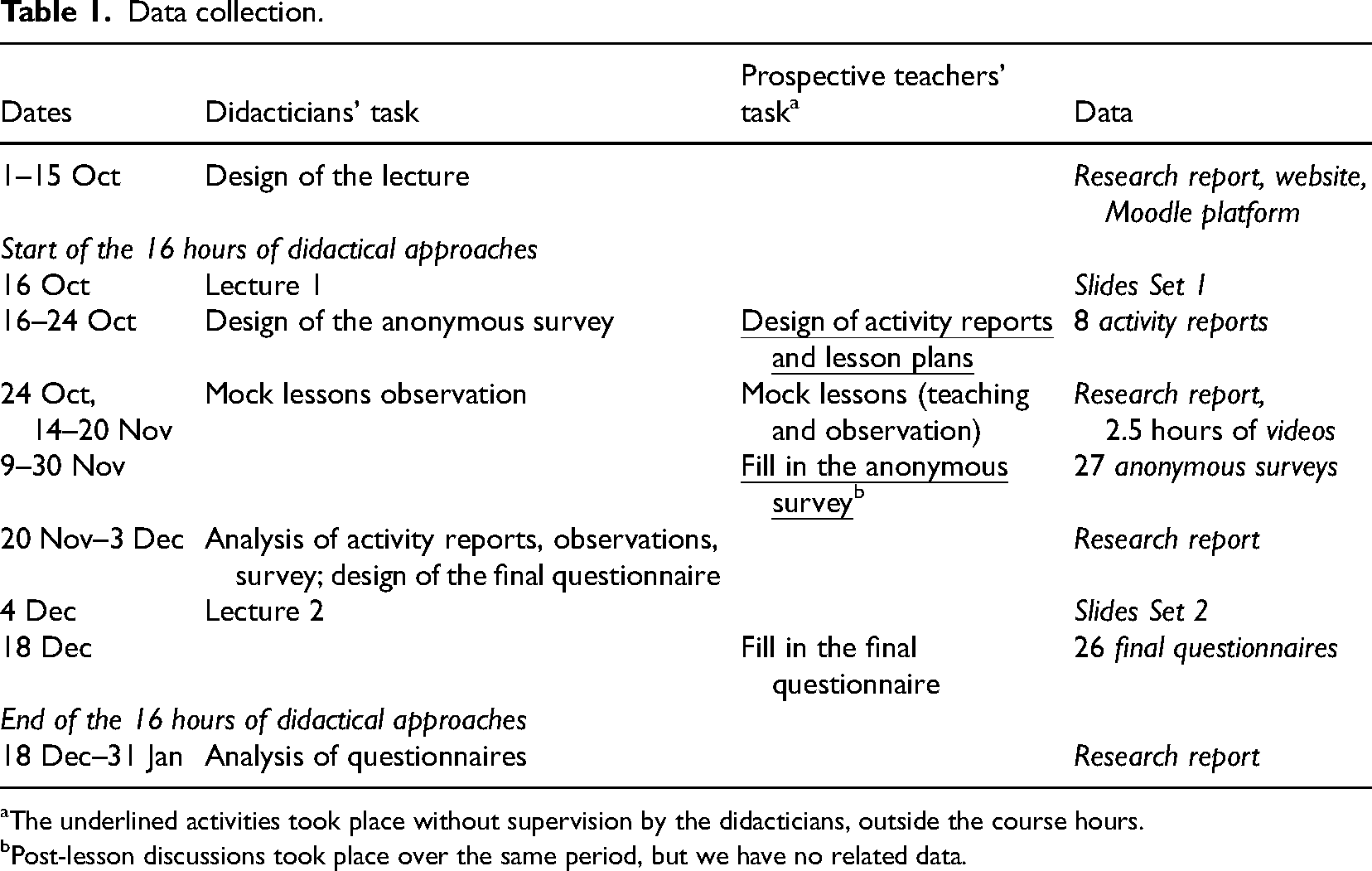
Data collection.
The underlined activities took place without supervision by the didacticians, outside the course hours.
Post-lesson discussions took place over the same period, but we have no related data.
The data analysis focus is twofold: didacticians’ praxeologies and prospective teachers’ praxeologies. About the didacticians, the praxeological analysis was conducted according to the specific moment of the TPD course, prior to and subsequently to the prospective teachers’ LS work, to identify the evolution of the didacticians’ praxeologies, which is the focus of RQ1. In the praxeological analysis, the slides and the materials used in TPD were used to identify elements of the praxis block. The research report was analysed to identity elements of the logos block. We specifically identified the elements of didacticians’ praxeologies related to the TPD course with LS and characterised them in terms of research praxeologies or teacher-education praxeologies. This characterisation is critical to answering RQ2 concerning the relationship between these two kinds of praxeologies.
About the prospective teachers, the praxeological analysis was conducted according to three scenarios. The first scenario related to the data prior to their LS activities to identify the prospective teachers’ praxeologies expected by the didacticians. The second related to their practices during LS to identify their praxeologies in the course: the activity reports and the videos were used to identify elements of the praxis block, whereas the answers to the AS were used to identify elements of the logos block. The third focused on the answers to the final questionnaires to identify the prospective teachers’ level of knowledge after the TPD course therefore mainly for elements of the logos block. During this third scenario, elements of the praxis block could only be inferred from the teachers’ answers, but it was not possible to observe them in a practical situation. The results of these three scenarios allow us to investigate the evolution of the prospective teachers’ praxeologies. Together with the analysis of didacticians’ praxeologies, this allows us to investigate how the prospective teachers’ work affects the evolution of didacticians’ praxeologies, which is the focus of RQ1.
In these praxeological analyses, we initially explored the elements of praxis block (types of tasks and techniques) in the data and then sought the justifications (technology and theory) for the identified techniques (e.g., for the didacticians we analysed the slides to identify the techniques used for the teacher-education task, and then sought the justifications to such techniques in the research report). The logos block of both didacticians and teachers was used to identify institutional conditions and constraints that justify the praxis block, specifically with respect to LS. The praxeologies of teachers and didacticians are also analysed to identify possible shared elements between the two institutions, and to discuss the possible emergence of a shared praxeology. The analysis was first conducted separately by the first and second author. Data were coded with respect to the type of praxeology and element of a praxeology to which they related. The coding was then discussed to reach common ground. To avoid bias, the third author (who did not participate in the experiment) subsequently discussed and validated the analysis. In case of discrepancies, these were discussed by the three authors, until an agreement was reached. The analysis was qualitative. When useful, quantitative considerations are provided.
In this section, quotations from the research report are referred to as RR and sequentially numbered. Questions and responses to the Anonymous Survey and Final Questionnaire are referred to as AS and FQ, the question number and a sequential number. When describing the praxeologies, we highlight the elements relevant regarding the RQ, as a complete description would overly complicate the text. The results of the data analysis are summarised in the following diagram (Figure 6).
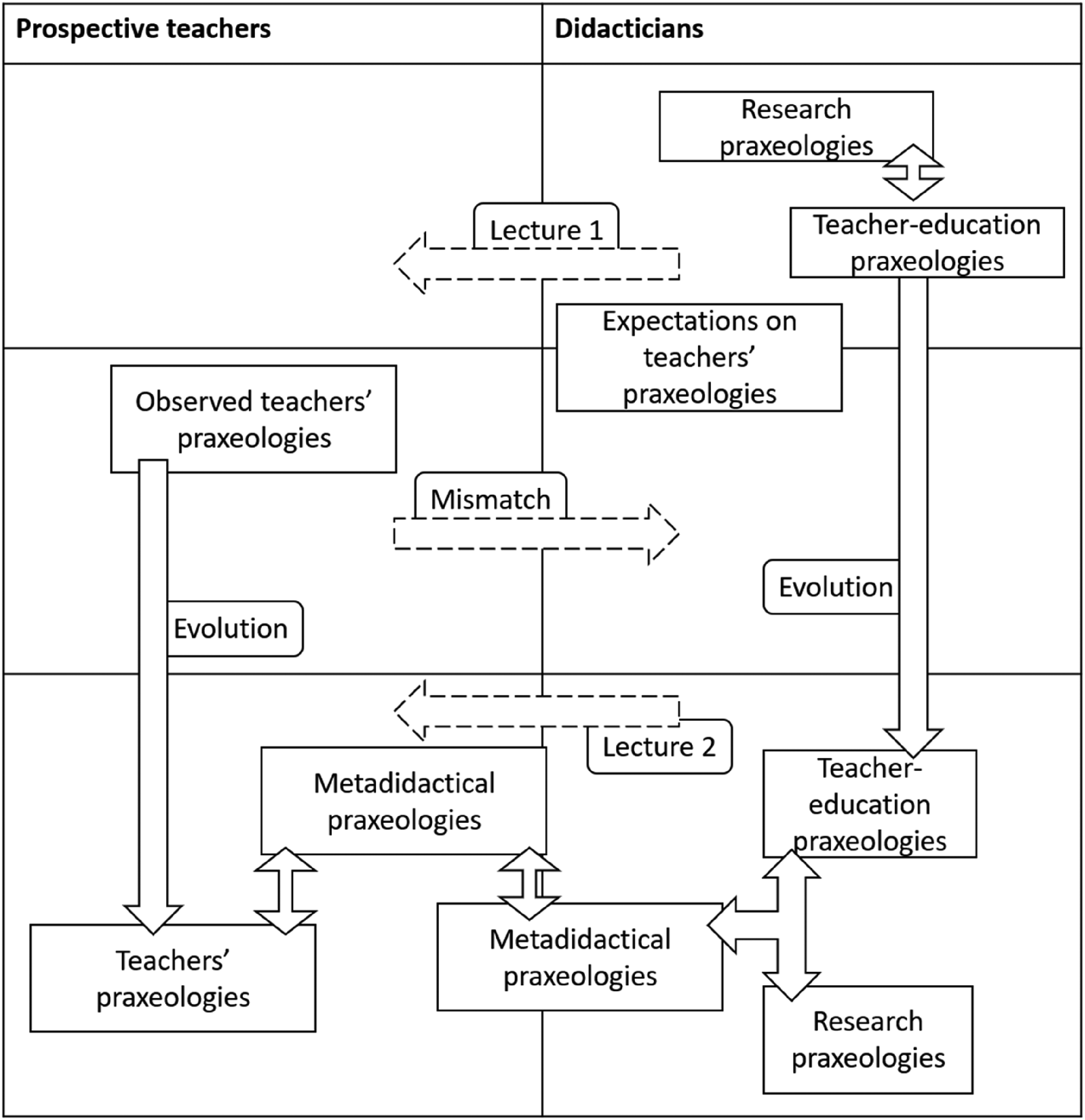
A diagram of the data analysis results.
The didacticians’ tasks (for brevity, we refer to task rather than type of tasks in this paper) related to this TPD experiment are to study LS as an object of research (T1) and to conduct a TPD course (T2). The didacticians are interested in LS itself as an object of study (RR1: ‘Both PhD students are interested in studying LS’). Task T1 is a task of a research praxeology, T2 is a task of a teacher-education praxeology.
About research task T1, the main technique is to ‘experiment LS implementation in Italy’, which also includes data collection and data analysis. In fact, the research report refers to the term ‘pre-pilot experiment’. The research praxeology includes other techniques: reviewing the scientific literature related to LS, developing theoretical and methodological frameworks, analysing data…, as described in the research report and in this paper. These techniques can be also considered sub-tasks of the main task: to solve a task, sub-tasks need to be completed, and ‘there exists a dialectical interplay between techniques and types of tasks’ (Chevallard, 2019, p. 85).
The research report also allowed us to identify the elements of the logos block that justify the research technique of LS implementation in Italy for studying LS (T1). The didacticians’ interest was in the cultural aspects of LS. In the research report, we found the following claims: RR2 […] an application of this TPD [model] in Italy would be impossible without considering the profound differences between the social, cultural, and institutional contexts in the two countries. RR3 To [have] a local group of conscious [didacticians], we tried to observe the critical aspects or potential of this TPD [model] in our context. RR4 The goal of the experiment was […] to recognise and in future be able to overcome the obstacles that may be encountered when presenting LS to a specific audience.
The term ‘conscious didacticians’ in RR3 means researchers who are aware of the critical aspects of Japanese LS, and teacher educators who are aware that these aspects are critical when implementing LS in the Italian context (RR4). Two elements of the technology that justifies the research technique of LS implementation are: a) an implementation of LS outside of Japan might allow the didacticians to shed light on the cultural specificities or dependencies of LS in its original Japanese context; b) implementing LS in the Italian context enables the identification of aspects of Italian institutions that are critical in its transposition from Japan to Italy. These elements are supported by a theory of the research praxeology: the Cultural Transposition framework (Mellone et al., 2019) and the first author's master thesis on LS, which are referred to in the research report.
The task T2 is conducted by the didacticians – as teacher educators – during a 1-hour lecture (Lecture 1) in which they use Slides Set 1 to introduce LS. The analysis of the slides highlights elements of the teacher-education praxeology. Slides Set 1 includes a description of the Japanese historical and institutional context as well as the phases of Japanese LS, as shown in Figures 2 and 8. The slide shown in Figure 7 describes the Japanese institutional context, emphasising in bold text some differences between Japan and Italy. Here, we identified one main teacher-education technique, namely teaching LS by way of two kinds of teacher-education techniques: the first directly related to LS, listing and describing the five phases of a LS cycle; the second related to the cultural aspects of LS, for example, explaining the Japanese context and comparing it with the Italian context.
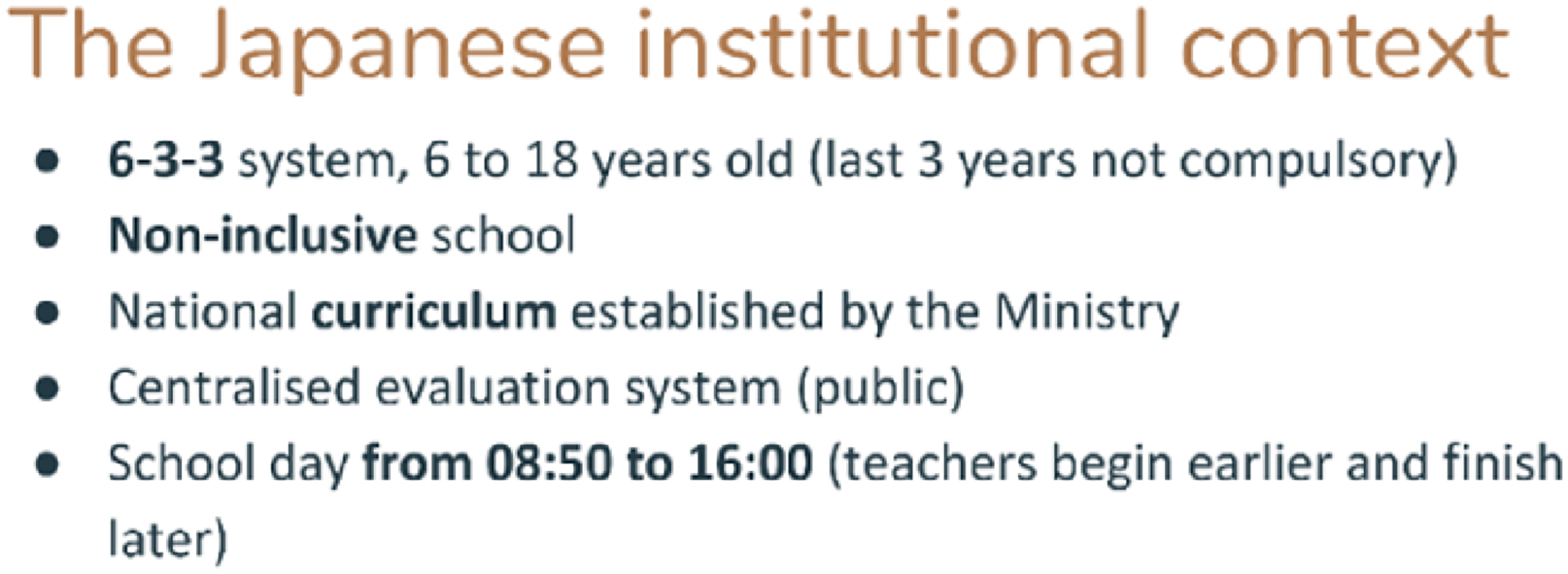
Slide 4/6, on the differences between the institutional contexts.
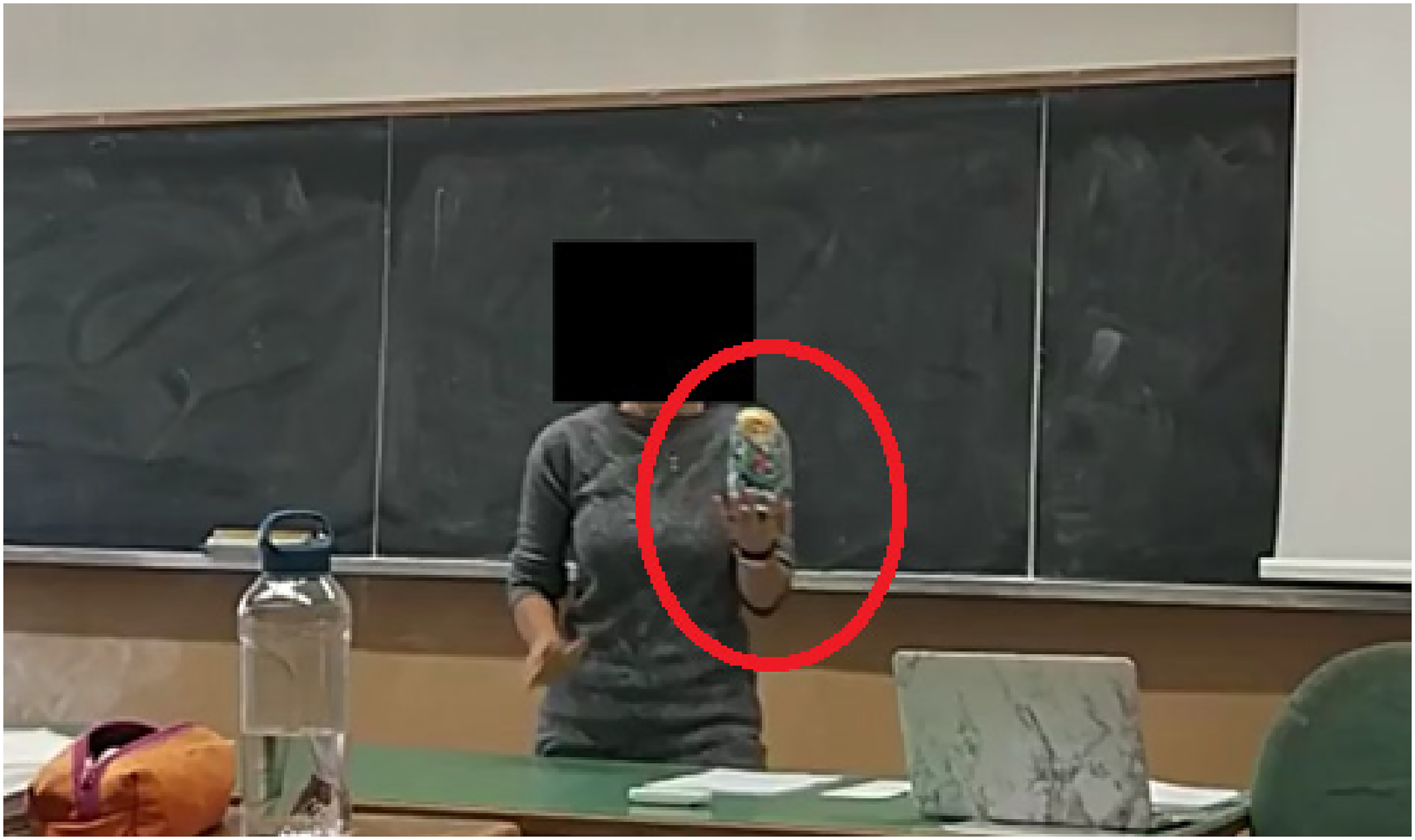
A snapshot from Group 1's mock lesson.
The main technique is justified by the institutional demand for collaborative TPD models. About the culture-related technique, the research report identifies elements of the technology that justify it, that is, relating the Japanese context with the existing Italian institutional framework is considered crucial for the implementation of teachers’ practices of another cultural context like LS, as shown in RR2.
This demonstrates that the teacher-education praxeology is influenced by the research praxeology. The didacticians consider LS as a suitable response to the institutional demand, and this knowledge originates from the literature review, which can be modelled as part of the logos block of the research praxeology. Due to the knowledge concerning the importance of culture, which is also modelled as part of the logos block of the research praxeology, the didacticians stress the cultural aspects of LS and the conditions and constraints existing in different institutions about carrying out TPD. These teaching practices are modelled by the teacher-education praxeology. This knowledge – developed from their practices as researchers – guides the experimental design, which involves developing Lecture 1 and the slides. As a result, the slides used by the didacticians in their position as teacher educators contain many references to the Japanese cultural context: the techniques of the teacher-education praxeology are justified by elements of the logos block of the research praxeology.
The data analysis allows us to identify the didacticians’ expectations on the prospective teachers’ practices during the TPD course. This analysis focused on the research report and the slides, together with resources from the Moodle platform and the course website. The general task for the prospective teachers is ‘to participate in a LS implemented in the Italian context’. We were able to identify sub-tasks involved in accomplishing this task, and to observe how the didacticians expected the prospective teachers to work. In the Moodle platform of the course (MOD) the prospective teachers were specifically asked to: MOD In groups, design an activity: title, grade, class context, prerequisites, key concepts, didactical aims according to the national curriculum, phases, methodologies, and suggestions for assessment.
At the end of Lecture 1, the prospective teachers were asked to ‘collaboratively study and design an activity, write an activity report, and prepare a lesson plan for a 20-minute-long mock lesson based on the activity’. Note that the terms ‘activity’ and ‘lesson’ are introduced and used in different settings, and by different didacticians. The task is also partially described in the research report, in the section describing the experimental design, where we see that some contents were explicitly requested in the lesson plan: RR5 [The prospective teachers] were given a task: […] prepare a 20-minute lesson […] working with LS. RR6 Despite this [the differences between the Italian and Japanese context, and the differences between a real school situation and the course context] we have also chosen to stimulate them [the prospective teachers] to keep the following LS elements: attention to time; division into phases; meticulous description of the work in a shared worksheet, lesson plan […]; collegiality, collaboration and sharing.
These items refer to three sub-tasks assigned to the prospective teachers by the didacticians, and to the techniques that the didacticians were expecting from the teachers for each sub-task:
The first sub-task is to design a teaching activity and to write an activity report (MOD). The expected technique is to work in groups to plan and choose school grade, didactical aims according to the national curriculum, resources and artefacts, prerequisites, according to m@t.abel resources (MOD). This sub-task is related to the mathematical topic and the students’ learning. The second sub-task is to plan a mock lesson and to write a lesson plan (RR5). The expected technique is to plan collaboratively and detail every phase of the mock lesson with educational goals, time needed, role of the teacher, and students’ response (RR6). This sub-task is related to the teaching action and the student's learning. The third sub-task is for one student per group to teach the mock lesson while the others observe the lesson. The expected technique for one of them is to teach the mock lesson, according to the plan, while the others observe (RR6).
These expectations originate from the didacticians’ position as teacher educators, as teacher education is the main goal of the course. Here, we identified the prospective teachers’ practices and knowledge on teachers’ practices inside and outside the classroom. Prospective teachers are learning how to design a teaching activity, how to plan a lesson, and how to teach in the classroom: practices which can be modelled in terms of didactical and paradidactical praxeologies. Furthermore, they are also learning how to conduct LS as a TPD practice. Overall, they can be considered elements of the prospective teachers’ meta-didactical praxeologies.
Prospective teachers’ praxeologies identified in the course: An analysis of the activity reports and mock lessons
The elements of the praxeology that models the prospective teachers’ practices during the TPD course can be identified by analysing the diverse kinds of data: activity reports, videos from the mock lessons, and answers to the AS. The prospective teachers’ praxeology identified in the course corresponds only partially to that expected by the didacticians.
The prospective teachers dealt with the first sub-task as expected by the didacticians. All eight groups produced, over the course of one to two weeks, activity reports that indicate the results of the prospective teachers’ work for this sub-task. While the specific technique (process) of producing the report cannot be ascertained due to the data limitation, they were asked to work together in groups, designing tasks for students and identifying target school grade, didactical aims, resources and artefacts, prerequisites, etc., based on the resources provided in the TPD course (e.g., national curriculum, m@t.abel resources). An example of an activity report (Group 1) is given in Figures 3 and 4, showing that the prospective teachers described the teacher's instruction and students’ learning envisioned in the classroom.
The second sub-task was to plan a mock lesson and write a lesson plan. This sub-task overlaps with the first sub-task but requires a more detailed plan. There was no evidence that the prospective teachers worked on this sub-task, as none of the eight activity reports was accompanied by a lesson plan. Four activity reports contained some time estimations for the activity, and only two of these divided a 1-hour activity (that could fit into one lesson) into 20-minute sections.
Regarding the third sub-task, one prospective teacher from each group implemented a mock lesson and the others observed it. This sub-task was accomplished but not as expected by the didacticians, as there was no plan to follow. The mock lessons also included different instructions that were not written in the activity report. For example, in Group 1's mock lesson, a matryoshka doll (Figure 8) was used as a metaphor for continued fractions (a fraction inside another fraction, like a doll inside another doll) which was not identified in the activity report. When asked about the doll, the implementing teacher stated that it was her autonomous choice, without consulting the other members of the group. In six out of the eight groups, there were similar occurrences of resources used in the mock lesson not described in the activity reports (or vice versa), with similar justifications.
The prospective teachers justify these differences. One answer to the question AS3 in the AS ‘Before participating in LS, what did you expect from the implementing phase? Has your opinion changed?’ reads: AS3.1 I like the fact that there is collaboration between teachers to create a common project to be presented to students, but there must be flexibility in adapting the lesson to the class […] according to the characteristics of the teacher (we are people and not machines).
The prospective teachers perceived the lesson plan to be rigid, in contrast with the need to maintain teaching flexibility according to the class context (which can be considered an element of the technology of their didactical praxeology). Elements of the theory that justify the importance of teaching flexibility come from the materials included in the course (i.e., references to m@t.abel, material on LS, national curriculum, etc.). In particular, the national curriculum contains non-prescriptive indications about the contents and competencies to be developed in mathematics, and the teachers retain flexibility in choosing the class syllabus (Minisola & Manolino, 2022).
Didacticians’ praxeologies after the mock lessons: The influence of research practice on the teacher-education practice
The didacticians’ practices and reflections after the mock lessons were analysed using the research report data, the questions designed for the AS, and Slides Set 2 used in the follow-up lecture. Their first task was to analyse and evaluate the prospective teachers’ work. Comments from the didacticians on the prospective teachers’ products can be found in their research report. The didacticians noted a mismatch between the prospective teachers’ praxeologies observed in the course and the ones they had expected in response to the task that they had assigned, as highlighted in the following comment from the research report: RR7 Each group should have produced an activity report and a detailed lesson plan for the lesson to be presented. However, all groups only produced an activity report with a general time indication […].
Based on this evaluation, the didacticians tackled a new task, which was not included in the initial experiment plan, namely, to design a survey to gain a better understanding of the prospective teachers’ knowledge about LS (RR8). RR8 […] the research group decided on a survey to investigate how much they [prospective teachers] understood about LS.
This reveals elements of the didacticians’ research praxeology: firstly, as researchers, they designed a TPD intervention; they then tested the intervention profiting of their position as teacher educators; and finally, they analysed as researchers what worked as expected or not, as highlighted by RR8.
In addition to the tasks of evaluation and of designing a survey, we also identified a task by the didacticians of investigating the mismatch found between the prospective teachers’ praxeologies observed in the course and the expected ones. WN How do we communicate better with teachers? RR9 Does ‘what is meaningful in the world of LS research’ have the same meaning in the teachers’ community?
It emerged that the teachers used the terms activity and lesson as synonyms (despite the didacticians used them in distinct ways during Lecture 1). The didacticians – as researchers – considered the problem of communicating better with the teachers (WN). Lesson plan, lesson, and [post-lesson] discussion are technical terms related to LS (Fujii, 2019; Quaresma et al., 2018), which were not defined during Lecture 1, as can be seen in Figure 2(b). For instance, the meaning of the term ‘lesson’ as opposed to the word ‘activity’ and considerations on the lesson plan as a distinct entity from the activity report, or in terms of structure or content, were left implicit: the didacticians considered that using the two terms in a distinctive way, and introducing them in separate settings, would be enough. Unexpectedly, these terms may have different meanings in different institutions in the same cultural context (researchers and teachers, RR9), and the researchers conclude that these terms must be defined when working with LS: RR10 At macro level, […] we believe there is a need to establish a shared language a priori, particularly concerning the terms ‘lesson’ and ‘activity’.
The didacticians worked on the task of redesigning Lecture 2. The new Slides Set 2 shows how the reflections of the didacticians as researchers again influence their practices as teacher educators. One hour of Lecture 2 was dedicated to a whole-class new presentation of LS supported by a new set of ten slides (Slides Set 2), eight of which, newly designed, presented the phases of LS and detailed what a lesson plan is and how it should be built; two were also contained in Slides Set 1, presenting the Japanese institutional context and proposing some differences between the Japanese and the Italian school context. Figure 5 shows an example from Slides Set 2. It describes some of the features of lesson plans that were missing from the activity reports. The meaning of the term lesson in the LS context was also defined (orally).
From the new resources, we can identify new elements of the didacticians’ teacher-education praxeology. The LS-related technique for task T2 is now: detail each of the five phases of a LS cycle and new resources (such as the lesson plan). The culture-related technique is unchanged.
The research report reveals theoretical elements that support the evolved teacher-education technique. The excerpt from the research report, describing Lecture 2, reads: RR11 During this meeting, the phases of LS had to be explained again, focusing on the phases of lesson design and implementation, marking the difference between designing an activity and planning a lesson.
It suggests that the didacticians are more aware of the importance of the terminology, as some terms may have different meanings in different contexts. This can be modelled as an element of the technology behind the explanation of the phases of LS. Up to this point, we are identifying teacher-education praxeologies. However, there are some peculiarities due to the influence of the didacticians’ position as researchers, particularly their logos block. As we can see from another excerpt from the same section of the research report: RR12 With the support of the data collected up to this point […]. Based on the analysis of the work […].
This suggests that the findings from experimental data are a new element of the didacticians’ teacher-education theory, alongside the ‘Principles of Japanese LS’. This is an aspect specific to the research process, due to the didacticians acting primarily as researchers. It can be observed how the didacticians’ position as researchers influences their practices as teacher educators. The didacticians are aware of a mismatch between the expected outcomes of the TPD course and the observed data. The data are collected and analysed through theoretical lenses that are specific to researchers in mathematics education. Here, the line between the didacticians’ position as teacher educators and the position as researchers is porous: adapting to this mismatch would be a normal teacher-education practice, but how this adaptation is tackled reveals the deeper influence of the research praxeology, as the questions in the AS are meta-didactic in nature. Therefore, we can observe the synergy between the two positions. As teacher educators, they notice a mismatch. As researchers, they investigate the causes of the mismatch in a process of design-based research (DBR). They discover that the mismatch may be caused primarily by the different meanings held by some terms in different institutional contexts. The knowledge generated by the research process can be modelled as elements of the logos block for their teacher-education praxeology. This results in new practices as teacher educators. In terms of MDT, this can be modelled as a double dichotomy between the meta-didactic level of TPD and another level, which can be called the research level of the data collected during TPD.
Prospective teachers’ praxeologies after lecture 2: Towards a shared praxeology
The answers to the FQ can be analysed to identify any evolution, resulting from Lecture 2, of elements of the prospective teachers’ praxeology. The prospective teachers’ praxeology is now more like what was expected by the didacticians: the data infer that the expected technique ‘to collaboratively plan and detail every phase of the mock lesson with educational goals, time needed, role of the teacher, and students’ response’ may indeed have emerged. Three answers are presented, to exemplify recurrent reflections by the prospective teachers. FQ4 asks ‘Which of these elements [the elements of LS] did you consider most valuable for you, and why?’ and FQ6 asks ‘What would you change about your activity/lesson and its implementation, and why?’. FQ6.1 If I had to rewrite it […] I would be much more precise […] full of all those details that we have not reported because for me, an ‘implementing teacher’, they were already memorised. FQ4.2 I found the planning phase especially useful because it allowed me to compare myself with the others [and] to understand how to plan a teaching activity when I become a teacher. FQ6.3 I would change our lesson plan […] to make our intentions clear and visible to a reader who […] might otherwise not understand our choices.
In FQ6.1, the prospective teacher describes how a new activity report would be much more detailed than the one initially designed, and then suggests they may be referring to writing a lesson plan, even though the distinction with the activity report is still unclear. FQ4.2, by a different prospective teacher, describes how the planning phase is useful when interacting with other teachers, and how important this phase may be for their future profession. FQ6.3 hints that a detailed lesson plan is useful for sharing information with other teachers. Together, they provide technologies associated with different collaborative aspects of the Lesson Plan: the planning itself; and the possibility of sharing it in a collaborative effort of dissemination of good teaching practices. This suggests that teachers and didacticians have a shared understanding of LS as an object, albeit with specificities due to their positions.
Discussion
Answering the research questions
The purpose of this paper was to investigate the complex twofold position of didacticians in acting as researchers and as teacher educators. The introduction of LS into the Italian TPD context was an opportunity to deepen our knowledge on the didacticians, as we observed that during TPD their positions as researchers and as teacher educators are deeply inter-related and continuously influence each other, and that the interaction with the teachers is an essential component of their work as didacticians.
About RQ1 on the evolution of didacticians’ praxeologies, we observed how this evolution could not have happened without the interactions with the prospective teachers, which proved essential feedback for the didacticians. We note that to accomplish their main task as researchers (to study LS), they designed an experiment to implement LS in a TPD course. Due to their academic role, they also occupied the position of teacher educators, whose main task was to conduct the TPD course. The didacticians’ practices and knowledge in terms of teacher-education praxeology evolved, supported by their research praxeology. In the first part of the experiment, they developed a set of teacher-education techniques used to introduce LS, supported by the logos blocks of teacher-education praxeology and of research praxeology. In the second part, these techniques changed, and so did the logos blocks. Between the two parts of the experiment, the didacticians became aware of a mismatch between the prospective teachers’ techniques they had expected and those observed in the course. The identification of this mismatch led the didacticians to investigate the teachers’ knowledge on LS, which is modelled by the logos block of their praxeology, and the impact of their teacher-education techniques on the prospective teachers’ learning of LS. The didacticians investigated their own practices, modelled by teacher-education praxeology: they identified some issues, discussion about how to solve these issues (which causes an evolution of their logos block, specifically the technologies now supported by new theories) and subsequently re-shaped their techniques, along with the TPD course. The method of investigation reveals the influence of research praxeology on teacher-education praxeology, as the questions in the survey are meta-didactic in nature. The dialectic between the two positions of the didacticians (teacher educator and researcher) provides an answer to RQ2 on the reciprocal influence between teacher-education and research praxeologies: elements of the teacher-education praxeology exist because of the research praxeology, and the praxis and logos block of the research praxeology evolve because of the evolution of the teacher-education praxeology.
The analysis of the relationship between the didacticians’ dual positions forms the basis of the evolution of their praxeologies, as we find that their teacher-education praxeologies evolve thanks to the knowledge that the didacticians generate in their position as researchers. More specifically, the experiment of implementation of LS described here resembles the process of DBR, in which instructional design and educational research are intertwined (Gravemeijer & Prediger, 2019). As we have shown, the didacticians have a teacher-education task (the implementation of LS in the Italian context, instructional design) and a research task (studying LS, educational research). In the two parts of the experiment (corresponding to two cycles of developing, testing, and revising in DBR), the didacticians develop teacher-education techniques which are critically examined through the interaction with the prospective teachers. The didacticians test their teacher-education techniques in the first part of the experiment and revise them (as researchers) by analysing the feedback received from the prospective teachers, which causes an evolution in the logos block of didacticians’ praxeology (by way of their didactical practice and in relation to their answers to the AS). In the second part, they test the revised teacher-education techniques, which are a design result. This will again lead to the revision of the techniques according to the feedback received from the teachers (the answers to the FQ), explored in another paper. Research results were also produced, which will be discussed in the following sub-sections. This was only possible as the didacticians are researchers, and DBR is part of their research practice.
This experiment also confirms the possibility of a convergence process by didacticians and teachers towards a shared terrain. In the second step of the experiment, we observe that the prospective teachers’ knowledge of LS is more like that of the didacticians than at the beginning of the experiment, so is shared by the two institutions albeit with specificities due to their distinct positions. LS plays a dual role for the prospective teachers and the didacticians. For the Italian prospective teachers, LS is a model of teachers’ collaborative practices which are characterised as a paradidactical praxeology, and an object of learning during the TPD. For the didacticians, LS is an object to be taught in teacher education (a paradidactical praxeology to be transposed), and an object of research. LS becomes an example of the shared praxeology theorised by MDT, which we can describe with the metaphor of the asymptote: over the course of TPD, the praxeologies of didacticians and teachers can share increasing elements, without ever being the same since didacticians and teachers belong to different institutions.
Implementation of LS
Studies on the adaptations of LS necessary to overcome cultural barriers were quite scarce, at the time of this experiment. This is no more the case (e.g., Huang et al., 2019) and it is interesting to notice that many conclusions from this experiment are in line with the new studies at the time (e.g., Ponte et al., 2018 or Peterson et al., 2019), which suggests that international collaboration is important to this field. However, this experiment demonstrated that local research is essential to understand the reasons why some aspects of LS may require more attention in some contexts than in other, to introduce LS successfully. Of many specific aspects, related to the Italian context, one stands out: the ambiguity activity – lesson.
We identified this ambiguity among Italian teachers due to the terminologies used in their ordinary practices (i.e., they usually design an activity rather than a lesson), albeit both terms are defined at an institutional level. This is a cultural issue which hindered our work on LS, and LS itself allowed us to highlight this issue for the first time in relation to Italian TPD. The role played by terminologies of mathematics education is now studied in mathematics education research: for example, the Lexicon Project (Mesiti et al., 2022) investigates the terminologies used by teachers in diverse cultural contexts when describing mathematics teaching in the classroom.
This issue reflects on the lesson plan, which is a specific tool of LS. Its importance was not clearly understood in our experiment as the activity report plays a similar role for Italian teachers. This leads to another problematic aspect, time planning. Time planning of the lesson may be (e.g., Fernandez & Yoshida, 2004, p. 73) or may not be part of Japanese lesson plans, but for our didactical goal (that is, making the teachers engage in self-reflection on their habitual teaching habits, see Mellone et al., 2019) it is required. Data suggest that it could be exceedingly difficult, for Italian teachers, to time plan a single lesson in detail, as they are not used to meticulous time planning of teaching activities within their institutions.
This study alerts us once again (Stigler & Hiebert, 1999) to the importance of understanding, and allowing others to understand, the cultural context in which we work. Making the cultural context accessible to others is still a current challenge in mathematics education (see, Adler et al., 2005 or Bakker et al., 2021). We need ‘to frame our research accordingly, to provide careful attention to their [the cultural and institutional constraints] influence on teaching and learning processes in mathematics’ (Minisola & Manolino, 2022, p. 8), while making these constraints explicit and accessible to the research community.
Theoretical contribution
ATD provided a solid framework for formulating the didacticians’ and prospective teachers’ knowledge and practices in terms of praxeology, and for understanding the influence of institutional constraints on the didacticians and on the prospective teachers’ praxeologies, but it did not exhaust the complexity and specificity of the situation.
This paper suggests a further evolution of the ATD framework (in which teachers are the ones who teach), as teachers and didacticians assume various positions. Teachers are the ones who teach the students, and they are also learners of how to teach and how to prepare teaching. Didacticians are both the ones who teach the teachers and the ones who research (about TPD). It is worth highlighting that the didacticians, here, are the ones who teach the teachers about LS, but in other contexts they may also be the ones who support the teachers during LS as knowledgeable others. In this paper they do not take on this position, which would add another layer of complexity to be considered for future experiments.
Making sense of the complexity of these positions is a current research problem (Robutti et al., 2016). MDT attempts to integrate them into a wider framework (Arzarello et al., 2014; Cusi et al., 2022), whereby the praxeologies of didacticians’ and teachers’ institutions are analysed in their evolution. Specifically, the notion of positions proposed by ATD brings us to a novel result in MDT. Until now, the double dichotomy that allows the evolution of the praxeologies had been observed only in the case of teachers, between the didactical level developed in the classroom and the meta-didactical level developed during TPD (e.g., Pocalana, 2023). The results of our analysis can also be modelled as a double dichotomy for the didacticians, between the meta-didactical level developed during TPD and the research level, developed when they are making sense of the data collected during TPD. This is the first time that such evidence has been found, to be further researched in the future.
TPD is a complex system, and the relationships between the diverse elements of the system were unclear. The results of this paper allow us to understand the complexity of the relationships between the diverse elements of the system, summarised in Figure 9.
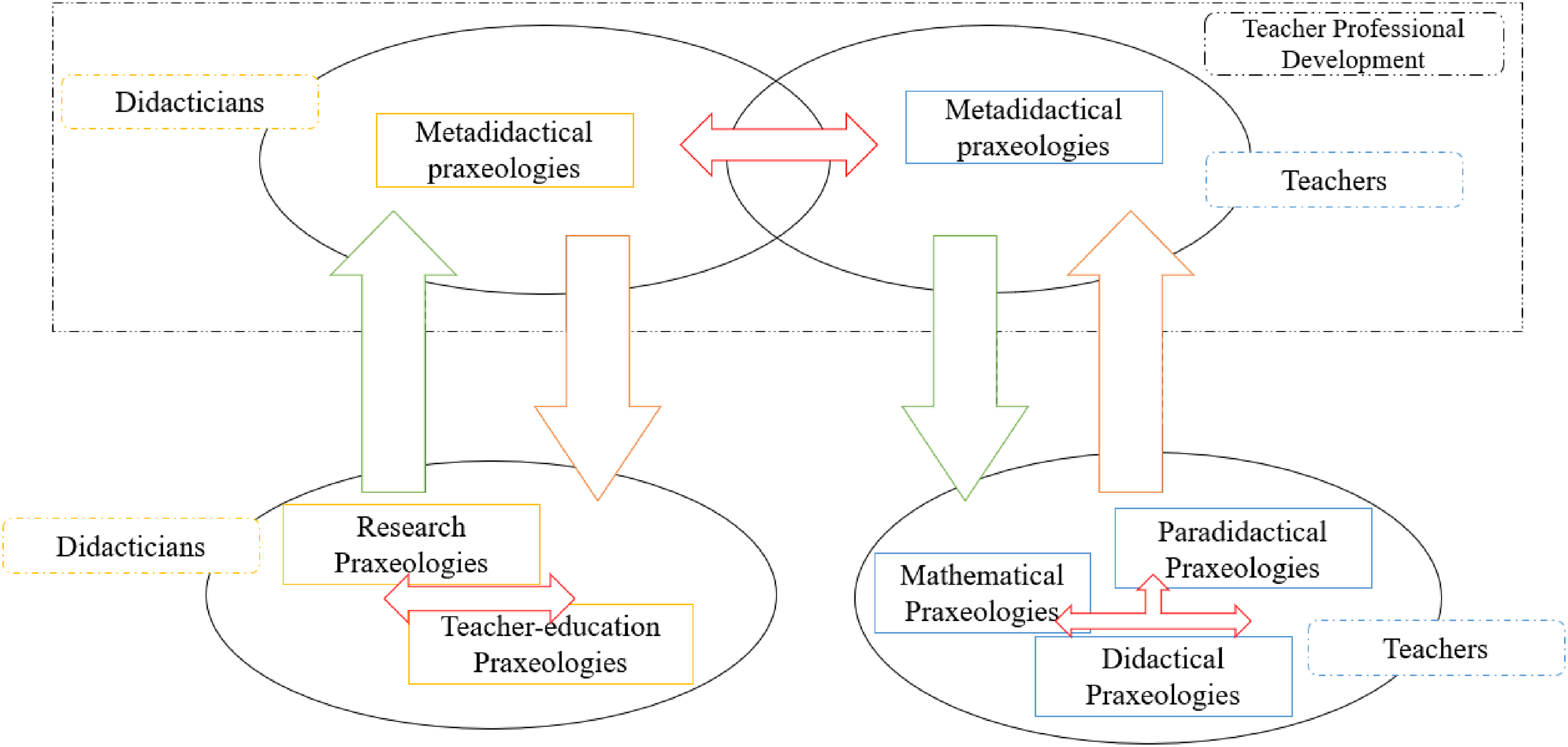
A summary of the praxeologies of didacticians and teachers.
This does not exhaust the complexity of the results. This study shows that:
on the didacticians’ side the double dichotomy, as suggested by MDT, shows that it is difficult to investigate didacticians’ practices and knowledge by clearly separating their research and teacher-education praxeologies. This suggests the need for an evolved model that strongly accounts for the complex position of the didacticians, and the relationships between research and teacher-education praxeologies; on the teachers’ side, it is difficult to investigate the evolution of their practices by isolating what is caused by themselves and what is caused by the didacticians. This calls for a model which considers the peculiarity of certain TPD contexts.
Our findings suggest that the combining (in the sense of Prediger et al., 2008) of the ATD and MDT theoretical frameworks may guide researchers in designing and analysing TPD programmes ensuring they interpret their complexity. Coordinating or even integrating them will be explored in future.
This study gives us an insight into two aspects that guide the complex position of didacticians in TPD: one is the didacticians’ research outlook; another is cultural, linked to the original context of LS. Implications are suggested for the study and implementation of LS itself through a cultural outlook. Synergies of the theoretical frameworks of ATD and MDT were shown, and thanks to these synergies both frameworks were expanded.
We recognise at least two important limitations of this study: data collection and terminology. Data collection was limited: future studies could take advantage of other documents to analyse the dynamics internal to the communities. Terminology of ATD and MDT is complex and overlapping, future networking of the two theories should find a new, simplified terminology.
Finally, LS offers a variety of research directions which were not explored in this paper. For example, future studies could take advantage of other documents to analyse the dynamics internal to the researchers’ and teachers’ communities. Much is left unsaid on the prospective teachers: future studies should consider the extent to which LS may contribute to their professionalism. Finally, we have questions on LS as a research object. The transposition of LS from didacticians to teachers was investigated, but the process of transposition from Japanese teachers to Italian didacticians is still obscure. Moreover, the role of LS in shaping the relationship between the communities involved should be considered.
Footnotes
Acknowledgements
The authors wish to thank Carola Manolino (at the time University of Turin, currently University of Valle d’Aosta) for her contribution in conducting the experiment.
Contributorship
Riccardo Minisola identified the research problem, designed and conducted the experiment and the data analysis, drafted the paper and contributed to revising the paper. Ornella Robutti conducted the experiment and the data analysis and contributed to revising the paper. Takeshi Miyakawa substantially contributed to revising the paper and to the data analysis. All authors read and approved the final manuscript.
Declaration of conflicting interests
The authors declared no potential conflicts of interest with respect to the research, authorship and/or publication of this article.
Funding
The authors received no financial support for the research, authorship and/or publication of this article.
Informed consent
The participants provided written informed consent to partake in the study and have been made aware of the publication.

Correction (December 2024):
Article updated to add Informed consent section.