




Abstract
The aim of this paper is to investigate how the contents related to the arithmetic of fractions, as described in the official curriculum issued by the Japanese Ministry of Education, Culture, Sports, Science, and Technology (MEXT), are implemented in actual teaching at the so-called Japanese supplementary school in Denmark. Additionally, at a methodological level, this case study demonstrates how so-called praxeological reference models can be developed at different levels of detail to describe classroom teaching at a particular grade level and the overall curriculum of primary school in a connected way. This study is based on the notions of praxeological reference models and moments of didactic processes from the Anthropological Theory of the Didactic. The findings reveal that (1) not much time is allocated to each moment and (2) the flow of gradually building up techniques, as intended by the textbook authors is to some extent disrupted in the lesson.
Keywords
Introduction
In mathematics education research, there is a tendency to study classroom episodes almost independently from studies of curricula (or official programs). In particular, classroom studies typically feature the curriculum as (at most) a background part of the context. In this paper, we attempt to demonstrate, through a case study, how modeling and analyzing the curriculum can be done in a way that informs and is tightly connected to the analysis of observations from a classroom conducted with this curriculum. This is mainly a methodological point of the paper. It draws heavily on elements from the anthropological theory of the didactics, which we outline in Section 3.
The case we consider is also interesting in its own right, as it relates to the phenomenon of expatriate schools (here, a so-called Japanese Supplementary School in Denmark [JSSDK]). This school uses the same curriculum as ordinary Japanese schools. However, mathematics is taught once a week for 90 min (we will say more about the specific case of Japanese supplementary schools [JSS] in Section 2). How is mathematics taught in the school? How does the Japanese mathematics curriculum transpose to contexts outside of Japan? We would imagine that different institutional conditions and constraints may lead the curriculum to be “implemented” (or rather transposed) in very different ways, but it has not been theoretically clarified. Based on classroom observations, we investigate how a particular topic (addition and subtraction of fractions) is realized in actual teaching in the JSSDK. In this paper, we have not observed lessons in Japanese ordinary schools, so it is not possible to explicitly discuss the differences between the didactic processes in these and in JSSDK. However, we briefly develop some hypothetical differences based on a previous study by Stigler and Hiebert (2009). As Stigler and Perry (2009) stress the importance of cross-cultural comparison for an explicit understanding of teaching mathematics, comparing the didactic processes in those two institutions will provide a better understanding of the didactic processes in JSSDK.
The paper is structured as follows. After presenting the theoretical framework, the context, and our research questions, we first present a meticulous analysis of the Japanese curriculum on the arithmetic of fractions and subsequently show how the resulting model can be used to analyze an episode of fraction teaching in JSSDK. We finally reflect on the scope or generalizability of the proposed method for studying curricula and classroom teaching with the same model.
Context and background
Globalization has caused an increasing number of people to live in (for them) foreign countries for extended but limited periods of time, for instance, to work in an overseas branch of their company. In particular, around 83,000 Japanese children in grades 1 to 9 live abroad as of 2017 (Ministry of Education, Culture, Sports, Science and Technology [MEXT], 2021). To ensure continuous schooling of children, several countries, such as France, the United Kingdom, and Germany have established overseas school systems. As for Japan, the government established Japanese educational institutions abroad for Japanese children as early as the 1950s (Shibano, 2020), including the so-called JSS. These schools were initially established for children who were supposed to go back to Japan; however, in more recent years, there has been an increasing number of children in these schools who live permanently (or at least for an indeterminate period of time) in the foreign country (Shibano, 2020).
The schools receive financial support from Japan's MEXT, in addition to the tuition paid by the parents of children attending the school. The institutions function only on Saturdays or after school hours, as children are supposed to attend a national or international school, for which the JSS then serves as a supplement, focused mainly on the Japanese language. However, the schools also teach other subjects, in fact, 80% of the schools provide Japanese as the primary subject and mathematics as another subject, based on the Japanese national program and Japanese textbooks (Okumura & Obara, 2017). All subjects are taught in Japanese. Okumura and Obara (2017) point out that the reason mathematics is taught in addition to Japanese is because mathematics is provided in local schools as well. Teaching in both the local school and JSS can then be applied to each other and help to improve the Japanese language skills of the children (Okumura & Obara, 2017).
The JSSDK, the context of the case study presented in this paper, operates every Saturday morning and provides teaching of Japanese and Mathematics. Children attend local or international schools in Denmark or southern Sweden. The first language of most of the children at JSSDK is Danish or Swedish, so in terms of Japanese proficiency, not all are at the level of children of their age in Japan. One lesson lasts 45 min, and on each Saturday, there are two lessons for each of the two subjects taught. In particular, the time devoted to mathematics is less than half of what is common in regular Japanese schools. In fact, the school covers all the mathematical content that children in Japan learn, but with only 55.5 h per year, unlike the 136–175 h per year that are available in regular Japanese schools. We note that all grades (1–9) are taught separately, and due to the modest number of children (80 in total), it is not uncommon for a class to have just a few children, unlike regular schools in Japan where classes usually consist of 35 children (MEXT, 2021). As ensuring a sufficient and stable number of teachers is a challenge for all supplementary schools, the teachers at this school, like those in other supplementary schools, are hired locally regardless of whether they hold a teaching license or have teaching experience, and they have other professions as their main job. Like teachers at other supplementary schools, they have limited time to develop lesson plans, and there are few opportunities for in-school or outside-school training to improve their teaching skills. Consequently, teachers conduct lessons based on their own teaching experience at the JSS and teaching guide.
Theoretical framework and research questions
Our study is based on the Anthropological Theory of Didactic (ATD), specifically focusing on the notions of didactic transposition, praxeology, levels of didactic codetermination, and moments of didactic processes. All of these are needed to formulate and motivate our specific research questions.
The theory of didactic transposition was elaborated for the case of mathematics education by Yves Chevallard, in the late 1970s. It considers that knowledge (including both practical and theoretical knowledge) must be understood as residing in institutions, and focuses on the way knowledge is transposed between institutions, which is not merely “transportation” but also requires adaptation to the conditions of the receiving institution. The main transpositions related to education comprise four stages in the transposition process: Scholarly knowledge (in institutions outside of school, such as universities), Knowledge to be taught (at schools, but formulated elsewhere such as in ministries), Taught knowledge, and Learnt knowledge (both within the school). In particular, the transposition from knowledge to be taught to learned knowledge is called internal didactic transposition (Chevallard, 1985). Within this theory, the knowledge that pupils acquire in schools is understood in terms of the three previous stages. The term “transpositions” here is used in a metaphorical sense: such as changing from one key to another key to play a piece of music, knowledge is successively adapted to fit official programs for schools, the classroom, and finally the individual pupil (Chevallard, 1999). In this paper, we study the internal didactic transposition taking place at JSSDK: How teachers implement the official curriculum in mathematics to the classroom within this institution, in view of the special conditions outlined above.
To conduct this study, we first need to elaborate an explicit reference model to describe the knowledge to be taught. In ATD, explicit reference models play a crucial role for researchers to keep distance from transposition processes (Bosch & Gascón, 2006), and the role of the model depends on the specific research purpose—in particular, the research questions. Here, the model is used to clarify what mathematical knowledge is officially set to be taught in Japanese primary schools (comprising grades 1–6). In order to develop this model, we need the notion of praxeology and the levels of didactic codetermination.
In fact, another fundamental assumption of ATD is that any human activity and knowledge can be modeled in terms of praxeologies. A praxeology consists of two interrelated parts. The first part is called the practical block. It consists of a type of task (Τ) and techniques (τ) that can be used to solve tasks of the type T. The second part is the logos block which is composed of a technology (θ) to explain the techniques and a theory (Θ) to justify and unify several technologies. A praxeology regarding mathematical knowledge is called a mathematical praxeology or a mathematical organization (Barbé et al., 2005). Praxeological models can describe all four levels in more or less detail, depending on the research aims: As in any other empirical discipline, didactic researchers need to construct explicit models of central phenomena to be studied, such as mathematical practice and knowledge.
Praxeologies are closely related to the first three levels in the theory of didactic codetermination. These levels are used to specify knowledge and practice in school institutions at different levels of institutional granularity, within and above the school itself. While a total of 10 different levels may be considered (Artigue & Winsløw, 2010), we shall focus here primarily on the three lowest levels:
– The first level, called Subject, corresponds to a point praxeology (Τ, τ, θ, Θ) to be taught and is often referred to by the symbol T. For instance, addition and subtraction of fractions with a common denominator [ – The second level, called Theme, is an organization of several subjects to be taught, and teachers usually enjoy some freedom also at this level; still, the knowledge to be taught usually comprises indications about the theory blocks that unify and organize the theme. For instance, a theme labeled “Addition and Subtraction of fractions” could determine a progression from the case of fractions with like denominators, toward the general case, while also drawing on a theory of equivalent fractions, as we shall see later. The praxeologies involved (Τi, τi, θ, Θ) are unified by a technology to describe and justify the different techniques involved. – The third level, called Sector, is unified by a theory and is thus constituted by praxeologies (Τi, τi, θi, Θ) where the central object is the unifying theory. For instance, the sector “Operation with fractions” will be characterized by a theory on the arithmetic of fractions, in which the four operations are related theoretically (for instance, some operations are inverses of each other, and there is a distributive law to relate addition and multiplication, and so on).
The subject level thus corresponds to more concrete and “small” parts of the knowledge to be taught, and can be associated with specific tasks or exercises that may sometimes be found in a simple section of the textbook, to be studied in short periods of time such as a few lessons; a sector may extend over several school years and will typically be intertwined with, and draw, on other sectors.
These levels together with the more detailed description of praxeologies are used, in this paper, as a tool for modeling the mathematical knowledge to be taught regarding fractions in the Japanese primary school. We develop the detailed model in Section 5.
As we mentioned before, our focus is how knowledge to be taught transposes to teach knowledge in JSSDK. Therefore, we need to investigate the didactic processes that occur in classrooms, extend in time and form the teachers’ way to organize a subject, theme or even sector in time. When analyzing a lesson, the notion of didactic processes allows us to describe the didactic flow in terms of the praxeological reference model (PRM), and in particular to classify episodes in the teaching in terms of what elements of the praxeologies are being worked on.
Didactic processes are considered to be built by six kinds of episodes or moments: Moments of first encounter, exploratory moments, technological–theoretical moments, technical moments, institutionalization moments, and evaluation moments (Barbé et al., 2005). Considering a classroom protocol, we concretely identify (not necessarily in this order):
– First encounters occur when pupils meet new types of tasks (Τi); here the focus is on simply understanding what the new tasks mean and ask for. – Exploratory moments consist of activities in which pupils try to solve one or more tasks of the new type(s) Τi and develop some first techniques (τi); here the focus is on the exploration based on what pupils already know. – Technological–theoretical moment occurs when one or more techniques τi (developed, for instance, in an explorative or technical moment) are examined and discussed, for instance, to name, compare or justify the techniques, or to develop a theory that could relate and justify several technologies. The focus here is thus on explication, justifications, and the relation of praxeologies. – Moments of technical work occur when techniques are introduced, strengthened, and generalized, and the focus is thus on elaborating pupils’ technical knowledge, beyond what can be obtained by a first exploration. In mathematics, the routinization of techniques, as well as elaboration and extension of techniques, may take up rather considerable parts of the didactical process. – Institutionalization moments are elements of the didactical process where the teacher summarizes or introduces knowledge—technical or theoretical—which the students are supposed to have learned or should subsequently work on learning; the focus here is on relating the work in the classroom to official aims. – Finally, evaluation moments are those parts of the didactical processes which are devoted to assessing some praxeologies which the students are supposed to have learned, in view of determining their qualities: For instance, students may be submitted to a test, or they may be engaged in evaluating the extent to which the work carried out so far leaves open questions that could be studied in the future.
The six moments are used to analyze the didactic processes in the JSSDK, not only to divide them into episodes with the said characteristics, but also to identify moments that are emphasized and to which more time is devoted, possibly at the expense of others.
We can now formulate the research questions of this paper:
What mathematical praxeologies regarding the arithmetic of fractions are set as knowledge to be taught in grades 1–6 in Japanese primary school? How can the goals be described at different levels of didactical codetermination?
How do these mathematical praxeologies develop in the didactic processes in JSSDK, particularly at the level of a theme relating to several subjects? What moments are emphasized?
Methodology for RQ1
In order to answer RQ1, we elaborated a PRM of the sectors on fractions (hereafter, we call this the regional PRM), stretching over five grades (2–6). We mainly used the program and textbooks as data to base this model on. The program was used for defining the levels of sectors and themes, and the latter was referred to for identifying the subject levels.
There are two levels of national programs issued by the MEXT in Japan: A general course of study for primary school (SHOGAKKO GAKUSHU SHIDO YORYO) and a primary school teaching guide for the Japanese course of study in mathematics (SHOGAKKKO GAKUSHU SHIDO YORYO KAISETSU SANSU-HEN). The former specifies the basic act of education, general educational aims, and an outline of contents for teaching in each discipline. By contrast, the latter is published for each discipline, such as mathematics, and contains more detail than the course of study. In our study, we primarily used the latter document and referred to it as the program. In the program, there is a very useful table (MEXT, 2017, pp. 12–15), which summarizes the structure of the content of mathematics in grades 1 to 6. The content to be taught is shown by five domains: “A. Numbers and Calculations,” “B. Geometric Figures,” C. “Measurements” (grades 1 to 3) or “Variation” (grades 4 to 6), and D. “Data handling.” This table then specified more concise labels for each domain, for instance, “teaching Addition and Subtraction of simple fractions” occurs in grade 3, in the domain of A. We mainly used this table when we defined the sectors and themes, although it does not suffice to describe all themes precisely. For instance, “teaching simple fractions such as
The textbooks are authorized by MEXT and are published by commercial textbook companies in Japan. Hence, the two levels of national programs and textbooks are interconnected and tightly aligned. The schools select the textbook company and distribute it to pupils. Here, we choose textbooks published by TOKYO SHYOSEKI publishing company (one of the textbook series authorized by MEXT) as it is used in JSSDK. Besides that, textbooks are widely used in ordinary schools in Japan. Here, we used the textbooks to define subject levels in terms of types of tasks and techniques since explicit tasks and techniques are stated in the textbook, more than in the program.
The process of elaborating the regional PRM is then as follows:
Browse through the table for the domain of A: Numbers and calculations, dividing it into two sectors, fractions (Sector1) and operations with fractions (Sector2). Pick up mathematical contents regarding fractions in the table and categorize these (within each of the two sectors) as a theme. Identify which grade these themes are taught in. After identifying the sectors and themes, browse through relevant textbook chapters, and analyze all examples and exercises to define types of tasks. We do not describe all techniques relative to types of tasks here, but we describe the techniques related to the lesson presented later. Whenever a task is encountered, which does not belong to a type of task already identified, a new type is added to the model. Ensure whether these types of tasks are positioned in the right themes, and confirm all titles of themes, particularly if the titles of themes are consistent. If necessary, modify the title or reposition the types of tasks.
Some of the tasks in the textbooks are not independent. In this analysis, subordinate tasks were considered techniques to solve main tasks. We do not explain for instance, why the sector is divided into two parts, and how we modify the title of themes. However, we will answer these questions in the next section as it is easier to explain in the context of our regional PRM.
Methodology for RQ2
In order to investigate RQ2, we collected data (specified later) from actual lessons observed in the JSSDK. We first present an outline of the lesson, and then explain how to analyze it in terms of didactical moments, corresponding to concrete themes from the regional PRM.
The two lessons investigated here were taught on 30 October 2021 in a 5th grade with three pupils, and lasted in total for 90 min, with a break in the middle. The teacher we observed is Japanese and has experience teaching in this school for 7 years. She has licenses to teach Japanese languages in Japanese lower and upper secondary schools and a certificate to teach in special schools for children with special needs. The two of the three pupils go to the Swedish primary school on weekdays, while one attends Danish primary school. The lessons were given in Japanese, as always. During the lessons, the teacher used a teaching guide provided by the publisher of the textbook they used. The teacher—as is also common—had prepared slides in advance to show on the smart board, mainly consisting of pages from the textbook, with some space where she could add handwritten notes during the lesson. In addition, she put the title of the subject and definitions of the mathematical terms, summarized in her own words.
From the beginning, the teacher let pupils open the textbook, and the pupils kept the textbook open during the lessons. Pupils also had personal notebooks, but they wrote answers to tasks directly in the textbook. Only once did they take notes in the notebook, at the demand of the teacher, regarding the definition of Reduction to a common denominator and Reduce fractions. The lessons were based on a part of chapter 10 in the 5B textbook: Let's Extend Addition and Subtraction of Fractions (Fujii & Majima, 2021, pp. 2–19), and the teacher conducted the lesson based on slides showing pages 2 up to 12. We took field notes during the observation, as well as pictures of smart board and pupils’ productions. The lesson was voice-recorded and transcribed in Japanese. After that we translated the lesson transcript into English. The analysis of these data is presented in a table showing how the lesson can be subdivided into episodes, each corresponding to didactic moments. Didactic moments are defined relative to praxeologies that are developed in the episode; so, the extent of the episode (in time) depends on when new types of tasks, techniques, and so on are introduced. We described types of tasks and techniques based on our reference model established to answer RQ1, while additional techniques developed by pupils were also noted.
This way, the flow of the lesson was analyzed in terms of how pupils established praxeologies are drawn on, and how new ones develop, through the identified moments. The primary data for the analysis is the transcript, but as always for analyzing mathematics lessons, captures of written representations such as photos are indispensable to interpret what is being talked about. Field notes help to relate the transcript and the pictures.
Results
In this section, we present the results for each research question separately. Note that the presentation of results related to RQ2 relies heavily on the model developed to answer RQ1.
Praxeological reference model
We present our regional PRM of fractions in Table 1; reading the content clearly requires some explanation. First, we note that we have found it useful to model the parts of the arithmetic domain that focuses on fractions, as two sectors: Fractions as objects (sector1) and operations with fractions (sector2). The main reason why we categorized it as two sectors is that one of the five domains is called “Numbers and Calculations” in the Japanese program, so that it corresponds to the official way in which the knowledge to be taught is categorized. In sector1, five themes are shown:
– Semantics of fractions, including visualizations (theme1−1), means parts of the teaching focused on explaining the meaning of fractions, viewed as individual quantities. For instance, pupils learn how simple fractions are used to represent the size of parts that arise when an object is cut into pieces, such as 1/2 in the case of two pieces. Fractions representing quantity, such as (2/3)m and (4/5)l are included in this theme. Pupils need to be able to read out simple fractions, such as “one half.” In addition, pupils should acquire terminologies related to fractions (e.g., the numbers 2 and 1 in 1/2 are called the denominator and numerator, respectively). – Fractions in relation to multiplication and division of natural numbers (theme1−2) are about how fractions can be interpreted as operators involving arithmetic of natural numbers: Division, multiplication, or both. Here, we refer to examples mentioned in the Japanese program (MEXT, 2017, p. 107). Figure 1 shows 12 marbles (on the left in the figure). To the right we see two groups of 12 marbles. This figure represents that 12 marbles are twice as many as six marbles, but also that 1/2 times 12 marbles gives six marbles. – Ordering fractions (theme1−3), mean pupils learn how to compare the magnitude of two or more fractions. For instance, this theme relates to a task such as “Arrange 1/2, 2/3, and 1/4 in ascending order” (Fujii & Majima, 2021, p. 9). – Relating integers, fractions, and decimals (theme1−4) concerns the passages between these three kinds of number representations. For instance, pupils will be able to represent the result of a division as a fraction (e.g., – Equivalence of fractions (theme1−5) includes activities such as producing several fractions that are equivalent to a given fraction and simplifying fractions, for instance, “Reduce the following fractions: 8/12, 2(18/24) and 90/15” (Fujii & Majima, 2021, p. 12).
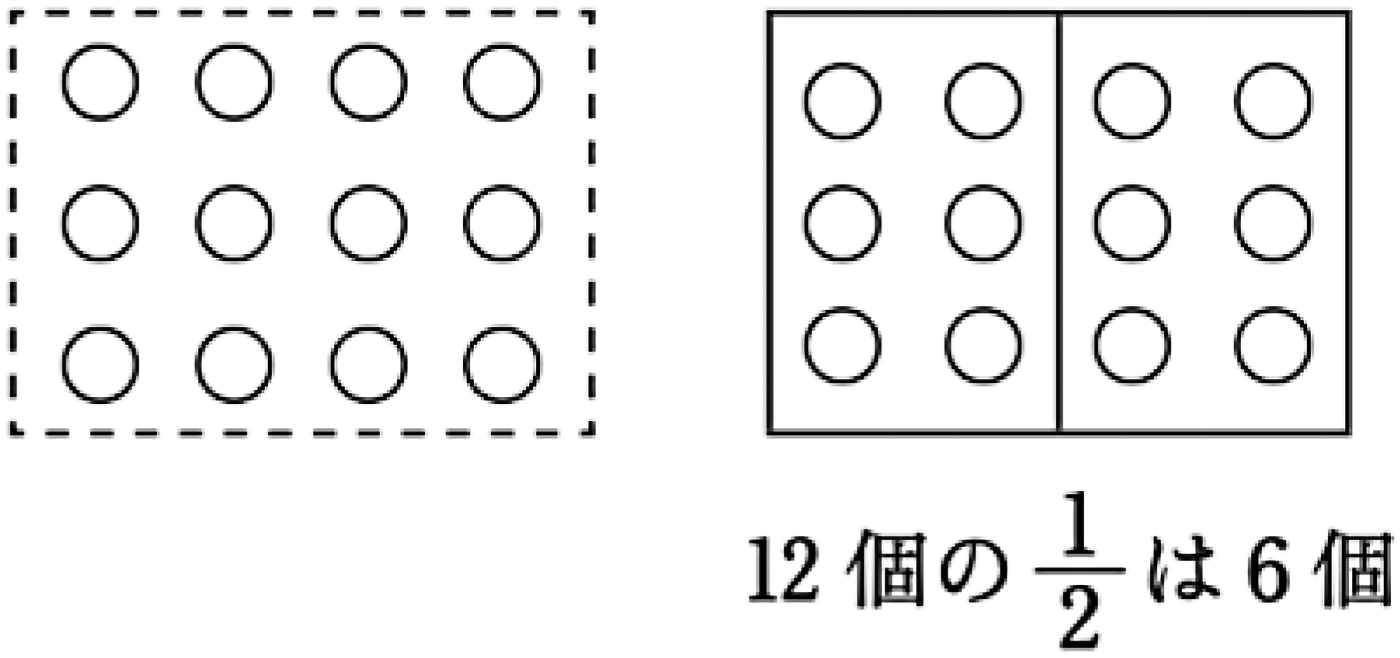
A diagram from the program (MEXT, 2017, p. 107).
The regional PRM of fractions.
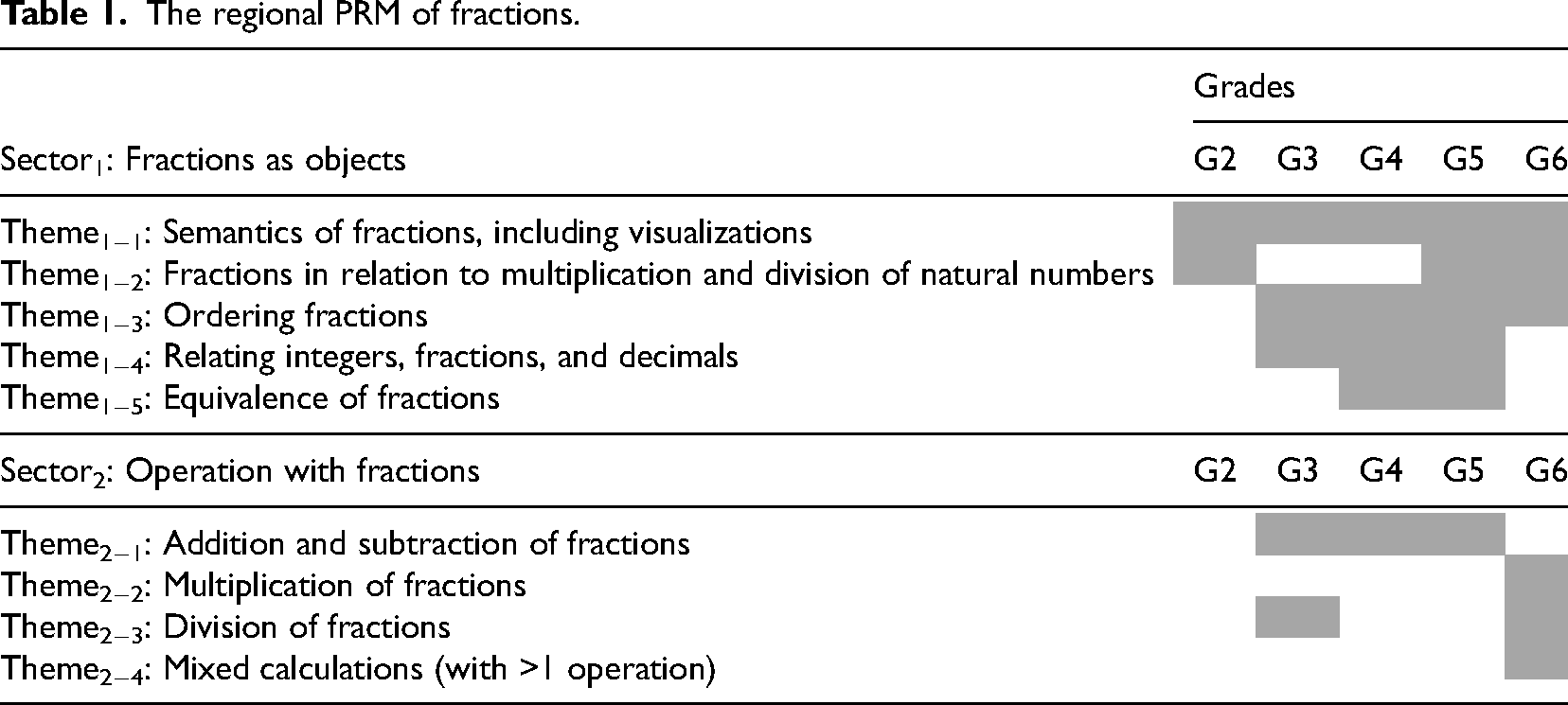
In sector2, we distinguished four themes: Addition and subtraction of fractions, multiplication of fractions, division of fractions, and mixed calculations (with >1 operation). We defined addition and subtraction of fractions as the same theme because both operations rely on the same techniques. We do not think detailed explanations of the first three themes are needed here. Mixed calculations mean that pupils learn to handle expressions in which multiple operations are included such as
All themes were named and categorized in a way that is strongly influenced by the table in the program (MEXT, 2017, pp. 12–15). We directly used the name shown in the table as titles of most of the themes in our model (e.g., “equivalence of fractions”). Note that we simply chose to include the mathematical contents that fall under the label “fractions” in the program (MEXT, 2017, pp. 12–15); therefore, mathematical contents indirectly related to fractions (e.g., ratio or probability) was not included in our model. Our regional PRM indicates what mathematical praxeologies regarding fractions are set as knowledge to be taught from grades 2 to 6 in Japanese primary schools. Notice that fractions are not taught before grade 2. As with any model, our regional PRM leaves out many details, like how the individual themes are related to each other. Our model does show in what grade(s) the theme—or some part of it—is actually taught, according to the program and textbooks; but it does not show what is taught first or next within a given grade, and this may in fact vary according to the choices of teachers and textbooks.
The subject level, corresponding to types of tasks (T) and techniques (t), is not shown in Table 1, but of course, each theme includes several subjects. But if needed, we can “zoom in” on any theme, as well will now exemplify. Concretely, in Table 2, we present the local PRM of the themes, theme1−3, theme1−4, theme1−5, and theme2−1 that appear in the lesson we observed, as we used this PRM later for investigating RQ2 with the same lesson as case.
The local PRM regarding the theme related to the lesson which we observed.
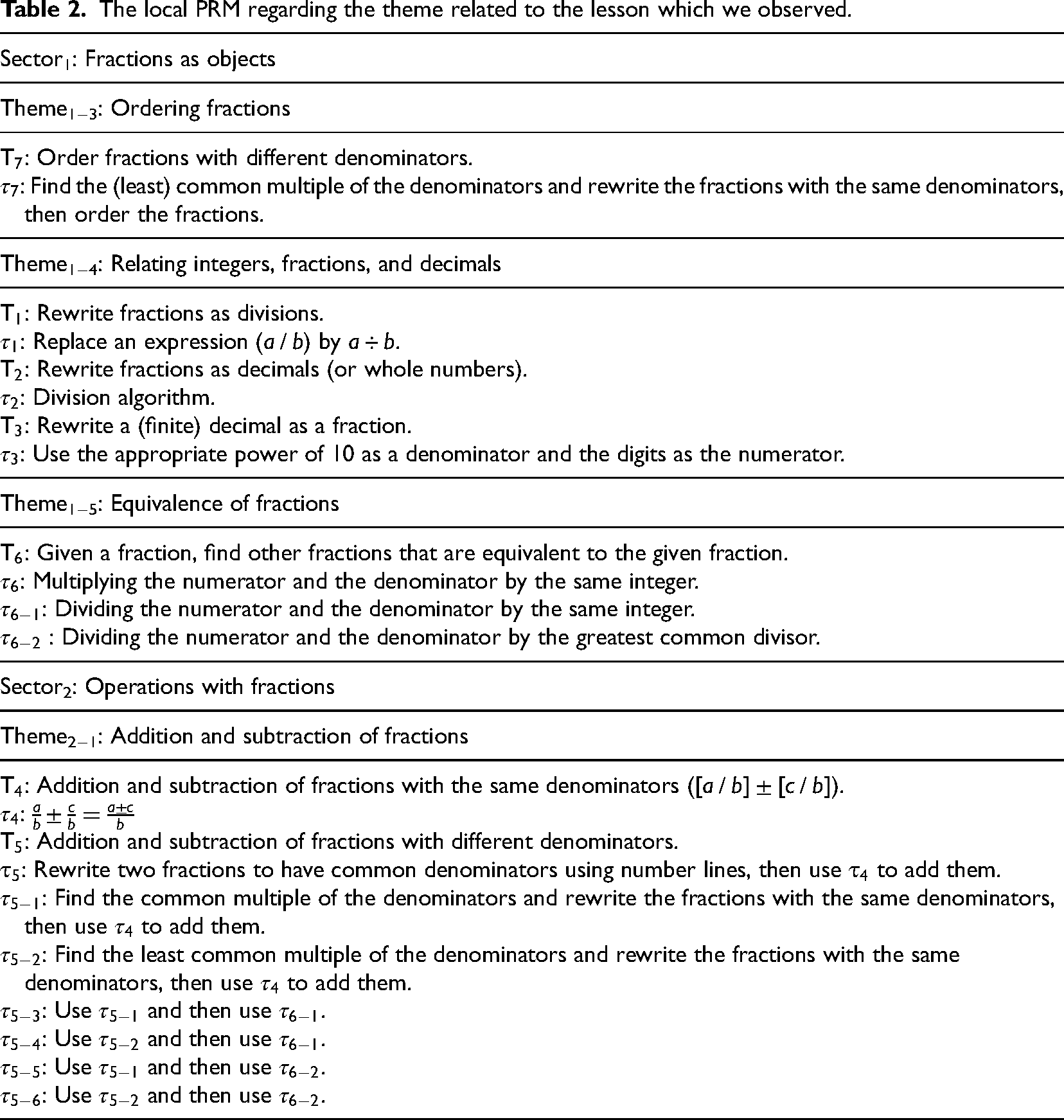
Seven types of tasks with corresponding techniques are shown in our model. All types of tasks and techniques are identified based on our analysis of the pages of the textbook corresponding to the lesson (Fujii & Majima, 2021, pp. 2–19); in other words, these types of tasks and techniques are expected to be worked on during the lesson. The Japanese textbook breaks several techniques into small steps. For instance, in order to acquire the technique (
Thus, in short, Tables 1 and 2 constitute our answers RQ1: What mathematical praxeologies regarding the arithmetic of fractions are set as knowledge to be taught in grades 1–6 in the primary school in Japan? We notice how the levels of codetermination (subject, theme, and sector) and praxeologies allowed us to provide these answers at different scales, which can serve different purposes. While the regional PRM can be used to discuss links across grades, the local PRM could be used to situate and study the details of content taught in a lesson or developed in a textbook chapter.
In this section, we analyzed a grade 5 lesson in JSSDK based on the models developed to answer RQ1 and the theoretical framework of six moments. In particular, we investigated how these mathematical praxeologies develop during didactic processes as these—not the matter to be taught—may differ from JSSDK. We first describe the first few episodes briefly to show the flow of the lesson, as it appears in the transcript (all of the lessons are whole class teaching). Then, we present the table with a summary of the didactic processes in the whole lesson. When we describe pupils’ utterances, we assign them names as P1, P2, and P3.
Description of the first 3 episodes
1. Episode 1: Reviewing what pupils have learned about fractions
The teacher presented the following tasks: 2. Episode 2–2.2: Addition of fractions with different denominators 3. Episode 3–3.7: Equivalent fractions
The teacher presented the following task: There are
The teacher presented the following task: Find other fractions, besides 6/8 and 9/12, which are of the same magnitude as 3/4 (Fujii & Majima, 2021, p. 5). P1 and P2 immediately proposed 12/16 and 15/20, respectively. However, P3 was confused about how to find these other fractions, so P3 asked “Are 12/16 and 15/20 of the same magnitude as 3/4?” P2 said that “15/20 is the same magnitude as 3/4 because both the numerator and the denominator are multiplied by 5.” The teacher agreed with P2's opinion. P3 asked the teacher, “should I add 4 to 20 and 3 to 15?” The teacher answered that “it is not addition,” but P2 claimed that P3 was right. The teacher and pupils confirmed that if we add 4 to 20 in the denominator and 3 to 15 in the numerator, the answer will be 18/24 and that 18/24 is the of same magnitude as 3/4. Everyone then agreed that the technique developed by P3 can work for this task.
After those interactions, the teacher pointed to a diagram in the textbook (see Figure 2) and confirmed the answer that 3/4 must be expanded by 2, 3 and 4 to yield, respectively, 6/8, 9/12, and 12/16.
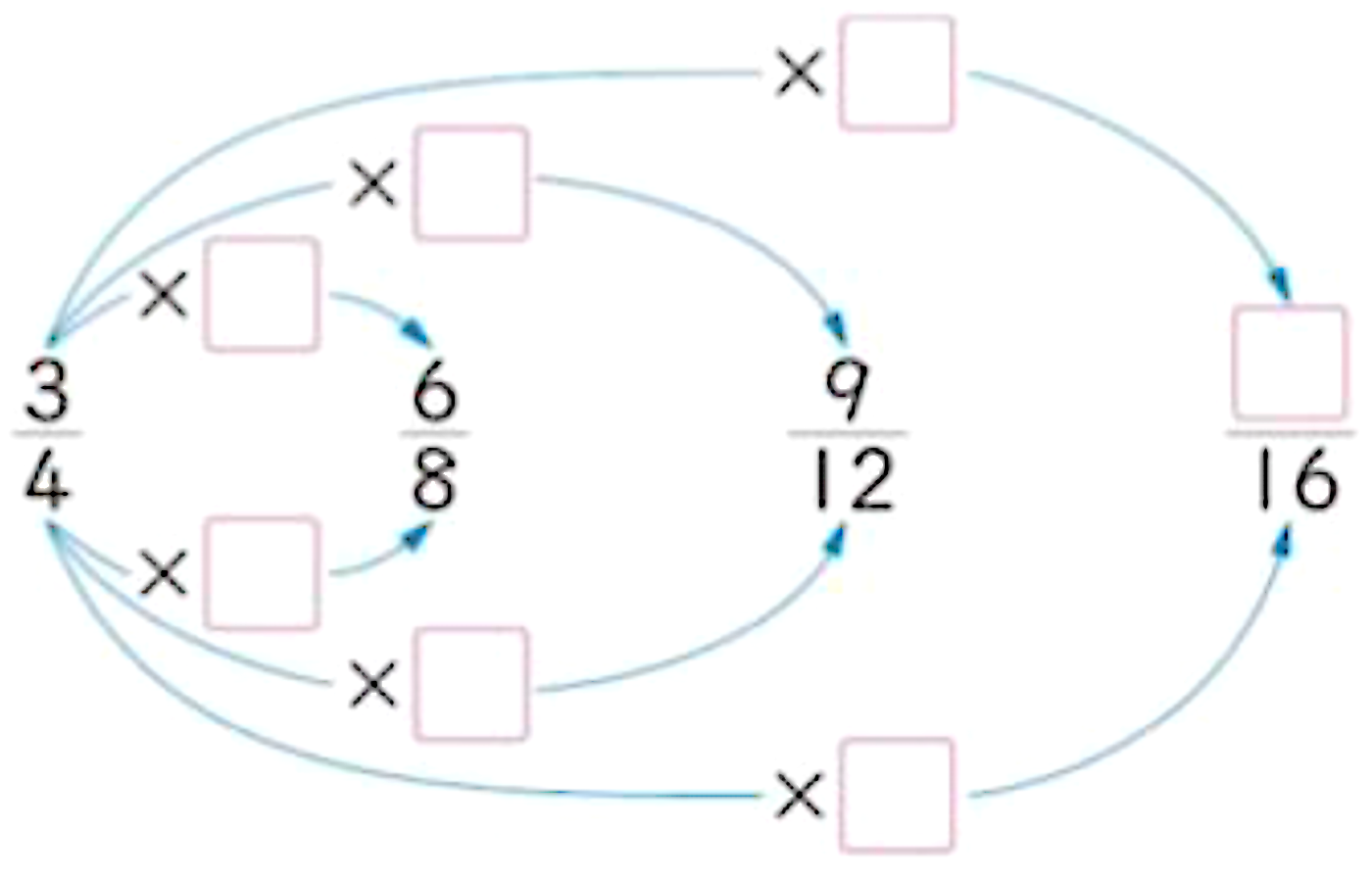
A diagram from the textbook (Fujii & Majima, 2021, p. 5).
Based on this technique, the teacher confirmed that 15/20, 24/18, and 75/100, found by the pupils, were all of the same magnitude as 3/4. Finally, the teacher summarized: Fractions with the same magnitude can be found by multiplying the denominator and numerator by the same number.
After that, the teacher pointed to a diagram in the textbook and presents a task: Determine whether 12/16 and 3/4 are of the same magnitude by rewriting them as decimal numbers (Fujii & Majima, 2021, p. 6) and everyone confirmed that 12/16 and 3/4 can be rewritten as 0.75, so that 12/16 and 3/4 are of the same magnitude. The teacher pointed to a diagram in the textbook (see Figure 3) and asked how to convert 6/8, 9/12, and 12/16 into 3/4.
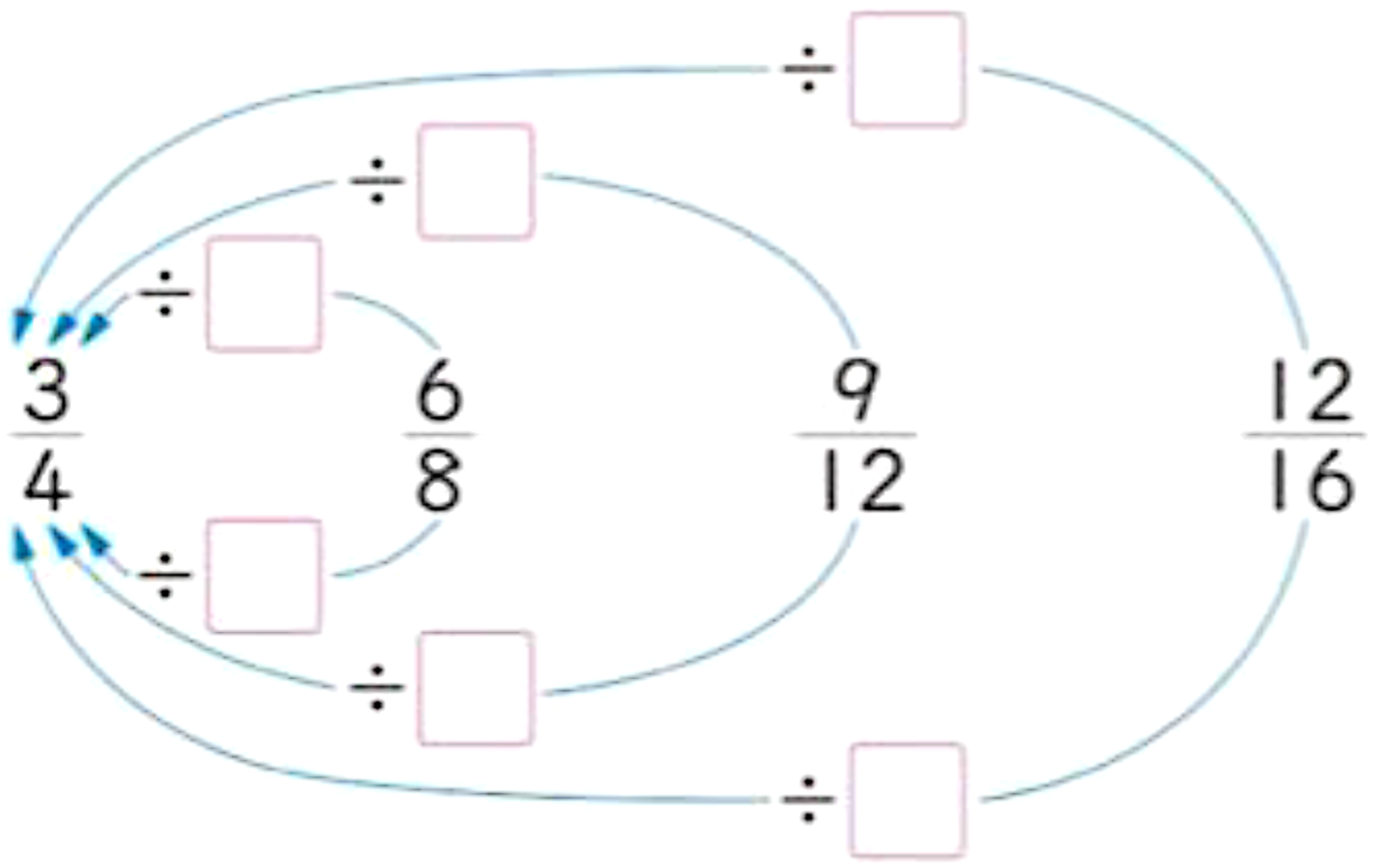
A diagram from the textbook (Fujii & Majima, 2021, p. 5).
P2 said, “previously, we multiplied, so now we divide by the same numbers.” The teacher confirmed that when one divided the numerator and denominator of 12/16 by 4, one gets 3/4, and dividing similarly by 3 in 9/12 leads to 3/4, and dividing by 2 in 6/8 produces 3/4. Finally, the teacher summarized that if we multiply or divide the denominator and the numerator by the same number, the magnitude of a fraction does not change. However, P3 could not grasp what the teacher said, so the teacher explained it again, referring to diagrams 1 and 2. Then, the teacher moved on to the next task.
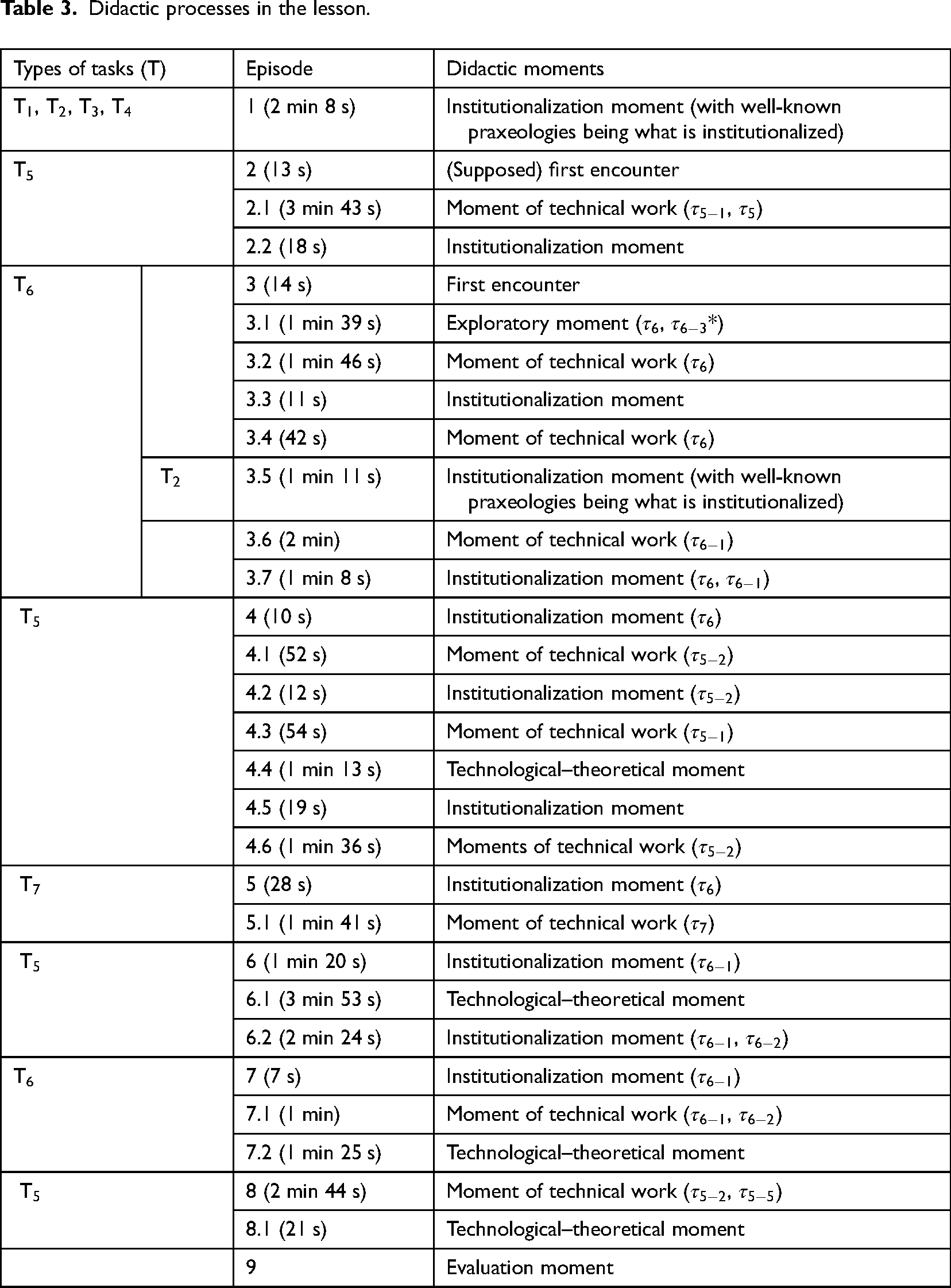
Table 3 was developed based on analyzing the teacher and pupil's utterances and writing in terms of how correspond to different moments of the didactic process, in relation the praxeologies that are being developed (also indicated, using the notation from our reference model, shown in Table 2).
Didactic processes in the lesson.
Didactic processes in the lesson.
As we described previously, episode 1 began by reviewing some of what pupils had learned about fractions earlier, by posing tasks of the following types: Rewrite fractions as divisions (
Episode 2–2.2 was divided into three moments: (supposed) first encounter, moment of technical work, and institutionalization moment. First, the teacher presented the “new” task (t1), which is of type
Episode 3–3.7 was divided into eight moments. The class encountered the task (t2): Find other fractions besides 6/8 and 9/12 that are the same magnitude as 3/4 (Fujii & Majima, 2021, p. 5), which is of type
In this way, we analyzed the whole lesson and produced Table 3 to answer RQ2. It is divided into 30 episodes that can each be characterized as a moment of the didactic process, numbered in Table 3 with two levels, to reflect how some moments refer to the same praxeologies (for instance, episodes 2–2.2 all relate to
As we can see from Table 3, the lesson began with an institutionalization moment (with well-known praxeologies being what is institutionalized), as the teacher started with a review of what pupils had previously learned about fractions, and ended with an evaluation moment. Between those moments, several moments occurred. Technological–theoretical moments developed several times in the latter half of the lessons. At this moment, utterances were identified where the teacher and pupils did not simply confirm the technique but where the teacher justified the technique. For instance, the teacher mentioned a technology: Tsubun (finding a common denominator, in Japanese), to justify
Based on the praxeological analysis of the lesson in the JSSDK, we have seen how two specific themes related to fractions, as defined by MEXT, are taught in JSSDK. We then described the characteristics of the didactic processes. We concluded that not much time is allocated to each moment, as several techniques are presented, and exploratory moments are almost absent. Here, we briefly discuss some hypothetical differences between JSSDK and Japanese ordinary schools, based on a previous study by Stigler and Hiebert (2009).
Stigler and Hiebert (2009) outline a pattern of lessons in Japanese ordinary schools, consisting of a sequence of five activities: 1. Reviewing the previous lesson. 2. Presenting the problem of the day. 3. Students working individually or in groups. 4. Discussing solution methods. 5. Highlighting and summarising the major points. In the first activity, the teacher briefly confirms what students have retained from previous lessons. In the second phase, a goal and core problem for the day are presented by the teacher. In the third phase, students initially work on the problem individually, often for 5 to 10 min, and then discuss their solutions (ideas) with neighbors or in small groups. In the fourth phase, the teacher lets students present one or more ideas. After that, they discuss the differences between each solution and summarize which method is more efficient. In the fifth phase, the teacher tries to summarize what students learned during the current lesson. These five phases can be characterized as moments of the didactic processes of the lesson. The first and second phases constitute a moment of institutionalization (with well-known praxeologies being what is institutionalized) and a first encounter with a new type of task. The third phase is an exploratory moment. The fourth phase constitutes one or more technological–theoretical moments and moments of technical work. The fifth phase involves moments of institutionalization and sometimes also evaluation. In other words, the “script” of ordinary lessons in Japan often follows an order which is similar to that proposed by the theory of didactic moments.
In the observed lesson, the pupils were not given much time to think individually or in groups about how to solve the tasks proposed by the teacher. Based on Stigler and Hiebert (2009) (as well as my own experiences), this is quite different from ordinary schools in Japan. In addition, not enough time was allocated to each moment, which means pupils have to acquire several techniques at a relatively high pace in the JSSDK. The conditions and constraints of supplementary schools may easily explain these differences, both the relatively low number of pupils in the classroom and limited time for teaching. Besides these material reasons, one can also speculate that the relative rarity of exploratory moments is related to the practice of “direct teaching from the textbook” in the JSSDK. Organizing exploratory moments, where several (in part, perhaps inadequate) techniques appear and are compared, requires both resources in terms of time and teacher preparation which are not available in supplementary schools. At the same time, as we saw in the lesson we analyzed, pupils may know the intended techniques from their mathematics teaching in a regular school.
Footnotes
Declaration of Conflicting Interests
The author(s) declared no potential conflicts of interest with respect to the research, authorship, and/or publication of this article.
Funding
The author(s) received no financial support for the research, authorship, and/or publication of this article.
Informed consent
The research received ethical approval from the University of Copenhagen, and informed consent was obtained from all participants to partake in the study.

Correction (December 2024):
Article updated to add Informed consent section.