




Abstract
This commentary paper is a pedagogical reflection on the interplay between variation and invariant. It begins with a brief discussion on the concept of Unity of Opposites as an ancient philosophical theme. Ancient thinking systems regarded the variation and invariant pair as a Unity of Opposites. Next, the use of variation as a pedagogical approach in mathematics education is briefly examined under Marton's variational theory of learning, Gu's bianshi jiaoxue, and the related research done by the author in the context of Dynamic Geometry Environment (DGE). These lead to the formation of the concept of variational thinking, the main contribution of this paper, which is presented and explained. A DGE task design sequence example is presented to illustrate how variational thinking can be used to frame a process of geometrical reasoning and argumentation.
Introduction
Teaching and learning are about change and transformation. Students learn when they change their perspectives to see and experience the world. This overarching pedagogical principle in practices could branch into multitude of cultural and situational actualizations, resulting in diverse pedagogical theories and methodologies. To be in time is to change, and change is fundamental to the complex life evolving process. When this evolutionary process is effectively and systematically captured in pedagogical processes, teaching and learning become powerful, resembling different aspects of the life growing evolution. A critical feature of change is the interplay between variation and invariant. After change has taken place, what remains unchanged and what was being changed knit together an epistemic net that can capture knowledge emergence. For example, in mathematics, the invariant mathematical expression y = ax2 + c captures the dynamic interplay between the variables y, x and the parameters a, c resulting in a “constant shape” (parabola) with invariant critical features (e.g., distance from the focus is equal to distance from the directrix). Dynamic iteration of this in the complex plane generates the emergence of Mandelbrot set in the realm of fractal geometry 1 . In mathematics education, variation-invariant discernment can be designed into pedagogical context by studying the intricate interplay between changing and unchanging features of the mathematics knowledge to be learnt. In this way, by noticing differences and similarity, and making strategic contrast, mathematical concepts may be sieved out. This is the basic tenet of studying the critical feature of change.
One way to manifest change is to visualize motion and movement. In the current 4th Industrial Revolution, digital tools play decisive role in knowledge acquisition. Digital platforms that could “visualize concepts and set them in motion” provides an epistemic-cognitive medium to develop pedagogy of change. In mathematics education, Dynamic Geometry Environment (DGE) is such type of digital platform that has been researched on in the past three decades, using it as a virtual-real Euclidean world to capture and study variational and invariant geometrical phenomena. Further, DGE induces a way of variation-invariant thinking which aims to bridge the empirical-conceptual gap that often occurs in the development of mathematical thinking and reasoning (see for example, Leung et al., 2013; Baccaglini-Frank & Mariotti, 2010; Leung, 2008). Leung (2014, 2017) further explored this variation-invariant thinking under a proposed Principles of Acquiring Invariant in DGE task design, focusing on the invariant perspective that is pertinent to mathematics knowledge acquisition. The purpose of this commentary paper is to further develop these ideas aiming to suggest an epistemic interplay between variation and invariant in terms of Variational Thinking, particularly in the context of mathematics education using a DGE explorative activity as an illustrative example.
In the first section, unity of opposites as a theme in ancient thinking systems will be briefly explored, leading to the idea of seeing variation and invariant as a non-dualistic epistemic pair. It is followed by a brief overview of the use of variation and invariant in pedagogical context, specifically the variational theory of learning (Marton, 2014), Gu's bianshi jiaoxue (teaching and learning through variation) (Gu et al., 2004), and related DGE research in mathematics education. Subsequently the concept of variational thinking is proposed and explained. The paper ends with a DGE task design example to illustrate a pedagogical application of variational thinking.
Unity of opposites as an ancient themes
The essence of variation is change, and of invariant is constancy. They seem to be opposite to each other; however, they are non-meaningful without each other. Change alone without recognizable patterns is chaos (in its true sense), and constancy (or sameness) without movement has no meaning. The ancient Greek philosopher Heraclitus of Ephesus (530–470 BC) focused his philosophical idea on change (panta rhei: everything flows). Nature is like a river he said, it flows ever onward. Even the nature of the flow changes. One cannot step twice into the same river, as the same river is not the same river over time. This doctrine of flux is really about Unity of Opposites, pointing to the idea that things are both the same (invariant) and not the same (variation) over time, depicting two key opposites that are interconnected, but not identical. 2
In the same vein, change and Unity of Opposites play a dominant role in Eastern philosophy. For example, all Indian systems emphasize … reverses movements which correlate everything and take away singleness and fixation. The idea of relation between everything results in the assumption of relativity and momentariness of everything. Every phenomenon has an ambiguous significance … The concept of a hidden unity between them all does not admit of a strict separation of opposites; it simultaneously views reverses and accepts paradoxes. The only constant factor which remains for the Indian thinkers is the continuity of flux … the continuous metabolism and transformation. (Heimann, 1942, pp. 178–179)
變者何也?情偽之所為也。 What is change? It is what is brought about by the interaction of the innate tendency of things and their countertendencies to spuriousness. (Lynn, 1994, p. 31)
睽而知其類,異而知其通。 To see how things in opposition still yield knowledge of their kinds, and to see how different things still yield knowledge of their continuity (Lynn, 1994, p. 32)
Because the universe is an open system that is self-generative and self-transformative, human beings must live with ceaseless change (Variation);
Because change takes place in an orderly manner, human beings must find a way to understand their patterns (Invariant);
Because the patterns of change are discernible, human beings will find peace and comfort in everyday life (Easy).
These are regarded as three interrelated aspects of the same idea Yi (易). Yi is an intricate network patterns of interaction between invariants and variations. For the Chinese, Yi translates into daily thinking/problem-solving practices like
In midst of changes discovers what is un-change (在變中發現不變). Use what is constant as a mean to cope with multiple changes (以不變應萬變). Use rule to thread a way through different types (以法通類). Use type to gather things together (以類相從). To become aware of what is constant in the flux of nature and life is the first step in abstract thinking …. The conception of constancy in change provides the first guarantee of meaningful actions. (Wilhelm, 1973, p. 23)
Thus, Yi is about what changes, what stays constant and what the underlying rule is.
Unity of Opposites is thus a common theme that appeared in these ancient thinking systems. In this connection, the variation-invariant pair falls into this (epistemological) category as change and constancy are critical complementary opposite aspects for discernment and for interpretation of observable phenomena. In this way, variation and invariant are non-dualistic hence they are not dichotomic to each other. Rather they are entwined together as an epistemic whole. When variation is taking the dominating discernment mode, seeking constancy is presence but lies in the background. Similarly, when invariant is in control of an epistemic activity, it manages variation in the acquisition process. These two “opposites” compose and concert rhythms of constancy and change in evolutionary dynamic processes and knowledge acquisition processes. Figure 1 borrows the Chinese Tai-chi (太極) symbol as a metaphor, which is a central idea in Yijing, to illustrate the variation-invariant pair as Unity of Opposites.
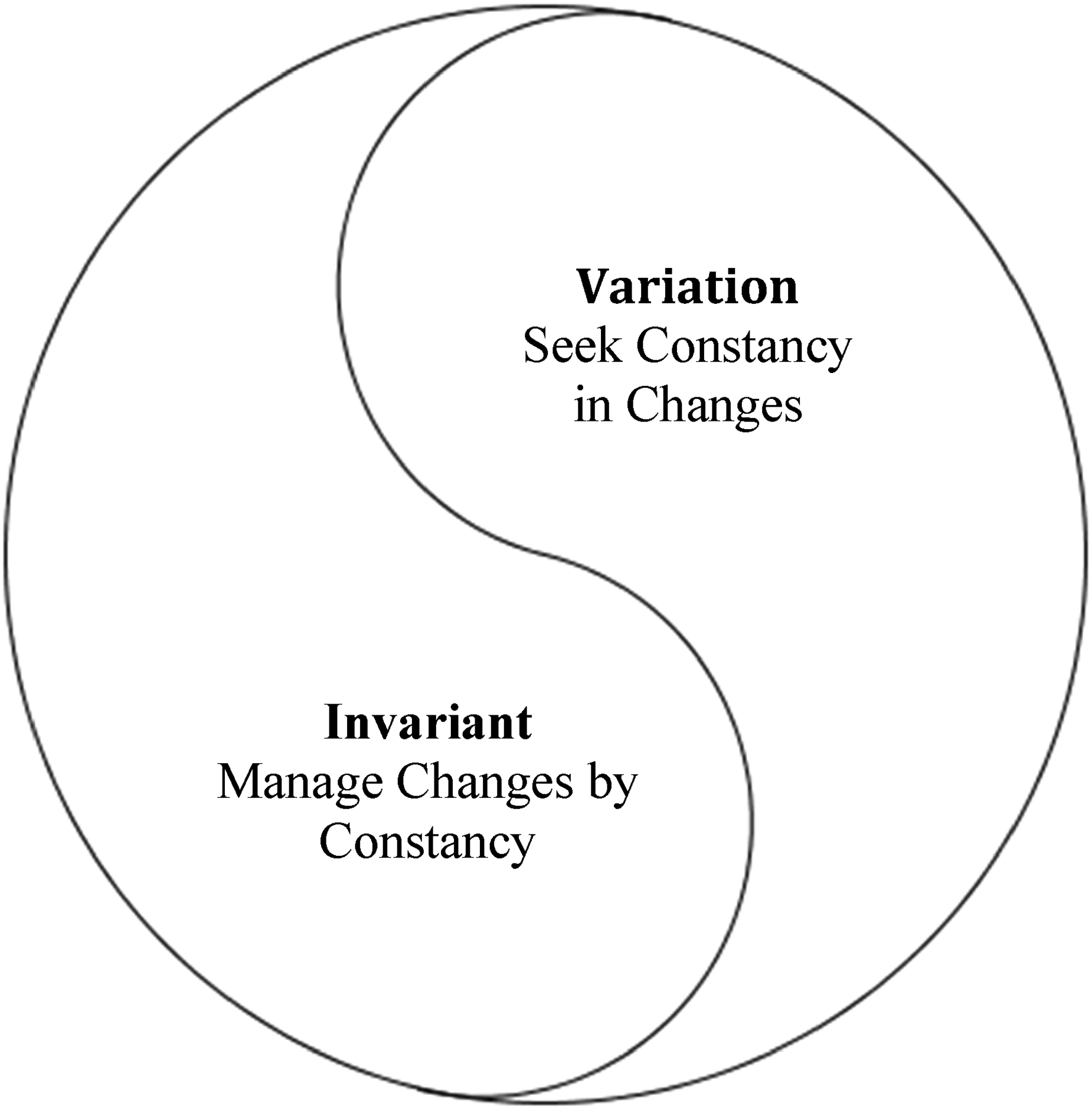
Concerted rhythm of constancy and change. Variation and Invariant work together in complementary ways in dynamic evolutionary processes and knowledge acquisition processes.
The variation-invariant coupling is central in mathematics knowledge acquisition as doing mathematics is to a large extent about finding constancy when variables and parameters are changing values, and about how constant patterns govern multifarious mathematical phenomena. Hence the teaching and learning of mathematics should involve curriculum designs that could harvest the epistemic potential of the variation-invariant coupling as a pedagogical instrument.
Variation theory of learning
One of the hermeneutic rules in phenomenology is “seek out structural or invariant features of the phenomena”, furthermore, The probing activity of investigation is called variational method … Variations “possibilize” phenomena. Variations thus are devices that seek the invariants in variants and also seek to determine the limits of a phenomenon. (Ihde, 1986, pp. 39–40)
Variation in mathematics education
In mathematics education, Dienes (1963) attributed the abstraction and the generalization processes in mathematical thinking by what he called the perceptual variability principle and the mathematical variability principle: The perceptual variability principle stated that to abstract a mathematical structure effectively, one must meet it in a number of different situations to perceive its purely structural properties. The mathematical variability principle stated that as every mathematical concept involved essential variables, all these mathematical variables need to be varied if the full generality of the mathematical concept is to be achieved. (Dienes, 1963, p. 158)
In the Chinese mathematics classroom, traditional bianshi jiaoxue (teaching and learning through variation) is employed to design teaching and learning (Gu et al., 2004; Pang et al., 2017). Bianshi (變式) means variation in form and move, and jiaoxue (教學) means teaching and learning. It refers to the use of intuitive materials or example cases with different forms, or the change to non-defining features of things to highlight the defining ones, so the learners can distinguish which features relate to the nature of the things concerned. (Pang et al., 2017, p. 46)
Using variation as a pedagogical approach has been a major research focus in mathematics education in the past two decades, among many notable research publications related to the subject (see for example, Gu et al., 2004; Watson & Mason, 2006), the book Teaching and Learning Mathematics through Variation (Huang & Li, 2014) is a testimony of the productive scholarly discussion that has been flourishing.
Leung and colleagues started a programme applying the variational approach in DGE research to explore DGE interactive reasoning and proving characterized by the four patterns of variation (for examples, Leung, et al., 2013; Leung, 2008, 2012, 2014, 2017). The four patterns were used as a cognitive tool to structure dynamic reasoning under the DGE drag-mode, guiding learners to develop DGE interactive strategies for solving geometry problems and generating DGE conjecture and proof. These studies all point to intricate interplays and inter-dependency between variation and invariant, in a way that echoes the Unity of the Opposites theme presented in Section 1 above.
Variational (Yi) thinking
The author (Leung, 2014, 2017) responded to the four patterns of variation in Marton's variation theory of learning (in the context of mathematics education) by pairing them with four Principles of Acquiring Invariance: Difference and Similarity, Sieving, Shifting, and Co-variation (respectively Contrast, Separation, Generalization, and Fusion) that focus on learning and awareness through the variation-invariant epistemic couplet. This motivates the idea of Variational Thinking, and a further refinement of the four principles, re-labelling them as acts of variation-invariant to emphasize the importance of interplay which is presented in this Section.
The three-fold meaning of Yi form an epistemic interactive triad that guides the process of knowledge acquisition through observable phenomena. When we encounter a phenomenon and we’d like to understand it, first we must observe the phenomenon in fine details and from different points of view. This is important as different perspectives sieve out different critical features of the phenomenon. The fine-tuning of the gradation of details is progressive in the discernment process. Such process is strategized by intentional acts of variation-invariant interplays that could bring about observable invariant features and constant relationships among these features. These two types of invariants may then produce generalizable tendencies (rules) to predict the behaviors of the phenomenon. This is the crux of Variational (Yi) Thinking, and it is summarized as follows: Variational (or Yi) Thinking (易思維) is a way to acquire understanding and interpretation of a phenomenon by repeatedly observing the phenomenon in fine details from different perspectives, resulting in discernment of manifested and latent invariants and their mutual influences. The observation is accomplished by acts of variation-invariant including different levels of contrast, spatial-temporal simultaneity, part-part and part-whole relationships. Such discernment of the co-cognition between variation and invariant brings about possible generalized tendency to be followed in predicting possible variation and invariant in the future.
Acts of variation-invariant are intentional actions strategized by an observer using variation as a mean to discern invariants that may involve direct or indirect manipulation of the object being observed. We could observe by strategically contrasting and comparing, separating out (making visible) critical features, shifting focus of attention, and varying features together to see whether invariant patterns emerge. The four categories of variation-invariant acts are Contrasting and Comparing, Sieving, Shifting, and Co-varying. They expand the scope of the four patterns of variation in the variation theory of learning (Contrast, Separation, Generalization, and Fusion respectively) fore-fronting acts of acquiring invariant.
Contrasting and comparing
Observing differences and similarities to perceive possible invariants. Contrasting differences is the first step for meaningful discernment. Coupling with inductive comparison, general patterns may emerge.
Sieving
Separating to reveal (“make visual”) invariant patterns under prescribed constraints or conditions. A dimension of variation is a varying aspect of a phenomenon, for example in mathematics, a variable, or a parameter. When certain dimensions of variation are being kept fixed while allowing others to vary, invariant characteristics of the phenomenon may be revealed. This is like slicing out a cross-section of a solid in certain fixed way to reveal hidden critical features of the solid; or changing the grid size/shape of a sieve to separate out different types of material.
Shifting
Focusing attention to different or same critical features at different time or in different situations to discern/perceive invariants. Shifting is about how to repeatedly observe a phenomenon in progressively fine details from different perspectives.
Co-varying
Co-varying multiple critical features simultaneously to perceive possible emergent invariant relationship between the features. This is about covariational reasoning and it emerges when one is able to observe “that there is an invariant relationship between their values that has the property that, in the person's conception, every value of one quantity determines exactly one value of the other” (Thompson & Carlson, 2017, p. 436), and “the operations that compose covariational reasoning are the very operations that enable one to see invariant relationships among quantities in dynamic situations” (Thompson, 2011, p. 46). Furthermore, covariation can be regarded as a form of conceptual understanding (Bagossi et al., 2022), and the observation of “dependency relation in which change in one variable causes a change in another, when one variation necessitates another variation” (Watson, 2017)
These four strategic acts of variation are not in any hierarchical order, rather they interplay with each other in any discernment process. However, they can be arranged in a particular hierarchical order in a pedagogical design. The invariants in the descriptions can either be manifested invariants or latent invariants. These acts are entwined with different levels of contrast, spatial-temporal simultaneity, part-part and part-whole relationships. Variational thinking ultimately is about predicting possible general rule under the variation-invariant Yi coupling. These acts of variation-invariant can be designed in ingenious way to achieve pedagogical goals. A DGE task design example will be shown in the following section.
An example of DGE variational thinking task design
Leung (2008) used the lens of variation based on the four patterns of variation in Marton's theory to investigate a geometrical problem and resulted in a DGE-dependent construction theorem. In the following, we revisit this construction in the context of variational thinking task design. The aim is to conceptualize and design DGE visual reasoning tasks using the elements of variational thinking. The variation-invariant acts are used to frame the task sequence. Students are implicitly prompted to experience these variation-invariant acts as they use the DGE drag-mode and related functionalities. Hence the variation-invariant acts “design” the tasks, whilst the students construct knowledge by activating the variation-invariant interplay design under the drag-mode.
Figure 2 presents the problem. The following is the variational thinking task sequence. 5
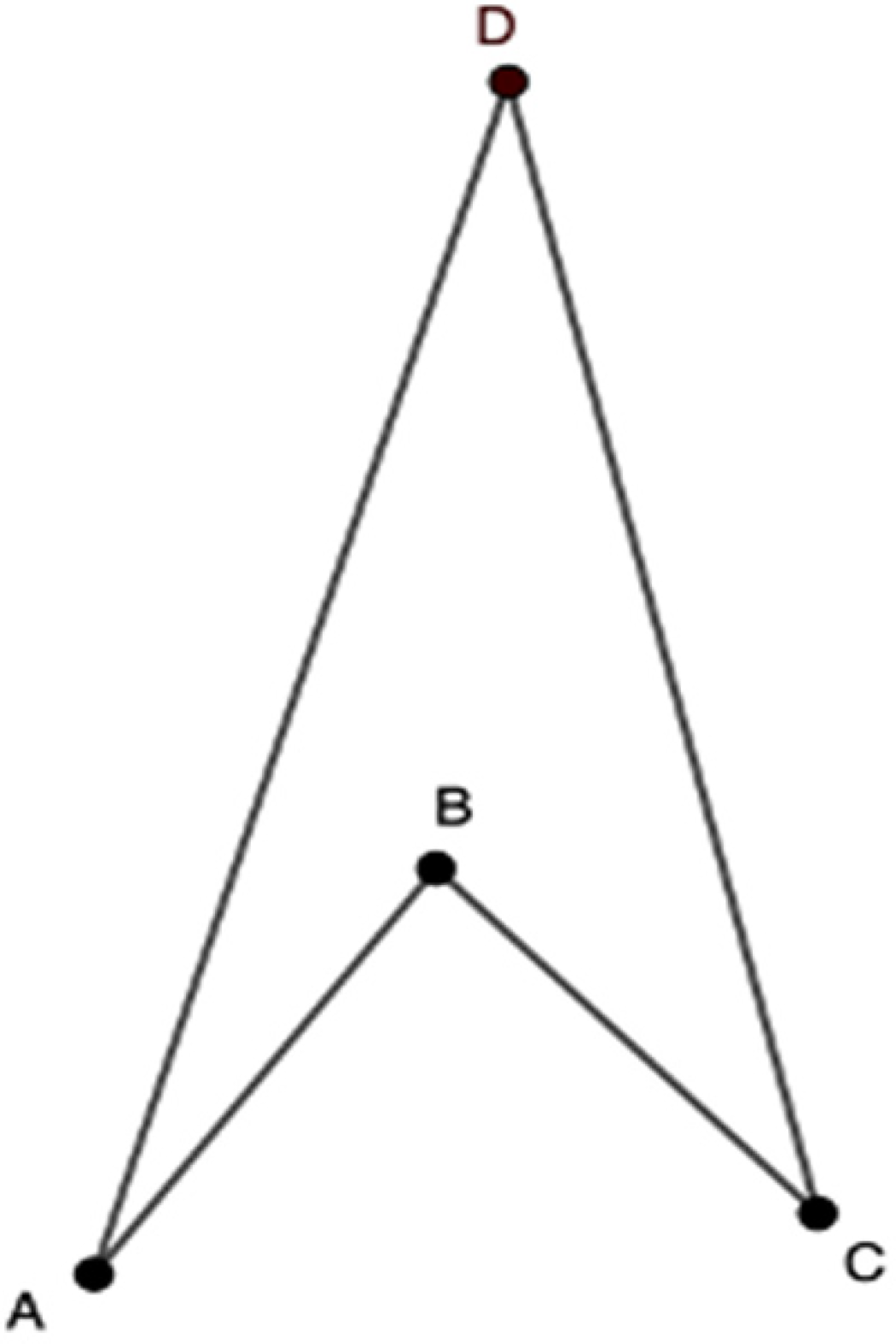
Determine all possible configurations of A, B, C and D such that ∠ABC = 2 ∠ADC holds.
Measure ∠ABC and ∠ADC. Drag A, B, C, D to different positions to maintain the given condition ∠ABC = 2 ∠ADC. Turn the Trace function on in DGE to observe possible visual patterns and hence to refine your dragging strategies.
(This task is for students to contrast and compare by trial-and-error positions that “more or less” satisfying the required condition, and to roughly guess possible emerging patterns.)
TASK 2 (mainly sieving)
Do the same as in Task 1, but this time drag D only while keeping A, B, C fixed. Observe and guess what is a possible locus of D that satisfies the given condition. For different fixed positions of A, B, C, do you see similar type of locus for D? Can you construct the locus?
(By allowing one point to vary while keeping other points fixed, this task asks students to separate out a soft locus on which D would more or less satisfies the required condition. Students should come up with a soft circle as depicted on the left of Figure 3.)
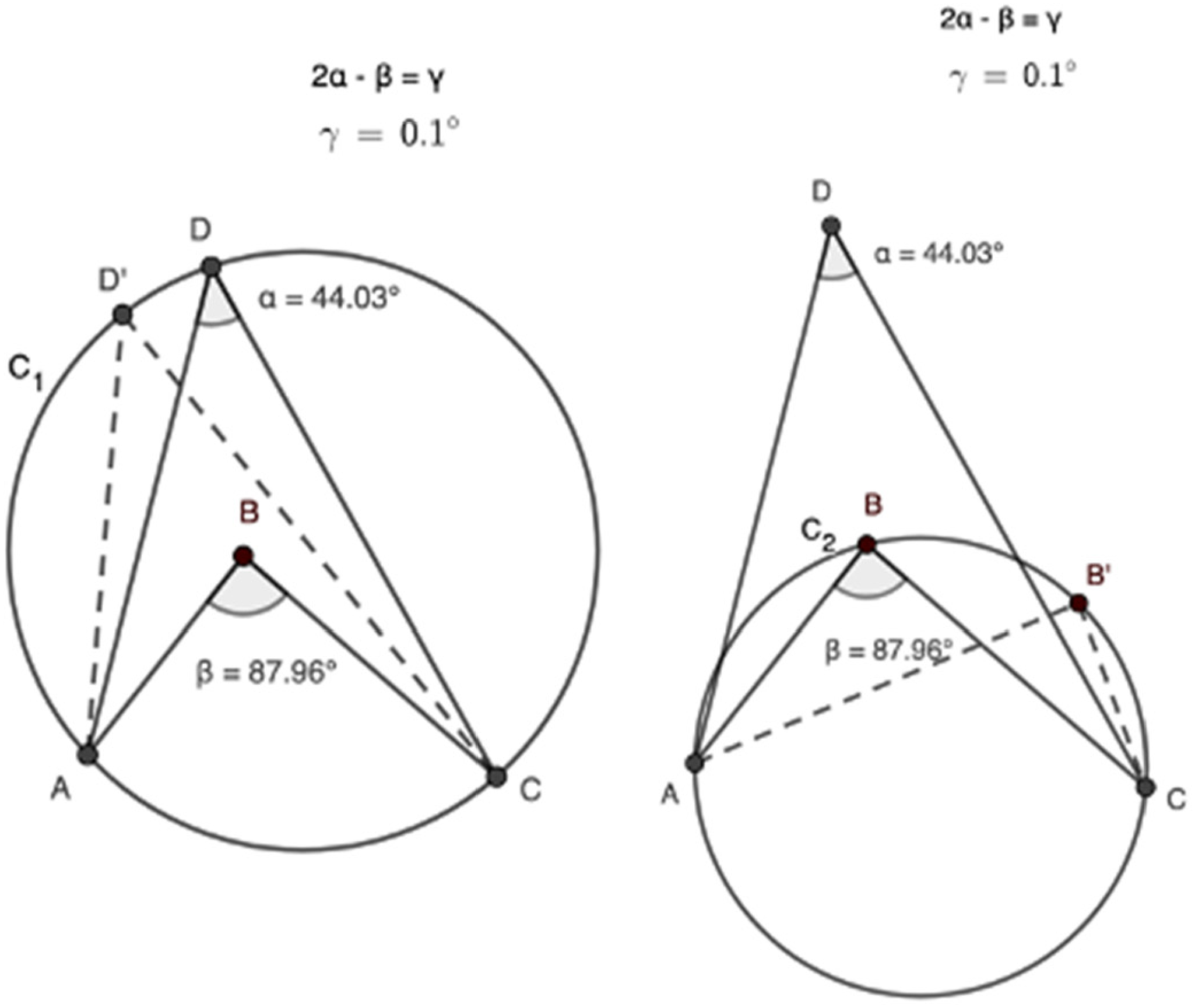
(Left) Soft Circle C1 on which D would more or less satisfying the required condition (Right) Soft Circle C2 on which B would more or less satisfying the required condition.
Do the same as in Task 2, this time drag B only while keeping A, C, D fixed. Similarly, observe and guess what is the locus of B that satisfies the given condition and construct the locus.
(This is the same task as Task 2, but this time the attention is shifted to B. Students should come up with a soft circle passing through B as depicted on the right of Figure 3.)
TASK 4 (mainly shifting and co-varying)
Combine the two soft circles in Figure 3 as in Figure 4. Drag A, B, C, D to different positions while at the same time maintaining the required condition as best as possible. Observe how the two circles C1 and C2 vary together. Try to find invariant features in this dynamic configuration.
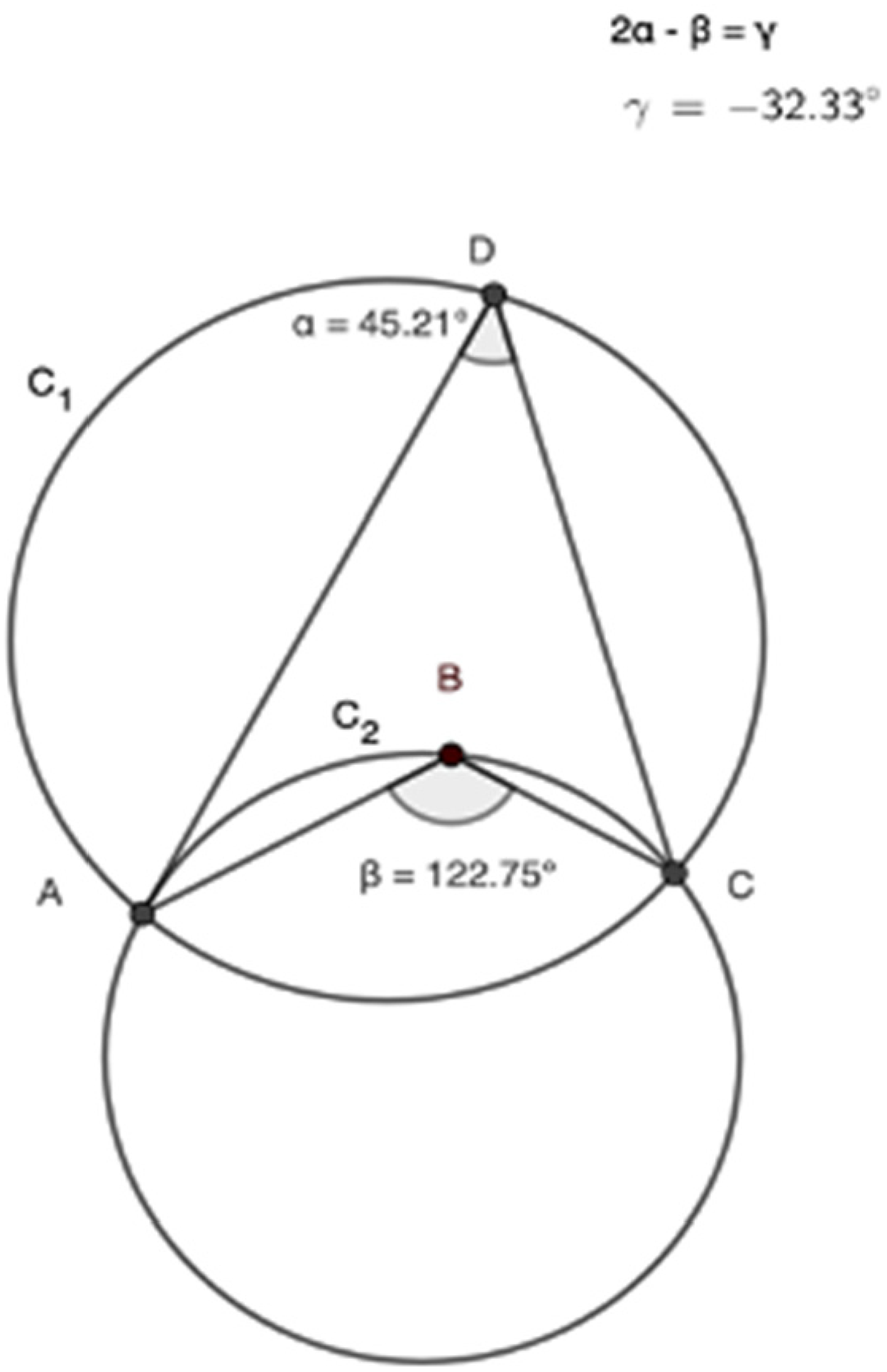
A dynamic visualization template for the problem.
(Students construct a dynamic visualization template for the investigation. γ acts as a guide for maintaining dragging (Baccaglini-Frank and Mariotti, 2010). Students need to change their focus and co-vary different critical features together during the investigation.)
Explore and devise a robust construction procedure for the two soft circles. That is, γ must equal to zero exactly. Can you write down your finding in the form of a geometry theorem?
(Figure 5 describe a possible DGE construction solution to the problem that needs to make use of a DG function: Attach/Link/Merge (depending on what DG system is being used) a point to an object.)
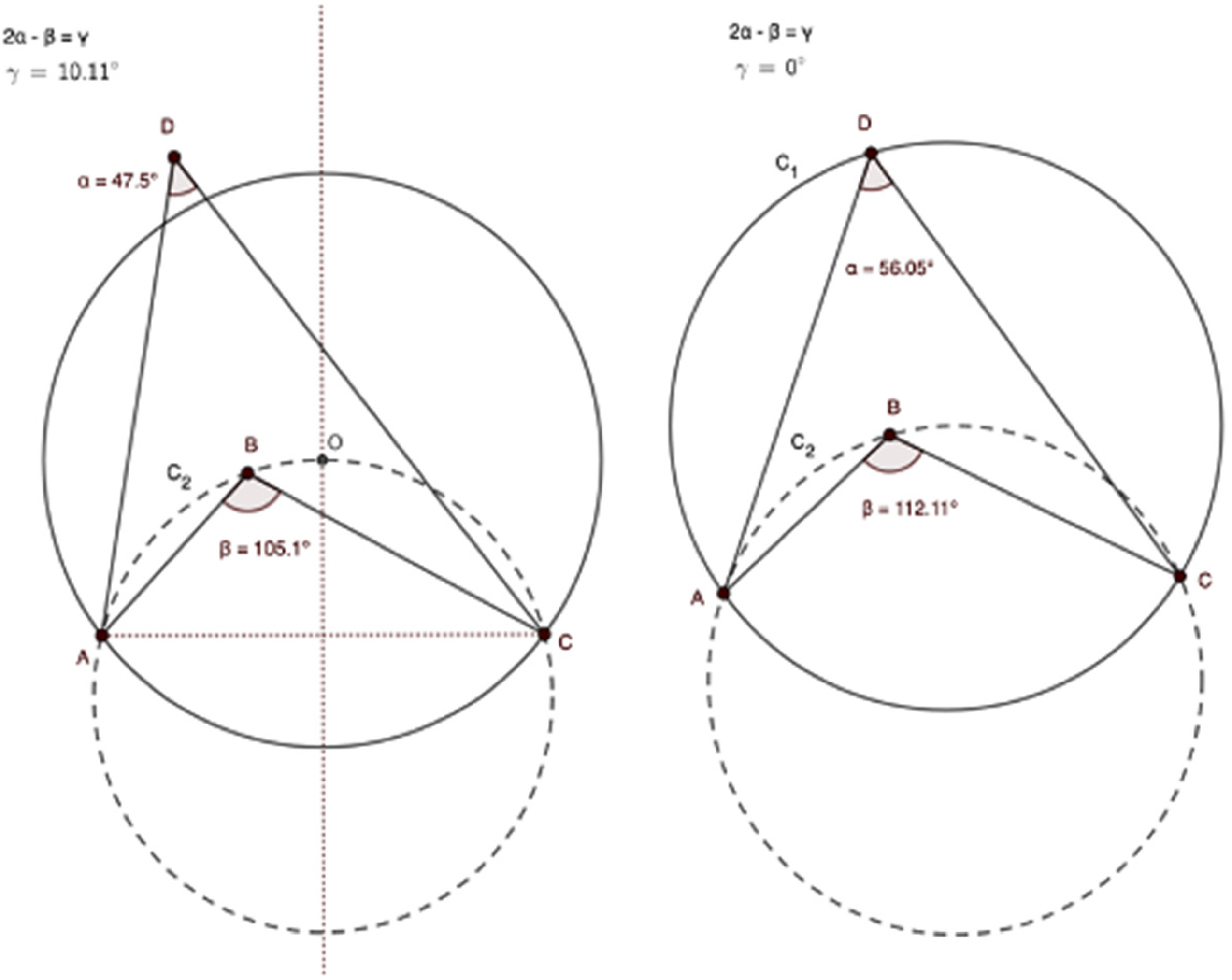
(Left) The intersection between the perpendicular bisector of AC and the circle C2 gives the center of circle C1 (Right) Attach D to C1, a DG functionality, gives a robust construction of a solution to the problem.
The construction procedure in Figure 5. suggests a possible statement for a construction theorem in DG: Given the configuration ABCD as shown in Figure 2, one can always constructs a circle that passes through A and C such that when D is attached to it, the condition ∠ABC = 2 ∠ADC holds. Given the configuration ABCD as shown in Figure 2, there exists a circle that passes through A, C and D such that the condition ∠ABC = 2 ∠ADC holds.
The DGE task design example above shows how a task sequence guided by variational thinking could be instrumental to develop geometrical reasoning and argumentation in a digital dynamic interactive environment. The acts of variation-invariant in this case are subtle in the sense that they are cognitive heuristics that depend on the problem-solver's DGE interactive skill. Nevertheless, strategic observation of the interplay between variation and invariant framed the main theme of the task design. Variational thinking is a generic thinking skill. It is transferrable to other mathematical topics and knowledge domains, and it can be incorporated into different types of thinking and reasoning model as it deals with changes, constancy and operative rules (i.e., Yi), which are universal elements in any cognitive development. I look forward to seeing Variational Thinking to become a welcome member to the pedagogical research arena.
Footnotes
Declaration of Conflicting Interests
The author(s) declared no potential conflicts of interest with respect to the research, authorship, and/or publication of this article.
Funding
The author(s) received no financial support for the research, authorship, and/or publication of this article.
