




Abstract
Preschoolers are offered few opportunities to become acquainted with non-fiction books, and when they are given the possibility to read non-fiction picturebooks, these are often fictionalised in one way or another. The fictionalisation of children’s non-fiction blurs the boundaries between fiction and non-fiction picturebooks. This could mean that children’s early opportunities to experience how different kinds of books, pictures and texts can be used and produced for different purposes are also blurred. Against this background, reading activities are designed in this study in which a group of five-year-olds is introduced to fiction and non-fiction picturebooks side by side. The study aims to contribute to an understanding of how children distinguish and experience different kinds of picturebooks when they are introduced to differences between them, and answers the research question: What is in focus when preschoolers determine whether a picturebook is a non-fiction or not? The analysis shows that the depiction (whether the picturebook depicts imaginary constructs or established knowledge) is in focus when preschoolers make this determination. This gives the children in the reading activities the opportunity to experience different kinds of picturebooks, but also to question whether non-fiction picturebooks depicting imaginary constructed (‘made up’) things, characters and events are non-fiction and to evaluate the reliability of such fictionalised non-fiction picturebooks.
Introduction
In early childhood education in Sweden and in several other countries, children’s literature is often equated with fiction picturebooks. Comparatively, non-fiction picturebooks are a low priority in preschool, in terms of both accessibility (Garvis et al., 2018) and use (Alatalo and Westlund, 2019; Kotaman and Tekin, 2017; Lennox, 2013; Massey, 2014; Yopp and Yopp , 2012). If children of preschool age are not offered acquaintance with non-fiction picturebooks to the same degree as they get to know fiction picturebooks, this can have consequences. Early experiences of differences between different kinds of literature, such as fiction and non-fiction, can be important for children’s continued use of books for different purposes and for their reading and writing of different kinds of texts, as well as for their creation and use of pictures for different purposes. In addition, and perhaps most important of all, the introduction of non-fiction picturebooks alongside fiction picturebooks in preschool reading activities and teaching about their characteristics can arouse children’s curiosity and commitment to literature of various kinds, offering different types of reading experiences.
Preschoolers are given few opportunities to become acquainted with non-fiction literature, and when they are given the possibility to read non-fiction picturebooks, these are frequently fictionalised in one way or another (Backman, 2022; Bintz and Ciecierski, 2017; Donovan and Smolkin, 2002; Goga et al., 2021; Grilli, 2020; Nikolajeva, 2014; Pappas, 2006; Sanders, 2018; Von Merveldt, 2018). The fictionalisation of non-fiction picturebooks entails ‘borrowing’ characteristics from fiction (Backman, 2022). Thus, many of the non-fiction picturebooks available to children can be regarded as hybrids between fiction and non-fiction (Pappas, 2006; Von Merveldt, 2018), but are labelled non-fiction for children by publishers and libraries and are thus presented to children as non-fiction. The boundaries between fiction and non-fiction picturebooks are becoming increasingly blurred (Goga et al., 2021). Since children’s non-fiction picturebooks increasingly resemble fiction, it may be difficult for children to experience how different kinds of literature are usually read for different purposes and for different reading experiences. At the same time, the curriculum for Swedish preschool emphasises that every child should be offered the conditions to develop their ability to use, interpret, question, and discuss different kinds of literature (Swedish National Agency for Education, 2019). Consequently, the blurring of the boundaries between fiction and non-fiction in children’s literature could contribute to children not perceiving that different kinds of books, images and texts can be produced and used for different purposes.
Against this background, in this study reading activities are designed so that a group of children is introduced to fiction and non-fiction picturebooks side by side. The study aims to contribute to an understanding of how children distinguish and experience different kinds of picturebooks when they are introduced to differences between them, and answers the research question: What is in focus when preschoolers determine whether a picturebook is a non-fiction or not? This is studied in an analysis, informed by variation theory of learning (Marton, 2015), of four reading activities with a teacher and six five-year-olds in a Swedish preschool setting, where the object of learning is for the children to distinguish non-fiction picturebooks from fiction picturebooks. An important basic idea within variation theory is that for learning to take place, differences must be perceived (Marton, 2015). The variation theory is therefore well suited to the design and analysis of this study, as the interest is directed towards how children distinguish and experience different kinds of picturebooks when they are introduced to differences between them.
How children distinguish different kinds of picturebooks
A previous study of children’s ways of distinguishing different kinds of books was performed by Donovan and Smolkin (2002). They conducted an examination of K-5 students’ performance on multiple tasks involving ‘genre knowledge’ supported by different grades of scaffolding. One of the tasks was to sort books they had read into two piles based on whether they were ‘storybooks’ (fiction) or ‘information books’ (non-fiction). Most of the children made their determinations in sorting based on whether the books contained real or fictional elements. The difference between fantasy (including ‘talking animals’) and reality proved to be important for most of the children in determining the book’s ‘genre’.
There are also previous studies discussing how to create opportunities for children to distinguish fiction books from non-fiction books. In discussion of the results from the Scientific Literacy Project, Mantzicopoulos and Patrick (2011) suggest that teachers could pair a fiction picturebook with a non-fiction picturebook on the same subject and draw comparisons between them. In this way, teachers can ‘support children’s appreciation of both fiction and non-fiction through rich discussions about each text’s ideas and purpose, consideration of the discrepancies between the texts, and reflection about the reasons for these’ (Mantzicopoulos and Patrick, 2011: 272). In addition, Pappas (2006), who has also studied the use of children’s books for scientific learning, points out that the purpose of hybrid forms can be contrasted with that of typical, traditional non-fiction books.
The teaching design in the study discussed in this article is inspired by the teaching suggestions of Pappas (2006) and Mantzicopoulos and Patrick (2011). The learning object in the present study’s reading activities involves developing children’s ability to distinguish non-fiction picturebooks from fiction picturebooks; hence, different kinds of picturebooks are introduced together in pairs so that comparisons can be made between them.
Method
In order to study what is in focus when preschoolers determine whether a picturebook is a non-fiction or not, design experiments (Brown, 1992) were planned and conducted as reading activities. Design experiments are useful in testing teaching ideas for teaching and learning considerations (Brown, 1992), and this study is based on the idea that teaching with variation theory principles (Marton, 2015) can enable children to discern certain aspects, making visible why some picturebooks are called fiction while others are referred to as non-fiction. This is done by contrasting and generalising (Marton, 2015) characteristics of different kinds of picturebooks.
Selection of characteristics for different kinds of picturebooks
To be able to offer the children in the study’s reading activities opportunities to distinguish non-fiction picturebooks from fiction picturebooks, teaching is applied in which characteristics of different kinds of picturebooks are presented. Previous research cites several characteristics of fiction and non-fiction picturebooks, of which the following four (the purpose, the depiction, the priority and the reading) are accentuated for the children in this study’s reading activities.
The purpose
Traditionally, fiction and non-fiction literature are stated to have different purposes. ‘The writer of an informational book sets out to inform and teach’, while ‘the writer of quality fiction sets out to depict and to comment about particular aspects of the human experience, hoping that the book will both entertain readers and elicit affective responses about the aspects of the human experience addressed in the story’ (Cianciolo, 2000: 2). Informative learning can also take place based on fiction picturebooks. For example, based on reading the fiction picturebook Vakna min kastanj (Pair 3), it is possible to recognise a chestnut tree and its seed capsules, yet the book’s main purpose is not to inform about chestnut trees but rather to entertain and elicit affective responses based on the story of the chestnut tree Figure 1. While it is possible to recognise a chestnut tree and its seed capsules based on reading the fiction Vakna min kastanj, its main purpose is not to inform about chestnut trees but to entertain and elicit affective responses based on the story of the chestnut tree.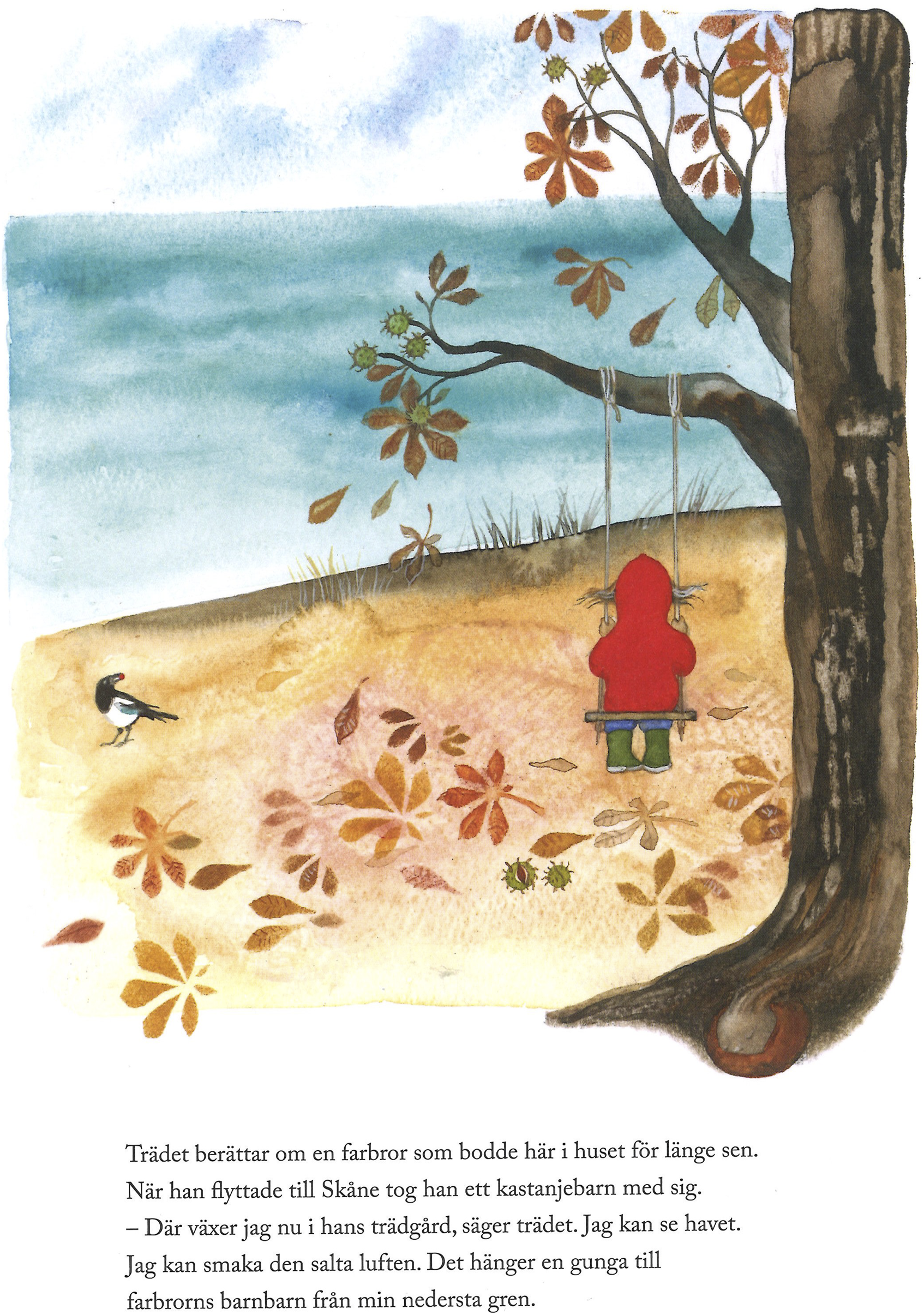
In the same way, non-fiction picturebooks may be ‘playful, entertaining, innovative, involving, even lyrical but, by definition, they have an informational purpose at their centre and this is what distinguishes them from fiction’ (Mallett, 2019, XXiV). The purpose is reflected in structure, design, layout, written text, illustrations and other characteristics of the picturebooks (Torr and Clugston, 1999). Thus, in a fiction picturebook, the main purpose is to entertain and elicit affective responses, while in a non-fiction picturebook the main purpose is to inform and teach.
The depiction
The purpose of the picturebook is reflected in what it depicts – how the material is visually and verbally represented or shown to the reader. The term ‘non-fiction’ communicates that the book depicts reality and the way things are (Panaou and Yannicopoulou, 2021). The term ‘fiction’ signals that the book depicts fictions and inventions (Panaou and Yannicopoulou, 2021), imaginary constructs constructed by author’s and illustrator’s experiences of real things, characters and occurrences (Vygotsky, 1930/2004). A fiction picturebook thus depicts imaginary constructs, while a non-fiction picturebook depicts established knowledge (generally accepted knowledge of how something is or has been).
The priority
Another difference between fiction and non-fiction picturebooks concerns the priority in them (Cianciolo, 2000). In fiction picturebooks the story comes first and has priority, while facts, concepts, or theories of whatever kind exist primarily to support the elements of the story. In non-fiction picturebooks the priority is providing facts to the reader; the techniques the writer uses to do this may well include narrative, but are subordinate to the book’s priority (Cianciolo, 2000). Thus, in a fiction picturebook the main priority is to tell a story, while in a non-fiction picturebook the main priority is to provide facts.
The reading
Whether a picturebook has storytelling or facts as its priority is related to how its reading is carried out. Fiction picturebooks that consist of a story contain events that are temporally sequenced (Mantzicopoulos and Patrick, 2011; Torr and Clugston, 1999), and therefore require that the entire text be read from beginning to end in order for children to comprehend it. Non-fiction picturebooks are not necessarily sequenced in time (Mantzicopoulos and Patrick, 2011); hence, it is mostly not necessary to read the entire text in a non-fiction picturebook in order for children to comprehend the facts presented in it (Price et al., 2012). A fiction picturebook thus needs to be read from beginning to end, while a non-fiction picturebook can usually be read in any order.
These four differences between fiction and non-fiction picturebooks, described above, are pointed out to the children in the study’s reading activities. The design of the reading activities is described in the section ‘Reading activities designed with variation theory of learning’ and an overview of all the picturebooks included in the study and their characteristics can be found in Appendix A.
Selection of a concept for fictionalised non-fiction picturebooks
As this study focuses on non-fiction picturebooks that ‘borrow’ characteristics from fiction, a suitable concept is needed to refer to these. Previous research has suggested a plethora of concepts for this kind of non-fiction picturebook.
Grilli (2021) uses the term artistic nonfiction picturebooks for picturebooks without narrative but with an artistic focus. Von Merveldt (2018) instead uses the term informational picturebooks for such literature, arguing that the concepts of fiction and non-fiction may support an opposition between factual information and fictional devices. Informational picturebooks include so much more than the presentation of facts, which in our digital age could be found elsewhere, according to von Merveldt. Kümmerling-Meibauer and Meibauer (2021) use the term descriptive picturebooks, with the argument that Sanders’ concept non-fiction (2018) is too broad and negative a concept, and that Von Merveldt’s (2018) concept informational may falsely suggest that narrative picturebooks do not contain information. Narančić Kovač uses the terms nonnarrative non-fiction picturebooks (2020) and nonnarrative picturebooks (2021), and makes it clear that these are picturebooks without narrative but not necessarily without fiction. Nonnarrative (non-fiction) picturebooks can thus be about fictional subjects that are presented in a descriptive way.
Donovan and Smolkin (2002) use the term dual purpose texts; that is, texts with the dual purpose of integrating narrative and informative text. A research review by Bintz and Ciecierski (2017) presents a variety of concepts for this type of non-fiction: hybrid texts, informational storybooks, blended or mixed-genre texts and multigenre texts. In new children’s literature research, Daly (2021) calls these narrative nonfiction, while Narančić Kovač (2020) calls them non-fiction narrative picturebooks.
Thus, in previous research the choice of concepts for non-fiction with fictional elements has typically focused on the borrowing of either ‘fictional’ or ‘narrative’ elements from fiction, but not both. However, there are hybrids that blur several characteristics between fiction and non-fiction (Donovan and Smolkin, 2002; Pentimonti et al., 2010). ‘Many non-fiction books for children use narrative techniques, fictive characters, fictive ‘documentary’ letters from ancient times, diaries, elaborated language and so on, which are elements that blur the distinction between fiction and non-fiction’ (Skyggebjerg, 2020: 131). The term non-fiction for children is most often used in research for books of this kind (Skyggebjerg, 2020). Although the concept of non-fiction for children includes different types of ‘borrowing’ from fiction, the definition lacks a distinction between traditional and fictionalised non-fiction. This study therefore uses the term fictionalised non-fiction picturebooks with a definition that includes all kinds of ‘borrowing’ from fiction and distinguishes between traditional and fictionalised non-fiction picturebooks for children.
The concept of fictionalised non-fiction picturebooks consists of the words fictionalised, non-fiction and picturebooks. Picturebooks, regardless of whether their priority is to tell a story or to provide facts, are books in which text and image interact (Goga et al., 2021; Grilli 2020; Von Merveldt, 2018). The use of the term non-fiction comes from the fact that these books are usually referred to as non-fiction when children encounter them in preschool and in libraries. The term fictionalised refers to the ‘borrowing’ of characteristics from fiction, inspired by Nikolajeva’s way of describing how non-fiction ‘can be fictionalised through selection of material, narrative perspective and the presentation style’ (Nikolajeva, 2014: 22). It is a highly conscious choice to use the contradictory term fictionalised non-fiction picturebooks, as ‘these picturebooks are always more or less contradictory, being non-fiction yet still not’ (Backman, 2022).
The purpose of writing and illustrating a fictionalised non-fiction picturebook for children can be to inform and teach the reader and at the same time to entertain and elicit affective responses (Goga et al., 2021; Grilli, 2020). According to Kümmerling-Meibauer and Meibauer (2021: 196), this combination serves multiple functions: ‘It introduces a sense of variety in order to entertain the reader and to avoid the impression of boredom, which may happen when a text merely consists of descriptive and/or explanatory passages’. Thus, the depiction in children’s fictionalised non-fiction picturebooks can consist of both established knowledge (real) and imaginary constructs (made up) (Backman, 2022). The priority in children’s fictionalised non-fiction picturebooks can be both to provide facts and to tell a story (Bintz and Ciecierski, 2017; Daly, 2021). When a story is included in a non-fiction picturebook, it affects the reading of the book. When the story is the priority, it requires the reader to read the book from beginning to end, while when providing facts is the priority, specific facts can be searched on any page and the book can thus be read in any order. This fictionalisation of non-fiction for children thus dissolves the differences between fiction and non-fiction, which could pose challenges for children in discerning characteristics of these different kinds of picturebooks.
Selection of children, teacher and picturebooks
This study consists of designed reading activities with children from a Swedish preschool. 1 The reading activities include 14 picturebooks which are mainly, according to the publishers, aimed at children aged three to 6 years; therefore, five-year-olds were considered suitable participants in the reading activities involving the books. Seven five-year-olds at a preschool were informed and asked if they wanted to take part in the study, and six of them agreed to participate. The children were informed that their participation in the study’s reading activities was voluntary and gave oral consent for their participation, and their guardians also gave written consent for the children’s participation. All the children had Swedish as their mother tongue and had various socioeconomic backgrounds. At the preschool, fiction picturebooks were read with the children on a daily basis, while non-fiction picturebooks were almost never read. To test the teaching idea developed for this study it was decided that I, with my many years of experience as a preschool teacher, would be responsible for implementing it in the designed reading activities.
The 14 picturebooks for the study’s designed reading activities were selected in consultation with an expert in children’s literature and an expert in teaching based on variation theory principles. The picturebooks selected for the study’s reading activities is connected to the object of learning to distinguish non-fiction picturebooks from fiction picturebooks. First, 10 picturebooks were selected as five pairs consisting of a fiction and a traditional non-fiction picturebook on the same subject (Pairs 1–5). These five picturebook pairs were read aloud to the children in mixed order before the study’s reading activities were carried out but were discussed later in the reading activities. Two fictionalised non-fiction picturebooks about dinosaurs and their extinction were also selected to be read and discussed in the reading activities together with the fiction and traditional non-fiction picturebooks on this same topic (Pair 5). In addition, another pair of picturebooks about dragons was added (Pair 6). The 14 picturebook titles and their different types (fiction, traditional non-fiction and fictionalised non-fiction) are listed in Appendix A.
Reading activities designed with variation theory of learning
Four reading activities with conversations about the 14 picturebooks were designed in accordance with variation theory principles and focused on a selected object of learning. In variation theory, a learning object is what a child needs to learn in order to approach a desired learning goal (Marton, 2015). In order to approach the curriculum goal that preschool should provide each child with the conditions to develop their ability to use, interpret, question and discuss different kinds of stories, pictures and texts (Swedish National Agency for Education, 2019), the object of learning in the study’s reading activities was the ability to distinguish non-fiction picturebooks from fiction picturebooks. Teaching with such a learning object may offer children a knowledge base for consciously choosing different kinds of books, for example when they want to indulge in a fantastic story, or to quench their hunger for information about something of interest to them. In addition, broad knowledge of the multifaceted areas of use of texts and images is valuable for children’s own production and creation of different types of texts and images.
The reading activities in the study were thus designed based on variation theory of learning (Marton, 2015), in which a basic idea is that you cannot know what something is without knowing what it is not. A child who only encounters fiction picturebooks cannot know what makes a picturebook a fiction picturebook; picturebooks will be regarded simply as picturebooks rather than a particular kind of picturebook. On the other hand, a child who has encountered both fiction and non-fiction picturebooks may be able to discern some characteristics of these different kinds of picturebooks and thus distinguish them. According to variation theory, learning takes place by discerning how aspects of a certain phenomenon vary, in relation to an invariant background. To enable the children’s discernment of characteristics of different kinds of picturebooks, characteristics were varied in the study’s reading activities.
When variation theory of learning is used for teaching, three patterns of variation – contrast, generalisation and fusion (Marton 2015) – can make characteristic features of different kinds of picturebooks discernible. In order to discern aspects that constitute the characteristics of a certain kind of picturebook, different features of those aspects need to be contrasted with other features. As an example, to discern the purpose of picturebooks about planets and space travel (the purpose is then considered to be a necessary aspect to discern in order to distinguish non-fiction picturebooks from fiction picturebooks), the fiction picturebook’s purpose to entertain and elicit affective responses through a story about a boy who is commissioned to go on an adventurous journey to fictional planets in space can be contrasted with the non-fiction picturebook’s purpose to inform and teach about space travel that has actually been carried out and scientific facts about planets in our solar system. In this way, the purpose of non-fiction picturebooks about planets and space travel is separated from the purpose of fiction picturebooks on the same subject (Figure 2) but will, through this contrast, bring to the fore a more complex meaning of the purposes of different kinds of picturebooks. Against an invariant background of a pair of picturebooks, both of them about planets and space travel (Pair 2), the purpose of the fiction Pelle på planetfärd can be contrasted with the purpose of the non-fiction Lätta fakta om planeter.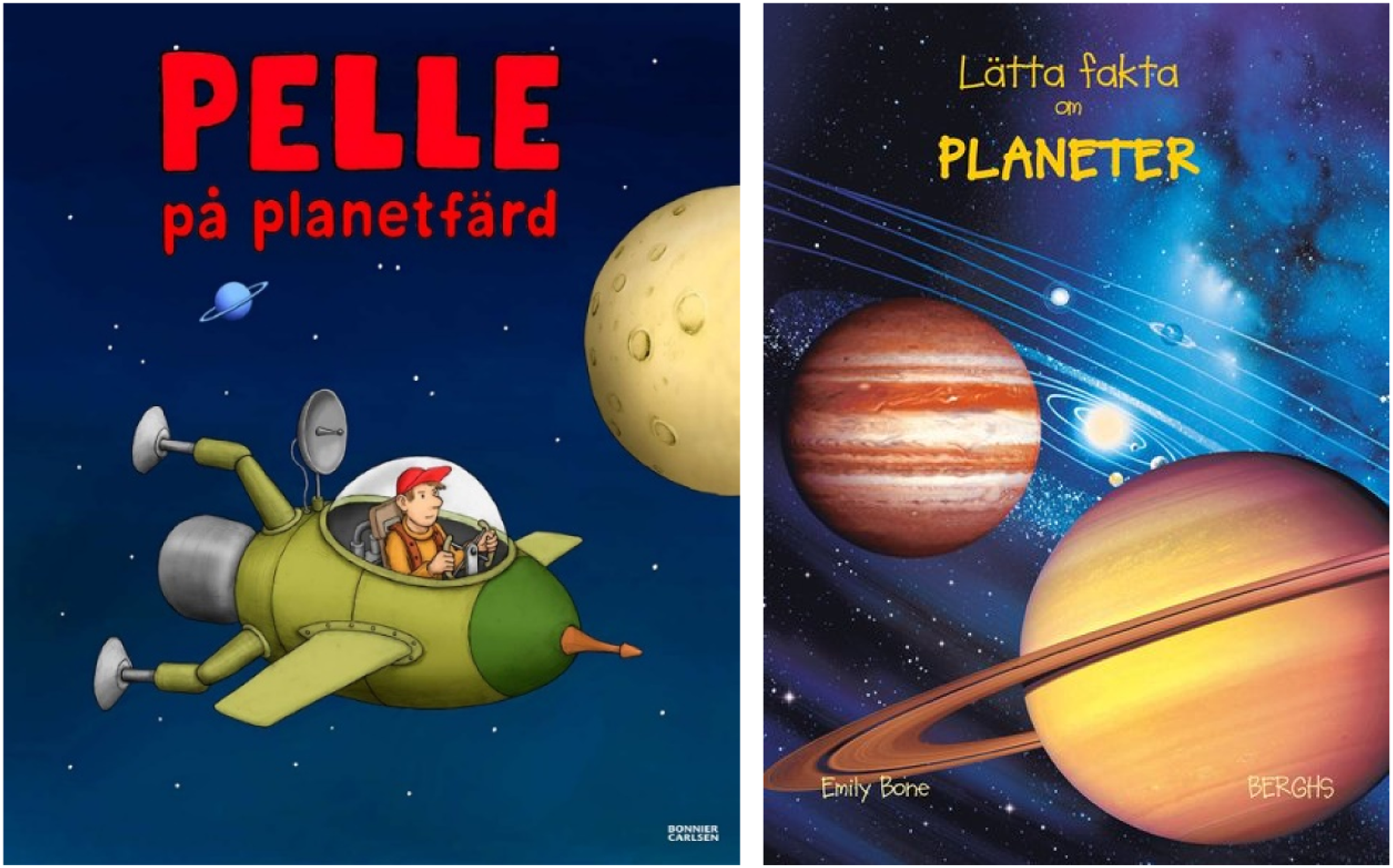
In order for children to recognise the separated features of the purpose in other fiction and non-fiction picturebooks on subjects other than planets and space travel, the aspects can be generalised. Here, the children were therefore introduced to several picturebook pairs on different topics but with the same invariant pattern that fiction picturebooks have the purpose to entertain and elicit affective responses, while non-fiction picturebooks have the purpose to inform and teach. In this way, non-fiction picturebooks, regardless of subject, can be experienced as picturebooks whose purpose is to inform and teach, unlike fiction picturebooks which rather have the purpose to entertain and elicit affective responses.
However, there are also numerous non-fiction picturebooks whose purpose is to entertain and elicit affective responses. In determining what kind of picturebooks these are, it is not enough to focus only on the purpose; other aspects need to be brought to the fore as well. For aspects other than the purpose to come into focus for children, the purpose needs to be invariant. Therefore, the reading activities introduced both fiction and non-fiction picturebooks with the purpose of entertaining and eliciting affective responses (see the fictionalised non-fiction picturebooks in Appendix A). With both the fiction and non-fiction picturebooks about dragons in Pair 6 having the purpose of entertaining and eliciting affective responses, the purpose became invariant in both books. This invariance of the purpose could direct the children’s focus towards other varying aspects, such as features of the priority or of the reading, in order for them to distinguish non-fiction picturebooks from fiction picturebooks.
To determine whether a picturebook is fiction or non-fiction when several aspects vary simultaneously, two or more aspects need to be considered simultaneously. This can be done through the use of fusion, a pattern of variation which defines the relationship between two (or more) aspects through their simultaneous variation. A combined consideration of all the essential aspects of different kinds of picturebooks will help a child to determine whether a picturebook is fiction or non-fiction. However, fusion was not used as a teaching principle in this study, as teaching with contrast and generalisation presented more than enough challenge for these five-year-olds.
Before the implementation of the designed teaching in the four reading activities, I made three visits to the children at their preschool. In this way, we could get to know each other before the study was carried out. During these visits, I read five pairs of fiction and traditional non-fiction picturebooks (Pairs 1–5) to the children. This ensured that they had experience of different kinds of picturebooks, as a starting point for discussions about what is characteristic of fiction and traditional non-fiction picturebooks. Thereafter, the following four reading activities took place: • • • •
The features contrasted and generalised in the teaching with the intention of broadening the ways in which the children could distinguish non-fiction picturebooks from fiction picturebooks are listed in Appendix A.
Reading activities analysed with variation theory of learning
The four designed reading activities (A-D) were video-recorded, and constitute the empirical material analysed in this study. This material consists of 184 min (65 + 29 + 56 + 34 min) of video-recorded and subsequently transcribed material from the reading activities. To answer what is in focus when preschoolers determine whether a picturebook is a non-fiction or not, a variation theory analysis of the empirical material generated in the study’s reading activities was conducted.
The predetermined aspects pointed out to the children in the teaching in the reading activities are: the purpose, the depiction, the priority and the reading (Appendix A). An aspect (for example the purpose) can, according to variation theory, be discerned when one feature (for example entertain and elicit affective responses) varies in relation to another (for example inform and teach). This means that statements in the empirical material showing, for instance, children’s discernment of ‘the purpose of fiction picturebooks is to entertain and elicit affective responses’ were sought in relation to statements showing their discernment of ‘the purpose of non-fiction picturebooks is to inform and teach’. From the empirical material, other aspects than the predetermined ones (the purpose, the depiction, the priority and the reading) of different kinds of picturebooks could also emerge, and are also taken into account in the analysis. The aspects and features the children expressed discernment of in words and actions show what is in focus when they determine whether a picturebook is a non-fiction or not.
Results
The depiction was in focus when the preschoolers in this study determined whether a picturebook is a non-fiction or not. Although other aspects were shown to the children in teaching and were discerned by some of them, they constantly returned to focus on fiction picturebooks depicting imaginary constructed (‘made up’) things, characters and occurrences, while the non-fiction picturebooks depict established knowledge about (‘real’) things, characters and occurrences.
To illustrate this result, empirical examples from the designed reading activities are presented below. In the empirical material, what the children say and do is shown in normal text, and when something is read from the picturebooks it is shown in italics. Actions are shown in parentheses. The material also contains pictures from the picturebooks 3 to which the children’s attention in the reading activities was directed.
The children’s focus when non-fiction picturebooks are ‘real’
The analysis shows that the depiction was in focus when the preschoolers in this study determined whether a picturebook is a non-fiction or not. This allowed them to experience two kinds of picturebooks, fiction and non-fiction.
In Reading Activity B, the teacher used a fiction and a traditional non-fiction picturebook about the extinction of dinosaurs (Pair 5) to contrast the priority in different kinds of picturebooks (Figure 3). Dinosaurier älskar underbyxor is a fiction picturebook in which the priority is to tell a story, a bizarre one about the dinosaurs becoming extinct in a war over cavemen’s underpants. Dinosaurier: Mitt stora bildlexikon is a non-fiction picturebook whose priority is to provide facts, for example about most of the dinosaurs dying as a result of a meteorite’s impact on Earth. The teacher used both a fiction and a traditional non-fiction picturebook about the extinction of dinosaurs (Pair 5) to contrast the priority in different kinds of picturebooks.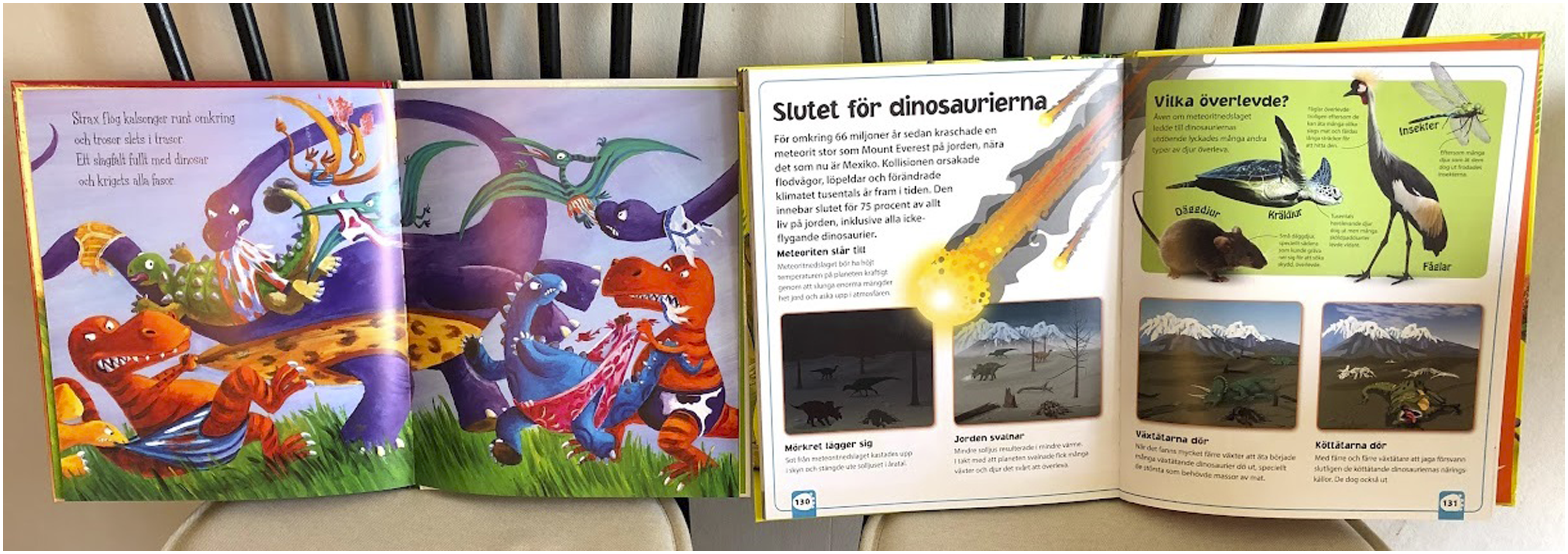
The teacher said to the children: ‘A fiction book is a kind of book that tells a story about something and a non-fiction book is one you can read to know things’. However, the children did not discern what was prioritised in the two picturebooks. Their focus was on the depiction in the picturebook, and Liam said: ‘That one’s fantasy (pointing to Dinosaurier älskar underbyxor) and that one was for real (pointing to Dinosaurier: Mitt stora bildlexikon)’. Expressions like Liam’s were repeated in the children’s statements about all the picturebooks in Pairs 1–5. To them, fiction books seemed to be those containing ‘made up’ things, characters and occurrences (depiction: imaginary constructs) while non-fiction books contains ‘real’ things, characters and occurrences (depiction: established knowledge).
The children’s focus when non-fiction picturebooks are ‘made up’ and ‘real’
The analysis of the reading activities shows that when a picturebook includes several characteristics that correspond to both fiction and non-fiction picturebooks, the depictions remained in focus. This allowed the children to question whether non-fiction picturebooks depicting imaginary constructed (‘made up’) things, characters and events are non-fiction, which in turn allowed them to experience a third kind of picturebook.
At the end of Reading Activity B, characteristics of different kinds of picturebooks were contrasted with the support of five picturebook pairs, including a fiction and a traditional non-fiction picturebook about dinosaurs and why they became extinct. Next, the children were asked to determine what kind of picturebook Det var en gång… Massor av dinosaurier is. Based on the purpose, the depiction, the priority and the reading (which were contrasted and generalised with the picturebook Pairs 1–5 earlier in the same reading activity), this picturebook could be experienced as both a fiction and a non-fiction picturebook. Differences in opinion arose, and Emma expressed that the book is fiction because of the elements in it that are ‘made up’ (imaginary constructs), such as the colours of the dinosaurs. Liam and Lucas claimed that, while some in the book is ‘real’ (established knowledge), there is also much in it that is ‘made up’ (imaginary constructs). When the children were asked to determine whether the book should be placed with the fiction picturebooks on the left chair or the non-fiction books on the right chair, they experienced fictionalised non-fiction as an additional kind of picturebook, as Liam and Lucas put Det var en gång… Massor av dinosaurier between the fiction and the traditional non-fiction picturebooks about dinosaurs and said that the book should be ‘in between’ (Figure 4). Liam and Lucas put Det var en gång… Massor av dinosaurier between the fiction and the traditional non-fiction picturebooks about dinosaurs, and say that this book should be ‘in between’.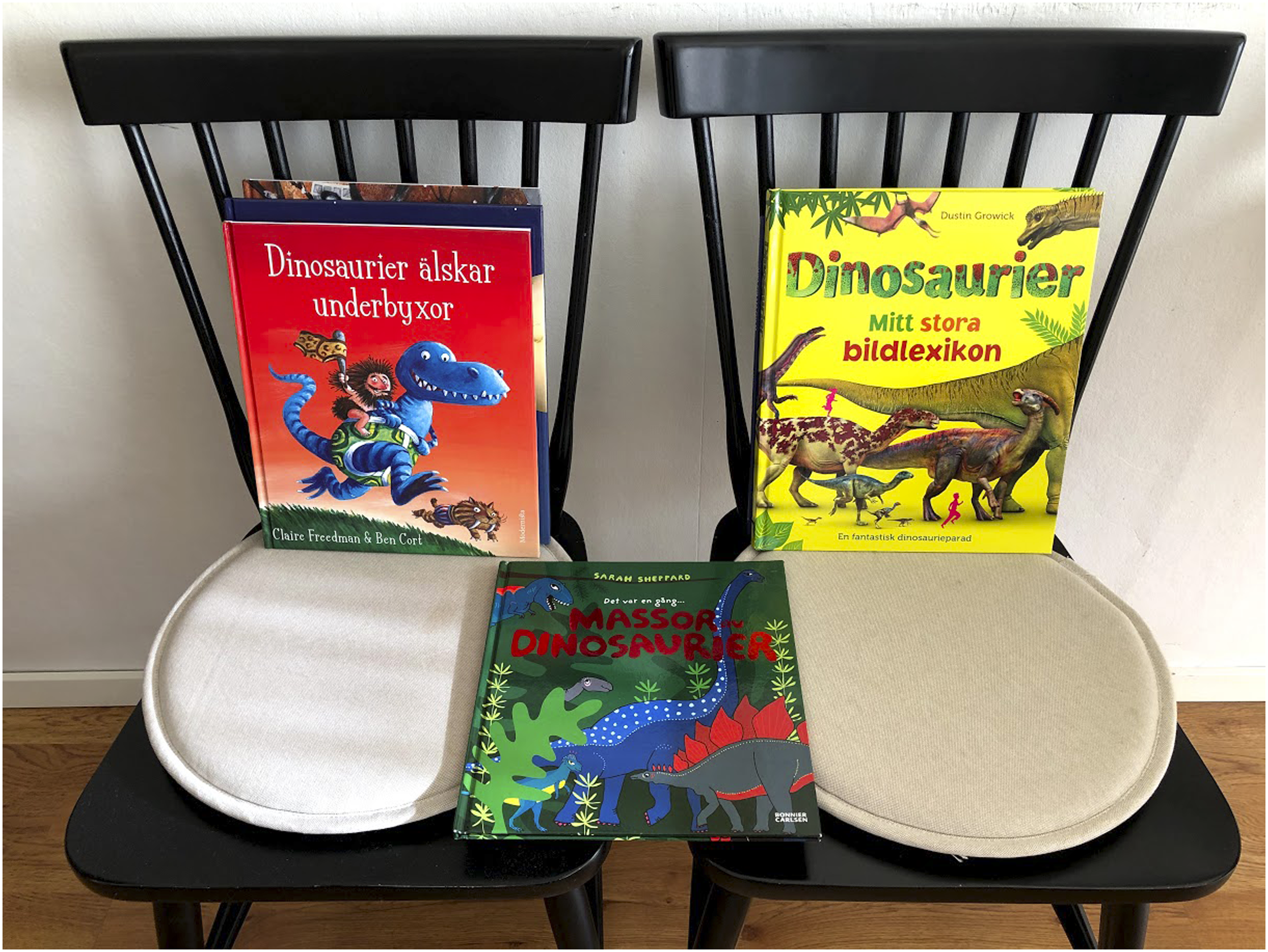
The depiction of the picturebook with the features ‘made up’ (imaginary constructs) and ‘real’ (established knowledge) was still in focus when determining where Det var en gång… Massor av dinosaurier should be placed on the chairs. Liam and Lucas express no discernment of other aspects of different kinds of picturebooks in this situation. The children’s focus on the depictions in distinguishing different kinds of picturebooks gave them the possibility to question whether a fictionalised non-fiction picturebook depicting imaginary constructed (‘made up’) colours as well as other things, characters and occurrences is non-fiction. This allowed them to experience a new kind of picturebook which is neither fiction nor (traditional) non-fiction but rather fictionalised non-fiction.
The children’s focus when non-fiction picturebooks are ‘made up’
The children’s focus on the depiction remained when established knowledge in non-fiction picturebooks was ‘replaced’ with imaginary constructs, although they also discerned other distinguishing features. This allowed them to question whether non-fiction picturebooks depicting imaginary constructed (‘made up’) things, characters and events are non-fiction.
In Reading Activity C, the teacher introduced a pair of picturebooks about dragons, Ett barn mer eller mindre… det spelar väl ingen roll? (fiction picturebook) and Våra nordiska drakar och konsten att spåra dem (fictionalised non-fiction picturebook). Våra nordiska drakar och konsten att spåra dem is a fictionalised non-fiction picturebook similar to Det var en gång… Massor av dinosaurier, highlighted in the previous example. But unlike the fictionalised non-fiction picturebook about dinosaurs depicting both imaginary constructs and established knowledge, the fictionalised non-fiction picturebook about dragons depicts only imaginary constructs. By using a picturebook pair consisting of a fiction and a non-fiction book that both depict imaginary constructs, the teacher intended to make the depiction, which has mostly been in focus for the children in determining whether a picturebook is fiction or non-fiction, invariant (Figure 5). Making the depiction invariant could make the children pay attention to aspects other than the depiction (such as the priority or the reading) when distinguishing non-fiction from fiction picturebooks. Våra nordiska drakar och konsten att spåra dem seems to have the purpose of arousing the reader’s feeling of imaginary wonder (the purpose: entertain and elicit affective responses), and therefore depicts imaginary dragons located in the Nordic countries (the depiction: imaginary constructs). The book does not tell a story but instead presents facts about dragons (the priority: provide facts), and it can be read in any order (the reading: in any order). In using a picturebook pair consisting of a fiction and a non-fiction that both depict imaginary constructs about dragons, the teacher intended to make the depiction invariant.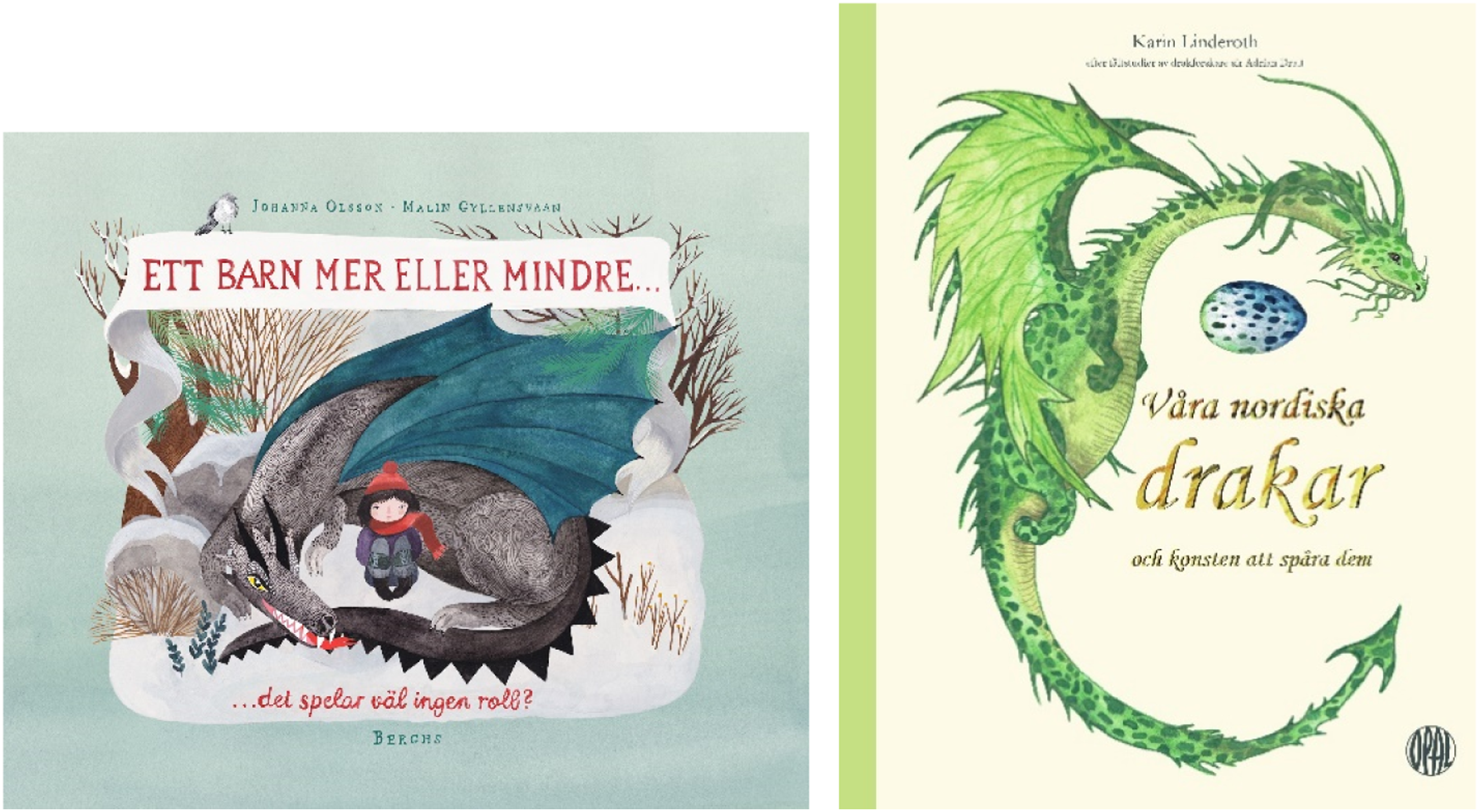
When the fiction picturebook about dragons was compared with the non-fiction picturebook about dragons, the depiction did not come into contrast as they both depict imaginary constructs. When the features of the depiction did not vary, on his own initiative Lukas found a completely new varying aspect, the scope, and used this to explain why Våra nordiska drakar och konsten att spåra dem is a non-fiction book. He said ‘it’s quite long’, drawing a comparison of the respective scopes of the picturebooks. Lucas distinguished non-fiction picturebooks as longer and fiction picturebooks as shorter in scope. The scope (with the features shorter and longer) was not an aspect the teacher had planned to contrast in the teaching; this took place on the children’s initiative when the depiction was not enough to determine what kind of picturebook it was.
In Reading Activity C, the children first identified the scope as an aspect of different kinds of picturebooks when a pair of picturebooks about dragons were presented to them. But when the teacher started reading the fictionalised non-fiction Våra nordiska drakar och konsten att spåra dem and talked to the children about how the reading of non-fiction picturebooks is carried out (Excerpt 1), the depiction came into focus again. The children’s recurring focus on the depiction as a crucial aspect in determining whether a picturebook is fiction or non-fiction, together with the fact that they have just agreed that Våra nordiska drakar och konsten att spåra dem is a non-fiction picturebook, caused them to question the non-fiction picturebook’s depictions.
Excerpt 1
In Reading Activity C, the two picturebooks about dragons are read and discussed (Pair 6). Earlier in the same reading activity, the children and the teacher talked about the similarities between dinosaurs and dragons. The teacher had then said that since fossils of dinosaurs have been found, scientists know they existed, but since no fossils of dragons have been found there is no evidence that they existed. Now the teacher reads about dragons in Våra nordiska drakar och konsten att spåra dem:
General facts about dragons in Våra nordiska drakar och konsten att spåra dem (Linderoth, 2017). Nordic fire dragon! in Våra nordiska drakar och konsten att spåra dem (Linderoth, 2017)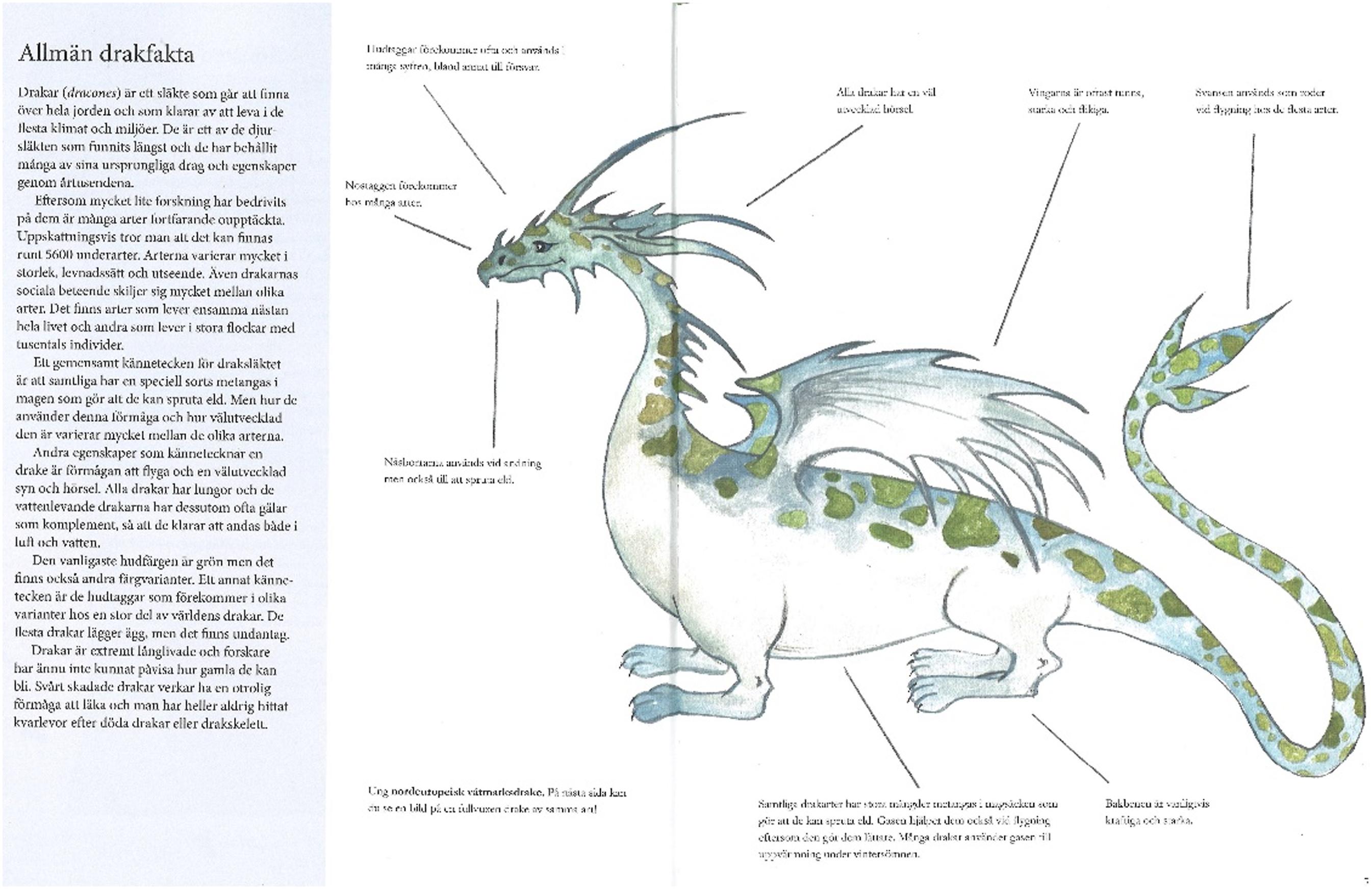
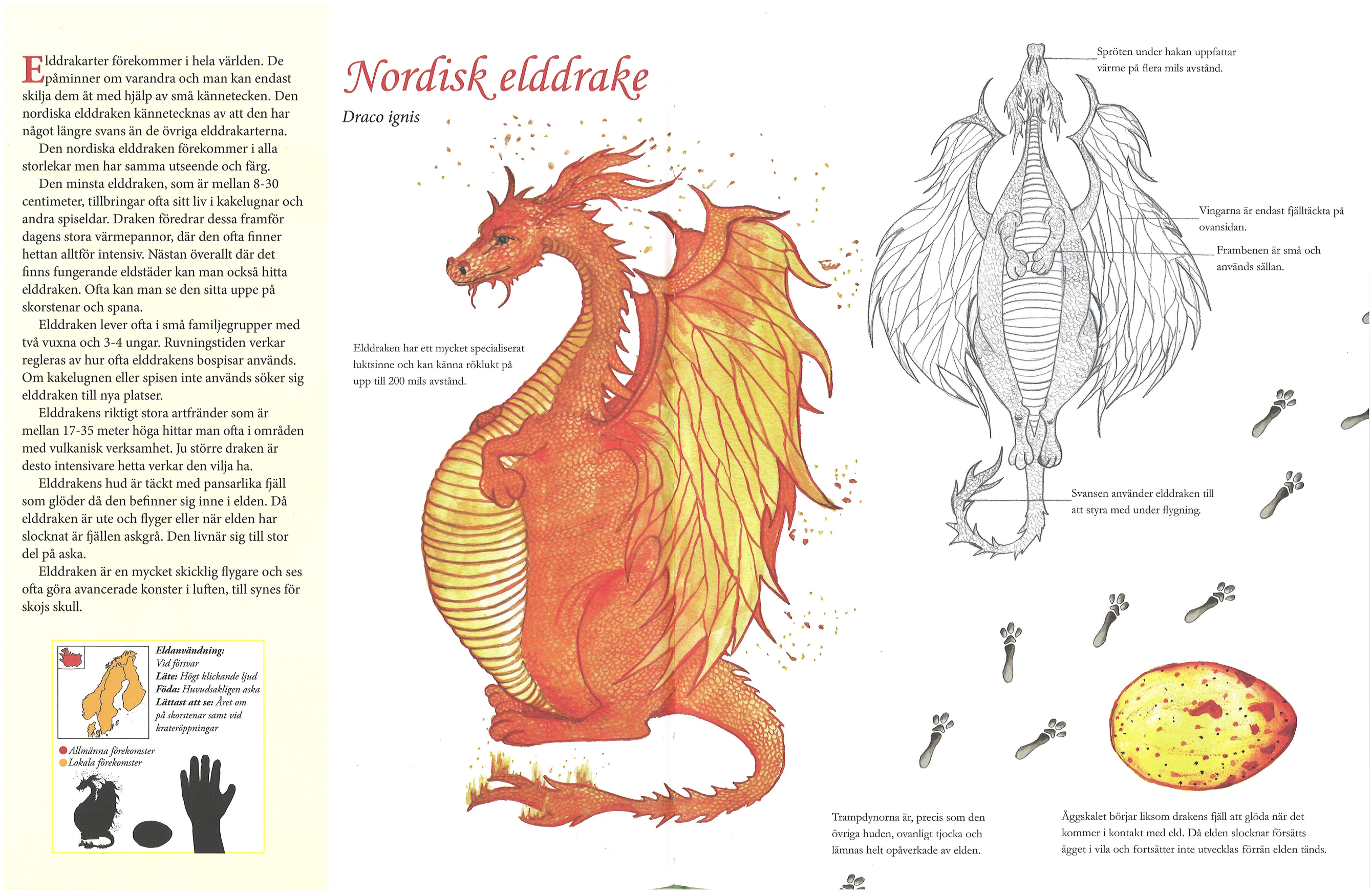
The teacher then reads the fiction Ett barn mer eller mindre… det spelar väl ingen roll from beginning to end, without the children questioning its realism. Then the teacher returns to reading and talking about Våra nordiska drakar och konsten att spåra dem:
Although the purpose of Våra nordiska drakar och konsten att spåra dem seems to be to entertain and elicit affective responses with imaginary constructs about dragons that can be found in our Nordic countries, the children’s responses to the book was not in line with its purpose. They focused on non-fiction picturebooks depicting established knowledge, not imaginary constructs and therefore began to question the ‘made up’ depictions in the non-fiction picturebook, expressing that these deceive them. This can be seen in Lucas shaking his head and exclaiming that the general facts about dragons are ‘fake’, while Henry and Liam ask if the teacher is trying to fool them by reading this non-fiction picturebook. Henry uncertainly asked if dragons exist or not, while Liam sounded annoyed when asking why the teacher says there are dragons in Sweden if they do not exist. Thus, the children’s focus on picturebook depictions in determining whether a picturebook is a non-fiction or not created a basis for them to become uncertain about their acquired knowledge, but also to be able to critically question both the book’s and the teacher’s reliability.
Discussion
The analysis showed that the depiction was in focus when the preschoolers in this study determined whether a picturebook is a non-fiction or not. The children’s focus on the depictions allowed them to question whether non-fiction picturebooks depicting imaginary constructed (‘made up’) things, characters and events are non-fiction books. This is not in line with how previous children’s literature research highlights its functions. For example, Narančić Kovač (2020: 83) writes that ‘the analysis of non-fiction nonnarrative picturebooks has shown that their discourses may combine fictional and non-fictional meanings in the same picturebook, while the whole still functions as non-fiction’. Judging from the children’s responses in this study, the totality of such fictionalised non-fiction picturebooks did not seem to function as non-fiction. When imaginary constructs are combined with established knowledge in Det var en gång… Massor av dinosaurier, the children said it should not be placed among the other non-fiction picturebooks. Their logic seems to be that, when a book depicts fictional elements, it is not a non-fiction. In addition, when established knowledge is replaced by imaginary constructs in Våra nordiska drakar och konsten att spåra dem, the children began to question its ‘made up’ depictions and wondered if the book and the teacher were trying to deceive them by presenting them with fictional facts (Excerpt 1).
Previous research on fictionalised non-fiction picturebooks, such as that by Sanders (2018) and Grilli (2020, 2021), does not include children’s voices – what children have to say about books of this kind. Grilli writes: ‘The artistic nonfiction picturebook is a hybrid form of literature which encourages children to think critically about the world (Sanders, 2018), because it does not provide final answers, but rather invites readers to question common knowledge, opening it up to doubt, dialogue, and revision’ (Grilli, 2021: 26). But neither Grilli nor Sanders includes children in their research on children’s non-fiction picturebooks, and can therefore not know whether these picturebooks actually encourage children to think critically about the world. The present study showed that children who encountered non-fiction picturebooks, in which established knowledge about the non-existence of dragons is exchanged for imaginary constructs about dragons in the Nordic countries, doubted their previous experiences that dragons are imaginary beings (Excerpt 1). In addition, this study showed that children who perceived that dragons in non-fiction picturebooks are fictional became frustrated when a non-fiction picturebook (which they believed should depict established knowledge) seemed to have the intention of deceiving them with incorrect information.
Fictionalised non-fiction picturebooks with ‘made up’ things, characters and occurrences thus created a basis for the children in this study to critically assess the source’s reliability, and to reflect on whether these picturebooks are non-fiction in the sense that they are ‘without fiction’. In order to answer the question of whether a fictionalised non-fiction picturebook ‘functions’ as a non-fiction picturebook for children as recipients of and respondents to it, more studies like the present one are needed, with children’s own statements in encounters with non-fiction picturebooks for children used in the analysis.
The present study is a small-scale qualitative study, the results of which are not generalisable in the same sense as in a quantitative study. The generalisability can thus be considered weak since few children participated in the reading activities. Something that, however, strengthens the generalisability to some extent, are the findings that are consistent with the results of Donovan and Smolkin’s (2002) study where children were invited to sort picturebooks of different kinds into piles. Like the children in this study, the children in Donovan and Smolkin’s study determined whether books were fiction or non-fiction literature primarily based on whether they depicted real or fictional elements. If more qualitative and quantitative studies were carried out, where children’s own statements about what determines whether a book is fiction or non-fiction, these combined could contribute to an even more generalisable understanding of how children distinguish and experience different kinds of picturebooks when they are introduced to the differences between them.
The children repeatedly focused on the depiction in the first reading activities of the study, hence the design was adjusted in reading activity C to make additional features of fiction and non-fiction possible for the children to discern. Given that the teaching design of this study’s reading activities changed in response to what the children expressed as their focus, it appears difficult to replicate this study. Studies of teaching that is developed and altered based on children’s ways of experiencing may have this scientific weakness. Results from such studies should nevertheless be important to consider for anyone interested in how children’s perspectives on children’s non-fiction picturebooks can be broadened.
A study like this, contrasting the characteristics of fiction and non-fiction picturebooks for children in reading activities, offer results that could be useful for teachers, librarians, caregivers, and others using picturebooks with children. If children in early childhood were given the opportunity to be presented with non-fiction along with fiction picturebooks, and if conversations were then held with children about the characteristics of these different kinds of picturebooks, this could arouse children’s curiosity and commitment to different kinds of literature, offering different kinds of reading experiences. In this way, children could gain sufficient knowledge of different types of books to be able to consciously choose which sort to read in order to immerse themselves in a fantastic story, or to get factual information about something of interest. However, the results of this study also reveal challenges that children may encounter when they expect books labelled as non-fiction to be without fiction, which is often not true when it comes to children’s non-fiction. When children’s expectations of a non-fiction picturebook do not match their way of experiencing the characteristics of non-fiction picturebooks, as in the case of the fictionalised non-fiction picturebook about dragons (excerpt 1), it opens the door to talking with children about whether the book is reliable as a source for information about real things, characters and occurrences or not. Such reviews of fictionalised non-fiction picturebooks, however, require the children’s experience and knowledge of the book’s subject matter.
In this article, the findings show that fictionalised non-fiction picturebooks for children may mislead children into believing that ‘made up’ depictions are ‘real’ depictions, and that children may perceive that someone is trying to deceive them when they find imaginary constructs in non-fiction, raises a lot to discuss. A question that arises is whether it is appropriate for non-fiction picturebooks to depict imaginary constructs if the readers in question (children) do not have the previous experience required to be able to interpret whether the depictions (of, for example, Nordic dragons) are ‘made up’ or ‘real’. However, whether it is appropriate for authors and illustrators to make non-fiction picturebooks of this kind is not discussed here. Instead, the discussion is directed towards the new dominant children’s literature research on children’s non-fiction (e.g., Goga et al., 2021; Grilli, 2020; Sanders, 2018) which unanimously celebrates this new wave of fictionalisation of children’s non-fiction, without including what children, who (according to the publishers) are their primary readers, have to say. Against the background of previous research on non-fiction picturebooks in the field of children’s literature, which usually do not include any children, this small-scale study, in which six children express how they distinguish and experience different kinds of picturebooks, contributes with a broadened perspective on how research on children’s non-fiction picturebooks may be conducted.
Supplemental Material
Supplemental Material - ‘But dragons don’t exist, do they?’: Preschoolers’ focus in determining whether a picturebook is a non-fiction or not
Supplemental Material for ‘But dragons don’t exist, do they?’: Preschoolers’ focus in determining whether a picturebook is a non-fiction or not by Anna Backman in Journal of Early Childhood Literacy
Footnotes
Declaration of conflicting interests
The author(s) declared no potential conflicts of interest with respect to the research, authorship, and/or publication of this article.
Funding
The author(s) received no financial support for the research, authorship, and/or publication of this article.

Supplemental Material
Supplemental material for this article is available online.
Notes
References
Supplementary Material
Please find the following supplemental material available below.
For Open Access articles published under a Creative Commons License, all supplemental material carries the same license as the article it is associated with.
For non-Open Access articles published, all supplemental material carries a non-exclusive license, and permission requests for re-use of supplemental material or any part of supplemental material shall be sent directly to the copyright owner as specified in the copyright notice associated with the article.
