




Abstract
Teacher is the most important person in enhancing the students’ learning and lesson study (LS) has achieved international consensus as a vehicle for developing good lessons and enhancing teachers’ professional skills. The aim of this study is to explore how lesson study might act as a form of professional development in helping primary mathematics teachers to develop their collective pedagogical content knowledge in teaching mathematics for the topic of quadrilaterals in the fourth grade. The case study approach with a participant researcher was used. Adapting the sociocultural perspective, the teachers’ reflective practice in LS is linked to the teachers’ engagement with inquiry and research. The term “Collective Pedagogical Content Knowledge” (collective PCK) is used to describe the pedagogical content knowledge that is explicitly developed and shared by the LS teachers with evidence identified as “Seed Events” in the analysis. Seed Events are episodes identified in LS teacher meetings or research lessons, leading into deep reflection, consequently clarifying the conceptions of mathematics objects, enhancing the pedagogical strategies, and further enactment in subsequent research lessons. Finally, we further argue that LS is a wise investment of professional capital so that teachers can envision their professional growth with their industrious effort for something worthy.
Keywords
Introduction
Teacher is the most important person in enhancing the students’ learning in all kinds of curriculum implementations and reforms (Cajkler et al., 2014; Hargreaves and Fullan, 2012; Kieran et al., 2012; White et al., 2012). Although researchers in education seek new theories and methods to understand and improve students’ learning, integrating research into practice needs a platform for teachers to develop their interpretation of research, professional skills for helping their students improve their learning. In recent years, lesson study (LS) becomes a very important and practical research vehicle for enhancing students’ learning in classrooms and teachers’ professional development (Cajkler et al., 2014). Broadly speaking, LS can be a venue for integrating research and practice, drawing upon teachers’ practical experience and educators’ expertise, whereas the latter sometimes may be input by knowledgeable the others (education experts or researchers). Huang and Bao (2006) contend that it is necessary to have expert input to upgrade teacher ideas. However, for limited resources, it is very common that partnerships with university researchers or experts are not available in most schools in Hong Kong. In addition, the presence of an external expert in projects in Hong Kong has its limitation because taking the role of an outsider, the external might have only a partial interpretation of the context of the school and limited communication (e.g., Lo et al., 2002). In an LS without an external expert in the natural school setting, the teachers in the school form a professional community working together with a sharing culture to prepare a detailed lesson plan, they have opportunities to reflect upon the subject, students, and instructional approaches (Watanabe, 2002). The implementation of the lessons may involve peer observation, evaluation, and revision of the lesson plan, followed by an implementation of the research lesson in another class by the same or another teacher. As a result, teachers can refine and deepen their understanding of the subject content, the students, and instructional pedagogy. In brief, the teachers may still develop their pedagogical content knowledge in the process of LS. Thus, it is pertinent to put teachers in the genuine role of action researchers making critical inquiry into the alignment of the curriculum, their students’ learning, and their teaching (Jaworski, 2006). Nonetheless, for the constraint of resources, the sustainability of using LS as school-based staff development and enhancement of students’ subject-based learning, LS without the input of an external expert is important. Little has been reported on professional teacher development in the context of school-based LS without the input of an external expert. Thus, it is important to fill the research gap and to get an interpretation of the effectiveness of LS in school-based in-service mathematics teacher continuing professional development in a normal school setting without any participation of outside experts.
Drawing upon the sociocultural perspectives (Jaworski & Huang, 2014), the authors report a case study of the growth of the teachers’ “Collective Pedagogical Content Knowledge” for primary mathematics in the process of a school-based LS in Hong Kong, where an LS school team formed a community of inquiry. In particular, the LS project was only advocated by the panel chairperson with the consent of the school head and colleagues, without any external playing the role knowledgeable the others. The overarching aim of the study is to explore how LS might act as a form of professional development in helping primary mathematics teachers to develop their collective pedagogical content knowledge in teaching mathematics. In the investigation, there are two subquestions:
How can the growth of pedagogical content knowledge in a collective manner be interpreted in the process of LS as a school-based professional development? What factors foster these changes in the LS?
This paper is arranged in the following: (1) the introduction, (2) a theoretical background for the construal of LS and collective pedagogical content knowledge (collective PCK), (3) the design of the study, (4) results, and finally (5) the discussion and conclusion.
Theoretical background
What is lesson study?
LS has become a global trend for enhancing mathematics teaching and teachers’ professional development. There are different formats of lesson studies and no consensus for the definition of LS. Huang and Shimizu (2016) carried out a systemic literature review of 52 papers of LS and give a conceptualization of LS. Based on this, they summarized four types of LS illustrations, namely, Japanese LS, Chines LS, Learning Study (Sweden/Hong Kong), and UK LS.
Japanese LS has a long history for professional development (Fernandez & Yoshida, 2004; Lewis, 2000), aiming to help teachers master teaching procedures and improve their capability for making judgment and choices in teaching situations with a focus on the students’ learning. There have been a number of studies on how Japanese LS can be incorporated into the U.S. context as a form of teacher professional development (Fernandez, 2002; Fernandez & Yoshida, 2004; Watanabe, 2002). Since LS had been employed in Japan for long, Yoshida (2012) conducted a study to explore the obstacles that stood in the way of high quality and effective LS in U.S. and his study found that the teachers in U.S. were found to have insufficient content knowledge, pedagogical knowledge, and curriculum knowledge. To enhance the effectiveness of LS, Yoshida suggested that teachers have to spend more time in studying mathematical content and curriculum.
In Mainland China, a long tradition of teaching research system has been established since the 1950s (Chen & Yang 2013). The system focuses on teachers’ professional development and promotion of high-quality classroom instruction in many aspects, such as research, administration, consultation, mentoring, revision of new curricula, and establishing links between educational theories and teaching practice (Huang et al., 2014). For LS in China, Ma (1999) pointed out that Chinese teachers gain professional knowledge through discussions about the content taught and through collaborative effort and the making of “research lessons” in mathematics, also known as “Keli” (Huang & Bao, 2006). Similar practice bearing the name of “open lessons (gongkaike)” has been a popular teacher professional activity in mainland China. The flow of the process is similar to that of LS (Ma, 1999; Wang, 2001), including collective lesson preparation meetings, open lessons (gongkaike) lesson observations, and post-lesson reflection meetings (Wong, 2010). Exploring the effectiveness of a subject-based professional learning community the partnership with outside experts was a crucial factor toward success in Chinese LS (Huang & Boa, 2006; Huang et al., 2011; Huang & Shimizu, 2016).
Learning study in Sweden and Hong Kong is a theory-based approach putting focuses on student learning through interviews, pre- and post-tests, and designing and debriefing with respect to variation theory (Cheng & Lo, 2013; Pang & Runesson, 2019). UK LS focuses on case pupils via various data source, including, video-recording the research lessons and post-lesson student interviews (Dudley, 2012). Both models can be seen as variations inspired from the Japanese LS models (Huang & Shimizu, 2016).
To conclude, LS is a useful platform for teacher professional development and integrating research into practice; however, there may be differences in operational formats and foci for lesson studies as a result of the cultures in different places. There are many variations of lesson studies, nonetheless, a typical LS process consists of six steps: (i) collaboratively planning the research lesson, (ii) observing the implementation of the research lesson, (iii) discussing the study lesson, (iv) revising the lesson plan (optional), (v) teaching the new version of the lesson (optional), and (vi) sharing reflections about the new version of the lesson (Fernandez & Yoshida, 2004; Kieran et al., 2012). In addition, teachers will have the opportunity to develop strong pedagogical content knowledge with their colleagues through LS.
Collective pedagogical content knowledge (PCK)
According to the seminal work of Shulman (1986), PCK is of special interest because it is a knowledge that links content and pedagogy. Pedagogical content knowledge in brief is the integration of subject matter knowledge, knowledge of students’ understanding, curriculum knowledge, and knowledge of instructional strategies. Pedagogical content knowledge is the essential element for effective teaching. The conceptualization of PCK has received much attention and a lot of studies have been carried out for the interpretation of teachers’ knowledge in teaching. For example, Hill et al. (2008), in seeking to conceptualize the domain of effective teachers’ knowledge of students’ learning of mathematics, proposed that the domain map for mathematical knowledge for teaching consists of common content knowledge, knowledge at the mathematical horizon, specialized content knowledge, knowledge of content and students, knowledge of content and teaching, and knowledge of curriculum. Adapting the sociocultural perspective (Jaworski & Huang, 2014), an effective goal for teacher development is reflective practice, in particular, LS is linked to teachers’ and educators’ engagement with inquiry and research. However, reflection and inquiry are not panaceas, so, a pertinent influence for teaching developments is the collaboration between teachers and educators. Thus, Kieran et al. (2012) identified teachers as the key stakeholders of research who can exert the greatest influence on achieving the research purpose of improving students’ mathematics learning. Unfortunately, many teachers may not read research papers (Kieran et al., 2012).
Strong claims have been made about the benefits of LS and it is a comprehensive approach to examine practice for teachers (Fernandez et al., 2003; Huang & Shimizu, 2016). In LS, teachers have to identify an LS goal and content area and then meet to discuss their observations and ideas for how to improve the lesson. Through the collaborative planning and examination of actual lessons, teachers’ subject matter knowledge, knowledge of students’ understanding, curriculum knowledge, and knowledge of instructional strategies are involved (Cajkler et al., 2014; Huang & Shimizu, 2016; Kieran et al., 2012). In this study, the term “Collective Pedagogical Content Knowledge” (CPCK) is created to describe the pedagogical content knowledge that is explicitly developed and shared by the teachers from LS group with evidence provided in their pre-lesson preparation meetings as well as post-lesson evaluation meetings, supplemented with their peer-observed research lessons.
The CPCK framework applied in the analysis of data consists four components, namely subject matter knowledge, knowledge of students’ understanding, curriculum knowledge, and knowledge of instructional strategies, and their interconnections. The four components in collective PCK and PCK are the same. A major difference between CPCK and PCK is where evidence is found. In many studies, PCK refers to that found in individual teacher and may be probed with research instruments (e.g., Ma, 1999). Collective PCK in this study refers to the knowledge generated in the discourse between the teachers in the preparation and evaluation of research lessons in the process of LS. Although each component has been addressed separately for analytic purposes, in actual use by teachers, these components are integrated and not as clearly distinguishable (Grossman, 1995). Hence, they may become interrelated that they cannot be considered separately. For example, knowledge about student understanding can inform both curricular planning and expectations of students. Although collective PCK is the result of teachers’ interpretation and integration of all components in the process of LS, the contributions of the four components in the team sharing depends on individual teacher. For example, a teacher may have a strong understanding of the concepts of a specific topic but with a weak perception of how the topic is organized in curriculum. In this analytical framework, subject matter knowledge includes not only mathematical concepts related to the topic of quadrilaterals in the primary school mathematics curriculum but also the knowledge which pertains to the underlying meaning and understanding of why things are the way they are. Knowledge of student understanding includes the preconceptions that students bring with them to the learning of quadrilaterals. In addition, understanding student learning difficulties, and misconceptions and the reasoning behind them will also be included in this category. Curriculum knowledge concerns the understanding that teachers have pertaining to how the topic of quadrilaterals is organized in mathematics curriculum both from the horizontal and vertical curricula development. The last component, knowledge of instructional strategies includes teaching methods, teaching materials, productive activities, representations, and instructional explanations that are particularly effective for teaching quadrilaterals.
Design of the study
The study adopted a qualitative case study research approach (Yin, 2009) with a participant researcher. Qualitative researchers believe that since humans are conscious of their own behavior, the thoughts, feelings, and perceptions of their informants are vital. How people attach meaning and what meanings they attach are the bases of their behavior (Burns, 2000). Yin (2009) claimed that the case study is suitable for examining contemporary events when behavior cannot be controlled. One of the aims of qualitative research is to get an inside perspective of subjects under study (Hammersley & Atkinson, 1983; Vulliamy et al., 1990). The objective is to understand the situation in the school by actually being there instead of asking members to explain what they feel. As Fetterman (1989) pointed out, the presence of the researcher is the most important element since watching what happens, listening to what is said, and asking questions are all significant to comprehending the issues in which the research is concerned. This study is a case of LS on teaching quadrilaterals participated by a group of primary mathematics teachers in the same school. The research intends to study the development of pedagogical content knowledge of a group of teachers from one primary school. Since the focus of this study is a holistic examination of the way a particular group of people confronts specific problems, the case study method is appropriate (Merriam, 1988).
The case school and participant teachers
The study has adopted a qualitative case study approach to explore the experiences of a group of five teachers engaged in one LS group. The case school was an established school with a good reputation in its local district, for its strong emphasis on mathematics and student performance in mathematics is generally higher than average for Hong Kong. The school was a bisessional school with teachers of the am school and pm schools working closely in collaborative lesson planning (or LS). The school principal was an innovative leader, who encouraged school reforms, and LS was utilized as a research tool for enhancing the teacher professional development in the school.
The school-based staff development project of LS was led by the mathematics panel chairperson and supported by the school principal and colleagues. At the same time, the panel chairperson got consent to use the data generated in the process for her own study for her doctoral degree thesis. Thus, this could be seen as a voluntary attempt initiated by the teacher integrating the school aims and her personal goals. The panel chairperson played the role of a participant researcher aiming to establish a culture of sharing collective PCK via LS in alignment with the goal of the school staff development.
The panel chairperson plays the role of a participant researcher and the coordinator leading the LS group. For the topic of the research, lesson was for primary 4, only the teachers teaching the primary 4 classes were included in this LS group. The teachers were helpful, industrious, and willing to share their experiences with others. This made it feasible to detect and illustrate developments in their pedagogical content knowledge and the subsequent effects on their teaching practices and the experiences of the students. They all had a bachelor degree and the panel chairperson had a master degree. In addition, their teaching experience ranged from 6 to 18 years (Table 1).
Demographic characteristics of the participant teachers.
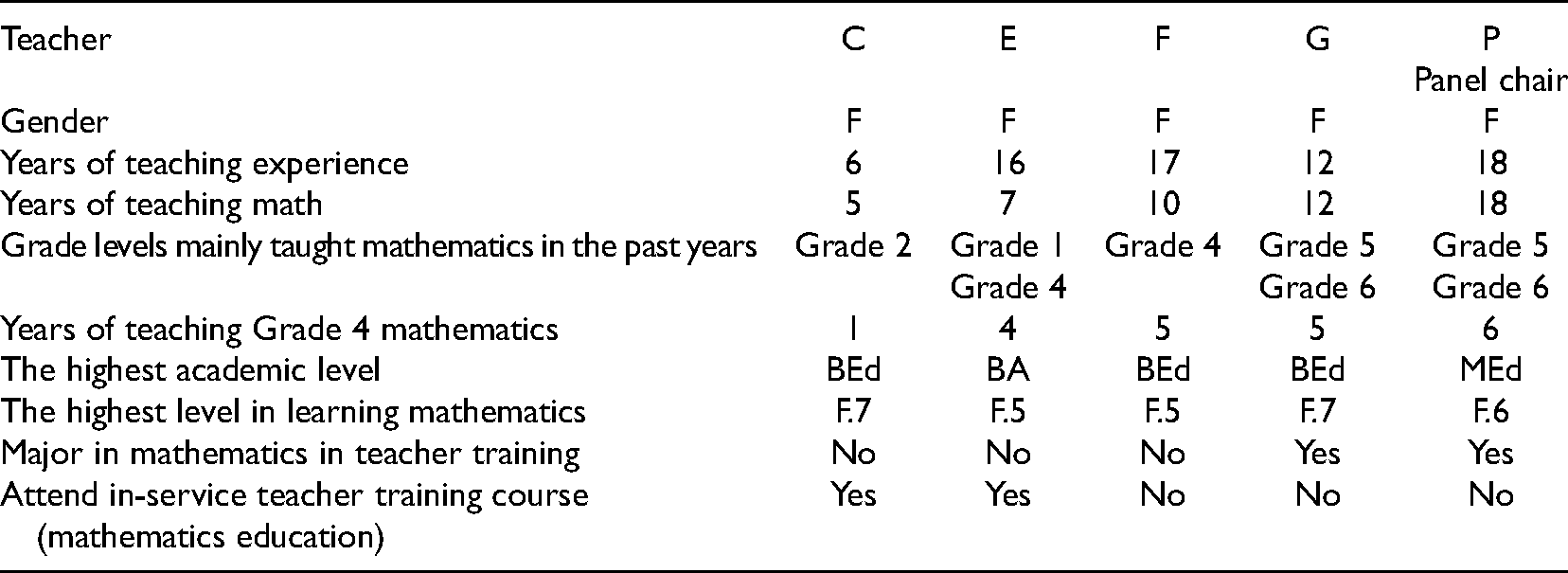
Demographic characteristics of the participant teachers.
Data collected from observations of research lessons, field notes, and audio records of teachers’ meeting and documents of LS artifacts such as meeting agendas and lesson plans. The mathematics topic was focused on the topic quadrilaterals for primary 4 (fourth grade), which was always perceived as a difficult topic in the curriculum. The data collection period involved intensive observation of the group of teachers who utilized research lessons over a period of three months. There were eight LS group meetings, four research lessons with lesson observation and video recordings.
The LS kicked off with a discussion of the difficulties and misconceptions that the students might have in learning quadrilaterals, and the teachers decided to conduct their research lesson on “the concept of opposite sides of quadrilaterals” and “grouping quadrilaterals into different sets by the characteristics of opposite sides” based on the teachers’ perceived students’ difficulty. All the participating teachers observed the first lesson taught by one of the teachers. In the remaining meetings, they developed collaboratively lesson plans for their research lessons. After the first lesson, the teachers held a post-lesson meeting to share their thoughts and insights, revised the lesson plan with some minor improvements and very often the teacher of the next Research Lessons also brought about ideas catering for the students in the class. These ideas were discussed further in the group for supplementing the lesson plan. The revised research lesson was, then, taught a second time by another teacher to another class. The lesson delivery and evaluation cycle was repeated until four research lessons had been taught. All the research lessons were videotaped and field notes were made during observations for evaluation purposes. In brief, the procedure of the LS is listed below in chronological order according to the school timetable:
4 Pre-lesson meetings to develop a lesson plan; Research Lesson 1 (Class 4A pm school, Teacher G) & Post-lesson meeting 1; Research Lesson 2 (Class 4B am school, Teacher F) & Post-lesson meeting 2; Research Lesson 3 (Class 4B pm school, Teacher C) & Post-lesson meeting 3; Research Lesson 4 (Class 4A am school, Teacher E) & Post-lesson meeting 4.
Analysis
“Seed Events”
During the pre-lesson meetings, the teachers drew upon their experiences to identify the difficulties and misconceptions that their students might encounter, hence, they designed a lesson plan together. In the post-lesson meetings, the teachers identified some events which may have shortcomings in the lessons. Sometimes, the teachers reviewed the events in the following meetings and initiated further changes. As a result, this leads to a possible objective reflection and development of pedagogical idea among the teachers. These events are coined “Seed Events” in the analysis. Through the discussion of a seed event, the team members learn something collectively, make suggestions for actions to be implemented in subsequent research lessons which are further evaluated and developed. In tracing the development of a seed event, the collective pedagogical content knowledge shared by the team becomes explicit. In brief, “Seed Events” are episodes identified in LS teacher meetings or research lessons, which lead the LS team into deep reflection, consequently clarifying the conceptions of mathematics objects, enhancing the pedagogical strategies, and further development in subsequent research lessons.
Coding of the pre-lesson, post-lesson meetings, and the research lessons
In addition, the audio of the pre- and post-lesson meetings, as well as the research lessons, was transcribed verbatim. The open-coding method of the grounded theory approach (Strauss and Corbin, 1998) was applied in the analysis. All the codes were then classified into four categories, namely subject matter knowledge, curriculum knowledge, knowledge of student understanding, and knowledge of teaching strategies. Within each of the four categories, there were different subcodes. For example, the category “curriculum knowledge” contained the subcategories “vertical curriculum development across grade levels” and “horizontal curriculum development in the same topic.” (Tables 2 and 3).
Categories for classifying pedagogical content knowledge.
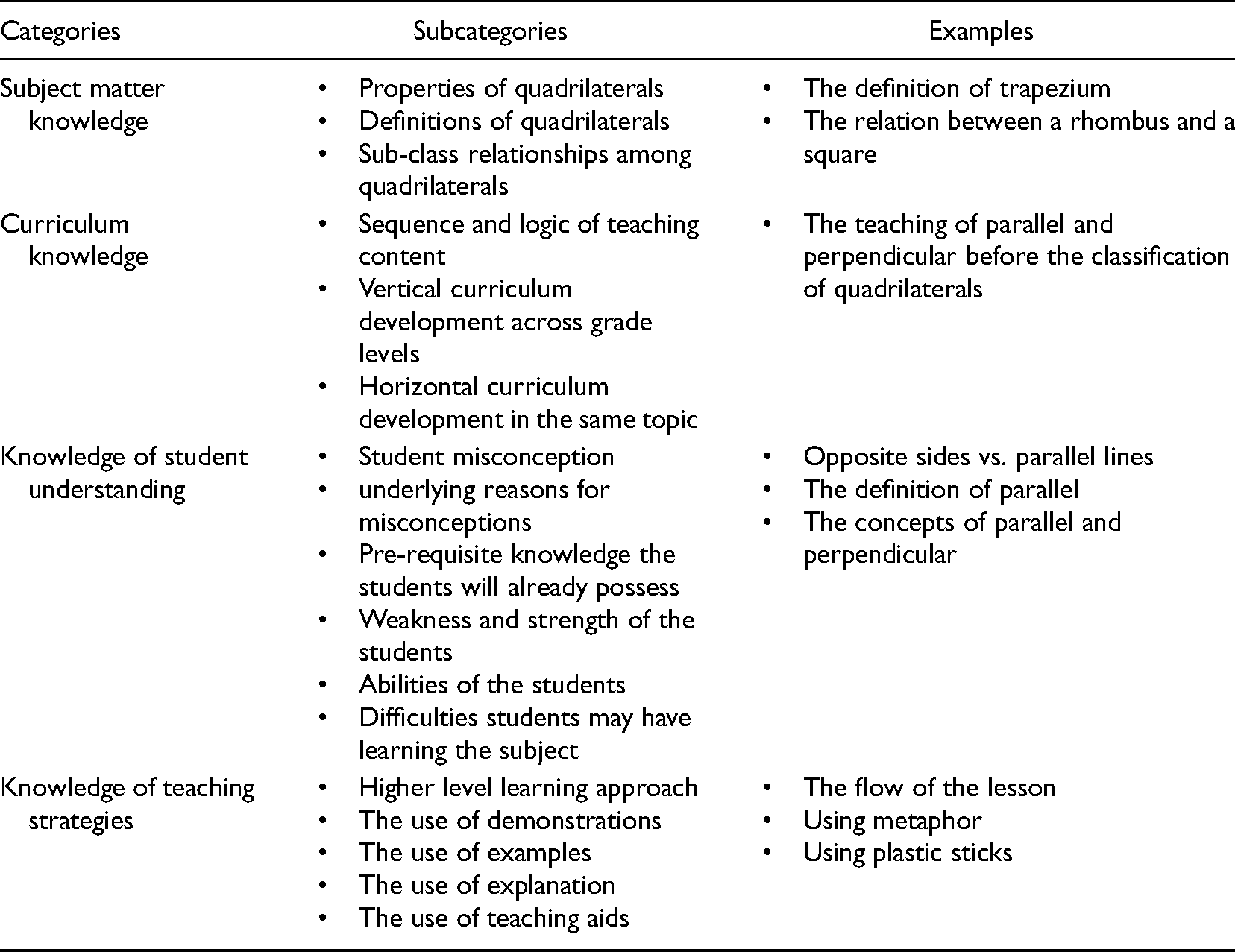
Categories for classifying pedagogical content knowledge.
Example 1 (Seed Event A): Student misconceptions found in RL1 and growth in RL2 to RL4 (opposite sides vs. parallel lines)
Seed Event A, which arose from Episode A1 in Research Lesson 1, illustrated the development of the collective pedagogical content knowledge of the teachers arose from a student's misconception. Seed Event A grew through each subsequent research lessons, which the Episodes A2 to A4 represented the “growth” in each of the subsequent Research Lessons 2 to 4, respectively (Figure 1).
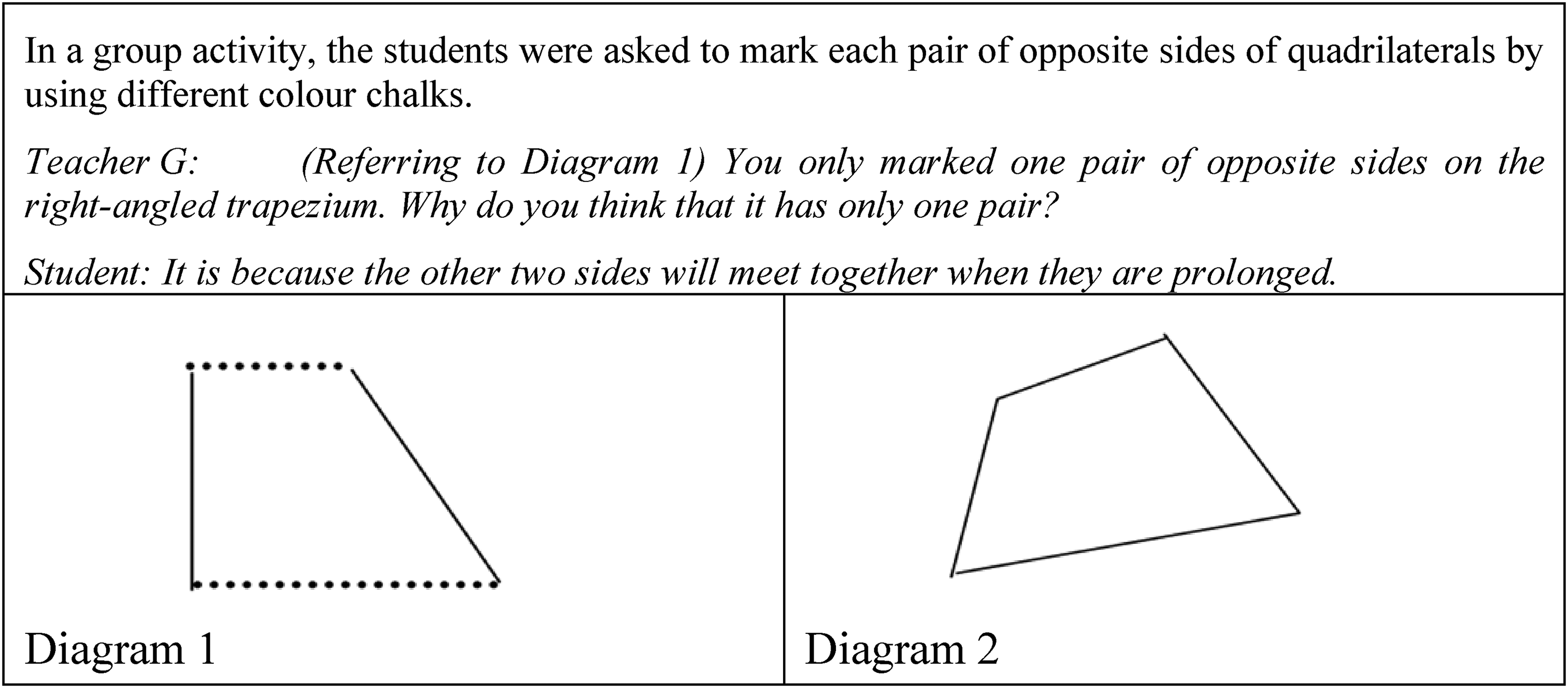
Students’ answers. Only the parallel sides in Diagram 1 were marked with color chalk (represented by the dotted lines). No sides were marked in Diagram 2.
Teacher G taught RL1 (Class 4A_pm). In a group activity, the students were asked to mark each pair of opposite sides of quadrilaterals by using different color chalks. A group could correctly mark two pairs of opposite sides of a square, rectangle, kite, rhombus, parallelogram, trapezium, and isosceles trapezium, but not a right-angled trapezium or an irregular quadrilateral.
Teacher reflections about Seed Event (A1) in post-lesson meeting of RL1
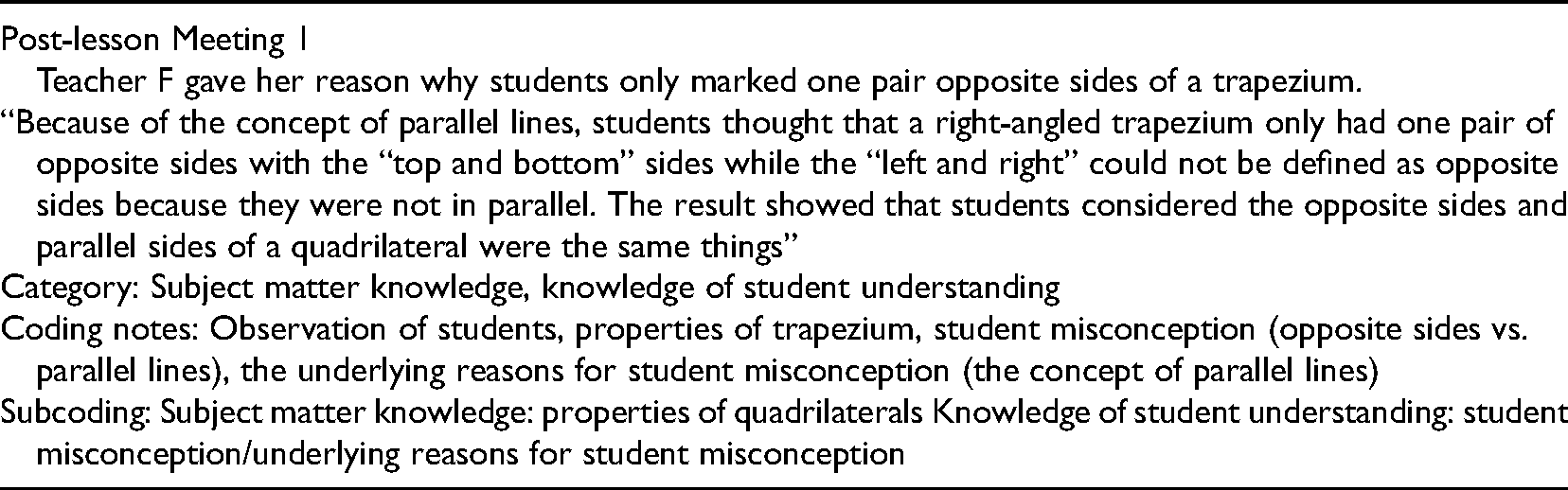
In the post-lesson meeting, Teacher F pointed to above episode (A1) and initiated the discussion. Different Teachers suggested the possible reasons (mix up opposite sides and parallel sides, the choice of example, insufficient explanation for the meaning of opposite side) that might possibly lead to the students’ incomplete answers. Teacher F: “Because of the concept of parallel lines, students thought that a right-angled trapezium only had one pair of opposite sides with the “top and bottom” sides while the “left and right” could not be defined as opposite sides because they were not parallel. The result showed that students considered the opposite sides and parallel sides of a quadrilateral were the same things”. [Codes: Teacher F, observation of student, knowledge of student understanding-misconception, subject matter knowledge]
Teacher P: “The teacher used an isosceles trapezium to introduce the concept of opposite sides and she showed the pair of parallel sides from the trapezium as an example of opposite sides only”. [Codes: Teacher P, observation of teaching, subject matter knowledge, knowledge of instructional strategies-demonstration, knowledge of student understanding-misconception]
Teacher E: “The teacher did not talk about the concept of opposite sides in depth and had not shown enough examples for this. I think we should emphasize what the term ‘opposite’ means”. [Codes: Teacher E, observation of teaching, subject matter knowledge, knowledge of instructional strategies-explanation and demonstration]
Some instruction strategies (e.g., using plastic sticks, prolonging the sides, and intersection of 2 sides/lines) were suggested during the discussion. Teacher E: “It would be better if the teacher picked up any example of quadrilateral to introduce two pairs of opposite sides simultaneously”. [Codes: Teacher E, knowledge of instructional strategies-demonstration, knowledge of student understanding-weakness]
Teacher P: “Since a trapezium with one pair of sides in parallel and the other pair not in parallel, it is a good example to show these two situations to students”. [Codes: Teacher P, subject matter knowledge, knowledge of instructional strategies-suggestion for modification, knowledge of student understanding-weakness]
Teacher E: (Expressing her own idea) “The teacher might use different color of plastic sticks to form a trapezium. Then she might ask students which color of stick is opposite to the stick in red and which color of stick is opposite to the stick in yellow. The teacher should also emphasize opposite sides mean two sides opposite to each other”. [Codes: Teacher E, knowledge of instructional strategies-suggestion for modification, knowledge of students’ understanding-students’ weakness]
Teacher F: (Suggestion to enhance students’ understanding) “Should we ask the students whether a pair of opposite sides would “touch” each other or not?” [Codes: Teacher F, subject matter knowledge, knowledge of student understanding-concept building]
Teacher P: “I am afraid that students might be misled according to the notion of “touch”, students might think that two sides not in parallel might touch each other when they were prolonged and therefore, they could not be identified as a pair of opposite sides. This would be the same issue as what happened in the lesson… It is necessary for the teacher to emphasize two sticks “touch” with each other mean the end of these two sticks had an “intersection point” in a quadrilateral”. [Codes: Teacher P, knowledge of student understanding-misconception]
To conclude, through the discussions of Seed Event A in post-lesson meeting 1, the interaction between teacher's knowledge of the subject matter and teacher's understanding of the students was active, suggesting critical evaluation and improvement for the teaching, such as considering suitable examples for illustrating the concept. When the other teachers taught their class the sample concept, they modified the instructional strategies in each of the research lessons (RL2, RL3, RL4), accumulating the discussions and suggestions of the respective post-lesson evaluation meeting. Hence, there were a total of three follow-up actions for Seed Event A.
The growth of Seed Event A in RL2, RL3, and RL4
Following meeting 1, another teacher (F) taught another class (4B_am) RL2 for the same topic. Comparing Research Lessons 1 and 2, two aspects of contrast are found. The first contrast concerns the choice of content for the lesson. Teacher F used an irregular quadrilateral and a parallelogram to illustrate the concept. The use of these two examples (irregular quadrilateral and parallelogram) offered two important points for teaching the concept. The second aspect concerns how the teacher treated the concept. Teacher F integrated the idea of “two opposite sides would not touch each other” and “they were opposite to each other” in further explaining the concept.
Teacher C taught the same topic (the concept of opposite sides) in another class (Class 4B_pm) RL3 and in the activity of marking the opposites, nearly the entire class thought that no opposite sides could be found in a kite or irregular quadrilateral. Although asking the students for the reason, the students' reply indicated that they had mixed up parallel lines and opposite sides. In the post-lesson meeting, the teachers agreed that when introducing the concept of opposite sides, the meaning of “opposite” and a pair of opposite sides do not have any meeting point in any quadrilateral should be emphasized.
Teacher E taught Research Lesson 4 to another class 4A_am. Taking the experiences from the earlier research lessons and meetings, after the activity and explanation, referring to a kite made from four sticks of different color, Teacher E directly challenged the students why the adjacent sides of the kite were not opposite sides. This time the student gave a satisfactory answer. Student: “No. Since you have just tell us that two sides touch with each other cannot be identified as opposite sides. Now the green stick touches the blue stick, and the green stick touches the white stick. Therefore, the side in green is the opposite side of the side in yellow.”
The development of collective PCK in Seed Event A
Seed Event A initiated from a student's mistake in a research lesson. The development of Seed Event A went through 4 Research Lessons and post-lesson meetings, analysis showed that the teachers’ collective PCK developed. Before the Seed Event, drawing on their past experiences, the teachers had noticed that students often confused the concepts of “opposite sides” and “adjacent sides.” They did not realize that their students also mixed up the concepts of “parallel lines” and “opposite sides.” In dealing with this misconception, the teachers learned more for the students’ misconceptions associated with the two concepts. In the dynamics of a Seed Event, the teachers gradually shared a growth of collective PCK with empirical evidence of applications in the different research lessons. To align with the school goal of collaborative lesson planning, it was purposefully in the analysis to emphasize that the LS team had shared ownership of the planning, implementation, and evaluation of the research lessons, and avoiding labeling and comparing individual PCK. This can help establishing genuine collegial trust and collaborative spirit.
Results
Seed events
The seed events were further categorized according to the characteristics of seed events, namely student misconceptions, teacher misconceptions, teaching strategies, teacher's own doubt about mathematical concept, and teacher's fears (see Table 4). Based on the main theme of different seed events, the characteristics of seed events fall into five categories, namely student misconceptions, teacher misconceptions, teaching strategies, teacher's own doubt about mathematical concept, and teacher's fears. For example, if the seed event was about how students mixed up the relationship between a square and a rhombus, then it was categorized under student misconceptions. Seed Event A and Seed Event F were under this category. For another example, if the seed event was about teachers demonstrating an unwillingness to teach the subclass relationship among different kinds of quadrilaterals, then it was cataloged in the category of teacher's fears. Seed Event E was under this category. If the seed event was about the design of the lesson plan, the sequence, and logic of teaching content, then it was cataloged in the category of teaching strategies. Seed Event B was an example of this category. In the earlier part of the paper, Seed Event A (Example 1) is chosen to illustrate what a seed event is and the growth of collective PCK. In contrast, Seed Event D is chosen as Example 2 for Teacher E initiated it by mentioning her doubt over a mathematical concept in the pre-lesson meetings, and the growth of Seed Event E shows the establishment in the growth of collective PCK in the LS.
A summary of seed events.
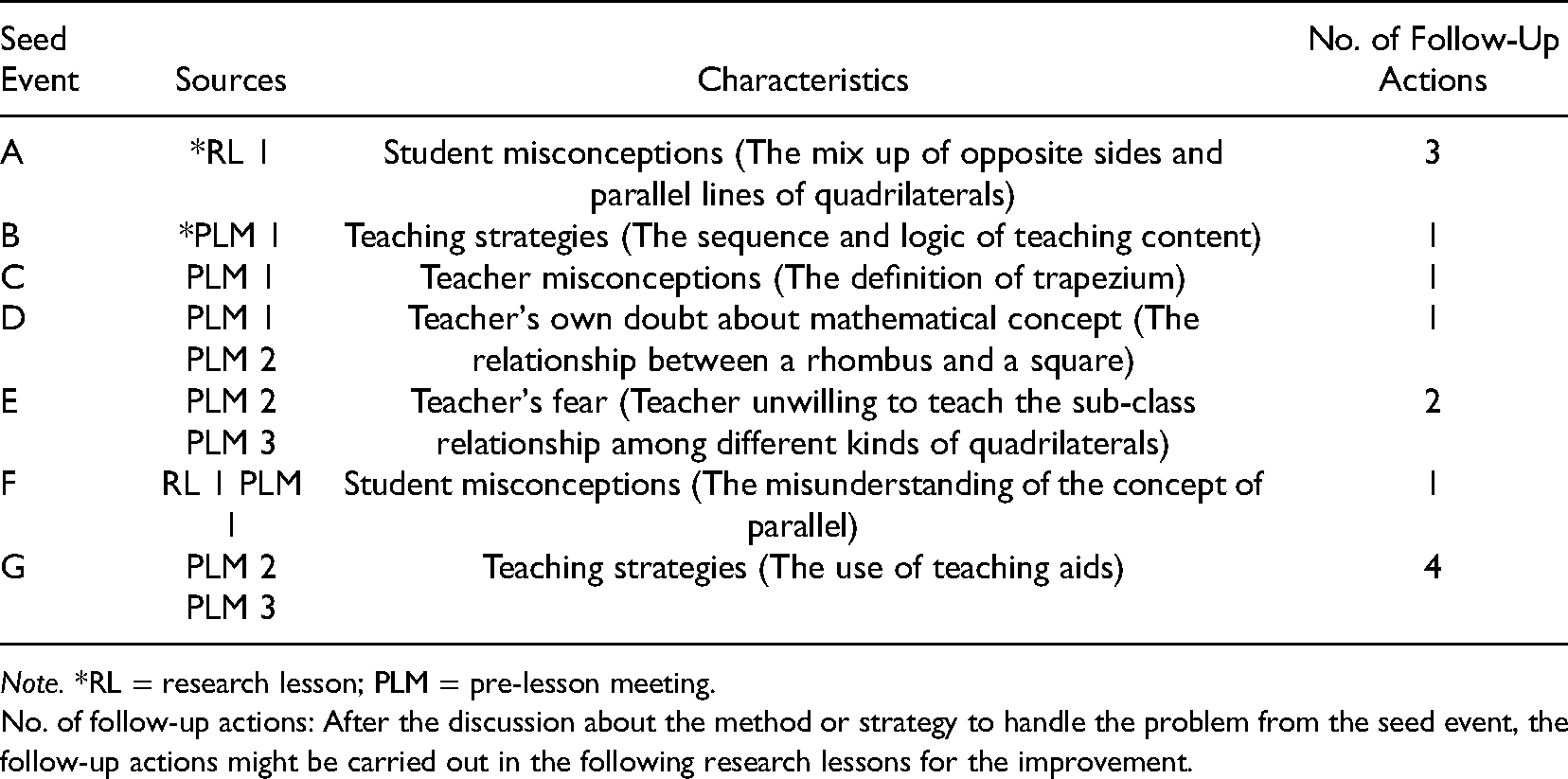
A summary of seed events.
Note. *RL = research lesson; PLM = pre-lesson meeting.
No. of follow-up actions: After the discussion about the method or strategy to handle the problem from the seed event, the follow-up actions might be carried out in the following research lessons for the improvement.
Since there were four research lessons in this study, the maximum number follow-up actions was “3.” Table 4 is used to illustrate the nature of seed events. For example in Table 4, Seed Event D was the example that only one trial was found in the first research lesson. If the first follow-up action still needed the improvement, then there might be a second trial on the following research lesson. For example, there were two follow-up actions in Seed Event E. The development of teacher's pedagogical content knowledge might be experienced by analyzing the change of follow-up actions.
An example of the open-coding approach in the analysis of the meeting transcripts.
Example 2 (Seed Event D): Dispelling of a teacher's own doubt about mathematical concepts
At the end of the first pre-lesson meeting (PLM 1), Teacher E first expressed her own doubt about the relationship between a rhombus and a square. Teacher E: “I don't understand the relationship between rhombus and square. I am really weak in this.” [Codes: Teacher E, subject matter knowledge—subclass relationships among quadrilaterals]
Since the question was posed in the last minute of the meeting, there was no time for further discussion. Therefore, the question was left to the next meeting. In the second pre-lesson meeting, Teacher E raised the question again in a more explicit way: Teacher E: “When a rhombus is leaned, can we say that it is a square? On the other hand, if a square is leaned from its normal position, then can we say that it is a rhombus?” [Codes: Teacher E, subject matter knowledge—definition of quadrilaterals]
Teacher P tried to clarify Teacher E's question by using the definitions of square and rhombus. Yet, Teacher E raised once again her question about the square in a leaned position. Teacher P: “What is the definition of rhombus?”
Teacher E: “Four sides are equal and two pairs of opposite angles are equal” [Teacher E: subject matter knowledge—definition of quadrilaterals]
Teacher P: “What is the definition of square?”
Teacher E: “Four sides are equal and four right angles.” [Teacher E: subject matter knowledge—definition of quadrilaterals]
Teacher P: (Further elaborated) “Four equal sides and two pairs of equal opposite angles can be found both in rhombus and square but four right angles only can be found in square. By comparing these two kinds of quadrilaterals, square possesses of one more property that four right angles can be found. Based on this difference, square is under the sub-class of rhombus.” [Teacher P: subject matter knowledge—definition of quadrilaterals, properties of quadrilaterals and sub-class relationships among quadrilaterals]
Teacher C used subclass relationships between people as a metaphor to express her view on the question whether a square in its right position or in a leaned position should be considered as a rhombus or not. Teacher F expanded this metaphor to illustrate the relationships among quadrilaterals. Teacher C tried to explain with the set and subset relationships. Teacher C: “If we define the definitions of rhombus and square in broad sense, square is a kind of rhombus…. It is something like “Hong Kong people” can also be called “Chinese”.” [Teacher C: subject matter knowledge—definition of quadrilaterals, knowledge of instructional strategies—using of metaphor]
Teacher F: “‘Square’ is ‘Hong Kong people’ while ‘rhombus’ is ‘Chinese’. And ‘quadrilaterals’ is ‘human being’.” [Teacher F: subject matter knowledge—definition of quadrilaterals, knowledge of instructional strategies—using of metaphor]
Teacher E: asked another interesting question. “Which one appears first in the world? Rhombus or square?”
Teacher C: “It is not about which one comes first. It should be considered as the relationship of set and sub-set. Which one is the set and which one is its sub-set? It depends on the cover range of the properties of different kinds of quadrilaterals”. [Teacher C: knowledge of instructional strategies—using of mathematical terms, subject matter knowledge—properties of quadrilaterals]
After settling the query about the rhombus and the square, Teacher E applied what she had just learned to elaborate on the relationship between rectangle and parallelogram. Teacher E: “What is the relationship between rectangle and parallelogram? A rectangle should be four right angles. The cover range of the properties of a rectangle is more than a parallelogram, therefore, parallelogram should be considered as set while rectangle should be as its sub-set.” [Teacher E: subject matter knowledge—definition of quadrilaterals, properties of quadrilaterals and sub-class relationships among quadrilaterals]
Seed Event D is important not only because Teacher E was able to dispel her own doubts about the relationship between rhombus and square; furthermore, the experience also invent the usage of a metaphor for interpreting the subset relationship between quadrilaterals such as rectangle and parallelogram. This kind of growth of knowledge is explicitly shared and developed in the LS meetings is an important aspect of collective PCK.
In addition, there is evidence that this has an impact on the actual lesson. Teacher G in RL1 asked the students in her lesson to classify different kinds of quadrilaterals by using the characteristic of the sides. After the activity, Teacher G asked students to discuss the relationship between a rhombus and a square. Student A: “They are not the same. A rhombus has 2 acute angles and 2 obtuse angles while a square has 4 right-angles.”
Student B: “A square can be changed into a rhombus, and vice versa. It depends on the size of their angles.”
Teacher G: “Since a square should have opposite angles equal and with 4 right angles, it is a sub-set of rhombuses. However, 4 right angles are not the conditions to consider a quadrilateral be a rhombus or not. Therefore, rhombus is not a sub-set of squares. Let us use a metaphor to explain this relationship. Peter is one of the students from the class of 4A. However, a student from the class of 4A may or may not be someone called Peter.” … “Based on the same rational, could anyone explain the relationship between rectangle and parallelogram?”
Student C: “A rectangle belongs to a parallelogram. It is because a rectangle has 4 right-angles and it is the only condition that a parallelogram could be considered as a rectangle.”
The development of collective pedagogical content knowledge from Seed Event D
In this seed event D, it is obvious that the panel chairperson (Teacher P) is no longer the sole leader of the LS group. The whole team shared the problem and formed a group of brainpowers to help the teacher to settle her own problem. All the members of the whole team expressed their ideas and suggestions about teaching the concept. Their contributions included their subject matter knowledge about the definitions and the properties of different quadrilaterals, as well as the class/subclass relationships among quadrilaterals. Based on the subject matter knowledge of the teachers, they tried to explain the concept by using different levels of instructional strategies, from mathematical definitions to metaphorical ideas using examples in realistic life. Finally, one teacher used the ideas to initiate students’ discussion in an authentic lesson.
A genuine liberation of the collaborative spirit
In the process, the LS team consisted two layers of personnel in which the multiple roles of the participants were emphasized. Layer 1 consisted of the panel chairperson, while Layer 2 consisted of mathematics teachers. All members in the LS team carried the roles of both peer observers and teachers of the research lessons. Through shared reflections, it became possible to identify problematic situations in teaching in a sharing culture in which the panel chairperson and the participating teachers cooperated with one another as collaborative learners. Throughout the LS process, every teacher had the responsibility to support both their own individual development and that of the collective PCK. Both top-down and bottom-up exchanges of ideas between the two layers of personnel contributed to the enhancement of teaching and learning. At the beginning of LS, the panel chairperson acted as a coordinator or stimulator during co-planning and served as a participant observer during research lesson observation. She played an active role to offer mathematical ideas, and to suggest possible methods to solve a problem (e.g., Seed Event A). After this initial stage, reverse dynamics gradually happened between the two layers. The panel chairperson changed her role to that of a good listener or encourager, while the other teachers played an active role on reflection upon lesson plans and on the actual implementation of research lessons. The interchange of roles among the group members in the group represented breakthroughs in collaboration. The group members became willing to express their ideas for the goal that the lesson should be well prepared. Based on trust and support, the teachers became willing to express their own doubts and shortcomings, to seek solutions jointly in the meetings (e.g., Seed Event D). During the LS process, the team members tried to reconstruct their personal vision-building to form the collaboration, suggesting growth of capacities and evidences of change.
Discussion and conclusion
Looking into the feasibility of integrating research into practice via LS, the authors report in this paper a case study of LS in primary mathematics without an external expert. The topic was quadrilateral in the fourth grade. The study specifically looks into the development of collective PCK shared in the LS team discourse in the research lessons and LS teacher meetings. In the analysis, seed events were identified in LS teacher meetings or research lessons. Seed events were episodes, in which students’ misconceptions or the teachers’ shortcomings in teaching were discovered, leading the LS team into deep reflection, consequently clarifying the conceptions of mathematics objects, enhancing the pedagogical strategies, and further development in subsequent research lessons. Thus, the dynamics in the seed events gave evidence for the growth of collective PCK in the LS community.
What possible factors may be contributed to the development of collective pedagogical knowledge in the seed events? The emergent factors can be summarized in three themes: alignment with the school goal of staff development via LS, changing from the traditional leader–follower norm to collaborative team professional development, and growth of collective PCK in the direction for enhancing teachers’ enquiry capacity.
Alignment with the school goal of staff development via LS. Every system has its own structure and policy. Likewise, what happens in a school is navigated by the school policy, the school head, and the staff personnel. The consent of school head and LS team is crucial for a shared goal for the LS project, for it implies a commitment for what is worthy for the hard work. In other words, the LS project can also be seen as an investment into developing the five Cs of professional capital, namely, capability, commitment, career, culture, and contexts or conditions of teaching (Hargreaves & Fullan, 2012). Changing from the traditional leader–follower norm to collaborative team professional development. Breaking away from the traditional norm of leader and follower is essential to collaborative learning and professional development. In this sense, equity and a shared power base are essential elements in the dynamics of LS. The two layers of personnel, panel chairperson, and the participating teachers formed a collaborative team with trust, in which all the participants actively involved in the decision-making and experience sharing. Gradually, the whole team shared problematic issues in the teaching of the topic and formed a group of brainpowers to help settle issues concerning the teachers’ interpretation of the subject matter, pedagogical strategies, and examples to strengthening students’ learning. Growth of collective PCK in the direction for enhancing teachers’ enquiry capacity. The collective PCK synthesized in the discourse in the LS meetings changed the focus from individual growth to collaborative growth in the LS team. The ownership of research lessons and knowledge generation was shared by the team instead of individuals. The seed events in the LS reported in this paper show the enhancement of the teachers’ enquiry capacity, a necessary element for personal growth and self-renewal (Fullan, 1993; Pascale, 1990). Teacher inquiry was found in the categories of subject matter knowledge, knowledge of students’ understanding of mathematics concepts, and knowledge of instructional strategies, where the teachers were eager to seek for solutions. Alongside with these three categories, the teachers’ knowledge of the curriculum was also consolidated.
Taking the stance of a sociocultural perspective, this case study has presented evidences of the teachers’ growth of collective PCK via the dynamics in the “seed events” in the process of LS. While LS helps integrating research into practice, warranting the feasibility of teachers becoming action researchers within a sharing culture inside the school (Huang & Shimizu, 2016; Jaworski & Huang, 2014; Kieran et al., 2012; White et al., 2012), teachers can envision their professional growth with their industrious effort for something worthy.
Footnotes
Contributorship
Dr. Ida Ah Chee Mok, supervised the study and drafted the paper. Dr. Yee Han Park carried out the lesson study research. Both authors read and approved the final manuscript.
Declaration of Conflicting Interests
The author(s) declared no potential conflicts of interest with respect to the research, authorship, and/or publication of this article.
Funding
The author(s) received no financial support for the research, authorship, and/or publication of this article.
