




Abstract
As mathematics has been seen for decades as a stereotyped male domain, gender differences in mathematics learning have received strong attention from the public and academia. In China, the issue of gender equity in education is a particularly interesting topic to most families with the implementation of the one-child policy since the late 1970s. This study aims to study in more depth the role of gender on Shanghai students’ mathematics attainment from a perspective of three societal factors (i.e., one-child status at home, socioeconomic status, and school types) via a secondary analysis of the Programme for International Student Assessment 2012 Shanghai–China mathematics data. In contrast to the official report by Programme for International Student Assessment on Shanghai–China and in line with own previous studies, the current analyses reveal that 15-year-old students in Shanghai performed significantly different on two content-related subscales (i.e., change and relationships and quantity) and two processes-related subscales (i.e., formulate and interpret). Furthermore, significant gender differences were found with students from one-child families but not multi-children families. Among schools of different types in terms of academic tracks and performance levels, the gender differences were largest in the more selective model (general) schools and then vocational schools followed by ordinary (general) schools. Given the nested structure of the Programme for International Student Assessment data, this study found that, on average, a Shanghai boy would achieve significantly higher marks than a girl in Programme for International Student Assessment 2012 mathematics test. The paper closes with discussions on societal and educational implications about these gender disparities, which are still apparent in the current school system of Shanghai.
Keywords
Gender equity in mathematics learning
Current overviews on equity in education point out that there still exist significant differences in education between males and females within almost all countries, whether developed, transitional, or in the process of developing; there are still serious reasons for concern about gender disparities in education. Although females are more likely to receive higher degrees from better high schools or universities, they are less likely to pursue mathematics-related careers compared with males. This gap between males and females in their choices of a mathematics-related career has serious consequences for further employment and leads among others to a strong income disparity (Lubienski & Ganley, 2017).
Overall, most recent large-scale studies, such as the Programme for International Student Assessment (PISA) by the Organization for Economic Cooperation and Development (OECD), point out that gender-related disparities in mathematics attainments are small and that there is no consistent picture across countries (Guiso et al., 2008). For example, Stoet and Geary's (2013) analysis on within- and across-nation assessment of 10 years of PISA data (i.e., 2000, 2003, 2006, and 2009) revealed that while the mean overall gender difference in mathematics was small but remained relatively stable over the 10 years, the mathematics gap in the OECD countries favoured boys with two outliers, Iceland and Georgia, and there was a considerable variability in the non-OECD countries with boys having higher mathematics achievement in some of them (e.g., Costa Rica) and girls having higher mathematics achievement in others (e.g., Albania). Consistently, PISA 2012 also showed that about 38 of the 65 participating countries/economics observed girls significantly underperforming in mathematics compared to boys with an average difference of 11 marks, while there were also about 22 countries/economics where no significant gender differences existed. Substantial gender differences favouring boys can be identified consistently within the group of high-achieving students, which are accompanied by substantial disparities in confidence (OECD, 2015). Tsai et al. (2018), based on 2012 PISA data, concluded that the gender gap in mathematics achievement in Western countries, favouring boys, does not necessarily apply to the East Asian countries (e.g., Japan and South Korea). The mathematics assessed in the PISA study is different from traditional tests, as it is about “an individual's capacity to formulate, employ, and interpret mathematics in a variety of contexts” (OECD, 2013a, p. 25), which leads to the conclusion that the mathematics instruction at school is not the only origin of these gender differences.
This description is in line with the results reported by various studies based on meta-analyses (Hyde et al., 1990; Lindberg et al., 2010), which describe the decrease of attainment differences between males and females in mathematics in the last few decades at an international level being very strong in the 1970s and 1980s and decreasing since then. However, despite these encouraging results, there exists evidence at least from the United States that although boys and girls start in kindergarten with a similar mathematical proficiency, already in grade three remarkable gender differences favouring boys can be identified concerning mathematical achievement and confidence in mathematics (Cimpian et al., 2016). Apparently, to a certain degree, gender differences in mathematics are persistent over time and very specific, so that later studies are needed to explore how far these gender disparities in mathematics favouring males exist internationally, both in Eastern and Western countries. For example, Shanghai–China is one of the regions where the PISA study did not find significant gender differences in mathematics (OECD, 2013b). However, more detailed analyses of the results of PISA 2015 from selected metropolitan areas from China (Beijing–Shanghai–Jiangsu–Guangdong) point out the high importance of students’ socioeconomic status (SES), school level, school type, school location, and SES at school level on the mathematical achievements of the students with a clear gender gap in favour of the boys (Zhu et al., 2018).
These analyses do not consider content-related and process-oriented aspects of the gender differences, as in PISA 2015 these kinds of scales on specific mathematical content and processes were not included. One important reason is that mathematics was not the main domain in this cycle. However, mathematics was the main domain in the cycle before the last, namely in the 2012 cycle, which differentiates between content-related and process-related views of mathematics achievement. In particular, the PISA identifies four mathematics content categories (i.e., change and relationships, space and shape, quantity, and uncertainty and data) and three process categories (i.e., formulate, employ, interpret). The former four categories serve as the foundation for identifying the range of content, and the latter three categories provide a useful and meaningful structure for organizing the mathematical processes that describe what individuals do to connect the context of a problem with the mathematics and thus solve the problem (OECD, 2013a). In this sense, students’ mathematics achievement in PISA 2012 was examined in a more detailed way compared with PISA 2015.
In the 2012 cycle, only Shanghai participated representing the Chinese Mainland. Although Shanghai students also participated in the PISA 2015 and PISA 2018, they were with students from the other three Chinese provinces as an integrated sample for the Chinese Mainland. In other words, Shanghai students’ mathematics achievement cannot be separated from the group data. We therefore base our study on the PISA cycle from 2012, which contains a richer data set allowing us to carry out more specific analyses on possible gender differences, and focus the study on Shanghai as representative of China.
Based on a secondary analysis of PISA 2012 Shanghai–China data, this study aims for a more intensive investigation on gender equity in Shanghai students’ mathematics learning in relation to subject-specific aspects, factors related to the societal and school contexts, such as the status of girls in the family (i.e., one-child or multi-children family) and the socioeconomic context. In particular, this study aims to answer the following two questions:
Is there a gender difference in Shanghai 15-year-old students’ overall mathematics achievement? If yes, is the difference related to mathematical contents and mathematical processes? Is the gender difference in (1) related to student personal characteristics and societal status (SES (ESCS), one-child status at home, school level) and school contexts (school type, school mean ESCS, proportion of females at school)?
By answering these research questions, this investigation aims to get a better understanding about gender equity in mathematics education in Shanghai, China. Moreover, the findings will be relevant to the Chinese mathematics education community as currently still many Chinese families are under the one-child policy, which was implemented in the late 1970s, with the policy change allowing a second child just since 2016.
Theoretical perspectives
The existence, degree, and origin of a gender gap in mathematics are of broad concern already for decades, in mathematics education, in education in general, and in politics, especially as the results in favour of boys in mathematics has decreased, but still remains important, especially in later grades (Stoet & Geary, 2012). The reasons for this gender disparity can be explained on the one hand by biological differences, such as higher abilities in spatial thinking or higher-order mathematical strategies (e.g., Penner, 2008; Wilder & Powell, 1989). On the other hand, cultural or societal factors, such as the stereotype of mathematics as male domain or less support for girls in contrast to their male siblings, provide additional understanding to gender differences (e.g., Hyde & Mertz, 2009). In the following part, we report the state-of-the-art on selected factors for possible gender differences in mathematics learning.
One particular social factor especially important for China, students’ one-child status at home, will be examined in this study. The one-child policy was introduced in 1979 and phased out in 2015, which has been implemented in China for more than 30 years, which had and still has an important impact on many families, especially in big cities such as Shanghai. McAtee (2016) noted that a child in a one-child family became the sole recipient of educational resources, regardless of gender. Regarding gender differences, existing research has mostly compared singleton girls and boys, respectively, with girls and boys with sibling(s). For instance, Fong (2002) reported that girls in one-child families systematically attained a significantly higher level of education than those in multi-children families. However, Fong's (2004) study found that singleton girls may be particularly likely to feel the pressure to accomplish higher achievement than boys with siblings as they are the “only hope” in their families. Tsui and Rich (2002) commented that the known intra-family discrimination against girls was still common among contemporary rural multi-children families, however, no gender differences related to education were found between single-girl and single-boy families in modern urban China. Lee (2011) reported similarly that within the years of schooling, a significant gap remained between boys and girls inside multi-children families, but not within singleton boys and singleton girls. Based on this result, Lee commented that the one-child policy may inadvertently contribute to greater educational gender equality in China. Based on these results, this study aims to explore both inter-gender and intra-gender differences in different family structures related to mathematics learning via a secondary analysis of PISA 2012 Shanghai–China data.
School type is another aspect investigated in the present analysis. It aims to examine whether boys and girls are educated equally well in schools of same types. The literature showed that while earlier studies did not find schools to have an effect on gender differences in educational achievement (e.g., Mortimore et al., 1988; Willms & Raudenbush, 1989), some later ones did (e.g., Mortimore & Sammons, 1994; Nuttal et al., 1989; Thomas et al., 1997). Given these contradictory findings, the question remains as to whether schools do have an effect on gender differences in educational achievements (Wong et al., 2002), which becomes one research aspect investigated in this study.
The relationship between academic achievement and SES is of high importance, which is emphasized in many studies for more than half a century (see Eriksson et al., 2021). According to Williams et al. (2005), only a few studies would enter publication without considering SES as a construct (see also Duerr, 2012). In this body of research, SES can be operationalized in many different ways (Cowan et al., 2012). The dominant perspective in this research area is that different socioeconomic factors are not important in their own right, and the only relevant comparison between different socioeconomic is which of them serves best as an indicator of SES. Eriksson et al. (2021) argued that it does not really matter how SES is operationalized for the big picture about the relation between SES and student achievement. In general, a positive relation with achievement was found with varied effect sizes due to different operationalizations. For instance, Sirin's (2005) meta-analysis of research published between 1990 and 2000 provides strong support for the strength of this relationship pointing out that the higher the SES as higher the achievements of the students are. Related to mathematics, White's (1982) meta-analysis of 143 studies revealed a positive correlation between SES and mathematics achievement. Similar conclusions were also drawn by Welch et al. (1982) and Yando et al. (1979).
The relation between gender and SES in students’ learning has been explored in several studies comprehensively. For instance, Alon and Gelbgiser (2011), Eagly (1995), Gallagher and Kaufman (2005), Henry (2008), and Spelke (2005) reported that gender differences have a higher chance to occur among students from medium- to high-SES regions than those from the lower socioeconomic region (also see Reilly, 2012). Related to mathematics, Fryer and Levitt (2010) and OECD (2015) found that girls with mothers working in mathematics-related occupations lag behind boys as much as those whose mothers are not in mathematics-related occupations. Cascella (2019) reported a positive correlation between students’ SES and their mathematics achievement with a significant mediating role of gender. Agozie (2016) revealed a significant two-way interaction between gender and SES (income) for both the Scholastic Assessment Test (SAT) and American College Test (ACT), which indicates a statistically significant difference in the mean of SAT/ACT scores between/among different combinations of gender and income levels. However, Di Tommaso et al. (2017) emphasize that how far the SES contributes to the gender gap in mathematics achievement is still unclear.
Gender differences by mathematical strand or content areas have been reported in PISA 2012 and other studies. PISA 2012 reported especially high gender differences in the subscale space and shape favouring boys, although gender differences in favour of boys can be identified in the areas of change and relationships, quantity, and uncertainty and data too (OECD, 2014). These results are confirmed by large-scale studies from the US, which report gender differences favouring boys in the area of measurement, especially concerning the interpretation of measurement scales (McGraw et al., 2006). Later studies describe better results by boys concerning estimation, however, girls perform better when measurement problems can be solved by the usage of formulae (Lubienski & Ganley, 2017).
Of high importance is the area of spatial thinking, which may explain gender gaps favouring males in several mathematical areas and which have been discussed in psychological studies intensively. Overall, there is a wealth of psychological studies carried out already decades ago, some of which pointed out higher performances of males especially in the area of varying magnitudes, while other studies reported the advantages of females in the areas of memory for objects and their locations (Linn & Petersen, 1985; Weiss et al., 2003). These advantages of males in spatial thinking may explain the gender gap in mathematical areas strongly connected to spatial thinking such as measurement, space, and shape. Later studies on the connection between spatial skills and higher-level strategies such as decomposition used in arithmetic problems and disadvantages of girls in this area may explain the preference of counting strategies (i.e., count-all and count-on strategies) by girls reported in many studies (Laski et al., 2013). Summarizing the research on the effects of the training of spatial skills by girls, Lubienski and Ganley (2017) pointed out the inconsistency of the current state-of-the-art, in which no unequivocal results exist about the success of these interventions.
Overall, there is consensus within the related discussion about gender differences that societal factors such as the SES and the one-child policy as well as more mathematics-related factors such as mathematical content or kinds of cognitive activities contribute strongly to gender differences favouring boys still reported in many large-scale studies.
Research methods
Data source
Data of the present analysis were taken from the Shanghai–China sample of the PISA study 2012 (mathematics focus), which were retrieved from the PISA official website. The PISA samples were obtained through a two-stage stratified random sampling approach with schools as primary sample units followed by students (at the age of 15) randomly selected from each sampled school (Adams & Wu, 2002; Ma et al., 2008). As a result, a total of 5177 Shanghai 15-year-old students (2637 females and 2540 males) from 155 schools participated in PISA 2012. The final sampling weights (W_FSTUWT) and the replicate weights (W_FSTR1 to W_FSTR80) for students were used in this study to make the sample representative of the population.
Measures and variables
PISA 2012 provides eight sets of five plausible values (henceforth PVs) for reporting student mathematics achievement, containing one set on overall mathematics performance, four on content-specific performance (i.e., change and relationships, quantity, space and shape, and uncertainty and data), and three on process-specific performance (employ, formulate, and interpret). All these PVs were used in the analysis to calculate parameter estimates.
Students’ gender, SES, grade level, and one-child status at home were included as background variables, which were gathered from the student questionnaire. In particular, students’ gender and grade level were directly asked in the questionnaire, Students’ SES is abbreviated as ESCS in PISA, which was a composite measure of parents’ educational attainment, parents’ occupation, parents’ occupation prestige, economic status, and cultural resources the family has access to, and one-child status at home was generated from the data on whether they lived with brothers and/or sisters at home.
School context variables include school type, school mean ESCS, and proportion of girls at school. In particular, school type and the proportion of girls at school were directly asked in the school questionnaire, while school mean ESCS was the average ESCS of students at each school.
Data process and analysis
Students’ gender was first recoded into a dummy variable, GIRL (1: girl vs. 0: boy). Students’ one-child status at home, a new dummy variable, ONECHILD (0: students lived with brothers and/or sisters at home vs. 1: students did not live with brothers and/or sisters at home) was created based on two related questions asking students whether they lived with brothers (including stepbrothers) and/or sisters (including stepsisters) at home.
As a typical Shanghai 15-year-old student studies at Grade 10 (i.e., Senior High One), a dummy variable, HIGH (1: high school vs. 0: middle school) was created based on students’ self-reported grade levels. The types of schools, students attending in Shanghai, were classified in terms of academic tracks and performance levels. Correspondingly, the schools were first recoded into a dummy variable, VOCATION (1: vocational schools vs. 0: general schools). Within the latter type, schools were further identified as model schools (1) or ordinary schools (0). School mean ESCS was calculated by averaging students’ ESCS within the same school and then standardized (i.e., ZMESCS).
A series of t-tests were first carried out to compare girls’ and boys’ overall mathematics performance and domain-specific performance. Next, regression analysis was used to estimate covariate-adjusted gender differences by controlling for students’ personal/family background (i.e., ESCS, ONECHILD, and HIGH) and school contexts (i.e., VOCATION and MODEL). All these analyses were applied to students’ overall achievement, content-specific achievement, and process-specific achievement by using the IEA IDB Analyzer. Given this software controlling for the complex sampling design implemented in PISA, its usage helped in obtaining unbiased standard errors and point estimates. When the differences were found at a statistically significant level, the effect sizes of the differences were reported accordingly.
As the PISA 2012 data were best described in two levels—students nested within schools, a two-level hierarchical linear model developed by Raudenbush and Bryk (2002) was used to identify the role of gender in students’ mathematics performance in relation to their personal characteristics and school features. For this analysis, only the five PVs on students’ overall mathematics achievement were used as the outcome measurement and the data were weighted by W_FSTUWT. For the hierarchical model, students’ gender, SES, one-child status at home, and grade level were used as student-level predictors, while school mean ESCS, school type, and proportion of girls at schools (PCGIRLS) were used as school-level predictors. The performance of the ith student nested in the jth school can be expressed as follows:

Results
Gender differences in mathematics achievement
Boys scored nearly six marks higher than the girls in the overall mathematics achievement (see Table 1), but the difference was insignificant (p = 0.057). Some significant but small differences were observed on content-specific and process-specific performance scales. The largest difference was identified on the scale quantity followed by the scale change and relationships. On the scale space and shape, boys and girls showed nearly identical performance, being the content subscale in which Shanghai students had the best performance. Among the three process-specific subscales, employ is the only one showing a similar performance between boys and girls, in the scales formulate and interpret, the boys showed a higher performance.
Students’ performance on overall mathematics and mathematics subscales by gender.
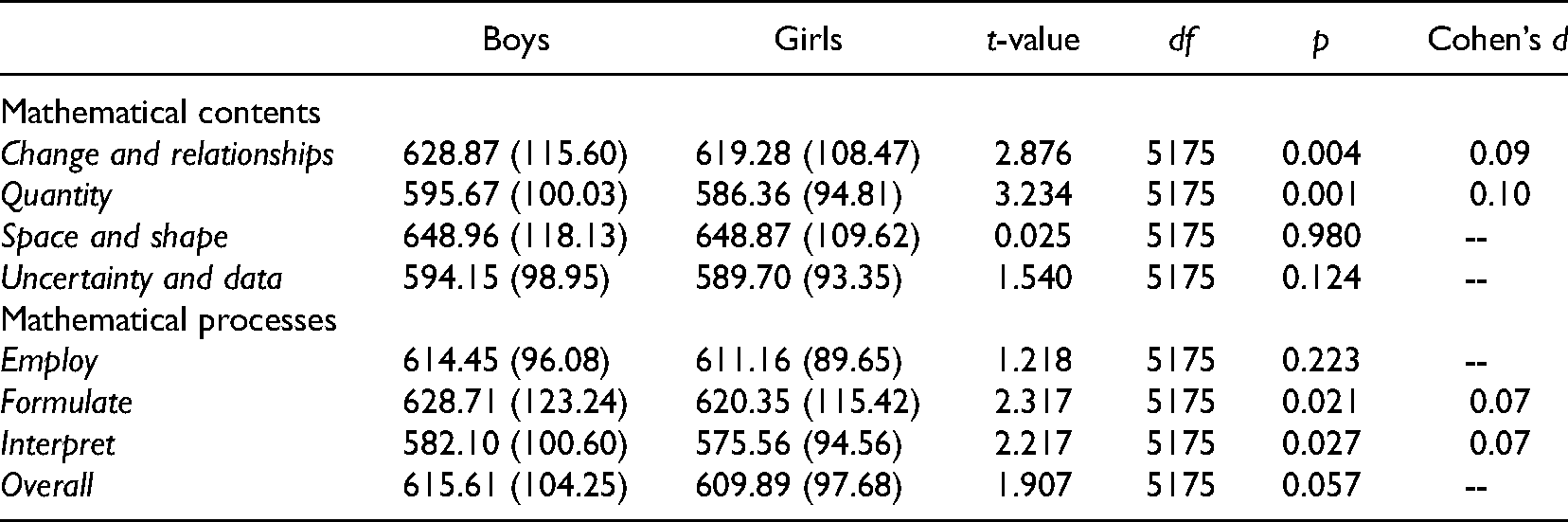
Students’ performance on overall mathematics and mathematics subscales by gender.
As discussed above, studies showed that the SES(ESCS) had an important influence on students’ academic achievement. In our analyses, students’ individual ESCS showed a significant correlation with their overall mathematics achievement, r (84805) = 0.39, p < 0.001. After controlling for students’ ESCS, the covariate-adjusted gender differences on overall and subscales are larger than the unadjusted differences. However, the increments are not higher than three scale score points. This implies that the ESCS has a minor influence on gender differences related to Shanghai students’ mathematics performance.
As mentioned above, the usually expected grade for Shanghai 15-year-old students is Grade 10 (i.e., Senior High One). As anticipated, students studying at the high school level have a significantly better overall mathematics performance than their middle school peers studying in Year 9 for both gender (boys: t(2538) = 9.448, p < 0.001, d = 0.40; girls: t(2635) = 9.864, p < 0.001, d = 0.41). The gender difference was reaching a significant level among high school students (Δboys–girls = 8.46, p = 0.034, d = 0.08) but not for junior high school students (Δboys–girls = 7.58, p = 0.074). In general, the gender differences were larger at the high school level than the middle school level, especially for the subscale performance. The only exception is the scale on quantity (middle: t(2364) = 3.227, p = 0.001, d = 0.14; high: t(2809) = 2.391, p = 0.017, d = 0.10). Moreover, boys and girls showed similar performance on the interpret-scale at the middle school level (t(2364) = 1.612, p = 0.107), while the corresponding difference became significant at the high school level (t(2809) = 2.516, p = 0.012, d = 0.10). These results show an important influence of school level on gender differences related to mathematics performance, that is, the higher the school level, the larger gender differences in mathematics learning in general become.
Among the 15-year-old students in Shanghai, 21.9% were from multi-children families. Significantly more girls than boys were staying in multi-children families, χ2 (1, N = 70,968) = 11.74, p < .001, Cramer's V = .01. It is found that students from one-child families had a significantly better overall mathematics performance than those from multi-children families (628.47 vs. 570.75; t(4328) = 15.155, p < 0.001, d = 0.60). Within each type of family, no significant gender difference was observed on overall mathematics performance with a slightly remarkable difference in one-child families (Δmulti−children = 0.04 vs. Δone−child = 6.95). On all the subscales, boys and girls from multi-children families again performed similarly, but significant gender differences in favour of the boys could be identified for children from one-child families on the scales change and relationships, quantity, formulate, and interpret. In contrast to the literature, it seems that boys received advantages against girls in one-child families.
About 21.2% of Shanghai 15-year-old students studied in vocational schools. A similar distribution appeared in both gender groups. As expected, students in general schools received significantly higher scores than those in vocational ones on overall mathematics and all subscales, which applied to both boys and girls. It was found that boys performed significantly better than girls in vocational schools (p = 0.046, d = 0.13), but not in general schools (p = 0.145). On all subscales, except space and shape, boys consistently performed better than girls in both school types (see Figure 1). The differences in vocational schools, in most cases, are about twice the differences in general schools. Moreover, the differences in change and relationships in both school types (general: p = 0.043, d = 0.08; vocational: p = 0.018, d = 0.21), quantity (p = 0.0029, d = 0.10) and formulate (p = 0.044, d = 0.07) in general school, and interpret in vocational school (p = 0.016, d = 0.17) reached a significant level.
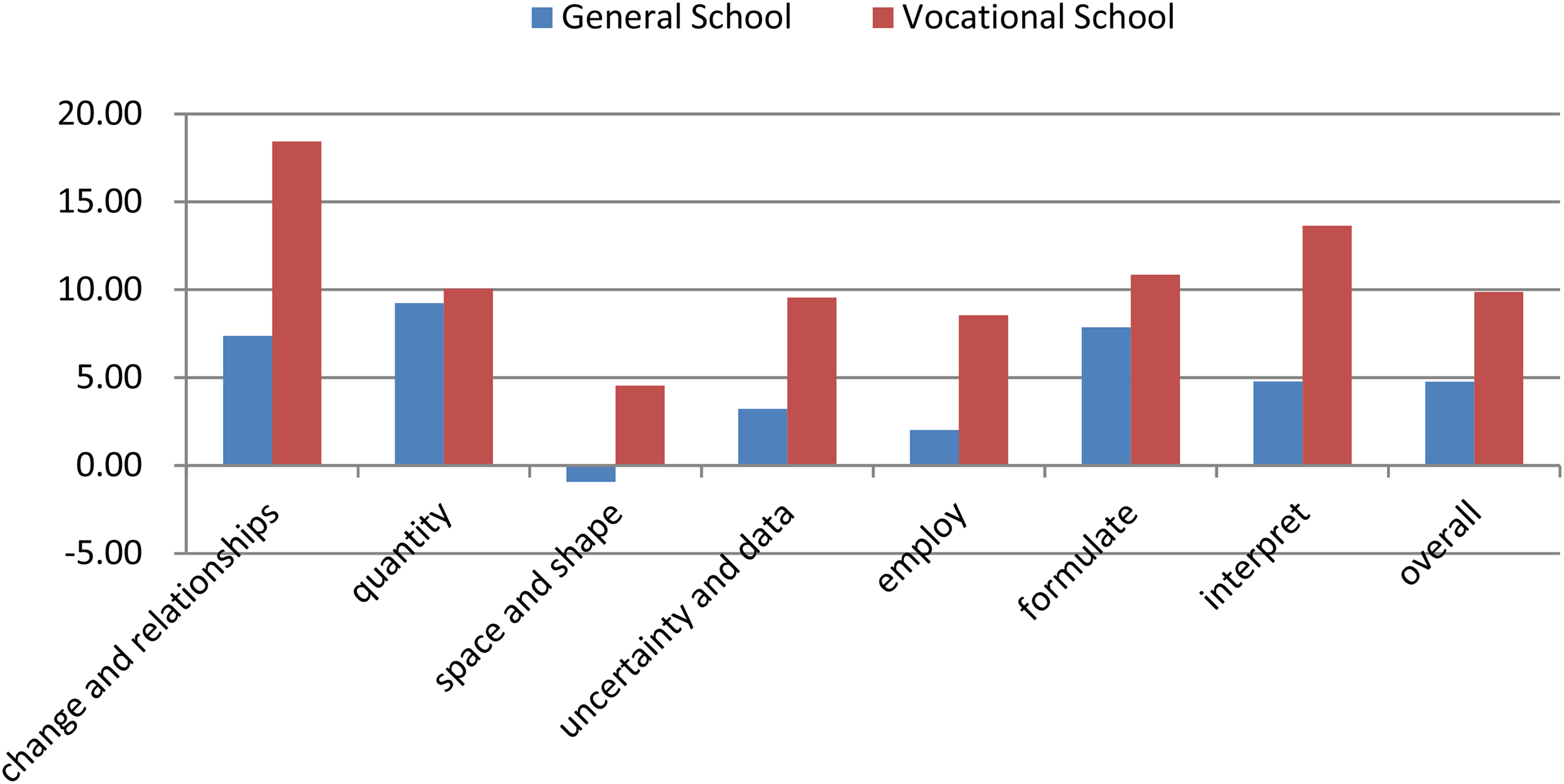
Gender differences (boys–girls) in mathematics performance by school types.
The general schools in Shanghai can be further classified into ordinary and selective model types. It is well known that model schools provide a higher quality of education than ordinary ones due to their more selected student population. The results point out that the proportion of girls studying in model schools (19.9%) is slightly higher than boys (16.0%), the difference reaching a significant level, χ2 (1, N = 66,485) = 173.858, p < 0.001, Cramer's V = 0.05. In both general school types, boys generally performed better than girls with the differences being larger in model schools (see Figure 2). The largest difference was identified for the scale on change and relationships in model schools (p < 0.001, d = 0.40) followed by formulate in model schools (p < 0.001, d = 0.32). However, no significant gender differences were found on the scales space and shape in both school types and employ in ordinary schools.
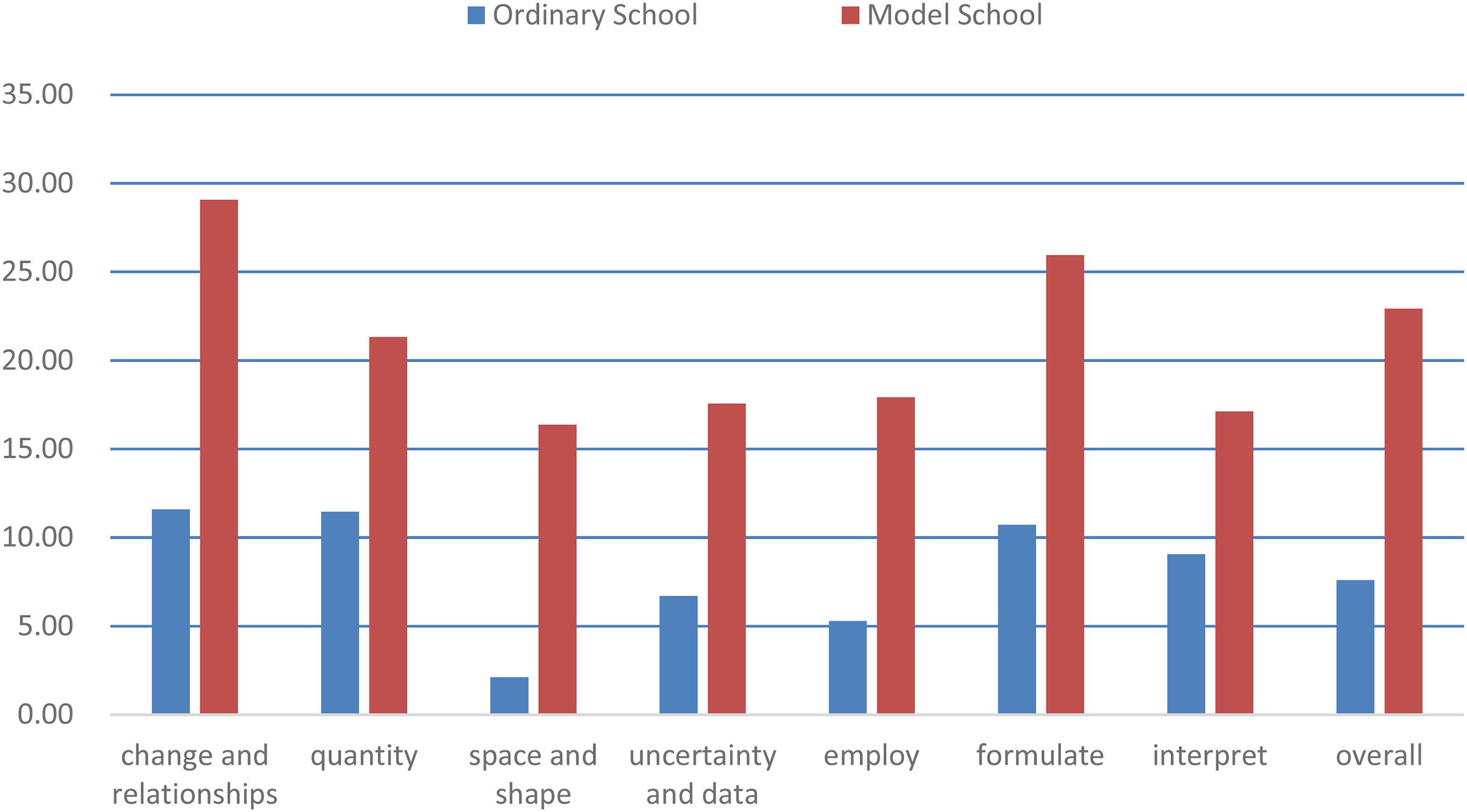
Gender differences (boys–girls) in mathematics performance in general schools.
Focusing on students’ overall mathematics performance, the analysis did not find significant gender differences among Shanghai 15-year-old students. However, further analyses into mathematics subscales and/or students’ different home/school backgrounds revealed a number of significant gender differences. Therefore, it is reasonable to hypothesize that home and school background factors could have an important impact on the gender difference. Moreover, such differences may show different patterns at the student level and school level. As a result, a two-level hierarchical linear model was used for the investigation, focusing only on students’ overall mathematics achievement.
First, a fully unconditional model revealed that for Shanghai 15-year-old students’ overall mathematics achievement 47.3% of the variance occurred at the school level (see Table 2). That means that nearly half of the gender differences existed between schools, while the other half was related to individual students’ differences. This result suggests that a multilevel analysis is appropriate and necessary.
Multilevel model with gender factor on Shanghai 15-year-olds’ overall mathematics achievement in the Programme for International Student Assessment (PISA) 2012 (n = 5177 students in 155 schools).
a
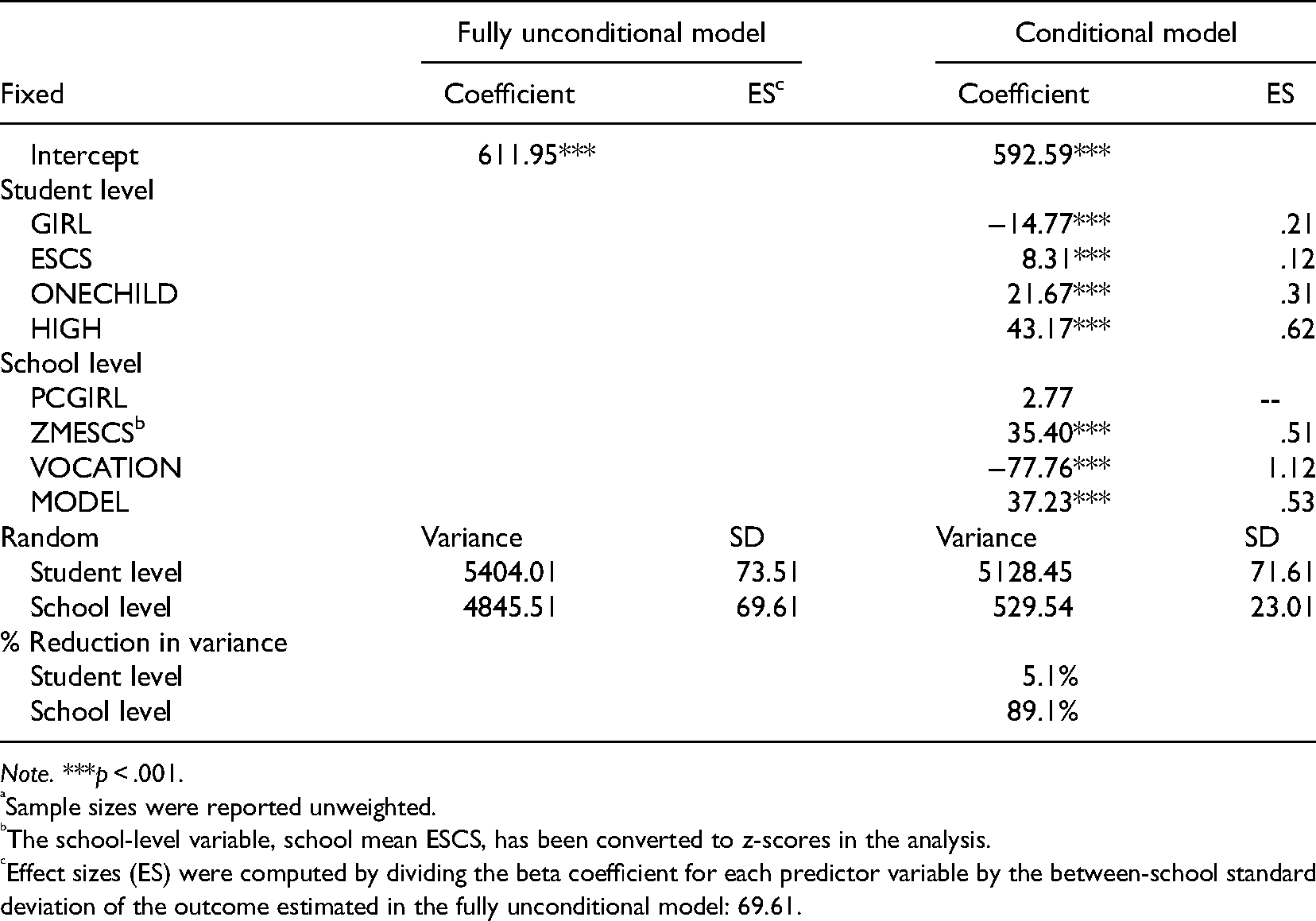
Multilevel model with gender factor on Shanghai 15-year-olds’ overall mathematics achievement in the Programme for International Student Assessment (PISA) 2012 (n = 5177 students in 155 schools). a
Note. ***p < .001.
Sample sizes were reported unweighted.
The school-level variable, school mean ESCS, has been converted to z-scores in the analysis.
Effect sizes (ES) were computed by dividing the beta coefficient for each predictor variable by the between-school standard deviation of the outcome estimated in the fully unconditional model: 69.61.
The main purpose of this investigation is to identify the role of gender on students’ mathematics performance. The conditional model revealed that at the student level, girls scored significantly lower in mathematics by 14 marks (p < 0.001). This indicates that gender differences exist in Shanghai 15-year-old students’ mathematics achievement after controlling for other personal and school factors. This is consistent with the findings from the analysis at the earlier individual level. However, the proportion of girls in school did not seem to have a significant impact on students’ performance (p = 0.88), while the impact is positive (γ01 = 2.77). The insignificant impact could be because the majority of the schools in Shanghai are co-education schools and the proportions of girls do not vary greatly between schools (M = 0.49, SD = 0.12). On the other hand, the positive impact of the girl proportion appears to be related to the mechanisms of the gender peer effects, as suggested by Lavy and Schlosser (2011). According to them, a higher proportion of girls in a class leads to a better classroom and learning environment, lower levels of classroom violence and disruption, and better relationships with other students, all of which support students’ learning.
Regarding students’ other personal factors, the conditional model showed that students with one-unit higher ESCS could receive eight marks more in the PISA mathematics test. One-child status at home may bring students additional 21 marks. The largest gain related to students’ personal factor is their grade level, which is expected and understandable. All the three factors have a significantly positive impact on students’ mathematics achievement in the PISA test (p < 0.001). In total, the four personal factors contributed to about 5% of the student-level variance of their mathematics performance in the PISA 2012 test.
Moreover, students studying in selective model schools with higher school mean ESCS were further in an advantageous position. In particular, students studying in model schools may receive 35 marks more in the mathematics test, while those studying in schools with one unit higher on school mean ESCS would gain additional 37 marks. As expected, studying in vocational schools significantly lowered students’ mathematics scores (γ03 = −77.76, p < 0.001). In sum, the four school factors contributed to about 89% of the school-level variance in students’ mathematics achievement with the type of school attended by the students causing high significant differences being directly connected to the ESCS.
Gender equity in education is an important issue in China, particularly given the fact that the one-child policy has been in force in China for more than 30 years. According to the PISA official reports (OECD, 2009, 2012), Shanghai–China is one of the education systems where from an overall perspective no significant gender difference within students’ mathematics performance can be identified. This study, using PISA 2012 Shanghai–China data, further investigated possible gender disparities in mathematics in a more in-depth manner, in particular, taking into account students’ SES, one-child status at home, school level, and types of schools attended in addition to content-related and process-related aspects.
The analysis revealed that although Shanghai boys and girls achieved similarly high scores in the PISA 2012 mathematics test, the two groups of students performed significantly differently on some mathematics subscales (content-related and process-related). While it is consistently reported that males are better at spatial skills in the United States (Tartre, 1990), such an advantage was not observed in Shanghai PISA data. This unexpected result is in contrast to the repeated results of strong gender differences in the 1970s to the 1990s in spatial skills, which, to some extent, show that on the one hand gender differences in this area are decreasing. On the other hand, this result can be explained by the different designs of the PISA test items, which are connected to mathematical literacy and not measuring psychological constructs as it was the case in earlier years (Tartre, 1990). In addition, uncertainty and data as new content-related subscale and employ as cognitive subscale were another two subscales showing gender equity, in accordance with the current discussion on gender differences (Bishop & Forgasz, 2007).
More significant differences have been identified within the mathematical strand of change and relationships, quantity, formulate, and interpret, which suggests that the gender gap is increasing with the more ambitious mathematical subject areas and higher cognitive aspiration levels. In particular, the area change and relationships includes functional thinking, which is a preparation for more advanced mathematics at the upper secondary level, such as calculus. Moreover, functional thinking also has a close connection to physics and chemistry, where boys usually achieved significantly higher than girls (e.g., TIMSS 2015; see Mullis et al., 2016). The area quantity can be regarded as an important transition element from arithmetic to algebra, which is essential for students to get a sound preparation for the learning of the concept of the variable as a key concept in algebra as a more advanced mathematical subject. Especially, this transition is ambitious and causes many difficulties in students’ learning. The growing gender differences at tasks requiring formulate and interpret are in line with the fact that in groups of highly gifted students, girls are underrepresented, as formulating a problem and interpreting demands important higher-order thinking skills. The findings about girls’ disadvantages on mathematical subject areas of higher cognitive demands and tasks requiring higher thinking skills call for strong attention and more efforts from researchers and educators to further work on appropriate instructional materials and methods, particularly for girls.
In this study, students’ personal or school backgrounds were used to subgroup students for a more detailed investigation under the perspective of gender equity. As a result, in all subgroups except one, significant differences were revealed. The exceptional subgroup comprises students from multi-children families, where no significant gender differences were observed on students’ overall mathematics achievement as well as the subscale achievement. A further inspection of the origin of one-child families and multi-children families reveals that a much higher proportion of students from one-child families were native from Shanghai (86.5% vs. 56.6%) and their ESCS was also much higher (−0.29 vs. −0.75). In other words, many of these multi-children families have migrated to Shanghai in the last few years or decades. In these families, traditional gender roles are more dominant than in the native families from Shanghai, that is, the academic development of girls is less important than that of boys and girls may then have to take over some responsibilities within such families. Consequently, these girls may develop more independently, as they have to care for their younger siblings. Overall, already in school, these girls experience that they have to fight for their education, leading to a kind of self-selection. No data are available in the PISA study about these processes, but it seems to be more than overdue to examine in detail these societal influences disadvantaging girls.
Another influential factor related to mathematical learning is language. While the written language is largely standardized all over China, there is a big variation between the spoken languages. Although Mandarin is the official instructional language in Shanghai schools, local students would like to talk to each other with Shanghai dialect if not taking a class. The students from these multi-children families, more from other provinces, speaking various dialects different from the dialect in Shanghai may therefore experience more problems with the language spoken in schools than students from Shanghai. As girls generally outperform boys in language (PISA 2012; see OECD, 2015), girls can compensate for these communication difficulties with their higher performance in language, which can promote their mathematical learning processes. Furthermore, referring to the literature findings about larger gender differences, which are more often observed among advantaged groups, gender equity in multi-children families was expectable and can be explained by referring to traditional gender roles and language.
The model (general) school is the only subgroup where gender differences were found significantly at the overall mathematics scale as well as all the subscales. As these schools are more selective and attract more gifted students, this finding can be explained by the overrepresentation of boys in the groups of gifted students. Throughout the world, the PISA report (OECD, 2015) also found that boys tended to be overrepresented among the highest achievers; in particular, boys outperformed girls in mathematics in PISA 2012 by 11 marks and such a gap increased to 20 marks among the top 10% of students. Overall, the result appears to be consistent with the phenomenon that a much higher proportion of participants and winners in the mathematical Olympiad are male. The larger gender difference among high-performers again points out that girls are still a disadvantaged group in mathematics learning and they therefore need continued help, though gender equity seems to be achieved for students of average level.
While many researchers have suggested that gender differences enlarged with the increase of grade level (e.g., Ambrose et al., 1997; American Association of University Women, 1998; Reynolds & Miller, 2003), this study did not observe a similar phenomenon. In particular, when there was a significant gender difference found at the high school level, a difference with a similar magnitude was also found at the middle level. This seemingly inconsistent finding may be related to the fact that all the students in this study were about 15 years old, although they may have studied at high schools or middle schools at the test time.
Regarding the two types of academic tracks, the study found that gender differences were greater among Shanghai students on the vocational track than those on the general track. More investigations on the influence of the types of schools on gender differences are needed.
Given the nested structure of the PISA data, this study used a hierarchical linear model to further investigate the gender issue in Shanghai 15-year-old students’ mathematics performance. As a result, on average, a boy would achieve 14 marks more than a girl in the PISA 2012 mathematics test; this gender difference reached a statistically significant level. This result being different from the PISA official report calls for caution concerning the appropriateness of the usage of traditional statistical analysis with such nested structure data. Methodologically, this study did not only illustrate that multilevel analysis is necessary to take into account the statistical dependency among the individuals within the same contextual schools, but also a holistic analysis may underestimate the group differences. Therefore, to develop a deeper and more comprehensive understanding about the role of gender in learning, it is important to relate students’ genders with the interactions with their personal characteristics as well as their learning contexts. More of such research efforts are in need in the future.
Lastly, there have been many studies reporting and attempting to explain the superiority in mathematics of East Asian students over their non-East Asian peers. However, few studies have been published investigating gender differences in mathematics performance amongst East Asian students (Turner, 1994). In addition, some believed that East Asian cultures with Confucian traditions tend to emphasize effort-based over interest-based learning, which might minimize gender differences in East Asian students’ achievement (Evans et al., 2002). The findings from this study challenge such a culture-based view and call for further research efforts dealing with more ambitious statistical methods differentiating the different socioeconomic and culturally diverse groups within one country or region such as Shanghai under a gender perspective.
Footnotes
Declaration of Conflicting Interests
The author(s) declared no potential conflicts of interest with respect to the research, authorship, and/or publication of this article.
Funding
The author(s) received no financial support for the research, authorship, and/or publication of this article.
