




Abstract
This article adds to the developing contemporary research base on the provision of one-to-one, or small group tutoring, to overcome the academic attainment gap for under-resourced young people. The tutoring programme was designed and delivered against the background of COVID-19 and the policy focus, in Scotland, on the poverty-related attainment gap. The project reported here represents Scotland’s largest tutoring programme. Using open-ended interviews this research explored the rich lived experience narratives of participating secondary school students aged between 15 and 18 years old, tutors, and stakeholders. Students reported a number of benefits; such as being able to make mistakes and ask questions they might not in the classroom; and the pace and atmosphere of tutoring was more conducive to their learning, compared to the classroom. This article adds to the developing contemporary research base on the provision of tutoring, to support the academic attainment gap for under-resourced young people. Using open-ended interviews, this research explored the rich lived experience narratives of participants in the programme. Analysis reveals that students were highly appreciative to be offered tutoring; that the importance of effective learning relationships between tutor and tutee is paramount; that good tutor/tutee/stakeholder relationships enabled misconceptions to be identified, monitored and individual learning needs met and supported. Attendance and engagement were particularly high for care-experienced, or previously non-attending students.
Context
There is significant research evidence to suggest that the intractable and growing problem of the inter-relationship between poverty and educational outcomes for children and young people is a reality across the globe (Hoffman et al., 2020; Mowat, 2017, 2020; Schleicher, 2015). In Scotland, in the face of widening income inequalities, the Scottish Government has committed its intention of eradicating child poverty by 2030 to legislation (see the Child Poverty Scotland Act, 2017 https://www.gov.scot/policies/poverty-and-social-justice/child-poverty/). Within this, recognition has been made of the causal influence of poverty on school attainment, and delivery of any eradication plan must outline proposals to close this attainment gap. It is within this context that in October 2020, a university-led tutoring initiative (we shall refer to this as the Tutoring Initiative – TI) supported by a local charity was established, initially as a rapid response to address the further educational disruptions and learning setbacks caused by the COVID-19 pandemic.
With child poverty already entrenched more in Scotland and the UK compared to other developed economies (Blundell et al., 2021; Congreve, 2019; Robertson and McHardy, 2021), the arrival of the COVID-19 pandemic compounded and exaggerated its effects. Increasing inequalities were felt disproportionately by children and lower earning households (Blundell et al., 2021; Hallaert et al., 2023; McCluskey et al., 2022; Schleicher, 2021; Scottish Government, 2023). School closures and a requirement for online teaching consequently placed significant demands on parents or carer-givers and their household resources, often further entrenching the poverty divide. Governments sought swift mitigations of the pandemic, in health, civic and educational terms.
Although not a governmental response, the TI programme began in 2021 with the primary objective to reduce the attainment gap and the subsequent disparity in educational outcomes and achievement among high school students. This initiative focussed specifically on students from areas of multiple deprivation, those in the care system, or young caregivers. The TI objective was pursued through the provision of subject-specific tutoring, available in both face-to-face and online formats, catering to small groups of up to three students or delivered on a one-to-one basis.
In light of the persistent disruptions to education, the TI project was extended and finally came to a conclusion in the 2023–24 academic year. To broaden the project’s reach, tutoring services were expanded to encompass not only the eligible students from the original six high schools but also those eligible from a further six high schools in the neighbouring local authority. Additionally, the initiative extended its support to individuals who were not actively participating in formal school education, and these individuals were identified and engaged through community organisations.
Within this context, this paper will outline the current research on tutoring initiatives before briefly outlining the TI model. The research methodology will then be presented to highlight our intention to collate rich lived experiences and to inform a thematic analysis identifying salient aspects of both providing and receiving tutoring.
Literature review
Provision
Tutoring is typically understood as supplementary one-to-one, or small group teaching that is provided outside of normal school hours. Internationally, considerable focus is on private, fee-paying tutoring (Hajar, 2018; Holloway et al., 2024; Zhan, 2014), which constitutes significant marketisation, whereby wealth is used to gain educational advantage, particularly in subjects that feed global accountability mechanisms such as the Programme for International Student Assessment (PISA) and the Teaching and Learning International Survey (TALIS) (Yung, 2021). Although some claim the marketisation of tutoring is most significant in Sino-Asian cultures (Yung and Zeng, 2022, Soeung, 2021), research evidence suggests the practice has influenced western schooling cultures that claim to be more egalitarian in their origins and values, for example, Denmark (Christensen et al., 2021); Finland (Jokila et al., 2021) and to a significant extent, parts of the UK, where the unregulated industry was estimated in 2016 to be worth £2 billion annually in England and Wales (Kirby, 2016).
Globally, the provision of tutoring, either government or privately funded, cannot be regarded as a new initiative: Private tutoring has typically been the domain of wealthier parents who seek to increase children’s competitive advantage over their peers in exam success. Parental demands have been shown (Holloway et al., 2024) to play a significant part in shaping the nature of this industry, including, in Bourdieusian terms, the cultural reproduction of social class inequality. Yung and Zeng (2022) refer to this as the shift from ‘meritocracy to parentocracy’ (p. 378) highlighting the power and influence wealthy parents hold in what Baker (2020) and Ghosh and Bray (2020) refer to as supplementary ‘shadow education’.
Conversely, tutoring has also recently been associated with supporting pupils within under-resourced groups to help reduce the socio-economic academic attainment gap. Much of the recent literature on additional tutoring support is in the form of ‘grey’ commissioned reports (e.g. Burtonshaw and Simons, 2023; Education Endowment Fund (EEF), 2022; Gupta and Abouaziza, 2021). There are, however, some exceptions where empirical research has been carried out, mainly concerning tutoring in mathematics, for example, Gortazar et al. (2024) researched using online platforms as a means of support for mathematics learning with vulnerable children in Spain; Hickey and Flynn (2019) explore maths and reading support in Canada, and De Ree et al. (2023) examine high dosage maths tutoring in Netherlands.
The widespread marketisation of tutoring, along with its use by governments to ameliorate the socio-economic effects of under-resourced lived experience, is, in itself, a testament to the potential educational advantages that might be gained (Zhao, 2018). An influential study of poverty and attainment in Scotland and its corresponding policy brief (Ellis and Sosu, 2015), established that tutoring can impact the poverty-related attainment gap when; tutoring has a clear strategy and lifespan; tutors are prepared through training, matched carefully with their tutee to build positive relationships, setting mutually agreed targets and meeting times. The next section looks at the contemporary research evidence on the educational gains linked to carefully conceived tutoring programmes.
Outcomes
One of the most reported benefits of tutoring is an increase in self-confidence (Hajar, 2018; Johnson et al., 2023; Robertson and McHardy, 2021; Centre for Transforming Access and Student Outcomes in HE (TASO) (2022), with Burtonshaw and Simons (2023)) noting how this can be life-changing. Students with increased confidence are better able to engage in and appreciate their studies, including wider aspects of education, such as art and sporting activities (Merino et al., 2022).
Improved relationships between tutor, student, school and family are reported by Barker (2023), EEF (2022), Johnson et al., (2023) and Robertson and McHardy (2021). Clear communication between tutor and school has been shown to help consolidate learning and allows students to ‘keep up’ with their peers (Barker, 2023; Burtonshaw and Simons, 2023; EEF, 2022; Hunt, 2022).
Direct causal improvements in exam performance are less clear; under the section title ‘What is the evidence for tutoring?’ the EEF (p3, 2022) suggest ‘pupils can make up to five months additional progress with one to one tuition and up to four months additional progress with small group tuition three hours of tutoring each week’
However, there is no indication as to what progress has been made or how it might have been measured. Johnson et al. (2023) noted a positive correlation between tutoring and higher English, mathematics and General Scholastic Aptitude scores. Although there is some further evidence supporting the argument that tutoring is moderately effective in raising academic attainment (Bell et al. (2020); Cullinane and Montecute (2023); Johnson et al. (2023); Robertson and McHardy (2021); TASO (2022), the Education Endowment Fund (2022) regards tutoring, particularly one-to-one, as a highly successful educational intervention.
The success of tutoring can also be evidenced in the level of student satisfaction. Burtonshaw and Simons (2023) found that 80% of students reported their experience as positive and would like to have more opportunity to receive tutoring. Interestingly, they also noted that students who received tutoring were aware of the advantages that came with it, suggesting their peers should also experience tutoring.
The ‘what works’ question
What is less clear, is what it is, that actually ‘works’, or what happens between a tutor and tutee that could account for the educational gains outlined above. To answer this, there is of course a need to consider what criteria are being used to measure success. Although not directly linked to tangible improvements in exam results Johnson et al. (2023), McCarthy (2022) and TASO (2022) highlight how tutoring provides an opportunity for the voices of young people, and their families to be listened to and heard; and how this can lead to more informed educational decision-making in relation to understanding the importance of high stakes testing and the potential offered by further or higher education.
It is acknowledged in this study that tutoring is relationally and contextually dependent and responsive to a wide variety of factors which are at play in tutor-tutee interactions. Thus, the design and provision of a particular ‘model’ is considered as unlikely to be helpful and we are careful about making contributions to the wider marketised ‘what works’ agenda.
While we acknowledge the importance of identifying success factors and positive effects of tutoring, with the exception of the sources cited directly above, there is a gap in literature that acknowledges the voices of students, tutors and stakeholders and in particular what stories they tell of their tutoring experiences. Our account here will therefore report on qualitative interview data that captured lived experience of tutoring, and identify, where possible, any features of tutoring practice relating to improvement in a range of outcomes for young people, including their confidence, their engagement in learning, equity in their learning experiences and their future prospects.
The following sections provide a summary of the tutoring provision and detail the methodological design of the research project that aimed to capture these voices to explore how tutoring may have been experienced and contributed towards academic achievement.
Summary of TI provision
The cohort reported in this paper includes 243 students from 7 schools between the ages of 15–18, as well as 7 community organisations. The way in which eligible students were invited to take part in the TI varied from school to school, however, all institutions and community groups were asked to identify and refer eligible pupils, and to report how each referral met the eligibility criteria (see appendix i). Participation was voluntary. Information sessions were organised at the beginning of term which members of the TI team attended to clarify what the tutoring would entail and answer any questions. Around 40 tutors were recruited via adverts placed in the host university website from the local community and were required to be either near peer (final year students and recent graduates) or professionals with a depth of relevant experience. The tutoring initiative did not provide a ‘standard’ model, rather all tutors were required to complete an Induction Training Programme. This focussed on skills to encourage students to (re)engage with education, through working with each other to identify what needs were to be met.
Delivery comprised two 10-week tutoring blocks, one preceding the Christmas recess and the other following in the New Year. In addition to this structure, supplementary tutoring sessions were delivered during the February mid-term break, the Easter holiday, and in the final weeks leading up to the Scottish Qualifications Authority (SQA) exams. Students were offered tutoring in a wide range of subjects.
Methodology
Our research focussed on evaluating the third year of the TI project, the aim was: To provide an experiential understanding of delivering and receiving tutoring through qualitative research based on individual narratives within various components of the project delivery. For example, types of delivery (face-to-face/online), and the experience of tutors based at the host university, teachers, other stakeholders and interested parties.
Working to such a broad remit required an approach to gather rich qualitative accounts of ‘lived experience’. Therefore, we sought to provide insight into the experience of tutoring from the perspective of the students, tutors, Local Authority colleagues, Alternative Provision Link colleagues, parents and the TI team. While it should be noted that we were unable to recruit teachers or parents, our main focus was on the student voice, followed by the tutor experience and then representatives from the other interested parties.
A ‘single stimulus’ question was used for both the online and face-to-face group and one-to-one interviews. To address power imbalances, we drew on Wengraf’s (2001) Biographical-Narrative Interpretive Method, particularly the use of a single-stimulus question technique to guide the interview process, that seeks to provide an environment where the interviewee could tell as much or as little as they wished about their life and their experiences of the TI project. For example: “Thank you for giving up your time to come and talk with me today. Could you tell me as little, or as much about yourself that you feel comfortable with, and your experience of the tutoring programme.”
The interviewee was then given time to respond uninterrupted, providing an opportunity to recount accurately, honestly and authentically their experience of the tutoring project and when they finished talking were asked … “I would just like us to sit with the silence for a little while, you might think of something else you want to say.”
The lead researcher is experienced with this method and other interviewers were given training, particularly being aware of the fine balance between remaining quiet while not unsettling the participant. Once the participant had finished what they wanted to say, the researcher identified aspects of the narrative and asked if they would like to expand on these points. For example, “Thank you, you mentioned early in your reply that you were told about the tutoring project in assembly. Can you tell me a little more about that.”
Breakdown of interview types and participant.
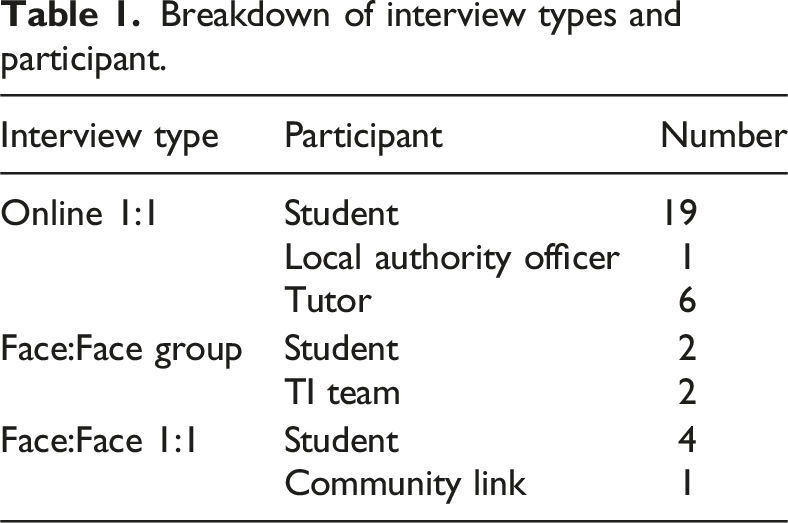
All interviews were recorded, and an inductive thematic analysis (Merrill and West, 2009) was carried out by each researcher separately listening and re-listening to the recordings and noting down emerging themes that could be supported by direct quotes. The emerging themes for each participant type were presented and discussed in interim reports and consequently led to a more deductive analysis that required evidence for existing themes to be corroborated in the form of directly attributable quotes.
In line with the principles of qualitative research (Cohen et al., 2018), issues of validity were attended to by providing a space where participants are able to share as much detail about their experiences as they wish, while a careful matching up of direct quotes to emerging themes contributed towards the reliability of our analysis.
Ethical approval for the study was granted by our university ethics committee. To protect anonymity, as best we can within a small evaluation project, all participants are referred to using pseudonyms. Quotes are presented in italics and presented ‘as said, or as typed’, without correction for grammar.
Findings
Drawing on Malone and Hogan’s (2020) conception of ‘justified warrants’, we offer our findings here ‘lightly’, confident that the emerging themes justify the warrant we make of them to represent the lived experiences of those of our participants. While not willing, or able to suggest widespread generalisability, as will be outlined in the discussion, there are synergies between our findings and those found in existing research.
Two emerging themes will be presented using the voices from across the range of participants – ‘Developing a learning relationship’ and ‘Responding to individual learning needs’. We do so, as within the context of this paper these provide a coherent and compelling lived experience narrative. Three additional themes – ‘Participants recruitment’, ‘Attendance and engagement’ and ‘Academic attainment and wider benefits’, are to be included in a more quantitatively focussed paper currently being developed.
When names are provided, they are pseudonyms, but for members of small groups, the responses have been amalgamated to reduce the possibility that individuals might be identified.
Developing a learning relationship
Tutoring initiative team experience
Our findings offer support to those of Barker (2023), EEF (2022), Johnson et al., (2023) and Robertson and McHardy (2021) who note that building effective working and learning relationships with the student, school and parents lies at the very heart of successful tutoring. This is evident in the TI Induction Programme and confirmed by a team member who notes the need to ‘… trust us, trust the tutors, trust the quality of what we are delivering...’, as foundational towards providing the best conditions for learning.
It was also recognised that this is not a short-term ‘flash in the pan’ fix but requires long-term collaborative working. That relationships are at the core of TI’s working is evident in the Induction Programme: ‘It’s not just good been enough to train our tutors on how to deliver the academic tutoring sessions, we’ve got a whole side of our tutoring which helps our tutors understand some of the experience the pupils have had and maybe the impact that has had on their capacity to learn, their experience of schools … it’s all about relationship building, everything else comes out of that.’
The importance of building relationships was evidenced by a team member stating: ‘… you can’t invite yourselves into the lives of vulnerable young people and not do it well …. we work really hard to engage young people in tutoring and this for some young people can take a really long time.’
The team accept that such an approach is not cheap but does reap rewards in the long run, and for a young person who may not achieve academically it is the regular contact with their tutor that ‘shows them that we care and they matter’. The central aim is not initially academic achievement but ‘just about getting them back engaged in education again’ and: ‘We say to our tutors in training that our starting point with every pupil, no matter what their school history has been, that we think the absolute best of them.’
Through the careful selection of tutors and the Induction Programme the TI team go a long way to ensuring that the tutors ‘are engaged and can buy in and can believe in it’ and spending time with young people before engaging in academic content is regarded as important. The next section confirms from the student perspective the importance of taking time to develop relationships.
Student experience
A consistent feature within the interviews with the young people is how they comment positively on the value of the relationships developed with their tutors. Additionally, they note how the experience had a positive influence on their confidence and perception of academic performance, suggesting a link between the tutors’ efforts to nurture a working relationship and the tutees sense of ‘being known’ and willingness to undertake tutoring again.
The narratives shared paid particular attention to tutors who ‘got to know me/my needs’, ‘knew what it was that I was talking about’, and ‘tried to take everything into account’. Jacob’s insightful comment that he ‘gave the tutor my needs’, suggests not only a tutor’s willingness to take on the needs of another, but vitally, the tutees trust to hand their needs over to a largely unknown other. Likewise, examples of tutors and tutees ‘going on a journey together’, of ‘helping each other’, and the importance of a caring reciprocal relationship is wonderfully encapsulated when Miriam declares that ‘your tutor grows with you’. On a more matter-of-fact, but no means less important level, Jack recognised that tutoring ‘helped me to talk to people’.
The boost in individual confidence we argue can be linked to the quality of the tutor/tutee relationship and the tutor’s ability to recognise individual needs. Ellie ‘felt special and I just wanted more’, and others spoke of tutors who were ‘friendly’, ‘like a friend, ‘approachable’, ‘open’, ‘relaxed’ and they ‘wanted to get to know me’. Aaron also noted how the tutor took time (over weeks) to wait until he felt it was OK to turn the camera on, noting ‘this was a big deal for me’. What is interesting from our interviews is how the young people articulate what a ‘good relationship’ is, highlighting the importance of time being taken by the tutor to get to know the student – personally and academically.
Ultimately, tutoring is experienced as ‘not being like school’. The tutor has the time to get to know what the tutees individual needs, learning preferences or perspective might be and to then plan how to support them – a sort of bespoke education process. To an extent, the public awareness (including within the family) of being tutored, acted as a motivator to work hard. One student made the straightforward connection between their success and simply the extra time they now spent on the subject … ‘there was no escaping your homework now!’
The tutor perspectives provided below corroborate the importance of time being spent on developing relationships.
Tutor experience
From the tutor perspective, taking time with the process of building positive, supportive relationships was consistently seen as important. Elizabeth (a tutor) noted that ‘learning is not linear, but we keep going forward … it is important the students take ownership of their learning and that we, just honour that’. Elizabeth articulated the importance of being flexible and ‘authentic’ by acknowledging that tutoring involves ‘Two nervous people, who both make mistakes’, and ‘that it is human not to know’. By sharing her own experiences of learning (including failing assessments), she was able to offer a safe space where the students could make mistakes and learn from them.
Donna articulated how this process has no set pattern and is bespoke for each student, highlighting the difference between tutoring and school. School is busy, rushed and people can get left behind, while tutoring is not forced, time can be taken to make mistakes, return to material, or just be happy with a student turning up to say ‘Hi’.
What has clearly been evidenced here is how the success of tutoring is reliant on the tutor/tutee relationship and how this is dependent on the tutee being recognised and their needs accepted and acted on. The following section moves closer towards how tutoring might influence individual learning outcomes.
Responding to individual learning needs
TI team experience
The TI team’s focus on building effective relationships to help create optimal conditions to meet individual student learning needs by working closely with colleagues in schools and other settings reflects findings by Barker (2023) and Hunt (2022). Such collaborative working drives the effective development of the project, with a team member noting how ‘this is more of a joint project now’, with teachers becoming more involved with future planning: ‘… it is a constantly changing and evolving programme, and it needs to evolve. We can’t just say “this is what we do” but as relationships develop you can develop it more and this needs time’.
The iterative nature of the project is acknowledged in the recognition that the project now bears little resemblance to how it started, using ‘feedback from the pupils and the tutors and the schools … we respond to feedback to develop the project but also to ensure the quality of the project’. The to-ing and fro-ing of information and feedback to monitor, identify when tutoring is not working and improve the experience is central to TI, but it also takes a toll on time. There is also an impact on the student’s resources and time.
Student experience
The most widely commented experience provided by the students was how, in relationship with the tutor, the tutee was given time to explore their learning needs. Using the metaphor of doing the laundry to describe how the ‘school’ day had changed, Kyle spoke movingly about how the changes during lockdown made significant demands. Before lockdown the standard school timetable ensured that learning demands were naturally divided up into manageable lesson-sized chunks, but since learning moved online, he would ‘go downstairs for breakfast, open my laptop and there was this huge pile of stuff to do. It was like a great pile of laundry – I didn’t know where to start’. Kyle found the increased stress created by this seemingly unsurmountable workload so great that he began to ignore it, sometimes not even logging on to find out what had to be done. Fortunately for Kyle, the tutor ‘began to help sort out the mess’, and mornings became bearable again, the pile of laundry could now be sorted and dealt with.
Kyle’s expressive metaphor mirrors the experience of all the students who regularly reported how the tutors took the time to identify their individual needs and then plan a way forward. This discussion often took place in contrast to the usual experience in large school classes where teachers could not be afforded the opportunity to meet all the individual needs of 30 or so learners. The students understood the different roles between the classroom teacher and 1:1 tutor but noticed how the tutor ‘took the time for me to learn’, or ‘was patient and waited until I understood before moving on’, and ‘there was more time for you, the approach was more personal’. They noticed that there was ‘less pressure on the tutor’, ‘it was calmer than school, there was less stress’ and that time was available ‘to explain and make the idea we had to cover liveable’.
The ability for the tutor to work at the pace of the students was a consistent and central feature and contrasted with the busy and often distracted classroom teacher for whom they recognised that ‘the job is too hard’, and that ‘they have to help all the pupils … but that might not help me’. Interestingly, Amy also noticed how the experience of tutoring found its way back into the classroom to support the teacher, noticing that ‘I could help the teacher, I could help out in class’.
At no stage did any student criticise their own classroom teacher and they all seemed to be very aware of how difficult the classroom teacher’s job is. This does not mean that all schoolteachers were liked, and some students were open about how teaching style/personality clashes have interrupted their learning. Such responses were in the context of the difficult and complex nature of the classroom that was often described as ‘chaotic’, ‘full of distraction’ and ‘difficult to concentrate’ when ‘work is continually being chucked at you’. The students knew when they were being left behind by the rest of the class and this made them feel stressed and that they ‘were stupid’.
Potentially, the tutors’ greatest gift, is that of time taken with a single student and carefully monitoring whether material is understood or not – crucially, only moving on once it is clear the student understands. School is often too fast and too confusing, where there is not enough time ‘to put it all in my brain’, or ‘I have no time to process everything’. With the tutor there is time to be asked, and to ask questions, repeatedly, if necessary. The overall effect of this is to motivate the students to want to work more, leading to increased confidence and the motivation to further understanding.
The time that tutors were able to give each tutee had noticeable relevance on the distinction between getting an answer right, or knowing how to answer an exam question, and understanding the concepts being encountered. Miriam explained how ‘my tutor helped me to think, to understand and not just to answer a question. I could answer ‘riddles’ – not just answer questions.’ Ellie gave examples of how ‘the tutor would not just ask me to define things, but they would give me definitions and I had to say what it was. This helped me to understand’.
Aaron noted how tutoring ‘is not robotic like school – the tutor doesn’t follow a script’, and others also identified the contrast to classroom experience where the needs of everyone might counter the needs of the individual. Tutors ‘challenged me’, ‘asked me questions’ and ‘move me forward when I understood’, and what becomes clear is the word – ‘me’ and the focus on individual need. Jacob was also aware how being challenged in a tutoring context, although it could be uncomfortable, ‘it was OK to make mistakes – you don’t need to be right’. Jacob suggests here how, in a classroom context, there is considerable risk to answering a question and getting it wrong, so answers are not offered; therefore understanding cannot be advanced. Jacob felt that the one-to-one tutoring space made room for mistakes to be made and learning to be enhanced.
Tutoring is not like school and instead is a place where questions thrived. Asking questions is identified as important as this is how the tutor is able to assess where the student is and to plan where to go next; there is a balance of responsibility between the tutor and tutee. The tutor asks questions to assess the tutees understanding, while equally, the tutees questions provide insight into their understanding. Although our focus in this paper is not on quantitative data collection, we can report that approximately 70% maintained or improved their predicted grades but do acknowledge limitations in collecting accurate data to reliably report on academic attainment.
Discussion
Our focus has been the complex environment tutoring operates within, noting that a central principle of the tutoring project is to re-engage young people with adults in an educational setting. The previous ‘Findings’ section confirms the success that this central principle has been met and it is deeply moving to hear one student’s joy, declaring, ‘I didn’t think I would ever recover from failing’.
The main principle driving our methodological decisions focussed on hearing the voices of those delivering and receiving tutoring and we now return to them to guide our discussion. The ‘single-stimulus question’ technique has not only provided a means for reporting the experience of tutoring but also a reflective space where many participants provided critical insight into expectations and tensions between the process and outcomes of tutoring. The discussion shall first focus on the importance of the learning relationship, before moving on to consider how individuals needs have been met. Finally, we will highlight some of the wider, less tangible benefits.
The importance of the learning relationship
Our research has found that taking time to build up a trusting relationship is fundamental, but this does not mean that the student/tutor relationship is ‘as if’ a friendship, the programme makes clear the need for boundaries and safeguarding issues to be respected. Trust is paramount, even if that means early on subject content is side-stepped
For many students we found the TI project has removed barriers that had previously prevented them from accessing educational opportunities
Responding to individual needs
The TI focus on the learning relationship provides an excellent position from which to respond to ‘bespoke’ individual learner needs. This, along with the expanding collaborative partnership with students, schools, teachers, parents and LA colleagues has provided an effective positive feedback loop to learn from experience and improve practice. The lessons learned are valuable ones with close ties to the importance of taking time early on to match tutor and student and to develop a trusting relationship (De Ree et al., 2023; Ellis and Sosu, 2015). From this base, the student is more likely to feel comfortable enough to articulate their learning needs.
One of the distinctions to emerge from the student interviews is the comparison between tutoring and classroom learning, and the difficulties around admitting to ‘not knowing’ in a busy classroom
Once students could work with a tutor who was prepared to resist judgement and consider each student as an individual, asking questions became much easier, as did the possibility that the well-prepared tutor could sit with the student’s lack of understanding and use different approaches until the student felt they understood. Ultimately, success motivates, and success was more likely for most of these students in the tutoring environment.
Wider benefits of tutoring
It was encouraging to notice how the students could engage with the interviews in quite technical pedagogical discussions; for example, they could distinguish between education as a process or outcome, often acknowledging, that for them, process trumped outcome. Equally, the students could articulate the difference between ‘knowing’ something for an exam and really ‘understanding’ something.
Tutoring was overwhelmingly reported by students as a positive experience, although this was tempered by acknowledging that schools had an ‘important social role to play’. Additionally, it was suggested that it is possible ‘to become over-reliant on the tutor to prompt your thinking’, and that this prevents ‘being independent and taking responsibility’ even to the extent of ‘trying to second guess what my tutor would say when I was doing an exam question’. Some students also felt ‘isolated and under pressure to have to answer questions’, yet ‘when I do well, get it right. I want to do more’.
A member of the Local Authority team highlighted the importance for students to regain agency and control of their life, and the legacy this can create; ‘leaving students with memories about where they want to go in life’ so that the student can make ‘positive life choices’. One evocative case shared by the tutoring team indicates the vitality of agency being returned to the student who re-engaged with full-time education having been out of school for a year, their tearful mother confessed she ‘never imagined that this would be possible’. Too often, such stories are lost in quantitative data, especially those linked to school examinations, yet the benefit to the young people and wider society is no less significant.
Equally, to focus exclusively on process would diminish being part of the TI project. Young people who were not attending school and destined to receive few, or no qualifications have since passed National 3 and 4 assessments in English, Maths, German, History, Numeracy, Geography, Modern Studies, People and Society and Biology. For some students, the achievement has been a single pass, multiple passes, and others the decision to return to school (see also Merino et al., 2022). These achievements will seldom be headlines or even reported in school-level data returns, but they represent much more than that: a shift from low confidence, poor self-esteem, resistance or refusal of education towards a belief that they can achieve and that education (and adults) have something positive to offer them.
Limitations
While we do not want to detract from the relevance of the young people’s tutoring experiences presented here, for completeness it would be remiss not to consider the limitations of our research. It must be acknowledged that the participants’ stories and our analysis represent a very particular geographical location and schooling system. We make no claims for generalisation beyond the possibility that the voices of young people and our findings may resonate with others, irrespective of their context.
The recruitment of participants represents, in good faith, an attempt to capture all the significant agents in the field. Our approach was to focus initially on the voice of young people, and only when their stories began to coalesce around similar themes, did we then recruit adults. Additionally, we acknowledge that the young people were selected by their education settings (not all agreed to take part) and could, therefore, be construed as having a potential bias towards those who found tutoring to be helpful.
It is reasonable to ask questions of our own positionality; as education academics holding particular views on how schooling is organised, and employees of the same establishment that organised the tutoring. Led by an interview method that promotes the participant voice – with all the difficulties and inconsistencies relating to power relations – in good faith, we tried to maintain the integrity of their lived experiences. In this context, our decision not to transcribe, required us to listen to the audio recordings, rather than reading a disembodied transcript.
An attempt was made to collect quantitative data from the settings and even though we have some data (although more is still being sought as we type), the nature of the data held by schools and the system in which it is saved have been barriers we could not resolve over the project time-line.
Conclusion
Our research shone an important light on the lived experience of the tutoring relationship. Although we corroborate previously reported findings (e.g. increases in self-confidence, the importance of student/tutor/family/school relationships, an opportunity to learn in a calm environment), we begin to lift the veil on the subjective experience within the tutoring ecosystem. We hold our findings lightly, not wishing to make unjustified warrants of uniqueness, or even generalisability. Instead, we draw on Bruner’s (1986) understanding of a narrative truth that seeks verisimilitude – a contextual true-to-life representation that can have resonance in the lives of others. That said, we are guided by the voices of those engaged with receiving or providing tutoring, to offer the following concluding remarks.
The tutoring programme has enabled students to encounter academic learning from within supportive relationships, where, to a large extent, bespoke learning programmes can be provided. The students welcomed the opportunity to experience a slower, less chaotic environment than the classroom, where mistakes could be made without fear of ridicule. The confidence gained through the tutoring process can be seen to have wider benefits that influence out-of-school decision-making.
The tutoring (or Shadow Education) landscape can be both mandated by government policy, or a significant beneficiary of private funding, hence it is to a large extent unregulated and confused (Holloway et al., 2024). For example: while there is still some confusion between academic and calendar years, in England (where the financial implications are well reported) £178 million of a potential £416 million government funding for tutoring went unused for the financial year to March 2023 (DfE. 2023). And though £416 million may sound impressive, research carried out by the Sutton Trust (Burtonshaw and Simons, 2023) revealed a potential annual £2 billion spend on private tuition.
In the context of the TI evaluation, two conclusions can be reached: One suggestion is schools either do not know what to do with funding, therefore it is left unspent, or schools are unable to find tutors. The later appears doubtful when considered alongside the potential £2 billion private spend. Yet, what the TI project has shown, is that with care, high-quality tutoring can successfully be made available to young people.
To end, we would ask questions of educational provision for young people from under-resourced backgrounds, not to suggest that tutoring itself is a silver bullet, but to re-think ways of doing education, that do not shirk from mitigating socio-economic academic attainment gaps and consider how to develop relationships that can engage and sustain. For many of the young people who have been tutored, this project has provided a chance of a lifetime. We would ask readers to sit with and consider what the lived experience of a young person must have been for them to say to a complete stranger: ‘I didn’t think I would ever recover from failing’.
Equally, we would ask you to imagine what it is like to sit in a room as a member of the established educational community and hear a young person say to you: ‘I didn’t think I would ever recover from failing’.
Footnotes
Declaration of conflicting interests
The author(s) declared no potential conflicts of interest with respect to the research, authorship, and/or publication of this article.
Funding
The author(s) disclosed receipt of the following financial support for the research, authorship, and/or publication of this article: Funding for the tutoring programme and evaluation was provided by STV Children’s Appeal.
