



Abstract
This research paper explores the lessons from London schools in driving school improvement and addressing inequalities. Drawing upon evidence from trend attainment data by ethnic background, a literature review of academic research, the London Challenge, Ofsted and London Local Authorities publications, and case studies of schools, the paper will identify areas of good practice that contribute to raising achievement in London schools. The overall findings showed that attainment at GCSE (General Certificate for Secondary Education) has risen much faster in London than nationally since the London Challenge school improvement programme was launched to improve outcome. There are several reasons why London schools are bucking the national trend. The paper identified many success factors and strategies which contributed to the raising achievement and tackling inequalities such as effective school leadership, quality of teaching and learning, use of data, use of multi-ethnic workforce that reflect the community, and effective support for ethnic minorities and EAL pupils and targeted interventions. The overall conclusion of this study is that improvement in schools in London is an exceptional achievement and offers a worthwhile example of a success story that policymakers at both national and international levels can learn from. Lessons from London schools in tackling inequality and the policy and research implications are discussed critically in the final section.
Keywords
Introduction
The context and issues
This study aims to examine the factors behind the success story of the transformation of schools in London between 2003 and 2013. It also explores the lessons from London schools in driving school improvement and addressing inequalities.
For years researchers have attempted to answer the question, ‘Do schools make a difference in a child’s educational outcomes?’ Research in the field of school effectiveness suggests that the factors influencing low attainment are beyond the control of schools. There is now evidence that some schools have difficulty overcoming the problem of poverty and educational attainment (Demie, 2019; Clifton and Cook, 2012; Reynolds and Sammons, 1996). Education researchers, policymakers, and practitioners have debated the question of what and how much, schools can do to mitigate the effect of socioeconomic factors. They argued that socioeconomic status is the most significant difference between individuals in England (Strand, 2014; Demie, 2019, 2020).
The evidence from school effectiveness research confirms that only about 8–15% of the attainment difference between schools is accounted for by what they actually do ( Reynolds and Sammons, 1996; Strand, 2014; Rabash, 2010; Demie, 2020). The rest is attributed to pupil-level factors such as the wider family environment, the neighbourhood where they live and the school attended (Strand, 2014; Ofsted, 2014). There is now a consensus in the field of educational research that about 85% of the difference in how well children do at school is dependent on what happens outside the school gates (Rabash, 2010). Consequently, there is a need for additional regional and local, district level initiatives beyond the school gates to tackle disadvantages at school and individual pupil level.
However, we would argue that although schools can make a difference it cannot compensate for society. We would therefore like to remind policymakers to acknowledge the importance of the relationship between social disadvantage and educational achievement (Demie, 2019). Clifton and Cook (2012: 3) argued that: ‘While many of the factors driving low achievement lie beyond the direct control of schools, it is a mistake to assume that schools cannot be part of a solution.’
There are now a number of schools serving disadvantaged communities that have defied the association between poverty and low attainment (Demie and Lewis, 2010; Ofsted, 2009a, 2009b) through effective use of pupil premium investment money for targeted support and interventions (See Ofsted, 2014 and EEF (Education Endowment Fund, 2019).
A review of other available British and international research also suggests that efforts to improve school performance and student outcomes have traditionally focused on initiatives and strategies at the individual school level (Barr and Parrett, 2007; Demie and Lewis, 2010; Ofsted, 2009a, 2009b). As a result, there is a growing body of evidence that shows conclusively how schools that serve disadvantaged communities can and do perform as well as other schools in more affluent areas. Recent research into good practice in schools by Ofsted (2009a, 2009b), Demie and Lewis (2010) show that schools serving deprived areas can succeed against the odds in raising achievement. The research identified the reasons behind a school’s success, which included the quality of teaching and learning, effective leadership at all levels, supportive professional development, inclusive pastoral care, high expectations, and the use of data. One crucial aspect, without which the above would not be as effective, is the quality of leadership by the headteacher. The majority of headteachers spread the credit for success widely but they have played pivotal roles in creating the ethos of the school and exercising strong pedagogical leadership Ofsted (2009a, 2009b) despite the competitive challenge created by government league table performance publications which affects schools serving challenging and disadvantaged area. In addition, Muijis et al. (2004) highlighted evidence from British literature demonstrates that effective leaders exercise a direct and powerful influence on the effectiveness of the school and on the achievement of students in most countries. They maintain that headteachers are effective and improving schools keep their focus on teaching and learning issues. They are also good at proving constantly that being disadvantaged need not be a barrier to achievement (see Demie and Mclean, 2016). The issue many policymakers and researchers have ignored is that the impact of deprivation is more widespread than in any single school.
There is a concern that word disadvantage used to refer only to Free School Meal (FSM) children and Ofsted, EEF ignore any race and ethnicity related factor in any inspection and reports. The lack of policymakers not to acknowledge the importance of particularly race and ethnicity in terms of investment mean today there is no targeted intervention to support any ethnic group or EAL that are underachieving. There is also evidence now Ofsted stopped mentioning any underperformance by ethnic group in inspection report (Demie, 2019). This policy has negative impact on achievement of ethnic minority pupils and EAL recently. As a result of the lack of support for targeted interventions like disadvantaged pupils they are some ethnic minorities and EAL pupils who are underachieving.
A similar situation exists in the United States. For example, Edmonds (1982) and Williams et al. (2005) analysed high-performing schools to identify the common characteristics that could be the source of their success. The USA research has found that factors such as strong leadership, frequent monitoring of student progress, shared goals in the professional community, parental involvement, and a positive and academically focused school climate were responsible for high achievement in successful schools. Barr and Parrett (2007) also completed a meta-analysis of 18 research studies into high-performing and high-poverty schools across the United States. As in England, their studies are about schools rather than students or districts and local authorities.
In general, good practice in education has traditionally focused on successful schools that focus on the total child, academic achievement, commitment to equity and access, parent, and community engagement, distributed strong leadership, supported teaching workforce and Staff (Ofsted, 2014). Such work has acquired a significant following, particularly among education policymakers and school effectiveness and improvement practitioners in the last decade in the UK and USA yet has largely ignored the work of LAs or districts. However, a few researchers question the approach. For example, Boyle and Humphreys (2012) investigated how Hackney local authority in England transformed its schools through the leadership of the Learning Trust. Demie and Mclean (2015a) research explored the factors behind its outstanding improvement in terms of GCSE achievement in one London LA. This research identified eight key factors that have underpinned the transformation of the local authority schools including • ‘Ambitious LA leadership at all levels • Effective school improvement service (Advisory Service) • Effective research and data service • Maintaining strong partnership and school to school support • Strong school leadership • High-quality teaching and learning • Tackling disadvantaged beyond the school gates • Effective support for ethnic minorities and for pupils who speak English as an additional language’. (Demie and Mclean, 2015a: 3)
Another research by Woods et al. (2013) also explored the extraordinary transformation of education in Tower Hamlets and identified seven key factors that are behind the transformation of education in that local authority. These are: ‘Ambitious leadership at all levels, very effective school improvement service, high-quality teaching and learning, high levels of funding, external integrated services, community development, and partnerships, and a resilient approach to external government policies and pressure.’ (Woods et al., 2013: 18)
Zadvadsky’s (2009) research was also concerned with what might be learned from successful districts and gave a detailed study of five school districts in the USA that demonstrated the greatest performance and improvement in student overall achievement while reducing achievement gaps among poor and minority students. She identified good practices such as rigorous standards, ‘aligned curriculum’, and ‘smart investment in human capital that led to great schools and successful districts.
We would argue that much of the research into school effectiveness and improvement is helpful but has not focused on Local Education Authority (LEA), regions, and District effectiveness in either the UK or USA. To tackle disadvantages more systematically, we need to look at high-performing education systems in deprived areas, rather than individual schools. Concerned about limitations of scalability when focusing solely on one school, this research focuses on the London level, with LAs as a case study. In London, before 1998 many schools struggled to provide a decent standard of education for their pupils, and a significant number were judged to be performing unfavourably against national standards of achievement at KS2 and GCSE. But with the challenge and support of an increasingly effective LAs in London, over several years and the government significant investment through the London challenge and national strategies between 2003 and 2013 (DfES, 2003; Demie, 2019) London schools made dramatic strides in improvement (see Baars et al., 2014; Hayes and Cassen, 2014; Cook, 2013; Clifton and Cook, 2012; Demie and Mclean, 2014); Greaves et al., 2014; Hutchings and Mansaray, 2013; Wood et al., 2013).
The London Challenge was a school improvement initiative launched by the UK’s government in 2003 to transform London Secondary Schools backed by £80 million additional investment programme for 5 years (DfES, 2003). Its main objective was to • ‘raise standards in the poorest performing schools; • narrow the attainment gap between pupils in London; • create more good and outstanding schools’. (Kidson and Norris, 2010: 3)
Key components of the London Challenge were a close focus on raising the quality of school leadership, on the quality of teaching, and learning and on raising achievement in schools. The initiative has been credited by Ofsted and others for a significant improvement in pupils’ outcomes in London’s state education system. Ofsted first reported in 2006 found that, between 2001 and 2005, London’s GCSE results had improved faster than in England as a whole (DfES, 2007). A subsequent report in 2010 further corroborated those findings and confirmed that: ‘The London Challenge has continued to improve outcomes for pupils in London’s primary and secondary schools at a faster rate than nationally. London’s secondary schools continue to perform better than those in the rest of England’ (Ofsted, 2010:1)
London is therefore an important case study, offering evidence of area-based educational transformation and improvement. It tells us the remarkable story of how schools were transformed. We would argue that successfully improving areas and districts are more challenging than individual schools. Individual schools can develop their own improvement, but system improvement at the London level or LAs and district level needs more sustained and multifaceted approaches. This also need systematic school leadership that will drive successful school improvement (Zadvadsky’s, 2009; Demie 2019; Hutchings and Mansaray 2013; Wood et al., 2013).
The aims of the research
The main purpose of the research is to explore the remarkable transformation of education in London, examine the success factors behind the outstanding improvement between 2004 and 2013, and tackle educational inequality during London challenge period. Three research questions guided this research: • What does the data tell us about the performance of London schools over the period? • What were the strategies for tackling inequality and driving school improvement? • What are the lessons for school improvement?
Research methods
A complementary methodological approach has been used in the research, to study the reasons for the vast improvement including • Reviewing research literatures results. • Analysing GCSE trend attainment data and Ofsted judgments to explore changes. • Case studies evidences to establish the factors that contributed to the improvement at school and LA level.
The study drew on a range of data, including pupil attainment data, Ofsted reports, questionnaires surveys, and interviews with key participants that were selected using purposive sampling to trace the success story. None of the statistics used refers to independent schools.
The limitation of this study was the lack of baseline achievement data by ethnic background before the London challenge started in 2003/2004. Unfortunately, the DfE has not published any data by ethnic background before this data for London and any attempt to access the data was not successful. Instead, we used 2006–2019 data which is available from National Pupil Database (NPD) to compare the change and improvement. Some ethnicity data is also available either for all schools or for state maintained schools showing different percentage points. This has some weaknesses although it clearly shows the trend over the period (see Table 2 and Figure 3).
Educational attainments in London and the achievement gap (2003–2019)
Trends in attainment in London
The challenges that face educational policymakers today are not how to raise achievement, but how to tackle educational inequality. A body of research evidence shows that inequality in educational outcomes has grown for some groups over the last three decades in England (Hutchinson et al., 2019; Demie, 2019). There are long-standing achievement gaps in England associated with ethnic background and socioeconomic status.
In terms of attainment in the late 1990s London schools were outperformed by those in the rest of England. In 1997/98, 32.4% of pupils in London achieved five or more A* to C grades at GCSE, including English and mathematics, compared to 34.2% of pupils in the rest of England.
Figure 1 shows that in 2003, the overall attainment found in London and nationally was broadly the same (50% and 51%) but over the intervening years, London has pulled ahead and established a gap of five percentage points by 2019. London compared to the rest of England.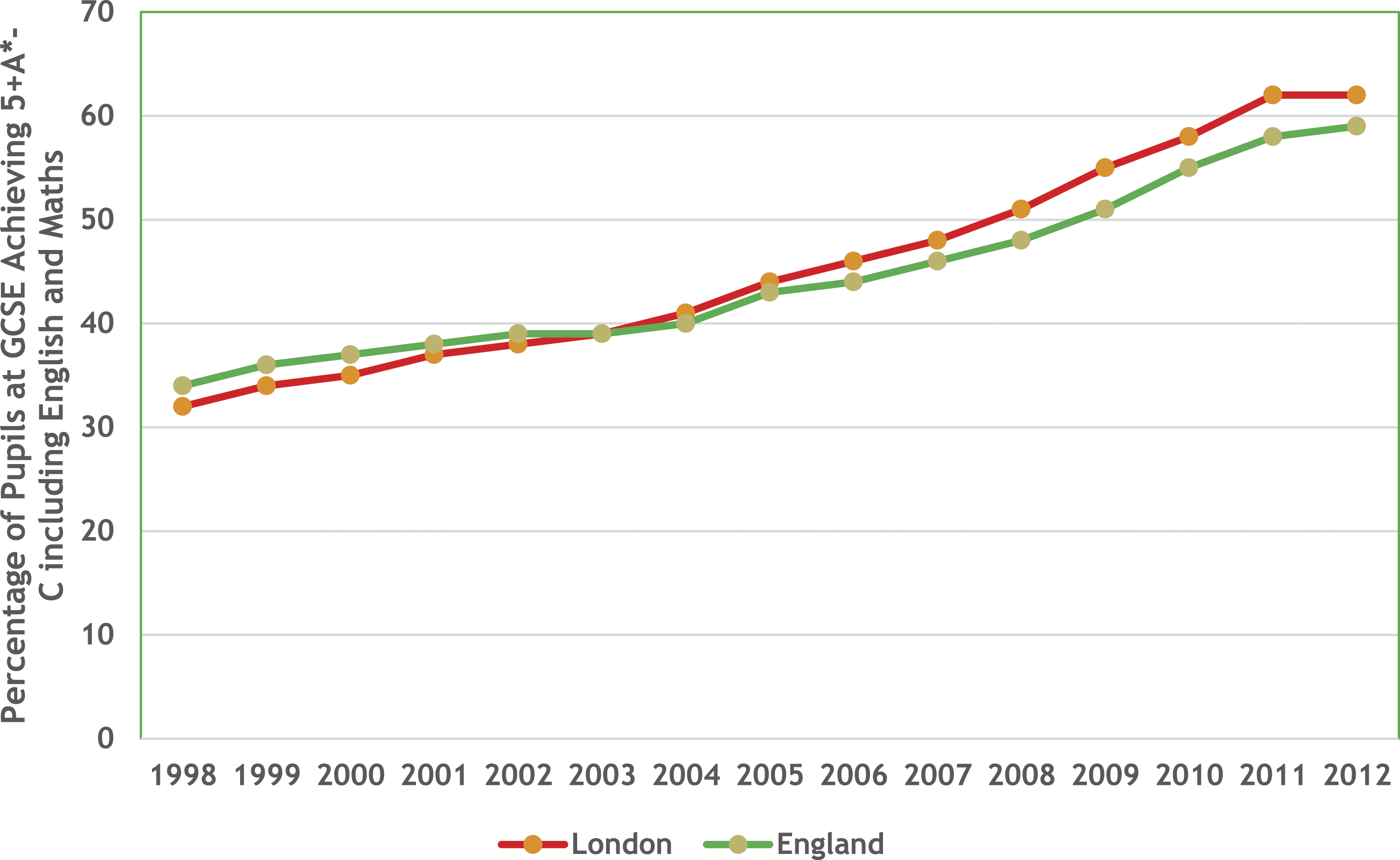
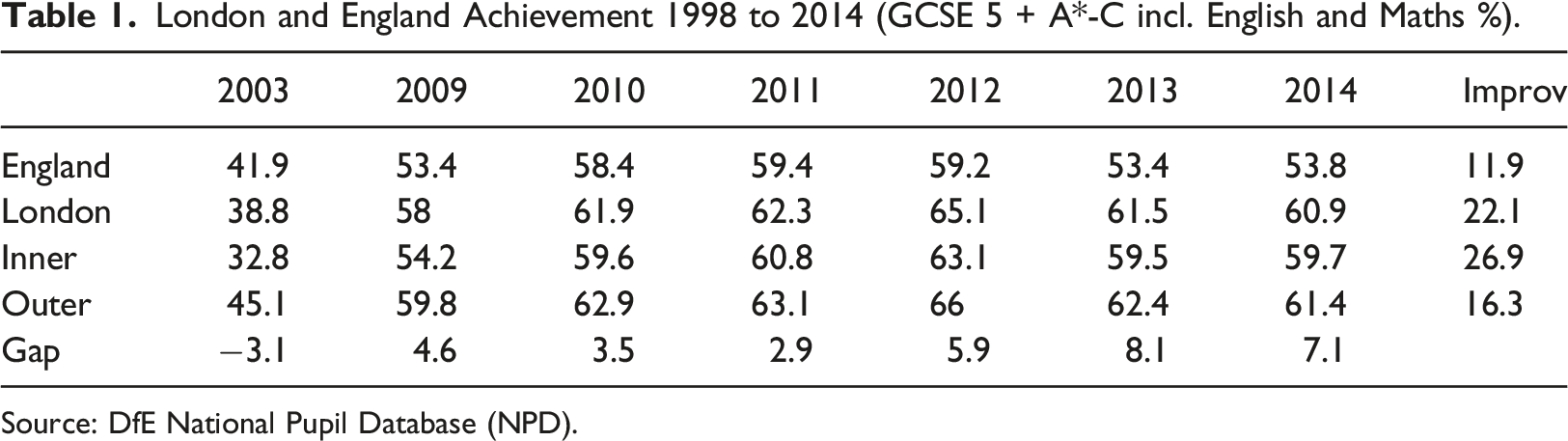
London and England Achievement 1998 to 2014 (GCSE 5 + A*-C incl. English and Maths %).
Source: DfE National Pupil Database (NPD).
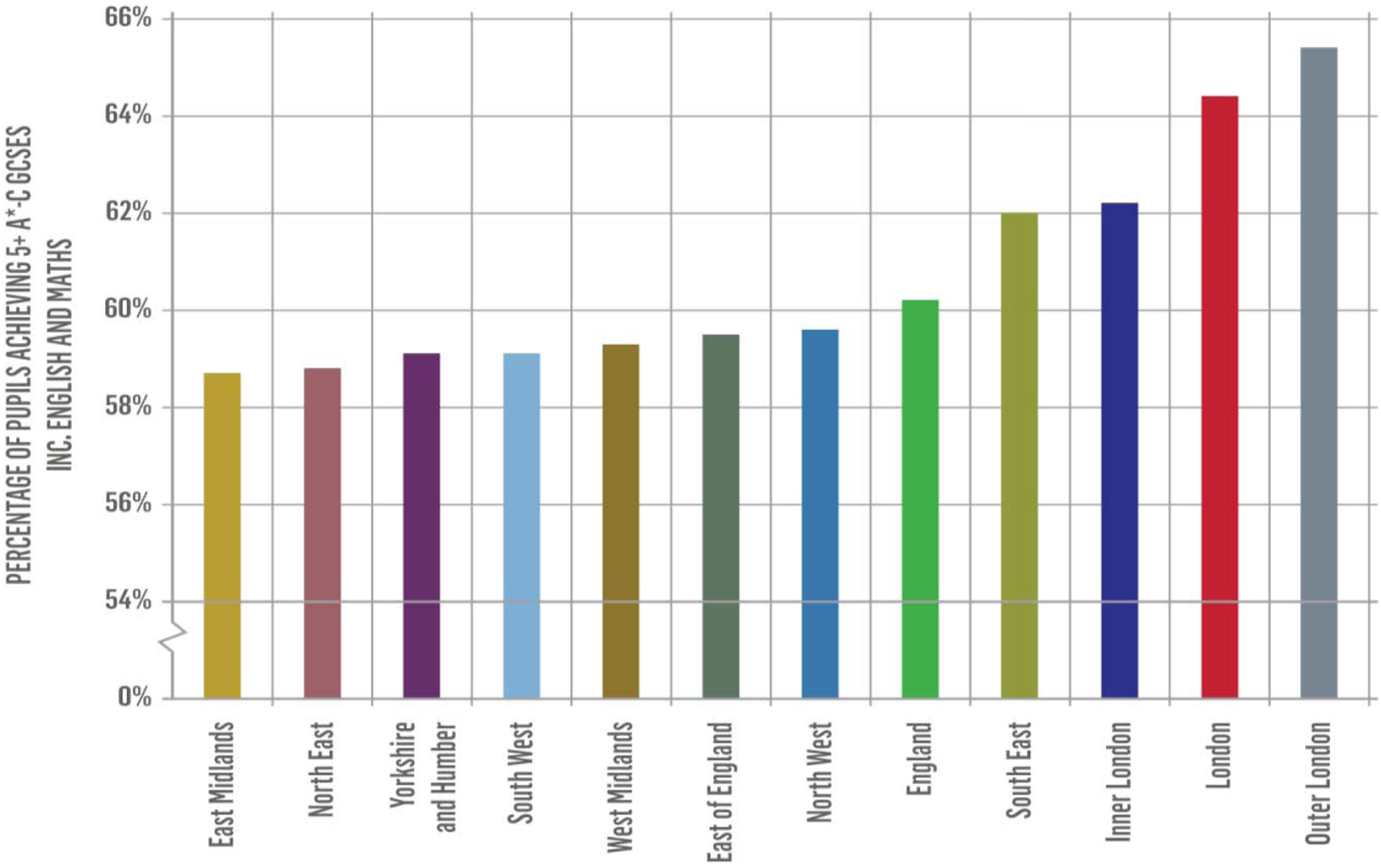
2013 GCSE attainment by region.
London has also made a significant difference to the lives of children over the years by tackling disadvantages in schools. The official government data between 2005 and 2019 indicates there is a marked difference in GCSE performance between pupils eligible for free school meals and the most economically advantaged groups in schools. At the end of secondary education in 2019, 49% of eligible pupils achieved 5 + A*-C, whereas 68% of pupils who were not eligible achieved this level. Overall, the findings from the London data confirm that pupils eligible for school meals did less well than their more affluent peers but they achieved 12% point better than their peers at national level (see DfE, 2013a; Baars et al., 2013; Demie and Mclean 2015b).
Educational attainment in London by ethnic background
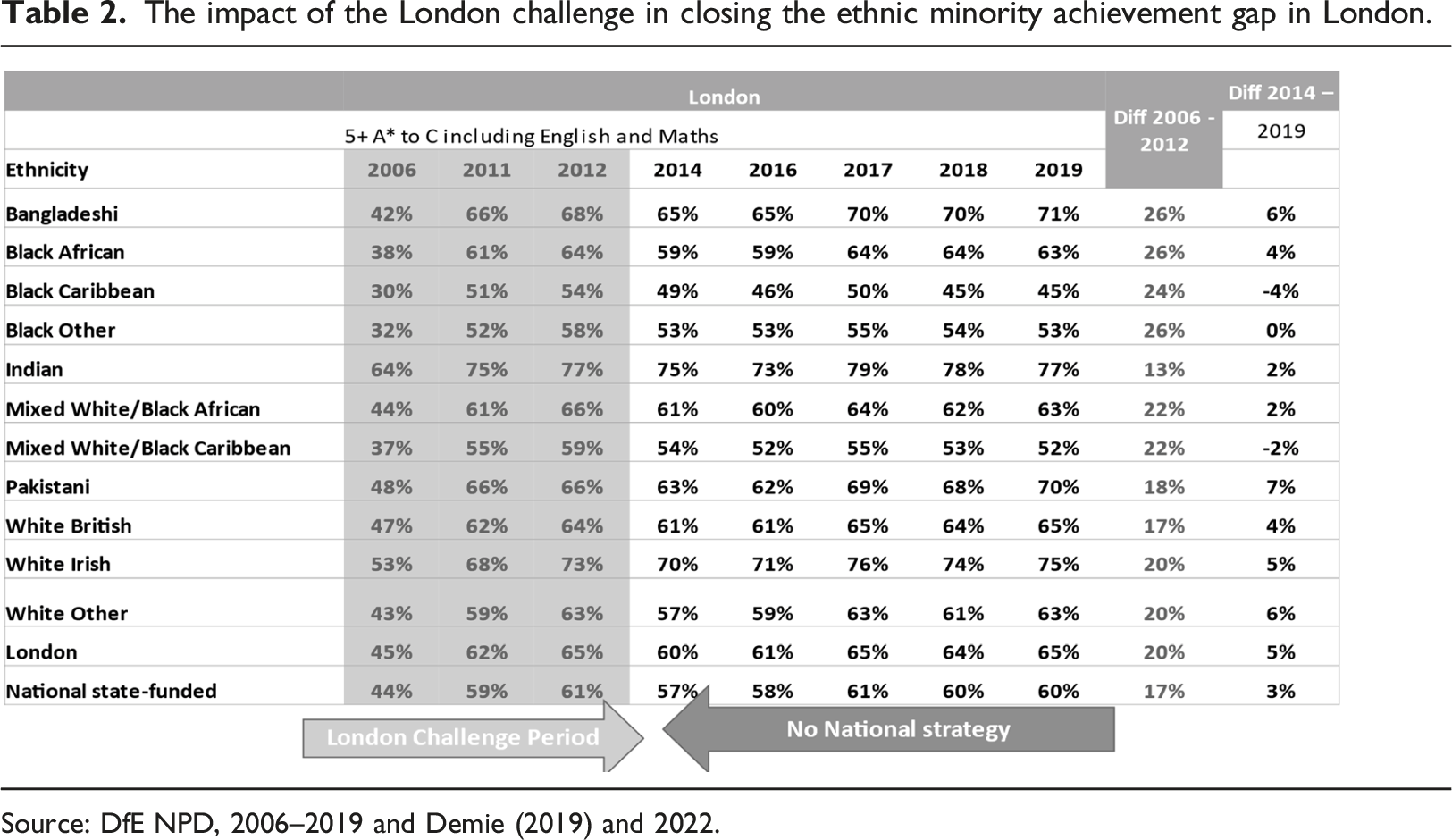
Educational attainment in London by ethnic background also confirms and shows the impact of London’s challenge in closing the BAME (Black and Minority Ethnic) achievement gap in London compared to white British (see Table 2). In 2006, white British pupil’s attainment of 47% gaining five passes was compared that found in London overall (45%). However, by 2019, they were still on a par with London but had higher levels of achievement than nationally with a gap of five percentage points (65% vs 60% nationally).
The impact of the London challenge in closing the ethnic minority achievement gap in London.
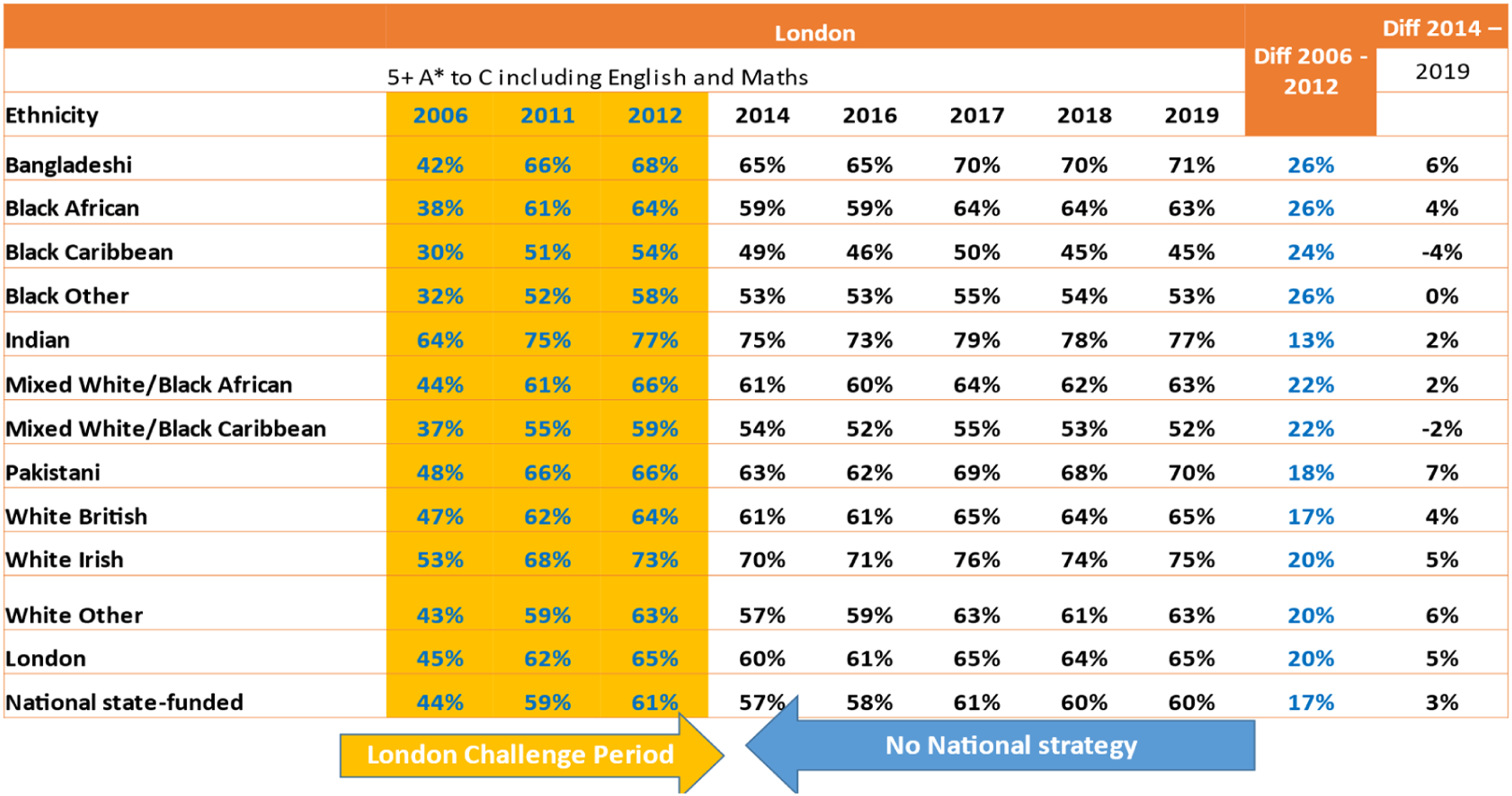
Source: DfE NPD, 2006–2019 and Demie (2019) and 2022.
The relative attainment of Black African pupils in London schools has improved since 2003 when they were 6 percentage points below overall London attainment and seven points below national attainment. By 2019, they were 2 percentage points below the London average, but three percentage points above the national. Black African pupils in London schools improved at a faster rate than Black African pupils nationally. In 2003, their attainment was the same, with both groups having 44% meet the expected standard, but by 2019 the gap had widened to 3 percentage points, with 63% of Black African pupils in London and 60% nationally getting five passes including English and maths.
Black African pupils in London now outperform white British pupils nationally, and this has been the case since 2014, although the reverse was true for the years studied before then. However, they do not outperform white British pupils in London schools, with a gap of about one to two percentage points in the last 5 years.
Indian pupils comprise about 7% of the London school population. Between 2003 and 2017, they had the highest levels of attainment of any ethnic group in London. In 2017, 79% of Indian pupils met the required standard, which was 14 percentage points higher than White British pupils or London pupils overall. Results fell back slightly over the next 2 years, although Indian attainment was still high compared with most other ethnic groups. Indian pupils in London were slightly more likely to meet the GCSE benchmark in each of the years studied than Indian pupils nationally.
The next largest ethnic group was for Asian other pupils. Their attainment was the second highest of any of the main ethnic groups in London, consistently higher than white British or national attainment overall, and by 2019 their attainment was higher than for Indian pupils with 78% meeting the expected standard.
Ofsted (2009) research shows Bangladeshi pupils seen in 1980 and 1990s as underachieving and had the same attainment rate as Bangladeshi pupils nationally in 2003, but by 2019 they were outperforming them by 4 percentage points, with 71% of London and 67% of Bangladeshi pupils nationally meeting the key GCSE measure. In 2003, Bangladeshi pupils in London were less likely than White British pupils to get 5 passes, but by 2014 the relative position had reversed, and by 2019 the gap was 6 percentage points in favour of Bangladeshi pupils. The high achievement by Bangladeshi pupils in later years can be seen as one of the success stories of London schools.
The attainment of Pakistani pupils in London was higher than found nationally, by about 11 percentage points in each of the years studied, and this was the highest gap found for any of the larger ethnic group when comparing peers in London and nationally. Their attainment was consistently higher than that found overall in London or nationally, and the gap with White British pupils in the capital grew since 2003. By 2019, Pakistani pupils in London outperformed White British pupils by 5 percentage points.
There is also a success story in closing the gap for black Caribbean pupils. In 2006, 30% of black Caribbean pupils in London got 5 + passes at A*-C, and by 2019 this had risen to 45%, an increase of 15 percentage points. This increase was smaller than in London overall (up 19 percentage points) or nationally (up 17 points). The 45% rate was also the smallest for any of the ethnic groups in London, except for Gypsy/Roma, or travellers or Irish heritage, both comprising very small cohorts, and in each of the years analysed Black Caribbean pupils had the lowest attainment.
Black Caribbean attainment in London was about one percentage point above black Caribbean pupils nationally in each of the years compared. However, when compared with overall London attainment, they were consistently below, with the smallest net gap in 2014, but this then increased year on year and by 2019 it was 20 percentage points (45% of London Black Caribbean pupils gained 5 passes including English and maths, compared to 65% of all London pupils). A similar pattern was noted when comparing Black Caribbean pupils to White British pupils in London, and White British pupils nationally. In 2019, the gap was bigger than for any of the previous years, at 16 percentage points.
The attainment of mixed white and black Caribbean pupils in London was also lower than that found in London overall, although it was higher than for white and black Caribbean pupils nationally. However, the relative attainment of this group worsened over time when compared with white British pupils. In 2014 the gap was 7 percentage points in favour of white British pupils but by 2019 this had widened to 13 percentage points, due to a fall in attainment of mixed White and Black Caribbean pupils since 2017.
In London, White British pupils comprised the main ethnic group. Between 2014 and 2019, attainment of London pupils improved at a faster rate than found nationally, up to five percentage points to 65%, compared with three points increase nationally to 60%. Within London, there were different rates of progress for the different ethnic groups. However, some key points can be noted. Attainment for all the ethnic groups discussed in London was higher in 2019 than for their peers nationally, and most groups also made faster progress.
Indian, Asian other, Bangladeshi, and Pakistani pupils in London all had higher rates of attainment than white British pupils, and apart from Indian pupils, the rate of improvement over the last 5 years was greater, widening the gap. By contrast, black African, black Caribbean and Mixed White and black Caribbean pupils had lower rates of attainment than white British pupils in London schools, and none of these groups closed the gap with their white British, and in fact for black African and mixed white and the black Caribbean, the gap widened.
We would argue there were a number of reasons for the improvement of all ethnic groups. Table 2 shows there was an interesting pattern in attainment by ethnic backgrounds when compared before and after the introduction challenge. During the London challenge period Ethnic minority achievement grant (EMAG) and Black Caribbean Project was used to tackle the underachievement of ethnic minority pupils (Tikly et al., 2006). The government invested £219 million per year through the Ethnic Minorities Achievement Grant (EMAG) to tackle the underachievement of ethnic minorities pupils and with another black Caribbean Project in 30 successful schools with £16,000 to support leadership and £10,000 per year for each school involved in the project has made difference (see Tikly et al., 2006). The Black Caribbean Pupils were supported with a range of targeted interventions including Using successful Black Headteachers, small groups support, personal tutoring, booster class, pastoral care and training teachers, and teaching assistants and learning mentors (Tikly et al., 2006; Demie 2019). As a result of the impact of EMAG and National Black Caribbean achievement project in narrowing the achievement gap (2003–2011), it was possible to reduce the achievement gap from 19% gap in 2004 to 8% in 2013 (Demie and Mclean 2019; Demie 2019).
EMAG funding has also helped the improvement of other minorities ethnic groups in London. As a result of EMAG and National Black Caribbean Achievement Project, all main ethnic groups made a huge improvement with Bangladeshi and black African Improving by 26%, followed by black Caribbean (24%), white other (20%) compared to white British 17% narrowing the inequality gap. There are no doubt national strategies, the London challenge, and EMAG have huge impact in closing the gap for all underachieving ethnic groups in England and London.
There is some other evidence to show that results have improved for African Caribbean pupils attending Aiming High schools at national level. As noted by Tikly et al.: ‘The evaluation report of the project also shows that between 2003 and 2005, the percentage of Black Caribbean boys attending Aiming High schools improved at Key Stage 4 by 5.4 percentage points and for Black Caribbean girls it improved by 6.9 percentage points (See Tikly et al., 2006: 5) ‘Overall, Aiming High has been highly effective in raising awareness of African Caribbean issues in schools. It has enabled schools to include African Caribbean achievement within mainstream school development plans and fostered the professional development of Head-teachers, lead professionals, and senior management on leadership on race equality issues.’ (See Tikly et al., 2006:9)
Another survey evidence asked respondents how far they agreed with statements about the impact of the schools on transforming education in London (Hayes and Cassen 2014). The findings of the surveys confirm that the factors that respondents rated as having the greatest impact on educational transformation and were, the effectiveness of school leadership, effective headteachers, high-quality teaching, effective use of data, pupil tracking, commitment to the standard agenda, target setting, support for BAME, EAL, and disadvantaged pupils, effective performance management, effective school partnership and effective governing bodies (Hayes and Cassen 2014). ‘Many factors have been identified as playing a part in the improvement and it is difficult to separate out those that had the greatest impact. Although the studies evaluating the London Challenge acknowledged the role local authorities played in partnership with the challenge advisers. Other research has much less to say about the role and impact of local authorities.’ (Hayes and Cassen 2014:25)
There are other reasons for improvement in GCSE in London. As argued above historically London’s attainment was below that found nationally, for example with a gap of 5.5 percentage points in 1998 and 3.1 points in 2003 (see Baars et al., 2014; Hutchings and Mansaray 2013). The London Challenge was in action between 2004 and 2011 with an £80 million government investment for 8 years to support London schools and LAs to develop effective school leadership, improve the quality of teaching and learning, effective use of data to monitor and identify underachieving groups, tackling disadvantaged, and for targeted interventions. This investment by central government had an impact on London improvement.
Pupil premium funding was also used to target and support through effective use of small group additional teaching, one-to-one tuition, use of the strongest teachers to teach English and Maths for intervention groups, use of well-trained teaching assistants (TAs), booster classes, early intervention, mastery learning, EAL support, pastoral care, and enrichment programmes, for example, trips to cultural venues (see for details Demie 2019 and Demie and Mclean 2019, 2016; Baars et al. 2014). The evidence from the schools suggests that these targeted interventions through use of London Challenge funding, pupil premium funding have undoubtedly had a significant impact on raising achievement and closing attainment gaps for eligible pupils.
Overall, the impact of the London Challenge, EMAG, pupil premium, and national strategies is clear and between 2009 and 2014, London attainment rose above the corresponding national figures and by 2014, they were 7.1 points above It is interesting to note that inner London, whose results were below that of the outer boroughs, improved at a faster rate than outer London (see Baars et al. 2014; Hayes and Cassen 2014; Demie and Mclean 2014); Greaves et al., 2014; Hutchings and Mansaray 2013). A few other studies also argued a key reason for the improvement in London was not only because of the work of the London Challenge but because of other factors such as race and ethnic diversity (see Burgess 2015; Greaves et al., 2014; Hayes and Cassen 2014). New research provides alternative explanations that ‘the capital’s ethnic diversity (Burgess 2015), previous national primary literacy and numeracy strategies (Greaves et al., 2014), and improved support from local authorities (Demie and Mclean 2014; Woods et al., 2013; Hayes and Cassen 2014) were one of several key reasons why teenagers in London score higher GCSE results than those in the rest of the country. We would argue that the improvement and difference in results in London were down to a ‘complex series of factors’. It would be simplistic and misleading to suggest that improvement in attainment was accounted for by the London Challenge, higher school funding, demographic composition, or national literacy and numeracy initiatives. It needs to consider other complex factors including the huge contribution of local authorities in raising standards.
It is also important to note data on Figure 2 and Figure 3 clearly shows downward trend in terms of achievement by ethnic background (Demie 2019, 2022) in post the London challenge period. There is now a consensus among researchers in the field that one of the biggest obstacles to raising ethnic minorities achievement is racism and the government and Ofsted ‘colour blind’ approach which has put them at a disadvantage in the English school systems. This is another key reason for widening the gap in post the London challenge. The data clearly suggest that the government policy since 2010 have a negative impact after stopping the London challenge initiatives and EMAG funding. Government now put blind eyes on equality act with race as a protected characteristic. The change of government and the removal of contextual value added from schools as well as funding centralised in pupil premium that was before able to be spent more freely has resulted in negative impact and downward trend in terms of achievement by ethnic background (Demie 2019, 2022). GCSE black Caribbean and White British Achievement Gap in England (5 + A*-C incl. English and Maths)% (2004–2018)-all schools.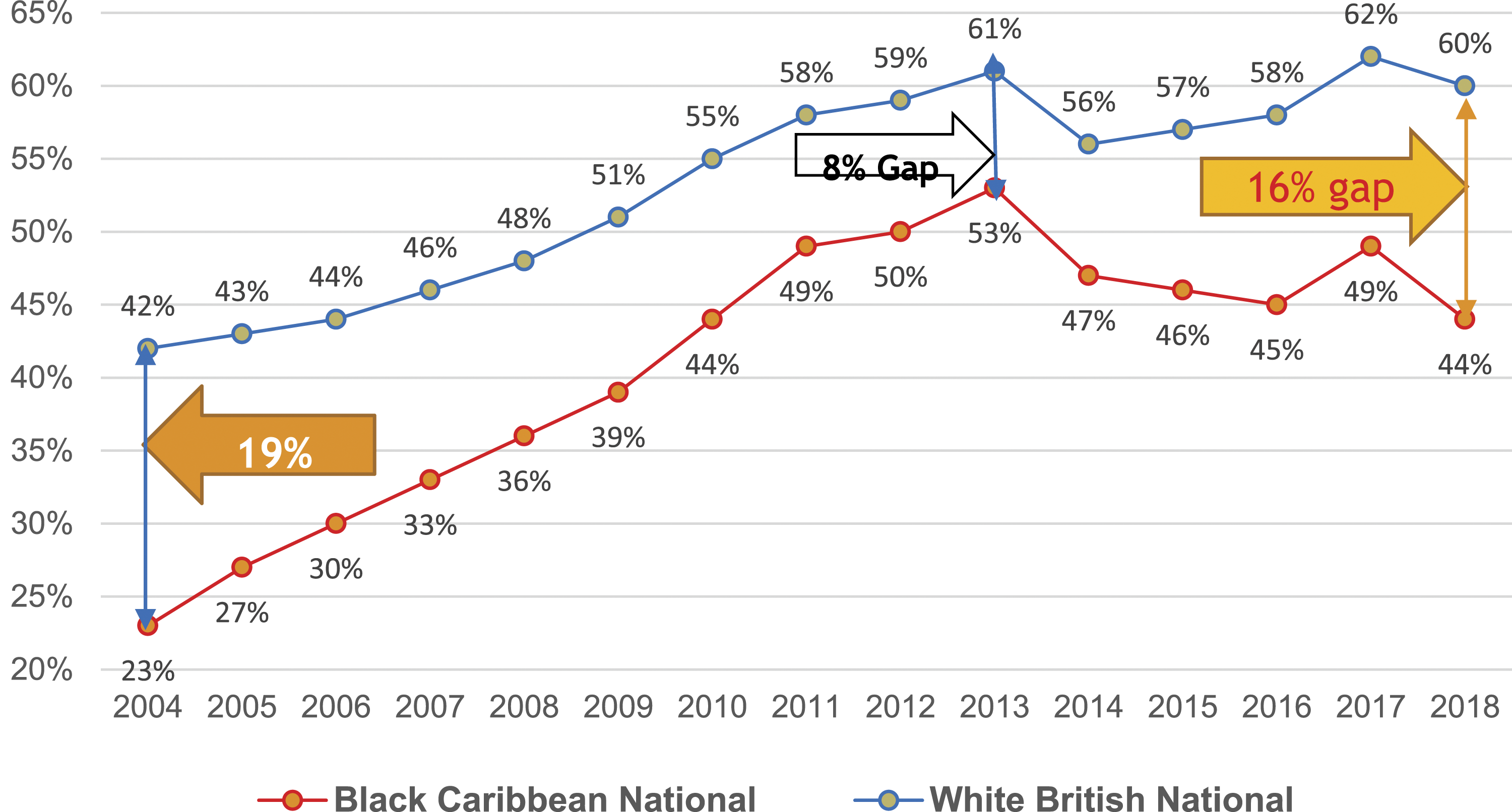
Success factors in driving school improvement and tackling educational inequalities
There are several reasons why the schools are bucking the national trend in closing the achievement gap in London. The substantial body of previous research into what works in driving school improvement and tackling inequality suggest several key factors including providing effective school leadership on diversity and equality issues; high-quality teaching and learning, use of inclusive curriculum and data, effective use of the diverse multi-ethnic workforce, targeted interventions to support disadvantaged and ethnic minorities pupils, and addition funding investment (See, Demie, 2019; Demie and Mclean 2019; Baars et al. 2014; Hutchings and Mansaray (2013). Building on the past research, this section explores success factors in driving school improvement and tackling educational inequalities in one London local authority. The evidence from several studies findings in London schools (see Demie, 2019; Demie and Mclean, 2019; Baars et al. 2014; 2014; Hutchings and Mansaray, 2013; Hayes and Cassen, 2014; Ofsted, 2014) suggests that a well-managed and effective school can make a real difference in raising achievement and closing the gaps in the locality it serves. It also shows how strong leadership that is committed to diversity and equality can challenge racism. These success factors are discussed in detail below.
Providing strong leadership
The most important key factor that links all schools’ success in raising the achievement of disadvantaged pupils is the excellence of their leadership in promoting equality and diversity in schools. Research undertaken in school effectiveness and improvement shows that leadership is second only to high-quality teaching and learning as having the most significant impact on pupils’ learning outcomes (See Demie, 2019; Demie and Mclean, 2015b, 2016; Sammons, 1999; Sammons et al., 1995; Edmonds, 1982). The London schools have many exceptional school leaders that have fostered a climate of high expectations. Ofsted graded all school leadership by the headteachers and senior management teams as ‘good and outstanding’ (see Figure 4). Leaders in the schools were described as ‘inspirational’ and ‘visionary’. Each has a strong moral drive for pupils. In each of these schools, there is a culture of high expectations and no excuses, collaboration with colleagues, and close links with parents/careers and the community. 2013 Ofsted judgements about teaching and leadership quality.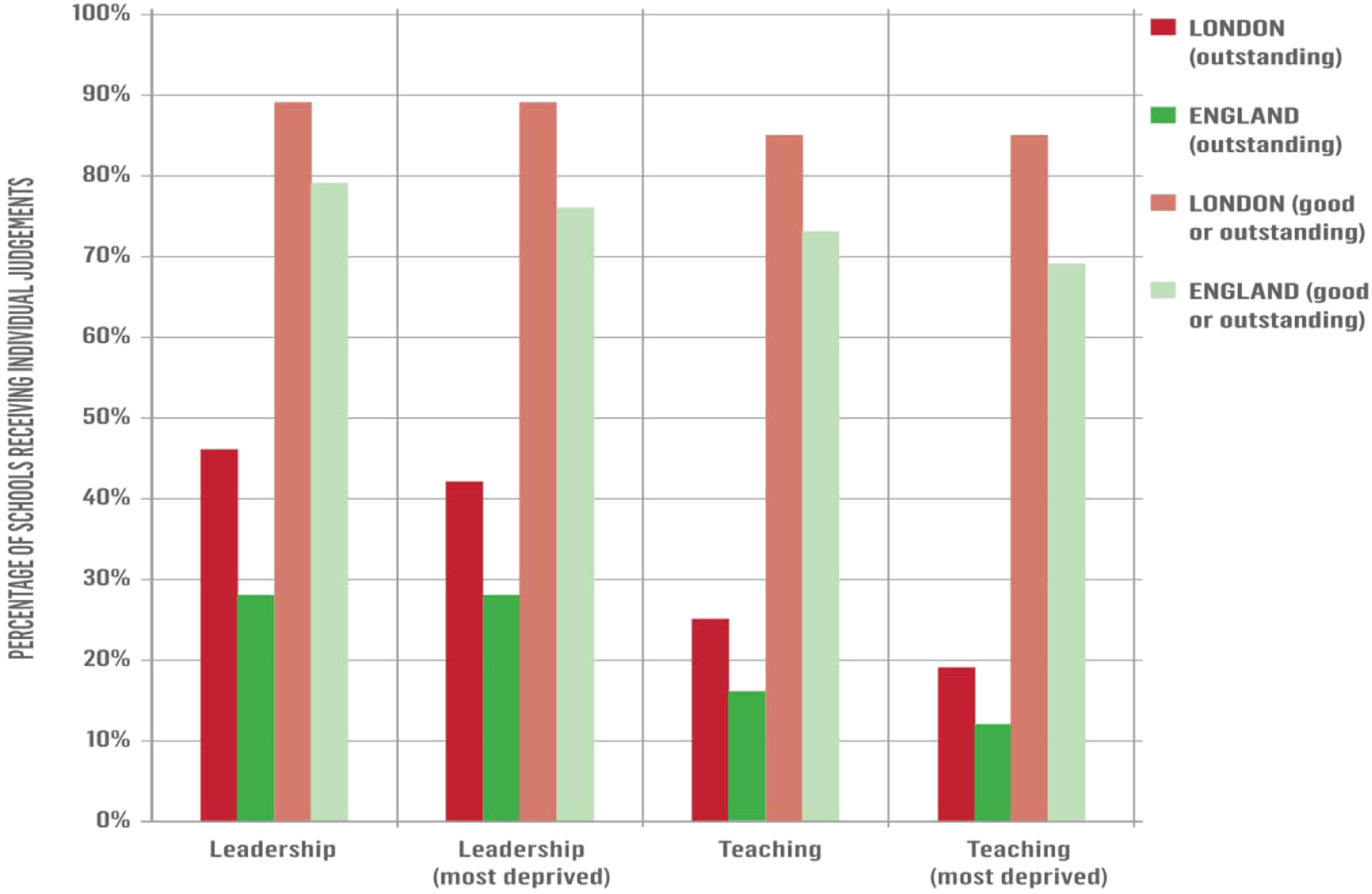
The Ofsted data in Figure 4 below suggests that by the end of the period, the leadership was judged good or outstanding in 89% of secondary schools (79% nationally) and overall 85% of teaching were judged good or outstanding (72% nationally) (Ofsted, 2014).
Leaders in each school set high expectations for their staff teams with a relentless focus on improvement, particularly in the quality of teaching and learning, effective use of data, and higher achievement by students. ‘It is about staff taking responsibility for outcomes… everyone is clear about their roles, and everyone is supported!’ (Deputy Principal) ‘There is an exceptional sense of teamwork across each school which is reflected in the consistent and committed way managers at all levels work toward the schools’ aims to raise achievement. Governance in the schools is strong. Governance shares the school’s aspirations for the students. Governors are involved in the life of each school through ‘regular meetings and fact-finding visits and its strategic direction. They are well informed about development plans and increasingly effective in the balance between support and challenge.’ (Headteacher, Demie and Lewis, 2013: 4–5)
The views of pupils, parents, and students are sought regularly are much valued and used to inform worthwhile changes in the schools. Headteachers are keen for children to have a greater say in the way the schools are run and a greater involvement in their learning, to get the culture of learning right. A member of staff in the English department of one school states, ‘If we are doing it for them, we need to know what we can do better for them. (Demie and Mclean, 2015a: 85)’.
A headteacher states; ‘Pupils do feel that they have an input into policies etc. As school leaders must be flexible, to look at our population- know who is in the population- connect with the community. We constantly reflect with the children.’ (Demie and Mclean, 2015a: 85)
Pupil views are sought through School Council meetings with Senior Management Team (SMT), pupil questionnaires, target setting days, student committees and through a range of action groups for example Chaplaincy, Environment, and Fundraising.
There is a diversity in school workforce. They have recruited good quality teaching and non-teaching staff who reflect the languages, cultures, ethnic backgrounds, and faiths of the pupils in the workforce. The schools recruit from their local communities, which sends a strong message to the communities that they are valued. This has helped the schools to become the central point of the wider community and has built trust. Teaching Assistants, often from the local communities, are greatly valued in the schools. They play key roles in communicating with parents and supporting pupil.
High-quality teaching and learning
Another factor for success in raising achievement is there is good and outstanding teaching. There is also an active focus on ensuring access to the curriculum for every pupil, whatever their background. Ofsted data also confirm that about 85% of the quality of teaching in London schools is good or outstanding compared to 73% nationally (see Figure 4). The London schools have teachers with passion and energy and the belief that they can make a difference. They have no excuses. Ofsted praised the schools, which achieved an outstanding grade for teaching and learning to state: ‘Teacher has the excellent subject knowledge, very high expectations and plan a range of activities that inspire and enthuse pupils in lessons.’ (Ofsted Inspection, secondary, Demie and Mclean, 2015b:88) ‘High-quality teaching has had a significant impact on the impressive rise in pupils’ achievements over the last three years. Teachers create stimulating classrooms in which purposeful learning takes place. Pupils are in no doubt what is expected of them…’(Secondary school Ofsted inspection report 2012, Demie and Mclean, 2015b: 88, Demie, 2020: 4) ‘Teachers systematically and effectively check pupils’ understanding throughout lessons anticipating where they may need to intervene and doing so with sticking impact on the quality of learning. The teachers’ subject knowledge is excellent and is kept at this level because of the high-quality professional development they receive.’ (Primary Osted Inspection, Demie, 2020:4).
Ofsted praised the quality of teaching at one school, which they judged to be outstanding because: ‘Teachers have excellent subject knowledge, and very high expectations and plan a range of activities that inspire and enthuse pupils in lessons… teachers make excellent links across subjects providing practical experiences to make learning more relevant to pupils and to develop curiosity.’ (Demie and Mclean, 2015b:88)
At another school, which also achieved an outstanding grade from Ofsted for teaching and learning in 2013, ‘teachers systematically and effectively check pupils’ understanding throughout lessons. The teachers’ subject knowledge is excellent and is kept at this level because of the high-quality professional development they receive’. There is an active focus on ensuring access to the curriculum for every pupil, whatever their background. Curriculum planning focuses on the individual. Teachers have an excellent understanding of where pupils are at in their learning; they know the learning profiles of each child and what interventions pupils might need. Pupil progression is very much an area of discussion and staff teams, and schools are keen to bring a discussion of learning not only in the core subjects but to have a ‘microscopic view into the foundation subjects too’. Through weekly targets, teachers focus on pupil learning and constantly review what they do in the classroom.
All of our case study schools that is participated in the London challenge programme and used in this study share many of the characteristics of successful schools nationally and demonstrate exemplary practice in teaching and learning that encourage good pupil motivation.
Based on this evidence, we would argue that there are no more important determinants of pupils outcomes than good teaching. This evidence based on case studies and Ofsted reports is well supported by other researchers who have also drawn attention to the centrality of teaching and learning (see Demie, 2019; Sammons, 1999).
Effective use of data
One of the core elements of the schools’ success in raising achievement is a robust focus on tracking and monitoring individual student’s progress and achievement in the widest sense of the term (see Demie, 2019; Baars et al., 2014; Hayes and Cassen, 2014). There has been a growth in data use since 2000 in London schools. Schools and the LA are data rich, with a wide range of data including KS2 and optional assessments/tests for monitoring performance. GCSE examination data is rigorously analysed to identify areas for improvement and to identify support needs and organise the deployment of resources appropriately. Schools have good systems for assessing and mapping the progress of all pupils, including ethnicity and bilingual pupils at individual and group level. High-quality assessment and pupil tracking are therefore features of the school. Schools see ‘The use of data as an essential part of school improvement and self-evaluation and is used as one of the levers of change.’ (Deputy Headteacher, Demie, 2019: 69)
There is good practice in the use of data in all schools. Key stage data is gathered as early as possible and analysed carefully by gender, ethnicity, and mobility, supplemented by other tests such as in English, mathematics, or verbal reasoning tests. Schools also use KS1 to KS2 and KS2 to GCSE value-added data to improve the attainment of individual pupils. Data are used well to evaluate the quality of provision and to identify and provide support and interventions for differentiated groups of pupils (Demie, 2019).
Schools used data to support a number of interventions including for one-to-one support, booster groups, making changes to the teaching programme or curriculum. Deputy headteachers and a data manager commented: ‘The school is good at assessing all pupils and teachers look at data carefully.’ (Deputy Headteacher, Demie, 2019:69) ‘We use data incredibly well for personalised learning and we have a well-developed tracking system with detailed assessment data and background information, including ethnic background, language spoken and level of fluency.’ (Data manager, Demie, 2019:69) ‘Data is critical for raising standards. It is useful to track pupil progress and identify strengths and weaknesses.’ (Deputy Principal, Demie, 2019: 69)
Teachers interviewed also acknowledged the effectiveness of data and commented that: ‘Use of data raised the expectation of staff and pupils and makes you focus on what children are actually learning.’ (Teacher, Demie, 2019: 69) ‘It has helped teachers to decide what to do to help the children get to the next level.’ (Teacher, Demie, 2019: 69)
This finding also supported by other studies which argued that there is ‘a longer history of educational data in inner London through the ILEA Research and Statistics Section’ until 1990 until it was abolished and also a number of the London LAs established a dedicated Research and Statistics service to provide a comprehensive range of performance data to schools (Demie, 2003, 2019; Hayes and Cassen, 2014). A review of the literature confirms that data circulated to schools helped to raise questions that pinpointed strengths and weaknesses precisely. Schools and other providers have high regard for the data which is influential in helping them to identify school-based performance priorities. The evaluation of London challenge also identified as a major feature of the programme success to the use of ‘family of schools’ data: ‘London Challenge placed performance data at the heart of the programme. The schools that received the highest level of support were identified using of consistently data-based criteria. The educational improvement process was supported by the careful benchmarking of performance against the performance of other schools with similar characteristics.’ (Baars et al., 2014:80) ‘One headteacher who had been heavily involved in London Challenge talked about ‘a massive focus on the data’. She was particularly impressed by the value of the ‘families of schools’ data as a means of identifying where the best practice was that could be shared with other schools.’ Baars et al., 2014: 82)
To conclude, one common feature of the strategies for raising achievement in all schools is intelligent use of assessment data, progress tracking, target setting, and support for students slipping behind with targeted interventions. The evidence about the use of data confirms that data is used effectively to support school improvement, by, for example: • challenging the aspirations of staff, pupils, and parents • supporting school self-evaluation • tracking pupils’ performance and progress • identifying underachieving groups • closing the achievement gap. (Demie, 2020; Baars et al., 2014)
The teachers in all these schools expect every pupil to achieve their full potential. Teachers and school leaders use the data to pinpoint underachievement and target additional support. Data is used effectively by senior managers, teachers, and teaching assistants to pose and answer questions about current standards, trends over time, progress made by individual pupils, to track pupils’ progress, and to set high expectations in case study schools (Demie, 2019).
Use of multi-ethnic school workforce and inclusive curriculum
One of the issues that faces the educational system in England is the lack of representation in staffing, particularly in leadership position in school and educational organisations, compared to the diversity of the pupil population the school serve. Previous research suggests a long-standing concern about the mismatch between the teacher workforce and student populations (Demie, 2019). While BAME student numbers now stand at 31% (Demie, 2019), most school leaders (93%), teachers and teaching assistants (86%), and other staff (87%) are white British by ethnic background in England (Demie, 2019; Demie and See, 2022). The London schools challenge this worrying picture of national statistics and the school population mirrors the community in which the schools sit. For example, in the case study schools • ‘The percentage of leadership staff in the schools recorded as an ethnic minority is 38% compared with 9% nationally. • 52% of teachers in the schools are from ethnic minority groups compared with 14% nationally. • 60% of all the school staff are an ethnic minority compared to 13% nationally’. (See Demie, 2019 and Demie and Mclean, 2015b)
Most pupils in London come from white British, African, black Caribbean, Indian, Pakistani, Bangladeshi, and mixed/white backgrounds. The schools ensure pupils understand and appreciate others from different backgrounds with a sense of sharing a vision, fulfilling their potential, and feeling part of the community. The school curriculum explores the representation of different cultural, ethnic, and linguistic groups. The school ethos that is developed is based on a commitment to a vision of the school that serves its pupil community in the context of diversity. The schools are multicultural. Staff is aware of the many pressures young pupils face in the wider society. They actively consider this in their approach to education. They are promoting equality and diversity in the classroom actively promoting multiculturalism in lessons and planning lessons that reflect the diversity of the classroom. A key success for some of the London schools is the leadership’s ability to create a community that reflects the student population by employing a diverse multi-ethnic workforce.
The schools are truly multicultural schools where the diversity of ethnic origin, languages spoken, and cultural heritage brings real life to learning. The schools pride themselves on the diversity of their workforce and actively recruit from the local community. What is even more important, in addition to the diversity in the school workforce, is that these schools are good at using an inclusive curriculum that reflects the pupils’ heritage, culture, and experience to explore the representation of the different cultural, ethnic, linguistic, and religious groups in the area. They have developed an inclusive and broad curriculum that has relevance to their lives and reflects and values cultural diversity and engages the students in multicultural society.
Effective support for English as an additional language (EAL)
Among the successes was the raising the levels of fluency English proficiency among the large body of EAL learners through raising the achievement of EAL pupils in London (Ofsted, 2010) during 8 years London challenge period.
As all schools serve a linguistically diverse community, support for EAL is a strength. Schools recognise that proficiency in English is the key to educational success for their bilingual learners. Our observations and interviews with staff suggest that the level of expertise within schools to support students in learning English as an additional language is outstanding. EAL departments are very small, but EAL coordinators are well qualified, experienced, knowledgeable, and very committed to the profession. Specialist staff, for example, those who assist students with EAL, provide effective support during lessons and elsewhere. This starts with a detailed assessment on admission to school in order to identify individual needs and inform teachers. It continues with rigorous scrutiny and analyses of students’ performance data in order to appropriately target resources towards specific individuals or groups.
The interviews and observations clearly demonstrate the teachers’ knowledge and understanding of EAL pedagogy and strategies that have been developed as a result. This ensures that the teaching of pupils with EAL is class-based, where language would be contextually embedded. Withdrawal sessions are planned only for the immediate needs of new arrivals or to address specific needs. Most schools have clear induction processes for new arrivals, which incorporate assessment of both English (and where possible) their literacy and numeracy skills in their first language, to ensure that teaching is pitched at the appropriate cognitive level. It is very evident that in all schools EAL is not an ‘add-on’ but is seen as an advantage and considered within every aspect of school life. As one headteacher commented: ‘EAL is not a barrier but a bonus’ and another ‘as staff we don’t see it as a challenge, we see it as an opportunity ….we have all these EAL children, what a wonderful opportunity to share our languages and our culture … EAL permeates everything we do.’ (Demie and Mclean, 2015a: 94)
There is a strong focus on learning in schools in the London challenge programme to make sure no student with EAL falls behind. Through detailed monitoring and tracking EAL students below the expected level or at risk of falling behind are quickly identified and individual needs are targeted. All students are assessed carefully using the LAs stages of fluency in English to ensure that they receive the appropriate support and are making the required progress. The most common types of data-driven intervention employed in the school are providing additional support, including one to one support or booster groups; making changes to the teaching programme or curriculum such as more personalised learning; differentiated teaching to meet the specific needs of pupils with EAL; other targeted initiatives to improve performance. In addition, the EAL coordinators keep a register of all children with EAL needs in the school by year group and the schools are very good at tracking the performance of EAL children by sex, date of birth, the date on a roll, home language, stage of English fluency and attainment, and test results. This information is updated once a term. All class teachers are given this information so that they have an up-to-date picture of their pupils’ EAL stages.
Overall, there are excellent systems for monitoring the work of the pupils, identifying those who need additional help or extra challenge and then providing them with appropriate additional support. In all case study schools, a high priority is placed on supporting language acquisition amongst EAL students not fluent in English. This often appeared to be a dominant feature of curriculum developments in these schools. The teaching and class support for EAL is well organized and led by EAL coordinators. As a concluding remark, we would argue that the schools are highly effective at analysing data in order to identify pupils who are at risk of underachieving. The excellent range of support provided has had a positive impact on the achievement of EAL pupils and those whose circumstances have made them vulnerable. This finding further confirmed by Bell Foundation (2022) research which highlighted that as a result of London challenge EAL initiatives all London boroughs have now enjoyed significant proportions of EAL pupils attaining high level of English proficiency.
Funding
Generally, London LAs were relatively well funded in 2012/3 and this was true of the case study LA, receiving £202,897,000 based on 35,891 pupils (£5,664 per pupil), and further supplemented by additional pupil premium funding. The LA then funded schools based on six pupil characteristics, namely, • ‘A basic per-pupil amount • Pupils who are from deprived backgrounds • Pupils who have been looked after • Pupils with low attainment before starting at their primary or secondary school • Pupils who speak English as an additional language and • Pupil mobility’ (Demie and Mclean, 2015a: 69)
One could argue that one of the key factors for the educational transformation in London was related to funding. One headteacher in our survey commented that: ‘Schools have been well funded and well-resourced over time and LA has maintained an arms-length approach which has developed an effective working relationship over time to the benefit of students.’ (Headteacher, Demie and Mclean, 2015a: 70)
This is further supported by a school governor who maintained that: ‘Additional funding has been used effectively for targeted interventions and support. This helped in raising achievement.’ (Governor, Demie and Mclean, 2015a: 70)
There is a wide variation in funding among the 150 English local authorities ranging from £1,268 in Darlington, £1,893 in Bromley LA to £7,358 in Tower Hamlets in 2013. The London and national averages are £4,456 and £3,804, respectively (Demie and Mclean, 2015b: 71).
This variation arises largely because schools differ in their characteristics. The most deprived pupils in each school attract more funding.
DfE (2013b) data also shows that London schools have always been funded at a higher level than other regions. Funding per pupil has increased dramatically in the last decade and has been consistently higher in London compared to other regions (DfE, 2013b; Baars et al., 2014). Of course, costs have been higher in the capital than elsewhere so it would be wrong to assume a mechanistic relationship between funding and London schools’ performance. However, many of the people we interviewed commented on resourcing. They noted the strengths of LAs and schools in getting more money to challenge poverty and inner-city issues. The LAs and schools have effectively used this funding for targeted interventions. ‘Good school funding; with additional grants to support initiatives help everyone work on programs e.g., national strategies.’ (Director of Education, Demie and Mclean, 2015a: 72) ‘Higher level of school funding for schools when compared to the national funding levels. Evidence of London School’s performance shows that a higher level of funding per pupil has delivered better outcomes.’ (Assistant Director-Education, Demie and Mclean, 2015a: 72) ‘Targeted Central Government funding for school improvement e.g., Standards Funds, dedicated school grant (DSG) facilitated capacity building in a local authority for the provision of specialist teaching staff and ability to intervene.’ (Assistant Director-Education, Demie and Mclean, 2015a: 72) ‘High level of funding for schools compared with other LAs.’ (Headteacher, Demie and Mclean, 2015a: 72) ‘School have been well funded and well resources overtime.’ (Headteacher, Demie and Mclean, 2015a: 72) ‘Additional funding has been used effectively for targeted interventions and support. This helped in raising achievement.’ (governor, Demie, and Mclean, 2015a: 71)
Conclusion and policy implications
Conclusions
The challenges that face educational policymakers today, are not how to raise achievement, but how to tackle educational inequality. A body of research evidence shows that inequality in educational outcomes has grown, and a large number of children are underachieving at school (Hutchinson et al., 2019; Demie, 2019). There are long-standing achievement gaps in England associated with socioeconomic status and ethnic background. Although overall educational attainment for black minorities increased steadily between 2004 and 2011 during the London challenge period, this trend is reversing, and black Caribbean and Pakistani pupils are still at the bottom of the league when compared to white British and their peers. Despite the rhetoric of equality in schools in England, the school experiences of the black Caribbean and other minority students continue to be unequal.
Drawing on Ofsted reports, the London Challenge and LA good practice publications, case studies of schools and past research, which suggested regions, LAs, and districts can and do make a difference in school improvement (Demie and Mclean 2015b; Wood et al., 2013; Zadvadsky’s, 2009), this study extends the current literature by exploring the role of the London LAs and schools in transforming education in the area it serves and tackling educational inequality. It examines the factors behind the success story of the transformation of schools in London.
Several initiatives were carried out by the government to raise achievement in London schools including the London Challenge (2003–2011), the replacement of failing schools with new schools known as ‘academies’ in London (2002–present), and improvements in the quality of support and challenge provided by local authorities (see DfES, 2003, Demie and Mclean, 2015b). These initiatives had a significant impact on raising attainment and tackling educational inequality of disadvantaged and ethnic minority pupils in London schools. All schools used for the purpose of this study participated in the London challenge programme and has also benefited from the government investment and initiatives.
The conclusion from this study is that London schools now outperform schools in the rest of England examinations results and Ofsted inspections grade. They achieve the highest proportion of students obtaining five good GCSEs, the highest percentage of schools rated ‘outstanding’ by Ofsted, and the highest GCSE attainment for pupils from poorer backgrounds. The quality of both teaching and leadership in London schools is also above the national with marked improvement in inner London. This success evidence is a greatest achievement despite challenging in terms of level of poverty and changing ethnic mix in London compared other regions in England.
There are several reasons why London schools are achieving above national average. Drawing on empirical data, case studies, and focus group evidence, all previous studies identifies a number of key factors which appear to underpin the transformation of London, with huge improvement between 1997 and 2013 including providing strong school leadership, high-quality teaching and learning, effective use of data, effective support for minority ethnic pupils, effective support for pupils who speak English as an additional language and targeted interventions and support (Demie, 2019 and Demie and Mclean, 2019, 2017, 2016; Baars et al., 2014).
The above findings are also supported further by another research (Demie and Mclean, 2015b; Ogden, 2013). For example, the London challenge evaluation reports by Hutchings, M. and Mansaray, A. (2013) argued on that the reasons why the London Challenges were effective raising attainment in London schools. It highlighted that London challenge has closely worked together with schools, challenge advisers, and local authority school improvement staff to make a difference. Ofsted also confirmed a positive report that London challenge initiatives: ‘Has reduced the number of underperforming schools; increased the number of Good and Outstanding schools and improved educational outcomes for disadvantaged children, (Ofsted, 2013).
Other studies also argued a key reason for the improvement in London was not only because of the work of the London Challenge but because of other factors such as effective use of EMAG grant to support EAL and ethnic minorities pupils by schools (see Burgess, 2015; Greaves et al., 2014; Hayes and Cassen, 2014). We would argue the improvement and difference in results in London were down to a ‘complex series of factors’. It would be simplistic and misleading to suggest that improvement in attainment was largely accounted for by the London Challenge, higher school funding, demographic composition, or national literacy and numeracy initiatives.
Overall, research (see Baars et al., 2014; Hayes and Cassen, 2014; Demie and Mclean, 2014; Hutchings and Mansaray, 2013) on London’s success suggested that factors such as quality of leadership at all level, quality of teaching and learning, funding, effective use of data and targeted interventions to support ethnic minorities and disadvantaged pupils played key role in tackling inequalities in London schools. One could also argue that the key factors for improvement during the challenge period were related to funding and government initiatives to transform urban schools. School in London no doubt has been well funded to challenge poverty to support teaching and learning in challenging schools. Other factor that was highlighted by researcher also suggest that the ethnic diversity of the London population has also helped (Burgess, 2015). Cook (2013: 1) argued that: ‘London also benefits from a flow of high-performing immigrant children who tend to boost schools’ results. However, even its poor white British children, defined as those eligible for free school meals, perform well.’
These findings also further supported by other study (Ladd and Fiske, 2016) that suggested there were several factors that helped to transform London education. The study highlighted that the national policies to transform the quality of school leadership and teaching through the London Challenge, significant growth in school funding directed toward disadvantaged students and ethnic minorities, the changing ethnic mix in London are potential contributors to the success of the pupils in London.
Implications for policy and practice
Schools in inner-city in England are often associated with poor educational attainment and this is challenged in London where outcome has improved considerably (Blanden et al., 2015; Baars et al., 2014; Demie, 2019). This research tells the remarkable story of how London transformed its schools through passion, leadership, and commitment by putting learning at the centre of its priorities and by engaging with the community it serves. Commitment to the principle of local service in education is paramount. Our findings show that where schools needed to be challenged to improve, this was successfully mediated through an effective local authority and London challenge. The lessons learned from London emphasises that it is possible to drive education transformation through well-managed and well-run local authorities and schools. The overall conclusion of this study is that the schools have bucked national trends using a range of strategies to raise educational attainment at GCSE. The research findings also contain several important messages for policymakers. The study contends that there is no ‘pick and mix option’. An effective school will seek to develop all these characteristics underpinned by practical use of data to monitor the achievement of groups to pinpoint and tackle underperformance. The study argues that the London challenge initiative was innovative because it has focused on a strong moral purpose that it is possible to improve the life chances of the most deprived pupils in Inner London by creating an environment in which they are able to achieve above-average standards.
Key messages for policymakers and school improvement practitioners have emerged from the London experience. As concluding remarks, we reflect on the lessons that can be derived from the London improvement story. The wide range of effective strategies and success factors to drive school improvement at GCSE consistently featured the following:
Firstly, there was strong school leadership and excellent teaching tailored to each child’s abilities, which raises the achievement of all children whatever their background.
Secondly, the transformation of the schools in London has been a great success story which illustrates how a well-managed, good local authority can and does make a difference. The successes in London have been hard-won. They are the result of successful partnerships between schools and the LAs and reflect the extraordinary efforts of students, parents, headteachers, school staff, Council officers, LA school improvement professionals, and democratically elected politicians.
Thirdly, the transformation of education in London took over 10 years of concerted efforts to close the achievement gap and tackle educational inequality.
Fourthly, one of the core elements of the LAs and schools’ success in raising achievement has been the robust focus on tracking and monitoring individual students’ progress and achievement through the effective use of data. Several London LAs established a dedicated Research and Statistics service to provide a comprehensive range of performance data to schools (Demie, 2003, 2019; Hayes and Cassen, 2014). A review of the literature confirms that data circulated to schools helped to raise questions that pinpointed strengths and weaknesses precisely. Schools and other providers have high regard for the data which is influential in helping them to identify school-based performance priorities.
Fifthly, A key success of the case study schools is the leadership ability to create a community that reflects the student population by employing a diverse workforce and tackling inequality of opportunities. Heads recognised their schools as multicultural schools, where diversity of ethnic origin, and languages are spoken and cultural heritage brings real life to learning, the value of the cultural heritage of each child.
Finally, there was a well-focused approach to tackling educational inequality and the achievement gap of ethnic minority pupils in London schools and LA areas. Government funding had been provided for greater resources for schools with a high proportion of ethnic minorities through the Ethnic Minority Achievement Grant (EMAG) and raising the achievement of black Caribbean funding to support multicultural education and to tackle the underachievement of ethnic minorities, EAL pupils. Schools have implemented multicultural teaching policies and strategies using the funding provided by the central government and these have helped in tackling inequality and closing the achievement gap.
The evidence from London suggests that exceptional education leaders at all levels are critical to the success of local and national initiatives and to the transformation of education in local areas. We would argue that the London story is of national and international significance. The remarkable transformation of outcomes in the schools in London provides hope for those educators worldwide who are trying to improve learning and life chances, particularly for disadvantaged students and ethnic minorities pupils. This evidence demonstrates that it is possible to tackle the link between poverty and underachievement in urban schools through effective use targeted intervention initiatives such as the London Challenge. The approach used to transform education in London can be used elsewhere. I would argue that it takes a wide-ranging strategy with a strong lead from the national government to reverse the trend of underachievement as demonstrated in London. What is needed is additional funding and investment to support schools to raise achievement from national and local governments.
In concluding remarks, The London Challenge initiatives no doubt raised the standard of teaching in the classroom in London. It has also played key role in driving school improvement in urban schools. I would argue it is one factor in several that contributed to significant improvement in pupil outcomes in London schools (see Baars et al., 2014; Hayes and Cassen, 2014; Demie and Mclean, 2014; Hutchings and Mansaray, 2013). It also offers a worthwhile example of a success story that policymakers at both national and international levels can learn from (Hunt, 2013; Demie and Mclean, 2015b; Demie, 2019).
The ‘London Effect’ was real, and it would be unfortunate if this highly effective area-improvement strategy in London was ignored in future policymaking in England.
Footnotes
Acknowledgements
The study drew mainly on a range of secondary data, including pupil attainment data by ethnic background, case studies of schools, Ofsted reports on London, publications on lessons from London schools during the London Challenge period which is listed below. The author would like to acknowledge that all the extracts and the quotations used in this article is with kind permission of the authors. We also acknowledge the lack of base line attainment data by ethnic background in 2003, when the London Challenge started.
Declaration of conflicting interests
The author(s) declared no potential conflicts of interest with respect to the research, authorship, and/or publication of this article.
Funding
The author(s) received no financial support for the research, authorship, and/or publication of this article.
