




Abstract
George Floyd’s death invigorated the Black Lives Matter movement and stimulated debate and passionate action across the globe. Commitments are set out at every level to address racial inequalities and injustices. However, changing mindsets and instituting changes meets with challenges at multiple levels. Taking the knee, wearing the tee-shirt, removing statues and decolonising the curriculum is not enough. The school curriculum is a major site for the development of understanding about, and the development of attitudes towards, people of other races. Across the spectrum, from challenging selective and biased histories about other peoples to multiple government commissions about ethnic inequalities we have seen limited impact on institutions in their treatment of ethnic minorities. Viewing the effects of policy interventions in England hitherto realistically – and pessimistically – one conclusion is that the challenges to the eradication of racism are too narrowly conceived, symbolic and performative. Indeed, symbolic allyship and multiple government ‘commissionsphere’ reports deceive us into thinking we do enough, whilst experience shows failure. In increasingly neoliberal political and economic environments, individualised, competitive, populist agenda, are forces supporting inequality and subjugation blunting drives for social justice. Sustained, holistic policies enacted with energy and critically monitored are required.
Introduction
Racism is a potent and enduring force in society. There are strong arguments that the school curriculum needs to change in response to heightened awareness of equality issues not least those concerning race. There has been added impetus for change from Black Lives Matter (BLM) and wider motivation to create a better, fairer society. Schools, as one of the environments where young people develop their values, relationships and behaviours, need to be viewed in an ecological context. That wider context is comprised of various ‘stubborn’ inequalities and the forces that sustain them: moral stances with regard to migration; symbols and narratives of history; slow progress in correcting inequalities of treatment and life chances of different groups, especially evident in government commissions. The relevant context is global and historical as well as national, institutional, local, personal and contemporary. Many see the decolonisation of the curriculum as an urgent and important development (Arday et al., 2020; Moncrieffe et al., 2019). This paper argues that the efforts to address racial inequalities in England through education are too narrowly defined, and the ‘reculturating’ and training required may be more challenging than anticipated. Additionally, related institutions need to change in practical and sustained ways, which respond to data on existing inequalities, and ensure that action and outcomes follow realistically on from ardently expressed good intentions. Without this, we are in danger of continuing rhetoric and performative posturing without reducing and eliminating injustices.
Insofar as this affects England, one could focus on three contemporary areas in the challenge to the persistence of ethnic inequalities: one is the global outrage of BLM as a groundswelling, participative visual phenomenon; a second is the big picture comprising, nations’ responses to their racist pasts and presents, including the stratosphere of government commitment and decision-making – the ‘commissionsphere’ reports on racism and inequality; a third is comprised of the glorious narratives which are embedded in the curriculum and in the wider society, the claims to being Great Britain. For societal change it has to go beyond curriculum change in schools and will have to be fought for.
The persistence of ethnic inequalities and the global Black lives matter outrage
George Floyd died in Minneapolis on 25 May 2020 with a police officer’s knee on his neck for 9 min. The filming by 17 year-old Darnella Frazier was a critical contribution in media and court evidence set beside the official police version. The USA context for Black people is different from that in the UK, yet maybe only different in degree, in the ethnic composition of the populations and in availability of guns. George Floyd and the filming of his murder had been preceded by other equally horrifying filmed instances: Walter Scott, in 2015, in Charleston, shot in the back whilst running away after being stopped for a traffic offence – a broken rear light; Keith Lamont Scott, shot in 2017 in Charlotte, sitting in his car surrounded by police with his wife filming whilst reassuring officers that her husband was not a threat and doing nothing wrong. Videos of three of these tragic events in the USA are referenced and viewable via a link to the New York Times (Parsons, 2021).
As a caution against too readily expecting change in the USA, one should note that, on the day in April 2021 when police officer Derek Chauvin was found guilty of murdering George Floyd, in Minnesota, Daunte Wright, a 20-year-old biracial Black man, was fatally shot by police officer Kimberly Potter during a traffic stop and attempted arrest, the officer claiming to have mistakenly drawn her gun instead of her Taser. On the day Chauvin’s sentence was announced, in Columbus, Ohio, a 16 year-old, Black girl, Ma’Kiah Bryant, was shot with four bullets in her chest fired by a police officer, called to a domestic dispute. If the murder of George Floyd catalysed worldwide protests against police violence and George Floyd’s daughter, 6-year-old Gianna, told Joe Biden that ‘Daddy changed the world’, one would ask if things have even started to change in the country where the movement began, let alone in other countries of the world. The chilling title of Moore and Sullivan’s (2018) article on the killing of Keith Lamont Scott by police contains the words ‘the erasure of Black suffering’, signalling how easily tragedies involving Black citizens are disregarded.
Across the UK, there have been Black Lives Matter posters in the windows of homes, almost as many as those saying ‘Thank you NHS’. Football matches begin with ‘taking the knee’, where only Black Crystal Palace player, Wilfried Zaha, remains standing. There cannot be a secondary school classroom in the UK where BLM is not debated, both in its specifics and wider implications. Whilst this is not the usual place for curriculum changes to arise, there is every reason why it should intrude into instructional decision-making, relevant as it is to the lives of all now and into the future. Information and debate, sensitively supported, are elements of a broad and balanced education. This is a current issue with historical antecedents and multiple contemporary consequences. It is important that educators get this right and that adults and young people are not to be satisfied by symbolic, performative responses to racism in society. A year on from George Floyd’s death Professor Rama Thirunamachandran (2021), Vice-Chancellor of Canterbury Christ Church University, tweeted: ‘Today marks the first anniversary of the death of George Floyd. On this day we reflect on the lasting impact that this tragedy has had on our society as a whole and on our own community. The outrage from this day inspired protests, activism and new thought across the world, pressing us all to confront the reality of these injustices and fight for a better future’. Greenwich University’s invitation to participate in a research study began: ‘The death of George Floyd in the US has sparked outrage and global protest. It has also sparked renewed discussion about racial inequalities. Many feel we are at cross-roads in relation to how we speak about race, and beginning to take steps to address a range of inequalities’. The Guardian advertised an on-line discussion (30 June 2021) where, ‘A panel of journalists and activists mark George Floyd’s death, and analyse the global impact of his murder’. The italicised words and phrases are those making claims, which may not yield results in the real world. They make us feel good, make it appear that we are doing something, may even lull some into thinking the job is done. Inspired, new thought, confronting injustices is where some thought we already were. As for new thought across the world and beginning to take steps to address inequalities, one might ask if it is indeed ‘new’ and if it is about ‘beginning’.
A Race Equality Charter (REC) for universities was established in 2016 as a national scheme aimed at improving the representation, progression and success of minority ethnic staff and students within higher education. Institutions can achieve a REC mark and set up a Self-Assessment Team to progress race equality matters. Currently (March 2022), 93 universities are signed up with 22 holding a Bronze award, which ‘acknowledges commitment and preparation to act’ (Advance HE, 2022). The Race and Conscious Equality (RACE) Charter Mark is for schools wishing to demonstrate their commitment to action and improvement in relation to race equality in all aspects of their work, as educators, employers and community leaders. Bronze, silver or gold levels can be achieved (SSAT, 2021). 50+ schools are currently signed up and 100 more expected within the year. The teachers’ union has its own offering of an anti-racist charter (NEU, 2021). In 2018, the London Transport Museum established Windrush Day on the 70th anniversary of the arrival of the ship of that name. The objective was ‘to celebrate the huge contribution the Windrush generation and their descendants have made to the capital’s transport and culture’ (Gaudian and Paul, 2021: 40). Black History Month takes place in October each year in the UK, and in February in the USA where it is also known as African-American History week. The Show Racism the Red Card charity in the UK celebrates its 25th anniversary. There is no end of awards, expressions of intent, events marking recognition of ethnic minorities’ contributions to British society, enquiries into benefits institutions have derived from slavery and colonialism, much of which is well-meaning but inevitably, if unintentionally, patronising.
British universities are examining how they benefited from slavery (The Economist, 2021). The Law Society (2020) invited tenders to research the Society’s historic relationship to slavery and colonialism. Museums are examining which artifacts should be repatriated. Statues are coming down (Mohdin, 2021) and reputations of historical figures, once deemed heroes, are being recalibrated.
The work of the Commission for Racial Equality, since 2007 absorbed into the Equalities and Human Rights Commission, has lost some of its bite, evident in recent resignations of commissioners who saw an erosion of emphasis on race as one of the ‘protected categories’.
Black lives matter, colonial atrocities and nations’ responses
At the level of official national responses to historical acquisitiveness, Germany, Belgium and France have come forward with apologies, and, in one case, finance, in respect of damage caused during their colonial rule. Germany has agreed to €1.1bn to Namibia, a gesture of reconciliation for the tens of thousands of men, women and children shot, tortured or driven into the Kalahari desert to starve by German troops in the period 1904–08. The German foreign minister, named the events, ‘an atrocity unsparingly and without euphemisms … a genocide’ (Otterman, 2021). Germany had been negotiating with the Namibian government since 2015 over what it called an attempt to ‘heal the wounds’ of historic violence. They omitted the words ‘reparations’ or ‘compensation’ because it might lead to legal precedents for similar claims from other nations. French President Macron attended a ceremony at the Gisozi genocide memorial in Kigali, acknowledging France’s role in the Rwandan genocide of 1994. He said, ‘I hereby humbly and with respect stand by your side today, I come to recognise the extent of our responsibilities’. His speech, however, did not mention any form of financial compensation for the damages caused and lives lost. Nor did he highlight the impact the genocide had on its neighbouring country, the Democratic Republic of Congo (DRC), where a humanitarian crisis is still felt today. Recognition and apology of the two countries' historic roles in the atrocities that occurred are of great importance in the step towards healing and fostering a better relationship with the respective African states affected by their actions.
Germany’s statement stands in stark contrast to Belgian King Philippe’s apology in June 2020 (Kunda, 2021). After Belgian citizens had demonstrated and statues of King Leopold II had been vandalised, King Philippe wrote to the Congolese President expressing, ‘deepest regrets for these wounds of the past, the pain of which is now revived by the discrimination still too present in our societies. I will go on fighting all forms of racism’. No mention was made of financial compensation from the Belgians and overall the statements were considered grossly insufficient, lacking genuine acknowledgement of Belgium’s colonial legacy in the DRC. Nor was King Leopold II referred to, or how the wealth of the royal family and Belgian state owed much to the exploitation of the DRC.
There are multiple instances where Great Britain, as the major slave trafficker over several centuries, could apologise and compensate, as emerged with some embarrassment on the visit of the Duke and Duchess of Cambridge to the Caribbean, where sentiments about reparations for slavery and the desire to become republics arose (Hall and Gentleman, 2022).
Sen (2021) has pointed at the damage to India of 200 years of British rule, a period of economic stagnation and the ‘regular famines … throughout the duration of British rule – but none since independence in 1947’ (p. 8), which is not entirely accurate. Tharoor reports on the huge wealth extracted from India, indeed Britain’s biggest source of revenue over centuries, offering highly paid employment for British civil servants and soldiers at India’s own expense such that ‘Indians literally paid for their own oppression’ (Tharoor, 2017: 20). Sen speculates that, had India been left alone, as Japan was, it might it have developed in a similar way. He compares the situation in Britain in the later 19th century, where there was a drive to achieve universal literacy, yet ‘when the empire ended, the adult literacy rate in India was barely 15%' (Sen, 2021: 8).
In April 1919, in Amritsar, British soldiers, or those controlled by British officers, shot and killed an estimated 1500 peacefully protesting, unarmed Indians (Tharoor, 2017: 169). The Amritsar slaughter is scarcely known by British school children, yet the Peterloo massacre in Manchester, resulting in an estimated 15 dead and 500 injured, exactly one hundred years earlier, is remembered, even if the circumstances of the protest and the cavalry’s response are poorly understood.
Great Britain was the biggest exploiter and plunderer in Africa, the Indian sub-continent and the West Indies. We recognise that much of Britain’s infrastructure was developed from profit from the imperial past; school buildings, stately homes, canals and railways were considerably funded by banking, the laundering of colonial riches (Hall et al., 2014).
To address such issues in the school curriculum is not to invite a guilt trip but to rebalance ideas of worth, of blame, of enduring benefits to the UK from the country’s subjugation of other peoples and the taking of their land. It is not simply to strike down the British empire as ‘something to be proud of’, with which 59% agreed in a Yougov poll (2014), but to raise the worth of other races and diminish the British sense of superiority. England’s commissionsphere is a wonder of official posturing. Examining the many official reports on racial inequalities in England in recent years, the impact and progress recorded is depressing. The Prime Minister set up the Race Disparity Audit in 2016, ‘with a view to shining a light on how people of different ethnicities are treated across public services by publishing data held by the Government’ (Cabinet Office, 2017: 4). This report summarised evidence across a range of institutions and preceded the establishment of seven commissions or reports and other enquiries with an ethnic disproportionality element. The Cabinet Office audit, whilst sketchy, was not significantly augmented by all the later ‘action’ but together they sent out the message that, ‘We are doing something’, but it was showy, rhetorical and ultimately distracting.
Commissions of enquiry concerning race 2017.
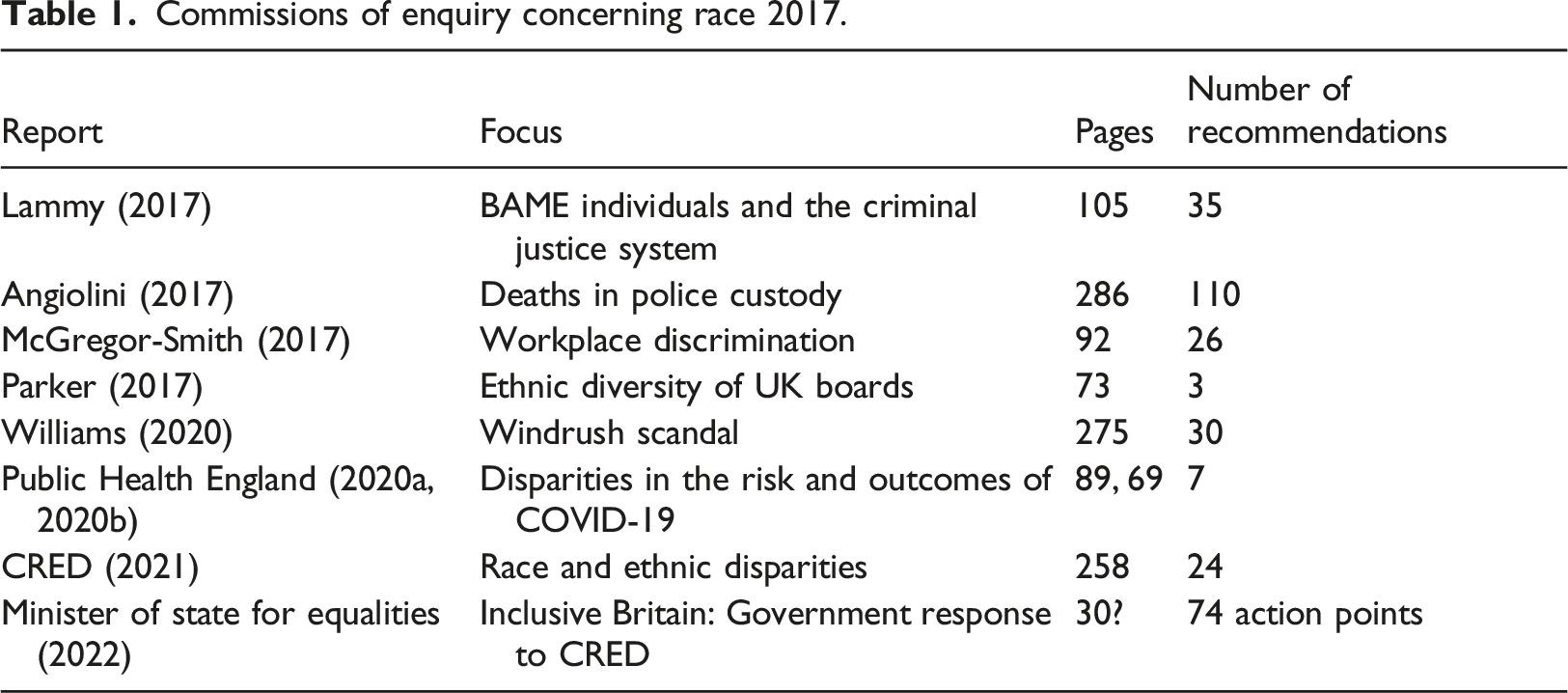
The effects of government commissions of enquiry on race discrimination turn out to be little more than strategic ploys, one kick away from ‘the long grass’. The disregard by government of the recommendations of reviews, which it has itself set up, is lamentable. The immediate dismantling of the support teams once the report is delivered, rather than continuing staff to monitor implementation, signifies their symbolic status and intended impotence.
Authors of a number of these reports have registered disappointment or anger at the lack of tangible outcomes from, collectively, over 1200 pages, over 300 recommendations and involvement of hundreds of stakeholders. Add the Marmot Review, 2010, Fair Society, Health Lives (Marmot, 2010) and the Timpson Review of School Exclusions (DfE, 2019) and this amounts to a mammoth output which has achieved and is achieving little. As an example, the Lammy report of 2017 states that ‘The BAME proportion of young people reoffending rose from 11% year ending March 2006 to 19% year ending March 2016 [and] the proportion of youth prisoners has risen from 25% to 41% in the decade 2006–2016' (Lammy 2017: 4). Little has changed from a similar report 10 years earlier, where it was stated, ‘Black people constitute 2.7% of the population aged 10–17, but represent 8.5% of those of that age group arrested in England and Wales … more likely to be stopped and searched, less likely to be given unconditional bail … more likely to be remanded in custody … likely to receive more punitive sentences than young white people’ (House of Commons, 2007: 5)
The National Police Chiefs’ Council has published a Police Race Action Plan (College of Policing, 2022) which states in the Foreword, ‘We accept that policing still contains racism, discrimination and bias. We are ashamed of those truths, we apologise for them and we are determined to change them’ (p. 3). They have set out an outcome framework, which commits to ‘making sure Black people feel Not under-protected, Not over-policed, Involved, Represented’ (p. 10). As indicated above, the track record for bringing about stated changes for identifiable groups in the criminal justice system is not good.
In the mix, one might include The forgotten: how White working-class pupils have been let down, and how to change it (House of Commons, 2021) which contentiously pushes back against the ethnic inequalities movement. Its 41 paragraphs of conclusions and recommendations convey the notion that the White poor have been overlooked and that ‘White Privilege’ is a misnomer. Indeed, the term ‘White Privilege’ appears 45 times in the report. ‘The MPs’ report muddles the term “white privilege” and arguably stands as part of an implicit campaign to keep people angry at the wrong target’ claiming, ‘disadvantaged White pupils … do not have “White Privilege” in the education system’, and ‘there is an industry which has emerged to support these other groups in a form that isn’t available for disadvantaged White pupils’ (House of Commons, 2021: 16 and 70). There are inequalities of many kinds, multiple causes and varied consequences, all of which should be recognised, analysed and addressed.
The commissionsphere is part of the societal backdrop to changes required of curricula, yet relationships, life chances and the negative impact of racism may persist for further generations if changes in the educational experience are not managed in a sustained, sensitive and engaging way with pupils. Otherwise, all the policy statements, commissions, commitments, charter marks, celebratory events, posters and taking the knee gestures will be ‘performative allyship’ contributions. Commissions serve to hide injustices in plain sight and, in the England context, do not equip recommendations to be implemented and monitored. Speeches in 2020 by the Badenoch, Equalities Minister, and Truss, Minister for Women and Equalities, reported in Miller (2021b) are more public expressions of push-back and present the version of ‘fairness’ of the political right such that it complements the contrived impotence of commission reports.
Embedded narratives of glory and re-shaping the school curriculum
Revisions to the content of history, geography, literature and Personal, Social, Moral and Health Education in schools would be welcome for many reasons, as would styles of teaching to give pupils scope for self-expression and for exploring their maturing understanding of issues.
There is a self-proclaimed myth that Britain is respected across the world for its culture and achievements, for winning world wars, for taking democracy across the world, its record only blotted by slave trading and slave owning. That is some blot and it extends to the whole colonial and imperial manner, which was predicated on exploitation and the extraction of wealth from overseas ‘possessions’. Extending a list begun by Gus John, one would have to ask when, and by whom, was Britain respected across the world: by those who lived with consequences of the scramble for Africa; those still impacted by the splintering of India; Palestinians before and since 1947; the Mau Mau in Kenya and the people of Rhodesia/Zimbabwe; the people of South Africa betrayed by British sanction-busting and support for apartheid? by the people of the Caribbean whom Britain left to their fate when it suited them economically, further abandoned when GB joined the European Communities in 1972 without any guarantees of trade, economic development and technical aid; by those pressing for reparations of ‘stolen’ artefacts and reparatory justice; by colonial military personnel who fought for Great Britain in two World Wars, then subjected to the racism that earlier generations had endured on plantations and the racialisation of immigration after the Second World War?
More recent experiences again question what gratitude is due: from the Windrush generation and descendants subjected to the ‘hostile environment’; relatives of residents who died in the Grenfell Towers fire in London, England in 2017; countries losing qualified doctors, nurses and teachers to service the UK healthcare and education systems; those in factories, farms and mines on subsistence wages in the poorer countries of Africa and Asia?
The depth, longevity and conviction about White superiority need to be recognised. Ince quotes from Adam Smith’s 1776 Wealth of Nations of colonialism enabling the colonisers to ‘relieve one another’s wants, increase one another’s enjoyments, and encourage … industry [and that] their general tendency would seem to be beneficial. To the natives, however, both of the East and West Indies, all the commercial benefits which can have resulted … have been sunk and lost in the dreadful misfortunes which they have occasioned’ (Ince, 2018: 1). In addressing the ‘rematerializing’ of the relationship between liberalism and empire he writes of how ‘the British matched and eventually surpassed their European rivals in their capacity and readiness for imperial warfare, conquest and brutality [but] believed themselves to be … a Protestant, commercial, maritime and “free” people’ (Ince, 2018: 4/5). It is precisely the dressing up of colonial capitalism by the metropolitan elite which renders invisible or acceptable ‘expropriation’, ‘exploitation’ and ‘despotism’ generally (ibid, 21), and ‘commercial barbarism particularly in India’ (ibid, 73). We overlook how ‘settler capitalism in British “neo-Europes” ... invariably entailed the extirpation or drastic marginalization of indigenous populations (as in America and Australia)’ (ibid, 159) substituting largely triumphalist narratives and preserving the self-image of a cherished liberal patrimony of Anglophone imperialism. Thus were the ideological tensions between liberalism and colonialism managed – and continue into modern day. Decolonising the curriculum is not to impose a load of guilt on young learners but, at the very least, about raising awareness of historical events and a de-mythologising, demystifying even, of both Britain’s colonial history and its continuing extraction of benefit from countries of Africa and Asia. Decolonising must be more than removal of material which portrays people of colour as inferior and more than finding examples of Black explorers, scientists or writers.
Fundamental British Values (DfE, 2014) need to be removed from the curriculum. The five Fundamental British values – Democracy, Rule of law, Individual liberty, Mutual respect, and Tolerance of others – are not especially British, now or in the past, and are just some of the values that we wish to promote in young people. The NEU’s Antiracism Charter sets out a better set of values which are less pompous and vague and which specifically support anti-racist education: Equity; Justice; Inclusion; Voice; Respect; Wellbeing (NEU, 2021).
Even adding this up can be performative positioning without change being brought about where it matters: with experiences, life chances and particularly the political and economic structures within which we all live, work and prosper (or not).
British history which touches on the involvement of those we so easily refer to as ‘ethnic minorities’ is not so much ‘a forgotten history’ (Olusoga, 2016) but one which has been ‘managed’ over the years with events recounted selectively, staunch bias towards Britain’s rectitude and intentional dismissal of the viewpoints and experiences of those who were subject to imperial rule.
There is much to be done on de-mythologising generally held views of Britain’s history and challenging, or at least raising debate about, convictions embedded in a postcolonial melancholia (Gilroy, 2004). We may wish to value cultures and histories from around the world, but, as Gorski noted, despite overwhelmingly good intentions, most of what passes for intercultural education practice accentuates rather than undermines existing social and political hierarchies. He asks, ‘Do we advocate and practice intercultural education so long as it does not disturb the existing socio-political order … does not require us to problematize our own privilege?’ (Gorski 2008: 516). He insists that, along with decolonised multicultural education, there is, first and foremost, social reconstruction for equity and justice and without this we render ourselves complicit in existing inequity and injustice.
We are in a neoliberal age, which is competitive, individualised and intentionally unequal. We have economies that function on inequalities whether within national boundaries or in trade with other countries. With a history of domination and exploitation, rendered legitimate by a contrived world view justifying inequality, caricatured maybe as– ‘we ruled the world, sun never set on our empire, we were the best militarily, intellectually and morally’. Indeed, Gorski points to the ploy of ‘pathologiz[ing] oppressed communities [which] justified imperial pursuits’ (Gorski, 2008: 518). Success at this pathologising leads easily to justification for ‘the deterioration of support for public policy meant to alleviate political and economic marginalisation [and] the erosion of welfare programs’. Imperialist resonances are strong and colour-coded. Lowe has concluded from her study of historical archives that neoliberalism’s racist tendencies stem from former imperialist and colonialist histories of gaining power and expansion within the establishment of systems of racial exploitation on a global scale (Lowe, 2015). Endemic racism and structural inequality are inherent. Goldberg refers to ‘born again racism’, which is ‘racism without race, racism gone private, racism without the categories to name it as such. It is racism shorn of the charge, a racism that cannot be named because nothing abounds with which to name it. It is a racism purged of historical roots, of its groundedness, a racism whose history is lost’ (Goldberg, 2009: 23).
Therefore, discrimination and the tolerance of inequality can be attributed to character or effort with no connection with colour or ethnicity – and certainly not to imperial adventures long ago
It is difficult to conceive of a decolonised curriculum where, every December, prestigious Jesus College, Cambridge, hosts the Rustat Feast, where the assembled diners raise a glass to Tobias Rustat, whose generosity three centuries ago allowed generations of orphans to go to Cambridge and be ordained as Church of England clergymen. In November 2020, Rustat’s name was quietly removed – and presumably the toast to his memory did not occur (Moore, 2022). Tobias Rustat, a courtier to King Charles II, was a big investor in the Royal African Company, which ‘trafficked more African men, women and children to the Americas than any other British institution. … in the half-century after it was founded in 1672, it shipped close to 150,000 enslaved Africans, mostly to the Caribbean’ (The Economist, 2021). Later objections prevented the removal of the Rustat memorial from within the Jesus College chapel. Richard Drax, MP, inherited Drax Hall Plantation on Barbados on the death of his father in 2017. It is worth £150m, a 250 acre site where enslaved Africans were forced to work from 1640–1836 (Lashmar and Smith, 2020).
Prime minister William Gladstone’s father received the largest compensation payment, a sum equivalent at today’s prices to £80m, for ‘freeing’ his slaves, following the Slavery Abolition Act (1833), which came into force in 1834. In the years following 1834, there were 47,000 recipients of the £17bn (by today’s reckoning). There are resonances through to the modern day, and if any degree of moral judgement is applied, it raises a set of questions relevant to decolonising the school curriculum. These range from reappraisal of a number of British heroes and historical events to the impact of the wealth derived from colonialism, imperialism and slavery that are visible in buildings, infrastructure in our towns and cities and the enduring wealth of identifiable families, such as those of Drax and Cameron. There are matters of blame, responsibility and regret, and some countries have taken that step, leading to consideration of repatriation of artefacts and reparations. For this last, Germany stands out as probably unique in allocating large sums to a country affected by its brutal rule more than 100 years ago. Then there are matters of how we view the peoples of those countries and how we establish an equality of worth in the minds of learners.
A contemporary, institutional local example of racism is the stopping by police on a Saturday afternoon of two UK athletes with their baby in the back of their car and the protesting mother handcuffed, which she said left her ‘feeling like being black is a crime’ (Siddique, 2020). Two years later this case was still going through the Police Complaints procedure. Wendy Williams’ report on Windrush Lessons Learned states, ‘Members of the Windrush generation and their children have been poorly served by this country. They had every right to be here and should never have been caught in the immigration net. The many stories of injustice and hardship are heartbreaking, with jobs lost, lives uprooted and untold damage done to so many individuals and families … the Home Office must acknowledge the wrong which has been done; … and … change its culture to recognise that migration and wider Home Office policy is about people and, whatever its objective, should be rooted in humanity’ (Williams, 2020, 7).
Her progress update (Williams, 2022) is a mixture of restraint and disappointment. A suppressed report commissioned by the Home Office reportedly refers to ’30 years of racist legislation’, ‘deep-rooted racism of the Windrush scandal’, more broadly claiming that, ‘the British empire depended on racist ideology in order to function’ (Gentleman, 2022). Both the suppression of the report and the reasonable conclusion that imperial racist ideology persists widely, in individuals and institutions, underscores the magnitude of the challenge and the resistance to addressing it openly and honestly.
It is worth comparing the response of UK citizens to the plight of Ukrainians fleeing their war-torn country with the response to Afghans, Somalis and other refugees from Africa and whether there are colour-coded aspects to the generosity expressed and hospitality offered.
Conclusion
This paper has sought to recalibrate and broaden our thinking about racism in education and how it must be addressed on a broad, ecological front. In England we are some way short of this and still settling for self-congratulatory performative responses when, particularly at the highest levels, we are not actively disguising the flimsiness of our reform efforts. It is good to finish with examples of young people taking a stand – and therein lies hope! A heartening phenomenon is the admirable success of campaigning led by young people, their commitment to understanding the issues and to do something about them. Matilda Marcus, still a school student and part of the Advocacy Academy in South London (a social justice youth movement), writes of how the ‘school system has avoided teaching a defining feature of Britain’s history from the past 300 years … British colonies’ (Marcus, 2020). Marcus Rashford, (24) has engaged in influencing government policy on the provision of school meals (Butler, 2021); another footballer, Trent Alexander-Arnold (23) is pitching in with Football for Change, campaigning against child poverty. Greta Thunberg is known worldwide for her climate change campaigning. Sheldon Allen, a sixth former at a south London academy, started a petition to hold the head teacher accountable for ‘off payroll payments totalling £145,000’ out of the school budget into a company of which he was CEO (Fraser, 2018). The head was sacked.
Most heartening, and specifically on racism and decolonising the curriculum, young people have protested up and down the country: in one Sheffield school, Year 10 and 11 students demonstrated during one lunch-time over a claim that the school had failed to tackle a racist incident (Day, 2020). As uplifting was the school’s senior management response – setting up a specific email address for students to report allegations of discrimination and a curriculum team to re-examine the curriculum for content representing all cultures. This would count as an element of ‘anti-racist school leadership’ (Miller, 2021a); they had clearly listened and students reported feeling that their voice was heard. The ultimate point is that the future belongs to those currently going through education. They have the biggest stake into the future which means, from early on, their voices should be heard, indeed enabled, to address issues from racism, climate change, child and family poverty in an era of increasing inequality and social injustice and ever more ‘fake news’.
So important are these issues that not only should young people in schools and other places of learning be presented with evidence or be guided to find it, but should, at age-appropriate levels, be enabled to develop interrogatory and debating skills to use the information.
We fight symptoms of oppressions rather than the conditions themselves or the forces which create and sustain them. As Male writes sadly about secondary school students of Ghanaian heritage arriving in her school to continue their education, ‘To the extent that “acculturation” appears to be a one-way process, this could be legitimately construed as institutional racism’. (Male, 2021: iii). Assimilation and acculturation remain processes newcomers must accomplish, supporting Andrews’ (2021) thesis, subtitled, ‘How Racism and Colonialism Still Rule the World’. Colonial-influenced attitudes impinge on the present, underplaying the colonial sources of Britain’s prosperity today, imbuing mentalities with conviction that Britons were once great, superior in every way, whilst the dominated were of lesser worth, and their descendants, who do not belong here (as we did not belong there) are inferior. It points to a need to reset the history agenda and for a re-working of what Britain can rightly be proud and re-consideration of who belongs as our society increasingly diversifies.
It is a challenge to get a school curriculum deeply and broadly decolonised. Placing the school within an ecology of young people’s learning emphasises the challenge. Mamdami, with his title Neither Settler nor Native, proposes that we ‘understand colonization as the making of permanent minorities and their maintenance through the politicization of identity, which leads to political violence …. Decolonization…. is the unmaking of the permanence of these identities’ (Mamdani, 2020: 18). That is the challenge – cognitively and emotionally. That challenge is the greater when a government commission report denies the significance of structural racial and ethnic inequalities stating. ‘Put simply, we no longer see a Britain where the system is deliberately rigged against ethnic minorities. The impediments and disparities do exist, they are varied, and ironically very few of them are directly to do with racism’. (CRED, 2021:8), reiterated in the Foreword to the government’s response (Race Disparity Unit, 2022). Add to this the view of the ‘common sense’ group of Conservative MPs, that Critical Race Theory had ‘no place in schools’ (Williamson, 2022) and the barriers at the top are clear. A response for educators, operating in their realms of influence, is to ‘proclaim our advocacy of the need to decolonise and provoke into reflecting and thinking about their feelings, views and experiences on decolonizing curriculum’s (plural) in education, thereby producing more equity in education and society’ (Race et al., 2022:2).
George Floyd’s murder has reverberated globally. Symbols are important and not to be too readily dismissed as showy, emotional and performative, but the roots of our racism go deep and expectations for meaningful reduced racism may not be met unless actions and policies are not also deep and sustained. Decolonisation of the curriculum may be too shallow as conceived and may not endure beyond the hyperbolic, mass action triggered by a single horrific and tragic event in another country. From the ‘commissionsphere’ output to reconstructed classroom materials and practice there is a danger of it amounting to no more than a performative sham. Whilst looking institutionally at the experience of learners, educators should raise their gaze more and exercise social justice leadership requiring ‘triple activism’ – regulatory, pedagogical and emancipatory (Miller, 2022: 2).
Footnotes
Declaration of conflicting interests
The author(s) declared no potential conflicts of interest with respect to the research, authorship, and/or publication of this article.
Funding
The author(s) received no financial support for the research, authorship, and/or publication of this article.
