




Abstract
Higher education (HE) in the UK continues to prioritise equality (or equity), diversity and inclusion (EDI), but stark inequalities still exist, and non-inclusive cultures persist. We have created the Equality Pledge (EP) scheme which empowers HE staff to contribute to positive culture change by making a personal pledge to improve some aspect of EDI in their working lives. We encouraged staff to each set a manageable pledge, either individually or as a team, so as not to increase already high workloads. Staff recorded their pledges on an online form, and six-monthly updates were requested to capture impact, progress and feedback on the initiative. We recorded over 260 pledges from staff in the Faculty, aiming to tackle issues around teaching and learning, working practices, self-development, admissions, marketing and other issues. Over 100 staff have now recorded progress updates, which reveal significant impact. The EPs have also led to a significant increase in dialogue around EDI and, we believe, the beginning of a positive shift in culture. Within our own university, other faculties are now beginning to roll-out the EP. This initiative has relevance across HE and other sectors. It is a practical intervention to facilitate positive culture change.
Introduction
In recent years, equality (or equity), diversity and inclusion (EDI) have risen up the agenda in UK higher education (HE) institutions. Various charters including Athena Swan and the Race Equality Charter (REC) have evolved to provide some recognition of the work that HE institutions (HEIs) have done to evaluate their workforce and student bodies, to address any inequalities they find and to promote sustainable cultural and structural change (AdvanceHE, 2022a, 2022b). These charters have certainly increased awareness of inequalities in HE, but it is clear that deeper culture change is needed. Furthermore, EDI related activities are often tackled by small groups of individuals within HEIs, those who are most passionate about, or personally impacted by, these issues (Rosser et al., 2019; Tzanakou and Pearce, 2019). This means that many working and studying in HEIs in the UK will have no direct involvement with any EDI activity. The Equality Pledges (EP) scheme was created with the aim of involving as many people as possible in bringing about positive culture change.
Inequalities in UK higher education institutions
Despite the best efforts of individuals and organisations, many inequalities exist still in UK HEIs, some of which we discuss here.
It is clear that gender still impacts career progression and pay in academia and that women are under-represented at the top levels of university management. Whilst the number of female and male academic staff working in UK universities is fairly even when we consider all levels of seniority (46% female, 52% male), the proportion of female staff at higher levels is much lower, with only 29% of professors being female in 2020–2021 (HESA, 2022b). This trend is seen outside the UK too, as only around a quarter of professors in the EU were women in 2019 (Rosa and Clavero, 2022). In stark contrast to female senior academic staff who are in the minority, in 2020–2021, 57% of students in UK HE were female (HESA, 2022a). There are a number of possible barriers to women aiming for the top jobs in academia, but a significant factor appears to be that women do not apply for promotion at the same rate as men, partly due to being less confident about their eligibility and being more likely to work part time. Women also appear to be disadvantaged by their higher teaching loads (Santos and Dang Van Phu, 2019), unconscious bias (Stewart-Brown, 2020) and the structure of the university system itself (Cooper, 2019).
The recent COVID-19 pandemic appears to be a step backwards for advancing women’s careers in academia. School and childcare facility closures have largely impacted women the most, as they are more likely to take on caring responsibilities. In addition, cancellation of career development events and training is likely to have impacted women striving to progress their careers (Gewin, 2020). Women with childcare responsibilities were reported as spending more time on caregiving and less time on academic work during the pandemic, resulting in a negative impact on their research productivity, publications and other academic achievements (Kasymova et al., 2021). Of course these metrics are often recognised by promotions processes, making it likely that we will continue to see a slowing of career progression for women in HE as a result of the pandemic.
Inequalities due to racial differences persist in HE. Black and minority ethnic (BME) staff and students still experience racism at university. BME students are less likely to achieve high grades than White students, potentially due to teaching practices, the White supremacist history of HE (that, to some extent, continues), micro-aggressions, racism and the attitudes and expectations of teachers (Mahmud and Gagnon, 2020; Wong et al., 2021). Furthermore, BME academics, especially Black academics, are significantly less likely to be professors than their White colleagues (Bhopal and Pitkin, 2020).
The Athena Swan and REC initiatives have resulted in a tendency for HE organisations to focus on gender and race over other protected characteristics and have potentially created an environment where certain inequalities are prioritised over others (Bhopal and Henderson, 2021). Whilst addressing these inequalities is certainly positive, it may have caused us to neglect other equally important groups. The culture of our HE environments is vital when considering students and staff who may need additional support, for example, those with disabilities. This includes those with ‘invisible’ disabilities, such as learning difficulties or mental health problems. Changes in lecturers’ awareness and teaching practices can significantly improve student inclusion (Svendby, 2020). Findings also indicate that supportive and accepting environments make individuals more likely to disclose their dyslexia, increasing the chance they will receive adequate support (Evans, 2014).
For lesbian, gay, bisexual, trans and sexually/gender diverse (LGBTQ+) individuals in academia, added pressures, discrimination and peers’ lack of knowledge about LGBT + issues still exist (Smith et al., 2022). The decision to ‘come out’ at work and disclose their identity can be incredibly difficult and stressful to take, and for those that do, there is the high probability of tokenism, where they are expected to represent the LGBTQ + community in various ways (Prock et al., 2019). In fact it is the heteronormative environment of HE that means people need to ‘come out’ in the first place, and the need for some to compartmentalise their personal lives and maybe even change the way they act at work can be exhausting (Boustani and Taylor, 2020).
Issues affecting academics inevitably also impact on their students, who look for role models and mentors to guide their career progression. Around 8% of students studying in UK HE are Black, compared to only 2% of all academic staff (HESA, 2022a, HESA, 2022b). The fact that Black students see so few Black members of staff no doubt influences their experience of university and their likelihood of remaining in academia after they graduate (Coelho et al., 2022; Mahmud and Gagnon, 2020). Likewise, when considering disability, around 15% of UK students have a known disability, compared to only 5% of academic staff (AdvanceHE, 2022a; HESA, 2022a, HESA, 2022b). We must consider the need, for example, for deaf students to have deaf role models, or wheelchair users to see people like themselves amongst their teachers and peers (Wolbring and Lillywhite, 2021).
Awareness of EDI is essential for education staff and enables them to review and develop the curriculum, learning environment and teaching practices to reflect the diversity of society, the local community and the student cohort. This may require significant changes to teaching approaches, content and resources to ensure that they are inclusive, culturally responsive and encourage learning and reflection on EDI issues. Teachers also need to consider their own biases and the messages they, or their institution, may be communicating through the hidden curriculum (Mbaki et al., 2021).
The intersection of any number of characteristics can create further inequality in an academic education or career. The Women’s Higher Education Network has launched a campaign, ‘100 Black Women Professors Now’ in the UK, highlighting how dramatically the diversity of the academic career pipeline reduces when we look at the overlap of protected characteristics (WHEN, 2022). Rather than further marginalise individuals with overlapping characteristics, we must value individual experiences, listen to personal narratives and carry out much more in-depth research to understand the struggles and barriers faced by our colleagues and students (Kachchaf et al., 2015; Scharrón-Del Río, 2020).
Here, we have presented an overview of some of the inequalities experienced by those working and studying in HE. This is not close to a complete list of the issues that remain and that we must aim to resolve. We next consider how we can bring about positive culture change to create a more inclusive and equal environment.
Promoting cultural change
The focus of the initiative we present in this paper was to bring about some degree of cultural change, and to begin to tackle some of the inequalities discussed above. Initiatives and charters like Athena Swan, REC, the LGBT Charter, Two Ticks disability scheme, Disability Confident scheme and the Stonewall Diversity Champions Programme have gone some way to encouraging HEIs and other organisations to tackle inequalities. Whilst these initiatives can certainly increase awareness of EDI issues and identify specific areas to focus on for each department or institution, there is not a consensus that they are always transformative. Charters like REC and Athena Swan have been criticised for creating a focus on box-ticking and ‘performative doing’ (O’Mullane, 2021), rather than necessarily leading to deep, cultural change. Even when positive interventions are implemented, the culture of an organisation can perpetuate inequalities (O’Connor, 2020). Counting ‘women’ as a single homogenous group in Athena Swan applications risks missing nuance, intersectionality and personal narratives (Tzanakou and Pearce, 2019). This is also the case when setting actions measured only by numerical outcomes. Recently however, Advance HE have reviewed the Athena Swan charter, requiring more focus on intersectionality and qualitative data (AdvanceHE, 2022a), which it is hoped will help with this issue.
There is a considerable staff workload associated with applying to and delivering actions for these charters, with studies showing that women and other disadvantaged groups are often disproportionally burdened by this work (Rosser et al., 2019; Tzanakou and Pearce, 2019). Evidence suggests that the universities who have achieved REC awards were already leading on reducing the awarding gap between BME and White students, with the charter acting to enhance and legitimise existing activity, rather than bringing about significant progress in race equality. In addition, a relatively low number (17 in 2021) of British universities hold a REC award (Campion and Clark, 2022). Whilst this is not necessarily negative, it might mean that REC has limited impact on those institutions that are not already reducing racial inequality. For both charters, concern has also been raised as to whether those leading the processes have the required expertise, are given training and receive recognition and reward for this work (Henderson and Bhopal, 2021), including recognition in promotions processes.
There are still stark inequalities in the HE sector which equality charters and other work are aiming to remove, but there is much still to do. Our belief was that whilst EDI work was carried out only by small, self-selected groups of staff, true culture change involving the wider organisation and its members, would be hard to attain. Our aim in developing the EP scheme was to enhance existing work around Athena Swan, REC and other EDI activity, whilst simultaneously attempting to engage many more staff in EDI work and culture change.
Equality pledges
Rationale and conception
In our Faculty (a health faculty in a UK university), we are very active in the EDI sphere and have several groups working on different components such as clarifying and improving academic staff promotions, supporting professional services staff with career progression and supporting researchers. A single Faculty group also exists to oversee and coordinate all EDI activity. As a result of feedback from an Athena Swan application, we began discussions on what more we could do to make the culture across our Faculty more inclusive, for both staff and students. We felt the key step was to increase engagement from staff not already involved in EDI. We also knew that culture change could come about through many small steps, gradually accumulating into a tangible result. The EP originated as an idea from one of the authors (HN). This was picked up by others involved in Athena Swan (led by HRW and implemented by HW, CM and NM) and developed into an effective, workable and widely promoted system which was designed to enable monitoring and evaluation. It subsequently became central to all of our Faculty’s EDI activity.
How EP works
We invited all staff in our Faculty (consisting of six schools) to set a personal pledge to improve EDI in some aspect of their day-to-day role. Aware of high staff workloads, we emphasised that pledges should be manageable, realistic and could be small tasks. We included the option for staff to set pledges as teams. Although EP emerged from our gender equality work, we decided to encourage staff to set pledges relating to any protected characteristic or marginalised group (or more than one), reflecting an issue they thought was a priority in their own work. Staff pledges could be aimed at students, other staff or both. EP was approved by the Faculty Executive Group, where it was agreed that line managers should discuss their staffs’ pledges during the annual performance and development review (PDR).
During the design stage of the project, we recognised that a large volume of data could be generated as a result of staff pledges which could quickly become difficult to manage. Additionally, staff taking part would have time constraints, and so making their involvement as simple and efficient as possible would be a key driver towards the success of the project. To meet these requirements, an integrated Office 365 (O365) solution was implemented, combining functionality of Forms (Microsoft, 2022b), Power Automate (Microsoft, 2022d), Teams (Microsoft, 2022) and Excel (Microsoft, 2022a).
When launching the project, we contacted all staff with some background information about EP and a link to the online form where they could record their pledge. This data then fed into a secure spreadsheet, stored in a MS Team and accessible only to the EP organising team. The process was automated to ensure that every six months following their initial pledge, staff would be emailed with a request to update their form with any progress or changes to their pledge, including any evidence of impact. By automating this process, the EP organising team could focus on output instead of contacting staff to request pledge updates and impact assessments. Once staff deemed their pledge to be complete, they could also mark their pledge as such when submitting an update. They could then start the process again and re-pledge if they identified another opportunity to do so, thus encouraging staff to continue their EP journey.
We have continued to promote the EP widely, asking line managers to raise it with their staff at PDR meetings, reminding staff to fill in their online forms and sharing good practice and impact from staff pledges.
Prior to preparing this manuscript, the authors discussed the project with the Faculty Ethics Committee who agreed that as this was a service evaluation, no ethical approval was needed. No direct quotes from pledges are included, and all pledge data has been anonymised.
Outcomes and discussion
Since first announcing EP in summer 2020, 262 staff have set pledges, representing 33% of all staff in the Faculty (both academic and professional services staff). Our total staff number includes a significant group of healthcare professionals who spend only a small amount of time teaching our students, many of whom have not yet engaged with EP as they are not present in the Faculty very regularly (some healthcare professionals have set pledges however). Therefore, the proportion of staff working with us regularly on a daily or weekly basis who have engaged with EP is higher than the third quoted here. Staff have remarked that the six-monthly reminders to update their pledges have been useful and have helped them to prioritise work on their pledges when it was required. The initial uptake of the scheme was low, and feedback indicated that staff did not fully understand the aim of EP and were concerned at having extra work to do. We carried out a promotion campaign, including giving staff examples of pledges that others had set. We found this helped staff to understand what was required. We also provided line managers with information so they could discuss pledges with their staff. Many staff still have not yet engaged with the scheme, and we are now using successful, completed pledges to demonstrate how impact can be made with relatively little work in many cases. We hope this will increase engagement as we continue with the scheme. Approximately 40% of staff who have set pledges (over 100 staff members) have provided updates on their progress, some more than once. We hope that more updates will emerge as we continue with the scheme, and again we are using examples of completed pledges to promote the scheme and the need for staff to update us with their progress. Some staff have fed back to us that they could not complete their pledges as they have come across barriers to their initial idea, for example, change in role or structures, and have instead set a new pledge. A few other individuals have also set new pledges, having completed their first one.
Data from completed forms and updates has provided us with important information about the pledges made and issues being tackled, the scale of each pledge, whether staff are working alone on their pledge or as part of a team and which pledges have been successful.
Pledge themes
The pledges made were diverse, with a range of protected characteristics being represented. We have grouped pledges into themes. As many of the pledges did not focus on just one specific protected characteristic, we chose to classify the pledges by type of activity (Figure 1) rather than protected characteristic. One exception to this was the theme labelled ‘decolonisation’ which classifies pledges specifically related to decolonisation of the curriculum. We identified these specifically because decolonisation of the curriculum is a current strand of work being carried out at Faculty and University level, and by highlighting these pledges we could facilitate and raise awareness of this work. Some of the themes relate to pledges that aim to improve student experience (e.g. around teaching and learning), whereas others are more staff orientated (e.g. working practices). Number of pledges in each theme are shown. The numbers on the x axis indicate how many pledges have been set in each theme. Some pledges have been allocated to more than one theme.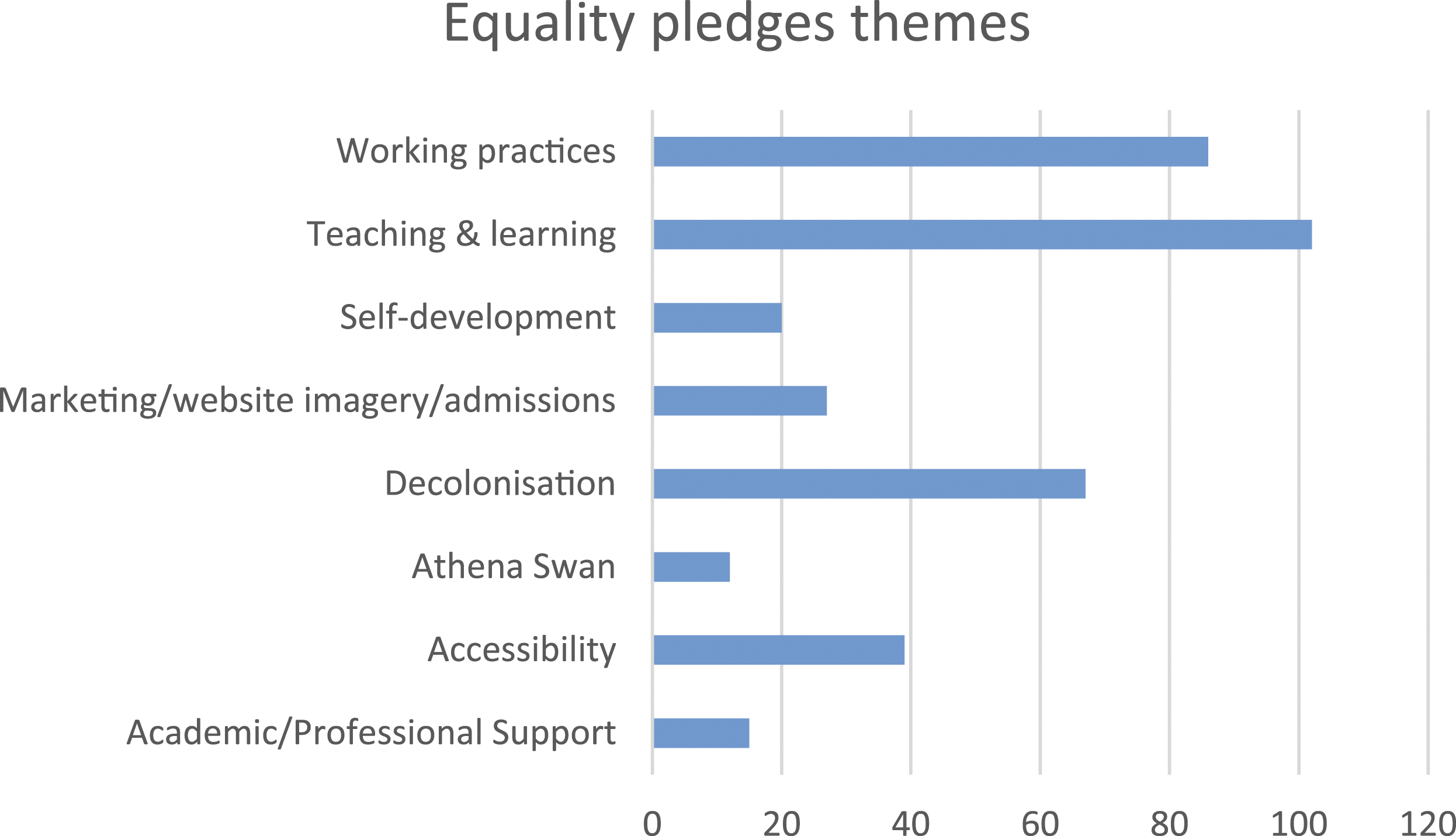
Some staff chose to set more than one action within their pledges, to tackle an aspect of inequality from more than one angle. For example, one colleague pledged to both diversify their lecture materials (by including scholars from under-represented backgrounds and evidence from diverse perspectives) and also to mentor and support postgraduate students from under-represented backgrounds. Through these two actions, the member of staff could address the issue of under-representation of certain groups in their subject.
Many of the pledges were related to teaching and learning activity, which was unsurprising given the high number of our staff who teach and work with students on a day-to-day basis. These included pledges aiming to diversify teaching materials, improve career development for students and doing more to help students understand unconscious bias. Working practices was also a popular theme, with pledges in that area aiming to improve the working culture for staff by addressing a large range of issues including how and when meetings are held to ensure those with caring responsibilities can attend, and improving communications within and between teams. Some senior staff pledged to improve how we embed EDI into processes at School and Faculty level, for example how we discuss EDI issues at regular committee meetings. Pledges that we classified in the decolonisation theme were largely teaching and learning related, looking at how we can better represent various ethnic groups in the teaching and resources that we provide. Staff aiming to improve accessibility were, again, often looking at this from the student viewpoint, to ensure that teaching activities and materials were accessible to all and by providing and signposting support for students with specific needs. Some staff set pledges to improve our outward-facing image in terms of EDI, looking at our websites, marketing material and admissions processes to ensure that the images and content are diverse, as well as the admissions processes being accessible to all. In our Faculty, this is especially important in programmes where we have a large gender imbalance amongst our students, for example, nursing, which attracts few male applicants. Issues related to staff development generally fell into two themes, with some individuals pledging to undertake courses and other development themselves (self-development) and others aiming to support others’ careers by mentoring or providing career development opportunities to other staff members (academic/professional support). Finally, some pledges specifically related to Athena Swan activities, generally set by those closely involved in preparing the current application at the time, as well as delivering on the previous action plan.
Examples of pledges and impact
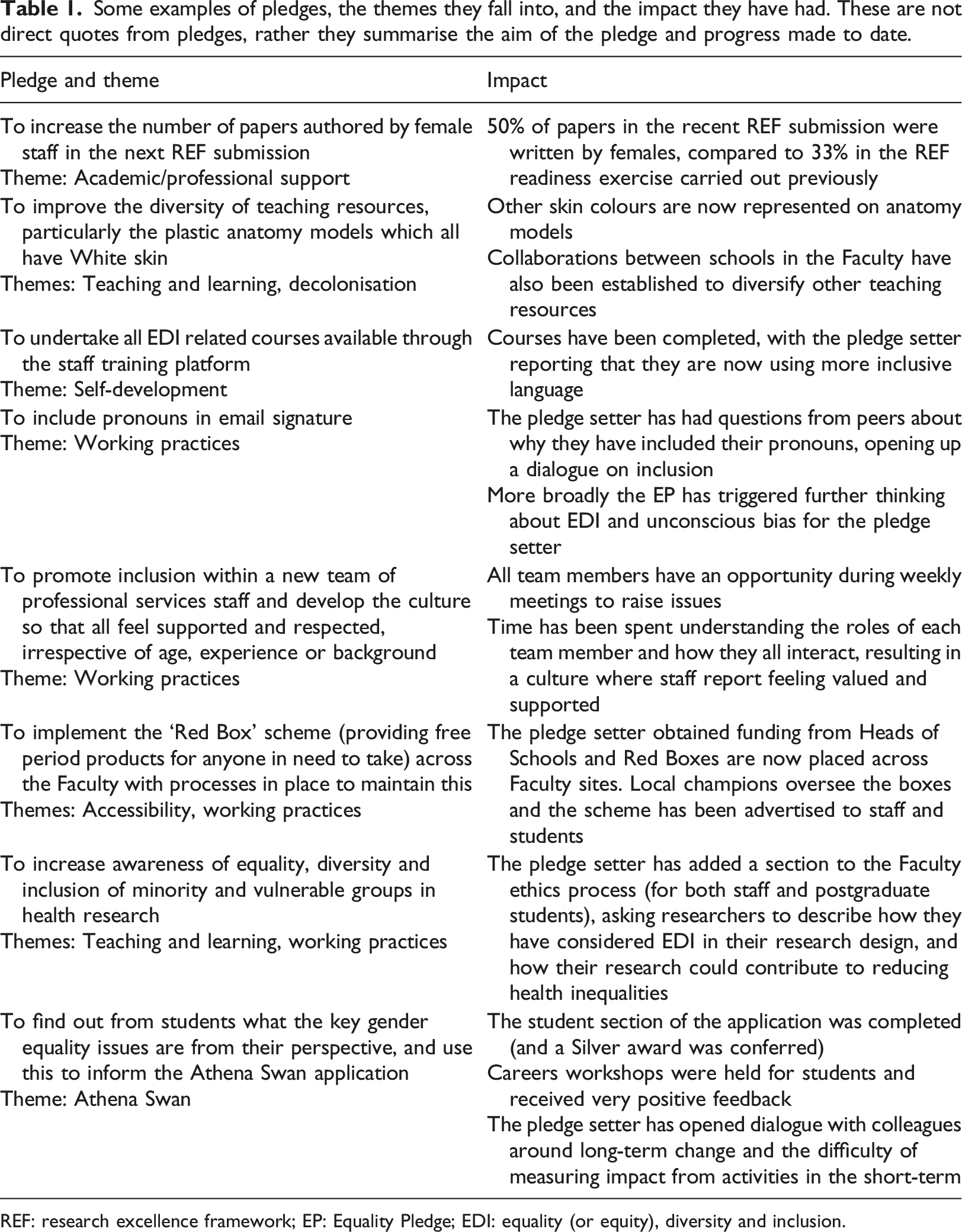
Some examples of pledges, the themes they fall into, and the impact they have had. These are not direct quotes from pledges, rather they summarise the aim of the pledge and progress made to date.
REF: research excellence framework; EP: Equality Pledge; EDI: equality (or equity), diversity and inclusion.
EP: The impact so far
From the example pledges shown in Table 1, and many others not included here, it is clear that EP is creating tangible change, and the varied nature of the pledges means they are beginning to have impact across several areas of activity within the Faculty, on both students and staff. Individual pledges are often small, yet even some of these small changes have already led to larger improvements across the Faculty and to external collaborations. Importantly, the pledges address the needs of a range of under-represented or disadvantaged groups and aim to tackle many of the issues highlighted in the EDI literature, including career progression, discrimination and unconscious bias, a lack of inclusive teaching practices and diversity in teaching resources.
A logical question to ask of the scheme is whether the pledges set by staff actually address the EDI issues and challenges that matter most in our Faculty. Work done by Athena Swan groups in the Faculty, drawing particularly on staff surveys, staff numbers over time and external guidance, has identified career support for researchers (especially early career researchers), professorial promotion for female staff, career progression routes for professional services staff and various gender imbalances in student numbers (e.g. low proportions of men in nursing and dental therapy and hygiene programmes) as strategic priorities. In addition to these gender related actions, we are also prioritising decolonisation of the curriculum, cross-school working and promotion and further uptake of the EP.
These areas have certainly been noticed by staff and are beginning to be tackled through the pledges. For example, staff in the Dental School and the School of Biomedical Sciences have pledged to work towards increasing male applications for dental therapy and hygiene and nutrition courses, both of which are female dominated at present. Several senior staff have pledged to mentor and support more junior female colleagues, in order to help them get their work published and ultimately apply for promotion. Others have pledged to support early career researchers by ensuring that developmental opportunities are promoted and accessible for all those who would benefit. Several staff working in professional services teams have made pledges around staff training and development, taking proactive steps to ring-fence time for colleagues to attend training and also ensuring funding opportunities are well advertised so staff can fund external training where required. Discussions of pledges across schools have also enabled cross-school working in EDI related matters, for example, the work emerging from the pledge to increase the diversity of teaching resources (as detailed in Table 1). This particular pledge has had an impact across schools, and the staff involved are currently collaborating to further improve the diversity of the resources we use in our teaching. Decolonisation of the curriculum is a huge and complex area, and even equality-focussed staff have struggled to conceptualise exactly what it means for our Schools and programmes. Rather than set staff the challenge of decolonising all of their teaching in one go, EP offers a more step-by-step approach, encouraging staff to think about achievable goals that will help us work towards these larger targets. For example, EP has offered individuals the chance to reflect on their own reading lists, teaching materials and other aspects of their teaching, and set their own actions to begin to address this complex topic. EP is supporting a bottom-up approach to tackling large and challenging EDI priorities in a practical way. It is beginning to address real needs in our Faculty by allowing all members of staff to work on what they think their key EDI challenges are. It appears that our staff are well aware of where improvements need to be made, and the EP has enabled many colleagues to make these positive changes. Having senior buy-in to the scheme has also been important to its success. Our Faculty Executive Group approved implementation of EP, and were instrumental in bringing it onto the PDR agenda for all staff. Senior staff including some Heads of Schools and the Dean have been very visible role models in sharing their own pledges and promoting the scheme amongst staff.
Another important outcome is that, rather than EDI priorities only being decided by small, focused staff teams such as the Athena Swan groups, individual staff and teams are now identifying what they themselves see as the key EDI issues in their work. Whilst it is important that we have champions and leaders for EDI in HE, the bottom-up approach of EP allows all staff at all levels to engage with the EDI issues that are relevant to them and their colleagues, students and other stakeholders. EP also allows the transition of EDI from a huge and complex concept, to something more tangible with measurable, operational, outputs.
EP: A mechanism for culture change?
Research suggests that an evidence-based, strategic approach combined with an accumulation of single actions works to bring about positive culture change (Ali et al., 2012). In addition, whilst external policies and guidance can be useful for universities attempting to improve equality, what is also important is that change comes from the bottom up, and that those involved in the workings of the institution are involved in taking action for positive change (Scott, 2020). Charters like REC and Athena Swan are hugely important in helping organisations open and maintain dialogue related to EDI, raise awareness of the inequalities that remain in HE and also to provide frameworks for thorough self-assessments. These charters also require action plan setting and identification of priorities, so can help institutions decide what to tackle and in what order. However, the work associated with these charters is largely carried out by small groups of staff in HE, and usually those for whom the aim of the charter is of personal interest (Rosser et al., 2019; Tzanakou and Pearce, 2019).
As discussed above, it is reassuring that a number of the pledges set by staff were targeted to address key priorities emerging from Athena Swan and other EDI work in the Faculty. Some of these have provided a new way of tackling them. For example, helping researchers with career development is a key strategic priority for us, but through Athena Swan and other activity, actions around this are largely concerned with training opportunities, line management systems, mentoring and funding. One of the pledges in Table 1 is aimed at looking at how we can improve our own REF application process to increase female representation in our submission. So whilst the overarching priority of researcher development is central to this pledge, the way it is being tackled is something that had not previously been identified by existing EDI activity. Therefore through EP, we are enabling colleagues to identify new ways to tackle existing priorities.
With many of the developmental processes staff encounter (including the PDR), the discussions they have and the goals they set are generally expected to align to the Faculty or University’s core values and priorities. This was not required of staff engaging with the EP. Staff were free to identify what they thought was important to work on. What is interesting and important is that this seems to have led to a significant number of pledges not specifically aligned to any of the Faculty or institutional priorities. Some of these are concerned with smaller, personal tasks, such as adding pronouns to email signatures or attending training or other personal development activities. Whilst these will not immediately solve any of our strategic priorities, perhaps these actions are exactly what we need, to work in synergy with the larger issues that require more senior buy-in and more people to deliver. With countless small changes like this working in concert with larger changes to policy and processes, we are addressing EDI issues from multiple angles. These smaller changes, as touched upon in the examples given, are being discussed in teams and triggering questions and conversations that may well not have arisen without EP. This increased dialogue about equality is a key step in achieving culture change (Simmons-Welburn, 1999).
At the same time, EP has led to changes in policy. EP is now, in a very practical way, part of existing processes and frameworks; for example, EDI is now on the agenda for staff PDRs and is a standing item for discussion on many meeting agendas. These policy changes are also contributing to a more inclusive culture where everyone is encouraged to play a role in positive change.
EP has also had a wider impact, including on students. Our students, hearing about the scheme, asked if they too could contribute pledges. We have since implemented a student EP scheme, which we anticipate will have a wider impact on our students, empowering them to contribute to culture change alongside staff. Other faculties and HE institutions have also expressed an interest in adopting the scheme.
Concluding remarks
What we have presented here is a method of empowering staff working at all levels in HE to contribute to creating a more inclusive culture for staff and students. What appears to make EP so effective is firstly that it focuses on small, tangible and achievable steps which do not add significantly to already high workloads. Secondly we aimed to engage everyone in this initiative, not just those who were already involved with specific EDI groups or activities. This helped identify areas that needed improvement, but also new and different ways to tackle these. Arguably this also resulted in more effective solutions, as staff who are immersed in certain activities on a daily basis are probably best qualified not only to spot issues, but also to resolve them. Finally, and importantly, the implementation of EP opened up countless conversations about EDI in the Faculty. Staff began to discuss EP within their teams and line managers worked with their staff to refine pledges, EDI was literally moved up the agenda at various committee meetings, individuals considered their own behaviours, colleagues thought more about the experiences of others and further actions were set to build on previous pledges. People that were previously unengaged with EDI activity began to talk to each other about it. Therefore EDI has become part of our culture, and the changes that EP has already facilitated have had a significant and lasting impact.
Perhaps what we need to genuinely improve the culture within HE is a multi-stranded approach. We can use external guidance where appropriate, and engage in charters like Athena Swan and REC to provide a scaffold for institutional and departmental self-assessment and action planning. Small, EDI-focused groups are important for overseeing progress, identifying gaps and developing action plans. This is exemplified by the EP scheme itself which was developed into an effective tool for change by the Athena Swan group. However, we also need a bottom-up approach to identifying issues, action planning and implementation. What EP provides is complementary to higher level, strategic EDI work. It empowers all staff to identify what they see as the key EDI issues in their working environments, and encourages them to take small actions to start to resolve them. As we have seen from the examples above, and from the many other pledges not included here, EP has enabled staff to take tangible action. Though many of the steps are small, they are accumulating into something significant and meaningful. By using EP, alongside existing EDI structures, we can tackle inequalities from many different angles, empowering those closest to the issues to devise the most effective strategies.
EP is a novel and inclusive method of embedding EDI activity in HE. Whilst we have a long way still to go, enabling everyone to work within their own areas of expertise to take small steps, and the accumulated impact of many small changes, appears an effective method for achieving culture change. In our case this was developed within a health faculty in a UK university, but we believe the scheme has much wider relevance and could be used in many different settings to facilitate meaningful structural and cultural change.
Footnotes
Declaration of conflicting interests
The author(s) declared no potential conflicts of interest with respect to the research, authorship, and/or publication of this article.
Funding
The author(s) received no financial support for the research, authorship, and/or publication of this article.
