



Abstract
Using data from a qualitative study exploring the intersections of school exclusion, mental health, and involvement in criminal behaviour, we explore young people’s experience of schools to inform consideration of how schools might be modified to help improve mental health and engagement, and take a more proactive role in safeguarding young people from contextual risks. We draw on sociological theories considering how inequity and disadvantage may be reproduced. Poor experiences of school create disengagement, perpetuate deep structural inequalities, and can act as a motivating force to gain status and money through the illicit economy. Broadening the focus in schools, away from the narrow pursuit of academia, to include more group-based and project-based learning; placing greater priority on life skills and vocational training; and focussing more on developing a sense of belonging through sports and arts may benefit all students, particularly those most at risk of exclusion. If the education system is to build stronger engagement with the most marginalised students, it must actively support them to achieve their priority to find (legitimate) means of earning money.
Background
Vulnerable children and those suffering poor mental health are at higher risk of experiencing problems at school, often leading to absences including exclusion (Daniels et al., 2020; Finning et al., 2019). In the Spring term of 2012/22 in the United Kingdom, there were 2175 permanent exclusions and 200,826 suspensions (GOV.UK, 2023) and evidence shows that once excluded, subsequent lack of structure and boundaries together with increasing disengagement and disconnection from positive peer groups mean that young people are at greater risk of involvement in criminal gangs (CCE, 2019; Irwin-Rogers et al., 2020). Both exclusion and mental health problems are patterned by gender, ethnicity, and socio-economic inequality. We draw here on a structural approach to understanding the exclusion of young people from the education system examining how systemic factors, such as socio-economic inequalities, institutional policies, and cultural biases, create and perpetuate barriers to educational access and success.
Boys are over three times more likely than girls to be school-excluded, with the types of disturbed behaviours exhibited, often linked to mental health and special educational needs (Graham et al., 2019). Boys tend to externalise behaviours when under stress (Verma et al., 2011) and therefore are more likely than girls to be experienced as threatening by teachers. Ethnicity data are complex and nuanced but Black and mixed-race groups are over-represented both in figures for school exclusion (Demie, 2022; Graham et al., 2019) and in certain areas of mental health diagnosis and related behaviours (Ahmad et al., 2022; MIND, 2020). Black Caribbean pupils are 1.7 times more likely than their White British counterparts to be school-excluded. Disparities in exclusion also relate to income with children living in poverty, being 3.7 times more likely to be sent home from school than other children (Gill et al., 2024).
This manuscript describes qualitative research which explored the mechanisms contributing to gang 1 involvement in young people. The study explored the perceptions of young people and asked how poor mental health and the experience of school may impact gang involvement. Whilst mechanisms linked to gang involvement will be addressed in linked outputs (including definitional concerns), the focus of this paper is on how school experiences may facilitate an increased sense of ‘not belonging’, using the findings to reflect on how changes to education policy may improve outcomes, particularly for the most marginalised.
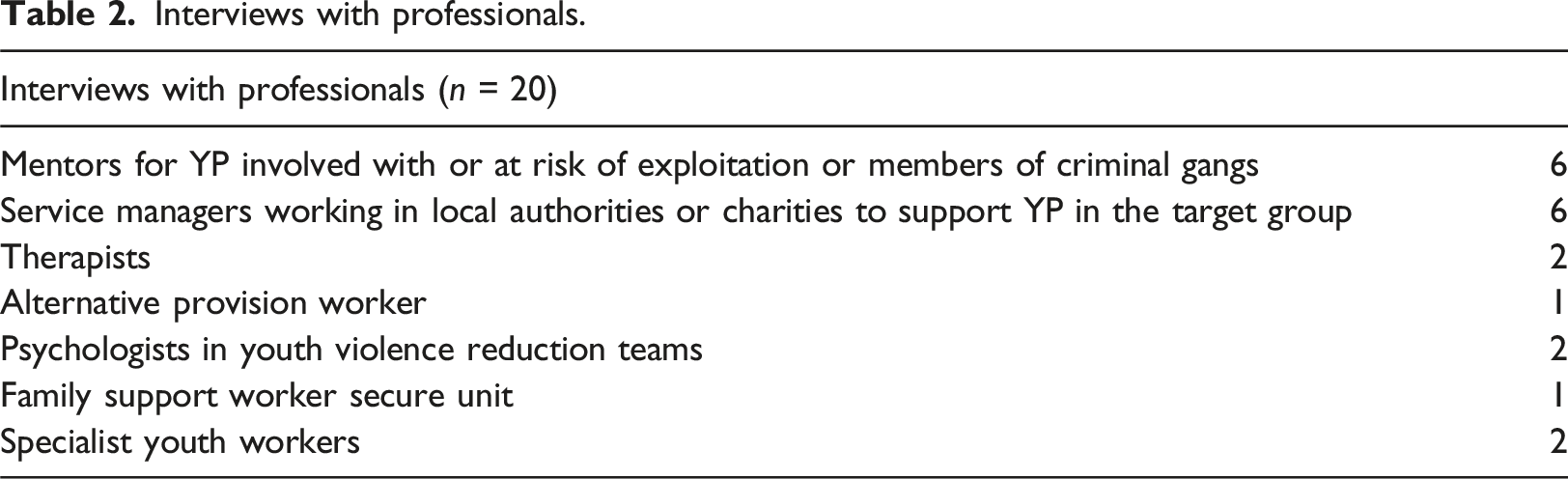
The target group for the study was young people aged 14–24 years, who were known to have been involved in criminal gangs or deemed by associated professionals to be at high risk of this occurring. Here, we explore how the insights of a group of extremely vulnerable young people, relating to experiences of school particularly during transitions, can guide policy to protect against further marginalisation and exclusion. The emphasis is on data drawn from young people, though we include professional narratives where there is a particular strength of feeling or in instances where there are discrepancies or tensions between the different perspectives.
Schools: Provision of a protective framework?
Schools face growing pressures from multiple directions including the focus on academic outcomes, high parental expectations, declining student mental health, insufficient resource, and the burden of regulatory inspections (Cassidy and Boulos, 2023; Jiang et al., 2022). Yet, their capacity to provide a protective framework to support children to flourish is imperative to building an egalitarian society, particularly for those children with less stable home environments (Allen, 2014).
Discourse behind exclusion
The discourse around provision of universal education and its antithesis, exclusion from school, sheds light on some of the tension in the policy debate. Education is not ideologically neutral but sits within a strong value-laden and moral framework where power dynamics and cultural and social control are reproduced (Bernstein, 2003; Bourdieu and Passeron, 1990; Gillborn et al., 2017). Schooling as a universal right is presented as a force to civilise, control, and teach (Taubman, 2022). Yet, the increasing importance attached to certain academic skills, as opposed to relational or creative skills, since the education reforms in the United Kingdom between 2010 and 17, potentially leads to cultural shifts which run counter to inclusion and are less tolerant of difference (Taubman 2022). Greater emphasis on discipline, increasing focus on academic performance through the implementation of the National Curriculum (in particular the English Baccalaureate (EBacc)) and the publication of league tables, conspires to favour children who perform well in statutory tests. Indeed, a 2023 enquiry by the UK government into the state of education for 11–16 year olds concluded that the emphasis on knowledge acquisition and academic rigour fails to account for the prevailing economic and social climate (Education for 11-16 Year Olds Committee, 2023).
Running alongside this discourse is the ‘motivating metaphor’ of public policy which advocates the exclusion from school of the problematic for the greater good (Carlile, 2009: 266). According to this narrative problem, children may be excluded ostensibly to facilitate inclusion and are contained instead (either within schools or in separate locations) in units with little contact with peers, a state, often referred to euphemistically, as ‘being in inclusion’. Yet, the structural and systemic nature of such exclusion and the fact that minoritised and marginalised communities (in respect of race, special educational needs, and economic and social context) tend to suffer more than mainstream groups is often overlooked. Wallace (2023) highlights the concept of the ‘culture trap’, where educational underachievement is attributed to cultural deficiencies, rather than more entrenched structural and systemic factors. In this way, lower educational outcomes in certain groups are blamed on individual behaviours or characteristics. Adopting an ecological approach to examine inequities in both educational achievements and exclusion may be a helpful way to understand how outcomes are driven by the system rather than merely being attributable to individual characteristics. Such analysis aims to dislodge the hold of systemic power, illuminating interconnections between a complex mix of life events, and the cultural and economic context in which young people develop. Social structures are necessarily implicated both in contributing to exclusion and being a route to prevention (Stewart-Hall et al., 2023).
Conceptual framework
School environments influence student outcomes in a range of complex ways. Of particular interest here are theories which draw on ethnography to give meaning to the way students experience school and how this impacts both their mental health and wellbeing as well as their attitudes and actions. Sociological theorists addressing the role of education, poverty, and marginalisation add particular insight.
Bourdieusian understandings of social reproduction consider how cultural settings (in this case schools) may reproduce cultural norms, such as ways of thinking, by social class or ethnic group (Bourdieu and Passeron, 1990). In a similar vein, Bernstein (2003) viewed schools as institutions which reflect the norms and values of the dominant class reproducing their values, norms, and culture and potentially alienating those from working class or minority groups which don’t reflect the majority. Stark racial inequities in academic outcomes have been highlighted (Gillborn et al., 2017) yet policy interventions to raise academic standards have met with mixed outcomes. Ethnic inequalities in attainment narrowed substantially during the New Labour years, only to dramatically increase again since 2010 with a disproportionate reduction in funding reported for schools in the most economically deprived areas (Andrews et al., 2017; Stewart and Waldfogel, 2017).
For students who don’t fit with mainstream, majority norms, whether due to socio-economic background, cultural and ethnic differences, and mental health challenges, the impact can be significant. An inability to properly address their needs, preferences, and learning styles may contribute to disparities in academic achievement and opportunities. If this is the case, it is perhaps unsurprising that Black pupils were more likely to be excluded in less diverse schools where they are outnumbered by a White heterogeneous majority (Graham et al., 2019). Moreover, teachers may be more likely to stereotype Black students as troublemakers, viewing multiple episodes of poor behaviour as part of a connected pattern, reflected in a more punitive response, than with White pupils exhibiting similar behaviours (Okonofua and Eberhardt, 2015).
The meritocratic education system creates an expectation that students will aspire to achieve. Lack of aspiration is predominantly framed within a discourse of individualisation where a shortage of ambition is seen as a personal choice with little consideration given to wider structural factors, detracting from the role that schools, education policies, and the broader social/economic environment might play (Archer, 2008).
Paulle (2019) in his ethnography of high-poverty education in New York and Amsterdam highlights how school disorder can harm pupils. Disruptive behaviours reinforce stratification and stigmas yet, the type of poor behaviours exhibited by some of the most marginalised students, are more an emotional plea for security and boundaries, rather than a considered act of rebellion. Given the lack of soothing situations and calming bodily states, an intellectual celebration of ‘resistance’ based on anti-school utterances would have been absurd. (Paulle, 2019: 210)
School climate has the potential to create a sense of belonging and is arguably most important for students for whom structural injustices may be particularly pronounced (Wang and Degol, 2016). Climate is defined by the quality and character of school life and is seen as pivotal to successful achievement of positive norms and values, academic achievement, social skills, and pro-social behaviours. Students with positive perceptions of the school climate are likely to feel connected to school life and to demonstrate this in pro-social behaviours; yet, school climate may not be experienced in the same way by all students. African American students, for example, can feel less supported by teachers, and experience lower student connectedness and less peer support (Bryson and Childs, 2018). Lacoe (2015) also looks at school experiences of Black and Hispanic students and finds differences in perceived safety reported by location, compared to White and Asian peers. Black students feel less safe in classroom areas, where there is teacher supervision and more likely to cite fear as a factor contributing to missing school. The disconnection resulting from such experience may manifest as anti-social behaviours. Students looking to find peer connection and sense of belonging may turn to anti-social behaviours to attain alternative symbols of status – as means to forge protective membership of ‘safe’ groups (Jamal et al., 2013).
In the next section, we examine how young people experience challenges which are likely to impact their health and wellbeing as well as longer term economic, social, and individual outcomes and will locate these within the theoretical frameworks referred to here. We explore how schools can at times support and reinforce existing inequities and ask how school structures may be reviewed to help guide marginalised pupils along pathways which may support school engagement and extend opportunities.
Methods
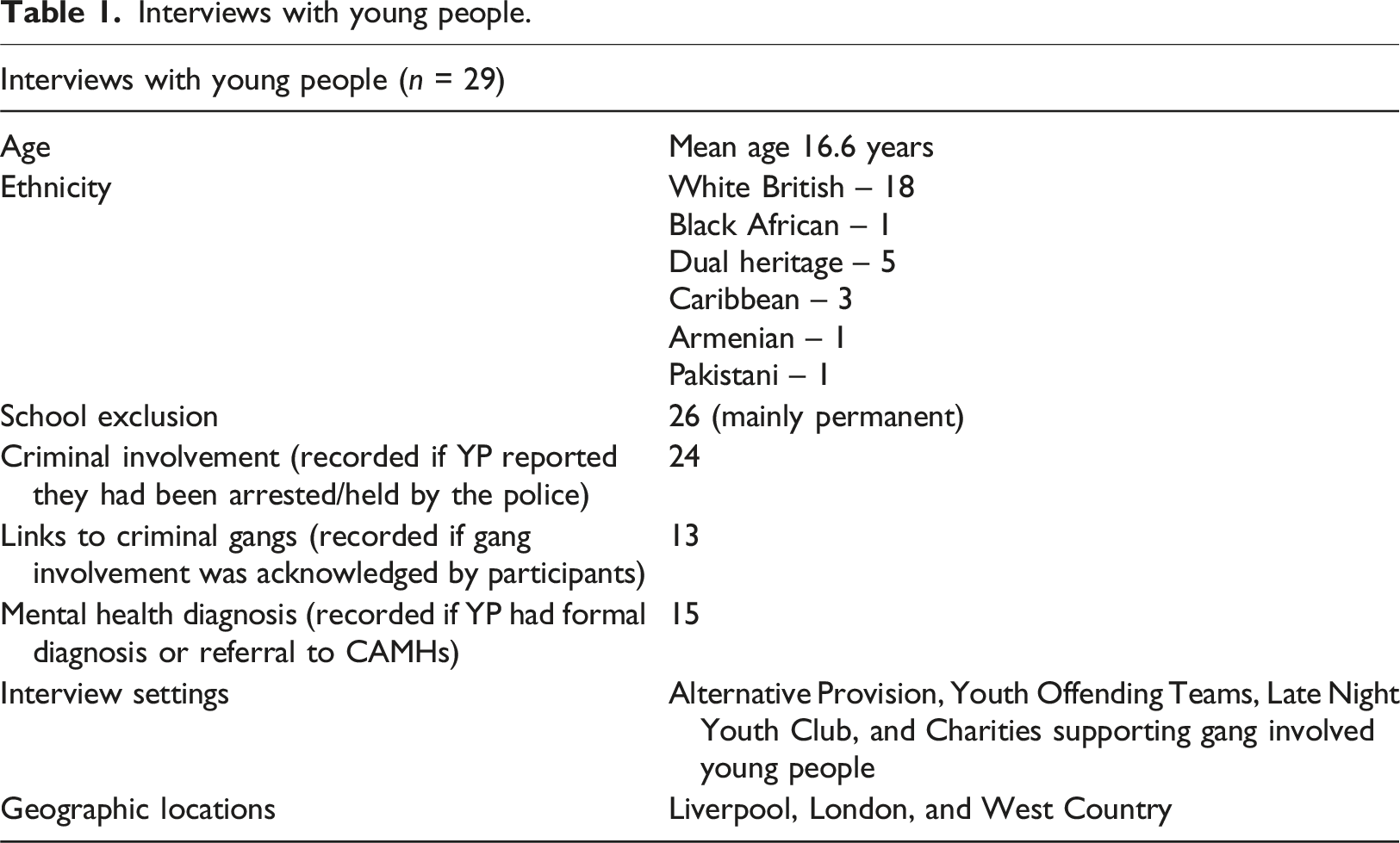
Interviews with young people.
Interviews with professionals.
Target group of young people
The target group of young people was defined as being those deemed by professionals working with them to be gang involved or at risk of involvement. In addition, participants needed to be considered by both gatekeepers and the researcher (RB) to have sufficient mental capacity to fully understand the process of consent. Recruitment in Liverpool was facilitated by an Alternative Provision working in predominantly White working-class areas of the city – consequently no Black and minority ethnic participants were recruited in the Liverpool sample. The low number of girls in the sample is reflective of the gender composition within the settings where interviewing was conducted.
Recruitment
To optimise recruitment, a variety of different approaches were made. Given the sensitivity of the topics and the vulnerability of the target group, access was facilitated by trusted gate keepers. Recruitment challenges, ethics, as well as more detail on creative methods are developed in a linked paper (Barker et al., 2024).
Interviews
A topic guide was used, covering a number of key themes including growing up, family, friends, school experience, aspirations, mental health, and gangs. Techniques were used to reduce the intensity of the ‘interviewer gaze’ including snacks and refreshments, optional art materials, and paper and pens to doodle.
Ethics
Ethics permission was received from the LSHTM Ethics Committee in November 2022 (ref: 26873) and informed consent was received from all participants both orally and in writing. The consent procedure paid particular attention to explaining issues relating to instances in which confidentiality could not be kept – that is, where there were serious concerns about safeguarding or in the rare circumstances where previously unrecorded criminal activity needs to be reported. Safeguarding protocols were in place should such eventualities have arisen. Written consent was obtained from young people and professionals in all instances. All accounts have been anonymised to mitigate risks of identification.
Analysis
Analysis of the data was rooted in grounded theory (Corbin and Strauss, 2008), where theory and ideas are generated inductively, from a ‘bottom up’ approach. Data from interviews were transcribed, and NVivo software was used for data management. Analysis begins with open coding on the first data generated and continues iteratively throughout the study. A constant comparative method helped develop an understanding of how young people assign meaning to their actions and acknowledged the complexity of social processes. This method draws on axial coding (Glaser and Strauss, 1967), where excerpts of raw data are organised into groups according to attributes, and then resulting categories of data are used to generate a theoretical account of social phenomena and their characteristics underpinned by the data (selective coding). Our intention was not to create new theory, rather to see how well our theoretical frameworks (based on reproduction of class and interpretations of marginalisation) explained the narratives collected. This technique fits with an emergent method of grounded theory, beginning with the empirical world and looking at events as they unfold to accrue knowledge and build an inductive understanding (Charmaz, 2008).
Anonymity
To protect the identity of participants, all data have been anonymised by using pseudonyms. Details that may have led to the recognition of a particular interviewee have been changed, and all references to specific individuals or organisations were removed.
Findings
Here, we address findings relevant to our central question of how the insights and experiences of marginalised young people at school may impact them becoming involved in criminal gangs and how this can be used to guide education policy. Using the axial codes represented in Figure 1, we arrived at the core selective code labelled ‘one size doesn’t fit all’. There are three sub-categories within this: i) the potential impact of broader environmental and social factors; ii) the immediate experience of being at school, particularly secondary school, where feelings of disaffection and lack of engagement and belonging are exacerbated; and iii) the impact of this on mental health (represented in Figure 1). Due to space constraints, although mental health is highlighted as a key code in Figure 1 and runs strongly through the narratives explicated in this section, challenges unique to mental health will be considered fully in linked publications. Axial and selective codes.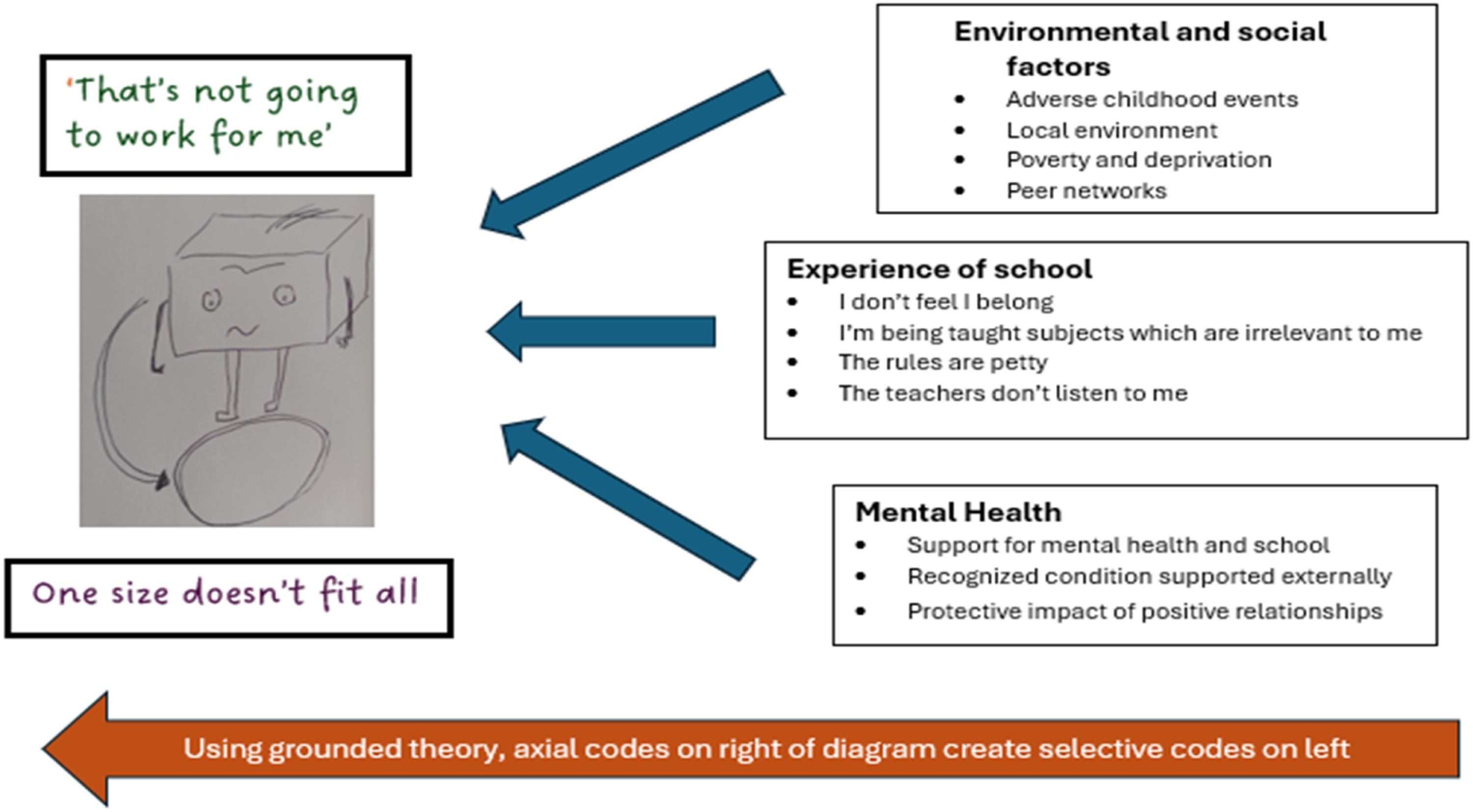
Broader environmental and social influences on school experience
Environmental influences were frequently alluded to – particularly relating to how hard it was to escape the pressure of complex sub-cultures and historical connections which influenced social interactions and bubbled constantly under the surface. I wasn’t bad – it was the kids around me. (James)
The tension between pressures to follow social norms, versus the capacity to demonstrate individual agency, was perceptible in a number of interviews. Being surrounded by people behaving in a particular way acts as a form of student instructional order (Jamal et al., 2013) and makes it harder to follow an independent path. Narek describes below how smoking cannabis meant he had to abandon his dreams of playing professional football and give up the one thing that he really loved in his life. Although he cites smoking as the reason he was thrown out of the elite football academy where he trained, he found it hard, within the complexity of other vulnerabilities, to steer a lone path, tangential to that of his peers. The friends were people from school – it’s not that they were a bad influence – it’s just that they smoked. All they do is smoke {weed} so I did the same. All day – 20 zoots a day. One pack of cigarettes a day. 2 vapes a day. I can’t blame them for what I did. I chose to smoke. (Narek)
Whilst Narek took responsibility for his behaviour, the suggestion is that when surrounded by people acting in a certain way, it required particular resolve not to follow them. Hassan observed that some schools inevitably faced greater challenges reflecting the level of social deprivation in the immediate area. Here, he reflects that although naughtiness might be a normal childhood characteristic, it’s ultimately the environment that is the determining factor in how the extent of the naughtiness is played out: Sometimes kids are just naughty ain’t they? And they’re always going to be like that. If a kid is naughty and hanging around in a skateboard park… then the naughty they get up to may be spraying graffiti. But if a kid is naughty and they are hanging around people selling class A drugs then that’s the naughty they’re going to get up to. (Hassan)
Hassan’s words resonate strongly with a number of related sociological theories (Bandura and McClelland, 1977) touching on the human tendency to copy peers’ behaviours.
Negotiating friendships at school had in some instances been made harder by the void of lockdown, with some reporting how school closures had enabled them to roam more freely. Noah recounted flatly how following lockdown the allure of wanting to go out with mates from his special school had led ultimately to disappointment and mistrust. I just wanted to got out with the lads…yeh there was drugs like but…I was just with mates. It was just stupid shit cos the kids I was doing it with didn’t know nothing. They ended up sneaking me anyway. So it wasn’t worth nothin’. They set me up and then I got jumped by kids in town and they ran away…they split me head open…. It just means you can’t trust anyone can you? (Noah)
Whilst Noah’s friendship challenges weren’t linked to racism, for young people minoritised because of racial identities accounts of discrmination were notable and varied with environment and geographical location. Tyrone here explains that when his father went to jail, his mother moved him from a diverse inner London comprehensive school to a school in Sussex where she thought he would be free from bad influences. The outcome wasn’t as she anticipated: Until I moved to Brighton I never experienced no racism. In Brighton there’s less diversity so obviously you get picked on more... Then in year 9 I got chucked out of school so we moved back to London. (Tyrone)
Echoing Tyrone’s observation that racism was more of an issue in areas with less diversity, Reuben described how, in his predominantly White school, his Afro immediately got him noticed and racist slurs followed him around.
Several of the boys who were implicated in dealing as ‘road-men’ in county lines gangs recounted how initial contacts leading to this involvement were made in schools (both mainstream and special schools). Noah, for example, was drawn in through associations at his pupil referral unit (PRU). Harvey, still at secondary school, and being supported by a mentor following his involvement in county lines drug dealing, suggests that one of the best things about school was in its provision of a market for drugs: {School is} good and bad at the exact same time. It’s good cos I’ve got my mates there and it’s a GOLDMINE. You can sell poppers, edibles, anything, weed anything. If I didn’t go to school I’d have no sales. (Harvey)
Gendered response and male externalising
Some of the young people spoke of their behaviour in gendered terms: ‘we were just doing boys stuff’. One reported exclusion followed a fight with a girl in which he perceived his treatment as unfair. Some girl started tripping me up on the stairs and stuff – she kept on doing it – so then I pushed her down the stairs. She told a lie and said that I’m the one who started it – but she tripped me up and I hit my head twice…Then cos of that they kicked me out of there…. I was angry… the boy is more likely to get picked up for it. (Jaden)
A number of those with probable or diagnosed mental health problems alluded to the fact that school reacted to the externalisation of their problems, played out through bad behaviour, rather than a more root-and-branch approach to supporting underlying problems. They didn’t care about me problems… they just thought I was naughty. (Ethan)
Mental health challenges, such as Ethan’s, were frequently part of the complex presentation of problems which, in the context of multiple, competing demands, teachers struggled to engage with in the individualised manner required. The externalising of some mental health conditions is more evident in boys than girls (Hayden and Mash, 2014) and may be particularly hard to contain in the progression from primary to secondary school. Conceivably, as boys progress through the school system, threatening behaviours may precipitate a more fearful response from teachers and classmates – explaining in part how poor behaviour from boys provokes a different response to girls.
Inflexible responses to complex lives
All of the 29 young people who participated in this research had experience of at least some of the risk factors commonly associated with school exclusion and criminal activity. Their lives were complex, touched by family breakdown, poverty, mental health, domestic violence, neglect, and abuse. The limited ability of big state schools, pressured by expectations around largely academic outcomes, to provide a nuanced and relational response was limited. Morgan, for example, had a schizophrenic mother and father who was a drug user: ‘I used to pick needles off the floor when I was six’. He was eventually removed from his father’s care and put under the protection of child services, when teachers at his primary school recognised the level of neglect and abuse he suffered at home.
Franklin is another of the many young people spoken to, whose school journey needs to be understood within the context of his traumatic life story. Whilst still at primary, and living with an alcoholic mother, Franklin was implicated in starting a fire in a neighbour’s house following which he was sent to a secure unit and from there to a residential school. He explained that professionals now tell him he is someone who has ‘slipped through the net’.
There is no clear formula which can help determine exactly which young people are going to be able to swim whilst others sink – yet, there are obvious clues along the way which help identify those likely to be at particular risk. Some children benefitted from strong parental support and because of that, despite a range of risk factors appeared able to be keep their head above water. However, other accounts were bleak, describing immersion in poverty, family breakdown, abuse, neglect, and violence. A number of young people were fearful to go out, lacking in both aspiration and hope, scarred by a series of personal, family, and institutional injustices. I’d rather sit in that go out and get stabbed…I don’t like having guns smashed in my face…you just keep smiling… you just got to keep yourself strong – that’s it. (Max)
Max’s appraisal of his enforced self-isolation and his refusal to indulge in self-pity was stark.
School experiences
Participants were asked to recollect experiences of school, starting as early as they could recall. Although a small minority of participants claimed never to have liked school, the majority had generally positive memories of their primary experiences.
For some, there was an element of surprise in recollecting that school had, at one stage, been a happy time – and pride too, that in contrast to the fragmented career many had through secondary school, most had remained at one primary school throughout. Primary school was good….I went to one primary school through my whole life …it was a good experience. I had cousins around my age – so the teachers knew us – our surnames and stuff. (Jaden)
The journey to the point of exclusion tended to be one where small misdemeanours and struggles against school rules build up cumulatively until they become entrenched forms of behaviour.
The move from year 6 to year 7 heralded a changing direction and mood for many: The teachers were just being snotty. They were just like accusing. If you’re like walking there with your coat on they’ll try and suspend you... (Bobby)
Complaints, such as Bobby’s, about petty rules were common. Young people alluded to the stark contrast between the expectations of primary and secondary school and how the transition was often experienced as a brutal shift in gear. Primary school was perceived as a safer and more relational environment where there was less pressure to achieve academic goals. Respondents recalled ‘having lots of friends’, ‘running around’, and having fun. It appeared that in secondary school, there was an expectation of greater passivity and non-physicality – a difficult ask particularly for boys and less allowance was made for those who struggled with aspects of learning and required greater support.
A number of reasons were suggested to explain poor experiences in the transition into secondary school: not being liked by teachers; trivial rules which were hard to follow; existing gripes with other children (some gang related); racism; making friends and fitting in; being bullied; and no interest or engagement with curriculum. Complaints about the curriculum were common with maths being singled out as being particularly hard and P.E. as a saving grace. It was evident that unrealistic educational expectations, led quickly to boredom, disengagement, and feelings of failure. There are people in the school system who do well from it and benefit and some don’t. I’m one of those who don’t. I was a clever kid at primary…but I’ve got a short attention span… just sitting in class looking at the board and copying. I couldn’t do that. (Sid)
Person-centred
The difference in size between primary and secondary tended to make students feel less in control. The experience generally was less person-centred and several reported the feeling of not being listened to or that their views and perspectives were largely ignored. This appeared to feed into an already low sense of worth. {My school} had a very authoritarian policy … Sometimes I felt that our voices and opinions were ignored. (Adem)
For vulnerable children, prone to being bullied, the level of protection the school could offer was limited. I got bullied and terrorised off the school. In the end me mam took me out. The teachers said they couldn’t have their eye on me all day. (Mike)
A minority of children mentioned staff with whom they forged positive relationships and who were credited with extending their stay at school prior to ultimate exclusion. In instances where young people felt they were being listened to or had contact with staff who understood them, this could be an important anchor helping negotiate the many hurdles confronted.
Struggling to negotiate school rules
Complaints about petty rules and perceptions of unjust treatment were frequently voiced. I didn’t like the teachers. They thought their school was just too good innit. They made it so strict and it don’t need to be that strict. (Narek)
Accounts presented were often inconsistent, at times blaming the system whilst at others acknowledging, to different extents, the way in which their own behaviour could have been implicated in outcomes. The narrative of ‘petty rules’ not reflecting things that really mattered (at least to the young people) was a dominant one. School regulations appear to both confine and irritate certain groups more than others. Those young people who lack confidence, or have been made to feel less entitled, may find it harder to regulate their reaction when challenged by a teacher – perhaps explaining the tendency to lash out – rather than discreetly flaunt rules in the way that more secure children might.
Curriculum
The strength of feeling from professionals and young people that the secondary curriculum didn’t reflect the needs of most marginalised or engage with their life experiences was resounding. There was a call for more vocational opportunities which potentially would not only improve levels of engagement but help build aspiration. When I say ‘where do you see yourself in three to four years time?’ they have no idea… the school hasn’t helped them to develop an interest in what they’re going to do later – outside of school – how they’re going to earn a living. (Mentor 5)
Ethan’s irreverent indignance regarding his teacher’s choice of cars illustrates how many young people viewed the school curriculum as both insulting and irrelevant. They’re just turning up at school in shitty ford fiestas and that. They’re just ‘Jack shit’. They should be learning ya about how to make money… I was 15 and making more money than what the teachers were making. It’s just stupid man. Stupid. Stupid. …. They’re teaching me science. Like – what’s the odds of me becoming a scientist when I’m older. It’s fucking that slim. (Ethan)
It was evident with Ethan, as with many others, that lack of belonging and engagement encourages young people to turn away from school and seek identity and meaning often through illicit means which they find easier to access, than through an education system where they feel excluded and failed.
Special school/alternative provision
In the majority of cases where students had been excluded from the mainstream and transferred to special schools or alternative provisions where class sizes were significantly smaller, young people spoke about the relief of having fewer people around, allowing for a more student-centred focus. The broader, more vocational curriculum was also well received.
Discussion
The accounts presented in this paper from marginalised young people illustrate the challenges English state schools currently face when trying to provide inclusive education to individuals whose lives have undergone often unimaginable hardships. The experiences of young people raised in the context of poverty, family breakdown, racism, neglect, and abuse mean that, for this group, socialising and complying with the requirements of the school/classroom are often hard paths to follow. Additional pressures have been placed on schools by increases in class sizes over the last decade (DfE, 2024), together with significant numbers of young people with SENs and mental health challenges going undiagnosed and unsupported (Hutchinson, 2021) and reductions in per capita funding (Farquharson et al., 2021). The impact of these contextual resource constraints is likely to be most pronounced on those with complex needs.
Paulle’s (2019) moving and visceral account of ‘high-poverty, self-destructing’ schools talks about a ‘toxic culture’ which can only be gleaned, he asserts, from an empirical focus bringing lived understandings and providing insight into how students navigate their complex environments. Young people who struggle to fit into school life become disengaged and gravitate towards counter-school sub-cultures, motivated by the desire to find anchors elsewhere. Such anchors may be in the form of a social group which confer status and offer a sense of belonging, or as was more often the case in this sample, as a route to financial gain, securing the money to buy material status and self-affirmation.
Just as Bourgois (2003) notes in his account of Harlem, participants in this study, failed by the system and emerging from school without the qualifications to gain legitimate employment, often found it easier to ‘go underground’, earning money from the illicit drug trade. The accounts from this research chime too with Willis’ (1978) notion of how class culture is reproduced in working class boys. Willis suggests that culture is formed through a mix of human agency and striving for autonomy; tempered by and embedded in a set of social and material realties; and bounded by institutional regulations and relationships. Rebellious behaviour of working class ‘lads’ at school, he argues, is a demonstration of agency. In subverting the norms and values of school, young people ‘empower’ themselves to follow the same route taken by their working-class peers into the underground economy. Teachers, according to Willis, encourage this ‘cultural reproduction’ by unconsciously attaching negative labels.
Motivations to involve themselves in counter-school sub-cultures appeared, in this study, to be mixed. Previous ethnographic work (Fletcher and Bonell, 2013) with marginalised young people in schools has surmised that the most vulnerable and marginalised students are pushed to the margins by a centrifugal force where anti-school behaviours such as substance use may confer status with networks of friends/associates. Whilst there was evidence here that friendships and fitting in were important, it appeared that counter-school behaviours (criminality and gangs) were most often entered into as a means to get money; behaviours such as substance use, taken up as a form of social coping or fitting in, didn’t emerge as a strong theme. Whilst this may, in part, be explained by the fact that criminal behaviours were not the starting point, many of these young people were engaged in previous disruptive behaviours at school, perhaps an earlier response to their feeling of marginalisation. However, it appeared that the primary motivation for dealing drugs, within our sample, was attributed to making money rather than a desire to belong. Money secured material goods that provided status and made people feel good about themselves. It was used either for personal gain, buying clothes/drugs/food for self, or to help the family with bills.
It may be that the experience of multiple exclusions, compounded often by poor mental health, has made the expectation of membership of peer networks less tangible – or at least access to networks where young people simply ‘chill' becomes less commonplace. Marginalised and fragmented lives are less sociable and increasingly isolated; poverty is itself linked to social exclusion (Gordon et al., 2000). Moreover, the strong influence of social media, with its promulgation of images of designer clothes, or other desired consumables and its crude exposition of inequality, means that there is an almost universal craving to secure status through acquisition of these external trappings. In this way, when the school doors are permanently shut on excluded young people, they turn instead to the welcome of gangs and dealers, who provide the means to acquire ‘easy’ money and thus ‘easy’ status.
In the eyes of our young narrators, in choosing paths opposed to school and societal rules, they were not so much ‘choosing to fail’ as being failed, or choosing not to continue to struggle against all odds in a system they felt was ultimately against them. This finding aligns with Paulle’s (2019: 211) plea to move past the ‘opposition narrative’ – there can be no opposition, he claims, if these young people have been effectively abandoned by the system. According to this view, the system becomes the active force contributing to disruptive and anti-social behaviours and the young person the victim of ‘being failed’.
In adopting money-driven anti-school behaviours, young people are demonstrating how they are using individual agency within the boundaries of a system which is built up around a dominant class, access to which has been largely cut off. Through this interplay of structure and agency, or structuration (Turner, 1986) class structures, in the form of economic/social/familial reproduction of patterns or habitus, are reproduced. The sense of ennui or estrangement that results means that opportunities for pro-social learning within school were being replaced with the adoption of anti-social skills (in many cases relating to drug dealing, criminality, or knife-crime), chiming with Bourgois’ (2003) findings that those failed by the system will find subversive (if ultimately destructive) means to earn money. Time out of mainstream school acts to reinforce negative attitudes towards authority figures and build distrust towards civic society. Many respondents, cited here, have turned away from accepting the school as the moral arbiter, decrying the system as unjust and aligning to Sherman’s (1993) notion of defiance theory where the instigator is said to be ‘poorly bonded’ to the sanctioning agent.
The challenges explored go deep – and certainly are influenced by factors way beyond the control of the school gates. Yet, the important question remains: how does school either support these vulnerable people in down pathways which will help secure social and economic security in mainstream society or identify the vulnerability, label it, and make it worse? How can the feelings of estrangement and alienation be replaced with greater engagement? The flexible, holistic response required to enable these students to feel both listened to, and to engage with and respond positively to what the school has to offer, does not appear to fit with the imperative secondary school teachers in England currently face to deliver the national curriculum.
A clear distinction was made between primary school, experienced as being more relational and student-centred, and secondary schools which are more rule-based and outcome-focused. Whilst the majority of students have the capacity to manage the constraints and boundaries set down in primary school, this did not extend to the more stringent, less relational expectations they were faced with after the transition to secondary. Worrying about petty school rules, such as which shoulder your school bag must sit on, makes little sense to a young person whose main concern revolves around their next drug deal or social services involvement in their family life. Protective factors, recognisable in those who didn’t find themselves in downward spiral of self-destruction, included enduring family relationships, meaningful relationships with professionals, or where, as Hudson observed, ‘I’ve got stuff in my life’. A trauma-informed approach to teaching, emphasising the building of strong relationships, promoting emotional and physical safety, and providing consistent routines, has been found to improve both individual and larger community outcomes (Cummings et al., 2017).
It may be that we can learn something from the difficult experience of the transition from primary to secondary school (Gilbert et al., 2021; Rice et al., 2011) when learning is divided up into discrete academic subjects which are abstracted from their lives. As Ethan indignantly pointed out the chances of him becoming a scientist were ‘that fucking slim!’ It was suggested by a number of professionals and young people in the sample that stronger school engagement may be achieved through greater emphasis on vocational training, group and project-based learning, community activities (including sports), and the development of life skills. Similarly, a number of systematic reviews (Gerami et al., 2015; Nasheeda et al., 2019) suggest that life skills training, which aims to improve self-regulation, decision-making skills, and the building of supportive relationships, has positive outcomes on mental health and other aspects of wellbeing – but to date, national implementation is inconsistent. More research is needed to identify clearer evidence which will guide the development of universal, statutory provision of life skills and vocational training in UK secondary schools and to consider the impact of this on the most marginalised.
Limitations
The small sample of marginalised young people in this research can only provide an indication of some of the mechanisms attributed by the participants to school exclusion and criminal involvement. The aim was not to measure or test but rather to understand, represent, and explain a complex social situation. Quantitative longitudinal research is necessary to propose and test causality. The research was conducted at a range of locations across England, but it is impossible to cover the array of contexts, geographies, and racial groups which will all influence the way school is experienced. Furthermore, only 2 of the 29 participants were girls; the female perspective is therefore largely missing and further research is needed to interrogate this.
A further limitation of methods of purposive sampling is that young people who agreed to be interviewed were those with sufficient trust and social skills to embrace the uncertainty of the interview situation. Ethnographic research seeking interviews with vulnerable young people – particularly those in contact with the criminal justice system – is notoriously difficult because of a number of ethical and social sensitivities. Young people particularly those involved in gangs are typically tight lipped about their activities, following the rules of loyalty to the gang and the adage: ‘snitches get stitches’. The voice of those who are least engaged and most distrustful therefore remains unheard.
Positionality and reflexivity
Qualitative research, such as this, which requires an insight into areas of vulnerable young people’s lives that many would consider intrusive, requires the researcher to be sensitive to the individual being interviewed, as well as intuitive, to tread gently and be respectful not to probe areas the respondent wants to guard. As a White, middle-class, older woman, I was aware of my positioning ostensibly as an ‘outsider’ and the way this may impact on how the interview unravelled. Hellawell (2006) suggests that research benefits from a balance between ‘involvement and estrangement’. Whilst different perspectives and positionalities provide ‘socially situated knowledge’ (Haraway, 2020), each of these perspectives goes towards providing a piece of the larger puzzle. All knowledge is partial, situated, and incomplete – yet goes towards adding depth and a fuller understanding to the bigger picture (Pawson and Tilley, 2004). Whilst I acknowledge that there may have been times when someone with direct experience of gang life may have been more acceptable to some of the young people I approached, and that different forms of knowledge would undoubtedly have emerged, I was nonetheless gratified by the generous and trusting spirit with which the young people I spoke to were able to open up and share their life stories. To counter initial apprehension, I offered my insight into their world by telling the story of my son who himself became involved in a criminal gang following school exclusion – this personal insight was often something of an ‘aha’ moment, when my intentions, to get more insight into the young people perspective, was more clearly understood and doors began to open.
Conclusion
The current English, meritocratic, education system is built on the premise that if an individual works hard and shows talent, they will be able to rise above the structural challenges faced. Yet, we see in the accounts presented in this research how schools may perpetuate and extend existing cultural capital and thus inequalities (Bourdieu and Passeron, 1990). Narratives collected here show the complex interfaces of fragmented families, social class, race, poverty, mental health, and school experience – and how these may combine to lessen the opportunities available to vulnerable young people. Findings suggest that an education system premised on academic assessment will take the majority of its ‘winners’ from those who are able to respond positively to classroom-based didactic models of pedagogy on which traditional learning is based. The marginalised, vulnerable young people interviewed in this research eloquently reported how they don’t currently have fair access to this winning cohort. A standard set of ‘offerings’ will not suit those with the most complex needs.
Improving outcomes for those currently seen to be failing may involve both broadening the way in which success is measured to include indicators which aren’t exclusively academic as well as supporting communitarian aspects of school life. Moreover, our findings suggest that the current emphasis of the UK education system on knowledge acquisition and academic rigour, so alien to the priorities and needs of the marginalised young people who participated in this research, will continue to fail and exclude sections of the population most in need of support. The cost-of-living crisis currently impacting the United Kingdom particularly affects the most disadvantaged, and young people in this research prioritised routes to making money. An education system unable to teach vocational skills to help these young people achieve their economic goals is failing those most in need.
Whilst multiple reports have examined potential routes to preventing exclusions, explicating the role of school strategy, unless we take account of how marginalised young people experience school and attend to the complex array of structural injustices faced, new policies and strategies will continue to meet the metaphorical brick wall encountered by young people in this study. Providing ways to achieve a more secure sense of belonging and engaging those students who feel the current curriculum is irrelevant to their needs, through greater emphasis on technical, digital, creative, and relational areas of study, is now an urgent priority (Education for 11-16 Year Olds Committee, 2023). Simple wins, that do not necessarily involve whole system change, may include a stronger emphasis at secondary school on developing affective relationships between form staff and students.
Footnotes
Acknowledgements
We would like to extend grateful thanks to all the young people and professionals who gave up time to talk to us and reflected on our questions with such honesty and generosity.
Author contributions
RB conceived the initial study design with input from CB and G.J.M-T. RB carried out data collection and initial analysis with CB and G.J.M-T contributing to coding themes. RB produced the first draft with critical analytic input from CB and G.J.M-T. All authors read and approved the final manuscript.
Declaration of conflicting interests
The author(s) declared no potential conflicts of interest with respect to the research, authorship, and/or publication of this article.
Funding
The author(s) disclosed receipt of the following financial support for the research, authorship, and/or publication of this article: This Fellowship (award number: MH015) was funded as part of the Three NIHR Research Schools Mental Health Programme. The views expressed are those of the author(s) and not necessarily those of the NIHR or the Department of Health and Social Care.
Ethical statement

Data availability statement
Anonymised data that support the findings of this study are available on reasonable request from the corresponding author, RB. The data are not publicly available due to containing information that could compromise the privacy of research participants.