



Abstract
In 2020, schools worldwide closed due to the COVID-19 pandemic. Almost one million young people and children were impacted in Ireland, with those from ‘marginalised’ backgrounds being especially vulnerable due to pre-existing inequalities. The Crisis Coping for Marginalised Young People: Living and Learning through COVID-19 project aimed to explore youth pandemic life and learning experiences and to support the needs of, particularly marginalised, young people, culminating in the implementation of supports for students in schools. Here, we present a praxeological account of the benefits and challenges associated with our novel methodology which involved working ‘through’ 14 final-year student teachers’ practitioner research projects in their designated disadvantaged or socio-demographically diverse placement schools (11) across six counties in the Republic of Ireland, involving 269 students. Supervised closely by the lead researchers, the teacher-researchers conducted empirical research in their schools (involving questionnaires with students and interviews with Principals) to inform the design of academic, social and mixed school-based interventions which were subsequently implemented and evaluated. The empirical findings pointed to young people’s concerns about social isolation, the stability of friendships and having fallen behind academically, and Principals’ concerns about supporting those from marginalised backgrounds and about creating a safe and happy environment upon return to in-person school. In this paper, we highlight our significantly improved understanding of the COVID-related experiences of young people from marginalised backgrounds but point to the uncertain effectiveness of the interventions for improving their educational readjustment. Further, we critically interrogate the challenges encountered which constrained the lead researchers’ and teacher-researchers’ actions.
Keywords
Introduction
In Spring 2020, schools in over 191 countries closed their doors due to the COVID-19 pandemic (UNESCO, 2020) and families and young people found themselves living a ‘new normal’ life (Flynn et al., 2021). During the pandemic, young people encountered a host of challenges, not least in terms of social isolation and learning how to navigate online learning environments (Loades et al., 2020). However, young people from marginalised backgrounds were especially vulnerable due to pre-existing inequalities (Sahlberg, 2020). In Ireland, the significant disruption that occurred in education impacted almost one million young people and children.
The Crisis Coping for Marginalised Young People: Living and Learning through COVID-19 research project was an 18-month study funded by the Health Research Board and Irish Research Council as part of a co-ordinated COVID-19 Rapid Response Research, Development and Innovation programme in Ireland. Overall, the project aimed to explore youth life and learning experiences during the pandemic and to support the ongoing needs of, particularly marginalised, young people in Ireland. The wider project involved data collection with young people, parents, education welfare professionals, school teachers and Principals, using focus groups, interviews and real-time surveys. From the beginning, we recognised the term ‘marginalised’ to be contested and problematic and hesitated in categorising or ‘naming’ any individual or group as such. However, given the demonstrated differential impact of structural inequalities on the life experiences of different groups (Reay, 2017) we were particularly concerned about the impact of COVID-19 on young people from lower socio-economic and minority ethnic groups, and those with additional educational needs. Whilst recognising the term’s imperfect nature, by ‘marginalised’, we mean, inter alia, young people from lower socio-economic groups, young people from minority ethnic backgrounds (both those of immigrant ‘origin’ and the Traveller community), LGBTQI + young people, young people with additional educational needs (AEN), young people with mental health needs, young people attending ‘alternative’ education provision, homeless young people, young people living in emergency accommodation or in Direct Provision 1 and young people living in care.
In this paper, we present a praxeological account (Rigg, 2014) of one of the wider project’s work-packages, which aimed to examine the experiences of, and co-design and deliver targeted supports to, marginalised young people in schools in Ireland during COVID-19, at the particular point in time when they were re-adjusting to in-person schooling (the 2021–2022 academic year). The research team, most of whom were teacher educators, developed a unique approach to attempting to address educational inequities in schools through 14 student teachers’ practitioner research projects during their period of teaching placement in 11 designated disadvantaged and socio-demographically diverse second-level schools throughout Ireland. The student teachers’ practitioner research projects were used as a vehicle to conduct the project in schools, with the student teachers acting as teacher-researchers. Following a brief review of the literature on the educational and psychosocial impacts of the pandemic on young people (section two), section three details the methodology of the project. Section four presents the empirical findings of the research conducted by the teacher-researchers in schools which established a rationale for the type of intervention subsequently implemented. Section five details the specific interventions and their evaluation. In section six, we critically discuss the challenges encountered in this complex sub-project by the teacher-researchers and ourselves as lead researchers and teacher educators before concluding in section seven. While we successfully achieved project objectives to design and deliver targeted school-based interventions aiming to reduce inequitable outcomes for marginalised young people, we highlight the relatively limited evidence of the effectiveness of these interventions. We end by considering key learning from this aspect of the wider project as we transition into post-COVID educational times.
Literature review
Research from the international context during the early stages of the pandemic revealed the significant challenges young people around the world were facing, including in relation to social isolation and peer relationships (Romm et al., 2021), and online learning. While events which have a disruptive effect on schooling have been shown to have negative implications for young people across all socio-economic groups (Moss, 2020), with resulting social and educational costs (Cauchemez et al., 2014), it was also widely recognised that children and young people from marginalised backgrounds have been especially vulnerable to the effects of the pandemic due to a wide range of pre-existing inequalities (Sahlberg, 2020). While disruptions to schooling may negatively affect all learners in the short-term, it is likely that the severity and longevity of the negative effects increase for students who were already experiencing marginalisation or disengagement (Darmody et al., 2020). Indeed, there is emerging evidence of the particularly detrimental impact of disrupted education on certain groups; including children from disadvantaged communities, children in alternative care arrangements, care-leavers, children considered at risk due to their family situation, children experiencing poverty, children with disabilities, and migrant, asylum-seeking and refugee children (Burgess and Sievertsen, 2020; Larkins et al., 2020). Adverse impacts of school closures on marginalised groups have been partially mediated through reduced academic engagement during the ‘schooling at home’ (Flynn et al., 2020) period, which has been negatively impacted by differential approaches to teaching, learning and student support within and between schools, and differential access to devices and quality broadband (Burke and Dempsey, 2020; Cullinane and Montacute, 2020; Devitt et al., 2020; Dreesen et al., 2020; Roulston et al., 2020; United Nations, 2020; Dietrich et al., 2021). Irish-based research highlighted that students’ engagement in learning declined over the period of school buildings closure in general, and that this decline was particularly acute for those from marginalised communities (Bray et al., 2021; Flynn et al., 2020; Symonds et al., 2020). More specifically, significantly lower student engagement was reported for schools designated as ‘disadvantaged’ (‘DEIS’ 2 schools) (Bray et al., 2020; Devitt et al., 2020; Mohan et al., 2020) with students in DEIS schools three times more likely to have shown low online engagement (as reported by teachers) (Devitt et al., 2020).
With regard to the potential consequences of diminished engagement in learning, researchers internationally have expressed concern about ‘learning loss’ that may exacerbate inequalities for certain groups in the long-term (Hanushek and Woessmann, 2020). Based on US data on the effects of summer learning loss, Kuhfeld and Tarasaw (2020) estimated that students were likely to return to school (upon school re-opening) with approximately 63–68% of learning gains in reading and 37–50% in Mathematics relative to a typical academic school year. Moreover, trends in naturally occurring educational data have provided preliminary confirmation of predictions about the pandemic’s adverse effects on student academic progress, due to lost learning progress or learning loss or both (Maldonado and De Witte, 2022). For example, analysing 6-year panel data from standardised tests of upper primary school students in Belgium, Maldonado and De Witte (2022) found decreases of 0.17 standard deviations in average mathematics scores and of 0.19 standard deviations in average Dutch scores (reading, writing and oral language) in the 2020 student cohort relative to other cohorts. In addition, drawing upon national biannual test scores for students aged 8 to 11 in the Netherlands between 2017 and 2020, Engzell et al. (2021) reported evidence of a learning loss of 3 percentile points (0.08 standard deviations) in Maths, reading and spelling, equivalent to one-fifth of a school year across participants (approximately 350,000). However, learning losses were observed to be up to 60% larger among children of parents with lower levels of education (Engzell et al., 2021). Research from the UK indicates that differential learning loss is furthering the attainment gap between students from lower and higher socio-economic groups, reversing past progress in closing the gap (Education Endowment Foundation, 2020). In Ireland, school principals felt that students from low income backgrounds, together with students with AEN and EAL (English as an Additional Language) learners, particularly those in examination years, were disproportionately at risk of academic regression linked to school closures (Mohan et al., 2020; Burke and Dempsey, 2020). Overall, the empirical literature suggests that young people from marginalised groups, already at risk of early school leaving and underachievement (Byrne and Smyth, 2010; Reay, 2017) are now at greater risk of being severely educationally disadvantaged.
The COVID-19 pandemic has also brought into sharp relief the important non-academic functions played by schools such as providing ‘food security’ (Darmody et al., 2020) and a safer and happier place for many at-risk children and young people living in challenging home environments (Kelly et al., 2020; Symonds et al., 2020). In addition, the critical role of schools in adolescent social development has become manifest during school closures. Adolescence is a sensitive period for social development during which young people spend increasing amounts of time with their peers, developing complex friendships and romantic relationships, advancing their social cognitive skills and constructing a social identity relative to their peer group (Backes and Bonnie, 2019; Foulkes and Blakemore, 2021). As schools are key contexts for such development (Bronfenbrenner, 2005), school closures are likely to disrupt these important social processes (Foulkes and Blakemore, 2021). Indeed, most Irish COVID-19-related research has highlighted how much children and young people missed their friends and everyday social life in schools (Bray et al., 2020; Symonds et al., 2020; Flynn et al., 2021; O’Sullivan et al., 2021), and further, that the sense of isolation was felt particularly acutely by those already marginalised, for example, children living in Direct Provision (Ombudsman for Children’s Office, 2020). In addition to detrimental impacts on social development, social isolation and disconnectedness from peers were concerning from a mental health perspective. This is because links have been established between loneliness, reductions in social support and mental health problems such as symptoms of anxiety and depression (Loades et al., 2020).
Educational responses internationally centred predominantly on striving to ensure continuity of academic learning through alternative learning opportunities for children and young people via existing online resources, printed instructional packages, online instruction or educational television and radio (OECD, 2020). At the school re-opening stage, common goals across countries included monitoring of re-enrolment and attendance, formally identifying and remediating learning gaps, addressing mental health needs and less commonly, providing outreach to students who did not return to school (OECD, 2020). Additional supports were planned for all students, but mitigation was particularly prioritised for educationally at-risk students (OECD, 2020). In Ireland, like other countries, the governmental response to the emergence of the pandemic was to temporarily close schools, colleges and universities, move schooling to online provision through the use of various virtual learning environments (cf. Flynn et al., 2020; Darmody et al., 2020; Mohan et al., 2020), and replace State examinations with a predicted grade model (cf. Kelly, 2021). Despite these measures, there were significant concerns about the transition of marginalised students back to in-person schooling following the re-opening of schools (e.g. Mohan et al., 2020). In response, the government instituted a new programme entitled ‘Covid Learning and Support Scheme’ (CLASS) which was announced shortly after we began our work in schools. The scheme intended that ‘schools will implement measures to mitigate the impact of COVID-related schools closures in 2020 and 2021 and that students will be supported in improving their wellbeing and to address issues associated with learning loss so that they may engage fully with learning in the 2021/2022 school year’ (Department of Education, 2021: 2). Through the scheme, funding was made available for the provision of targeted supports for students who had struggled the most during the period of school buildings closures. While schools were understandably grateful for this funding, concerns were expressed on the ground about the unavailability of teachers, in the context of exacerbated teacher shortages (O’Doherty and Harford, 2018), to deliver required supports. It was in this uncertain educational transition phase of the COVID-19 pandemic in Ireland that the research reported on in this paper was conducted.
Methodology
The objective of the Crisis Coping project was to capture and use the pandemic experiences of Irish young people to inform the co-design and implementation of an intervention in schools aiming to help to mitigate the disproportionate learning and mental health effects of COVID-19 on young people from ‘marginalised’ or disadvantaged backgrounds. Given this overall focus on aiming for positive change within a social justice framework, the project could be said to be located in the transformative paradigm (Cohen et al., 2017). As Mertens (2007) argues that ‘transformative mixed methodologies provide a mechanism for addressing the complexities of research in culturally complex settings that can provide a basis for social change’ (p. 212), this paradigmatic framing aligned particularly well with our project. Full ethical approval for the project was obtained in December 2020 from the institutional research ethics committee (reference number: 2020.12.008).
The specific work-package upon which this paper draws represented the culmination of the overall project in that its objective was to research, co-design, implement and evaluate responsive, and potentially scalable, interventions that would support cohorts of particularly marginalised students in their transition back to in-person schooling across selected second-level schools in the Republic of Ireland. This complex and multi-dimensional work-package involved the recruitment of 15 student teachers from the University of Galway’s Professional Master of Education 3 (PME) programme and the conduct of research, intervention and evaluation activities through these student teachers’ Year 2 practitioner research projects in their placement schools. Teacher education programmes commonly employ practitioner action research which student teachers conduct in their schools during placement, such that it is now regarded as a ‘structural’ part of the teacher education curriculum (Onwuegbuzie and Leech, 2005; Vaughan and Burnaford, 2016). The goals of practitioner research for student teachers are the development of an ‘inquiry’-based mind-set and teaching approach (cf.Cochran-Smith and Lytle, 2009), an integrated understanding of theory and practice (Cochran-Smith and Lytle, 2009) and enhanced professional development at individual teacher and wider school levels (Oolbekkink-Marchand et al., 2022). While the original aim of recruitment was to attract student teachers (hereafter, teacher-researchers) on school placement in DEIS school contexts, to allow for more precisely targeted outreach to marginalised students, we were dependent upon student self-selection for specific projects. Unexpectedly, recruitment was challenging, perhaps due to student perceptions that the project would involve a higher workload than a self-devised project. Ultimately, some non-DEIS schools were part of the final sample for the research which somewhat compromised the original sampling strategy.
At the outset of the school year, training sessions were conducted with the teacher-researchers on research methods. The participating teacher-researchers then implemented an online questionnaire, developed by the lead researchers, with a convenience sample of second and fifth year students in their schools, for whom parental consent and student assent were obtained. The online questionnaire consisted of socio-demographic items, open- and closed-ended items exploring students’ experiences during COVID-19, and their views on transition supports needed during the return to in-person education. Following the attrition of one teacher-researcher and her school from the project, the final sample for the online survey across 11 participating schools was 269 students. Most were second-year students (65.4%), with 34.6% being in fifth year. 61% identified as male, 35.7% as female, 1.5% as non-binary and 1.9% indicated that they did not wish to report a gender identity. In relation to medical card 4 status, a commonly used indicator of socio-economic status in Ireland (Department of Education and Science, 2005), 33.5% reported that their parents did and 29.7% reported that their parents did not have a medical card, while 36.8% were unsure. Data collection also involved the completion of an interview by the teacher-researchers with the school Principal (or their nominee) in each of the participating schools. A semi-structured schedule, developed by the lead researchers, explored Principals’ perspectives on the approach taken by the school during emergency remote learning; the benefits and challenges of emergency remote learning for their students; their students’ experiences of the return to in-person education in September 2020 and again in March 2021; and key supports needed by their students, particularly those from marginalised backgrounds. Each interview was recorded (with informed consent) and transcribed and analysed 5 by the teacher-researcher, following training and individual support from the lead researchers. An individual school-level report, detailing the findings from their school context, was generated by the teacher-researchers and research team, shared with the school Principals and was used to discuss and co-design the tailored intervention to be implemented.
Overview of interventions: School context, sample characteristics, intervention characteristics and evaluation measures.
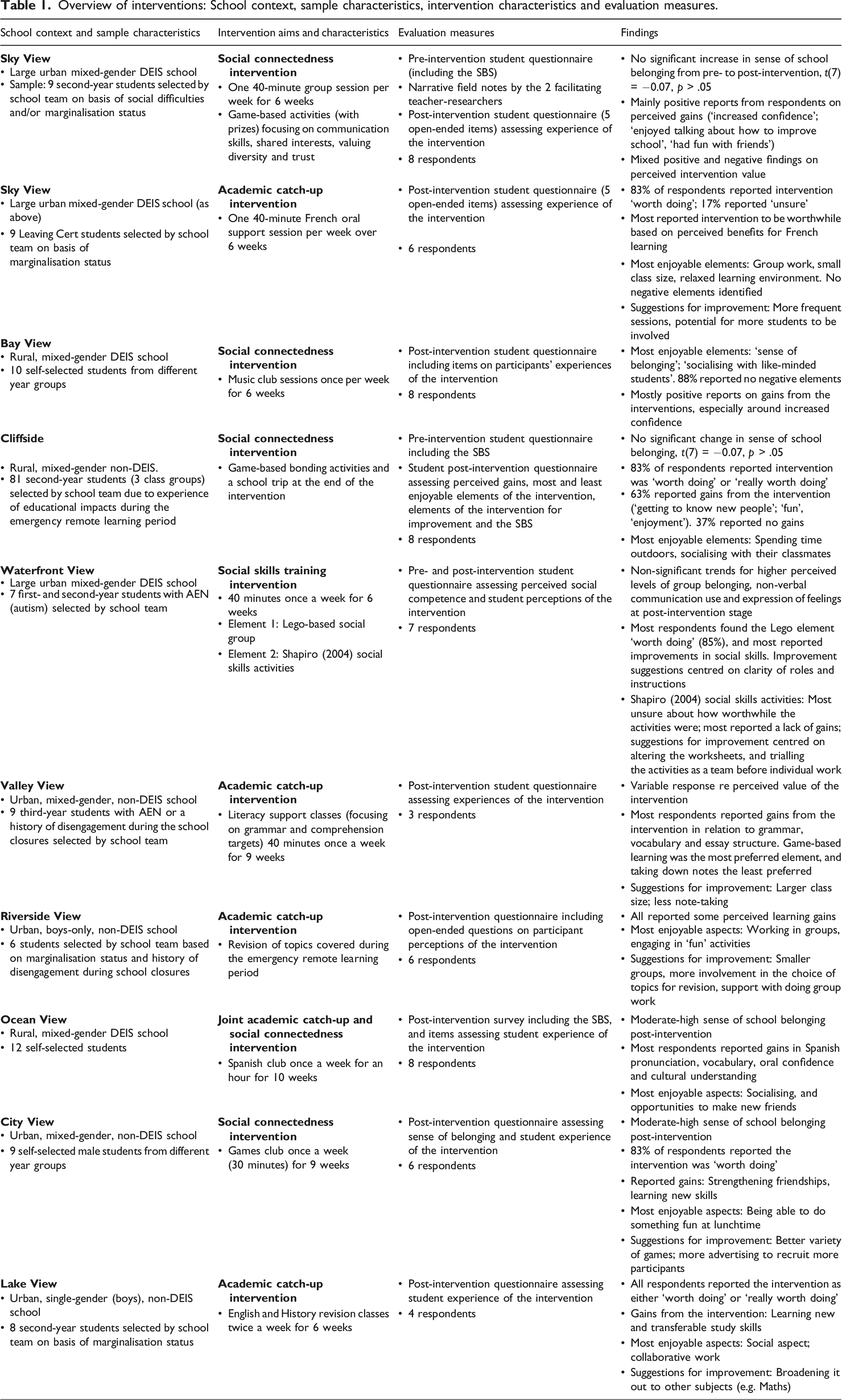
The impacts of the interventions were evaluated by the teacher-researchers using novel questionnaires completed by the participating school students at both pre-intervention and post-intervention time-points (N = 3), or at post-intervention only (N = 7). Evaluation measures and testing procedures could not be standardised across schools because they needed to be constructively aligned with the specific intervention goals and modes of delivery in each school. However, one measure that was in common across a subset of the interventions (i.e. those focusing on re-establishing a sense of social connectedness) was the Simple School Belonging Scale (SBS) (Whiting et al., 2018), which has preliminary evidence of adequate content and construct validity (Whiting et al., 2018). Other evaluation items focused on participants’ experiences of the intervention (e.g. ‘What did you enjoy most/least about the activities?’; ‘How do you think the activities could be improved?’) and their perceptions of the effectiveness of the intervention (‘Do you think the activities were worth doing?’; ‘What did you gain (if anything) from the activities?’).
Summary findings from teacher-researchers’ data collection
We now present summary findings from the school-based data collection to contextualise the subsequent presentation of the findings of the interventions. Based on the young people’s responses to the questionnaire, it was found that the most significant general life challenges encountered since the start of the pandemic were feeling socially isolated, being worried about the stability of friendships and missing preferred activities, especially sport. It was clear that many of the young people had strongly disliked online schooling, and over 43% were unsure about or unhappy with their academic progress over the previous 18 months. Overall, the young people were ‘relieved’ and ‘happy’ to be back in physical school because they found it easier and could interact socially with their peers and friends. There was a sense that some participants had found the transition back to school quite challenging initially but were now coping quite well. A smaller number were continuing to struggle with concentration and motivation difficulties, social awkwardness, anxiety around COVID-19 infection, discomfort with wearing masks and concerns about a perceived increased workload. However, some of the negative reports of being back in-person seemed to be linked to long-standing experiences of disaffection from school. When asked about potential school-based supports that might benefit them during the return to school period, they requested time and opportunities for social interaction with friends and classmates, revising content covered during online schooling, and, to a lesser extent, mental health support.
Analysis of the data from the interviews with Principals (or their nominees) revealed the intense work in schools in adjusting to online learning and teaching, as they moved from ‘scrambling in the dark’ at the commencement of the first lockdown towards the enactment of more effective online pedagogy by the second. Participants emphasised the development of effective school-home contact systems to monitor and support student engagement, with a particular focus on supporting marginalised students. They expressed significant concern about the general circumstances of many of these students, including, but not limited to, their academic engagement, and how many were now ‘lost’ to the system. Their focus upon return to in-person school was the creation of a safe and happy environment for all, particularly in the context of social distancing rules, viewing this as a prerequisite to academic re-engagement. The participants emphasised the need for long-term multi-pronged supports for all students into the future, which they felt ought to prioritise mental health. While very much welcoming the CLASS scheme funding support from the DE, they felt it was too short-term and emphasised the difficulty in recruiting teaching staff, a problem that had significantly worsened over the previous 12–18 months due to teacher absences as a result of COVID-19 infections. Finally, they observed that a key challenge ahead was ‘not to lose what we’ve gained’, in terms of keeping good learning and teaching practices developed during the pandemic, for example, using online platforms to make content available to students.
The interventions: Implementation and evaluation
The individualised, school-specific transition support interventions as described above were co-designed by the lead researchers, the teacher-researchers and the school Principals. The interventions varied from school to school because they were informed by the findings from the research in each context as well as by school-level factors including pre-existing priority support targets, the availability of supporting teachers, the subject-specific expertise of the teacher-researchers on placement there and/or the ethical accessibility of particular groups of students.
A total of 160 students from predominantly first- or second-year groups were involved in the interventions that took place in nine second-level schools across six counties in the Republic of Ireland. 6 In some schools, students were nominated for participation on the basis of marginalisation status (i.e. students with AEN, students from the Traveller community, students from lower socio-economic groups, EAL students) and/or an evidenced pattern of disengagement from education during the emergency remote learning period. In other schools, targeted participant selection was not possible or was not considered appropriate by the school Principal, and thus, participant self-selection was facilitated, using varying modes of student recruitment. Parental informed consent and student informed assent were obtained for all data collection connected to the interventions. The individual interventions were facilitated in each participating school by the teacher-researcher, with mentoring and monitoring from the lead researchers and, in most cases, school personnel. The interventions were implemented between November 2021 and April 2022, with the average duration being 6 weeks.
Due to the heterogeneity in interventions (i.e. in relation to the target student group, duration, goals, mode of delivery, number of participants and methods of evaluation), it is not meaningful to quantitatively synthesise the evaluation findings across all interventions. Rather, a narrative synthesis of the findings from each intervention is provided. In general, a cautious approach to interpretation of the evaluation findings is advised because very low response rates were achieved at the post-intervention evaluation stage, meaning that reports cannot be considered representative of the experiences of all the participating students. Turning firstly to the social connectedness interventions (N = 4), 109 participants were involved across schools, but only 30 students elected to participate in the evaluation process. No significant improvements in perceived sense of school belongingness were found in the two interventions that were able to implement baseline and post-intervention measures of this construct (see Table 1). However, open-ended responses in post-intervention student surveys suggested that the majority experienced some benefits including ‘increases in confidence’, ‘getting to know new people’, ‘strengthening friendships’ and ‘having fun with friends’. The most enjoyable aspects of the interventions included experiencing a sense of belonging, spending time outdoors, socialising with ‘like-minded individuals’, learning new skills and engaging in fun activities outside of class-time. The majority of the respondents felt that the activities were worthwhile.
The goals of the academic catch-up interventions (N = 4) were informed by identified academic needs at a local level. Thirty two participants were involved in academic catch-up interventions, but only 19 participated in the evaluation process. Most reported gains including perceived improvements in subject-specific or generic academic skills, and most respondents perceived the activities to be worthwhile. The most enjoyable elements of the interventions were collaboration in learning, a small class context, a relaxed learning environment and engaging in fun activities such as game-based learning.
The sole joint academic and social connectedness intervention (an after-school Spanish club) involving 12 self-selected participants was associated with perceived gains in subject-specific skills and cultural understanding, with the most enjoyable aspects for the respondents (N = 8) being opportunities to socialise and make new friends. Finally, the specialist social skills training intervention, involving seven school-selected participants with diagnosed or queried ASD, comprised organised play with LEGO materials (LeGoff, 2004), combined with activities (Shapiro, 2004) that involved explicit instruction and guided practice in social skills. Trends (non-significant) for increases in perceived levels of group belonging, non-verbal communication use and expression of feelings were found post-intervention. Most respondents (N = 7) found the LEGO activities to be worthwhile in terms of social skills gains, whereas most were uncertain about the value of the social skills training activities.
Discussion
Previous research has detailed the significant impact academically, socially and emotionally on children and young people as a result of the school buildings’ closures during the COVID-19 pandemic (Bray et al., 2020; Grätz and Lipps, 2021; Loades et al., 2020; Romm et al., 2021; UNESCO, 2020). Research has also been clear about the additionally negative impact on students from minority and disadvantaged groups (Burgess and Sievertsen, 2020; Larkins et al., 2020; Sahlberg, 2020) including in Ireland (Burke and Dempsey, 2020; Darmody et al., 2020; Devitt et al., 2020; Flynn et al., 2020). Indeed, with regard to academic engagement and learning, research from the Irish context highlighted that the decline in student engagement over the period of school buildings’ closures was especially marked for those from marginalised communities (Flynn et al., 2020; Symonds et al., 2020), with notably lower student engagement being observed for schools designated as ‘disadvantaged’ (Bray et al., 2020; Devitt et al., 2020; Mohan et al., 2020). Furthermore, on the re-opening of school buildings, there were significant concerns that marginalised students would not return to education, or if they did return, that they would experience heightened adjustment difficulties due to greater learning loss (Mohan et al., 2020; OECD, 2020). In this context, the aim of the school-based intervention aspect of the wider Crisis Coping project was to design and deliver school-based interventions to support second-level students, particularly from marginalised backgrounds, as they re-adjusted to in-person schooling. We did this through specially designed school-based practitioner research projects of 14 student teacher-researchers in 11 schools in the Republic of Ireland. Through the school-based projects, the perspectives of 269 students on living and learning through COVID-19 were examined, as well as those of 11 school Principals (or their nominees), and these fed into the design of the school-based interventions, which were then evaluated.
This paper provides evidence of the perspectives and experiences of young people from mostly marginalised backgrounds in relation to living and learning during the pandemic and then upon transitioning back to in-person school. This evidence stimulated greater insight amongst the team into young people’s ongoing and future support needs, as we transition to a post-COVID educational and societal context. As we have shown in this paper, the school-based intervention aspect of the wider project achieved its objectives to provide targeted supports. However, the outcome of our broader objective to positively impact these school students’ social and academic educational outcomes via the implementation of targeted interventions is less clear. In terms of the outcome of the intervention evaluation measures, broadly, it could be said that the response of participating students was quite positive in that they enjoyed many aspects, particularly those relating to socialising and learning collaboratively with peers, and most found aspects of the social and/or academic interventions to be beneficial. Nonetheless, it is difficult to conclude as to their ultimate effectiveness based on the limited data collected, especially given the low response rates achieved at the post-intervention evaluation stage. Thus, the success of our attempt to achieve improvements in outcomes for these students at school level is uncertain.
Critically reflecting upon the process of designing and implementing this aspect of the project, a number of discussion points arise. This study was complex, multi-faceted and was very demanding on both the teacher-researchers and the lead researchers, who together worked intensively throughout the 2021–2022 academic year to ensure project objectives were met. While all schools readily signed up for the project, their level of engagement throughout its lifespan varied and several of the teacher-researchers experienced significant challenges conducting the project during placement. Schools are always busy places, and at the time of their projects, schools were dealing with significant additional issues in returning to in-person schooling. It was challenging and, at times, quite stressful for many of the teacher-researchers as they sought to recruit support from relevant school staff, for example, to assist in boosting survey response rates, and also ‘chasing’ their very busy Principal to conduct the interview. Particular points of tension emerged with regard to the teacher-researchers’ status as student teachers who lack real power in their schools (Patrick, 2013). In this context, they may not enjoy adequate ‘standing’ in schools to conduct externally funded research to requisite standards. This may be because student teachers are continuously navigating a liminal space between student and practitioner, where they feel that they must consciously ‘play the game’ (p. 99) in order to be evaluated favourably (Axford, 2005). Indeed, using a Foucauldian lens, Rutherford et al. (2015: 327) described student teachers as ‘governed’, with expectations not only around high levels of performance on placement, but also around ‘docility, obedience and discipline’ (p. 327). Relatedly, student teachers’ practitioner researcher projects are not always valorised in schools (Oolbekkink-Marchand et al. (2022), perhaps because they tend to be conducted in individual classrooms (Willegems et al., 2017) and are often experienced by school staff as a ‘complicated and ... disturbing factor in the practicum … [with] student-teachers pulled in different directions’ (Ulvik, 2014: 532). In this context, the teacher-researchers’ commitment and determination to implement the project to the best of their ability was notable. We had believed that extrinsic motivation among school staff for active engagement with, and support of, the study would be elicited through factors influencing perceptions of status including 1) that the research was university-led; 2) that researchers associated with UNESCO were involved in the project; and 3) that the project was funded by two high profile national research bodies. However, we recognise now that an overconfidence in extrinsic motivational factors connected to the status of the research represented a naïve ontology on our part since research appears to be valued most by teachers when it is directly linked to their own practice, and thus, they are intrinsically motivated to engage with it (Dagenais et al., 2012).
Further difficulties arose at the intervention stage in some schools, where challenges were encountered in aligning the interventions with the school-based research findings, whilst also taking cognisance of school preferences, and where commitment from other school teachers to assisting the teacher-researcher in implementing their intervention was not always strong. To compensate for limited collaborative support from the school team in particular contexts, the lead researchers intensively supported the teacher-researchers concerned to progress their projects locally, formally intervening in some cases with letters or phone calls to the school. It is important to note the high levels of stress, anxiety and depression reported by many teachers in schools throughout the various stages of the pandemic internationally (Pressley et al., 2021; Santamaría et al., 2021) including in Ireland (Minihan et al., 2021). School principals are reported to have experienced a particularly high level of stressors and work-related exhaustion and burn-out (Duong et al., 2022). In this context, experiencing significant additional demands in their work environment likely resulted in school staff having less time and motivation to engage with our teacher-researchers and the work required by the interventions. Of course, student teachers also experienced additional stress in schools and in their teacher education programmes during the pandemic (Lei and Medwell, 2021; White and McSharry, 2021). In Ireland, for example, at time of the implementation of the interventions, there was significant pressure on student teachers nationally to provide extra support and hours to their schools as a result of teacher absences (due to COVID-19) (Donnelly and Riegel, 2021). This may have limited the capacity (i.e. the time and energy) of our teacher-researchers to proactively seek support from the school team for participant recruitment, intervention implementation and retention of participants for the evaluation phase of the research. Another factor that likely contributed to the high attrition of participants following the completion of the intervention was student fatigue that stemmed from the psychological adjustment demands of the school closure period but only manifested during the return to school period (e.g. Schwartz et al., 2021). It was regrettable that despite our intention for the school students to co-design the interventions with us, this proved to be highly ethically and practically challenging, meaning that the research was ultimately conducted on the students rather than with them (Rowell et al., 2017). To counterbalance, the team made every effort to communicate the school students’ views in negotiations around the nature of the interventions with the school Principals. However, considering the low levels of student engagement with some elements of the intervention process, expecting them to actively participate in co-designing the interventions may have been unreasonable from the outset.
Through reflection on the disconnect between the predicted and actual partnership processes of this study, a number of lessons have emerged. Whilst we do not discourage research of this nature in the future, we urge other researchers considering remotely managed research partnerships with schools, mediated through student teachers, to deeply reflect on, and avoid underestimating, potential methodological and ethical implications of unequal school-based power relations. Following the completion of this study, we feel that it may be necessary for lead researchers to initially take a more active and visible role in the research in participating schools, such as through direct consultation with principals and key teachers so as to establish ongoing systems of support for the student teacher-researchers. This would prevent any pressure on the student teacher-researcher to move beyond the boundaries of their current professional identity and would be ethically preferable since it could pre-empt the experience of negative emotions such as anxiety or discomfort. In addition, we believe that a more reciprocal type of partnership should be an aim such that the school team perceives the research to be associated with direct benefits for their school and their current or future students. This effort could involve the development by the lead researchers of an accessible framework or model of intervention that could be used (and potentially scaled up) independently by the school in the future, thereby functioning as a meaningful incentive for involvement in the research. Alternatively, researchers might consider offering professional development workshops as a way of ‘giving back’ to the school community. Finally, significant thought needs to be given to the readiness and capacity of members of the school community (Principals, teachers and students alike) to collaborate with research projects; whilst university-based researchers may be working to their own particular, generally funder-determined, deadlines, they must recognise and be responsive to situations where research timelines are entirely unsuitable for the socio-temporal reality of the school.
Conclusion
The call for this Special Issue observed how much of the global effort made by educational institutions to address barriers to equitable outcomes in the context of COVID-19 has been neither acknowledged nor published, and identified a ‘need to help advance scholarship and practice by providing counter-narratives of change’. In this paper, we have presented, through an evidence-based case study, our attempt to effect change for students from marginalised groups, identifying evidence that improved our understanding of the (school) student experience of living and learning during COVID-19, as well as our somewhat limited evidence of positive effects in terms of improved academic and social outcomes for these students. We also identified the challenges encountered through the novel methodological model we deployed, that of working through our student teachers’ practitioner research projects in their placement schools, highlighting in particular the difficulties encountered by our teacher-researchers in accessing school support and in recruiting and maintaining student participation. In terms of key learning from the project, our findings aligned with the trends observed in previous research pointing to disproportionate impacts of the pandemic-related educational disruptions on marginalised students. Specifically, we found that students who were experiencing the greatest level of challenge readjusting to in-person schooling were those who had been educationally at-risk prior to the pandemic, and these were the students that were perceived to be most in need of long-term multi-dimensional supports by school Principals. However, at a more universal level, Principals felt that flexible supports should prioritise addressing mental health needs for all students. The CLASS scheme was believed to be an appropriate funding vehicle for mitigation but its short-term nature, given ongoing teacher supply challenges, was highlighted as particularly problematic. Indeed, the limited lifespan of the CLASS scheme stands glaringly at odds with ongoing school-based mitigation measures in other educational jurisdictions. Even the participating students themselves recognised the need for additional support, calling for academic catch-up to compensate for learning loss, combined with opportunities for restoring social connectedness with peers. Thus, our research has contributed to the emerging body of research alerting us to the need for action on compounded inequalities in the post-COVID educational reality. We attempted to answer this call to action through student teacher-mediated interventions that theoretically allowed for an ambitious level of outreach to marginalised students. The interventions were implemented in a sample of diverse schools in Ireland, focusing on the support needs ascertained through student voice in each local context. However, the effectiveness of these interventions was compromised by numerous ethical and practical barriers, including unequal power relations in schools, which constrained the actions of the research leads and facilitators on the ground. Based on these experiences, careful thought needs to be given to identify the parties that are best placed to deliver mitigation supports in schools. Ongoing attention to the psychosocial and learning needs of all students but particularly of marginalised students is necessary. Schools should consider how to embed social opportunities to facilitate and strengthen student peer relationships, an important factor for resilience and wellbeing. Additionally, whole-school efforts to support students in rebuilding a sense of belonging in school are needed. Ultimately, though, actions to address the learning loss of marginalised students must be addressed as a matter of urgency to prevent long-standing inequalities in education from being irrevocably compounded.
Footnotes
Declaration of conflicting interests
The author(s) declared no potential conflicts of interest with respect to the research, authorship, and/or publication of this article.
Funding
The author(s) disclosed receipt of the following financial support for the research, authorship, and/or publication of this article: This work was supported by the Health Research Board and Irish Research Council (COV19-2020-037).
