



Abstract
Decolonising the curriculum is not a fad (Moosavi, 2020) nor a metaphor (Tuck and Yang, 2012). It is the deep interrogation of curriculum with Black and minoritised students, to expose how the colonialist patriarchal epistemological worldview has shaped the curriculum, the results of which are seen in the different educational outcomes for these groups compared to their white peers. Thus, this approach to curriculum transformation decentres the hegemony disadvantaging and harming Black and minoritised students. Decolonising the curriculum reinserts knowledges and authors that are pushed to the margins/devalued, so that Black and minoritised students can be represented in the curriculum, representation leads to belonging, a contributor for student success (Pedler et al., 2022). This paper reflects on the development of an evidence informed ‘decolonising the curriculum wheel – a reflection framework’, as a method to support and guide engagement and continuous evaluation of decolonising curricula activity/ies across a higher education institution, to potentially improve belonging for Black and minoritised students. The article shares how through a scoping literature review and thematic analysis of reports from student focus groups, components for a decolonising method were identified. The article also lays bare the challenges that occurred in this journey towards developing the wheel.
Introduction
It is important for the author to declare their positionality in a paper on decolonising, to be transparent regarding their potential power advantages and imbalances as part of the process. The author is a dark-skinned person of South Asian heritage, a British national, pronouns she/her/hers; an academic at a higher education institution. The author prior to embarking on this project was already leading the strategy for the allied health professions (AHP) curricula in supporting staff to start using the decolonising method for their curricula transformations, a contributing activity to reduce the racial degree awarding gap in AHP courses. The author acknowledges the privilege and power that come with being a paid academic, but currently is doing her PhD part time and with that comes experiences of being a post-graduate research student who is racialised as Asian and minoritised. Also, the tension of creating decolonial praxis while being in a university that is in the heart of the metropole has not gone unnoticed by the author (Moosavi, 2020; Tuck and Yang, 2012).
In 2020 after the murder of George Floyd, a few Black students from AHP courses approached the author upset and disappointed at the lack of support and visibility of condemnation from the courses and the university. On discussing further, the students identified that they needed an exclusive and safe space to gather and talk openly. From this the Race and Cultural Equity Group (RACEG) was formed that meets monthly, an extracurricular online space for Black and minoritised students and staff; the students identified they wanted staff there as they felt staff needed a space too and they wanted to join with them in solidarity and direct conversations. The discussions and directions from the conversation in this group, with students from Black and minoritised heritages, instigated the author to explore the decolonising approach for curriculum change, meanings and actions.
An England-based university has taken the route of academic curricula transformation by applying the decolonising method. This article from the author’s perspective describes the journey to the development of an evidence-informed decolonising the curriculum wheel as a reflective framework to aid deep interrogation and move towards an equity- and justice-based approach to curriculum.
Background
Relationship between colonialism and education
Decolonising education is not a new term; it started as soon as Euromodernity gave rise to coloniality (De Sousa Santos 2007). The decolonising method is transformative beyond just delivering antiracist or inclusive education; however, the phrase is beginning to become a buzzword, and due to misunderstanding of the term causes tension and resistance (Fataar 2018; Adefila et al., 2021). Another concern is the approach can also be inappropriately narrowed (Liyanage 2020), that is, change action just seen as a limited increase in range of authors as part of the strategy to reduce the racialised degree awarding gap.
Understanding the terms, its history and current context of decolonisation in education before engaging in any decolonising action in higher education is fundamental for impactful implementation. In the following content some key terms are identified and discussed that may help with understanding terms.
Colonialism is systematic occupation of indigenous/native peoples and their lands by another country, for economic exploitation and political control, the other country takes over and rules (Mignolo 2007, Mignolo and Walsh, 2018). It creates systems of hierarchies, around constructs such as race and knowledge, Eurocentrism causing power imbalance (De Sousa Santos 2007). There is a denial of pre-colonial knowledge and a restriction and control of indigenous culture and knowledge production. There is a suggestion that colonialism has played out in all levels of modern society, for example, epistemically, in sexuality, identity and more. Hence, decolonisation can be thought of as liberation from colonialisation. Decolonising the curricula is not the abandonment or removal of the advances made by Western centric knowledges such as, medicine, psychology, sociology, geography and more. Decolonising is a method to enhance the curriculum by reviewing and acting through the lens of equity and justice, by integrating processes and knowledges that have been invalidated through systemic exclusion by the Global North ideologies (Bhambra et al., 2018; Liyanage 2020). Quijano (1999) calls this systemic exclusion ‘coloniality of knowledge’, whereby the Global North hegemony dictates globally that knowledge is valid if it is written in the English language, and if the authors are white. Thus the dominating knowledge is based on Eurocentricism, that is, ethnocentric worldviews, by making invisible or pushing to the margins Indigenous or Global South knowledges to devalue them. Decolonising is repairing the harm to Black and minoritised students from experiencing ethnocentric curriculum, and creating conditions for equity for the students by enhancing, for example, the curriculum by integrating authors and knowledges and increasing diversity of staff from Black, indigenous and Global South heritages. Decolonising is a whole system approach to transformation, and it is not an end point but a university and hence curriculum ‘lifestyle’ change that must be monitored and reviewed to enable continuity (Liyanage 2020). That is creating conditions for justice in education by keeping in check and continuously removing institutional barriers, for the benefit of Black, indigenous and Global South students, and in turn all students, this needs to be done because racism has not been eradicated in society.
Coloniality is the setting up of the colonial matrix of power (Mignolo 2007), that is, there are four interrelated domains of control that are used to maintain the structures that reproduce coloniality as described in Quijano’s (2000) seminal article: Economy - labour exploitation, resource extraction, forced acquisition of land, setting up power dynamic difference between rich and oppressed. Authority – setting up army power and enforcing coloniser’s rules and law, setting the construct of that those holding colonial power as human and those that do not as subhuman hence justifying their oppression and violation of their human rights. Gender and sexuality – identifying and enforcing colonialist’s constructed societal norms and conventions. Knowledge – enforcing colonialists’ constructed epistemology and education norms.
An England-situated university
At an England-situated university as part of the Access and Participation Plan (APP), that all UK universities must provide, in relation to improving four key performance indicators (KPIs) for identified under-represented and marginalised student groups, from, that is, BME (Black and Minoritised Ethnicities) populations, care leavers, socio economically disadvantaged and mature student groups and intersectionality (LSBU [no date]): Progression from year 1 to 2 (number of students successfully progressing to year 2 (students from BME populations). Racial degree awarding gap (reduce the disparities between BME students being awarded first and upper second compared to peers racialised as white); NSS scores (National student survey scores regarding student satisfaction with their courses, this capitalist notion of marketisation of education, in that the satisfaction scores are promotion for the university to get more students to buy their courses to study). Graduate outcomes (employability 6 months post-graduation, there is a difference between students racialised as BME and white students).
In February 2021, this England-situated university's academic board approved eight vision statements for decolonising their university, presented by the author and two others, all are part of the APP project group regarding decolonising the university under the racial degree awarding gap change agenda of the APP. This gave the green light for the schools across the university to go ahead with implementing the decolonising method to their courses. The dean of the AHP school allocated me the role to lead the decolonising AHP curricula strategy as I had intiated some activity around this.
From March 2021, the AHP curricula staff members were introduced to the decolonisation method in several sessions, and they were encouraged to read the resources placed on MSTeams and do self-directed learning, intermittently there were meetings with the school lead and curricula heads to gain updates and to provide support.
In September 2021, the author started a teaching fellow, an approved sabbatical to focus on developing an evidence-informed decolonising framework for AHP curricula.
In October 2021, the author and a colleague were successful in being awarded an internal funding grant to purchase an external allyship and antiracism training course, to improve the racial literacy of the AHP staff. The idea for antiracism training came from the students in RACEG regarding all staff having a basic level of understanding regarding antiracism and terminologies. The training was necessary because the author could not lead and support the AHP staff in decolonising the curriculum without all having at least the same starter knowledge and understanding of terminology, history and currency of the topic. Although different dates were offered, between October and November for the sequenced sessions, 27% of AHP staff attended, and five of the AHP staff, including the author, attended the training the trainers’ session. It is hoped that the trainers will then be able to access the AHP staff that did not attend, but also work with clinical partners who deliver the clinical training placements for students.
Developing an evidence-informed framework for decolonising curricula
Scoping literature review
The frameworks that the author had come across that were identified for decolonising the curriculum or related frameworks, for example, SOAS (2018) ‘decolonisation toolkit’ or UCL (2018) ‘inclusive curriculum healthcheck’, did not make it explicit how they developed their frameworks from evidence.
Hence, the author decided on carrying out a scoping literature review because this type of review can provide evidence synthesis when it is unclear what literature is available and what form it takes and, offers an opportunity to initially identify key concepts in relation to a relevant question (Peters et al., 2020). Additionally, as a scoping review is a precursor to a systematic literature review, there is no need to critically appraise the literature (Peters et al., 2020). ➢ Scoping literature review question (1) initially was: ➢ Search engine: EBSCOHost Discovery Service at LSBU library. ➢ Inclusion criteria are as follows: -All papers are from year 2015, as this is the year the #RhodesMustFall students’ movement originated in South Africa (Ahmed 2020). The movement brought to the world’s attention that university culture, curricula design, delivery and content are based on and dominated by the colonial culture and knowledge from the Global North (Ahmed 2020). -Peer reviewed. ➢ Exclusion criteria are as follows: -English translation unavailable. -Full text unavailable from LSBU library catalogue. ➢ Search terms (1):
What are the components of decolonising AHP curriculum checklist and why?
decolon* AND curriculum AND checklist or tool or form or assessment or protocol AND allied health professional or healthcare professionals.
This resulted in one paper from nursing. ➢ The question (2) was adjusted to improve on the number of papers, removing AHP: ➢ Search terms (2):
What are the components of decolonising the curriculum checklist and why?
decolon* AND curriculum AND checklist or tool or form or assessment or protocol.
Papers identified from scoping review.

Figure 1 provides a summary of the search process. Summary of the scoping literature review search process.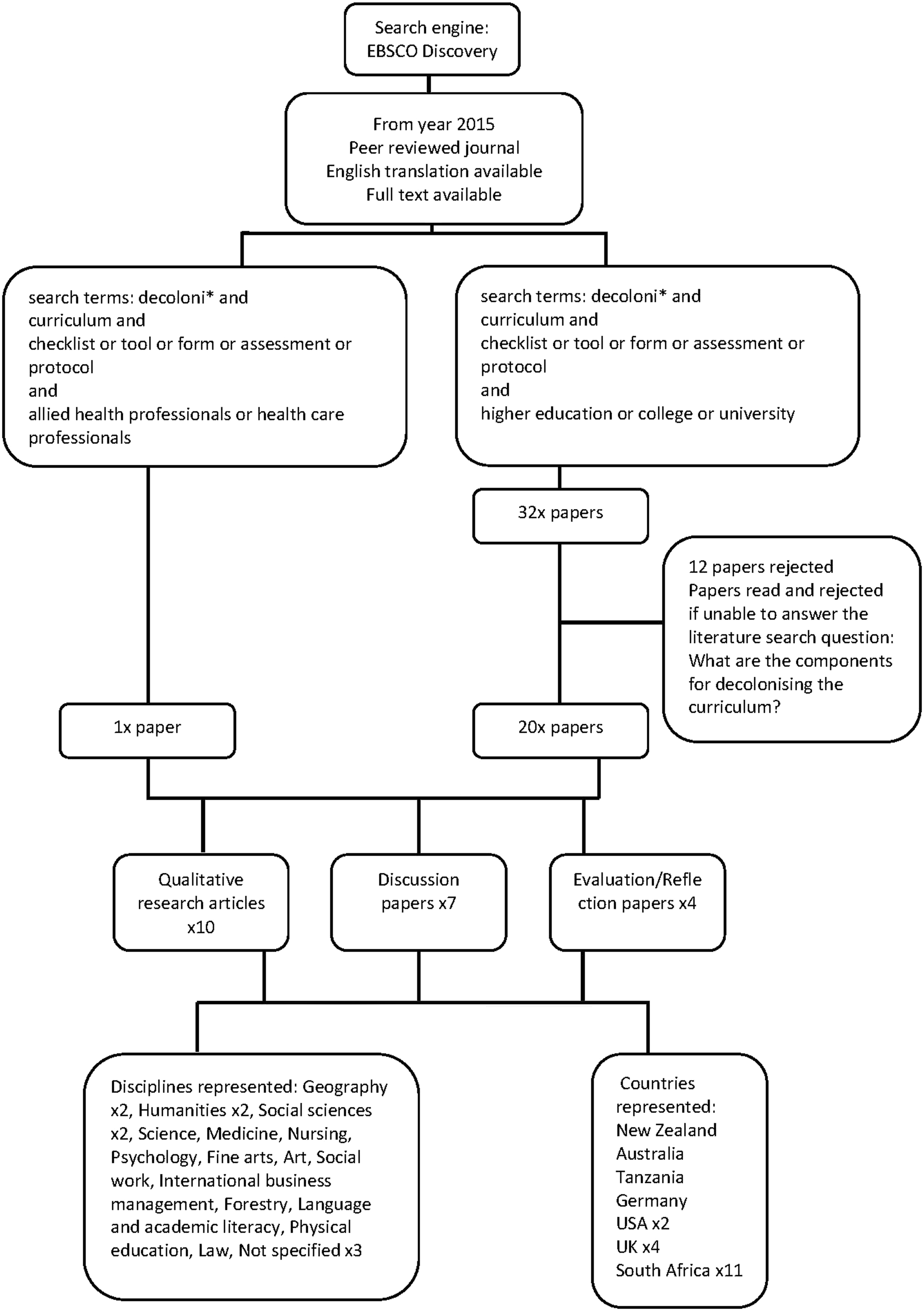
Centring the students
As the framework is for the benefit of students, the author wanted to hear and understand their university experiences and coproduce the framework with them. The author did send out emails for volunteers from AHP students to coproduce a framework but gained no responses. One of the students from RACEG suggested that as the APP project had recently surveyed students across the university through 12 focus groups, it may be worth analysing their reports, as an alternate approach to including the students’ voices. The APP project had set up 12 focus groups with students across the university from under-represented and marginalised groups, to gain their views of university experiences. These groups were facilitated by a hired community research group company. Seventy-nine students attended over all the twelve groups, and twelve reports were compiled by the community research group. The author carried out a meta-analysis of the 12 reports as a secondary plan to centre the students’ voices in designing the framework.
Themes from the scoping review and the meta-analysis of the focus group reports
Themes were identified using Popay et al. (2006) guidance for thematic analysis: -The reports were examined line by line seeking to identify content that answered question (2) from the papers, and answers were noted by using a highlighter pen on the document. -Once this was completed for all the papers and reports, two Excel spreadsheets were produced, one for the scoping literature review and one for the focus group reports. -Each highlighted item was transferred to a separate row, in the first column of the related Excel spread sheet, and then the items from the first column were cut and pasted to group items into other columns on the Excel spread, if they were identifiable as similar in meaning and topic. -Once this was completed, each of the columns was labelled, and this label grouped the items in the columns under a representing category name that summed up the column content of the grouped items. Eight categories representing the outcomes from the scoping review and focus group report thematic analysis.
A total of 18 items were identified from the content of the 21 papers that answered the scoping literature review question, and these were grouped into 4 categories (Table 2, column on left).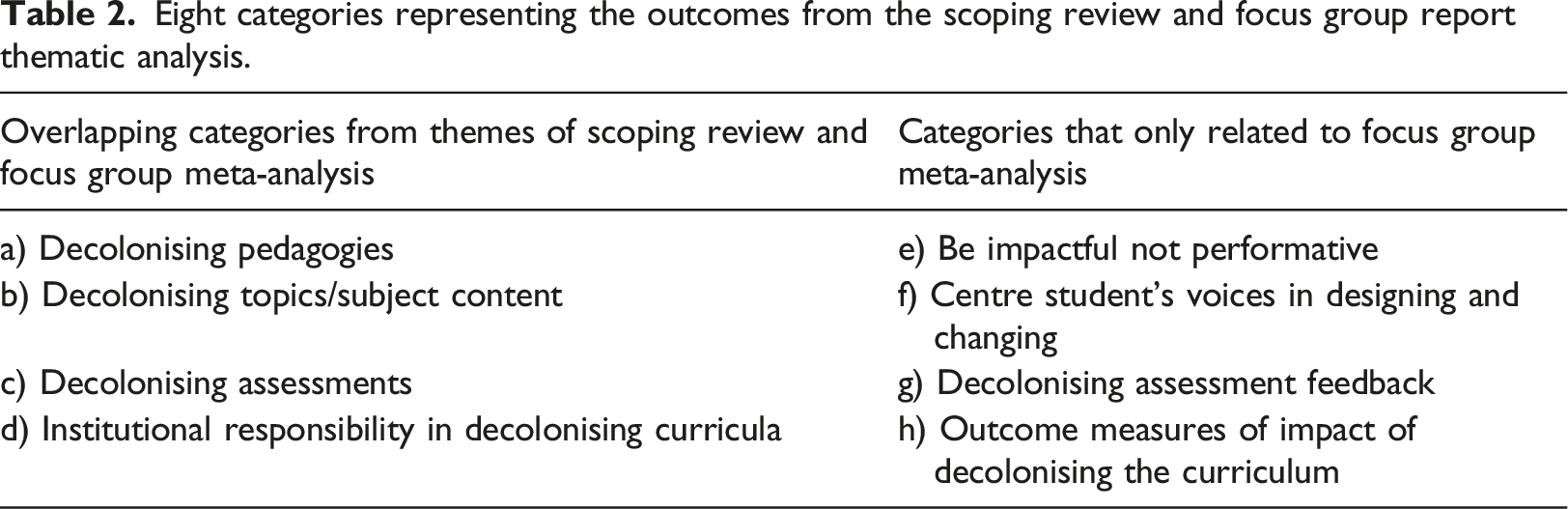
Thirty-one items were identified from the twelve focus group reports which were grouped into eight categories (Table 2). Four of the categories identified here overlapped with the four categories identified for the scoping review. a) Pedagogy (detailing instructional and relational learning practices), an example of decolonising pedagogy is from Paulo Freire's ‘humanising pedagogy' which is about care and support of marginalised students within the learning environment. b) Curriculum (material content and purpose, which imply what counts as knowledge), manifesting inside/outside of classrooms, such as in a course, program, discipline/profession, institution, and/or minoritised community. For example, teaching and learning about race inequality and health inequity in health and social care, and then applying strategies in clinical training placements to promote race equality and health equity in settings (Apple, 2004; Pinar, 2004; Hooks, 1994; Freire, 1970). c) Be more out of the box, innovative and less traditional regarding end of module assessments; for example, why stick to the convention of one assessment method at the end of a module, why not have choice of methods for students (Hanesworth et al., 2019). d) Decolonising the curriculum cannot happen without central commitment and investment in resources and finances; leadership must be on board and it must be part of the strategic agenda ((Kline, 2020); Du Plessis 2021). Prof Leon Tikly (Wilkinson and Zou’bi 2021) describes that decolonising the curriculum is one of the three pillars of decolonising the university, the other two are democratising the university (central supports enabling decolonising activities across the university) and decolonising research (e.g. reviewing grant applications to make sure they are equitable and not exclusionary or coproducing research with marginalised groups). e) The students were very clear that they felt that the university was good at doing the changes that were outward facing; for example, advertising or canteen food representing diversity, that is in their view being performative, but the university was poor at making structural changes, the impactful changes meaningful for them. f) Any change concerning a population should coproduce the change with that population (NIHR 2021). This came through clearly in the focus group reports, in that students would like to be involved in change making. g) Students commented that feedback from assignments appears generic, not personalised and not written in a way that is useful to them as individuals. Glover and Brown (2006) purport that feedback can only be effective if it explains to the individual student how to close, or narrow, the gap between what they have written and the desired goal of the assessment. Feedback can be delivered using different modes; it does not always have to be written. h) In relation to e) students felt that the university did not clearly demonstrate meaningful outcomes that held the institution to account to make changes for under-represented and marginalised populations. Hence any changes in relation to decolonising the curriculum must have meaningful outcome measures to demonstrate impact, for example, measuring belonging which is a precursor for success at university (Pedler et al., 2022).
Decolonising curricula wheel
As decolonising the curriculum is not an end point but a continuous process of monitoring and reviewing to check that the university and curriculum are fit for equity and justice purposes, the author imagined that a wheel-like design would be suitable. A wheel design for an infographic is accessible for humans because it is a recognisable shape in nature, it is symbolic of beginnings, of continuity and of change and it can be a simple-shaped vessel that holds complex information (Hopkins 2009). This idea of making complex information accessible through simplicity is reiterated in GOV. UK’s (2019) page on design principles, although we have to be wary of sound bites or catchy slogans that are in danger of becoming vacuous Figure 2. Evidence-informed framework to guide decolonising curricula.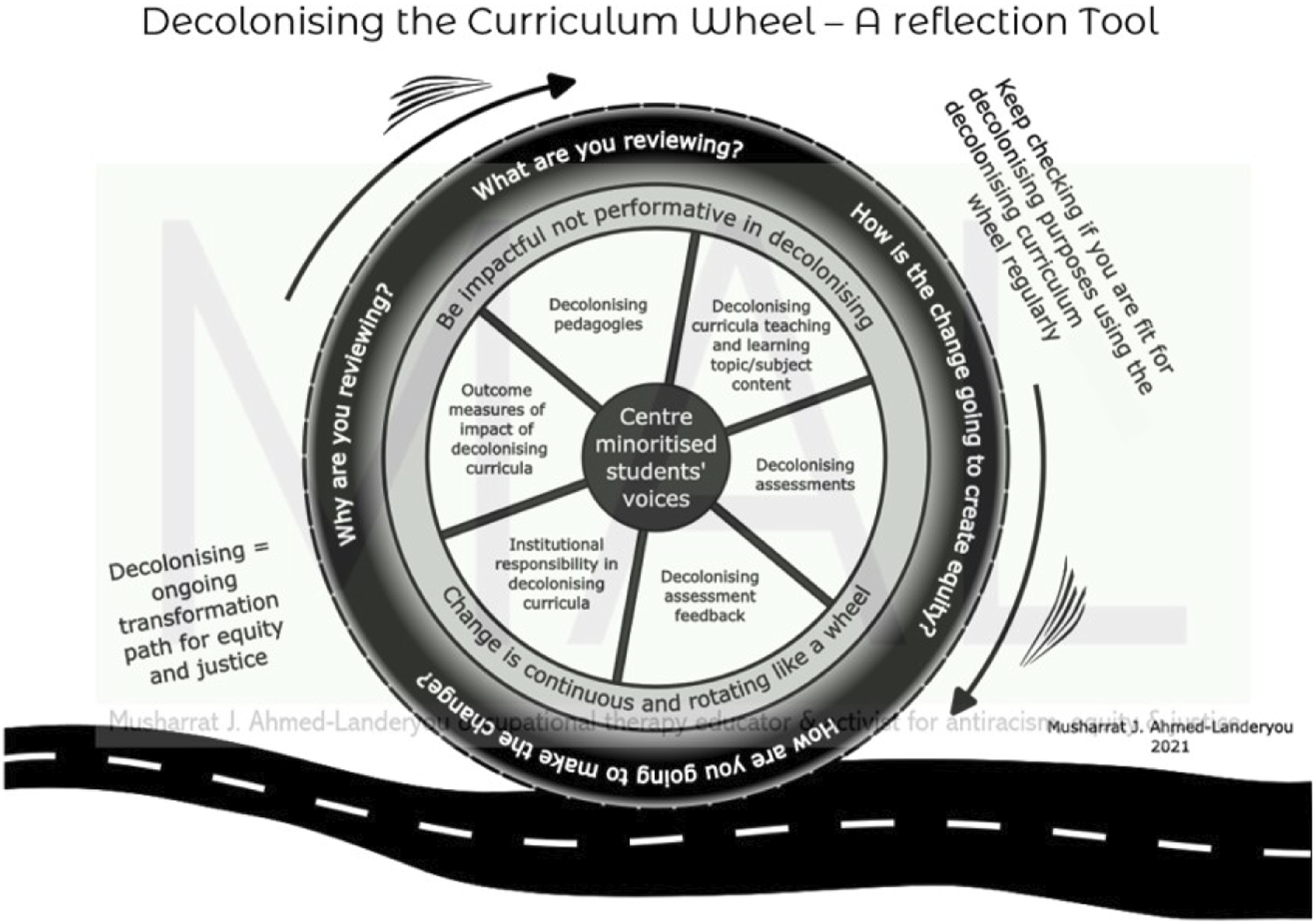
The components of the wheel: -Central lynchpin:
This wheel to assist decolonising transformation should start with the students, category f) in Table 2, their views and working in collaboration for coproduction, not only for development but also for monitoring and reviewing. It is important if students are helping us in this way that they get paid a living wage, to equalise the space of influence, as it is unequal power dynamics if students are the only unpaid participants around the table. -Spokes:
The spokes of the wheel are all categories in Table 2, excluding e) and f), they are the broad areas to deeply interrogate. -Spoke rim:
The rim of the spokes contains category e) from Table 2 and a statement that is a reminder that decolonising the curriculum is continuous, the latter is further supported by the curved arrows to indicate circular motion. -Tyre:
The tyre of the wheel has four prompt questions:- What are you reviewing? Why are you reviewing? How is the change going to create equity? How are you going to make the change?
The message from the wheel design being that a functioning wheel needs all its components to be working successfully for the wheel to be a wholly effective instrument, i.e., effective ongoing decolonising actions.
Initial feedback regarding the wheel
The author has not heard back from all the AHP staff yet.
Ending thoughts on changes and challenges
AHP focus
The process of developing led to use of literature evidence that was not focussed on AHP courses, and the student focus group was not only AHP students. Hence, the wheel developed was potentially for curricula wider than AHP courses.
Coproducing the wheel framework with students
The process of designing the wheel has a limitation in that it was not coproduced with students in real time. This was due to the author’s inability to gather a few students to help with the design; the author had to rely on the focus group reports to centre their voices to inform the content of the framework. The same for settling on the design of the wheel, the author had to decide on the structure to place the content in, instead of being able to design the form of the framework with the students as this would continue with the decolonising approach. After the wheel was designed, the author did share the framework with the students for their feedback, it felt uncomfortably tokenistic and at odds with the decolonising approach. Referring to Arnstein’s ladder for citizen involvement in projects, this kind of activity is identified as consultation and deemed as tokenistic because there is no sharing of the power in the space (Gaber 2019). The author does query whether if the wheel design and or components would have been different if the students were involved in the process. However overall, the students have responded to the wheel positively and are more concerned regarding the overall institution’s engagement in decolonising. Here is a quote from one of the students who gave permission to share their comment: ‘As a student occupational therapist (OT), I will re-apply the methodology outlined in the wheel to guide me in a “decolonising healthcare” values-based approach to my role, when I go into my practice placement 3 and 4 and then as a newly qualified OT……I find the image of the wheel very useful for communicating the dynamic, shape shifting changes that occur during this journey ahead……In the ethical minefield that will come in my daily role as an OT, this wheel will become one of the tools in my tool kit. The prompt questions are very useful clear guides’.
BSc Occupational Therapy course student
AHP staff engagement
The author is still working on gaining better engagement from the AHP staff with the decolonising the curriculum method. This is a long-term commitment, and the author feels that to improve AHP staff engagement, there needs to be visible and regular messaging from the university regarding their focus on transformation through the decolonising method. In writing this article, the author is reminded of Sipos et al.’s (2008) guidance for transformation of education. Head – A framework that unites the students and learning objectives that they can achieve. Heart – A platform to translate passion into action. Hands – Develop and share practical skills.
The author has engaged in the head stuff in designing the framework and must move to the hearts and hands elements of the guidance.
One of the author’s teaching fellow actions is to produce a series of podcasts on decolonising AHP curricula and has produced two episodes which can be found on YouTube. The author hopes this will improve staff motivation and that they hopefully will be encouraged to coproduce the episodes with students. The author hopes this will be connecting with the heart and hands for the AHP staff.
University
The university started with enthusiasm in approving the eight vision statements for decolonising the university, but after this it has gone very quiet since then. The author has had some interesting conversations with two of the professors linked to the teaching fellow and it has resulted in: -the wheel has been agreed to be a part of the university academic curriculum framework and; -a permanent post has been developed for a decolonising curriculum research fellow, and a person is in post now.
The interesting conversations and exchange of ideas with the professors have revived the author’s energy, motivation and curiosity to pursue more institutional-level activities to start embedding the decolonising approach, if opportunity arises, working with the new fellow across the university.
A quote from one of the professor’s on their thoughts about the wheel, permission given to share:
‘The work on the decolonising wheel has been highly impactful by highlighting the cyclical and whole institution components of a successful approach. We are adopting it as the key to our decolonising practice and so it will influence how effectively we fulfil our decolonising vision. Consequently, the wheel has had a deep impact and a powerful impact on our institutional thinking’.
Professor, Pro Vice Chancellor Academic Framework
Conclusion
mportantly to note, is that the decolonising the curriculum wheel framework although it started as a guide for AHP staff, it is not unique for the AHP context as it has been adopted into the university academic curriculum framework. The wheel is not a prescription of how to transform, but a guidance regarding the components to review and explore. In applying the decolonising method, the change process is context bound because the change is linked to the people and disciplines in the institutions, the culture and the policies. In relation to the author’s concerns regarding overall AHP staff engagement, one way of examining the future with them is to monitor and evaluate whether this prompts staff to engage with students in a more authentic manner with concepts of racism in health and social care as part of their decolonising work. The marginalised and minoritised students have to be central in the decolonising work, and this must not be lost going forwards.
This work has been a labour of necessity to disrupt the recycling of coloniality and inequity resulting in comparatively negative outcomes and experiences for under-represented and marginalised student groups in UK higher education. As the author has engaged in the work, they have noted that they are not alone within the AHP course, within the university, nationally and internationally. It is important to know you have a ‘tribe’ that you can turn to, to support, and critique, your work and to exchange knowledge and experiences.
Footnotes
Declaration of conflicting interests
The author(s) declared no potential conflicts of interest with respect to the research, authorship and/or publication of this article.
Funding
The author(s) received no financial support for the research, authorship and/or publication of this article.
