



Abstract
This article investigates the professional status of conference interpreters in Japan, by focusing on interpreters employed as haken, that is, dispatched temporary workers. Combining the perspectives of interpreting studies and the sociology of work, it addresses both internal and external factors upholding interpreters’ status: expertise, autonomy, and authority, on one hand, and social and market dynamics, on the other hand. It provides a thick empirical analysis of status-related factors by drawing on fieldwork data in Japan, including 46 interviews with interpreters and 7 interviews with agency managers. The findings show that internal and external factors intertwine in limiting or upholding interpreters’ status recognition. Despite their expertise and qualifications, conference interpreters in Japan have limited control over their work, because of clients’ expectations of subordination. Furthermore, the monopoly of agencies in the Japanese market constrains their professional visibility. Last but not least, interpreters’ employment as temporary workers and the disproportionate feminisation of the category contribute to societal perceptions of interpreting as an insecure and unrewarding occupation. The findings bear practical implications for the advocacy of interpreters’ status and its betterment in Japan.
Introduction
Focusing on the social and labour context of Japan, this article investigates the professional status of conference interpreters. Specifically, it examines interpreters employed as haken, understood in Japan as dispatched temporary workers. Interpreting research has adopted a sociological perspective to investigate the professionalisation of interpreting and interpreters’ perception of status (Dam & Zethsen, 2013; Sela-Sheffy, 2010, 2016; Setton & Guo, 2009; Tseng, 1992). Most of this research analyses the development of professional status by focusing on “traits,” that is, the internal characteristics that reputable occupations hold in society (Suddaby & Muzio, 2015). Through this lens, which is typical of the sociology of professions, scholars shed light on the relevance of traits as expertise and qualification, autonomy, and monopoly in upholding and upgrading interpreters’ prestige. Their work revealed that in most of the world, qualification requirements are uneven, and skills and role misconceived (Pym et al., 2013). As a result, the interpreters’ professional status is, by and large, insecure (Sela-Sheffy & Shlesinger, 2008).
As Helmer (2021) notes, however, interpreter status also rests upon identity-related aspects, shaped, for instance, by gender and national markets. This observation echoes the sociology of work, which explores the socio-economic and cultural dimensions of labour, thus addressing the “external” factors that come into play in the formation of professional status (Abbott, 1993; Kapitulik et al., 2016). External factors are processes outside a group’s control (Klegon, 1978) and can include the context of work, market dynamics, technological development, and public perception.
Adopting an interdisciplinary perspective, this article integrates sociological interpreting studies and sociology of work, to gain renewed critical insights into the forces that affect interpreters’ social recognition. It argues that combining internal and external factors helps to better account for the “multiple logics of work” (Faulconbridge & Muzio, 2008, p. 10), that is, processes and practices such as employment relationships, which bring to bear on professional status. Because interpreter status is determined by its place in a given society (Choi & Lim, 2002; Kondo, 1988), this article focuses on conference interpreting in the particular and scarcely explored context of Japan, by paying attention to the “local dimensions” of interpreter status. Japan’s interpreting industry is a thriving segment of the language market, worth US$ 8 billion (Yano Research Institute, 2021). In Japan, conference interpreters are mainly haken, that is, temporary workers registered to staffing agencies and “dispatched” to clients. Temporary workers’ activities are regulated by the Worker Dispatching Act, including some basic benefits as minimum fees, bonuses, and commuting allowance. This arrangement covers 80% of interpreting transactions. Clients favour this system because of its reliability, simpler financial settlements, and its fit with Japan’s corporate-oriented business culture (Komatsu, 2017). Although it is possible to carry out interpreting activities outside the haken arrangement by commissioning contracts with direct clients as self-employed (kojin ukeoi jūjisha), it is harder to sustain given the monopoly of the haken system.
This study focuses on haken interpreters because it is a widespread, localised work arrangement which not only provides insights into Japanese interpreters’ status, but also might diverge from interpreters’ typical experience of freelancing worldwide. It draws on fieldwork and qualitative interview data collected in 2015–2017, and involving 46 Japanese conference interpreters, as well as 7 representatives of Japanese language service companies (agencies).
After reviewing research on interpreter status, from the complementary perspectives of interpreting studies and the sociology of work, I introduce the context of the study, and outline the methodological and analytical tools. Finally, I present the findings and streamline the insights gained.
Interpreter status through the lenses of the sociology of professions
Following the sociological turn in interpreting studies, there has been increasing interest in examining conference interpreting as a profession and the role of interpreters in society. This interest was foreshadowed by Tseng’s (1992) theoretical model of the professionalisation of conference interpreting in Taiwan. Drawing upon the sociology of professions, this model applies trait theory (Larson, 1977), which identifies the specific features, or “traits,” that distinguish professions from occupations. Traits include expertise, authority, autonomy, and availability of training and existing associations (Barber, 1963; Goode, 1960). Expertise is the specialised knowledge of a field. Authority refers to the monopoly professionals have over the knowledge of their work. Autonomy indicates that professions exert control over their activities and self-regulate through training, associations, and ethical codes. Central to this model is that traits are “internal dynamics,” the factors a group recognises as valid to attain professional status and societal respect (Klegon, 1978).
The interpreting literature contains a wealth of empirical contributions that apply the sociology of professions to assess which elements signal status among interpreters and stakeholders (Dam & Zethsen, 2013; Gentile, 2014; Hoyte-West, 2020). Scholars agree that interpreting does not fully meet all of the criteria, so the formation of interpreters’ professional status is still incomplete (Sela-Sheffy, 2016). They point to expertise and authority as the first but incomplete signals of status. If the members of a profession control a body of knowledge, that is, if society accords them to determine their expertise, then outsiders cannot dictate what they do, or how they do it (Gorman & Sandefur, 2011). Interpreters are specialised professionals who possess expertise, including abilities as interpreting techniques, performing strategies, and terminology management. Nonetheless, the general public is largely misinformed about what they do. Stakeholders often see interpreters as proficient language speakers, and do not consider interpreting as requiring a specialised knowledge base. Consequently, interpreters are not accorded full status, because interpreting is seen as an activity that any language speaker can undertake (Inghilleri, 2010). This controversial association between interpreters’ expertise and “natural skills” of language also rests upon stakeholders’ perception of any “natural interpreter” (i.e., non-trained/non-certified bilingual individuals) as capable of working like professionals (Angelelli, 2016; Valdés & Angelelli, 2003). This is partially due to the fact that in most countries, there is no licence system or recognition of “interpreter” as a professional title with accompanying qualifications. As Dong and Napier (2016) note, lack of regulation, inadequate screening between qualified and unqualified members, and stakeholders’ ill-conceived beliefs affect interpreters’ status, which remains vulnerable to exercises and losses of authority outside of their control.
Consistent with these observations, scholarship evidences that although interpreters have a strong mandate over their work, their autonomy is not fully supported by outsiders. Katan (2009) and Gentile’s (2014) international surveys show that interpreters perceive their right to exercise control over their work for the benefit of clients and society as high. However, others suggest that stakeholders can limit autonomy. For instance, Albl-Mikasa (2019) notices that clients frequently evaluate interpreters’ performance and output despite lacking knowledge about interpreting processes. In doing so, they can restrict interpreters’ ability to exercise judgement as they see fit, reducing their professional jurisdiction. Similarly, Rudvin (2015) notes that autonomy is undermined by stakeholders’ misconception and depreciation of interpreting as an automatic translation act.
The availability of qualifications criteria has been a central concern for the interpreting field since Tseng’s (1992) pioneering study. It is also a key trait of status by which professions affirm their role in the market, by promoting relevant education at the tertiary and vocational level, by screening members’ entry to the profession, by setting standards of performance, and by creating boundaries between qualified and unqualified (Larson, 1977). Valuing training and accreditations for distinguishing interpreters as educated experts, Mikkelson (2013) and Hoyte-West (2020) acknowledge their benefits in creating a credentialing process that allows interpreters to claim authority, excluding those with substandard performance levels. However, the availability of training alone cannot signal status. As shown by Huh’s (2021) study of conference interpreting users in South Korea and Setton and Guo’s (2009) survey of interpreters in Shanghai and Taipei, despite the wide support for academic training across interpreters and users, the value of training as a unified status enhancer is hindered by competing locally based certifications and recruiters’ beliefs that untrained individuals who are in the market can provide interpreting services.
This alerts us to the fact that the construction of status is not an isolated phenomenon limited to an internal push (Klegon, 1978). A focus on status across regions reveals the extent to which the societal and market context affects recognition. For instance, interpreters’ status rests upon “language proficiency” (as part of expertise), but differently, across the Middle-East and East Asia. In Iran (Fakharzadeh & Kazemi, 2020) and Turkey (Akçayoğlu & Ömer, 2020), local stakeholders consider that foreign-language speakers can interpret, and do not accord special recognition to interpreters. In contrast, in Japan (see Giustini, 2019), language proficiency is a pivotal demonstration of interpreter expertise in the local market, together with interpreting skills; in South Korea (see Cho, 2017; Lee, 2017), language skills and bilingualism are similarly idolised by both interpreters and clients as a fundamental status signal. In linguistically homogeneous societies as Japan and South Korea, “such factors as whether the society is multilingual, monolingual . . . all impact their [interpreter] status” (Choi & Lim, 2002, p. 627), because the foreign-language knowledge at the basis of interpreting activities is by itself valued as a rare commodity. The rich landscape available illustrates that status is a context-dependent construct, and that internal factors can have different values according to the local setting of the investigation. This shows the need to integrate extant knowledge of internal factors, with the analysis of the social (and local) forces that affect interpreting, as I set out to do in the following section.
Interpreter Status Through the Sociology of Work
The sociology of work is concerned with “the social relations, normative codes, and organisational structures that inform the behavior, experience, and identities of people during the course of their working lives” (Vallas, 2018, n.p.). It attends to these dimensions by examining, among others, the “external” factors which affect labour: the organisational contexts of work, market forces, and the distribution of social characteristics such as gender, inequality, race/ethnicity, and technology literacy. While the sociology of professions narrows the exploration of work down to professional processes, the sociology of work takes a wider approach by considering the ways, contents, and structures of work, addressing particularly the extent to which these forces affect individuals (Muzio et al., 2013). This body of research has promoted a shift from investigating the characteristics of professions to studying the dynamics in and around existing professions, including accounts of status experiences (Ackroyd, 2016; Anteby et al., 2016; Suddaby & Muzio, 2015). This section complements available knowledge on internal traits of interpreters’ status with a consideration of the “outside forces” that affect interpreters’ life and recognition.
The sociological debate about external factors affecting status addresses several concerns related to forms of employment. Most relate to the precarious control and autonomy professionals have over their work, when associated with non-standard employment, that is, an employer–employee work arrangement that deviates from continuous, full-time, employment (Eurofound, 2017). Sociological research notes that non-standard employees (such as freelancers and the self-employed) enjoy low autonomy, and thus, limited opportunities and flexibility. However, self-employment (usually referring to independent workers who own a business, and who may perform or delegate the work) is more prominently associated with entrepreneurialism, favouring stronger assumptions of professionalism and status (Burke & Cowling, 2020; Fraser & Gold, 2001; Smeaton, 2003). Gieure and Buendía-Martínez’s (2016) study of entrepreneurship in interpreting and translation indicate that self-employment businesses can act as a proxy for professional success. This contrasts with freelancing, which consists of providing and performing services for clients, directly (the Western sense of freelancing) and/or via agencies. The 2005 and 2009 AIIC global surveys on conference interpreting show a majority of freelance interpreters (9:1, use sign of ratio). Lagoudaki (2006) and Pym et al. (2013) report, respectively, a majority of 73% and 74% freelancers worldwide, likely including self-employed interpreters because of the lack of legal middle ground between the two in many countries.
Freelance employment arrangements also bring to bear on autonomy and status, as underlined by Dong (2017) in her analysis of the UK market of for-profit providers. Generally, interpreters value the flexibility brought by freelancing as a way to enhance their professional independence (Fraser & Gold, 2001; Lee, 2017; Pym et al., 2013). Nonetheless, interpreting scholarship and market reports reveal a tension between the optimistic picture of interpreters as self-determined professionals (Gentile, 2014) and aspects such as lack of control and unsteady working conditions, which are rising in the industry, as reported by the European Language Industry Survey 2020 (EUATC et al., 2021). Sociologists argue that flexible and freelance work, a form of non-standard employment, even if skilled and qualified, is often associated in the social imagination with “hard living,” dependence upon organisations’ and clientele’s expectations, and low regulatory protection (Ackroyd, 2016; Collins & Butler, 2020; Hodgson et al., 2015; Muehlberger & Pasqua, 2009). As individuals who work unpredictable schedules and experience fluctuating patterns of commissions and income, interpreters can suffer uncertain status due to the negative perceptions that society holds towards limited autonomy over work pace and workload, lack of stability, and economic vulnerability (Bögenhold et al., 2014; Pichault & McKeown, 2019).
Ideological discourses about certain jobs may also shape the professional status (Meisenbach, 2008). In the case of interpreting, gender is a particularly important factor. According to the AIIC’s 2008 and 2010 surveys (Zwischenberger, 2009), interpreting is a feminised profession, that is, more than two-thirds of the interpreter population is female. Interpreting scholars have warned about the impact of this gender imbalance on interpreter status, and more generally on the prestige of the profession (Angelelli, 2004). A study carried out by Gentile (2018), which analyses male and female conference interpreters’ perception of their status, shows that women feel their status is less valued by lay people, because gender stereotypes become a qualifier for low prestige and recognition. In their exploration of stereotypes in translational occupations, Shlesinger et al. (2019) explain that interpreter status is challenged on multiple grounds. First, lay society considers interpreting as a derivative task, that is, stemming from another source and individual (message/speakers). Second, interpreting is problematically perceived by outsiders as based on “feminine” characteristics, such as being helpful and supportive of other individuals, for example, users. Sociological research demonstrates that these characteristics, which are typical of service sector jobs, are negatively associated with female stereotypes of “subservience” (Hakim, 2016). Because of structural barriers, women are more likely to be in non-standard employment, including freelancing, and to be over-represented in service sector jobs (e.g., language-based work) with a high temporary contract component (Stier & Yaish, 2014). It is thus not surprising that temporary and service workers, who are mostly female, are categorised as part of a secondary labour market which attracts low professional status (O’Sullivan et al., 2021). Bringing together sociological theories of feminised labour and status helps explain the under-appreciation of interpreting, on the ground that it is a temporary, feminised occupation, “but also by virtue of its seemingly inherent submissiveness” as a service performed for others (Shlesinger et al., 2019, p. 188).
Finally, with the expansion of global information in labour markets, technology has become a key factor that affects status. Professionals strive to resist “technologisation” causing the automatisation, routinisation, and substitution of their labour. This ability is central to claims of professional status (Acemoglu & Restrepo, 2019). Interpreters relate to the use of technology with varying concerns for lowering status and employment insecurity (Mellinger & Hanson, 2018). Fantinuoli (2018) analyses technological advancements, such as computer-assisted, remote, and machine interpreting (respectively known as CAI, RI, and MI), noticing that the interpreting industry is riding these developments to outsource work to unqualified individuals and justify price dumping. The “neoliberal drive” behind these practices can significantly affect the profession, “from the way it is perceived by the general public to the status and working conditions of interpreters” (Fantinuoli, 2018, p. 3).
Although these factors are analysed separately in the empirical sections below, in fact they are interrelated. Expertise, autonomy, training, and authority—internal status traits—influence how interpreting work is constructed and performed. In turn, mechanisms such as work arrangements, technology, and ideologies reify social constructions of interpreter status, influencing how it is externally perceived. In what follows, I pay attention to such internal and external dynamics to explore the status of conference interpreters in Japan.
Study Context: Conference Interpreting in Japan
Japan has a strong interpreting tradition, but a systematic investigation of interpreter status remains to be done. The Japanese case is particularly interesting, because its local, socio-historical, and labour market contexts bear distinctive implications for the professional recognition of interpreters.
Most of these dynamics date back to the Edo period (1603–1867), when Japan pursued an isolationist foreign policy (sakoku), barring relations with other countries. Through interpreters, Japan maintained limited contact predominantly with China, Korea, as well as Dutch traders. In this period, interpreters were lower-rank government officials, subordinate to higher-ranking officials and to feudal authorities. In this system, interpreters were trained and had to pass a qualifying examination. They were hierarchically organised based on expertise and seniority, and their salary was paid accordingly. The role was hereditary, passed onto in male line. However, the powers they served often mistrusted them for mistranslations, bad reputation, and poor linguistic abilities (Sugimoto, 1990). Interpreters were called tsūji (“by mouth”), an abbreviation for “people whose mouth is of service” (Bodart-Bailey, 1999, pp. 201–204). Their role was equalled to a functional, often invisible service. Indeed, in the Japanese imaginary, interpreters are often labelled as kurogo (Torikai, 2009), stagehands employed in kabuki, a traditional form of theatre originating in the late 17th century, to assist actors. Dressed and face-veiled in black, kurogo are meant to be invisible and excluded from the main action. Possibly, the contemporaneous development of kabuki prompted an association between the work of tsūji with that of kurogo.
Throughout the Meiji period (1868–1912) and starting from 1853, when Japan was threatened by warfare by the United States to end centuries of isolationism and establish formal diplomatic relations, interpreters served in Japan’s foreign affairs. As other diplomatic figures, they were called urakata, indicating the custom of being as inconspicuous as possible in negotiations (De Mente, 2011) and expected to be transparent (Shaughnessy, 2015). Thus, historical practices of interpreting in Japan embedded and “localised” the interpreter at the centre of structures of power, sublimated into a partly visible, subordinated figure.
From 1946 to 1948, interpreters served at the International Military Tribunal for the Far East which judged Japanese war criminals. Proceedings developed in consecutive interpreting; simultaneous interpreting was used only when reading out translated documents (Takeda, 2012). The adoption of simultaneous interpreting occurred from 1956, when the US State Department recruited linguistically skilled Japanese individuals and trained them as interpreters in Washington, DC. These interpreters assisted Japanese businessmen and engineers, who toured the United States as part of the industrial productivity programme supporting Japan’s post-World War II economic recovery. Back to Japan in the 1960s, those interpreters founded the first agencies, establishing the industry. 1 Although interpreters often held their role as “invisible” (Torikai, 2009), they attracted considerable public recognition by interpreting for events as the 1969 Apollo moon landing, the 1964 Tokyo Olympics, and the 1970 Osaka World EXPO (Torikai, 2011). In the 1980s, the industry boomed thanks to Japan’s economic expansion. Industry standards were established by commercial agencies and business bodies, for example, Japan Technical Communicators Association, Japan Translation Association, and Japan Translation Federation. Dedicated associations, such as the Japan Association for Conference Interpreters and the Japan Association for Interpreting and Translation Studies attended to the interests of the category.
AIIC presence is scarce (11 members as of 2021). Associations and commercial bodies promote their own codes of ethics. As a result, the governing power of ethics authorities in Japan is dispersed and decentralised, with a variety of indications running parallel in the same domain. These are not harmonised into a national code, and recognition of AIIC standards remains limited (Fukuno, 2020).
In Japan, interpreter training has been traditionally delivered by commercial schools, often owned by agencies. More than a hundred universities offer interpreter education, but “agency” training retains higher popularity as a market gateway. Many interpreters follow a “double-track” (Torikai, 2011), attending both university and agency courses to earn a formal degree together with practical skills. It is vital to note that in the vastly monolingual Japan, despite educational policies, the Japanese have the lowest active skills of foreign language among East-Asian learners, an issue attributed to inadequate teaching and learning methods (Asano & Mochizuki, 2006; Bradford, 2019). Fascination for foreign-language skills and aspirations for career betterment push individuals to attend eikaiwa, commercial schools, to practically develop active language competence (Bailey, 2006). Similarly, honing foreign-language competence through practical (e.g., agency) routes is perceived as increasing chances of occupational mobility among interpreters (Mizuno, 2008).
Interpreting is more often than not a non-regular employment in Japan. It is performed through fixed-term contracts and does not cover social security, pension, paid, and sick leave (Keizer, 2008). Within non-regular employment, interpreters mainly belong to the haken category, whereby temporary work arrangements rest upon a service provision triad: an agency dispatches a worker to operate for a client (1986 Worker Dispatching Act, last revised on 1 April 2020). The Worker Dispatching Act regulates the 26 occupational categories employing skilled workers other than those in regular employment, including interpreting and translation. For these categories, an employment contract with potential clients and companies is concluded subject to the existence of a licenced staffing agency. Interpreters’ relationship with agencies is a precondition for full-time work, as this is available predominantly in the haken category of employment (Houseman & Ōsawa, 2003). Interpreters conclude an employment contract with an agency and register to its pool. The agency regularly outsources assignments and liaises with all interpreter-related, client-facing, and organisational aspects. While this set-up relieves the interpreters from self-marketing, it can also contractually prevent them from registering to multiple agencies (which is legal but effectively limited in practice among haken workers). It can also reduce non-haken opportunities, that is, working with direct clients without the mediation of a staffing agency. In this way, agencies curb potential competition and client-poaching from interpreters. To give an example, Sato (2004) estimates on the basis of the Haken Business Report 2006 that in the early 2000s there were only around 200 freelance conference interpreters in Japan, while there were 6,000 registered haken interpreters. Therefore, although haken interpreting work may not seem unique as many interpreters work through agencies in the West, in Japan the staffing agency largely functions as a vertical and centralised job placement actor, and not as a mere referral service.
Haken interpreters can receive some basic benefits, as a commuting allowance or a guaranteed minimum fee. Their income is set by the agency through fixed fees. Fees increase with performance level, seniority, and type of assignments which are adjusted to interpreters’ “categorisation.” Many agencies categorise interpreters with up to 3 years’ experience using an alphabetical system, from the lowest “C” (sometimes referred as “G,” general), and assign them face-to-face encounters and escorting. The middle category “B” (5 years’ experience) works for corporate and business negotiations. The highest category “A” (10 years’ experience) covers national and international events. Category “S” interpreters (shuu, excellent) specialise in high-profile engagements in medicine, finance, politics, and diplomacy. Concerning interpreters’ language combinations, it is complex to locate comprehensive data. Language service providers included in this study unsurprisingly suggested that English<>Japanese covers most of the demand (around 85%).
Interestingly, almost 90% of haken workers are women (Statistics Bureau of Japan, 2021). Regular employment (mostly the corporate workplace) is particularly challenging for Japanese women’s career development. In the workplace, the ideology of “full-fledged men” (ichininmae no otoko) is strong: men are expected to be breadwinners (Dasgupta, 2013, pp. 44–45). By contrast, women are considered to achieve full adulthood by marrying and becoming mothers. The social expectation that women should quit their jobs after marriage or childbirth pushes employers to negate them opportunities in the occurrence that they leave. In 2020, only 47% of married women went back to regular employment; 53% of Japanese working women were non-regular (Organisation for Economic Co-operation and Development [OECD], 2020). This reflects in the interpreting marketplace. According to the Japan Institute for Labour Policy and Training data (The Japan Institute for Labour Policy and Training [JILPT], 2016), 84% of the interpreting industry is monopolised by women. There are several reasons behind such imbalance. Japanese women invest in foreign languages—a scarce skill and thus a valuable market commodity—to enhance career opportunities beyond Japan’s male-oriented work environment (Kubota, 2011). In contrast to men, favoured by the corporate market, women attach more instrumental value to linguistic competence as a buki (“tool”) that can differentiate them professionally. Professions as interpreting hence become an “effective space for oppositional female praxis” (Kelsky, 2001, p. 87). In addition, as a form of temporary employment, interpreting is societally perceived as an idealised job for Japanese women, who can feel “intellectual, international, and professional” while enjoying “appropriate” work–family balance (Kobayashi, 2002, p. 188). Interpreting in Japan thus runs along a gender-based labour division, where the “casual nature of language work fits in well with typical female biographies” (Cho, 2017, p. 34). This is evident in Giustini’s (2019) ethnography of female Japanese conference interpreters. Her findings show that although women feel empowered by flexibility and self-determination in the interpreting labour market, they remain acutely aware of their position as temporary workers. Their situation reproduces the occupational segregation typical of Japan, where women fill in the more marginal (and precarious) jobs.
Methods and Data Collection
This article is based on a multi-method study of conference interpreting in Japan, conducted between 2014 and 2019. It draws upon fieldwork data, specifically a dataset of 46 qualitative, semi-structured interviews with Japanese conference interpreters (“Group 1”), and 7 semi-structured interviews with language companies’ managers (“Group 2”). The study used stratified purposeful sampling for Group 1 to generate contextually laden data, information-rich cases and thick descriptions (Patton, 2005) of interpreters’ social position in Japan. This sampling logic affords illustrative insights into typical status experiences shared across the affected population (Maxwell & Chmiel, 2014). Purposeful sampling criteria included occupational level, experience, education, and professional membership. These criteria are appropriate for the purpose of this study as they typically serve to distinguish professional from non-professional interpreters. The study included interpreters working in conference settings with at least 2 years’ professional experience, who were haken, formally registered temporary agency workers; who had either qualifications (graduate or vocational training) or “on-the-job” training 2 ; and who had membership of any recognised professional, industry, or academic interpreting association.
Group 1 (n = 46) was composed of n = 40 female and n = 6 male Japanese interpreters, 25–65+ years old, including 12 kikokushijo (the “returnee” children of Japanese expatriates), who were bilingual English–Japanese. Detailed socio-demographic information is provided in Table 1.
Detailed Socio-demographic Information.
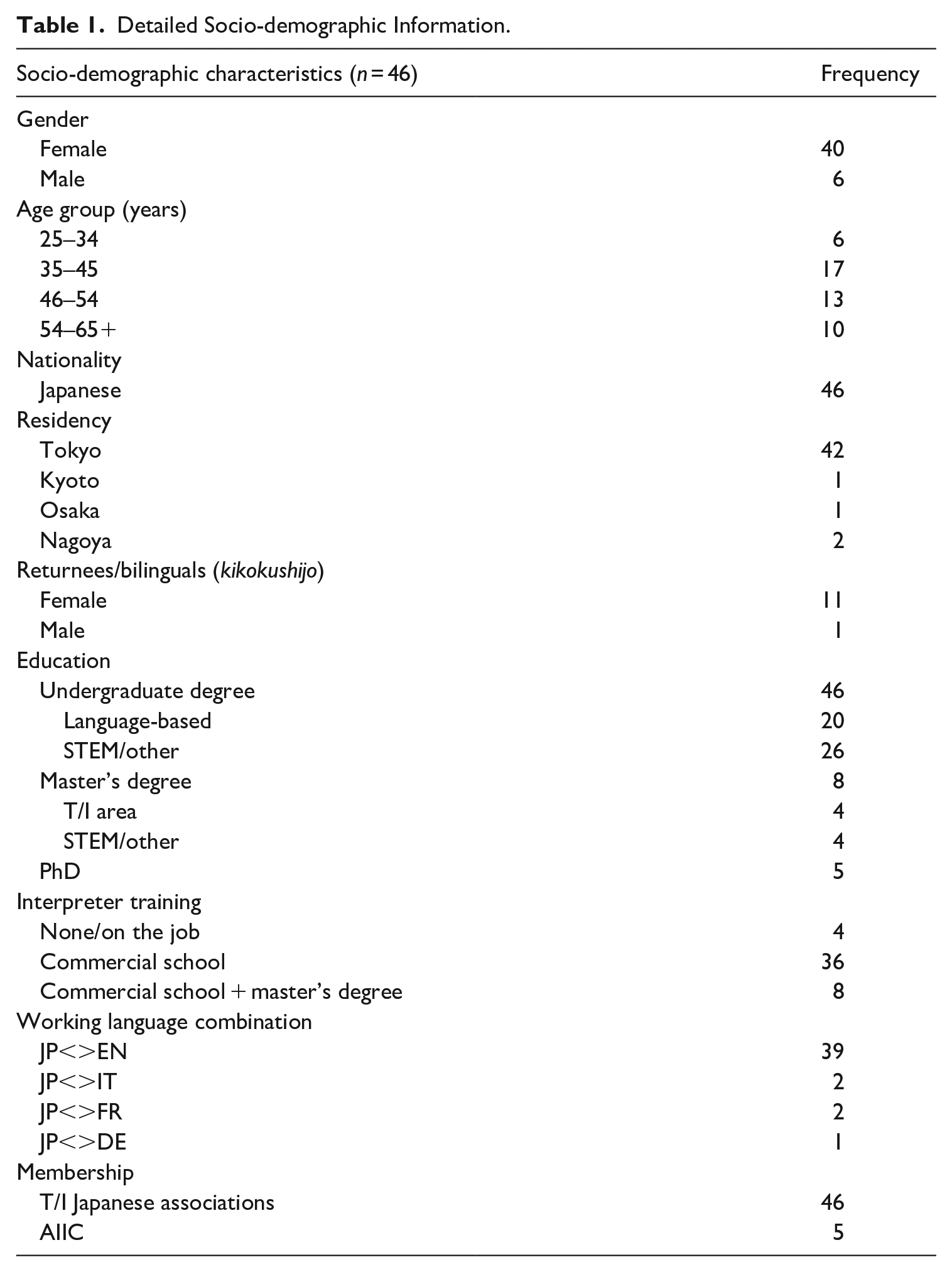
Group 2 included the managers or executive directors (n = 7, 5 male and 2 female, aged 39–83) of 4 language service companies (agencies), which employed most of the interpreters interviewed. Group 2 was also recruited through stratified purposeful sampling, to select market stakeholders with unique knowledge of the industry. Sampling criteria included at least 5 years in a managerial role at a well-established agency enjoying strong industry reputation. Agencies participating in the study were founded in the 1960s–1980s, are affiliated to chambers of commerce, conventions bureaus, and interpreting associations. They offer communication services across high-level settings. Email and in-person contact was established with agencies that fulfilled these criteria. The inclusion of one of the agencies was facilitated by in-person referral through an interpreter from Group 1.
All interviews lasted on average 80–120 min, were audio-recorded and transcribed. In relation to the specific topic of professional status, Four main themes were included in the interpreters’ interview questions: perception of status in relation to society and the labour market; ideological aspects of status; relationship with clients and agencies; employment arrangements. Interviews with agency representatives focused on their perception of interpreters as a professional category, their recognition by clientele and Japanese society, and agencies’ role in shaping status. Social research guidelines were followed (e.g., ethical clearance, informed consent). The study uses pseudonyms and does not disclose confidential, identifying material.
Data Analysis
A digital text format was uploaded for systematic coding to NVIVO by means of qualitative content analysis (QCA). QCA supported a sense-making effort of core consistencies, patterns, and meanings (Patton, 2005) around interpreters’ status. Codes, as the minimum level of script analysis, flowed into categories and themes, for example, of expertise, employment arrangement, and interpreting labour, as lived dimensions through which informants represented status. The analytical process involved going back-and-forth from the codes to the themes, addressing their interweaving until the point of saturation. In what follows, the findings are structured around the internal and external factors that signalled status to informants: expertise, autonomy and authority, training and accreditations, for internal factors, and work arrangements, the role of agencies, the impact of technology and gender ideologies, for external factors.
Internal Factors of Interpreter Status
Expertise
Interpreters’ expertise is generally publicly recognised in Japan. The informants highlight positive societal esteem, linked to lay society’s admiration for the language and technical skills of interpreting. Azusa’s words, a female 50-year-old professional specialised in engineering and nuclear energy, summarise this view:
Everybody wants to be good at English in Japan, to be market-competitive, but they really cannot get it to any real working level [ . . . ] our status is connected to how much society respects this. When I mention to people that I am a conference interpreter, their reaction is sugoii (“amazing”)! Like I am from the outer space. Society in general thinks that we are awesome, very special, talented. Almost 100% of the people ask me “what’s going on in your brain, what’s wrong with your brain, it’s not human to do that.” Especially for simultaneous interpreting.
Given Japan’s low level of foreign-language competence among the general population, interpreters’ status is elevated by virtue of their language skills. These skills are a scarce commodity, which are ascribed business importance as a key to market competitiveness. In turn, status, for many of the interpreters, is positively related to the perception of their expertise as a complex task that seems impossible to perform.
Language competence is an important signal of expertise also in another sense. The informants refer to native speakers (usually of English) to differentiate between bilingual and “ordinary” interpreters. This tension is visible between returnee and non-returnee informants. Kikokushijo (bilingual returnee, literally “returnee children”) interpreters often equal bilingualism with higher interpreter status, as does Kaede, a 64-year-old-female professional with a long international career:
[Interpreting] came so natural to me! [ . . . ] Ours is a higher status that you cannot achieve otherwise [ . . . ] because us bilinguals grew up in different parts of the world [ . . . ] Now, you have many people from normal households who train [ . . . ] they make the interpreters’ status drop, because we do not have anymore those bilinguals to make great interpreters.
The idealised personhood of interpreters is constructed along bilingual skills beliefs, signalling returnees as a “premium” category. This attitude implies that status cannot be fully achieved if not through the socio-linguistic experience of bilingualism (or through the experience of being kikokushijo). This division draws a line between legitimate and less legitimate routes to interpreting that unsettles interpreters’ established professional status.
Of all the kikokushijo interviewed, only 46-year-old Kaoru dispels equating bilingualism with inherent interpreting ability. Kaoru had spent extended periods of her youth and education in English-speaking countries. Before becoming an interpreter, she worked a corporate job, managing communications with foreign partners. However, when she was once called to formally interpret for a negotiation, she failed:
When asked to interpret, I couldn’t do it. I do speak Japanese and I do speak English [ . . . ] Bilingualism is not really, you know, a prerequisite. It’s not a talent. Being bilingual doesn’t mean that you can interpret. It doesn’t make your status as an interpreter.
The popular belief that the interpreter’s status is based upon ideal bilingual subjecthood is invalidated here. Kaoru’s words are echoed by Rei, a non-bilingual interpreter, who unabashedly questions the legitimacy of bilingualism as a basis for expertise and status. When during the interview I asked her about her background, she attempted to engage me as an interlocutor in her criticism:
Maybe you ask, expecting that when I was young I went overseas, and became bilingual, that it was natural that I decided to become an interpreter to make some kind of contribution to cultural communication! It’s not my case, because I had never lived abroad. I learnt English in Japan, at school and a national university. So many people wouldn’t think that I could become a professional . . . or that I am qualified to do this job!
Across interview data, there is a hiatus between the bilingual faction of informants who achieved expertise and status in interpreting because of overseas experiences, and the “domestic” faction who achieved them in the local environment. Although Rei deconstructs the established discourse of status superiority as almost exclusively depending upon (English) bilingual proficiency, it is clear that she feels burdened by her misalignment with the desired image of interpreters in Japan.
This issue of lower or higher status deriving from linguistic authority resonates with Group 2 informants. Godai, a 62-year-old female agency CEO, expects the bilingual skills of returnees to serve as an institutional measure for the quality of the pool of registered interpreters:
After 10–15 years’ experience, our interpreters can be ranked “A.” But sometimes though they’re very fluent, they don’t speak English with a most perfect pronunciation, like our returnees, so they can’t become A, maybe something like A- !
The interpreters’ categorisation typical of agencies is used to differentiate among expertise levels. Given interpreters’ reputation as master foreign-language speakers in Japan, the agency managers often consider bilingualism as a key market asset and an indicator of superior competence. Such practices strengthen the perception of interpreters’ status across hierarchical lines of bilingualism or lack thereof.
Authority and autonomy
Despite celebratory discourses of language competence most stakeholders in the Japanese labour market do not grant expert status to interpreters. This issue emerges as lack of recognition of interpreters’ professional authority. Group 1 and 2 informants feel that stakeholders do not grant interpreters authority because of the socio-cultural understanding of their role in Japan, which echoes the long-standing metaphor of the invisible interpreter. Kanagawa, a 57-year old agency manager, uses the expression urakata (“scene shifter”) to indicate this:
There’s a word to indicate interpreters’ status, urakata or “people in the backstage” [ . . . ] that don’t come out on the stage, who prepare the stage where principal actors perform. So they’re [ . . . ] always second to the client.
Interpreters are expected to keep their authority in the background, meaning that their professional status becomes invisible against stakeholders’. This placing contributes to generate a wider status asymmetry between interpreters and clients which, as Kaoru comments, is partially built upon tacit norms of behaviour, established by the dominating position of users:
There are unwritten rules. You have to demonstrate that you know these . . . business practices. Like if you get a taxi, who will get in first? The client or . . . ? It’s not written, but you’re expected to know. If you don’t know it, they’re not going to like you, to trust you. Knowing your status, that’s very important, almost as important as the skills of interpreting.
The interpreter–client relationship is forged on asymmetrical expectations about authority, which lower interpreters’ status. Complying with clients’ business practices is critical to the overall service delivery, but this asymmetry is exacerbated by limited recognition of autonomy. Autonomy emerges as interpreters’ ability to exercise their expertise during the actual performance. In contrast with clients who are elevated as autonomous experts in specific disciplines, many informants lament—see below Tomomi (33, female), Haruka (49, female) and Terumi (53, female)—that interpreters’ status is limited by assumptions of non-autonomous work:
Clients are experts—engineers, managers, economists—some people think [ . . . ] we are not high in the hierarchy [. . .] you just translate what I say. Everybody knows what a doctor does [ . . . ] How many really get what’s to be an interpreter? Clients [ . . . ] can’t fully put the finger on our skills as something specific. Since we work with the spoken language they’d think the product of our work also is not tangible. Maybe that’s why we get such low status recognition. Clients tend to think that the “product”—the interpretation—is just a verbatim repetition.
Interpreter status is limited by clients’ inability to recognise autonomy. This inability is composed of several layers, some of which contradict informants’ assumptions about the ways society perceives them. First, clients’ lack of awareness of the tasks and complexity involved in the interpreting process reduces interpreters to foreign-language speakers. While the Japanese society looks up at interpreters as rare foreign-language speakers, the clients do not elevate their status only by virtue of this competence. The interpreters attribute their low status to the clients’ failure to identify interpreting as material, tangible, original labour. As a result, the interpreters feel that their status cannot be linked to a specific area of work, indicating lack of autonomy over knowledge.
Notably, the lack of autonomy and authority pushes interpreters to feel as “professional inferiors.” This is evidenced in the following extract, in which Azami, a female interpreter with more than three decades’ experience, comments that her clients seldom respect her expertise:
They act as they do not trust interpreters’ knowledge, or feel they can give their opinions on the interpretation but are not communication experts [ . . . ] We try to make them understand [ . . . ] “please treat the interpreter as you would treat an executive.”
Thus, interpreters consider that their autonomy is comparable with that of their clientele, but recall that clients often disrupt their autonomous working activities and undermine their professional authority. Ironically, as Azami remarks, the clients often lack the professional authority to adequately judge a work for which they have no expertise.
Many informants share concern regarding the symbolic unequal status between interpreters and clients. Manabu, a 50-year-old male interpreter who discussed at length issues of identity in the Japanese interpreting community, links low status appreciation to the use of specific honorific suffixes:
Interpreters have pride, they have a history. But that’s what they think inside themselves. Clients consider them as “interpreters.” They are not called sensei [ . . . ] even though they feel they should be treated as sensei, they’re just called tsūyaku-san.
Honorific suffixes are used in the Japanese language when referring to others in a conversation. They are attached to the end of surnames or names, indicating the social level of the speaker. Sensei is an honorific, formal suffix used for some professional figures of authority (e.g., doctors, teachers, lawyers, and politicians), or for respected technical and artistic mastery (e.g., that of novelists or musicians). While both meanings can be attributed to interpreters, clients address interpreters with the respectful but generic -san. This is the most commonplace honorific, used among adults of equal status, including on informal terms. In contrast with sensei, -san has the simpler, less formal, and more anonymising meaning of “Mr/Ms interpreter” (tsūyaku-san) and does not carry implications of professionalism.
In sum, interpreter status in Japan is affected by stakeholders’ behaviours, which symbolically construct interpreters’ work in a way that limits their authority and autonomy. These dynamics reflect the points of tension between interpreters’ appreciated roles (as elite language speakers) and negative experiences of under-appreciation, with acute repercussions for professional status.
Training and accreditations
Training and accreditations are ambivalent internal signals of status. In Japan, despite many academic interpreting programmes, interpreter training is held predominantly by agencies’ schools. Among informants, there was consensus about academic training as an under-functioning signal of status in the Japanese industry. This is reflected in the experiences of eight informants, who had earned a master’s degree but also attended a commercial school. In the following excerpt, Rika, a 37-year-old female interpreter, recollects her struggles around developing a sense of professional status during her academic training:
The first university months were OK, but then I realised I wasn’t going to get to any professional level. I started looking at commercial schools to get market-accepted recognition and intense practical training [ . . . ] After that I could see that I was going to be a professional interpreter and registered in their pool.
This example gives insight into interpreters’ perception that “agency” training promotes status through certification of practical competency and easier market entrance. According to several interpreters, trainees who successfully complete the required programme can be directly registered by the school’s affiliated agency and be provided with work opportunities. As it emerged on fieldwork, this practice is widely known in the Japanese interpreting industry, as agencies prefer to hire the best graduates from their own schools.
Another frequent mention concerns postgraduate degrees in interpreting. Five informants with a PhD who combined interpreting with part-time teaching, think that higher academic qualifications do not enhance status. Rather, as Rei comments, it is a means for resolving their own employment insecurity:
I decided to do something for myself, because being an interpreter, you don’t get much societal recognition. I thought that it would have been interesting to teach at university, because being an academic here is just among the best positions. So I did a PhD in interpreting, and I took a job offer at the same university.
This insight shows that academic qualifications can connote status by allowing interpreters to join a wider occupational hierarchy filled by jobs enjoying higher social prestige. These instances can be paired with a disinterest in professional accreditations. Judging from the interviews for this study, two-thirds of the interpreters do not link status recognition and employment enhancement in Japan with accreditations. Kotomi, a 36-year-old woman, discusses, for instance, that AIIC membership in Japan is rarely recognised:
AIIC is not well-known in the Japanese industry, many would just say “oh, what’s that!?” They don’t really care! Because [ . . . ] there are several agencies here in Japan [ . . . ] which give you assignments and extra benefits, they don’t really need to be part of any association to get those.
As in the case of training, the dominance of the agency model and the perception of this business practice as conducive to commissions and overall satisfying working conditions, suggests lack of incentives to join dedicated organisations as a route for gaining status recognition.
External Factors of Interpreter Status
Work arrangements
The professional profile of interpreters is framed through a combination of external factors, such as satisfactory employing conditions. When in the interviews we would speak about status experiences, the interpreters identified various external dynamics affecting their role, the most common one being interpreters’ employment arrangement. As previously noted, all the interpreters in this study were haken, temporary agency workers. They enjoyed this employment arrangement because it guaranteed a degree of flexibility in their working life. However, the most enumerated negative aspects were a constrained work–life balance and a low control over work pace. Take the case of Tomoyo (44-year-old, female), a highly quoted interpreter:
I work almost at any time during the day or night, including business trips and requests for video-conferences. I’m very busy but I wouldn’t refuse work. You never know when it comes in. If I work like this, I make quite a lot of money.
The experience of being temporary haken workers and not knowing when and how much work can be secured, imply that interpreters can feel compelled to accept requests. In spite of positive status signals, such as a steady flow of assignments and income, most informants list the negative aspects of temporary work. This emerges in the interview with Azusa, a 50-year-old woman who states that temporary employment negatively affects status:
We [ . . . ] don’t have much of a safety net. If we don’t work, we get nothing. And if you get nothing, what professional status can you say you have?
Perceptions and experiences of precariousness given by temporary work are considered a disadvantage for professional status. The misconstruction of interpreting as financially insecure, despite the high income the activity can afford to professionals, has adverse consequences on interpreters’ livelihood, as highlighted by 54-year-old Michiko:
In Japan, stability is most important [ . . . ] sometimes you can’t get a loan with a bank. Interpreting jobs are not really well recognised in this society, so they don’t know how well interpreters can be paid, and you cannot prove it, because [ . . . ] it’s not fixed income, even if you earn more than a kaisha-in (“company worker”) [ . . . ] when it comes to financial factors, we are not considered high-status professionals.
The importance of the “company” emerges continuously in interviews. To contextualise the interpreters’ stories here, it is important to clarify that Japan has a distinct employment tradition. Japan’s post-war economic miracle led to the development of the lifetime employment system. In return for stability, employees ought to show allegiance to their company. The company for employees functions almost as a familial kin, with lifelong bonds and the sharing of best interests (Allison, 2012). Where an individual is employed thus is central to professional identity construction in Japan: this is encapsulated in the widespread use of meishi (business cards) that showcase company before personal information.
3
As haken, interpreters have an individualised, rather than a corporate professional role. Asao, a 67-year-old male informant, explains this conundrum:
We don’t belong to any company, we identify with our profession. That’s not entirely good for our status. That’s to do with the Japanese system [ . . . ] group identification with your company, and 100% dedication to the company until you retire. If you’re not part of this system, you’re just yourself, thus you’re nobody.
Lack of a sense of belonging implies fragmented status experiences. In contrast with the regular workforce, protected by business and labour associations, interpreters in Japan do not enjoy protection or national regulation. Many informants, as 42-year-old Sachiko, complain about the lack of a collective bargaining institution to advocate for their own status experience:
We don’t have a licence system, or a government-recognised national accreditation, or associations granted real regulating or bargaining power [ . . . ] As a result our status is deprived of recognition and appreciation.
In turn, Group 1 and 2 informants agree that agencies are collectively controlling business practices in the interpreting industry. Agency manager Nishiyama (46, male) describes these arrangements:
Interpreters rely on agencies as a matter of business manner [ . . . ] The agency comes face to face with clients [ . . . ] We don’t expect interpreters putting themselves onto the stage. We organise the market—we acquire contracts from clients and direct interpreters [ . . . ] playing a critical role as an indispensable go-between.
Agencies organise the work of interpreters, by managing the industry against Japan’s corporate-oriented business culture. Agencies act not as neutral intermediators, but as dominating agents between the suppliers and service requestors. The agency-based system and its organisational imperatives, additionally, affect considerations of interpreters’ status and cast a shadow over their visibility in the market. Agencies relegate interpreters to the role of task performers, expecting them to downplay their status in favour of the dominating roles of agencies and clients.
Technology
Favoured by a background of neoliberal policies intensified by bouts of economic recession, the Japanese interpreting industry has embraced digital practices and remote interpreting work to contain costs and enhance productivity. According to many informants, this increased “technologisation” is one of the most worrisome developments for their professional standing, especially when coupled with assumptions of replacement of interpreters’ role. Compare the views of Sachiko (42, female) and Madoka (52, female), who engage with the relationship between technological innovation and status in the following way:
People around me think that I am in a very status-unstable profession and that I could be replaced by any app or smartphone. Many people say that translation machines will automate our job. As long as human beings talk to human beings, things as the speaker’s intentions or emotions in the message, will go outside the scope of any technology. This does not mean that the perception of our status will not be somewhat lower.
The impact of technological change on status emerges in discourses of substitution, de-skilling, and task automation. Although some informants are more optimistic, most worry about the risks of a continued narrowing of their role in favour of technology, and a potential shift in professional status. As a protection mechanism, informants legitimate and protect the interests of the category by remarking the superiority of their human expertise to challenge fears of technology-induced employment insecurity.
The downward pressure of “technologisation” is evident also in Chisato’s words (female, AIIC), who questions the lowering working conditions offered for remote assignments:
It’s becoming more of a mass work and status, and that’s very sad. With platforms, clients want you to interpret off−site and agencies assign work for very cheap rates. I don’t like it, but you know, we are a mass communication market.
Chisato discusses the uneasy alliance between increased digitalisation and outsourcing work to a “mass” of interpreters to meet increased consumption needs, as the industry feeds these developments to accommodate a broader market. For most of the informants, this tendency devalues status through uncontrolled commodification of interpreting services and working conditions.
Gender ideologies
Finally, the relationship between gender and language work is a pivotal external factor affecting status. Japan’s interpreting industry, in which women account for an absolute majority, embeds promises and constraints for both female and male informants.
Gender ideologies manifest in a variety of ambivalent perceptions attached to the societal evaluation of interpreter status in Japan. Very commonly, informants suggest that it is affected by assumptions about communication work. Manabu (50) comments how interpreters’ status collides with socio-cultural gender stereotypes regarding spoken languages:
Working with spoken languages has a lot to do with the societal evaluation of our profession here in Japan [ . . . ] interpreters can perform [ . . . ] only by speaking. People insist that women, who are for nature inclined to speak all the time, can chatter away and can interpret.
Interpreters’ skills are naturalised and devalued as female predisposition for “chatting,” rather than recognised as a professional ability. The gendering of interpreting as a female task further equals it to implications of submissiveness and servitude. Many female interpreters, as Kumiko (43), Fuyuko (27), and Michiko (54), discuss that gender characterises their status experiences:
Interpreting is seen as subordinate work, you cannot take real initiatives or leadership, you are the voice of someone else. Subordinate to clients, a kind of posh secretary. There is a general belief that women can be interpreters [ . . . ] because we are used to serve in the house . . . clients are predominantly male in my experience, so it’s like women “serving” clients through linguistic assistance.
These examples show that interpreting labour is gendered by attributing the “paternity” of productive speaking work to (male) speakers and the “maternity” of reproductive translation work to (female) interpreters. Furthermore, interpreters’ reproductive work is associated not to professional authority, but to Japanese women’s traditionally expected domestic role, implying caring abilities, revealing a gap between the status attributed to male clients as professionals in dominant positions of power, and interpreters as a lower category of female assistants.
Low status perception is exacerbated by gendered practices crosscutting from the corporate to the interpreting environment. In Japan’s corporate employment, the predominantly male managerial career-track (sōgō-shoku) is juxtaposed to the mainly female generalist-track (ippan-shoku). Women are queued by employers on the latter on the assumption that they will show lower commitment because of marriage and maternity. On this track, women mainly engage in pink-collar tasks (e.g., secretarial work) as “office ladies” (OLs). Matsu, a 74-year-old male “pioneer” interpreter, comments that female interpreters in Japan are often paired to office ladies:
Many female colleagues have had such ignominious experiences of being called to serve tea at conference backstage or meetings. So low is the status of interpreters in this country, that they’re treated as OLs.
Workplace customs in Japan dictate that office ladies engage in ochakumi (“tea-pouring”), which emphasises their subordinate position within the organisational and male hierarchy. While it is not possible to generalise ochakumi practices in the interpreting industry, the experience reported by Matsu shows that interpreters’ status is gendered and ritualised in deferential acts to clients—here, serving tea—where the nature of the task recalls women’s peripheral position in the workplace.
Almost all of the female informants comment that the feminised nature of temporary employment in Japan affects the status of both female and male interpreters. The account of Rika (32) retraces the bitter dichotomy between the male biography of regular employment, and the secondary role of women living at the margins of the labour force which is typical of Japan:
Men don’t like interpreting because it’s [ . . . ] haken employment. How could they justify being temporary workers rather than respected salarymen? But for women being haken it’s fine, so you can still work and take care of domestic duties.
This dichotomy relates to societal perceptions of the profession as appropriate for women. The temporary nature of interpreting is seen in Japan as an opportunity for women to step into the labour market in their otherwise restricted abilities to maintain regular employment, but also as a way to follow normative expectations of the female life course. This view is turned upside down in the case of male informants: temporary employment is considered inappropriate for men, who are instead expected to pursue a stable, corporate working life. Toshio, a 51-year-old male interpreter who lectured part-time, sheds light on how status intersects with normative constructions of gender which are at odds with masculinity:
I was told, you are a fool, doing this job, you’ll not get any opportunity for climbing the ladder, getting senior positions as men do in a company [ . . . ] I have the chance to think about it now and I could never justify that I was a temporary rather than a respected regular worker. I simply love interpreting, but I was considered a re-speaker of more successful men. I didn’t enjoy the suffering of such misunderstandings.
The absence of a standard career ladder in interpreting, which is typical of men’s trajectories in regular employment, resized Toshio’s aspirations. In Japan, interpreting does not conform to ideals of masculinity in the labour market, where men are socially expected to pursue job security. Furthermore, the gender stereotype of “servitude” impedes male interpreters’ recognition as independent, authoritative professionals. In the predominantly female profession of interpreting in Japan, both male and female interpreters face extreme bias, which hinder the process of professional status recognition along gender lines.
Concluding Discussion
This study integrated the insights from interpreting studies and from the sociology of work to contribute an understanding of Japanese haken interpreters’ professional status. This approach identified the internal factors—expertise, autonomy, authority, training—by which Japanese interpreters signal status. It also distinguished some external dynamics—technology, gender, work arrangements, and relations with stakeholders—as the social forces that influence status. This theoretical integration helped explore the circumstances of interpreters within the context of Japanese society, and to analytically frame their status experiences, by paying attention to the combination of professional criteria and the dynamic ecosystems where interpreters move.
Interpreters’ status in Japan is distinctive. In spite of a host of internal factors that identify them as a professional category, status tends to be low. The reason is found in the presence of social and market factors typical of the Japanese context.
In the repertoire of Japanese interpreters’ status, expertise features as a significant but contradictory internal factor. From one side, interpreters enjoy an idealised personhood as elite language speakers in a monolingual society, to the point that bilingual interpreters are held in the highest esteem as they embody the “premium” status image of the category. However, this admiration does not live up to full recognition. Clients do not fully acknowledge interpreters’ expertise, because they consider interpreting as an activity which any linguistically skilled individual can perform, and which produces intangible, non-original outputs—“repeating” the original message.
Previous research similarly identified wrongful assumptions of linguistic skills as a sufficient ground for interpreting (Angelelli, 2016; Valdés & Angelelli, 2003), where additionally “the element of reproduction which [interpreters’] work inevitably involves is difficult to reconcile with the[ir] image [ . . . ] as highly skilled, responsible and autonomous specialists” (Dam & Zethsen, 2013, p. 255). Previous discussions of interpreting in Japan suggest that interpreters are often considered as “mere hearing and speaking machines,” whose status has low value beyond the ability of communicating in a foreign language (Kondo, 1988, p. 71; Kondo & Mizuno, 1995). My study contributed a significant element to this discussion: Japanese interpreters are not accorded full status because they lack a clear role defined in terms of topical knowledge and disciplinary area. This might explain the asymmetry between society’s admiration for interpreters, and stakeholders’ sizing down of their expertise. For the lay Japanese public, interpreters serve as a quintessential case of a scarce ability (foreign-language competence). Nonetheless, interpreters’ expertise is downgraded in the relationship with stakeholders, who boast a more concrete skill-set which is easier to grasp in the collective imaginary.
As regards training, and how it brings to bear on status, it is surprising that academic training was not a tangible status signal, despite the fact that many informants had completed a university programme. Participants attached value to academic credentials for the occupational mobility opportunities they yield beyond the interpreting industry, and favoured agency affiliated schools for their practical orientation and market gateway role. This should raise concern for the professionalisation of interpreting in Japan, as academic education ought to enhance status within the profession, rather than acting as a cross-mobility tool.
These findings run counter to previous studies, which argue that the academisation of training fortifies interpreters’ status (Gentile, 2014). They seem in line, however, with investigations of interpreting in East Asia (Chen, 2009; Huh, 2021; Setton & Guo, 2009; Takeda, 2012; Torikai, 2011), where attitudes towards academic qualifications for raising status remain mixed, because commercial training and government-run accreditation programmes have a strong signalling power. Similarly, the informants did not attach particular status value to accreditations. Previous studies suggest that interpreters favour them as a mark of difference between professionals and amateurs (Gentile, 2014; Hoyte-West, 2020), but the dominance of the agency model in Japan limits incentives to join professional organisations for gaining status recognition.
In addition to “paradoxical” internal traits of professionalisation, interpreters’ status is complicated by external factors tied to the local conditions of Japanese society. Employment arrangements play a most significant role. Self-employment and freelancing significantly affect status in the translation professions (Koskinen & Dam, 2016; Pym et al., 2013), but the case of Japan is distinctive because of its local, cultural specificities. In this regard, the study identified two threads: haken work and lack of workplace affiliation. The social exclusion that accompanies temporary work in Japan negatively reflects on interpreters’ status. Under these conditions, interpreters also suffer from lack of an organisational identity. They are assigned to work for clients, but are not employees—a key factor in the identity-making of many Japanese workers—and thus lack a concrete sense of professional belonging. This arrangement is largely controlled by agencies, which enjoy an effective monopoly over the interpreting industry thanks to the Worker Dispatching Act. Agencies are not merely a broker party, but fulfil a primary role that organises and monitors interpreting practices, in turn influencing interpreters’ status. They showcase a public role, while interpreters are overshadowed as a less noticeable manpower.
Previous research reports that agencies are effectively interpreters’ “third client,” and can create dilemmas for status by giving “dos and don’ts” which restrict interpreters’ role (Dong & Turner, 2016; Ozolins, 2007). Although scholars concluded that interpreters across regions show increasing dependence on agencies (Best, 2019; Dong, 2017), there is usually a looser relationship, as interpreters can gain work opportunities through multiple channels. In sharp contrast, haken interpreters in Japan are tied to their agencies for job allocation, pay, and status conditions. My study corroborates Komatsu’s (2016) discussion of agencies as norm- and partially status-setters in Japan’s interpreting industry. This dimension becomes more threatening if we consider that Japanese interpreters had an ambivalent view of industry trends, as evidenced in their perception of increased technologisation. While these concerns parallel previous studies, where interpreters worldwide fear the impact of technology over their work quality and expertise (Fantinuoli, 2018; Pym, 2011), Japanese interpreters were concerned by the consequences that this shift could have on the perception of their professional status.
Unexpectedly, agencies oriented interpreters’ status also in relation to invisibility. Agencies promote discourses (backstage-person) and actions (affirming monopoly) which impede the interpreters to fulfil a speakership role that could shadow clients’ power. This finding reminds of the metaphor of the “conduit” interpreter, or allegations of invisibility constraining interpreters’ role (Angelelli, 2004; Roy, 1993). However, there is a relationship between invisibility and status tied to Japan’s historical practices of interpreting, which predates and deviates from the Western, academic discourse of invisibility. This discourse usually locates invisibility in the post-WWII shift from consecutive to simultaneous interpreting, as well as the domestication of interpreters’ role in codes of ethics (Wadensjö, 2011). As above-mentioned, interpreting in Japan followed a different trajectory, which better explains status invisibility. Interpreters’ characterisation as the functional “mouths” of higher powers might have normalised their status as inconspicuous and shaped interpreters’ status differential with clientele and agencies, as the later “higher” powers organising their labour. Professional networks in Japan involve a high degree of status differential according to traditional lines of seniority and superiority (as also evinced in the use of honorifics) (Ikeda & Takemoto, 2016) and interpreters’ status might be framed within this dynamic.
This finding also has gender implications. Historically, interpreting in Japan was a male profession; its feminisation can be attributed to post-war labour reforms and the ensuing gendered division of labour. Corporations started to offer lifetime employment in exchange for male employees’ loyalty, while women were expected to be homemakers. This probably caused a shift in the gender composition of interpreting, given its nature as a temporary occupation at odds with rising ideals of Japanese working masculinity, but meeting women’s aspirations of flexibility. In contrast with Gentile’s (2018) study results where female interpreters bear the most pessimistic societal acknowledgement of status, Japanese female interpreters seemed to suffer slightly less negative status than men, because in Japan interpreting is an appropriate temporary, “caring” work for women catering clients’ linguistic needs. However, it remains mostly undesirable for any workers other than women, who are already pushed to the margins of employment.
Thus, the international and the Japanese market present similarities and differences concerning status. While both show similar constraints to the internal status traits of expertise, autonomy, and authority, they differ in terms of training, accreditations, and bilingual competence. The peculiarities of the Japanese market (temporary work arrangements, gender stereotypes, and asymmetrical relations with stakeholders) show that interpreters’ status is, to some extent, tied to socio-culturally specific external factors. Future studies should take this into account for more targeted findings.
The study presents some limitations. As a qualitative endeavour which provided thick descriptions of Japanese interpreters’ status, it cannot generalise its findings to other settings, for example, in-house interpreters, whose status experience would imply a different combination of factors. Qualitative research rarely uses probability sampling and supports inference from non-random samples according to population specifics and research objectives (Maxwell & Chmiel, 2014; Schreier, 2018), so this study remains empirically meaningful because it targeted concrete signals of status in a specific community. However, it calls for further qualitative studies within and beyond Japan, and for quantitative research, to measure status variations. This study bears practical implications for the advocacy of interpreters’ status. Adequate agencies’ communication of interpreters’ role and client guidelines on interpreters’ credentials might debunk unfavourable assumptions of interpreting as gendered and unsteady labour, potentially improving interpreters’ status recognition as a whole.
Footnotes
Acknowledgements
This paper was first developed within the context of the Satsuma/Konishi Chair of lecture series at the KU Leuven. I am indebted to my colleagues and to the students at the Department of Japanese Studies for their support throughout the steps leading to the writing of this article. This paper and the research behind it would not have been possible without the participation of interpreter informants and their invaluable insights. I am also grateful for the comments offered by the anonymous peer reviewers and for the editors’ guidance.
Declaration of conflicting interests
The author(s) declared no potential conflicts of interest with respect to the research, authorship, and/or publication of this article.
Funding
The author(s) disclosed receipt of the following financial support for the research, authorship, and/or publication of this article: The Great Britain Sasakawa Foundation, Grant no. 4802; The Japan Foundation Endowment Committee, Grant no. JFEC 566 0415; The University of Manchester School of Social Sciences Fieldwork Grant; The British Association for Japanese Studies John Crump Studentship. Social research ethical approval for this study was granted by the University of Manchester.
