



Abstract
Our study investigates how German journalists produce quality journalism on TikTok based on 22 semistructured interviews. Specifically, we explore whether German journalists adhere to established journalistic norms and values, using Lacy & Rosenstiel's quality journalism framework as a theoretical foundation. Given the prominent role of public service media and their legal mandate to contribute to public opinion formation, Germany constitutes an interesting case. Findings suggest that German journalists rely on a mixture of traditional journalistic standards and audience-related news values on TikTok. Moreover, they tailor content to the unique platform environment. This entails the adoption of TikTok-specific storytelling with crisp openers, simplified narrating styles, and appealing audiovisuals. Editorial quality management remains crucial, with public service journalists exhibiting more sophisticated content approval and production processes than private media journalists. Overall, German journalists strike a balance between upholding journalistic integrity and adapting to TikTok's distinctive dynamics.
Introduction
TikTok revolutionized the social media sphere by introducing short video as the latest form of platform communication (Guinaudeau et al., 2020) and attracting over a billion mostly young users worldwide in the process (Newman et al., 2021). Journalists quickly created accounts and experimented with platform-specific content production (Hase et al., 2022; Mellado & Alfaro, 2020). They realized, however, that gathering the attention of TikTok audiences is tough (Vazquez-Herrero et al., 2020) if established standards of journalistic quality are to be upheld (Degen et al., 2024). This dynamic mirrors the experience with other platforms, including Facebook and Twitter/X (Lasorsa et al., 2012; Rogstad, 2014). There as well, journalists engage in a constant renegotiation process between social media's algorithmic requirements and marketing potentials on the one hand (Hermida & Mellado, 2020; Mellado & Hermida, 2022) and considerations about journalistic quality on the other (Bentivegna & Marchetti, 2018).
On TikTok, this renegotiation continues as journalists produce news and entertaining content while incorporating platform affordances and trends (Klug & Autenrieth, 2022; Negreira-Rey et al., 2022). Vazquez-Herrero et al. (2020) observed a media approach that is “highly conditioned by the technology and the use that is made of it” (p. 13). Meanwhile, little is known about German journalists’ adoption of TikTok (Eichler, 2022). Regarding social media in general, German journalists have been found to be late adopters (Gulyas, 2017) who normalize the platform they are on by relying on established norms and news values (Nuernbergk, 2016). Thus, they might be late adopters of TikTok as well. In this regard, Germany constitutes an informing case study. Characteristically, the country's media system features a large variety of private media outlets as well as a financially strong public-service media sector (Degen & Olgemöller, 2021). The latter is regulated via the German State Broadcasting Treaty (Medienstaatsvertrag, 2020), which legally obliges public broadcasters to contribute to public opinion formation, demanding that they serve society's social, cultural, and democratic needs while upholding core journalistic and democratic norms.
Against this background, we trace how German journalists adapt established quality standards and content production routines for TikTok. We conducted 22 semistructured interviews to investigate what journalists perceive as quality journalism and how they transfer their understanding of quality into the production of TikTok content. This adds to the literature on quality journalism (Lacy & Rosenstiel, 2015), especially in the context of social media (Degen et al., 2024), while also advancing research on the journalistic adoption of TikTok in Germany. We pinpoint which standards and news values German journalists prioritize on TikTok, how they make content decisions, and how they structure their workflows. Additionally, we widen the lens on the journalistic adoption of social media (Hendrickx, 2023a), which has mostly been focused on Facebook and Twitter/X (Humayun & Ferrucci, 2022; Stoycheff et al., 2017).
Social media, TikTok, and the struggle of platform journalism
While the term social media has been defined differently over time (Aichner et al., 2021), scholars frequently use it to analyze Facebook, Twitter/X, YouTube, Instagram, and TikTok (Anter, 2023; Lewis & Molyneux, 2018) based on Ellison and Boyd's (2013) narrow definition of social media. We also adhere to this narrow definition, concentrating on the abovementioned many-to-many platforms as they encourage content generation by and public interactions between users. Each platform, while following what Van Dijck and Poell (2013) call social media logic, features-specific characteristics and technological affordances (Hase et al., 2022) and poses different challenges for journalists (Hendrickx & Vazquez-Herrero, 2024). On Facebook and Twitter, journalists took their first steps in the platform-environment, experimenting with social media content production and negotiating news values appropriate for the digital age (Ferrucci, 2018). Journalists normalized Twitter (Lasorsa et al., 2012) by transferring established norms and news values such as objectivity and transparency to the new environment, albeit at different speeds across countries (Bentivegna & Marchetti, 2018; Degen & Olgemöller, 2021). As Facebook proved more playful, journalists adapted by relying on news softening (Lamot, 2022) and entertaining content (Lischka, 2021).
Gradually, content production routines emerged (Molyneux et al., 2018; Mourao & Molyneux, 2020; Powers & Vera-Zambrano, 2018). Since then, the platform sphere expanded with the rapid rise of Instagram and TikTok. Instead of text, Instagram initially emphasized photos while TikTok popularized short videos. These second-generation platforms follow different logics (Hermida & Mellado, 2020), forcing journalists to again reconsider which standards and news values might be suited to shape content decisions (Bossio, 2023; Hendrickx, 2023b) and to meet audience demands (Vazquez-Herrero et al., 2019; 2022).
As this study explores German journalists’ content production on TikTok, a brief contextualization of TikTok in Germany is helpful. Since 2021, TikTok has become a staple in the social media mix of many German users (Bösch & Ricks, 2021) with the average number of monthly users almost doubling since then (Kemp, 2023). Users appreciate TikTok's innovative design which allows them to create customized short video clips which can include song snippets, filters, textual elements, etc. (Guinaudeau et al., 2020). At the time of the study's field phase, video clips were usually between 3 and 60 s in length (Bhandari & Bimo, 2022). However, recent changes in TikTok's regulations allow for videos to be considerably longer; videos recorded in TikTok now have a maximum duration of 10 min and those uploaded to TikTok may be up to 60 min long (TikTok, 2024). Unlike the first-generation platforms, TikTok rewards smartphone use since some of its affordances can only be accessed using the mobile app (Serrano et al., 2020). This makes the platform particularly attractive for very young audiences (Negreira-Rey et al., 2022). TikTok's X-factor is the unique “For You” algorithm which, despite remaining somewhat obscure (Taylor & Brisini, 2024) and susceptible to changes by platform operations (Lee et al., 2022), recommends content based on virality rather than users’ networks (Serrano et al., 2020).
Regardless of the personal accounts that users follow, TikTok's algorithm distributes videos based on factors such as user activity and usage patterns (Zulli & Zulli, 2022), trending hashtags, and the number of interactions and thus amplifies the success of viral videos (Klug et al., 2021). In the words of Bhandari and Bimo (2022), TikTok is the only platform “to position its algorithm at the center of the social experience it engenders; the algorithm determines the type of video content the user is exposed to, and viewing this content makes up the majority of the experience on the platform” (p. 2). This distinguishes TikTok from other short video options such as Instagram Reels or YouTube Shorts, where user networks and followed accounts are more important and where account consistency is rewarded in terms of content creation and reception (Negreira-Rey et al., 2022).
Quality journalism in social media
Whenever journalists produce content, they are expected to meet professional standards (McQuail, 1992) and adhere to news values (Galtung & Ruge, 1965; Harcup & O'Neill, 2017). Both relate to expectations about media performance and constitute core tenets of quality journalism (Bogart, 2004). Lacy and Rosenstiel (2015) identify three levels of quality journalism: “One is to specify the characteristics of quality-oriented news organizations. The second is to specify the content attributes that reflect the output of these organizations. The third is to analyze engagement data to see what kind of qualities resonate with audiences” (p. 27). In this study, we focus on the first two levels. First, we explore what journalists understand as quality journalism based on professional standards (Shapiro, 2010). Specifically, we monitor whether standards such as independence and credibility (Meijer, 2003; McQuail, 2003; Welbers et al., 2016) continue to be relevant in journalistic content displayed on TikTok. Second, we focus on content attributes and production practices relating to news values (Gladney, 1996; Harcup & O'Neill, 2017) and quality management considerations (Bachmann et al., 2022). While we agree with Lacy and Rosenstiel (2015) that audiences and engagement data are vital, especially on TikTok, we address performance metrics and audience expectations (Shin & Ognyanova, 2022; Walters, 2021) within the first two levels.
The exploration of quality in mass media journalism (Bachmann et al., 2022; McQuail, 1992) revealed that legacy media adhere to a variety of standards, including editorial independence, accuracy, research, and relevance (Allern & Pollack, 2019; Gladney, 1996). Recent studies investigated quality journalism in the platform sphere (Ramirez de la Piscina et al., 2016), exploring the importance of professional standards (Degen & Olgemöller, 2021; Nuernbergk, 2016) and mechanisms of journalistic content production in social media (Zaid et al., 2022). Findings suggest that journalists in many countries produce content for Facebook and Twitter in accordance with a variety of journalistic standards and news values (Hanusch, 2018; Mourao & Molyneux, 2020; Olausson, 2017; Tandoc & Vos, 2016), but tailor content to platform logics. Audience metrics increasingly play a role in editorial decisions on content relevance (Tsuriel et al., 2021; Walters, 2021). Sometimes, the incorporation of human-interest stories and entertaining content even undercuts values such as accuracy (Garcia-Perdomo, 2021; Zaid et al., 2022) in what is called the evolution of news values. Here, traditional values are complemented or even replaced by audience-related ones, for example, content shareability and appealing audiovisuals (Harcup & O'Neill, 2017; Hermida & Mellado, 2020).
Regarding TikTok, findings suggest that journalists benefit from knowledge spillover, as they can build upon previous platform-experiences (Negreira-Rey et al., 2022). At the professional level, journalists must consider which standards to uphold and where to adapt to the platform. At the content level, journalists must decide which design options they implement and whether they want to optimize content along TikTok's algorithm. Early evidence suggests that journalists still consider established selection criteria to be important (Hase et al., 2022; Vazquez-Herrero et al., 2020), but increasingly cater to TikTok's algorithmic requirements (Garcia-Ortega & Garcia-Aviles, 2023; Klug & Autenrieth, 2022; Vazquez-Herrero et al., 2022). Related to the latter, Newman (2022) identifies two different approaches when comparing how different international media organizations deal with TikTok.
The first is a creator-centered strategy, where media organizations rely on content creators to creatively use TikTok affordances and established elements of the platform's user culture to produce and distribute content. This strategy is widely adopted by media organizations in many countries, as it encourages journalists to experiment on TikTok while incorporating the sounds, filters, and visuals which TikTok audiences have come to know and appreciate (Negreira-Rey et al., 2022; Vazquez-Herrero et al., 2020).
The second approach mentioned by Newman (2022) is a newsroom-led approach and commonly used by news providers and broadcasters. As they rely on video material for much of their established work routines, they can use TikTok as just another distribution channel for their content. Since neither of these studies addresses journalists’ understanding of quality on TikTok, however, it remains unclear which professional standards, news values, and audience considerations factor into journalists’ content-related decision-making on TikTok. Hence, we formulate two research questions:
The first question explores what journalists perceive as quality journalism in relation to TikTok and accesses the wider field of how individual journalists and their media organizations define and understand quality journalism. It specifically addresses the professional level of quality journalism which Lacy and Rosenstiel (2015) associate with the characteristics of quality-oriented media organizations.
The second question relates to the content level of Lacy and Rosenstiel's (2015) quality journalism framework by placing an emphasis on content characteristics such as content design features, target audiences and topic selection processes. By asking this question, we aim to understand how conceptual quality standards held by journalists and their organizations are transferred to TikTok and implemented within the production process of journalistic TikTok content.
Sample and data collection
To answer these questions, we conducted semistructured interviews with journalists responsible for the TikTok accounts of various German media outlets. To assure case comparability, we only interviewed journalists operating professional institutional accounts. Case selection was based on the overall mass media reach of German media organizations and TikTok account size based on the number of followers (Kay et al., 2020). We then carefully considered the structural particularity of the German media system in our sampling process. Germany's media system features a particularly strong public service orientation as public broadcasters, at over 10 billion Euros in cumulated funds, receive the highest public funding among all public broadcasters worldwide (Institut für Medien- und Kommunikationspolitik, 2023).
In return, however, they are legally bound to contribute to public discourse and informed opinion formation (Medienstaatsvertrag, 2020). To reflect this, we constructed our sample based on media organization type, that is, private media (PM), publicly funded media, and public service media (PSM) (Degen & Olgemöller, 2021). Given the broad thematic range of journalistic accounts on TikTok, we conducted 22 interviews, adding to the sample until reaching theoretical saturation (Bowen, 2008). The sample comprises accounts of most major public-service providers (e.g., Tagesschau, 1live, ZDF Sportstudio) and private media (e.g., ZEIT, FAZ, RTL aktuell). Fifteen interviewees held a leadership role in their respective media organization. Four interviewees also appear on TikTok as hosts or presenters (cf. Appendix). Most accounts focus on general news, including politics. Eight accounts offer special interest content such as sports, finance, or regional information. Most journalistic TikTok accounts were founded between late 2021 and the end of 2022, with only one major public broadcaster launching in 2019.
Study data was collected in May and June 2023. Conversations were held online and in German, lasting between 21 and 46 min. We recorded and transcribed the interviews with the consent of the participants. Additionally, we took detailed notes during the interviews for further analysis. Our interviewers first obtained general information about the interviewee and their media organization (position, run-time of TikTok account, etc.) before asking open questions, such as “How do you measure the success of your TikTok posts?” and “How do you ensure quality when researching and scripting content for TikTok?” These questions served as guideposts, allowing for the spontaneous digression of the conversation to other topics of interest. Responses were only prompted if the interviewee was unclear about the meaning of the question. Questions were based on previous research (Harcup & O'Neill, 2017; Lacy & Rosenstiel, 2015), with a particular focus on professional standards, content production routines, and the role of metrics and audiences on TikTok.
Methodology
Upon conducting the interviews, we checked the transcripts for quality, coded them in MAXQDA and applied thematic analysis to structure the interview data. To do so, we first defined the individual coding categories that were used throughout the coding process as first-order concepts (Gioia et al., 2013). Following the Gioia method, we then distilled second-order themes from those codes, that is, in our case, the journalistic news values and content standards related to these first order concepts. This process saw us scrutinize the coded material for recurring themes which could serve as an umbrella for a particular subset of individual codes. Upon gaining an initial understanding of the data in this way, we eventually clustered first-order concepts and second-order themes based on the dimension of quality journalism to which they contribute (Figure 1). Given the variation in interviewees’ responses to the questions, comments made in the context of a different question but related to another segment of the interview were coded accordingly.
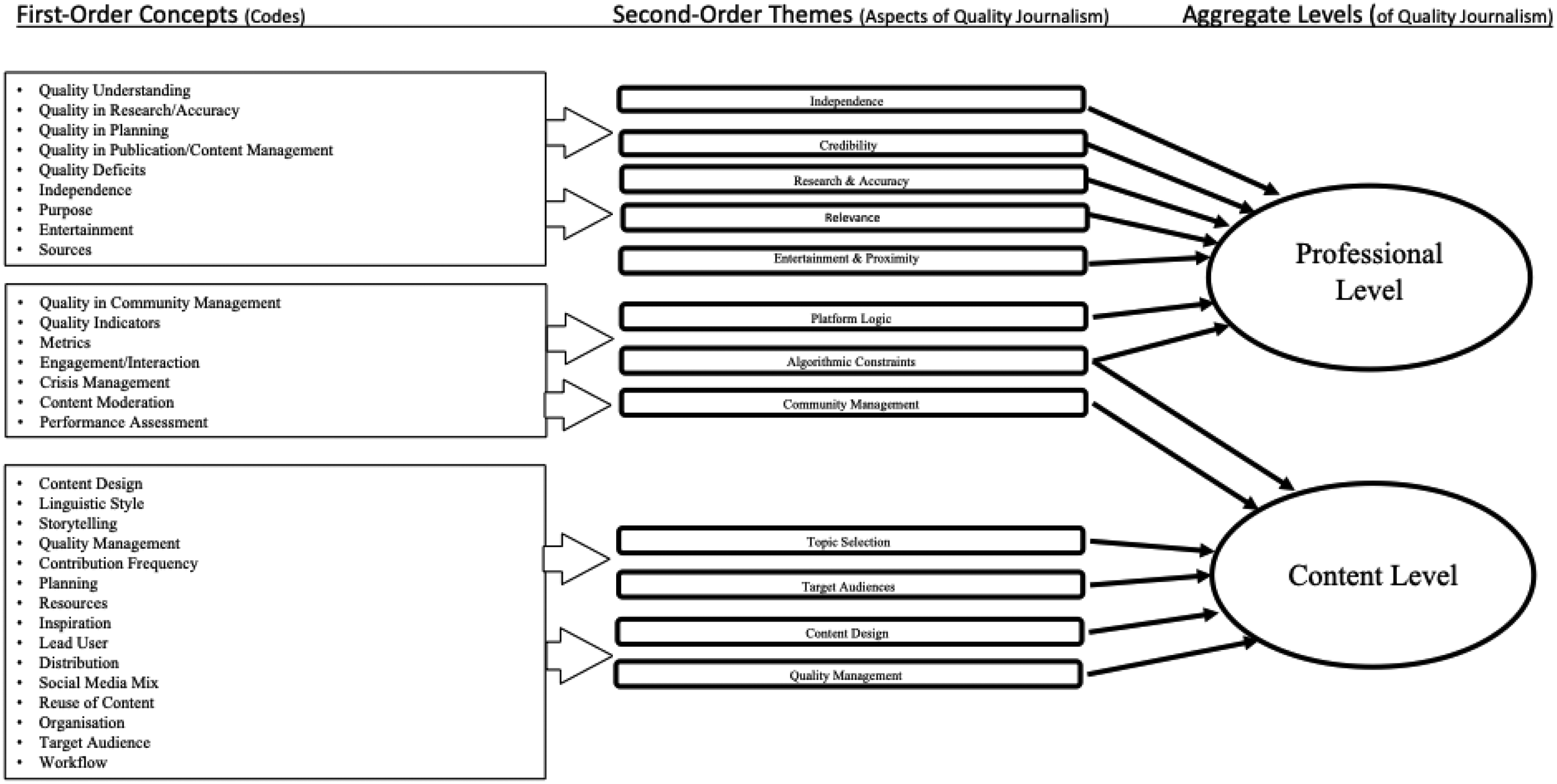
Outline thematic analysis.
The overarching coding categories relate to the levels of quality journalism. Based on these categories, an initial set of subcodes was generated through the independent reading of the transcribed interviews and notes. The applied codes were checked by at least two coders and were iteratively refined through joint discussion. To achieve the most comprehensive analysis of the data based on group consensus among the coders, quantitative measures of intercoder reliability were not used (Saldana, 2021). In total, 31 subcodes could be identified relating to the aggregate levels of quality journalism. After the coding phase, the coded segments were scrutinized for recurring themes and discussed weekly.
Findings
RQ1 addresses the professional standards shaping the respondents’ understanding of quality journalism on TikTok. All respondents named standards which they consider to be defining characteristics of quality journalism at their respective media outlet and thus incorporate on TikTok. Research, accuracy, relevance, and independence were mentioned most frequently. Slightly less often, the interviewees spoke of credibility, entertainment, and proximity, that is, the way in which journalistic outputs relate to the real-life experiences of the target audience. Which standards are mentioned differs to some degree across media outlets and TikTok channels. Determined to offer quality journalism on TikTok, most interviewees (e.g., PSM7, PSM10, PSM11, PM7, PM8) stated that they pay particular attention to research and accuracy, as they consider these criteria to be an editorial pre-requisite for establishing credibility. Correspondingly, many outlets strategically opt for an information-driven approach incorporating a strict separation of facts and opinionated content (e.g., PSM2, PSM4, PSM6, PSM10, PSM11, PSM12, PM2, PM10). Public service media are particularly keen on this approach, which they justify based on their funding mechanism and the public-value obligations that go along with it: “As we receive public funding, our audience expects us to provide information and contribute to public opinion formation. We seek to comply with this expectation.”
1
(PSM2)
This information-driven strategy further encompasses considerations about relevance, although journalists from different outlets diverge in their assessments of what relevant content is. PSM journalists, with their legal mandate in mind, rely on “a traditional understanding of relevance,” rating the newsworthiness of an event or a piece of information based on its societal or target-group-specific importance: “We do not just make topics visible, but also provide background information and resolve misconceptions” (PSM6). Audience-related considerations also play a role, but traditional relevance considerations clearly dominate: “We primarily seek to impart knowledge by providing informative content. As a public broadcaster, we have an educational mission which we try to fulfil with every video. It is quite simple: When watching our TikToks, young users should always learn something.” (PSM9)
A large public broadcaster, meanwhile, experiments with a dual approach: “As a well-known news provider, we must be recognizable on TikTok. Hence, two-thirds of our videos are news-related. Yet, we cater to TikTok's entertainment-driven logic by reserving one-third for entertaining content. In those TikToks, we show the processes of news-making, often highlighting funny interactions with our presenters.” (PSM10)
Other media outlets (PM1, PM2, PM9, PM8, PM6, PM3, PSM1, PSM8) pursue an audience-driven approach where they view relevance as the degree to which content meets the interests of the presumed target audience. These journalists select topics based on the “proximity to the real-life experiences of young users” (PM2). To do so, these outlets rely on the feedback of lead users who reply to test posts and share topic suggestions (PM1). Strikingly, media outlets with a more user-centered understanding of relevance emphasize the importance of entertainment for their journalistic TikTok content: “TikTok is like the tabloid press, it’s not overly journalistic. Users seek fun and entertainment rather than information.” (PSM5)
In response, these outlets seek to provide a mixture of cringe topics (PM3), “humorous posts, which embrace the dynamics of trend videos” (PM1), and viral content (PSM1, PM2).
Independence also plays a vital role in the respondents’ understanding of quality journalism. Many interviewees argued that maintaining institutional independence from TikTok and Byte Dance, the company owning it, is a top priority, not just because independence is a core tenet of democratic, free, and uncensored media systems, but also because it distinguishes journalism from nonjournalistic forms of social media content. Yet they claim that TikTok deprioritizes journalistic content, in what they experience as a restriction of their editorial independence. Over time, TikTok's operating department appears to have reconsidered its stance on professional journalism. One journalist describes the deterioration of what used to be a productive relationship: “We aim to cultivate a productive relationship with TikTok representatives. Early on, they were interested in a news partnership and encouraged the presence of journalistic media on the platform. Lately, TikTok has de-emphasized the news segment and deprioritized exchanges with journalists.” (PSM10)
Maintaining independence is challenging in other ways as well. Various interviewees contended that neither TikTok's algorithm nor Byte Dance's decisions can be amended or controlled by media outlets’ editorial teams. Hence, TikTok's content and community guidelines constrain media outlets in their choice of topics and content presentation (PM8). They interfere with many topics which journalists consider newsworthy, since they stipulate that the portrayal of violence and death, nudity, or similarly sensitive topics is not desired. Content containing these topics is earmarked by the algorithm, distributed less, or blocked altogether. This practice, known as “shadow banning,” affects all media outlets interviewed, but especially public broadcasters who distribute news content on TikTok or discuss topics of social relevance (e.g., PSM5, PSM10, PSM9). They observe that TikTok acts as a content gatekeeper, a role previously monopolized by professional journalists. With TikTok dictating which topics are platform-compatible, editors acknowledge that they feel constrained in the way they present content and even experience repercussions against their channels: “Content addressing certain topics is often blocked by TikTok. We cannot publish LGBTQ content in the Arab world. Whenever we try, TikTok deletes the post and threatens to algorithmically downgrade our account.” (PSM5)
As a result, some outlets gauge whether they can still justify their presence on TikTok or not: “We reevaluate our decision to maintain a TikTok presence whenever platform-induced challenges to our journalistic independence arise.” (PSM6)
This even includes an exit plan if information about the transfer of user data between Byte Dance, TikTok's mother company, and the Chinese government were to be confirmed (PSM2).
While the standards of relevance, research, accuracy, and independence continue to be important, journalists emphasize the growing impact of audiences and engagement metrics on TikTok. This leads to a constant process of careful negotiation between established markers of journalistic quality and emerging criteria catering to user needs and TikTok's platform logic in what is described as a balancing act between two competing goals: “Transferring an established media brand to TikTok is a major challenge, because you don’t want to destroy the brand image. On an entertainment platform, there is the risk that we do exactly that. Yet, we want to reach a large audience on this relevant platform. Metrics help us do that.” (PSM10)
Across all outlets surveyed, TikTok's platform design and its attention-rewarding algorithm draw attention to quantitative metrics. Clicks and views per post, watch time, subscriptions, shares, and the completion and interaction rate are often cited among the key factors influencing editorial decisions. Based on growing platform experience, one outlet suggests that “watch time is TikTok's decisive parameter when it comes to whether a video goes viral or not. That's why we try to structure our videos in ways to optimize it, for example by adding crisp openers and a TikTok-compatible narration style.” (PSM12)
Journalistic content production for TikTok
Regarding RQ2, the paper examines the process of journalistic content production reflecting on target audiences, topic selection decisions, and content design choices, while also analyzing quality management practices. Asked about their target audience on TikTok, the interviewees underscore that they prioritize young audiences, usually belonging to the age cohorts of 14 to 24 and 25 to 35: “We aim to be attractive for young audiences and people not interested in our legacy products. With a large percentage of very young users, TikTok allows us to do that.” (PM7)
Some outlets determine target groups not just by age, but also by specific socioeconomic parameters. PSM6, for example, specifically addresses school kids aged 14 to 16 without much of an educational background in the family. PSM2, meanwhile, seeks to appeal to middle schoolers with migration backgrounds, given that they usually do not consume content from public-service broadcasters.
Beyond the importance of target audiences, all interviewees consider topic selection to be particularly important. PSM10 identifies topics for TikTok based on “the same quality standards that apply to all our media products. We select topics based on news relevance, checking whether there are must-haves, that is, topics that we absolutely want to place on all platforms, simply because they contain relevant information for everyone.”
Other outlets follow this approach, but it is more the exception than the rule. Outlets like PSM4, PM4, and PM9 instead cater to audience suggestions when selecting topics because they consider this an effective way to establish proximity and a closer connection between the respective outlet and its audience. At PSM2, the effort to select topics in accordance with audience demands has even been awarded a code word: it is called “schoolyard talk,” which is an allegory for the young target audience and their collective interests. Additionally, media outlets closely observe other social media platforms to identify attention-craving content (PSM1), a practice which the PM3 respondent describes as “band wagoning with viral topics.” Once identified, they use these viral topics from Instagram and other platforms as a steppingstone to either create new and original TikTok posts (PSM7, PSM11, PM3) or to copy an already successful post using a similar message and style (PSM1, PSM2, PSM3, PSM5, PM1).
Concerning content design choices, the interviewees underscore in unison that they initially found it challenging to develop a journalistic product in line with TikTok's short video format. A particularly important aspect is “ensuring video lengths between 30 to 35 s. These have higher completion rates and higher watch times. TikTok's algorithm prioritizes such videos over other content.” (PSM3)
Using this knowledge, journalists aim to establish a TikTok-compatible form of storytelling. This includes catchy openers, a simplified narration, appealing video-graphic designs, and comprehensible language. Multiple journalists (e.g., PSM4, PSM8, PSM9, PSM11, PM7, PM9) believe that TikTok posts must captivate people immediately. To increase video attractiveness, they incorporate emojis and memes, use colloquial expressions, and embed humoristic elements to generate audience attention.
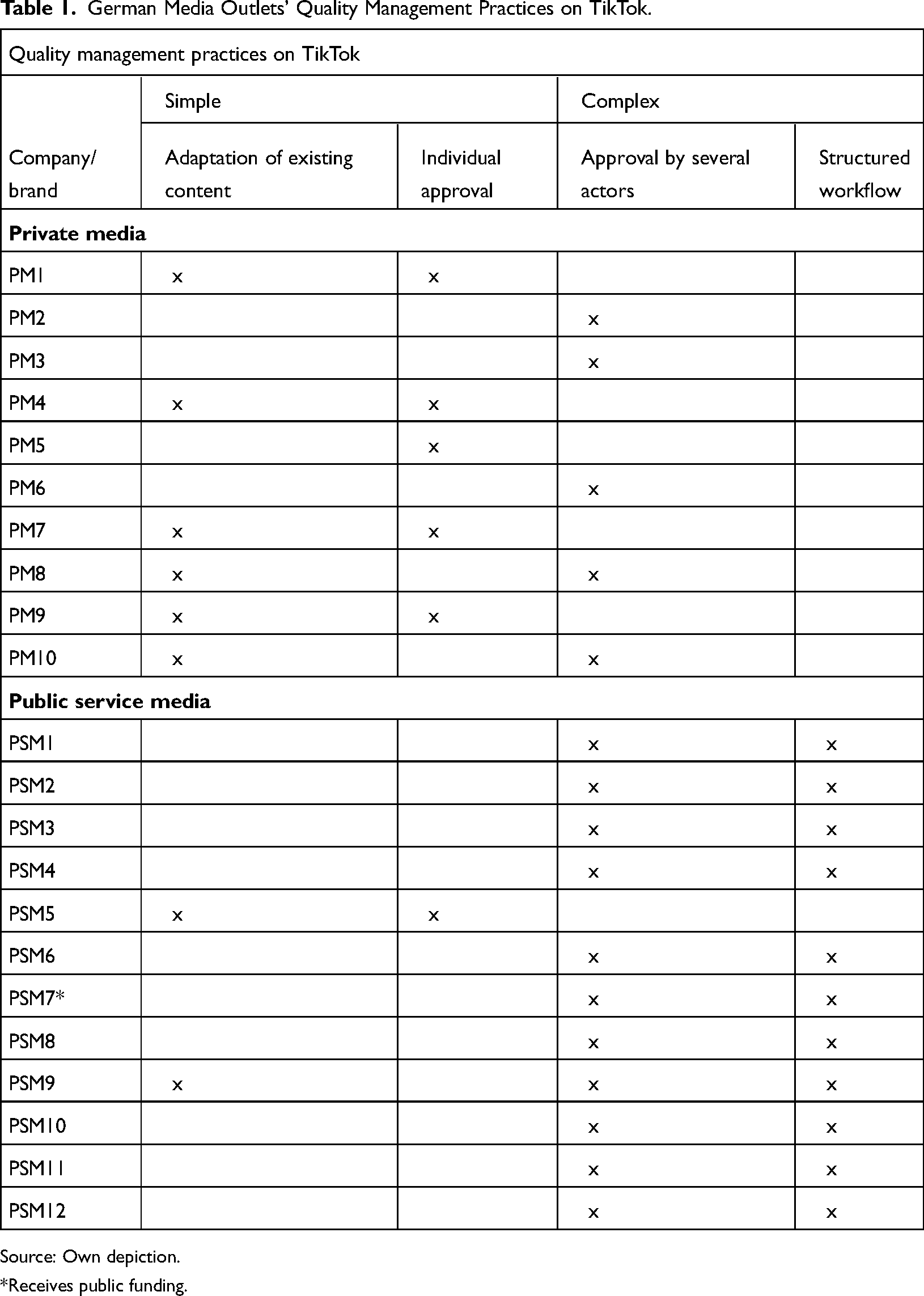
Since respondents emphasized accuracy, relevance, and research as fundamental aspects of quality journalism, they also stress them in their quality management processes. However, two distinct quality management approaches are identifiable (Table 1).
German Media Outlets’ Quality Management Practices on TikTok.
Source: Own depiction.
*Receives public funding.
Many PM respondents (PM1, PM4, PM7, PM8, PM10) follow the first approach, which they describe as a content-recycling strategy. They reuse existing news and entertainment content from their online websites which they adapt to meet TikTok's language, style, and presentation requirements without conducting additional quality control measures to ensure content veracity and quality. This strategy proves useful, because it not only reduces the pressure to identify relevant topics and produce original content, but also saves time: “We often recycle articles into TikToks. Since the article has already been approved by the editorial team, we rely on the quality assurance which has already taken place.” (PM8)
Another interviewee confirms this line of reasoning: “As the recycled content has previously passed quality approval in a different editorial setting, additional fact-checking and research efforts are unnecessary.” (PM4)
That is not to say that private media underestimate the importance of approval mechanisms to ensure that the published content meets quality standards: “Irrespective of whether our TikTok posts are original or based on articles, they are always well-researched using the multiple person rule. An editorial team must always approve every decision along the way. Standards for TikTok content match those for online articles.” (PM10)
Other PM organizations (PM3, PM2, PM6) rely on similar practices, ensuring that at least two journalists double-check that content meets the institutional quality requirements prior to publishing. Sometimes, even high-level executives are involved in this process: “The editor-in-chief approves anything we publish on TikTok. This process is not fundamentally different from publishing an article or shooting a longer documentary.” (PM8)
The second approach, which features organized editorial workflows and extensive sourcing and fact-checking, as well as quality approvals at different levels of responsibility, prevails among PSM organizations (PSM1, PSM2, PSM4, PSM6, PSM8, PSM10, PSM11, PSM12). Their newsrooms allocate significantly more resources to the production of original content for TikTok, both financially and staff-wise. Within German PSM newsrooms, production and approval processes are clearly defined and integrated into a comprehensive routine that benefits from the contributions of a variety of journalists with different skillsets. The routine typically starts with a story or topic idea and an initial storyboard. The content piece then moves through several stages of production, involving different actors: “Our social media chief of staff oversees the storyboard editing, advising revisions and approving the script before it is transferred to the social media staff for production. Upon production, we obtain approval for the final product from our chief editor. Only then we publish our TikToks.” (PSM10)
Other PSM share similar workflows allowing them to ensure that their TikTok content has the same level of fact-checking, sourcing, and expertise from specialized editorial departments as their legacy media products. PSM4 even cooperates with comedians to make the finished TikTok posts not just informative, but also entertaining. Only public broadcasters can bear the high costs of elaborate workflows, as they are not subject to economic pressures because they receive public funding.
The major difference, however, that emerges in the quality management approaches of PSM and PM pertains to the value and resources attributed to community management on TikTok. Private media representatives stated that community management, that is, the way journalists encourage and engage with user comments, proved difficult due to resource scarcity, both financially and staff-wise. As a result, community management is often delegated to young journalists or journalism trainees. In other cases, channel hosts perform this task rather superficially as it is placed on them on top of their other responsibilities. In either scenario, community management is not a core priority within private media organizations. The PSM representatives, meanwhile, emphasize active community management practices: “Our community management team consists of two people per weekday and one person on weekends. To ensure that exchanges with our audience run smoothly, our host and the supervising head producer provide them with briefings for each video.” (PSM6)
As TikTok is a fast-paced, engagement-rich platform, where comments, likes, and shares are the currency of attention, they latter interviewees consider community management rewarding: “The community is very important on TikTok. We interact with users a lot. Community building is easier here compared to other platforms. Whereas Instagram comments often contain feel-good messages, TikTok users love to debate.” (PSM3)
Engaging in these debates proves useful, as “audience engagement extends the reach of our TikTok account” (PSM8) and is considered one important reason for being active on TikTok. Ultimately then, public service journalists view community management as a direct contribution to journalistic quality on TikTok which helps them to satisfy their legal mandate: “Through active community engagement we can pick up user comments and discuss different topics, helping us build stronger connections with our audience and contribute to public opinion formation.” (PSM3)
Discussion
As TikTok's rapid growth and innovative algorithm appeal to journalists, the latter quickly add the platform to their existing social media repertoires (Vazquez-Herrero et al., 2022). Compared to journalists in South-East Asia, Latin America, the United States, Australia, or European countries like the United Kingdom, France, and Spain (Newman, 2022), German journalists are late technology adopters yet again. In fact, only one of the accounts in our study was launched before 2020 with the majority being operated since late 2021 or even 2022. This is worth highlighting, since it documents a trend in the technology adoption of German journalists that was equally visible on Twitter/X (Degen & Olgemöller, 2021) as well as on Facebook and other social networks (Gulyas, 2017). Part of this late adoption dynamic might be explained by the strong public-service orientation within the German media system. Since some of the major news media are PSM, these media are bound to contribute to public discourse and facilitate opinion formation across society by legal mandate (Medienstaatsvertrag, 2020). Hence, they are forced to gauge the adoption of any new social media platform carefully. And while not all German media organizations are PSM, even those who are not are indirectly shaped by the media system's public-service orientation.
Our findings illustrate that the incorporation of TikTok into the journalistic platform portfolio triggers adaptations at the professional level where journalists engage in conceptual sensemaking about their profession and reflect on new technologies. Most journalists, irrespective of being from PSM or PM, identify relevance, accuracy, independence, and research as vital criteria of quality journalism on TikTok. Not surprisingly, PSM journalists cite their legal mandate (Medienstaatsvertrag, 2020) as a core motivation for doing so. Within this role, they aim to follow a pragmatic-integrative approach to reaffirm professional journalism as a societal institution vis-à-vis the audience. They refrain from preempting their mandate by forgoing established values of quality journalism to achieve higher views and shares on TikTok but embrace audience-metrics and entertaining elements in their content pieces to optimize what their outputs.
Despite being exempt from such a mandate, most PM journalists still aim for the same core values, but experiment with audience-related news-values more aggressively than their public-service peers. Lacking legal constraints, PM journalists embrace TikTok's logic and viral narrative styles and video techniques (Bolz, 2023; Garcia-Ortega & Garcia-Aviles, 2023) more fully but nevertheless do so within journalistic boundaries. After all, our respondents from both PM and PSM emphasized that they are professional journalists rather than TikTok influencers. We view this as a sign of continuity in the journalistic understanding of quality journalism, since these values have been fundamental for professional journalists in mass media (Lacy & Rosenstiel, 2015) and other social media platforms alike (Olausson, 2017; Walters, 2021). Yet, the interviewees can be clustered into two groups based on the way they translate these quality standards into content production processes on TikTok. The first cluster consists of PM representatives who pay attention to end-to-end quality control, but usually do so by having streamlined approval processes which involve only a small number of journalists, often three people or less. They frequently reuse legacy media content for TikToks without additional fact-checking or quality management efforts, as they deem quality checks at the previous publication level to be sufficient.
In the second group, PSM representatives rely on more sophisticated, multilevel workflows. Their content production processes for TikTok involve a higher number of journalists with different skills and technical responsibilities. With large social media departments and even designated TikTok teams, PSM rely on newsroom integration to streamline workflows. This contradicts earlier findings (Sehl et al., 2016) and may indicate that multimedia management practices and expertise have evolved in these organizations over time, at least in Germany. Integrated newsrooms enable German PSM to implement quality standards at the content production level in the same multistep processes they apply in their news broadcasts. This strategy, then, by and large, mirrors what Newman (2022) identifies as the newsroom-led approach to TikTok journalism of broadcasters and established news providers. However, we can also provide some nuance. Our interviews indicate that some German PSM use their financial resources to collaborate with professional comedians to make their content more humorous and attractive in terms of storytelling. We can thus confirm earlier research which finds that financial resources and staff availability (Weberling, 2011; Sehl et al., 2016) affect how media organizations translate their understanding of quality journalism into TikTok content.
As the interviewees stress the enhanced importance of audience-related news values and performance metrics at the level of content production (Hermida & Mellado, 2020; Tsuriel et al., 2021), we discuss this further. When assessing relevance, entertainment (Negreira-Rey et al., 2022), and proximity to the community (Harcup & O'Neill, 2017) play an important role, especially when outlets seek to appeal to specific target audiences.
PSM journalists claim to concentrate more on hard news content, whereas PM journalists focus on TikTok trends and viral topics. This distinction qualifies earlier evidence, according to which journalists produce content in such a way, that “the adaptation of their professional activity … mimic[s] the predominant content on TikTok” (Negreira-Rey et al., 2022, p. 153). To identify viral topics, private media representatives monitor other TikTok channels and pay attention to the performance of previous content, confirming earlier international findings (Bolz, 2023; Klug & Autenrieth, 2022). More generally, TikTok advances the metrification of journalism. Whereas the impact of metrics on content design is limited on other social media platforms (Lamot, 2022; Lischka, 2021; Tsuriel et al., 2021), we find that German journalists view metrics as an essential factor in the content-related decision making for TikTok. Quantitative performance indicators directly impact topic selection processes as journalists follow the formula of “participating in the trends of the moment to support the virality of [their] content” (Vazquez-Herrero et al., 2020, p. 13). With respect to content shareability (Harcup & O'Neill, 2017) and audiovisual presentation (Klug & Autenrieth, 2022), journalists take cues from the success of previous posts. They infer that the more successful a post is, the more likely it is to match audience demands or meet algorithmic preferences. These considerations feature prominently in editorial decisions on how to design subsequent TikTok content.
Upon discussing how German journalists approach TikTok, we claim that the growing importance of quantitative and audience-related quality criteria does not encourage German journalists to de-emphasize fundamental journalistic values (Degen & Olgemöller, 2021; Walters, 2021). Two considerations validate our claim.
First, all interviewees regard editorial independence as a credibility prerequisite vis-à-vis the audience. While the problem that social media curtails independence and content selection decisions is widely acknowledged in social media research (Tandoc & Vos, 2016; Tsuriel et al., 2021), it is magnified on TikTok. Our interviews uncover a structural tension between journalistic selection criteria and TikTok's obscure platform mechanisms, cumulating in posts being shadow-banned and media outlets being penalized. Consequently, German journalists aim to retain as much editorial independence as possible, especially vis-à-vis Byte Dance, TikTok's mother company. Second, we find that journalists identify fundamental journalistic values as prerequisites of quality journalism on TikTok. This reflects continuity in the perception of journalistic quality among German journalists, considering that the values mentioned also underpin legacy media (Galtung & Ruge, 1965) and journalistic accounts on other social media platforms (Degen et al., 2024). In fact, these standards and news values attenuate audience-related criteria such as entertainment and proximity in the sense that any content piece must comprise a mixture of both. German journalists aim for posts which combine sound research and topics of public relevance with entertaining audiovisuals and target-group-specific storytelling. The objective is to generate maximum audience appeal while ensuring the journalistic credibility of the media outlet by adhering to core quality standards. The latter is imperative, as it helps users distinguish between journalistic and user-generated content.
In sharp contrast to the finding that TikTok activities of journalists neglect the public-service vocation within the profession (Negreira-Rey et al., 2022), our interviewees, irrespective of being bound by the public-service mandate or not, emphasized the expectation to contribute to societal discourse with their TikTok content. To do so, they deliberately refrain from placing an all-out focus on quantitative success in what is a conscious decision against clickbait and strategies based on sensationalism—strategies that media outlets in other media systems promote (Zaid et al., 2022). This concern for the public good distinguishes journalists from social media influencers, who produce content based on commercial interests, putting a premium on shareability and community fit (Zabel, 2023). Instead, the interviewees describe quality journalism on TikTok as featuring informative, well-researched, and fact-checked content in combination with design features which boost shareability and audience engagement. This strategy broadly aligns with audience expectations of journalism in the social media sphere (Banjac & Hanusch, 2022) and specifically accommodates the preferences of young TikTok audiences (Vazquez-Herrero et al., 2022).
Conclusion
Journalism scholarship widely acknowledges that journalism in social media “requires different angles and approaches for every individual platform, which creates additional workloads and burdens on journalists” and contributes to “rapidly and profoundly altering traditional journalistic norms and values” (Hendrickx, 2023a, p. 239). Within this study, we examined these norm and value changes in the context of the multilevel concept of quality journalism (Lacy & Rosenstiel, 2015). Our investigation of German journalists on TikTok offers two valuable takeaways. First, we find that evidence of German journalists being late adopters of social media (Gulyas, 2017) can be confirmed for TikTok as well. One reason for that is a dynamic rooted in the German media system and the constitutive shaping power of its public service orientation. We find that PSM and PM journalists alike seek to cultivate a careful stance on new technologies while upholding core journalistic norms out of a widely shared understanding of what quality journalism ought to be.
Second, we can show that German journalists normalize TikTok less than other social media, such as Twitter (Nuernbergk, 2016). While they consider core journalistic values, including research, accuracy, relevance, and independence as essential on TikTok, they also emphasize more recent news values, such as entertainment, proximity to the real-life experiences of audiences, and content shareability (Harcup & O'Neill, 2017). German journalists deliberately design TikTok content in an audience-focused way. They use TikTok-specific storytelling based on crisp openers, simplified narrations, and appealing visuals to boost visibility and virality. Furthermore, they stress the importance of editorial quality management, with public service media possessing more elaborate and developed content production processes than private media. Unlike on other social media platforms (Badham & Mykkänen, 2022), community management is even more important on TikTok. Journalists use these interactions to identify promising topics and gauge content performance.
Despite best efforts, our study has limitations. First, it is based on a case selection process that considered the two criteria of reach and dichotomy between public service and private media. We cannot rule out, however, that other nonobserved factors may affect the sample. Second, we did not validate interviewee perceptions externally, since our research method does not allow for the “objective” assessment of quality journalism. Third, we analyzed quality journalism at a specific point in time and cannot cover diachronic developments. Finally, our study only refers to German journalists and might overly reflect the peculiarities of the German media landscape (Degen & Olgemöller, 2021). Future research could explore English-speaking media systems or smaller media markets in Europe, Latin America, and Africa, as these might show different patterns.
Footnotes
Declaration of conflicting interests
The authors declared no potential conflicts of interest with respect to the research, authorship, and/or publication of this article.
Ethical statement
The research has been conducted with due respect for the rights and privacy of individuals and has not compromised the interests of any stakeholders. Furthermore, any potential conflicts of interest have been duly disclosed and appropriately managed throughout the entire research process, in alignment with the ethical standards expected in scholarly publications. Informed consent was obtained verbally before participation and recorded within the interview.
Funding
The authors disclosed receipt of the following financial support for the research, authorship, and/or publication of this article: This work was supported by ZEIT Stiftung Bucerius.

Notes
Correction (January 2025):
Since the original online publication, an ethical statement and the note ‘All authors listed above are co-first authors’ have been added to the article.