



Abstract
As social media is constantly gaining in importance, public service media (PSM) is forced to create content that fits the environment of social media platforms (SMPs). In Germany, the content network funk by the ARD and ZDF represents a change in the thinking of PSM and policy makers. Since platformization affects PSM institutionally and structurally, German media regulators are addressing platformization in the context of the new Interstate Media Treaty. The article aims to discuss the treaty’s orientation toward digital platforms and SMPs as it attempts to subject them to the control of local state media authorities. Algorithms and data-driven content curation are policed in terms of transparency and non-discrimination, and to ensure that public value content is not marginalized. To enforce this, I would argue, the treaty has to acknowledge the importance of platformization as a structural prerequisite that enables PSM to serve its public demand.
Introduction
Social media platforms (SMPs) have a sustainable effect on the current media environment. In the West, platform providers Alphabet/Google, Apple, Meta/Facebook, Amazon and Microsoft (GAFAM) have transformed into infrastructural forces that regulate great parts of the online world. These platforms “have penetrated the heart of societies – affecting institutions, economic transactions and cultural practices” (Van Dijck et al. 2018a, 2). Their expansion permeates “existing societal arrangements as [it] is increasingly mingling with established institutional structures” (Van Dijck et al. 2018b, 15–6). This has considerable consequences for public service media (PSM) in Germany as well as other European countries (Andersen and Sundet 2019; Klein-Shagrir and Keinonen 2014; Van Es and Poell 2020) since they are competing with digital platforms, and SMPs in particular, for both viewers’ attention and cultural influence. “Paradoxically, they do so by increasingly distributing content through these digital platforms” (Van Es and Poell 2020, 1). With SMPs constantly gaining in importance, PSM is forced to create and distribute content that fits the social media environment in a particular effort to reach a younger audience with public service content. PSM content production and distribution on social media must therefore follow the data-driven logics as determined by the GAFAM platforms’ ecosystem (Stollfuß 2021). As PSM appears to be increasingly marginalized in the commercially-driven “public” space of the internet, Fuchs and Unterberger (2021) have called for a “Public Service Media and Public Service Internet Manifesto.” They assume that “the survival of Public Service Media is in danger” since “the dominant form of the [commercial] Internet and Internet platforms undermines the democratic public sphere” (Fuchs and Unterberger 2021, 2).
This discussion is also accompanied by a broad discourse on the need for media regulation to encounter the market dominance of global platforms, to negotiate the accountability and responsibility of SMPs, and to balance competitiveness in Europe in particular (De Blasio and Selva 2021; Enli et al. 2019; Helberger 2020). Directive EU 2018/1808 of the European Parliament, for instance, emphasizes “the provision of audiovisual media services (Audiovisual Media Services Directive) in view of changing market realities” (Official Journal of the European Union 2018, L 303/69). The directive addresses the “convergence of television and internet services” that affects “[v]iewing habits, particularly those of younger generations” (L 303/69). This “requires an updated legal framework in order to reflect developments in the market and to achieve a balance between access to online content services, consumer protection and competitiveness” (L 303/69). This also includes audiovisual content on SMPs, since these platforms “compete for the same audiences and revenues as audiovisual media services” (L 303/70). The directive highlights the need for regulations in terms of the editorial responsibility of media providers, transparency of media ownership, the plurality of media, accessibility of content, and the promotion of the distribution and production of European content as a prominent part of a provider’s catalog.
In addition, recent agreements between the European Parliament and the European Council on the Digital Services Act (DSA) and the Digital Markets Act (DMA) aim to regulate the market position of large media companies (like GAFAM) with regard to their infrastructural connectivity, accessibility, networkability, and economic dynamics (Council of the EU 2022a, 2022b). The DSA forces platform companies to provide an annual analysis of “systemic risks they create” and to describe how they plan to reduce risks associated with issues such as illegal content distribution and service manipulations that jeopardize public security, democratic processes, and user practices—particularly for younger media users. To foster the transparency of recommender systems, the DSA says that platforms and search engines must employ a recommendation process that should not be based on “user profiling.” To protect younger media users in particular, platforms should be prohibited from employing target advertising based on individual user data (Council of the EU 2022a). The DMA, in turn, aims to regulate infrastructural platforms, for example, in terms of their conditions for service subscriptions and cancellations, the interoperability of the basic functions of their messaging services, and their conditions of fair access for developers to provide supplementary service functions (Council of the EU 2022b).
However, neither of the European acts has been fully implemented to date, and the statutory jurisdiction of the national regulatory authorities must still be harmonized with the supervisory mechanism on the European Commission level “in cooperation with the member states” (Council of the EU 2022b). National approaches thus represent regulatory attempts within the scope of responsibility of the member states. In Germany, the new Interstate Media Treaty, which governs the rights and obligations of media providers, has been effective nationwide since November 2020. The treaty represents Germany’s implementation of Directive EU 2018/1808 to “ensure compliance with journalistic standards and promote equal opportunities for communication” in a digital media environment (Interstate Media Treaty 2020, Preamble) and to address the shift in media usage of younger users in particular. The treaty aims at regulating press and broadcasting laws with a view to contemporary challenges in the digital age. In particular, it addresses digital platforms and intermediaries such as SMPs, subjecting them to the control of German state media authorities.
However, I would argue that to enforce this, the treaty has to acknowledge the importance of platformization as a structural prerequisite that enables PSM to serve its public demand. The structural penetration of public media institutions by SMPs appears to be not only supervised but also acknowledged by media regulators, which allows them to address them on a regulatory basis. As others demand independent environments such as a “public service internet” (Fuchs and Unterberger 2021) or call for the development of “public service algorithms” (Van Den Bulck and Moe 2018), German PSM has adapted its media policy to embed SMPs in the production and distribution of public service content—which is covered by the Interstate Media Treaty. This applies in particular to content broadcast by the social media-driven public service network funk, which was launched in 2016 by ARD (a consortium of public broadcasters) and ZDF (second German television), and which serves the needs of younger audiences (Article 33 of the Interstate Media Treaty; for more information on the network itself, see funk 2021). Here, PSM operates within the logics of SMPs while following the process of platformization (Nieborg and Poell 2018) to reach younger media users with public service content (see also Stollfuß 2021).
Other EU states such as France also regulate social media, mainly to counter hate speech, fake news and the distribution of misinformation, thereby preventing the public from harm (Helberger 2020, 843–4). However, the new German Interstate Media Treaty “signals an important point of departure from the traditional European e-commerce approach to the regulation of social media” (Helberger 2020, 843). It represents a media-political paradigm, setting standards in governance approaches by acknowledging platformization as a structural dimension. This should be followed by further attempts to regulate digital platforms and social media in the European Union.
My argument proceeds as follows: First, I briefly discuss the media policy of ARD and ZDF in the context of funk. The network must be understood in terms of the impact that SMPs have on PSM in Germany, since funk represents PSM’s reaction to the shift toward SMPs in younger audiences’ media usage (see also Stollfuß 2019). I discuss the policy for the funk network in view of the results of trend and representative research by PSM. Second, as funk produces and distributes content exclusively on SMPs, the social media-driven policy of PSM regarding the content network must be articulated in line with corresponding media regulations such as the new Interstate Media Treaty. The treaty incorporates the key regulatory conditions that justify the social media-driven orientation of funk by acknowledging platformization as a structural dimension for PSM. I discuss the treaty with a specific focus on its conditions both in terms of funk’s orientation toward content for younger media users on SMPs and within the discourse regarding the competition between PSM and SMPs that affects the ability of PSM to serve its public demand. Finally, to discuss the changed media regulatory orientation toward platformization in accordance with the changed ways that younger audiences use PSM content on mobile media, I will adapt Neuberger’s (2019) communication model on norms and standards of media regulation (p. 436; see also Stollfuß 2020, 656–7). This communication model helps to contextualize the discursive dynamics between platformized media markets and media culture, challenges PSM organizations to meet public demand in a platformized environment, and outlines media users’ changed patterns of media communication on SMPs in the field of changed media regulation through the new Interstate Media Treaty. This will lead me to describe my understanding of platformization as a structural dimension of PSM’s public values in the digital age.
Social Media as a Challenge for Public Service Media and the funk Network
Commercial providers and third-party platforms have challenged PSM for some time now (Johnson 2013; Syvertsen 2003). However, as Van Es and Poell (2020, 2) have put it, PSM and their policy makers must “develop specific understandings of platforms and their audiences” since “platformization requires a fundamental rethinking of the public service mission.” SMPs “are not just new channels through which public service content can be distributed; they profoundly reshape the larger media landscape in which PSM operate” (Van Es and Poell 2020, 3). The mandate of PSM—to serve the common good (Gonser and Baier 2010) by promoting key public values (universality, independence, equality, social and cultural diversity and integration) while attempting to make democratic public service content available to all citizens—is being challenged by the alignment of PSM with SMPs. “Platforms have been found to give rise to new hierarchies in public communication, shaping user interaction in correspondence with their business interests rather than crucial public values” (Van Es and Poell 2020, 1). It is apparent that SMPs are changing the terms of democratic societies in the digital age. The concept of public value and fulfilment of the public service mission has been subject to German-language debate in an effort to rearticulate public discourse on the SMP environment (Lowe 2016; Mitschka and Unterberger 2018; Steinmaurer and Wenzel 2015). Nevertheless, collaboration with commercial platforms may be required (Neuberger 2011, 46; Steinmaurer and Wenzel 2015, 39–62) to meet a younger audience on SMPs. Consequently, since PSM must operate in alignment with the platform logics of social media, the platformization of PSM and its content production poses a challenge to the public service mission (see also Stollfuß 2021).
In Germany, results from trend and representative research also highlight the fundamental challenges that SMPs pose to PSM due to technological transformations in media culture and the differentiation of digital and social media platforms. The results of online studies by ARD and ZDF in recent years have shown that the online usage of media by German citizens is constantly growing (Beisch and Koch 2021; Beisch and Schäfer 2020; Koch and Beisch 2020). Younger media users in particular prefer the flexible, time-independent online applications, both for personalized individual communication and for entertainment-related audiovisual content. In addition to video streaming services, SMPs such as Instagram and TikTok are central to everyday cultural media usage. Moreover, the use of PSM content on SMPs plays an essential role in reaching younger audiences (Koch and Beisch 2020, 487; Van Eimeren and Egger 2018, 466). However, social media doesn’t only pose a threat to PSM; it also provides opportunities for the development of PSM content on SMPs. The 2018 ARD acceptance study has shown that the everyday media use of younger users is largely determined by social media. Though PSM content is still esteemed and trusted by these users (Van Eimeren and Egger 2018, 473), but the individual utility value seems to be low. The younger audience requires adequate media representation, user participation and target group-specific PSM content on social media (Stollfuß 2020, 649; Van Eimeren and Egger 2018, 473).
German public broadcasters ARD and ZDF launched funk in reaction to the recent shift in media usage, especially by younger users. As I have frequently discussed elsewhere (Stollfuß 2019, 2020, 2021), the public service network represents an embodiment of a form of convergence of PSM and SMP that synchronizes the “media logic of television” with the “logic of social media” (Altheide and Snow 1979; Van Dijck and Poell 2013, 2015). The network follows an online-only approach. It provides content for an audience aged 14 to 29 on more than 70 channels on SMPs. In contrast to a youth channel or an online approach that relies on a PSM website, funk is largely broadcast within the platform environment of social media. It must provide content that fits the social media ecosystem and it is forced to permit SMPs to generate and influence an audience within their operational boundaries (Stollfuß 2019, 513–4; Stollfuß 2021, 130–3).
Since platformization affects PSM institutionally, structurally, and in terms of its production processes, I will discuss these changing dynamics in light of the implications that are ascribed to platformization within the discourse of the new Interstate Media Treaty, and the public values. The status of platformization relative to PSM is ambivalent because, in the discourse on public values in the digital age and the competition between SMPs and PSM, platformization certainly jeopardizes the independence of content production and distribution (Nieborg and Poell 2018; Van Es and Poell 2020, 4277). However, in the context of the challenges that the new Interstate Media Treaty addresses, I would argue that platformization is also seen as being increasingly important as a structural prerequisite for PSM. From this perspective, the treaty represents a modified media regulation that provides the legal framework for a public service network like funk in a competitive environment of commercial SMPs. The treaty thus follows a double logic: on the one hand, it advocates the control of platforms by local state media authorities to ensure their viability and the enforcement of public value content. On the other hand, in order to implement this, the treaty must also acknowledge that platformization is the structure that allows PSM to serve public demand, and to reach younger media users in particular.
In Germany, media regulation follows the federal structure of the country, involving a complex coordination process between various state media authorities and cross-state committees (Jarren and Donges 2004, 57). Primary responsibilities are assigned to fourteen state media authorities out of the sixteen state governments. These authorities are responsible for the licensing and supervision of commercial media providers. They also review instructions for advertising and compliance with protection of the young, encourage projects for media education, and they promote the safeguarding of media plurality in commercial broadcasting and the internet. They therefore aim at regulating commercial radio, television, and providers of media platforms and intermediaries in line with the statutory requirements of the Interstate Media Treaty, ensuring its coordination and compliance nationwide and in accordance with European media policy (Arnold and Donges 2020; die medienanstalten 2022; Jarren and Donges 2004). In addition, they are accompanied by civil actors, non-governmental organizations (NGOs) and independent scientific associations which monitor, study and discuss socially relevant criteria of media developments and regulation, thus operating as a “responsibility network” (Dogruel et al. 2020, 139).
In view of the research on media governance with a focus on “institutional structures” and the “processes of the accomplishment of interdependencies” in terms of an adequate “coordination of different actors’ operations,” aims and objectives can vary in terms of “micro perspectives (individual actors), meso perspectives (collective actors) and macro perspectives (society),” depending on the theoretical approach (Donges 2007, 10–1). In the following, I will highlight the entanglements of micro, meso, and macro conditions and effects with regard to the new media regulation in the context of platformization as a structural dimension for PSM. In doing so, I will adapt Neuberger’s communication model (2019, 434–43; see also Stollfuß 2020, 656–7) on the interdependency of norms and standards in media regulation and the broader discourse on the interrelationship between the range of services and the public service mandate in a more comprehensive way.
The funk Network in the Context of the Interstate Media Treaty
The discussion on the objectives of PSM’s public value content and its public service requirement encompasses a variety of discursive perspectives. Positions of the PSM as media organizations, positions of policy makers, audiences, professional media actors (like production companies), commercial providers (commercial television, digital platforms), advertisers and others offer diverging perspectives in the broader discursive negotiation. Neuberger’s (2019) communication model (pp. 434–6) discusses these positions, which he describes as being interdependent with the norms and standards of media regulation, the “modes of regulatory actions” (Neuberger 2019, 435). This can be applied to PSM’s public service requirement and the competition with private providers, correspondent with the various discursive positions. As I see it, the communication model is an analytical tool that helps to describe the effects of the mutual relationship of discursive positions and explains how these effects may add value to the broader discursive negotiation of the conditions that are necessary for PSM to serve public demand.
With regard to the conceptual nature of public value, Neuberger characterizes PSM as serving a “public demand” (instead of having a “public remit”) that is discursively addressed from a societal point of view and leads to certain normative assumptions. According to the legal requirements based on media regulations such as the Interstate Media Treaty, PSM must specify its contributions in an open and transparent discourse with the public to justify the value of its content. Neuberger operationalizes a communication model that addresses several factors which are basic conditions for broader discursive negotiations: “macro conditions” (financing, market, regulation), “meso conditions” (media organizations) and “micro conditions” (media actors), which he describes as the level of conditional programs. These are integrated into a conceptual network of mutual relationships with society (“macro effects”) and media users (“micro effects”) on the level of aims and objectives. The mutual relationships are mediated via production processes and practices, distributed media content, and changing forms of media consumption and usage (Figure 1).
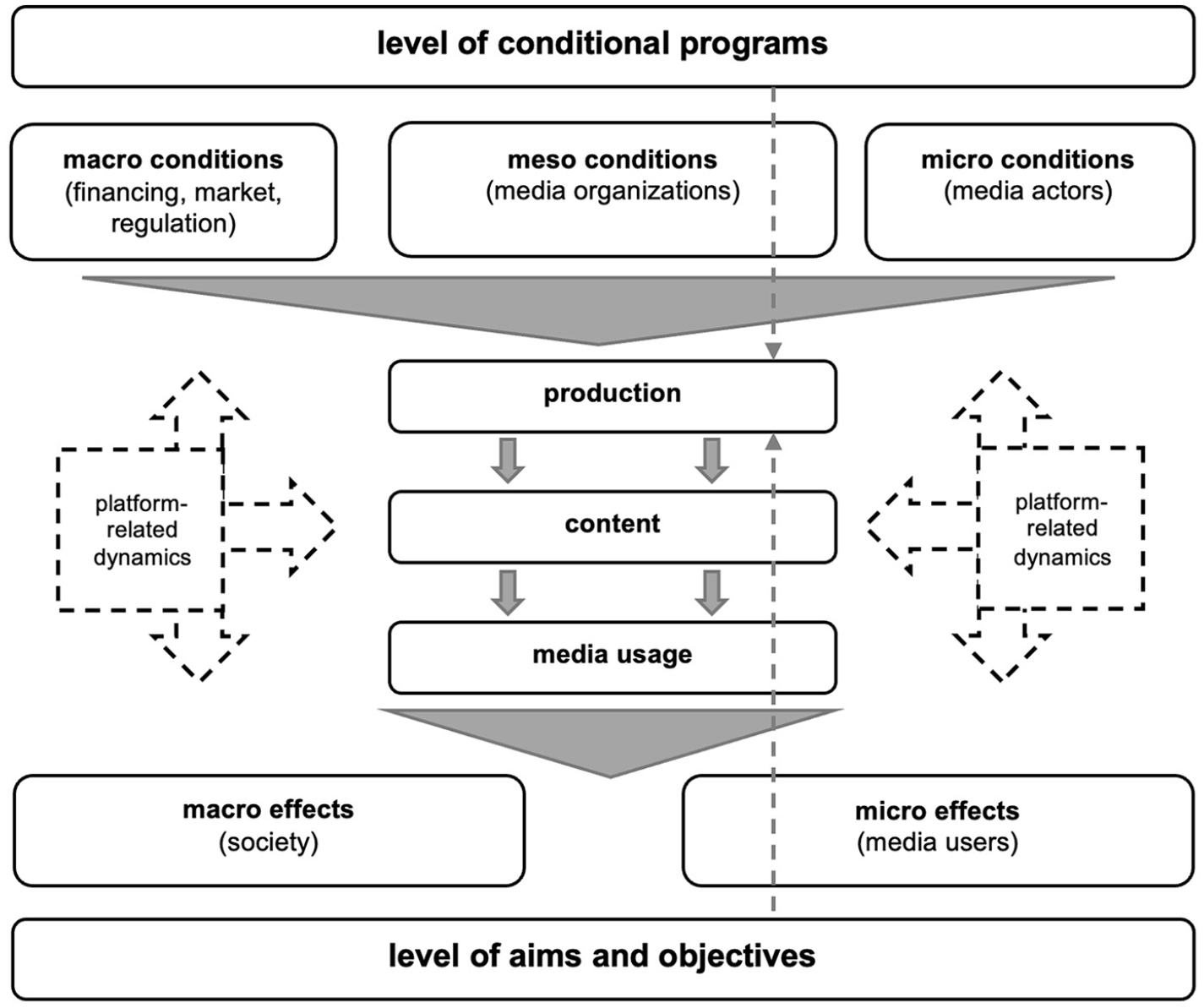
Communications Model of Interdependencies of Norms and Standards in Media Regulation (adapted from Neuberger 2019, 436).
In this view, the terms and standards of media actors such as professional content producers (micro conditions) who work for, or on behalf of, a television network (meso conditions) in a particularly regulated and financially structured market (macro conditions) shape the production processes and practices of the media content and the way in which the content is distributed. This also affects the forms and means of media consumption by users (micro effects) as both citizens and as a target group with specific societal and cultural needs and expectations (macro effects). On the other hand, as citizens or as members of target groups, media users influence the media content and professional processes of production and distribution. This is due to the forms and practices of their media consumption, which effects content producers, the corresponding media organization and the media market. The communication model addresses these mutual effects as interdependent discursive perspectives in accordance with media regulations. In the following, this model will be applied to analyze the effects on PSM and the public service network funk in particular, as it seeks to serve public demand in a platformized media environment in line with the regulatory conditions imposed by the new German treaty.
Media Regulation, Public Value, and the funk Network
As an approach that addresses the discursive structures affecting negotiations regarding PSM’s public values, the communication model outlines the interdependency of norms and standards in media regulation between the level of conditional programs (e.g., decisions by PSM executives that affect certain procedures like new organizational processes, rules for professional media producers and PSM employees, etc.) and PSM’s purposes on the level of aims and objectives (e.g., via the launch of specific projects such as the funk network and its corresponding media policy). This means that, in order to achieve objectives such as reaching younger audiences with content on SMPs through the funk network, conformant conditional programs such as a new policy regarding PSM content and new media regulations for PSM in general must be put into force. All norms and standards of regulation can be incorporated, whereby new requirements and conditions associated with digital media transformations can be considered in terms of their flexible involvement and combination. They can also be considered as part of the broader discursive process within a communication model to negotiate and justify the dimension of PSM’s public values (Neuberger 2019, 435–7).
In addition to formulating essential public values (such as universality, independence, equality, social and cultural diversity and integration), PSM must meet new demands and expectations in a digital media environment. This environment requires corresponding forms of platform-related communication which affect both content and different levels of the following structural relationships (Neuberger 2019, 438–40). First, the content needs to be differentiated by genre-specific qualities (e.g., for information processing or entertainment, cultural and educational offers), media-specific qualities (radio, television, different digital and social media platforms) and society-specific qualities (i.e., functions in terms of politics, economy, art, etc.; the distinction of political and cultural segments such as regional, national or international orientation; the classification of particular socio-cultural milieux, etc.) (Neuberger 2019, 439; Stollfuß 2020, 657). Second, with regard to structural relationships, the quality of target group-specific community management needs to be addressed and evaluated. In addition, the relationship dimension also relates to the quality of PSM in terms of its independence, diversity and balance, especially regarding relationships with other media providers. These relationships can be seen as competitive, complementary or cooperative (Neuberger 2019, 440; Stollfuß 2020, 657).
The Interstate Media Treaty and Derived Perspectives on the funk Network
As a result of the new Interstate Media Treaty, the following becomes apparent with regard to the funk network: The treaty calls for the adaptation of PSM due to platform-driven conditions on the web and articulates specifications for platform regulations and the integration of media intermediaries for the provision of content that addresses a younger audience in particular. Article 33 (“Offer for Young Audiences”), sentence 1 states that content for young audiences, such as the funk network, needs “to focus on the reality of life and the interests of young people, thereby effecting a specific contribution to fulfilling the public-service remit.” Sentence 2 further states, “The offer for young audiences shall be designed and transmitted in a dynamic manner concerning content and technology which is open to allow for new developments to meet the democratic, social, and cultural needs of the target audience. Interactive communication with the users reflecting the specificities of the target audience as well as stabilized opportunities for their participation are also to contribute to this objective.” For this purpose, a platform-aligned media policy appears to be structurally required, since sentence 5 outlines in particular: “If for the purpose of reaching the target audience [. . .] the distribution of the offer for young audiences outside the separate portable [sic!; portal] set up for the offer for young audiences by the public-service broadcasting corporations forming the ARD association and the ZDF is deemed necessary, the public service broadcasting corporations forming the ARD association and the ZDF are to ensure that the provisions pursuant to sentence 1 are adhered to (italics added).” Thus, the treaty permits a broad scope of operating possibilities in order to allow PSM executives a wide range of developmental opportunities to provide content for younger media users within the technologically dynamic and platform-driven environment even outside the PSM’s own platforms (Stollfuß 2020, 657); in the case of funk, these are SMPs.
The Treaty and Derived Perspectives on funk in the Context of the Communication Model
With Neuberger’s communication model, the relevance and societal value of the funk content network are assumed due to the causal relationship between its purpose (of platform-aligned content), its implementation (of a social media-driven network within the institutional and productional processes of PSM) and its goal (of reaching a younger audience on third-party platforms outside of PSM’s service portals). The content, with its diversity of information, education and entertainment (Article 26, sentence 1), has to be designed in an interactive and participatory way, since this is required for use in a platformized environment. This is justified by the treaty, which demands dynamism with regard to “content and technology” that allows “for new developments” in PSM content production and distribution on SMPs (Article 33, sentence 2). Regarding interdependencies between macro effects (society) and micro effects (media users) in terms of the democratic, social and cultural needs of the target group, the funk network’s executives are justified in providing content that addresses “the reality of life and the interests of young people” on SMPs, because this constitutes a “specific contribution” to fulfill “the public-service remit” (Article 33, sentence 1). Due to the increasing social media-driven usage of younger media users and their decreasing consumption of traditional PSM channels (micro effects), PSM (meso conditions) must implement new practices and processes for content production and distribution (micro conditions). This must be in line with its public mission and on the basis of media regulations that address the confrontation between PSM and commercial platform infrastructures on the platformized media market (macro conditions). As younger media users still value PSM content on third-party platforms as well (Van Eimeren and Egger 2018, 473), on the level of aims and objectives, PSM executives and policy makers are responding to micro effects with the funk network, which provides relevant public service content to the target group in line with PSM’s values (macro effects).
Thus, to comply with a public service requirement that the target group’s content interests be represented on SMPs, PSM must engage with platforms that are entangled with numerous stakeholders with a social impact—from other non-commercial services to commercial providers (Lowe 2016, 40; Steinmaurer and Wenzel 2015: 18–9; Stollfuß 2019, 517–8; Stollfuß 2021, 131–3). Therefore, due to the increasing processes of platformization, PSM’s content production is becoming progressively dependent on GAFAM’s infrastructural platforms. Since this means that PSM is drawn into the platforms’ algorithmic processes and serves their operational aims, media regulation is required to address the role, societal dimensions and structural function of platformization. Moreover, even with the platformization of PSM content on SMPs, regulators must guarantee universal access and equality of content in light of the plurality of media providers, and they must also ensure that there is a diversity of content that represents the social and cultural realities of contemporary society – especially since the independence of PSM will be affected long-term by the providers of media intermediaries.
Platformization as a Structural Dimension of Public Service Media and Public Value
On the level of conditional programs in Neuberger’s model, I would thus argue that the new Interstate Media Treaty formulates platformization as a structural dimension in the mutual relationship between PSM and its users on third-party platforms, thus establishing it as a framework for fulfilment of the public service mission in the digital age. This certainly calls for changed requirements for the macro conditions (in addition to the network’s financing as a joint venture by ADR and ZDF), the meso conditions for the PSM institutions (e.g., new editorial standards), and the micro conditions (e.g., changed media production practices) (Article 33, sentences 1–6). In line with the discursive specifications between the macro, meso, and micro conditions the platform-aligned relationship between PSM and its younger media users is rooted in the treaty. This allows PSM to increase diverse, target-group-oriented content that enables and promotes user participation and PSM community management on SMPs. As Van Es and Poell (2020) have outlined, PSM are reacting structurally to their changing position with regard to the development of a platform-driven media environment. “PSM and policy makers develop specific understandings of platforms and their audiences,” which the authors conceptualize as “platform imaginaries” (Van Es and Poell 2020, 2). This approach helps to emphasize the interdependencies of PSM and platforms by referring to the ways in which PSM actors and policy makers “understand, envision, and orient themselves toward a particular phenomenon” such as platformization. Therefore, platform imaginaries address “the ways in which social actors understand and organize their activities in relation to platform algorithms, interfaces, data infrastructures, moderation procedures, business models, user practices, and audiences” (Van Es and Poell 2020, 3). In the case of the German Interstate Media Treaty, such an understanding of platform imaginaries seems to be part of the discursive conditions of the funk network. It shows how PSM in Germany must operate to produce and distribute content on SMPs; the treaty in particular addresses the positioning of PSM’s role relative to the structural dimension of platforms for media regulation. In that sense, the treaty attempts to transparently and non-discriminatorily formulate norms and standards in terms of their importance as public values (accessibility, plurality of opinions, content diversity, equal opportunities for communication) for digital platforms, video sharing platforms, and platform intermediaries such as SMPs, particularly through the use of algorithms (see Article 78–99). The treaty aims to provide technical and functional instructions to ensure the general enforceability of its norms and standards. Its specifications, which are intended to ensure and enhance transparency on the internet, force media intermediaries to provide information regarding the aggregation, selection, presentation and accessibility of content on their platform (such as the positioning of search engine results and the valuation of news feeds on SMPs). In addition, providers must explain how they weight and prioritize content relative to the specific functionalities of the algorithms in terms that are “easily understandable, directly accessible, and continuously available to ensure diversity of opinion” (Article 93). Moreover, to further ensure the diversity of opinion on the internet, “media intermediaries are not allowed to discriminate against journalistic-editorial offers, the discernibility of which they have a particularly high influence on” (Article 94, sentence 1). Discrimination in terms of sentence 1 seems to be the case if, “for no objectively justified reason, the criteria to be published in accordance with Article 93 (1) to (3) are systematically deviated from, in favor or to the detriment of a specific offer,” or if the “criteria systematically and directly or indirectly impede offers unfairly” (Article 94, sentence 2). If providers of journalistic-editorial content identify violations against the specifications on transparency and non-discrimination, they can request further action by the “competent state media authority,” which “can also prosecute ex officio in self-evident cases” (Article 94, sentence 2). If a report is filed, providers of media intermediaries “are obligated to submit the necessary documentation to the competent state media authority on request” (Article 94, sentence 3).
Platformization and the Challenges for Local State Media Authorities
The Interstate Media Treaty attempts to subject digital platforms and intermediaries like SMPs to control by local state media authorities in order to guarantee both the transparency of a platform’s algorithmic processes and the non-discrimination of journalistic-editorial content providers. This is intended to ensure that other content providers are not further marginalized in the environment of SMPs, where platform providers have great influence on the visibility and discernibility of journalistic-editorial content. In that sense, as Dogruel et al. (2020), 139) have put it, the treaty “constitutes the first regulatory framework that formulates rules to control the use of algorithms and data-based curation of online content in accordance with norms on transparency and non-discrimination.” However, as they demonstrated in a study in which they interviewed German data protection authorities, state media authorities and civic actors from influential institutions like the NGO AlgorithmWatch, the non-profit think tank New Responsibility Foundation and the Bertelsmann Stiftung, the possible consequences seem to be rather vague thus far. While the regulation covers a wide range of aspects, the “discussion of the results points to an extensive need for more concretization of the new media policy norms to ensure an effective societal use of algorithms” (Dogruel et al. 2020, 140). The norms and standards for transparency intend to create basic conditions for independent user decisions on the internet, and to protect users against discriminatory selection and sorting practices. The experts consider this an important basis to counter the opacity of algorithmic systems and to strengthen user autonomy. Moreover, the policy has a preemptive dimension since it encompasses standards meant to sensitize platform providers with regard to their algorithmic operations. However, transparency goals must still be specifically defined since transparency does not necessarily include disclosure of the source code (Dogruel et al. 2020, 143). The treaty is rather vague on this point, stating only that providers must explain their criteria in plain language that is “easy to understand” and is “directly accessible” as well as “continuously available” (Interstate Media Treaty 2020, Article 93). It thus addresses mostly formal specifications on how information is to be presented. As it does, it links transparency to a variety of tasks such as the “use” of algorithms or the “understanding” of algorithmic operations as such. The treaty does not yet define in detail how media authorities are to implement this in practice (Dogruel et al. 2020, 143). Similarly, realization of public values such as the plurality of opinions, content diversity and equality of communication seems to be conditional on their technical and formal enforcement. Therefore, since the treaty and other regulations are still in their infancy, authorities need more best practice examples so they can outline standards for effective transposition of the new regulations (Dogruel et al. 2020, 143). Particularly since platformization as a structural dimension of PSM involves increased institutional supervision, media authorities must provide more detailed definitions and advice to ensure adequate conformity with the standards of media governance.
Moreover, if discrimination against journalistic-editorial content providers is to be reported by the parties concerned (if legal authorities do not act ex officio), social media content must technically be continuously monitored by the content providers. This means that content providers must provide the necessary monitoring resources, which they may not all have access to. What’s more, even the resources of the responsible state media authorities in Germany are unequal. As Laufer (2020) discussed in his article for the digital culture news website netzpolitik.org, the divergent responsibilities of the German state media authorities have a wide variety of staff checking on infractions and taking legal measures: There are 86 full-time employees in the Bavarian Authority (Bayerische Landeszentrale für neue Medien) and only two in Mecklenburg-Western Pomerania (Medienanstalt Mecklenburg-Vorpommern). The state media authorities’ staffs will require significant adjustments and professional training (e.g., on the functionalities of algorithms) to manage the regulatory tasks of the new Interstate Media Treaty if they are to be expeditiously and sustainably effective (Dogruel et al. 2020, 145–6).
Furthermore, the terminology of the treaty also leaves room for interpretation. Terms such as “criteria,” “central criteria” and “functionality” (of algorithms) have not been defined in detail. In-depth information has not yet been specified since the treaty is primarily concerned that these aspects are explained to content providers and users “in plain language” (Interstate Media Treaty 2020, Article 93); this is particularly true for information regarding the investigation of media authorities and sanctions to be imposed in case of violations (Dogruel et al. 2020, 142–6). Additionally, on the user’s side, a considerable demand for educational training is indicated in terms of a growing need for media, information and data literacy, as Dogruel et al. (2020, 143–4) have pointed out. More educational training programs and opportunities are crucial if users are to sufficiently understand and evaluate all the information provided by media intermediaries. This is necessary to ensure the media, information and data literacy of all users, but particularly of younger ones (for a discussion of educational media literacy skills, also in the context of challenges posed by data and information overload, see Ganguin et al. 2017). In brief, the treaty represents a vital contribution toward increased transparency in the platform environment, as Dogruel et al. (2020, 147) conclude . Still, even if it addresses the need to regulate platform algorithms and data infrastructures in alliance with journalistic or platform moderation procedures and user practices, it remains to be seen whether or not the transposition of the new norms and standards is effective in the long term.
Conclusion
The platformization of the mobile media environment poses challenges for the institutional situation and for the social and cultural position of PSM in the digital age. PSM executives alone are less able to develop effective strategies to work against the continuous expansion of GAFAM’s platforms and their already profound effects on platform-driven society (Van Dijck et al. 2018b). Above all, this challenges PSM’s effective strategy for realizing their public values in a platformized environment. Social media not only forces PSM to adjust internal organizations and strategic approaches in order to meet the preferences of younger media users in a digital media environment; PSM must also re-negotiate “public service commitments in an online world which is primarily dominated by social media platforms” (Klein-Shagrir and Keinonen 2014, 18). The development of PSM’s understanding of its audience on SMPs, and the need to rethink the public service mission in a platformized online world, imply that PSM executives and media policy makers need new strategies to counter the restructuring of the internet by commercial platform providers (Van Es and Poell 2020, 2–3). On a supranational level, the European Union (EU), while still struggling “to find efficient ways to regulate the dominance of digital platforms based in the United States” (Enli et al. 2019, 396), has tried to regulate digital platforms and intermediaries with the DSA and DMA to curb platformization solely in terms of commercially-driven stakeholder values.
In addition, media regulation in Europe follows heterogeneous logic in terms of the regulatory relationship between the state and the market. De Blasio and Selva (2021, 827–8) discuss four different regulatory models including “regulated self-regulation” by means of basic legislation (like in Nordic countries); “coregulation” of companies and NGOs, which usually involves internal monitoring audits but does not provide the power to sanction (like in the Netherlands); “restricted regulation,” with an independent supervisory authority that is separate from the parliament and the government and has limited regulatory but strong sanctioning powers (like in Italy); and powerful legislative and administrative media regulation (like in Germany) that is designed to preserve “public control over private companies” (e.g., in terms of transparency standards).
The new Interstate Media Treaty ensures a regulatory framework within Germany’s scope of responsibility that allows PSM executives to provide public service content on SMPs. It attempts to address standards for transparency and non-discrimination by using intermediaries’ algorithms. However, while the treaty seeks to subject platforms to the regulatory control of state media authorities (Dogruel et al. 2020, 139), it must nonetheless accept their structural conditions in order to fulfill the public service mission at present. Rather than proposing alternative infrastructural conditions within today’s platformized digital media culture—such as adopting features of an independent public service platform (PublicSpaces 2021) or attempting to develop an independent environment such as a “public service internet” (Fuchs and Unterberger 2021)—German PSM instead appears to be actively adapting to an institutional operational framework within a third-party platform-driven environment; this is geared in particular toward reaching younger audiences with the funk network’s content. Thus, the mingling of GAFAM’s infrastructural conditions with traditional institutional structures (Van Dijck et al. 2018b) affects PSM’s structural significance within a platform-driven environment (Stollfuß 2019, 517–8; Stollfuß 2021, 130–3). This environment has been adopted by PSM and acknowledged and policed by media policy makers via the new treaty. Since the treaty tries to regulate third-party platforms in view of their relevance for young people’s interests and the “reality of life,” it must consequently accept the platforms’ structural dominance, which effects PSM’s “specific contribution to fulfilling the public-service remit” (Interstate Media Treaty 2020, Article 33, sentence 1).
Neuberger’s (2019) model ascribes the flexible discursive processes regarding PSM’s public value to a conceptual perspective on the mutual relationships among all stakeholders as various elements and perspectives are entrenched in the model between levels of conditional programs, aims and objectives. The funk network represents German PSM’s response to contemporary dynamics and an effort to mediate between macro effects (society) and micro effects (media users) due to the ongoing popularity of SMPs among younger media users, as traditional PSM channels lose ground (Koch and Beisch 2020, 483; Kupferschmitt and Müller 2020, 392–4). The corresponding flexibilization of PSM’s public value, in terms of platform-aligned content production and distribution that is in line with the network public service mission, requires updated media regulations that specifically address PSM’s confrontation with the commercial platform environment of SMPs. To accomplish this, the treaty must acknowledge the value of platformization as a structural prerequisite that enables PSM to serve the public demand. The structural penetration of public media institutions by SMPs appears to be not only recognized but also acknowledged by media regulations.
The German treaty represents a novelty (see also Helberger 2020, 843). It can be seen as a paradigm that sets standards in media and platform governance approaches as it acknowledges that platformization is a structural dimension that allows PSM to serve its public service obligation on third-party platforms. “Since much of our private and public communication has moved to online infrastructures, along with an increasing percentage of our social and economic activities,” as Van Dijck (2021, 323–4) has recently put it again, regulation, governance and monitoring cannot be assigned solely to commercial platform providers, who are permitted to determine the conditions of platformized mobile media environments. Instead, public discourse that involves national and supranational regulatory measures is required, not only “to protect the Internet as a common infrastructure,” but also to prevent different regulatory approaches from becoming “tools in the hands of authoritarian governments or corporate elites” (Van Dijck et al. 2021, 14–5). The German Interstate Media Treaty will hopefully result in further media and platform regulation, both in alliance with other countries and in accordance with efforts by the EU.
Footnotes
Declaration of Conflicting Interests
The author declared no potential conflicts of interest with respect to the research, authorship, and/or publication of this article.
Funding
The author disclosed receipt of the following financial support for the research, authorship, and/or publication of this article: This article is an outcome of the research project “Social TV in a Connective Media Culture: Apparatus Analysis of Public Service Content Networks and Participatory Multiplatform Productions for Social Media” which is funded by the Deutsche Forschungsgemeinschaft (DFG, German Research Foundation) – project number 425493721.
