



Abstract
People can intentionally change specific personality traits, but whether such interventions effectively change moral character traits is less clear. The present study (total N = 179), using two active intervention groups, examined whether a 5-week goal-setting intervention could lead to trait change for either a moral trait, compassion (n = 87), or the Big 5 trait of conscientiousness (n = 92). Participants self-selected into one condition after receiving trait-standing feedback and completing a brief reflection task. They set implementation intentions and reflected on their progress every 3 days throughout the intervention. State assessments (Nassessments = 1014) were collected every 3 days in addition to trait assessments at pre- and post-test, with follow-up assessments 2 weeks post-program. Results indicated that participants in both intervention groups reported changes in their chosen trait in the short term. In the absence of a randomized blinded control condition, we cannot be certain whether observed changes reflect genuine intervention effects versus demand characteristics, expectancy effects, or regression to the mean. Nonetheless, findings provide preliminary evidence that implementation intention-based interventions may facilitate self-reported short-term increases in moral traits.
Keywords
Personality traits have been shown to be robustly linked to a variety of important life outcomes and measures of well-being (Ozer & Benet-Martinez, 2006). Intentionally working on changing specific personality traits is therefore one potential pathway to well-being. Desiring to change one’s personality is ubiquitous—when prompted, between 67.5% (Baranski et al., 2017) and 95% (Robinson et al., 2015) of participants describe a desire to change at least one personality trait. Initial evidence suggests that such change is possible, with a growing body of research showing that individuals report moderate increases in their levels of extraversion, conscientiousness, openness and emotional stability when participating in structured personality change programs (Haehner et al., 2024; Hudson et al., 2019; Hudson & Fraley, 2015; Stieger et al., 2020, 2021).
However, the traits for which there is the most evidence for volitional change—conscientiousness and emotional stability—are also traits that most likely benefit the individual’s own well-being, as opposed to other people in an individual’s life or community, at least directly (Hudson & Fraley, 2016). When asked what, if anything, they would like to change about their personalities, people typically do not prioritize traits related to prosocial or personal values (e.g., agreeableness and openness to experience), or more specifically, traits related to moral character (Sun & Goodwin, 2020; Thielmann & de Vries, 2021). Here, these “moral” traits refer to personality characteristics that involve patterns of thinking, feeling, and behaving with clear ethical relevance—those concerning questions of right and wrong, or good and bad (Smillie & Cushing, 2025). This lower prioritization of moral traits may partly reflect a tendency to favor traits with perceived direct personal benefit, as well as a self-protective bias wherein people believe they are already sufficiently moral (Sun & Goodwin, 2020). Given that volitional personality change interventions allow participants to select which aspect of their personalities they want to change, one limitation is that such self-guided interventions may not facilitate positive changes in moral traits.
Whether people are able to improve morally has implications for both societal progress and individual well-being, as there is now increasing evidence that enacting moral behaviors and possessing high levels of moral traits is associated with greater happiness and meaning in life (Kushlev et al., 2022; Sun et al., 2025). Moreover, moral traits like compassion predict important outcomes including relationship quality, prosocial behavior, and reduced prejudice (Pommier et al., 2020), making them valuable targets for intervention efforts. The present research investigates whether a digital intervention can be used to elicit self-reported change in compassion, with conscientiousness as a comparison condition.
Volitional Personality Change Interventions
A recent systematic review and meta-analysis of volitional personality change (VPC) research provides important context for understanding intervention effectiveness (Haehner et al., 2024). Across 30 longitudinal studies, the review found that VPC interventions produced small-to-moderate self-reported changes (d = 0.22), with effects appearing to increase at follow-up (d = 0.37). These changes exceed those observed through normative development or simply having change goals without intervention. The meta-analysis revealed that effects were strongest for extraversion (d = 0.38), neuroticism (d = 0.33), and conscientiousness (d = 0.31), while being weaker for agreeableness (d = 0.15).
The theoretical foundation for these interventions draws in part from psychotherapy research, particularly the common change factors framework (Allemand & Flückiger, 2017, 2022). This framework identifies four key mechanisms: (1) actuating discrepancy awareness between actual and desired personality, (2) activating existing strengths and resources, (3) targeting thoughts and feelings to achieve insight, and (4) practicing new behaviors. Interventions operate through a bottom-up approach, targeting specific behaviors, thoughts, and feelings with the assumption that accumulated changes in trait expression will eventually lead to trait-level change.
Contemporary interventions have operationalized these principles in diverse ways. For instance, implementation intention approaches ask participants to create specific “if-then” plans for enacting desired behaviors (Hudson & Fraley, 2015). Building on this approach, Stieger and colleagues (2020) introduced a two-active-intervention-group design in which participants chose between working on self-discipline (a facet of conscientiousness) or openness to action (a facet of openness to experience) over two weeks. This design allowed for mutual comparisons between groups while maintaining the volitional component of trait selection. Participants in both groups reported increases in their chosen trait, and notably, participants self-selected into groups based on their initial trait levels—those lower in self-discipline chose to work on self-discipline, and those lower in openness to action chose that option. Importantly, these selection effects occurred even though participants did not receive explicit feedback on their trait levels prior to choosing their intervention group (Stieger et al., 2020), suggesting that people have some implicit awareness of their standing on personality traits.
Subsequently, the PEACH smartphone application integrated multiple intervention components targeting all four change factors, including psychoeducation, self-reflection, resource activation, and individualized progress feedback (Stieger et al., 2021). In a large randomized controlled trial, the PEACH app produced medium-to-large self-reported trait changes (d = 0.52) that persisted for at least three months post-intervention. Importantly, however, observer-reported changes were substantially smaller—approximately half to two-thirds the size of self-reported effects (Stieger et al., 2021)—highlighting the challenges in determining whether self-reported changes reflect genuine personality change or shifts in self-perception.
Barriers to Volitional Moral Trait Change
Despite these advances in volitional personality change interventions, a clear motivational asymmetry has emerged: emotional stability, conscientiousness, and extraversion are the traits people most often want to change (Hudson & Fraley, 2015; Sun & Goodwin, 2020; Thielmann & de Vries, 2021), with traits related to personal values and moral characteristics notably less prioritized. People are not typically motivated to change moral traits, which can partially be explained by people typically believing that they are already “moral enough” and that they do not need to change (Sun & Goodwin, 2020). Moral traits are highly evaluative, and believing that one is already a “good” person can act as a self-protective bias (Vazire, 2010). People also prioritize changing traits that they see as positively contributing to their own well-being rather than the well-being of others (Hudson & Fraley, 2016; Sun et al., 2025). This pattern—wherein people prioritize traits with perceived direct personal benefit over traits with ethical relevance—represents a fundamental obstacle to moral trait change interventions.
Recent work has begun to address these challenges. Providing personality feedback can increase motivation for moral trait change, particularly when that feedback reveals discrepancies between self-perception and observed results (Casali et al., 2025; Thielmann & de Vries, 2021). For instance, Casali and colleagues (2025) found that receiving detailed personality feedback—even when negative—was perceived as helpful and was associated with increased goals to change on moral traits. This suggests that making people aware of gaps between their actual and ideal moral selves may be a promising avenue for encouraging moral improvement. To implement this approach, we selected compassion as our target moral trait, a choice that required careful consideration of how moral traits are situated within personality frameworks.
Compassion as a Target for Moral Change
The Big Five model was intentionally constructed to be descriptive rather than evaluative, avoiding explicitly moral language in favor of neutral terms (Smillie & Cushing, 2025). However, certain traits within this framework carry more moral relevance than others. Agreeableness, while not inherently a moral trait, contains substantial morally relevant content—it encompasses tendencies toward cooperation, respect, and care for others that are typically viewed as ethically praiseworthy (Smillie & Cushing, 2025). In contrast, traits like neuroticism involve experiences that, while potentially distressing, are generally morally neutral.
This distinction becomes clearer when examining the hierarchical structure of personality. Research has identified compassion as one of two primary aspects of agreeableness, alongside politeness (DeYoung et al., 2007). While politeness involves adherence to social norms, compassion specifically captures the emotional concern for suffering and the motivation to alleviate it—a fundamentally moral orientation. We define compassion as an emotional response to suffering that elicits a feeling of caring and a desire to alleviate distress (Pommier et al., 2020). This conceptualization encompasses compassion directed toward others as well as toward oneself (self-compassion). Though compassion toward others and self-compassion can be distinguished empirically, they share theoretical foundations and are moderately related (Neff & Pommier, 2013; Pommier et al., 2020). Moreover, Buddhist contemplative traditions—from which both concepts derive—suggest that self-compassion may facilitate the development of compassion toward others by first cultivating the capacity for compassionate responding (Neff, 2011). While correlational evidence for this developmental relationship varies across studies (Lee et al., 2021; Neff & Pommier, 2013), allowing participants to pursue both self-compassion and other-directed compassion goals may help bridge the motivational gap by making moral trait change feel personally relevant and beneficial (Hudson & Fraley, 2016). Our intervention primarily targeted compassion broadly construed, acknowledging that participants’ specific goals might emphasize either or both orientations.
In addition to these motivational considerations, compassion represents an ideal candidate for studying moral trait change for several reasons. First, compassion captures the core moral content within agreeableness— the Big Five trait most closely associated with ethical behavior (Smillie & Cushing, 2025)—while being a lower-level personality characteristic (DeYoung et al., 2007) sufficiently specific to target through intervention. Second, compassion is broadly endorsed as a moral virtue across diverse cultural and religious traditions (Graham et al., 2013; Kinnier et al., 2000), making it more likely that participants would be willing to pursue compassion-related change goals.
Recent Work Examining Moral Trait Malleability
The first study to explicitly investigate whether moral personality traits can be changed volitionally was conducted by Mendonça and colleagues (2023). This study aimed to explore volitional changes in two character traits, compassion and intellectual humility, through a 3-month online intervention. The study consisted of two active intervention groups, totaling 500 participants, who underwent weekly self-reported assessments of both state (weekly experiences) and trait (global) measures of the character trait they chose to work on. In the intake survey, after participants chose a trait to work on, participants chose three general trait-relevant behaviors to practice for the duration of the program. These behaviors were modeled after items from the scales used to measure the relevant traits, e.g., “If I see someone going through a difficult time, I want to practice being caring toward that person” (from the Compassion Scale; Pommier et al., 2020) and “I want to practice being open to changing my opinions in the face of conflicting evidence” (from the Intellectual Humility Scale; Leary et al., 2017). Each week, participants were presented with a list of additional ways to become more intellectually humble or compassionate (including ways to remind themselves of their goal, ways to model goal-relevant behavior, and ways to celebrate examples of their chosen trait). From this list, they were asked to select one of the strategies to practice for the week, in addition to the three behaviors they had already picked. After selecting a “tip,” participants were then prompted to list one obstacle they might encounter in being more intellectually humble or compassionate during the week and to propose a solution to that obstacle.
The findings of the Mendonça et al. (2023) study revealed that participants who focused on intellectual humility exhibited significant gains in both state and trait levels of intellectual humility. Conversely, those who chose compassion showed significant improvements in state compassion but not in trait compassion. The researchers speculated that this might be due to the cognitive aspects of taking another’s perspective, which the provided tasks emphasized, being easier to achieve than experiencing an emotional reaction in response to another’s situation. The researchers also discussed how the suggested tasks they provided to participants may not have been targeted enough on situations that required support in times of suffering, with many tasks focusing on activities that aligned more with a general definition of kindness (e.g., buying a coffee for a stranger) rather than encompassing the suffering-related aspects of compassion. Despite the study’s innovative design, these findings highlight the challenges inherent in catalyzing both state- and trait-level changes in deep-seated moral character traits.
The Present Study
Building on this foundation, the present research provides a novel contribution to research on volitional moral trait change by implementing an enhanced intervention design that addresses limitations identified in previous work. We compare self-reported changes in compassion—a moral trait that previous research found difficult to change at the trait level (Mendonça et al., 2023)—with conscientiousness, one of the most successfully modified traits in the VPC literature.
This comparison design serves multiple purposes. First, using conscientiousness as a comparison trait allows us to compare effect sizes with a well-studied trait. Second, by limiting participants’ choice to these two options rather than allowing free selection among all Big Five traits, we increase the likelihood that participants will select the moral trait option while maintaining the volitional component. Third, this design provides direct evidence on whether moral and non-moral traits change differently across the intervention period.
Because compassion is a lower-level construct within agreeableness, while conscientiousness represents a broad personality domain, comparing these constructs requires parallel measurement approaches. This is especially important given that VPC interventions targeting broad trait domains produce heterogeneous effects concentrated in specific facets (Olaru et al., 2022). We therefore employed matched measurement strategies assessing both constructs at comparable levels of specificity (see Measures for details).
Our intervention incorporated several methodological advances designed to maximize the potential for trait change. First, following evidence that personality feedback increases motivation for change (Casali et al., 2025; Thielmann & de Vries, 2021), participants received visual feedback about their standing on both traits relative to population norms before selecting their change goal, accompanied by a reflection task designed to enhance discrepancy awareness (Allemand & Flückiger, 2017). Second, rather than providing preset behavioral challenges as in previous interventions (Hudson et al., 2019; Mendonça et al., 2023), participants created their own implementation intentions every 3 days over 5 weeks, ensuring goals remained personally relevant. This self-directed approach directly addresses Mendonça and colleagues’ (2023) speculation that their researcher-provided tasks may not have adequately targeted the suffering-related aspects of compassion. The 5-week duration represents an optimal balance, as meta-analytic evidence suggests this is the minimum duration at which lasting personality change effects are observed (Roberts et al., 2017). Finally, we assessed personality at both state and trait levels, consistent with a growing emphasis on state-level measurement in VPC research (Columbus & Strandsbjerg, 2025) and following the approach used by several recent interventions (Haehner et al., 2025; Mendonça et al., 2023; Stieger et al., 2021). This allows us to examine whether state-level changes translate to broader trait-level change (Jayawickreme et al., 2021).
We recognize that without a randomized blinded control group and relying solely on self-report measures, observed changes cannot be definitively attributed to the intervention itself (Krämer et al., 2025). However, the two-group design allows for mutual comparison of moral versus non-moral trait change while preserving participants’ autonomy in selecting their change goal—a core feature of volitional personality change that cannot be experimentally manipulated without fundamentally altering the phenomenon under study.
Hypotheses
The preregistration of this study (https://aspredicted.org/QSW_L1T) included the broad hypotheses that participants would increase in their self-selected trait and that trait-specific increases would differ by intervention group. These have been elaborated into the eight numbered sub-hypotheses presented below for clarity and precision.
Trait Level
We hypothesized that those in the conscientiousness group will report higher levels of trait conscientiousness at posttest compared to pretest and that these self-reported increases would be retained at follow-up (Hypothesis 1), and that those in the compassion group will report higher levels of trait compassion at posttest compared to pretest and that these self-reported increases would be retained at follow-up (Hypothesis 2). We also hypothesized that people who chose the conscientiousness intervention will show greater self-reported increases in trait conscientiousness compared with the compassion group (Hypothesis 3), and people who chose the compassion intervention will show greater self-reported increases in trait compassion compared with the conscientiousness group (Hypothesis 4).
State Level
We hypothesized that those in the conscientiousness group will experience significant self-reported increases in state conscientiousness over the duration of the study (Hypothesis 5) and that those in the compassion group will experience significant self-reported increases in state compassion over the duration of the study (Hypothesis 6). We also hypothesized that people who chose the conscientiousness intervention will show greater self-reported increases in state conscientiousness compared with the compassion group (Hypothesis 7), and people who chose the compassion intervention will show greater self-reported increases in state compassion compared with the conscientiousness group (Hypothesis 8).
Method
Participants
This study was approved by the Wake Forest University Institutional Review Board (approval number IRB00024741), and all participants provided informed consent. Participants were students in Introductory Psychology courses at Wake Forest University during the fall of 2022. As such, our sample size was chosen based on practical considerations (i.e., how many students were enrolled in Introductory Psychology) rather than formal power analysis. Students earned course credit for study participation. At intake, the study’s sample consisted of 209 participants. However, only participants who completed pretest, posttest, and at least one additional wave were included in the final study sample (N = 179). These exclusion criteria were preregistered. Post-hoc sensitivity analyses using parametric bootstrap simulation indicated that with N = 179, our design provided 80% power to detect time × intervention interaction effects ranging from β = 0.078 to β = 0.093 across trait- and state-level outcomes (see full sensitivity analyses in ResearchBox at https://researchbox.org/1144).
At the beginning of the 2022 fall semester, participants who signed up for the study first provided informed consent and took an intake survey (pretest). At pretest, 116 participants chose to work on becoming more conscientious (55.5%), and 93 participants chose to work on becoming more compassionate (44.5%). The final study sample included 92 conscientiousness group participants (51.4%) and 87 compassion group participants (48.6%). 1
The final study sample was 64.8% female, with a mean age (SD) of 18.65 (0.88) ranging from 17 to 23 years of age. Most participants were White (86.3%), followed by Hispanic or Latinx (10.5%), Asian (6.8%), Black or African American (6.2%) and American Indian or Alaska Native (0.6%). Participants could choose more than one race/ethnicity.
Forty-eight hours after completing the intake survey, participants were automatically emailed a link to the next part of the study and were told that they had 24 hours in which to complete it. Each subsequent survey link was automatically sent to participants in this timeframe. There were 11 waves of main data collection, with approximately 3 days between each wave. Participants completed the final survey (posttest, wave 11) 5 weeks after pretest (wave 1). Participants set personality change goals for the next 3 days at each of the first 10 waves. Participants also completed a follow-up survey 2 weeks after the end of the main data collection phase (wave 12, follow-up). Figure 1 provides the number of participants for each wave. Participants were given course credit upon completing waves 1, 6, 11, and 12. Participants by wave. Note. Green boxes designate waves at which trait data were collected (Wave 1, Wave 11, and Wave 12). Blue boxes designate waves at which state data were collected (Waves 2-10). The n is relatively higher at wave 6 because this is the second out of four waves (waves 1, 6, 11, and 12) where participants received course credit directly after completion. Time labels indicate approximate timing from the start of the study (Day 0). Intervals between waves averaged approximately 3 days during the main intervention phase (Waves 1–11), with Wave 11 (posttest) occurring 5 weeks after Wave 1, and Wave 12 (follow-up) occurring 2 weeks after Wave 11
Procedure
All components of the study were administered via Qualtrics surveys, automated emails sent via Qualtrics survey workflows, and automated messages from Sona Systems (https://www.sona-systems.com/), the participant pool management software used by Wake Forest University.
Intake Survey
The intake survey began with an explanatory section that introduced the possibility of volitional personality change, including a reminder that most people have “room to improve” on the traits of compassion and conscientiousness. Participants were provided with detailed definitions of both traits, including how compassion encompasses self-compassion (Brach, 2004; Goetz et al., 2010; Salzberg, 2005), and how the definitions differentiated each trait from related but distinct constructs (see online materials for full definitions).
After reading the definitions, participants completed a comprehension check (76.4% correct for compassion; 78.7% for conscientiousness). Participants who answered incorrectly were shown explanations and restated definitions before proceeding (see online materials). Participants then completed measures of trait compassion and conscientiousness.
Visual Feedback on Trait Standing
Next, participants were given visual feedback about how compassionate and conscientious they were (as indicated by the trait measures they completed) in relation to the population. They were shown two bell curves (one for compassion, one for conscientiousness) centered at the mean, with two standard deviations away from the mean marked on both sides. They were given the percentiles of their compassion and conscientiousness scores in relation to population averages 2 and were shown this on the two graphs. Examples of these feedback graphs are in the full intake survey text in online materials.
Reflection Task
As a final activity before selecting which trait they would work on for the duration of the program, participants were asked to “write about a time in your life when you felt negative emotions and/or experienced a negative outcome because you didn’t have enough compassion or conscientiousness.” Participants were asked to write in a text box for at least 2 minutes, with the “next” button for the next part of the survey only appearing after the 2 minutes was complete.
Selecting a Trait Change Goal
Participants then selected which trait they would work on for the duration of the program. They also indicated the magnitude of desired change (a little more, a good bit more, a lot more [compassionate/conscientious]). At the end of the intake survey, participants set their first round of trait-relevant goals for the next 3 days.
Twice-Weekly Goal Setting and Reflection
Twice a week for 5 weeks (beginning with the intake survey), participants set implementation intentions relevant to their trait change goal. They identified up to three specific situations likely to occur over the next 3 days in which they could practice their chosen trait, then created 1-2 specific implementation intentions for each situation. Participants were provided with example situations and intentions but could create their own (see online materials for examples).
Upon submitting each goal-setting survey, participants were automatically emailed a copy of their implementation intentions.
All goal surveys beyond the intake survey (i.e., waves 2-10) included three parts: (1) completing state measures of both the compassion and conscientiousness, (2) reflecting on progress towards goals from the past 3 days, and (3) setting new goals for the next 3 days. For the reflection, participants indicated whether they felt they had achieved their goals (Yes, Sort of, or No) and wrote briefly about why (see online materials for an example goal-setting survey). Two weeks after the completion of the posttest survey, participants completed a follow-up survey that included the trait compassion and conscientiousness measures.
Measures
Trait Personality Measures
At pretest, posttest, and follow-up, participants in both the compassion and conscientiousness groups completed the Compassion Scale (Pommier et al., 2020) and the Conscientiousness factor scale from the HEXACO Personality Inventory–Revised (HEXACO-PI-R, also known as the HEXACO-100; Lee & Ashton, 2018). Both scales were comprised of 16 items. The Compassion Scale measured four factors of compassion, including Kindness, Common Humanity, Mindfulness, and Indifference, with four items corresponding with each factor. For each item of the Compassion Scale (e.g., “If I see someone going through a difficult time, I try to be caring towards that person”), participants rated how often they felt or behaved in the stated manner on a scale ranging from 1 (almost never) to 5 (almost always). The Conscientiousness factor scale measured four facets of conscientiousness, including Organization, Diligence, Perfectionism, and Prudence. For each item of the Conscientiousness factor scale (e.g., “When working, I often set ambitious goals for myself”), participants rated how much they agreed or disagreed with the statement on a scale ranging from 1 (strongly disagree) to 5 (strongly agree). 3
At the pre-study survey and follow-up survey (waves 0 and 12, respectively) participants completed the Brief HEXACO Inventory (BHI; de Vries, 2013). This 24-item measure assesses all six personality dimensions of the HEXACO personality framework: Honesty-Humility, Emotionality, Extraversion, Agreeableness, Conscientiousness, and Openness to Experience, with one item for each of the four facets of the six dimensions.
State Personality Measures
At all surveys outside of pretest, posttest, and follow-up (i.e., waves 2-10), participants completed versions of the Kindness and Mindfulness subscales from the Compassion Scale (Pommier et al., 2020) and the Organization and Diligence subscales from the Conscientiousness factor scale (Lee & Ashton, 2018) modified to assess how much participants had identified with the given statements over the past 3 days (rather than in general). To this end, all prompts were changed to the past tense and participants were reminded that the time scale of the items had changed from pretest. Participants were asked to complete the two aforementioned subscales instead of the full scales (1) to minimize participant burden and keep the twice-weekly check-in surveys as short and efficient as possible, and (2) to only use the subscales that were most relevant in a short-term context. 4
Data Analytic Strategy
We modeled these analyses after the data analytic strategy of Stieger and colleagues (2020, 2021), adapting the code they made openly available on the Open Science Framework. All analyses were conducted in R (version 4.5.1) using the lme4 package (version 1.1-37; Bates et al., 2015) for model fitting and the lmerTest package (version 3.1-3; Kuznetsova et al., 2017) for obtaining p-values via Satterthwaite’s approximation. All models were fit using maximum likelihood estimation (REML = FALSE) to allow for model comparisons using information criteria. Statistical significance was evaluated at α = .05.
Trait Level
For the trait data (from wave 1, pretest; wave 11, posttest; and wave 12, follow-up), we conducted a series of longitudinal multilevel models with a two-level structure: Level 1 represented repeated measurements (Time) and Level 2 represented individuals (Person). Time was coded as 0 (pretest), 1 (posttest), and 2 (follow-up).
To determine the most appropriate functional form for modeling change, we compared four model types: (1) intercept-only (no change over time), (2) linear time, (3) logarithmic time (log(time +1)), and (4) piecewise linear (separate slopes for the intervention period and follow-up period). For models that converged, we compared fit using Akaike Information Criterion (AIC) and Bayesian Information Criterion (BIC), with lower values indicating better fit. Across all four trait-level hypotheses, logarithmic models consistently provided the best fit to the data (see Supplemental Materials Tables S1 and S2 for detailed model comparisons). These models included both random intercepts and random slopes for the logarithmic time variable, allowing each person to have their own baseline level and rate of change over time.
For Hypotheses 1 and 2, we conducted separate analyses for the conscientiousness and compassion groups. The model formula for the best-fitting logarithmic model was:

For Hypotheses 3 and 4, we combined both groups and tested for Group × Time interactions to determine whether the two groups differed in their rates of change. The model formula was:

State Level
For the state data (waves 2–10), we used multilevel models with the same two-level structure (Level 1 = Time, Level 2 = Person). Time was coded as 0–8, corresponding to waves 2–10, with 0 representing the first state assessment.
Following the same model comparison approach as the trait-level analyses, we compared three model types: (1) intercept-only (no change over time), (2) linear time, and (3) logarithmic time (log(time +1)). Model selection using AIC and BIC indicated that logarithmic models provided the best fit to the state-level data (see Supplemental Materials Table S1 for fit indices). As with the trait-level analyses, these models included both random intercepts and random slopes for the logarithmic time variable, allowing for individual differences in both baseline levels and rates of change.
For Hypotheses 5 and 6, we conducted separate analyses for the conscientiousness and compassion groups. The model formula for the best-fitting logarithmic model was:

For Hypotheses 7 and 8, we combined both groups and tested for Group × Slope interactions. The model formula was:

Transparency, Openness, and Reproducibility
We preregistered this study’s core predictions, methods, planned sample size, exclusion criteria, and primary outcome measures prior to data collection on AsPredicted (https://aspredicted.org/QSW_L1T). However, specific analytical decisions—including the coding of time variables, choice between linear versus nonlinear trajectories, testing piecewise modeling for trait-level data, and random effects specifications—were determined during analysis. These decisions were guided by best practices from previous volitional personality change research (Stieger et al., 2020) and model fit comparisons using AIC and BIC.
All study materials (intake survey, posttest survey, follow-up survey, and example goal-setting survey), the anonymized raw dataset, the cleaned dataset used for analyses, and the R code for the analyses are available in ResearchBox at https://researchbox.org/1144. All data are original data and have not been used in any other publications.
Results
Attrition Analyses
As mentioned previously, only participants who completed wave 1 (pretest), wave 11 (posttest), and at least one of the state-level waves (waves 2-10) or the follow-up wave (wave 12) were included in the final study sample. These 179 participants completed an average of eight waves of assessment (M = 8.39, S = 3.30). Independent samples t-tests examined whether participants who completed all 12 waves (35.2% of the sample) and 11 or fewer waves (64.8% of the sample) differed on age, trait conscientiousness, and trait compassion between. Chi-squared tests examined differences in race, ethnicity, and gender. No significant differences were found between these groups.
We also compared participants who completed four or fewer waves (21.2% of the sample)— the minimum required to earn all possible course credit—versus five or more waves (78.8% of the sample). These groups did not differ significantly on any tested variables.
Selection Effects
Means and Standard Deviations for Trait-Level Variables Across Assessments for Both Intervention Groups
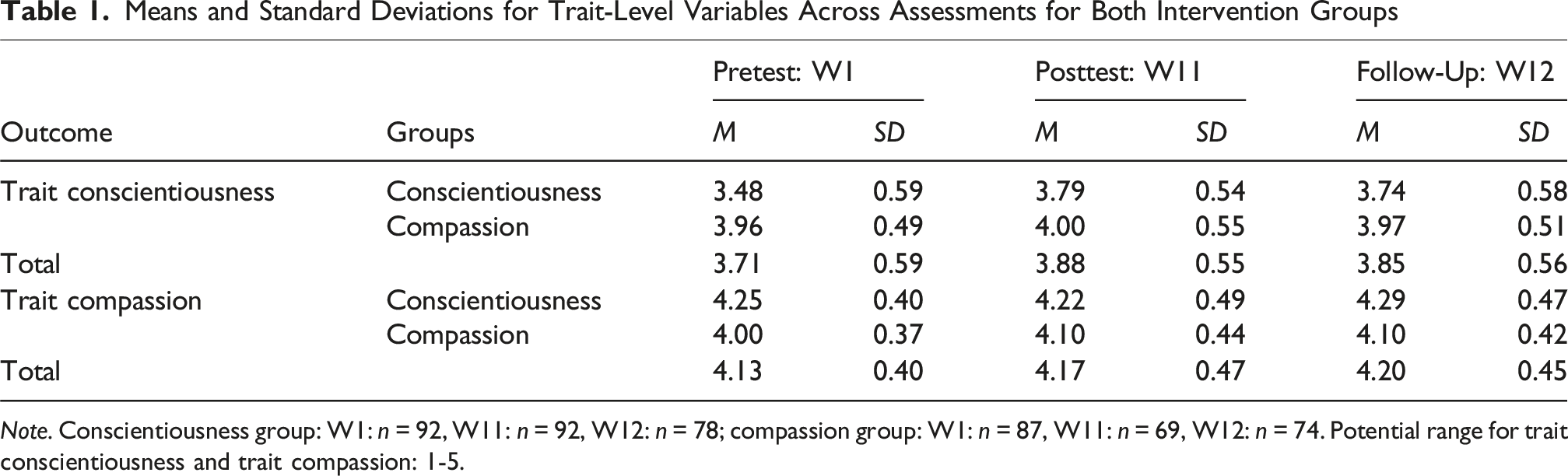
Note. Conscientiousness group: W1: n = 92, W11: n = 92, W12: n = 78; compassion group: W1: n = 87, W11: n = 69, W12: n = 74. Potential range for trait conscientiousness and trait compassion: 1-5.
Participants who chose to work on their conscientiousness reported significantly lower trait conscientiousness than those in the compassion group (t(177) = 5.96, p < .001, d = 0.89), and participants who chose to work on their compassion reported significantly lower trait compassion than those in the conscientiousness group (t(177) = 4.51, p < .001, d = 0.68). The intervention groups did not differ on any other HEXACO personality dimensions or demographic variables.
Intervention-Related Changes: Trait Level
To identify the best-fitting model for trait-level change, we compared four model types: intercept-only, linear time, and logarithmic time, and piecewise linear models (with separate slopes for the intervention and follow-up periods). The logarithmic models consistently demonstrated superior fit across all trait-level hypotheses (see Supplemental Materials Tables S1 and S2 for complete model comparisons). All reported trait-level results are based on these logarithmic models with random intercepts and random slopes.
We first examined each intervention group separately. Hypothesis 1 was supported: those in the conscientiousness group reported significantly higher levels of trait conscientiousness at posttest compared to pretest, with these self-reported increases generally retained at follow-up (b = 0.13, 95% CI [0.07, 0.18], SE = 0.03, p < .001, d = 0.52). These participants did not report increases in trait compassion (b = 0.00, 95% CI [-0.03, 0.04], SE = 0.02, p = 0.89).
Hypothesis 2 was also supported: participants in the compassion group reported significantly higher levels of trait compassion at posttest compared to pretest, with these self-reported increases mostly retained at follow-up (b = 0.05, 95% CI [0.01, 0.09], SE = 0.02, p = .017, d = 0.28). These participants also did not report increases in trait conscientiousness (b = 0.01, 95% CI [−0.03, 0.04], SE = 0.02, p = .61). As shown in Figure 2, participants in the conscientiousness group reported a greater increase in their target trait compared to the increase reported by those in the compassion group. Changes in trait and state compassion and conscientiousness in standard deviation units. Note. Average change in outcome from the beginning of the study (pretest/wave 1/week 0) to the end of the study (follow-up/wave 12/week 7). Following the method of Stieger et al. (2020) estimates for each week for each outcome were calculated by subtracting the pretest mean from the mean of the outcome at a specific week and dividing by the standard deviation of that outcome at pretest
When examining both groups together with Time × Group interactions, Hypothesis 3 was supported: the logarithmic slope by group effect for conscientiousness was significant (b = 0.14, 95% CI [0.07, 0.20], SE = 0.03, p < .001). While the compassion group did not report significant increases in trait conscientiousness (p = .90), the conscientiousness group reported a 0.14 unit increase (p < .001).
Fixed Effects Parameter Estimates for the Logarithmic Models With Logarithmic Slope by Group Interactions

Note. Number of observations at the trait level = 492; number of observations at the state level = 1009. SE = standard error; group: 1 = conscientiousness, 0 = compassion. *p < .05, **p < .01, ***p < .001.
Intervention-Related Changes: State Level
Means and Standard Deviations for State-Level Variables Across Assessments for Both Intervention Groups
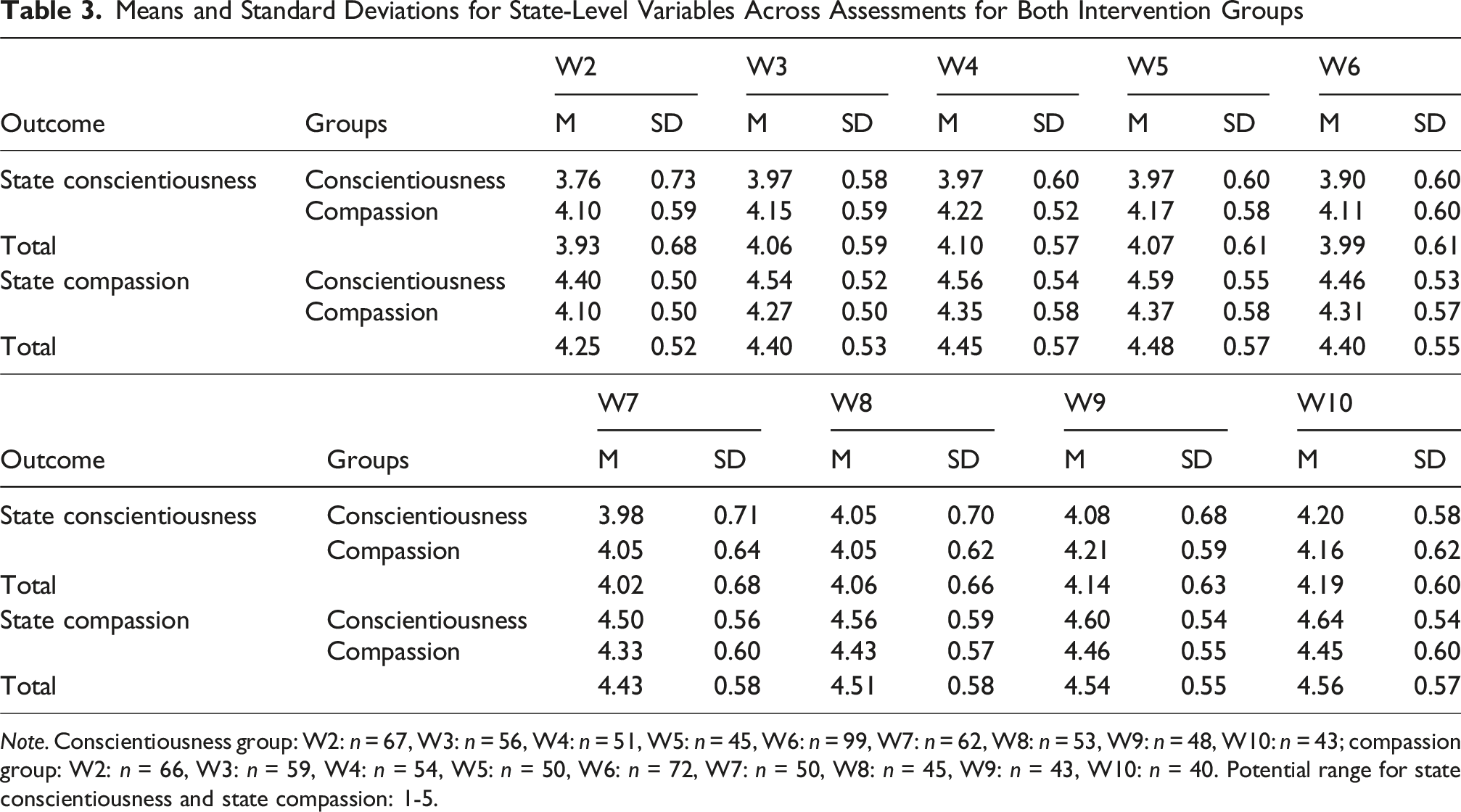
Note. Conscientiousness group: W2: n = 67, W3: n = 56, W4: n = 51, W5: n = 45, W6: n = 99, W7: n = 62, W8: n = 53, W9: n = 48, W10: n = 43; compassion group: W2: n = 66, W3: n = 59, W4: n = 54, W5: n = 50, W6: n = 72, W7: n = 50, W8: n = 45, W9: n = 43, W10: n = 40. Potential range for state conscientiousness and state compassion: 1-5.
Examining groups separately, Hypothesis 5 was supported: participants in the conscientiousness group reported significantly higher state conscientiousness across the intervention period (b = 0.08, 95% CI [0.01, 0.14], SE = 0.03, p = .025, d = 0.61). Unexpectedly, these participants also reported increases in state-level compassion (b = 0.07, 95% CI [0.03, 0.12], SE = 0.02, p = .003, d = 0.48).
Hypothesis 6 was also supported: participants in the compassion group reported significantly higher state-level compassion across the intervention period (b = 0.16, 95% CI [0.11, 0.20], SE = 0.02, p < .001, d = 0.70). These participants did not report significant increases in state-level conscientiousness (b = 0.02, 95% CI [-0.02, 0.08], SE = 0.03, p = .37). Figure 2 depicts these self-reported changes across both intervention groups.
For the combined analyses, Hypothesis 7 was not fully supported: although participants in the conscientiousness group reported greater increases in state conscientiousness than those in the compassion group (b = 0.06, 95% CI [-0.03, 0.14], SE = 0.04), this effect was not significant (p = .09). The conscientiousness group reported a 0.08-unit increase in state conscientiousness, while the compassion group did not report significant increases (b = 0.02, p = .46).
Hypothesis 8 was supported: the logarithmic slope by group effect for state compassion was significant (b = −0.09, 95% CI [−0.15, −0.02], SE = 0.03, p = .006). The compassion group experienced a significant 0.15-unit increase in state-level compassion (p < .001), while the conscientiousness group experienced a smaller 0.06 unit increase. Complete state-level parameter estimates are presented in Table 2, with models controlling for baseline conscientiousness in Supplemental Materials Table S3.
Discussion
The purpose of this study was to investigate whether volitional personality change can be successfully initiated for moral traits; specifically, for the trait of compassion. Previous research has shown that individuals report changes in their levels of emotional stability, conscientiousness, and extraversion following personality change interventions (Baranski et al., 2017; Hudson et al., 2019; Stieger et al., 2021). There is, however, limited evidence that people are able to change on traits related to personal values, including moral traits, as people tend to prioritize traits with perceived direct personal benefit over those with ethical relevance (Sun & Goodwin, 2020). This study adapted the model of two previous volitional personality change interventions (Mendonça et al., 2023; Stieger et al., 2020), allowing participants to choose one of two personality traits to work on improving over the duration of a 5-week goal-setting intervention. Participants could choose between a non-moral (conscientiousness) or moral trait (compassion) and were guided in choosing which trait to work on through a series of novel activities they engaged with before the intervention began. In addition to the intake activities, the study was also novel in its duration and in the self-directed nature of the trait-relevant goals participants set.
Results indicated that participants in both intervention groups reported changes in their chosen traits in the short term. Participants in the conscientiousness group reported larger trait-level increases in conscientiousness, while participants in the compassion group reported larger state-level increases in compassion over the course of the intervention. In sum, while these findings should be interpreted cautiously given the reliance on self-report measures and the absence of a randomized blinded control group, this research provides preliminary evidence that implementation intention-based volitional personality change interventions may lead to self-reported increases in both moral and non-moral personality traits.
Changes During the Intervention Period
Overall, the results of this study indicate that participants in both intervention groups reported changes in their self-selected personality traits in the short-term. However, there were differential changes in magnitude across the two intervention groups and across the different levels of assessment (trait and state).
Trait-Level Changes
Replicating the results of previous volitional personality change studies, the largest trait-level changes were found for conscientiousness. On average, participants in the conscientiousness group reported increases in their trait conscientiousness levels of 0.52 standard deviation units from pretest to posttest, with this effect only diminishing to a 0.44 standard deviation unit change from pretest to follow-up (2 weeks after posttest). When compared to changes in conscientiousness reported by those in the compassion group (examining a time × group interaction), this effect still held.
However, in a novel finding, participants in the compassion group also reported successfully increasing their trait levels of compassion. On average, participants in the compassion group reported increases in their pretest trait compassion levels of 0.28 standard deviation units from pretest to posttest, maintaining a 0.27 standard deviation unit change from pretest by follow-up. The time × group interaction effect for trait compassion also held.
When contextualized within the broader literature, our effect sizes are notably larger than meta-analytic averages. Our conscientiousness effect size (d = 0.52) substantially exceeds the meta-analytic average for conscientiousness interventions (d = 0.31; Haehner et al., 2024), while our compassion effect (d = 0.28) is larger than the average for agreeableness-related traits (d = 0.15). These comparatively larger changes during the intervention period may reflect several factors, including the active reflection component requiring participants to write detailed implementation intentions every 3 days and the provision of trait-standing feedback prior to intervention selection. However, alternative explanations such as demand characteristics, the specific student sample, and normative trait changes during this developmental period cannot be ruled out.
Our compassion findings represent an important contrast to Mendonça et al. (2023), who failed to find trait-level compassion change despite conducting a longer intervention (12 weeks vs. our 5 weeks) and using the same compassion measure. Notably, our 5-week intervention was also shorter than the typical volitional personality change intervention duration of approximately 10.5 weeks reported in Haehner et al.'s (2024) meta-analysis, yet was still associated with significant trait-level compassion change. The differences in outcomes between our study and Mendonça et al. may be attributable to our provision of trait-standing feedback combined with a structured reflection task, which may have enhanced motivation for compassion change. Sample differences may also play a role: Mendonça et al. studied established adults (ages 30-45) while our sample consisted of college students, suggesting that younger adults in our developmental period may show greater plasticity for compassion change, or that our college student sample had different baseline motivations or situational affordances for compassion development.
State-Level Changes
The large majority of volitional personality change research has examined changes in personality only at the trait level. However, a growing number of recent studies have begun to examine personality change at the state level. Mendonça et al. (2023) assessed weekly state-level compassion and intellectual humility, finding significant state-level increases in both traits even when trait-level compassion did not change—a pattern partially paralleled by our own findings. The PEACH intervention studies incorporated experience sampling and weekly state assessments, demonstrating that the intervention successfully changed personality states (Allemand et al., 2024; Stieger et al., 2021), and that achieved state changes during the intervention predicted the degree of trait change (Olaru et al., 2025). Our findings converge with this emerging literature while also revealing distinct patterns across our two intervention groups.
At the state level, the pattern of effects diverged notably from the trait-level pattern. Those in the compassion group reported a much larger state-level increase in their target personality characteristic as compared to the conscientiousness group, with compassion group participants reporting increases in their state compassion levels of an average of 0.70 standard deviation units from the first point of state-level data collection (wave 2) to the last (wave 10). Practically, this means that compassion group participants reported generally engaging in more and more compassion-relevant thoughts, feelings, and behaviors over the course of the intervention. However, there were slight exceptions to this upwards-increasing trend: there were some fluctuations in average state-level compassion for participants in both intervention groups around the halfway mark of the intervention (wave 6). One possible explanation is that this was the only state-level wave that participants could complete to receive course credit, so many participants who were engaging in the intervention less than other participants were assessed at this point. This fluctuation in state-level data speaks to the importance of a minimum personality change intervention duration of 5 to 6 weeks (following Roberts et al., 2017). The longer the intervention and data collection periods, the more temporary fluctuations in personality levels can be put into the context of longer-term trends.
Participants in the conscientiousness group also reported increases in their state levels of conscientiousness over the course of the intervention, by an average of .61 standard deviations from wave 2 to wave 10. This change was significant when just comparing conscientiousness group participants’ levels at wave 10 to their levels at wave 2 but was only marginally significant when examining the multilevel model testing for a time × group interaction effect. In other words, conscientiousness group participants’ state-level conscientiousness increases were not as significant when compared to how much those in the compassion group increased in state-level conscientiousness over the course of the intervention. Additionally, as shown in Figure 2, participants in the conscientiousness group also reported increases in state-level compassion almost as much as they increased in state level-conscientiousness.
Notably, this divergent pattern—with compassion participants showing larger state-level changes than conscientiousness participants, despite showing smaller trait-level changes—suggests that the processes through which state-level behavioral changes consolidate into trait-level self-concepts may differ between these two personality domains.
Implications of Differential Intervention-Related Changes
The present study found support all eight hypotheses, yet the magnitude of changes that occurred during the intervention period varied substantially both across intervention groups and across assessment levels. Understanding these differential patterns provides important insights into the mechanisms underlying volitional personality change.
Interpreting State-Level Changes
The interpretation of state-level changes deserves careful consideration. These increases may partially reflect participants’ active creation of situations that afforded the expression of their target traits rather than representing purely spontaneous changes in trait expression. In this sense, state measures may function partially as a manipulation check, demonstrating that participants successfully created more opportunities in their everyday lives to engage in behaviors related to their chosen trait. However, this situation creation itself represents an important form of volitional change—participants were successfully modifying their environments and behavioral patterns in ways aligned with their change goals. The distinction between “genuine” trait change and successful situation selection may be less clear-cut than it initially appears, as real-world personality development likely involves both processes.
The differential magnitude of state-level changes between groups may reflect differences in how easily participants could create relevant situations. Conscientiousness-related behaviors (e.g., organizing, planning, completing tasks) are largely under individual control and can be enacted in most contexts. In contrast, compassion-relevant behaviors typically require interaction with others and appropriate social situations. Compassion participants may have needed to more actively and deliberately create or seek out opportunities to express compassionate behavior—for instance, by initiating conversations, offering help to others, or engaging in perspective-taking exercises. This more effortful situation creation may explain why compassion participants showed particularly robust state-level changes: they were not merely expressing an existing trait in available situations but actively constructing new behavioral patterns and social contexts.
The fact that state-level compassion seemed to be more malleable than state-level conscientiousness may also reflect fundamental differences in these constructs. Compassion is inherently more emotion-based than conscientiousness, and emotions fluctuate with greater variability (Eaton & Funder, 2001). Additionally, the stronger state-level than trait-level changes for compassion could indicate that trait-level compassion changes at a slower rate than trait-level conscientiousness, and that more intense state-level change is needed to produce comparable trait-level increases. It is also possible that purely implementation-intention based interventions are better-suited for changing a trait such as conscientiousness, which individuals have a lot of personal control over, than they are for a trait like compassion, for which engagement mostly necessitates interacting with others. Future research should examine the effect of specifically compassion-oriented personal activities, like loving-kindness meditation, to see if this can increase the level of possible trait change in such areas.
Motivation, Expectancy, and Selection Effects
Beyond these mechanistic differences between traits, motivational factors and individual differences in baseline characteristics help explain the differential intervention effects. The fact that trait-level effects were stronger for conscientiousness aligns with broader patterns in personality change motivation. Conscientiousness is generally a trait that people are motivated to change (Sun & Goodwin, 2020), and participants in the conscientiousness group expected to experience significantly more personality change than those in the compassion group. These differential expectations were reflected in the results, suggesting that motivation and expectancy may play substantial roles in determining the magnitude of self-reported change. It may be the case that individuals will generally be more motivated to change aspects of themselves they see as having more direct personal benefit, creating an inherent challenge for moral trait change interventions.
The selection effects observed in this study merit further consideration. As expected based on prior research (Baranski et al., 2017; Hudson & Roberts, 2014; Stieger et al., 2020), participants chose to work on personality traits for which they had generally lower levels: those who chose conscientiousness were significantly lower in trait conscientiousness at pretest (d = 0.78), while those who chose compassion were significantly lower in trait compassion at pretest (d = 0.96). This finding aligns with research showing that individuals are most likely to want to change the parts of themselves and their lives that they are most dissatisfied with (Baumeister, 1994) and are generally motivated to close the gap between their actual self and their ideal self (Higgins, 1987; Markus & Nurius, 1986).
Notably, however, participants who selected the compassion intervention reported significantly higher conscientiousness than those who selected the conscientiousness intervention (d = 0.89). This creates an interesting paradox: although participants in the compassion group reported higher baseline conscientiousness, which may have facilitated greater diligence in intervention task completion, they still reported smaller trait-level changes than the conscientiousness group. Our Supplemental Analyses (Table S3) confirmed that effects held when controlling for pretest conscientiousness levels, with effect sizes for compassion change actually becoming slightly larger when baseline conscientiousness was controlled. This pattern suggests that trait-level compassion change may be inherently more difficult to achieve than conscientiousness change, regardless of participants’ capacity for sustained engagement. It also indicates that self-regulated personality change may be possible for individuals who are relatively lower in conscientiousness, although future research should investigate whether there is a minimum level of conscientiousness required for successful intervention engagement.
Facilitating Moral Trait Selection
Despite these challenges, the present study was successful in getting essentially half of participants to choose to work on a moral trait. This outcome is particularly noteworthy given that previous research suggests people would be less likely to prioritize a morally relevant trait in this context (Sun & Goodwin, 2020). The fact that both intervention groups ended up being of equivalent size particularly demonstrates that, at least when individuals’ personality change options for a volitional intervention are circumscribed to just two traits and trait-standing feedback is provided, individuals can choose to prioritize moral trait improvement.
The relatively high proportion of participants selecting compassion (48.6%) may reflect characteristics specific to our sample of psychology students, who may be particularly drawn to interpersonal and helping-oriented goals given common aspirations toward therapeutic or helping professions. However, we note that countervailing factors might make college students less likely to prioritize compassion development: young adults in this developmental period often prioritize self-focused goals related to achievement and establishing their careers over more other-oriented concerns (Dunlop et al., 2013). The balance of these factors in our sample remains unclear, and replication with more diverse samples is needed to determine the generalizability of our findings.
Although this study provides no experimental evidence on the effectiveness of the trait-standing feedback feature provided in the intake survey, exploratory analyses suggest that this feature may have had some influence. Individuals who rated this feature as more influential in their trait choice were more likely to choose to work on the moral trait option, compassion (see exploratory analyses in the Supplemental Materials). Participants in both intervention groups were also marginally more likely to experience greater change in their targeted trait if they rated the feedback feature as more influential. These findings provide tentative evidence that participants who (1) are made aware of discrepancies between their current trait standing and the population norm or their trait standing on other traits and (2) feel significantly impacted by this feedback are more likely to be able to desire and successfully carry out moral trait change. Trait-standing feedback has been incorporated in previous VPC research, both in studies assessing trait change preferences (Thielmann & de Vries, 2021) and in intervention contexts such as the PEACH study, which provided participants with their Big Five personality profile prior to goal selection (Stieger et al., 2018). Our approach extended this by providing normative feedback—showing participants their percentile standing relative to population norms—which may be particularly relevant for moral traits given that people tend to inflate their moral self-perceptions more than their nonmoral self-perceptions (Tappin & McKay, 2017). Future research should experimentally test whether such feedback causally influences trait selection and intervention outcomes.
Limitations and Future Directions
Although this study had many novel features and generally supported the preregistered hypotheses, several important limitations must be acknowledged.
First and most importantly, this study relied exclusively on self-report measures, which precludes determining whether participants actually changed their personalities or merely perceived themselves as having changed. The observed increases in self-reported compassion and conscientiousness may reflect genuine personality change, but they could also result from shifts in self-perception, increased self-awareness without corresponding behavioral change, demand characteristics, or effort justification following intensive intervention engagement. This limitation is particularly acute given the absence of a randomized blinded control group and the fact that we recruited participants specifically to participate in a personality change intervention, which likely created both selection effects (attracting individuals already motivated to change and, critically, individuals with lower baseline trait levels who then chose to work on those specific traits) and demand effects (encouraging participants to report change). Furthermore, participants were not blinded to the study’s goals, which likely amplified expectations for change and motivation to report improvement. As Krämer and colleagues (2025) note, without proper control conditions and relying solely on self-report, observed changes cannot be definitively attributed to the intervention itself. The specific pattern of selection we observed—with participants choosing traits on which they scored lowest—creates conditions particularly favorable for regression to the mean, where observed improvements may partially reflect natural fluctuation back toward population averages rather than genuine intervention effects (Krämer et al., 2025). Future research should incorporate well-powered observer report analyses, as demonstrated by Stieger et al. (2021), who found that observer-reported changes were approximately half to two-thirds the size of self-reported effects. Such multi-method assessment would provide stronger evidence for genuine personality change versus perceptual shifts. 5
Beyond the issue of measurement methods, the absence of appropriate control conditions represents another key limitation. Recent findings from Krämer and colleagues (2025) underscore the severity of this concern: they demonstrated that waitlist control groups in personality intervention studies showed changes nearly as large as those in active intervention conditions. Critically, they found that simply framing a study as a personality change intervention—as we did in our recruitment—was sufficient to produce both selection effects (attracting individuals lower in target traits) and expectancy effects that together led to self-reported improvements in conscientiousness, neuroticism, and extraversion. This suggests that our observed effects, while encouraging, may substantially overestimate the true causal impact of our specific intervention components. The absence of a measurement-only control group or a group recruited under neutral framing means we cannot determine what proportion of our effects would have occurred simply from repeated assessment and expectancy-driven reporting.
Second, although we could make some conjectures based on differences in the observed state- and trait-level changes, we were not able to isolate the specific processes that potentially caused compassion to change in one way and conscientiousness in another. While our pattern of results suggests that situation creation, differential motivation, and trait-specific change mechanisms may all play roles, our study design does not allow us to determine which factors were most critical or how they interact. Future research should focus on testing granular mechanisms of change through experimental designs that systematically manipulate specific intervention components and assess proposed mediators.
Third, as was mentioned previously, we were not able to experimentally test the effectiveness of the features included in the intake survey, such as the trait-standing feedback and reflection task. Future research should therefore test the effectiveness of elements like these with an experimental design in which some intervention participants are randomly assigned to partake in these activities and others do not.
Fourth, there was substantial attrition, especially across the state-level assessment waves. While attrition has been a feature of past research on volitional personality change (e.g., Hudson & Fraley, 2015), future studies could try giving participants monetary incentives after each state-level wave and then also giving a larger bonus to participants who completed a certain minimum number of waves.
Fifth, studies of this kind need to be replicated with a more representative sample demographically in order to be able to generalize these findings to a larger audience. In this college student sample, developmental and situational factors may have played an outsized role: being a young adult college student in the setting of a residential college campus is a very specific role and environment, and personality change might occur in different ways for individuals in different stages of life, with different personal resources, and with different environmental roles and incentives.
Sixth, due to the study’s 7-week timeframe, no conclusions can be drawn about the intervention’s effect on personality in the long term. Although short-term personality change can still be useful (and for some people, more desirable than long-term personality change; Rebele et al., 2021), it would be helpful to know whether less-intensive interventions like this one can have effects that last longer than only a few weeks. Future volitional personality change intervention studies should attempt to assess personality at follow-ups further than only several weeks (or even several months) post-intervention.
Conclusion
The findings of this study support the idea that moral personality traits (in this case, compassion) can be changed volitionally, at least as indicated by self-report measures in the short term. Below, we describe what we believe are the three most important takeaways from this work.
First, this study was successful in getting many—essentially half—of participants to choose to work on a moral trait, even though previous research suggests that people would be less likely to prioritize a trait with significant ethical relevance over one with more obvious direct personal benefit in this context (Sun & Goodwin, 2020). This suggests that providing participants with personality feedback, giving them a circumscribed choice, and framing moral traits in ways that also feel personally relevant—such as including self-compassion alongside other-directed compassion—could have a substantial impact in encouraging participants to work on morally relevant aspects of their personality.
Second, individuals who took part in the study reported substantial increases in state-level compassion over the course of the intervention—larger state-level increases in their desired trait than those working on their conscientiousness. This provides evidence that individuals are able to volitionally change their day-to-day behaviors to include more compassionate ways of interacting with others and themselves, and that these self-reported changes seem to accumulate and become stronger over time.
Third, the choice of outcome measure matters substantially for detecting change. Our findings reveal that state-level measures were considerably more sensitive to changes occurring during the intervention period than trait-level measures, with compassion showing particularly strong divergence between assessment levels. State measures detected large, significant changes in daily compassionate behavior (d = 0.70) that were not fully reflected in global trait self-perceptions. This pattern suggests that researchers may miss important intervention effects when relying solely on traditional trait assessments, as participants may be successfully enacting more frequent trait-relevant behaviors in their daily lives before these changes consolidate into shifts in global self-concept. In other words, relying solely on trait assessments may miss important short-term (or “elastic”) changes (Roberts & Bonner, 2024). The substantial state-level effects we observed indicate that volitional personality change interventions can meaningfully influence day-to-day experience and behavior even when reported trait-level changes are more modest, and recent evidence suggests that the degree of state-level change during an intervention may predict subsequent trait change (Olaru et al., 2025). Future intervention research should therefore incorporate multi-level assessment to capture the full scope of personality change processes.
Overall, this research challenges commonly held notions that moral trait change is both undesirable and unattainable. Future research should examine the possible long-term effects of such change, investigate the specific processes of different kinds of trait change with rigorous experimental designs including randomized blinded control groups and observer reports, and explore whether volitional change for other moral traits is possible.
Supplemental Material
Supplemental Material - Becoming More Compassionate (or Conscientious) at the State or Trait Level? Effects of a Short-Term Volitional Intervention Promoting Moral and Non-Moral Personality Change
Supplemental Material for Becoming More Compassionate (or Conscientious) at the State or Trait Level? Effects of a Short-Term Volitional Intervention Promoting Moral and Non-Moral Personality Change by Rowan Kemmerly, Eranda Jayawickreme in Personality Science.
Supplemental Material
Supplemental Material - Becoming More Compassionate (or Conscientious) at the State or Trait Level? Effects of a Short-Term Volitional Intervention Promoting Moral and Non-Moral Personality Change
Supplemental Material for Becoming More Compassionate (or Conscientious) at the State or Trait Level? Effects of a Short-Term Volitional Intervention Promoting Moral and Non-Moral Personality Change by Rowan Kemmerly, Eranda Jayawickreme in Personality Science.
Footnotes
Author Note
Rowan Kemmerly is now affiliated with Rutgers University, Newark, NJ, USA.
Acknowledgement
Many thanks to Shannon Brady, Heath Greene, and Phillip Clarke for helpful feedback on this project.
Author Contributions
Rowan Kemmerly: Conceptualization, Data curation, Formal analysis, Investigation, Methodology, Project administration, Writing - original draft, Writing - review & editing
Eranda Jayawickreme: Conceptualization, Formal analysis, Supervision, Writing - review & editing.
Funding
The authors disclosed receipt of the following financial support for the research, authorship, and/or publication of this article: This publication was made possible through the support of grant #61514 from the John Templeton Foundation. The opinions expressed in this publication are those of the authors and do not necessarily reflect the views of the John Templeton Foundation.
Corrections (April 2026):
This paper was updated to correct the heading “State conscientiousness” in Table 3.
Declaration of Conflicting Interests
The authors declared the following potential conflicts of interest with respect to the research, authorship, and/or publication of this article: Eranda Jayawickreme is a member of the journal’s editorial board.
Data Availability Statement
Data, code, and materials from this study can be found at https://researchbox.org/1144. This study was preregistered:  .
.
Supplemental Material
Supplemental material for this article is available online.
Notes
References
Supplementary Material
Please find the following supplemental material available below.
For Open Access articles published under a Creative Commons License, all supplemental material carries the same license as the article it is associated with.
For non-Open Access articles published, all supplemental material carries a non-exclusive license, and permission requests for re-use of supplemental material or any part of supplemental material shall be sent directly to the copyright owner as specified in the copyright notice associated with the article.
