



Abstract
Trait responses to emotion (TREs) are personality traits that develop from consistent emotion coping strategies. TRE theory is a novel theory and has yet to be empirically validated; thus, the primary aims of Study 1 were to determine the empirical relationships among individual TREs and the relationship between TREs and demographic factors that influence personality development: age, gender, early life experiences, and socioeconomic factors. Study 1 developed a multidimensional model to explore TRE from a TurkPrime sample (N = 284). Multi-dimensional scaling yielded 3 dimensions: approach, dyscontrol, and engagement. Age, gender, and early life experiences were significantly associated with TREs. Study 2 extended the findings of Study 1 by testing whether the 3 latent dimensions identified in Study 1 replicated and were distinct from other prominent models of personality (e.g., five-factor and HEXACO models). Study 2 replicated the multidimensional model from Study 1 in a TurkPrime sample (N = 546) and determined that TRE latent dimensions had small to moderate correlations with facets of the five-factor and HEXACO personality models, supporting TRE dimensions as a distinct personality model. These studies have better characterized the empirical relationships and structure of TREs and distinguished TREs from other prominent models of personality.
Keywords
Introduction
There are two prevailing views of the relationship between emotion, coping, and personality. The first view proposes that personality dimensions can impact a person’s coping with stress, and coping then affects emotions: a top-down process (Lazarus, 1999). The second view proposes that personality emerges from the consistent way that people cope with their emotions: a bottom-up process (Segerstrom & Smith, 2019). From a functionalist view, emotions influence cognitive and behavioral responses to a person’s environment. Emotions are also considered to be adaptive because they draw attention to needs and can impact psychological and physical health outcomes. Consistently coping with or managing emotions over time can become dispositional in nature (Campos et al., 1994).
Dispositional coping styles, trait responses to emotion (TRE), develop and subsequently impact one’s social, psychological, and physical health. Trait responses to emotions have been theorized to include elements of control, approach, escape, and avoidance. These elements are reflected in traits like urgency, need for affect, and alexithymia (Segerstrom & Smith, 2019; Timoney & Holder, 2013). Although there has been extensive research on most individual trait responses to emotions, the empirical relationships among them have largely not been characterized. Our primary aim was to address this gap by developing a dimensional model of the relationships between trait responses to emotions from a large, diverse, US sample. Additionally, because demographic characteristics impact personality trait development and expression, a secondary aim was to explore the correlations between trait responses to emotion dimension scores and age, gender, early life experiences, and early life socioeconomic context. Finally, we tested whether trait response to emotion latent dimensions are distinct from other prominent models of personality, such as the five-factor and HEXACO models.
Characteristics of Trait Responses to Emotion
Responses to emotion can include deliberate regulation as well as non-regulatory motivations and behaviors in reaction to the experience of emotion. One dimension of trait responses to emotion related to the neurobiological underpinnings of responses to emotion concerns control (Barbas, 2007; Bechara et al., 2000; Lewis & Todd, 2007; Segerstrom & Smith, 2019). Controlled responses to emotion result in aligning management of an emotional experience with long-term interests and goals. In contrast, uncontrolled responses would include reacting impulsively to a strong emotion. For example, positive and negative urgency have an inverse relationship with control. People high in urgency act rashly and impulsively when experiencing intense emotions to deal with those emotions, potentially inconsistent with their long-term needs and goals (Cyders & Smith, 2007; Whiteside & Lynam, 2001).
Another dimension of trait responses to emotion concerns approach and avoidance, that is, the predisposition to engage with emotions and feel more, such as crying during a funeral, or disengage from emotions and feel less, such as playing video games after being rejected for a date. Emotional approach typically has small rather than large negative correlations with avoidance (Moreno et al., 2016), and approach and avoidance in need for affect are modestly negatively correlated (usually r = −.30 to −.50; Maio & Esses, 2001). However, approach correlates more highly and positively with reward, and avoidance correlates more highly with inhibition, suggesting that while both approach and avoidance are emotion responses, they are rooted in different motivations, which can then influence behaviors. Emotional approach includes need for affect, trait emotional approach coping, and trait emotion expression (Segerstrom & Smith, 2019). Those who are high in emotional approach are motivated to seek out and approach both positive and negative emotions (Maio & Esses, 2001) and use emotional approach coping strategies (including emotional expression and emotional processing; Master et al., 2009).
The converse of emotional approach is escape/avoidance. Through negative reinforcement, escape (taking action to reduce discomfort when experiencing emotions) can develop into avoidance (taking preemptive action to prevent unwanted emotions). For example, alexithymia is closely associated with escape-avoidant responses to emotion. Alexithymia reflects difficulty identifying and communicating emotions and a tendency to focus on external rather than internal factors. Alexithymia may involve avoiding recognizing emotions, which leads to failure to recognize effective strategies for coping with emotion (Li et al., 2015). As expected, people who experience more negative emotion are more likely to use escape/avoidance (Maio & Esses, 2001; Timoney & Holder, 2013).
Demographic Correlates of Trait Responses to Emotion
Changes in motivations for emotion may result in age-related differences in trait responses to emotions. Younger adults are less likely to avoid negative emotion than older adults (Riediger et al., 2009). Older adults utilize more passive, escape/avoidance, and suppression strategies, such as deliberate withdrawal, to cope with emotion and conserve emotion resources. They are less likely to express emotions or seek social support than younger and midlife adults (Blanchard-Fields et al., 2004).
Trait responses to emotions may differ by gender, especially in emotion expression. In gender-stereotypic socialization, women are viewed as nurturers and men are viewed as providers (Brody & Hall, 1993). Therefore, emotions are thought to fall to a greater degree in women’s domain. Additionally, women may be more likely to endorse control over their negative emotions, particularly anger, to align with their interpersonal goals. Men may be more concerned with power dynamics (Timmers et al., 1998).
Early exposure to stressors can result in negative outcomes such as more internalizing behaviors, more emotional reactivity to stressful situations, and a lower ability to effectively engage in control-based emotion regulation (D’Andrea et al., 2012). Early-life stressors can result in responses to emotion that are rooted in emotion dysregulation in childhood and carry on into adulthood (Dvir et al., 2014; Shields & Cicchetti, 1998).
Socioeconomic context (SEC) encompasses the economic and social resources in a person’s environment. Early-life socioeconomic context can be an important determinant of health-relevant contexts such as exposure to environmental toxins, education, and health care access. Poverty negatively impacts children’s development, which in turn can impact emotion regulation ability across the lifespan (Aber et al., 2000).
Study Aims
Study 1 was conducted to determine the empirical relationships among trait responses to emotions using a large, diverse, US sample. The first aim of Study 1 was to develop a multidimensional model of those relationships among trait responses to emotions to characterize them and test empirical support for the theorized dimensions of control and approach (Segerstrom & Smith, 2019). The second aim of Study 1 tested the correlations between dimension scores and demographic variables including age, gender, early life experiences, and socioeconomic context. Study 1 tested the following pre-registered hypotheses. 1. Approach-avoidance and control-dyscontrol will characterize the dimensional structure of trait responses to emotions. 2. Younger and/or female participants will report more approach and less avoidance in trait responses to emotions than older and/or male participants. Older and/or female participants will report more control and less dyscontrol in trait responses to emotions than younger and/or male participants. 3. Exploratory analyses of the relationships between early life experiences and SEC on approach-avoidance and control-dyscontrol were conducted.
Method
Transparency, Openness, and Reproducibility
The study’s aims, hypotheses, methods, materials, and sampling and analysis plan were pre-registered through the Open Science Framework (https://osf.io/mfyeh/overview?view_only=ff3d072ad195400186c2b3d3540beca6). No deviations from the pre-registration occurred. Study data, syntax, code, and instructions for study analyses are available in the following public data repository on Open Science Framework (https://osf.io/3gxqj/overview?view_only=3821535e73c345f0a1c131e2a372fce3).
Participants
Descriptive Statistics

Procedure
All procedures were approved by the University of Kentucky Institutional Review Board (IRB) prior to data collection. Participants were recruited through a survey link posted on the TurkPrime website. Participants read the consent form online and gave consent to participate. Measures were administered via a battery of online surveys.
Measures
Demographics and Early Life
Participants provided demographic information including age, gender, SES, education, and race/ethnicity.
Early life experiences were assessed with the Risky Families Questionnaire (Felitti et al., 1998; Taylor et al., 2004). The Risky Families Questionnaire is a 13-item measure (10 items +3 filler items) that uses a 5-point Likert scale ranging from 1 (not at all) to 5 (very often) to assess the degree of risk of physical, mental, and emotional distress experienced by participants in their homes during childhood and adolescence. The scale had adequate internal consistency (ω = .74).
Early-life socioeconomic context was assessed via a single-item, open-ended question, which asked participants, “What cities and states did you live in from ages 10–18 years old?” Participants listed what year, city, and state they lived in for each year of age (e.g., age 10, 11, 12) during that time frame; if they lived in multiple places in one year, participants were asked to report where they lived for most of that year. We then utilized publicly available data from Social Explorer, a website that provides access to United States Census data, to obtain county-specific demographic information (i.e., population, percent unemployed, median household income) to assess early-life socioeconomic context (Scott et al., 2018). Using Mplus, a latent socioeconomic context variable was created from population, employment, and income values from all counties and Census years, standardized within Census year. Early-life socioeconomic context was then calculated by averaging the socioeconomic context value in the county of residence from ages 10 to 18 years old.
Trait Responses to Emotion
Measure Information and Descriptive Statistics of Trait Response to Emotion Measures

Note. PUR = Positive Urgency measure; NUR = Negative Urgency measure; NFA = Need for Affect scale; AAQ = Acceptance and Action Questionnaire; AoE = Acceptance of Emotions measure; EAC = Emotional Approach Coping measure; BEQ = Berkeley Expressivity Questionnaire; EEQ = Emotional Expressivity Questionnaire; ERQ = Emotion Regulation Questionnaire; ASQ = Affective Style Questionnaire; TAS-II = Toronto Alexithymia Scale-II.
Control
Urgency was assessed with the Positive Urgency (PUR; Cyders et al., 2007) and Negative Urgency (NUR) scales of the revised version of the UPPS Impulsive Behavior Scale (UPPS-R; Whiteside & Lynam, 2001). Because of concerns about ambiguity of particular negative urgency items’ relation to emotion content, items 1, 2, 3, 8, 11, and 12 were modified to include the following leading statement: “When I am experiencing strong negative emotions…”
Approach and Avoidance
Approach- and avoidance-related traits was assessed with the Need for Affect Scale (Maio & Esses, 2001), the Acceptance and Action Questionnaire-II (Bond et al., 2011), the Acceptance of Emotions Scale (Weihs et al., 2008), and the Emotional Approach Coping Scale (Stanton et al., 2000).
Expression
Emotion expression was assessed with the Berkeley Expressivity Questionnaire (Gross & John, 1998), the Emotional Expressiveness Questionnaire (King & Emmons, 1990), the Emotion Regulation Questionnaire (Gross & John, 2003), and the Affective Style Questionnaire (Hofmann & Kashdan, 2010).
Alexithymia
Alexithymia was assessed with the Toronto Alexithymia Scale-II (Bagby et al., 1993).
Affect
Affect was measured to determine if the valence and intensity of emotions impacted trait responses to emotion placement in dimensional space. Affect was assessed with the modified Differential Emotions Scale (Fredrickson et al., 2003).
Anchoring Scales
The BIS/BAS Scale (Carver & White, 2013) and the Brief Self-Control Scale (Tangney et al., 2004) served as anchoring scales for interpretation of empirical dimensions in terms of approach/avoidance and control/dyscontrol, respectively.
Analytic Approach
Sample size was set a priori to precisely estimate the correlations among measures. Correlation precision is impacted by sample size and the reliability of the measures (Schönbrodt & Perugini, 2013). Target sample size was 250 because we employed reliable measures, allowing accurate estimation of “distance” among constructs (i.e., how similar or dissimilar constructs are to each other). Nonparametric correlations were used for multidimensional scaling (MDS) because Positive Urgency was negatively skewed.
Missing data were handled on a case-by-case basis. If the measure had an ω < .70 and 50% or more of the items were missing for a participant, that participant’s score for that measure was not included in analyses. If 75% of a participant’s measures were missing, their data were not used in analyses. Of the 415 initial participants, 131 participants had missing data and were not included in analyses. From the 284 participants included in analyses, missing data rules resulted in 3 missing values for Negative Urgency and 1 missing value for Positive Urgency, the Toronto Alexithymia II Scale, and the BIS/BAS. There was also 1 nonresponse for age. Participants with genders other than male or female (N = 8) were excluded from correlations and from regression analyses with gender because the categories were too small for analysis. Therefore, the analytic sample size was 276 for correlations with gender and for regression analyses.
Confirmatory Hypothesis 1 was tested using multidimensional scaling with ALSCAL in SPSS (25.0). Multidimensional scaling (MDS) was used to quantify the distances between constructs. Unlike factor analysis, in which constructs are either grouped together on the same factor or forced apart on different factors, MDS creates a configuration of constructs in continuous multidimensional space. This configuration, like a map, has poles or dimensions used to orient the space. The first dimension is the one that captures the most variance in distances between constructs, followed by the second dimension, and so on. Each construct’s position is determined by its position or weight on the dimensions, much as latitude and longitude provide positions on a map. Constructs that are close together on a dimension are considered similar on that dimension, whereas those that are far apart are considered different or even opposite on that dimension. For instance, the relationship between an apple and a passion fruit can be described using two dimensions, with one dimension being taste-based (e.g., sweet to bitter) and another dimension being texture-based (e.g., smooth to rough). The apple and passion fruit would likely be together near the smooth pole of the smooth to rough dimension but would be further apart from each on the sweet to bitter dimension (with apple being closer to sweet and the passion fruit being closer to bitter). In line with our confirmatory hypotheses, we expected on a theoretical basis a multidimensional structure along two dimensions: control and approach/avoidance (Segerstrom & Smith, 2019) and did not see these dimensions as mutually exclusive (as factors would be). A general propensity to endorse any response to emotion was assessed by examining item-total correlations and the mean correlation among the measures to determine whether there was such a propensity. The second step investigated qualitative differences in trait responses to emotions using multidimensional scaling. Distances between trait responses to emotion measures was calculated as 1 minus the correlation between the two measures and treated as interval data. Model fit was assessed by stress, a measure comparable to the square root of the residual sum of squares when the model is used to estimate the initial distance matrix. Stress values close to zero indicate good model fit. Accurate estimation of stress depends on the number of objects compared with the number of dimensions. With 21 total measures (including subscales), stress estimates would be interpretable up to a 5-dimensional model (Kruskal & Wish, 1978). Dimension scores were calculated using the following equation:
Confirmatory hypothesis 2 and exploratory hypothesis 3 used zero-order correlations and multiple regression in SPSS (25.0) to test relationships among demographic and early life variables and dimension scores. In multiple regression models, demographics served as explanatory variables, and the dimension score was the outcome variable.
Alpha was set at .05. The Benjamini-Hochberg procedure was applied to account for performing multiple tests on each proposed trait response to emotion dimension. Descriptive statistics for trait responses to emotion measures are available in Table 2.
Results
Confirmatory Hypothesis 1: Dimensional Structure of Trait Responses to Emotion
Kruskal’s stress values for two-to four-dimension solutions were .13, .07, and .06, respectively. Because higher-dimension models did not substantially reduce stress, a three-dimensional solution was selected. Based on Kruskal’s guidelines (stress value less than .10 and greater than .05 as “fair fit”) and the results of a Monte Carlo study (MacCallum, 1981; stress of .051 is “low random error”) the final stress value of .06 for a three-dimensional solution represents fair fit and reasonably low random error. The three dimensions that characterized the dimensional structure of trait responses to emotions were avoidance-approach, engagement-disengagement, and dyscontrol-control. Figure 1 shows the mapping of trait responses to emotions onto the two a priori hypothesized dimensions: Dimension 1 (Avoidance) vs Dimension 3 (Dyscontrol). Multidimensional scaling of trait responses to emotion and anchoring personality measures with the hypothesized dimensions of avoidance and dyscontrol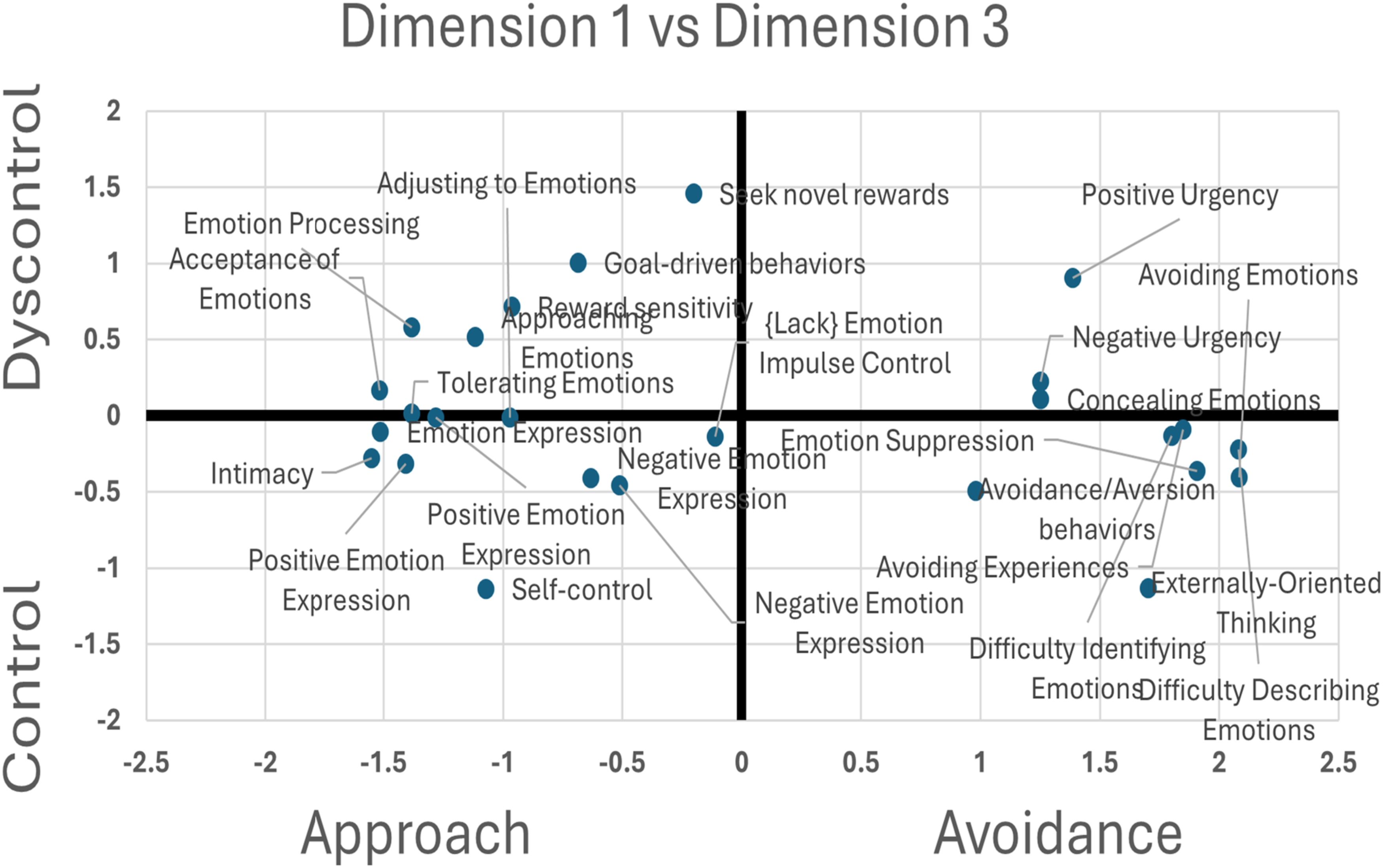
For Dimension 1, measures reflecting emotional avoidance, such as avoiding emotions, alexithymia traits, such as difficulty describing emotions, and emotion suppression, had the highest scores. Those reflecting emotional approach, such as intimacy and positive emotion expression, emotion acceptance, and emotion processing, had the lowest scores.
For Dimension 3, measures reflecting emotion dyscontrol, such as positive and negative urgency, seeking novel rewards, and emotion approach, received the highest scores. Those reflecting emotion control, such as alexithymic traits (e.g., externally-oriented thinking), self-control, and avoiding emotions, received the lowest scores.
Dimension 2 identified a third, unhypothesized dimension, emotion engagement. Measures reflecting emotion engagement, such as positive and negative emotion expression, impulsive emotion expression, and approach, received the highest scores. Those reflecting emotion disengagement, such as concealing emotions, adjusting emotions, and emotion suppression, received the lowest scores.
Confirmatory Hypothesis 2 and Exploratory Hypothesis 3: Correlations and Regression
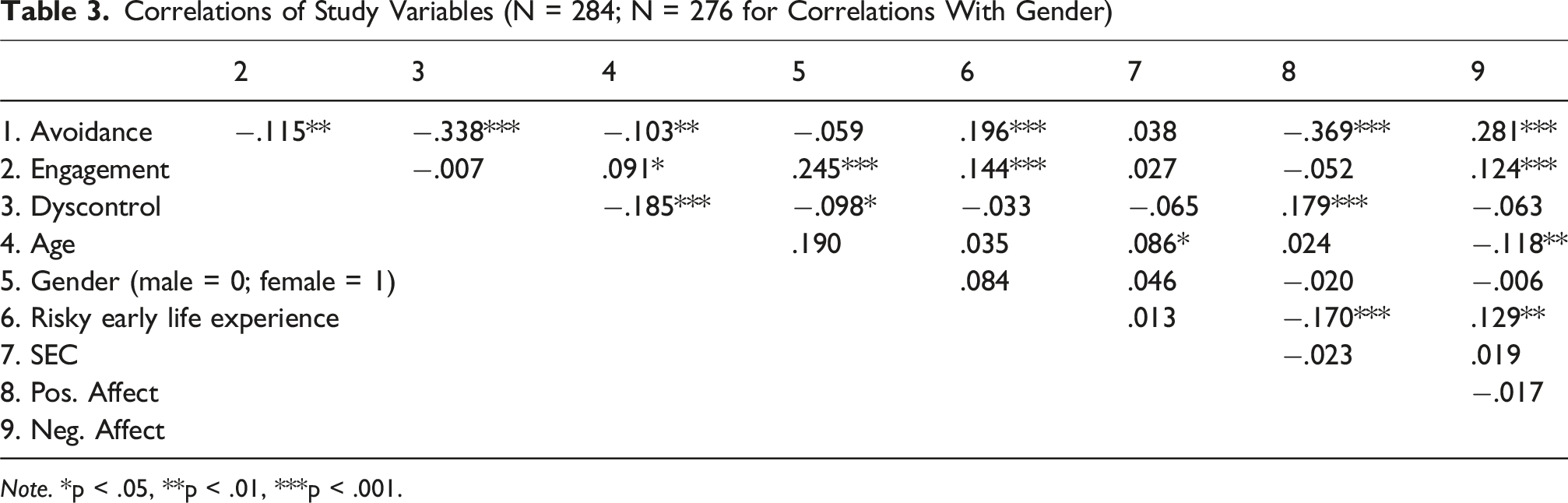
Correlations of Study Variables (N = 284; N = 276 for Correlations With Gender)
Note. *p < .05, **p < .01, ***p < .001.
After determining that multicollinearity was not present between age and gender (VIF = 1.055), the variables were entered together in the regression model. Full regression model results are available in Online Supplemental Table 2.
Avoidance was significantly correlated with younger age (τb = −.10, p = .013) but not with gender (τb = −.06, p = .238). These relationships remained unchanged when age and gender were entered together in a regression model (model F (2, 266) = 2.60, p = .076, R2Adjusted = .012); however, after Benjamini-Hochberg adjustment, the relationship between avoidance and age was also nonsignificant (p = .064).
Dyscontrol was significantly correlated with male gender (τb = −.10, p = .050) and younger age (τb = −.19, p < .001). The relationship remained for age when age and gender were entered together in a regression model but the relationship between dyscontrol and gender was nonsignificant (p = .201; model F (2, 266) = 13.82, p < .001, R2Adjusted = .087).
Engagement was significantly correlated with older age (τb = .09, p = .028) and with female gender (τb = .25, p < .001). The relationship remained for gender when age and gender were entered together in a regression model but the relationship between engagement and age was nonsignificant (p = .568; model F (2, 266) = 13.87, p < .001, R2Adjusted = .088).
Risky early life experiences was significantly correlated with avoidance (τb = .20, p < .001) and engagement (τb = .14, p < .001) but not with dyscontrol (τb = −.033, p = .431). These relationships remained unchanged in regression models (avoidance: F (1, 268) = 16.77, p < .001, R2Adjusted = .055; engagement: F (1, 268) = 8.48, p = .004, R2Adjusted = .027; dyscontrol: F (1, 268) = 2.59, p = .109, R2Adjusted = .006). After Benjamini-Hochberg adjustment, relationships with approach and engagement remained statistically significant (early life experiences and avoidance, p < .001; early life experiences and engagement, p = .006).
Early-life socioeconomic context was not significantly correlated with any of the trait responses to emotion dimensions (avoidance: τb = .038, p = .357; dyscontrol: τb = −.065, p = .116; engagement: τb = .027, p = .507). These non-significant relationships remained so in unadjusted regression models (avoidance: F (1, 260) = .171, p = .680, R2Adjusted = −.003; dyscontrol: F (1, 260) = 3.052, p = .082, R2Adjusted = .008; engagement: F (1, 260) = .044, p = .833, R2Adjusted = −.004).
After determining that multicollinearity was not present between age, gender, early life experiences, and early-life socioeconomic context (VIF = 1.009–1.063), a post-hoc analysis entered them together. This model accounted for 8% of the variance in avoidance (F (4, 257) = 6.421, p < .001, R2Adjusted = .077), 10% of the variance in engagement (F (4, 257) = 8.200, p < .001, R2Adjusted = .099), and 9% of the variance in dyscontrol (F (4, 257) = 7.451, p < .001, R2Adjusted = .090). Individual relationships with dyscontrol were substantively unchanged in this model. The relationship between avoidance and age was stronger (β = −.161, 95% CI [−.282, −.040], p = .009). The relationship between riskier early life experiences and engagement was weaker but remained statistically significant (β = .135, 95% CI [.019, .251], p = .023); other relationships were substantively unchanged.
Post-hoc analyses analyzed correlations between positive and negative affect and trait responses to emotion dimensions. After determining that multicollinearity was not present between positive and negative affect (VIF = 1.017), a post-hoc analysis entered them together to determine how much of the variance in each trait responses to emotion dimension was accounted for by positive and negative affect. Positive affect was correlated with less avoidance (τb = −.37, p < .001) and higher dyscontrol (τb = .18, p < .001), but not significantly correlated with engagement (τb = −.05, p = .207). These relationships remained when positive and negative affect were entered together in the regression models (avoidance: model F (2, 267) = 111.792, p < .001, R2Adjusted = .452; dyscontrol: model F (2, 267) = 14.234, p < .001, R2Adjusted = .090; engagement: model F (2, 267) = 5.303, p = .006, R2Adjusted = .031). Negative affect was correlated with higher avoidance (τb = .28, p < .001), higher engagement (τb = .12, p = .003) but not significantly correlated with dyscontrol (τb = −.06, p = .136). The relationship between negative affect and avoidance, but not engagement, remained when positive and negative affect were entered together in the regression models; additionally, the relationship between negative affect and dyscontrol was also significant (β = −.159, 95% CI [−.274, −.044], p = .007). Hypothesized and post-hoc full model information is available in online Supplemental Tables 1 and 2, respectively.
Study 1 Discussion
A 3-dimensional model best represented the structure of trait responses to emotions. Consistent with our confirmatory hypothesis, avoidance/approach and dyscontrol/control characterized the dimensional structure of trait responses to emotions. An unhypothesized dimension, emotion engagement, also emerged. This dimension was subsumed under approach in initial theorizing (Segerstrom & Smith, 2019), but the empirical evidence suggests that it is distinct.
Older age and male gender were hypothesized to associate with higher avoidance; however, neither age nor gender was associated with avoidance. As reflected in the literature, the relationship between age and approach varies, with some studies reporting that increasing age leads to higher approach (Schirda et al., 2016) and other studies reporting that increasing age is associated with more avoidance to conserve resources (Carstensen & Charles, 1998); thus, there may be other factors, such as context, that play a larger role in the relationship between age and approach. Additionally, men and women were equally high in emotional approach. Shifting gender ideals regarding “appropriate” emotions may facilitate men expressing a variety of emotions as much as women do. Finally, those who had riskier early life experiences reported higher avoidance. People raised in riskier early life contexts may be more likely to utilize avoidant emotion-focused strategies, which can lead to the development and maintenance of avoidant trait responses to emotions (Evans & Kim, 2013).
Older age and female gender were hypothesized to associate with higher control, and these hypotheses were partially supported. Older age was associated with higher control, but gender was not. Older adults, compared with younger adults, have had more time to develop emotion regulation capacity (Gross et al., 1997). Additionally, men and women were equally high in emotional control, suggesting that the need to focus on goal-driven emotion regulation may supersede gender stereotypic expectations for emotional control (Liu et al., 2012). Contrary to the literature on the relationship between early life adversity and dyscontrol, there was not a statistically significant relationship between early life experiences and control (D’Andrea et al., 2012).
A third dimension, emotion engagement, captured people’s engagement with or disengagement from emotions. High emotion engagement is characterized by high expression and approach and low urgency and suppression. Urgency can represent emotion disengagement because one reacts impulsively to avoid feeling strong emotions without resolving the emotions or their cause. Female participants were more likely to report emotion engagement, reflective of gender socialization practices where women are allowed to explore and express emotions (Brody & Hall, 1993).
Additionally, there was a significant positive relationship between riskier early life experiences and emotion engagement, possibly suggesting resilience. Exposure to harsher experiences early in life or more emotionally volatile environments may lead to adaption to and comfort with expressing and engaging with strong emotions (Chen & Miller, 2012). For instance, in our data, riskier early life experiences implied less positive and negative urgency. Alternatively, in riskier families, there may be excessive maladaptive engagement with emotion, predisposing children to engage with emotions regardless of their social and relational effects. The latter explanation seems more likely in this sample, as riskier families were associated with more avoidance (τb = .196, p < .001) and impulsive expression (τb = .150, p < .001) but less intimacy expression (τb = −.173, p < .001).
Early-life socioeconomic context did not have a significant relationship with any of the trait responses to emotion dimensions. Considering the impact of SES on emotion and personality trait development through other traits such as IQ and access to psychosocial and physical resources, the lack of a relationship between a contextual variable like socioeconomic context with trait responses to emotions was unexpected (Deckers et al., 2015). Smaller scale socioeconomic context attached to neighborhoods may play a larger role in trait responses to emotion development. In the present study, differences between neighborhoods within counties may have been obscured. Future research should consider utilizing neighborhood-level socioeconomic context to determine if there is a relationship between early-life socioeconomic context and trait responses to emotions.
Positive and negative emotions significantly accounted for variance in trait responses to emotion dimensions. Affect and trait responses to emotions may shape each other over time. For instance, one would want to avoid negative emotions, but avoidance is not an effective coping strategy for reducing negative emotion, and thus avoidance and negative emotion reinforce each other over time.
Study 2
A latent three-dimensional structure for trait responses to emotion (e.g., approach-avoidance, control-dyscontrol, and engagement-disengagement) could reflect other personality models. For instance, one could argue that the control-dyscontrol dimension is a reflection of conscientiousness, because control-dyscontrol requires acting conscientiously to continue engaging in goal-directed behaviors even when experiencing strong emotions. Thus, Study 2 was conducted to determine if trait response to emotion latent dimensions are distinct from the five-factor and HEXACO models of personality. If trait responses to emotion latent dimensions are distinct aspects of personality, trait responses to emotion could make unique contributions to psychological, physical, and well-being outcomes.
Trait responses to emotion dimensions were compared to the five-factor and HEXACO models of personality, two of the principal theories of personality structure. Both models have been validated in their generalizability and cross-cultural relevance (Ashton & Lee, 2009; Ion et al., 2017; McCrae, 2002; McCrae & Costa, 1987; Rolland, 2002). Trait responses to emotion might be expected to correlate with elements of five-factor and HEXACO personality. For instance, neuroticism is characterized by a general tendency to experience negative emotions, and extraversion is characterized by a general tendency to experience positive emotions (McCrae & Costa, 1987). In Study 1, positive affect was significantly associated with less avoidance and higher dyscontrol, and negative affect was significantly associated with higher avoidance, higher engagement, and less dyscontrol, suggesting similar relationships between these dimensions and extraversion and neuroticism, respectively. Additionally, honesty-humility and agreeableness share generally positive emotion-based adjectives and prosocial tendencies (Ashton et al., 2014; Ashton & Lee, 2007). Prosocial behaviors align with approach-oriented tendencies from effective emotion processing, which allows for a person to be more receptive and understanding of their own and others’ emotions (Ashton & Lee, 2007; Van Kleef & Lelieveld, 2022). In order to provide ‘added value’ beyond existing taxonomies, trait responses to emotion should be distinct enough from those taxonomies that they can be considered different components of personality.
Current Study
We hypothesized the following preregistered aims and hypotheses: that latent trait responses to emotion dimensions would be correlated modestly with specific five-factor and HEXACO personality traits, but trait responses to emotion dimensions would account for variance in affect above and beyond those personality traits. ‘Modest’ correlations, given reasons for actual overlap and shared method variance, were operationalized as a trait responses to emotion dimension sharing less than half of true score variance with a given personality trait, which, after accounting for measurement error, constitutes a correlation of |0.57| or smaller.
The approach dimension will be positively correlated with extraversion, honesty-humility, and agreeableness and negatively correlated with neuroticism.
The engagement dimension will be positively correlated with extraversion, openness to experience, and agreeableness.
The control dimension will be positively correlated with conscientiousness and negatively correlated with negative emotionality and neuroticism.
Trait responses to emotion dimensions will account for at least 5% of the variance in positive and negative emotions above and beyond the variance accounted for by other personality dimensions.
Method
Transparency, Openness, and Reproducibility
The study’s aims, hypotheses, methods, materials, and sampling and analysis plan were pre-registered through the Open Science Framework (https://osf.io/cye9f/overview?view_only=669bab298f5846128e7f951059563a89). After submission of the pre-registration, redundancy in Hypothesis 2’s language was noted and revised to reduce redundancy. No other deviations from the pre-registration occurred. Study data, syntax, code, and instructions for study analyses are available in the following public data repository on Open Science Framework (https://osf.io/3gxqj/overview?view_only=3821535e73c345f0a1c131e2a372fce3).
Participants
Descriptive Statistics

Procedure
All procedures were approved by the University of Kentucky Institutional Review Board (IRB) prior to the start of data collection. Study 2 followed the same procedures as Study 1.
Measures
Demographics
Participants provided demographic information including age, gender, SES, education, and race/ethnicity.
Trait Responses to Emotion and Affect
Measure Information and Descriptive Statistics of Trait Response to Emotion, Affect, and Personality Measures

Note. PUR = Positive Urgency measure; NUR = Negative Urgency measure; NFA = Need for Affect scale; AAQ = Acceptance and Action Questionnaire; AoE = Acceptance of Emotions measure; EAC = Emotional Approach Coping measure; BEQ = Berkeley Expressivity Questionnaire; EEQ = Emotional Expressivity Questionnaire; ERQ = Emotion Regulation Questionnaire; ASQ = Affective Style Questionnaire; TAS-II = Toronto Alexithymia Scale-II; mDES = modified Differential Emotions Scale; IPIP NEO = International Personality Item Pool NEO.
Personality
The International Personality Item Pool (IPIP)-NEO 120 (Goldberg et al., 2006; Johnson, 2014) and the HEXACO-Personality Inventory-Revised-100 (HEXACO-PI-R-100; Lee & Ashton, 2018) assessed the five factor and HEXACO models of personality, respectively.
Analytic Approach
Sample size was set a priori to stably estimate the correlations in our model. Because we had specific hypotheses about correlation size and thus wanted to have the most precise estimates, desired sample size was 500. Nonparametric correlations were used for multidimensional scaling (MDS) because Positive Urgency was negatively skewed and the AAQ-2 was negatively kurtotic.
Missing data were handled on a case-by-case basis as in Study 1. Of the 615 initial participants, 69 participants either had missing data or failed verification checks and were not included in analyses. From the 546 participants included in analyses, missing data rules resulted in missing values across scales ranging from 1 to 19.
Multidimensional scaling analyses were conducted as in Study 1. For confirmatory hypotheses 1-3, relationships among personality subscales and the dimension scores were investigated using zero-order correlations. Correlation matrices were used to determine relationships between trait responses to emotion dimensions and personality subscales. Correlation cutoffs were determined a priori where correlations of r > .70 would indicate that trait responses to emotion dimensions were more likely to reflect the personality subscales than reflect a distinctive personality trait.
For confirmatory Hypothesis 4, hierarchical multiple regression models modeled the relationships between personality subscales, positive and negative affect, and the dimensions scores by fitting a linear equation to observed data. Because there were multiple personality measures with potential collinearities, all personality dimensions scores were subjected to Principal Components Analysis (PCA) to reduce dimensionality without losing a substantial amount of information. The number of components was the number with eigenvalues >1 or accounting for 5% of the variance and resulted in 5 components together accounting for 30-60% of the variance. The five trait components aligned with the “Big Five” for extraversion, conscientiousness, openness to experience, and agreeableness; however, the final trait component was more closely aligned with HEXACO’s emotionality because the component loadings were higher for HEXACO emotionality facets than NEO neuroticism facets. These 5 components and trait responses to emotion dimensions served as explanatory variables, and affect (positive or negative) was the outcome variable. The variance accounted for by (orthogonal) trait responses to emotion dimensions and affect was calculated above and beyond that accounted for by personality principal components. The amount of additional R2 that was associated with the addition of the trait responses to emotion dimensions was used to determine incremental predictive validity of trait responses to emotion. 5% was chosen as a benchmark for incremental validity based on other personality-based articles that investigated incremental predictive validity of affective personality traits (e.g., optimism) with the FFM and HEXACO models (Anglim et al., 2020; Miciuk et al., 2016). Across these studies, the lower range of predictive validity estimates was 5-6% and was as high as 14%. 5% was selected because incremental validity estimates tended to be closer to 5-6%. An a priori benchmark value for incremental validity increased the validity of interpretations because they were not based on post hoc determinations. Alpha was set at .05. Descriptive statistic information for trait responses to emotion, affect, and personality measures is available in Table 5.
Results
Confirmatory Hypotheses 1–3: Dimensional Structure of Trait Responses to Emotions Confirmation and Correlations
Kruskal’s stress values for two-to four-dimension solutions were .09, .05, and .05, respectively. The three dimensions that characterized the dimensional structure of trait responses to emotions in Study 1 were replicated in Study 2: approach, emotion engagement, and dyscontrol.
Correlations of Study Variables (N = 546)

Note. *p < .05, **p < .001. HEX H-H = HEXACO Honesty-Humility; HEX Emotion = HEXACO Emotionality; HEX Extra = HEXACO Extraversion; HEX Agree = HEXACO Agreeableness; HEX Consci = HEXACO Conscientiousness; HEX Open = HEXACO Openness to Experience; mDES Pos = modified Differential Emotions Scale – Positive Emotions; mDES Neg = modified Differential Emotions Scale = Negative Emotions; NEO Agree = IPIP NEO Agreeableness; NEO Consci = IPIP NEO Conscientiousness; NEO Extra = IPIP NEO Extraversion; NEO Neuro = IPIP NEO Neuroticism; NEO Open = IPIP NEO Openness to Experience.
In line with confirmatory hypothesis 1, the approach dimension was positively correlated with both HEXACO and NEO’s extraversion (τb = .40, p < .001 for HEXACO; τb = .26, p < .001 for IPIP-NEO), HEXACO’s honesty-humility (τb = .20, p < .001), and both HEXACO and IPIP-NEO’s agreeableness (τb = .21, p < .001 for HEXACO; τb = .38, p < .001 for IPIP-NEO). Also in line with confirmatory hypothesis 1, the approach dimension was negatively correlated with IPIP-NEO’s neuroticism (τb = −.41, p < .001). All correlations were below the a priori threshold for divergent validity.
Contrary to confirmatory hypothesis 2, the dyscontrol dimension was not significantly negatively correlated with HEXACO’s conscientiousness (τb = −.04, p = .176). However, in line with confirmatory hypothesis 2, the dyscontrol dimension was modestly but significantly negatively correlated with IPIP-NEO’s conscientiousness (τb = −.07, p = .015) and positively correlated with HEXACO’s negative emotionality (τb = .13, p < .001) and IPIP-NEO’s neuroticism (τb = .16, p < .001). All correlations were below the a priori threshold for divergent validity.
In line with confirmatory hypothesis 3, the engagement dimension was positively correlated with both HEXACO and IPIP-NEO’s extraversion (τb = .10, p = .001 for HEXACO; τb = .17, p < .001 for NEO), with IPIP-NEO’s openness to experience (τb = .17, p < .001), and NEO’s agreeableness (τb = .07, p = .024). Contrary to confirmatory hypothesis 3, the engagement dimension was not significantly positively correlated with HEXACO’s openness to experience (τb = .06, p = .062), and the engagement dimension was negatively correlated with HEXACO’s agreeableness (τb = −.12, p < .001). All correlations were below the a priori threshold for divergent validity.
None of the dimensions shared more than approximately 1/2 of their true score variance with other personality traits (all τb < .57). The highest correlations were those with approach (median absolute τb = .31; range = .10 - .42).
Confirmatory Hypothesis 4: Incremental Predictive Validity of Trait Responses to Emotion
After determining that multicollinearity was not present between approach, dyscontrol, and engagement (VIF = 1.101 – 1.367), the variables were entered together into the regression model.
Trait responses to emotion latent dimensions alone accounted for 36% of the variance in positive affect (F (3, 485) = 93.225, p < .001, R2Adjusted = .362). The five principal components for other personality dimensions alone accounted for 43% of the variance in positive affect (F (5, 425) = 64.566, p < .001, R2Adjusted = .425). Supporting confirmatory hypothesis 4, trait responses to emotion dimensions accounted for 6% of the variance in positive affect above and beyond other personality dimensions (ΔF (3, 422) = 15.611, p < .001, Δ R2 = .057).
Trait responses to emotion latent dimensions alone accounted for 29% of the variance in negative affect (F (3, 485) = 68.606, p < .001, R2Adjusted = .294). The five principal components for other personality dimensions alone accounted for 31% of the variance in negative affect (F (5, 426) = 38.757, p < .001, R2Adjusted = .305). Partially supporting confirmatory hypothesis 4, trait responses to emotion dimensions accounted for 4% of the variance in negative affectivity above and beyond other personality dimensions (ΔF (3, 423) = 8.667, p < .001, Δ R2 = .040).
Study 2 Discussion
Consistent with our confirmatory hypothesis, trait responses to emotion latent dimensions were correlated with facets of the five-factor and HEXACO personality models. These correlations were all small to moderate, supporting conceptualization of trait responses to emotion dimensions as distinct personality traits.
The approach dimension was hypothesized to and did positively correlate with extraversion, honesty-humility, and agreeableness and negatively correlate with neuroticism. Trait responses to emotion approach encompasses personality traits related to extraversion, such as seeking out positive emotions. Trait responses to emotion approach includes processing one’s emotions; it might be important to be able to trust others (an element of agreeableness and of honesty-humility) to engage in conversations to process one’s emotions (Goldberg et al., 2006; Johnson, 2014; Lazarus, 2006; Lee & Ashton, 2018). Additionally, prosocial behaviors align with approach-oriented tendencies from effective emotion processing behaviors allowing for a person to be more receptive and understanding of their own and others’ emotions (Ashton & Lee, 2007; Van Kleef & Lelieveld, 2022). At the facet level in our study, these findings were corroborated as the approach dimension shared moderate correlations with prosocial facets of agreeableness, such as altruism (r = .556, p < .001), cooperation (r = .403, p < .001), and sympathy (p = .444, p < .001). Approach was negatively correlated with neuroticism. Facets of neuroticism, such as anxiety, involve avoidant emotion-focused coping (Semcho et al., 2023).
The dyscontrol dimension was significantly negatively correlated with the NEO’s conscientiousness scale but not with the HEXACO’s, although both correlations were small. One subscale in NEO conscientiousness (self-discipline) has multiple reverse-scored items that capture impulsive and rash behavior (Goldberg et al., 2006; Johnson, 2014) in contrast to HEXACO conscientiousness’s single item (e.g., “I make a lot of mistakes because I don’t think before I act”; Lee & Ashton, 2018). In line with confirmatory hypothesis 2, trait responses to emotion dyscontrol was positively correlated with emotionality and neuroticism. Both scales contain subscales and items that capture negative emotionality and “feeling overwhelmed” by those emotions. Those high in urgency may engage in a reinforcing cycle where impulsive behaviors provide distraction from unwanted emotions (Fetterman et al., 2010).
Partially supporting confirmatory hypothesis 3, the engagement dimension was positively correlated with both the NEO and HEXACO’s extraversion subscales and with NEO’s openness to experience and agreeableness subscales. Extraverted people are more likely to be sociable, and socializing can involve expressing positive emotions around others. Both the NEO and HEXACO’s extraversion subscales have emotion-based facets (Goldberg et al., 2006; Johnson, 2014; Lee & Ashton, 2018; Sels et al., 2021). Additionally, engagement being positively correlated with NEO’s openness to experience subscale is consistent with its element of openness to feelings, which is reflected in this study’s findings by the moderate positive correlation between the engagement dimension and the emotionality facet of the NEO’s openness to experience subscale (r = .585, p < .001). However, the engagement dimension was not significantly correlated with the HEXACO’s openness to experience subscale, and the engagement dimension was negatively correlated with the HEXACO’s agreeableness subscale. HEXACO’s agreeableness subscale has one patience facet that assesses explicit emotion content (e.g., controlling anger; Lee & Ashton, 2018). Emotion engagement involves expression of all emotions while disengagement involves tolerating and concealing emotions. Thus, the negative correlation may be because the HEXACO’s agreeableness subscale only reflects aspects of the disengagement dimension.
Partially supporting confirmatory Hypothesis 4, trait responses to emotion latent dimensions incrementally accounted for 6% of the variance in positive affect and 4% of the variance in negative affect above other traits. All three dimensions significantly correlated with positive emotions, but only the approach and engagement dimension significantly correlated with negative emotions, suggesting that aspects of the dyscontrol dimension may not influence one’s behavioral and cognitive responses to negative emotions when other personality traits, such as neuroticism and negative emotionality, are considered.
Additionally, trait responses to emotion are personality traits that develop over time from consistent behavioral and cognitive responses and reactions (Segerstrom & Smith, 2019). It may be easier to develop a consistent behavioral and cognitive response when one experiences a higher frequency of positive emotions versus negative emotions because generally, physical and cognitive responses to most positive emotions are less variable than physical and cognitive responses to negative emotions (Ntoumanis & Biddle, 1998). Thus, trait response to emotion latent dimensions may be better at accurately capturing those effective and consistent behavioral and cognitive coping styles for positive emotions and less so for negative emotions.
General Discussion
These studies are the first to investigate the dimensional structure of trait responses to emotions, leading to better characterization and understanding of the empirical relationships and structure. They also distinguished trait responses to emotions from other prominent models of personality (e.g., the five factor and HEXACO models).
These studies also investigated the relationship between trait responses to emotions and positive and negative emotions. Positive and negative affect were significantly associated with trait responses to emotion dimensions and accounted for significant variance in trait responses to emotion dimensions in Study 1. In the presence of other personality traits, trait responses to emotion dimensions accounted for significant variance in positive affect but not for negative affect in Study 2. Overall, positive and negative affect are significant correlates of trait responses to emotion dimensions. Considering that trait responses to emotion encompasses personality traits that arise from how one consistently behaves and responds to emotions, it makes sense that positive and negative affect would be significant correlates of trait responses to emotions.
Study 1 not only empirically determined that the theorized dimensions of approach/avoidance and control/dyscontrol existed within dimensional space but identified a third latent dimension, engagement/disengagement. The identification of the engagement dimension delineates an aspect of trait response to emotion theory that involves emotion expression (and suppression). Study 2 determined that trait responses to emotion latent dimensions are not merely reflections of the five factor and HEXACO models of personality Thus, trait responses to emotions are a distinct personality framework. Establishing trait responses to emotions’ uniqueness can allow for further investigation of how these personality traits can influence psychosocial and physical health outcomes and investigation of how lifespan development, adversity (both in early life and later), and other demographic factors, such as race/ethnicity and sexuality, can influence trait responses to emotion development. Identifying these relationships can lead to further exploration of trait responses to emotions as possible mechanisms and thus, potential treatment targets to improve overall well-being.
These studies were not without limitations. The study samples were demographically generalizable to the US population; however, in both studies, there was an underrepresentation of Hispanics and an overrepresentation of middle-class Americans and majority race Americans, so the dimensional structure may not be wholly representative of other ethnic and socioeconomic groups in the United States. Additionally, the survey’s availability was limited to the United States to ensure results were applicable to and relatively representative of United States residents because the trait response to emotion dimensional structure could be different depending on one’s country of origin. There are arguments for how personality trait structure can be universal, for instance, with the cross-cultural application of the five-factor model (e.g., McCrae & Costa, 1996, 1997, 1999). There are still measurement concerns about if there is conceptual equivalence across cultures when assessing personality traits in different cultures from the culture of origin for the personality theory (Allik, 2005; Allik & McCrae, 2002; Van de Vijver & Leung, 2000). These studies were also both conducted with online convenience samples, which may obscure regional differences within the US that could be found in community samples. These data were cross-sectional in both studies, and longitudinal designs could reveal how trait responses to emotions change over time and the effect of demographic differences. Finally, these studies involved only self-report measures. Objective measures (e.g., observation) and informant data could provide an alternative perspective on trait responses to emotions.
There is still much to learn about the relationship between emotional goals, emotion types and valences, and trait responses to emotions. For instance, motivations to regulate and seek out emotions are often influenced by how ideal the emotion is for the person and/or the situation to experience and/or regulate that particular emotion (Tamir, 2009, 2016; Tamir et al., 2020). Future directions include assessing if the idealness of emotions influence trait responses to emotions. Additionally, more fine-grained assessment and/or quasi-experimental work could reveal, for example, “if-then” relationships between specific emotions and responses to those emotions. Determining which aspects of early life experiences influence the development of trait responses to emotions would help with identifying points of intervention early in child development. Examining other ethnic, gender, socioeconomic, and other historically underrepresented samples would determine if the dimensional structure observed in these studies also characterizes other minoritized groups. Creation of a more streamlined trait responses to emotion latent dimensional measure could make future trait responses to emotion data collection and analysis easier; this measure could then be used in both clinical practice as a screener and in research for further validation in cross-cultural samples. The dimensional structure could help consolidate research on how individual trait responses to emotion constructs (e.g., emotion expression, alexithymia, emotional approach coping) relate to health. Finally, the dimensional structure could help clinical practice by identifying general targets in the adoption of adaptive and prosocial trait responses to emotions.
Three latent trait responses to emotion dimensions have been empirically identified, and the individual constructs representing different trait responses to emotions have been associated with psychological and physical health outcomes (Barr et al., 2008; Röcke et al., 2009; Segerstrom & Smith, 2019; Stanton et al., 2002; Timoney & Holder, 2013). Mapping the relationships among trait responses to emotions helps to establish their nomological net and to provide a more parsimonious way to characterize their relationships and underlying qualities. Distinguishing trait responses to emotion theory from other higher-order and prominent personality theories has further expanded the integration of emotion into personality psychology. Future research using this dimensional map will clarify how trait responses to emotions affect psychological and physical health.
Supplemental Material
Supplemental Material - Why do I Cope With Emotions Like This?: Structure, Demographic Correlates, and Distinction of Trait Responses to Emotion (TREs) From the Five Factor and HEXACO Models of Personality
Supplemental Material for Why do I Cope With Emotions Like This?: Structure, Demographic Correlates, and Distinction of Trait Responses to Emotion (TREs) From the Five Factor and HEXACO Models of Personality by Anita M. Adams-Dickinson, Gregory T. Smith, Thomas A. Widiger, Suzanne Segerstrom in Personality Science
Footnotes
Acknowledgements
We would like to thank the study participants for their invaluable contributions to our study’s data.

Ethical Considerations
This is an observational study. The University of Kentucky Research Ethics Committee confirmed that no ethical approval was required.
Consent to Participate
Informed consent was obtained from all individual participants included in the study.
Author Contributions
Funding
The authors disclosed receipt of the following financial support for the research, authorship, and/or publication of this article: This research was supported by a grant from the National Institute on Aging (3R01AG026307-12S1) of the National Institutes of Health (NIH). Funding agencies had no role in study design, data collection or analysis, or preparation and submission of the manuscript.
Declaration of Conflicting Interests
The authors declared no potential conflicts of interest with respect to the research, authorship, and/or publication of this article.
Data Availability Statement
Disclaimer
The content is solely the responsibility of the authors and does not necessarily represent the official views of the NIH. All authors certify that they have no affiliations with or involvement in any organization or entity with any financial interest or non-financial interest in the subject matter or materials discussed in this manuscript.
Data Accessibility Statement
Notes
Supplemental Material
Supplemental material for this article is available online.
References
Supplementary Material
Please find the following supplemental material available below.
For Open Access articles published under a Creative Commons License, all supplemental material carries the same license as the article it is associated with.
For non-Open Access articles published, all supplemental material carries a non-exclusive license, and permission requests for re-use of supplemental material or any part of supplemental material shall be sent directly to the copyright owner as specified in the copyright notice associated with the article.
