



Abstract
People differ in the way they respond to perceived immoral or illegal activities within their organization. One possible response in such situations is whistleblowing. Empirical research, however, shows that many individuals who observe questionable organizational practices refrain from blowing the whistle. Although previous studies have identified certain personality traits that may predict whistleblowing, we currently lack a thorough theoretical understanding of the dispositional basis of whistleblowing. To close this gap, we (1) organize the whistleblowing decision along four phases, (2) identify situational characteristics present in each of these phases, and (3) derive hypotheses regarding the effects of broad personality dimensions (i.e., Big Five/FFM and HEXACO dimensions) and narrow personality traits on whistleblowing based on these situational characteristics. We hope that this framework contributes to a more holistic understanding of how personality shapes the whistleblowing decision-making process and stimulates systematic research on the nexus of personality and whistleblowing.
Introduction
How do people respond when they observe illegal or immoral practices within their organization? Oftentimes, organization members have insufficient power to stop the wrongful practice on their own efforts; thus, their behavioral options essentially reduce to remaining silent versus informing someone who might be able to intervene, that is, to blow the whistle (Near & Miceli, 1985). As such, whistleblowing constitutes an important mechanism to help detect and combat organizational misconduct, for example, financial fraud (Wilde, 2017), corruption (Köbis et al., 2016), or scientific wrongdoing (Gross, 2016; Stroebe et al., 2012).
The global economic value of whistleblowing is difficult to estimate, but it is well-documented that whistleblowers contributed to the recovery of $1.6 billion from fraud against the US government in 2020 alone (U.S. Department of Justice, 2021). Above and beyond the economic value, whistleblowing may also create more indirect societal value by raising public awareness of potentially harmful organizational practices. Edward Snowden’s disclosures about global surveillance practices operated by US intelligence agencies, for instance, stimulated a public debate about privacy issues on the internet. Arguably resulting from Snowden’s revelations, governments have implemented new data protection regulations (Traynor, 2013) and tech companies have adopted encryption technologies (Sanger & Chen, 2014).
Unlike the NSA surveillance programs that were disclosed by Edward Snowden, many other instances of organizational misconduct remain undetected because no one blows the whistle: According to a survey among employees of a military base, only 26% of those who observed organizational wrongdoing, such as mismanagement, safety problems, or discrimination, reported it (Near et al., 2004). Similarly, a large-scale survey among employees in the Australian public sector revealed that only 39% of those who witnessed wrongdoing within their organization disclosed it (Brown et al., 2008). 1
This discrepancy between the economic and societal value of whistleblowing on the one hand and the low-to-moderate reporting rates of organizational misconduct on the other hand has motivated researchers across disciplines to identify factors that may foster versus inhibit whistleblowing. One line of research has largely focused on situational predictors of whistleblowing, and—to name a few examples—revealed that whistleblowing rates increase (i) with an increasing severity of the wrongful action (Cassematis & Wortley, 2013; Miceli & Near, 1985), (ii) with increasing financial incentives for whistleblowing (Butler et al., 2020), and (iii) in organizational climates that approve of whistleblowing (Cassematis & Wortley, 2013; see also Mesmer-Magnus & Viswesvaran, 2005).
Effect sizes in selected empirical studies on the personality-whistleblowing association.

Note. HH = Honesty-Humility; EM = Emotionality; EX = Extraversion; AG = Agreeableness; CO = Conscientiousness; OP = Openness to Experience; NE = Neuroticism. Whenever effect sizes were not provided in the metric of Pearson’s r, we calculated r from either means and standard deviations (i.e., for Bartuli et al., 2016; Bocchiaro et al., 2012; Miceli et al., 2012) or estimated r from Kendall’s Tau (i.e., for Bjørkelo et al., 2010) by using the Table provided in Gilpin (1993). Based on recent recommendations regarding the classification of effect sizes (Funder & Ozer, 2019; Gignac & Szodorai, 2016), we interpret values of |r| < .05 as tiny, .05 ≤ |r| < .10 as very small, .10 ≤ |r| < .20 as small, .20 ≤ |r| < .30 as medium, and |r| ≥ .30 as large. The negative effect of Locus of Control on whistleblowing intentions reported by Chiu (2003) indicates that a more internal Locus of Control was associated with increased whistleblowing intentions.
Unlike this evidence supporting the relevance of personality in accounting for whistleblowing, other studies failed to show associations of personality traits with whistleblowing. For example, a lab-based study investigating the associations of the six HEXACO dimensions with whistleblowing behavior (operationalized as informing the local ethics committee about the ostensibly wrongful actions of a researcher) found that none of these traits were significantly related to whistleblowing (Bocchiaro et al., 2012), although the magnitude of some of these correlations corresponded to medium-sized effects (see Table 1). In turn, even when focusing on effect sizes rather than statistical significance, traits capturing individual differences in prosociality (e.g., HEXACO Honesty-Humility, HEXACO Agreeableness, or FFM Agreeableness), for example, have in some studies been found to positively and strongly correlate with whistleblowing (Bartuli et al., 2016)—as one would expect given that whistleblowing represents a prosocial behavior (Dozier & Miceli, 1985)—whereas other studies revealed only (very) small (Bocchiaro et al., 2012) and sometimes even negative correlations with whistleblowing (Bjørkelo et al., 2010). Such inconsistencies, together with the fact that there are only few empirical studies investigating personality correlates of whistleblowing, illustrate that the whistleblowing literature is still far from reaching a consensus regarding the general relevance of personality for whistleblowing, and, more specifically, there is still a lack of robust evidence about which personality traits reliably predict whistleblowing—in and of themselves as well as in interaction with situational features.
Arguably, the incoherent empirical picture regarding the role of personality for whistleblowing is attributable to an underdevelopment of theory rather than a “true” absence of personality effects in this domain. We suspect that this lack of theory has led to a rather arbitrary selection of personality constructs that may or may not be associated with whistleblowing. As a consequence, the current state of evidence hinders identifying a coherent set of personality predictors of whistleblowing. Moreover, non-significant personality associations with whistleblowing in some studies might have resulted from methodological limitations, such as limited sample sizes in (lab-based) whistleblowing research or the use of different paradigms to operationalize whistleblowing (see Table 1). Notably, different whistleblowing paradigms may afford different personality traits with regard to whistleblowing, which may explain inconsistent findings in the literature.
To overcome these issues and provide the basis for more theory-driven research on the personality-whistleblowing link, we propose a theoretical framework of individual differences in whistleblowing. This framework can serve several purposes, such as providing testable hypotheses about which personality traits should account for whistleblowing, allowing to evaluate existing empirical evidence in a systematic way, facilitating comparisons of whistleblowing with other behaviors in the realm of prosocial and ethical behavior, and identifying gaps in the literature on individual differences in whistleblowing. To develop this framework, in what follows we (1) delineate four phases of a whistleblowing decision, (2) describe situational characteristics present in each of these four phases, and (3) identify both broad personality dimensions and narrow personality traits that should be “afforded” (i.e., activated) to become expressed in the presence of these situational characteristics. 2
Defining whistleblowing
To date, there is no consensus about how to define whistleblowing in the scientific literature: Scholars from different fields have proposed a variety of whistleblowing definitions (e.g., Anvari et al., 2019; Bjørkelo, 2016; Jubb, 1999; Near & Miceli, 1985; Waytz et al., 2013). One frequently cited definition that we are also relying on here reads: Whistleblowing is a deliberate non-obligatory act of disclosure, which gets onto public record and is made by a person who has or had privileged access to data or information of an organisation, about non-trivial illegality or other wrongdoing whether actual, suspected or anticipated which implicates and is under the control of that organisation, to an external entity having potential to rectify the wrongdoing. (Jubb, 1999, p. 83)
This definition has four core features: First, whistleblowing is an act of disclosure which is publicly promoted (e.g., in the media). The disclosure has to be “deliberate” and “non-obligatory” to be considered as whistleblowing, which means that role-prescribed reports (e.g., an organization member’s disclosure of safety problems to their direct supervisor) cannot be considered as whistleblowing. 3 Second, the disclosure is made by a person with privileged access to relevant data or information related to the organization. By implication, whistleblowers have some kind of “insider status” of the respective organization, for example, because they are employees or other members of that organization. Third, the subject of the disclosure needs to refer to an illegal activity or related wrongdoing. Thus, the disclosure can be made about violations of legal or moral norms that occurred under the control of the respective organization. Fourth, the wrongdoing has to be disclosed to an external party, that is, an entity (e.g., a person or institution) outside of the organization, which has the capacity to correct the wrongdoing. This feature excludes internal reports (e.g., directed at the direct supervisor, management, or HR department) as well as disclosures not intended to evoke counteraction (e.g., informal conversations with friends or family) from being classified as whistleblowing.
Whistleblowing is conceptually similar to other constructs in the prosocial domain, most prominently moral courage. By definition, “moral courage […] manifests itself in actions that are intended to stop or redress others’ violations of moral principles, such as fairness or care, even if one is not personally or directly affected by these violations and risks negative consequences from intervening” (Sasse et al., 2022, p. 146). This definition suggests that whistleblowing can be regarded as a special case of moral courage (see also Anvari, 2018) because both behaviors intend to stop or rectify a wrongdoing or legal/moral violation. However, unlike moral courage, whistleblowing is, by definition, embedded in an organizational context. This is not necessarily the case for moral courage; moral courage is often a response to interpersonal transgressions.
Decision-making in whistleblowing situations
Now that we have defined whistleblowing, we turn to the question of how individuals who face a corresponding situation decide whether to speak up and blow the whistle or rather remain silent. Building on previous theorizing in the domain of helping behavior (Latané & Darley, 1970), Dozier and Miceli (1985) developed a model describing the decision-making process in whistleblowing situations as a sequence of six phases: organization members need to (1) become aware of an organizational wrongdoing, (2) consider this wrongdoing deserving of action, (3) take on personal responsibility for correcting the wrongdoing, (4) know at least one action that could correct the wrongdoing, (5) choose one specific action they consider most appropriate, and (6) evaluate whether the benefits outweigh the costs of that action.
According to the original formulation of this model, each of the six phases represents a necessary precondition for whistleblowing to occur. Later, this model was re-organized and extended (Miceli et al., 2008; Miceli & Near, 2005). Crucially, the whistleblowing phases are no longer viewed as strictly sequential—in other words, it is not required that one phase has to be completed before the next phase can be entered. This suggests that an organization member (i.e., a potential whistleblower) may engage in several phases simultaneously, that phases may trigger each other in any possible order, or that these phases may be repeated multiple times (i.e., in “loops”).
To illustrate this, imagine a person who suspects that the organization they belong to is involved in immoral or illegal practices. However, evidence for this suspicion is ambiguous. Thus, the organization member would need to investigate it further to gain final proof that the organization indeed engages in immoral or illegal practices. In this case, the organization member might first evaluate the costs and benefits of whistleblowing and then search for more evidence of organizational misconduct if the cost–benefit ratio of that action is perceived to be favorable. As a second example, imagine an organization member who, after “completing” phases 1 through 3 of the Dozier and Miceli (1985) model, cannot think of a way to correct the wrongdoing (phase 4) and, as a result, denies their personal responsibility for doing so (phase 3) as a means to reduce cognitive dissonance (Gosling et al., 2006) or to morally disengage from the wrongdoing (Bandura, 1999). Such a back loop in the decision-making process would not be possible in strictly consecutive models.
In addition, we propose that some of the six phases of the original model by Dozier and Miceli (1985) cannot be meaningfully distinguished and should thus be merged. Specifically, we argue that the observation of a wrongdoing and the judgment whether the action is deserving of action (i.e., phases 1 and 2 in Dozier and Miceli’s model) essentially represent a common psychological process. This is because moral judgments have been shown to be made quickly, intuitively, and sometimes even automatically (Haidt, 2001; Malle, 2021). Thus, separating moral judgements from the observation of wrongdoing is neither methodologically feasible nor conceptually meaningful. We will therefore refer to the combination of these two phases as the “Detection and Interpretation” phase in our framework. Likewise, phases 4 and 5 of Dozier and Miceli’s model—knowing at least one action that might correct the wrongdoing and choosing one that is seen as most appropriate—may be condensed into one “Considering and Choosing Response Options” phase. The rationale for merging these two phases was pragmatic: If the organization member believes that only whistleblowing but no other, potentially “milder” means will correct the wrongdoing (e.g., as in Snowden’s case), they can no longer select the most appropriate one. Thus, condensing these two phases appears to be parsimonious and sufficient for many whistleblowing situations.
Structure of the whistleblowing decision-making process.

Note. We use the term “response option” to denote possible responses to the observed wrongdoing (e.g., whistleblowing) while Dozier and Miceli (1985) choose the term “political behavior alternative.” We therefore exchanged this wording in the questions describing the phases of their whistleblowing decision-making process.
How personality shapes whistleblowing decisions
By definition, personality traits are “relatively enduring patterns of thoughts, feelings, and behaviors that reflect the tendency to respond in certain ways under certain circumstances” (Roberts, 2009, p. 140). Personality traits are influential predictors of a broad variety of behavioral and life outcomes (Ozer & Benet-Martínez, 2006; Soto, 2019; Zettler et al., 2020), but their role also depends on situational characteristics. As Funder (1991) noted, “every global trait is situation specific, in the sense that it is relevant to behavior in some (perhaps many), but not all, life situations” (p. 36). As such, certain personality traits can be more or less relevant for behavior in a situation, depending on the specific characteristics of that situation. Put differently, the situational characteristics of a situation activate or “afford” the expression of certain personality traits (De Vries, Tybur, et al., 2016; Reis, 2008). These characteristics are thus usually referred to as situational affordances. In the present work, we apply this idea to the context of whistleblowing by delineating which situational affordances each whistleblowing decision phase entails, and which personality traits are, in turn, likely to be activated and expressed in each decision phase.
For the latter step, we begin by discussing broad personality dimensions—specifically the Big Five (Goldberg, 1990) respectively the FFM (McCrae & Costa, 1987), and the HEXACO model (Ashton & Lee, 2007). However, given that the Big Five and the FFM dimensions are conceptually and empirically almost identical (John, 2021), we will subsume both taxonomies under the term Big Five/FFM herein. According to the Big Five/FFM, as derived from the lexical approach (for a review, see John, 2021), five broad personality dimensions are sufficient to describe the personality space comprehensively (e.g., Digman, 1990). These dimensions are typically labeled Extraversion (defined by traits such as sociable and talkative), Agreeableness (e.g., sympathetic and kind), Conscientiousness (e.g., organized and precise), Neuroticism (e.g., moody and temperamental), and Openness (e.g., intellectual and unconventional; see John, 2021). For quite some time, researchers agreed that this five-dimensional taxonomy appropriately and sufficiently captures individual differences in personality (John, 2021).
However, more recent research based on further lexical studies in various languages suggested a six-dimensional structure of basic personality (Ashton, Lee, & Goldberg, 2004; Ashton, Lee, Perugini, et al., 2004), leading to the proposal of the so-called HEXACO model of personality (Ashton et al., 2014; Ashton & Lee, 2007). The name HEXACO represents an acronym of its dimensions: Honesty-Humility, Emotionality, eXtraversion, Agreeableness, Conscientiousness, and Openness to Experience. The HEXACO model incorporates three dimensions that closely resemble their Big Five/FFM counterparts (i.e., Extraversion, Conscientiousness, and Openness to Experience) and three dimensions that are conceptually more distant to the Big Five/FFM model (Ashton et al., 2014; Thielmann et al., 2022). More specifically, Honesty-Humility (defined by characteristics such as being sincere and honest), Emotionality (e.g., fearful and sentimental), and Agreeableness (e.g., patient and tolerant; Ashton, Lee, Perugini, et al., 2004; Ashton & Lee, 2008) are all conceptualized to capture different aspects of (reciprocal or kin) altruism (Ashton et al., 2014). By contrast, in the Big Five/FFM model, such prosocial tendencies are mostly subsumed under the Agreeableness dimension (John, 2021). Thus, the HEXACO model provides a more fine-grained differentiation of dispositional differences in prosociality, which may also be an advantage in accounting for whistleblowing, which is often considered a prosocial behavior (Dozier & Miceli, 1985). That said, given that the Big Five/FFM and the HEXACO model are both commonly used in psychological research, we will derive hypotheses for both of them.
Broad personality traits such as the Big Five/FFM or the HEXACO dimensions are useful because they allow a comprehensive yet parsimonious assessment of the personality space. However, their conceptual breadth sometimes results in limited predictive power: Narrower or more “facet-level” personality traits often outperform broad personality dimensions in the prediction of certain outcomes (e.g., Paunonen et al., 2003). We will therefore also consider narrow personality traits that are likely to be afforded by the whistleblowing situation in our framework. Importantly, the narrow personality traits we consider merely serve as examples of a broader class of relevant narrow traits and should not be considered comprehensive. That is, any one narrow trait that is conceptually similar to the ones considered here—in the sense that they are activated by the same situational affordances—should also be predictive of whistleblowing. 4
Summary of our main predictions.
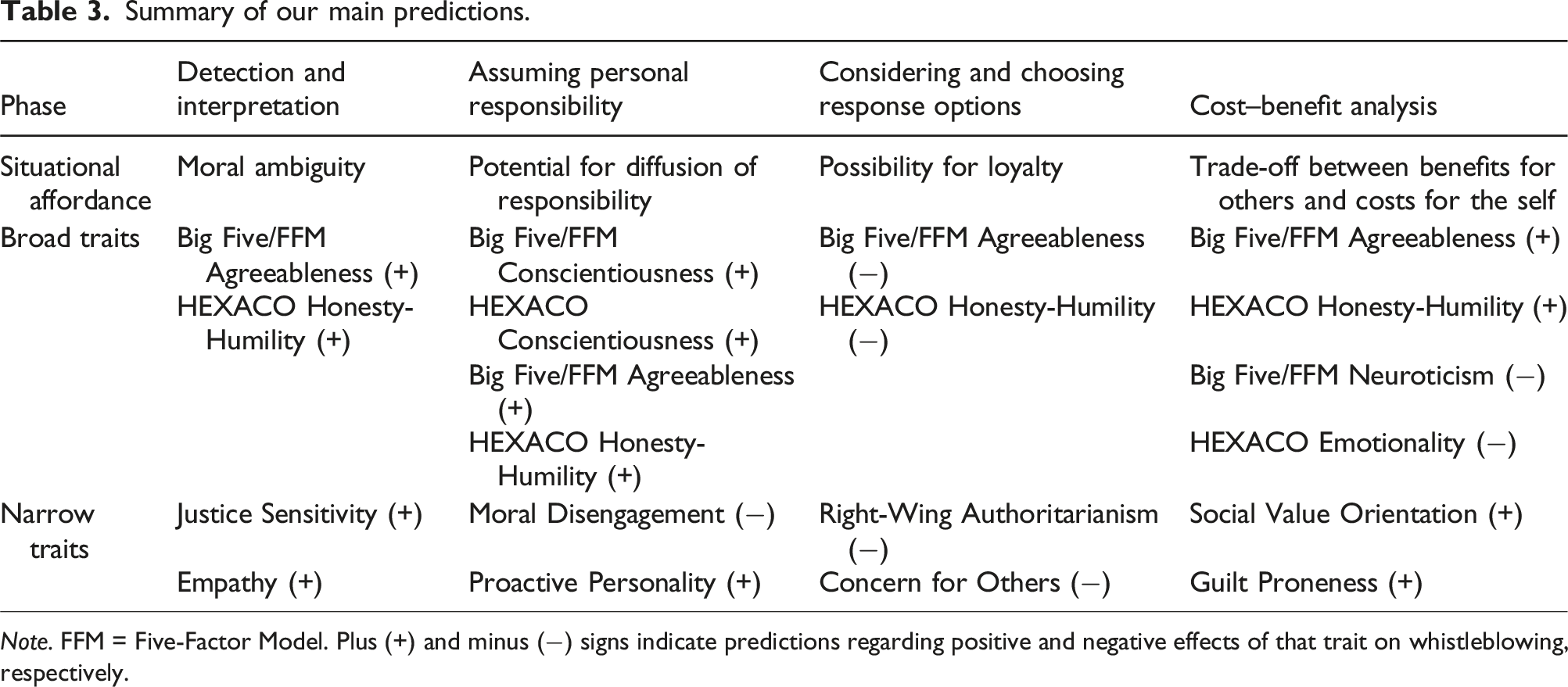
Note. FFM = Five-Factor Model. Plus (+) and minus (−) signs indicate predictions regarding positive and negative effects of that trait on whistleblowing, respectively.
Phase A: Detection and interpretation
As described above, a necessary precondition for whistleblowing is that an organization member perceives and interprets an organizational activity as illegal or morally wrong. Legal judgments may at least to some extent be normative and objectifiable; but moral “wrongness” judgments are often highly subjective (for a review, see Malle, 2021). In other words, individuals differ substantially in their perception of what is “right” or “wrong”, and one reason why some individuals may refrain from whistleblowing is because they do not perceive the organizational activity as “wrong.” To illustrate this, again consider Snowden’s disclosures about the NSA surveillance programs. Public opinion polls conducted with representative samples in the US showed that—even after Snowden’s disclosures—40% of respondents indicated that it is acceptable for the government to monitor communications of US citizens (Pew Research Center, 2015). It can thus be speculated that other NSA employees might have perceived the mass surveillance programs as morally acceptable to some extent, holding them back from blowing the whistle.
By implication, this phase of the whistleblowing process requires dealing with moral ambiguity (Alford, 2001)—thus, one’s dispositional sensitivity to moral issues or injustice should be activated in this phase. Importantly, moral transgressions can be viewed from different perspectives. Drawing on the social justice literature, one can differentiate the perspectives of the victim, observer, beneficiary, and perpetrator of a moral transgression (e.g., Mikula, 1993). 5 In a prototypical whistleblowing situation, the organization member is, by definition, an observer of the wrongdoing. However, the organization member may also experience the wrongdoing from the perspective of a victim, a beneficiary, or the perpetrator themselves. For example, an organization member with a migration background who reports discriminatory practices within their organization can also be considered a victim of the wrongdoing if it affected them personally. An organization member who reports tax fraud can be considered a beneficiary of the wrongdoing if they economically benefitted from it through profit sharing. And an organization member can be considered a perpetrator if they are directly involved in or responsible for the wrongdoing, such as a software developer who works on a tool that secretly collects confidential data from the smartphones or computers of their users. Notably, results from an autobiographic recall study showed that whistleblowing is more prevalent when the organization member was personally victimized by the observed wrongdoing (Cassematis & Wortley, 2013).
Broad personality dimensions
Which broad personality dimensions from the Big Five/FFM and HEXACO model should be afforded by morally ambiguous situations? Considering the Big Five/FFM, Agreeableness is a prime candidate in this regard as it contrasts “a prosocial and communal orientation toward others with antagonism and hostility” (John, 2021, p. 42). Thus, Big Five/FFM Agreeableness should be positively related to judgments about how “wrong” a behavior is in morally ambiguous situations and, therefore, have a positive effect on whistleblowing.
In terms of the HEXACO model, Honesty-Humility should be most relevant in this context. HEXACO Honesty-Humility is conceptualized as “the tendency to be fair and genuine in dealing with others, in the sense of cooperating with others even when one might exploit them without suffering retaliation” (Ashton & Lee, 2007, p. 156). Similar to our rationale for assuming a positive effect of Big Five/FFM Agreeableness on whistleblowing, HEXACO Honesty-Humility should relate positively to the perception and evaluation of morally ambiguous cues as morally wrong. Therefore, we predict a positive effect of HEXACO Honesty-Humility on whistleblowing. 6
Narrow personality traits
In the presence of moral ambiguity, a highly relevant narrow trait is Justice Sensitivity. Justice Sensitivity manifests itself in the frequency of injustice perceptions and in reacting with strong affective (e.g., anger), cognitive (e.g., rumination), and behavioral (e.g., punishment) responses (Schmitt et al., 1995, 2005). It consists of four facets, which mirror the previously introduced perspectives on moral transgressions. Put differently, Justice Sensitivity comprises dispositional sensitivity to moral transgressions from the perspective of a victim (Victim Sensitivity), an observer (Observer Sensitivity), a beneficiary (Beneficiary Sensitivity), and a perpetrator (Perpetrator Sensitivity; for a review, see Baumert & Schmitt, 2016). This conceptualization suggests that Victim Sensitivity should be most predictive of whistleblowing when the organization member is personally negatively affected by the wrongdoing (e.g., through discrimination). Observer Sensitivity should predict whistleblowing positively when the organization member is neither actively involved in the wrongdoing nor personally affected by its consequences. Likewise, Beneficiary Sensitivity should affect whistleblowing positively when the organization member personally benefits from the wrongdoing (e.g., through profit sharing), and Perpetrator Sensitivity should lead to more whistleblowing when the organization member is actively involved in the wrongful practice.
Another narrow personality trait that should become relevant under the presence of moral ambiguity is Empathy which has been defined as “the extent to which an individual can take another person’s perspective […] and has warm, tender feelings of concern for another’s well-being […]” (Joireman et al., 2006, p. 1310; for a review of definitions, see Clark et al., 2019). This definition suggests that Empathy should be linked to experiencing negative emotions (e.g., anger) when another person suffers from the organization’s wrongdoing, and therefore ultimately exert positive effects on whistleblowing. 7
Phase B: Assuming personal responsibility
We argue that—in most whistleblowing situations—more than one organization member is aware of the organizational wrongdoing but not all who observe the respective organizational practice (and interpret it as legally or morally wrong) will act to correct it. This phenomenon closely resembles the “bystander effect” in emergency situations—the phenomenon that every single observer of an emergency is less likely to help with an increasing number of bystanders (Latané & Darley, 1970; for a meta-analysis, see Fischer et al., 2011). From a psychological perspective, this effect can be explained by diffusion of personal responsibility across multiple observers: The more people observe an emergency, the less each individual bystander is accountable and blameworthy if they refrain from helping. Even though whistleblowing situations are structurally different form emergency situations (e.g., because emergencies involve more time pressure than whistleblowing situations; see Dozier & Miceli, 1985), diffusion of responsibility should also be relevant in whistleblowing contexts. Specially, the more organization members become aware of an organizational wrongdoing, the less responsible each individual might feel to act against it. 8
Broad personality dimensions
Situations with potential for diffusion of responsibility should activate Conscientiousness. As previously noted, the conceptualization of this trait is largely equivalent in the Big Five/FFM and the HEXACO model (see also Thielmann et al., 2022, for a meta-analysis) and our prediction therefore applies to both traits. One definition of Conscientiousness conceptualizes it as a tendency for “socially prescribed impulse control that facilitates task- and goal-directed behavior” (John, 2021, p. 42). This conceptualization suggests that Conscientiousness should be afforded in situations that allow demonstrating one’s sense of duty (De Vries, Tybur, et al., 2016) and this idea has also been meta-analytically confirmed (Zettler et al., 2020). Thus, among people who observed organizational wrongdoing and judged it as morally wrong, Big Five/FFM and HEXACO Conscientiousness should have a positive effect on a sense of duty to act somehow, for example, by blowing the whistle.
Similarly, Big Five/FFM Agreeableness and HEXACO Honesty-Humility should positively affect whistleblowing in this phase because these dimensions reflect tendencies for integrity and fairness. Thus, these personality dimensions should have positive effects on assuming personal responsibility to act against the wrongdoing.
Narrow personality traits
A representative narrow trait that is likely activated in situations affording diffusion of responsibility is Moral Disengagement (Bandura, 1999; Bandura et al., 1996). Moral Disengagement represents a set of cognitive strategies that allow to situationally disengage from one’s moral standards, thereby allowing to engage in unethical behavior without feeling distress or cognitive dissonance (Bandura, 1999; Moore, 2015). Specifically, these strategies are (1) moral justification, (2) palliative comparison, (3) euphemistic labeling, (4) ignoring or minimizing the consequences, (5) dehumanization, (6) attribution of blame, (7) displacement of responsibility, and (8) diffusion of responsibility (Bandura, 1999, p. 194). Conceptually, the diffusion of responsibility strategy associated with high levels of Moral Disengagement should be particularly afforded at this stage of the whistleblowing process, as we have discussed earlier. However, since the eight disengagement strategies are highly correlated with one another and often load on a single, common factor (e.g., Bandura et al., 1996; Detert et al., 2008), the general tendency to morally disengage should negatively predict whistleblowing.
In a similar vein, the Proactive Personality should be associated with embracing one’s individual responsibility to correct the observed wrongdoing (as compared to denying it). Therefore, rooted in this phase of the whistleblowing decision-making process, we predict a positive effect of the Proactive Personality on whistleblowing. 9
Phase C: Considering and choosing response options
Another relevant phase of a whistleblowing decision is that the organization member has to trade-off different possible responses to the observed wrongdoing. Besides whistleblowing, an organization member may, for example, not act at all, confront the responsible person, voice one’s concerns internally (e.g., reporting to an ombudsperson), or leave the organization (see Anvari et al., 2019; Packer, 2008). Empirically, it is well-established that most whistleblowers first raise their concerns internally (e.g., by confronting the perpetrator, informing one’s supervisor, or filing a report) before doing so externally (Vandekerckhove & Phillips, 2019). In other words, external whistleblowing is often considered a “last resort” when internal reporting failed to rectify the situation.
A psychological explanation for the (initial) preference for internal reporting over (external) whistleblowing is the moral dilemma inherent in the whistleblowing situation: Whistleblowing involves a trade-off between the desire to consider the welfare of people outside of the organization (who might be harmed by the organizational wrongdoing) and the desire to be loyal to one’s own organization (Dungan et al., 2015, 2019; Jubb, 1999; Misch et al., 2018; Waytz et al., 2013). As such, whistleblowing entails a possibility for loyalty. Thus, organization members who observed wrongdoing need to evaluate how justifiable whistleblowing is as opposed to alternative options: For organizational practices that are perceived as morally dubious but not blatantly wrong, an organization member might consider whistleblowing as too extreme to justify being disloyal. By contrast, organizational practices that are perceived as highly immoral or even illegal are arguably more likely to evoke whistleblowing (Mesmer-Magnus & Viswesvaran, 2005)— specifically if earlier internal reporting failed to redress the situation.
Broad personality dimensions
A possibility for loyalty affords the expression of traits pertaining to differences in prosociality. Thus, Big Five/FFM Agreeableness and HEXACO Honesty-Humility should be relevant for this decision phase. These traits should generally have positive effects on an increased preference for actions that avoid or minimize negative consequences for one’s group/organization (e.g., voicing one’s concerns internally) over those that have considerable reprisals for one’s group or organization (i.e., whistleblowing)—at least as long as these actions are believed to be similarly effective in stopping the organizational wrongdoing.10,11
Narrow personality traits
A prime candidate for a narrow trait that is afforded by a possibility for loyalty is Right-Wing Authoritarianism (RWA; Altemeyer, 1981). RWA is a three-dimensional construct reflecting (1) adherence to social norms, traditions, and conventions (i.e., conventionalism), (2) a tendency to strictly obey authorities (i.e., authoritarian submission), and (3) a tendency to behave aggressively or legitimize aggression towards others who deviate from established norms or conventions (authoritarian aggression; Altemeyer, 1981). An evolutionarily conceptualization of RWA has argued that its function is to enable cooperation in (large-scale) groups (such as organizations), particularly by enforcing norm compliance and condemning norm deviance (Kessler & Cohrs, 2008). This idea maps onto whistleblowing situations as blowing the whistle has been shown to be less likely when loyalty norms (as compared to fairness norms) are made salient through an experimental manipulation (Waytz et al., 2013) or when organization members strongly endorse loyalty concerns (Dungan et al., 2019). By implication, RWA should influence whistleblowing negatively because it comprises preferences for norm compliance and loyalty.
Another narrow personality trait whose expression is likely afforded by a possibility for loyalty is Concern for Others. It is conceptualized as “the extent to which […] other people’s interests serve as guides for behavior” (Gerbasi & Prentice, 2013, p. 495). Applying this idea to the whistleblowing context suggests that people who are strongly concerned with the welfare of others (i.e., the welfare of one’s colleagues or employer) should be more motivated to be loyal to their organizations. Thus, our framework suggests a negative effect of Concern for Others on whistleblowing in this phase of the decision-making process. 12
Phase D: Cost–benefit analysis
Many scholars have argued that whistleblowing constitutes a prosocial act because whistleblowers sacrifice their self-interest for the greater good (Dozier & Miceli, 1985; Gundlach et al., 2003; Miceli et al., 2008). Whistleblowing usually benefits others than the whistleblower themselves (e.g., the society) by stopping a potentially harmful organizational practice, emphasizing its prosocial nature (see Pfattheicher et al., 2022, for common definitions of prosocial behavior). At the same time, whistleblowers often experience substantial backlash and retaliation from their (current or former) colleagues or supervisors, such as being fired, the obstruction of career opportunities, or ostracism (Rehg et al., 2008; Rothschild & Miethe, 1999). Thus, whistleblowing is beneficial on the one hand, but undoubtedly costly on the other. In addition to the tangible costs associated with whistleblowing, applying the “arousal:cost-reward” model from the helping literature (Piliavin et al., 1981) suggests that there are also costs for non-reporting organizational wrongdoing, for example negative self-evaluations such as self-blame or feelings of guilt—after all, looking away perpetuates the wrongdoing. However, the personal costs of whistleblowing are typically higher than the personal costs of non-reporting organizational wrongdoing. Anecdotal evidence for this also comes from Snowden’s case: He lost his job, had to flee to a foreign country in order to escape prosecution, and was separated from his spouse, family, and friends for a long time. Therefore, whistleblowing situations entail a trade-off between benefits for others and costs for the self, corresponding to negative interdependence between the whistleblower and those being negatively affected by the wrongdoing (e.g., members of society; see Kelley et al., 2003).
Of note, considering the consequences for Edward Snowden illustrates that the costs (and benefits) of whistleblowing should be broadly conceptualized, namely, in terms of all negative (and positive) consequences for the whistleblower. Under this assumption, the costs of whistleblowing not only include tangible (i.e., financial or legal) consequences, but also more subjective, emotionally-charged consequences such as distress, isolation, becoming a victim of workplace bullying, depression, or sleeping problems (Alford, 2001; Bjørkelo, 2013; Rothschild & Miethe, 1999; van der Velden et al., 2019).
Broad personality dimensions
A trade-off between benefits for others and costs for the self should again activate prosocial traits, and more specifically traits related to unconditional concern for others. Therefore, Big Five/FFM Agreeableness and HEXACO Honesty-Humility are likely to be afforded at this stage of the decision process again to positively influence whistleblowing. Moreover, building on the notion that whistleblowing costs are not only legal or financial, but also emotionally-charged consequences, broad traits capturing individual differences in the experience of negative emotions (i.e., fear, anxiety) should become additionally activated. This suggests that Big Five/FFM Neuroticism and HEXACO Emotionality may additionally be relevant in this phase (see also De Vries, Tybur, et al., 2016). Big Five/FFM Neuroticism “contrasts negative emotionality with emotional stability, contentment, and frustration tolerance” (John, 2021, p. 42). Similarly, HEXACO Emotionality comprises tendencies to experience negative emotions (i.e., fear, anxiety, and sentimentality) as well as a need for emotional support from others (Ashton et al., 2014). We therefore hypothesize negative effects of Big Five/FFM Neuroticism and HEXACO Emotionality on whistleblowing in this phase of the decision-making process.
Narrow personality traits
A narrow trait that is crucial for situations with a trade-off between benefits for others and costs for the self is Social Value Orientation (SVO). SVO represents “the weights people assign to their own and others’ outcomes in situations of interdependence” (Balliet et al., 2009, p. 533). Given that, as we have argued, this phase of the whistleblowing decision-making process contains negative interdependence between the organization member and those who are negatively affected by the organizational wrongdoing, a prosocial value orientation should increase the likelihood of whistleblowing. Another narrow trait that should be activated in this phase is Guilt Proneness. It has been defined as “a predisposition to experience negative feelings about personal wrongdoing, even when the wrongdoing is private” (Cohen et al., 2012, p. 355). Guilt Proneness should have a positive influence on anticipating greater emotional costs for personal wrongdoings (i.e., self-blame), and one salient personal wrongdoing in this context would arguably be non-reporting an organizational practice which harms other people. Following this theorizing, Guilt Proneness should influence whistleblowing positively. 13
Discussion and outlook
Organization members who blow the whistle when their organization resorts to unethical or illegal practices are crucial to detect and stop such wrongdoing, and to consequently hold the responsible individuals accountable. Whereas a large and growing body of research focuses on the situational circumstances that foster or inhibit whistleblowing, a second category of whistleblowing antecedents has so far received less systematic attention: The whistleblower’s personality. To overcome this gap, we proposed an integrative framework for the role of (broad and narrow) personality traits that should predict and explain whistleblowing. Our framework was guided by an affordance-perspective, that is, the idea that certain characteristics of a whistleblowing situation activate certain personality traits. Thereby, our framework not only allows the prediction of main effects of personality on whistleblowing, but it also enables to explain why and when (i.e., under which situational affordances) these effects are to-be-expected. Therefore, our framework provides a more comprehensive and more fine-grained perspective on the personality-whistleblowing link than previous research. 14 Understanding the personality dispositions that relate to whistleblowing is not only theoretically important but also of practical relevance, for example, for organizations seeking to create a workplace environment in which misconduct is detected early on to prevent further damage.
Directions for future research
We see five directions for future research that might be worth pursuing. First, we hope that our framework inspires more research on the proposed main effects on whistleblowing. As we have delineated above, the existing evidence is limited by a heterogenous selection of personality traits, different whistleblowing paradigms, and relatively small sample sizes. Thus, we call for more systematic research on the personality-whistleblowing association, preferably with large(r) samples and measurement of actual whistleblowing behavior rather than whistleblowing intentions (Fischer & Gollwitzer, 2023; Miceli & Near, 2005), although this will undoubtedly be challenging. For instance, we are not aware of any study that has investigated the joint impact of all (five or six) broad dimensions from basic personality models on whistleblowing within an economic game, which allows measuring actual behavior and, thus, represents a viable alternative to self-report measures. Ideally, future research should operationalize whistleblowing as a decision process encompassing multiple phases (see Table 2). As our review has shown, personality may exert opposite effects on whistleblowing behavior in different phases of the decision-making process. For example, our theorizing suggests that prosociality-related traits, such as Big Five/FFM Agreeableness and HEXACO Honesty-Humility, may exert both positive and negative effects on whistleblowing, depending on the phase of the decision-making process under consideration (see Table 3).
Second, we propose that testing whether whistleblowing decisions are sufficiently predicted by the proposed broad personality dimensions, or alternatively, whether the proposed narrower traits (i.e., Justice Sensitivity, Empathy, Moral Disengagement, Proactive Personality, Right-Wing Authoritarianism, Concern for Others, Social Value Orientation, and Guilt Proneness) predict whistleblowing over and above the broad Big Five/FFM or HEXACO dimensions. This approach seems adequate because previous research has shown that some of the narrow traits we consider relevant for whistleblowing are substantially correlated with the proposed broad personality dimensions. For example, regarding the “Assuming Personal Responsibility” phase, meta-analytic evidence suggests that Conscientiousness and Moral Disengagement are substantially correlated (ρ = −.38; Ogunfowora et al., 2022). Thus, whether or not Moral Disengagement (as well as the other narrow traits) explains variance in whistleblowing over and above the broad personality dimensions is subject to future empirical research. Research testing the predictive power of narrow personality traits over and above broad personality dimensions in the context of whistleblowing can provide important information on the bandwidth-fidelity dilemma, a longstanding debate in personality science on whether broad or narrow personality traits are better suited to explain and predict behavior (Ones & Viswesvaran, 1996).
Third, another promising avenue for empirical tests of hypotheses resulting from our framework refers to the context specificity of the proposed effects. Our framework builds on the assumption that four situational characteristics are inherent in most whistleblowing situations. However, in some real-life whistleblowing situations, not all of these characteristics may be present. For example, when an organization has a “code-of-conduct” that verbalizes which practices it considers morally unacceptable, the affordance of dealing with moral ambiguity may be less present. Consequently, the traits we proposed to be afforded by this characteristic (i.e., Big Five/FFM Agreeableness, HEXACO Honesty-Humility, Justice Sensitivity, and Empathy) should be less predictive of whistleblowing. As another example, we have argued that certain traits should be predictive of whistleblowing when the specific situation entails a trade-off between benefits for others and costs for the self. However, when an organization member is convinced that they can stay anonymous during and after the whistleblowing episode, for example because the respective organization has a well-functioning IT system that enables anonymous reports of organizational wrongdoing or because their legally protected from retaliation against them, these traits should exert weaker effects on whistleblowing.
Fourth, our framework entails that some of our theoretical predictions might be method-dependent. Our hypotheses hold for many real-life whistleblowing situations. However, when researchers operationalize whistleblowing in a (lab-based or vignette) study, not all relevant situational features of whistleblowing situations can be modelled (for a review, see Fischer & Gollwitzer, 2023). For example, studying whistleblowing intentions using a scenario study might underestimate the effects of the traits afforded by the trade-off between benefits for others and costs for the self because the costs associated with whistleblowing are non-immersive in that paradigm. Similarly, when studying whistleblowing as responses in an economic game where whistleblowing is usually made costly only through implementing monetary costs (e.g., Butler et al., 2020), the traits that are afforded by emotional whistleblowing costs (e.g., Big Five/FFM Neuroticism and HEXACO Emotionality) should be attenuated. As such, our review may also inform future methodological advancements in whistleblowing research: An ideal whistleblowing paradigm should not only mirror its definitory features (see Jubb, 1999) in order to ensure its construct validity, but also model all situational characteristics we have proposed to be featured by typical whistleblowing situations to ensure ecological validity. However, to our knowledge, no whistleblowing paradigm available—that is, scenario studies (e.g., Chiu, 2003), autobiographical recalls (e.g., Bjørkelo et al., 2010), immersive lab-paradigms (e.g., Bocchiaro et al., 2012), or economic games (e.g., Butler et al., 2020)—is capable of modelling the situational characteristics of whistleblowing situations comprehensively in that regard. Therefore, the most promising test of the proposed hypotheses is a multi-method approach, combining methodologies that jointly capture all relevant characteristics of typical whistleblowing situations.
Fifth, further research is needed to better understand the interplay between whistleblowing intentions, whistleblowing behavior, and personality. It is straightforward to assume that intentions to blow the whistle precede whistleblowing behavior (Bjørkelo & Bye, 2014), but we currently lack a solid understanding of the strength of this association. The meta-analysis by Mesmer-Magnus and Viswesvaran (2005), which included only two studies that reported correlations between whistleblowing intentions and whistleblowing behavior, yielded a close-to-zero meta-analytic effect of r = .05. Although the empirical basis for this estimate is limited, the intention-behavior association is likely weaker in the context of whistleblowing than in other behavioral domains due to the substantial personal costs that can be associated whistleblowing (see phase D of our framework). 15 Furthermore, the magnitude of the intention-behavior association may depend on certain personality traits. Specifically, we hypothesize that higher levels of Conscientiousness may strengthen the association between whistleblowing intentions and whistleblowing behavior. This prediction follows from the conceptualization of Conscientiousness comprising characteristics such as being diligent, responsible, and thorough (Ashton, Lee, & Goldberg, 2004) as well as from previous research in other behavioral domains showing a moderating role of Conscientiousness for the intention-behavior relationship (Chatzisarantis & Hagger, 2008).
Conclusion
In conclusion, the present review provides a comprehensive theoretical account of how personality shapes whistleblowing decisions. Our framework not only allows to hypothesize which broad personality dimensions and which narrow personality traits should predict whistleblowing, but also why and under which situational circumstances these effects are to-be-expected. By this means, our framework contributes to a more holistic understanding of the personality-whistleblowing association and hopefully stimulates more research in this domain.
• The whistleblowing decision-making process entails various psychologically-relevant situational characteristics. • These situational characteristics afford the expression of personality traits. • Broad and narrow personality traits shape whistleblowing decisions. Some instances of organizational wrongdoing remain concealed while others are disclosed to the public by whistleblowers. Based on theoretical considerations, we here identify personality traits that shape whistleblowing decisions.Key insights
Relevance statement
Supplemental Material
Supplemental Material - The role of personality in whistleblowing: An integrative framework
Supplemental Material for The role of personality in whistleblowing: An integrative framework by Moritz Fischer, Isabel Thielmann, and Mario Gollwitzer in Personality Science
Supplemental Material
Supplemental Material - The role of personality in whistleblowing: An integrative framework
Supplemental Material for The role of personality in whistleblowing: An integrative framework by Moritz Fischer, Isabel Thielmann, and Mario Gollwitzer in Personality Science
Footnotes
Author note
The handling editor is Marco Perugini.
Acknowledgements
Not applicable.
Author contributions
Declaration of conflicting interests
The author(s) declared the following potential conflicts of interest with respect to the research, authorship, and/or publication of this article: Isabel Thielmann and Mario Gollwitzer are members of the journal’s editorial board.
Funding
The author(s) received no financial support for the research, authorship, and/or publication of this article.
ORCID iD
Not applicable.
Data accessibility statement
Data sharing not applicable to this article as no datasets were generated or analyzed during the current study.
Supplemental material
Supplemental material for this article is available online. Depending on the article type, these usually include a Transparency Checklist, a Transparent Peer Review File, and optional materials from the authors.
Notes
References
Supplementary Material
Please find the following supplemental material available below.
For Open Access articles published under a Creative Commons License, all supplemental material carries the same license as the article it is associated with.
For non-Open Access articles published, all supplemental material carries a non-exclusive license, and permission requests for re-use of supplemental material or any part of supplemental material shall be sent directly to the copyright owner as specified in the copyright notice associated with the article.
