



Abstract
Many people worldwide want to be less neurotic, and targeted interventions can elicit these desired changes. However, many prior interventions relied on a heterogenous mix of strategies––often chosen ad hoc or derived from varied theoretical perspectives––leaving the change mechanisms of neuroticism and of effective interventions unclear. To guide theory development and inform intervention design, we first detailed a multidimensional theoretical personality framework that can support future intervention research. Second, we systematically reviewed literature on nonclinical interventions for neuroticism and related constructs (k = 99 articles). We used the multidimensional framework to code information from studies, provide an overview of this literature, and identify limitations. Third, using the coded information, we developed a theoretically informed taxonomy of 19 intervention strategies for neuroticism-related constructs. The Taxonomy of Neuroticism Strategies (TONS) organizes intervention components focal to theorized personality change processes, serves as an interactive tool for intervention design, and offers a systematic framework to test change mechanisms. Fourth, we used three personality change theories to conceptually validate the taxonomy. Overall, by integrating prior empirical and theoretical research, we hope for TONS to offer a common language to guide future study designs and systematically test the mechanisms and consequences of intentional neuroticism change.
Plain Language Summary
Neuroticism is a personality trait that describes how likely a person is to experience frequent negative emotions, unstable moods, and strong reactions to stress. People with higher levels of neuroticism tend to face more challenges in their mental health, relationships, and overall well-being, and many individuals around the world say they would like to reduce this trait. Therefore, finding effective and accessible ways to help people lower neuroticism could have important benefits for both individuals and society. However, developing effective interventions requires a clear understanding of how neuroticism can change. In this paper, we first present a broad theoretical framework to support future research on personality change. We then review existing intervention studies that aim to reduce neuroticism or related traits in nonclinical populations. This review highlights how differences in study design and terminology make it difficult to compare results across studies. Using insights from this review, we introduce the Taxonomy of Neuroticism Strategies (TONS), a new framework that organizes key strategies and processes involved in changing neuroticism. Finally, we examine TONS using established theories of personality change. Overall, this work provides a common language to guide future research and the development of effective interventions to reduce neuroticism.
Neuroticism is a broad personality trait that describes the tendency to experience negative emotions, strongly react to stress, doubt abilities to manage challenges, and be hypersensitive to threats (Barlow et al., 2014; Goldberg, 1990). Individual differences in neuroticism account for much of the genetic vulnerability underlying common mental disorders, especially depression and anxiety (Griffith et al., 2010; Hettema et al., 2006; Kendler et al., 2019). High neuroticism scores prospectively predict many undesirable outcomes (Soto, 2019; Wright & Jackson, 2023) and the medical costs associated with this trait even surpass those associated with mental health disorders (Cuijpers et al., 2010). These individual and societal implications have raised questions about whether and how the personality trait neuroticism can be changed in members of the public via targeted interventions (Sauer-Zavala et al., 2017).
Individual differences in personality traits, including neuroticism, were historically viewed as highly stable (Costa & McCrae, 1994; Terracciano et al., 2005). However, substantial research illustrates the lifespan malleability of people’s neuroticism scores (Bleidorn et al., 2022; Wright, Krämer, et al., 2025) and, more recently, their changeability in response to intervention (Haehner et al., 2024; Stieger et al., 2021; Wright, Haehner, Andrae, et al., 2025). More people want to change their neuroticism than any other trait worldwide (Baranski et al., 2021) and are willing to invest time and money to do so (Hennecke et al., 2014). Despite a promising outlook for intentional change efforts, though, designs and results of existing intervention studies are heterogeneous and difficult to synthesize. This limits the ability to systematically test effects of different interventions, gain insight about change mechanisms, and make progress towards at-scale intervention efforts. For instance, the most comprehensive meta-analysis on this topic found that the top descriptor of (non)clinical interventions to reduce neuroticism was “mixed” (Roberts et al., 2017)––a label offering little insight into key design features and change processes.
To understand why an intervention is effective, its components driving change must be identified (Michie & Abraham, 2004). Since interventions often contain multiple strategies, it is necessary to systematically test strategies’ individual and joint effects (Collins et al., 2009). It is thus imperative that strategies are clearly defined to ensure researchers can uniformly implement them across studies and avoid confounding discrepancies in effects. Moreover, it is critical that designs and strategy content are guided by theory (Larsen et al., 2017). Theoretically uninformed or agnostic interventions risk omitting features that facilitate change and restricting possible effects. Interventions’ generalizability, replicability, and theory-building potential are also limited if mechanisms driving effects are poorly understood or unidentifiable (Michie et al., 2008).
Such challenges are not unique to personality science. For instance, health and clinical psychology faced similar difficulties in intervention research and scholars aimed to address these by creating integrative taxonomies of interventions (Di Maio et al., 2024; Kok et al., 2016; Michie et al., 2013). The applied and theoretical utility of taxonomies for interventions is well-documented (Michie & Abraham, 2004), but their broad value can also be seen within the field of personality. Among the most widely used taxonomies in psychology, the Big Five (Goldberg, 1990) pushed personality science forward by offering a framework to organize diverse constructs, guide new research, and facilitate communication across subfields. A taxonomy of personality interventions stands to similarly unify research, inspire new studies, promote knowledge gathering, and help integrate theoretical evidence by guiding the designs of future studies capable of obtaining these important insights (Bleidorn, 2024; Larsen et al., 2017). In turn, insights from such studies can be used to help revise, update, and strengthen the utility of the taxonomy.
As such, to develop interventions that can inform theories of change, help systematically test mechanisms driving effects, and be implemented in a consistent manner in future studies, we adopted a theory-driven, best-practice approach to developing taxonomies for interventions (Bartholomew Eldredge et al., 2016; Bleidorn, 2024; Larsen et al., 2017; Michie, Yardley, et al., 2017). By doing so, we hoped to emphasize the necessity of theory-based designs and importance of documenting intervention planning, development, and evaluation in personality science.
Our study had four parts. First, we outlined a multidimensional theoretical personality framework that can support future intervention research. Second, we systematically reviewed literature on interventions for neuroticism and related constructs 1 in nonclinical samples. 2 Guided by our theoretical framework, the information we coded from studies in the review were targeted constructs; executed strategies; levels (traits/habits/states), aspects (affects/behaviors/cognitions), and directions of change processes (bottom-up/top-down); and moderators/mediators of effects. Third, we used a multi-coder procedure to extract, define, and classify strategies implemented in past interventions. Using all coded information from our review, we developed the Taxonomy of Neuroticism Strategies (TONS)––organized by strategies’ targeted levels, aspects, and directional change processes––and created an interactive app to present all extracted information within this framework. Fourth, we conceptually validated our taxonomy by mapping it onto three prominent theories of personality change. In total, we created a theory-based taxonomic framework for neuroticism change that cohesively integrates past research, informs future study designs, and offers a common language to derive theoretically informed hypotheses.
Organizational Framework of Neuroticism Change
Theories of neuroticism change generally stem from personality (Geukes et al., 2018; Hennecke et al., 2014; Hooker, 2002; Jackson & Wright, 2024; Roberts, 2018; Wrzus & Roberts, 2017) or clinical psychology (Allemand & Flückiger, 2017; Barlow et al., 2014; Bullis et al., 2019; Sauer-Zavala & Barlow, 2021; Watson et al., 1994). The theories share goals of organizing, deriving predictions, and explaining causal relations among factors involved in the change process in systematic, testable ways (Abend, 2008; Cervone & Pervin, 2022; Sutton & Staw, 1995). Theories often detail moderators, specific mechanisms, and superordinate processes of change, and have inspired a broad, diverse collection of interventions. Identifying common features across theories to integrate into a single, generalizable framework may help organize evidence, guide systematic intervention development, and offer insight on what causes change. Outlining such a general theoretical framework for personality is thus the first goal of our study.
Common across theories is a distinction between different levels of change (Figure 1), which we parse into three levels: traits, habits, states. Levels are interrelated such that change in one level can facilitate change in another level via bottom-up or top-down processes (Allemand & Flückiger, 2017; Geukes et al., 2018; Jackson & Wright, 2024; Wrzus & Roberts, 2017). Constructs per level systematically vary in breadth, complexity, and duration.
3
Within each level, constructs also vary in aspects, or their affective, behavioral, and/or cognitive content (ABC; Wilt & Revelle, 2015; Zillig et al., 2002). For interventions, discerning these features helps integrate structural, organizational and functional, process-oriented components of neuroticism change. Organizational and functional process of change across the three levels of personality.
Organizational components––levels, aspects, and their hierarchy––describe the general structure of neuroticism. In Figure 1, each level and ABC aspect constitute a possible intervention target, and directional paths linking each level outline the top-down or bottom-up sequences of change that occur after successful intervention. Functional components are factors that attenuate or exacerbate change (moderators) and drive key change processes (mediators). For example, time of day or participants’ locations when completing tasks may be moderators of intervention-driven change at the state level (Haehner et al., 2026), whereas coping skills may be a mediator of cross-level change (Essau et al., 2012). Functional elements detail the process of change and delineate points at which change may be subject to mediating/moderating influences, constituting potential mechanisms of action for interventions. It is critical to specify and distinguish these mechanisms of action to effectively design, implement, and test theory-based interventions.
In sum, this framework outlines key structural and process-oriented features of personality change. We focus on neuroticism and constructs similar to it (e.g., anxiety, depression), but the framework is versatile in that its organizational elements apply to many personality constructs whereas its functional features are tailorable to specific constructs. It is thus an ideal choice to serve as a theoretical foundation for a taxonomy of neuroticism interventions. In the next sections, we use this framework to detail important considerations for neuroticism interventions.
Level of Intervention
Interventions can target different levels of neuroticism (Figure 1; Allemand & Flückiger, 2017; Jackson & Wright, 2024; Wrzus & Roberts, 2017). We primarily use “level” to refer to content breadth (i.e., degree that a construct encompasses thoughts, feelings, and behaviors), but this is closely related to temporal stability or duration, as described below. At the broadest level are traits: patterns of thoughts, feelings, and behaviors that are relatively stable over time, largely consistent across situations, and the least malleable (Allemand & Flückiger, 2017; Jackson & Wright, 2024; Wrzus & Roberts, 2017). Neuroticism as a trait captures dispositional patterns of negative affect, worrying, rumination, negative or irrational thoughts, and distorted expectations about oneself or others (Barlow, 1988; McCrae & Costa, 1987; Wilt & Revelle, 2015). At the intermediate level are habits: learned, automatic, and routine clusters of thoughts, feelings, or behaviors that are often specific to contexts or domains (Allemand & Flückiger, 2017; Wood & Rünger, 2016; Wrzus & Roberts, 2017). Habit-level constructs are believed to be malleable with ample repetition and reinforcement of novel ABCs. Neuroticism-relevant habits include isolating or withdrawing during conflict, using maladaptive emotion regulation techniques when upset, and having biased cognitions when stressed (Barlow et al., 2014; Sauer-Zavala & Barlow, 2021). At the lowest level are states: momentary personality expressions that are situation specific, variable in range and frequency, and highly malleable (Fleeson, 2007; Jackson & Wright, 2024; Wrzus & Roberts, 2017). Typical neuroticism states are stress, negative mood, impulsive behaviors, self-doubt, irritability, and irrational fears about one’s environment.
The key distinction of traits versus habits or states is that the trait level subsumes trait-relevant habits and states that span many different aspects, contexts, and life domains. It is the most generalized level because it reflects a person’s durable collection of habitual contingencies and situation-specific personality states. For example, imagine a person with a high score on trait neuroticism. To score highly, their habitual neurotic contingencies across contexts and state expressions of neuroticism are likely concordant and interrelated. For instance, after a negative event, they likely have repeated momentary instances of negative affect and ruminate, withdraw from social interactions, seek reassurance, and strongly react to later stress. In contrast, a person with a low trait neuroticism score likely has few instances of high-neurotic states and infrequent or inconsistent neurotic habitual responses. For instance, after a negative event, they may initially have elevated state neuroticism levels but only briefly withdraw from others, calmly react to later stress, and not ruminate. These people thus differ in both their neuroticism trait levels and in their person-typical collections of neuroticism habits and states in daily life. The cumulative nature of states and habits to the trait level is a central feature of bottom-up processes that link these levels and is the key reason that content breadth is linked to temporal stability.
Most personality interventions target states or habits, with traits being infrequent targets (Allemand & Flückiger, 2017; Chapman et al., 2014; Magidson et al., 2014). This may be due to the need to target comprehensive sets of cross-domain, habitual contingencies and trait-relevant states across situations to elicit change at the trait level, whereas habit- or state-level change can be elicited by less complex interventions that only target context-specific contingencies or brief state expressions. Which level is the most effective to intervene at remains an untested empirical question, however. To answer this, studies must explicitly state the level(s) they are targeting, the constructs that vary in these levels, and use measures designed to assess the targeted level(s). For example, a trait measure is likely insensitive to state change, so using a trait measure to evaluate a state intervention may overlook effects. Such a mismatch in a construct’s targeted level and the measure used to quantify its change may lead to erroneous conclusions about an intervention’s efficacy. As such, a first step in intervention design is determining which level will be targeted.
Aspect of Intervention
Constructs at each level are comprised of representative ABCs (Figure 1; Wilt & Revelle, 2015; Zillig et al., 2002), ranging from integrative, multi-aspect constructs to distinct, single-aspect constructs. 4 Traits are the most complex configurations of ABCs, best depicted as integrative constellations of all aspects due to comprising context-specific habits and states across situations. States are the narrowest, most specific units best viewed as a brief affect, behavior, or cognition in a situation. Although an aspect-specific state (e.g., worrying [C]) can be linked to later other-aspect states (e.g., fidgeting [B]), we conceptualize these latter states as “reactions” to the initial state, not as part of the initial state itself. Habits fall between the breadth of traits and specificity of states, often taking the form of a temporal contingency for a context and ABC (e.g., when taking a test [context], I feel anxious [A]). For neuroticism, examples of affects are negative moods or feeling nervous, behaviors are withdrawing or acting impulsively, and cognitions are worrying or having biased beliefs (Barlow, 1988; McCrae & Costa, 1987).
Delineating the aspect composition of constructs targeted in interventions may help inform intervention design and implementation. Neuroticism is generally regarded as a highly internalized and affective personality trait as opposed to, for example, conscientiousness, which is largely externalized and behavioral. This view is corroborated by personality measures primarily assessing neuroticism with items including affective content (Wilt & Revelle, 2015). Given neuroticism’s affective nature, strategies targeting affective aspects might be most effective. Conversely, it may be most beneficial to target multiple aspects in hopes of eliciting widespread change. In any case, it is sensible to suspect that an intervention’s effects may vary as a function of a construct’s most central aspect(s) and the aspects targeted by the strategies implemented in the intervention––yet, whether and how this is true remain untested hypotheses.
Direction of Change
A third consideration is the direction of change (Allemand & Flückiger, 2017; Jackson & Wright, 2024; Wrzus & Roberts, 2017). A bottom-up process refers to change at a lower level leading to change at higher levels (i.e., state → habit → trait). A top-down process, in contrast, is when change at a higher level elicits change at lower levels (i.e., trait → habit → state; Figure 1). Since different strategies target different levels of a construct, they vary in theorized directional change processes. Bottom-up processes are commonly believed to be the main driving force of personality change (Allemand & Flückiger, 2017; Wrzus & Roberts, 2017), so it is expected that changes at the lower and intermediate levels of states and habits will eventually broaden to trait-level change. However, state- and habit-level changes do not necessarily affect higher trait levels (Jackson & Wright, 2024). Some scholars have also posited that top-down, trait change could foster more enduring, widespread change than habits or states (Allemand & Flückiger, 2017; Bleidorn et al., 2019). To elicit top-down change, though, an intervention likely must persist for a substantial time and would thus be more resource intensive. It must also be potent as it has to comprehensively cover many life domains and target broad patterns of ABCs rather than single attributes in isolated contexts (Allemand & Flückiger, 2017).
The directional change process that elicits the largest intervention-induced changes in neuroticism has been largely unexplored (cf. Stieger et al., 2022; Wright, Haehner, Hopwood, et al., 2025; Küchler et al., 2025). As such, which intervention strategies successfully elicit these processes likewise remain unknown.
Theorized Processes and Mechanisms of Change
The final consideration concerns the theorized mechanisms of the change processes. The prior sections have detailed organizational considerations pertinent to the content, structure, and hierarchy of change. However, a functional theory should also detail the process of change and its potential mechanisms of action, or facets of the change process that can be used to target or facilitate change (Cane et al., 2012; Larsen et al., 2017). A thoughtfully chosen theory can help ensure that key functional components of the change process are appropriately considered. Below, we detail three contemporary theories of personality change and their functional factors.
First, the TESSERA Framework outlines how short-term changes in states may foster long-term trait change (Wrzus & Roberts, 2017). It posits that external and personal factors influence situation selection, exposure to triggering situations elicit novel states, and, with ample repetition, these state changes may lead to broad trait change via associative (e.g., implicit learning, habit formation) and reflective processes (e.g., accommodation, self-reflection). These processes are mediators of change, whereas moderators include the valence, automaticity, and locus of control of TESSERA sequences. For instance, negative situations are believed to elicit stronger state reactions that, over time, lead to stronger trait changes.
Second, the Self-Regulation Model outlines three preconditions necessary for change to occur (Hennecke et al., 2014). The first and second preconditions are that change is perceived as desirable and feasible. If these preconditions are satisfied, self-regulated behavior change can follow via practice and effort. Trait change occurs when the third precondition, that these self-regulated changes become habitual, is satisfied. Individual differences in the desirability or feasibility of self-regulated behavioral change may moderate subsequent trait change, whereas practice and repeated changes in self-regulated behaviors are mechanisms of change.
Third, the General Change Mechanisms Theory, or Common Factors Model, focuses on which intervention strategies lead to change (Grawe, 2004). Common factors are core features of successful interventions that operate under shared change mechanisms and are believed to drive changes in targeted constructs across interventions. Four common change factors have been described for personality interventions (Allemand & Flückiger, 2017). Discrepancy awareness involves concentrating on differences between one’s actual and ideal personality. Practice refers to forming skills that enhance coping abilities and self-efficacy. Insight refers to identifying underlying motives for unpleasant thoughts and feelings, reappraising past situations, and changing intentions. Finally, a strengths-orientation entails focusing on skills, resources, and abilities rather than problems or deficits. Variation in factors related to these mechanisms may moderate changes in personality elicited by an intervention.
These theories describe three popular perspectives on the fundamental elements of the personality change process and provide exemplar structures for integrating organizational and functional components. As such, we used these theories to conceptually validate our taxonomy by ensuring our strategies adequately covered the breadth and depth of theorized change processes, mapped onto focal elements or mechanisms of action in each model, and were described by terminology that was complementary with previous research.
Implications for Designing and Implementing Interventions
The features of personality and its change process described thus far have implications for intervention design and implementation. An intervention can contain many distinct strategies, and each strategy may be theorized to elicit change at different levels or aspects via its mechanisms of action and, therefore, facilitate unique changes via top-down or bottom-up processes (Allemand & Flückiger, 2017). For example, although cognitive behavioral therapy (CBT; Beck, 2021) is often viewed as a single intervention, it contains strategies like Behavioral Activation, Cognitive Restructuring, and Psychoeducation that target distinct levels and aspects of constructs (Wenzel, 2017). A strategy’s targeted level, aspect, 5 elicited direction of change, and mechanism(s) of action are thought to be consequential for successful interventions. Collectively considering these features may thus help foster an integrative theoretical understanding of neuroticism change. Below, we list some common strategies in existing personality interventions and briefly detail how they differ in targeted levels, aspects, direction(s) of change, and mechanism(s) of action.
At the broadest level, trait-level strategies are cognitive in nature and require people to change how they perceive and attribute meaning to their thoughts, feelings, and behaviors. For neuroticism, examples of trait strategies are psychoeducation about the adaptivity of emotions or coaching sessions to create self-insight and learn to label and understand one’s feelings, beliefs, expectations, and goals (Bem, 1972; Boyd & Fales, 1983; Caspi & Roberts, 2001; Staudinger, 2001). Effective strategies designed to target the trait level of neuroticism are theorized to lead to changes at the habit and state levels via top-down processes. Key mechanisms of action for trait-level strategies thus likely include cognitive aspects of traits and top-down reflective change processes (Jackson & Wright, 2024; Wrzus & Roberts, 2017).
Habit-level strategies often operate via repeated practice and reinforcement of desired states in specific contexts (Lally et al., 2010; Wood & Rünger, 2016). For neuroticism, this may entail repeatedly replacing maladaptive behaviors with more adaptive alternatives in stressful situations (Barlow et al., 2014), modifying implicit biases (Devine, 1989; Forscher et al., 2017), or setting weekly goals to plan mood-elevating activities (Chorpita et al., 2005). Habit-formation strategies are mainly behavioral (e.g., skill building), but can involve cognitive (e.g., implicit learning) and affective (e.g., social support) aspects, too (Lally et al., 2010). Habit strategies are theorized to change states and traits via top-down and bottom-up processes, respectively. For instance, positive reinforcement can foster bottom-up trait change and goal setting can spur top-down changes in states. By involving both directional processes, habit strategies have a wider range of mechanisms of action, including reflective (top-down) and associative (bottom-up) processes. Additionally, since forming lasting habits requires sustained effort, support and motivational factors may also be possible mechanisms of action.
Lastly, state-level strategies focus on altering momentary emotions, behaviors, or cognitions. For example, this may involve listening to a calming audio or engaging in breathing techniques to lower negative affect (Hudson et al., 2019). If successful, state strategies elicit changes at higher levels via bottom-up processes, and their focal mechanisms of action are novel ABC states. One key distinction between state- and habit-level strategies is that state strategies do not directly promote habit formation. Rather, state strategies aim to reduce state neuroticism in a clearly defined moment in time so people can reap benefits associated with the state change (e.g., momentary relaxation). In this way, state strategies lack the prompted, guided repetition within specific contexts that is crucial to the skill formation nature of habit strategies. However, with enough repetition, people may independently form implicit links between a state and some outcome (e.g., improved mood). The idea that state strategies generalize to habits via learning is central to treatments like exposure therapy or behavioral activation (Kazdin, 2007). As such, associative learning processes are also a likely mechanism of action for some state strategies.
In sum, a strategy’s effects likely depend on the congruence of its intended versus actual targeted level(s) and aspect(s) of a construct and the suitability of conditions for its theorized change process to occur. For example, changes in a construct due to a state strategy may not occur if the strategy is received once a month since state-level change, and eventual habit change, require repetition and reinforcement (Lally et al., 2010). As it stands, it is currently unclear how many distinct strategies have been implemented in past neuroticism interventions; which levels, aspects, directional change processes, and mechanisms of action are targeted by these strategies; and which levels and aspects of neuroticism have been assessed alongside these strategies. This makes it difficult to evaluate interventions, choose strategies that align with theoretical goals and designs of future interventions, and make robust inferences about change mechanisms. We thus aimed to develop an integrative taxonomy of neuroticism interventions that defines, organizes, and systematically classifies commonly implemented strategies and different constructs.
The Present Study
This study consisted of four parts. First, throughout the introduction, we comprehensively detailed organizational and functional components of a multidimensional theoretical personality framework that can be used to support future intervention research. Second, we systematically reviewed literature on interventions targeting neuroticism and related constructs in nonclinical samples. In line with the guiding multidimensional framework, we coded levels and aspects of strategies and targeted constructs, directional change processes, moderators, mediators, and any theories cited for interventions. We focused on nonclinical samples to identify strategies chiefly relevant for changing neuroticism in the general public. Third, using this coded information, we created TONS, a theoretically informed taxonomy of neuroticism intervention strategies. This taxonomy serves as a tool to organize the most common strategies reported in the literature and to aid in the design, implementation, and systematic testing of intervention effects. We used the taxonomy to categorize information from the review and created an interactive app that can be used to search for strategies implemented in prior interventions, targeted constructs and measures used to assess them, and effects from interventions targeting different levels or aspects. Fourth, we mapped our derived strategies onto three process-oriented theories of change from personality and clinical psychology and evaluated the similarity of their content with the content embedded within our novel taxonomic framework (Allemand & Flückiger, 2017; Grawe, 2004; Hennecke et al., 2014; Wrzus & Roberts, 2017).
Overall, we aimed to describe a common theoretical framework of personality change and use it to develop a theoretically informed taxonomy that provides a shared language to describe features and findings from interventions, can aid in designing nonclinical interventions, helps facilitate the derivation of theoretically guided and evidence-based hypotheses about ways to change neuroticism, and will help unify personality intervention research.
Method
Literature Search
To accomplish our second goal, we conducted a systematic literature search using PsycINFO with the following filters: peer-reviewed journal articles, in English, empirical study, human subjects, and no dissertations. Titles were searched with (neuroticism OR personality OR emotional stability OR emotional instability OR depress* OR anxi* OR mood OR negative affect*) AND (change* OR mechanism) AND (treatment OR intervention* OR therapy). Abstracts were also searched with (change* OR mechanism) AND (treatment OR intervention* OR therapy). Titles and abstracts shared NOT (patient OR outpatient* OR inpatient*). In total, the search identified 5,139 articles. The search was conducted on October 3rd, 2023.
Article eligibility was evaluated during screening and three successive steps of coding using increasingly specific information. In Step 1, eligibility was evaluated based on titles and abstracts, where we opted to be overinclusive. In Step 2, eligibility was evaluated based on the full texts of articles. In Step 3, it was confirmed that an article included the information necessary for coding. In the end, 99 articles were included (Figure 2). Flow diagram of procedure for determining article eligibility.
Coding Procedure for Systematic Review
Continuing with our second goal, we extracted and coded information from the 99 articles (for details, see coding notes and instructions [Files S1–S2]). For information about interventions, we coded the number and names of interventions in a study, their content (i.e., materials, assigned tasks, modes of administration), number and names of targeted neuroticism-related constructs, and intervention efficacy as described in the article’s abstract. 6 If authors referred readers to an article that described the protocol, this secondary article was used to record relevant information.
For sample information, we coded the number of samples receiving an intervention, the sample type (school, family, convenience, etc.), sample size of treatment group with pre-post data, mean and standard deviation of baseline age, and percentage of women in the sample.
For design information, we coded if a control group or follow-up survey were included, measure(s) used for neuroticism-related construct(s), number of times construct(s) were assessed, and the length of time between the pre-post survey and the post-follow-up survey (if included).
For moderator information, we coded information about the total number of moderators tested, type (demographic, psychological, environmental, intervention-specific, other), which were effective (judged via statistical significance and/or effect size magnitude), and which exacerbated or attenuated the effects of an intervention (judged via direction of its effect).
Lastly, for mediator information, we coded the number of variables either described or alluded to as being a mediator, if a variable was explicitly stated as a mediator, if a mediator was statistically tested as such, its name in the article, results of the mediation test (if available), and if it was an effective mediator (judged via statistical significance and/or effect size magnitude).
Coding was independently completed by 5 trained coders (2 postdoctoral researchers, 2 graduate students, 1 professor). A subset of articles was coded in duplicate or triplicate to assess intercoder agreement for all steps. For article eligibility, agreement was 90% in Step 1, 83% in Step 2, and 98% in Step 3. For data extraction, agreement ranged from 62% (e.g., time between pre-post intervention) to 100% (e.g., sample information like age/gender), with a mean agreement of 87%. For each step, coding discrepancies were resolved through discussion and any studies not originally coded by multiple raters were then revisited by another rater to verify information after team discussions 7 . Coded information from all 99 articles in our systematic review is in File S3.
Additional Ratings and Categorization of Study Variables
Following the systematic review and coding procedures completed for the second goal of our study, we began the third goal: developing the taxonomy. To do so, we completed further ratings and categorizations of variables that would be incorporated in the taxonomy.
First, we used coded article content to extract strategies in interventions. In line with past work (Di Maio et al., 2024; Michie et al., 2013), we defined a strategy as an active, observable, and replicable component of an intervention that is distinct from other components in its content and presumed change process(es). To maintain compatibility with past work, distinctions between strategies and assigned labels were informed by articles’ descriptions of intervention content and prior theoretical work (Allemand & Flückiger, 2017; Grawe, 2004; Wrzus & Roberts, 2017). The initial extraction, categorization, and labeling of strategies per intervention were completed by the first author. Each strategy was then categorized by three criteria: (1) targeted level of a construct, (2) targeted aspect(s) of the construct, and (3) direction of change process. Ratings were based on descriptions of intervention content per strategy in original articles. Initial ratings were completed by two psychology professors, one with expertise in personality psychology and one with expertise in personality and clinical psychology. All strategies were independently coded by each professor and compared to a portion of blind codings completed by the other professor.
Second, the above categorizations of intervention strategies were eventually combined with information about constructs targeted by the strategies. Accordingly, similar ratings for the level and aspect of each targeted construct were also (independently) completed and were based on measures used to assess constructs. Specifically, we used a measure’s item content and the timeframe noted in its instructions. For trait measures, we used broad periods like “in general” or “on average”; for habit measures, we used intermediate periods such as “in the past two weeks” or “in the past month”; for state measures, we used brief periods like “right now” or “in the past day.” If a measure’s timeframe was not explicitly stated in an article’s methods, it was assumed the timeframe in the original, unmodified version of the cited measure was used. Ratings were first completed by one professor who also categorized strategies and then additionally, and independently, completed and checked by the first author.
As described above, levels of constructs were primarily classified according to the time dimension because this information was almost always in measures’ instructions. Some measures referred to specific contexts (e.g., test taking; Weems et al., 2015) and their level designation was based on the situation dimension. For strategies, levels were based on theorized mechanisms of action and time-specific measures that would best capture effects. Cognitive Restructuring, for example, targets people’s routine or habitual patterns of negative thinking in given contexts (e.g., when hearing an exam is today, a person may get anxious). If this strategy were used to reduce test anxiety, it is expected that assessment frequencies able to capture multiple event occurrences would best capture effects (e.g., weekly, monthly). In this way, the time and situation dimensions were both used to categorize strategies’ levels because different mechanisms of action tend to co-occur with different frequencies of thoughts, feelings, and behaviors that measures for different levels of neuroticism are best suited to capture. See Files S1–S2 for further details on ratings.
All extracted strategies and their categorizations were then discussed by a team of two postdoctoral researchers and two professors. Each strategy was reviewed according to its label, corresponding intervention content, and distinctiveness. When necessary and agreed upon, some strategies were combined, renamed, or divided. For example, Mindfulness and Meditation were combined due to their frequent co-occurrence and content overlap; Self-Reflection was relabeled as Motivated Reflection to better distinguish it from other strategies; and Skill Building was divided into Skill Building via Modeling and Skill Building via Practice to reflect their unique mechanisms of actions. Each strategy was given a final unique label; definition; representative content examples; and classifications for primary targeted level, aspect(s), and directional change process(es). All features were then integrated into a single framework to serve as our taxonomy.
Third, with our final list of strategies organized by targeted levels, aspect, and directional change processes, we derived common mechanisms of action across strategies. As these are central features of personality change theories, we aimed to also include these in our taxonomic framework. Ideally, all strategies in an intervention taxonomy would be able to be linked to one or more mechanisms of action to allow theoretical predictions to be tested. This was the broad boundary condition used to develop and classify strategies’ mechanisms of action.
As an additional step, theories explicitly mentioned in included articles were extracted. Text from PDFs of each article was scraped using the tidytext package (Silge & Robinson, 2016) in R (R Core Team, 2023). The extracted words from each article were used to identify articles that included the string “theor” in their corpus. Identified articles were searched by the first author to record the theories most often mentioned and cited in intervention research for neuroticism and related constructs. If not already present, each theory’s original citation was obtained as well. A list of and references for all theories obtained from articles is in Table S1.
Conceptually Validating the Taxonomy
Our fourth goal was to conceptually validate our taxonomy by comparing it to prominent process-oriented change theories from personality and clinical psychology: TESSERA (Wrzus & Roberts, 2017), Self-Regulation Model of Personality Development (Hennecke et al., 2014), and General Change Mechanisms (Allemand & Flückiger, 2017; Grawe, 2004). Comparisons were done in two ways. First, multiple team members independently created a graphical depiction of each theory’s key elements, theorized change processes, and any included strategies. All diagrams were compared, discrepancies or questions about the optimal placement of strategies were discussed, and finalized versions of each figure were created. This helped evaluate our taxonomy’s comprehensiveness, similarity and generalizability in nomenclature, and agreement in theorized change processes implied by our ratings and categorizations.
Second, we used natural language processing to assess similarity. The tm (Feinerer et al., 2025) R package was used to scrape text from articles. We excluded all references and sections where we describe the models and compare them to our taxonomy. For each of the three models, we combined its text with our paper’s text, converted words to lowercase, and removed symbols, punctuation, whitespace, numbers, and common stop words (i.e., articles, prepositions, etc.) so similarity would not be inflated. Next, we converted each pair’s text data to a document-term-matrix, which organizes data per document by unique words and frequency, and obtained their weighted cosine similarity (Li & Han, 2013) using the lsa (Wild, 2022) R package.
Results
Systematic Review and Coded Information
Descriptive Statistics
Descriptive Statistics for the Systematic Review at the Level of Articles and Interventions

Note. Article-level information was aggregated across each construct targeted in an intervention, each sample receiving the same intervention, then all interventions in the article (total N = 99). Intervention-level information was aggregated across each construct targeted in an intervention and each sample receiving the same intervention (total N = 125).
Neuroticism-Related Constructs Targeted in Interventions
We identified 44 distinct neuroticism-related constructs as intervention targets, the most frequent being Depressive Symptoms (37% of articles) followed by Anxiety Symptoms (9%). In total, 74 measures were used. The most common were variants of the Center for Epidemiological Studies Depression (CESD) Scale (Radloff, 1977), used in 12% of articles. Constructs like symptoms or severity levels of disorder constructs were, by far, the most frequent targets.
Among constructs, 64% were best identified as being measured at the habit level, whereas trait and state levels were identified 25% and 11% of the time, respectively. Timeframes used when assessing constructs were only explicitly mentioned 41% of the time, requiring levels of constructs to be inferred from authors’ descriptions of item content or timeframes in measures’ original instructions. With available information, 85% of constructs were identified as “Multiple” (i.e., contain more than one aspect). This plurality in aspects is largely to be expected, especially for traits (e.g., Neuroticism) or multidomain symptom profiles (e.g., Anxiety Symptoms).
Moderators of Intervention Effects for Neuroticism and Related Constructs
We identified 84 distinct moderators, with a mean of 1.63 moderators per intervention (Table 1). Moderators were tested in 58% of interventions, with the most common types being demographic (58%; e.g., age), psychological (53%; e.g., baseline depression), and intervention-specific (33%; e.g., language). The most examined moderators were gender (18%), age (12%), baseline depression (8%), intervention engagement (5%), and cultural group or ethnicity (3%).
We gauged the relevance of moderators via authors’ descriptions of moderation tests, such as a significant statistical test or meaningful effect size. As we did not quantitatively synthesize effects, our results should be seen as an approximation of general trends, not specific claims for statistical nor practical significance. Across 305 unique moderations, only 24% were significant, 73% were nonsignificant, and 3% were unclear. Among common moderators, intervention engagement (50%) and baseline depression levels (44%) had the highest percentages of significant effects, whereas ethnicity (17%) and cultural group (0%) had the lowest percentages.
Mechanisms of Change in Interventions for Neuroticism and Related Constructs
Mechanisms of change were operationalized as mediators. Slightly over half of interventions explicitly stated a mediator (Table 1) and, among those, 62% conducted an actual statistical mediation test. When these tests were conducted, the mediator was significant 60% of the time. Examples of significant mediators were self-efficacy, self-compassion, positive/negative affect, physical activity, and skills (e.g., CBT-relevant skills). Self-compassion, physical activity, and CBT-relevant skills sometimes also emerged as nonsignificant mediators, though.
Strategies Used in Interventions Targeting Neuroticism-Related Constructs
Labels, Definitions, and Examples for the 19 Unique Intervention Strategies in the TONS

Note. All examples are derived from coded intervention content belonging to each intervention strategy from one of the 99 articles in the systematic review. A “––––” in a cell indicates there was not another example available for that intervention strategy.
Overview of TONS, A Taxonomy for Neuroticism-Related Constructs and Intervention Strategies

Note. A = Affective, B = Behavioral, C = Cognitive. BU = Bottom-Up, TD = Top-Down. “Level” column = strategy’s primary targeted level. A full list of constructs and their measures used with each strategy from articles in the systematic review is available in the R Shiny App (https://personalitychange.shinyapps.io/NeurTaxonomyShinyApp/).
Most strategies were identified as primarily targeting habits (47%) or states (42%), and 11% primarily targeted the trait level (Table 3). Nearly all interventions (89%) included habit-level strategies (Table S2). For aspects, most strategies were purely cognitive (42%) or purely behavioral (21%), and most interventions included these strategies (90% and 81%, respectively; Table S2). Most strategies were identified as engendering bottom-up change (58%), followed by top-down change (37%), then both (5%; Table 3). Both directional processes were often present in interventions, with bottom-up (93%) slightly more common than top-down (90%).
Lastly, when examining whether levels and aspects of strategies and constructs aligned, results were mixed. Across interventions, constructs, and measures, levels of constructs aligned with primary levels of strategies 48% of the time (SD = 31%, Range = 0–100%). For any degree of overlap, this value rose to 94% (SD = 18%, Range = 0–100%).
Creating the Taxonomy of Neuroticism Strategies (TONS) for Interventions in the Public
We next integrated all extracted information about strategies and constructs into a cohesive taxonomic framework. An overview of the TONS is available in Table 3, with its core elements further depicted in Figure 3. All coded information from the review used to create the taxonomy, in the form of a comprehensive, interactive table that contains all combinations of strategies and constructs according to level, aspect, and direction of change, as well as specific intervention content, measures, and previously examined mediators and moderators, is available as an R Shiny app (https://personalitychange.shinyapps.io/NeurTaxonomyShinyApp/). Diagram of derived intervention strategies in the TONS according to level, aspect, direction of change process, and mechanism(s) of change.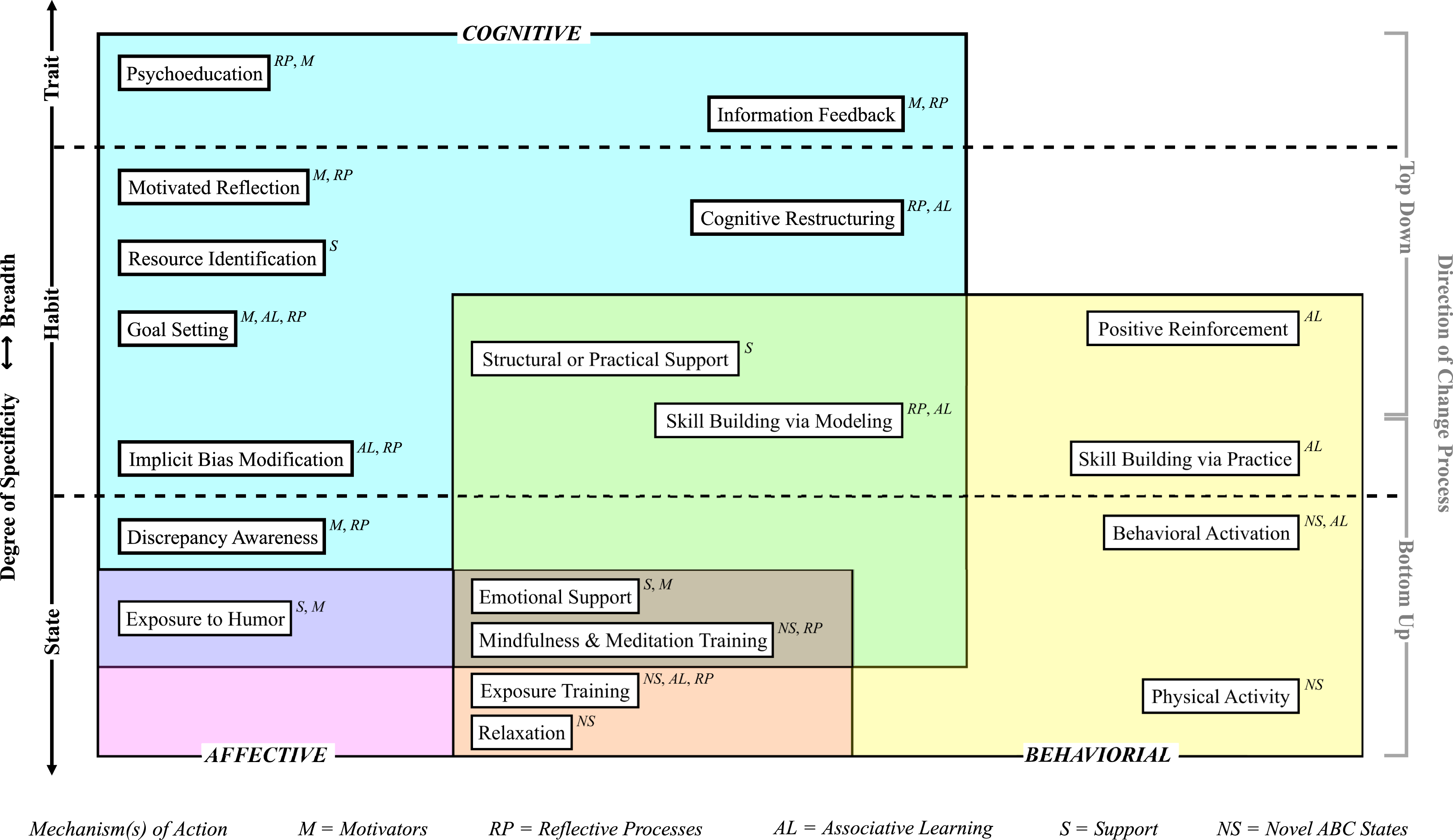
All strategies were classified according to their primary targeted level, aspect(s), and directional change process(es) for constructs (Table 3) and categorized into five clusters that indicated their mechanism(s) of action (Figure 3). The mechanisms of action are distinct and can reciprocally impact one another, but, at least early in the change process, they tend to follow the listed order. Motivators reflect factors that bring awareness to a discrepancy between how one is versus how they want to be, thus encouraging one to initiate and/or sustain change. Novel ABC States are momentary personality expressions triggered by new situations that differ from one’s typical personality-relevant states. Support refers to desirable or beneficial factors that help a person overcome barriers and maintain novel changes. Associative Learning Processes are (a) repeatedly activated trigger-behavior links encoded in procedural memory as habits and (b) states implicitly associated with the self-concept encoded in associative memory. Reflective Processes describe the (re)structuring, evaluating, and reappraising of past behavior, thoughts, and feelings.
To illustrate the taxonomy’s potential utility, imagine a study in which researchers wish to change an anxiety-related construct in a community sample. The first way the taxonomy can be helpful is by providing an overview of constructs related to anxiety that have been previously intervened upon in that sample type. The taxonomy also provides possible measures to use for the constructs, in addition to their corresponding levels and aspects based on the measures. After consulting the taxonomy, the researchers may decide to use Trait Anxiety (assessed via the State-Trait Anxiety Inventory––Trait [STAI-T]; Spielberger, 1983) and Anxiety Symptoms (assessed via the Generalized Anxiety Disorder–7 [GAD-7]; Spitzer et al., 2006). The taxonomy indicates that Trait Anxiety is at the trait level and its measure contains all three ABC aspects, whereas items for Anxiety Symptoms also contain all three aspects but the construct is at the habit level.
Researchers can next identify which strategies have been used for these constructs, cross-reference these strategies with those that correspond to their constructs’ assessed levels and aspects, and see example intervention content implemented in past studies for these strategies. Upon doing so, the researchers may, for example, decide to use Psychoeducation for Trait Anxiety and Skill Building via Practice and Cognitive Restructuring for Anxiety Symptoms. The taxonomy would indicate that Psychoeducation and Cognitive Restructuring are theorized to elicit change in a top-down manner whereas Skill Building via Practice operates via bottom-up change. Based on this insight, it could then be hypothesized that targeting multiple levels and aspects of a construct and engendering bidirectional change is more efficacious than targeting a single level and aspect and eliciting unidirectional change. Various combinations of strategies could be systematically examined to test this hypothesis, including comparing effects of each strategy alone, every combination of two strategies, and all three strategies. Finally, inferences can then be made about how an intervention’s efficacy varies across different combinations of strategies, targeted levels, targeted aspects, and directional change processes per construct.
Overall, the taxonomy can be used to guide the design of a study to test these and many different hypotheses in an informed and systematic manner.
Comparison to Process-Oriented Theoretical Frameworks of Personality Change
Last, to conceptually validate our taxonomy,
8
we compared it to three process theories of personality change from personality and clinical psychology (Figure 4): TESSERA (Wrzus & Roberts, 2017), Self-Regulation Model (Hennecke et al., 2014), and General Change Mechanisms (Allemand & Flückiger, 2017; Grawe, 2004). To do so, we first used a descriptive approach whereby the research team mapped TONS onto each theory. Second, we used natural language processing to assess the similarity between our taxonomy and each of the three theories. Adapted depictions of the process-oriented theories of personality change integrated with the 19 intervention strategies from the TONS framework.
We identified conceptual similarities between our taxonomy and the three personality change theories. Our taxonomy’s five mechanisms of action also corresponded well with the processes and mechanisms of change in the three theories. For example, reflective and associative processes are similar to TESSERA (Wrzus & Roberts, 2017) and habit formation is a key feature of the change process like in the Self-Regulation Model (Hennecke et al., 2014).
We identified structural similarities, too, but also differences. For instance, the three levels of personality are explicitly incorporated into both the General Change Mechanisms Theory via the mechanisms of its four common change factors (Allemand & Flückiger, 2017) and the Self-Regulation Model of Personality Development via its underlying process of change (Hennecke et al., 2014). In contrast, the habit level is not explicitly mentioned in the TESSERA Model (Wrzus & Roberts, 2017). However, the repetition of state-level TESSERA sequences over time and their accompanying learning processes that precede trait-level change seem to capture the process of habit formation. Thus, although elements explicitly highlighted in our taxonomy are not always similarly explicit in these process-oriented models of change, the core underlying processes associated with different levels do appear to align.
For intervention strategies, because our taxonomy contained more strategies than there were core criteria in the three reference models, we categorized our 19 strategies in accordance with each model’s core criteria to obtain a broader view of similarity. For instance, in the General Change Mechanisms Theory, “Actuating Discrepancy Awareness” can comprise Discrepancy Awareness; “Promoting Insight” can comprise Psychoeducation, Motivated Reflection, and Information Feedback; “Realizing Strengths” can comprise Emotional Support, Exposure to Humor, Resource Identification, and Structural or Practical Support; and the remaining strategies can fall under the category of “Behavioral Practice.” Similar comparisons can be drawn for the other models based on their locations within those models’ figures.
Natural language processing identified notable overlap in content as well as novel contributions by our taxonomy. This overlap is largely attributable to the multidimensional framework upon which TONS was based, supporting the taxonomy’s potential to contribute theoretical insights for personality change. In comparing the taxonomy to each theory, we found similarity indices of .371 with TESSERA, .425 with the Self-Regulation Model, and .576 with the General Change Mechanisms Theory. As similarity indices range from 0 to 1, our taxonomy was most similar to the General Change Mechanisms Theory and least similar to the TESSERA Framework. Considering the personality-intervention focus of the General Change Mechanisms Theory and broader personality focus of TESSERA, these findings complement our comparisons.
Overall, our TONS framework for neuroticism change corresponded well with the other models depicting process-oriented theories of personality change, offering novel contributions to this topic as well as similarities in content that are conducive to building a cumulative body of knowledge for personality intervention research.
Discussion
Individual differences in neuroticism have important consequences for individuals and society (Cuijpers et al., 2010; Olaru et al., 2023; Wright & Jackson, 2023), many people worldwide wish to be less neurotic (Baranski et al., 2021), and neuroticism can be changed via targeted interventions (Hudson, 2021; Martin-Allan et al., 2019; Stieger et al., 2021; Wright, Haehner, Andrae, et al., 2025). Neuroticism interventions that effectively reduce neuroticism thus hold great potential benefits. To develop such interventions, it is necessary to synthesize prior evidence and understand what strategies lead to lasting change. However, it is often challenging to make sense of existing research due to unsystematic heterogeneity in study designs and vague connections among theories, strategies, and targeted constructs.
To begin addressing these barriers, this study consisted of four parts. First, we detailed a multidimensional theoretical framework containing organizational and functional components of personality change that are important for intervention research. Second, we systematically reviewed nonclinical interventions targeting neuroticism-related constructs to give an overview of this heterogeneous work, identify limitations, and summarize key design features in past studies. Third, we used coded information from the studies to develop TONS, a theory-based taxonomy for neuroticism interventions organized by levels, aspects, and directional change processes prevalent in different strategies for neuroticism-related constructs. We also created an interactive, searchable app that allows users to filter studies from our review by constructs and features of the framework. Fourth, we conceptually validated our taxonomy by comparing it to three theories of personality change, finding that our nomenclature, internal elements, and underlying change mechanisms aligned well with these theories.
The TONS taxonomy offers a common, systematic framework to guide future intervention designs, derive specific hypotheses about the causes and boundary conditions of intentional neuroticism change, and gain theoretical insight into effective change mechanisms for neuroticism. Below, we discuss the state of the nonclinical neuroticism intervention literature through the lens of our systematic review (Goal 2), the empirical utility of the taxonomy’s multidimensional framework (Goal 1), the theoretical implications and directions for future research using the taxonomy (Goal 3), and initial findings as well as further considerations for conceptually, empirically, and theoretically validating the taxonomy (Goal 4).
State of the Nonclinical Neuroticism Intervention Literature
The systematic review offered key insights into the literature on interventions for neuroticism and related constructs in nonclinical samples. Although there have been numerous and impressive intervention efforts for these constructs, there are also several aspects of this research that deter progress towards obtaining a comprehensive understanding of intervention-induced neuroticism change.
First, a sizable portion of articles lacked descriptive information, such as sample sizes for specific intervention groups or central tendencies for age. Information about sample sizes is critical to address questions about statistical power and evaluate the credibility of findings. Likewise, considering evidence for age-graded changes in personality traits like neuroticism (Bleidorn et al., 2022; Caspi & Roberts, 2001; Schwaba & Bleidorn, 2018), data on the ages of participants are necessary to contextualize findings and understand potential boundary conditions of any effects. Further, evidence from intervention research in other fields, like health or clinical psychology, suggests that the extent to which people benefit from interventions can vary based on demographic characteristics, particularly factors like socioeconomic status (Beauchamp et al., 2014; J. Brown et al., 2014; Leijten et al., 2013; Western et al., 2021). Thus, reporting this basic information is necessary to evaluate the reproducibility and generalizability of research findings.
Second, key information about the designs of intervention studies, particularly regarding the targeted construct(s), was often missing. It should be commonplace to include details about the measure used for a construct, such as its response scale and the reference point or timeframe specified in the instructions. Reporting this information ensures it is clear which construct is the target of an intervention and enables future research to evaluate it relative to other similar studies and continue building upon the study in a systematic way.
Third, theoretical foundations were often underspecified, raising questions about design choices, tested moderators or mediators, and underlying change mechanisms. For example, the theoretical premise that traits tend to change more slowly than state manifestations of personality (Allemand & Flückiger, 2022; Jackson & Wright, 2024; Wrzus & Roberts, 2017) could be used to guide decisions about an intervention’s length (Hopwood et al., 2022). Similarly, change mechanisms should ideally be derived from theory and rigorously tested in empirical studies to validate, revise, or reject the hypothesized mechanisms (e.g., Allemand et al., 2024). However, rather than relying on a theoretical change model, many studies referred to empirical correlations between two measures to justify the inclusion of a construct as a mediator (e.g., depression and optimism). An unsystematic approach to designing and testing interventions makes it difficult for knowledge from this work to accumulate and for scientific progress to be made; incorporating theory can thus help guide and systematize this process.
Lastly, existing studies used a wide and inconsistent variety of terms to describe both their targeted constructs and implemented intervention strategies. For instance, the label “anxiety” was used for constructs measured at both the trait and state levels. Disregarding such nuances in constructs is problematic, because it makes it difficult to discern distinct constructs and their expected change mechanisms, thereby leading to a proliferation of potentially incompatible or redundant construct-strategy combinations (Anvari et al., 2025; Lawson & Robins, 2021). This can result in a heterogeneous mix of studies that hinders the accumulation of evidence that is required for a cumulative science. In contrast, consistently specifying that an intervention’s targeted construct is “state anxiety” or “trait anxiety” makes it explicit which level of a construct an intervention is expected to elicit change in, and, if unsuccessful, provides clear starting points for researchers to reflect upon what may have led to the inert effects of their intervention.
Empirical Utility of the Taxonomy’s Multidimensional Theoretical Framework
The multidimensional theoretical framework can support future intervention research in multiple ways. First, the framework constitutes an integrative overview of commonalities among prominent personality change theories. It has long been argued that theoretical pluralism is a necessary precondition of science (Dixon, 1983); however, similar to constructs and measures (Anvari et al., 2025), there are drawbacks to theories using unique jargon to refer to similar or identical elements. This can, for instance, make it more difficult to conduct systematic literature reviews because general search criteria may overlook studies that use terminology specific to one theory. It can also lead to unnecessary confusion and redundancy and complicate efforts to accruing theory-relevant evidence. Thus, we sought to capitalize on shared features among prominent theories of personality change to formulate a robust, theory-informed, general framework for personality interventions.
Second, the framework represents a minimalist outline of key information to report from interventions. It can thus serve as a general guideline for which elements of studies are of focal interest, thereby helping to standardize the content that is reported and the ways in which it is reported. As noted above, a common occurrence in our review was that studies did not report details about study designs, used a heterogeneous mix of terms for constructs and strategies, and had underspecified theoretical backgrounds. The strategies in the taxonomy, and the dimensions along which they are organized, offer terminology that can be used to consistently describe and design a wide variety of interventions. In doing so, this makes it easier for future researchers to find existing evidence for a given strategy and construct, ascertain whether it was effective in a certain sample, use that insight to inform study designs, and obtain evidence that can help gain cumulative insight on intentional personality change.
Third, the multidimensional framework underlying TONS offers a systematic guide for designing future interventions. The taxonomy can be used to design interventions capable of testing effects of single strategies or isolating effects of strategies targeting different aspects or levels, like affective versus cognitive or habit versus state, to identify which aspect or level is the most effective target. For example, the Changing How I Live Life (CHILL) Study (Haehner, Wright, et al., 2025) used the taxonomy to design a smartphone neuroticism intervention. Participants were randomized to groups that varied in their strategies’ targeted levels, targeted aspects, and directional change processes. By using our taxonomy as a guide for intervention design, the CHILL Study was able to find that the group receiving only trait strategies had no significant change and the group with all three levels targeted had the largest neuroticism declines (Wright, Haehner, Andrae, et al., 2025); state strategies led to larger initial albeit less durable declines whereas habit strategies led to longer-lasting decreases that strengthened over time; behavioral habit strategies were more effective at changing neuroticism than cognitive habit strategies, a finding that also generalized to state affect (Haehner et al., 2026); and bottom-up changes were often larger in magnitude than top-down changes (Wright, Haehner, Hopwood, et al., 2025). Such findings from the CHILL Study highlight the range of empirical utility that the taxonomy and its multidimensional framework hold.
Fourth, the framework can be used as a blueprint to develop interventions for other psychological constructs. This “branching out” in taxonomy development has successfully occurred in other fields, such as health psychology, which originally focused on interventions of single, discrete behaviors but has transitioned to highly integrative and holistic ontologies for interventions (e.g., Michie et al., 2017). Personality is a uniquely suitable area for this type of expansion given its foundational higher-order frameworks that contain sensible “next steps” to expand to (e.g., other Big Five domains and lower-order traits).
Theoretical Implications of the Taxonomy for Neuroticism Interventions
Beyond its empirical utility for intervention design and implementation, a key motivation for using the general multidimensional framework as the foundation for TONS is that it can help advance theoretical understanding on intentional personality change. Specifically, the taxonomy can assist with theory building because its strategies and their defining qualities are intended to help gain insight into mechanisms of change. Typically, a study’s ability to test hypotheses from its guiding theoretical framework is contingent upon its design. By zooming in on strategies, processes, levels, and aspects, researchers can articulate and test change mechanisms to develop more precise theories of neuroticism change (Bleidorn, 2024; Leising et al., 2022).
The CHILL Study (Haehner, Wright, et al., 2025) is an exemplar case for future studies using the taxonomy helping to gain theoretical insight. For instance, trait-level strategies alone having inert effects is consistent with the assertion of all three theories used to conceptually validate the taxonomy that top-down change originating at the trait level is insufficient to change personality (Allemand & Flückiger, 2017; Hennecke et al., 2014; Wrzus & Roberts, 2017). Habit-level strategies being uniquely potent at eliciting change corroborates the Self-Regulation Model (Hennecke et al., 2014) and supports that habits are a theoretically distinct, leverageable level of personality (Watkins & Nolen-Hoeksema, 2014). Lower-level changes predicting higher-level neuroticism changes more strongly than the reverse supports theoretical notions that personality change is largely a bottom-up process (Allemand & Flückiger, 2017; Hennecke et al., 2014; Wrzus & Roberts, 2017) but also highlights that top-down processes still play a key role (Jackson & Wright, 2024). Additionally, behavioral habit strategies being more effective than cognitive habit strategies again supports that bottom-up processes more strongly drive change and affirms that behavioral mechanisms are critical for lasting habit formation (Verplanken & Orbell, 2022).
The taxonomy can also improve theories of intentional personality change in other ways. For example, once effective strategies have been identified, theoretically relevant mediators, moderators, and colliders can be tested to identify boundary conditions of effects and test causal pathways of change (Rohrer, 2018). It would be particularly helpful to transition this line of research from verbal change theories to formalized change models (Bleidorn, 2024). Similar tests of factors with practical relevance, such intervention formats (e.g., in-person, online), can also be conducted to optimize intervention implementation and identify theoretically relevant effects. Existing research has generally found few differences across formats for depression or behavioral change interventions (e.g., Rafieifar et al., 2025; Wantland et al., 2004), but this may not necessarily hold for personality interventions.
Further Considerations for Validating the Taxonomy
Our fourth goal was to conceptually validate our taxonomy against three theories of personality change. We mapped all 19 strategies in TONS onto key components and structural features of these theories. For example, we matched Cognitive Restructuring for reflective processes in TESSERA (Wrzus & Roberts, 2017), Skill Building for self-regulated behavior changes in Self-Regulation Theory (Hennecke et al., 2014), and Information Feedback for promoting insight in General Change Mechanisms Theory (Allemand & Flückiger, 2017).
However, this conceptual validation constitutes only one form of validating the taxonomy. The present taxonomy does not seek to validate evidence for nor make any statements regarding the efficacy of its included strategies (i.e., we only present and organize results of past studies). Moreover, although TONS integrates organizational and functional components from multiple theories, its utility for theory building is that it can assist in designing studies in such a way that they are equipped to test hypothesized mechanisms. As such, to validate the taxonomy on both an empirical and broader theoretical scale (Varpio et al., 2020), future studies are needed.
Studies that test whether implementing different types of strategies lead to expected effects are needed to empirically validate the taxonomy. For instance, it can be tested if strategies targeting certain aspects tend to elicit greater changes in these targeted aspects (e.g., if behavioral strategies elicit greater changes in items capturing trait-relevant behaviors) or if they are generally more effective for constructs containing more of their aspect-specific content (e.g., if cognitive strategies elicit greater changes for rumination than negative affect). Then, future studies that are equipped to derive and test theory-based hypotheses about effects are needed to theoretically validate the taxonomy. The CHILL Study (Haehner, Wright, et al., 2025) detailed above serves as one example for theoretically validating the taxonomy, with results thus far supporting its utility and validity. As future research accrues and new evidence is gathered, hypotheses derived from TONS can continue to be tested and used to further refine the taxonomy. TONS is thus best regarded as version 1.0 of a neuroticism intervention taxonomy. Insights from future research, such as newly developed strategies, should be integrated to update TONS––leading to a version 2.0 (e.g., Berli et al., 2025)––to move towards a more comprehensive theoretical framework of neuroticism change.
Limitations
First, all information extracted from the systematic review was done by multiple coders to ensure reliability, but additional ratings for the taxonomy remain subjective to a certain degree. To ensure validity of ratings and comparability with existing research, we included definitions, key criteria, and guidelines informed by prior research in the coding instructions for these ratings (Allemand & Flückiger, 2017; Barlow et al., 2014; Geukes et al., 2018; Hooker, 2002; Wilt & Revelle, 2015; Wrzus & Roberts, 2017). Further, all raters have expertise in personality and/or clinical psychology. These safeguards should help lend credibility to ratings and support them having a rational foundation, but some subjectivity is still inherently present. Our coding scheme also could not capture the full breadth nor complexity of all concepts (e.g., levels of constructs). Overall, we strived to achieve an optimal balance between theoretical consistency, practical constraints, and ease of applying these concepts in future research.
Second, the taxonomy primarily includes constructs assessed with self-report measures and thus strategies that have been implemented with constructs of this nature. Exceptions to this include 10 studies that used other-reported measures and two studies that used behavioral coding where members of the research team completed assessments based on observed behaviors or interactions of participants. Greater use of methods beyond self-reports may help corroborate intervention effects by showing that they are not due to shared method variance nor demand characteristics (Paulhus & Vazire, 2007; Podsakoff et al., 2003).
Third, to be included in the review, studies had to consist of less than 50% of participants with a clinical diagnosis or clinically significant scores on a symptom inventory. This ensured we created our taxonomy using content previously implemented and tested in nonclinical samples, thereby reducing the chance of incorporating methods that are ill-suited for public intervention. For instance, many treatments for disorders linked to high neuroticism are medications (Cuijpers et al., 2019) or physiological/neurological interventions (e.g., transcranial magnetic stimulation, electroconvulsive therapy; Li, 2023), which are widely considered inappropriate to administer freely or to people simply wishing to change their personality. The taxonomy is thus restricted to members of the public with no clinical treatment needs. Although clinical interventions may incorporate strategies that are relevant for nonclinical populations, like CBT techniques, these strategies were already represented in studies using nonclinical samples, and their content was thus incorporated in our taxonomy. Nonetheless, by excluding clinical samples, our approach may complicate synthesizing findings derived from our taxonomy with results from clinical intervention studies, which may employ distinct methods and aims.
Lastly, publication bias is always a limitation for review studies. Most interventions in our included studies were reported as efficacious. However, similar studies that were not efficacious were likely not included in our review due to a lower likelihood of being published (Ferguson & Brannick, 2012; Francis, 2012). As our goal was to create an integrative taxonomy that aids in theory building and designing future intervention studies, efficacy of studies was not considered for their inclusion. Unpublished interventions likely included comparable strategies and targeted constructs as included studies, though, meaning the breadth of strategies and constructs included in the taxonomy would be similar even with their inclusion. Again, however, our taxonomy does not make any statement nor provide evidence for the efficacy of any strategy––rather, its purpose is to offer a comprehensive organizational framework that defines, categorizes, and connects key elements of interventions for neuroticism into a unitary system. Future studies wishing to report information about the efficacy of strategies should consider consequences of publication bias.
Conclusion
Many people want to be less neurotic and existing evidence suggests this is possible through targeted intervention. However, a heterogeneous body of literature has made it difficult for researchers to gather cumulative, cohesive evidence to effectively develop and evaluate interventions for neuroticism in the general public. We used an empirically driven approach to create a comprehensive, integrative, and theoretically guided taxonomy that can aid in the systematic development, testing, and implementation of neuroticism interventions. Elements of taxonomy comported well with three existing theoretical frameworks of personality change. This taxonomy can be used to promote efficient and evidence-based tests of the specific mechanisms of neuroticism change, and ultimately promote well-being for individuals and society.
Supplemental Material
Supplemental Material - A Systematic Review and Taxonomy of Neuroticism Interventions for the General Public
Supplemental Material for A Systematic Review and Taxonomy of Neuroticism Interventions for the General Public by Amanda J. Wright, Peter Hähner, Christopher J. Hopwood, Wiebke Bleidorn in Personality Science
Supplemental Material
Supplemental Material - A Systematic Review and Taxonomy of Neuroticism Interventions for the General Public
Supplemental Material for A Systematic Review and Taxonomy of Neuroticism Interventions for the General Public by Amanda J. Wright, Peter Hähner, Christopher J. Hopwood, Wiebke Bleidorn in Personality Science
Supplemental Material
Supplemental Material - A Systematic Review and Taxonomy of Neuroticism Interventions for the General Public
Supplemental Material for A Systematic Review and Taxonomy of Neuroticism Interventions for the General Public by Amanda J. Wright, Peter Hähner, Christopher J. Hopwood, Wiebke Bleidorn in Personality Science
Footnotes
Author Note
The handling editor for this paper was Editor-in-Chief, Dr. Jaap Denissen. This study was exempt from ethical review due to only using secondary data.
Acknowledgements
We would like to thank Leyla Rosero Betancourt and Vera Bocklet for their assistance in coding information from articles identified in the literature search for the systematic review. We would also like to thank Urte Scholz for sharing and discussing her research on a compendium of dyadic interventions for health psychology and giving feedback on an earlier draft of this manuscript.

Author Contributions
Funding
The authors disclosed receipt of the following financial support for the research, authorship, and/or publication of this article: This research is supported by a Consolidator Grant (#213696) awarded to Wiebke Bleidorn from the Swiss National Science Foundation.
Declaration of Conflicting Interests
The authors declared no potential conflicts of interest with respect to the research, authorship, and/or publication of this article.
Data Availability Statement
Supplemental Material
Supplemental material for this article is available online. Depending on the article type, these usually include a Transparency Checklist, a Transparent Peer Review File, and optional materials from the authors.
Notes
References
Supplementary Material
Please find the following supplemental material available below.
For Open Access articles published under a Creative Commons License, all supplemental material carries the same license as the article it is associated with.
For non-Open Access articles published, all supplemental material carries a non-exclusive license, and permission requests for re-use of supplemental material or any part of supplemental material shall be sent directly to the copyright owner as specified in the copyright notice associated with the article.
