




Abstract
The term “Kama Muta” (Sanskrit, “being moved by love”) describes the feeling of being emotionally touched or moved. Even though the scholarly literature on Kama Muta is growing, little is known about individual differences in experiencing this emotion. Are some people more prone to experiencing Kama Muta than others? And if so, by which personality traits are those people characterized? In this preregistered online study (N = 263), we assessed individual differences in both the frequency (via self-reports) and the intensity (via emotional responses to eight Kama Muta stimulating videos) of Kama Muta. The two measurements were internally consistent and positively correlated, indicating that individuals systematically differed in their Kama Muta proneness and that these individual differences could be captured reliably. The results further showed that Kama Muta was associated with traits from different domains (e.g., empathy, affect-related traits, spirituality, motive dispositions) with most of them being interpersonal in nature.
The feeling of being moved has been examined in literature and philosophy for centuries (Konstan, 2021). Still, psychological research has only recently started to define, conceptualize, and study this emotion. Fiske et al. (2017) refer to it as Kama Muta, which is the Sanskrit term for “being moved by love.” The key characteristics of Kama Muta are that it is evoked when individuals perceive the sudden intensification of communal sharing relationships, positive in valence, often accompanied by bodily sensations (such as a warm feeling in their chest, goosebumps or chills) and motivates individuals to enhance, renew and sustain communal sharing relationships (Fiske et al., 2019). Whereas past research has revealed intriguing insights into the situational triggers of Kama Muta (e.g., Steinnes et al., 2019; Swarbrick et al., 2021), its physiological correlates (Zickfeld et al., 2020) and motivational consequences (e.g., Blomster Lyshol et al., 2023; Pizarro et al., 2021), not much is known about the relations between Kama Muta and personality. We targeted this question in the current research.
Kama Muta and personality
Past studies indicate that personality is linked to constructs that are conceptually related to Kama Muta, such as crying proneness (e.g., Barthelmäs & Keller, 2021; De Fruyt, 1997; Peter et al., 2001; Vingerhoets et al., 2012; Zickfeld et al., 2020), being moved (Menninghaus et al., 2015), elevation (Landis et al., 2009) or proneness to experiencing awe (Silvia et al., 2015). Furthermore, previous research indicates that individuals systematically differ in their proneness to experience Kama Muta (Zickfeld et al., 2019), yet it has not been comprehensively studied how these individual differences relate to other personality constructs.
To better understand these relationships, it is important to consider the potential mechanisms through which personality traits may attenuate or dampen Kama Muta experiences. At least five such mechanisms seem plausible. First, motivated attention and appraisal could play a role. Individuals differ in their tendency to attend to particular cues (Rauthmann et al., 2012) and in their interpretation of situations (Rauthmann et al., 2015), depending on their personality. Certain traits might lead them to be more vigilant to Kama Muta inducing cues and bias their perception of potentially Kama Muta relevant situations. Second, personality traits can lower the threshold for experiencing a given emotion (Larsen & Ketelaar, 1989). In the context of Kama Muta, this suggests that while some individuals may require intense stimuli to feel moved, for others, milder stimuli are sufficient. Third, given that personality is linked to situation selection (Ickes et al., 1997), it is possible that some traits make individuals select more Kama Muta evoking contexts. Fourth, because personality is linked to emotion regulation tendencies (Hughes et al., 2020), it might be the case that individuals differ systematically in their tendencies to up- or downregulate Kama Muta experiences. Finally, it is possible that a link between personality traits and emotions emerges due to conditioning processes (Corr, 2004). This would mean that individuals who frequently experience Kama Muta in certain contexts—due to their personality—may become increasingly sensitive to those contexts over time, making future experiences of Kama Mute more likely.
But which personality traits specifically characterize individuals with a strong Kama Muta proneness? Aiming for a comprehensive examination of personality, we considered traits from several prominent frameworks and traditions that could be theoretically linked to Kama Muta. That is, we considered (a) traits associated with empathy and perspective taking, (b) affect-related traits, (c) dispositions associated with spirituality and mindfulness, (d) motive dispositions, and (e) broader and more general personality dispositions.
Empathy and perspective taking
Empathy’s subfacet, empathic concern, describes the tendency to experience strong emotional reactions and a motivation to help when observing others in need (Lebowitz & Dovidio, 2015). Thus, individuals with strong dispositional empathic concern react strongly to a situation, in which a person in need receives help, which is a typical Kama Muta inducing situation (Zickfeld et al., 2019). Empathic concern has already been studied in the context of Kama Muta with three different studies reporting robust positive associations (Seibt et al., 2023; Zickfeld et al., 2017, 2019). Another potential correlate of Kama Muta is perspective taking, the cognitive aspect of empathy (Melchers et al., 2015). It describes the tendency to imagine how others feel (Davis, 1983) and has been linked to stronger feelings of closeness with the target (Maner et al., 2002; Myers et al., 2014; Myers & Hodges, 2012). Such feelings of closeness, in turn play a key role in Kama Muta elicitation (Fiske et al., 2017). Thus, we expected positive links of empathy and Kama Muta.
Similarly, the capacity to understand others’ mental states more generally, including their beliefs, desires and intentions, that is Theory of Mind (Sodian & Kristen, 2010), seems relevant for Kama Muta. The better this understanding is, the stronger reactions should be in typical Kama Muta-inducing situations. Hence, also Theory of Mind should go along with high Kama Muta proneness.
Affect-related traits
We also considered two traits directly linked to dispositional affective experience, affect intensity and alexithymia. Individuals high in affect intensity generally respond with more frequent and intense positive and negative emotions to various situational triggers (Larsen & Diener, 1987). Given this strong responsiveness, the threshold for experiencing Kama Muta should be lower for individuals high in affect intensity, resulting in more Kama Muta experiences.
Alexithymia is the tendency to have difficulties in identifying, describing, and expressing emotions (Popp et al., 2008). Individuals scoring high on alexithymia have impairments in emotional intelligence (Parker et al., 2001), poorer empathic abilities (Grynberg et al., 2010) and difficulties to connect with others (Hamaideh, 2018). Therefore, whether stemming from deficits in emotional appraisal or a lack of conditioned learning, alexithymia is expected to be negatively associated with proneness to Kama Muta.
Spirituality and mindfulness
We also considered spirituality and mindfulness as potential correlates of Kama Muta. Spiritual individuals cultivate an intense connection with higher entities (e.g., God, the universe) and like-minded peers (Jerotijević & Hagovská, 2019). They seek out contexts such as spiritual gatherings and rituals that have been theorized to provide a good base for the elicitation of Kama Muta (Fiske et al., 2017). Spiritual individuals are also highly capable to sense and differentiate their emotions (King et al., 2012). Thus, spirituality should be positively linked to Kama Muta proneness.
Religious practice is often associated with the experience of mindfulness (Trammel, 2017), the tendency to cultivate awareness and acceptance of the present moment in a nonjudgmental way (e.g., Kabat-Zinn, 2015; Roemer et al., 2015). Mindful individuals engage in compassionate behavior more often than others (Lim et al., 2015), and because compassionate social interactions often elicit Kama Muta (Fiske et al., 2017), mindfulness should be positively associated to Kama Muta.
Motive dispositions
Among the major human motives, affiliation and intimacy motives are communal in nature (Schultheiss & Köllner, 2021). The intimacy motive describes the desire to seek out dyadic relationships, such as romantic relationships, whereas the affiliation motive describes the desire to pursue relationships more generally. According to Dufner et al. (2015, 2024), the socio-affective core underlying both motives are positive affective contingencies (PACs), the tendency to spontaneously associate affiliation with positive affect. Because the situations that trigger Kama Muta are also typically affiliative and because Kama Muta also entails affective reactivity to these situations, the conceptual overlap with affiliation-specific PACs is considerable. Accordingly, due to a reduced threshold or conditioning processes, Kama Muta should correlate positively with affiliation-specific PACs, the affiliation motive and the intimacy motive.
Broader personality traits
With regard to the Big Five, agreeableness and openness seemed likely correlates of Kama Muta. Individuals high in agreeableness are keen to maintain positive close relationships and often show altruistic behavior (Graziano et al., 2007), which closely aligns with the motivational feature of Kama Muta. Furthermore, highly agreeable individuals exhibit an increased affective responsiveness (Reizer et al., 2023), which is also a key feature of Kama Muta. Thus, agreeableness should be positively linked to Kama Muta.
Individuals high in openness have heightened sensitivity to aesthetic content (McCrae & Costa, 1997) and greater proneness to aesthetic chills (Silvia & Nusbaum, 2011), a bodily sensation often co-occurring with Kama Muta. The emotion can be elicited by reading literature (Hartford Sundquist, 2020) or listening to music (Swarbrick et al., 2021), activities that highly open individuals engage in more often (Soubelet & Salthouse, 2010).
Finally, we also considered the dark triad of personality, narcissism, psychopathy and Machiavellianism (Paulhus & Williams, 2002). These traits have been linked to low empathy (Wai & Tiliopoulos, 2012) and disdain for the communal domain (Czarna et al., 2014). Given that experiencing Kama Muta means being moved by others’ fate, it seemed likely that individuals scoring high on the Dark Triad would be less prone to experiencing Kama Muta.
The current research
In this study, we examined the frequency of Kama Muta (KMF), understood as the proneness to experience Kama Muta often in everyday situations (Zickfeld et al., 2019), and the intensity (KMI) of Kama Muta, as well as a composite score of both. We measured KMF with a validated self-report questionnaire (for details on the validation, see Cova & Boudesseul, 2023), that taps into the (retrospective) frequency of Kama Muta experiences in real-life settings, but also carries the typical disadvantages of all self-report questionnaires. Most importantly, biases and method effects can potentially lead to inflated correlations with other self-report constructs (Paulhus & Vazire, 2007). Accordingly, we additionally implemented an experimental assessment of KMI by inducing Kama Muta via videos (e.g., Steinnes et al., 2019; Zickfeld et al., 2019; Śmieja et al., 2022). We conducted a pilot study (N = 73) to safeguard the reliability of the Kama Muta measures. Detailed information about the pilot study and the videos, including their length, topics, and weblinks, can be found in the SOM (https://osf.io/gkj2z).
Overview of hypotheses.

aWe removed the in-text references for better readability and due to limited space in the table. The full references can be found in the relevant section of the introduction.
Methods
This study was approved by the ethics commission of Witten/Herdecke University and preregistered with regard to its hypotheses, measures and analysis plan (https://osf.io/vxndk). All additional analyses that have not been preregistered will be referred to as exploratory. A study codebook, the data and analysis code can be found online (https://osf.io/whpb7/files/osfstorage). In preparing this manuscript, we used generative AI (OpenAI, 2024) to assist with stylistic improvements and to help identify relevant literature.
Participants and procedure
An a priori power analysis was conducted using G*Power (Faul et al., 2009). For detecting effect sizes of r = .20 (a medium effect size in personality psychology; Funder & Ozer, 2020) with 90% power at an alpha level of .05 (two-sided), a sample size of at least N = 258 was necessary. However, we erroneously preregistered an alpha level of .01, which we decided to adhere to in interpreting our results. This more conservative threshold reduced the statistical power to 78% for the final sample size (N = 263, see below). Considering that some cases would need to be excluded due to non-compliance or inattention, a total of 316 participants (the largest sample size possible given our financial resources) living in Germany were recruited by the professional panel provider Bilendi (2025), meaning that they were regular survey takers familiar with online questionnaire formats. We ensured a diverse sample by applying quotas for a broad age range and varying educational backgrounds. After applying the exclusion criteria (i.e.; failing a compliance item or skipping more than four videos; see preregistration for details), our final sample consisted of 263 participants (134 male, 129 female, 0 other; age: M = 42.86, SD = 14.50). All respondents indicated to be German-speaking and to possess a sufficient level of proficiency in English to comprehend basic conversations (which was necessary, because some of the Kama Muta-inducing videos were in English). Fifty-seven percent of the participants were employees, the others were either retired (14%), students (8%), self-employed (8%), unemployed (7%), civil servants (3%) or other (3%). To ensure that participants could fully concentrate on the 45-min online self-report study, we instructed them to complete it on their computer rather than on a tablet or mobile phone, while making sure that the audio quality on their devices was good. The latter was crucial for ensuring that all videos were presented correctly, and the intended emotional response could be elicited effectively.
Measures
KMI
KMI was assessed with a 12-item version of the German Kama Muta Multiplex Scale (KAMMUS-S; Zickfeld et al., 2019), which has been used in previous research (e.g., Swarbrick et al., 2021). This scale measures Kama Muta intensity on five different dimensions: bodily sensations, appraisals, motivations, valence, and labels. For the purposes of the present study, we used the total KMI score rather than analyzing subdimensions, as the limited number of items per dimension would not have allowed for reliable separate scoring. The total score, however, was well-suited to our objectives. Participants watched eight video clips we had selected based on the pilot study and completed the KAMMUS-S after each video.
KMF
KMF was measured with the 7-item German version of the Kama Muta Frequency Scale (KAMF; Zickfeld et al., 2019).
Empathy
Empathy was assessed with 8 items concerning the two facets empathic concern and perspective taking from the German version (Paulus, 2009) of the Interpersonal Reactivity Index (IRI; Davis, 1980; response format: 1 = never to 5 = always).
Theory of Mind
In order to assess Theory of Mind, we used a 16-item self-report questionnaire (ToMiA) by Kalbe et al. (2002). The scale measures the ability to understand or even share the mental states of others in everyday life (response format: 1 = disagree strongly to 4 = agree strongly.
Affect intensity
We assessed the trait affect intensity using the 20-item version of the Affect Intensity Measure Questionnaire (A.I.M.; Larsen, 1985). We translated the scale into German using the back translation method (response format: 1 = disagree strongly to 6 = agree strongly).
Alexithymia
Alexithymia was assessed with the 20-item German version (Popp et al., 2008) of the Toronto Alexithymia Scale (TAS; Bagby et al., 1994). Next to providing a total score, the TAS allows to assess three subfacets of alexithymia (Popp et al., 2008): difficulty identifying feelings which describes uncertainty among individuals in recognizing their emotions, importance of emotional introspection which describes the perceived significance of emotions and socially appropriate handling of them and external thinking style which describes tendencies to focus on external factors rather than internal emotions (response format: 1 = strongly disagree to 5 = strongly agree).
Spirituality
To measure spirituality, we used our own back translated German version of the 6-item Intrinsic Spirituality Scale (Hodge, 2003). As suggested by the author, we applied a sentence completion format with a response range from 0 to 10. An incomplete sentence is followed by two opposite endings on both ends of the scale. For instance, participants could complete the sentence “In terms of the questions I have about life, my spirituality answers…”, with answers ranging from “…no questions” (1) to “…absolutely all my questions” (10).
Mindfulness
Mindfulness was measured as a trait using the German 15-item version (Michalak et al., 2008) of the Mindful Attention Awareness Scale (Brown & Ryan, 2003). The questionnaire focuses on the disposition towards using the ability to direct attention to the present moment (response format: 1 = almost never to 6 = almost always).
Affiliation and intimacy motives
The affiliation and intimacy motives were measured using the respective subscales of the Unified Motive Scale (Schönbrodt & Gerstenberg, 2012). These scales consisted of 10 items per motive that concerned either motive-relevant statements or motive-relevant goals to address the motives. The items could be answered on a 6-point Likert scale ranging from 1 (strongly disagree) to 6 (strongly agree) for the statement items and from 1 (not important at all) to 6 (extremely important) for the goal items.
Affiliative PACs
For the PACs, a validated set (Wieg, 2019) of 10 affiliative pictures (e.g., a group of friends, couples, etc.,) was presented, each followed by a single item assessing affect valence (response format: 1 = very negative to 5 = very positive).
Big Five
The Big Five personality factors were measured with the 30-item German version (Rammstedt et al., 2020) of the Big Five Inventory-2 (BFI-2-S; Soto & John, 2017). The response format was a 5-point Likert scale (response format: 1 = disagree strongly to 5 = agree strongly).
Dark triad
We measured the dark traits of personality, namely narcissism, psychopathy and Machiavellianism, using the German 9-item version (Küfner et al., 2015) of the Dirty Dozen Scale (DDS; Jonason & Webster, 2010; response format: 1 = strongly disagree to 9 = strongly agree).
Narcissistic admiration and rivalry
Because the subfacets of grandiose narcissism often show very different correlates (Back, 2018), we assessed grandiose narcissism also in a more differentiated fashion. That is, the two dimensions of grandiose narcissism - admiration (i.e., a propensity towards agentic self-enhancement) and rivalry (i.e., an antagonistic tendency to derogate others in order to protect the ego) - were measured using the German version of the Narcissistic Admiration and Rivalry Questionnaire (NARQ; Back et al., 2013; response format: 1 = not agree at all to 6 = agree completely.
Results
Descriptive statistics and internal consistencies of all study measures as well as their correlations with Kama Muta.
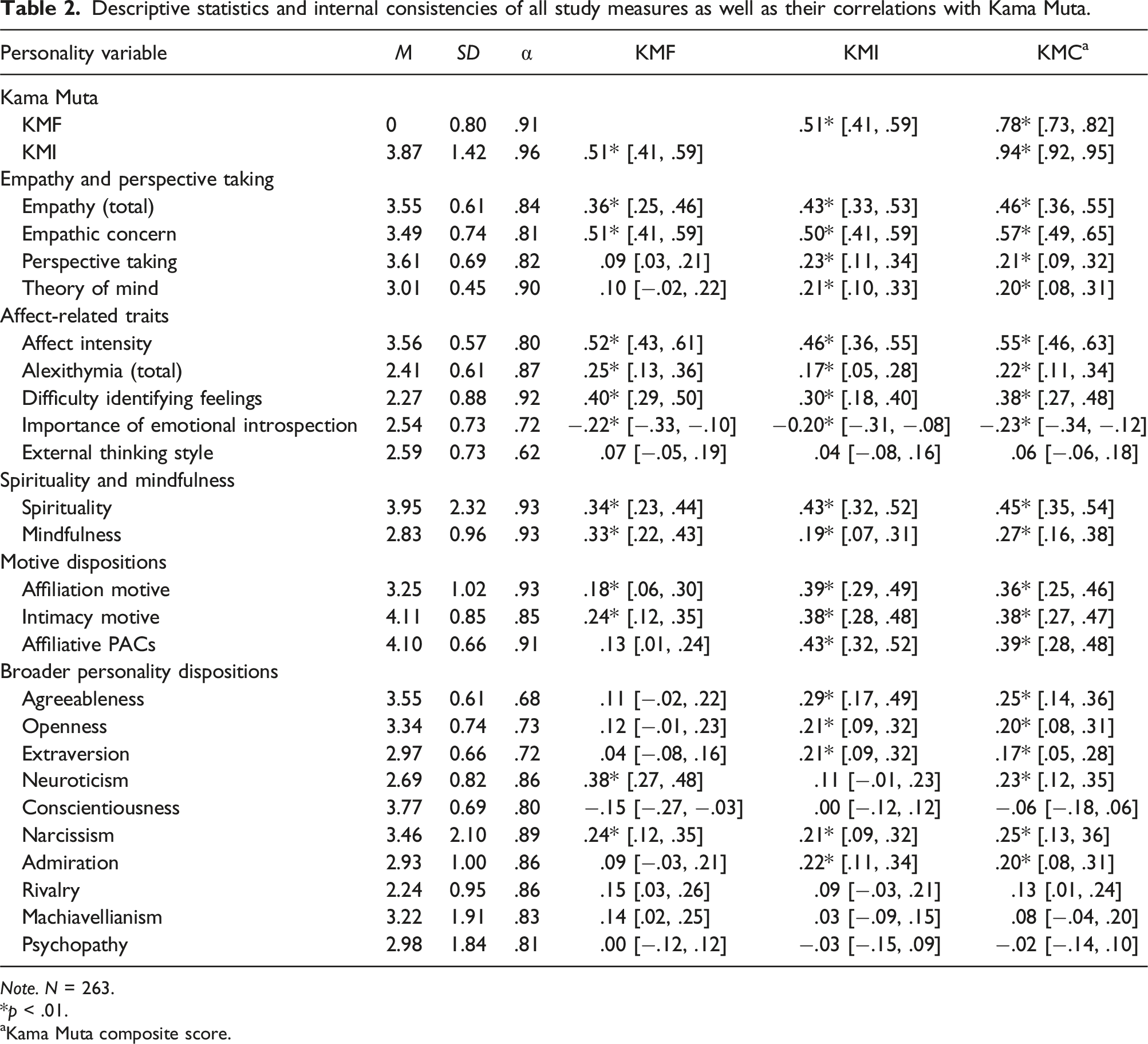
Note. N = 263.
*p < .01.
aKama Muta composite score.
Association between KMF and KMI
As expected, we found a positive correlation (r = .51, p < .001, 95% CI [.41, .59])) between KMF and KMI (H1; Table 2). Even though the size of the correlation was substantial, it still left room for a differentiated pattern of results for the two measures. We also decided, in an explorative fashion, to compute a Kama Muta composite score (KMC) that was aggregated across the two (standardized) Kama Muta scores.
Age effects and gender differences
We found a small negative correlation between age and KMI, which was not significant at our predetermined alpha level of .01 (r = −.13, p = .036, 95% CI [−.25, −.01]). However, a descriptively stronger negative correlation was found with KMF (r = −.26, p < .001, 95% CI [−.37, −.15]), and with KMC (r = −.20, p < .001, 95% CI [−.32, −.08]), indicating that older age was associated with less frequent, but not necessarily with less intense, Kama Muta experiences.
As hypothesized (H2), women had higher KMF and KMI values than men (KMF: Mwomen = 0.27; SDwomen = 0.75 vs. Mmen = −0.26; SDmen = 0.76; t = −5.66, p < .001, d = −0.70, 95% CI [−0.95, −0.45]; KMI: Mwomen = 4.13; SDwomen = 1.27 vs. Mmen = 3.61; SDmen = 1.51; t = 3.00, p < .002, d = −0.37, 95% CI [−0.61, −0.12]). This was also evident for KMC, where women (M = 2.20; SD = 0.90) scored higher than men (M = 1.68; SD = 0.98; t = 4.50, p < .001, d = −0.55, 95% CI [−0.80, −0.31]).
We explored whether the effects of age and gender were unique by running two multiple regression models, in which each Kama Muta indicator was simultaneously regressed on age and gender (see Tables S4-S6 in the SOM). For KMF and KMC, gender had incremental effects on Kama Muta.
Relations between Kama Muta and personality
Empathy and perspective taking
Empathy, with both its facets empathic concern (H3) and perspective taking (H4), correlated positively, as hypothesized, with KMF and KMI (and with KMC). Theory of Mind (H5) correlated positively with KMI (and KMC) but, contrary to our prediction, not with KMF.
Affect-related traits
As predicted, affect intensity (H6) correlated positively with KMF, KMI and KMC. The magnitude of these correlations was quite substantial. Contrary to our hypothesis, however, we found positive, rather than negative, associations between alexithymia (H7) and both KMF and KMI (and KMC). To further investigate these unexpected results, we separately explored how the three subfacets that underlie the alexithymia scale are related to Kama Muta. It turned out that the difficulty identifying feelings facet was positively linked to all Kama Muta indicators, whereas the importance of emotional introspection facet was negatively linked to them. The external thinking style facet was not associated with Kama Muta.
Spirituality and mindfulness
As hypothesized, spirituality (H8) and mindfulness (H9) were positively and moderately related to KMI and KMF (and KMC).
Motive dispositions
The affiliation motive (H10) and the intimacy motive (H11) were, as hypothesized, all positively related to KMF and KMI (and KMC). The affiliative PACs (H12) were significantly correlated with KMI and with KMC, but not with KMF.
Broader personality traits
Among the Big Five personality traits, agreeableness (H13) and openness (H14) were, as hypothesized, positively correlated with KMI (and KMC), but not with KMF. We also explored the relations between Kama Muta and the remaining Big Five factors and found positive correlations between extraversion and KMI (and KMC), as well as between neuroticism and KMF.
Unexpectedly and contrary to our hypotheses (H15), Machiavellianism and psychopathy were not linked to any of the Kama Muta indicators, while narcissism was positively associated to all of them. When we looked at the two major subfacets of grandiose narcissism separately, we found that admiration was positively linked to KMI (and KMC), but not to KMF, whereas rivalry was not significantly linked to any of the Kama Muta indicators.
Partial relations controlling for age and gender
The vast majority of the above-described correlations held when we controlled for age and gender (see Table S2), which means that the relations were not driven by these demographic third variables. There were a few exceptions (affiliation motive and narcissism for KMF, mindfulness and alexithymia for KMI), but these were all cases where the initial zero-order correlation with the Kama Muta measure had been small in the first place.
Incremental prediction of Kama Muta
Regression of the Kama Muta composite.

Note. N = 263.
CI: confidence interval; LL: lower limit; UL: upper limit.
Supplementary analyses
After finding unexpected results with regard to alexithymia, we tried to replicate those results by using an openly available dataset by Hu et al. (2019). The set contained cross-national data from twelve countries, including both the KMF and the alexithymia measures we have used in our study. We could not replicate the positive correlation between KMF and alexithymia (r = −.03, p = .29, 95% CI [−.08, .02]). Looking at the three subfacets of alexithymia, we found only a very small correlation with the difficulty identifying feelings facet, that was not significant according to the .01 threshold (r = .06, p = .02, 95% CI [.01, .11]), but negative correlations with the importance of emotional introspection (r = −.18, p < .001, 95% CI [−.23, −.13]) and the external thinking style facets (r = −.17, p < .001, 95% CI [−.22, −.12]). We found the same pattern when we only analyzed the German subsample of the cross-national dataset (for details see Table S8 in the SOM).
Discussion
The present research aimed at deepening the understanding of the emotion Kama Muta by examining how demographic variables and personality dispositions relate to both KMF and KMI. The results replicated key findings from earlier research, revealed many formerly unknown correlates of Kama Muta proneness and demonstrated the unique predictive power of these constructs through a comprehensive regression approach. As in previous research (Zickfeld et al., 2019), KMF and KMI were positively associated, with a medium-to-large correlation. This suggests a consistency in the experience of Kama Muta: Individuals who are moved frequently in their daily lives can also easily be moved in an experimental setting.
Age and gender differences
We found older individuals to experience Kama Muta less frequently, whereas for KMI, the association with age did not pass the .01 significance threshold. For KMF the pattern is consistent with age-related declines of emotional responsiveness (Consedine & Magai, 2006; Pinquart, 2001; Schweizer et al., 2019). While some authors attribute these effects to differences in emotion regulation (Silvers et al., 2012), others focus on the exposure to life events (e.g., reduced social activities among older individuals; Hillerås et al., 1998). However, longitudinal rather than cross-sectional research is needed to better understand these age effects.
We found gender differences for all Kama Muta indicators, implying that women experience Kama Muta more often and more intensively than men. These findings replicate earlier research (Zickfeld et al., 2019). One factor that might play a role in this context are gender stereotypes. Kama Muta is a communal emotion (Fiske et al., 2019) and therefore fits with the female stereotype (Cross & Madson, 1997; Eagly & Wood, 1991). Such stereotypes often have an effect on emotion self-reports, and particularly on retrospective rather than directly assessed measures (Robinson & Clore, 2002). We found this pattern in our data, as KMF, which was assessed by a retrospective measure, showed a descriptively larger gender difference than KMI. Yet, this interpretation is speculative and needs to be tested in future research.
Personality correlates of Kama Muta
Empathy and perspective taking
Empathy was consistently positively associated to Kama Muta. This link was mainly driven by the emotional aspect of empathy, empathic concern, while the cognitive aspect of empathy, perspective taking, was less strongly and consistently linked to Kama Muta, a pattern that is consistent with earlier research (Seibt et al., 2023; Zickfeld et al., 2017, 2019). In combination with the non-significant association between Kama Muta proneness and Theory of Mind, these findings indicate that actually experiencing others’ emotions, rather than cognitively understanding their perspective, is typical for individuals high in Kama Muta proneness. The relations between empathic concern and the Kama Muta indicators were relatively large and empathic concern also had predictive power in explaining Kama Muta, beyond the effects of other personality variables. These findings support the notion that a high level of empathic concern predisposes individuals to experience Kama Muta (Zickfeld et al., 2017).
Affect-related traits
Affect intensity was consistently and positively associated with Kama Muta, showing larger correlations than most other variables and unique predictive power in the regression model. These findings indicate that irrespective of individuals’ motives and interpersonal orientations, those who generally respond with strong emotions to various events also respond with strong Kama Muta reactions in Kama Muta-evoking situations. In this case, the proneness for Kama Muta is an instance of a more general affective style.
Concerning alexithymia, the positive correlation with Kama Muta was unexpected, and did not replicate in the larger data set by Hu et al. (2019). Yet, it is noteworthy that neither in our study, nor in the cross-national data, Kama Muta was substantially negatively related to alexithymia. Only the importance of emotional introspection subfacet of alexithymia was consistently negatively linked to KMF across the two data sets, which would indicate that those who disregard the examination of their own emotions also have impairments connecting with others. Yet future research will be necessary to further clarify how alexithymia and its subfacets are linked to Kama Muta.
Spirituality and mindfulness
As predicted, spirituality was positively associated with all Kama Muta indicators. Because positive correlations were present not only with KMF, but also with KMI, it cannot be due to the fact that individuals high in spirituality experience Kama Muta more often because they attend spiritual gatherings. Instead, those individuals also experience more intense feelings of Kama Muta when put into a Kama Muta-inducing situation. It could be that they are more familiar with the emotion than less spiritual individuals and can therefore perceive and describe it more accurately, which would fit with a positive relation between aspects of spirituality and emotional competencies reported in the literature (King et al., 2012).
A similar case can be made for mindfulness, which was also consistently and positively associated with Kama Muta. Had mindfulness only been related to KMF and not to KMI, the whole explanation could have been that mindful individuals show more compassionate behavior in their everyday lives, which would lead to more frequent Kama Muta experiences. Yet, also KMI was higher among mindful individuals, which fits with the notion that mindful individuals let themselves be affected by external stimuli, being highly aware of their affective response and bodily sensations (Hölzel et al., 2011).
Particularly in the case of spirituality, however, a reverse causality seems possible too. That is, it is conceivable that a strong Kama Muta proneness leads individuals to seek out spiritual contexts that provide the opportunity for Kama Muta experiences and, as a consequence, their level of spirituality increases. Potentially, this process also leads to increased levels of mindfulness. In any case, future research would do well to study the mechanisms underlying the links between Kama Muta and spirituality/mindfulness more closely.
Motive dispositions
The affiliation and intimacy motives as well as affiliative PACs showed the expected positive associations with Kama Muta. Hence, the present findings again indicate that motivation and emotion are closely intertwined (Rothermund & Eder, 2011).
Previous research has indicated that specific motives are linked to a heightened proneness to experience certain emotions (Job et al., 2012; McClelland, 1988) and an emotion that is particularly relevant for the affiliation/intimacy motive seems to be Kama Muta. This insight might lead to a better understanding of the types of situations that individuals with a strong affiliation/intimacy motive seek out and that are highly rewarding for them—namely those that provide the opportunity for Kama Muta experiences.
Broader personality traits
As hypothesized, agreeableness was positively associated with KMI (and KMC), but it was not significantly associated with KMF. The positive relation with KMI fits with the propensity to experience intense emotional reactions to Kama Muta-eliciting situations, pre-disposing individuals to a more understanding, supportive, accommodating and altruistic attitude towards others. At the same time, however, the findings that the association to KMF was non-significant and that agreeableness was not a unique predictor of KMC in the multiple regression model indicate that agreeableness is not as closely or directly linked to Kama Muta as other communal personality aspects.
A similar picture emerged for openness, which was also positively associated with KMI (and KMC), but not with KMF, and which also did not uniquely predict Kama Muta in the multiple regression model. There seems to be an association between openness and Kama Muta, and potentially the explanation is that a proneness for Kama Muta experiences when consuming arts, music and literature makes these experiences more attractive for highly open individuals. At the same time, openness does not seem to be the most direct and proximate personality correlate of Kama Muta.
Contrary to our expectations, the dark triad traits were not negatively related to Kama Muta. One of the traits, narcissism, was positively related to both KMI and KMF (and KMC), and it turned out that this relation was mainly driven by the admiration facet of narcissism. Narcissism was a unique predictor of Kama Muta in the multiple regression analyses. At first glance, this result might seem puzzling. Narcissists have been consistently associated with a lack of empathy (Watson & Morris, 1991), a reduced propensity for emotional contagion (Czarna et al., 2015) and a higher likelihood of engaging in antisocial behaviors such as aggression (Konrath et al., 2006). While there have been some partial revisions to these findings, suggesting that narcissists are capable of empathy when instructed to take the perspective of others (Hepper et al., 2014), the association with a communal emotion like Kama Muta still appears counterintuitive.
However, there are two potential explanations for these findings. First, it is important to consider that grandiose narcissists despise the mundane and are instead attracted to the extraordinary; they love the great show (Back, 2023). From this perspective, it seems understandable that individuals scoring high in narcissism—and particularly those who seek narcissistic admiration—reacted strongly to the Kama Muta-inducing videos, which predominantly featured individuals engaging in outstanding and even heroic acts. In narcissists’ daily lives, their desire for the big show might have led them to enter more Kama Muta-inducing situations, which would explain why they experienced Kama Muta more frequently. Another potential explanation could be the generally heightened positive emotionality observed in grandiose narcissists (Krizan & Herlache, 2018). Their general proneness towards experiencing positive emotions could lead them to also experience higher levels of Kama Muta.
The current research is also informative when the goal is not to solely describe the association between personality and Kama Muta proneness, but to use measures of personality for predicting experiences of Kama Muta (Mõttus et al., 2020). The multiple regression analysis indicates that empathic concern, affect intensity, and spirituality, among other traits, have incremental predictive validity, meaning that these traits are most relevant for prediction.
Limitations and further research
Some limitations need to be mentioned. The present samples consisted only of German speaking individuals, which could have limited generalizability of the results with regard to other cultures. Similarly, our analyses included only individuals who identified as either male or female. Future research should investigate Kama Muta experiences across a broader spectrum of gender identities. Future research could also go beyond simple main effects and test whether gender moderates the associations between personality and Kama Muta proneness.
Furthermore, besides our experimental measures (PACs, KMI), our assessment of personality was mainly based on self-reports. While self-reports are considered the best choice measuring subjective phenomena such as Kama Muta (Corneille & Gawronski, 2024), personality measures can benefit from additional assessment methods (McDonald, 2008). In future research informant reports (and potentially also performance-based measures of empathic accuracy) could be implemented to attain even higher accuracy of the personality measures.
We assessed some constructs using short forms of established questionnaires, such as the KAMMUS-S or the dark triad measure. A disadvantage of this approach is that differentiated information about facets and nuances of the respective constructs could not be distinguished. In future research, the long forms of the scales should be used.
Future research could also assess KMI not only through video-induced responses but also via retrospective self-report measures, ideally using the same format as the frequency scale. This would help reduce potential confounds introduced by using different measurement modalities and improve comparability between the two dimensions.
An interesting task for future research might be to use non-self-report measures of Kama Muta proneness. Although self-reports offer direct access to subjective experiences, they also have their shortcomings, such as their reliance on accurate self-knowledge and their proneness to socially desirable responding (which are particularly problematic when individuals with low self-knowledge and strong self-presentation concerns are tested; Paulhus & Vazire, 2007). Zickfeld et al. (2020) have taken first steps in identifying a physiological fingerprint of Kama Muta by showing that intense Kama Muta experiences correspond with heightened phasic skin conductance, increased skin temperature, piloerection, and greater zygomaticus activity, while also being linked to lower heart rate, slower respiration, and decreased tonic skin conductance. Implementing physiological measures in Kama Muta-personality research could offer deeper insights into how individual personality traits influence physiological and neural responses to Kama Muta-stimulating material.
Future research should also investigate the link between narcissism and Kama Muta proneness more closely. It would be particularly interesting to study the role of communal narcissism, a form of narcissism in which a grandiose self-view is attained not via agentic means, such as dominating others or performing well, but by communal means, such as being exceptionally empathic and helpful (Gebauer et al., 2012). It seems likely that this form of narcissism will show particularly strong associations with Kama Muta proneness.
Also concerning empathy a more differentiated investigation might be warranted. Previous research indicates that another empathy facet than empathic concern and perspective taking is also sometimes linked to Kama Muta proneness, namely fantasy. This subfacet describes the tendency to imaginatively transpose oneself into fictional situations, like identifying with characters in books or movies. Future research should investigate how it relates to different assessments of Kama Muta and whether it can predict Kama Muta experiences above and beyond empathic concern (and other personality constructs).
When analyzing the predictive power of personality, in the multiple regression analysis we have only looked at the separate linear effects of the examined traits. Future research could also look at non-linear effects or constellations of effects and try to maximize predictive power using machine learning approaches, such as conditional random forest models (Molnar, 2022).
Conclusion
The present research identified the personality correlates of Kama Muta. Our findings suggest that individual differences in Kama Muta can be partly attributed to variability in personality traits from very different domains, such as empathy, affect-related traits, spirituality and mindfulness, motive dispositions, and broader and more general personality dispositions. We hope that our findings will lead to a deeper understanding of Kama Muta experiences and of the relationship between emotions and personality more generally.
Supplemental Material
Supplemental Material - Who is moved to tears easily? Individual differences in Kama Muta proneness and their relation to personality
Supplemental Material for Who is moved to tears easily? Individual differences in Kama Muta proneness and their relation to personality by Fynn L. Müller, Anna Z. Czarna and Michael Dufner in Personality Science.
Footnotes
Author note
Not applicable.
Acknowledgements
Not applicable.
Author contributions
Declaration of conflicting interests
The author(s) declared no potential conflicts of interest with respect to the research, authorship, and/or publication of this article.
Funding
The author(s) disclosed receipt of the following financial support for the research, authorship, and/or publication of this article: This research was funded by the National Science Centre, Poland (Grant nr. 2018/30/E/HS6/00863).
Data Accessibility Statement

Supplemental Material
Supplemental material for this article is available online. Depending on the article type, these usually include a Transparency Checklist, a Transparent Peer Review File, and optional materials from the authors.
Notes
Not applicable.
References
Supplementary Material
Please find the following supplemental material available below.
For Open Access articles published under a Creative Commons License, all supplemental material carries the same license as the article it is associated with.
For non-Open Access articles published, all supplemental material carries a non-exclusive license, and permission requests for re-use of supplemental material or any part of supplemental material shall be sent directly to the copyright owner as specified in the copyright notice associated with the article.
