




Abstract
This study examined whether individual differences in personality (development) from adolescence to emerging adulthood were associated with burnout and happiness in emerging adulthood. At Time 1 (2009; Mage = 15.7 years), Time 2 (2012), and Time 3 (2015), Belgian participants (N = 329; 43.1% boys) reported on the personality dimensions of extraversion, agreeableness/benevolence, conscientiousness, emotional stability, and openness/imagination. Burnout (exhaustion, disengagement) and happiness (life satisfaction, overall affect) were measured through self-reports at Time 4 (2018). For each personality dimension, except benevolence, higher levels were associated with fewer burnout symptoms. Initial levels of all personality dimensions were related to more happiness. Shallower decreases in extraversion, emotional stability, and stronger increases in imagination were related to fewer burnout symptoms and more happiness. Results indicate the importance of studying personality development as a determinant of later well-being, above and beyond effects of initial levels. Findings offer new insights into the field of personality, occupational, and positive psychology.
There is a growing scientific and societal interest in how individuals function in emerging adulthood as they develop in a transition period (age 18–25 years) characterized by opportunities, identity exploration, feeling in-between, and instability in all life domains (Arnett et al., 2014). Accordingly, emerging adulthood may be experienced as a stressful developmental period in life. These experiences may develop into burnout symptoms regarding their education or work if the stressors emerging adults are confronted with accumulate over time and become chronic. Emerging adulthood may also be experienced as a period of challenges during which individuals thrive and develop into happy individuals (Switek & Easterlin, 2018). Indeed, emerging adults show considerable heterogeneity in their levels of well-being (Scales et al., 2016). Personality is suggested to be an important factor explaining this heterogeneity in well-being, as certain personality traits may predispose individuals to interpret situations as more negative, resulting in maladaptive behaviors (Swider & Zimmerman, 2010), or more positive, resulting in better well-being (Garcia, 2011). Although personality traits are relatively stable over time, there are important individual differences in personality development during adulthood (Roberts et al., 2006) and even more so during childhood and adolescence (De Haan et al., 2016; Van den Akker et al., 2014). As literature suggests that personality (development) in adolescence is linked to well-being, we examined how individual differences in personality development from adolescence to emerging adulthood are related to burnout symptoms and happiness in emerging adulthood.
This study addresses several knowledge gaps. First, it provides unique knowledge on how individual differences in initial levels and development of personality relate to (academic and work) burnout symptoms and happiness in emerging adulthood. Second, our study focuses on the understudied role of individual characteristics, specifically personality, as a predictor of burnout. Third, our focus on happiness, next to burnout, rests on the positive psychological perspective that absence of problems does not indicate better well-being (Westerhof & Keyes, 2010; World Health Organization, 2006).
Personality and Burnout Symptoms
Emerging adulthood is characterized as a life period in which individuals show considerable heterogeneity in levels of well-being as a result of many important drastic social changes that take place during these years. For example, emerging adults move out of the house, go to college, or start working—all major life events. A transition takes place from a structured, less autonomous system to a more independent support system with new residences and peer groups. In addition, emerging adults on average have rather high expectations when it comes to their professional pursuits (Arnett, 2004). They need to make important decisions during their educational path and afterwards when they start their career. However, the reality is that many emerging adults are confronted with a lack of work opportunities or unstable jobs with low pay (Wood et al., 2017). Accordingly, this instability and unsettlement as well as the changes in emerging adulthood partly explain why some emerging adults experience this phase in life as stressful (Foster et al., 2008). These stress experiences may develop into burnout symptoms if the stressors with which emerging adults are confronted accumulate or become chronic over time. Indeed, worldwide studies have shown that emerging adults are particularly susceptible for developing burnout symptoms (Chen et al., 2022; Marchand et al., 2018).
Burnout is most often defined as a chronic stress response characterized by feelings of exhaustion and disengagement from one’s education or job (Demerouti et al., 2010; Maslach et al., 2001). Exhaustion refers to the long-term consequence of intensive affective, cognitive, or physical stressors. Disengagement comprises distancing from and having negative attitudes toward the job or education in general or the object and content. Burnout may have a substantial impact on individual well-being, including educational or occupational performance, absenteeism, or physical health, and may spill over to other psychological or physical problems (Salmela-Aro, 2017). According to Job Demands-Resources (JD-R) theory (Bakker & Demerouti, 2017), burnout results from a complex interplay between demands and resources. Demands and (lack of) resources as antecedents of burnout are most often grouped into organizational, occupational, and individual factors (Maslach et al., 2001; Swider & Zimmerman, 2010). Organizational and occupational factors, such as time pressure, job control, and social support have been studied most often as resources (Aronsson et al., 2017). Individual factors in relation to burnout, such as personality, have been suggested to play a major role as well (Bakker & Demerouti, 2017; Bianchi, 2018). Yet, personality is often overlooked or considered as a more distant predictor of burnout, compared with job-related factors (Swider & Zimmerman, 2010).
According to the cognitive-affective personality system (Mischel & Shoda, 1995), personality traits affect one’s reactions to the environment and their interpretations of certain situations. Certain personality traits may predispose individuals to interpret situations as more negatively and react more negatively in stressful situations, which can result in increased burnout symptoms (Swider & Zimmerman, 2010). The Big Five approach of personality constitutes the most influential taxonomy of personality (Costa et al., 2019) and has been validated particularly in populations derived from Western, industrialized, high-income countries (Laajaj et al., 2019; Thalmayer et al., 2020). Five distinct personality domains are identified: extraversion (being sociable, talkative), agreeableness (benevolence regarding to child personality, Mervielde & De Fruyt, 1999; being cooperative, good-natured), conscientiousness (responsible, organized), emotional stability (vs. neuroticism; level of emotional adjustment and stability), and openness (imagination regarding child personality; being imaginative, creative). Individuals low in emotional stability are generally more anxious and nervous (Costa & McCrae, 1992). This heightened vulnerability to negative stimuli makes individuals low in emotional stability more prone to interpreting their environment as more stressful and, therefore, more prone to developing burnout (Swider & Zimmerman, 2010). Individuals high in extraversion are more likely to experience positive emotions, such as optimism, resulting in more positive evaluations of their education or work and in turn less disengagement of one’s education/work (Swider & Zimmerman, 2010). Extraverted individuals are more outgoing and cheerful (Costa & McCrae, 1992). They perceive their environment as more positive, and therefore tend to experience less exhaustion (Bakker et al., 2010). Those with higher levels on imagination/openness show a more positive attitude toward learning and are more intellectually curious and open-minded, which can make them less likely to experience disengagement (Swider & Zimmerman, 2010). Moreover, imaginative individuals may experience less exhaustion as they are less likely to perceive challenging situations as stressful; rather, they tend to view struggles more positively as an opportunity for personal maturation (Zimmerman, 2008). Conscientious individuals may experience less exhaustion because their high self-discipline and effective organization helps them to avoid stressful situations more (Armon et al., 2012). Their strong work ethic and hardworking nature may likely prevent them more from feeling disengaged (Judge & Ilies, 2002). Finally, those high on benevolence/agreeableness are cooperative and good-natured, which can aid in having positive views about their job or education and reduce disengagement (Armon et al., 2012). These individuals may be less likely to experience exhaustion through their tendency to have an understanding of the negative aspects of situations (Zimmerman, 2008).
Implementing a Salutogenic View: Personality and Happiness
Knowledge on the link between personality and burnout entails information about the presence of problems. This pathogenic view does not entail the full continuum of well-being, because an individual may not experience problems and not experience positive well-being at the same time (Westerhof & Keyes, 2010). Complementing the pathogenic view by the salutogenic perspective (i.e., promoting well-being) yields a more complete picture of well-being (Two-Continua Model of Keyes; Keyes, 2005, 2014). The application of a salutogenic view in psychological research is less common compared with the pathogenic view; according to Schaufeli and Salanova (2007), publications on maladaptation (e.g., depression) appear to exceed those on adaptation (e.g., happiness), by a ratio of 16:1. Since the publication of their study, the number of studies implementing the salutogenic view increased (e.g., Soto, 2019, 2021) but still is limited (Mittelmark et al., 2017). Brauchli and colleagues (2015) referred to the salutogenic implementation of the JD-R model as the JD-R Health Model consisting of a direct pathogenic path to maladaptive outcomes, such as anxiety or depression, and a direct salutogenic paths to adaptive outcomes (Jenny et al., 2016).
Happiness, or subjective well-being, is a strong indicator of well-being in positive psychology (Ackerman et al., 2018). Happiness consists of a cognitive component (i.e., life satisfaction) and an affective component (i.e., presence of positive emotions and absence of negative emotions; Diener, 1984; Diener & Lucas, 1999). Many studies showed that more happiness was related to better well-being across various life domains, such as work performance and educational success (i.e., Oswald et al., 2015). In fact, Lyubomirsky and colleagues (2005) showed that personality accounted for as much as 50% of the variance in happiness. A meta-analysis on the Big Five personality dimensions reported the highest correlations for emotional stability with life satisfaction and negative affect, and for extraversion with positive affect (Steel et al., 2008). Individuals high in extraversion and emotional stability tend to interpret their environment more positively, resulting in more well-being, such as experiencing more happiness (Garcia, 2011). Meta-analytical evidence also revealed that effect sizes were largest, specifically for extraversion and emotional stability, followed by conscientiousness (Anglim et al., 2020). The two dimensions of benevolence and imagination were less consistently and less strongly correlated with happiness.
Personality Development, Burnout Symptoms, and Happiness
Over the years, a solid empirical ground has been established stating that personality characteristics are important (longitudinal) predictors of life outcomes on various life domains (Costa et al., 2019; Soto, 2019, 2021). For example, Shiner and Masten (2012) found that emotional stability in children (8–12 years old) was positively related to academic achievement 10 years later and work competence 20 years later. The study of personality measured at a single point in life in relation to later outcomes assumes that personality characteristics are stable features of individuals. However, personality is in fact not static but changes from childhood on (Roberts & DelVecchio, 2000; Roberts et al., 2006). These changes often happen in relation to certain life experiences or transitions (Lodi-Smith & Roberts, 2007), for example, because of physical and hormonal changes related to puberty (Paikoff & Brooks-Gunn, 1991) or increasing autonomy (Galambos & Costigan, 2003).
A vast amount of research indicates that mean-level personality development from mid-adolescence into emerging adulthood is directed toward greater maturity (i.e., the five personality dimensions increase; Bleidorn et al., 2022; Borghuis et al., 2017; Soto et al., 2011), also referred to as the maturity principle (Klimstra et al., 2009). Several longitudinal studies reported defiance of maturity (decreases in personality dimensions; Branje et al., 2007; Van den Akker et al., 2010); however, this has been found most often during the transition to adolescence or across early adolescence. Increases in personality traits can help individuals to perform better on age-graded tasks, meaning that personality development may relate to the new social roles that are taken (Social Investment Theory; Roberts et al., 2005). Entering college, starting a paid job, or becoming involved in romantic relations can require individuals to become more structured, more organized, and less egocentric (Roberts et al., 2008). In this light, one can expect that personality development toward maturity (indicated by increased levels on the personality dimensions) is related to higher levels of happiness and lower levels of burnout. Moreover, studies on personality development from adolescence on show that personality development may differ within individuals (intra-individual differences) and between individuals (interindividual differences) (Klimstra et al., 2009), which may explain why some individuals show better well-being than others. Hence, the changing nature of personality implies that it is important to study individual differences in initial levels (intercepts) and changes (slopes) in personality dimensions as determinants of later well-being.
The few studies that focused on personality development as a predictor of well-being found that decreases in conscientiousness, emotional stability, and extraversion were related to more mental and physical health problems (Magee et al., 2013). The study by Van den Akker and colleagues (2010), based on the same study sample as the current study but conducted in the earlier developmental period of ages 8–14 years, reported that decreases in benevolence, conscientiousness, and emotional stability were related to more externalizing problems and that decreases in extraversion and emotional stability were associated with more internalizing problems in adolescents. Our research extends these initial findings on personality development in relation to future well-being by focusing on the developmental phase of mid-adolescence into emerging adulthood (ages 14–23), well-being at a later age (age 25; emerging adulthood), a counterpart of well-being (burnout), and by adding an outcome of well-being (happiness).
The Current Study
In this study, the link between individual differences in initial levels and personality development from adolescence into emerging adulthood (14–23 years) and burnout symptoms regarding education or work and happiness in emerging adulthood (mean age 25 years) is examined in a community-based sample (see Figure 1 for the statistical model). First, we expect initial levels of extraversion and emotional stability to be negatively related to burnout—in this study represented by disengagement and exhaustion toward education/work. Second, we hypothesize that initial levels of extraversion and emotional stability are positively related to happiness, represented by life satisfaction and overall affect. Because benevolence, conscientiousness, and imagination are relatively understudied personality dimensions in relation to burnout and inconsistently related to happiness, no a priori hypotheses are made regarding their initial levels. Finally, based on the personality maturity principle, earlier findings on initial levels of personality in relation to burnout and happiness and the few studies examining personality development in relation to well-being, we expect stronger increases in all five personality dimensions over time to be related to less burnout and more happiness in emerging adults.
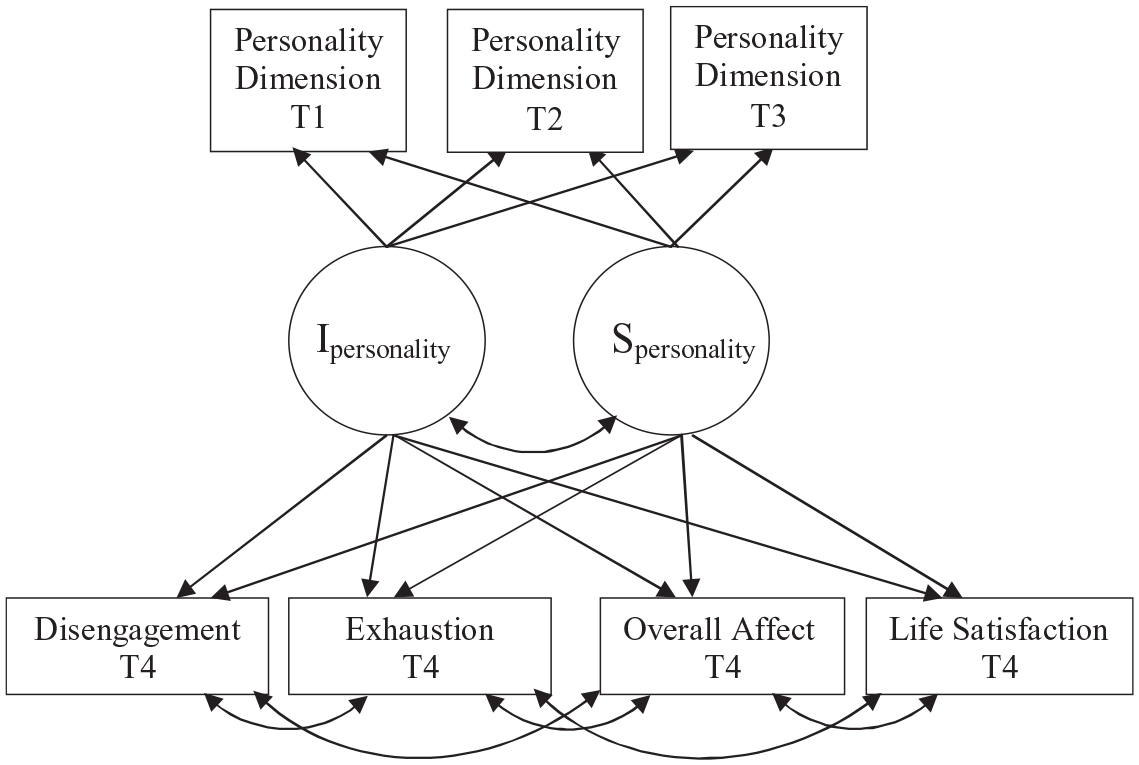
Statistical Model with Personality from Adolescence into Emerging Adulthood, and Burnout Symptoms and Happiness in Emerging Adulthood.
Method
Participants and Procedure
This study is part of the ongoing longitudinal Flemish Study on Parenting, Personality and Development consisting of nine waves (1999–2018). The study procedures were approved by the board of the Katholieke Universiteit Leuven (OT 98/12 ZKA 2922). The original study sample was randomly selected from 167 schools in Flanders, Belgium. Written informed consent was given. A detailed description of the study design and recruitment of participants is presented previously (see Prinzie et al., 2003). Data from the sixth (2009; Time 1 [T1], N = 449), seventh (2012; Time 2 [T2], N = 438), eighth (2015; Time 3 [T3], N = 387), and ninth (2018; Time 4 [T4], N = 367) waves were used as these waves contained the measures of interest. The final sample (N = 329; 187 girls; mean age T1 = 15.82 years, range age T1 = 12.92–18.25 years, mean age T2 = 18.82, T3 = 21.82, T4 = 24.82) consisted of participants from whom information regarding personality was available on T1, and T2 or T3 and who participated at T4 (T1 N = 307; T2 N = 313; T3 N = 307; T4 N = 329).
Attrition analyses with participants who participated at T1, T2, T3, and T4 (N = 284) compared with participants with missings on either T2 or T3 but not on T1 and T4 (N = 45) showed no significant differences regarding personality on T1 and sex of the adolescent. Attrition analyses with complete cases at T1 (N = 307) and the final sample (N = 329) showed a few significant differences: on extraversion at T2, χ2(318) = 5.50, p = .037, and T3, χ2(308) = 4.03, p = .037, and emotional stability at T2, χ2(318) = 0.28, p = .043. Those with complete cases on T1 scored on average slightly higher on these personality domains.
Measures
Supplementary Material 1, Table 1 shows descriptive and psychometric information for all measures.
Model Fit Indices of the Intercept-Only Models and Linear Growth Models.
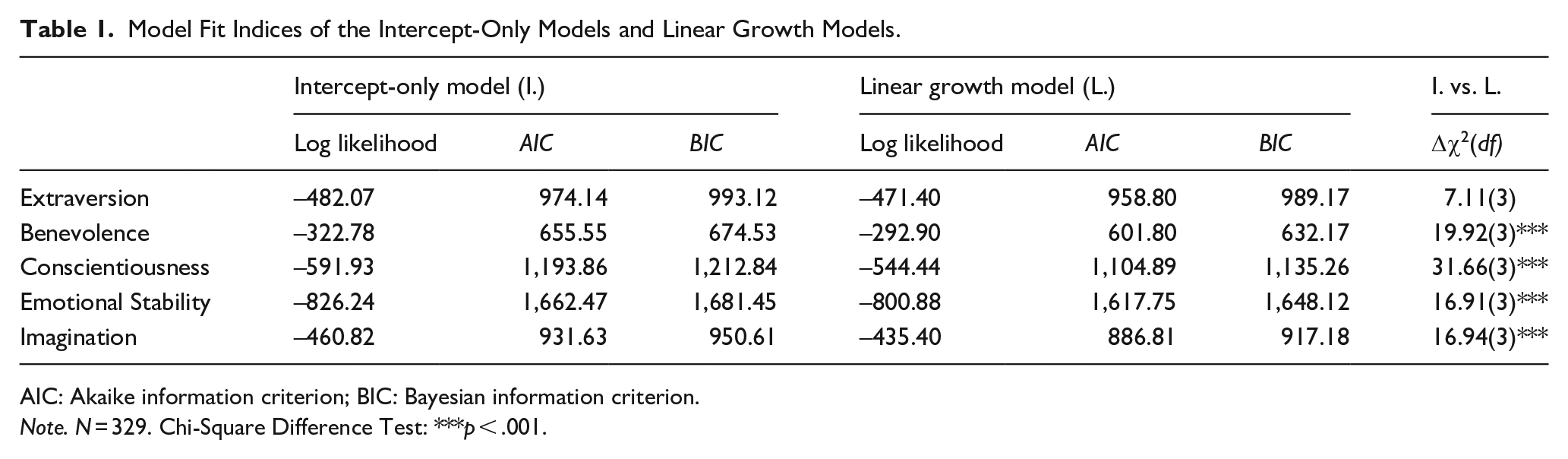
AIC: Akaike information criterion; BIC: Bayesian information criterion.
Note. N = 329. Chi-Square Difference Test: ***p < .001.
Adolescent Big Five Personality Dimensions
At T1, T2, and T3, adolescents completed the 144-item Hierarchical Personality Inventory for Children (HiPIC; Mervielde & De Fruyt, 1999), structured hierarchically under the five domains Extraversion, Benevolence, Conscientiousness, Emotional Stability, and Imagination. Items were rated on a 5-point scale ranging from 1 (barely characteristic) to 5 (highly characteristic). Mean scores of the items for each Big Five personality dimension were used. The factor structure of the HiPIC has been established and internal consistencies of the domains are high (Rossier et al., 2007). Measurement invariance of the structure of the HiPIC across time has been established before for this sample (De Haan et al., 2016).
Burnout Symptoms
At T4, emerging adults rated their feelings of exhaustion and disengagement toward their education/work using the Oldenburg Burnout Inventory (OLBI; Demerouti et al., 2010; Reis et al., 2015). The OLBI consists of two subscales Exhaustion and Disengagement. Items were rated on a 4-point scale ranging from 1 (strongly agree) to 4 (strongly disagree). For both scales, mean scores of the items were used. Two versions of the OLBI were used for working or studying participants: a version measuring burnout related to work (n = 232) and one assessing academic (n = 51) burnout. For participants who work and study at the same time (n = 46), statements were modified such that they referred to both work and study (Supplementary Material 1, Table 2). Reliability and validity, and factorial invariance of the work and academic versions of the OLBI have been established before (Demerouti & Bakker, 2008; Reis et al., 2015).
Parameter Estimates of the Univariate Latent Growth Models.
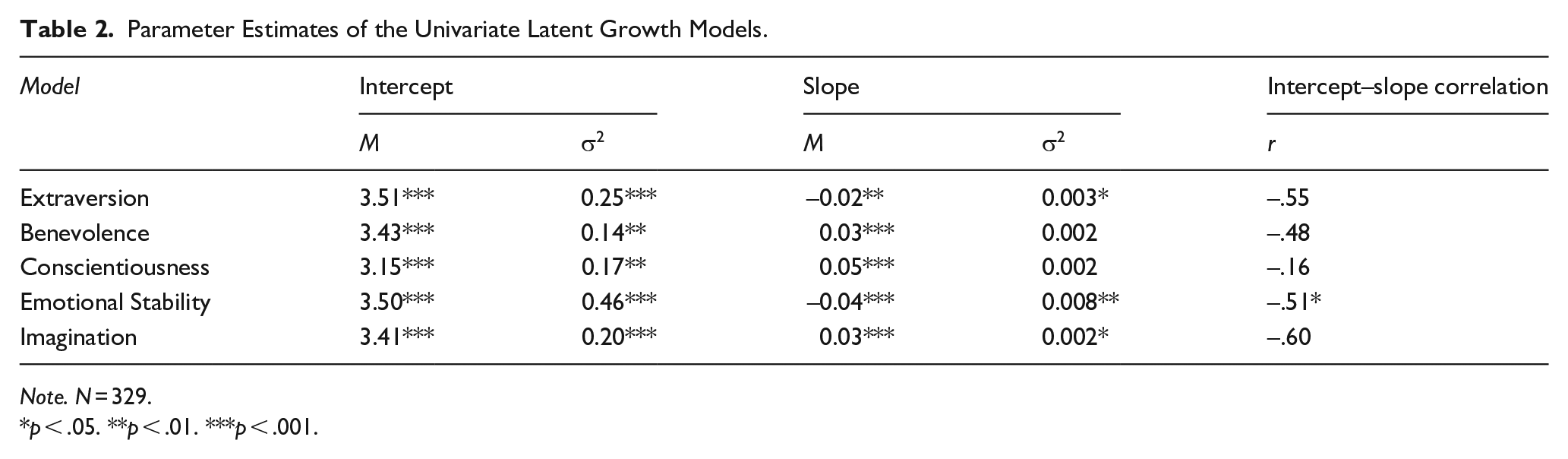
Note. N = 329.
p < .05. **p < .01. ***p < .001.
Happiness
At T4, emerging adults rated their feelings of happiness through the Satisfaction with Life Scale (SWLS; Arrindell, 1991; Diener, 1984) and the Positive and Negative Affect Scale (PANAS; Peeters et al., 1996; Watson et al., 1998). The SWLS taps into the cognitive component of happiness. Items were rated on a 7-point scale ranging from 1 (strongly disagree) to 7 (strongly agree). Sum scores of the items were used (Pavot & Diener, 2013). Through the PANAS the affective component of happiness was measured. Positive and negative states were assessed on a 5-point scale ranging from 1 (very slightly) to 5 (extremely). See Supplementary Material 1 Table 2 for descriptives and bivariate correlations. To obtain a net score of affect, based on the theoretical conceptualization by Diener (1984) and similar to the method that was applied before (i.e., Mukolo & Wallston, 2012), Overall Affect was computed by subtracting the sum score of the negative state items from the positive state items. This method yielded negative values, therefore, we added the lowest score in the sample to all scores of Overall Affect. Adequate validity has been established for both the SWLS (Arrindell, 1991) and the PANAS (Peeters et al., 1996).
Statistical Analyses
The study design and analyses were not preregistered. The study analysis outputs and syntaxes can be accessed at https://osf.io/sb7h8/?view_only=a97e90ea68de435d9765899b285292d8. To determine personality development, univariate latent growth models were assessed through latent growth modeling (LGM) analyses for each personality dimension separately in Mplus 8.5 (Muthén & Muthén, 2017). We applied the full information maximum likelihood (FIML) approach (Schafer, 1997) to deal with missing values. For each personality dimension, first intercept-only models were fitted in which only the intercept was specified. These (reference) models were compared with the univariate linear growth models, including an intercept and linear slope factor. The latent growth models were scaled by continuous age (as opposed to measurement occasion) to account for the wide range of ages. Fit of the intercept-only and linear growth models were compared using the (Satorra–Bentler) Chi-Square Difference Test. The fit indices Bayesian information criterion and Akaike information criterion were used to assess the adequacy of fit for the growth models (Bollen & Long, 1993). Mean values and variances of the intercept and slope factors and intercept–slope covariances were reported for each dimension. Estimate significances were reported based on p values. Based on the significance of these parameters combined with the Chi-Square Difference tests, we evaluated whether there was change in each personality dimension.
Subsequently, multivariate latent growth analyses were performed to analyze relations between the growth factors (intercept and slope) of each personality trait and the outcome variables burnout symptoms (disengagement and exhaustion) and happiness (overall affect and life satisfaction). Participant’s sex was added as a covariate in each model. Outcome variables burnout and happiness were standardized (z-scores) before performing the main analyses, as TYPE = RANDOM estimation does not offer standardized coefficients. Reported estimates are unstandardized regression coefficients (b), standard errors, and p values.
Results
Univariate Development of the Personality Dimensions
Supplementary Material 1, Table 3 shows descriptives of and bivariate correlations for all measures. Stability of the personality dimensions was relatively large between consecutive measurements (rs = .62–.75).
Parameter Estimates of the Regression Paths From Adolescent Personality to Burnout Symptoms and Happiness in Emerging Adulthood.
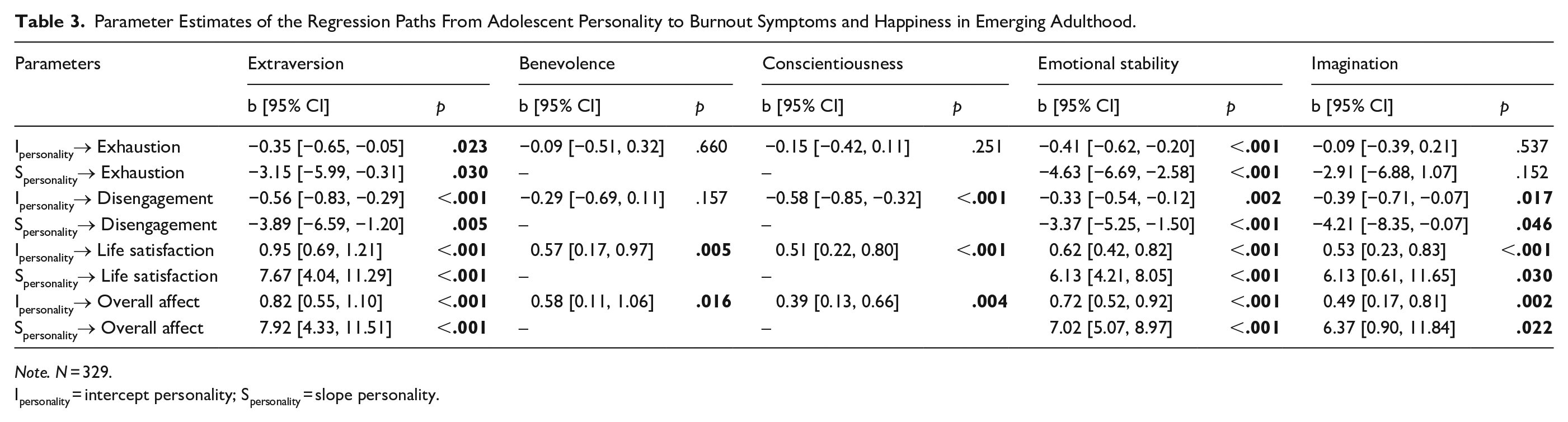
Note. N = 329.
Ipersonality = intercept personality; Spersonality = slope personality.
For each personality dimension, intercept-only and univariate linear growth models were fitted (see Table 1). Through Chi-Square Difference tests combined with the significance of the parameter estimates (mean values and variance of the intercept and slope factors), models indicating linear change were preferred for all dimensions. Table 2 shows the means and variances of the intercept and slope factors for the personality dimensions. The mean slopes of Extraversion and Emotional Stability were significant and negative, indicating that, on average, adolescents became less extraverted and less emotionally stable from mid-adolescence to emerging adulthood. The significant mean slopes of Benevolence, Conscientiousness and Imagination were positive and indicated that, on average, adolescents became more benevolent, conscientious, and imaginative over time. The intercept variances for all personality dimensions were significantly different from zero (Table 2). The slope variances for Extraversion, Emotional Stability, and Imagination were significantly different from zero, indicating variability in change over time (Duncan et al., 2006). Hence, the slopes of Extraversion, Emotional Stability, and Imagination were included as predictor in the multivariate models (Duncan et al., 2006), in which we tested each personality dimension in isolation of the other personality dimensions.
Associations between Personality (Development) and Burnout and Happiness
To examine relations between the personality dimensions and burnout and happiness in emerging adulthood, five models were fitted for each intercept of the personality dimensions separately. For Extraversion, Emotional Stability, and Imagination the slope factor was also included as predictor (see Table 3). Higher initial levels of Extraversion and Emotional Stability were negatively associated with Exhaustion and higher initial levels of all personality dimensions (except Benevolence) were significantly related to lower scores on Disengagement. The regression paths for the slopes of Extraversion and Emotional Stability were significant for all outcomes. Regarding Exhaustion and Disengagement, regression coefficients indicate that shallower decreases in Extraversion and Emotional Stability, and stronger increases in Imagination were related to lower scores on Exhaustion and Disengagement in emerging adulthood. Furthermore, higher initial levels of all personality domains were related to higher scores on Life Satisfaction and Overall Affect in emerging adulthood. The regression paths between the slopes of the personality dimensions and the happiness outcomes showed that shallower decreases in Extraversion, Emotional Stability, and stronger increases in Imagination were related to higher scores on both Life Satisfaction and Overall Affect1,2.
Discussion
This study investigated whether individual differences in initials levels and development of personality throughout adolescence into emerging adulthood were related to (academic and work) burnout symptoms and happiness in emerging adulthood. On average, extraversion and emotional stability decreased over time. Shallower decreases were related to fewer burnout symptoms and more happiness later in life. Moreover, adolescents who showed stronger increases on imagination also experienced fewer burnout symptoms and more happiness in emerging adulthood. Thus, development of extraversion, emotional stability, and imagination were related to burnout symptoms and happiness, above and beyond effects of initial levels of these personality dimensions.
Personality and Burnout Symptoms
Initial levels of extraversion, conscientiousness, emotional stability, and imagination were negatively related to disengagement from education or work, whereas initial levels of extraversion and emotional stability were also negatively related to exhaustion from education or work. Thus, conscientiousness and imagination were negatively related to the disengagement dimension of burnout, but unrelated to exhaustion. Imaginative individuals are curious and open to change and variety (Costa & McCrae, 1992). Such skills yield more proactive work behavior in anticipation of future goals (Parker et al., 2006), and in turn, promote positive experiences regarding education or work (e.g., Rudolph et al., 2017) and therefore may decrease feelings of disengagement. Conscientiousness is associated with self-discipline, achievement striving, dutifulness, and competence (McCrae & Costa, 1986), indicative of a general motivation to finish tasks and accomplish things—hence the negative relationship with disengagement. Imagination and conscientiousness were, however, not related to exhaustion. Exhausted individuals persist in the face of difficulties and do not stop when feeling tired (Bakker & De Vries, 2021). Instead, they will achieve their goals at the expense of increased subjective effort, and behavioral and physiological costs (Hockey, 1993). Imagination and conscientiousness will therefore help individuals to reach their goals, but this might come at the cost of substantial effort, which depletes cognitive and physical resources.
In addition to initial levels (stability) of personality, we found that the development of extraversion, emotional stability, and imagination was related to burnout. Specifically, stronger increases in imagination were related to less disengagement and shallower decreases in extraversion and emotional stability were associated with less disengagement and less exhaustion. Individuals scoring high on extraversion, emotional stability, and imagination tend to experience more positive emotions and are more optimistic (Anglim et al., 2020). Particularly extraversion, emotional stability, and imagination were related to (more) positive affect. Connor-Smith and Flachsbart (2007) indicated that through positive emotions, extraverted, emotionally stable, and imaginative individuals tend to evaluate stressful situations as less threatening (Lue et al., 2010) and are less likely to use certain maladaptive coping strategies such as withdrawal. It is also conceivable that extraverted individuals are better able to mobilize social resources than their counterparts (Oerlemans & Bakker, 2014), that emotionally stable individuals are better able to deal with episodes of incivility (Zhou et al., 2015), and that imaginative individuals are more likely to playfully redesign repetitive study and work tasks so that these tasks are more meaningful (Scharp et al., 2022). Based on these cognitive and behavioral mechanisms, we speculate that extraversion, emotional stability, and imagination may form protective factors regarding experiencing burnout symptoms.
Personality and Happiness
Adolescents with higher initial levels on all personality dimensions were more satisfied regarding their lives and showed more positive affect in emerging adulthood. Moreover, adolescents with shallower decreases in levels of extraversion and emotional stability, and those who increased more strongly in levels of imagination, were happier compared with their peers. These findings support the meta-analytical findings of Anglim and colleagues (2020) and extend this knowledge by providing evidence for associations between personality development in relation to happiness. Furthermore, our findings indicate that personality is not only important for well-being on the education or work level but entails a longitudinal indicator for general well-being as well, supporting implementation of a salutogenic view within the JD-R model, namely, the JD-R Health model. Our findings suggest that personality seems to play a role in both otherwise distinct pathogenic and salutogenic processes. Our results highlight the importance to consider the role of a broader range of well-being outcomes to understand why certain individuals thrive, whereas others experience more difficulties. Such an approach within research, policy, and practice can promote our knowledge on individual well-being (Seligman, 2002), which may provide insights for (re)development of prevention and intervention programs.
Personality Development as a Longitudinal Predictor of Happiness and Burnout
Over the past decades the notion that personality is not static is uprising (Slobodskaya, 2021). Based on initial levels of personality we might expect that an individual may be at risk for burnout. However, if certain personality traits decrease less strongly or increase more strongly, this individual might experience less burnout in the long term. These findings may provide theoretical insights into certain longitudinal trajectories that put individuals in more vulnerable positions for future problems or, on the other hand, promote success. A next step for future research may be to extend this study design by examining factors explaining heterogeneity in personality development in relation to burnout and happiness. The moderating role of environmental (e.g., parenting) and biological factors (heritability) might be interesting to explore. Earlier studies suggested that personality development is driven by parenting (Shiner & Caspi, 2003), for example, increases in benevolence and conscientiousness were related to increases in positive parenting and decreases in negative parenting (Van den Akker et al., 2014). Moreover, the meta-analysis by Vukasović and Bratko (2015) showed that almost 40% of individual differences in personality were affected by genetics, compared with 60% by environmental influences.
Our findings indicated that extraversion, emotional stability, and imagination may form a protective factor regarding future well-being. This may open up a window for new questions, such as: Is it possible to increase certain personality dimensions in terms of prevention or intervention purposes? A long-standing discussion exists on whether and how personality traits can be changed through interventions. Roberts and colleagues (2017) provided systematic clinical evidence for the benefits of psychotherapy for personality change (particularly for emotional stability and extraversion). Hence, with respect to our study results, it may be of help to incorporate a focus on increasing emotional stability, extraversion, and imagination within prevention and intervention programs on employee/student well-being. Despite the small effect sizes, these findings on personality development may still play an important role in intervention programs. For public health, moderate changes of moderate risk factors are beneficial, which is especially important to consider, as burnout is a large societal problem on the general population level (Bakker & De Vries, 2021).
Moreover, investment in personality development from an early age on may be considered. Implementation at schools might be beneficial, as adolescents spent most time during the day at school (Werner-Seidler et al., 2017). We encourage prevention and intervention school-based programs aimed to improve adolescent well-being to consider a focus on emotional stability, extraversion, and imagination. Benefits might not only be for decreasing future burnout symptoms but also for increasing happiness in the long term.
Limitations
Some limitations need to be mentioned. First, this study was based on self-report data, which runs the risk of single-reporter bias. Second, the dataset used in this study only provided information on burnout and happiness at one timepoint (emerging adulthood). A more precise estimation of the effects could be retrieved by controlling for baseline measures, as individuals may have differed in their initial levels and, consequently, in their rate of change in burnout and happiness. Moreover, in our study the HiPIC measure (for personality) was assessed only in the first three measurement waves and not during the last measurement wave leaving a “gap” between the personality measures at ages 22 and 25. We were therefore not able to examine possible increases or decreases in personality development during this gap. Furthermore, a full cross-lagged panel design, including repeated measures of burnout symptoms and happiness, may have provided additional insights on bidirectionality (Rapee, 1997). Besides personality affecting individual well-being, well-being (e.g., psychological problems) may also affect personality (The Scar Model; Tackett, 2006). We did not collect data on burnout and happiness on earlier measurement waves. Note, however, that specifically for burnout regarding work it would have been challenging to include earlier measures, as many participants likely were not working during adolescence. We suggest future research to include repeated measurements of burnout and happiness to control for baseline measures and to test for possible bidirectional relations. In doing so, it may be of value to examine personality development on shorter timescales to capture possible dynamic processes more thoroughly. According to the Dynamic System Theory (Smith & Thelen, 2003), development takes place over different time scales that are linked with each other: Long-term development has its origins in short-term development at the meso- or micro-level (i.e., months, weeks, or days). To understand how an individual develops over time, we need to zoom in on smaller timescales as well (Keijsers & van Roekel, 2018). As there is a specific paucity in our understanding of meso-time scales (i.e., weeks and months) and micro-time scales (day-to-day), we urge future studies to tap into personality development on shorter timescales.
With the current sample size, we were not able to perform second-order latent growth curve modeling (Sayer & Cumsille, 2001). This method would have been beneficial to account for measurement error across time, considering the probabilistic nature of associations between the items that are measured (Borsboom, 2008). Yet, De Haan and colleagues (2016) showed that the Big Five facets in this study were measurement invariant, which is a strong indicator for measurement invariance on the level of the Big Five dimensions.
A final limitation concerns the cultural generalizability of our study results as the study sample consisted of only Belgian participants. Our knowledge on the Big Five personality domains is mainly based on studies conducted in populations of WEIRD (Western, educated, industrialized, rich, and democratic) countries in Western Europe and North America (Thalmayer et al., 2020). Questionnaires measuring Big Five personality show low validity in non-WEIRD countries (Laajaj et al., 2019), raising concerns regarding generalizability. The replicability and universality of the Big Five dimensions comprises a subject of considerable debate (Allik et al., 2010), posing important disclaimers within personality-outcome research (Bleidorn et al., 2022; Soto, 2019). In that line, we argue that caution is warranted regarding the cultural generalizability of our findings as they are based on a rather homogeneous group of relatively highly educated and high-income families derived from a WEIRD country. Given the lack of replicability of the Big Five across cultures (Laajaj et al., 2019; Thalmayer et al., 2020), we urge future research to replicate this study within a culturally more diverse sample or within a cross-cultural study design.
Conclusion
This study provides important knowledge on adolescent personality as an early determinant of well-being in emerging adulthood, by showing that initial levels and development of personality from age 14 to 23 were related to (academic or work) burnout and happiness in emerging adulthood. On average, adolescents decreased on their levels of extraversion and emotional stability. Shallower decreases were related to fewer burnout and more happiness in emerging adulthood. Also, on average, adolescents became more imaginative over time, but stronger increases were related to fewer burnout and more happiness. Our results were in line with the JD-R theory and the JD-R health model, thereby emphasizing the value of adding a positive psychological view on individual well-being. Our findings may provide buildings blocks for prevention and intervention purposes. In sum, our findings indicate the importance of studying personality development as determinant of later well-being, above and beyond effects of initial levels of personality.
Supplemental Material
sj-docx-1-jbd-10.1177_01650254231152422 – Supplemental material for Adolescent personality development as a longitudinal marker for burnout and happiness in emerging adulthood
Supplemental material, sj-docx-1-jbd-10.1177_01650254231152422 for Adolescent personality development as a longitudinal marker for burnout and happiness in emerging adulthood by İldeniz B. Arslan, Nicole Lucassen, Amaranta D. de Haan, Joran Jongerling, Arnold B. Bakker and Peter Prinzie in International Journal of Behavioral Development
Footnotes
Declaration of Conflicting Interests
The author(s) declared no potential conflicts of interest with respect to the research, authorship, and/or publication of this article.
Funding
The author(s) received no financial support for the research, authorship, and/or publication of this article.

Supplemental material
Supplemental material for this article is available online.
Notes
References
Supplementary Material
Please find the following supplemental material available below.
For Open Access articles published under a Creative Commons License, all supplemental material carries the same license as the article it is associated with.
For non-Open Access articles published, all supplemental material carries a non-exclusive license, and permission requests for re-use of supplemental material or any part of supplemental material shall be sent directly to the copyright owner as specified in the copyright notice associated with the article.
