



Abstract
In this paper, we investigated the relation between a positive social emotion, kama muta, and immigrants’ acculturation to Norway. Kama muta is evoked by a sudden intensification of a communal sharing relationship. Since communal sharing relationships are characterized by feeling one with others and orienting one’s actions to something they have in common, we predicted that feeling kama muta about Norway or Norwegians would enhance immigrants’ motivation to adopt Norwegian culture. We investigated this with exploratory sequential mixed methods: In Study 1, we interviewed 18 immigrants in Norway to understand in which situations the emotional experience, that can be identified as kama muta, occurs in connection to Norway and Norwegians, and how this affects acculturation to Norwegian culture. Based on the results of Study 1, we developed prompts that assessed immigrants’ kama muta experiences in connection with Norway and formulated hypotheses relating to immigrants’ bicultural identity integration, acculturation motivations, motivation to stay, and acculturative stress. In Study 2 we quantitively assessed these hypotheses in a larger sample of immigrants to Norway (N = 142). The frequency and intensity of kama muta experiences in connection with Norway uniquely predicted immigrants’ motivation to adopt Norwegian culture, and negatively predicted acculturative stress. This suggests that kama muta can connect immigrants to their new homeland.
Migrating to a new country is challenging. Many migrants 1 have phases of loneliness, homesickness, rejecting the new country and feeling rejected, practical hazzles, and disappointed hopes. These can give rise to dejection, fear, or anger. Yet migration can also fulfill hopes, provide new opportunities for thriving, and for forming new relational bonds. Episodes that highlight the positive sides of migration can correspondingly give rise to positive emotions, such as joy, excitement, or gratitude. Such positive emotions about their new home, its culture, people, traditions, or nature, for example, should thus be a hallmark of successful acculturation, and may, by virtue of their rewarding nature, motivate further acculturation efforts. Here, we are interested in this potential virtuous circle of positive experiences, rewarding emotion, and further engagement with the host culture for events that highlight the new bonds formed, to new friends, to relatives, to colleagues, strangers, nature, to national symbols, or to traditions.
From being a country with net emigration until the late 1960’s, Norway has become a country that people immigrate to (Brochmann & Hagelund, 2012; Brochmann & Hammar, 1999; Sam et al., 2017). As of January 1st 2021, first-generation immigrants constituted 15% of the Norwegian population (Statistics Norway [SSB], 2021). Thus, a large and increasing proportion of the Norwegian population need to learn a new language and customs, and perhaps construct a new identity. Acculturation theories have described various strategies and cognitive frames that immigrants might adopt. These include motivation to adopt host country practices versus motivation to maintain home country practices (Bourhis et al., 1997), and whether immigrants view their home culture identity as compatible with the host culture identity (Benet-Martínez & Haritatos, 2005). A lot of research has been conducted on how immigrants’ positive and negative contact experiences with the host country influence their acculturation strategies (Brown & Zagefka, 2011; Schwartz et al., 2010). For example, immigrants’ perceived acceptance by the host country and positive interactions with host country members increase host culture adoption (Sixtus et al., 2019; Te Lindert et al., 2008).
However, previous research has not investigated the emotions evoked during this positive contact, and how they are related to immigrants’ acculturation strategies. In this paper, we will start filling this gap by investigating how a positive social-relational emotion called kama muta is related to immigrants’ acculturation to Norway. Kama muta is evoked by a sudden intensification of a communal sharing (CS) relationship (Fiske et al., 2019). CS relationships base interactions on what one has in common with others, which affords feelings of belonging and closeness (Fiske, 1991). The motivational effect of kama muta is increased devotion to the CS relationship that was strengthened, for example by orienting one’s actions toward what one has in common with the interaction partner (Fiske et al., 2019). Thus, episodes that highlight an immigrant’s connection with aspects of Norway, for example, when feeling accepted, invited, and welcome by people, or when feeling one with a crowd or a landscape, should give rise to kama muta, and motivate further adoption of Norwegian culture, as it is a way of enhancing one’s CS relationship with Norway and Norwegians.
The social cultural context provides specific implementations of CS (Fiske, 1991, 2000). Thus, in order to assess the relationship between kama muta and acculturation among immigrants to Norway, we must know how CS intensification occurs in that context. In other words, what sorts of events and perceptions make immigrants suddenly feel a sense of closeness with Norway or Norwegians? Furthermore, we must also know how motivation for CS enhancement is implemented in the context of immigrants to Norway. How will immigrants adopt Norwegian culture, through adopting a Norwegian identity, adopting Norwegian language, values, customs, or all of these?
The purpose of this paper is to investigate the relationship between immigrants’ acculturation and their kama muta moments in connection with Norway or Norwegians. An exploratory sequential mixed methods design (Creswell et al., 2011; Creswell & Plano Clark, 2017) was used to first qualitatively explore kama muta experiences among immigrants to Norway and their acculturation, in order to develop a context-specific questionnaire to generate quantitative data. Interview data were collected from 18 immigrants who had lived in Norway less than 10 years. A theory-driven qualitative analysis was employed in order to identify kama muta experiences among immigrants, and to select relevant variables assessing different aspects of acculturation. The findings were used to develop a questionnaire that was administered to a sample of 142 immigrants to Norway in order to test the correlation between kama muta and host culture adoption, home culture maintenance, motivation to stay in Norway, how immigrants’ identities are combined, and acculturative stress.
We start by outlining the theory we based our qualitative analyses on, kama muta, and how we theorize kama muta to be related to dimensions of acculturation, bicultural identity integration, and acculturative stress. We then provide a short description of migration to Norway in order to provide a context in which the research was conducted. Thereafter, we present the qualitative study followed by the quantitative study.
Kama Muta
Kama muta, which means moved by love in Sanskrit, is the technical term for an emotion which is defined by the coherence of five components: (1) Its appraisal: it is evoked by a sudden intensification of a communal sharing relationship. (2) The emotion is experienced as positive in that people report having positive feelings when experiencing kama muta (Zickfeld et al., 2019) and that it is an emotion that people seek and like to share with others (Fiske et al., 2019). (3) When sufficiently strong, people may experience warmth in the chest, tears, goosebumps, or being choked up (Zickfeld et al., 2019). (4) Kama muta motivates people to strengthen or develop communal sharing relationships. (5) When talking about kama muta, English speakers often use terms such as “being moved,” “touched,” or “heartwarming.” Though, depending on the context and dialect, they may give it many other labels, or not be able to label it at all (Fiske, 2020a, 2020b; Fiske et al., 2019).
Kama muta is posited to be a universal emotion that is informed by culture in its evocation and motivation (Fiske, 2020a; Fiske et al., 2019). That is, people are evolutionarily equipped to notice and fruitfully respond to sudden CS intensifications (Fiske, 2000; Fiske et al., 2017). Furthermore, the co-occurrence of the five components outlined above is prevalent across cultures (Seibt et al., 2018; Zickfeld et al., 2019). In order for kama muta to be an evolutionarily beneficial emotion, the CS relationships must be attuned to the cultural context. Thus, one must notice which CS relationships are salient within that cultural context, and what cues signal their intensification (Fiske, 2020a). In showing the universality of kama muta across cultures, Fiske (2020a) provides accounts of kama muta in a range of contexts in different cultures, such as oratory, religion, literature, social media, and nature. Thus, kama muta is a universal emotion, but cultures provide implementations of kama muta, such that the specific practices and experiences that evoke kama muta vary.
By not relying only on vernacular labels when measuring and theorizing an emotion one avoids mistaking vernacular words for psychological constructs (i.e., committing the lexical fallacy, see Fiske, 2020b). Thus, the kama muta construct attempts to delineate a specific positive emotion evoked by a sudden intensification of communal sharing, approximately and variably denoted with context- and language-specific lexemes (see Figure 1 in Fiske et al., 2019). However, kama muta is indeed a distinct emotion; Previous research has shown that kama muta is reliably different from sadness, awe, and amusement (Zickfeld et al., 2019, 2020). Furthermore, kama muta has been shown to be related to the trait Empathic Concern (Zickfeld et al., 2017, 2019), the disposition to feel compassion toward others in need (Davis, 1980, 1983). Interestingly, this relationship holds even when one feels kama muta toward a non-needy person, such as proposal scenes. Thus, Zickfeld et al. (2017) proposes that “the state of empathic concern is a specific case of experiencing the emotion kama muta when perceiving others in need” (Zickfeld et al., 2017, p. 4).
Kama Muta and Its Relation to Acculturation
The elicitors and effects of kama muta must be understood in the framework of Relational Models Theory (Fiske, 1991, 1992, 2004), which proposes that humans coordinate and organize social interactions based on four relational models. The relational model of interest for kama muta is communal sharing (CS), which is characterized by interactions in which people feel one with others, through for example having the same identity, that orients their actions, motives, and thoughts to something they have in common. CS relations are often operationalized as interpersonally close relationships (Schubert et al., 2018), and can be both in the form of dyadic relationships or relationships within small as well as large-scale groups, such as nations.
Kama muta is elicited when CS relations suddenly intensify. CS intensification can be experienced because of something that oneself or someone else initiates, or something that one observes (Fiske et al., 2019). This is because kama muta can be elicited through (1) first-person CS intensifications, for example by suddenly becoming closer to a host country member, (2) second-person CS intensifications, for example, through being pleasantly surprised by others’ kindness toward oneself, or (3) third-person CS intensification, for example when feeling warmth in one’s chest due to seeing how tolerant people are of others.
The literature on intergroup contact (Allport, 1954; Pettigrew, 1998; Pettigrew & Tropp, 2006), which describes the nature and the resulting experiences of intergroup interactions, aligns with the kama muta account. In this connection it is notable that, in creating a measure to categorize instances of positive intergroup contact, Hayward et al. (2017) included items that are similar to CS intensification, for example “Been welcoming towards you,” “Been warm and affectionate towards you,” “Hugged you,” and “Felt they wanted to become friends with you” (p. 350).
The effect of kama muta is to motivate increased commitment to CS relationships (Fiske et al., 2017); when feeling kama muta due to suddenly intensified CS, people feel motivated to renew or (re)commit to CS relationships. Thus, we hypothesize that kama muta felt toward Norway or Norwegians is related to immigrants’ motivation to adopt the host culture. Whether and how much to adopt the host culture is one of the choices acculturating immigrants are faced with, along with the choice of how much of their home culture they wish to maintain (Berry, 1997; Bourhis et al., 1997). There are many aspects of cultures which one can adopt or maintain, and this has led to the theorizing of the dimensions of acculturation (Schwartz et al., 2007), making distinctions among practices, language, values, and identity. Practices involve attitudes toward friendships, cultural customs, and traditions of the host and home cultures (Schwartz et al., 2010, 2014). Language use is seen as a transmitter of cultural practices (Guo et al., 2012). Adoption of language and practices is related to immigrants’ motivation to stay in the host country (Wilson et al., 2017). Values, defined as ideas about what is good, right, and desirable in a society (Williams, 1970), are also thought to change during acculturation (Schwartz et al., 2006). Lastly, identification is theorized as attachment to a culture or country, and the importance this culture or country has to oneself (Phinney & Ong, 2007). Adopting the new culture along these dimensions of acculturation can also help acculturating individuals develop new cultural schemas (Doucerain, 2019; Mesquita et al., 2017).
There is an overlap between the dimensions of acculturation account and the CS relational model; people within a CS relationship have the same identity and they orient their actions and thoughts to something they have in common with their relationship partner (Fiske et al., 2019). Therefore, we hypothesize that kama muta evoked by Norway or Norwegians enhances CS motivations entailing commitment toward Norway as a community, and toward individual Norwegians. CS commitment toward Norway is operationalized as the adoption of Norwegian values, identity, and “ways of doing things.” Supporting this hypothesis is a recent study showing that immigrants’ positive interactions with host country members increased identification with their host country and adoption of host culture values and practices, and forming social relationships with host-country nationals (Sixtus et al., 2019). Here we operationalize CS commitment to individual Norwegians as immigrants’ motivation to have Norwegian friends. Previous findings show that kama muta evoked by videos of out-group protagonists increases motivation to develop a CS relationship with the protagonist (Blomster Lyshol et al., 2020). Motivation to stay in Norway is another form of CS enhancement with Norway which can result from kama muta.
To summarize, kama muta is an emotion which is evoked by sudden CS intensification, is regarded as a pleasant emotion, and is often associated with tears, goosebumps, and warmth in the chest. In the context of acculturation, we predict that kama muta can be evoked when immigrants suddenly become closer to Norway as a nation or individual Norwegians. We further predict that having these kama muta experiences will motivate immigrants to adopt Norwegian practices, values, language, and identity, and motivate immigrants to develop friendships with Norwegians.
Conversely, motivation to adopt Norwegian culture can influence kama muta if it motivates people to adopt Norwegian culture, and by doing so more often experience kama muta in connection with Norway. For example, having more Norwegian friends will give immigrants more opportunities to suddenly feel closer to a Norwegian, thus evoking kama muta. Or partaking in Norwegian national and cultural celebrations can enhance CS commitment toward Norway thus evoking kama muta. We therefore think that there is a bi-directional relationship between kama muta and acculturation motivations. Adopting Norwegian culture will afford kama muta experiences, and feeling kama muta in connection with Norway will motivate immigrants to adopt Norwegian culture. Previous studies have similarly shown that there is a bi-directional relationship between kama muta and humanization (Blomster Lyshol et al., 2020), that is, that a motivational effect of kama muta is to humanize out-group members, while, conversely, viewing out-group members as human affects the level of kama muta experienced from the actions of out-group members.
Experiences of Being Bicultural and Acculturative Stress
How immigrants manage their cultural identities, and difficulties immigrants may face when living in Norway, can also be related to feelings of kama muta in connection with Norway. The Bicultural Identity Integration (BII) scale is a measure that captures how immigrants view their home and host culture identities along two dimensions: harmonious versus conflictual, that is, whether the two cultures are perceived to be compatible or clashing, and blended versus separated, that is, whether a bicultural individual mixes or compartmentalizes the two cultures (Benet-Martínez & Haritatos, 2005; Huynh et al., 2011, 2018). The blendedness component captures how people cognitively organize their bicultural identity and has been shown to be related to language proficiency and adoption of host culture practices (Huynh et al., 2018). The harmony component, on the other hand, captures how people affectively organize their bicultural identity and has been shown to be associated with feelings of belonging in the host culture, and negatively correlated with acculturative stress (Huynh et al., 2018). Acculturative stress consists of culture-related challenges in the domains of language skills, work, intercultural relations, discrimination, and contact with home culture members (Benet-Martínez & Haritatos, 2005; M. J. Miller et al., 2011). We hypothesize acculturative stress to be negatively related with kama muta, as acculturative stress is experienced as not fitting in with the host country. Furthermore, we hypothesize that the harmony and blendedness components of the BII are related with kama muta. CS relationships are characterized by focusing on what one has in common with the interaction partner (Fiske, 1991), thus one can feel kama muta from suddenly realizing that one’s own culture is similar to Norwegian culture. Harmonious and blended bicultural identities focus on similarities between the host and home culture identities. Thus, having harmonious and blended identities affords kama muta experiences, and kama muta experiences can shift biculturals’ attention toward similarities between their identities.
The Norwegian Context
Since the late 1960’s, the number of immigrants to Norway has continuously increased (Brochmann & Hammar, 1999). Immigrants that came to Norway in the 1960’s were from Pakistan and the Mediterranean as labor immigrants, and immigration increased following the discovery of North Sea oil in 1967 (Sam et al., 2017). Norway stopped labor immigration in 1975, but continued to admit refugees. Labor immigration resumed when Norway became a member of the European Economic Area (EEA) and the European Free Trade Association (EFTA) in 1994, as these agreements allow free movement between Norway and EU countries. Following this, new labor immigrant groups came to Norway, notably from Poland and the Baltic countries (Brochmann & Hagelund, 2012). The five largest national origins of immigrants, in order, are Poland, Lithuania, Sweden, Syria, and Somalia (SSB, 2021). However, compared to other countries, Norway is relatively ethnically homogenous (Alesina et al., 2016; Sam et al., 2017).
Norwegian policies currently present immigrants with opportunities for labor mobilities and political participation. Due to these policies, Norway is ranked number 4 of 38 democratic countries in the Migrant Integration Policy Index (MIPEX, 2015, http://www.mipex.eu/norway). However, Norway scores only moderately on the Multiculturalism Policy Index (MPI; Banting & Kymlicka, 2010; http://www.queensu.ca/mcp/). The MPI assesses policies in 21 democratic pluralistic countries relating to representation of ethnic minorities in the media and in decision processes, multiculturalism in school curricula, allowing dual citizenship, and funding of cultural organizations. Nevertheless, studies conducted by Statistics Norway have shown that Norwegians have positive attitudes toward immigrants (SSB, 2020a): 82% of respondents indicated that they would not feel uncomfortable if their child married an immigrant.
Study 1
The purpose of this first qualitative study was to identify potential kama muta situations in the acculturation process to inform the measures of the second quantitative study. In this study 1, we were specifically interested in the two following research questions: (1) What are the situations in which immigrants describe emotional experiences, which can be interpreted as kama muta, occurs in connection to Norway and Norwegians? (2) How are those kama muta experiences related to their acculturation? In order to answer these research questions, we conducted semi-structured interviews with 18 people who had migrated to Norway in the last 10 years. We decided to focus on recent immigrants because the rate of acculturation is strongest during the first years of emigration (A. M. Miller et al., 2009). A postpositivist interpretive framework (Creswell & Poth, 2018) informed our qualitative method approach. Specifically, we conducted a theory-driven thematic analysis following the six steps of Braun and Clarke (2006; also see Braun & Clarke, 2021): We used kama muta theory as a lens to interpret participant’s emotional experiences in connection with Norway/Norwegians. Thus, the bodily sensations, labels, valence, and appraisals components of the kama muta framework were used to interpret whether participants were describing a kama muta experience or not. Participants did not identify kama muta experiences themselves, but rather reported on moving events, which is a lexeme often related with kama muta experiences (Zickfeld et al., 2019), and we interpreted whether these experiences were kama muta in the analysis. To answer the first research question, we developed themes which illustrate the different ways immigrants experienced intensified CS with Norway or Norwegians, evoking kama muta. Answering the second research question, we developed themes with reference to acculturation dimensions, BII, and acculturative stress frameworks as motivational effects of kama muta. This way we were able to develop a questionnaire for the quantitative study which assesses relevant kama muta experiences and acculturation variables. It is important to point out that the aim of this study is to provide situations where immigrants have felt kama muta in connection with Norway/Norwegians and how this is related to their acculturation. We base the analyses on the empirically validated theoretical construct kama muta, and thus the aim of this study is not to provide further proof of the kama muta concept.
Researcher Description
The interviews were conducted by two research assistants, both psychology students. One interviewer, indicated as SB in the transcripts and participant IDs, was born and brought up in Norway by Indian-born parents, growing up culturally both Indian and Norwegian. The other interviewer, indicated as MW in the transcripts and participant IDs, was an exchange student from the US at the time data collection took place and had lived in Norway for approximately three months before conducting the interviews. Both interviewers received training in interviewing before conducting the interviews, and SB had some experience in conducting interviews prior to the project. The interviewers knew about kama muta theory, which enabled them to ask follow-up questions regarding physical sensations, motivations, and appraisals that could help us better determine whether participants had felt kama muta during the experiences they described. The interviewers’ own experiences of acculturating to Norwegian culture also helped them ask productive follow-up questions regarding participants’ acculturation process in Norway. The authors are immigrants to Norway, having lived in the country between 1 and 20 years at the time of data collection. The authors are also well-versed in kama muta theory, and theories of acculturation, which enabled them to conduct a theory-driven thematic analysis. On the other hand, having own relevant experiences as immigrants could have made both interviewers and authors pay more attention and elaborate more on the specific themes and aspects they were familiar with. We therefore were particularly careful in the analysis phase not to overlook any aspects that interviewees mentioned.
Participants
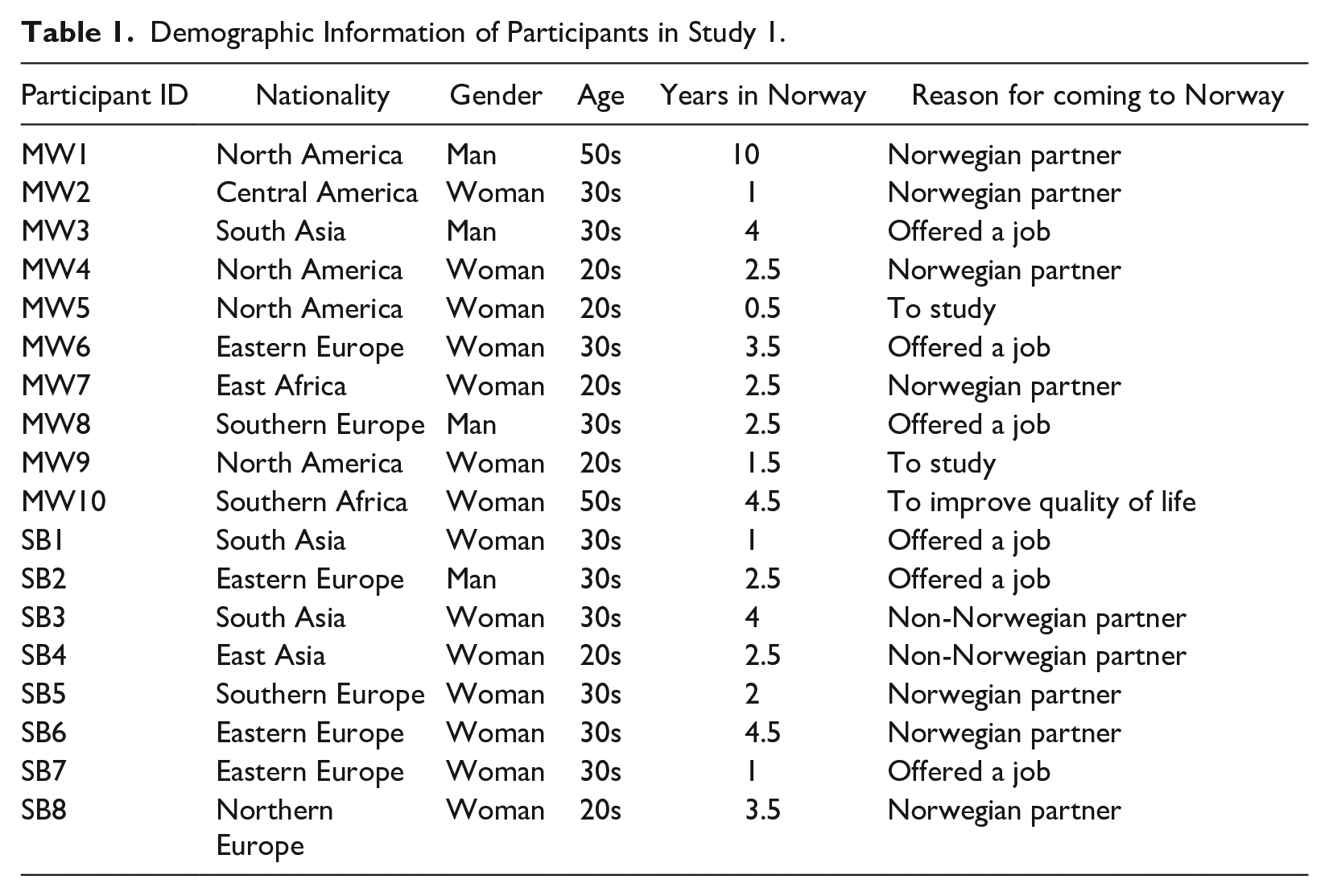
The interviewers recruited participants through an open invitation in a Facebook group for people new to Oslo. Due to the large response from this Facebook group, other recruitment channels were not necessary. Participants were told that the purpose of the study was to learn more about immigrants’ experiences with Norwegians and the Norwegian culture, and that we wished to interview immigrants in Norway who had lived in the country for 10 years or less. About 18 participants were interviewed, 14 women, mean age 38.6 (range from 20 to 54 years). See Table 1 for demographic information about each participant. We stopped recruiting new participants when no new types of kama muta instances were mentioned, and when the sample became diverse in regards to participants’ home country and reason for coming to Norway.
Demographic Information of Participants in Study 1.
Data Collection
All interviews were conducted in English and in public places such as cafés or restaurants. Written informed consent was obtained, and we asked participants not to disclose any identifying information during the interview (such as place of work or names of themselves or others). Interviews lasted 30 minutes to 1 hour, with an average of 45 minutes. All interviews were recorded and fully transcribed verbatim.
We developed a semi-structured interview guide (see Supplemental Material for the interview guide) with questions that reflected the two research questions: (1) In which situations have immigrants experienced kama muta due to a sudden closeness with Norway and/or Norwegians. (2) How those kama muta experiences were related to their acculturation?
The interview guide focused on situations in which participants had felt kama muta from suddenly feeling closer to Norway or Norwegians, and how those kama muta experiences had affected their acculturation to Norway. In order to make sure that participants understood what kind of events we wanted them to recall and talk about, we first asked participants two satellite questions; (1) What they consider to be typically Norwegian and (2) To describe the last time they felt moved. In order to gauge whether participants were describing kama muta experiences, follow-up questions regarding what bodily sensations they experienced, describing why they felt the emotion, and whether they were motivated to do anything special were asked. Additionally, if participants were talking about a negative emotional event when answering the second question (e.g., a friend’s grandfather dying) then they were asked to recall another moving event that was positive. Participants were not informed about the kama muta framework, but the interviewers were trained in asking follow-up questions that allowed us to determine whether participants were describing kama muta experiences. After this, interviewers would ask whether participants had experienced similar emotions they had just described due to something they considered to be Norwegian. When participants were describing kama muta events related to Norway, follow-up questions about bodily sensations and appraisals were asked. Importantly, interviewers also asked participants to reflect on how they thought the experience had affected them, and how it affected their lives in Norway. This part of the interview allowed us to construct relevant prompts for the second study that would tap into kama muta experiences focused on Norway or Norwegians. Additionally, we hoped that this part of the interview would also give us insight into how the acculturation process and kama muta experiences in Norway are related by shedding light on participants’ perceptions of being bicultural (BII), acculturative stressors, and their motivations to maintain their home culture, and adopt Norwegian culture practices, language, values, and identity.
The interview guide also included questions about participants’ general adjustment and acculturation to Norwegian culture. The data from these questions, along with the data from the second research question, were used to guide the selection of suitable items for the acculturation measure (i.e., home culture maintenance and host culture adoption) in Study 2. A complete presentation of the analysis and findings from these questions are presented in Supplemental Material.
Analysis
We used theory-driven thematic analysis by following the six steps of Braun and Clarke (2006) to analyze sections of the interview transcripts where participants talked about what we deemed to be kama muta experiences, using the qualitative software program NVivo. The goal of the study was to answer the following research questions: (1) Which situations elicited kama muta experiences from suddenly feeling closer with Norway and/or Norwegians? 2) How respondents perceived those kama muta experiences to be related to their acculturation? The categories were generated based on kama muta theory, acculturation dimensions, BII, and acculturative stress theory.
The coding scheme was developed using the following steps: First, the first and second authors read through the transcripts without coding in order to familiarize themselves with the interviews. Second, they then generated initial codes separately, and discussed the merits and drawbacks of their respective coding schemes. Third, based on their discussions, they jointly generated a new common coding scheme, and then separately coded all of the transcripts based on the new coding scheme. Fourth, the first and second author compared their coding based on the agreed-upon coding scheme and settled all inconsistencies in coding through discussion. Additionally, in this phase, the coding scheme was refined by collapsing earlier codes.
In the final coding scheme, we interpreted participants’ emotional experiences related to Norway or Norwegians by using the kama muta framework. Thus, we generated codes for their descriptions along the lines of the five kama muta components (appraisal, physical signs, positivity, motivation, and emotion words used to describe their feelings). Investigating the first research question, we divided the appraisal codes according to the types of CS intensification with Norway or Norwegians, thus generating suitable prompts asking about kama muta experiences in connection with Norway or Norwegians for the second quantitative study. Investigating the second research question, we generated the motivation codes into adoption of, respectively, Norwegian identity, practices, language, and values, and how participants combined their identities (i.e., bicultural identity integration). We indicated which type of CS intensification was associated with each type of motivation. Thus, the coding was hierarchical where the motivation codes were coded within each CS intensification with Norway or Norwegians code. This was in order to investigate whether specific CS intensifications had specific motivations, for example, whether CS intensification from observing Norwegian nature was associated with other motivations than CS intensification due to receiving help from Norwegians. As participants talked about negative experiences in Norway, we coded these within the acculturative stress framework. The first and second author developed the coding scheme, and the first author identified themes based on the codes. The themes were discussed with all authors, and with other experts in kama muta theory.
Results and Discussion
Kama muta Norway experiences
This section will present findings related to the first research question: Which situations elicited kama muta in connection with Norway for our participants. Seven kama muta Norway themes were identified (all of which were used as prompts in the quantitative study).
Receiving help
Some participants (MW5, MW6, SB1, SB3, SB4, and SB7) talked about events where they had felt kama muta from receiving help from Norwegians. Thus, Norwegians intensified their CS relationship with the participant by caring for them, which made participants feel kama muta. The people who helped them were either acquaintances or strangers. Interestingly, none of the participants who mentioned such kama muta experiences had a Norwegian partner.
“[T]he last time I was asking him about ski, and the skiing conditions. And from that question I just wanted to know how the skiing conditions are, and he offered to give me his wife’s shoes and skis. [. . .] But yeah I didn’t ask for it like, he offered all of these things, and I felt very welcome and encouraged to try.”
“Yeah. . . So what was it, why do you think you were moved by that?”
“It is because someone went I guess, what it seemed to me, out of their way a bit, to help someone enjoy some Norwegian traditions because we have been talking about skiing. . . Norwegians do that a lot.”
Developing a friendship/relationship
Some participants described events during which they felt kama muta from becoming closer to Norwegians. They either described events where they felt like they had developed friendships with Norwegians, or they developed closer ties with Norwegian in-laws. All but one (SB4) were from Europe or Northern America (MW4, MW5, MW6, MW9, and SB8).
“I think it was maybe when we were entrusted their dogs, to dog-sit their dogs. Because I know their dogs are like super important for them, so they were like “Okay, can you guys dog-sit?” Yeah, like “Of course”. I thought that was really so “Okay, they trust us”. That’s. . . I mean, that was a good feeling. Kind of they acknowledge us as trustful, yeah.”
Values
A bit over a half of the participants mentioned events where they felt kama muta from Norwegian values; they suddenly intensified their CS relationship with Norway when they noticed that their own values and the values they perceived to be Norwegian aligned. These participants differed in reasons for coming to Norway and country of origin. The values that participants mentioned were gay rights (SB5 and MW6), how children are valued (MW3), how the police treat people (MW10 and SB2), egalitarianism (MW2), trust (MW4 and SB7), being allowed to treat oneself to something nice (MW7), and being tolerant of other people’s decisions (SB4 and MW6).
Feeling one’s culture is welcome in Norway
Three participants (MW7, SB1, and SB8) described kama muta experiences in which their home culture was welcome in Norway. Thus, they felt that Norwegians intensified their CS relation with them by showing that they cared about their home culture. These participants differed in reasons for coming to Norway and country of origin. One participant mentioned that her father-in-law had learned English in order to talk with her:
“His dad did not speak any English at all. [. . .] A year later, I visited again over Christmas and he picked. . . he picked me and my husband up from the airport and he had a whole monologue prepared. It was like “Hey, it’s really good to see you. Welcome home. This and that, blah, blah, blah” and I’m standing there gob smacked. I was just like “Your dad is speaking English” and he was like “Oh yeah he spent all year learning” and I was just like “What?”. I still couldn’t speak a word of Norwegian apart from tusen takk and all the normal stuff and it was kind of like a repeat of the year before where we sat down and he could actually have a conversation with me and I felt so bad because I hadn’t learned any Norwegian, but he had gone out of his way in his 60 years of life to actually learn a new, like. . . something new. And I remember thinking to myself this is an old dog that just learned something new and that’s pretty amazing. That’s pretty fantastic and that was the first. . . like that was very moving to me, especially because I know Norwegians are very proud of their language.”
Another participant said that she felt kama muta due to seeing people from her home country celebrating on the streets in Oslo that their cricket team had won the world championship, which made her feel that her home culture was welcome and integrated in Norwegian society:
“So, it felt really good because there is celebrations happening all across the world but like we didn’t feel like we weren’t home. We felt like we belong, you know? That was nice.”
Achievements
Some participants recalled events that made them feel kama muta because of achieving something that they regarded as an accomplishment for their acculturation in Norway (MW1, MW2, MW9, and SB6). Some considered that Norwegians would now welcome and accept them more as part of their community, because certain accomplishments, such as hiking and skiing, are valued highly in Norway. Some intensified themselves their CS with Norway as a result of accomplishing an activity they consider to be typically Norwegian. Participants recalling such kama muta events all had Norwegian partners and were from Northern America or Europe. Some of these participants related their achievement to how it contributes to their feeling of having accomplished something that is perceived as an activity that most Norwegians take part in:
“And not only was the nature amazing, but. . . but to push myself and complete it [hiking Besseggen] was a feeling of achievement. Especially when Norwegians will tick this off or check it off as something to do in Norway.”
Other participants related their sense of achievement to being able to take part in Norwegian society by knowing the language, which then contributed to their getting a job:
“Yeah, like excitement, and this feeling of like accomplishment in some way. Like it was definitely one of the goals that I had was just to complete an interview in Norwegian, and I had. . . like I was really surprised when I ended up getting the job.”
Nature
Many participants experienced kama muta from Norwegian nature (MW2, MW6, MW8, MW9, MW10, SB1, and SB2). That is, the CS intensification consisted of feeling one with Norwegian nature (Petersen et al., 2019; Petersen & Martin, 2021). Participants differed in country of origin, but all participants except for one (MW2) did not have a Norwegian partner. They talked about the vastness of Norwegian nature or the cold climate and the geographical position of Norway, which differ from their home country.
Celebrations and traditions
Lastly, participants talked about experiences where they felt kama muta from participating in celebrations or traditions in Norway, as these events made them intensify their CS relation with Norway either because they saw similarities between their home country and Norway (SB7), or because the events made them understand Norwegian culture (MW9, MW10, and SB5). Participants recalling such events were heterogenous in their country of origin and reason for coming to Norway. Illustrative quotes of each type of kama muta event in connection with Norwegian traditions or celebrations are presented below:
“They’re all wearing their bunads, their Norwegian national dress. And then they have a banner, you know, for their school, and they dance, play, and everybody is happy, waving their flags, and they walk through the town and all the schools of the town are doing that. And when I saw my two kids’ school going through, and their teachers, and waving, you know, I had a real sense of belonging [. . .] And. . . and I think of it, the language before I came here, and I knew nothing about it. And then just suddenly under quite sort of challenging circumstances, suddenly I think ‘Ahh.. I really like, I can understand what these traditions are about.’”
“One of our colleagues brought some almond cake, that his grandma makes. [. . .] And just the fact that this grandma made a cake for him to bring it to work. I thought that was very sweet, and I related it to something that my grandma would do for example. And I felt very connected and. . . Yeah they are different, they have their own traditions, but we are kind of the same.”
Summary
A variety of kama muta Norway experiences were mentioned from a diverse group of participants. Indeed, some kama muta experiences were experienced by a homogenous group of participants (e.g., receiving help), whereas other kama muta experiences were experienced by a heterogenous group of participants (e.g., nature). However, by including all these themes in the prompts in a composite measure of kama muta Norway experiences we think we will be able to tap into kama muta Norway experiences from a diverse group of immigrants in the quantitative study.
How kama muta is related to participants’ acculturation
This section will present results answering the second research question: How are participants’ kama muta experiences related to their acculturation? A substantial number of participants related their kama muta experiences to a motivation to stay in Norway, and motivation to adopt Norwegian practices, language, values, and identity. Some participants also talked about what we interpreted as them relating their bicultural experience (i.e., their bicultural identity integration, Huynh et al., 2018) and acculturative stress, which will also be presented below. These results were used to select relevant variables and to formulate hypotheses regarding these variables for the quantitative study.
Motivation to stay in Norway
Three participants, experiencing kama muta from Norwegian values, achievements, or receiving help related these experiences to wanting to stay in Norway (MW6, SB1, and SB6):
“So, how do you think that affected your stay in Norway?”
“I think it made me like Norway more. Yeah. . . yeah, absolutely. I think it was the moment when I thought “Yeah, I’m ok with. . . I’m. . . I like it being here. I could see myself even having a family here”. Just because of the values, yeah, this freedom, and tolerance, democracy.”
Thus, we predict in the quantitative study that kama muta Norway experiences will be positively related with immigrants’ motivation to stay in Norway.
Adopt Norwegian culture
Participants related their kama muta experiences to the practices, language, values, and identity dimensions of acculturation (Schwartz et al., 2010). With regard to the practices dimension, a subset of participants had experienced kama muta in connection with nature, values, developing friendships, or receiving help; they frequently talked about how these experiences made them either understand, adopt, or accept Norwegian practices (i.e., friendships, traditions, and activities; MW2, MW6, SB5, SB7, and SB8). For example, because SB7 felt kama muta from receiving help from a colleague it motivated her to develop friendships with Norwegians:
“You think you would have been any different if you hadn’t gotten that help?”
“Yeah, I believe so. It would’ve been harder, because I am a reserved person as well, and I wouldn’t try to get close to people if they are also like this, you know. That’s why I was super grateful that he was proactive.”
Other participants who had felt kama muta when receiving help, from developing a relationship, or feeling that their culture is welcome in Norway talked about how these experiences motivated them to learn Norwegian (MW5, MW7, and SB3). MW7, who felt kama muta from her father-in-law learning English in order to communicate with her, said that this motivated her to make an effort to learn Norwegian:
“[I]t was definitely the thing that kind of pushed me in the right direction to where I am today, and trying. . . and, you know, in my relationship, and learning Norwegian, and about the culture, and language, and everything like that.”
Some participants who had experienced kama muta from Norwegian values talked about how these experiences made them adopt the values that evoked kama muta (SB2 and SB4). SB4 felt kama muta from the respect Norwegians have for other people’s choices, which made her respect her husband’s choices:
“Do you think that changes your way of being with other people here in Norway? [. . .] do you feel that you are less judgmental towards them?”
“Yeah. Also, in the beginning I just wanted my husband because my husband is not so social. So I wanted to push him to go outside to have a social network in Norway. But now I just don’t do this I just respect it. I just say it once “oh, maybe it is better if you are more social”, but just one sentence. No more.”
“Wow.”
“So I respect him.”
Regarding the last dimension of acculturation, identification, participants talked about how Norwegian values or celebrations made them feel proud of Norway (MW6, MW10, and SB5). For example,
“[Y]ou know, I got this understanding, that sense of pride, that I’m sort of a part of it, you know? And yeah, I feel very lucky. Actually, I can say, I feel as if I won the lottery of life, because I’ve ended up here.”
In sum, these results show that many participants related their kama muta experience to a motivation to adopt different dimensions of Norwegian culture. We also included a secondary hypothesis predicting that kama muta Norway experiences and motivation to maintain one’s home culture will be positively related. This was included to order to assess the whole acculturation experience of participants. We predicted a positive relation because some of the kama muta Norway experiences tapped into feelings of their home culture being welcome.
Bicultural identity integration
As we mentioned above, bicultural identities can be organized along a harmonious versus conflictual dimension and a blended versus compartmentalized dimension (Huynh et al., 2018). Our findings provide some support for the conclusion that kama muta experiences are related to a harmonious bicultural identity. SB7 talked about how her feeling kama muta from finding similarities between her home culture and Norwegian culture made her feel that her home culture and Norwegian culture are the same:
“But if you take that example with the cake thing, do you think that that experience has affected you in some way?”
“Yeah, like I said it made me connect with them beyond. . . because usually like. Initially when I came here I could only see differences and differences and then almost like this make you feel like we are the same. Or I would make associations of this kind with other traditions that they have. I can’t remember right now, but I know that I keep trying to link things, what they do with how we do it back home. And it makes me feel like we are the same at some level.”
Furthermore, our findings indicate that two participants have compartmentalized identities: they don’t regard themselves as Norwegian, but still feels belongingness in Norway and harmony between their two cultures (SB1 and SB8). For example, SB8 felt that her culture was welcome in Norway, evoking kama muta, which she related to feelings of belonging in Norway even though she did not consider herself as Norwegian:
“But do you feel included in that kind of pride that they have? That you can feel that pride, and you can share it with them?”
“I do feel that yeah, yeah, yeah, for sure it’s not like in me, and I’m not, and like I said, I am not going to say it is in me, but I do feel (thinks). . . I do feel I am part of it. I don’t feel an outsider.”
Thus, since some participants expressed a sense of belonging and harmony between their cultures when describing their kama muta experiences we predict that kama muta Norway experiences and having a harmonious bicultural identity is positively correlated.
Our findings also indicate that feeling kama muta in connection with Norway can be related to having a blended bicultural identity: MW7 had felt kama muta from her father-in-law learning English in order to communicate with her, which had motivated her to adopt Norwegian practices and language. Later in the interview she talked about how her home culture and Norwegian identities are blended, and related this to her speaking Norwegian at home:
“So, I do consider [East Africa] my culture. I find myself recently saying ‘we’ a lot when I talk about Norwegians, so like ‘In Norway, WE do this’ and I’m just like ‘Crap [name], you are [East African], come on!’ (laughs) So, I’m definitely. . . we call it “Norwenglish” because when we’re at home we speak Norwegian and English but I am. . . I am definitely [East African]-Norwegian at this point.”
Thus, we included a secondary hypothesis where we predict that kama muta Norway experiences is positively correlated with a blended bicultural identity.
Acculturative stress
Lastly, our findings also indicated that acculturative stress might be negatively related to experiencing kama muta in connection with Norway. For example, SB1 said she feels judged for not knowing Norwegian and felt that she was being excluded from conversations because she does not speak Norwegian, further saying “so that does negatively affect you.” Another participant (SB3) related her living in a multicultural environment, thus experiencing low level of acculturative stress, with why she had experienced many kama muta evoking events:
“Yeah, is there anything specific that you like about being in the city?”
“Yeah it is very cosmopolitan. You meet people from all kind of backgrounds, all kind of. . . From different countries. They are like, you know people, they are Italian, Spanish and they are married to Norwegians here. So you have this multicultural thing. And they are very open. The Norwegians I have become friends with over here, they have all studied abroad in America or England. And they are Norwegians, white Norwegians. But because they have studied in different countries and they have worked in different countries, they are very open towards people from other countries.”
Relatedly, other participants (MW6 and MW8) related that their kama muta experiences to Norwegian values or nature compensated for the negative aspects of living in Norway:
“But it was mainly my own, kind of. . . my. . . like an internal motivation to. . . (thinks) Maybe just trying to forget all the. . . like the negative parts, aspects, of living up here. As I said before, this, kind of, distance and like people really, yeah, trying to keep distance from you. So, just, yeah, to try to forget about that and just accept them as they are because I like other aspects of, of the society, yeah. I think that was my, kind of my, internal (laughs). . . it was sort of an internal conversation and analysis of kind of what. . . what I value here. What I think is great about here, so yeah.”
The results presented above indicate that experiencing acculturative stress can negatively affect immigrants’ feeling kama muta in connection with Norway. In addition, the results also indicate that feeling kama muta in connection with Norway is related to having fewer acculturative stressors, and a motivation to look past acculturative stressors. Thus, we predict that acculturative stress and kama muta Norway experiences are negatively correlated.
Study 2
Based on the qualitative findings of Study 1, we developed prompts and hypotheses for the quantitative Study 2. The following pre-registered hypotheses were based on the findings of Study 12:
H1: Kama muta Norway experiences are positively correlated with adoption of Norwegian identity, values, language, and practices.
H2: Kama muta Norway experiences are positively correlated with motivation to stay in Norway.
H3: Kama muta Norway experiences are positively correlated with the harmony subcomponent of the bicultural identity integration scale.
H4: Kama muta Norway experiences are negatively correlated with acculturative stress.
We also pre-registered two secondary hypotheses.
H5: Kama muta Norway experiences are positively correlated with the blendedness subcomponent of the bicultural identity integration scale.
H6: Kama muta Norway experiences are positively correlated with maintenance of home culture identity, values, language, and practices.
This study was pre-registered (https://osf.io/gf428) and all data and codes are uploaded on OSF (https://osf.io/q82fc/).
Method
Participants
We recruited participants through our own social networks (friends, colleagues, and acquaintances) and snowballing, asking for people who were born in a country other than Norway and who had not lived in Norway for more than 10 years. Our sample size was limited to what our funding could cover in compensation for participation, which was 150 movie vouchers. In order to receive a movie voucher, participants had to provide their e-mail address in a separate questionnaire, since we emailed the vouchers. Some participants (N = 12) did not provide their e-mail address. We excluded responses from our analyses based on the following pre-registered criteria: Participants who had lived in Norway for longer than 10 years (N = 9), or had spent less than 4 minutes on the survey (N = 3). Furthermore, we also excluded responses who had missing values on over 20% of the cases (N = 4), and we excluded persons who had reported that they came to Norway as a refugee or asylum seeker (N = 3), which our ethics clearance did not cover. We also excluded one inattentive participant who had zero response variance. Therefore, we included N = 142 participants in our analyses. See Table 2 for demographic information of the participants.
Demographic Information of Participants in Study 2.
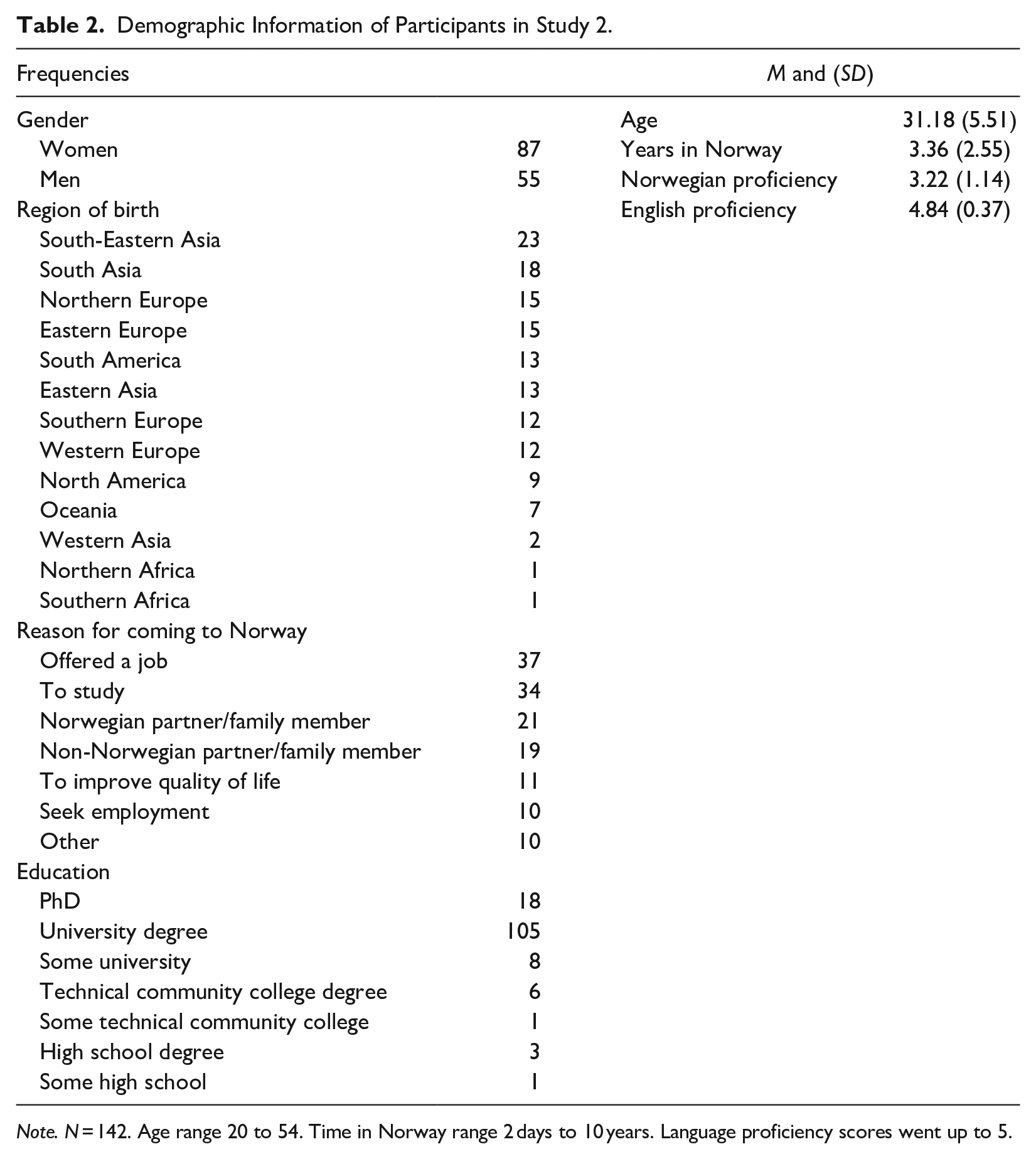
Note. N = 142. Age range 20 to 54. Time in Norway range 2 days to 10 years. Language proficiency scores went up to 5.
Measures
The questionnaire was given in English and Norwegian. A back-translation method was used to translate the English questionnaire into Norwegian. Most participants chose to respond to the English version (N = 129, English proficiency for those who answered the English survey M = 4.86, SD = 0.33), and 13 participants chose the Norwegian version (Norwegian proficiency for those who answered the Norwegian survey M = 4.65, SD = 0.35).
Language proficiency
Norwegian and English proficiency was from the MIRIPS questionnaire (Berry, 2017) in which participants were asked to rate their ability to understand, speak, read, and write Norwegian (α = .96, M = 3.22, SD = 1.14) and English (α = .96, M = 4.84, SD = 0.37) using a 5-point scale, from 1 (not at all) to 5 (very well).
Acculturation stress
Participants responded to the Riverside Acculturation Stress Inventory (RASI; M. J. Miller et al., 2011), whose subscales measure acculturative stress related to work, language, intercultural relations, discrimination, and cultural isolation. This scale is comprised of 15 items (α = .86, M = 2.25, SD = 1.10), all measured on a 7-point scale from 0 (strongly disagree) to 6 (strongly agree).
Kama muta Norway experiences
The composite score of kama muta Norway experiences consisted of (1) frequency measures of the seven kama muta Norway prompts developed based on the findings of Study 1 and (2) the intensity of the kama muta experience assessed through the Kama Muta Multiplex Scale—Short (i.e., KAMMUS-S, a short version of the cross-culturally validated, multi-component measure of kama muta, see Zickfeld et al., 2019).
We wrote prompts assessing CS intensification which were based on the events that participants in Study 1 had experienced, where each prompt assessed one theme found in the interviews in Study 1. An instruction text was presented to participants: “Here we would like to know about your positive emotional experiences in Norway. We are interested in both strong and not so strong emotional experiences. We are also interested in experiences or people who you consider Norwegian, or that you think reflect Norway.” The following seven prompts were then presented: (1) Being moved or touched by receiving help by someone Norwegian or a Norwegian organization, (2) . . .developing a friendship/relationship with someone Norwegian, (3) . . .Norwegian values (by values we mean common ideals or beliefs), (4) . . .feeling that your home culture is welcome in Norwegian society, (5) Feeling closer to Norway because of achieving something that makes you have something in common with Norwegians, (6) . . .because of Norwegian nature, and (7) . . .by taking part in Norwegian traditions or celebrations. Participants were asked to indicate how often they have experienced each event (i.e., the frequency of each prompt) using a 5-point scale (0—never, 1—once or twice, 2—a few times, 3—sometimes, and 4—many times). Participants also responded to a question asking with whom they had experienced the first (receiving help) and second (developing a friendship/relationship) event (see Table S1 in Supplemental Material).
Following this, participants were asked to fill out the KAMMUS-S for each prompt which they had indicated that they had experienced once or more (i.e., indicating the intensity of kama muta experienced by each prompt). The KAMMUS-S measures the following components of kama muta: Physical signs (five items: tears; chills or shivers; a warm feeling in the center of the chest; choked up; and refreshed, energized, or exhilarated); appraisals (two items: I felt an extraordinary feeling of being welcomed in Norway, I felt an exceptional sense of closeness with Norway appear); valence (I had positive feelings); and labels (two items: I was moved, and I was touched). All items were measured using a 7-point Likert scale from 0—Not at all to 6—A lot. Participants were also asked if they thought about a specific event or a combination of events when answering the KAMMUS-S for each prompt. See Table 3 for means, standard deviations, and reliabilities for each component of kama muta answered in reference to each prompt, and for frequencies of whether participants answered the KAMMUS-S with a specific event or a combination of events in mind.
Means, (Standard Deviations), and [Reliabilities] for Each Kama Muta Component and All Components Combined, and Frequency of Type of Situation Remembered.
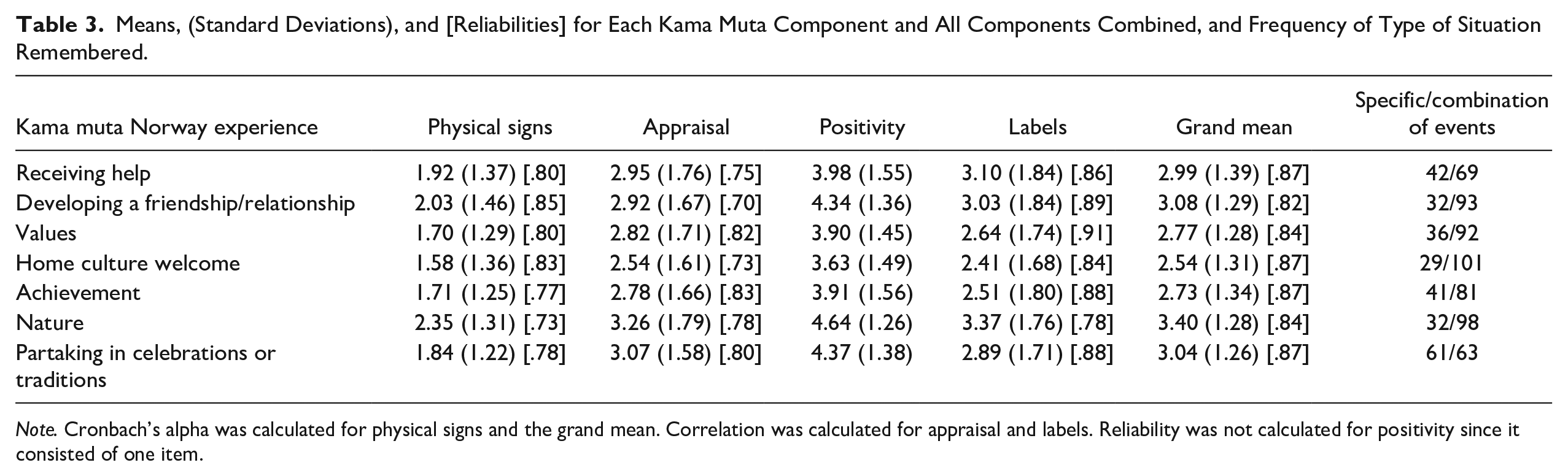
Note. Cronbach’s alpha was calculated for physical signs and the grand mean. Correlation was calculated for appraisal and labels. Reliability was not calculated for positivity since it consisted of one item.
As pre-registered, a composite score of kama muta Norway experiences was calculated by first making a grand mean of the intensity of kama muta experienced for each prompt from the mean scores of the four kama muta components (i.e., physical signs, appraisals, valence, and labels), then multiplying this by the ordinal frequency measure (i.e., how often they had experienced each kama muta Norway event on a scale from 0 to 4). These kama muta intensity x frequency scores for each prompt were then added together, and divided by 10 (in order to have approximately similar variance with the other measures). Values of the kama muta Norway scale ranged between 0.08 and 14.75 (M = 4.73, SD = 2.99).
Although not pre-registered, a Confirmatory Factor Analysis was conducted using Mplus 8 (Muthén & Muthén, 2017) where the seven kama muta intensity x frequency scores was estimated to load onto one kama muta Norway factor. This was in order to assess whether the seven events of CS intensification with Norway or Norwegians and their corresponding kama muta ratings is explained by one latent factor. The model was identified and showed good model fit χ2(14) = 19.34, p = .152, RMSEA (90% CI) = 0.052 [0.00, 0.103], CFI = 0.99, SRMR = 0.031. Factor loadings ranged from 0.54 (kama muta intensity x frequency composite score for nature prompt) to 0.82 (kama muta intensity × frequency composite score for achievement prompt), and all were statistically significant. Cronbach’s α value for the seven kama muta intensity × frequency items was .87, indicating very good internal reliability.
Acculturation
An acculturation scale assessing the motivation to maintain one’s home culture and adopt Norwegian culture along the four dimensions of acculturation (practices, language, values, and identity; Schwartz et al., 2010) was developed. The items were constructed based on the qualitative results of Study 1 and on existing measures. In our interviews for Study 1, in addition to asking participants to reflect on how they thought their kama muta experiences affected their acculturation, we had also asked them to reflect on their acculturation in general. The results of our thematic analysis regarding this question are presented in Supplemental Material. In assessing participants’ general acculturation, we asked them how their home culture is present in their daily lives and how they see their future in Norway. We coded participants’ descriptions of their general acculturation along the lines of Schwartz et al.’s (2010) dimensions of acculturation theory (see Supplemental Material for further details). In the development of the acculturation measure we looked at the qualitative data from Study 1 and searched the literature for measures that assess the same aspects of acculturation that the participants in Study 1 had talked about. Items assessing practices and identification were from existing measures, and the items assessing language and values were developed for this study as we did not find suitable existing measures. The items of the acculturation measure are presented in Table 4.
Principal Component Analysis for Home Country Maintenance and Norway Adoption Measures.
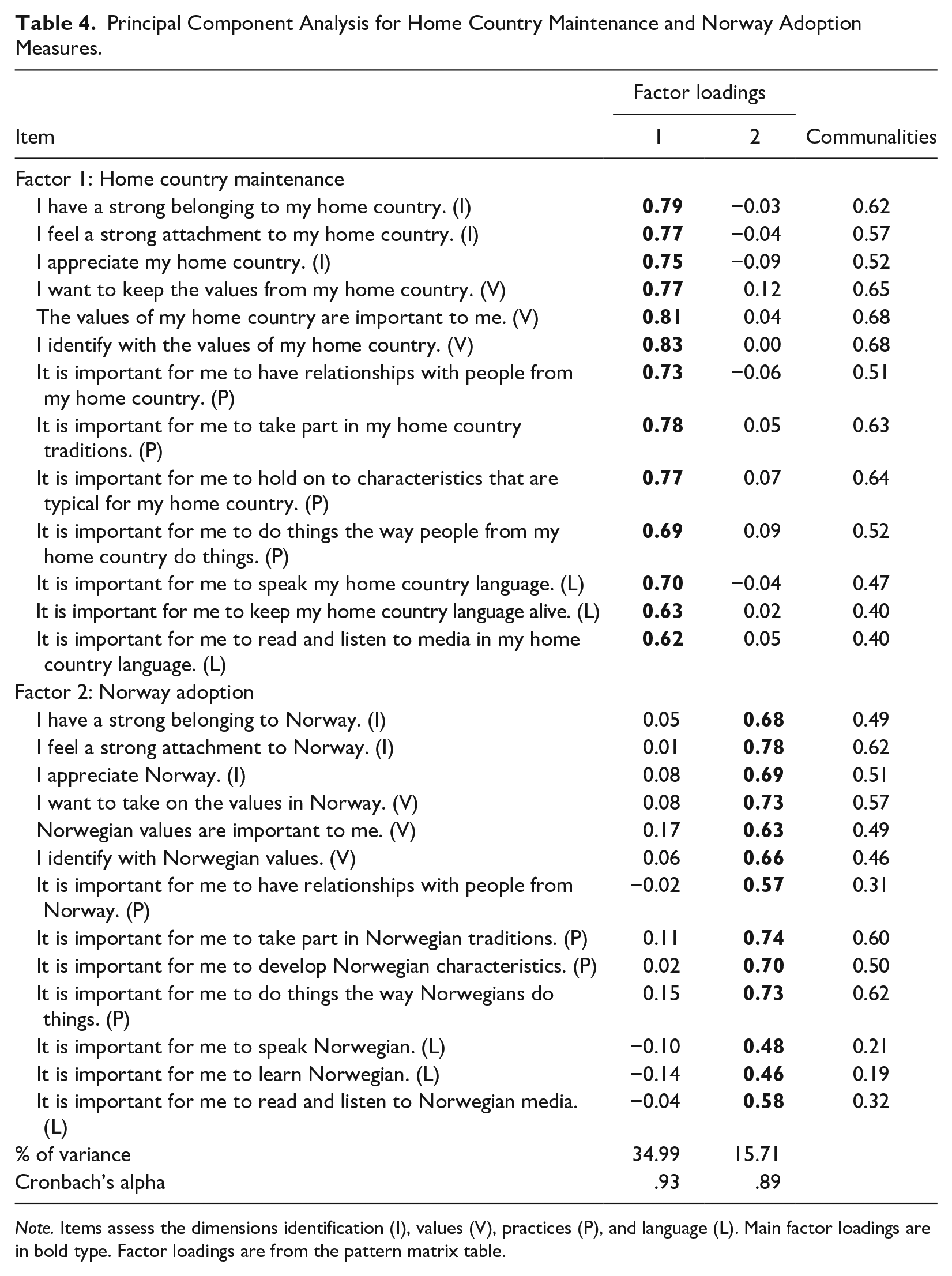
Note. Items assess the dimensions identification (I), values (V), practices (P), and language (L). Main factor loadings are in bold type. Factor loadings are from the pattern matrix table.
The practices items were from Demes and Geeraert’s (2014) Brief Acculturation Orientation Scale, as participants talked about their home culture and Norwegian relationships, traditions, activities, and characteristics, which this scale assesses. The identification items were from the commitment subscale of Phinney and Ong’s (2007) identity measure, as participants talked about their attachment and belonging to their home culture and Norway. The identification items asking about their appreciation of Norway and their home country were developed for this study. This was because participants talked about valuing and feeling proud of Norway and their home country. Items assessing motivation to maintain home culture language were developed for this study and were based on participants talking about how they found it important to speak their home culture language to their kids and expose them to their home country media in order to keep their home country language alive. Motivation to adopt Norwegian language items were developed for this study and were based on participants saying that learning Norwegian was very important for them. The values items were developed for this study and were based on participants saying that they would like to keep some of their home culture values and adopt some Norwegian values. In addition, they talked about how their home country values are important to them.
A PCA (Oblimin rotation) was conducted in SPSS 25 to make composite scores of the acculturation items. Three factors were initially extracted based on the Scree plot and parallel analysis (overall explained variance: 59.6%). Factor 1, “Home country maintenance,” comprised of 13 items; factor 2, “Adoption of Norwegian identity, values, and practices,” comprised of 10 items; and factor 3, “Adoption of Norwegian language,” comprised of three items. However, since it is theoretically more coherent to include all components into a Norwegian culture adoption scale, and since none of the Norway adoption items pulled down the Cronbach’s alpha, we decided to make composite scores of Norwegian culture adoption (α = .89, M = 3.93, SD = 1.04) and home-culture maintenance (α = .93, M = 3.84, SD = 1.29), both measured on a 7-point scale from 0 (strongly disagree) to 6 (strongly agree).
This decision was further supported by a PCA analysis (Oblimin rotation) where a two-factor solution was requested. The items measuring home country maintenance loaded on one factor, and items measuring Norway adoption loaded on another factor (overall explained variance: 50.7%). The KMO measure of sampling adequacy was .86, which indicates good sampling adequacy (Howard, 2016). See Table 4 for factor loadings and communalities of this two-factor structure.
Stay in Norway
Motivation to stay in Norway was measured using a 4-item measure on a 7-point Likert scale (0—Strongly disagree to 6—Strongly agree) developed for this study. The items were: “I would like to build a life in Norway,” “If it were up to me I would stay in Norway,” “If I had the opportunity I would leave Norway” (reverse scored), “I cannot see myself having a future in Norway” (reverse scored). A PCA with Oblimin rotation extracted one factor (70.33% of variance explained), and the KMO measure of sampling adequacy was .75, which indicates adequate sampling adequacy (Howard, 2016). Factor loadings were between 0.75 and 0.91. A composite measure of all four items was therefore made (α = .85, M = 4.06, SD = 1.56).
Bicultural identity integration
The Bicultural Identity Integration Scale—Version 2 (BIIS-2; Huynh et al., 2018) which measures bicultural identity through two components, harmony and blendedness, was used. This scale is comprised of 17 items, all measured on a 7-point scale from 0 (strongly disagree) to 6 (strongly agree). An item from the blendedness subscale “I cannot ignore the side of me that is from my home country or that is from Norway” was deleted as this item brought the Cronbach’s alpha down (from .74 to .71). Therefore, six of the blendedness items were averaged into a blendedness score (α = .74 M = 3.35, SD = 1.22), and a composite measure with the 10 harmony items was made (α = .89, M = 3.91, SD = 1.29).
Our dataset contained a small proportion of missing values, 0.44%. Little’s MCAR test indicates that the values were missing at random (χ2 = 850.74, df = 805, p = .128). Missing values were thus imputed using the EM estimation procedure in SPSS 25.
Results and Discussion
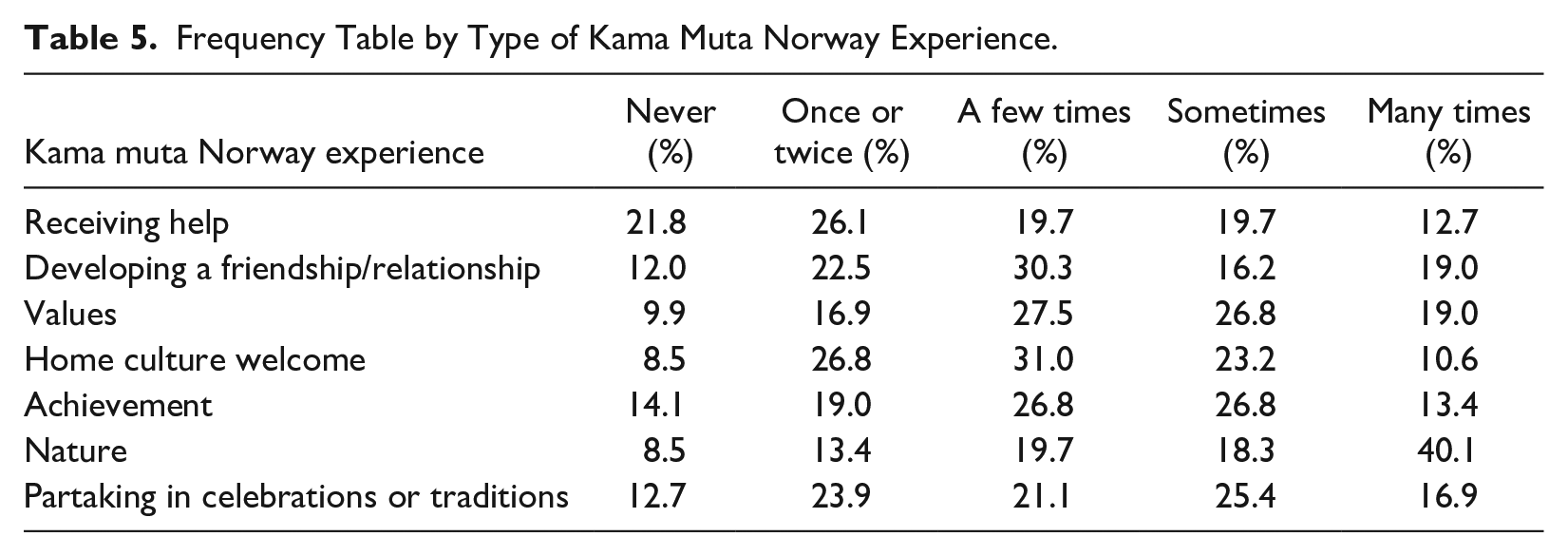
We first investigated the frequency and intensity of each kama muta Norway experience. As seen in Table 3, most participants based their ratings of kama muta on a combination of events. We calculated the number of kama muta Norway experiences each participant had experienced, half of the participants (50.7%) had experienced all seven kama muta Norway experiences, followed by six (26.1%), five (14.1%), four and three (4.2% each), and two (0.7%, i.e., one participant). As seen in Table 5, the kama muta Norway events most participants had experienced were nature in Norway (where 40.1% of participants had experienced this many times), and feeling that their home culture is welcome in Norway.
Frequency Table by Type of Kama Muta Norway Experience.
The test of hypotheses are presented in the correlation matrix in Table 6. H1 was supported as kama muta Norway experiences was positively correlated with motivation to adopt Norwegian culture. Motivation to stay in Norway was also positively correlated with kama muta Norway experiences, supporting H2. The hypothesis predicting correlation between kama muta Norway experiences and having a harmonious bicultural identity (H3) was not supported. However, H4 was supported where kama muta Norway experiences were negatively correlated with acculturative stress. Furthermore, the secondary hypotheses H5 and H6 were supported where kama muta Norway experiences were positively related with having a blended bicultural identity (H5) and motivation to maintain one’s home culture (H6).
Correlation Matrix for Kama Muta Norway Experiences and Acculturation Variables (Upper Half), and Correlations Between Demographic Variables, Kama Muta Norway Experiences and Acculturation Variables (Lower Half).
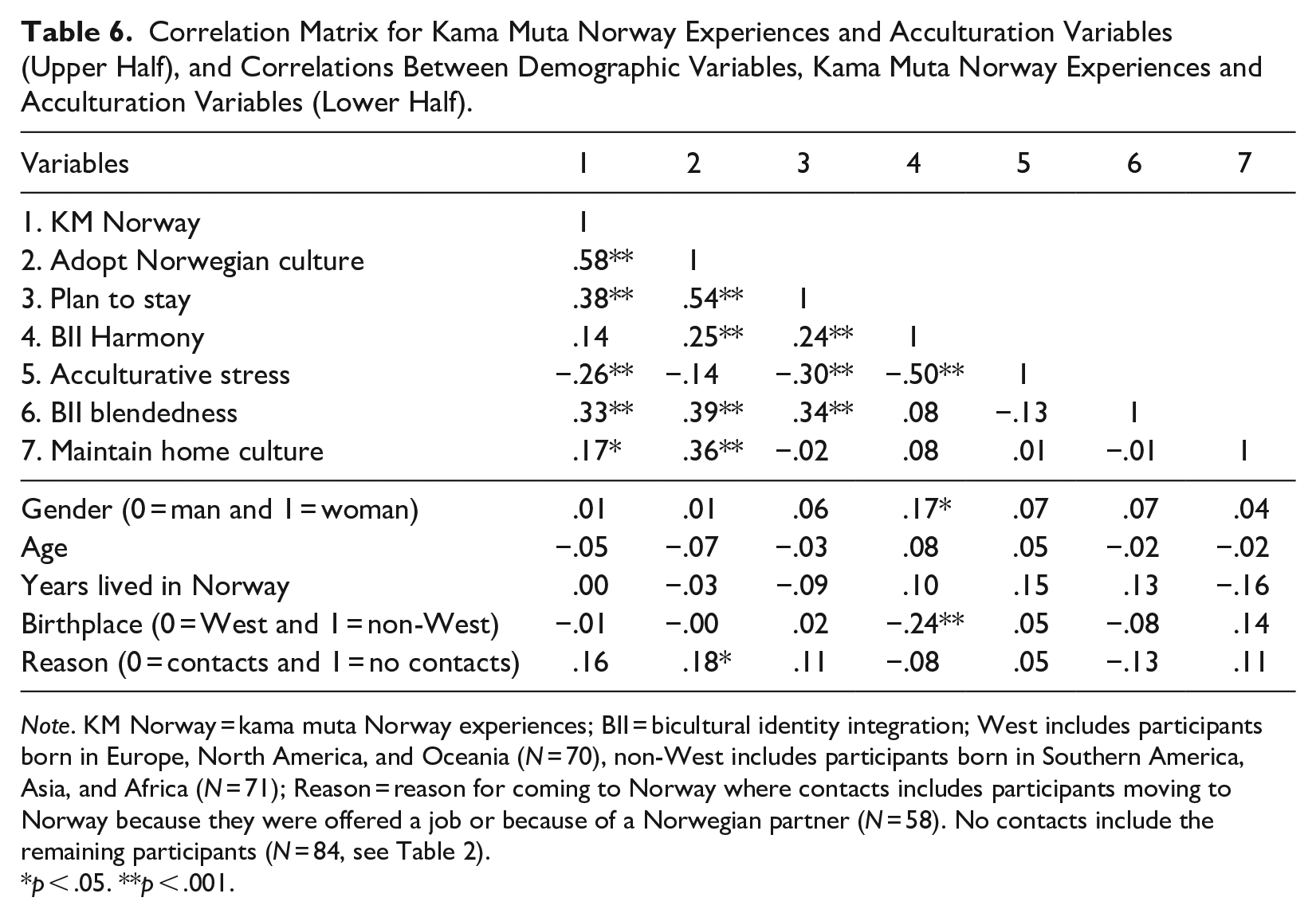
Note. KM Norway = kama muta Norway experiences; BII = bicultural identity integration; West includes participants born in Europe, North America, and Oceania (N = 70), non-West includes participants born in Southern America, Asia, and Africa (N = 71); Reason = reason for coming to Norway where contacts includes participants moving to Norway because they were offered a job or because of a Norwegian partner (N = 58). No contacts include the remaining participants (N = 84, see Table 2).
p < .05. **p < .001.
As seen in Table 6, many of the pairs of variables pertaining to our hypotheses correlated, making it important to assess the unique association between kama muta Norway experiences and acculturation variables. Thus, we conducted a multiple regression analysis with kama muta Norway experiences as the DV and motivation to adopt Norwegian culture, stay in Norway, BII harmony, acculturative stress, BII blendedness, and motivation to maintain one’s home culture as IVs. The assumptions of linearity and normal distribution of residuals were met. A summary of the multiple regression model is presented in Table 7. The overall model was significant, F(6, 135) = 14.44, p < .001, R2 = .39. The regression model showed that when controlling for the other variables pertaining to the hypotheses, just two variables were significantly related with kama muta Norway experiences; motivation to adopt Norwegian culture (b = 1.53 [1.00, 2.07], β = .53, t(135) = 5.66, p < .001) and acculturative stress (b = −0.62 [−1.05, −0.19], β = −.23, t(135) = −2.87, p = .005). Thus, motivation to adopt Norwegian culture and acculturative stress were the only variables that were uniquely related with kama muta Norway experiences. The unique association between kama muta Norway and host culture adoption could be because blended bicultural identification has shown to be related to language proficiency and sociocultural adaptation (Huynh et al., 2018). Similarly, in previous studies motivation to stay was found to be related to adoption of host country language (Wilson et al., 2017) and identification with the host country (Amit & Bar-Lev, 2015; Kilpatrick et al., 2015). It seems that participants’ motivation to become more involved in Norwegian culture, rather than viewing themselves as bicultural and their future plans of staying in Norway, is related with kama muta Norway experiences. The unique association between kama muta Norway and acculturative stress indicates that contextual stressors are negatively related with the amount and strength of kama muta Norway experiences.
Summary of Multiple Regression Analysis With Kama Muta Norway Experiences as the Dependent Variable.
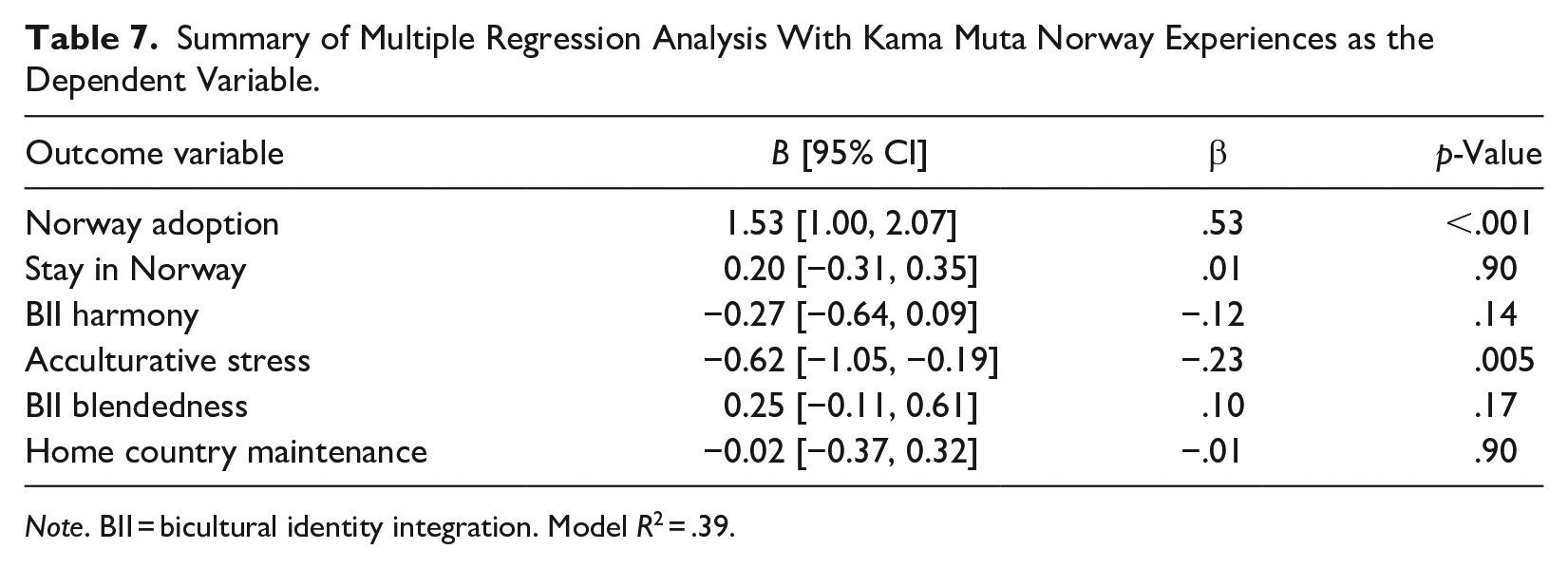
Note. BII = bicultural identity integration. Model R2 = .39.
Kama muta Norway experiences were not correlated with any of the demographic variables or reason for coming to Norway (see the bottom rows of Table 6). Thus, the results appear to be quite general.
General Discussion
In two studies, we examined how feeling kama muta in connection with Norway or Norwegians is related to immigrants’ acculturation to Norway. In Study 1, we investigated which situations with Norwegians or Norway evoked kama muta among immigrants and how this was related to their acculturation to Norway. In Study 2, we tested how kama muta in connection with Norway and Norwegians was quantitatively associated with immigrants’ acculturation. Study 1 indicated that what we interpreted as participants’ kama muta experiences consisted of positive contact with Norwegians (receiving help, developing a friendship, and feeling one’s culture is welcome in Norway), instances of adapting to the Norwegian culture (achievements and celebrations and traditions), as well as appreciating aspects considered to be Norwegian (values and nature). Furthermore, participants indicated that these kama muta experiences motivated them to adopt Norwegian practices, language, values, and identity.
In Study 2, we statistically corroborated these results, showing a moderate correlation between kama muta Norway experiences, operationalized through the categories obtained from Study 1, and motivation to adopt Norwegian culture. This association remained statistically significant when controlling for the other variables assessed in Study 2. These findings contribute to the understanding of how immigrants’ emotions are related to their acculturation, an under-researched, but important, topic.
Study 1 also showed that participants talked about how acculturative stressors were related to what we interpreted as their kama muta experiences, and Study 2 confirmed that acculturative stress and kama muta Norway experiences were negatively correlated, even when controlling for other variables. Thus, kama muta Norway experiences evidently reduce the stresses of limited language skills, work problems, intercultural relations, discrimination, and cultural isolation.
One possible interpretation of our results is that feeling kama muta in connection with Norway is an indicator of successfully adapting to Norway, as seen in some of the descriptions of kama muta Norway events (e.g., achievements and developing friendships with Norwegians) in Study 1. By the same interpretation, it could be argued that kama muta Norway is an indicator of overall psychological well-being, as seen in the negative correlation between kama muta and acculturative stress (which is related with anxiety and depression, M. J. Miller et al., 2011). However, we argue that kama muta experiences in connection with Norway contribute to enhancing psychological well-being and sociocultural adaptation to Norway. This is consistent with studies showing that kama muta experiences have the motivational effect of increasing commitment to communal sharing relations (Blomster Lyshol et al., 2020; Zickfeld, 2015). Indeed, participants related what we interpreted as kama muta to an increased motivation to enhance their CS relationship with Norway, making them want to learn Norwegian, adopt Norwegian practices, and develop friendships with Norwegians. Furthermore, the qualitative results indicate that kama muta can have an effect on psychological well-being, focusing their attention on the positive aspects of living in Norway. The results of Study 2 further corroborate this interpretation, as a measure of number and intensity of past kama muta experiences predicted present acculturation. However, given that we cannot exclude memory biases with the present design, future studies should directly test the direction of the relationships between kama muta, well-being, and sociocultural adaption, preferably with a longitudinal or experimental design.
Our study responded to a call for more research into the process of acculturation (Ward, 2008) and for more open exploration of the experience of immigrants (Chirkov, 2009) by examining the role of one particular emotion, kama muta, in that process. While previous research has mainly addressed this process by investigating the strategies and events involved, we suggest that many factors fostering host culture adoption are characterized by positive emotional experiences, an important one of these being kama muta. For example, Barker (2015) concluded that “the acculturation process is primarily influenced by the depth of social interaction with host-country nationals, including meaningful friendships and career opportunities, which provide social acceptance and a sense of host-culture belonging.” Deep social interactions, friendship, acceptance, and belonging are typical elicitors of kama muta, the warm feeling of increasing connection and closeness to others. By systematically exploring the many ways in which kama muta can be elicited regarding the host culture, our studies contribute to extending the range of experiences considered potentially relevant for the acculturation process, and also contributes to kama muta research by specifying the concrete elicitors of kama muta in a context that is relevant for large and increasing numbers of people: migration to a different culture.
Relational models theory (Fiske, 2004) was originally formulated regarding interpersonal relationships. Research on kama muta has revealed that persons can feel a communal sharing relationship not only with other persons, but also with animals (Steinnes et al., 2019), nature (Petersen et al., 2019; Petersen & Martin, 2021), music (Swarbrick et al., 2021; Vuoskoski et al., 2022), social movements (Lizarazo Pereira et al., 2022), and one’s home country (Blomster Lyshol et al., 2022). Here, we asked immigrants about which entities they had in mind when they felt a sudden connection or intensification of CS with Norway. We found that participants felt a sudden intensification of CS with concrete Norwegians, like friends, family members, colleagues, or neighbors, as well as with abstract concepts, such as values, traditions, celebrations, or nature. Both types of elicitors evoked the emotional response of kama muta. We therefore conclude that relational models can structure individuals’ thinking about various entities, both concrete, and abstract: We relate to them and respond with relational emotions.
We acknowledge that our Study 1 sample consisted mostly of women, which may have affected which kama muta Norway experiences were measured in Study 2. Second, our sample in Study 2 consisted of highly educated immigrants (92% of our sample had attended university), which is not representative of Norwegian immigrants as a whole (38% of immigrants in Norway have attended university, SSB, 2020b). Third, although we used two coders, and discussed the codes with kama muta experts, the participants in Study 1 did not verify our codes. Fourth, while we used prompts designed to elicit kama muta experiences in both studies, we cannot be sure that kama muta was the only emotion that participants experienced in the episodes they retrieved. It may well be that some of them also contained elements of awe at majestic nature. It will be interesting in future research to estimate the contribution of various positive emotions, both individually and conjointly, to successful acculturation. Lastly, future research should test for the psychometric properties of the newly developed kama muta Norway and acculturation scales.
To conclude, the present paper is the first to show that a positive social-relational emotion called kama muta is positively related to immigrants’ motivation to adopt Norwegian culture. The immigrants we interviewed expressed that they value and remember such moments, and our questionnaire data shows that immigrants who experience such moments more often and more intensely are more engaged in their adopted nation.
Supplemental Material
sj-doc-1-jcc-10.1177_00220221221104944 – Supplemental material for Moved to Norway, Then Moved by Norway: How Moments of Kama Muta Is Related With Immigrants’ Acculturation
Supplemental material, sj-doc-1-jcc-10.1177_00220221221104944 for Moved to Norway, Then Moved by Norway: How Moments of Kama Muta Is Related With Immigrants’ Acculturation by Johanna K. Blomster Lyshol, Olivia Pich and Beate Seibt in Journal of Cross-Cultural Psychology
Footnotes
Acknowledgements
We wish to thank Evi Petersen for helpful critical feedback. We also wish to thank Suchi Badhwar and Megan Warner for conducting the interviews.
Declaration of Conflicting Interests
The author(s) declared no potential conflicts of interest with respect to the research, authorship, and/or publication of this article.
Funding
The author(s) disclosed receipt of the following financial support for the research, authorship, and/or publication of this article: This research was supported by funding from the Methodology, Work-, Cultural- and Social Psychology (MAKS) section at the Department of Psychology, University of Oslo.

Notes
Supplemental Material
Supplemental material for this article is available online.
References
Supplementary Material
Please find the following supplemental material available below.
For Open Access articles published under a Creative Commons License, all supplemental material carries the same license as the article it is associated with.
For non-Open Access articles published, all supplemental material carries a non-exclusive license, and permission requests for re-use of supplemental material or any part of supplemental material shall be sent directly to the copyright owner as specified in the copyright notice associated with the article.
