




Abstract
The Big Five, originating from English lexical studies, is widely used as a framework for personality in Japan. In contrast, the results of Japanese lexical studies are not widely applied as a framework for Japanese personality, despite the fact that such research has been conducted since the 1950s. This study briefly reviews the history of Japanese lexical studies and focuses on two studies conducted in the early 2000s. These studies were contrasting in that one study focused on replicating the Big Five, while the other also examined Japanese unique personality structure. Reflecting on the five-factor and eleven-factor solutions reported in both studies, the factor content is interpreted in light of lexical studies’ findings in other countries. Finally, future issues for lexical research in Japan are discussed.
Before a paper has been conditionally accepted, any accessible repository can be used to store the supplements. Thus, at the time of submitting the paper, no supplements need to be uploaded to the online submission system; linking to them suffices for the time being. However, after a paper has been conditionally accepted, all supplements need to be uploaded in a zip-folder (along with other documents and forms) to the journal submission system. For the time being, PsychOpen staff of the publisher will then upload your supplements to PsychOpen’s PsychArchives repository (https://www.psycharchives.org/) and automatically add the new respective URLs into the published paper. Once your paper has been conditionally accepted, you will receive more information on this process in the editorial decision letter.
The Big Five or the Five Factor Model, which captures personality in five dimensions such as Extraversion, Agreeableness, Conscientiousness, Emotional Stability, and Intellect, is widely accepted worldwide (John, 2021). Measures such as the NEO-PI-R (Costa & McCrae, 2008) and Big Five Inventory (John & Srivastava, 1999), which assess these five dimensions, have been translated and utilized globally, including in Japan. In particular, the development of the Japanese shortened versions of the Big Five scales (e.g., Namikawa et al., 2012; Oshio et al., 2012) has contributed to the expansion of Big Five research into various fields. For instance, the use of the TIPI-J (Oshio et al., 2012), a ten-item measure of the Big Five, has extended beyond psychology journals to include publications in robotics, medicine, and industrial economics. The five-factor structure is considered robust across cultures because it maintains the structure of dimensions even when translated into Japanese, and various other languages (e.g., Yamagata et al., 2006). The Big Five can be considered the most widely used framework for capturing personality in Japan today.
The Big Five Model has originally emerged from lexical approach. The lexical approach, which aims to examine personality structure by extracting words expressing personality traits from dictionaries, originated in the 19th century (Galton, 1884). One of the notable achievements in the lexical approach is the discovery of the ‘Anglo-Germanic Big Five ‘(AGB5: Saucier et al., 2001) in languages such as English, Dutch, and German. The scales measuring these five dimensions have been developed and utilized in thousands of studies (John, 2021; Soto & John, 2017).
However, as the number of languages considered in lexical research increases, the diversity of inherent personality structure in each language becomes more apparent (c.f. De Raad et al., 2014; Thalmayer et al., 2021). According to De Raad et al. (2010), who examined 14 lexical taxonomies from 12 different languages (Croatian, Czech, Dutch, English, Filipino, French, German, Greek, Hungarian, Italian, Korean, and Polish
Differences in personality structure – as expressed in natural language – can even be observed between neighbouring countries. For example, in East Asia, the personality structures derived from Korean and Chinese lexical studies appear to differ. A Korean lexical study (Hahn et al., 1999) reported a four-factor solution, encompassing Agreeableness, Extraversion, Conscientiousness-Precision, and Masculinity/Emotional Stability. This four-factor solution showed a close one-to-one correspondence with the four factors of AGB5, namely Agreeableness, Extraversion, and to a lesser extent, Conscientiousness, and Emotional Stability. Additionally, the study found that when five factors were extracted, the space formed by these factors completed the AGB5 space. On the other hand, a Chinese study (Zhou et al., 2009) reported a seven-factor solution, including Extraversion, Conscientiousness, Unselfishness, Noxious Violativeness, Gentle/Even Temper, Intellect/Positive Valence, and Dependency/Fragility. The researchers noted that the features of some emic factors obtained from five-, six- and seven-factor solutions could not be well captured by the AGB5, cross-language Big Six, or Multi-Language 7 model, respectively. Considering that both studies eliminated evaluative terms, analysed ipsatized data, and adopted the same rotation method (varimax rotation, consistent with many prior lexical studies), the difference in emic dimensions may depend, to some extent, on cultural differences between the two countries.
The current article focuses on Japanese, which is linguistically distant from English and other European languages (Chiswick & Miller, 2004). Lexical studies have been conducted in Japan since the 1950s, yielding extensive vocabulary pools that contain words related to personality expression (e.g., Yaoi et al., 2021). However, it is difficult to assert that these findings are widely utilized both internationally and domestically. Due to being presented in Japanese, these studies have been scarcely cited in research exploring cross-linguistic personality structures, as well as in investigations into language-specific personality structures. Furthermore, as these studies did not lead to standardization, the AGB5 framework is often employed for personality measurement in domestic research in Japan. Introducing the results of lexical research conducted in Japanese is believed to contribute valuable material to international studies exploring personality structures.
Lexical research in Japanese aimed at understanding personality structures can be divided into two phases. The first period spanned from the 1950s to the 1970s, during which researchers collected and sorted personality expression terms inspired by Allport and Odbert’s (1936) vocabulary collection and Cattell’s (1943, 1957) lexical classification studies. The latter period, in the early 2000s, aimed to test the replication of the AGB5 model. This paper focuses on the latter period because it builds on the former. In Japan, lexical studies based on free descriptions (e.g., Nagashima et al., 1966, 1967; Isaka, 1990, 1992; Yamaguchi & Kurosawa, 1999, 2000) and those focusing on interpersonal aspects of personality (Hashimoto, 2018; Hashimoto & Oshio, 2019) have also been conducted. However, detailed explanations of these will be deferred to another occasion.
The first period
The first lexical research using a Japanese dictionary to collect personality expression terms dates back to Koura (1952). He extracted words that could distinguish the actions and characteristics of individuals from those of others from a Japanese dictionary, Dainippon Kokugo Jiten, which contained approximately 200,000 words. He manually classified 1796 words (500 nouns, 964 adjectives, and 332 verbs and adverbs) into 25 groups, including physical and age-related characteristics. In 1966, Tada collected 2072 words from Kojien, which is still a well-known Japanese dictionary containing over 200,000 words. However, they only collected vocabulary words and did not attempt to classify them.
Aoki, 1971a collected 3862 words from a compact Japanese dictionary, Meikai Kokugo Jiten (which contained approximately 66,000 words) that, in some sense, distinguished one person or their state from others. He also added vocabulary from dictionaries of synonyms and antonyms. The six raters (all male, aged between 28 and 37, university graduates) then categorized the words into vocabulary describing personal tendencies, evaluations, temporary moods, or biological characteristics, according to Allport and Odbert’s (1936) classification. Finally, he selected 455 words from the 517 words classified as describing personal tendencies and organized them into 10 categories based on semantic content. Subsequently, Aoki (1971b) separated these words into desirable and undesirable personality characteristics and conducted a factor analyses for each. Among the desirable traits, three factors emerged: diligence and tenacity, kindness and cheerfulness, and stability and calmness. Additionally, three undesirable factors were identified: instability and self-centeredness, passivity and apathy, and unkindness and pretentiousness. Furthermore, Aoki (1972) conducted factor analysis on a list of 580 words, which included an additional 125 words primarily expressing competency aspects that were not part of the initial 455-word list. After comparing the results with the content of another multidimensional personality assessment which was made of 35 bi-polar adjective list designed to explore personality differences across regions in Japan, he organized the facets of personality into 66 bipolar-aspects. It has been reported that among the antonyms chosen by Aoki (1972), there were combinations different from those chosen by Cattell (1957) (for example, Aoki identified the opposite of “easy-going” as “impatient”, while Cattell listed “short-tempered” as the opposite aspect of “easy-going”). A series of studies conducted by Aoki has provided a useful list of personality trait terms to researchers interested in personality.
The later period
Approximately 30 years after Aoki’s studies, two separate lexical studies using personality expression terms extracted from the same dictionary were conducted at about the same time (Murakami, 2003; Tsuji, 2001). The dictionary used was the Kojien 5th edition, published in 1998, which contains over 230,000 words. Although both studies were designed to examine the replicability of the AGB5 model, Tsuji (2001) additionally attempted to interpret the uniqueness of the Japanese language and culture without exclusively focusing on the reproducibility of the AGB5 personality traits.
Tsuji’s study
In Tsuji (2001), 23 participants, including undergraduates, graduates, research assistants, and psychology researchers, extracted words describing individual differences from a dictionary. In addition to words in the dictionary, terms used in daily life to express individual differences were also collected. In total, 17,158 words were identified. Collaborators checked each word, eliminating those not representing individual differences. The remaining 13,198 words, including evaluative and temporary state descriptions, were rated by 18 graduate students and psychologists for understandability to native Japanese-speaking adults. 11,145 words were retained. Another group evaluated whether the words were commonly used to express personality, resulting in a set of 400 words (270 nouns, 77 adjectives, 40 idioms, 8 verbs, 4 adverbs, and 1 conjunction) selected as representative terms for expressing personality.
Five-factor solution with equamax rotation using an ipsatized dataset (Tsuji, 2001).

Note. The translation of factor names and high-loading terms was done by the first author.
Eleven-factor solution with equamax rotation using an ipsatized dataset (Tsuji, 2001).
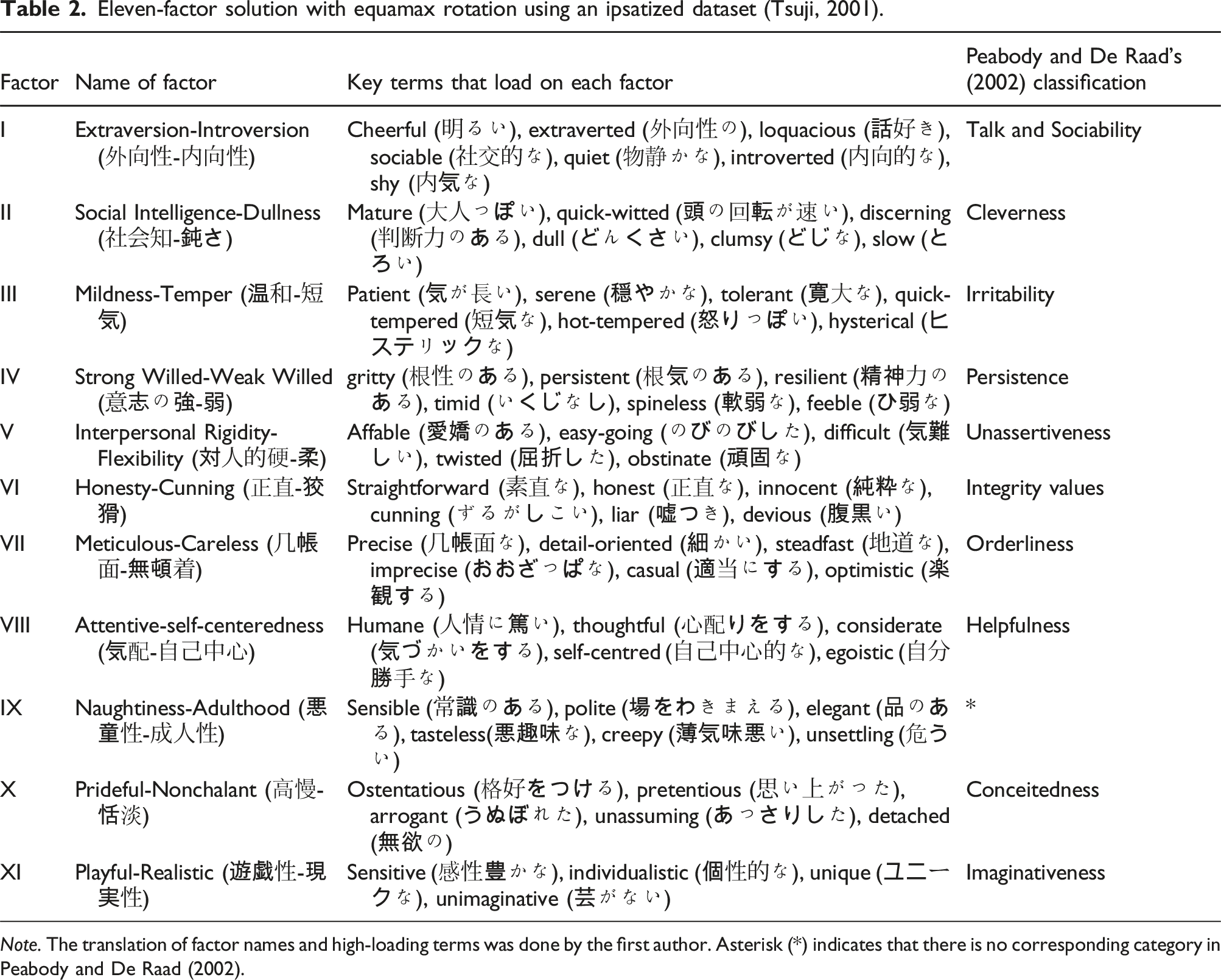
Note. The translation of factor names and high-loading terms was done by the first author. Asterisk (*) indicates that there is no corresponding category in Peabody and De Raad (2002).
Correlations between Tsuji’s eleven factors and the FFPQ (Tsuji, 2001).

Note. N = 270 (college students; 230 women). The translation of factor names was done by the first author.
Murakami’s study
Murakami (2003) conducted a study “to confirm the big five structure in Japanese language through the lexical approach” (p. 85). The word collection procedure was as follows (Murakami, 2002): First, four psychology major university students extracted personality-related terms from all entries in Kojien, 5th ed. After excluding words related to temporary states, evaluative terms, anatomical or physical conditions, ambiguous and figurative words, and geographical or occupational terms, 950 words were collected. Three psychology students reviewed them, eliminating 14 clearly inappropriate words. The remaining 936 words were checked by 341 college students, excluding 184 words based on three criteria: (a) words with unknown meaning; (b) words that are rarely used nowadays; or (c) words that have little or no relation to personality. After comparing with previous studies (Aoki, 1971a; Tsuji, 2001), 201 additional words were selected. In total, 934 words (539 nouns, 142 adjectives, 103 verbs, 37 adverbs, and 113 compound words) were considered representative personality terms.
Murakami (2003) selected 554 words with high usage rates from the initial pool of 934. In the subsequent study, 370 university students were asked to evaluate whether the personality traits represented by each word applied to themselves using a dichotomous scale (yes, no). To filter out socially desirable (or undesirable) words, 237 words with a small response variance were excluded, leaving 317 words for factor analysis.
Five-factor solution with orthomax rotation (factor parsimony criterion) using a raw dataset (Murakami, 2003).

Note. The translation of factor names and high-loading terms was done by the first author.
However, the names Murakami (2003) assigned to the five factors carry the risk of causing misunderstandings. This is because there are discrepancies between the concepts that can be inferred from the names and the actual content of Murakami’s factors, especially factors III to V. Factor III consists of terms representing Peabody and De Raad’s (2002) classifications of Integrity Values and Helpfulness, and seems to be a mixture of positively evaluated terms. Factor IV appears to correspond to a mixture of Peabody and De Raad’s (2002) Impulse Expression and Unassertiveness. Factor V seems to be a combination, including Peabody and De Raad’s (2002) negative poles of Boldness, Impulse Control and Persistence, and it resembles Tsuji’s (2001) Strong Willed-Weak Willed factor in the eleven-factor solution. Consequently, it appears that the content of Murakami’s five-factor structure differs from that of AGB5.
Characteristics of lexical studies in Japan
We focus on two lexical studies conducted in the early 2000s in this section.
Firstly, it should be pointed out that Japanese lexical studies did not restrict themselves to adjectives but included all parts of speech when selecting personality-related terms. It is noteworthy that in both Tsuji’s (2001) and Murakami‘s (2003) studies, there was a considerable prevalence of nouns in the extracted words, constituting approximately 60%. This is because there were adjectival nouns that functioned similarly to adjectives in the Japanese language (e.g., the Japanese noun “soumei” functions as an adjective to describe a person’s characteristic by adding the particle “na”, such as “soumei-na” meaning “wise”). In Tsuji’s list, adjectives and adjectival nouns together account for approximately 70% of the total. The result that ‘adjectival words’ constitute a large portion aligns with the emphasis on adjectives in lexical studies abroad (Tsuji, 2001).
Japanese five-factor solutions reported by Tsuji (2001) and Murakami (2003) do not necessarily replicate the AGB5. The Extraversion factor, which emphasize Sociableness and Talk aspect (Peabody & De Raad, 2002), was consistently found in every five-factor solution. On the other hands, aspects of AGB5 Agreeableness, Conscientiousness, and in some cases, Emotional Stability combined in different ways in each solution. The Intellect factor was reported only in Tsuji’s ipsatized data analysis (Table 1). This suggests that when categorizing Japanese personality domains into five dimensions, the categorization may differ from that of AGB5 in some aspects. The differences in the content of each Japanese five-factor solution by Tsuji (Table 1) and Murakami (Table 4) may partly stem from whether data ipsatization was applied or not, as the former, based on ipsatized data, tended to form bipolar factors, while the latter, based on raw data, tended to form unipolar factors.
The eleven-factor solution reported in Tsuji (2001) is interesting in that two aspects of Intellect, controlled intellect and expressive intellect (Peabody & Goldberg, 1989), are reported as independent factors. In comparison to lexical studies in East Asia, controlled intellect appears in both the Korean (Controlled Intellect; Hahn et al., 1999) and Chinese (Intellect/Positive Valence; Zhou et al., 2009) five-factor solutions. However, expressive intellect emerges only in the seven-factor solution for Korean (Dependability vs. Expressive Intellect; Hahn et al., 1999) and is not reported in the seven-factor solution for Chinese. It is unclear from Tsuji’s report (2001) at which level an expressive intellect factor emerged. It seems that controlled intellect is distinguished from other factors at a relatively high hierarchical level, whereas expressive intellect is more likely to emerge only when the number of extracted factors increases. Moreover, considering that the controlled intellect was not identified in the raw data analysis by Tsuji (2001), as well as in the reports by Aoki (1971b) and Murakami (2003), even the emergence of the controlled intellect factor may depend not only on personality-related terms selection tactics but also analysis methods.
It is also noteworthy that three factors related to Agreeableness (Factor V, VII, and X) – and possibly four if we include Factor VI – are found in the eleven-factor solution. This suggests that there are numerous terms to describe individual differences in various aspects of Agreeableness. The “Seventeen-Article Constitution”, considered Japan’s oldest written law dating back to AD 604, also include the provision “Harmony is to be valued.” The way individuals form bonds with members of their community may represent significant individual differences in Japan. The emphasis on cooperation and harmony with others in Japan may also be related to the absence of an assertiveness or masculinity-like factor (see Table 1, 2, and 4), as reported in the Korean lexical study (Masculinity/Emotional Stability; Hahn et al., 1999). Further research is necessary to examine whether the prevalence of Agreeableness-related factors and the absence of an assertiveness factor reflect cultural characteristics in Japanese culture or are merely artifacts resulting from the selection tactics of personality-related terms or analytical methods.
Finally, it should be acknowledged that Tsuji (2001) reported an eleven-factor solution in the early 2000s. Interpreting the content of factors objectively, without being influenced by biases, is challenging. The two studies conducted in the early 2000s in Japan seem to reflect “the tension between attempts to take cultural differences into full consideration and an expedient tendency to over-impose Western models“ (Thalmayer et al., 2022, p. 936). As previously pointed out by other researchers, it appears that the AGB5 model is far from being considered a universal model (De Raad et al., 2010, 2014; Saucier et al., 2014; Saucier & Iurino, 2020). Instead, it is one of many emic models – even if it may be the most predominant, and widely used among them. It would be crucial to abandon the insistence on the five-factor model, reconsider the criteria for determining the number of factors and the method of factor rotation, and examine the contents of factors that are extracted (Saucier & Iurino, 2020). Tsuji’s lexical study (2001) can be considered an example of such reconsideration.
Conclusion
Lexical studies in Japanese have been conducted since 1952. In the early 2000s, two separate lexical studies were undertaken. One study focused on verifying the replicability of the AGB5 model, while the other sought to explore the uniqueness of the personality structure inherent in the Japanese language. In the five-factor solutions, the Extraversion (Talk and Sociableness) factor was consistently identified, and aspects of AGB5 Agreeableness, Conscientiousness, and in some cases, Emotional Stability were not identified as independent factors but rather combined to form factors. In the eleven-factor solution, the uniqueness of the Japanese personality structure was observed in two independent factors related to controlled intellect and expressive intellect, the existence of several Agreeableness-related factors, and the absence of an assertiveness-related factor. Further studies are needed to examine the robustness of these factors. Additionally, examining the replicability of cross-language models such as Big Two, Big Three, Big Six, or Multi-language Seven in Japanese language would contribute to the investigation of universal personality aspects across languages. Furthermore, as pointed out by Thalmayer et al. (2022), integrated research combining personality studies and cultural research will be necessary to examine how emic personality factors reflect the characteristics of the relevant culture, such as “amae“. Lastly, findings of lexical studies seem to contradict the notion that the Big Five are universally shared across cultures. Examining how these contradictions can be interpreted will also be an important topic for future consideration.
• Japanese lexical studies were overviewed. • The AGB5 structure was not replicated in Japanese. • An eleven-factor solution was observed, and its characteristics were discussed. A Japanese lexical study reported an eleven-factor solution in the early 2000s. The content of these factors was examined in the context of previous personality models. This manuscript will be of interest to researchers exploring both language-specific and universal personality aspects.Key insights
Relevance statement
Supplemental Material
Supplemental Material - Recent overview of lexical studies of personality terms in Japan
Supplemental Material for Recent overview of lexical studies of personality terms in Japan by Yasuhiro Hashimoto and Atsushi Oshio in Personality Science.
Supplemental Material
Supplemental Material - Recent overview of lexical studies of personality terms in Japan
Supplemental Material for Recent overview of lexical studies of personality terms in Japan by Yasuhiro Hashimoto and Atsushi Oshio in Personality Science.
Supplemental Material
Supplemental Material - Recent overview of lexical studies of personality terms in Japan
Supplemental Material for Recent overview of lexical studies of personality terms in Japan by Yasuhiro Hashimoto and Atsushi Oshio in Personality Science.
Footnotes
Author note
This paper is part of the bundle Personality Science Around the World. The handling editor is Friedrich M. Goetz.
Acknowledgements
Not applicable.
Author contributions
Declaration of Conflicting Interests
The author(s) declared no potential conflicts of interest with respect to the research, authorship, and/or publication of this article.
Funding
The author(s) received no financial support for the research, authorship, and/or publication of this article.
ORCID iD
Not applicable.
Data accessibility statement
Data sharing not applicable to this article as no datasets were generated or analyzed during the current study.
Supplemental material
Supplemental material for this article is available online. Depending on the article type, these usually include a Transparency Checklist, a Transparent Peer Review File, and optional materials from the authors.
Note
References
Supplementary Material
Please find the following supplemental material available below.
For Open Access articles published under a Creative Commons License, all supplemental material carries the same license as the article it is associated with.
For non-Open Access articles published, all supplemental material carries a non-exclusive license, and permission requests for re-use of supplemental material or any part of supplemental material shall be sent directly to the copyright owner as specified in the copyright notice associated with the article.
