




Abstract
We reply to each of the issues raised by Schwartz in a commentary on our article on a comparison of value taxonomies. We discuss two approaches, mentioned in that commentary, the lexical approach and the theory-driven approach, especially with respect to their capacities in covering the domain of values and with respect to the representation of important values in a useful structure. We refute the critique by Schwartz that the lexical approach is superfluous, because his theory “toward universals in values” would already cover all values, and that their mutual relationships are relevant to individuals around the globe. We explain the necessity and strength of the lexical approach in taxonomizing the value domain, both within and across languages. Furthermore, we argue that principal components analysis (PCA) and simultaneous component analysis (SCA) are most adequate in arriving at a satisfactory structuring of the great many values in terms of both underlying constructs and their facets. We point to a misrepresentation in Schwartz’s circular model, and we review some misunderstandings on the side of Schwartz with respect to our results in comparison with those proceeding from his circular model.
Schwartz (2017) commented on our article “Values in a Cross-Cultural Triangle” (De Raad et al., 2016), criticizing several issues of our study, especially in comparison with his theory-guided approach to values. These issues concern (a) the role and significance of the psycho-lexical approach, the theory-driven approach, and their contrast; (b) the coverage of the value domain; (c) the structural organization of the value domain; and (d) the adopted methodology. Most central in his commentary seem to be the coverage of the domain of values and their structural representation.
Schwartz starts with evaluating some differential results proceeding from the two approaches: He criticizes the fact that security is not prominent in our findings and tries to justify why aesthetics is not prominent in the Schwartz theory “toward universals in values” (TUV). Schwartz then extensively discusses the potential of the TUV to fully cover the domain of values, in comparison with the capacity of the lexical approach at that point. Next, Schwartz puts forward the circular representation as the postulated model that would be sufficient for a proper accommodation of all different human values. He does so while criticizing the use of principal components analysis (PCA) and simultaneous component analysis (SCA) to arrive at a proper structuring of values.
In the remainder of his commentary, Schwartz discusses the outcomes of the SCA in relation to what is represented in his motivational circle. He expresses confidence in the validity of certain lexical components on the basis of our data where they agree with his model but does not seem to trust the same data set when it concerns other components that disagree with his model. Furthermore, he discusses procedural steps in the lexical approach, with a conclusion about etic versus emic.
In the following, we reply to each of the issues raised by Schwartz; we discuss the two approaches, their differences, and their capacities in covering the domain of values. We refute the critique and emphasize once more the necessity and strength of the lexical approach in taxonomizing the value domain, both within and across languages; we argue that PCA and SCA are most adequate in arriving at a satisfactory structuring of the great many values in terms of both underlying constructs and their facets. We point to a misrepresentation in Schwartz’s circular model, and we review some misunderstandings on the side of Schwartz with respect to our results in comparison with those proceeding from his circular model.
The Two Approaches and their Contrast
According to Schwartz, we largely frame the lexical approach by contrasting it with a theory-driven approach. In our view, this is a skewed representation. We point to weaknesses of a theory-driven approach with respect to coverage of the domain of values. The theory-driven approach in general tends to serve as a “straitjacket” for mapping concepts and ideas. The lexical approach explicitly aims to capture the full spectrum of concepts in the field of interest. If one wants to delineate the population of concepts in a certain field, for example, traits or values, the lexical approach is exceptionally useful. The lexical approach can be applied in all stages of theory formation, hence preceding, within, and after the process of theory formation. Therefore, in our view, with respect to the identification of values and delineation of the domain of values, the proper distinction is not between the lexical and theory-driven approaches, but between exploratory and theoretical approaches. The lexical approach is a logical step in both the exploratory and in the theory-guided approaches. Starting with amorphous and unspecific perspectives on the field of interest, for example, values seen as guiding principles in making choices or decisions in life; for the further delineation and specification of the field of interest, the lexical approach typically gathers all relevant value instances possible.
As early as 1987, Schwartz has put forward that the structure of values refers to the conceptual organization of values on the basis of their similarities and differences (Schwartz & Bilsky, 1987). That is fully agreed. However, the claim as settled in his TUV that all human values could be represented into a circular format, in which the mutual positions of the values reflect their compatibilities and contradictions, and that this value circle is universal across cultures and eras, does not necessarily follow. For example, if one values freedom, it is contradictory to value the logical opposites, such as repression or lack of privacy. These latter concepts are, however, usually not seen as belonging to the universe of values. One can value such diverse values as happiness, prestige, peace, professionalism, and autonomy at the same time, although all of these values are from different domains. It may well be possible that an emphasis on certain values, for example, a good family life, is at the expense of other values, for example, career or achievement. Such interdependences, and their cross-cultural similarities and differences, should be established empirically and represented properly.
Coverage of the Value Domain
Concerning the content areas, both the TUV and the lexical approach are based on certain assumptions concerning the coverage of the domain. The TUV claims comprehensive coverage through the application of a facet-theoretical approach. The advantage of this approach is that one has an articulate description of the universe of values. The disadvantage is that this description depends on the specific set of selected facets: The choice of facets depends on the insights and theoretical preoccupations of the theorist, while certain distinctions that may lack momentum may give rise to a theoretical emphasis that is disproportionate relative to the empirical reality. The exploratory psycho-lexical approach follows a multiple-step bottom-up procedure in which the universe of traits is defined by tracing down, identifying, and tagging all (hundreds or even thousands) possible instances of values. This essential and logical first step in the taxonomic process is followed by a systematic structuring of those value instances based on empirical findings. The goal of the value taxonomy is an ordered system of the elements in its domain. This not only applies to a single language or culture but also applies to all languages and cultures of the world.
The lexical approach usually takes its starting point in a tangible repository of the lexicon of a language (i.e., a dictionary) under the assumption that individual differences in daily transactions that are considered important will become encoded into their language in the form of words and expressions. The lexicon of values is the stock of words that people can draw on to interpret, understand, and clarify behaviors of self and of others.
Schwartz peculiarly suggests that his theoretically based system of values is not a taxonomy. This may be true to the extent that he did not aim at identifying all possible instances of values. Theoretical considerations have led him to arrive at his ordered system of 10 or 19 so-called basic values. According to Schwartz, his theoretical framework does not limit the set of values, because a value can always be located in that system. This is certainly true, because the system of values is based on a visualization of observed distances between empirically scored values, which can always be done in a two-dimensional space. However, the key question is whether two dimensions suffice to properly represent the mutual distances between values. If the dimensionality of the system is fixed to the two-dimensional circular arrangement, there is a good chance that many values or value instances remain located near the origin and are therefore not given the prominent location they deserve. Such values may be in need of one or more additional dimensions to be represented prominently. Interestingly, in his commentary, Schwartz opens the door to more dimensions where he suggests “that it is probably more accurate to conceptualize the value space as a sphere.”
The TUV has recently been refined by subspecifying the previously published 10 so-called basic values (Schwartz et al., 2012), thus indicating that coverage is an issue in value theory. This is also reflected in his commentary, where Schwartz reports that researchers had been asked to add values that were missing in the Schwartz Value System. Asking people to generate values, given the mind-set induced by the availability of a list of items that assumes coverage of the domain, is, however, a hard task. Such a goal is better reached by listing all lexically available values, which can subsequently be organized in an insightful arrangement on the basis of their empirical relations.
Adding Languages or Cultures
Languages differ in the number of words and expressions to describe values; there is certainly no one-to-one correspondence (through translation) between value descriptors observed, identified, and described in different languages. Moreover, certain values or clusters of values may be less prominent or even virtually absent in one culture or language compared with their presence in other languages or cultures. Certain values or clusters of values may show more density in one language (in terms of more words and more nuances) than in the other. The psycho-lexical approach relatively easily catches such specifications, divergences, and relatively unique value descriptions in a language.
Schwartz gives credit to the potential of the psycho-lexical approach to identify values. The power of the lexical approach is indeed in the identification of the full range of hundreds of values in a language. The value vocabularies in the three languages under study each form the most inclusive sets of significant values that could be collected from the lexicons of the three language communities. Those sets are the values that have been found relevant and functional in the daily lives of the members of the language communities.
The practical relevance of those values has been demonstrated with large samples of participants in the three cultures, who provided ratings on the extent to which the values were useful or important for them in their lives. The empirical test of relevance of the values is in the ratings provided by the participants. The factors of values independently found in the three languages and the factors found in the joint study for the cross-cultural triangle are empirically based. Schwartz expressed confidence in the validity of two components (Pleasure and Virtue) that do agree with his theory, but not in those components that disagree with his theory. Yet, they were all empirically based.
The low profile of security values in our empirically determined system, for example, 1 is taken by Schwartz as “surprising” and “conspicuous.” In his circular arrangement, security values are formulated as aspects of a broad Conservatism domain of values to which also belong values emphasizing conformity and values emphasizing tradition. In our system, security and safety values form part of the 1+3+ facet Care and support and of the 4+1+ facet Self-realization. Note that the SCA Interpersonal Relatedness component (1+) plays a role in both facets that accommodate security values.
Value instances referring to security are not all mentioned in Table 6 in De Raad et al. (2016). The concept of security covers many facets, including being confident, being without doubt, protection, shelter, and invulnerability. Such value instances are mostly part of the two mentioned facets and are mainly related to the secure surroundings of family and friends, and with being in control, being determined, and being confident. These are empirical facts.
The reference made by Schwartz to the value rhetoric of right-wing politicians is not convincing. Political rhetoric serves political goals, and implicit or explicit reference to values is too often made to serve partisan and populistic goals of a temporary nature. The reference to Neuberg, Kenrick, and Schaller (2011) does not convince either. Motivations to avoid threats to one’s security in that study refer to reproductive fitness goals as put forward from the evolutionary perspective. Those motivations do not necessarily lead to values, but probably rather to traits as adaptive mechanisms. The specific personal and societal formulations for security in Schwartz’s system (avoiding danger, secure surroundings, a strong state that can defend citizens) do seem to refer more to (often physical) conditions to be fulfilled for the individual to behave freely in accordance to values transcending such physical conditions.
Structural Organization
Schwartz hypothesized two dimensions to be sufficient to accommodate all values, when based on their mutual distances in scoring. That is, the various domains of values are postulated to be arranged in a circular format spanned by the two dimensions, using distances to represent the similarity between scored values. Schwartz reasoned that the circular positions of value domains would reflect their compatibilities and contradictions. Using the term contradiction or conflict for circular opposites, is, however, not very adequate. Values that appear to be circularly opposite are just those values that have the largest distances in the data set. The structure thus completely depends on the values included in the set, and on their relative mutual distances.
To gain more insight into the nature of the circular representation of the values, it is useful to consider its origin somewhat further. Schwartz’s circular representation stems from a multidimensional scaling (MDS) of the distances between scored values. To shed some light on the relationship between the MDS approach and the factor approach that we took, we used simulated data. These data were simulated according to a factor model, and subsequently an MDS analysis was applied to those simulated data. Figure 1 gives the MDS solution of 32 items, simulated according to two types of factor models.
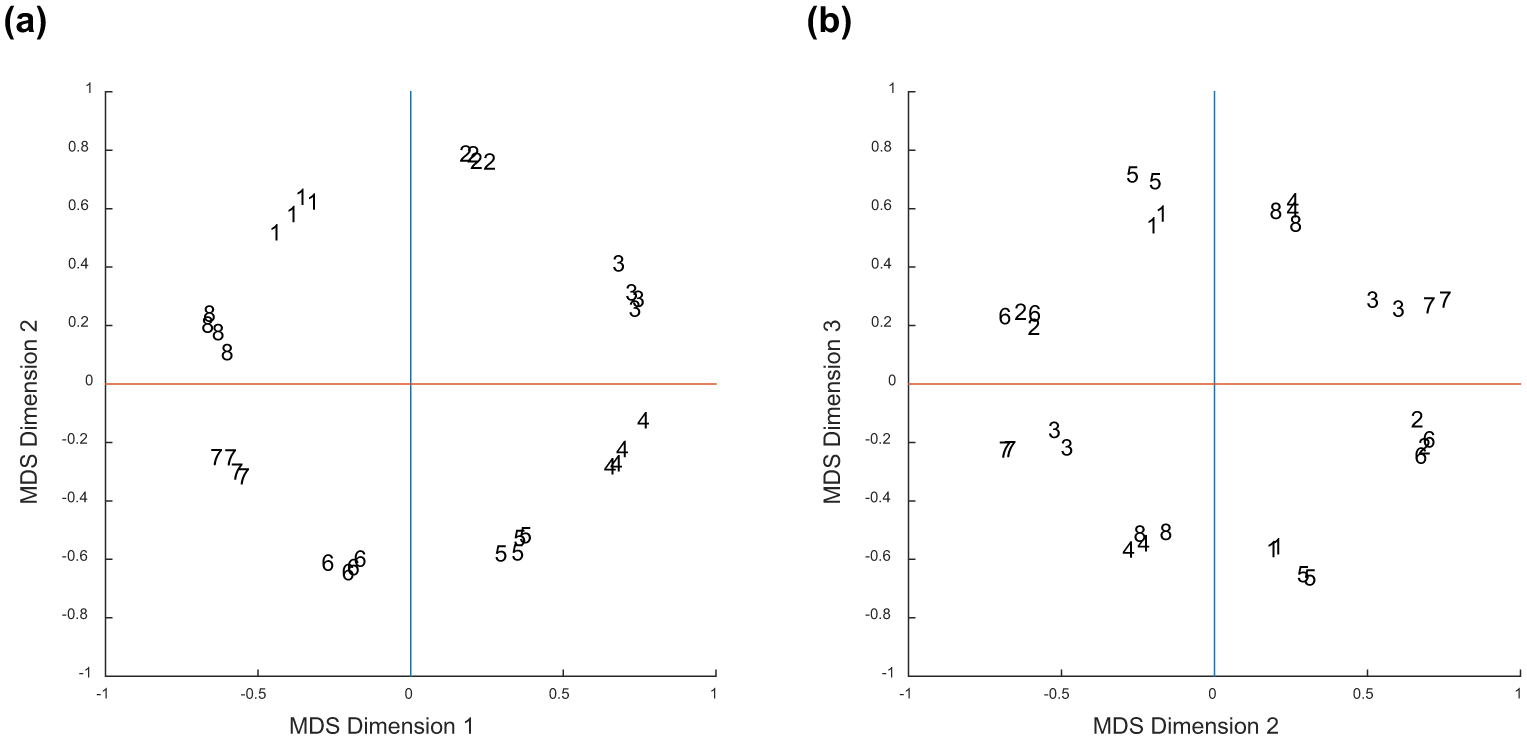
MDS solution for simulated data according to an eight-factor model with Toeplitz structure in interfactor correlations, with (a) 32 items, eight factors with Toeplitz structure, per factor four positive loadings and (b) 32 items, eight factors with Toeplitz structure, per factor two positive and two negative loadings.
As shown in Figure 1, the circular structure was perfectly replicated. In both factor models, eight factors were used, with four nonzero loadings per factor. The key to achieve the circular structure in the MDS solution of the simulated data is the structure of the interfactor correlations. A circular structure results, if that correlation matrix is a Toeplitz matrix, which is a matrix in which all elements on any Northwest–Southeast diagonal are the same. For example, with four factors, one could have as the interfactor correlation matrix:
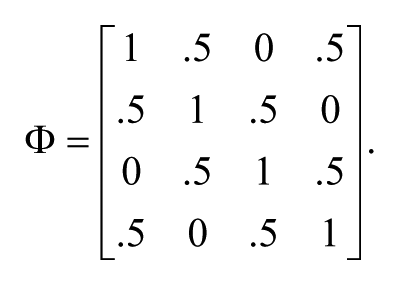
This structure implies that adjacent factors are correlated highest (i.e., .5), and factors further apart are correlated lower (i.e., 0 here). For our eight factors, we used as subsequent factor correlations the values .7, .4, .1, 0, .1, .4, and .7. In Figure 1a, per factor all four items loaded positively on that factor; in Figure 1b, per factor two items loaded positively and two items negatively. In Figure 1a, the items are opposite to each other in the circle for all pairs of factors that correlate zero. In Figure 1b, the items are opposite to each other for all pairs of factors that correlate zero, as well as for the items that belong to the same factor, but have opposite signs (i.e., positive and negative loadings). The latter case implies that the items correlate highly negative. For the simulated data in Figure 1a, a two-dimensional solution appeared to be sufficient, whereas for the data in Figure 1b, three dimensions seemed to be more appropriate. Note that in Figure 1b, Dimensions 2 and 3 are depicted (a plot of Dimensions 1 and 2 showed two sickle shapes, expressing in Dimension 1 primarily the positive vs. negative loading items per factor).
What implications does this simulation exercise have for the theory of values? A key question is whether the factor model would comply more with the factor model used in Figure 1a or in Figure 1b. Considering that the factor loadings of values in Schwartz et al. (2012, Table 6) are all positive, and that our large loadings were all positive as well, we presume that the structure of values resembles more the one reported in Figure 1a than in Figure 1b. This would imply that values that are located opposite to each other on the circle are uncorrelated. For example, the extent to which a person values Action would not tell anything about the extent to which that person values Rules. Thus, for opposite values in the circle, there is no incompatibility, contrast, contradiction, or conflict, as Schwartz claims.
It thus seems that values can be ordered in such a way that the correlations among subsequent values decrease, where the correlation matrix between scored values follows—more or less—a Toeplitz structure, while the order of values has a certain degree of consistency among various cultures.
According to Schwartz, PCA 2 and SCA can retain coverage and enable the derivation of a shared kernel of values, but he considers the components to be incoherent and disparate. He attributes this to the fact that we use components, rather than common factors, motivated by the notion that components are formative indexes rather than reflective ones. We respectfully disagree with this view for two reasons. First, if data comply perfectly with a common factor model, and one would apply a PCA, the interpretation of the resulting loadings is typically the same (e.g., Velicer & Jackson, 1990). Second, we think that value ratings, whichever specific set of values was included, would never comply perfectly with a common factor model (unless one considers the trivial case with each value loading on a single factor, which would result in an unidentified model). It seems inconceivable that subsets of individual values could be described perfectly by a single factor (or a very limited set of factors), with really all uncorrelated residuals. Thus, we would interpret a common factor model of values to be of a descriptive nature, rather than reflecting a true, but hidden, reality. Accordingly, we interpret our SCA solutions as descriptive.
As such, Schwartz’s objection to our SCA solution is a disqualification of the conceptual richness of the value domains that we describe. We aim at a comprehensive taxonomy of values in which all possible instances of values and their interrelations are used to arrive at an economical description of the variance through a smaller number of underlying dimensions. PCA and SCA are most appropriate for that purpose, and indeed the SCA application has provided us with this fine-grained faceted system of values.
Schwartz sees complexity in the faceted composition of the components, while those facets are completely logical; moreover, they cover value distinctions of the type that Schwartz aimed at in his own refined system of basic values.
Schwartz theoretically defined value domains and adopted and constructed items to measure those values. From that perspective, it is understandable that Schwartz suggests factor analysis to be more appropriate. He also assumes that we would use the component results to build scores for a set of coherent values. That is a misunderstanding. Our faceted system of values is intended to be used as a basis for the development of a full set of items to measure factors of values and their facets.
Emic–Etic and the Capacity of the Psycho-Lexical Approach
Schwartz concludes that the lexical approach does not escape the imposed etic approach. We do not make such a claim but instead “we aim at a balance between emic and etic perspectives” (De Raad et al., 2016, p. 1054) in which we optimize the emic perspective, which is trying to get the maximum out of “unique” values, and exploit those values in codetermining the value structure.
We did not drop items just to find the common items, as Schwartz seems to conclude; we selected common terms as our point of departure. We started with a joint set of 1,148 distinct values from the three languages and first identified the 142 items that are shared by the three languages; we then added the three sets of items that were, respectively, shared by the three pairs of languages, amounting to a total of 413 items, thus drastically improving the connectivity among the three value data sets. This 413 set of items was used to define the SCA structure on the basis of the ratings. The remaining set of 735 items did not play a role in determining that SCA structure. However, they are useful in contributing to the semantics of the various components, simply by correlating the remaining value variables with the SCA components. This was not done in our present study; instead, we only correlated the unique PCA components with the common SCA components, thus demonstrating the overall connectivity among the full set of 1,148 items.
With reference to those correlations, Schwartz reasoned that because none of the single five SCA components accounted for as much as 50% of the variance in five of the 15 country-unique value factors, the content of the country-unique factors was not discernable. In fact, considering the Multiple R’s, the SCA components on average explained over 70% of the variance of the unique factors, with an exceptionally low figure for the Austrian F5 “Left-wing, revolution.” Thus, also the contents of values considered unique in this study are largely covered by the common SCA components.
With more different languages involved, the number of items shared by all languages reduces, but pairwise overlap remains more or less the same, and in addition there will be items that are common to three languages or to more depending on the number of additional languages. Overlap between all languages creates a kind of “patchwork” matrix with many empty spots (missing data) and with crisscross connections between the many “patches.” Such a matrix with this complex linkage allows finding dimensions underlying the enormously large intercultural set of values.
Discussing Outcomes
Although it makes more sense to discuss method than outcome, Schwartz focuses on outcome and compares emerging SCA components (of which he mixes up the codes, that is, 7/1 to 7/7) from different levels of extraction with basic TUV values. He does so starting with the seven-component solution that we did not choose as the final structure because of too much specificity. Admittedly, certain SCA components are indeed easily related to TUV values on the basis of superficial recognition of TUV semantics in the components. Considering some components (we assume that Schwartz means 7/4, 7/5, 7/6) to have split off from Component 4/1, however, cannot be concluded from the hierarchy. SCA 7/6, for example, correlates only .48 with SCA 6/5, and SCA 5/5 also correlates only .48 with SCA 4/1 (i.e., 23% common variance); taking 7/6 and 5/5 as split off from higher order components denies their unique variances. The same is true for SCA 7/7 (the presumed counterpart of TUV-Tradition), which is quite similar indeed to SCA 6/6 (r = .96), but SCA 6/6 correlates only .53 (28%) with SCA 5/3. Conclusions on motivational closeness make therefore not much sense.
Next, Schwartz identifies facets of the SCA Components I and III in our Table 6 as sets of values that are adjacent on his Motivational circle. Obviously, value items that have common semantics and common denotations cluster together, both in the lexically derived system of values and in the theory-guided organization of values. Table 6 with the faceted structure of the fire components consists mainly of mixtures of components. For example, the II+IV+ facet Prestige represents values with primary (highest) loadings on the Component II (Status and Respect) and secondary loadings (lower but still substantial) on Component IV (Competence). This facet is close to the IV+II+ facet Expertise that represents values with primary loadings on Component IV (Competence) and secondary loadings on Component II (Status and Respect). The empirically derived faceted structure of values is a logical and elegant system, something that Schwartz qualifies as complex (“each one relates in complex ways to the others”).
On the basis of the representations of the components depicted in Table 6 of De Raad et al. (2016), it is certainly possible to see links with the TUV basic values, maybe particularly in reference to SCA Component I (Interpersonal Relatedness) and Component III (Commitment and Tradition). The SCA structure, has, however, its own configuration, in which, for example, the SCA 1+3+ facet Care and support and the 3+1+ facet Benevolence are close to each other, although belonging to different components; this lexical facet Benevolence is primarily Competence (Component IV) and secondarily Interpersonal Relatedness (Component I). The I+II+ facet Pleasure, however, primarily expresses values of Interpersonal Relatedness, while Schwartz suggests that it “largely expresses benevolence.”
Footnotes
Declaration of Conflicting Interests
The author(s) declared no potential conflicts of interest with respect to the research, authorship, and/or publication of this article.
Funding
The author(s) received no financial support for the research, authorship, and/or publication of this article.