




Abstract
We are very excited by the recent work of Soto and colleagues (2021; 2022; 2023) integrating the Big 5 model with the growing literature on the determinants of success. We agree that their proposed taxonomy of skills is a good starting point, especially given that it complements the substantive research literature supporting the Big 5. However, we argue that the decision to sharply separate traits from skills does not do justice to the full implications of their model, and that pulling back on the integration between traits and skills obscures the dynamic processes underlying the Big 5. Existing dynamic accounts of personality such as Whole Trait Theory provide a model for understanding both how these skills are included as part of traits and their development as well as a framework for interventions focused on skill development. We hope that discovering the link between skills and traits will warm researchers up to dynamic accounts of the Big 5.
Soto and colleagues (2021; 2022; 2023) recent work integrating the Big Five model with research literature on the determinants of success makes a major contribution to the personality literature in at least two ways. The paper contextualizes the growing literature on social, emotional, and behavioral (SEB) skills within a personality framework and provides a deeper insight into how personality traits associated with life success (Ozer & Benet-Martínez, 2006; Soto, 2019) can be promoted through intervening on capacities to promote the manifestations of those traits. Skills are “qualities that are beneficial to the individual and their social partners” (Soto et al., 2022, p. 193), because they bring about desired outcomes such as maintaining positive relationships Soto et al. (2021; 2022; 2023), effectively pursuing goals, and regulating emotions and moods (Soto et al., 2022).
We are very excited by Soto et al. (2021)’s simplifying the 136 existing taxonomies into one taxonomy based around the organizing principles of the Big Five, as well as by the way this taxonomy allows for clear integrative links to be made between traits and skills. For example, the three categories of skills just mentioned above would correspond to agreeableness, conscientiousness, and emotional stability, respectively. We also concur with the notion that skills and traits are distinguishable from each other. However, we wish to encourage Soto et al. (2021), to push the implications of their discovery even further. They find that traits and skills overlap in content and in structure yet propose distinguishing between skills and traits in a way that leads to separating them from each other. We agree that traits and skills should be distinguished from each other, but not fully separated into two different, unrelated components of personality.
In our view, skills and traits should be integrated as parts of a larger personality model. Indeed, given that the overlap in content and structures suggests a strong integration between skills and traits, why not take the opportunity afforded by these findings to discover the nature of the integration? Specifically, we propose that skills and traits do not affect different states and behaviors, but rather affect the same states and behaviors, and as a result they should be combined into a model that situates SEB skills as one important mechanism producing personality manifestations. In our view, the integration most promising is that skills are one of the pieces constituting the processes underlying the manifestation of traits in daily life (i.e., the machinery underlying traits; Allport, 1937). Furthermore, we argue that dynamic models of personality such as Whole Trait Theory (WTT; Fleeson & Jayawickreme, 2015; 2021) can successfully achieve this goal.
The connection and distinction between skills and traits
Soto and colleagues (2021) offer an inspirational example to convey their distinction between skills and traits. A student who is introverted (in terms of her general level of the trait of extraversion) accordingly usually acts at low levels of extraversion. One time, when called for by the situation, she steps up and enacts high levels of extraversion, thereby achieving leadership and a successful group project outcome. More abstractly, the authors offer the following distinction: skills describe what people are capable of doing for a short time when needed or called for, whereas traits describe what people do typically (Soto et al., 2021, p. 27; Soto et al., 2022, p. 216; Soto et al., 2023, p. 1).
This distinction between skills and traits builds on the difference between a person’s typical behavior and their behavior for a moment, that is, the difference normally labelled the “trait” (what a person generally does) and the “state” (what a person is doing for a moment; Fleeson, 2001; Nesselroade, 1998; Steyer et al., 1992). “Trait” and “state” both describe the degree to which the same content is descriptive of the person; they differ only in the duration of time they are describing the person. 1 The “trait” describes the degree to which the person is describable by a given trait’s behavioral, affective, and cognitive content in general for an extended period of time, whereas the “state” describes the degree to which the person is describable by a given trait’s behavioral, affective, and cognitive content for a short period of time, such as a few minutes. Soto and colleagues’ offered distinction between skills and traits builds on this difference in that it characterizes traits as descriptive of what people typically or generally do (people’s “traits” or usual “states”), whereas it characterizes skills as indicative of what people are capable of doing for short periods (what “states” they are capable of on occasion). For example, a person’s trait extraversion would be the degree to which they usually act, feel and think in extraverted ways, whereas their skill of extraversion would be the degree to which they are capable of acting, thinking, and feeling in extraverted ways for short periods of time.
Definitions of skills (as present in Soto et al., 2022, p. 194).

Soto and colleagues have reported several findings showing considerable overlap between skills and traits. Soto et al. (2021) showed strong conceptual overlap between a taxonomy of skills and the Big 5 taxonomy of traits. Soto et al. (2022, p. 202) showed strong empirical overlap between the taxonomy of skills and the Big 5 taxonomy of traits. Finally, Soto et al. (2022, p. 204) showed very strong correlations between individual differences in skills and individual differences in traits (.60–.73). That means that people who are more skilled in a particular domain also act that way more often. In other words, skill levels and trait levels are highly correlated; people with higher skill levels also have higher state and trait levels.
Our suggestion is not to disagree with any of this, but rather to push running with this even further. Rather than conclude as Soto and colleagues do that skills are distinct parts of personality which affect different states and behaviors than do traits, we suggest embracing the empirical overlap. We suggest that skills, while not the same things as traits, are closely integrated into traits in that they are part of the causal forces that lead to states. As shown in Figure 1, we propose that skills and traits do not affect different states and behaviors, but rather affect the same states and behaviors, in a part-whole relationship. Skills make up one set of the many causal forces that lead to the degree to which a person manifests a given trait’s content in their behavior, feeling, and thought at any given moment. Two contrasting models of the relationship between skills and traits.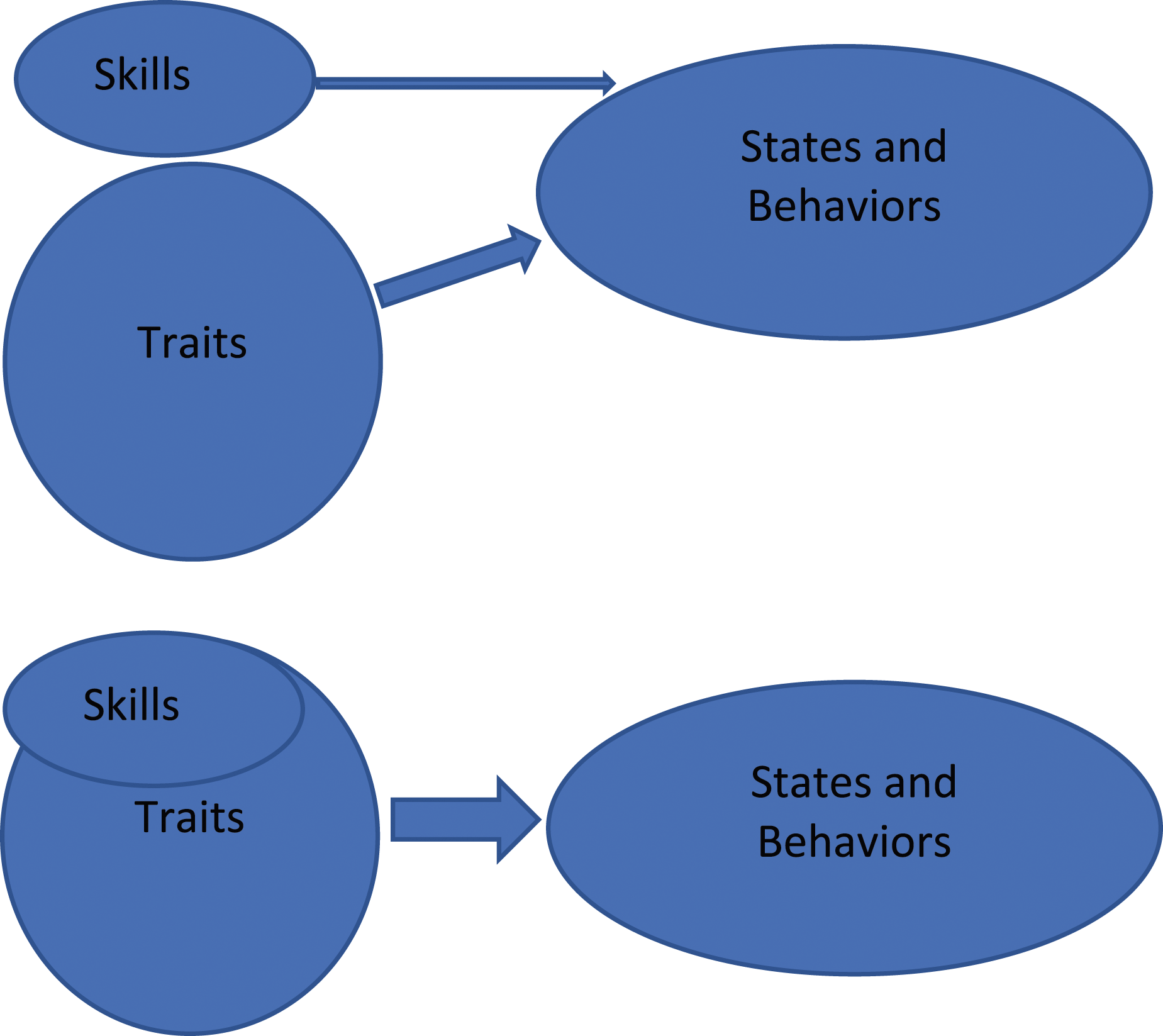
Reasons to suggest that skills are part of the machinery constituting traits
Three reasons skills might be part of traits.

Skills are usually called for
The second reason for our suggestion is that skills are potentially useful to most actions an individual enacts, and thus should be expected to influence the typical state level of a person. We believe that most actions are relevant to outcomes. For example, we think that one’s friendliness, warmth, rudeness, and anger generally impact the quality and length of one’s relationships. Good quality relationships require continual warmth, generosity, and refraining from nastiness. Similarly, we think that quality work outputs require regular hard work, organization, and dependability. It seems unlikely that only once in a while does someone have to work hard to do good at a job. Indeed, many studies have shown that one’s level of momentary extraversion predicts one’s simultaneous level of positive effect, expressing anger, exclusion, or disdain leads to both immediate and long-term negative impacts, and sustained effort is among the best predictors of expert performance.
If state levels are usually impactful on desired outcomes, then there is usually a call or need to act at the desired state levels. For example, if the level of agreeableness one exhibits to one’s partner is usually impactful on the quality of the relationship, then there is usually a call or need to act at a least a minimally acceptable level of agreeableness. If the capacity and function of skills are precisely to be able to act in the ways that bring about those desired outcomes, then there will usually be a call or need to apply that skill. For example, if the skills related to agreeableness states are “capacities used to maintain positive social relationships”, then there will usually be a call or need to apply those skills to one’s agreeableness states. If this is true, then skill levels should usually be affecting the level of the corresponding state; as a result, the usual state level at which the person acts would be influenced by their skill level.
Soto and colleagues propose that traits affect a person’s usual state level and that skills do not – skills affect only a subset of state levels. We consider six possible reasons for this proposal below.
Possibility #1: Most states do not affect outcomes
One possible rationale would be an assumption that most states do not normally affect outcomes. In critical situations, outcomes are at stake, and in those situations, skills will come into to play because they are needed. For example, the introverted student in the example mostly acts introverted because outcomes are mostly not affected by her level of introversion states, but when outcomes do come into play, such as a group project, then her extraversion skill comes into play and she acts extraverted. We, however, find this unlikely; states are most likely relevant to outcomes most of the time. For example, one cannot maintain positive relationships by only refraining from yelling once every few weeks. To maintain positive relationships, one has to be courteous, respectful, and generous day in and day out. Similarly, one cannot effectively pursue goals by occasionally being very organized. To effectively pursue goals, one has to be organized most of the time. If most states are relevant to outcomes, then skills are called for most of the time, and skills would be part of what produces state levels most of the time. This is empirically testable by examining whether most states impact outcomes, or only occasional ones do. 2
Possibility #2: States produced by skills affect different outcomes
A second possibility is that states produced by skills affect different outcomes than do states produced by traits. However, empirical work to date has focused on largely the same kinds of outcomes, such as grades, career success, happiness, relationship quality, etc. Future empirical work may identify distinct outcomes predictable from the two instances of states (one possibility was identified in Soto et al., 2023 – performance on the ACT).
Possibility #3: States produced by skills are qualitatively distinct
A third somewhat related possibility is that even with the same outcomes, it may be that the states produced by skills are qualitatively different from the states produced by traits. They might be more effective or more focused, or they might have some other observable marker that distinguishes them from other kinds of states. For example, it may be possible to be kind in a ham-handed, ineffective way versus in a smooth, effective way. We believe this is probably at least sometimes true. However, we think it does not describe the majority of cases, because again, normal trait levels have been robustly shown to be related to outcomes. Thus, states must be effective in the usual case. And if such states are effective in the usual case, then it would be wise to apply one’s capacities to bring those states about in the usual case. Future empirical work may attempt to identify observable distinctions between skill-produced states and trait-produced states.
Possibility #4: Skills may produce states in non-normative situations
Yet another possibility is that, even with the same outcomes and the same states, skills may produce states and associated outcomes in specific, infrequent situations whereas traits produce states and associated outcomes in routine, frequent situations. We think this is unlikely because it assumes that skills and traits produce the same states and the same associated outcomes, so it assumes that skills could potentially be improving outcomes in routine, frequent situations as well as in specific, infrequent situations. If the point of skills is to bring about those outcomes, it is unclear why the skills would lie dormant for those routine and frequent but also impactful states. This possibility could be tested empirically by looking for differences in the cross-situational variability of trait-predicted states versus skill-predicted states, or by looking for situations that moderate the skill prediction of states and/or the trait-prediction of states.
Possibility #5: States produced by skills may be more effortful
Another possibility for suggesting that skills might have limited applicability to states is that they may require effort, expenditure of resources, or conscious evocation. Thus, people would need to limit their use of the skills in order to conserve those resources. This is also possible, but it would make SEB skills unusual types of skills, because most skills have the opposite profile. Most skills make tasks easier require fewer resources, and more automatic to implement in behavior. Furthermore, most skills require frequent use to prevent erosion. For example, tennis skills makes it easier to hit the ball hard, well, and accurately, and limiting its use would quickly lead to its erosion. Foreign language proficiency makes it easier and less effortful to communicate in the language, but similarly erodes without frequent use. Reading skill makes it easier, more automatic, and less effortful to read, and erodes slowly without use. All of these skills, and others, make the average, routine use of the skill less effortful and more automatic, so one would expect that skills for states would make the average, routine enactment of those states less effortful and more automatic. There would be no need to limit the use of the skill. Naturally, very high levels of performance would take more effort than low levels of performance, but that jump would be less intense for the skilled person than for the non-skilled person. Thus, skilled people would find high levels of performance less taxing than would less skilled people. Future research could test this idea empirically by measuring effort after enactment of a state for those high versus low in the corresponding skill.
Possibility #6: Skills only produce states at the “maximum” level
One final possibility is that skills affect only maximum states, but they do not affect average, routine levels of the states. Skill differences may be most evident at the higher level of performances, when people “turn it on”. We would agree that skills would be most evident at those higher levels, but we do not believe that skills would not be applied at moderate and lower levels. We would expect that SEB skills, like other skills, would make routine levels of extraversion, agreeableness, conscientiousness, and other states easier and more automatic. Given that those routine states are relevant to skill-relevant outcomes, it would also make sense for the system to follow this typical pattern of skills. This idea could be tested empirically by examining whether skills predict states at all in the normal range, in addition to the expected prediction of states in the highest levels.
Our expectations are based on the common proposition that the states are relevant to outcomes much of the time, so skills are always potentially in play (see Fleeson, 2017). One can always improve the prospects of the outcome by applying the skill, so it wouldn’t make sense to refrain from doing so if one was capable of doing so. For example, one can always act in ways that enhance or maintain one’s relationships, so it wouldn’t make sense to refrain from acting in pro-relationship ways if one was capable of doing so.
Whole trait theory suggests that skills are part of the machinery underlying traits
The third reason we propose for integrating skills and traits more fully is that Whole Trait Theory (WTT; Fleeson & Jayawickreme, 2015; 2022) has argued that constructs like skills are part of the fundamental machinery producing traits. WTT recognizes the dynamic nature of personality function (i.e., that people vary meaningfully in their manifestation of personality across contexts) and the need to explain this variability. In WTT, traits have two parts. The first part is a descriptive part, consisting of a density distribution of enacting the trait at different states levels at different moments, summarized across many moments. The second part is an explanatory part, consisting of social-cognitive mechanisms that lead to the person enacting the trait at different state levels. WTT jumps off from the assumption that states produce outcomes. For example, conscientious states produce quality work performance, agreeableness states produce positive relationships, and extraverted states produce positive affect. The linearity of these effects means that the more of the state, generally, the more of the outcome. Thus, whatever the level of the state the person enacts, the outcome will be modified. If the skill is the ability to influence the outcome, then the levels of states the person enacts are within the skill’s domain. The set of causes of the levels of the states the person enacts includes the skill.
Ways skills possibly routinely affect state levels.

Consider a school counselor known for his skill in maintaining positive relationships with students. He perceives numerous opportunities (point 1) to foster trust, whether through casual hallway chats or scheduled counseling sessions. Understanding the impact of his empathetic approach, he sees a clear connection (point 2) between his behavior and the positive rapport he builds. His extensive training and experience provide a deep knowledge (point 3) of effective communication strategies. Interacting positively with students has become almost second nature for him (point 4), enabling him to effortlessly sustain a supportive demeanor (point 5) even in challenging situations. Through effective implementation of his skills (point 6), he’s able to navigate conflicts and help students feel understood and supported. In these ways, his agreeableness level is higher across the board because of his skill at maintaining positive relationships.
These mechanisms (and possibly others) are the sort by which skills frequently and commonly may affect people’s state levels. If they are thereby part of the mechanisms that frequently and commonly affect state levels, then they are squarely within the set of mechanisms that explain traits. We call this set the explanatory side of traits, or TraitEXP. Furthermore, these skill-based mechanisms naturally and necessarily interact with other mechanisms responsible for state levels. For example, an individual’s relevant skill level and their motivation to achieve a specific skill-relevant goal may interact together to produce relevant behavior. We further agree that SEB skills likely have unique properties (compared to goals, affect, etc.,) which may be associated with distinct processes of producing states.
Implications for interventions
Thinking about personality manifestation in the pursuit of goals as a manifestation of specific SEB skills also helps us make sense of recent work on interventions promoting personality change. Many people want to devote time and energy to develop their personality (Hudson & Fraley, 2015). Recent research suggests that it is likely that such intentional change occurs through changing one’s personality manifestations in daily life (Mendonça et al., 2023). Dynamic perspectives on personality have provided new theoretical and empirical insights into the ways in which personality manifests differentially in the service of meaningful goals (McCabe & Fleeson, 2016), how personality develops over time and how personality can be volitionally changed in ways that are beneficial (Hudson & Fraley, 2016). Intentionally changing personality traits may involve focusing on specific cognitive, motivational, and affective processes underlying such manifestations. Encouraging shifts in the deployment of SEB skills would represent one such example of a strategy to motivate personality change (Blackie et al., 2014; Hudson et al., 2019; Jayawickreme et al., 2019). We believe that existing dynamic theories of personality (such as Whole Trait Theory) can provide a model for understanding both how SEB skills impact trait development as well as a framework for interventions focused on skill development. In particular, such interventions can target mechanisms (i.e., the explanatory side of traits) including SEB skills, but also behavioral goals (Hudson et al., 2019), and skill implementation intentions (Duckworth et al., 2013). Given that SEB skills have distinctive properties compared to other mechanisms, one interesting question for future research would involve examining whether SEB skills are more effective in producing change on specific traits. We expect that successfully shifting SEB skills would be a particularly effective method for motivating personality change, since improving content-specific skills (i.e., agreeableness) will likely to more frequent and habitual manifestations of relevant thoughts, feelings and behaviors (Gupta & Cohen, 2002).
Conclusion
In summary, we applaud Soto et al. (2021) for integrating discussions of SEB skills with personality research. However, we think emerging work on the dynamic nature of personality provides a better framework for studying and promoting these skills. SEB skills likely play an important role in the successful manifestation of personality in the service of important life goals, and we encourage researchers to engage with the new insights provided by personality dynamics to further integrate these literatures.
Supplemental Material
Supplemental Material - Social, emotional, and behavioral skills can be integrated into existing dynamic personality models
Supplemental Material for Social, emotional, and behavioral skills can be integrated into existing dynamic personality models by Eranda Jayawickreme and William Fleeson in Personality Science.
Supplemental Material
Supplemental Material - Social, emotional, and behavioral skills can be integrated into existing dynamic personality models
Supplemental Material for Social, emotional, and behavioral skills can be integrated into existing dynamic personality models by Eranda Jayawickreme and William Fleeson in Personality Science.
Footnotes
Author note
The opinions expressed in this publication are those of the authors and do not necessarily reflect the views of the John Templeton Foundation. The handling editor is Ryne Sherman.
Acknowledgements
We would like to thank Erik Noftle for comments on an earlier draft.
Author contributions
Declaration of conflicting interests
The author(s) declared no potential conflicts of interest with respect to the research, authorship, and/or publication of this article.
Funding
The author(s) disclosed receipt of the following financial support for the research, authorship, and/or publication of this article: This publication was made possible through the support of a grant from the John Templeton Foundation (62669).
ORCID iD
Not applicable.
Data accessibility statement
Data sharing not applicable to this article as no datasets were generated or analyzed during the current study.
Supplemental material
Supplemental material for this article is available online. Depending on the article type, these usually include a Transparency Checklist, a Transparent Peer Review File, and optional materials from the authors.
Notes
References
Supplementary Material
Please find the following supplemental material available below.
For Open Access articles published under a Creative Commons License, all supplemental material carries the same license as the article it is associated with.
For non-Open Access articles published, all supplemental material carries a non-exclusive license, and permission requests for re-use of supplemental material or any part of supplemental material shall be sent directly to the copyright owner as specified in the copyright notice associated with the article.
