



Abstract
Background:
Sudden cardiac arrest (SCA) is the leading cause of sport-related death in athletes during competition despite their healthy physiological status. Sudden cardiac death is defined as an unexpected death from cardiac causes that occurs within 1 hour (or within 24 hours in unwitnessed cases) from the onset of an acute change in cardiovascular status in the absence of external causal factors. Medical personnel should be prepared to care for athletes who experience SCA and understand the factors that increase the chance of survival in athletes who experience SCA.
Indications:
Being prepared for these events is essential for increasing the chance of survival in athletes who experience SCA. In addition to in-game management of a SCA, we review the causes of SCA, the role of screening and workup, implementation of an action plan, and the transition of care following an event.
Technique Description:
Emergency action plans (EAPs) are necessary to streamline and standardize efficient care for athletes who experience SCA. The EAP discussed in this article comprises 12 items that guide the management of SCA from appropriate setup and planning for each sporting venue to the postresuscitation transition of care.
Results:
Athletes who experience SCA are more likely to survive if an automated external defibrillator (AED) is available and measures are taken to prepare the sideline medical team with an EAP that addresses conditions before and after the SCA event.
Discussion/Conclusion:
SCA is a serious event that all sideline personnel should be prepared for. With the presence of an AED and preparation of medical and training staff with an EAP, the likelihood of an athlete surviving a cardiac arrest increases substantially. Thus, medical and training staff should familiarize themselves with EAPs and rehearse them annually.
Patient Consent Disclosure Statement:
The author(s) attests that consent has been obtained from any patient(s) appearing in this publication. If the individual may be identifiable, the author(s) has included a statement of release or other written form of approval from the patient(s) with this submission for publication.
This is a visual representation of the abstract.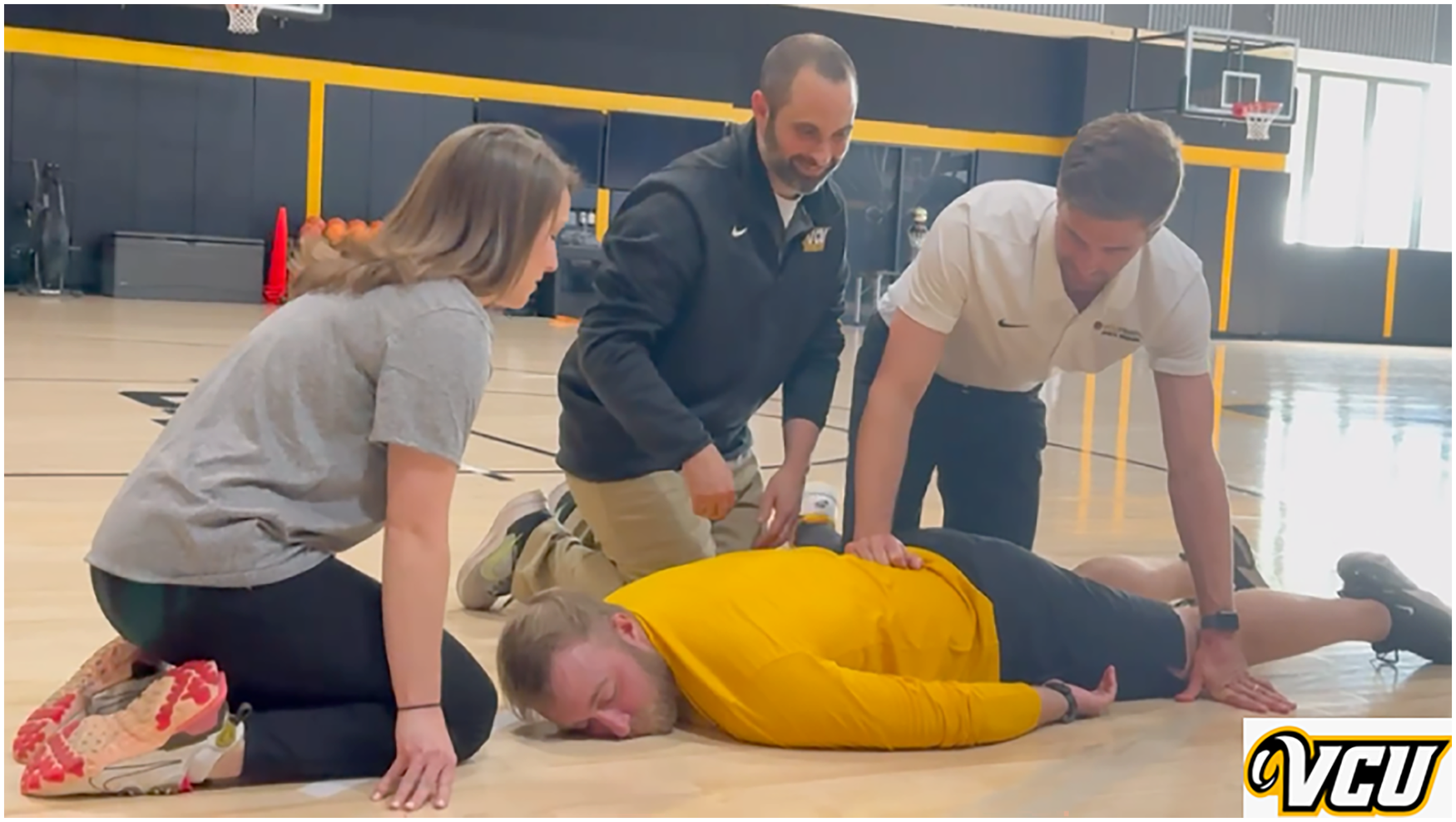
Keywords
Video Transcript
This project was completed in collaboration with the Virginia Commonwealth University (VCU) School of Medicine, VCU Health System and Department of Orthopaedic Surgery, and the VCU Sports Medicine and Athletic Training Staff.
None of the authors have any disclosures relevant to this work.
Overview
We will be discussing the background of sudden cardiac arrest (SCA), the role of screening for cardiac issues in athletes, preparedness for a cardiac event, emergency action plans (EAPs), and the role of post–cardiac event management.
Background
SCA is the leading cause of sport-related death in athletes during competition despite their healthy physiological status. 6 Sudden cardiac death is defined as an unexpected death from cardiac causes that occurs within 1 hour (or within 24 hours in unwitnessed cases) from the onset of an acute change in cardiovascular status in the absence of external causal factors. 3 SCA occurs in approximately .75 per 100,000 athletes per year and is often the first manifestation of underlying cardiac pathology in this healthy population. SCA is 2.8 times higher in young athletes compared to nonathletes. 5 Additionally, SCA is more than twice as likely to occur in male athletes than female athletes. 6 Recognizing the risks, presentation, and need for preparedness is necessary to ensure we are adequately prepared to care for competitive athletes who experience SCA.
In young athletes, the most common causes of SCA are “primary electrical disease” with a structurally normal heart (referred to as sudden arrhythmic death syndrome [SADS]), idiopathic left ventricular hypertrophy, coronary artery anomalies, myocarditis, and congenital disorders such as hypertrophic cardiomyopathy. 6 The cause of SADS is not entirely understood. Contributing syndromes may include long QT syndrome, Brugada syndrome, or Wolff-Parkinson-White syndrome. 6
The goal of performing precompetition screenings is to identify athletes who may be at high risk for SCA. 5 There are many different guidelines regarding the specifics of precompetition screening, but they all recommend a thorough medical and family history as well as a methodical physical examination as part of routine screening. 7 It is important to inquire about feelings of dizziness, shortness of breath, and chest pain during/after exercise. The interviewer must inquire about medical history and family history, with an emphasis on cardiac history. 8 Physical examination must include a thorough heart and lung examination as well as noting any findings of Marfan syndrome. Around 2% to 4% of cardiac screenings in athletes yield findings that require further testing, with clinically significant findings in about 0.3% of patients. 5
The use of a 12-lead electrocardiogram (EKG) in routine screening in athletes has been heavily discussed in the past, with experts agreeing that EKG has low specificity and can only be used with strict interpretation criteria. Many pathologies that contribute to SCD may not be detected on EKG. The general consensus is that EKG should only be obtained in the presence of concerning findings on history and physical.3,4
In athletes who have had a positive screening for risk factors for SCA (about 3 in 1000 screened athletes), a consultation to a cardiologist is recommended for any further necessary testing and treatment. 5 Informed decision-making and a thorough discussion of risks and benefits are essential when discussing the role of exercise restriction and disqualification from sport. 5
Indications
SCA occurs in competitive athletes despite screening. Being prepared for these events, having the appropriate resuscitation training, and having a well-rehearsed plan of action can contribute to lowering the risk of death in athletes who have SCA. 7 Cardiopulmonary resuscitation (CPR) certification is beneficial not just for physicians and trainers but may also allow athletes, coaches, and bystanders to respond to action when an SCA event has occurred. One of the most important aspects of preparedness for an SCA event is the presence of an on-site automated external defibrillator (AED) and the training on how to operate it. 5 Aschieri et al 2 reported a 93% survival rate in athletes who have had an SCA with an AED on site.
An EAP is developed for managing serious/life-threatening injuries or conditions and should be independently tailored to each facility or venue that hosts a competitive sport with maps/addresses included. EAPs should be developed in coordination with local emergency medical services (EMS) and have appropriate EMS contacts available. The EAP should identify personnel with their specific responsibilities and a designated chain of command. All emergency equipment (including AEDs) should be listed within the EAP, and there should be a designated health care facility for all postevent care. It is necessary that the EAP be reviewed and rehearsed by all involved parties annually and that all staff members of the venue have access to the EAP. 1
Technique Description
Check scene safety.
Assess the airway, breathing, and circulation of the patient.
Once ABCs are established, send 1 person to retrieve the AED and another person to call 911. (The person calling 911 should give as much information as possible regarding the patient’s condition and demographic information.)
Begin CPR compressions.
Attach AED pads to the patient while continuing CPR.
Use AED to deliver shocks as advised by the AED.
Have a staff member meet EMS outside the building to guide them to the correct building and entrance.
Continue CPR/AED usage until EMS is on-site or until the patient regains signs of life.
Transition care to emergency personnel once on-site.
Brief emergency staff on cardiac emergency.
Coordinate with emergency staff and stakeholders on the next steps related to case management.
Document the incident.
Results
Here we have a common presentation of an athlete experiencing a SCA in the middle of an athletic performance.
The responder immediately assesses the athlete and calls for help from other on-site providers or even the athletic training staff of the opposing team if needed.
While stabilizing the cervical spine, the responders log-roll the athlete from a prone to a supine position. The primary responder often acquires the role of establishing cervical stability, but this can be communicated based on the responder’s comfort level. The log-roll technique can be modified based on the number of responders and is coordinated by the responder who is performing cervical spine stabilization.
The responder assesses the athlete’s airway and breathing in a stepwise fashion.
The responder assesses the athlete’s circulation with multiple pulse checks from various sites to confirm the presence or absence of a pulse. When they do not palpate a pulse, they signal to other sideline providers to escalate resuscitation efforts.
One provider performs high-quality CPR while another provider obtains the AED and begins applying it to the athlete. In the on-field setting, protective equipment must be removed, and the jersey must be removed for application of the pads. Often a towel must be used to dry the pad sites to aid in adhesion.
The prompts given by the AED are followed. High-quality CPR is administered with a compression-ventilation ratio of 30:2.
The AED delivers a shock to the athlete when the timing is appropriate. The AED will announce the necessity of a defibrillation to the surrounding providers and instruct them to not touch the athlete while a shock is being administered. A provider will have to press the button on the AED to deliver the shock when prompted.
Discussion/Conclusion
Following the execution of an EAP and the stabilization of the patient, medical care must be transitioned to a medical facility with the capacity to continue resuscitative/postresuscitative efforts. A designated medical facility is identified before the competition. Following initial resuscitation in the field, transition of care to EMS must occur to continue patient care and for transportation to the designated medical facility. Sideline responders can aid in this transition by briefing EMS and emergency staff on the events surrounding the SCA and management specifics, such as the interventions that have been implemented. Last, formal documentation should be kept surrounding the preceding events and conditions, the SCA, resuscitative measures, and transition of care. 8
Thank you.
Footnotes
Submitted June 27, 2024; accepted February 19, 2025.
The authors declared that they have no conflicts of interest in the authorship and publication of this contribution. AOSSM checks author disclosures against the Open Payments Database (OPD). AOSSM has not conducted an independent investigation on the OPD and disclaims any liability or responsibility relating thereto.
