



Abstract
Environmental issues have geared the interest of researchers toward the use of naturally occurring materials for various applications in recent times. Hydroxyapatite particles (HAp) for biomedical applications were synthesized from egg and snail shells and used for the fabrication of bio-composites in this research. The shells were prepared by thoroughly cleaning before subjecting to calcination as well as wet-chemical precipitation treatment to obtain 50 µ sized hydroxyapatite particles that were used for the development of the bio-composites. The composites were fabricated with an open mold stir casting technique after mixing the constituents in predetermined proportions. Mechanical, wear, and physical properties evaluations were carried out on the composites and control samples while the images of the fractured surfaces were examined using a scanning electron microscope. It was revealed from the results that the addition of hydroxyapatite to epoxy improved the properties of the composite where most of the optimal values emerged from 15 wt% HAp-reinforced samples. It was discovered that snail shell HAp-based composites had superior enhancements than the eggshell HAp-based composites which showed that the source of the animal shell influences the characteristics of the ensuing properties. Flexural strength and modulus were 63.95 and 774.64 MPa, respectively; hardness was 40.25 HS, wear index was 0.07, and thermal conductivity was 0.545 W/mK for the snail shell HAp-based composites. Hence, synthesized HAp from snail shells is more structurally stable than eggshell-based and can be used for biomedical applications.
Introduction
The search for durable materials with a combination of distinct properties like good strength and fracture toughness as well as lightweight at a competitive cost has led to prime global interest in polymer-based composites.1,2 Polymer-based composites consist of a polymer matrix and reinforcement(s) and are easy to process at low temperatures due to their flexibility. 3 They also possess high specific strength and modulus, fatigue resistance, and thermal stability properties that are desirable in most applications. 4 In addition, they are of very low cost, have better mechanical properties, and require low production energy consumption. 5 However, the fabrication of a polymer composite is based on the mixture of matrix and reinforcement to enhance the polymer’s inherent properties. By utilizing the traditional processing route, it is possible to prepare polymeric-based materials with expected properties to meet specific application requirements by selecting a suitable matrix and reinforcement.
Nowadays, researchers are exploring the suitability of agricultural-based materials as biomaterials to solve biomedical-related problems. Biomaterials are synthetic materials that are being used in making devices for biomedical applications. 6 For instance, contrary to orthodox medicine in which damaged parts are amputated, the emergence of biomaterials has changed the trend. Recently, different biomaterials, including biomedical implants, are being developed for different uses within the biomedical field. 7 Due to the growing need for biomaterials, researchers are now converting available agricultural wastes to biomaterials in large quantities. 8 The emergence of agro-wastes for the production of hydroxyapatite serves as an alternative inorganic source for bones and tooth replacement due to their similar biomineral constituents. Hydroxyapatite has been proven to improve the biocompatibility of substrate biomaterials or smart implant materials due to its chemical composition and physio-chemical structure that are similar to the human bone as well as other mammalian animals. 9
Hydroxyapatite (HAp) is a typical synthetic biomaterial with chemical formula;
Nowadays, research is not only geared toward improving hydroxyapatite performance but also cost-cutting its production.
15
Several strategies have been developed to synthesize hydroxyapatite into different architectures and morphologies such as powder fillings, dense/porous blocks, or reinforcement in bio-composites.
16
Notable methods of synthesizing hydroxyapatite powder (HAp) are the sol-gel process, wet-chemical method, and hydrothermal technique.
17
Calcium salts, coral, hollow calcium carbonate (
Hydroxyapatite can also be measured as an auspicious material for bone grafting because it generates an adhesive chemical bonding between implant material and host tissues. Due to the comparable chemical properties of hydroxyapatite to the bioactivity, osteoconductivity, and osteoinductivity of human and mammalian bone, hydroxyapatite has been effectively developed and efficiently applied in the fabrication of biodegradable polymer and metallic-based bio-composite green materials. 20 Once a bio-hydroxyapatite-based implant is inserted into the body, it offers sustenance for tissue healing and bone evolution. They are also absorbed by the body yielding regenerated tissue. 21 Hydroxyapatite of biological (coral-, bovine-, or marine algae-derived) or synthetic origin is presently used for bone repair and bone regeneration in the form of granules, blocks, and scaffolds. They can be applied directly or as composite with polymers or other ceramics or as coatings on orthopedic or dental implants.
Chicken eggshells and snail shells are animal wastes that have been proven to be raw materials for the development of bio-derived hydroxyapatite. Hydroxyapatite is a ceramic material that forms the mineral phase of bone and teeth comprised primarily of calcium and phosphate at a respective ratio of 1.67 and has been used extensively within the world of orthopedics as a biomaterial to promote tissue regeneration. It is an inorganic mineral that is found in human bone and teeth thereby playing a role in the structural strength of bone and in bone regeneration. The bone forms the major parts of the skeleton representing a unique organ system in the body. Unlike most other organs, the skeletal organ system is composed of a calcified tissue called bone which consists of about 60% inorganic component known as hydroxyapatite, 10% water, and 30% organic component known as bone matrix proteins. Based on the high proportion of HA in bone, healthcare professionals often use synthetic and natural HA when carrying out bone repair treatments. They have been successfully and effectively applied as reinforcement materials (calcium filler) in the production of biomaterials due to the presence of calcium carbonate. It has been reported in past works that they possess a substantial impact on the fabrication of numerous products that require calcium fillers. Some research works have been carried out where particulate animal shell constituents were added for diverse applications.15,18 Reports have indicated among numerous features, that seashells based on calcium carbonate possess a reasonably lower density compared to mineral calcium carbonate and this improves the mechanical features when reinforced in polymer matrix materials.22,23
Epoxy resins are distinctive thermoset polymer materials that possess exceptional chemical, mechanical, and physical properties. Epoxies are designed to strengthen and fortify structural parts, such as flooring materials, engineering adhesives, and paints. 24 Cured epoxy resin possesses a strong and rigid cross-linked chemical structure suitable for structural bonding applications. It possesses useful properties such as low shrinkage, high strength, excellent adhesion to several substrates, effective electrical insulation, and greater thermal and chemical resistance. 25 They are extensively applied in lamination processes, adhesives, coatings, and the development of advanced bio-composite surfaces. 26 They are dimensional stability materials. The integration of bio-derived hydroxyapatite particulates into an epoxy-based polymer matrix can improve biocompatibility and catalyze the degradation potentials of epoxy-based composites as well as promote the enhancement of their bioactivity. 18
Having studied the previous research on the use of HAp for composite development, it was discovered that comparative influence of various solid precursors from natural sources for HAp synthesis has not received much attention. Hence, this research focused on the development of eggshells and snail shells-derived HAp-reinforced epoxy composites for biomedical implants applications. Many previous works have shown that these solid precursors are good for HAp synthesis. They serves as cheap source for calcium phosphate ceramics production because they are readily available at no cost, rich in calcium and can produce HAp that is capable of promoting greater bone reformation.16,18 Thus, the work was to reveal the most suitable HAp-derived animal wastes for epoxy bio-composite development based on property enhancement and availability. This was carried out to open a new vista on the effects of various natural solid precursor sources on the performances of the synthesized HAp and their composites. This is imperative because by-products from animals are biological and can be influenced by environmental and geographical factors. These and many other factors such as processing methods that are cost-effective and environmentally friendly still need to be given more attention.
Materials and methods
Materials
In the research, epoxy resin alongside a hardener material was purchased from Malachy Enterprise in Lagos, Nigeria. Eggshells from Gallus domesticus and snail shells from Archatina Manginatta were obtained from farmland in Akure, Ondo State, Nigeria. Orthophosphoric acid and distilled water were procured from Pascal Scientific in Akure, Ondo State, Nigeria.
Method
The process used by Agbabiaka et al., (2020)
27
was followed in a series of steps to convert the eggshell and snail shell into hydroxyapatite particles. To completely remove moisture from the shells, the calcination procedure was carried out in an oven at 80°C. Both the snail shells and chicken eggshells were obtained were thoroughly washed and boiled in distilled water for 10 min to remove inherent membranes. The cleaned shells were first oven dried for 24 h, and thereafter carry out a three-stage calcination treatment at 55 (a) Snail shell and (b) chicken eggshell.
Fabrication of the composites and control samples
The composites were fabricated by an open mold process after compounding in a stir casting technique. In order to produce the composites, epoxy resin was mixed in a ratio of 2:1 with its hardener and was mixed with varying proportions of HAp from egg and snail shells, respectively, within the range of 3–15 wt%. The mixtures were mixed thoroughly for about 5 min when homogenous pastes were achieved and poured into the respective test molds for tensile, flexural, and wear, respectively. The samples in the molds are allowed to cure before removal and left to further cure at ambient temperature in the laboratory for about 14 days before testing. For the purpose of comparison, control samples were also prepared as unreinforced epoxy. Plate 2 displayed samples of the composites that were developed from eggshell-based and snail-shell-based HAps before the test. Fabricated hydroxyapatite-based epoxy bio-composite. (a) Eggshell-derived and (b) snail shell-derived.
Characterization and evaluation of the developed composites
Tensile properties
A universal testing machine, FS 300-1023 with a crosshead speed of 5 mm/min, was used to test for tensile strength. The test was conducted in accordance with ASTM D-638-14 standard at an ambient temperature of 24 ± 2°C. The dimensions of the samples were length 115 mm and 3 mm in thickness. Three samples were tested for each composition and the average values were used as the representative values.
Flexural properties
A universal testing machine at ASTM D-790-15 standard for testing flexural samples was carried out on samples. Dimensions of the sample were 150 × 50 × 3 mm while the test was carried out at a crosshead speed of 5 mm/min. Three samples were tested for each composition and the average values were used as the representative values.
Hardness property
The hardness test was carried out using a computerized Shore Hardness Tester. Each sample was put to the test throughout a 15 s pressing duration with a 15 kg weight. Six indentations were made on each sample that was analyzed and the average value was used as the representative value.
Wear property
A taber abrasion machine (Model 5135, USA) was used to determine the wear resistance in accordance with ASTM D4060-10 standard. The samples were firmly fastened to the machine's testing platform, which is operated by a driven motor spinning at 500 r/min. Sample dimension of about 3 mm thickness and 100 mm diameter was used. Equation (1) was used to determine the wear index based on sample weight loss.

Thermal conductivity
The thermal conductivity of samples was determined using Lee’s disk device in accordance with ASTM E1530-19 (2019) standard and in accordance with the procedure adopted by Oladele et al. (2022) and Thomas et al. (2012). The thermal conductivity of samples was determined using equation (2).

Water absorption
Water absorption testing was performed in line with ASTM D5229M-12 where 250 cm3 of water was put into clean plastic containers to conduct the test. The dry weight of each sample was determined using a chemical weighing balance (FA2104A model with a precision of 0.0001 g), and measurements were collected every day for 30 days. The samples were brought out and wiped with a clean towel before being weighed. Equation (3) was utilized to determine the weight gained by each sample.

Characterization via microscopy
EVO MA 15 and Carl Zeiss SMT were used to characterize SEM images of fractured surfaces. The fractured surfaces of the developed composite samples were examined by means of SEM which was operated at 15 kV. The samples were gold coated with a Quorum coating machine (Q150RES) to make them conductive before SEM observation.
Results and discussion
Flexural strength
Figure 1 shows the variation of maximum flexural strength on developed composites and control samples. Enhancement in maximum flexural strength on the reinforced samples was noticed where 15 wt% snails shell-derived HAp-reinforced composite emerged as the optimum sample with a value of 63.95 MPa yielding an enhancement of about 54.48% when compared to the unreinforced sample (with a value of 41.40 MPa). Also, 15 wt% eggshells-derived HAp-reinforced composite gave optimum value (with a value of 62.94 MPa) showing a 52.02% increase when compared with unreinforced sample. These enhancements might have occurred based on the increase in the weight percentages which improves stronger adhesion of the reinforcements to the epoxy matrix. Also, the dominant presence of CaCO3 in egg and snail shells-derived HAp which contains an abundant quantity of hydroxyl, carboxyl, and amine groups that increase the covalent bonding strength of oxygen and hydrogen present in the bio-derived HAp and epoxy resin respectively can aid the improved strength obtained.28,29 While on the other hand, low enhancements observed with 3 wt% reinforced composites could be due to the presence of low percent of the reinforcements. In general, snail shell HAp-reinforced composites showed better maximum flexural strength when compared to the eggshell-derived HAp composites. Variation of maximum flexural strength with reinforcement content for developed composites and control sample.
Figure 2 shows the variation of flexural modulus on samples. Proper enhancements in flexural modulus occurred in all the reinforced composites similar to what was observed in Figure 1. Snail shell-derived HAp-reinforced composites show better flexural modulus properties when compared to eggshell-derived HAp-reinforced composites. From the results, it was observed that 15 wt% snail shell-derived HAp-reinforced composite gave optimum value of 774.6 MPa exhibiting 38.05% enhancement when compared to unreinforced sample which has a value of 561.1 MPa. Also, snail shell-derived HAp-reinforced composites had better flexural moduli when compared to the eggshell-derived HAp-reinforced composites and this might be possible due to the higher value of CaCO3 present in snail shell-derived HAp particles as reported by Karthicka et al. (2014).
30
Variation of flexural modulus with reinforcement content for developed composites and control sample.
Ultimate tensile strength
Figure 3 indicated the impacts of adding HAp reinforcements produced from egg and snail shells on the maximum tensile strength of developed composites. The results showed an inverse trend to Figures 1 and 2 that represent the flexural properties. It was discovered that the addition of eggshell- and snail shell-derived HAp-reinforced particles at low weight fractions increased the maximum tensile strength more than what was achieved at higher HAp contents. As a result, the maximum tensile strength decreases as the weight percentage increases. It was discovered that, 3–9 wt% HAp addition from both egg and snail shells gave improved properties after which there was a rapid decrease in this property. When compared to eggshell-derived HAp-reinforced composites, the HAp-reinforced composite made from snail shells exhibited superior maximum tensile strength characteristics. Optimally, 40.77% enhancement over the unreinforced sample was seen in the maximum tensile strength of the 3 wt% snail shell-derived HAp-reinforced composite, which had an optimal value of 32.11 MPa. This optimal improvement in the 3 wt% snail shell-derived HAp could be attributed to the low concentration of snail shell-derived HAp in the epoxy matrix and the higher concentration of CaCO3 in the snail shell-derived HAp particles.
30
It can be deduced from the results that the tensile strength of epoxy composites decreases as the density (weight fraction) of the animal-based composites increases.
31
Hence, optimum properties are seen to be strongly influenced by the amount of reinforcement added in addition to other significant factors. This is strongly in agreement with the idea that the influence of reinforcement content on epoxy composites is important in composite development and cannot be overemphasized.
32
Variation of maximum tensile strength with reinforcement content for developed composites and control sample.
Figure 4 shows the variation of tensile modulus on the reinforced composites and control sample where similar trends to Figure 3 was observed. However, all the composites possess improved moduli compared to the control sample contrary to what was noticed for ultimate tensile strength in Figure 3. Tensile modulus property has its peak occurring at 3 wt% snail shell-derived HAp-reinforced composite with a value of 1720.32 MPa. This optimum tensile modulus enhancement can be traced to the good bonding strength between the eggshell-derived HAp and the epoxy matrix in addition to all that was stated in the discussion of Figure 3. Variation of tensile modulus with reinforcement content for developed composites and control sample.
Hardness properties
The hardness properties of the unreinforced, eggshell, and snail shell-derived HAp-reinforced composite samples are indicated in Figure 5. The unreinforced sample possessed the least hardness value while 15 wt% of the snail shell-derived HAp-reinforced sample possessed the optimum hardness value. Hardness properties of the eggshell and snail shell composites increased simultaneously from 3 to 15 wt%, respectively. In comparison, the hardness properties of snail shell composites are higher when compared to eggshell-reinforced composites. There was a 254% increase from the unreinforced sample (with a value of 11.36 HS) to the sample with the highest hardness property (with a value of 40.25 HS). The increase in weight density of epoxy-based composites is influenced by the enhancements in the weight fraction of reinforcements
33
and this increase brings about an increase in hardness properties which is also confirmed in this research. This increase in hardness property could also have occurred due to the absence of pores in the matrix with an increase in weight fraction. The superior hardness properties possessed by snail shell-derived HAp-reinforced samples were caused by higher density of snail shell-derived HAp particles when compared to eggshell-derived HAp particles. Thus, high-density particulate reinforcements bring about enhancements in hardness properties of epoxy-based composites. Variation of hardness with eggshell-based and snail-shell-based HAp-reinforced composites and control sample.
Wear properties
The produced composites and control sample wear index values were as shown in Figure 6. When compared to the reinforced samples in this instance, the unreinforced sample had the highest wear index (0.342), indicating minimal wear and shear resistance. When compared to eggshell-derived HAp-reinforced composites, snail shell-derived composites had a low wear index. Sample with 15 wt% snail shell-derived HAp-reinforced samples showing a 78.94% increase in wear index over the unreinforced sample supports this claim. In comparison to HAp-reinforced composites made from eggshell, snail shell-derived composites often have stronger wear resistance and superior shear strength. In addition, HAp reinforcements made from eggshell and snail shells improve wear resistance in epoxy composites when compared to unreinforced samples (epoxy without reinforcement). Due to the presence of reinforcements that are frequently denser than the epoxy matrix, reinforced epoxy composites exhibit low frictional force. This justifies the rise in wear index enhancements due to constant decrease in frictional resistance as the weight fraction increased from 3 to 15 wt% in agreement with reports from previous researchers.34,35 Likewise, Daramola et al. (2020)
36
demonstrated in their research that the shear strength and wear resistance of polymer composites are improved by the addition of reinforcing particles. Effect of variation of eggshell-based and snail-shell-based HAp on wear index of developed composites and control sample.
Thermal conductivity
Figure 7 displays the thermal conductivity of composites from both reinforcements and unreinforced matrix as the control sample. According to Karthigairajan et al. (2020),
35
the unreinforced (neat epoxy) sample had the least thermal conductivity property when compared to reinforced samples with a value of 0.1134 W/mK. For the eggshell-derived and snail shell-derived HAp-reinforced samples, thermal conductivity showed a concurrent increase with increasing weight percent reinforcements. According to Oladele et al. (2022a),
18
reduced thermal conductivity results in greater tolerance to temperature variations. With a value of 0.545 W/mK, 15 wt% snail shell-derived HAp-reinforced sample displayed the best thermal conductivity. When compared to samples reinforced with eggshells, thermal conductivity of the snail shell was generally gradually greater for snail shell reinforced samples. Variation of thermal conductivity with reinforcement content for developed composites and control sample.
Water absorption properties
Saba et al. (2019)
37
emphasize the importance of water absorption and other physical properties tests for bio-composite materials in their report on an overview of mechanical and physical testing of composite materials. The effects of HAp generated from eggshells and snail shells on water absorption were shown in Figure 8. This shows how the samples perform over time after immersion in water-based media. The weight gain by the composites increased from 3 to 15 wt% as the weight percentage of the reinforcement particles increased. The obvious curve in Figure 8 showed that all samples initially absorbed water quickly and linearly before the saturation level was reached on the 27th day after which no further rise in water absorption was apparent till the last day. From day 1 to 15, the rate of water absorption was quick, resulting in a steep slope on the curve. From day 16 to 24, however, the rate of water absorption was linear and progressive, signaling that the samples were almost saturated while from day 25 to 31, it was noticed that the samples were completely saturated. Hence, the curve had a flat and parallel mode for most of the samples. It was discovered from the results that, 15 wt% snail shell-derived HAp-reinforced sample had the highest weight gain. Kalirasu et al. (2019)
1
validated these results of weight gain and concluded that water aids in the transport of oxygen and ions. According to Agbeboh et al. (2020),
8
the usage of polymer composites in bioengineering heavily depends on the dispersion of water in those materials. In their study on thermal stability, moisture uptake potentials, and mechanical properties of modified plant-based cellulosic fiber-animal wastes hybrid reinforced epoxy composites, Oladele et al. (2022b)
38
noted that the diffusion of water in polymer will adhere to Fick’s law (J), which determines the amount of substance that will flow through a unit area in a given time. Variation of water absorption properties of eggshell-based and snail-shell-based HAp-reinforced epoxy composites and control sample.
SEM images for the fractured samples
Plate 3 indicates SEM images of 3 wt% reinforced composites. In plate 3(a), an indication of white particles in the matrix denotes the presence of snail shell-derived HAp particles. The presence of pores in the matrix confirms yields parts of the reasons for poor hardness, wear, and thermal conductivity properties observed in Figures 5–7. Due to the absence of agglomeration in the matrix, optimum enhancements in tensile properties were noticed in Figures 3 and 4. In Plate 3(b), efficient dispersal was also observed as we have it in 3(a) which influenced the tensile properties enhancements of the epoxy composite. Agglomeration of the eggshell-derived HAp particles in the matrix was also absent which instigated the improvement in the tensile properties. Thus, a less porous composite was obtained. The presence of eggshell-derived HAp particles is denoted by the white particulate in the SEM image. Fractured surfaces of 3 wt% reinforced composites. (a) Snail shell-derived HAp and (b) eggshell-derived HAp.
The SEM image of 6 wt% reinforced composite is shown in Plate 4. Here, a uniform dispersal of the snail shell-derived and eggshell-derived HAp reinforcements was observed in the matrix, and this gave it its efficient tensile strength properties stated in Figures 3 and 4. A minimal porous structure was also observed which provided a better hardness, impact, and wear property when compared to 3 wt% in Plate 3. In plate 4(b), a crack was observed in the matrix of the eggshell-reinforced composite. This may have influenced its poor flexural properties as well as its poor mechanical properties. An even dispersion of eggshell-derived HAp which yielded a less porous structure occurred in the matrix which led to the occurrence of the enhancements in the tensile properties in Figures 3 and 4. A minimal agglomeration also occurred which enhanced the tensile properties. Fractured surfaces of 6 wt% reinforced composites. (a) Snail shell-derived HAp and (b) eggshell-derived HAp.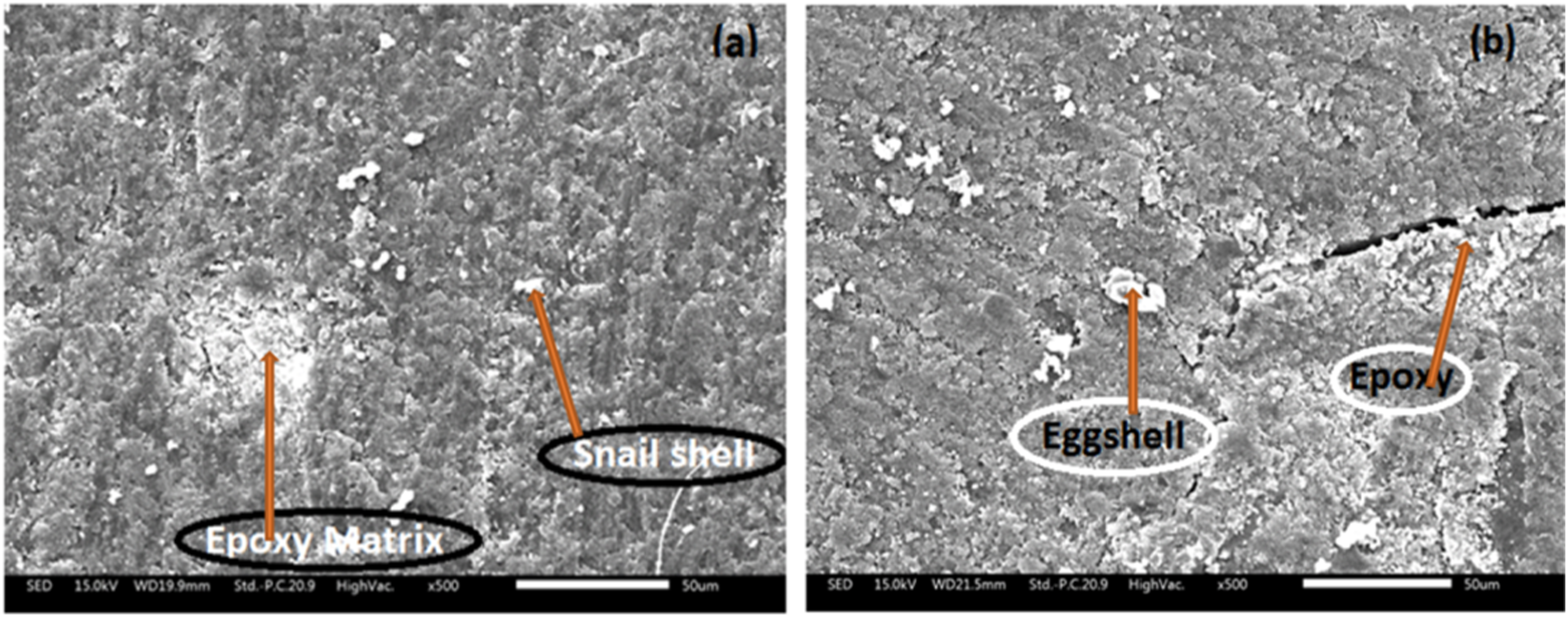
Plate 5 shows the SEM images of 9 wt% reinforced composites. White particulates were observed which indicates the presence of snail shell and eggshell-derived HAp particles in the matrix, respectively. The presence of agglomeration was pronounced with increased reinforcement weight fraction which influenced the minimal values in the tensile properties of both composites. More uniformly dispersed reinforcement particles in the matrix were visible and this was part of the reason for the increase in hardness, wear, and thermal properties when compared to the 3 and 6 wt% HAp-reinforced composites. Fractured surfaces of 9 wt% reinforced composites. (a) Snail shell-derived HAp and (b) eggshell-derived HAp (you need to remove agglomeration from the figure because I have deleted it from the discussion).
The SEM images for 15 wt% reinforced composites were as shown in Plate 6. An enhanced weight fraction of snail shell-derived and eggshell-derived HAp was observed, and this gave confirmation of the optimum properties detected in the wear, hardness, and thermal conductivity properties for both composites. Agglomeration was noticed to occur which may be part of the reasons for poor tensile properties in Figure 3. In Plate 6(b), an increase in the eggshell HAp-derived particles was detected with a pronounced agglomeration of the particles in the matrix when compared to the snail-shell-based composite in (a). This may contribute to the reasons why snail-based composites were more enhanced in properties than eggshell-based composites. Fractured surfaces of 15 wt% reinforced composites. (a) Snail shell-derived HAp and (b) eggshell-derived HAp.
Conclusion
This study was carried out to evaluate comparatively the viability of using eggshell-based and snail-shell-based HAp particles as reinforcements in an epoxy matrix for biomedical applications. Both solid precursors are readily available in Nigeria and many parts of the world at low or no cost, hence, forming source of low cost HAp material desirable globally. According to the study, reinforcing the epoxy polymer matrix with HAp particles produced from these shells significantly improved the mechanical, wear, and other physical characteristics of the epoxy composites. From the results, it was found that, when compared to eggshell-derived HAp-reinforced composites, the inclusion of HAp particles from snail shells improves the investigated properties of epoxy composites more than that of eggshell-based HAp-reinforced composites and, therefore, is been established as the best solid precursor. Tensile qualities typically decrease with an increase in reinforcement contents whereas flexural, hardness, wear, thermal, and water uptake properties increase as the reinforcement contents increase. The weight fraction with the best values was found to be 15 wt% from composites reinforced with snail shells that had the best combination of mechanical properties. According to the findings, the reinforced polymer composites had better characteristics than the control sample, making the HAp materials a promising reinforcing material for biomedical applications.
Footnotes
Acknowledgments
The support from the AESA-RISE Fellowship Program [ARPDF 18-03], the African Materials Science and Engineering Network (A Carnegie-IAS RISE network), and the DST-NRF Centre of Excellence in Strong Materials were appreciated. Assistance received from Dr M. O. Bodunrin, Department of Chemical and Metallurgical Engineering, University of Witwatersrand, South Africa was also valued.
Declaration of conflicting interests
The author(s) declared no potential conflicts of interest with respect to the research, authorship, and/or publication of this article.
Funding
The author(s) received no financial support for the research, authorship, and/or publication of this article.
