



Abstract
Recently, the use of composite materials has significantly increased in various industries, ranging from automotive to construction, due to their more advantageous properties compared to traditional materials. Nevertheless, with the growing environmental and ecological awareness, researchers are focusing on developing more environmentally friendly and healthier bio-composites while ensuring high-performance, affordable, renewable, biodegradable, and lightweight materials with environmental benefits. This literature review intends to provide an overview of recent work that focuses on bio-composites and bio-hybrid composites with natural reinforcements. Moreover, it presents the natural fillers, their classifications, the cultivation of some plants, their mechanical and chemical characteristics, as well as their potential applications. Additionally, this work describes the modeling, its different approaches, as well as the selection process of a model.
Introduction
Economic growth, increasing world population, and industrialization are leading to an exponential increase in the consumption of conventional materials and petroleum resources. This overexploitation is one of the main factors of pollution and depletion of minerals and raw materials. The exhaustion of these resources had led hundreds of scientists and specialists to search for alternatives that are both efficient and eco-friendly. This ecological and environmental awareness, combined with the desire to improve living conditions for the ultimate benefit of all living organisms on earth, has prompted the development of new biomaterials to replace conventional materials. 1 These green materials, which respect our health, environment, and planet, are bio-composites/bio-hybrids reinforced with natural fibers. 2 Among the different natural fibers that have attracted a lot of attention, there are cotton, alfa, coir, sisal, kenaf, flax, hemp, banana, coconut, jute, wood, clay, coconut, jute, cotton husks etc.3–6 These natural fillers compete with their synthetic counterparts due to their multiple advantages, which are reflected in low cost, biodegradability, lightweight, renewability, ecological benefits, low abrasion, high resistance to fatigue, corrosion and impacts, plus good electrical insulation.7,8 Natural element-reinforced composites have acquired great importance owing to their properties, which allow broad access to different industry activities such as construction, rail, military vehicles, automotive, furniture, sporting goods, and aeronautics.9,10 Due to the variety of the reinforcing elements used (organic and inorganic), a wide range of bio-hybrid composites had been created in the last years. These composites exhibit new behaviors that enable their application fields to be expanded as well as intermediate properties between the inorganic and organic. 11
Several studies have investigated the incorporation of natural fibers into various polymer matrices to examine the mechanical performance and ultimate properties of the reinforcements and associated biomaterials. According to these studies, reinforcement efficiency is significantly dependent on the interfacial adhesion between matrix and natural fibers; consistently, the stress transfer between matrix and fibers is higher with the more efficient the fibers are. 2
In general, experimental tests are used to evaluate the mechanical and thermal properties of composite materials, along with identifying the influence of the different fillers by the variation of their filling volume. These tests require chemical surface treatment of the different constituents before their use to eliminate unnecessary substances contained therein, followed by the manufacture of tested material samples, which is time intensive and costly. 12 In the face of these constraints, modeling has been implemented to minimize the time and cost of experimental tests. On the other hand, modeling aims to develop solutions to define the deformation and stress fields in heterogeneous materials to calculate their properties based on homogenization approaches that allow determining the effective characteristics (macroscopic properties) of material from the characteristics of its different components (microscopic properties).12–16 Starting with the definition of REV, the elementary volume representative of the material, on which the heterogeneous medium is replaced by an equivalent homogeneous medium MHE.17–19 Among the micromechanical models designed to predict the characteristics of composites (Young modulus, stress, Poisson’s ratio …), there are Hashin, Self-coherent, Mori-Tanaka Halpin- Tsai, Voigt, Reuss, etc.
This article reviews the work done on the different types of natural fibers and their potential applications in the fabrication of biomaterials (bio-composites/bio-hybrid composites). It is divided into several parts.
The 1st section is devoted to composite materials, their definition and classification, along with hybrid composites.
The 2nd section presents natural reinforcements, their classifications, and the cultivation of some plant fibers. The 3rd section shows the work performed on bio-composites and bio-hybrid composites with naturally occurring organic/inorganic reinforcements. The 4th section presents the mechanical and chemical properties of natural reinforcements and their application areas. The last section is focused on modeling approaches and on the selection of a micromechanical model.
Composite material
In a broad sense, composite material is generally defined as a mixture of two or more distinct immiscible components (Figure 1). These have excellent penetration capabilities and strongly complement each other concerning their properties.20,21 The resulting material is an inhomogeneous (heterogeneous) material with properties that the components alone do not have.
22
It is generally composed of a matrix and a reinforcing material, which can take the form of fibers, platelets, or particles. The reinforcement phase is characterized by high stiffness and strength compared to the continuous matrix phase, whose role is to hold the reinforcing elements and ensure load transfer in these elements.23,24 In recent decades, composites have been able to replace metallic materials in several areas thanks to many criteria as their better shock absorption capacity, ease of manufacture, low density, etc.
25
Composites.
Composite materials classification
Composite materials can be classified according to the following criteria:
Main differences between (TP) and (TD). 25

Metal matrix composites are materials based on metal (titanium or aluminum) reinforced with ceramic (non-metallic) reinforcements. 24 However, the ceramic matrix can be made of glass, and silicon carbide, reinforced with ceramics, metals, and carbon. 24
The figure below (Figure 2) shows the shape of the reinforcements (long, short, particles or platelets) and their nature (organic, inorganic, or mineral).23,25 Concerning the shapes, it is possible to classify the fillers according to their aspect ratio (L/D: Length/Diameter): • If (L/D) is infinite, the fiber is long. • If 10 < (L/D) < 50, the fiber is short. • If 1 < (L/D) < 5, the result is a particle. • If (L/D) approaches 0, it is a disk. Composites classification.

Hybrid composites
According to Bottreau and Vicq, 28 hybrid composites are materials that contain at least two reinforcing elements that have diverse mechanical and physical characteristics. Furthermore, Sanchez et al. 29 consider a hybrid composite to be a mixture of both organic and inorganic components with blending in the micrometer range. For Achby et al., 30 this material combines two or more components with predetermined geometries and dimensions to perform a certain function in an optimal way. Thus, hybridization involves combining two or more reinforcing elements to create new and improved functionality. For a long time, glass, aramid, and carbon are used as reinforcements thanks to their good mechanical characteristics and affordable production costs.31,32 Although different types of reinforcements can be mixed to generate a hybrid material, several studies show that high-performance hybrid composite obtained by combining two types of reinforcements.33,34
Natural reinforcements
In front of the recent pressure on industries to reduce the nuisances related to industrial processing and encourage the development of sober and clean technologies respecting the environment and ecology, together with the desire to use ecological and eco-friendly materials with little effect on the health of users,30,33,35,36 scientists and eco-designers are leaning towards using as much as possible renewable resources as reinforcements due to their lower price. In addition to being more environmentally friendly, natural fiber composites are lightweight and have thermal and mechanical performances as composites with synthetic fiber. 37 Accordingly, the necessary raw materials to produce reinforcing agents are readily available.30,34 Impressively, the percentage of renewable raw materials used in the manufacture of biomaterials has increased from 5% in 2004 to 13% in 2010 and 18% in 2020. According to predictions, it will reach a 25 percent level by 2030. 38
Natural fiber classification
All components of the plant, mineral, or animal origin penetrating a matrix are called natural reinforcements, as shown in Figure 3. • Organic reinforcements of animal origin come from secretions (silk), sheep (wool), oxen, buffalo, sheep, goats (hooves, horns), alpacas (hair), birds (feathers, beaks), turtles (shells), claws, baleen of whales, as well as spider silk.39–42 They can be used in many sectors: thermal and electrical insulation, packaging, mural covers, etc.23,24 Animal fibers are primarily based on proteins, which include collagen, fibroin, and keratin. Collagen is both the prevalent protein in mammals and the most important structural protein in connecting tissue.
43
Keratin is one of the main structural constituents of vertebrate skin, hair or horns,
44
and is also a member of the structural protein family. It is rich in sulfur and contains between 12 and 15% nitrogen
39
According to45, this protein gives silk fiber a very good tensile strength between 650 MPa and 750 MPa. Despite their superior performance, silk fiber composites are rarely used in industrial applications than green fibers.
46
• The most used mineral fillers are clay, brucite, basalt, talc, chalk, asbestos, etc.47–52 In contrast with other green and animal fibers, mineral or geological fillers have superior properties which give them wide use in many industrial and military fields such as aeronautics, electronics, medical, marine, automotive, construction, and defense applications.48,52,53 These fillers are often in the form of nanoparticles, which allow them to have a higher aspect ratio, this criterion offering them a good surface interaction with the matrix. • The plant reinforcements come from residues of fruits, leaves, stems, grains, wood, etc.2,25 The Figure 4 illustrates the green fiber’s structure, which consists of a central tube “lumen” (transporter of nutrition and water), and a cell wall. This wall consists of several layers: the thin main wall, the central lamella, and the secondary wall, itself divided into the external secondary wall S1, the central secondary wall S2, and the internal secondary wall S3. These layers are formed by micro-fibrils whose spatial orientation, called the micro-fibril angle, differs depending on the cell wall layer and the plant cell type.46,54 Natural fillers. Structure of the plant fiber.
55


Chemical composition of the plant material
The chemical composition of the plant material is mainly based on, cellulose, lignin, and hemicelluloses, with traces of other components such as proteins, inorganic salts, pectin, and starch.56,57 It varies according to the type of the plant, moreover, it is possible to change inside one plant.58–61 The variability of the chemical composition depends on many parameters as species, climatic circumstances, soil conditions, age, and extraction process.
62
• Cellulose is the most dominant component of plant fibers. It is a macromolecule formed by a very long stereo-regular chain of D-glucose subgroups attached by β-1,4-glycosidic bonds,63,64 as seen in Figure 5. • Hemicelluloses are heterogeneous polymers with modified linear structures. It is a readily biodegradable hydrophilic substance that serves as a link between cellulose micro-fibrils.
66
Hardwoods, softwoods, and various agricultural residues all contain hemicelluloses in an average proportion of about 26%, 22%, and 30%, respectively.67,68 • Lignin acts as a collage that assures the support to the cell walls to keep their attachment,
69
filling the spaces between the pectin, the hemicellulose, and the cellulose to improve their rigidities in the plant.70,71 Compared to lignin, hemicellulose has 2.6 more times the moisture content.
64
• Pectin is a crucial component of natural fibers, helping to bind them together into bundles and affecting their shine and feel. Pectins can be found in variable amounts in plant tissue, but the most common is in gums and peels of fruit.
67
The pectin content of flax ranges from 3 to 4%.
64
Cellulose structure.
65

Resources of nature fibers
Conditions and areas for the cultivation of natural reinforcements.

Properties of natural fibers
Natural fiber is a sustainable and recyclable raw material, and its bio-composites can be recycled into ecological compost after completing their life cycle.55 Furthermore, they are characterized by being biodegradable, skin-friendly (non-irritating), low cost, lighter than synthetic fibers, and having low absolute tensile strength, as illustrated in Figure 6.46,84–86 Besides, they are characterized by a rough and irregular surface that facilitates their bonding with the matrix of a composite.
86
Due to their higher specific tensile strength, found by division the absolute tensile strength by the mass density, these fibers are considered an excellent choice for manufacturing composites for aerospace fields. Stress/strain diagrams of bio and synthetic composites.
46

Generally, the physical characteristics of natural fibers are determined by several essential fiber-related factors, such as structure, physical and chemical composition, section, micro-fibrillar angle, degree of polymerization, cellulose content, and L/D ratio (a key parameter to ensure the loading transmission between the matrix and the fibers). Cellulose fibrils are helicoidally oriented according to an angle called the micro-fibrillar angle, existing between the fibrils and the fiber axis, is considered a parameter that affects fiber rigidity. In simple terms, at a given cellulose content, the microfibrillar angle (MFA) increases with decreasing fiber stiffness and strength, although the elongation at break increases. In contrast, the elasticity linearly increases with increasing cellulose percentage.86–88
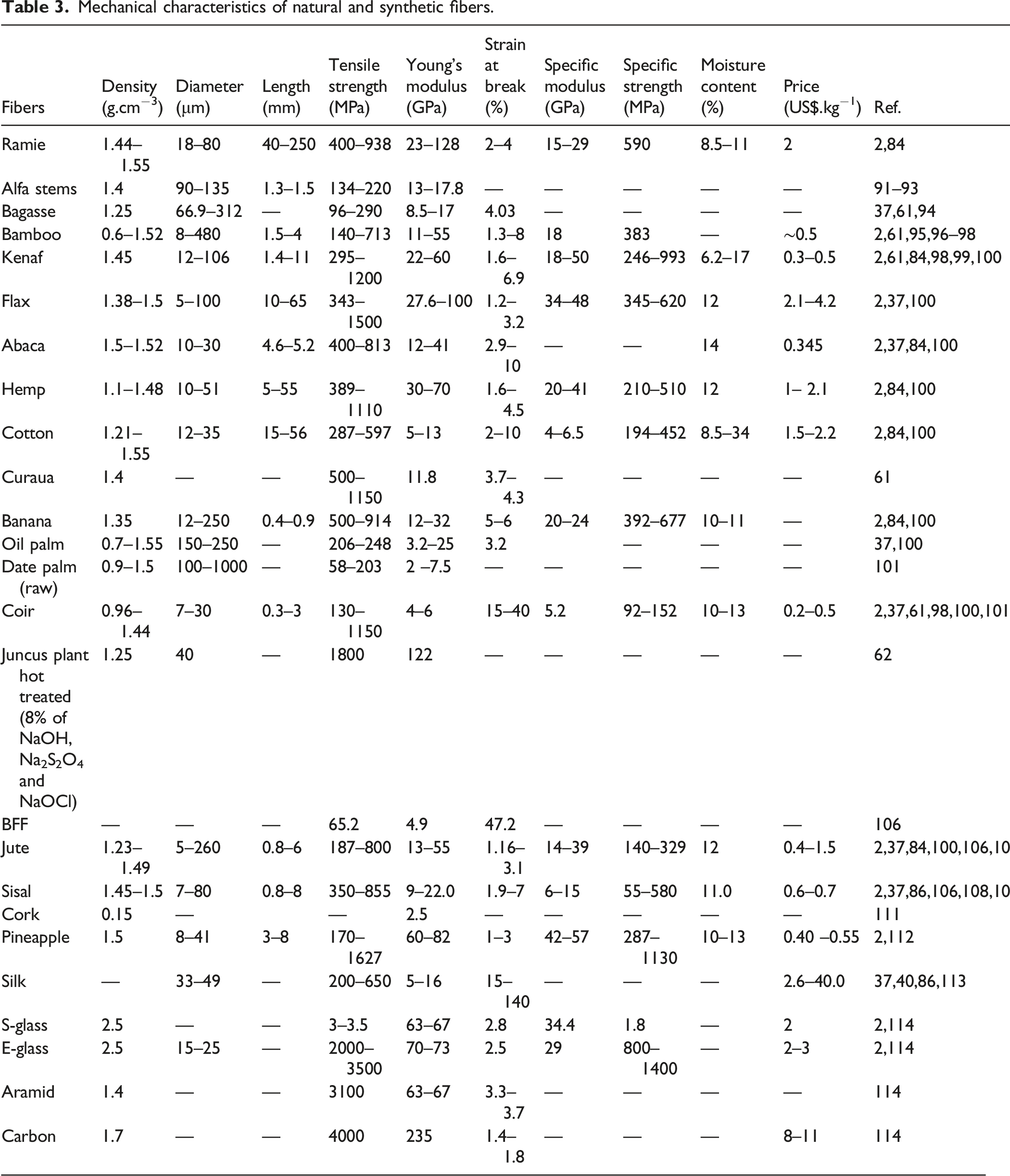
Mechanical characteristics of natural and synthetic fibers.
Natural fiber chemical characteristics.

Chemical modification
The bio-fiber’s use faces several limitations, 80 such as high moisture absorption, low compatibility between fiber and matrix, hydrophilic structure, etc. Therefore, to increase the surface properties of natural fiber and reduce its moisture absorption, it has been subjected to chemical modifications such as alkalization, Bleaching, silanization, acetylation, dewaxing, Seawater, benzoylation, cyanoethylation, graft copolymerization, etc.
Alkaline treatment
This method is one of the most widely used and economical techniques. It acts on the molecular structure of the fibers by removing pectins, hemicellulose, lignin, and wax which clothe the fiber surface to be cleaner, by adding aqueous sodium hydroxide (NaOH) to the natural fiber to facilitate the ionization of the hydroxyl group to the alkoxide natural fibres (fibre-Cell-O-Na).127,128
Bleaching treatment
The fibers are subjected to a bleaching test with calcium hypochlorite Ca (ClO)2 for about 45 min, after which they are washed with deionized water and dried in an oven at 80°C for 24 h. 127
Silane treatment
Silane is a versatile chemical element that is utilized to change fiber surfaces as a coupling agent. Among various coupling agents tested for natural fiber surface treatment, silane proved to be the most successful, forming a chemical bond between the fiber surface and the matrix via siloxane molecules. The absorption of silane is highly reliant on a number of parameters, including hydrolysis time, temperature, pH, etc. After the hydrolysis phase, the silanol created combines with the OH groups of the cellulose, while the second end reacts with the functional groups of the matrix. This process promotes the formation of hydrocarbon chains that reduce fiber swelling.2,127
Benzoyl treatment
This treatment is done in two steps: removal of waxes and impurities, then immersion of the fibers in a benzoyl chloride solution where the benzoyl group (C6H5CO) replaces the OH group of the natural fiber. It reduces the hydrophilic properties of the fiber and improves the interfacial adhesion between the fiber and the matrix.2,127
Acetylation treatment
During this treatment (esterification method), the acetyl group reacts with the hydrophilic hydroxyl groups of the fiber. To expedite the reaction, the fibers are immersed in acetic acid and acetic anhydride, respectively. As a result, the fiber’s hydrophilic nature is reduced due to the substitution of OH groups with acetyl groups, and its surface becomes smoother, thus improving the transfer of mechanical stresses to cell interfaces.2,127
Seawater treatment
This is the easiest and least expensive way to treat natural fibers. After testing the pH and salinity of the seawater, the fibers are placed in the water for 30 days before being cleaned and dried at ambient temperature. 127
Nature fiber reinforcement of biocomposite and biohybrid composite
Composites with natural reinforcements
Recent work on natural fibre reinforced biocomposites.

Racca et al. 137 studied the influence of talc particles in a PP matrix with experimental tests and mathematical models to determine the elastic modulus. The results indicate that the obtained modulus of elasticity grows with the proportion of particles. Nailia et al. 62 have valorized the green biomaterial, where this study aimed to characterize the fibers extracted from Juncus and to examine the influence of the chemical treatments performed on these fibers. They revealed that its Young’s modulus and tensile resistance are higher when treated with 8% NaOH, sodium dithionite (Na2S2O4), and sodium hypochlorite (NaOCl) at elevated temperature. Haba et al. 138 focus on measuring the hygienic and thermal properties of a composite material used in construction reinforced with 15 wt% date palm fibers by comparing the results obtained with other types of bio-composite materials used in the same field. Mechakra et al. 139 were interested in the mechanical characterization of composite with short fibers of alfa plants. The results obtained showed the influence of alkaline chemical treatment by the significant progression of the elastic modulus from 28.67% to 132.22% compared to virgin PP and also tensile resistance from 11.34% to 30.14% relative to the untreated fibers at 30% content.
In the same context, Rokbia et al. 140 investigated the impact of these alkali-treated fibers on the bending characteristics to define the ideal parameters for chemical treatment (NaOH). During the treatment of Alfa fibers with 10% NaOH in 24 h, the strength and Modulus of bending increased from 23 MPa to 57 MPa and 1.16 to 3.04 GPa. In contrast, these results decreased during treatment with 5% NaOH for 48 h, which was explained by the reduction of lignin. The two previous articles62,140 show the importance of chemical pretreatment of the fiber to eliminate unwanted substances and render it suited to use as a reinforcement in a composite, where the alkaline treatment affects the mechanical behavior of the fibers, especially on the strength and stiffness of the fibers. 141 Kumar et al. 125 performed a comparative study between untreated and treated raw coconut sheath fiber. They showed the impact of fiber chemical treatment on the composite properties; better fiber-matrix coupling. Song et al. 142 evaluated the thermal and viscoelastic characteristics of Poly Lactic Acid matrix composites with twilled and plain hemp tissues. With an increase in fiber volume fraction from 6 to 20%, they demonstrated that the thermal expansion coefficient of composites constructed with hemp fabrics dropped from 70 µm/°C to 10 µm/°C; however, their tensile and impact properties were 10% and 15% higher than those of the plain tissue. To reinforce a soybean resin, Behera et al. 143 studied woven and unwoven jute fibers with different contents ranging from 40 to 80 wt%. The maximum mechanical properties were obtained at 60 wt% jute for both materials, woven and non-woven jute composites. For the non-woven jute composites, the tensile properties are: 37.1 MPa for tensile strength and 1.04 GPa for Young’s modulus (E), yet the modulus and flexural strength are 1.12 GPa and 38.4 MPa, respectively. Regarding the woven jute composites, the tensile resistance and elastic modulus are 35.6 MPa, and 0.972 GPa Regarding the modulus and flexural resistance are 1.02 GPa and 33.5 MPa. According to Liu and al., 144 a basalt fiber with the right dimension can improve the traction, bending and impact characteristics of PLA. The non-notch impact strength of matrix improved to 34 * 103 J/m2 by combining 20% basalt fiber and 20% ethylene acrylate glycidyl methacrylate copolymer. In addition, the phases are tightly bound, as there is no void between the matrix and the fiber, while the matrix barely wets the fiber surface.
Hybrid composites
Hybrid composites with synthetic/natural fibers
Hybrid composites with natural-synthetic reinforcements.

Hybrid composites with natural fibers
Faridul et al. 105 studied the effect of melamine urea formaldehyde (MUF) on trilayered bio-composites reinforced with coir fibers and fibrous chips. They demonstrated the successful formation of bio-composite panels. Mbeche et al. 151 focused on the fabrication of hybrid bio-composites with a polyester matrix reinforced with sisal and cattail fibers. At a fiber content of 20 wt % (fiber mixture ratio varied between 0 and 75%), tensile, compression, and bending strength increased with optimum contents of 75/25 sisal/cattail ratio. Boujmal et al. 51 studied hybrid PP matrix bio-composites (70% wt) reinforced with Alfa fibers and clay particles with their total fillers constant at 30 wt %. They showed that the dispersion and interface interaction between the two fillers were good, that the elastic modulus, yield strength, tensile resistance changed with the filler content, and that the inclusion of clay enhanced the thermal stability of the matrix.
Hybrid composites with natural fibers.

Application sectors of bio-composites
Application fields of natural reinforcements.

The use of bio-composites is expected to become more diffused in industries foreseeable future. In this regard, it is important to broaden their applications by developing improved and innovative treatment techniques to address the shortcomings of natural fillers. Successful marketability of these biomaterials also requires surmounting the impediment of not recognizing the quality of R&D in developing countries (DCs), wherein natural reinforcements are abundant.
Modelling approaches
Modeling approaches have been employed to approximate the mechanical performance of composite based on the characteristics of their structural components (matrix/fiber), that is, they predict the responses of structures based on these materials to external stresses before their manufacturing. 13 Thus, modeling attempts to minimize the need for experimental tests and thus reduce their costs.168,169 Among the models used are Voigt “Rule Of Mixtures ROM,”170,171 Hirsch model, Reuss “Inverse Rule of Mixture IROM,” 172 rule of hybrid mixtures,164,169,173 Halpin-Tsai model,169,174,175 Hashin and Shtrikman model, 30 Mori-Tanaka, 150 Neerfeld-Hill Model, 176 self-consistent, 177 method of finite elements “MEF,” 178 etc.
Generally, the geographical shape of the fibers conditions the micromechanical model used. If the fibers are continuous and unidirectional, the mixing rule (ROM-IROM), the Hashin-Shtrikman model, and the classical laminate theory can be used. However, for shorter (random) fibers, there is the mixing rule, the Halpin-Tsai equations, the Tsai-Pagano equation,
179
Nielsen-Harris, Mori-Tanaka, Bowyer–Bader,180–182 self-consistent, Manera-Cox-Krenchel, Hirsch, Kelly-Tyson,183,184 generalized shear-lag analysis,
180
the stress transfer model,
185
etc. For particles, it is appropriate to use the mixing rule, the Halpin-Tsai equations, the Kerner-Nielsen model,
186
the Tsai-Pagano equation, etc. • Voigt (1910) - Reuss (1920) are the two simplest models to apply, represent respectively the maximum and minimum bounds of elastic properties (framing model).187,188 They are calculated from the volume fractions of the components (fiber/matrix), and their individual properties. The longitudinal178,189 and transverse175,190,191 moduli of the composite are predicted with Voigt and Reuss models, respectively. • Hybrid mixture rule (ROHM) is a derivative of the previous method, except that it is intended for hybrid composite with two types of fibers.169,179,192 • Neerfeld-Hill Model takes the arithmetic median of the values obtained by the two models Reuss and Voigt.176,193 • Hirsch model, a semi-empirical model, combined the two above-mentioned models: Voigt “the parallel law” and Reuss “the series law,” inserting an adjustable parameter “x” that defines the stress transfer between the fiber and matrix.175,190 Mainly, it is determined by the stress concentration at the extremities of the fibers, their orientations, and their lengths.
194
• Halpin-Tsai equations,
195
a semi-empirical model, is an approximate representation derived from self-consistent micromechanics.”196,197 They are applied in aligned short-fiber composites. In addition to the individual moduli of the matrix and fibers and their volume fractions, this approach accounts for fiber morphology via theL/D ratio. • Mori and Tanaka (1973) describes the material containing a high rate of inclusions with properties identical to those of the matrix,
199
assuming that these inclusions are distributed isotropically and embedded in an infinite matrix submitted to an average deformation.200–202 This model is applicable for a fiber volume rate not exceeding 30% to 50%. It considers the interaction between the inclusions,
203
the mechanical characteristics and, the volume fraction of the phases, their shapes, and their orientations.
204
• Finite element analysis is a numerical method oriented towards simulation applications used to model physical phenomena, and solve problems of complex bounded structures by partial derivative equations.198,205 This model is based on the division of the analyzed surface/volume into units of smaller size, this operation is called “mesh,” and it calculates the load at the level of each finite element.






Selection of a micromechanical model
Regardless of their microstructure, the models stated above are used to calculate the effective characteristics of heterogeneous materials. The architecture of the composite has a great influence on the choice of the relevant model. Therefore, it is crucial to take into account the volume fractions of the reinforcements, their spatial distribution, orientation, shapes, aspect ratio, and symmetries of the material. For example, Voigt-Reuss are the two simplest methods (less descriptive). They only consider a small number of microstructural parameters as volume fractions and tensors of all phases. 187 However, the shape, orientation, and spatial distribution of the reinforcements are not considered in these methods. Hashin and Shtrikman’s approach is constrained to a specific shape of reinforcement (small disks, long fibers, spherical reinforcements). Additionally, the boundary models (Voigt-Reuss and Hashin-Shtrikman) provide a framework for the effective properties. The Halpin-Tsai equations are more efficient than the laws of mixtures. 179 They take the volume fractions and properties of the phases, and the morphology of the fibers into account. Mori Tanaka and self-consistent have broader applications because of their potential to predict the performance of composites with a higher ratio of reinforcement. Indeed, Mori Tanaka has the advantage of being able to visualize separately the matrix in which the reinforcements are incorporated directly, as opposed to the self-consistent technique, where no distinction is made between the phases. Moreover, compared to the self-consistent model, Mori Tanaka offers the advantage of an analytical resolution. 25 As an application, Chichane et al. 128 provided a comparative and applicative study of analytical and numerical models using Voigt-Reuss models, Halpin-Tsai equations, the Hirsch model, and numerical simulation to predict the effective elastic moduli of composites and hybrid composites reinforced with natural reinforcements. The results obtained are compared with experimental data and show the advantages and disadvantages of each model.
Conclusion and perspectives
This article proposes a detailed review of the literature on naturally reinforced bio-composites. It presents the latest work on natural reinforced composites and hybrid composites, the different natural resources of reinforcements, their cultivation, their mechanical characteristics, and their chemical compositions, along with their uses in different industrial fields. It also presents the modeling technique, their approaches, and the procedure for choosing a model. The main conclusions reveal that the choice of green fibers as reinforcement requires consideration of their growing conditions (optimal temperatures, precipitations, etc.) and their geographical location, mechanical properties, and cost. Thus, natural reinforcements may be employed in their native state or modified after undergoing pretreatment procedures to remove unwanted substances and prepare them for use in a composite. They also point out that the chemical composition of the reinforcement has an influence on its mechanical properties. These characteristics can facilitate the determination of the suitable reinforcement type for a given application. Additionally, they highlight that the model providing the most accurate prediction of effective properties requires detailed access to microstructural information.
Footnotes
Declaration of conflicting interests
The author(s) declared no potential conflicts of interest with respect to the research, authorship, and/or publication of this article.
Funding
The author(s) received no financial support for the research, authorship, and/or publication of this article.
