




Abstract
This research was aimed at studying the preparation of polypropylene based wood plastic composite material by twin-screw extrusion. The effects of the addition of the maleic anhydride (MAH) and wood flour on WPC properties were evaluated. WPC with 4, 5, 6, 7, 8, 9, 10 wt% of MAH contents were prepared. The mechanical properties and water resistance of WPC were studied. The result showed that with the increasing of MAH, the tensile strength of WPC increases at first and then decrease, and water absorption reduced by 39%. After immersing in water for 24 h, the tensile strength of WPC decreases but the impact strength increases, and with the increasing of MAH, the reducing extent of tensile strength increases, but the improvement extent of impact strength gradually decreases. When the MAH content exceeds 8 wt%, the impact strength of dried WPC samples (dried for 24 h) can be recovered basically. WPC with 10, 20, 30, 40 wt% of wood flour contents were prepared. The result showed that with the increasing of wood flour, the tensile strength of WPC increases at first and then decreases, the impact strength decreases, and water absorption increased by 62%. When the wood flour content exceeds 10 wt%, the impact strength of dried WPC samples can only recover partially. WPC containing different wood meal sizes was prepared. The result showed that with the decreasing of wood flour particle size, the water absorption of WPC increases obviously. The impact strength of dried WPC samples is higher than that of unsoaked WPC, when the particle size of wood flour is 60 meshes. It can be seen from the SEM photos that the distance between the wood powder fibers becomes larger after 24 h of WPC soaking in water. The finer the wood flour, the easier it is to aggregate in WPC.
Introduction
Natural fibers are increasingly used for thermoplastic enhancement as an alternative to traditional synthetic fibers such as aramid and glass fibers for their low density, good thermal insulation and mechanical properties, reduced tool wear, unlimited availability, low cost, and problem-free handling. 1 Wood-plastic composite material (WPC) not only has the texture of natural wood but also can be processed by extrusion molding, injection molding, blow molding, compressing, thermal molding, etc. 2 WPC overcome the anisotropy of natural lumber such as warping, deformation, mildew, and infestation by insects and ants. The problems of wood shortage and waste wood recycling can also be solved. 3 Therefore, WPC are truly green products and widely used in the construction industry. However, whether WPC are used as outdoor building materials or indoor household materials, they will contact with water, so the material must have certain water resistance. Polypropylene-based WPC were prepared in this study.
In recent years, the research on wood-plastic composite materials has been continuing, and the material range of wood powder is becoming more and more extensive.
Abbas Ghanbari et al. 4 prepared thermoplastic starch (TPS) from cornstarch flour using twin screw extrusion. And the composite material consists of cellulose nanofibers (CNFs) and TPS were prepared. The properties of the composite were optimized.
Madhoushi et al. 5 used waste sanding dust instead of wood powder as a reinforcing material for thermoplastics. The effects of sanding dust loading and nanoclay content on the physical and mechanical properties were also studied. The waste sanding dusts content has a significant effect on the physical and mechanical properties.
Ashori et al. 6 used agricultural waste (i.e., bagasse fiber and corn stalk fiber) instead of wood flour for wood-plastic composites. Incorporation of agro-waste fibers in PP matrix considerably decreased the water uptake and thickness swelling of the hybrid composites.
Lee D, Kim B. 7 investigated the effect of environmentally friendly flame retardants (EFFRs) on the mechanical, thermal, morphological, and water absorption properties of wood flour (WF)/talc/polypropylene (PP) composites in comparison with neat PP.
M. N. Islam 8 used cold neutron radiography (CNRF) to study the water absorption properties of different kinds of wood-plastic composites. The water absorption thickness of the sample can be easily observed and measured from radiographic images.
X Zhang 9 prepared hyperbranched polymer via single electron transfer living radical polymerization. This copolymer can be used in wood-plastic composites.
Experimental section
Materials
Powers of poplar with particles size at 40, 60, and 80 mesh. Polypropylene with a melting point of 170°C. Maleic anhydride (MAH) at analytical grade. Antioxidant 1010 at analytical grade. Stearic acid with iodine value of 8. Zinc stearate, liquid paraffin, high-grade dicumyl peroxide (DCP), acetone (analytical grade).
Sample preparation
The preparation of maleic anhydride grafted polypropylene (MAH-g-PP)
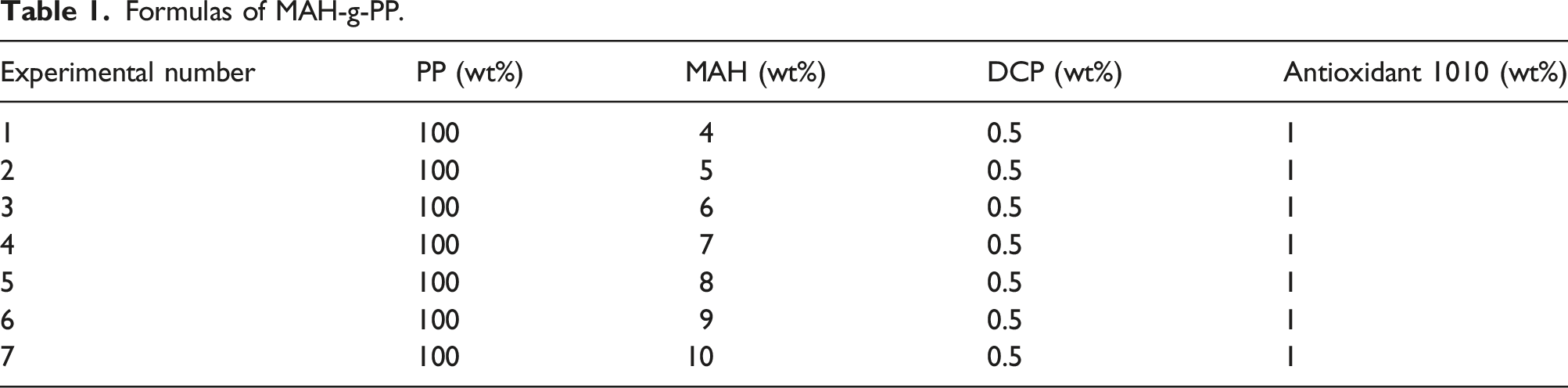
Formulas of MAH-g-PP.
The temperature in each zone of the extruder.

Preparation of PP-based WPC
The formula of WPC.

The temperature in each zone of the extruder.

Characterization
The preparation of WPC samples needs to be placed for more than 24 h in order to eliminate the stress and avoid affecting the test results.
Mechanical property test
The tensile strength was tested according to GB/T 1040-2006. The notched impact strength was tested according to GB/T1043.1-2008.
Water absorption determination
The sample was cut into small blocks, the dimension of block was 10 mm × 10 mm×4 mm. One block mass was weighed in the air (denoted as m1). The block was soaked in water for 24 h, then the surface moisture of the block was dried. Immediately measure its mass (denoted as m2). The water absorption of WPC was calculated using the following formula
Water resistance evaluation
The mechanical properties of samples were compared before soaking in water, after soaking in water for 24 h and after drying for 24 h.
Characterization of fiber distribution inside the material
The distribution of fibers in the material was characterized by image analysis. The changes of the internal structure of wood plastic materials before and after soaking were compared. The effect of wood powder particle size on fiber distribution was analyzed.
Results and discussion
The effect of MAH content in PP-g-MAH on the water absorption and mechanical properties of WPC
Because it contains many hydroxyl groups, wood flour has strong water absorption. 10 Moreover, its compatibility with PP matrix is not good, and it is easy to agglomerate, thus reducing the dispersion effect of wood flour in resin species. Therefore, the mechanical properties of wood plastic materials are poor. This defect can be improved by adding compatibilizer. 11 In this study, PP-g-MAH was selected as compatibilizer. The effects of MAH content in compatibilizer on the properties of PP-based WPC (the particle size and dosage of wood powder were fixed at 80 mesh and 30 wt%, respectively) were investigated.
It can be seen from Figure 1 that the water absorption of WPC decreases with the increase of MAH content. This is due to the reaction between the anhydride in MAH and the hydroxyl group on the wood powder, which reduces the hydroxyl content and thus reduces the water absorption of the material (improved water resistance). The higher the MAH content, the smaller the deviation of water absorption of the sample of the same formula. It can be inferred that the more uniform the structure inside the material. Effect of MAH content on water absorption of WPC.
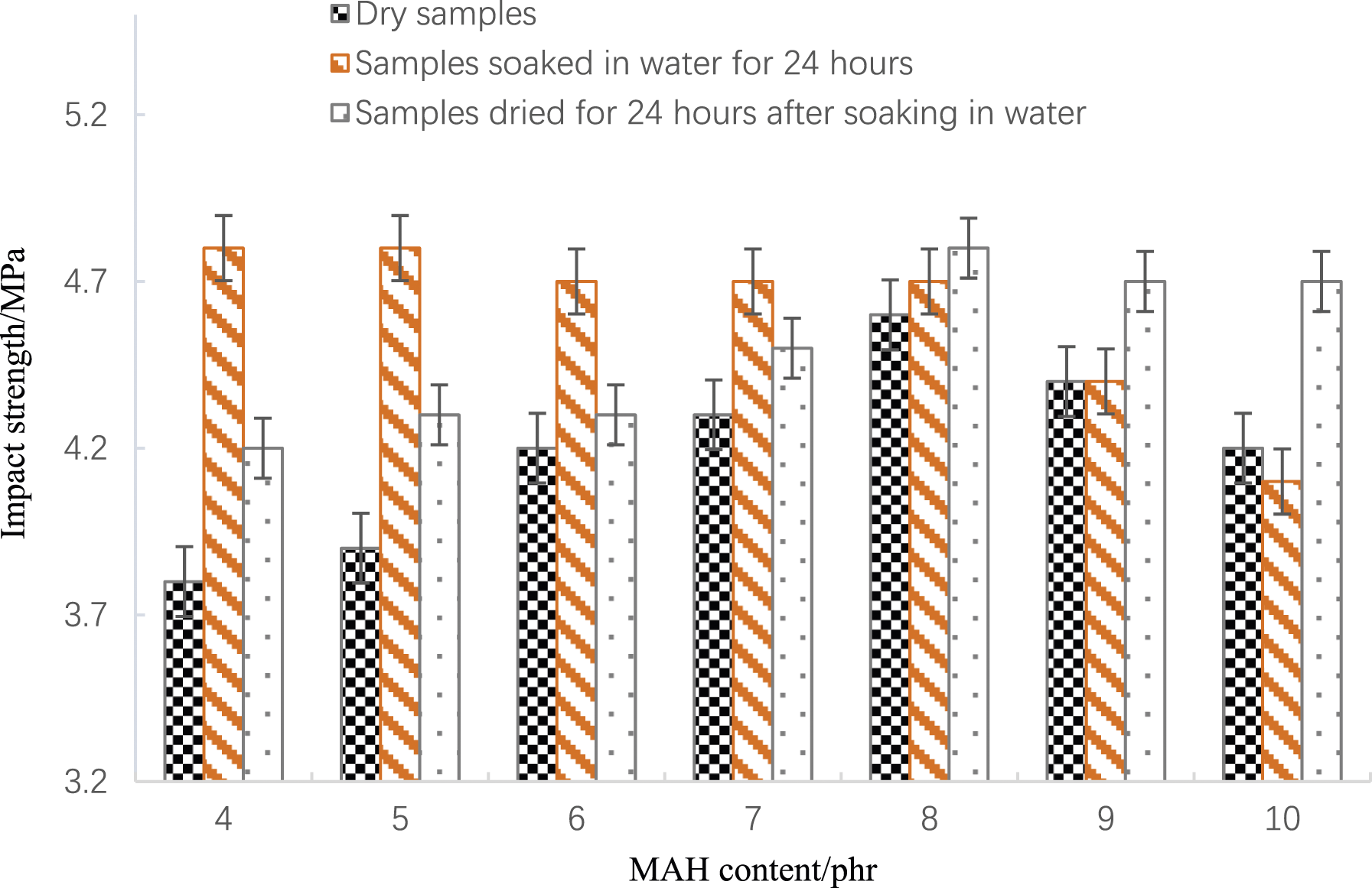
The effect of MAH content in compatibilizer on WPC samples was showed in Figure 2. The mechanical properties of the samples were tested under three conditions: drying, soaking in water for 24 h, and drying for 24 h. It can be seen from Figure 2 that the tensile strength and impact strength of WPC are gradually increased when the content of MAH in compatibilizer is increased from 4 to 8 wt%. This is mainly because the anhydride group on MAH can react with the hydroxyl group on wood flour to form an ester group, which produces chemical bonds and improves the interfacial compatibility between wood flour and PP matrix. However, when the content of MAH was more than 8 wt%, the mechanical properties of WPC decreased. This was because the grafting reaction rate of PP-g-MAH decreased when the content of MAH was too high, and the residual DCP would cause PP degradation during the preparation of WPC. In addition, compared with the unsoaked sample, the tensile strength of the soaked sample decreased, and the decrease tended to be significant with the increase of MAH content. At the same time, the impact strength of the soaked sample is improved, and the higher the MAH content, the smaller the increase. This is mainly due to the intervention of water molecules to destroy the hydrogen bonds between the molecular chains, thereby reducing the tensile strength of WPC. The water can act as a plasticizer for WPC, so the impact strength of the material is increased. It can also be seen from Figure 3 that when the soaked sample is dried and placed for 24 h, the impact strength and tensile strength of the material are basically restored to the original state. The change of tensile strength under different conditions. The change of impact strength under different conditions.
The effect of wood flour content on the water absorption and mechanical properties of WPC
The increase of wood flour content will increase the processing viscosity of WPC to a certain extent, thus affecting its mechanical properties. 12 At the same time, the hydroxyl group on the wood flour will also affect the water resistance of WPC. 13 In this study, PP-g-MAH with MAH content of 8 wt% was selected as compatibilizer to investigate the effect of wood powder (80 mesh) content on the properties of WPC.
The effect of wood flour content on the water absorption of WPC was showed in Figure 4. It can be seen that with the increase of the amount of wood powder, the content of hydroxyl in WPC gradually increased, so that the water absorption of WPC also increased significantly. Effect of wood flour content on water absorption of WPC.
The effect of wood flour content on WPC samples was showed in Figure 4. The mechanical properties of the samples were tested under three conditions: drying, soaking in water for 24 h, and drying for 24 h. It can be seen from Figure 5 That the tensile strength of dry samples was gradually increased with the increase of the content of wood flour. When the wood flour content was more than 30 wt%, the tensile strength decreased rapidly. This is because wood flour is a kind of fiber material, which can play a certain role in strengthening PP matrix.
14
However, when the amount of wood flour is too much, the force between PP molecular chains will be destroyed, thus reducing the tensile strength of the material. In addition, the increase in the amount of wood flour increased the probability of wood flour agglomeration, resulting in the phenomenon of stress concentration in WPC, thus reducing the impact strength of the material (as shown in Figure 6). It can also be seen from Figure 5 that compared with the drying sample, the tensile strength of the sample soaking in water for 24 h decreased. However, the tensile strength of the material only increased slightly when the samples were dried for 24 h. When the content of wood flour was more than 10 wt%, the tensile properties of the materials could not be restored to the state before soaking. This is mainly due to the increase in the amount of wood flour resulting in increased water absorption of the material, and the water cannot be quickly volatilized in a short time.
15
It can also be seen from Figure 6 that when the amount of wood powder exceeds 10 wt%, the impact strength of the samples soaked in water were slightly increased compared with that before immersion. For the soaked sample after drying, when the amount of wood flour was less than 30 wt%, the impact strength was higher than that of the unsoaked sample, but when the amount of wood flour exceeded 30 wt%, the impact strength of the material was lower than that of the unsoaked sample. This is mainly due to the excessive water absorbed by the wood powder in the material at this time, so that the hydroxyl content is much higher than the carboxyl group produced by the hydrolysis of PP-g-MAH, resulting in incomplete reaction between the two.
16
In summary, the less the amount of wood powder, the better the water resistance of WPC. With the change of wood powder content, the water absorption deviation of the same formula sample did not change much. Therefore, the wood powder content had little effect on the uniformity of the internal structure of the material. The tensile strength of WPC before and after soaking changed with the content of wood flour. The impact strength of WPC before and after soaking changed with the content of wood flour.

Effect of particle size of wood flour on water absorption and mechanical properties of WPC
The amount of hydroxyl in the fiber of wood flour is different with different particle size. 17 In this study, PP-g-MAH with MAH content of 8 wt% was selected as compatibilizer. The effect of wood flour particle size on the properties of WPC was investigated when the amount of wood flour was 10 wt%.
The effect of wood powder particle size on the water absorption of WPC was shown by Figure 7. The water absorption of WPC increases with the decrease of wood flour particle size (mesh increase). This is because the smaller the particle size, the larger the specific surface area of the wood flour particles, which in turn increases the hydroxyl content. The smaller the particle size of wood flour, the smaller the deviation of water absorption of the same formula sample, which indicates that the smaller the particle size, the lower the internal uniformity of the material. Effect of wood flour particle size on water absorption of WPC.
Figure 8 showed the influence of wood particle size on the mechanical properties of WPC samples (including dried samples, soaked samples, and soaked samples after drying). For dried samples, the mechanical properties of WPC basically increased as the particle size of wood flour decreased. This is mainly due to the decrease of wood powder particle size, which leads to the increase of its specific surface area, thereby enhancing the interfacial force of the composite material. However, too small particle size of wood flour will make it easy to agglomerate, which will affect the dispersion of wood flour in WPC. Therefore, when the grain size of wood meal exceeded 60 mesh, the tensile strength of WPC decreased (Figure 8). It can also be seen from Figure 8 that compared with dried samples, the tensile strength of soaked samples decreased, while the impact strength slightly increased. In addition, when the soaked samples were dried and placed for 24 h, the tensile strength of the samples basically returned to the state before soaking treatment, in which the particle size of wood powder had little effect (Figure 8). However, the impact strength of the sample can be basically restored only when the particle size of the wood flour is larger. When the particle size was 60 mesh, the impact strength of the sample was significantly higher than that before immersion (Figure 9). Overall consideration, the wood meal size of 60 mesh is more suitable. The tensile strength of WPC before and after soaking changed with different particle sizes wood flour. The impact strength of WPC before and after soaking changed with different particle sizes wood flour.

Changes of internal structure of materials before and after soaking in water
The sample with 40 parts of wood powder flour was selected for the test. As shown in the Figures 10 and 11, the sample after 24 h of drying after soaking in water cannot return to the state before drying. The distance between wood fibers became larger. As a result, the intermolecular forces decrease. This also explains that in Figure 5, the mechanical strength of the material after drying cannot be restored to the state before drying. Microstructure of dried samples. The sample after 1 day of drying after soaking in water.

The effect of particle size of wood flour on the internal structure of the material
Wood powder samples with particle size of 60 mesh and 80 mesh were selected for comparison. Through the electron microscope observation. The internal structure of the sample is quite different. As showed in Figures 12 and 13, the wood powder particle size is 40 mesh sample, the internal structure is relatively uniform. The sample with a particle size of 80 mesh showed obvious agglomeration of wood flour. The uneven internal structure of the material will affect the mechanical properties of the material. This also explains that in Figure 8, the particle size of wood flour is small, but the mechanical strength of the material will decrease. The smaller the particle size of wood flour, the greater the deviation of water absorption of the material. The sample of 60 mesh wood powder particle size. The sample of 80 mesh wood powder particle size.

Conclusions
With the increase of MAH content in the compatibilizer, WPC water absorption gradually decreased. The mechanical properties of the material were the best when MAH content was 8 wt%. After immersion, the tensile strength of WPC decreased, and the impact strength of WPC was improved. After drying and placing for 24 h, the mechanical properties of WPC can basically return to the original state.
The content of wood powder can affect the mechanical properties of materials and the water absorption. When the amount of wood powder was more than 10 wt%, the tensile strength of the soaked sample after drying could not be completely restored. When the amount of wood powder is more than 30 wt%, the impact strength of dried sample is lower than that of unsoaked sample.
With the decrease of wood particle size, the water absorption and impact strength of WPC increased, while the tensile strength increased first and then decreased. In addition, particle size has little effect on the recovery of tensile strength of WPC soaked samples after drying, but has a great effect on the recovery of impact strength.
The smaller the particle size of wood flour, the more difficult it is to disperse in WPC, and the higher the probability of agglomeration. After water absorption, the internal structure of WPC will change, and the distance between wood powder fibers will become larger, which will affect the mechanical properties of WPC to a certain extent.
Footnotes
Declaration of conflicting interests
The author(s) declared no potential conflicts of interest with respect to the research, authorship, and/or publication of this article.
Funding
The author(s) received no financial support for the research, authorship, and/or publication of this article.
