



Abstract
There have been gradually increasing interests in the stratospheric airship (SSA) as a cost-effective alternative to earth orbit satellites for telecommunication and high-resolution earth observation. Lightweight and high strength envelopes are the keys to the design of SSAs as it directly determines the endurance flight performance and loading deformation characteristics of the airship. Typical SSA envelope material is a laminated fabric, which is composed of fabric layer and other functional layers. Compared with conventional composite structures, the laminated fabric has complex nonlinear mechanical characteristics. Artificial neural network (ANN) has good processing ability to nonlinear information so that it is suitable to model the constitutive relation of laminated fabrics. In this work, an ANN based on the Scaled Conjugate Gradient (SCG) algorithm is proposed firstly to model the constitutive relation of fabric Uretek3216LV. Considering significant errors of the SCG ANN results, the network model is optimized through methods of selecting the number of hidden-layer nodes and training algorithms. Results show that the improved network model based on Bayesian Regularization (BR) algorithm and eight nodes of single hidden layer can better describe the constitutive relation of the laminated fabric than other conventional training algorithms. The proposed constitutive modelling method with ANN is expected to gain a deeper understanding of the mechanical mechanism and guide structural design of envelope material in further work.
Keywords
Introduction
The stratosphere, with a height of 10 km–55 km, is a space between the troposphere and the mesosphere.1,2 Considering the stability of airflow in stratosphere, it is of great significance to develop special aircraft which can operate in this environment. Among them, stratosphere airship (SSA) has gradually become an interest in the stratospheric aircraft design area. SSA is a sort of Lighter-Than-Air (LTA) vehicle operating in the stratosphere of about 20–25 km, with characteristics of long-time endurance, fixed point residence and wide communication coverage.
3
The special shape design of SSA results in various radiuses of curvature. In the rising process, SSA is gradually filled with gas and the curvature of its envelope changes. In addition, significant temperature change during prolonged stay at the bottom of the stratosphere will cause obvious pressure difference between the inside and outside of the envelope. Different parts of the envelope are subjected to stresses in different directions due to the radiuses of curvature.4,5 These factors indicate that stress ratios have great impacts on mechanical response of the envelope material,
6
and it is the reason that this paper focuses on constitutive relation modelling of the envelope material under biaxial tensile test. Considering complex working condition, any kind of material with a single component cannot satisfy the requirements of SSA. The widely used envelope material of SSA shown in Figure 1 is a laminated fabric that consists of five functional layers, including wearable layer, ultraviolet layer, fabric layer, gas retention layer and sealing layer.
7
The fabric layer, composed of Vectran fibre plain weave fabric, is the major load-carrying structure. The functional membrane layers of the envelope are laminated or heat sealed by different membrane materials to meet requirements for ultraviolet protection, ozone protection, heat preservation and helium resistance. Envelope material of SSA: (a) fabric membrane composite and (b) microstructural model.
Mechanical analysis of the envelope is shown in Figure 2, where the pressure difference between inside ( Mechanical behaviour of the envelope.
To better guide the structural design of SSA, it is necessary to accurately simulate the constitutive relation of the envelope fabric. Envelope fabrics have been widely applied in large-span architecture envelope9,10 and some airships flying at low altitudes. 11 To accurately describe their mechanical behaviours, envelope fabrics can be regarded as elastic, nonlinear-elastic, 12 viscoelastic 13 or viscoplastic 14 in many analysis models. Traditional studies on constitutive modelling of envelope fabrics include experimental study and simulation analysis. Kumazawa et al. 15 carried out biaxial tensile tests with different stress ratios and obtained the elastic constant of membrane material by the law of orthotropic complementarity. Galliot et al. 16 proposed a simple model to describe nonlinear biaxial tensile behaviour of PVC-coated fabrics. Chen et al. 17 presented a least residual strain theory and analysed the tensile modulus and Poisson’s ratio of warp and weft yarns.
The complex environment of stratosphere makes it difficult and costly to set up an experimental platform on the ground and analyse the constitutive relation of fabric structures. Additionally, it is difficult to obtain accurate constitutive relations of the envelope fabrics through traditional mathematical derivations by reason of complex nonlinearity. Artificial neural networks (ANNs) are a family of algorithms based on the imitation of biological neural networks and they are good at estimating the tendency of nonlinear and multivariable functions based on a large amount of data 18 ANNs have been applied to a wide range of problems, such as prediction of mechanical properties, machine control and constitutive modelling. It provides a new concept for mechanical analysis of envelope fabrics. Lin et al. 19 constructed an ANN model to depict the flow behaviours of TC18 titanium ally. Colasante et al. 20 designed a neural network capable of modelling the shear behaviour of coated fabrics employed in architecture. Jung et al. 21 presented a new rate-dependent neural network constitutive model formulation and implemented it in finite element software, which has good potential to describe any rate-dependent material behaviour. However, ANN has not been applied yet as a tool for modelling the constitutive relation of SSA fabric structures accounting for stress ratios and existing network models are not applicable to this study.
An appropriate network model is very important for modelling the constitutive relation of envelope fabrics. Back propagation artificial neural network (BP ANN) is the simplest and most widely used ANN. It is a tutor-learning algorithm that can easily approximate any highly complex nonlinear function. 22 However, standard BP network has some deficiencies such as slow convergence rate and getting into local minimum. 23 Back propagation algorithms that can converge faster have been developed. Among them, Scaled Conjugate Gradient (SCG), Levenberg–Marquardt (LM) and Bayesian Regularization (BR) are able to obtain lower mean squared errors than standard BP algorithm. SCG is a conjugate gradient method to avoid linear search per learning iteration and has the advantage that there are no predefined parameters. 24 LM is especially developed for faster convergence in backpropagation algorithms. 25 SCG converges almost as fast as LM, but as network size grows, SCG performs better and needs smaller storage space than LM. 26 BR is an objective function that includes a residual sum of squares and a sum of squared weights to minimize estimation errors and achieve a better generalization capability than LM.27–29 The learning performance of ANN is related to data preprocessing, training functions and the number of hidden-layer nodes. There are few studies on the optimization of ANN model based on experimental results of biaxial tension of envelope fabrics, which is essential to explore the possibility of using ANN to predict the constitutive relation of SSA envelope fabrics.
To remove these limitations of the mathematical derivation methods and existing ANN models in estimating the constitutive relation of the typical airship envelope fabric Uretek3216LV under biaxial tension, a typical SCG ANN model is trained firstly because of its low demand for storage space and sample size. However, the learning results show that the SCG ANN model exhibits poor performance, so the main work for this model is to optimize the number of the hidden-layer nodes and training algorithms. An optimal ANN model with eight nodes in the hidden-layer and Bayesian Regulation as the training algorithm is proposed in this paper, namely, BR ANN model. Results show that the BR ANN model can model the constitutive relation of the fabric Uretek3216LV with higher precision than SCG ANN in a short period of time. Additionally, the BR ANN model has ability to accurately predict the mechanical response of the envelope material with different stress ratios.
This paper firstly introduces the design of the fabric material and biaxial tensile tests in Material and experimental method. Sequentially, the establishment and training of the artificial neural network are presented in Design of artificial neural network. To optimize the learning performance of the network model proposed in Design of artificial neural network, the methods of selecting the number of hidden-layer nodes and training algorithms are given in Optimization of network structure. Additionally, some discussions on the learning performance of the optimized network model and the comparison between the experimental data and the ANN predicted data are also stated in this section. Finally, some conclusions are presented in Conclusion.
Material and experimental method
Material
Material parameters of the fabric Uretck3216LV.

Under overpressure, the deformation behaviour of the laminated fabric is confirmed similar to nonlinear biaxial tension.
32
It is clear that the fabric is subjected to orthogonal stresses 
In equation (1), the ratio of
Biaxial tensile test
The biaxial tensile tests are performed on cruciform specimens with their arms aligned to the warp and weft directions of the fabric,
33
according to the geometry depicted in Figure 3. The cross area of the specimen is 160 mm × 160 mm and the effective cantilever is 160 mm. Slits are cut in each arm of the specimen to obtain a homogeneous tensile stress in the centre of the specimen even for large deformations. Additionally, the shape of the cross corner is rounded with a radius of 25 mm to avoid the stress concentration.
34
. The cruciform arms are loaded independently by two clamps mounted on a loading car. The loading car of each arm is equipped with a load transducer to measure the load applied to the specimen. The strains are measured by two needle extensometers, which are placed in the warp and weft directions and bolted on the test specimen using small diameter screws. Dimensions of the specimen for biaxial tensile tests (unit in mm).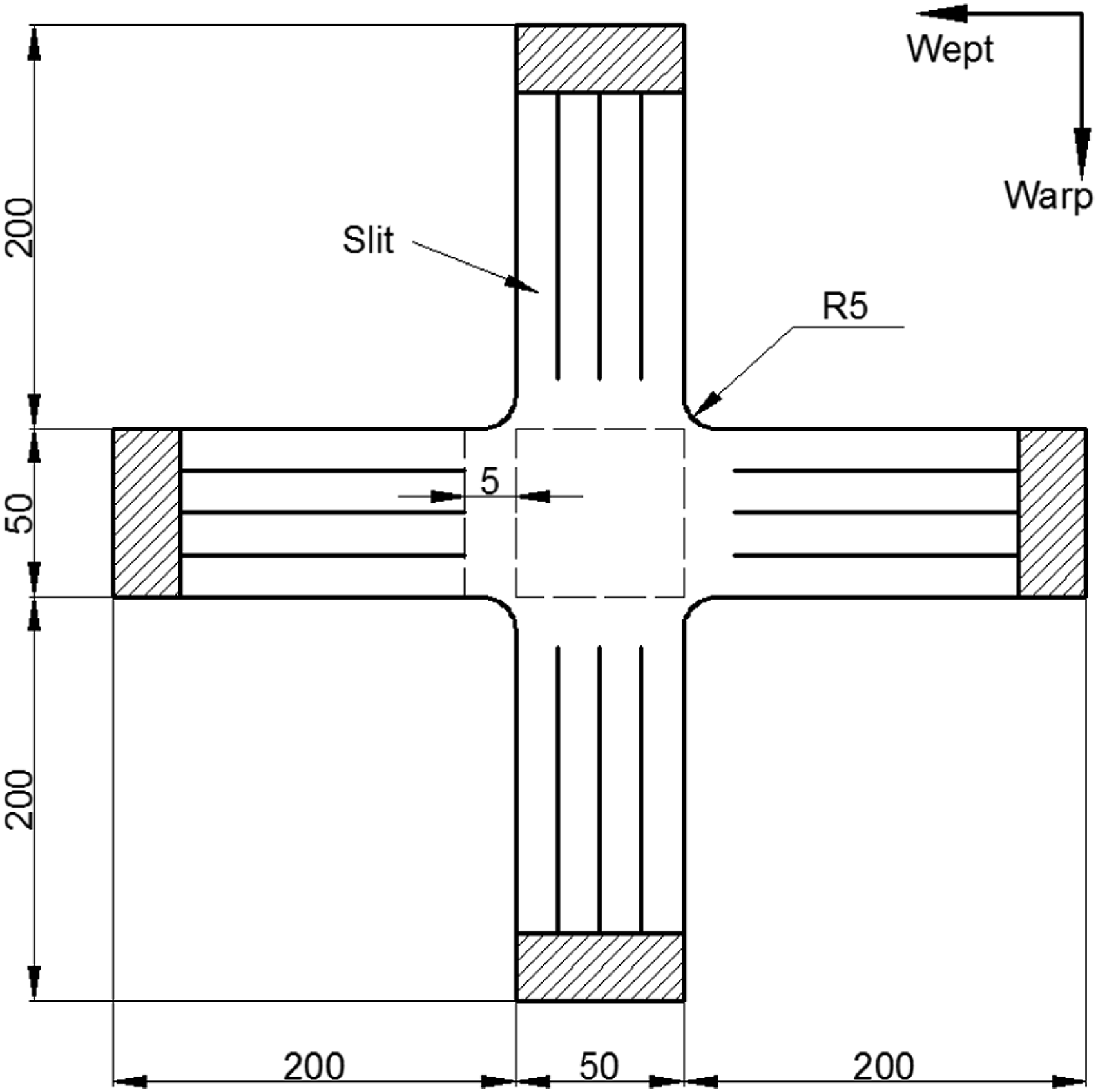
The material of the SSA envelope structure is different from the traditional architectural membrane structures. The range of the stress ratios of the envelope material for SSA is relatively concentrated, which basically between 1:2 and 2:1
30
To highlight the stress ratios in this region, five kinds of stress ratios are selected in this paper: 1:1, 1.3:1, 1.5:1, 1.7:1 and 2:1. Specimens of the laminated fabric are tested with a biaxial tensile testing machine shown in Figure 4. The different loading ratios are shown in Table 2. There are 15 specimens with the same size, and the five loading conditions are all carried out by three specimens, respectively. Tests are carried out by load-controlled method to get precise control of the stress ratios in warp and weft direction. Prestressing specimens before loading conditions are carried out to prevent specimens from relaxing or slipping. Biaxial tensile test of the specimen. Layout of different loading ratios.

Result of tests
Considering space limitation, one test result of each loading condition is selected to picture the deformation trends in Figure 5. As shown in Figure 5, stress–strain curves reveal obvious nonlinear constitutive relation of the laminated fabric. It can be seen in Figure 5 that the stress–strain curves with different stress ratios have the same trend. The failure of the biaxial tensile specimens occurred in the central region. The central region of the specimen was stretched and broken. Fracture of the central region of the specimen, without shrinkage deformation, and the fibre yarn bundle fracture occurred almost at the same time. The failure strength and failure strain of the five groups of tests in warp direction have small difference (10%) between each other. The displacement elongation varies slightly under different stress ratios. This may be resulted by discrete type of fabrics
35
. Experimental results of biaxial tensile test (linear stages: stage 1 and stage 3; nonlinear stage: stage 2).
Design of artificial neural network
Network structure design
In consideration of the structural design of SSA envelope, stress values of the fabric vary in different directions. The envelope fabric is considered as a plain-woven composite
36
With the fabric loaded, the mechanical properties of warp and weft yarns vary greatly with the geometrical structure of the fabric and the weaving process of warp and weft yarns. As the plain-woven technique is employed to the fabric, the effect of shear strain is ignored when modelling its constitutive relation. The constitutive relation of the fabric is an explicit formula through traditional mathematical modelling method, which can be expressed as
The major work to analyse nonlinear constitutive relations of materials through mathematical method is to figure out an explicit coefficient matrix
Different from mathematical derivation, ANN does not depend on mathematical equations and numerous material parameters, which avoids errors from assumption and simplification of equations. 38 It makes ANN good at modelling constitutive relations of composites and a good candidate in constitutive modelling research. SCG algorithm, a second order training algorithm for training ANN, can be regarded as something intermediate between gradient descent and Newton method. It is motivated by the desire to accelerate the convergence of gradient descent method. It also avoids the information requirements associated with the evaluation and storage, as required by Newton method. 39 The training process of SCG ANN is constituted by two parts: forward propagation of data and back propagation of weights adjustment. 40 .The above process is iterated till the error reaches an acceptable range and network ends up training.
The structure of SCG ANN is illustrated in Figure 6. The input layer has two nodes, which represent the warp stress Architecture of SCG ANN
In the process of ANN forward propagation, the activation function plays an important role in transmitting and calculating data from the input layer to the hidden and the output layer. Different from mathematical derivations, the activation function between the hidden layer and the input layer is a nonlinear function, which enables any input parameters to map to a specific range. The existence of the activation function makes outputs of the network no longer a linear function of inputs and ANN can approximate any function.
41
In this paper, hyperbola tangent function (tanh)
42
is used as the nonlinear activation function for hidden-layer nodes. Tanh function is defined as shown hereafter


Numerical implementation
The work is coded with the Neural Network Toolbox in MATLAB platform. The input data is divided into the training (70%), the validation (15%) and the testing (15%) subsets. Firstly, a two-input and two-output SCG ANN model is established by analysing the physical process of biaxial tensile tests. Then, the experimental data needs to be preprocessed before training the ANN. The method of data preprocessing will be introduced in Preprocessing of sample data. The experimental results are transformed into vectors through preprocessing and used to train ANN model. Training process is automatically executed by the MATLAB toolbox.
Preprocessing of sample data
Deformation data are collected from biaxial tensile tests. Before training the ANN model, experimental data needs to be preprocessed, including data sorting and normalization.
Influence of sample pretreatment on the network training.

Analysis of training results
In this paper, deformation values are obtained through biaxial tensile tests with different stress ratios. According to the network structure proposed in Figure 5, stress values in warp and weft directions are taken as input nodes and the corresponding strain values as output nodes. The number of hidden-layer nodes is 4. The whole process of network training is shown in Figure 7. After iterations, weights and biases inside the network model are updated and the learning results are obtained. Comparing the network learning results with experimental results, the nonlinear processing and generalization capability of the proposed SCG ANN model are discussed. SCG ANN establishment and training process.
The Mean Squared Error (MSE) between the predicted and experimental values is used to verify the predictability of the established model.
43
it can be expressed as Validation performance of the SCG ANN model.

Regression result of the SCG ANN model is shown in Figure 9. Relative coefficient, R is a relative measure of error. The closer R approaches 1, the better performance network model shows. The relative coefficient, R is calculated as follows Regression result of SCG ANN.

As shown in Figure 9, the data trained by SCG ANN has poor regression performance with the overall regression value 0.94143. To visualize the final learning effect of SCG ANN, Figure 10 shows the comparison of network learning results and the corresponding experimental results. It is obvious that most of SCG ANN learning strain values both in warp and weft directions under all stress ratios are not consistent with experimental results. Comparison of network output data and experimental data. (a) Warp direction and (b) weft direction.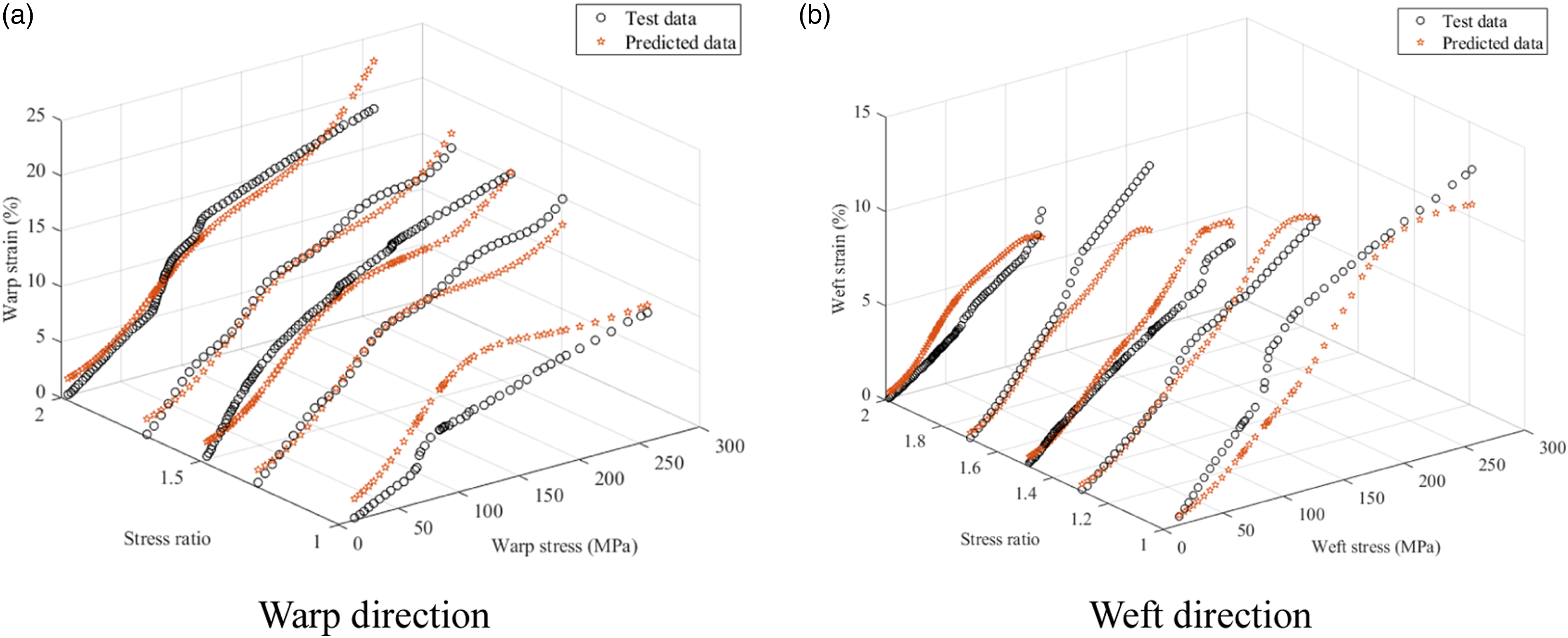
The poor learning performance of the SCG ANN model may be attributed to the non-optimized number of hidden-layer nodes and the improper training algorithm. The former badly affects learning capacity of ANN and the latter reduces the iteration efficiency and generalization capability of network models. 44 Therefore, this paper optimizes the network structure from these two aspects.
Optimization of network structure
Adjustment of the training function
For the network structure, it is note that not the smaller training error is, the better learning effect would be. Controlling the training error to be very small may lead to a local minimum and weaken the generalization ability of ANN models. Choosing an appropriate training function can not only avoid local minimum, but also improve the prediction ability of ANN models.
Results in Figure 10 reveal that SCG ANN performs poorly in learning the nonlinear constitutive relation of the laminated fabric. Some network outputs deviate from target outputs for a large scale. To find a network model which can learn constitutive relation of the laminated fabric accurately, BR algorithm has become an alternative training function.
LM algorithm is the basis of BR algorithm and is widely used in solving nonlinear least square problems with small network structure and has advantages on the convergence rate and approximation accuracy. Derivation of LM algorithm is shown in Appendix A. LM algorithm can monitor the learning process of the network, modify the iterative variable layer by layer and effectively improve the convergence rate of standard BP neural network. However, LM-based BP ANN relies highly on the amount of new input sample, which behaves poorly in predicting new deformation data in this work. BR algorithm is an optimization on LM algorithm in calculating the square sum of errors. The undetermined coefficients in the equation of the square sum of errors can be obtained quickly, which improves the learning rate and prediction accuracy of the network model.
The square sum of error is written by the BR algorithm as follows



The training function of the SCG ANN is optimized by BR algorithm in this paper for its capability in adjusting weights and errors in the network structure. The optimized ANN model is called BR ANN model. According to the constitutive relation of the laminated fabric shown in equation (2), experimental results are brought into the BR ANN model for learning. Detailed analysis on the results will be discussed in the following section.
Optimization of nodes in the hidden layer
Apart from the adjustment of the training function, hidden layer plays an important role in the iteration and prediction. Selection of the number of hidden-layer nodes is a complex problem. It depends on the experience of network designers and trial-and-error approaches. There is no theory about how to calculate the exact number of hidden-layer nodes at present
40
. The number of hidden-layer nodes is related to the problem to be solved and the number of input/output layer nodes. If the number of hidden-layer nodes is less as compared to the complexity of the problem data, the underfitting problem occurs and the nodes in the hidden layer is not many enough to detect the signal in complicated data set. In addition, too many hidden-layer nodes may result in overfitting. Overfitting occurs when the neural network has so much information processing capacity that the limited amount of information contained in the training set is not enough to train all of the nodes in the hidden layer. The empirical equations to select appropriate number of hidden-layer nodes in this work can be expressed as follows.41,42


Synthesizing Equations (12), (13) and (14), the number of hidden-layer nodes is initially selected as {4, 5, …,14}. Decision of the optimal number of hidden-layer nodes requires further trial calculation.
MSE is an intuitive tool to detect deviations between predicted values and experimental values and can better reflect the network training performance.
43
The optimal number of hidden-layer nodes can be determined when the least MSE occurs in network training process. It should be noted that MSE does not simply decrease as the number of hidden-layer nodes increase, which is shown in Figure 11. MSE of the network model reaches minimum 0.0020156 when the number of hidden-layer nodes is adjusted to 8. The number of hidden-layer nodes is adjusted to eight for better learning accuracy. MSE of BR ANN under different number of nodes in the hidden layer.
Results and discussion
The number of hidden-layer nodes is adjusted from 4 to 14. Analysing training results of BR ANN after every adjustment, MSE of the network model reaches the minimum when the number of hidden-layer nodes is set at 8. BR algorithm is an improvement based on LM algorithm. Comparing learning performance of SCG ANN, LM ANN and BR ANN, a proper ANN with enough learning and generalization ability is proposed to model the constitutive relation of the envelope material.
Learning performance of ANN with different learning algorithms.


Learning results of BR ANN model. (a) Network learning outputs in warp direction, (b) network learning outputs in weft direction, (c) the surface of network learning outputs in warp direction and (d) the surface of network learning outputs in weft direction.
To better guide the envelope design of stratospheric airships, ANN model should be verified that it has strong capability to predict brand new data. Biaxial tensile tests with stress ratios of 1:1, 1.5:1, 1.8:1 and 2:1 are carried out. New stress values are put into the trained BR ANN model and the capability of the network model in predicting new data is tested. Prediction results are shown in Figure 13. BR ANN model performs well in learning the constitutive relation of the laminated fabric Uretck3216LV by training sets of data from biaxial tensile tests and predicting new deformation data, with a better prediction accuracy than SCG ANN model. Comparison between target and BR ANN predicted outputs. (a) Warp direction and (b) weft direction.
Considering limited space in this paper, prediction results in warp and weft directions are compared with experimental results in Appendix B (Table B1, B2) and relative errors are calculated. As is shown in Appendix B, a large relative error is shown when the stress is low for any stress ratio. This is mainly caused by the properties of ANN. The stress–strain data of the biaxial tensile tests under different stress ratios is a one-to-one correspondence. However, the small strain values do not deviate much from each other for any stress ratio at the beginning of the tests. Therefore, the ANN model performs poorly in learning the characteristics of small stress–strain values. As the deformation increases gradually with the biaxial tension, the stress–strain characteristics under different stress ratios become obvious and the learning ability of the ANN improves.
Comparison results prove that BR ANN model has formidable generalization and nonlinear processing capability. Through the above analysis on the performance of ANN models with different training algorithms, BR ANN performs better in modelling the constitutive relation of the laminated fabric Uretck3216LV. It is concluded that the final network model adopts a single hidden-layer structure, the number of hidden-layer nodes is set at eight and the training function is BR algorithm. The final network model structure is shown in Figure 14. Flowchart of BR ANN with eight nodes in the hidden layer.
As can be seen from the curves in Figure 5, the laminated fabric Uretek3216LV has typical nonlinear characteristics. There are two linear stages and one nonlinear stage in the stress–strain curves under any stress ratio. The learning performance of the proposed BR ANN model is shown in Figure 13. Figure 13 shows that the network model accurately learns the constitutive relation of the fabric Uretek3216LV under biaxial tensile tests. The trained BR ANN model is an implicit coefficient matrix C in equation (2) because ANN is a typical black box. The deformation data obtained by the BR ANN model agrees with the actual deformation trend of the fabric Uretek3216LV well. Additionally, Appendix B shows that relative errors of the BR ANN model range from 0.01% to 29.22% in warp direction and 0.11% to 28.21% in weft direction. The large relative error is caused by the difficulty of ANN in distinguishing which stress ratio the data belongs to at the stage of small deformation. In general, the constitutive relation modelled by BR ANN can accurately reflect the deformation of the envelope fabric Uretek3216LV under the biaxial tension. Besides, the proposed BR ANN model performs well in extrapolating more stress ratios and predicting new deformation data for its good generalization capability.
Conclusions
In this work, the constitutive relation of a laminated fabric for SSA envelope is investigated by biaxial tensile tests under five types of stress ratios. The constitutive relation is obtained by an ANN model for its advantage in dealing with nonlinear problems. To verify the validity of the network model under complex working conditions, the influence of the network structural parameters on its performance is discussed and new deformation results under different stress ratios are predicted by an optimal network model which is called BR ANN. The following conclusions can be drawn: 1. SCG ANN performs poorly in modelling the constitutive relation of the laminated fabric under biaxial tensile tests because of the improper training algorithm and the non-optimized number of hidden-layer nodes. 2. Training algorithm and hidden-layer nodes have obvious impacts on the training accuracy and efficiency of ANN. BR algorithm performs better than LM and SCG algorithms in learning the constitutive relation of the laminated fabric. Empirical equations are comprehensively applied to narrow the selectable range of optimal number of hidden-layer nodes. 3. A BR ANN model with eight nodes in the single hidden layer is carried out to predict new data. Results prove that the BR ANN model established is more capable of learning unknown deformation values. It is of great significance to guide the design of envelope material for stratospheric airships in further works.
Although some interesting results are obtained from the work of this paper, it has some shortcomings. For example, the effect of shear strain and other complex factors on mechanical properties of the envelope material is not considered in this paper. Motivated by this attractive study, further research studies about the effect of more complex factors on the constitutive relation modelling of the SSA envelope material with ANN method will be conducted based on these results.
Footnotes
Acknowledgements
The authors thank all the people involved in the past and present progress of the experiment. The authors also are grateful to the reviewer and the executive editor for their precious suggestions about this paper.
Declaration of conflicting interests
The author(s) declared no potential conflicts of interest with respect to the research, authorship, and/or publication of this article.
Funding
The author(s) disclosed receipt of the following financial support for the research, authorship, and/or publication of this article: This work was supported by the National Natural Science Foundation of China under (11902029) and the Key Laboratory of Space-craft Design Optimization and Dynamic Simulation Technologies (Beihang University), Ministry of Education, China under (2019KF004).

Appendix A
The weights and biases of each layer of BP ANN are represented by vector W
The square sum of error can be given as
As the iteration moves from
For the deficiencies of standard BP network such as slow convergence rate and getting into local minimum, LM is especially developed for faster convergence. The key point of LM algorithm is to rewrite E as
Appendix B
Prediction values in warp and weft direction are compared with experimental data in the following lists. Comparison of experimental values with BR ANN predicted values in warp direction. Comparison of experimental values with BR ANN predicted values in weft direction.
Warp stress/MPa
Stress ratio
Target warp strain/%
BR ANN predicted warp strain %
Relative error/%
52.59
1
3.57
2.53
29.22
58.62
1
3.96
3.50
11.63
64.66
1
4.43
4.26
3.67
70.69
1
4.81
4.01
16.65
75.86
1
5.19
4.36
15.95
82.76
1
5.83
5.76
1.21
83.62
1
6.30
5.52
12.36
84.48
1
6.64
5.35
19.46
85.34
1
7.06
5.16
27.01
87.07
1
7.87
5.72
27.36
92.24
1
8.26
8.77
6.27
96.55
1
8.51
9.21
8.21
101.72
1
8.98
9.65
7.43
107.76
1
9.45
10.05
6.40
115.52
1
9.83
10.44
6.21
123.28
1
10.13
10.86
7.25
135.35
1
10.60
11.03
4.14
144.83
1
10.94
11.23
2.67
156.03
1
11.36
11.51
1.33
167.24
1
11.66
11.76
0.83
177.59
1
12.04
12.00
0.36
186.21
1
12.30
12.30
0.04
197.41
1
12.68
12.76
0.62
206.90
1
13.06
13.11
0.39
219.83
1
13.45
13.60
1.11
230.17
1
13.74
13.85
0.74
237.069
1
14.04
13.98
0.43
245.69
1
14.26
14.08
1.25
255.172
1
14.51
14.16
2.42
71.92
2
5.22
4.14
20.74
84.73
2
7.69
6.16
19.91
92.61
2
9.68
7.48
22.75
104.43
2
10.70
9.36
12.51
123.15
2
13.01
11.81
9.19
129.06
2
13.30
12.43
6.55
138.92
2
13.67
13.30
2.68
144.83
2
13.93
13.74
1.41
153.70
2
14.32
14.29
0.19
166.50
2
14.88
14.93
0.36
177.34
2
15.36
15.37
0.01
182.27
2
15.53
15.54
0.05
190.15
2
15.85
15.80
0.29
198.28
2
16.21
16.06
0.96
200.00
2
16.31
16.11
1.23
205.17
2
16.51
16.27
1.47
210.35
2
16.72
16.43
1.77
215.27
2
16.87
16.63
1.44
215.52
2
16.89
16.59
1.81
221.55
2
17.11
16.78
1.90
222.66
2
17.14
16.82
1.86
228.45
2
17.40
17.01
2.25
233.62
2
17.62
17.20
2.39
234.48
2
17.65
17.23
2.37
240.52
2
17.83
17.46
2.10
242.37
2
17.86
17.53
1.88
247.41
2
18.06
17.73
1.81
252.22
2
18.11
17.94
0.93
252.59
2
18.17
17.95
1.19
255.17
2
18.23
18.07
0.88
259.11
2
18.37
18.25
0.69
43.10
1.5
6.13
4.70
23.36
48.28
1.5
6.85
5.43
20.76
52.59
1.5
7.19
6.01
16.36
60.34
1.5
8.04
6.96
13.46
68.10
1.5
8.77
7.82
10.78
75.00
1.5
9.36
8.53
8.94
86.21
1.5
10.17
9.49
6.66
94.83
1.5
10.77
10.20
5.28
104.31
1.5
11.28
10.84
3.87
113.79
1.5
12.64
11.48
9.16
125.86
1.5
12.81
12.24
4.41
141.38
1.5
13.66
13.26
2.95
160.35
1.5
14.94
14.30
4.24
168.10
1.5
15.28
14.70
3.74
171.55
1.5
15.36
14.87
3.17
178.45
1.5
15.62
15.19
2.70
187.07
1.5
16.03
15.56
2.91
194.83
1.5
16.30
15.87
2.61
202.59
1.5
16.55
16.17
2.35
211.21
1.5
16.77
16.48
1.68
217.24
1.5
16.98
16.71
1.58
223.28
1.5
17.19
16.94
1.45
228.45
1.5
17.40
17.15
1.48
237.07
1.5
17.70
17.50
1.15
243.97
1.5
17.87
17.78
0.50
248.28
1.5
18.04
18.02
0.13
37.58
1.8
3.74
2.74
26.90
43.45
1.8
4.36
3.28
24.81
49.32
1.8
4.97
3.82
23.26
55.18
1.8
5.59
4.39
21.58
61.05
1.8
6.23
5.01
19.54
66.92
1.8
6.89
5.70
17.31
72.79
1.8
7.59
6.44
15.14
78.66
1.8
8.31
7.21
13.20
84.52
1.8
9.05
8.01
11.56
90.39
1.8
9.79
8.79
10.16
96.26
1.8
10.52
9.56
9.16
102.12
1.8
11.17
10.28
8.00
108.04
1.8
11.79
10.96
7.08
113.91
1.8
12.36
11.58
6.31
119.73
1.8
12.88
12.14
5.75
125.62
1.8
13.35
12.65
5.21
131.51
1.8
13.77
13.12
4.72
137.34
1.8
14.14
13.53
4.28
149.15
1.8
14.78
14.27
3.47
154.92
1.8
15.07
14.58
3.23
166.73
1.8
15.6
15.16
2.81
172.54
1.8
15.85
15.42
2.69
184.31
1.8
16.33
15.92
2.49
196.04
1.8
16.77
16.39
2.29
201.9
1.8
16.99
16.61
2.22
207.72
1.8
17.24
16.83
2.38
213.6
1.8
17.41
17.05
2.08
219.54
1.8
17.62
17.26
2.02
225.33
1.8
17.82
17.48
1.93
231.21
1.8
18.01
17.69
1.78
237.13
1.8
18.23
17.90
1.79
243.04
1.8
18.39
18.12
1.49
248.82
1.8
18.57
18.32
1.33

Weft stress/MPa
Stress ratio
Target weft strain/%
BR ANN predicted weft strain/%
Relative error/%
52.59
1
2.30
1.80
21.72
58.62
1
2.64
2.47
6.35
63.79
1
3.11
3.09
0.64
64.66
1
3.49
3.20
8.40
65.52
1
3.91
3.34
14.58
66.38
1
4.30
3.55
17.35
68.10
1
4.64
3.68
20.58
69.83
1
4.94
3.82
22.53
72.41
1
5.32
4.05
23.90
79.31
1
5.79
4.77
17.62
92.24
1
6.43
6.18
3.88
96.55
1
6.60
6.50
1.43
101.72
1
6.81
6.84
0.39
107.76
1
7.02
7.16
1.91
115.52
1
7.32
7.47
2.10
124.14
1
7.62
7.74
1.63
135.35
1
8.00
7.97
0.36
144.83
1
8.34
8.13
2.52
156.89
1
8.68
8.33
4.01
168.10
1
9.06
8.57
5.40
177.59
1
9.36
8.87
5.21
186.21
1
9.66
9.23
4.46
197.41
1
9.96
9.79
1.70
206.03
1
10.21
10.25
0.39
219.83
1
10.64
10.83
1.80
230.17
1
10.94
11.13
1.75
237.93
1
11.15
11.27
1.08
245.69
1
11.36
11.37
0.11
255.17
1
11.57
11.45
1.08
35.96
2
1.41
1.02
27.60
42.36
2
1.77
1.47
17.31
52.22
2
2.26
2.15
4.77
61.58
2
2.74
2.71
1.02
69.46
2
3.37
3.12
7.45
76.85
2
3.86
3.47
10.14
88.67
2
4.42
4.00
9.42
95.07
2
4.71
4.31
8.55
100.05
2
4.93
4.56
7.47
107.88
2
5.27
5.02
4.75
111.33
2
5.44
5.25
3.43
117.24
2
5.83
5.70
2.11
121.18
2
6.14
6.05
1.46
126.11
2
6.53
6.55
0.24
127.59
2
7.26
6.71
7.60
129.56
2
7.94
6.93
12.72
133.99
2
8.40
7.45
11.25
64.53
2
3.03
2.87
5.28
46.31
2
1.97
1.75
11.20
83.25
2
4.15
3.76
9.51
72.41
2
3.62
3.26
9.76
91.13
2
4.54
4.12
9.31
99.14
2
4.94
4.51
8.56
102.59
2
5.06
4.70
7.15
105.17
2
5.15
4.85
5.77
107.76
2
5.28
5.01
5.02
110.78
2
5.42
5.21
3.76
114.22
2
5.53
5.46
1.31
116.81
2
5.80
5.67
2.23
120.26
2
6.13
5.97
2.64
123.71
2
6.34
6.30
0.70
126.29
2
6.98
6.56
5.93
24.14
1.5
1.23
0.88
29.05
28.45
1.5
1.49
1.13
24.01
31.89
1.5
1.66
1.34
19.31
35.34
1.5
1.87
1.55
17.24
39.66
1.5
2.09
1.78
14.55
45.69
1.5
2.30
2.14
6.71
50.02
1.5
2.55
2.36
7.73
57.76
1.5
2.98
2.76
7.37
62.93
1.5
3.19
2.95
7.48
69.83
1.5
3.49
3.34
4.27
75.86
1.5
3.79
3.60
4.94
83.62
1.5
4.17
3.95
5.25
94.83
1.5
4.68
4.64
0.83
106.89
1.5
5.19
5.16
0.69
112.07
1.5
5.40
5.39
0.21
114.37
1.5
5.53
5.49
0.68
118.97
1.5
5.70
5.69
0.18
124.71
1.5
5.96
5.93
0.44
129.89
1.5
6.13
6.15
0.30
135.06
1.5
6.43
6.37
0.89
140.81
1.5
6.60
6.64
0.64
144.83
1.5
6.77
6.85
1.19
148.85
1.5
7.62
7.08
7.11
152.30
1.5
8.21
7.29
11.27
158.05
1.5
8.47
7.67
9.47
162.64
1.5
8.60
7.98
7.16
166.67
1.5
8.68
8.25
4.99
20.88
1.8
0.74
0.56
24.06
24.14
1.8
0.95
0.68
28.21
27.40
1.8
1.10
0.81
26.31
30.66
1.8
1.22
0.95
22.08
33.92
1.8
1.39
1.09
21.73
37.18
1.8
1.53
1.23
19.18
40.44
1.8
1.71
1.39
19.06
43.70
1.8
1.88
1.54
17.84
46.96
1.8
2.02
1.70
15.89
50.22
1.8
2.22
1.86
16.09
53.48
1.8
2.33
2.02
13.37
56.72
1.8
2.49
2.18
12.41
60.03
1.8
2.64
2.33
11.67
63.28
1.8
2.84
2.49
12.22
66.50
1.8
2.99
2.64
11.54
69.78
1.8
3.02
2.80
7.28
73.06
1.8
3.38
2.95
12.56
76.28
1.8
3.52
3.10
11.87
82.83
1.8
3.80
3.42
9.87
86.06
1.8
4.01
3.58
10.75
92.61
1.8
4.23
3.92
7.37
95.83
1.8
4.48
4.09
8.58
102.39
1.8
4.62
4.46
3.62
108.89
1.8
5.11
4.84
5.18
112.17
1.8
5.33
5.05
5.26
115.39
1.8
5.51
5.26
4.60
118.67
1.8
5.92
5.48
7.31
121.94
1.8
6.15
5.72
6.94
125.17
1.8
6.43
5.97
7.21
128.44
1.8
6.86
6.24
9.01
131.72
1.8
7.03
6.52
7.23
135.03
1.8
7.41
6.83
7.81
138.21
1.8
7.76
7.14
8.01