



Abstract
Is gender oppression a structurally necessary feature of capitalism? Is discrimination based on race in-built into the reproduction of racial capitalism? By assessing wider contributions within and between Marxism Feminism and Black Marxism, this paper seeks to address the multiple oppressions of class, patriarchy, and race. Intersectional and dual-systems theorising establishes an analytical differentiation of patriarchy and capitalism, or capitalism and racism, as spheres in an external relation. We argue that this external theorising is at odds with Marx’s dialectics that avoids binary separations in its method of abstraction. As a result, we seek to revitalise dialectically understandings of class, gender, and race through a philosophy of internal relations, as a movement of internally related antagonisms comprising a social totality. Through an excursus on Marx’s conceptualisation of primitive accumulation, we draw on arguments that distinguish the logical and historical presuppositions of capital alongside highlighting elements that capital incorporates, internalises, and transforms as its results. This focus on logical and historical questions in relation to the origins of capital through conditions of primitive accumulation and its ongoing reproduction affirms patriarchal and racial oppressions as living dialectically in internal relation to capital.
Debates across Marxism Feminism and Black Marxism have sharpened a focus recently on the relationship between class, patriarchy, and race to elevate consideration of the structural relationships between gender oppression, racial discrimination, and capitalism. Is gender oppression a structurally necessary feature in the constitution and reproduction of capitalism, and is discrimination based on race also an in-built necessary element in the making and remaking of capitalism? Most prominently, Nancy Fraser is currently leading the avant-garde in attending to the necessary elements in the featuring of capitalism to argue that there is a non-accidental or structural imbrication between the emergence and reproduction of capitalism along with gender domination and racial oppression. To Fraser’s (2022: 29, original emphasis) own question: ‘Is capitalism necessarily racist?’, her answer is resolutely in the affirmative. While accepting that non-racial capitalism might be possible in principle, she argues that there are structural reasons for capital’s ongoing racialised expropriation. Put succinctly, ‘capitalism harbours a structural basis for racial oppression’ (Fraser, 2022: 40). Elsewhere, Ellen Meiksins Wood articulates a rather different stance to argue that, in the abstract, capital is structurally indifferent to wider ‘extra-economic’ identities, including race and gender relations. Yet, in practice, there exists a ‘systemic opportunism’ that allows capitalism to make use of such inequalities (Wood, 1988: 7–8, 1995: 266–267). Put differently, for Wood, there is no specific structural necessity for gender or racial oppression in capitalism because ‘capitalist exploitation can in principle be conducted without any consideration for colour, race, creed, gender, [or] any dependence upon extra-economic inequality or difference’ (Wood, 1988: 6, 1995: 270). The logic here is that gender oppression and racism are contingent phenomena, and in her assessment, the eradication of such oppressions would not be fatally dangerous to capitalist society. While resting on a similar theory of the origins and dynamics of capitalism, Charles Post (2023) swings the pendulum back to a necessity theory to argue that the creation and reproduction of capitalist class relations necessarily lead to racialisation. The same point of arrival is shared by Alex Callinicos (2023: 134), remarking that ‘all advanced capitalists states are structurally racist’.
Divergent positions are also clearly evident within Black Marxist debates on the origins of racism and capitalism. Observe W.E.B. Du Bois (1998 [1935]: 563) in Black Reconstruction in America, commenting on how capitalists’ reconstruction of post-Civil War border states and the expansion of the US southwestern frontier was based on a strategy of ‘reactionary property interests hiding behind the colour bar’, so that ‘under “race” they camouflaged a dictatorship of land and capital over black labour and indirectly over white labour’. In Black Jacobins, C.L.R. James (2001 [1938]: 230) further spurs the debate on race and class to affirm that ‘the race question is subsidiary to the class question in politics, and to think of imperialism in terms of race is disastrous. But to neglect the racial factor as merely incidental is an error only less grave than to make it fundamental’ (also see Morton, 2023). More stridently, Eric Williams (2001 [1944]: 5) in Capitalism and Slavery stressed that ‘slavery was not born of racism: rather, racism was the consequence of slavery’. According to this contributor to the Black radical tradition, the origin of slavery ‘was economic, not racial; it had to do not with the colour of the labourer, but the cheapness of the labour’. Yet Cedric Robinson (2000 [1983]: 2) in Black Marxism counters by commenting that ‘racialism would inevitably permeate the social structures emergent from capitalism’, to constitute racial capitalism. While acknowledging that race emerged as anterior to capitalism, ‘slavery was a critical foundation for capitalism’ to the degree that the invention of the ‘negro’ proceeded apace with the growth of slave labour so that the incidental relationship between capitalism and slave labour became its very structural foundation (Robinson, 2000 [1983]: 110, 119). Witness, as a final preliminary example, Angela Davis (2019 [1981]: 3) in Women, Race & Class stressing an alternative emphasis on the indifference of capitalism: The slave system defined Black people as chattel. Since women, no less than men, were viewed as profitable labour-units, they might as well have been genderless as far as slaveholders were concerned.
These initial forays across Marxism Feminism and Black Marxism reveal shifting emphases on gender and/or race as structurally necessary to capitalist exploitation, or patriarchal and racist relations as contingent dimensions of capitalist development. Raising the political stakes in the most illuminating fashion, Cinzia Arruzza clarifies an important distinction that is to be drawn between these logical and historical dimensions in relation to capitalism. In response to the question as to whether gender or racial oppression is a necessary feature of capitalism, Arruzza argues that locating gender and race as necessary preconditions of capitalism is possible but difficult to prove. Hence, in parsing the logical and historical dimensions of race and gender, she therefore concludes that ‘sets of social phenomena can be necessary consequences of the logic of capitalist accumulation, even if they are not logical preconditions for it’ (Arruzza, 2015: 7, emphasis added).
Our contribution to the debate on the structural necessity or logically contingent relationship between capital and/or gender or racial difference is to argue for a return to the method of Marx. As exhibited in Marx’s account of the origins of capitalist development, there is a method that pervades the analysis of primitive accumulation that reveals how the presuppositions of capital arise as its very results in the process of becoming the capital-relation. In contrast to the extant literature on the structurally logical priority, or historically contingent sequencing, of the political economy of gendered and racialised difference, we argue that a return to Marx’s dialectical method on the history of primitive accumulation discloses ways of seeing the matrix of class, gender, and race differently today. The next section widens our critique of some of the main existing avant-garde theorising on the political economy of difference that, we argue, views the spheres of exploitation and expropriation as externally related. In this section, we seek to further our reframing of the philosophy of internal relations (see Bieler and Morton, 2008, 2018, 2021, 2024) through the multiple oppressions of class, race, and patriarchy as antagonisms comprising a social totality. This dialectically revitalising reframing is then developed fully in the second main section on Marx’s history and method of primitive accumulation as both presupposition and result. The upshot is a specifically Marxist methodological approach to the political economy of difference grounded in the presuppositions and results of primitive accumulation that assists in extending analysis of the internal relations of capitalist exploitation, patriarchy, and racial forms of oppression in the third main section. The conclusion is an appropriate juncture to reflect on possible limitations of the philosophy of internal relations and dialectics as a mode of abstraction.
Beyond a boundary struggle between exploitation and expropriation
Dual-systems theory, positing two systems or spheres as analytically distinct and interacting in external connection, has a grip on the social sciences across mainstream as well as critical theory. Two examples will suffice. On theorisations of patriarchal structures, Sylvia Walby (1990) contributes to the first prominent example of intersectional theory, treating patriarchy and capitalism as two separate, analytically distinct systems. The intersection of patriarchy and capitalism, at best, is brought together but without ever resolving how the multiple oppressions of patriarchy and capitalism have become internally articulated. Although the potential to relate internally patriarchy and capitalism across the six structures of paid work, housework, sexuality, culture, violence, and the state exists, this is a legacy claim in the original theorising on patriarchy that is still left to future research to be realised (see Johnston and Meger, 2023). As Walby (1990: 142) herself admits, ‘the radical feminist account needs to be synthesised with an examination of a class and a racist state’. Likewise, this is the approach of intersectional political economy, with its consideration of many intersecting, interlocking, multilayered institutional structures. Rather than treating capitalism as a relational totality, however, intersectional political economy amounts to an additive philosophy of external relations so that patriarchal power is one structure that intersects with other structures of collective power (e.g. Folbre, 2020). A similar emphasis on intersectionality is freshly displayed by Alex Callinicos whether that be in stressing (1) ‘capitalist imperialism as a formation at the intersection of economic and geopolitical competition’ or (2) political mobilisation at ‘the intersection of ‘race’ and class’ (Callinicos, 2023: 13, 162, emphases added). 1
Also, recently, this endeavour has been taken up by our second prominent example in Nancy Fraser’s expanded conception of capitalism to address the ‘front story’ of the exploitation of capitalism and the ‘backstory’ based on expropriation. Exploitation, it is argued, transfers value to capital based on ‘free’ wage labour. Expropriation commonly underpins social reproduction as a necessary background condition for capital accumulation (patriarchy); or is structurally reliant on racism as a constitutive feature of capital accumulation (race); or is an essential feature as a ‘free gift’ of Nature to capital (ecology). However, framing these background conditions of exploitation and expropriation is a continuation of dualisms that are posited as boundary struggles between economics/politics, or production/reproduction, or exploitation/expropriation, or society/nature. Hence, ‘The distinction between expropriation and exploitation is simultaneously economic and political . . . analytically distinct yet intertwined ways of expanding value’ (Fraser, 2022: 37). Expropriation, for Fraser, is therefore the overriding in-built feature of capitalist exploitation, but it is assigned its own sphere within a set of dualist divisions and separations. According to Fraser, exploitation in capitalism is imbricated or, at best, interrelated with expropriation. However, what is revealed by the differentiation of the spheres is an external relation between the ontological foreground and background conditions. The external relations of such dual-systems theorising can be schematically presented as follows:
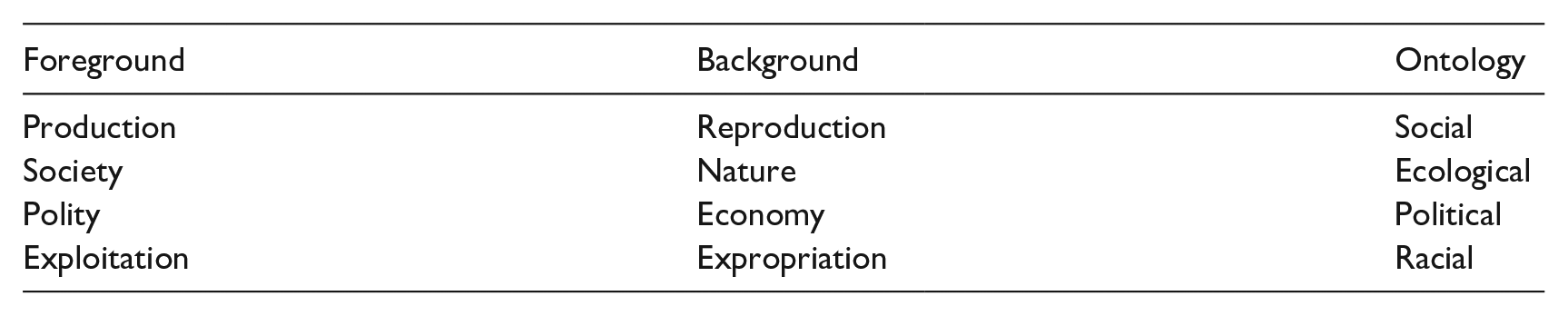
Politically, Fraser’s framework then aims to take us through the boundary struggles that lie across the exploitation/expropriation division, or class struggles at the point of production and its bonds with racism, social reproduction, and ecology, for example. In sum, the dual-systems thinking on patriarchy and capitalism, or production as distinct from social reproduction, economy distinct from polity, exploitation distinct from expropriation, and society distinct from nature is reinforced by this treatment of capitalism as an institutionalised political order (also see O’Kane, 2021).
The wider set of ontological concerns that we have about the above separations induced by differentiating patriarchy and capitalism as well as production and social reproduction, exploitation and expropriation, society and nature, or the political and the economic come together with the argument that capitalism is historically necessarily gendered and racist. To cite Fraser (2022: 20): To speak of capitalism as an institutionalised societal order, premised on such separations, is to suggest its non-accidental, structural imbrication with gender domination, ecological degradation, racial/imperial oppression, and political domination―all in conjunction, of course, with its equally structural, non-accidental foreground dynamic of (doubly) free labour exploitation.
One problem with this dualist theorising is the invocation of Ellen Meiksins Wood on the separation of the economic and the political in capitalism. To take Fraser’s (2022: 121) words: ‘In capitalist society . . . economic power and political power are split apart; each is assigned its own sphere, endowed with its own distinctive medium and modus operandi’. But rather then economic and political power held as a theoretical dualism, or ‘split apart’, Wood is actually arguing something quite different. Capitalist exploitation based on appropriation and coercion take on the appearance or differentiation of spatially separate spheres between the market-mediated conditions of commodity exchange (exploiting ‘free’ wage labour) and the specialised coercive political instruments of state power (the public sphere of the state). The stress here is not on a dualism but a unitarian approach to analysing the social form of surplus extraction and appropriation under capitalism. To consult Wood (1995: 29) directly, from Democracy Against Capitalism: To speak of the differentiation of the economic sphere in these senses is not, of course, to suggest that the political dimension is somehow extraneous to capitalist relations of production. The political sphere in capitalism has a special character because the coercive power supporting capitalist exploitation is not wielded directly by the appropriator and is not based on the producer’s political or juridical subordination to an appropriating master.
Put differently, there is the appearance of a separation between the ‘economic’ and the ‘political’ in capitalism, but in all senses, they remain internally related as the economic rests firmly on the political within capitalist relations of production. Moreover, breaking the appearance or differentiation of the ‘economic’ and the ‘political’ in capitalism is essential to class politics. After all, the aim is to make the unity of these spheres abundantly apparent and to reveal that the locus of power on which capitalist property rests is ultimately the state.
Most tellingly, Rahel Jaeggi pushes this ‘two spheres’ approach to its limits to reveal its perspectival dualism. For Jaeggi there is a dual-systems theory element throughout the kind of hierarchical and institutional theorising that Fraser’s critical theory (or intersectional political economy) proposes, even though the sentiment is to try and move beyond additive or pluralist approaches (Fraser and Jaeggi, 2018: 57, 108–109, 149). Put bluntly, Fraser’s theorising is ‘brazenly dichotomous’ (Young, 1997: 150; see also Doherty, 2023: 49). As Bertell Ollman (1969) clarifies (p. 436), by contrast, there is ‘no-boundary interaction’ within a philosophy of internal relations, which is distinguished by maintaining internal connections between parts in a relational sense as elements of a whole giving rise to the dialectical method. In contrast, the philosophy of external relations takes the world as logically made up of things external to each other, often as independent, isolated, and static variables. Hence Fraser’s (2022: 20–23) approach to ‘boundary struggles’ that counterposes in external relation class struggles at the point of production from gender domination, or racism, which are always held in binary opposition. Yet, ‘what was a thing for the philosophy of external relations becomes a relation evolving over time (or a process in constant interaction with other processes)’, within the relational and dialectical method of historical materialism (Ollman, 2015: 10). Therefore, across dual-systems theorising or intersectional political economy, the external framing identifies spheres as separate entities in a relationship of ontological exteriority (Morton, 2013). The philosophy of internal relations, instead, recognises no truly separate parts within capitalism, which is understood as a historically specific totality with relational elements that are ontologically interior. A dialectically revitalised reconstruction of multiple oppressions in the matrix of class, patriarchy, race is thus required that can avoid the additive and external method of dual-systems intersectionality to situate, instead, concepts relationally as part of a differentiated unity within a social totality. It is within this primary category of totality that the centrality of labour as the bearer of value-generation linked to social reproduction is also posited and expanded (McNally, 2015, 2017; Mezzadri, 2021). Our argument is that this sort of dialectical approach is evident in Marx’s methodological precepts of primitive accumulation in which the inner relations of class, gender, and race are linked in the capitalist production of space.
The history of primitive accumulation as both presupposition and result
The importance of the condition of primitive accumulation to the critique of political economy exists along two main axes. The first is in terms of the embodiment of primitive accumulation as the historical presupposition to the accumulation of capital and the processes then entrained as a result of the spatial expansion of the geographical frontier of capitalism. The second is in terms of the expanded reproduction of capital and its transfers of value through comparable mechanisms that have contemporary resonance and enduring presence. Our argument is that, even in Marx, these twin expressions are neither neglected nor framed as separate features but have an internal connection and cohesion revealed by a dialectical method. What follows is therefore a contribution to the reformulation of understandings of primitive accumulation and dispossession as a recursive process that produces what it presupposes (Nichols, 2020: 8–9). In what follows we are presenting both Marx’s account of the dialectical relationship between presuppositions/results in the materiality of primitive accumulation and demonstrating primitive accumulation as an example of the dialectical matrix of class, gender, and race.
The first proposition on primitive accumulation as historical presupposition is pivotal but should not be contentious. Any elementary engagement with Marx will reveal his immediate emphasis on primitive accumulation as a process that ‘is not the result of the capitalist mode of production but its point of departure’ (Marx, 1990 [1867]: 873). The prehistory of capital is therefore marked by a whole series of forcible methods of merciless barbarism even before the effervescent processes of surplus-value formation and the production of capitalist space are afforded fluidity, as we shall explore shortly. The second assertion is a little more stridently based on fostering a more nuanced reading of Capital to reject the assumption that the temporal framing of primitive accumulation was confined to a past period of violence and expropriation somehow separate from contemporary regulative norms of dispossession (Coulthard, 2014: 6–15). A hiving off of the violent birth certificate of the capital relation (linked to historical expressions of appropriation) from ongoing acts of the colonial relation (associated with contemporary orchestrated forms of dispossession) is an enforced binary that is much more evident in commentaries on primitive accumulation than in its original articulation. A sensitivity to a decolonial reading of Marx on primitive accumulation thus renders problematic the externality imposed on these distinctions and more subtly lays bare how these instantiations are historically and socially entwined. What follows is an unpacking of the dialectical method articulated through the condition of primitive accumulation as both presupposition and result and then, thereafter, its pertinence to the unfolding account of the history and ongoing aspects of primitive accumulation.
As on a weaver’s loom, the mingling threads of primitive accumulation are woven together by Marx as both warp and woof. The warp substance is represented by the presuppositions constituting the becoming of capital, and the woof substance that completes the fabric of primitive accumulation is the result of the capital-relation itself. This inner relation of the threads of primitive accumulation begins with capital’s presuppositions. Hence, in Grundrisse, Marx (1973 [1857–1858]: 461, original emphasis) articulates that ‘the presuppositions under which money becomes capital appear as given, external presuppositions for the arising of capital’. For the antediluvian forms of capital to become the capital-relation itself, there is also a ‘positing [of] the historical presuppositions for a new state of society’ to come into being (Marx, 1973 (1857–1858): 461, original emphasis). This constitutive process is explicit in the dialectical theorising of primitive accumulation. ‘The conditions and presuppositions of the becoming, of the arising, of capital presuppose precisely that it is not yet in being but merely in becoming’ through the condition of primitive accumulation (Marx, 1973 [1857–1858]: 459, original emphasis). ‘“Becoming”, as Dipesh Chakrabarty (2000: 62, emphasis added) recognises here, ‘refers to the historical process in and through which the logical presuppositions of capital’s “being” are realised’. The transfiguration of land, people and nature into the commodity form is part of this coming-into-being that unfolds through methods of violent means in order to arrive at the departure point of the capitalist mode of production. The originary conditions of capital accumulation thus appear ‘primitive’ because they entail nothing akin to the ‘idyllic proceedings’ assumed by classical political economists (see Perelman, 2000). Intrinsic to such presuppositions is ‘the historical process of divorcing the producer from the means of production’ based on brutally direct forcible expropriation and state-backed legislative interventions to create the conditions for wage labour (Marx, 1990 [1867]: 875). Hence it is crucial to recognise the scope of the formative elements of the violence of capital accumulation, assisted by the levers of the state, in producing capitalist space as well as acknowledge the uneven differentiated geographical aspects addressed by Marx. As Marx (1990 [1867]: 876) makes clear, ‘the history of this expropriation assumes different aspects in different countries, and runs through its various phases in different orders of succession, and at different historical epochs’. A differentiated account of the multilinear and uneven geographical development of colonialism can thus be evinced, including enhanced attentiveness to non-Western conditions of social development (Anderson, 2010).
At the forefront of these conditions of rapine as the prehistory of capital is the expropriation of land and the separation of producers from the means of production: the violent means of usurpation, direct seizure, systematic theft, annexation and gross acts of brutality indispensable to laying the foundations of capitalism. Concerning land expropriation, the relationship of natural elements to production is pivotal in terms of its appropriation as an assumed ‘free gift of Nature to capital’ (Marx, 1991 [1894]: 879). Meanwhile, the creation of social labour and abstract space requires the direct use of violence and utter brutality in order to ensure people are confirmed in their ‘transformation into mercenaries’ by the capitalist system (Marx, 1990 [1867]: 881). If forcible dispossession of land is not enough, then a multitude of tortuous punishments, crimes, and other enactments will become the ultimate form of expropriation. The genesis of capitalism is situated within these acts of blood with Marx, notably including the extirpation, enslavement and entombment in mines of the Indigenous population of the Americas alongside slave-hunting in Africa that were deemed of a piece with ‘the dawn of the era of capitalist production’. Continuing his sense of dryness, it is these ‘idyllic proceedings’ that are regarded as some of the chief moments of primitive accumulation (Marx, 1990 [1867]: 915). While peaking in such attempted means of extirpation or annihilation, also included within this register of bloody acts is the extensive use of an array of diverse violent practices. These levers to enable the concentration of capital leading to the emergence of the capitalist class in the course of its formation include, for Marx, whipping, ear-clipping, branding, slavery, looting, murder, child-stealing and child-slavery, execution, induced famine, and enforced migration. However, an important point of clarification is necessary here in order to realise the historical specificity of the violence and its presence in constituting capitalist labour relations. As William Clare Roberts (2017: 207) states: The point of Marx’s account of primitive accumulation is not that capital has its origin in acts of violence and theft, but that capital has its origin in the opportunistic exploitation of the new forms of freedom created by acts of violence and theft. Violence and theft cannot give rise to capital directly. There must be a displacement from the acts of violence and theft in the process of capitalising upon the conditions thereby created. Part and parcel of capital’s treachery is that it requires others to create its conditions of existence.
Put differently, capital requires others to do the ‘dirty work’ of creating its preconditions before setting in motion modified but persistent forms of accumulation on a world scale (Roberts, 2020: 542). The presuppositions of primitive accumulation are not, therefore, achieved by the ‘highly energetic solvent’ of money transforming itself into capital-creating workers and ‘not by creating the objective conditions of their existence; [but] rather by helping to speed up their separation from them – their propertylessness’ (Marx, 1973 (1857–1858): 507, original emphasis). This is the role of violence ‘written in the annals of mankind in letters of blood and fire’ that arrays the landscape of capitalist space and marks the process of primitive accumulation (Marx, 1990 [1867]: 875). The dirty work of violence in order to constitute the dissolution of propertylessness is thus a dialectical presupposition of capital. Hence, returning to this theme in Capital, Volume 3, Marx states that expropriation of the conditions of labour within capitalism as a mode of production is the very given presupposition from which it proceeds (Marx, 1991 [1894]: 730). Thus, he maintains that primitive accumulation does not only occur at the historical beginning of capitalism but is then also extended further as the result of capitalism. As foreshadowed in Grundrisse: As soon as capital has become capital as such, it creates its own presuppositions, that is, the possession of the real conditions of the creation of new values without exchange – by means of its own production process. These presuppositions, which originally appeared as conditions of its becoming – and hence could not spring from its action as capital – now appear as results of its own realisation, reality, as posited by it – not as conditions of its arising, but as results of its presence (Marx, 1973 (1857–1858): 470, original emphasis).
This continuity of the condition of primitive accumulation is further articulated by Marx across Theories of Surplus Value. ‘Accumulation merely presents as a continuous process what in primitive accumulation appears as a distinct historical process, as the process of the emergence of capital and as a transition from one mode of production to another’ (Marx, 1971 [1861-63]: 272, original emphasis). Or, in the creation of the separation of producers from their labour: ‘it is this separation which constitutes the concept of capital and of primitive accumulation, which then appears as a continual process in the accumulation of capital and here finally takes the form of the centralisation of already existing capitals in a few hands and of many being divested of capital’ (Marx, 1971 [1861-63]: 311–312, original emphasis).
This is all the more so important because Marx himself draws our attention to the frontier economy and the prevalence of the most gruesome acts of a purposive political economy of scalping. Under the British colonial administration of William Shirley, as governor of the Province of Massachusetts Bay seated at Shirley-Eustis House in Boston, it is remarked that: In 1703 those sober exponents of Protestantism, the Puritans of New England, by decrees of their assembly set a premium of £40 on every Indian scalp and every captured redskin; in 1720, a premium of £100 was set on every scalp; in 1744, after Massachusetts Bay had proclaimed a certain tribe as rebels, the following prices were laid down: for a male scalp of 12 years and upwards, £100 in new currency, for a male prisoner £105, for women and children prisoners, £50, for the scalps of women and children £50. Some decades later, the colonial system took its revenge on the descendants of the pious pilgrim fathers, who had grown seditious in the meantime. At English instigation, and for English money, they were tomahawked by the redskins. The British Parliament proclaimed bloodhounds and scalping as ‘means that God and Nature had given into its hand’ (Marx, 1990 [1867]: 917–918 citing Howitt, 1838: 348).
Worthy of note here is that John George Lambton, in his capacity as the Earl of Durham in drafting his Report on the Affairs of British North America, focused on the ‘blood and treasure’ of the colony as ‘the rightful patrimony of the English people, the ample appanage which God and Nature have set aside the New World for those whose lot assigned them but insufficient portions in the Old’, which was also Marx’s source (Durham, 1838: 7). Racialised struggles over extirpation, then, are pivotal to the history of primitive accumulation – including the inner connection of human and extra-human nature – on the frontier economy of capitalism.
It is the commodity landscape of scalping that comes, also, to be assisted by ‘bloody legislation’ enacted by the state. However, our argument is that the accretive power of the state and capital to expand spatially through the colonial system should also be regarded in terms of its geographical difference through conditions of uneven development. Hence, state force acts as a pivotal lever to hasten ‘as in a hothouse’ processes of appropriation and dispossession when grafted to the economic power of the concentration of capital (Marx, 1990 [1867]: 915–916). The result is the use of an array of state policies including legislation to expropriate church property and bring the ‘soil into capital’ alongside wider clearance acts of enclosure as well as the use of policies of public debt in the form of bonds, the deployment of the taxation system as an appropriating agent and the usage of the international credit-system, trade, protectionism and geopolitical conflict as material incarnations of the category of primitive accumulation (Marx, 1990 [1867]: 844–845, 889–895, 899–900, 919–921).
More nuance is thus injected by Marx into the historical geography of capital’s origins than commonly assumed, albeit mindful along the way that he was only providing a series of historical sketches. Hence, differences are highlighted in the uneven geographical development of capitalism, for example, in Ireland and Scotland in their organic connection to the spatial expansion of English social property relations. The transformation of arable land into ‘sheep-walks’ – resulting in the sheepwrecking of the landscape – for English landed property and its consequences of famine and emigration accomplished by the agricultural revolution in Ireland or the ‘clearing of estates’ in Scotland by the Duchess of Sutherland are thus connected but also distinguishable (Marx, 1990 [1867]: 869–870; 891–895). Equally, the capitalised blood that is at the centre of the disquisition on primitive accumulation in the United States focuses on emigration, extirpation and the slave trade across the ‘border slave states’ of the country, where ‘labour in a white skin cannot emancipate itself where it is branded in a black skin’ (Marx, 1990 [1867]: 414, 571). However, again, these processes are also clearly distinguished from the recognisably different and evident lack of the export of capitalist relations of production to Australia. There, the colonial state needed to ensure an immigrant labour market for capital based on wages over a prolonged duration, in order to transact the purchase of land at inflated prices (Marx, 1990 [1867]: 932–940). Similarly, these conditions are also distinguishable from the local conditions of induced famine in Orissa (Odisha) in India, where the increased colonial demand for cotton production skewed local rice cultivation with ‘the tender shoots of rice made crimson with blood’ by over 1 million deaths in the 1860s (Marx, 1990 [1867]: 473, 650–651, 916–917). The point of our argument here is that the colonial system at the centre of primitive accumulation – in the ‘homeland of political economy’ – produced a variegated aftermath in its ‘Herod-like slaughter of the innocents’ elsewhere (Marx, 1990 [1867]: 922, 931). Yet, at the heart of that dispossessive thirst for the blood of living labour is always the recurrent expropriation of land and the separation of producers from it. As Marx recognised, just as constructing a vacuum may rob people of air, then divesting them of access to land creates ‘a space void of wealth’ (Marx, 1990 [1867]: 938.n20 citing Colins, 1857: 268–271).
Pivotally, the critique of political economy in Capital has been highlighted as a form of descent – or katabasis – into a modern version of Dante’s Inferno. The result is a systematically ordered underworld in which the evils encountered are symptoms and presentiments of the modern social hell of capital (Roberts, 2017: 23–24). The methodological precepts of primitive accumulation facilitate a means to assess this coming-into-being of the production of capitalist space. As Henri Lefebvre (1991 [1974], 2022 [1953]) recognised, the result is an integral perspective on rural sociology, or historical sociology, that can be described as a regressive-progressive method (see pp. 67–70 and pp. 64–67). It involves a specifically Marxist methodological approach to history that moves through a regressive analysis of acts that have retroactively shaped the past to disclose aspects hitherto overlooked or uncomprehended. It also progressively moves dialectically to connect these historical presuppositions as the very conditions of possibility or results in constituting capitalism and its production of space. Whereas Chakrabarty starts from a similar understanding of primitive accumulation as ourselves, he crafts the antecedents in the formation of capitalism as History 1 (the presuppositions posited by capital) and History 2 (the capital encounters with human difference), which we believe enforces another dualist opposition (Chakrabarty, 2000: 62–64). At best, the presuppositions of capital (History 1) and the capital encounters with human difference (History 2) leave the duality intact so that both histories are treated in a relation of mutual dependence as external objects. A focus on History 1 and History 2 is, at best, only dialectical at the level of surface forms so that the ‘act of abstraction . . . revolves in its own circle’ and ‘takes place within the confines of the estrangement’ of human thought and history (Marx, 1977 [1844]: 155). What is missing is a focus on what we would recognise as History 3. For us, this refers to how capital ‘creates the other in completing itself, and creates itself as the other’ (Marx, 1973 (1857–1858): 93). Within this dialectical method of political economy, one category develops into the other as a ‘unity of two aspects’ as part of a totality (Marx, 1973 [1857-8]: 881). Therefore, the regressive-progressive method of primitive accumulation more resolutely focuses attention on the internality of the presuppositions and results of capitalism (or History 3), including how the logical preconditions of capital come to internalise elements of historical difference. Said otherwise, despite advances made on the relationship between the logic of capital and historical difference (Blaney and Inayatullah, 2010; Chakrabarty, 2000), the dialectical aspects of the regressive-progressive method are thus more consistent with Marx’s precepts of primitive accumulation and how it comes to internalise difference – in the form of patriarchal or racial oppression – in constituting capitalism as a mode of production.
Nevertheless, what is often glossed over in accounts of the history of primitive accumulation is precisely the attempted acts of extirpation of Indigenous populations as well as the dehumanising racialised and gendered forms of violence that are present at the dawn of the primal light of capital (see Morton, 2021). If a decolonial understanding of capital and its arrival with a ‘congenital blood stain’ is to be taken seriously more has to be made of the attempted processes of evisceration that mark the twilight of direct colonisation, their racialised and gendered targeting, and their present-day post-colonial repercussions and equivalents. Marx himself recognised that the forcible foundations of what would be termed patriarchy as well as racialised processes of expropriation were both consolidated through state legislative acts that ensured the acceptance of ‘grotesquely terroristic laws’ as the prelude for the system of wage labour and its later transformation of blood into capital (Marx, 1990 [1867]: 382, 899). 2 The character of capital conceived as a relational whole within a dialectical matrix of classed, gendered, and racialised social relations, therefore, requires further unpacking. In the next section, we argue that while not a structural precondition of capital accumulation, patriarchal, or racialised forms of oppression, have nevertheless become integral to the historical development of capitalism. Exactly as primitive accumulation is the presupposition and result of capitalism, so are gendered and racialised forms of primitive accumulation its presupposition and result. How is this concretely so, in relation to both the historical record and contemporary processes of capitalist patriarchy and racial capitalism?
Beyond the trinity formula of class, gender and race
In recent years, historical materialist scholarship has been criticised for overlooking patriarchal and racial forms of oppression in its analysis of capitalist accumulation. As Ferguson et al. (2016: 28–29) point out, large swathes of historical-materialist analyses have failed to understand and emphasise the interdependence between relations of production and reproduction, or to capture the role of gender and sexuality in forms and structures of oppression that shape capitalism’s social matrix in terms of both material conditions and ideologies.
It is therefore important to acknowledge that work necessary for humans to reproduce themselves within capitalism goes beyond work done for wages (Camfield, 2002: 42). In this section, we analyse how patriarchal and racial forms of oppression have been both the presupposition and result of capitalist accumulation. The aim is to go beyond a new ‘trinity formula’ of class, gender and race as merely the intersection of identities without a grounding in the determinatedness of class power (Giménez, 2019: 87–93; Lange and Pickett-Depaolis, 2022: xv–xvi). As Marxist Feminists point out, workers do not just reproduce themselves through wage labour in the workplace, but they equally reproduce themselves on the basis of unpaid work at home, including social care, cooking, the washing of clothes and the bringing up of children, tasks which are still predominantly carried out by women. Workers need to earn a wage in order to buy the necessary goods for their survival, but there are also all kinds of work in the sphere of social reproduction, which are essential for their survival. Hence, capitalist accumulation must be understood as a social system including both the spheres of production and social reproduction. ‘The relations between labour dispensed to produce commodities and labour dispensed to produce people [are] part of the systematic totality of capitalism’ (Bhattacharya, 2017: 2). Consequently, in the words of Maria Mies (2014 [1986]), labour can only be productive in the sense of producing surplus value as long as it can tap, extract, exploit, and appropriate labour which is spent in the production of life, or subsistence production which is largely non-wage labour mainly done by women (p. 47).
Thus, while capital accumulation depends on the exploitation of wage labour and the related creation of surplus value, it also depends on the expropriation of unpaid labour in the sphere of social reproduction. Importantly, distinguishing here between ‘exploitation’ and ‘expropriation’ does not refer to external relations between different background conditions as Fraser argues. Rather, in line with John Bellamy Foster and Brett Clark’s (2018) argument (p. 1), ‘exploitation’ refers to the extraction of surplus value from wage labour in the production process, as the dynamic of the capitalist mode of production, while ‘expropriation’ relates to the inner connections between the capitalist mode of production and its wider environment, emphasising an expanded understanding of capitalist accumulation.
Historically, both Maria Mies and Silvia Federici identify the witch hunts as key moments when the female body across Europe was subordinated to patriarchal forms of oppression. ‘The witch-hunt which raged through Europe from the twelfth to the seventeenth century’, writes Mies (2014 [1986]: 81), ‘was one of the mechanisms to control and subordinate women, the peasant and artisan, women who in their economic and sexual independence constituted a threat for the emerging bourgeois order’. Acts of extirpation against women have been specifically signalled as ‘an intrinsic element of the “ongoing primitive accumulation of capital”’ (Mies, 2014 [1986]: 170). Or, in the words of Federici (2004 [1998]: 101), ‘new laws and new forms of torture were introduced to control women’s behaviour in and out of the home, confirming that the literary denigration of women expressed a precise political project aiming to strip them of any autonomy and social power’. Thus, the witch hunts are regarded as part and parcel of the transition from feudalism to capitalism. The subordination of women to men, Federici (2004 [1998]) argues, was part of the same processes as the enclosures and the related expropriation of peasants from their land (pp. 75, 165). ‘It was in the torture chambers and on the stakes on which the witches perished that the bourgeois ideals of womanhood and domesticity were forged’ (Federici, 2004 [1998]: 186). In short, patriarchal forms of oppression, the witch hunts as a form of primitive accumulation, were part of the presupposition of capitalism. We disagree with Federici’s argument about a direct link between the witch hunts and the enclosures. While the former was a European-wide phenomenon and later exported to the ‘new’ world, the enclosures were initially a unique development in England. As such, however, the witch hunts ensured that capitalism emerged firmly within an already existing system characterised by patriarchal forms of oppression (Bieler and Morton, 2021: 1758–1759). 3 Thus, Maria Mies (2014 [1986]), for example, understands ‘patriarchal civilisation as a system, of which capitalism constitutes the most recent and most universal manifestation’ (p. 13). Patriarchy existed before the emergence of capitalism, but by emerging within a system characterised by patriarchal forms of oppression, from the very beginning patriarchy has been part and parcel of capitalist exploitation and throughout history has also been re-shaped by it. Capitalist exploitation and patriarchal oppression became inextricably intertwined. Although patriarchy did not originate with capitalism it has been comprehensively integrated by capitalism ‘to the extent that by now they act together, not constituting two systems, but a same and single system’ (Arruzza, 2013: 123). Of course, how exactly these internal relations have become manifested over time has constantly changed. In line with primitive accumulation being both the presupposition as well as result of capitalism, capitalist accumulation has constantly produced new patriarchal forms of oppression, new patriarchal forms of primitive accumulation.
Drawing on Social Reproduction Theory, it is clear that we have to look specifically at the role of women in capitalism and here in particular the constantly changing forms of how they have become subordinated politically and legally to men. For example, at the beginning of the Industrial Revolution in the late 18th and early 19th centuries, it was especially women and children who worked in the new factories of early industrialisation. During the second half of the 19th century, however, women were increasingly excluded from factories and often reduced to the role of providing unpaid care in the home. Mies refers to this process as the ‘housewifisation of women’, driven by the state and capital but also labour. ‘The working class movement in the nineteenth- and twentieth-centuries also made its contribution to this process. The organised working class welcomed the abolition of forced celibacy and marriage restrictions for propertyless workers’ (Mies, 2014 [1986]: 106). Trade unions in the latter part of the 19th century focused much on the elimination of female and child labour in order to get higher wages for male workers. For Mies (2014 [1986]), in other words, the ‘proletarianisation of men is based on the housewifisation of women’ (p. 110). This should not make us overlook the large number of women who continued to work for wages as domestic servants or in other sectors. Upon marriage or the birth of the first child there was frequently little alternative but to become a ‘housewife’. What is clear, however, is that the way gender oppression is internally related to exploitation in commodity production is constantly changing and has to be treated in an historically specific manner.
After 1945, expanding welfare states in Western Europe and North America provided the foundation for the male breadwinner model, in which the family was firmly established as the main unit of society with men taking up wage labour, while women looked after children at home all supported by the state through expanding welfare services. From the early 1980s onwards, however, against the backdrop of global economic recession in the 1970s and a restructuring of the global political economy around globalisation, there was an increasing focus on bringing women into the labour market while the state withdrew from social welfare provision. As Fraser rightly points out, this resulted in a re-commodification of care. Child nurseries and elderly care homes became profitable investment opportunities. The result is an organisation of social reproduction, that is ‘commodified for those who can pay for it, privatised for those who cannot – all glossed by the even more modern ideal of the “two-earner family”’ (Fraser, 2017: 25–26). Pension systems too were reorganised. Oran (2017) identifies a shift from public pay-as-you-go systems run by the state to individual, private provision for pensions through pension funds invested in financial markets. As a result, risk has been individualised, relieving employers at the expense of workers, whose pension returns depend on the profitability of volatile financial markets. As part of this re-organisation, the private provision of pensions has become a new profit-making opportunity for capital.
This combination of exploitation in the sphere of commodity production in tandem with expropriation of unpaid work in social reproduction is also visible in the way the Eurozone crisis has been played out within the European Union. It has been women who bore the brunt of austerity policies in the wake of the global financial crisis from 2007 to 2008 onwards based on ‘the intimate connection between increasingly authoritarian modes of governance and highly masculinised norms of competitiveness in the current period’ (Bruff and Wöhl, 2016: 92), which present competitiveness in terms of benefits for the whole of society. Combined with this discourse was a ‘strategy to displace the effects of the crisis from the “public” to the “private” [which] has intensified the crisis of social reproduction experienced by households across Europe’ (Bruff and Wöhl, 2016: 97). Unsurprisingly, women have had to shoulder the majority of the burden, as women work predominantly in the public sector or depend on public sector services (Hozić and True, 2016: 8).
Finally, Elena Baglioni’s analysis of female workers in the Senegalese export food production sector highlights well the internal relations between production and the sphere of social reproduction. By studying the position of female workers in Senegal at the very bottom of global value chains, she is able to demonstrate how cheap labour is secured through disciplining procedures which cover both the workplace as well as the household, the spheres of production as well as social reproduction. Polygyny, the fact that men can have several wives, implies that women can easily be replaced, which in turn pressures them to work hard, whether this is wage labour in factories or unpaid labour in the sphere of social reproduction at home. ‘The prevalence of polygyny and its construction of women as structurally or potentially insufficient – hence to be juxtaposed and/or replaced by other women – worked as an incentive to intensify their work and prove their worth’ (Baglioni, 2022: 454). In turn, factory work is disciplined through piecework, payment irregularity as well as the fact that many jobs are only seasonal and, thus, highly precarious. This precarity can only be sustained thanks to the unpaid labour which goes on in the household to maintain family members when there is no factory work available (Baglioni, 2022: 460). The fact that it is cheap labour in Senegal, which is exploited for the benefit of capital and workers-as-consumers in the Global North, also indicates the racialisation dynamics underpinning global value chains. Hence, not only patriarchy but equally racial forms of oppression need to be taken into account when analysing expansive capitalist accumulation. Thus, we need to explore the internal relations not only between capitalist exploitation of wage labour and the expropriation of unpaid labour in the sphere of social reproduction (or capitalist patriarchy), but also the internal relations of both with expropriation in racialised forms of oppression (or racist patriarchy) producing forms of racial capitalist patriarchy. Here again, a focus on primitive accumulation as both presupposition as well as result of capitalist accumulation is essential.
Across European forms of imperialist rule in the 18th century, the prevalence of race-thinking emerged before becoming consolidated as racism in the 19th and 20th centuries (Arendt, 1976 [1951]: 158–184). This tendency can be seen as a successor to the earlier permeation of racialism throughout the social structures emerging from capitalism in producing racial capitalism (Robinson, 2000 [1983]: 2, 66–67) or as part of different ‘modes of foreign relations’ that produce ‘foreignness as a set of exploitative relations, imbricated with relations of production’ (van der Pijl, 2007: x). In 18th-century Germany, nationalists formulated an emphasis on the innate personality and natural nobility of tribal origins to forge the race-thinking of romanticism. The result of race-thinking in France was an appeal to civilisation that was seen to be in danger of degeneration due to the decay of racial purity and the rise of elite cosmopolitanism. In England, concepts of landed inheritance and the acceptance of feudal property as the natural bequest of an aristocracy were propagated as bulwarks of race-thinking – by philosophers such as Edmund Burke – to bolster the ‘blue-blooded’ nobility as inheritors of title, land, and the nation. The race-thinking here was dominated, first, by inheritance theories of aristocratic pedigree and then, second, their modern equivalent in Darwinist natural selection, pure breeding, and applied eugenics based on the ‘survival of the fittest’. The prism of race-thinking is thus important because it avoids assuming that there was an immanent logic to the rise of racial capitalism. As Arendt (1976 [1951]: 183, emphasis added) argues acutely, ‘race-thinking was a source of convenient arguments for varying political conflicts’ and ‘it sharpened and exploited existing conflicting interests or political problems’. An emphasis on the antecedent presence of race-thinking thus historicises racism as a logically contingent feature within the subsequent expansion of capitalism. Historically, then, we argue that racialisation processes are to be understood as part and parcel of the emergence and outward expansion of capitalism. Race-thinking was part of primitive accumulation as both a presupposition of capitalist accumulation (the dirty work of extirpation) as well as its result (in sustaining new rounds of dispossession) in the expansion of capitalism.
However, in line with the dualist separation of the economic and the political critiqued earlier, colonialism is often separated from capitalism (Bhambra and Holmwood, 2018: 576). From a historical materialist perspective, too, a narrow focus on exploitation at the (capitalist) workplace can result in overlooking the racialising implications of capitalist accumulation. Nevertheless, as capitalism emerged within a pre-existing system of patriarchy, so it emerged within a pre-existing system of race-thinking and racism. Racialised forms of oppression were intimately related to capitalist expansion. For example, British capitalism in the 18th century depended heavily on slave labour in the production of cotton and sugar in the colonies. ‘In the late eighteenth-century, income from colonial properties in the Americas was equal to approximately 50 per cent of British gross investment. Since much of this would have been reinvested in British industries, it provided a significant input into British industrialisation’ (Anievas and Nişançıoglu, 2015: 164). In turn, slave labour in the Americas was only possible on the basis of the Atlantic slave trade, in which Britain was heavily involved and the receipts of which also directly fuelled the industrial revolution from the late 18th century onwards. ‘From 1783 to 1793 the slavers of Liverpool sold 300,000 slaves for £15 million, which went into the foundation of industrial enterprises’ (Ernest Mandel, quoted in Mies, 2014 [1986]: 90). In calling forth the industrial capital of Manchester’s manufactories, it was said of Liverpool that the principal streets ‘had been marked out by the chains, and the walls of houses cemented by the blood, of the African slaves’, with one street even nicknamed ‘Negro Row’ (Williams, 2001 [1944]: 58). Whether as metaphor or otherwise, Liverpool at ‘the red-brick Customs House by the Old Dock was blazoned not with golden wings but negro heads’ (Mackenzie-Grieve, 1968 [1941]: 4). In other words, as Marx (1990 [1867]: 925) recognised, ‘the veiled slavery of the wage-workers in Europe needed the unqualified slavery of the New World as its pedestal’. Racialised forms of primitive accumulation were thus embedded in race-thinking as part of the presupposition of capitalism as well as the subsequent racist results of capitalist expansion.
This had direct implications for the emerging political economies in the colonies. Siddhant Issar’s concept of ‘racial/colonial primitive accumulation’ captures well these dynamics in North America and Australia. First, his reference to ‘primitive accumulation’ makes clear that this was not only a process at the very beginning of the emergence of capitalism in England during the period of the enclosures. In North America, this affected two different and yet closely connected processes. Related initially to the expansion of cotton production, colonial primitive accumulation refers to the forced removal and expropriation of Indigenous populations. In turn, racialised primitive accumulation draws attention to the drastic increase in slave labour for the cultivation of cotton plantations, fuelling the transatlantic slave trade. This was all sustained by ‘the extension of northern and international credit lines to southern planters’ (Issar, 2021: 33). On the commodity frontier of 19th-century colonial Australia, the cultivation of sugar cane by unfree, racialised Pacific Islander workers – or ‘Kanakas’ – reveals the role of race in defining the cheapness of labour within a broader totality of world-ecology (Ryan, 2024). In short, capitalism has always already been racialised, whether this refers to the core or the periphery of the global political economy. In other words, the exploitation of wage labour in the emergence of capitalism became contingently and internally related to racialised forms of oppression and it is through these processes that both the capital-relation and racialisation became both presupposition and result.
These internal relations have persisted until today. When slavery was formally abolished after the end of the US Civil War in 1865, the expropriation of Black people continued in novel forms. The ‘whiteness’ of markets and property (Eastland-Underwood, 2023; Harris, 1993) alone ensured ongoing racialised forms of oppression. Moreover, while slavery, the private property of human beings, was abolished, the landed property of the former slave owners remained intact rather than being redistributed among slaves, leaving them inevitably in a vulnerable position. ‘We see a shifting history of class rule’, writes Manu Karuka (2020: 160), ‘predicated on intense colonial and racial violence – violence that is foundational to our own time’. Unsurprisingly, the actual living conditions of former slaves, now formally free, were rather dire. ‘By the 1890s, freedom, when marred by labour exploitation and racial terror, began to look uncomfortably similar to slavery’ (Leroy, 2020: 170). Black workers, too, continue to be in more precarious and exploited positions, generally living in poorer neighbourhoods and often being the first to lose access to water, as in Flint and Detroit in the United States (Clark, 2020), or at the sharp end during the COVID-19 pandemic (Spronk, 2020: 33). Unfree, bonded forms of labour also remain an essential part of capitalist accumulation. As the ILO (2022) reports, there were almost 50 million people in situations of modern slavery in 2021, subjected to direct coercion. In North America, the expropriation of Indigenous land has continued unabated, with Indigenous people being forced off the land to make way for oil pipelines, for example. In short, primitive accumulation continues to be the ongoing result of capitalism.
Examples of racial forms of oppression can be found across the world. Drawing on an understanding of racial capitalism, Ida Danewid analyses the racialised policies underpinning the making of global cities and how current methods of gentrification draw on city-making processes enacted during colonialism: The post-war period’s massive urban renewal and public housing programmes thus came to draw on urban planning rationales developed in the colonies, including techniques of slum clearance and racial segregation. Framed as a question of public health – of disease, criminality, alcoholism, prostitution and other ‘dangers’ that might ‘pollute’ the white body politic – these regeneration projects followed their colonial predecessors in displacing the racial poor to the city limits, while simultaneously creating small and highly visibly racial slums, typified by the high-rise tower block (Danewid, 2020: 302).
In other words, we cannot understand current forms of urbanisation without grasping the legacy and continuation of racialised discrimination across the built environment, shaping surplus land, surplus labour, and surplus capital (Gilmore, 2007). Hence, ‘today’s neoliberal urbanisation is intimately linked to yesteryear’s ‘urbanisation of empire’. Global cities should be conceptualised as part of a historical as well as ongoing imperial terrain’ (Danewid, 2020: 292). In turn, Diamond Ashiagbor analyses the way ‘in which race is constitutive of the labour market and present in the legal form by which labour is regulated’ (Ashiagbor, 2021: 507). While Western observers of the post-war welfare state, especially in Europe, praise the social democratic achievement of decommodifying certain services, Ashiagbor points out how these welfare states, while internally decommodifying and pursuing redistributive policies, nonetheless very much relied on the continuing exploitation of black labour in the Global South. And even those workers coming from the Global South to work in the North such as the Windrush generation of Caribbean workers migrating to the United Kingdom during the 1950s, were often disadvantaged due to inferior employment contracts and more difficult access to welfare benefits. ‘As with access to the benefits of the welfare state, collective bargaining coverage was partial, and that unevenness has, historically, been gendered and racialised’ (Ashiagbor, 2021: 523; see also Bhambra and Holmwood, 2018: 581–583). In short, colonial forms of exploitation continued even after 1945 and shaped the establishment of welfare states as well as ensured racialised structures of employment in the Global North. Thus, working-class formation was a form of race formation, in that the European working class continued the race-thinking of yesteryear in founding institutions such as the welfare state (Davidson and Saull, 2017: 712). Considering the racialised nature of the labour market in the Global North, it is no surprise that increasing informality as part of neoliberal restructuring has again disproportionately negatively affected minority, non-white groups. ‘The contemporary racialised division of labour and labour market segmentation’, Ashiagbor (2021: 531) concludes, ‘is just one legacy of how racial subordination, and the resources it generated, were integral to labour markets and, latterly, to labour law’. Racialisation of labour is an intrinsic aspect of capitalism in its efforts to maximise profits operating in primary and secondary forms (Bonacich et al., 2008: 344): Primary racialisation comes from (White) capitalists, who seek to exploit workers of colour more thoroughly than they are able to exploit White workers. Secondary racialisation arises among White workers, who fear being undercut and displaced by workers of colour because of their greater exploitability.
The secondary form clearly refers to what is often identified as ‘white supremacy’, a collaboration between capital and white workers to ensure continuing capitalist accumulation on the basis of the subordination of Black workers (Issar, 2021: 37).
In sum, historically, the emergence of capitalism depended not only on the exploitation of wage labour but also on the expropriation of unpaid labour based on racialised forms of oppression on the slave plantations in the Americas and the transatlantic slave trade. The subsequent abolition of formal slavery did not automatically result in emancipation or the shelving of race-thinking, as the expropriation of non-white labour continued albeit in different ways. ‘Racial capitalism places slavery within a broad, protean set of conditions that emerged out of but were not reliant upon slavery. These conditions continued to shape black freedom after emancipation’ (Leroy, 2020: 173–174). Hence, from the beginning, capitalism became inextricably interlinked with racism, the continuation of which is still with us today. The permeation of the emergent social structures of capitalism with anterior racialised and patriarchal differences is, then, a direct consequence of these processes, a result flowing from capital’s presuppositions.
Conclusion: Dancing the dialectic with Cacus
Our argument is that the methodological unpacking of primitive accumulation based on the presuppositions of capital as well as its results in the form of incorporating and renewing patriarchal and racialised oppressive relations enables a focus on the internal relations of the matrix of class, gender, and race. The way capitalism emerged into a world heavily characterised by patriarchy due especially to the witch hunts as well as race-thinking that then prefigured the racialised access to cotton, sugar and the receipts of the slave trade shapes, today, the continuing importance of such forms of oppression. Capitalist accumulation structurally depends on exploitation of wage labour in the production of surplus value as well as the expropriation of unpaid labour in the sphere of social reproduction. ‘For Marxist feminism’, writes Arruzza (2014), ‘gender oppression and racial oppression do not correspond to two autonomous systems which have their own particular causes: they have become an integral part of capitalist society through a long historical process that has dissolved preceding forms of social life’. Gender and race maintain an internal relation within a larger totality of the logic of capitalist accumulation. As Achille Mbembe (2017: 23, original emphasis) recognises in relation to the continuance of these processes through the subject of race, ‘capital not only remains fixed in a phase of primitive accumulation but also still leverages racial subsidies in its pursuit of profit’.
Rather than leaving dualities intact, the method of focusing on the presuppositions/results of capital advances the focus on what was necessary for the coming-into-being of capitalist society. Equally, it affords insight into what also emerged as logically contingent to nevertheless became structurally internalised and reproduced as ongoing expressions of gendered and racialised relations of oppression (see also Conroy, 2022). This methodological approach might be assessed as having problems. One common charge against this method of abstraction is the difficulty in delineating when a relation begins or ends. For example, Henri Lefebvre reflexively raises the objection that such methodological precepts on the accumulation of capital mean that ‘the “regressive” and the “progressive” movements become intertwined both in the exposition and in the research procedure itself’. The concern is then that ‘there is a constant risk of the regressive phase telescoping into the progressive one, so interrupting or obscuring it. The beginning might then appear at the end, and the outcome might emerge at the outset’ (Lefebvre, 1991 [1974]: 66). Two pointers can assist in thinking through this charge. First, working with a dialectical method that focuses on relational and processual forms of abstraction necessarily entails moving beyond the treatment of perceptible appearances. Market apologists examine only the surface processes and interactions with other institutions held in exterior relation – such as the state – beneath which there exist entirely different and more complex real abstractions (see Bieler and Morton, 2018: 11–20). To make this point, Marx provides us with an example from Greek and Roman mythology in the villainous form of Cacus, who hunts oxen by forcing them backwards into his cave so that their hoof prints make it appear that they had been let out from there and then disappeared (Marx, 1990 [1867]: 740n.22). As Ollman (1993: 10–11) elucidates in relation to this parable, an exclusive focus on appearances (on the hoof prints of events or state/market interaction) misses the larger totality of social property relations that they are a part of (or the relations of production). Second, the philosophy of internal relations and the method of dialectics does not treat history as an undifferentiated mess. Within the method there lies the potential to embark on differentiated processes of abstraction to pierce surface appearances and reveal the inner secrets of the origins and ongoing processes of capital accumulation. This more complex process of abstraction can entail the following three steps in a dance of the dialectic: (1) an abstraction of extension based on how much of the internal relations between anything in space and/or across time is to be included; (2) an abstraction of generality that sets a movement from the specific to the general to bring into focus a particular level of generality for treating not only the part but also the whole system to which it belongs; and (3) an abstraction of vantage point that ontologically establishes a point of departure to view, consider and piece together the other components in the relationship (Ollman, 1993: 38–40). We would add that because primitive accumulation cannot be separated from what capital is, then gender and race cannot be separated from capitalism because they are reproduced through it as a totality (see Altun et al., 2023). Capitalism conserves, internalises, and reproduces patriarchal and racial oppressions. The binary oppositions of dual-systems theorising, or the separation of the formation of capitalism (History 1) from encounters with human difference (History 2), fail to grapple dialectically with how capital creates itself. The dialectical method we support is a messier approach that seeks the inner connection and internal relations of what could be called History 3. Distinctions within this complexly structured differentiated totality are preserved as part of class contradictions, as a rich totality of many determinations and relations where class still matters. History 3 is multiply determined and diversely unified by class struggle. Appreciating how class power is internally racialised and gendered gets us beyond the mystification of a new ‘trinity formula’. For Ruth Wilson Gilmore (2022: 451, 495) ‘capitalism requires inequality and racism enshrines it’. Our approach is one that ‘can become progressively more dialectical without posing a threat to logic and consistency’ (Lefebvre, 1991 [1974]: 67).
As Susan Ferguson (2016: 47) asserts, ‘“capitalism” as a simple abstraction does not actually exist. There is only concretely racialised, patriarchal, colonial capitalism, wherein class is conceived as a unity of the diverse relations that produce not simply profit or capital, but capitalism’. Hence, it is therefore the historically, concrete way in which capitalism emerged in relation to anterior forms of race-thinking, which ensures its structural dependence on patriarchal and racialised forms of oppression today to produce capitalist patriarchy, or forms of racial capitalist patriarchy. Our argument is that the matrix linking class, gender and race can be dialectically revitalised through questioning the focus on the historically necessary or logically contingent distinction. The ways exploitation and expropriation are internally related manifest themselves in different ways at different moments in time. They are, however, always already inextricably involved in capitalist accumulation. Feminist struggles for equality or revolutionary politics as well as movements for racial justice are never purely identity-based struggles. By contrast, understanding capitalist accumulation in an expanded way and acknowledging the internal relations between patriarchal and racial forms of oppression and capitalist exploitation of wage labour provides the basis for broad alliances consisting of trade unions representing workers, environmental groups, feminist groups, movements such as Black Lives Matter as well as other social movements contesting capitalist accumulation. How gender and racial differences have been produced in a class society as distinctive forms of patriarchal and racist oppression are of a piece with the secret history of primitive accumulation and the origins of the capital relation. The presuppositions of capitalism therefore propose their own oppositions that are themselves internally related in class, feminist, and Black radical resistance.
Footnotes
Acknowledgements
The authors would like to thank Chris Hesketh and the two anonymous referees for their feedback as well as Noel Castree for his support in bringing this article to fruition. Paper presented at the 65th International Studies Association (ISA) Annual Convention, San Francisco (3-4 April 2024).
Declaration of conflicting interests
The author(s) declared no potential conflicts of interest with respect to the research, authorship, and/or publication of this article.
Funding
The author(s) received no financial support for the research, authorship, and/or publication of this article.
