



Abstract
Despite increasing attention to Indigenous demands for justice, self-governance and the decolonization of Canadian society, many Canadians remain deeply unaware of the complex ways Indigenous and non-Indigenous lives entwine in Canada and of the past and present settler-colonial structures which continue to control and harm Indigenous Peoples and lands. Drawing on our decade-long project examining education at multiple levels in multiple jurisdictions and bringing together scholarship on settler-colonial ignorance, decolonizing education and geographical imaginaries, we highlight how pervasive settler-colonial geographical ignorance, (re)produced through formal education, inhibits many Canadians’ capacities to understand themselves as inextricably linked and responsible to Indigenous Peoples. Through our examination of the results of surveys of college and university students and of public kindergarten to Grade 12 curricula in three Canadian provinces, we provide analyses of settler-colonial forms of geographical unknowing (re)produced in Canadian public education and echoed in the discourses of students. Our analysis draws out commonly held (mis)perceptions and prejudicial attitudes that pervade settler-colonial imaginations, allowing us to identify the entangled temporal, spatial and (non)relational dimensions of settler-colonial geographical ignorance in Canada. Considering the ways that many non-Indigenous people misunderstand and ignore the geographies of settler-colonialism and of Indigenous Peoples, we hope to contribute to ongoing, urgent investigations into the ways that settler-colonial and geographical ignorance serve to oppress Indigenous Peoples and exploit the lands to which they belong for others’ benefit. Furthermore, by focusing on and demonstrating the spatial nature of such ignorance, we argue that (re)conciliation between Indigenous and non-Indigenous Peoples in Canada must also be spatial.
Keywords
Introduction
Ignorance is at the heart of the problematic and dysfunctional relationship between Indigenous and non-Indigenous peoples in Canada today. 1 Despite increasing attention to Indigenous demands for justice, self-governance and the decolonization of Canadian society, most Canadians remain deeply ignorant of how Indigenous and non-Indigenous lives entwine and of the past and present settler-colonial structures which continue to control and harm Indigenous Peoples and lands. Significant and pervasive structures of geographical ignorance common among Canadian citizenry are reproduced through formal education. Drawing on the Assessing Student Awareness of Indigenous Realities Project’s decade-long examination of education at multiple levels in multiple jurisdictions, in this paper we explore the entangled temporal, spatial and (non)relational dimensions of geographical ignorance in Canada.
The Truth and Reconciliation Commission of Canada (TRCC, 2015a) has been instrumental in bringing to the public’s attention the ‘broad lack of understanding of the unjust and violent circumstances from which modern Canada emerged’ (Sinclair, 2015: n.p.). The TRCC investigated and reported on the crimes and legacy of the 139 state- and church-sanctioned Indian Residential Schools that operated in Canada for over a century. These institutions were a central mechanism of genocide designed to separate children from their families to sever their connections to Indigenous life, languages and lands and secure unfettered settler control over Indigenous territories and resources (Jacobs, 2009; Milloy, 1999). Over 150,000 Indigenous children were forced to attend these schools; thousands lost their lives due to violence, abuse and neglect at the schools, while survivors, their descendants and Indigenous communities are left to deal with the ongoing impacts.
Despite the release of numerous reports and frequent media coverage on widespread historical and ongoing settler-colonial violence like the ‘discovery’ of unmarked graves of Indigenous children on the grounds of former Indian Residential Schools, many Canadians remain surprised, in denial, or defensive when encountering information that challenges the commonly held benign image of Canada (Clark, 2021; Justice and Carleton, 2021; Liu, 2021; Shotwell, 2021; Supernant and Carleton, 2022). How can so many Canadians continue to ‘not know’ about the histories and geographies of settler-colonial violence and dispossession in Canada? In this paper, we bring together scholarship on colonial ignorance, decolonizing education and geographical ignorance to highlight how pervasive settler-colonial geographical ignorance, (re)produced through formal education, inhibits many Canadians’ capacity to understand themselves as inextricably linked and responsible to Indigenous Peoples.
Indigenous scholars and knowledge holders insist that the invisibilization and distortion of Indigenous and settler-colonial realities create barriers to dismantling structures of oppression and to unsettling relationships between Indigenous and non-Indigenous peoples (Donald, 2012; Donald et al., 2012; Moeke-Pickering et al., 2006). Rather than a simple absence of knowledge, ignorance is an actively produced and maintained social force (Brayboy and Chin, 2018; May, 2006; Mills, 1997; Steyn, 2012; Sullivan and Tuana, 2007). In its settler-colonial form, ignorance serves the interests of many non-Indigenous peoples and settler governments by normalizing and naturalizing settler state and corporate control of Indigenous lands, bodies and lives (Schaefli, 2018; Schaefli et al., 2018). Such cultivated ignorance renders egregious government and corporate acts of predatory self-interest benign and inevitable to many, including those pursuing higher education in the country.
State-backed education systems have functioned to reproduce and reinforce white supremacy and settler-colonial power. However, education is also a key component in efforts towards unsettling settler-colonial relations across complex positionalities. Recently, work exploring the political and historical significance of ignorance has clarified its collusion with education (Applebaum, 2015, 2017; Calderón, 2011; Godlewska et al., 2010; Godlewska, Schaefli, et al., 2017a; Malewski and Jaramillo, 2011a; Olson and Gillman, 2013; Walter and Butler, 2013; Whitt, 2016). As capitalist and colonial logics continue to produce epistemologies of ignorance within settler-colonial contexts (Malewski and Jaramillo, 2011b: 284), efforts to expose the hidden social and economic structures upholding Eurocentrism, settler domination and racism continue to deepen understandings of the ways Eurocentric education ‘normalize[s] discourses and discursive practices that bestow ignorance on students’ (Battiste, 2013: 106). As key players in the process of (re)conciliation, 2 educational institutions are tasked with navigating and unsettling ignorance that upholds harmful attitudes and assumptions deeply entrenched in Canadian consciousness (Battiste, 2013; Godlewska, Schaefli, et al., 2017a; Regan, 2010).
Indigenous knowledge holders, researchers and organizations have for decades identified the urgent need to transform education across Canada for all peoples. While efforts have been made to increase Indigenous representation and some aspects of settler-colonial history in provincial public curricula, there remains little reckoning with the ongoing violence of settler-colonialism (Lamb and Godlewska, 2021; Schaefli et al., 2019). Canadian education supports ignorance of this violence and its consequences, and this ignorance is a barrier to transforming society. 3 Education systems at all levels require significant overhaul to foster awareness of historical and contemporary settler-colonialism and to honour Indigenous perspectives, geographies, histories, cultures, knowledges and rights (National Inquiry Into Missing and Murdered Indigenous Women and Girls, 2019; Royal Commission on Aboriginal Peoples, 1996; TRCC, 2015c).
With some notable exceptions, literature within the discipline of geography has not fully conceptualized the intersections between geography education, Eurocentrism, settler-colonialism and the creation of geographical ignorance. Since the early 2000s, geography literatures about ‘geographical ignorance’ have been preoccupied with whether or how geography education should address alarming levels of geographic illiteracy in the United States and United Kingdom about foundational facts such as population size and growth, or the inability to locate countries and natural landmarks on a map (Laliberté et al., 2015; Little, 2016; Morgan, 2017; Morin, 2013; Trivedi, 2002). Discussions of education’s role in perpetuating settler-colonial epistemologies of ignorance, the importance of place-based education and the reinforcement of settler-colonial logics in education are commonly found in decolonizing education literatures (Battiste, 2013; Daigle, 2019; Daigle and Sundberg, 2017; Gruenewald, 2008; Rowe and Tuck, 2017; Seawright, 2014; Tuck and Gaztambide -Fernandez, 2013). In the past decade, geography scholars have explored the link between education, curricula, settler ignorance, colonialism and geographical imaginaries but have not explicitly elaborated on geographical ignorance and its political and social ramifications in a settler-colonial context (Godlewska et al., 2010; Howie and Lewis, 2014; Laliberté et al., 2015; Lamb, 2021; Lamb and Godlewska, 2021; Schaefli et al., 2018). We build on their work by examining how geographical ignorance is produced and reinforced in Canadian education and how geographical imaginaries that draw upon and reinforce such ignorance impede social change.
This paper explores and critiques the geographical ignorance of many Canadians about Indigenous Peoples and settler-colonialism in Canada. Drawing together the survey results of college and university students and analyses of public kindergarten to Grade 12 curricula in three Canadian provinces – Newfoundland and Labrador (NFLD & LB), Ontario (ON) and British Columbia (BC) – we illustrate commonly held (mis)perceptions and prejudicial attitudes that are perpetuated through formal education and pervade Canadian imaginations. We focus on important geographical ignorance and geographical imaginaries shared by many Canadians. In considering the ways that many Canadian students misunderstand and ignore the geographies of settler-colonialism and of Indigenous Peoples, we hope to contribute to ongoing, urgent investigations into the ways that settler-colonial and geographical ignorance contribute to the oppression of Indigenous Peoples and the exploitation of their lands for others’ benefit.
In this paper, we demonstrate how settler-colonial and geographical ignorance are intertwined in places like Canada, and how pervasive geographical ignorance impacts non-Indigenous relations with Indigenous Peoples, lands and futurities. We contribute to discussions of settler-colonial ignorance by focusing on and demonstrating the spatial nature of such ignorance, highlighting how (re)conciliation between Indigenous and non-Indigenous peoples in Canada must also be spatial. We contribute to scholarship on geographical ignorance and its entanglements with power by providing grounded examples and analyses of how settler-colonial forms of geographical unknowing are (re)produced through Canadian public education and echoed in the discourses of students. We contribute to education scholarship by illustrating how education concerned with supporting (re)conciliation must tend to the spatial ignorance and imaginaries that fundamentally uphold settler-colonial space-times.
Colonial geographical ignorance and imaginaries
Colonial geographical ignorance is predicated on two interrelated and mutually reinforcing phenomena: the predominance of colonial beliefs rooted in ignorance and adherence to certain geographical imaginaries. Colonial ignorance is about ‘hearing and seeing wrongly’; it is an outcome of ‘erasing, dismissing, distorting, and forgetting about the lives, cultures, and histories’ of colonized peoples (Bailey, 2007: 85). In settler societies, this ignorance manifests in beliefs and imaginaries of Indigenous Peoples as temporally and spatially distant. Geographical imaginaries are the ontological frameworks through which people enact relations with each other and with(in) places (Thiem, 2009: 161; Watkins, 2015). As Howie and Lewis (2014: 134) argue, attending to geographical imaginaries helps us understand how certain ways of understanding time, space and place cohere into ‘power-laden projects of knowing and acting on the world’. Settler geographical imaginaries are predicated on ignorance of Indigenous presence: the fact that Indigenous Peoples are here and now. Settler-colonial temporality, what Rifkin (2017: 4, 5) describes as ‘settler time’, makes Indigenous Peoples into ‘ghostly remainders’, with wide-reaching and disastrous political and relational effects. A pervasive myth that Indigenous Peoples are vanishing, whether through death or assimilation, has served settler-colonial purposes since early settlement on Turtle Island 4 (Dunbar-Ortiz and Gilio-Whitaker, 2016; Rifkin, 2013). References to the ‘dying Indian’ and the inevitability of their disappearance abound in Canadian and American literature as far back as the 17th and 18th centuries (Bross, 2001; Monkman, 1981).
Inextricably linked to this myth of disappearance is a treatment of Indigenous Peoples as mere vestiges that are ‘hopelessly contaminated’ and too far removed from the constructions of ‘Indianness’ many non-Indigenous people recognize as credible or legitimate (Rifkin, 2017: 5). Such constructions are profoundly racist, originating from and perpetuating the colonial concept of ‘savage’, which made it possible for imperial and colonial powers to ‘speak with no sense of absurdity of ‘empty’ lands that are actually teeming with millions of people, of ‘discovering’ countries whose inhabitants already exist’ (Mills, 2007: 27). The foundational ‘racialized concepts of Manifest Destiny and terra nullius’ legitimize and normalize (particularly white) settler superiority and control over Indigenous land (Bonds and Inwood, 2016: 724; Harris, 2004; Mackey, 2016; Mills, 2007; Pasternak, 2015). Furthermore, in this temporal framework, practices and processes of genocide, displacement and land dispossession are imagined as historical ‘events’ long past and disconnected from contemporary life (Rowe and Tuck, 2017: 6). Colonial temporality obfuscates the violence used to dispossess Indigenous Peoples of their land, positions non-Indigenous people as inevitable inheritors of the territories that became Canada, delegitimizes Indigenous sovereignties and projects settler-colonial futures as resolved and permanent (Mackey, 2014; Rifkin, 2013; Williamson, 2017).
(Mis)perceiving Indigenous Peoples as temporally distant is inextricably linked to a settler-colonial spatial imaginary. In this imaginary, if Indigenous Peoples still exist, they are far away and treated as ‘incompatible with urbanism and modernity’ (Lawrence, 2004; Proulx, 2006; Tomiak, 2017: 930). Long mobilized through the state’s discursive power (like the Indian Act’s definition of ‘Indianness’), these powerful discourses continue to delegitimize and ‘displace urban Indigeneity temporally and spatially’ (Lawrence, 2004; Tomiak, 2017: 933). Such an imaginary relegates Indigenous Peoples to distant spaces ‘up north’ or ‘on reserve’, erasing their presence from urban spaces. Wherever they are, Indigenous Peoples are not imagined as being ‘here’, robbing them of their place(s) ‘in’ space-time (Lamb, 2021).
Settler-colonial temporality and spatiality together animate an imaginative geography that collapses, conscripts and homogenizes the multitude of Indigenous places, polities, sovereignties and Peoples into a single abstract territorial entity over which settler states claim total authority (Agnew, 1994, 2005; Malpas, 2019; Mitchell, 1991; Reid-Henry, 2010; Sparke, 1998). In Canada, settler-colonial geographical imaginaries discursively and materially (re)produce settler-colonial space through the naturalization of state sovereignty and ‘public’ property rights (Harris, 2004; Lamb, 2021; Loftus, 2015; Tomiak, 2017). Such imaginaries are based on violent geographical abstractions of space, nature and scale, through ‘constructions of land as extractable capital, the denial of indigenous sovereignty, the myth of discovery, and the naturalization of the nation-state’ (Tuck, 2011: 36).
Settler-colonial geographical imaginaries also undermine understandings of co-presence, relationality and responsibility. Imaginations of Indigenous ‘temporal stasis or absence’ expunge from settler consciousness Indigenous Peoples’ dynamic and continuing systems of governance, ties to land and resistance to invasions of their territory (Rifkin, 2017: 5). Representations based in such erasure actively produce ignorance, rendering unintelligible the multiplicity of life worlds and experiences with(in) places across Turtle Island. Depictions that absent Indigenous Peoples from places and spaces in ‘the present’ and in ‘the future’ function to obscure their ongoing multiple, dynamic place- and land-based sovereign existence.
Indeed, non-relationality, or what Hoagland (2007: 97) calls ‘a denial of relationality’, is a fundamental dimension of settler-colonial geographical ignorance. Non-relationality is buttressed by an epistemology of ignorance, a way of (not) knowing that, regardless of its basis in corrupt and false understanding, rationalizes a refusal to know and learn otherwise (May, 2006). Beyond simply a denial of coevalness (Massey, 2005), the denial of relationality is fundamentally a denial of non-Indigenous people’s implication and responsibilities in and for their own colonial histories and geographies. Acknowledging these complex interdependencies requires accessing what Hoagland (2007: 112) describes as ‘distinct worlds of meanings in concrete geographies’. The ability to critically engage with geographies existing beyond and in contradiction with dominant understandings has ‘been undermined or compromised in key ways as a result of [non-Indigenous] material privileging’ (Hoagland, 2007: 113).
Education systems have been key in maintaining settler-colonial geographical imaginaries and consequently reinforcing severe epistemological and ethical barriers to partaking in complex, unsettling relational thinking and engagements. Learners have long been exposed to teachings that affirm past and present settler-colonial arrangements by disappearing Indigenous presence and relevance. Multicultural education has fostered a commitment to ignoring and rejecting Indigenous claims, framing the Canadian state as the ‘benevolent guardian’ of Indigenous Peoples and Indigeneity as ‘just one culture among many in the country’ (Thobani, 2007: 173). Under this view held by many white and non-white Canadians, Indigenous Peoples’ claims to ‘special’ rights counter an equality fundamental to the country’s ethos, which falsely claims that all racial and cultural groups share the same entitlements (Thobani, 2007). Consequently, learners from all backgrounds face cognitive and affective barriers to understanding, engaging with and situating themselves in geographies encoded with ongoing Indigenous sovereignties, connections with land and governance structures. Through the dominant settler-colonial imaginaries, Indigenous spatial assertions – which continue to confront and contest the erasure of Indigenous rights and spatialities – are often understood as disruptive, untenable and are met with disdain and opposition (Prout and Howitt, 2009).
Education is deeply enmeshed in this process of erasure, complicating Canadians’ abilities to engage meaningfully with Indigenous Peoples’ perspectives and to situate themselves within Indigenous spaces under colonial assault. In the following discussion, we illuminate all-too-common geographical ignorance and settler-colonial geographical imaginaries in the discourse of students and highlight how such ignorance and imaginaries fortify settler futurity, just as they reinforce the exploitation and oppression of Indigenous Peoples who are, and have always been, very much present and resistant to settler-colonial incursions into their territories.
Methodology
For over a decade, the Assessing Student Awareness of Indigenous Realities Project has plumbed the depths of settler-colonial ignorance in Canada through analyses of K-12 public school curricula and textbooks across the country, through survey assessment of college and university students, and most recently through interviews with educators in several provincial jurisdictions. 5 Our critical analyses have demonstrated how official curricula and textbooks significantly influence student knowledge and ignorance. We have identified direct sources of settler-colonial ignorance in mainstream elementary and high school curricula and textbooks, pointing to various strategies of exclusion including inadequate, neglectful and optional coverage of Indigenous topics, patronizing colonialist and nationalist narratives and major silences and omissions of Indigenous perspectives (Godlewska et al., 2010; Lamb and Godlewska, 2021; Schaefli et al., 2019). These findings resonate with those of critical Indigenous and non-Indigenous education scholars who have highlighted and critiqued the settler-colonial discourses (re)produced in past and present curricula in settler societies (Calderón, 2009, 2011, 2014a, 2014b; Seawright, 2014; Tuck, 2011; Tuck and Gaztambide-Fernandez, 2013).
We have also conducted in-depth surveys of entering and exiting students at partner universities and colleges across Canada. 6 Our analyses of survey data have revealed prevailing settler-colonial ignorance among post-secondary students and have illustrated how problematic content or lack of exposure to Indigenous topics at all educational levels has a significant impact on post-secondary students’ knowledge and willingness to engage (see Godlewska et al., 2013, 2016, 2019; Godlewska, Lamb, et al., 2020; Godlewska, Rose, et al., 2017; Godlewska, Schaefli, et al., 2017a, 2017b, 2020a, 2020b; Schaefli et al., 2018). In this paper, we examine the geographical ignorance and settler-colonial geographical imaginaries expressed by post-secondary students in Canada and explore their opinions, social attitudes, knowledge, influences and ignorance.
Our survey methodology took shape through a living and iterative process of co-design. The Awareness team developed our survey methodology over a period of 10 years through over 100 meetings with over 300 First Nations, Métis and Inuit educators, community members, faculty, staff and students affiliated with 15 universities and colleges across Newfoundland and Labrador, Ontario, Manitoba and British Columbia. The Awareness team brought a draft of the survey to every meeting so that co-designers could closely examine the significance and correctness of each survey question. Questions were added, removed, or modified according to co-designers’ advice (Schaefli and Godlewska, 2020). The aim of this process was to ensure that the content and wording in the survey reflected co-designers’ experiences, knowledges and visions for transforming education. Through this process, the Awareness team and our many co-designers developed surveys that ‘allow fine-grained analysis of the relationship between knowledge considered by Indigenous educators to be vital to responsible citizenship and post-secondary students’ formal education, attitudes, and experience’ (Schaefli and Godlewska, 2020: 224).
The survey for each partner institution comprised a knowledge test, questions about students’ views, attitudes and values, and demographic questions. The knowledge test included multiple-choice and open-ended questions to appraise student awareness of topics including Indigenous governance, history, geography, culture and current events. Multiple-choice questions were designed to capture the general level of students’ knowledge. Open-ended questions – often structured around a prompt such as a map, quotation, or artwork – were designed to allow students to go into greater depth on key topics, share their voices and demonstrate the depth of their understanding. 7 Multi-select and text-box response questions on student views, attitudes and values were designed to capture students’ opinions and perspectives on the survey topics as well as on their own knowledge, education and relationships with Indigenous Peoples. Demographic questions were included to allow disaggregation of quantitative data by diversity-related variables and intersectional analysis of quantitative and qualitative data.
In this paper, we focus our analysis on the responses of 1780 entering and 1186 exiting students who completed surveys co-designed for partner institutions in Newfoundland and Labrador, Ontario and British Columbia from 2013 to 2019. We negotiated in-person surveys for exiting students at Queen’s University and entering students at Vancouver Island University (VIU), delivering surveys in-class accompanied by an Indigenous Elder affiliated with the institution. The surveys at Memorial University and Douglas College and the exiting survey at VIU were conducted online. Survey participants represent a broad cross-section of post-secondary education, coming from many disciplines in the faculties of Humanities, Arts, Social Sciences, Sciences, Business, Education, Engineering and Health, as well as some professional schools including Nursing, Social Work, Criminology and Child and Youth Care. While the survey differed between institutions, analysis of several test questions included in all the surveys provides important insight into geographical ignorance in Canada. 8
In this paper, we highlight significant common trends in knowledge, ignorance, views, values and attitudes among students across provinces, jurisdictions and institutions. We explore trends in students’ knowledge and attitudes through quantitative analysis by comparing student performance on multiple-choice knowledge-test questions with other multi-select responses including the kind of education students have received, what they think of what they know and their social attitudes. This analysis allows us to examine the connections between students’ social attitudes towards Indigenous Peoples and topics, their level of knowledge and education and broad identity categories.
Analysis of open-ended responses allows us to explore even more deeply the dimensions of the geographical ignorance and imaginaries ensconced in students’ thinking. We include students’ verbatim written responses (grammatical and spelling mistakes included) to open-ended questions. In a footnote after each student quotation, we list the province where they completed high school, their focus of study, what university or college they attend, whether they are entering (EN) or exiting (EX) students and the unique identification number associated to the survey they completed. This information does not allow the identification of any individual.
Our analysis reveals substantial settler-colonial geographical ignorance and imaginaries in student responses. In what follows we first illustrate common student imaginaries of Indigenous Peoples as past or far away. Public school and university curricula in Canada are steeped in and reproduce settler-colonial constructions of spatiality and temporality which imaginatively relegate Indigenous Peoples to remote spaces and to the past. The presence of Indigenous Peoples in contemporary Canada appears unknowable for many students in consequential ways. Second, we turn to the common geographical imaginary among students of a unified and ubiquitous settler nation-space that naturalizes and reifies a settler-colonial space-time and reinforces ignorance of Indigenous presence. (Re)produced by school curricula across Canada, geographical imaginaries that presuppose a homogeneous nation-state space renders the existence of multiple and differentiated Indigenous polities imperceptible and unimaginable to many students. Finally, we show that for many students, settler-colonial geographical imaginaries and ignorance produce disinterest in learning about, and a will to ignore, contemporary Indigenous presence. Such willful ignorance underpins many students’ refusal of relationality, impeding equitable and responsible engagement with Indigenous Peoples with(in) their places and lands.
The focus of analysis in this paper is naturally limited. Our co-designed surveys allow us to gather data from many students across multiple jurisdictions to generate important insights into Canadian education’s collusion with settler-colonial and geographical ignorance. Our data allow for analyses of students’ awareness of and attitudes towards Indigenous Peoples and colonial topics across jurisdictions. Students’ experiences of education and learning in settler-colonial contexts are undeniably influenced by complex, intersecting aspects of social identity, including Indigeneity, racialization, gender, dis/ability, age, class, language, sexual orientation and citizenship and immigration status. Survey co-design and delivery was a living and learning process. Early surveys, including at Memorial (delivered in 2014), focused self-identification options towards differentiating Indigenous and non-Indigenous respondents. Analyses of these surveys’ data and subsequent co-design processes led to the inclusion of more nuanced and representative self-identification options including for racialized identities. As such, gaps in our data limit our ability to account for racial diversity at Memorial and whether differentiations based on such diversity exist between Memorial and the other institutions.
Furthermore, it is beyond the scope of this paper to adequately explore the causes of potential distinctions based on self-identification. Investigations of Indigenous students’ potential adoption of settler-colonial geographical imaginaries would require theoretical and methodological frameworks focused on the complexities of Indigenous students’ experiences within Canadian education systems as well as Indigenous knowledges and relationships with place, people and land. Likewise, the study of non-Indigenous identity formations and social locations (e.g. raced, gendered, classed, diasporic) and their entanglements with formal education and settler-colonial power calls for qualitative methodologies through which the complicities, participations, complexities and refusals underlying experiences of settler-colonialism can be understood.
Our methodological approach is one tool in the advancement of anti-oppressive education. Considering its limitations, the findings of this research should be considered in conjunction with ongoing inquiries that further explore the pluralities of settlers’ and guests’ (invited and uninvited) experiences living on stolen Indigenous lands under conditions of settler-colonialism and white supremacy (Haig-Brown, 2012; Marom, 2016, 2017; Rodríguez de France et al., 2018; Styres and Kempf, 2022; Young Leon and Nadeau, 2018). This body of work continues to illuminate complex pathways for teaching and learning that transcend neocolonialism and cultivate non-Indigenous responsibilities, relational ethics and anti-oppressive relationships with Indigenous Peoples and land.
Analysis: Ignorance of Indigenous presence and colonial arrangements
Indigenous Peoples as past or far away
Ignorance of Indigenous presence and imaginaries of Indigenous absence are prevalent throughout student responses on our surveys across the country. In Canadian education, curricula have consistently placed Indigenous Peoples and cultures in the past or far away through both content and position. 9 The TRCC’s (2015b: 235) Final Report notes that Canadian history textbooks typically present Indigenous Peoples in the early contact periods of the fur trade and initial settlement (1500–1800s) after which they virtually ‘disappear from education’ until their reappearance during the 1960 and 1970s civil rights movements.
In previous analyses of curricula and textbooks, the Awareness team found that public education in Newfoundland and Labrador, Ontario and British Columbia has (re)produced a ‘logic of relation premised on the disappearance of Indigenous peoples as sovereign, self-determining nations’, and that ‘curricula and texts invite students to participate in the perpetuation of colonial modes of thought and action’ (Schaefli et al., 2019: 146). Curricula and textbooks across jurisdictions have worked to strengthen ignorance of Indigenous presence and imaginaries of Indigenous absence by reciting myths of the frontier and of Indigenous vanishing, relegating First Nations to reserve lands, omitting discussion of traditional territories and naturalizing and normalizing the settler state (Furniss, 1999; Godlewska, Rose, et al., 2017; Lamb, 2021; Schaefli, 2018; Schaefli et al., 2019). Understandings of the past and present, contemporary identities and Indigenous and non-Indigenous relations are influenced by the ‘dominant modes of historical consciousness’ circulating in curricula and texts (Furniss, 1999: 54; Regan, 2010). Furthermore, by consistently placing Indigenous content primarily in history units and depicting Indigenous Peoples as primitive and absent, curricula and texts across jurisdictions invite students to adopt a form of consciousness that concludes Indigenous Peoples are irrelevant and possibly a barrier to the development of the modern Canadian nation-state (Regan, 2010; Schaefli et al., 2019).
Across our surveys, many students relegated the existence of Indigenous Peoples and colonial predations to a past for which they are not responsible, demonstrating the power and prevalence of settler-colonial temporality which denies the immediacy of Indigenous presence in the present. When asked the open-ended question ‘Name three things you know about Aboriginal people’, one student at Memorial revealed one of the uglier dimensions of this temporality: ‘They were brutalized by the Europeans hundreds of years ago and are still being compensated by the government’. 10 This sentiment infers not only that brutalization of Indigenous Peoples has long since ended but that any recognition of the costs and consequences of dispossession and brutality is excessive and unnecessary.
As high schools and universities have begun to include more critical coverage of Indian Residential Schools in their curricula (British Columbia Ministry of Education, 2015a, 2015b; Ontario Ministry of Education, 2016, 2018), most surveyed students across the country are able to articulate some of the ongoing impacts of these schools including intergenerational trauma and physical and mental health issues (Godlewska et al., 2019; Godlewska, Lamb, et al., 2020; Godlewska, Schaefli, et al., 2020b). A significant minority, however, expresses frustration about having to hear about problems that seem to them no longer relevant, typified in this Queen’s student’s response to an open-ended question on Residential Schools: I don’t believe the same policies are being used today, that’s absolutely ludicrous to say. People in Germany remember the holocaust but people do not constantly bring it up and use it against them to coerce the people into reconciliation.
11
Here is a profound ignorance of the impact of the Holocaust on German society, the guilt that many Germans still carry, the efforts to educate about the Holocaust in German schools and the sense that attention to past and present injustice is a form of coercion designed to deprive the privileged of their resources. The aversion to continuous efforts to ‘bring up’ history suggests a rejection of the politicized nature of truth-telling. Truth-telling about settler-colonial violence is a process fundamental to upholding calls for accountability and public reckoning with injustices and reparations, which are central components to actively addressing colonial harms and cultivating more just relations between Indigenous and non-Indigenous people (Regan, 2010). Furthermore, this student’s response betrays a will to ignore systemic anti-Indigenous racism, deflecting scrutiny onto Indigenous Peoples and inferring that Indigenous people, not the settler state, are the ones conjuring a baseless sense of entitlement. Undergirding such an expression of disdain towards Indigenous Peoples’ calls for accountability and justice are powerful expectations of unfettered settler-colonial control over people, land and resources.
Many students we surveyed across the country expressed geographical ignorance informed by settler-colonial spatiality and imaginaries of Indigenous distance. In the multiple-choice portion of the knowledge test focused on geography questions, students generally displayed profound ignorance of Indigenous presence. On both entering- and exiting-year surveys, we asked about students’ awareness of basic Indigenous presence: whether the population is increasing, decreasing, or unchanged; and whether more First Nations people live on- or off-reserve. Overall, fewer than half of students surveyed were able to answer these questions correctly. Indigenous Peoples have, for quite some time, been the fastest growing demographic in Canada (Statistics Canada, 2005, 2017; Indigenous Services Canada, 2020). However, most students we surveyed are ignorant of this burgeoning population trend (Figure 1) (Godlewska et al., 2016, 2019; Godlewska, Lamb, et al., 2020; Godlewska, Schaefli, et al., 2020b).
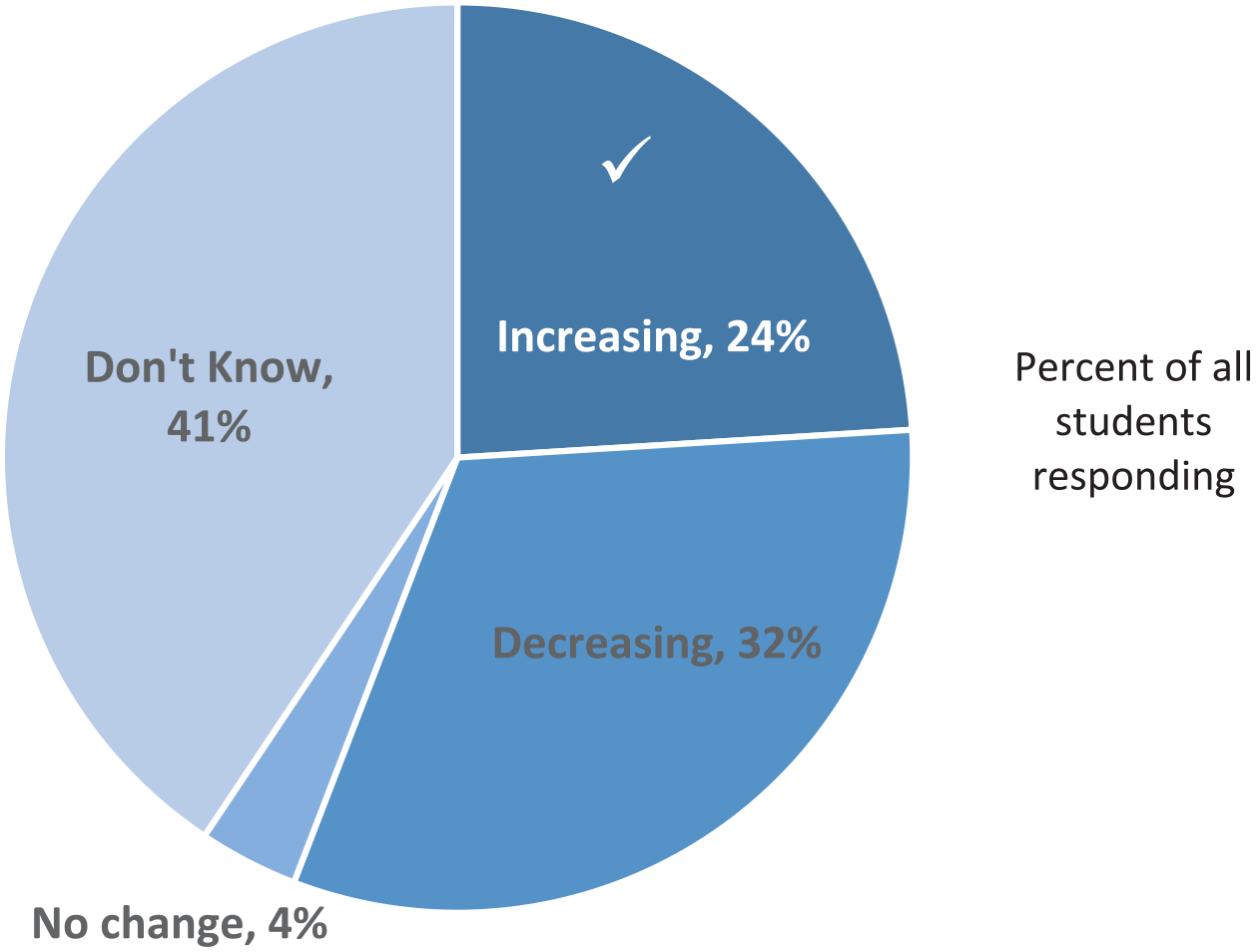
How is the population of Indigenous people in Canada changing?
The breakdown of responses to this question illustrates the level of geographical ignorance of students. That the largest proportion of students simply ‘don’t know’ speaks to the paucity of education they have received as well as the deep unawareness of Indigenous realities among the Canadian public. More troublingly, the belief that Indigenous populations are in decline, held by one third of the students, is politically important as it feeds discourses of Indigenous vanishing.
Powerful student imaginaries are also associated with reserves. Although most First Nations people live off-reserve, nearly two thirds of the students we surveyed were ignorant of this fact, typifying the ignorance of many Canadians of Indigenous presence here and now (Figure 2).
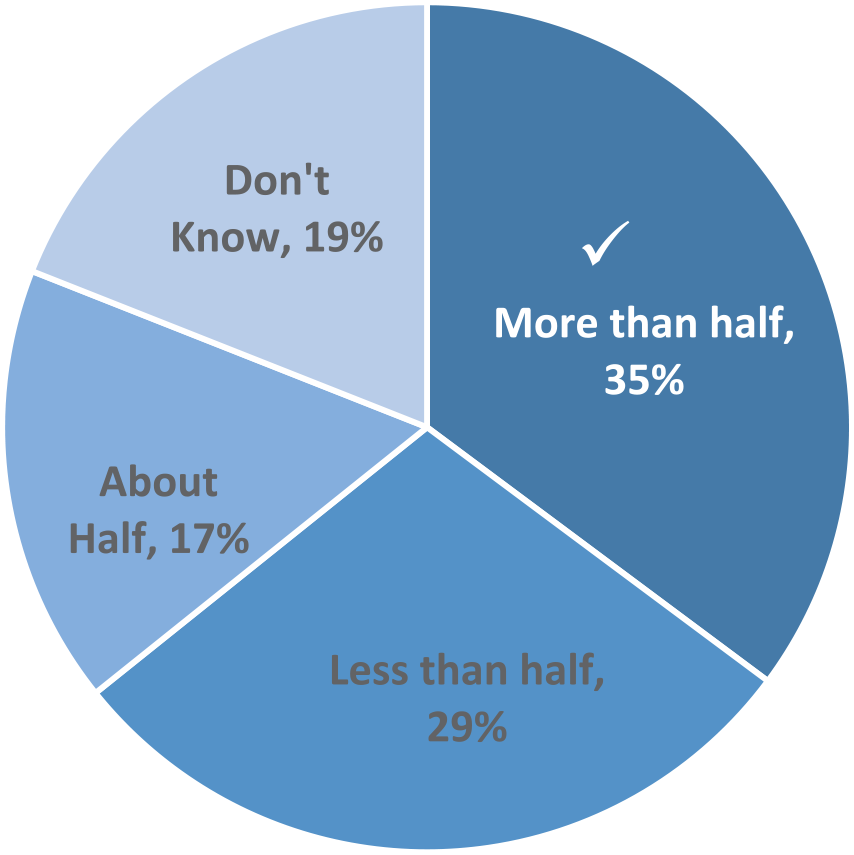
How many First Nations people live off-reserve?
Reserve lands, which make up only 1% of Canada’s land mass, were created over time as temporary repositories for First Nations, to remove them from prime agricultural land, separate them from mineral deposits and other resources, isolate them with inadequate economic transportation routes and eliminate competition with settlers until their presumed disappearance through assimilation (Godlewska, Schaefli, et al., 2020b; Titley, 1986). That 46% of student respondents believed that around or more than half of First Nations in Canada live on reserves highlights the power of settler-colonial temporality and spatiality in the settler-colonial geographical imaginary. Such an imaginary reinforces a reserve-urban binary, containing ‘Indianness’ (linked to primitiveness) to the imagined isolation of the reserve – a final vestige of Indigenous presence (Goeman, 2019). Indigenous presence outside these spaces is rendered invisible or exceptional. 12 Colonial temporalities and spatialities that separate Indigenous Peoples from the urban and modern in students’ imaginations are in keeping with a long legacy of Canadian policies aimed at removing Indigenous People(s) from urban lands (Peters, 2011; Peters and Andersen, 2013; Toews, 2018). Imaginaries of Indigenous vanishing and distance serve to naturalize settler presence, spatiality and diminish any sense of temporal and spatial immediacy for non-Indigenous people’s responsibility for (re)conciliation with Indigenous Peoples (Dunbar-Ortiz and Gilio-Whitaker, 2016; Mackey, 2014; Rifkin, 2013, 2017; Williamson, 2017; Wolfe, 2006).
Student imaginaries of Indigenous distance and remoteness are further displayed in responses to a question about why reserves might have more difficulties with poor infrastructure, water quality and inadequate housing than most municipalities. Nearly 50% of respondents considered reserves too remote and inaccessible to fund adequately, even though many reserves are in or near urban areas or towns (Godlewska et al., 2016, 2019; Godlewska, Lamb, et al., 2020). This ignorance obscures the crimes of dispossession and allows settlers to attribute all social problems associated with poorly resourced and isolated reserves to First Nations. It also highlights the significant ignorance of urban Indigenous identities and experiences (Cardinal, 2006; Lawrence, 2004; Peters, 2005; Woloshyn, 2015). However, despite widespread interpretations of reserves as colonialscapes (Hunt, 2007), reserves are spaces where First Nations ontologies and practices of kinship, community building, care networks, language, territorial relations and legal orders, among others, are enacted, transmitted and cultivated, and where settler-colonial violence continues to be resisted (Thobani, 2007; Tomiak, 2017; Vowel, 2016).
Analysis of results on the knowledge test at each institution confirms that geographical unawareness is not shared equally across broad identity groups. Across these surveys, we found no significant difference in test performance related to gender or between students who did and did not identify as racialized persons. However, as we have outlined in earlier reports and publications, on average self-identified Indigenous students showed greater awareness of the survey topics than non-Indigenous students, including on geography questions and questions about Indigenous presence in Canada. For example, among the entering students at VIU, those who self-identified as First Nations, Métis, and Inuit scored on average nearly 15% higher than students who did not so identify. In general, we found that self-identified Indigenous students were more aware of Indigenous presence in Canada, a result that is unsurprising.
Imagining settler space
We have found that public education in Canada reinforces and reproduces the abstracting, universalizing and homogenizing geographical imaginaries settler states rely on to normalize, naturalize and perpetuate Indigenous displacement and dispossession. Many of the students we surveyed displayed a geographical imaginary based on a profound ignorance of the diversity of Indigenous Peoples and an affirmation of settler space. Many students also demonstrated significant ignorance about Indigenous territories and, particularly, the spatial character of Indigenous plurality and sovereignties. Ignorance of Indigenous spatiality is inextricably intertwined with the dominant settler-colonial geographical imaginary of abstract and unified space that figuratively and materially constitutes the space of the settler nation (Lamb, 2021).
Students’ ignorance about Indigenous territories serves to obscure the magnitude of Indigenous dispossession. All the land in Canada and on Turtle Island is and remains the traditional territory of different Indigenous Peoples even when encroached upon by settlers or when Indigenous rights, titles and privileges to land are interpreted as extinguishable by means of treaties entered in bad faith by colonizers. Indigenous Peoples across Canada continue to assert and defend their sovereignties, rights and responsibilities to their lands through the courts, treaty negotiations and land-based acts of resistance and resurgence. It is troubling, then, that 41% of entering students at both VIU and Douglas College in British Columbia did not know the difference between reserves and traditional territories (Godlewska, Lamb, et al., 2020; Godlewska, Schaefli, et al., 2020b). When asked about this difference, 10% of exiting students from VIU and 28% of exiting students from Queen’s considered that all traditional territory had been extinguished with the arrival of Europeans (Godlewska, Lamb, et al., 2020; Godlewska, Schaefli, et al., 2020a). This is clearly articulated in one student’s response; ‘Traditional territories are the historical lands that indigenous communities resided within before colonial settlement’. 13 Framing Indigenous territories as things of the distant past and obscuring the historical and continuing processes that dispossess Indigenous Peoples from their lands and resources denies significant ongoing geographical, political, economic and social displacement and marginalization.
The inability of many students to comprehend the meaning of the contemporary multiplicity of Indigenous territories, or their connection to sovereign Indigenous place- and land-based polities, is tied up in the spatial imaginary of the Canadian settler state. Many of the students throughout our surveys imagine Canada as a unified and ahistorical space, in the sense of always having been as it is, disregarding Indigenous Peoples’ cosmogeneses which place them with(in) their lands from time immemorial (Weir, 2013). In this settler-colonial geographical imaginary, Canada is and has always been peopled entirely by settlers; Indigenous people are just another kind of settler. Thus, some students argue that Indigenous Peoples ‘Migrated from Europe’ 14 and were the first people to ‘settle in Canada’. 15 In such rhetorical constructions, Canada takes on an eternal status of always having been, already a unified space, and Indigenous Peoples were ‘essentially the ‘first people’ who made Canada home’. 16
Many students employ binary discourses of ‘we/they’ and ‘us/them’, enacting a performative unity of ‘we’ key to the creation of the imagined community and the imagined space of the settler nation (Anderson, 1991; Wolfe, 2006). However, unlike in the typical binary used in nation-unifying narratives which situates an ‘us’ here against an external ‘other’ there, these students imagine themselves as part of the ‘we’ of the settler state space and Indigenous Peoples as the ‘other’. This sense of an internal other generates profound uncertainty and spatial ambiguity that threatens settler control over land, people and place. Whether merely ignorant of contemporary Indigenous sovereignties or in an effort to alleviate uncertainty and ambiguity, many students used a ‘we/they’ construction imbued with settler-colonial temporality, placing Indigenous sovereignty in the past; ‘This Country was theirs before we arrived’. 17 Some students tie this temporalization to a settler-colonial spatialization, perceiving prior Indigenous sovereignty as a link in a narrative chain that leads inevitably to the ‘shared’ space of the settler nation where Indigenous Peoples ‘founded Canada’, 18 and as such are an ‘Important part of Canadian history’. 19 In such a geographical imaginary, while Indigenous Peoples may have been sovereign here in the past, Canada is now and inexorably settler space.
The exaltation of settler space is supported by liberal multicultural discourses that accord the settler state the authority to control and constrain Indigenous polities and sovereignties (Thobani, 2007). In such discourses, multicultural settler nationalism makes the state an unproblematic arbiter of rights, to which ‘cultures’ must be subordinate (Kymlicka, 1995; Taylor, 1994). Throughout the surveys, many students pointed to the state’s power as arbiter and giver of rights, for example, by seeing reserves as some sort of gift from the government ‘given’ to First Nations so they might ‘preserve their heritage’ 20 and ‘practice their culture’. 21 Here, the appropriating strategy of reserves is reframed as a product of government largesse and First Nations become passive beneficiaries of settler generosity. This perception not only denies settler-colonialism, but is easily mobilized to frame Indigenous struggles for restitution and self-determination as ungrateful.
In keeping with the exaltation of settler space, many students can only conceive of land and land rights abstractly. Commenting on Indigenous sovereignties and land rights, many wrote that Indigenous Peoples have lost rights and suggested that ‘we should give back the land rights to them’, 22 while some recognize that ‘There are Canadian Aboriginal laws that provide certain Constitutionally recognized rights to land and traditional practices’. 23 Either way, these students can only imagine that if Indigenous Peoples have any rights at all, that these are to an amorphous body of land. These students fold Indigenous rights within the framework of settler multiculturalism, obscuring Indigenous Peoples’ inalienable and sovereign rights as distinct polities with(in) their own particular lands, casting Indigenous Peoples as another minority to be managed by a settler state naturalized as the arbiter and giver of rights to a generalized space (Blackburn, 2005, 2007; Coulthard, 2014; Lamb, 2021).
Holding to an imaginary of Canada as a unified and abstract space, many students remain troublingly ignorant of the spatiality, plurality and diversity of Indigenous sovereignties. We found among students who did not self-identify as Indigenous very little awareness of, or engagement with, Indigenous Peoples as sovereign nations with their own unique senses of place, ways of knowing, and ways of being grounded with(in) their own lands (Godlewska et al., 2013; Godlewska, Schaefli, et al., 2017a, 2017b; Schaefli et al., 2018; Simpson, 2017). Instead, many students constantly betray monolithic and ‘pan-Indian’ imaginaries of Indigenous ‘culture’. When asked to share three things they know about Indigenous Peoples, these students used ‘culture’ in the singular, with the apparent assumption that all Indigenous people share a homogeneous culture. As Daigle (2019: 707) demonstrates, discourses of a unified ‘Indian subject’, which have been ‘codified and naturalized under the Indian Act’, serve to ‘erase Indigenous political and legal pluralities across space’. Perhaps it is unsurprising that this imaginary is so common as for hundreds of years settlers have sought to destroy Indigenous polities and their land- and place-based ways of being and sovereignties through genocide, land theft, the Indian Residential School system and the restriction and definition of Indigenous identity in the Indian Act (Daigle, 2019; Jacobs, 2009; Milloy, 1999).
A few students, implicitly recognizing the problematic way many of their peers imagine Indigenous ‘culture’, engage in myth-busting. These respondents insist that ‘There are many different kinds of first nations people, all with their own unique culture and traditions’. 24 Only a handful of students among the nearly 3000 across our surveys recognized the much deeper senses of Indigenous cultures interwoven with land and place (Battiste and Henderson, 2000; Cajete, 2000; Larsen et al., 2017; Tuck and McKenzie, 2015). As one of this handful recognizes, ‘Each territory has their own stories and way of life but each is a rich, proud culture with strong bonds to family and the land’. 25 For all the many mentions of ‘culture’, there are worryingly scant student mentions of multiple polities or place- and land-based sovereignties in the context of Indigenous Peoples.
Multicultural settler nationalism that denies Indigenous cultural and spatial diversity and distinctness is deeply embedded in education curricula across Canada (St Denis, 2011), and has deeply influenced the geographical imaginaries of many of these respondents and many Canadians. Combined with a geographical ignorance fed by settler-colonial temporalities and spatialities, such settler-colonial geographical imaginaries obscure and occlude fundamental facts of place in Canada, such as unceded land, the influence of the Indian Act, settlers’ treaty responsibilities and the continuity and vitality of Indigenous Peoples’ connections with their lands (Asch, 2014; Godlewska et al., 2019: 31; Simpson, 2014; TRCC, 2015d).
Ignoring co-presence and denying relationality
Active denial of settler-colonial and Indigenous geographies entails an ignoring of place-based connectivity with, and responsibility to, peoples, land and other-than-human life. Many Canadians’ attitudes, beliefs and practices of non-relationality are informed by ignorance of Indigenous presence and the naturalization of settler-colonial space. Many of the students we surveyed demonstrate non-relational thinking anchored in such geographical ignorance and imaginaries. Characterized by assumptions that favour and legitimize settler-colonial interests, such ignorance flattens geographies. Geographical ignorance is a significant angle from which to examine the ways education – which can be a situated and dynamic tool for societal transformation – perpetuates a ‘habitual disregard of Indigenous peoples’ and fails to challenge the widespread assumption that ‘Indigenous peoples and Canadians inhabit separate realities’ (Donald, 2012: 54; Donald et al., 2012).
Many of the students we surveyed, seemingly invested in the imaginary of sovereign settler space and the decline or absence of Indigenous Peoples, have difficulty perceiving how their own lives are inextricably linked with Indigenous Peoples’. When combining responses from Ontario and British Columbia surveys to a question about reasons for lack of knowledge about Indigenous topics, we found that despite living and studying in Canada, nearly one fifth (19.5%) of students believed Indigenous Peoples and topics were not relevant to their own lives (Godlewska et al., 2016, 2019: 19; Godlewska, Schaefli, et al., 2020b: 45). If students believe that Indigenous Peoples are not relevant to their lives, they will have less desire to understand complex issues like the spatial politics of ongoing dispossession. Where does this conviction of irrelevance come from?
Early in their education, many students across jurisdictions encounter coverage (or lack thereof) of Indigenous topics that affects their ability to recognize the significance of Indigenous Peoples and land-based sovereignties to their own lives (Godlewska et al., 2010; Schaefli et al., 2019). Analysis of student survey responses illustrates the implications of earlier education in post-secondary students’ consciousness, including their acceptance of or refusal to recognize co-presence with Indigenous Peoples. For example, students at VIU who reported they had been taught Indigenous topics in high school demonstrated a higher level of knowledge and showed greater interest than students who had not received similar education (Godlewska, Lamb, et al., 2020). At Douglas, 57% of students said they had not taken any courses at any level with significant Indigenous content (Godlewska, Schaefli, et al., 2020b: 5). Overall, compared to their peers who had been exposed to Indigenous content through formal education, these students demonstrated deeper unawareness of the Indigenous and settler-colonial realities that survey co-designers deemed crucial for students to know. We also found that students who expressed concern about social inequity for Indigenous Peoples had higher rates of educational exposure to Indigenous perspectives and topics, again suggesting the social value of education (Godlewska et al., 2019; Godlewska, Schaefli, et al., 2020b: 46).
Trends in student responses reaffirm how the treatment of Indigenous topics in education influences students’ willingness to understand Indigenous realities, particularly in regard to equitable and responsible engagement with Indigenous Peoples with(in) their territories. Although post-secondary education is where the development of critical thinking becomes possible for most students, many at Queen’s were not exposed to Indigenous topics and approaches. On average, students who had not been exposed to Indigenous topics in courses at Queen’s were much less likely than their peers to understand and correctly answer questions on the knowledge test, including questions focused on Indigenous population trends and presence in Canada, colonial government approaches to land claims and the breadth and depth of systemic anti-Indigenous racism. These students also demonstrated a greater unwillingness to engage with Indigenous topics at all. This finding reaffirms that educational silence impedes students’ development of the epistemological and affective capacities required to recognize, let alone partake in decolonizing relationships with Indigenous Peoples. Importantly, these students were also significantly less likely to have taken courses about Indigenous topics at their institution and were less likely to be interested in enhancing their knowledge (Godlewska et al., 2019). In fact, most students surveyed at Queen’s were not taking courses with any Indigenous content and were therefore likely leaving university with their prior knowledge and social attitudes unchanged. Such a likelihood poses a significant impediment to students’ capacity to recognize and address settler-colonial domination driving violent spatial clashes across Canada.
When asked questions about Canadians’ responsibilities in relation to settler-colonialism, many students across jurisdictions disengage, demonstrating an inability or resistance to situating themselves critically and productively within urgent struggles for socio-spatial justice. Post-secondary institutions that fail to engage all their students in Indigenous topics risk reinforcing students’ ‘active ignorance’, commonly expressed through ‘affective resistances (e.g. apathy, interest in not knowing – “the will not to believe”)’ and deflective tendencies (Medina, 2017: 250). Privileging ‘not knowing’ or ‘not needing to know’ inhibits students’ capacities for self-correction and openness to correction from others that favour non-oppressive relations (Medina, 2013b). This positioning can explain the tenacity of cognitive and affective distortions and investments – such as those that relegate settler-colonialism to the past and contain its relevance to only ‘Indigenous issues’ – that pose severe limitations of engagement for students. Within the wider Canadian context, such non-relational thinking turns what should be a spatially transformative (re)conciliation process into one that ignores ongoing spatial control over Indigenous Peoples, lands and resources and obscures the responsibilities of co-presence and coexistence (Daigle, 2019).
In education as in life, cause and effect are sometimes hard to disentangle; negative attitudes to Indigenous people can be generated in education, or simply reinforced there. Lack of exposure to thoughtful approaches to Indigenous topics ‘discourages young Canadians’ critical understanding of Canada’s colonial nature’ and ‘works to dull students’ responses to our collective inherited injustices, by allowing them denial of epistemic responsibility’ (Ermine, 2007; Medina, 2013a; Schaefli, Godlewksa, Korteweg, et al., 2018: 701; Whitt, 2016). The interconnected temporal and spatial dimensions of settler-colonial unknowing influence students’ social attitudes and their understandings of topics that are inherently spatial. At VIU and Douglas, students’ desire not to learn was the most significant predictor of unawareness of Indigenous and settler-colonial realities in the multiple-choice portion of the survey. We asked students why their knowledge might be limited and gave them an array of possible answers from negative emotions to externally induced time constraints. The approximately 5% of Douglas and VIU entering students who selected ‘I don’t want to know about these issues’ – a position indicating a sense of distance or disconnect from the very realities that shape life with(in) and across spaces in Canada – scored on average 27% and 20% lower, respectively, than the mean score of those who selected other options (Godlewska, Lamb, et al., 2020: 47; Godlewska, Schaefli, et al., 2020b: 45). Although a small proportion (just over 1%) of exiting students at Queen’s and VIU believed that ‘It is all in the past and does not matter anymore’ – a stance which renders Indigenous spatialities irrelevant to the present – it is telling that their mean test score was, respectively, 16% and 45% lower than peers who did not select this statement (Godlewska et al., 2019: 19; Godlewska, Lamb, et al., 2020: 47). It is significant that students who demonstrated a deep level of unawareness in the knowledge test also tended to select negative, denying, or dismissive responses about limitations to their knowledge.
Conversely, students who held positive attitudes to Indigenous topics and acknowledged the inadequacy of their education were more likely to express social attitudes driven by concern and a sense of responsibility towards Indigenous Peoples. Students at VIU willing to consider Indigenous topics of importance and interest were significantly more likely to ‘care a great deal about the wellbeing of First Nations, Métis, and Inuit people in Canada today’ (Godlewska, Lamb, et al., 2020: 48). Social justice issues affecting Indigenous Peoples were also of greater concern to students who were dissatisfied with their formal education about Indigenous Peoples. Indeed, 60% of entering students and 56% of exiting students at VIU believed coverage of these matters in school, college, or university was inadequate (Godlewska, Lamb, et al., 2020: 47). Exiting students dissatisfied with their education or who felt the need to re-educate themselves were more likely to want to pursue change, demonstrating a sense of personal responsibility. Contrarily, the students who believed that knowledge of Indigenous Peoples is irrelevant to them were more likely to blame Indigenous Peoples for the disadvantages Indigenous Peoples face. Such a corrosive belief disregards the fact that everyone in Canada, whether Indigenous or not, lives under shared settler-colonial conditions and that settler-colonialism disproportionately impacts Indigenous existence.
When looking at social attitudes of respondents at Queen’s, we found that those who identified as racialized (86/844) were significantly more likely to feel as though knowledge of Indigenous topics was not relevant to them because their family is not First Nations, Métis, or Inuit. These findings raise important questions about the experiences of racialization in relation to (non)relational thinking in settler-colonial contexts. It is beyond the scope of this paper to offer the dedicated focus required to ethically engage with such questions. Further study must attend to the complex entanglements between non-Indigenous learners’ own experiences of existing in a racialized Canada and their cognitive, affective and (non)relational stances.
The (mis)understandings of settler-colonialism, Indigenous Peoples and settler responsibilities demonstrated by many of the students we surveyed illustrate how geographical ignorance distorts, obscures and distances connections between people and places and normalizes uneven relationships anchored in power. Such issues are apparent in many students’ unawareness of the ways settler-colonial strategies continue to erode Indigenous land bases. Many students could only understand the fundamental issue of land through geographic settler-colonial imaginaries that distance, eliminate, or misplace settler responsibility and accountability for violent territorial arrangements that structure life across Canada. Evidence of the ignorance of entering and graduating students about the foundational territorial arrangements that organize their own lives – arrangements that inextricably entwine their existence with Indigenous Peoples – substantiate our call for education to address its role in maintaining geographical ignorance that enables non-relational thinking.
Conclusion: Cultivating geographical (Un)awareness through education
Settler-colonialism is fundamentally spatial. Consequently, (re)conciliation must be a spatial practice. When encountering truths about settler-colonial violence, many Canadians may be shocked or in denial because they are ignorant of their country’s history. However, underlying this ignorance is a foundational spatial ignorance and a settler-colonial geographical imaginary. Settler-colonial geographical ignorance cultivates and naturalizes ways of thinking that reject, obscure and erase the dynamic multiplicity of Indigenous presence and, therefore, Indigenous place-based politics of relationality. These (dis)investments and distortions protect settler-colonial interests, futurities and relationships by silencing and absenting Indigenous Peoples and their intimate, long-standing and ongoing connections to land, life forms and people. Such connections, fundamental to Indigenous existence, threaten to ‘disrupt naturalized settler rule’ (Dietrich, 2017: 74).
In this paper, we bring together studies of settler-colonial ignorance with scholarship on geographical imaginaries to better understand and critique settler states’ and people’s ongoing divestments from responsibilities to engage with Indigenous interests, sovereignties and settler-colonial issues. We demonstrate the tenacity of colonial ignorance built on geographical imaginaries of Indigenous absence and settler spatial hegemony, illuminating how settler-colonial unawareness about Indigenous peoples and colonialism functions to reaffirm white normative and strategic ignorance.
Although education is often considered a hopeful site for unsettling normalized and highly destructive ways of thinking and being together, our research reveals that public education still serves settler-colonial predations. The stories that are told through public education – and the understandings and attitudes these stories influence – have profound impacts in (re)producing and legitimating settler-colonial dispossession and violence against Indigenous lands and people. By engaging with the temporal and spatial dimensions of settler-colonial unknowing in students’ survey responses, we have detailed the structures of geographical ignorance created through formal education in Canada.
Canadian education cultivates in Canadians a profound ignorance of the places and spaces in which they live and undermines their capacities to recognize their complex responsibilities to build relationships with Indigenous Peoples and communities within those places and across Canada, both now and in the future. Canadian curricula and text books consistently place colonialism and Indigenous Peoples and territories in the past and present Canada as an ahistorical, unified and unproblematically sovereign state space. Students in Canada are educated to believe that the settler nation is a coherent whole, an abstract and unified settler space, making it difficult for them to perceive the multiplicity, diversity and spatiality of Indigenous polities, let alone imagine relationships between the settler nation and these polities within the same geographical area (Lamb, 2021). Informed by their formal education, too many students express apathy, ambivalence and indifference through their commitment to ignorance, claims that other issues are more important than those affecting Indigenous Peoples, denials of the relevance or responsibility of learning about Indigenous realities and settler-colonialism and desire to not know. Such expressions draw upon and reinforce anti-Indigenous racism, naturalizing non-Indigenous (often white) senses of superiority and making light of settler-colonial dispossession and violence against Indigenous Peoples (Mackey, 2016; May, 2006; Mills, 2007; Pasternak, 2015).
While silence on Indigenous topics has proven detrimental to students’ awareness and attitudes, our findings show that education engaging with Indigenous topics and challenging settler-colonial obfuscations can and has played an important role in enhancing awareness and the desire to learn. Students dissatisfied with their education or wanting to re-educate themselves were more likely to recognize the need to take part in changing the settler-colonial status quo. Education that enhances and shifts settler consciousness and engagement with Indigenous topics and perspectives is therefore fundamental to interrupting the denial of relationships between Indigenous and non-Indigenous existence. Furthermore, critical geographic education that engages place – the particular ‘wheres’ of historically and spatially entwined Indigenous and non-Indigenous ontologies, epistemologies, governance systems and relationships – is fundamental to participating in ‘relations of responsibility and accountability’ that cultivate ‘transformative change’ (Daigle, 2019: 715; Lamb, 2021). Profound relational and situational (un)learning demands recognizing and attending to pervasive geographic imaginaries anchored in an unawareness that serves the ongoing settler-colonial project.
Beyond formal education, we hope our theoretical contributions meaningfully inform the ongoing study of (settler)colonial ignorance by drawing attention to connections between deeply obscured settler-colonial geographical imaginaries and the ongoing undermining of people’s capacities to recognize or willingly engage with the situatedness of knowing and being. Such situatedness locates and implicates non-Indigenous people in both the ‘relational geographies of colonial dispossession’ and transformative ‘geographies of responsibility to Indigenous Peoples’ (Daigle, 2019: 715; Lamb, 2021). To study and to resist settler ignorance across contexts – institutional and otherwise – is to cultivate an understanding of how to recognize and upend settler-colonial geographical imaginaries. For geographers working on settler-colonialism and/or geographical imaginaries, engaging with settler-colonial geographical ignorance is an opportunity to identify, explore and critique geographical ways of knowing tethered to settler-colonial investments. We suggest there is also an opportunity to interrogate how the discipline’s own educational and research pursuits are sustaining or challenging ways of unknowing that impede anti- and de-colonial change. While geographical imaginaries and the ignorance they sustain transcend the discipline of geography, geographers are uniquely ‘placed’ – and perhaps thus uniquely responsible – to complexify, critique and challenge destructive, systemically reproduced geographical imaginaries.
Footnotes
Declaration of conflicting interests
The author(s) declared no potential conflicts of interest with respect to the research, authorship and/or publication of this article.
Funding
The author(s) disclosed receipt of the following financial support for the research, authorship and/or publication of this article: This research was funded by the Social Science and Humanities Research Council of Canada, Grant #43520150112.
