



Abstract
It is paramount that research relevant to Indigenous communities be conducted in partnership with them through free and prior informed consent. Historically, much research was extractive in nature, performed without Indigenous community consent, and often applied a deficit-framing. Some academic professional societies have developed guidelines for ethically conducting research with Indigenous communities to avoid these unethical practices. However, missing from these ethical research declarations are the specifics on research implementation or how research can be enriched through an ethical research approach. In 2010, the Association of American Geographers’ (AAG, now known as the American Association of Geographers) Indigenous Peoples Specialty Group (IPSG) wrote a Declaration of Key Questions About Research Ethics with Indigenous Communities outlining several questions that researchers should ask themselves when collaborating with Indigenous communities. We selected the AAG’s ethical principles for this study as it was one of the first environmentally oriented professional societies to make such a declaration. It is also among the world’s largest professional societies with over 10,000 members across 100 countries, with nearly upward of 7000 in attendance at its annual conference. The IPSG’s Declaration organizes their key questions around several elements: (1) Formulating the Project, (2) Identities of the Researchers, (3) Partnerships, (4) Benefits, (5) Findings, and (6) Deepening Relationships. This article discusses how each of the elements in the IPSG’s Declaration can be addressed for a wide range of research projects, providing specific examples from the Global Citizenship and Sustainability (GCS) program, a community-based partnership between Cornell University, the Institute of Social Informatics and Technological Innovations at the Universiti Malaysia Sarawak, and Penan village leaders in Long Lamai, Malaysia. This article argues that GCS’ research was enhanced through a non-extractive, community-based, and collaborative research mindset and further describes questions based on the IPSG’s Declaration that researchers can ask themselves throughout their research processes. This article serves as a foundation for researchers collaborating with Indigenous communities to think about their research to give agency to those communities while conducting innovative research. This article has been written in consultation with a community-chosen representative of Long Lamai, Borneo.
Keywords
Introduction
Indigenous communities have long experienced the negative consequences of extractive research practices (Smith, 2021). To this end, several professional societies have committed themselves to conducting ethical research, for example, the American Geophysical Union (2017), the Society for Conservation Biology (2004), and the International Association for Society and Natural Resources (2021). However, there is an opportunity for further growth within academia to work with Indigenous communities in an ethical manner by engaging in Indigenous methodologies that produce robust and co-created research that empowers communities. Our stance in this article is that ethical research is not a hindrance to the research process; on the contrary, it enriches the research experience and establishes the ability for long-term, in-depth, mutually beneficial research where researchers and Indigenous community members work in ethical relationships with one another. This creates a condition whereby academic organizations and researchers can create more robust research by utilizing Indigenous methodologies when working with Indigenous communities. To this end, this article focuses on the 2010 Declaration of Key Questions About Research Ethics with Indigenous Communities of Indigenous Peoples Specialty Group (IPSG) of the American Association of Geographers (AAG, formerly known as the Association of American Geographers) (Grossman et al., 2010) as a lens to evaluate an Indigenous research project undertaken by our team in partnership with the Penan community. The AAG’s IPSG comprises Indigenous and non-Indigenous geographers who work closely with Indigenous communities. The IPSG’s memberships saw that as academics, they had a moral obligation to formulate academically rigorous research and benefit Indigenous communities. A decade later, the Black Lives Matter movement highlights much work that societies still need to do to create justice beyond equality or equity (Nummi et al., 2019). Research science, institutions, and projects tend to impact Indigenous communities and, as such, are in a position to encourage research that happens “with and for” those communities and should evolve beyond being something imposed “on” them (Wilson, 2008).
The IPSG’s declaration focused on geographers’ academic research with Indigenous communities, but researchers from a range of disciplines and vocations can adapt the key questions to their research, institutions, and non-academic projects. To that end, this article argues that researchers must enter more collaborative and mutually beneficial processes when working with Indigenous communities. This article will address how each of the six elements of the IPSGs Declaration, as described above, can be a valuable framework for researchers to build stronger research collaborations with Indigenous communities. This article is a pragmatic examination of a research project conducted with the Penan people of Borneo and how the research process aligned with the IPSG’s declaration.
Cornell’s Global Citizenship and Sustainability (GCS) program was founded in 2012 to provide place-based research experiences for undergraduates and communities using community-based research principles, reciprocal learning, and trusting relationships (Allred and Somchanhmavong, 2015). In 2016, the GCS began a community-based research partnership with the Penan people of Long Lamai in Malaysian Borneo. The program’s focus was to offer a community-based field experience based on reciprocity and Indigenous cultural resilience (Allred et al., 2016, 2017).
The Long Lamai community is located in the Sarawak region of Malaysia on the island of Borneo near the border of Indonesia. There is no direct access by road, so the GCS group traveled by twin otter planes and small boats on the Sungai Balong River to arrive at the village of Long Lamai. According to Village Headman, Wilson Bian Belaré (Jengan, 2016), the history of the founding of Long Lamai is as follows:
The reason is that during (that time), they settled in that area, many diseases they experienced at the time. So, while the villagers built their village there, my father traveled to the jungle looking for suitable land. After that, he found the flat ground and also a suitable area to make a new settlement for the new village. So, he called all the villages to move to that place for making and build a new village it’s called Ba’Akep before and Long Lamai right now. In 1950, or something like that, there was a missionary who came to that area. They asked my father to find the other people who were still nomadic in the forest. So, my father traveled to the forest and found the nomadic brought them together from being nomadic. There were a few people in different groups from the downstream river, they met, and my father explained the living conditions here. Their lifestyle included hope in religion. So that nomadic people from downstream rotated to enter our village and met my grandfather, Jabu, as you know my generation starts from Batan down to Jaleng, then down to Muai, after that down to Sawen, and to Jabu, down to my father Belaré and lastly me.
In 2015, Universiti Malaysia in Sarawak (UNIMAS) and Cornell University established a formal partnership to host the GCS program. Given the long-standing relationship that UNIMAS has with the Long Lamai community, they agreed to partner with the GCS to engage with the Long Lamai community. UNIMAS first approached the Long Lamai community for their consent to expand the existing partnership to include another higher education institution, Cornell’s GCS program.
Formulating the project
One of the critical elements of the IPSG’s declaration is that building connections with communities begins even before the project begins. There are two fundamental elements that this article will discuss concerning formulating research projects. First, to what extent are the researchers devoting time to building community capacity before the project begins? Building community capacity requires that researchers spend time in Indigenous communities building relationships, and this process should start even before the project is implemented. Building community capacity at a fundamental level forges multiple types of connections between the researcher(s) and the Indigenous community. It extends to fostering relationships between Indigenous community members as a means to engage in collective work and strengthen the overall community (McDonald and Raderschall, 2019). Building community capacity enables researchers to better understand what is important to the Indigenous community and, as a result, prioritize the community’s goals equally with their research goals. The power dynamic is rebalanced by prioritizing what is essential to the people, which forges a stronger research partnership. Strong partnerships reduce the chance that the Indigenous community members will feel exploited by the researchers and shows how research projects can be conducted with the community’s needs in mind.
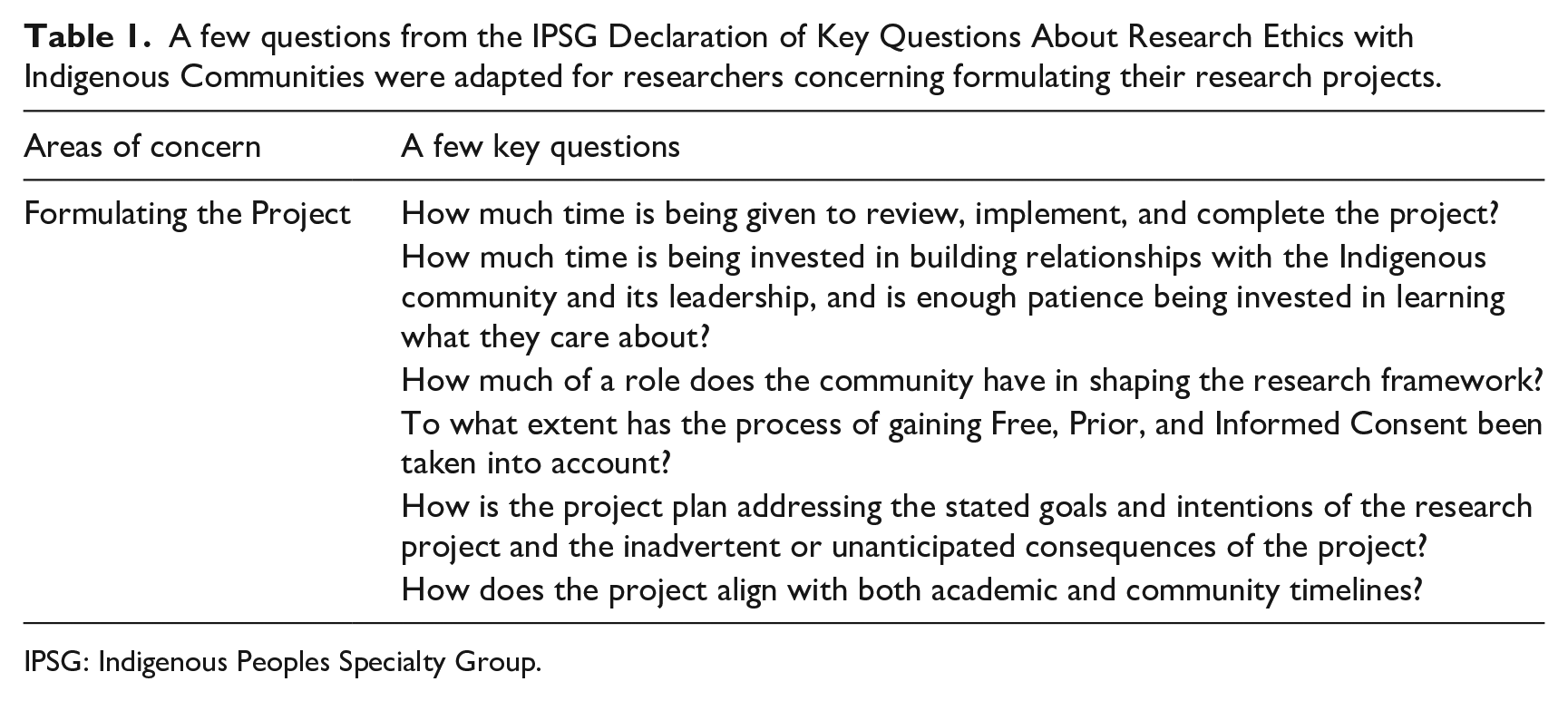
The second key question focuses on how much of a role the Indigenous community has in shaping the research framework. One way to address this question is to establish a community advisory board for the project while building community capacity. Community advisers can be political leaders, elders, or any trusted and respected community member. Community advisers collaborate with researchers to establish a research agenda that meets the community’s and research project’s goals, can help resolve misunderstandings between the researchers and the community and assist in validating how goals are being met throughout the research process (Kassam and The Wainwright Traditional Council, 2001; Robinson et al., 1998). Table 1 has several other questions adapted from the IPSG’s declaration that researchers can ask to ensure the agency of the Indigenous communities during the formulation of the research projects.
A few questions from the IPSG Declaration of Key Questions About Research Ethics with Indigenous Communities were adapted for researchers concerning formulating their research projects.
IPSG: Indigenous Peoples Specialty Group.
In formulating the project, it was vital to operate from a principle of reciprocity. The community of Long Lamai’s learning from the experience of working with UNIMAS and their collaborative development of cultural and research protocol were paramount (Zaman et al., 2016). Cornell University became an opportunity to serve as a “test case” (Zaman et al., 2016). Long Lamai was interested in how this process of engaging outsiders from a Western university might work for them as a community. The people of Long Lamai developed an agenda for the type of research that they would like to have conducted and thus expected to have a voice in the types of questions that were being explored by researchers. To that end, the community appointed Long Lamai elder, Mr Garen Jengan, as the liaison to the universities. His role is critical to the communication, administrative and logistical needs of both the universities and the Long Lamai community. As Cornell University and UNIMAS built their own capacity, the Long Lamai community was also building their capacities such as the infrastructure, homestays, food, electricity, and so forth, to host university students, faculty, and staff members. Simultaneously, they reworked their schedules and everyday routines to accommodate the group.
For Indigenous communities partnering with institutions of higher education, there are several key factors to consider. Findings from a service-learning workshop conducted by the authors at the 2015 eBorneo Knowledge Fair in Ba’kelalan, Malaysia, revealed that Indigenous communities from the Borneo highlands perceive benefits from university-community partnerships, including how external partners can bring the community together and sometimes suspend local politics (Harris, 2017). Factors that they stated are important are deciding on the project’s scope and considering the timing of projects, particularly because many are farmers and rely on agriculture for their livelihoods. When asked what success looks like, “sustainable relationships” were paramount. They expressed wanting to avoid a “one-night stand” with regard to the university–community relationship and emphasized the importance of “coming back to the community.” The process of returning creates excitement, rewards, and outcomes as long as both parties are coming together. Even if a technical issue is not solved through the partnership, “that does not mean that the partnership failed because there is still learning on both sides.”
Projects like the Ngerabit eLamai have connected Long Lamai to the world, creating cultural and linguistic preservation, economic development, and education opportunities. However, opening their community to outsiders like students, researchers, developers, and government agencies also created tensions in engaging with external groups (Winschiers-Theophilus et al., 2015). The community responded by appointing a well-respected member, Garen Jengan, to liaison between the community and UNIMAS. He is a fluent speaker of local languages and English and has extensive experience working with government agencies (Winschiers-Theophilus et al., 2015). The community research liaison tasks include facilitating researchers and their field activities during their visits to the community (Zaman et al., 2016). The community also designated five researchers as facilitators, including Franklin George, a Penan and a student at UNIMAS, and asked that one of the facilitators must join and lead any research team who wanted to visit Long Lamai (Zaman et al., 2016). The GCS was facilitated by a research team from UNIMAS, including Franklin George, who joined the GCS team as a student facilitator and translator during their time in Long Lamai.
Garen also built the capacity to handle small groups of visitors, but it did not happen all at once. Prior to the GCS research visit in 2013, the community hosted a group of 20 researchers (with different ethnic and cultural backgrounds) for the first time. It was the first time visiting a Penan community for many of them. As a result, the community started feeling pressure related to “engagement,” “facilitation,” and “communication,” and the need to “follow certain protocols” with the UNIMAS research team (Winschiers-Theophilus et al., 2015). A written cultural protocol was co-developed with the community based on this feedback. The first stage involved two focus groups in the community (with 15 participants), exploring the tacit and implicit values and practices (Zaman et al., 2016). This finding established a text-based, written cultural protocol with 17 fundamental themes (Winschiers-Theophilus et al., 2015). The guidelines were presented and approved by the community council of elders. Then the community reached a consensus on providing the guidelines to each researcher for endorsement during their visit to Long Lamai (Zaman et al., 2016). However, there was a disconnection between the written protocols that the researchers were given and the community’s expectations of how the researchers would conduct themselves. UNIMAS representatives listened to the community’s different engagement experiences with the researchers and held a workshop to raise awareness among guest researchers (Winschiers-Theophilus et al., 2015). The workshop comprised a series of presentations, discussions, conflicting scenarios, and reflections. Guest researchers’ responses were recorded and evaluated to prepare better researchers to interact with the Long Lamai community. In addition, the community designed cultural protocols based on the critical incidents they experienced working with researchers (Zaman et al., 2016). Furthermore, Franklin George transformed the guidelines and important community concerns into a sketchbook for their cultural training, as described in more detail in the Partnerships section.
The GCS program leaders understood that they also needed to build community capacity for the students as a community. To that end, they created a 3-credit class, Community-Based Research Methods in Southeast Asia, where they could discuss the issues, they learned about in Long Lamai with the students. They also modeled the decolonial methodologies that would later be used in the field, including a visual charting exercise (Allred et al., 2016). The class also included a language and culture component where the students learned basic Bahasa phrases to gain basic proficiency in communicating with the community in the national language in Malaysia. Finally, the class required an in-depth examination of Decolonizing Methodologies (Smith, 1999) so the students could understand the specific issues concerning Indigenous communities and research projects. In addition to the content, the class was designed to build a community of learners and community-based researchers. Instructors used multiple pedagogies to cultivate a safe and welcoming space for students and instructors to practice critical reflection, articulate their talents, assets, and biases, and form a supportive community leading up to the trip. It was meaningful when students took up the courage to express their frustration with the “unknown.” The year 2015 was a pilot year; all partners involved explored the possibility of a long-term collaboration. As instructors, we were learning simultaneously with students to be patient and open to the unknown and unexpected. Reading and analyzing course texts is much more straightforward, but personally experiencing them is a much fuller learning experience. The GCS leadership learned how to best navigate between students’ desires for structured and packaged projects and UNIMAS and the Long Lamai’s community’s approach of relationship building. The students eventually valued the knowledge exchange process rather than simply providing an output for the community.
The pre-departure course was designed to provide students with an introductory knowledge of the geographic location of the Long Lamai, the projects they might be conducting, community-based research methods, and so forth. More importantly, it was about being part of a community, using the classroom as the site of experiential learning. The class conducted several activities designed to change students’ perspectives throughout the semester. For example, they learned from the Borneo visit that people must remove shoes before entering the house before entering hosts’ homes. A sign was posted stating, “please remove your shoes before entering” on the first day of class. Some students took off their shoes at the door, and others took them off after entering the room. One or two students were reluctant to do so but saw others had done so. They then followed suit. As the semester progressed, the sign about taking off the shoes was removed, but the students continued to remove their shoes at the door, having established a social norm. The activity introduced students to the cultural etiquette of entering folks’ homes in Borneo, Malaysia. It was an activity that required students to reflect on their cultural upbringing and their day-to-day activities. One of the hopes was to have students recognize the importance of respecting cultural practices. Also, the conversation went further in talking about how to manage and unpack the “discomfort” if someone is not comfortable taking off their shoes before entering. However, once in Long Lamai, the students took their shoes off without being asked, which showed the community members that the GCS researchers were taking steps to respect their culture while reducing the impact of culture shock on the students.
Identities of the researchers
When working with Indigenous communities, researchers need to confront their own experiences with systemic racism and colonization and recognize that the process of institutionalized education may have created biases that have gone unnoticed (Rose, 2002). Researchers must be willing to self-reflect on their interactions on multiple levels. An example of multiple layered reflections would be transparently reflecting on oneself, their close relationships within the community, and how their actions impact the community in a larger context (Nicholls, 2009). Discussing the researchers’ identities can include sharing their family lineage, places they have lived, and why they went into their field. Researchers should not be limited to discussing their academic credentials with communities (Robinson et al., 1994). In addition, by working within the community, the researchers refine their own identity and worldview (Nicholls, 2009). The benefits of this are threefold. First, a more complex worldview can drive the research projects in unanticipated directions. Second, the researchers constantly refine their identities, which will be shared with new communities. Third, as the research project evolves, so do the researchers’ identities.
Another key element of the researchers’ identities focuses on the institutions supporting their research. It is important to recognize institutional goals for research and share that with community members to determine where there is synergy with community aspirations. Researchers need to discuss what is important to their associated institutions and their fundamental principles. Discussing one’s research institutions with Indigenous community members creates the opportunity for researchers to find ways beyond the thinking in their own projects and expands the conversation both within the community and within the institutions (Denzin et al., 2008). Including communities in that discussion can enrich research project priorities in the future and create a greater understanding between researchers and the community. In addition, the community leaders may want to check the researchers’ credentials and their institutions by scrutinizing their record of work with other communities (Kassam and The Wainwright Traditional Council, 2001). Discussing the research institution’s interests also provides a means for community members to contact other members of that institution to advocate for their research agendas or to assess the researchers’ reputations (Chambers, 1997). By being transparent with the ideals of their research institutions, the community can address any potential issues that may arise from the research process.
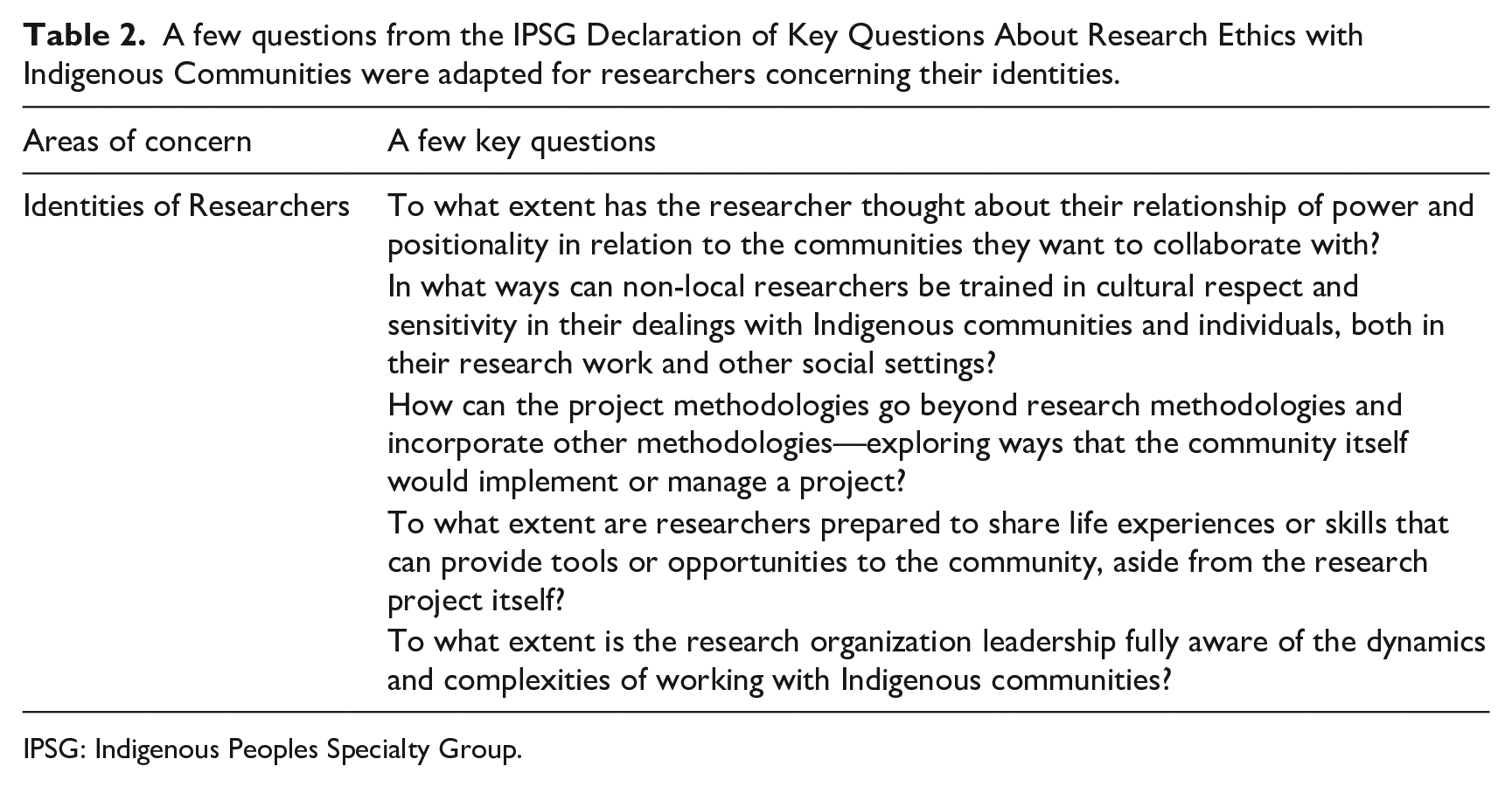
The source of a researchers’ funding is the final element that needs to be discussed with the community. In having this discussion, the community members can address any potential conflicts of interest. For example, if the researchers’ funding comes from an organization that has caused harm to the community in the past, the community members may feel betrayed if that funding source is not disclosed upfront (Bryan and Wood, 2015). Even if researchers adhere to all the other elements in this article but do not disclose their funding source, it can damage their reputation, trust, and relationships with the community. Indigenous communities do not exist in a vacuum; the researchers’ funding source will most likely be discovered. The community’s reaction to that betrayal of trust makes the research process more difficult for subsequent researchers and research projects. There is a greater benefit to being honest with the community and addressing their concerns that far outweighs the cost of not being transparent and losing a research partnership. Sustainable research means that the research projects are continuously viable and foster an inclusive environment where other researchers may be invited in to conduct future projects. Table 2 has several other questions adapted from the IPSG’s declaration that researchers can ask as a means to create space for the Indigenous community members to have a voice by discussing their identities with the community members.
A few questions from the IPSG Declaration of Key Questions About Research Ethics with Indigenous Communities were adapted for researchers concerning their identities.
IPSG: Indigenous Peoples Specialty Group.
However, discussing identity is a two-way process. Researchers need to engage with community members to understand their issues and histories better. The Penan have a tradition of trading with outside communities. Often the Penan have been described as “meek,” “inoffensive,” “peaceful,” and “politically irrelevant.” This perspective of the Penan meant that outsiders often took advantage of them and exploited trading with the Penan to create exorbitant profits. For example, in 1927, one Brooke official (Ermen, 1927: 304) noted that traders could make 600% to 1000% profits from trading with the Penan (Ermen, 1927: 304). Brooke officials were concerned about the Penan to protect them from economic exploitation (Ermen, 1927: 305). In 1906, the Brooke regime began supervising the barter-trade meetings between the Penan and outside traders in a system called Tamu. Although the Balui area came under Brooke control in 1861 and the Baram basin in 1882, Tamu meetings only occurred in the Baram District (Ermen, 1927: 331). As government officials did not supervise trade meetings between the Penan and outside communities in the upper Rejang, there is very little information on these transactions. Johannes Nicolaisen, a Danish anthropologist who worked among the Penan in the upper Rejang in the 1970s, witnessed some of these forms of exploitation (Nicolaisen, 1976: 58). This history has caused the Penan to be both open to working with researchers but also concerned about exploitation. Hence, they sought to create cultural protocols when working with researchers that dictated expectations, communication, relationships, and data ownership.
Partnerships
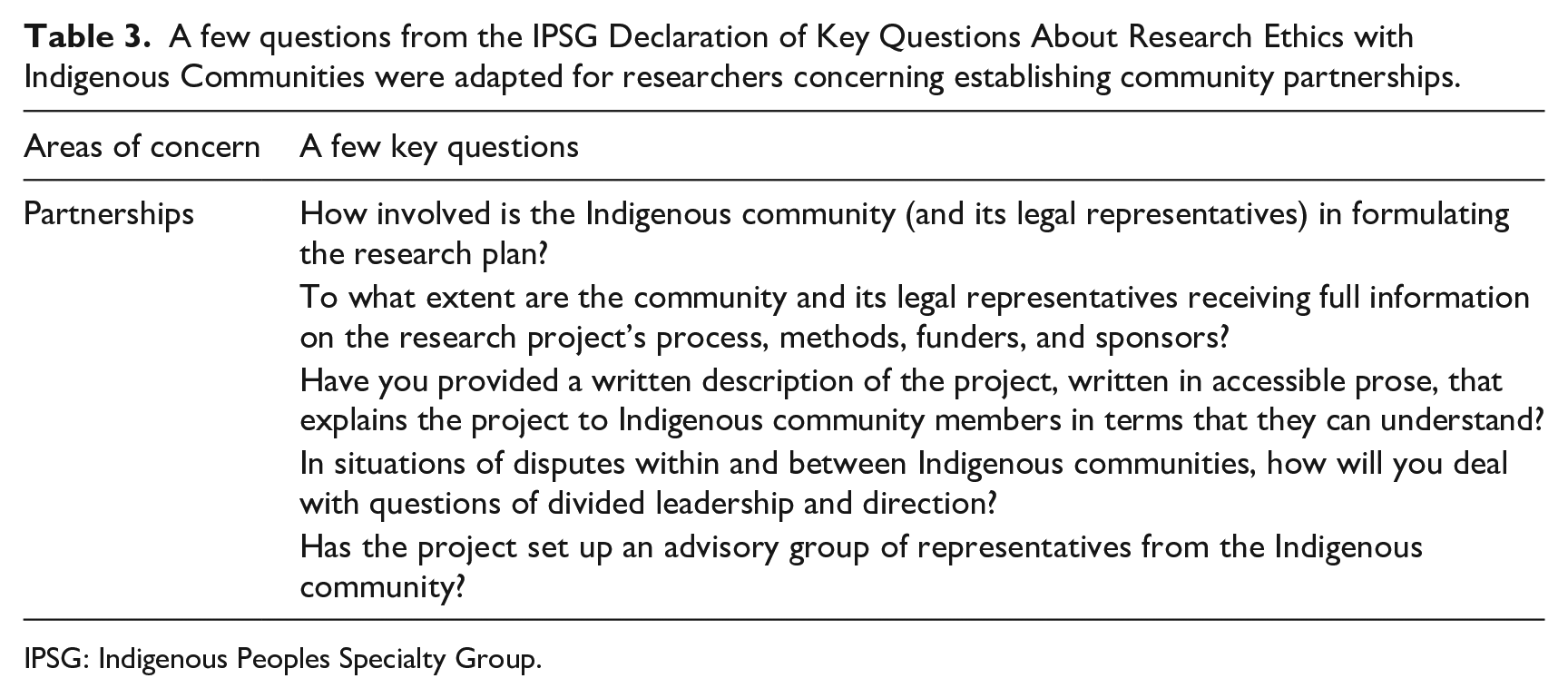
Ethical research with Indigenous communities depends on creating strong partnerships with the community members. Creating and sustaining partnerships requires researchers to communicate with their community advisers about the research continuously. Collaborating with community advisers provides an avenue to discuss strategies for developing the research project’s goals with the Indigenous community. While co-creating the research project’s goals with the Indigenous community members, it is important to discuss the issues that the community is facing and find ways for the research project’s goals to align with the community’s goals (Kassam and The Wainwright Traditional Council, 2001; Robinson et al., 1998). Respecting the community’s agenda can include community action projects or creating spaces within research institutions to hear the community’s voice (Smith, 1999). Research that is practical for the community is central to ethical research projects; there is little use in partnering with Indigenous communities if all parties are not working toward shared goals. In addition, creating spaces in research institutions for Indigenous community members allows them to build a cohort of researchers and establish their own research projects. Another element of forging strong partnerships with community members is that researchers work with community members to formulate the research project’s methods. Researchers’ methods need to be diverse and pluralistic to adapt to different contexts (Chambers, 2008). Thus, researchers should be flexible regarding their methods because community members may not be receptive to certain methods. By working with the Indigenous community members, researchers can avoid creating negative experiences in the communities they work with and foster the trust that is the basis for effective research projects. Table 3 has several other questions adapted from the IPSG’s declaration that researchers can ask to co-create knowledge with the Indigenous communities they work with through forging strong community partnerships.
A few questions from the IPSG Declaration of Key Questions About Research Ethics with Indigenous Communities were adapted for researchers concerning establishing community partnerships.
IPSG: Indigenous Peoples Specialty Group.
The first full day after the GCS arrived at Long Lamai, the Penan conducted their cultural training protocol with the GCS participants to discuss the expected behaviors of the researchers while in Long Lamai. A Penan community member sat with two or three researchers and showed them hand drawings of researchers interacting with community members. The Penan community members asked students to describe what they thought was depicted in the images, which served as a foundation for the Penan community members to discuss concerns about researchers in their community (Zaman et al., 2020). The researchers also engaged in multilayered reflexivity (Nicholls, 2009). First, they reflected on themselves by journaling daily and thinking about the events and how they informed their worldviews. Second, the researchers reflected on the research group by setting aside time once or twice a day to check in with each other and as a group, do group building exercises and support each other through the research process. Finally, the GCS met regularly with Penan community members to reflect on how the researchers impacted the community and prevented any conflicts before they started.
After a few days of interacting with the community, the researchers met with respected community members to conduct a visual charting exercise (Allred et al., 2016). The researchers and the community members separated, drawing how they saw Long Lamai and the issues it faced. Both groups examined the other’s representations, which facilitated a discussion over the important elements of the Long Lamai community and issues, both those that the researchers understood and those of which they were unaware. Based on that exercise, the researchers determined that issues of energy, tourism, clean water, and Internet access were significant to the Penan community members and were issues that the researchers could address (Allred et al., 2016). As Long Lamai community elder Garen Jengan stated, “We are trying to find our way to help ourselves before we seek help from others.” Thus, the right to self-determination was instrumental. Our ability to include the community in co-developing the research plan gave agency to the community in the process and respected their self-determination.
Benefits
It is vital for researchers to honestly examine the benefits they will receive from working on a research project and attempt to reciprocate those benefits for the community. It is optimal if researchers and the community discuss how the research project can benefit the community. In addition, the researchers need to find opportunities for those benefits to align with the community priorities. Ethical research needs to be sustainable, much like development in Indigenous communities needs to be sustainable and “indigenized”—bottom-up (Allred et al., 2022). Therefore, research projects prioritizing research goals over community goals are just as damaging as resource extraction prioritizing finances above the environment. The research project itself needs to benefit the Indigenous community by respecting its culture and reaching shared goals (Denzin et al., 2008). Research projects can negatively impact Indigenous communities, and those communities need to be adequately compensated for those impacts (Louis, 2007). The researchers can compensate the community monetarily; however, there are several ways to give back to the community with longer-lasting benefits as well.
Reciprocity of the community’s generosity is foremost. Reciprocity can include honor gifts that are culturally appropriate for a community member hosting researchers in their homes or sharing a story about a researcher’s life after a community member has shared one of theirs. It can also include more things, such as performing good works around the community and establishing programs that will have long-term impacts, like a peer tutoring program for high school students. The concept of reciprocity is vital regarding research projects and sharing the benefits of the projects with the Indigenous communities.
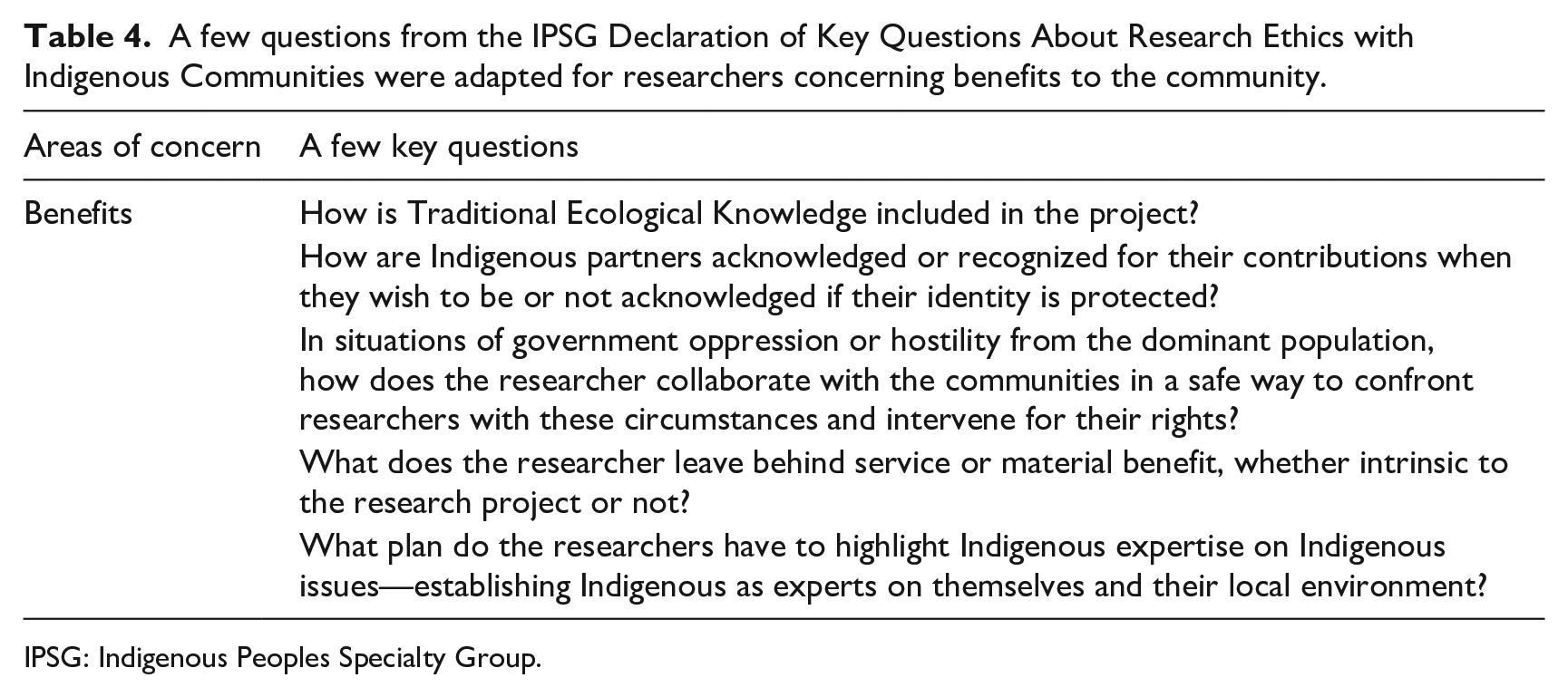
Research projects can address the community’s needs in many ways, including working with community members to manage the projects using culturally appropriate methods and taking the time to learn about traditional community-based research management techniques. In addition, researchers should find creative ways to benefit the communities in addition to the research. For example, researchers can advocate on behalf of the community’s goals to other stakeholders, work with community members to provide new skills, and support the academic goals of younger community members (Chambers et al., 2004). Furthermore, researchers need to engage with Indigenous communities to integrate Traditional Ecological Knowledge (TEK) into their research projects and give equal credit to the community members when TEK is used as an adaptive research management technique (Allred et al., 2022; Berkes et al., 2000). Table 4 has several other questions adapted from the IPSG’s declaration. Researchers can ask the Indigenous communities they are working with how they would like to see them give back and their perspectives on the community’s benefits.
A few questions from the IPSG Declaration of Key Questions About Research Ethics with Indigenous Communities were adapted for researchers concerning benefits to the community.
IPSG: Indigenous Peoples Specialty Group.
In Borneo, one of the main focal areas in addition to conducting research was cultural exchange. One of the GCS students, who is a member of the Choctaw Native American Nation, Michael Dunaway, engaged with the community members and shared experiences, stories, traditional dance, and gifts that were in line with his cultural values, which opened up opportunities for the Penan community members to do the same with him. In addition, the researchers engaged with sharing their own cultures and worldviews with the Penan, which included a shared dinner where Penan community members were able to share traditional songs, dances, and artwork. Even small exchanges where the Penan community members could practice speaking English were valued.
Traveling from the United States to Malaysia was the first time traveling outside of the United States for some students in the GCS program. This experience has impacted their outlook on society. One student, Rachel Whalen, who grew up in Upstate New York, decided to return to Sarawak, Malaysia, interning in UNIMAS in the summer following her participation in the GCS program. She researched community-based service-learning and was invited to facilitate community-based service-learning workshops for Pusat Internets, which led to the publication of a Service-Learning Toolkit (Whalen et al., 2022).
Another student, Komathi Wasudawan, who was a doctoral student, now a professor, mentioned how her involvement with the GCS sparked her doctoral dissertation:
Like for me, I was at the beginning of the Ph.D. [and] was suffering. I mean, I don’t know how to start my research. I said, “What?” Because I’m not from here. So, by joining this program, by me going to Long Lamai, I could actually see where to start and how to structure my questionnaire because I did my private study there. So that was very helpful. And in order for me to think there are several types of tourism and I could only focus on what is the relevant like for example, I present on tourism results. (Wasudawan, 2018).
Evvia, a graduate student from UNIMAS, commented that she came on the trip with no expectations since this was her first experience with a formal global service-learning program. However, the trip made the difference for her and connected her not only with the Cornell students but the Long Lamai community as well while also gaining fieldwork experience. In a post-program reflection, she discussed what she learned and how she adapted during the process of working with Long Lamai and the larger research team:
I’m working with a different group of people which comes from a different part of the world and culturally. We are different and the way we work is different also, but then it’s fun that they, they actually follow people. So, and they laugh a lot, which is good. I learned so much from them in so many ways . . . They really work, but at the same time, you don’t be so serious about it, but try to put some fun in it. Because I’m the kind that, like, know you have to be serious the hundred percent. They do it, you know, fun. So, at the same time you learn. That’s what I want. So, you gotta have some flexibility. (Interview with Evvia Veno, 2018).
Franklin George added from his experiences with our research project, “previously, if we done it [interviews] in class, our teachers only ask to do the interview and that’s it . . . and student need to do it alone. But now we interview them together with Dr. [Allred] and the students.” So, the UNIMAS students were exposed to collaborative and community-based approaches for research that helped them to apply what they had learned in the classroom.
A key aspect of finding mutual benefits is spending time together to understand each other’s perspectives. Our research group had to learn about how the Penan saw the world so we could find ways to benefit their community and deal with challenges in a way that aligned with the community’s values. Like other egalitarian communities, for Penans, unity is the most important aspect of their culture, which keeps the community together (Allred et al., 2022; Zaman et al., 2016). Penans are very deliberative in their approach to conflict, both internally and with outsiders. Therefore, they invest time in discussion and planning before embarking on a project or coming to an informed decision. In our partnerships, we faced frictions in the implementation phase, usually solved with mutual consultation between the community members and researchers. As reported by Needham and Beidelman (1971), Penans are shy in nature. In the early stage of UNIMAS engagement with Long Lamai, the researchers experienced isolated conflicts that arose from not being attentive to indirect forms of communication. As reported earlier, the community elders and researchers co-designed interaction protocols for guiding and preventing conflicting situations and how to handle them when they do arise (Zaman et al., 2016). In addition, to understand the explicit norms of a community at the outset of a partnership, it is also important to learn the community’s non-verbal cues and expressions of agreement and disagreement. For example, if the Penans want to avoid a situation or have no clear answer, they will request for a “break or pause” in the discussion instead of saying “no” outright (Zaman et al., 2020).
In our project, we had an intensive process of engagement and planning with the community elders before bringing a new idea or group of researchers, and if things needed to change—we adapted the research to the cadence of the community’s day. However, one incident happened where the local organizer (community members) had an error and miscalculation in the arrangements of the boats, which meant an increase in expenses beyond the allocated budget. In response, the community elders called for a meeting of the boat operators and also invited the researchers. They asked the researchers to explain the situation to the community. Once researchers explained the situation, they were excused from the meeting, and community members settled the arrangements within themselves instead of deviating from the allocated budget. There are other occasions where misunderstandings occurred due to cultural interaction and communication differences. Some of those tension points have been utilized as examples of conflicting scenarios to use later in training programs for the students and guest researchers, as reported by Winschiers-Theophilus et al. (2015). In each example of the points of friction that we experienced with the Penan, it was important to work with the community members and create the opportunity for them to exercise their agency in finding solutions.
We needed to be attentive to other types of benefits in our project. One of those areas was funding. We secured funding through the Office of Engagement Initiatives at Cornell University, which was much more flexible than most funding sources regarding working with Indigenous communities and supporting community partners. We were able to fund compensation for our Research Liaison, Garen Jengan, to coordinate the research with us, and the funds also covered the costs of homestays and meals and translation in Long Lamai for student community-based researchers from Cornell and UNIMAS. We spoke with the community about the level of compensation. The community met and agreed that compensation should be linked to the required time commitments. This aligned with the Penan cultural protocol training, where one sketch showed a researcher asking for a Penan community member to take time away from their work to partner with the researcher. The expectation is that community members should be compensated for the work they are contributing as it translates to time away from other activities such as tending agricultural fields. In addition, the Penan community members who were providing our meals had to learn to cook foods that met the various food requirements of the researchers (e.g. vegan, gluten-free), which was also a component we needed to negotiate.
One communication challenge arose when we requested a jungle trek to a Durian gathering area, a common trek for the community members. The community members could reach the area within 45 minutes to an hour from the village. However, it was a much more challenging trek for our research group and the trek took most of the day, and we found ourselves ill-prepared for a long hike. In retrospect, the community members did not want to tell us “No” but kept asking us to think about the trek. The Penan checked our footwear and placed guides at the front, back, and middle of our group. If we had been more attentive to the cultural norms of the Penan, we would have understood that they were trying to tell us that it was not a good idea to make that trek at that time. An elder joked that our pace for the hike was “city time” versus “kampung (village) time” as something to keep in mind for future hikes. In research with Indigenous communities, it is common to have areas of friction, but open communication with the community advisors and giving agency to the community to resolve issues in their own ways helped our project to be more successful.
Findings (publications and sharing results)
One of the main goals of research projects in Indigenous communities should be for the research project to be useful to the community. Thus, the research findings need to be shared with the community. The findings should not just be shared at the end of the research process, but the research needs to be validated throughout the research process (Kassam and The Wainwright Traditional Council, 2001; Robinson et al., 1998). Validating the data throughout the research process allows the community to give feedback and reduces the likelihood that the researcher misinterprets the data. The community advisers are indispensable to the validation process and should be consulted throughout the entire data collection and interpretation process. The final findings should be presented to the community. An example of this is hosting several community dinners where the research can be presented. This creates a space for the community to see the research, to give final feedback, and is a way that they can give back to the community.
In addition to sharing the findings with the community, researchers need to discuss who owns the data. The community and the researchers need to agree on ethical practices, safe data management, data ownership, and authorship of publications (De Crespigny et al., 2004; Robinson et al., 1998). Examples include discussing data storage, such as where data will be housed (at the home institution, with the community) and in what format (digital, paper, or both), with what levels of access (password protected, public), and who will have access to the data? Some researchers choose to co-publish with the community or community members as co-authors as an important contributor to the research findings. Examples include Dr Karim-Aly Kassam’s work with the Indigenous North Americans (Kassam and The Soaring Eagle Friendship Centre, 2001; Kassam and The Wainwright Traditional Council, 2001; Robinson et al., 1998), Dr Tariq Zaman’s research with the Indigenous Communities in Malaysia and Namibia (Winschiers-Theophilus et al., 2015, 2022), and Dr Shorna Allred’s community-based research with the Penan (Allred et al., 2016, 2022). This also acknowledges that the knowledge gained from the community belongs to the community as much as it does the researchers. It also rebalances the power dynamics between the researchers and the community.
Furthermore, co-publishing with the community effectively establishes co-ownership of the research data and the findings. The knowledge arises from the community, and researchers must find ways to ensure that the knowledge stays tied to the community. Table 5 has several other questions adapted from the IPSG’s declaration that researchers can ask as a means to engage with the Indigenous communities that they work with through sharing results with the community.
A few questions from the IPSG Declaration of Key Questions About Research Ethics with Indigenous Communities were adapted for researchers concerning sharing the results of research projects with the community.
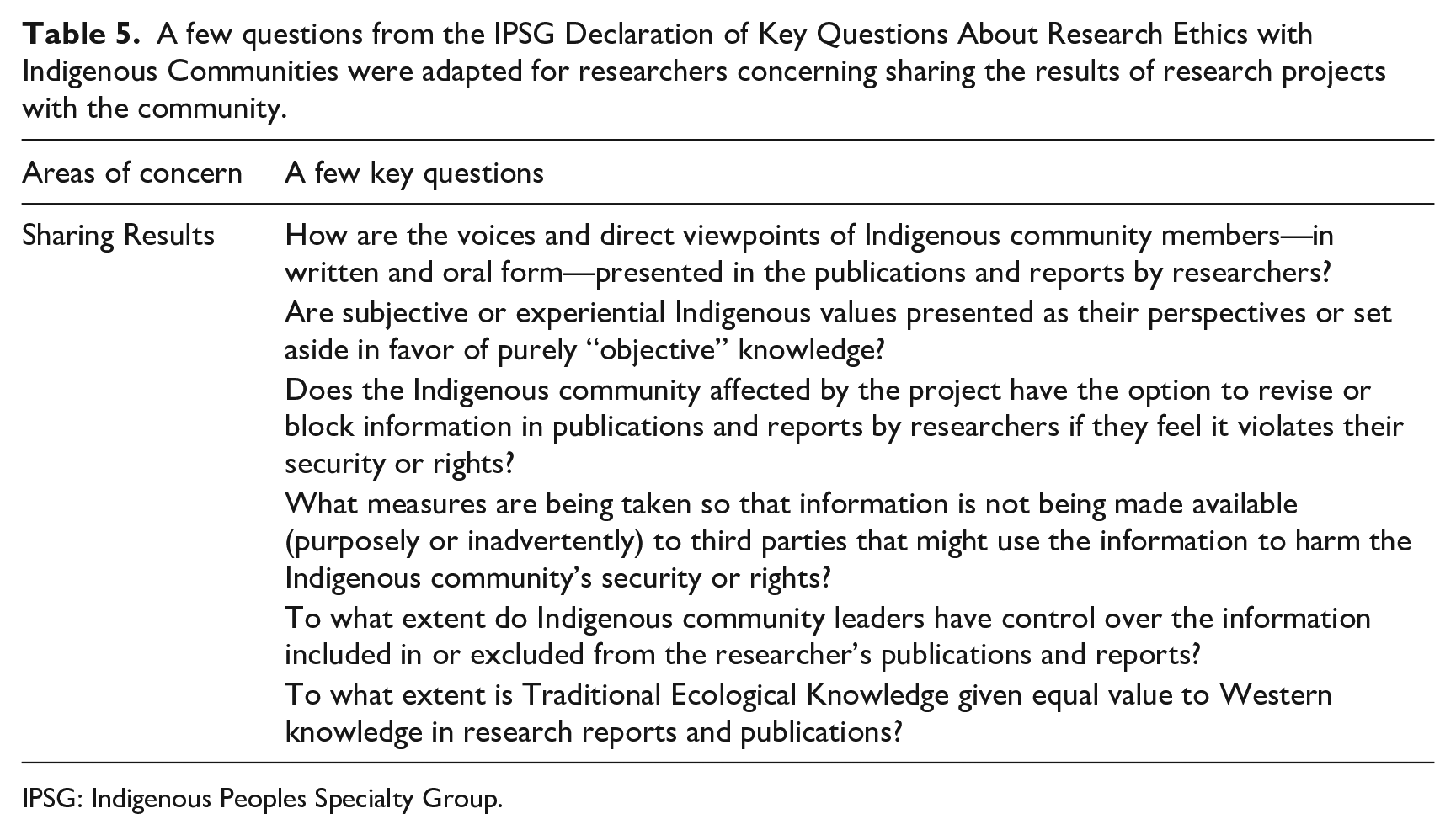
IPSG: Indigenous Peoples Specialty Group.
At the conclusion of the research project, the teams comprising student researchers and Penan community leaders presented their initial findings to the larger Penan community during a community meeting to which the village was invited. Each group discussed what they had learned about energy, tourism, clean water, and Internet connectivity issues with the community. Each presentation was accompanied by a visual representation and a community member who could translate the presentation into Penan. This process gave the Penan the agency to provide input on the findings, validate them, and discuss any parts of the findings they may not want to be shared. In addition, a community member had been a part of all the research teams, providing valuable local perspectives and knowledge. Upon returning to Cornell, the researchers continued their research and compiled a written report for the Penan on ways they could move forward on those issues if they so choose. The reports had several options so that the Penan could move forward on those issues in the ways that aligned best with their values. In addition, the reports were intended to serve as a foundation, so that when outsiders would come in with solutions for those issues, the Penan had the means to explain how they would like those issues worked on and why. Furthermore, the researchers completed “Story of Self” videos that showcased their experiences, which were also shared with the Penan community (CALS, 2022).
One of the unexpected outcomes was the participation of the Long Lamai youths. We were fortunate to have Penan youths join us. During the reflection sessions, they shared how the program impacted them in learning about their own culture, the village, the history, the forest, the cuisine, music, traditions, and more.
I grew up and went up to UNIMAS for my degree, and I took the Social Sciences program and continued to my internship in ISITI, where I became involved with all the projects; also, one of them is the service-learning program. This very good opportunity for me, and I can bring you back to my own community, and I can learn about my community where, when I was still young cannot manage to learn about my own culture, my own community, but when I was involved with this, with the SL, I was very lucky, I can learn back what I can’t learn in the early stage. I learned a lot about my community, about my traditions through this program, and I am very happy about that. And right now, I am involved with an NGO that is also working with the communities in the Baram Miri area, and I applied all what I learned from the service-learning program, how to engage with the community, how I approach the community in that area. So, it is really benefited for me, very beneficial. -Franklin George, formal Master student at UNIMAS. (CALS, 2021)
Chris Jengan, a Penan youth who joined us on the first and the most recent trip, commented how the interaction helped him to learn more about the community and how the program impacted the community.
He also shared that in the reflection, the community appreciated the compensation that was provided to them as part of the project. It was not just the money which was helpful but most importantly was recognition of People were also being paid to help in this project. The money has helped the local people a lot with many things. Although it was just a normal thing to do, but it helped make people’s day better. It had also made the people feel appreciated and grateful to be of any help to them. All the cultural exchange that took place during the project had also helped other people and me to adapt to the outside world. This will help prevent us from experiencing culture shocks. In conclusion, we hope that this kind of project will continue to make its way to the international level so the outside world can also learn about our local culture. —Chris Jengan. (CALS, 2021)
This article was published in consultation with Garen Jengan, Research Liaison and a community appointed elder, as well as, Ezra Uda, who is from Long Lamai and currently works with Penan matters in the Economic Planning Unit in the Chief Minister Department of Sarawak. Both are trusted by the community to represent the Penan with regard to academic publications. However, we recognize the difficulty with being able to do this, especially with the impacts of COVID-19. We made sure to allot the time for the consultation from the community before moving forward to publish. We were able to have one of the co-authors travel to Long Lamai for Garen’s consultation as well as used electronic copies and phone conversations for Ezra’s consultation. These types of consultations may require innovative solutions for communities that are isolated and have few options for communication outside of their community. One way to help to mitigate these issues is to discuss having the community appoint someone that they trust to represent them when it comes time to publish one’s findings. It is important that Indigenous communities have a voice in how they are represented in academia, and it is incumbent on researchers to create the space for those voices to be heard.
Deepening relationships
The researchers’ obligations to conduct ethical research projects do not end when the research projects are concluded. The mutual trust and respect initiated by the research project forged through strong alliances reinforce a sense of movement toward a positive future for the research project and the community (Smith, 1999). Maintaining these relationships provides the opportunity for future and continuing research projects with the community. In addition, by building lasting relationships with communities, the researchers can open the door for other research partners. Furthermore, the community can consult past researchers concerning future researchers and research opportunities. Staying connected with the community allows the researcher to be held accountable and find ways to mitigate the harm if there are negative impacts due to the research project. Strong research projects and social change are not mutually exclusive, but when done well, research projects that promote social change create more viable research projects in the future. Researchers that build strong alliances create lasting research projects and provide a mechanism that promotes positive changes for the Indigenous community (Kassam and The Wainwright Traditional Council, 2001; Robinson et al., 1998). Researchers need to create a positive research experience for the good of their own research project and create a foundation for those who follow. By being an example of how researchers can positively impact the community, the community will hold future researchers to that same mark and recognize when a research project has the potential to cause harm to the community. If each researcher tries to leave the communities better off than they found them, Indigenous communities will continue to be partners in research projects and will be more likely to build positive collaborations with researchers. Table 6 has several other questions adapted from the IPSG’s declaration that researchers can ask to reexamine ways to deepen their relationships with the Indigenous communities.
A few questions from the IPSG Declaration of Key Questions About Research Ethics with Indigenous Communities were adapted for researchers concerning deepening their relationships with the community.
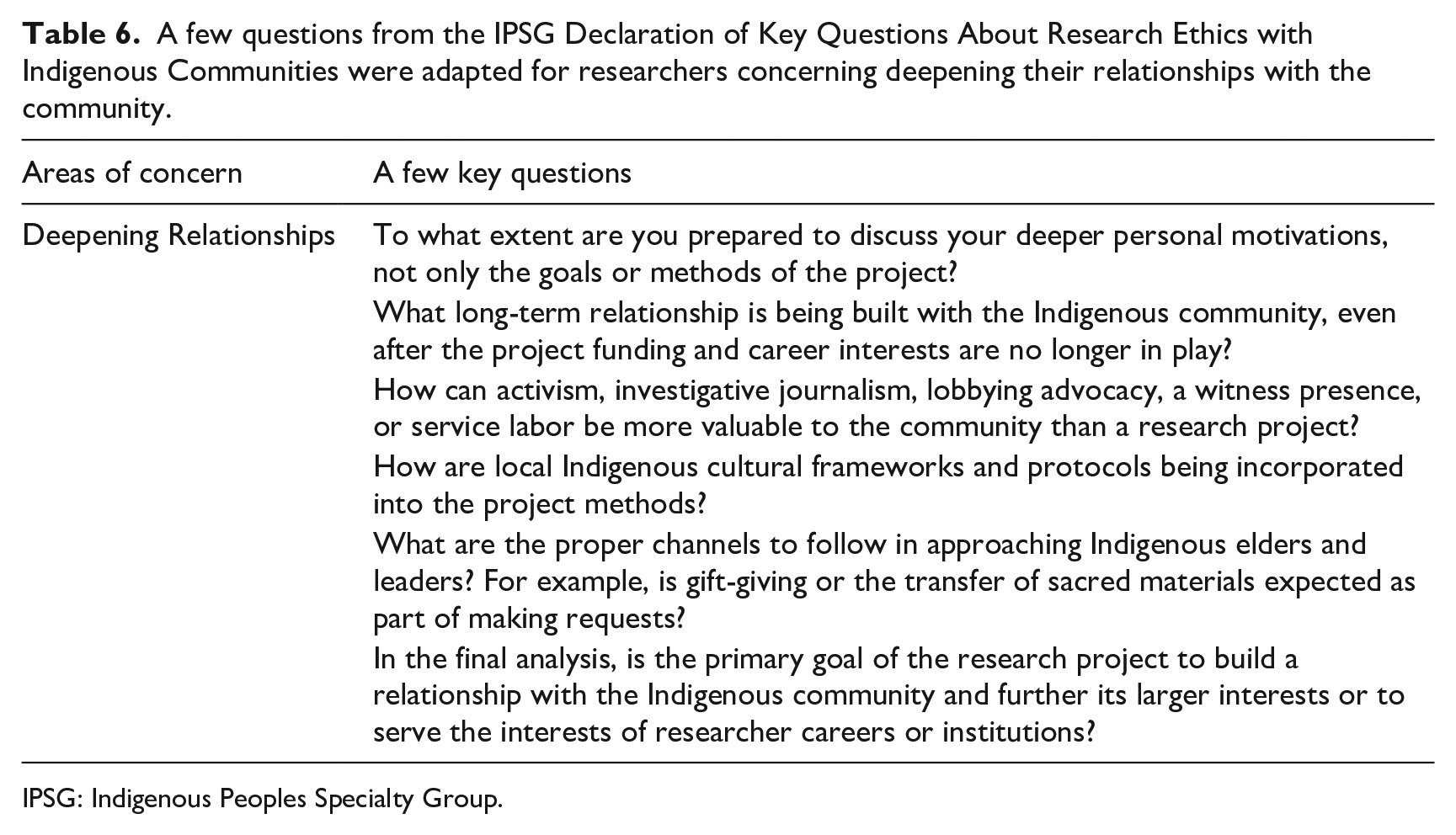
IPSG: Indigenous Peoples Specialty Group.
After the research project was concluded, the research team also presented their initial findings to academics at the University of Malaysia, Sarawak, and to government officials from the Sarawak Development Institute. Each group discussed the issues of energy, tourism, clean water, and Internet access, highlighting why those things were important to the Penan. The goal was to share some of the issues the Penan faced with local academics, hoping to synergize future partnerships with the Penan to find solutions. After the winter session, students were required to take post-trip classes to reflect on the experience and finalize the research conducted in the winter. The research product was then shared with the Penan community with feedback and comments that allowed us to continue the conversation on the direction of the collaboration and the invitation to return to continue the collaborative research. In addition, the GCS created space for Penan voices to be heard at Cornell by inviting community members to the campus to discuss the issues that their community faced. With Mr Jengan, co-authors also presented at international conferences to share the work, the approach, and the Long Lamai community. Furthermore, Allred, Somchanhmavong, Zaman, along with other academics, hosted an academic conference in 2021 about service-learning projects in Borneo where Penan community members had equal space and time as academics to highlight their experiences with research projects in their community (CALS, 2021). Finally, the annual return with a new group of university students led to the documentation of the history of Long Lamai, oral stories of people, and recently the soundscape project of the forest. Recently, the COVID-19 global pandemics prohibited travel have made it a challenge; however, the group pivoted in hosting a conference inviting past students. Each year the GCS returned with a new group of university students that led to the documentation of the history of Long Lamai, oral stories of people, and recently the soundscape project of the forest. Recently, the COVID-19 global pandemics prohibited travel have made it a challenge; however, the group pivoted in hosting a conference inviting past students. The conference was held over several days with equal time given to the community in Malaysia and the contributors in the United States (International Conference on Community-Based Service Learning in Borneo 2021). Furthermore, several of the conference sessions are cited in the previous section of this article, thus creating another opportunity for the Penans’ voices to be heard in academic spaces.
Conclusion
This article and these questions are not designed to be exhaustive or a final blueprint of how researchers should work with Indigenous communities. However, this article is designed to be a foundation for researchers to reexamine how they can be more inclusive of Indigenous communities when conducting research.
The GCS project serves as a pragmatic approach to implementing an Indigenous methodology that enriches the research experience for both the researchers and the community members. It is important to note that the GCS did not use the IPSG’s Declaration as a foundation for their methodology, but this article examines a research project through its lens. By spending time in the community, the GCS learned about the issues the Penan faced and educated the students before they arrived. Without the insights from the community, the researchers may have explored issues that were unimportant to the Penan, thus doing research that had little impact and reducing the community’s willingness to participate in the research. In addition, the GCS students expanded their worldview by participating in the Penan’s cultural training and through the constant reflexivity of the project. The community had the agency to comment and provide input on research findings because there was a forum to do so (the researchers presented their initial findings before leaving the community). Finally, the GCS created the opportunity for more research projects by presenting the results to other academics and government officials and giving the Penan a chance to advocate for their issues in both academic and government spaces.
This type of methodology aims not to fix past errors but as Somchanhmavong aptly described, “to heal forward.” Many have seen conducting research with Indigenous communities ethically as a hindrance to the research process. This case and others like it demonstrate that ethical research can enrich the research process. The paradigm shift can seem radical, but it may be as simple as Allred once stated: The ultimate goal of our research project is “to be invited back.” So much can be gained if researchers think about their research, not just in terms of collecting data but building relationships. This perspective ensures that the community wants them to return and provides opportunities for the community to move forward in the ways that align best with their interests while enriching the research. One of the Penan cultural training images showed a Penan community member and a researcher helping each other walk up a set of stairs. Each progressed up the stairs to reach two different rewards at the top. While the goals may differ, both are on the journey together. By aligning a researcher’s interests with the community’s interests, both can help each other reach their individual goals for collective benefit.
Footnotes
Acknowledgements
The authors of the paper would like to thank the members of the AAG’s IPSG that worked so hard on the declaration in which this paper is based. And to our local heroes, Ezra Uda and Garen Jengan, who consulted on this paper as a representatives appointed by the Long Lamai community. Without their hard work, experiences and dedication to change, this paper would not have been able to be written.
Declaration of conflicting interests
The author(s) declared no potential conflicts of interest with respect to the research, authorship, and/or publication of this article.
Funding
The author(s) disclosed receipt of the following financial support for the research, authorship, and/or publication of this article: The Global Citizenship and Sustainability partnership is funded in part by the Office of Engagement Initiatives at Cornell University.
