



Abstract
Scholarship on participatory action research (PAR) has come a long way since its foundations in Paulo Freire. However, it leaves much room to understand the personal transformations at stake in everyday residents’ participation in PAR—a key mechanism through which PAR contributes to long-term social change in local communities. This literature gap is particularly salient for decolonial PAR, which incorporates Indigenous communities at every stage of the research process, and which is explicitly committed to the political goal of decolonization (i.e. the repatriation of Indigenous lands and oceans). Borrowing heavily from feminist geographical PAR scholarship, we articulate the concept of “decolonial subjectivities” to capture the dynamic, embodied ways in which resident researchers in decolonial PAR connect their own knowledge, experiences, and relationships with ongoing local struggles for Indigenous sovereignty. We then elaborate on this concept through a qualitative analysis of four waves of weekly reflections from five resident researchers in a decolonial PAR project in Guåhan—a modern-day colony, unincorporated territory of the United States, and the southernmost island of Låguas yan Gåni (or the Mariånas archipelago). We find two distinct shifts in resident researchers’ decolonial subjectivities over time: (1) deepening embodied connection to decolonization through situating one’s role in decolonization within a broader set of familial and community relationships; and (2) deepening embodiment of role as decolonial researchers through affirming one’s expertise and power to effectuate change as a researcher supporting and facilitating the continued, ongoing struggle for Indigenous sovereignty.
Participatory methodologies challenge the traditional hierarchical relationship between researcher and subject by incorporating everyday residents (“resident researchers,” henceforth RRs) at every stage of the research process—from research design and data collection to data analysis, results dissemination, and beyond (Cornwall and Jewkes, 1995). Participatory action research (PAR) is a specific branch of participatory research. Drawing on anti-foundationalist philosophical tradition of pragmatism (Dewey, 1998; Flyvbjerg, 2004; Greenwood, 2007; James, 2000) and the practical framework of Paulo Freire’s (2000 [1970]) popular education, it includes an additional second component: conscientizaçao, 1 often translated as critical consciousness or conscientization, which involves reflection, motivation, and action as part of the research process to produce collective social change.
In research centered on Indigenous communities, the use of PAR methodologies is not new. Since whaea (teacher) Linda Tuhiwai Smith’s (1999) foundational monograph on Indigenous methodologies, many Indigenous scholars have lauded the utility of PAR in connecting knowledge-production to ethical considerations of Indigenous values, intellectual considerations of Indigenous epistemologies, and political considerations of accountability (Goodyear-Ka’ōpua, 2016; Phan and Lee, 2022; Smith, 2005; Tuck, 2009). In the field of geography and planning, PAR is also becoming increasingly common practice in Indigenous contexts (Nakamura, 2015; Porter et al., 2017; Sandercock and Attili, 2014; Vasudevan and Novoa, 2022).
Methodologically, PAR has come a long way since its early formulations. On the first component of participation, we have an improved general understanding of how power relations within the PAR team are related to (and often constrained by) macrostructural inequalities (Ozano and Khatri, 2018) and how good PAR design provides meaningful opportunities for professional researchers and RRs alike to recognize and reconfigure power relations within the team over time (Kesby et al., 2007; Mason, 2015; Taylor, 1999). On the participation of Indigenous communities in particular, we also better understand some of the challenges and tensions associated with having Indigenous and non-Indigenous research members, and with promoting productive engagements between Indigenous epistemologies and Western research paradigms (Datta, 2018; Datta et al., 2015; Howard, 2017).
On the second component of conscientizaçao, we have made considerable strides in developing conceptually and analytically precise tools to track and evaluate whether PAR projects actually do cultivate conscientizaçao, and the extent to which they are effective at doing so (Jemal, 2017; Watts et al., 2011). However, scholars have overwhelmingly focused on in-depth analyses of any of conscientizaçao’s constitutive elements. While these advances are certainly important for PAR design and construct validity, they leave much room for understanding how conscientizaçao connects to broader theories of change (Tuck, 2009). In particular, they miss how conscientizaçao functions more broadly as a site of personal transformation for RRs (Cahill, 2007b)—a key mechanism through which PAR contributes to long-term social change in local communities. This literature gap is particularly salient for decolonial PAR, which incorporates Indigenous communities at every stage of the research process, and which is explicitly committed to the political goal of decolonization (i.e. the repatriation of Indigenous lands and oceans).
In this article, we thus set out to answer the following question: how do personal transformations manifest for RRs in decolonial PAR? Borrowing from feminist geographical PAR scholarship, we articulate the concept of “decolonial subjectivities” to capture the personal transformations of RRs in decolonial PAR. At the broadest level, decolonial subjectivities entail the dynamic, embodied ways in which RRs connect their own knowledge, experiences, and relationships with ongoing local struggles for Indigenous sovereignty.
Drawing on the literature on conscientizaçao and feminist geographical PAR, we begin the article by way of offering a theoretical framework for understanding decolonial subjectivities. We then empirically elaborate on this concept through an analysis of four waves of weekly reflections from five RRs in the 2021 Guåhan Survey, a decolonial PAR project based in Guåhan 2 (meaning “we have” in fino’ Chamoru, commonly known as Guam)—the southernmost island of Låguas yan Gåni (the Mariånas archipelago), a modern-day colony, and unincorporated territory of the United States.
Conscientizaçao
In the original formulation of conscientizaçao in Freire’s landmark Pedagogy of the Oppressed, it is defined in several ways. In one instance, Freire (2000 [1970]: 160) speaks of conscientizaçao as the “means of which the people, through a true praxis, leave behind the status of objects to assume the status of historical Subjects,” or the process through which individuals take ownership over their capacity to change the historical circumstances that they find themselves in. Importantly, it “does not stop at the level of mere subjective perception of a situation, but through action prepares men [sic] for the struggle against the obstacles to their humanization” (Freire, 2000 [1970]: 119). In other words, conscientizaçao involves three distinct elements of reflection, motivation, and action.
Reflection denotes the continuous, iterative process of understanding how practice is done—what, when, where, and why it works well or not (Dewey, 1933). In the context of PAR, it involves moving dynamically between the closed, rigid formulations of theory and the open, spontaneous formulations of experience, to raise questions about and shed light on how the research process is changing the way that one thinks about one’s relationship to injustice and inequality, and consequently one’s role in social change (Jemal, 2017; Schön, 1983). Reflections are typically structured as a series of semi-structured prompts, to encourage critical engagement with these particular questions, while leaving room for thoughts from the field. To track and encourage reflections throughout the PAR process, scholars have used many different kinds of tools—individual journaling (Alt and Raichel, 2020; Draissi et al., 2021), group discussions (Cahill, 2007b), video blogs (Frazier and Eick, 2015), to photography (Stack and Wang, 2018).
Motivation broadly involves feeling like one’s voice is heard (Branquinho et al., 2020) and an “expressed commitment to address societal inequalities and produce social change” (Diemer et al., 2017: 479). The element of motivation is distinctive in its particular orientation toward action. For instance, the adjacent concept of political efficacy—prominent in the field of political psychology—broadly measures whether individuals feel like they have influence over the policy process and/or whether policymakers care about their opinions (Craig and Maggiotto, 1982; García, 2021). Motivation takes this concept one step further: it serves as the theoretical bridge linking political efficacy to political action and is concerned with whether one’s sentiments toward one’s voice translates into material commitments to redressing injustice (Diemer and Rapa, 2016).
Among the three distinctive parts of conscientizaçao, action is perhaps the most open-ended. Broadly, action aims to “challenge inequitable social structures and produce social change” (Diemer et al., 2021: 12). This could involve community organizing to address shared grievances (Minkler, 2000), holding public education workshops and launching campaigns to raise awareness about issues studied (Fine, 2009), or co-authoring academic publications to lend legitimacy to practitioner knowledge and expertise (Brydon-Miller and Maguire, 2009).
Yet, while this body of literature is enormously helpful in clarifying the analytically distinct elements of conscientizaçao, they are perhaps less useful in capturing how conscientizaçao occurs in actual PAR practice, and how PAR ultimately connects to broader processes of social change. On both counts, the feminist geographical PAR scholarship offers useful insights.
Feminist geographical PAR and subjectivities
While feminist geography itself comprises a heterogeneous set of theoretical and methodological approaches, it largely converges on its attentiveness to the body—particularly as a site of emotion, power, and change, and the ways in which these features play a constitutive role in the un/making of place, space, and scale (Nelson and Seager, 2007; Sharp, 2009). In the feminist geographical PAR literature, scholars start from the premise that conscientizaçao is an embodied, emotional and relational process that is influenced by myriad social and geographical forces over time, and that PAR constitutes but one institutional context that RRs inhabit (Cahill, 2007b).
This theoretical framework has enormous implications for how we conceptualize conscientizaçao. Attending to the openness, messiness, and unpredictability of the research process (Billo and Hiemstra, 2013), feminist geographical PAR scholars highlight how PAR design changes over time, often in unexpected ways (Houston et al., 2010). This poses methodological challenges to the application of static measures of conscientizaçao, which implicitly assumes an unchanging, stable PAR model. Instead, with greater attentiveness to the embodied experiences of specific RRs in specific geographical contexts over time, feminist PAR scholars instead propose analyzing RR subjectivities—defined as “the conscious and unconscious thoughts and notions of an individual, one’s sense of oneself and way of understanding one’s relation to the world” (Weedon, 1987: 32–33, cited in Cahill, 2007c). That is, subjectivity captures the “new ways of being in the world which are both situated within specific geographical settings and at the same time represent a perspective on one’s relation to others and the world” (Cahill, 2007a: 2863).
Subjectivity is distinct from the related idea of positionality. The latter is primarily concerned with power, and the ways in which power inequalities are inscribed, reinforced, and/or contested along axes of identity. The former is a broader category: while it certainly can (and should) involve analyses of power, it centers the embodied experiences of RRs in ways that generally highlight their shifting experiences, knowledges, and emotions over time. This entails recognizing how aspirations and desires affect both what we research and how we position ourselves with respect to our research community; identifying how feelings of affiliation, disaffiliation, enthusiasm, and discomfort open new ways of knowing and understanding; and considering how acknowledging our own multiple and fractured subjectivities can help us better understand those with whom we work. (Whitson, 2017: 300)
To track the dynamic evolution of subjectivities over time, feminist geographical PAR practitioners use a range of methods—from group discussion (Cahill, 2007b; Gustafson and Brunger, 2014), autoethnography (Whitson, 2017), to the familiar PAR tool of reflective journaling (Stapleton and Mayock, 2022).
Building on Mountz et al.’s (2003: 29) insight that “there is an undertheorised relationship between the politics of academic research projects and the broader political movements with which they engage,” we argue that the specific political goals of PAR constitute an underexplored contextual dimension of subjectivities. In feminist geographical PAR studies of subjectivity, this has certainly been at least implicitly recognized. Consider Caitlin Cahill’s Makes Me Mad PAR project with six young women from the Lower East Side of New York City, whose explicit political goal was to “‘speak back’ following a long line of feminists and scholars of color who have used research as a means to critique the dominant perspective based on their own situated experiences of racism, sexism, and structural poverty” (Cahill, 2007b: 272). Throughout the article, her RRs precisely articulate their subjectivities in relation to their embodied thoughts and emotions (frustration and anger among them) about the dominant stereotypes of “urban womyn of color” in their neighborhood, suggesting that subjectivities are often articulated in relation to the specific political goals of particular PAR projects.
Decolonial PAR, decolonial subjectivities
Commitment to the political goal of decolonization—in addition to Indigenous community participation at every stage of the research process—is precisely what distinguishes decolonial PAR from other types of PAR. Concomitantly, attentiveness to this goal is useful in understanding the distinctive contours of decolonial subjectivities of RRs in decolonial PAR. A ubiquitous term today, “decolonization” has been employed by postcolonial scholars to challenge the universalizing impulses of Euro-American academia denote theories and methodologies capturing the grounded empirical realities of the Global South (Connell, 2014; Roy, 2016), and by Indigenous scholars to capture the Indigenous struggles against the forces of Indigenous dispossession perpetuated by historical and ongoing empire and colonialism (Aguon, 2015; Corntassel, 2012; Steinman, 2016).
It is in this latter sense that we refer to decolonization. Starting from the premise that “decolonization is not a metaphor,” we view decolonial PAR as PAR that actively supports “the repatriation of Indigenous land and life” (Tuck and Yang, 2012: 21), and that produces both the knowledge and community infrastructure to “create within a working space that which has been systematically denied to us” (Tuck and Fine, 2016: 165). At the same time, the political goal of decolonization cannot be properly understood in a vacuum: it requires attending to and dismantling the specific social, cultural, legal, political, and economic mechanisms through which Indigenous peoples are denied our “natural” political right to sovereign control our own land, oceans, and nations (Wilkins and Stark, 2017: 51).
Following kumu (teacher) Haunani-Kay Trask (2008) and Dean Saranillio (2018) who challenge naturalized political affinities between Indigenous peoples and decolonization on one hand, and between settlers and Indigenous dispossession on the other, we affirm that everyone—Indigenous and settlers alike—can be aligned with decolonization, Indigenous dispossession, or the wide spectrum of gray in between. Decolonial subjectivities therefore can be cultivated among both Indigenous and settler RRs alike, and serve to capture the ways in which conscientizaçao constitutes a dynamic, embodied, and relational experience inextricably tied to the political goal of decolonization.
Decolonization struggles in Guåhan
We ground our empirical elaboration of decolonial subjectivities in a decolonial PAR project in Guåhan. As of 2022, the United Nations considers Guåhan as one of 17 non-self-governing territories around the world “whose people have not yet attained a full measure of self-government.” In this context, self-government would entail one of three internationally recognized political statuses—independence (i.e. national sovereignty), free association (i.e. national sovereignty with an international agreement with the United States for economic aid in exchange for military presence), and statehood. Per 2020 US decennial census data, Chamorus comprise approximately 37% of the island’s 154,000 people.
Currently, the Government of Guam (the territory-level government formalized through the 1950 Organic Act of Guam, which has the Governor of Guam as its executive, and the US President as its head of state) is legally prohibited from conducting a non-binding political status plebiscite for the “Native Inhabitants of Guam.” This plebiscite would allow for Indigenous Chamorus—and settlers who “became U.S. Citizens by virtue of the authority and enactment of the 1950 Organic Act of Guam and descendants of those persons” (per section 21001(e) of Guåhan’s 2000 Plebiscite Law)—to be exclusive voters in an island-wide survey of residents’ political preferences for Guåhan’s political status. As a result of a 2019 ruling by the US Court of Appeals for the Ninth Circuit (Davis v. Guam), it was concluded that any political status plebiscite restricted to the island’s “Native Inhabitants” would “[employ] ancestry as a proxy for race in violation of the Fifteenth Amendment” (932F. 3d 822 (9th Cir. 2019)).
Worse, the most recent public dataset on the subject, to our knowledge, is the 1982 Chamoru-only referendum on political status—collected a full four decades before the writing of this article. This is enabled, in part, by how US state–sponsored demographic surveys (such as the decennial census) do not ask questions about preferences for political status. Against the backdrop of federal judicial constraints upon the Government of Guam, and persistent data gaps on Chamoru preferences for Guåhan’s political future, the 2021 Guåhan Survey was conceived to provide a Chamoru-only platform to affirm the stolen right to express our preferences for our island’s political future.
The 2021 Guåhan Survey
The survey project team comprises nine researchers. It is co-led by two professional researchers—KL, a Chamoru PhD candidate, and NP, a second-generation Vietnamese refugee and professor. The incorporation of community members happened in two stages. In the first stage, we reached out to a Chamoru sovereignty group to gauge interest in the project in January 2021, then held six PAR workshops (each between 1 and 1.5 hours long) between March and July 2021 with three Chamoru sovereignty activists. This included collaboratively identifying a set of four Chamoru values to ground the project, and operationalizing each as concrete PAR design decisions; establishing public-facing action goals that formally articulated our commitments to being accountable to Chamoru communities in Guåhan; and co-designing the survey questions. Ultimately, we landed on the following three research questions: (1) What does it mean to be Chamoru? (2) What do Chamorus care about in and envision for their futures? and (3) What are the social and geographical factors shaping contemporary Chamoru political attitudes toward sovereignty and decolonization?
At the beginning of July 2021, we sent out a call for RRs to the Chamoru sovereignty activists, their affiliated organizational and personal networks, as well as staff and faculty members at the two largest local higher educational institutions—the University of Guam and Guam Community College. In our call, we asked applicants to provide their résumés and a one-paragraph statement describing their positionality and interest in participating in the survey.
Given our limited project budget, relatively small stipends, and data collection timeline (conducted over the period of a month, during the summer semester when school was out), our applicants were uniformly undergraduate students. Applicants were ultimately selected to obtain diversity in terms of gender, academic training, and professional interests, and selected for demonstrated interest in decolonization. One of the Chamoru sovereignty activists opted to continue their involvement in the data collection process, while the others offered continued input and guidance; four more RRs then joined the team. All RRs are born and raised in Guåhan, and comprised four Chamorus and one Filipina.
Throughout the PAR process, the professional researchers employed a feminist praxis of “mentoring with,” which entails “reciprocal support and mutual benefit, infusing a feminist ethics of care” (Goerisch et al., 2019: 1740). Over the course of our month-long data collection process, our team spent time together in multiple ways: we had weekly check-ins, conducted outreach together in shopping malls and farmer’s markets, shared meals, conducted local media engagement (through podcasts, radio shows, press interviews) to increase public awareness about the survey process and results, and maintained a shared WhatsApp group for continuous communication. In these different avenues, the co-PIs collectively offered their own expertise as researchers to help facilitate and enrich the data collection process while promoting mutual learning through emphasizing the expertise of RRs as “cultural navigators” with invaluable insider knowledge of the island’s local context (Ozano and Khatri, 2018). More specifically, the co-PIs emphasized how RRs can and should draw on their own experiences to make the research project appealing and accessible to everyday Chamoru residents, to design and implement outreach strategies that meet people where they’re at, and to draw from their own experiences to articulate the value of the project to local Chamoru communities.
Aligned with feminist geographical PAR praxis, the co-PIs emphasized the importance of self-care throughout the research process while providing space for RRs to discuss their anxieties, struggles, concerns, and lessons learned during the data collection process. Above and beyond the repeated, informal interactions that characterized our ethics of care, RRs were also asked to formally reflect on their evolving experiences in the project. Recognizing the importance of relationality as a key feminist strategy to reconfigure power relations within PAR, we employed “dialogue journaling” to facilitate RR reflections (Daniels and Daniels, 2014; Konishi and Park, 2017). This technique involves exchanging written journals between two or more PAR team members as part of collective, interactive, and relational reflection.
Dialogue journaling was critical in ensuring that the written reflections were a meaningful empirical window into RRs’ decolonial subjectivities. PAR reflections are all too often perceived as rote assignments (Draissi et al., 2021), rather than genuine opportunities for honest and transparent communication about personal thoughts and feelings. With the co-PIs modeling transparency in their own written reflections, RRs were encouraged to approach the reflection exercises with the same spirit. Furthermore, by providing a platform that emphasized our shared anxieties, struggles, and uncertainties about the PAR process and the future of Guåhan, dialogue journaling also helped to flatten out power relations within the team, thereby encouraging even more vulnerability and honesty.
Methods
Over the course of the 2021 Guåhan Survey, RRs provided four rounds of reflections to track their evolving thoughts and feelings about the project, and to identify opportunities for mentorship with and mutual learning alongside the co-PIs. Four rounds of reflections were solicited in total: (1) after first in-person training and before formal data collection began (n = 5); (2) after the first week of data collection (n = 5); (3) after the second week of data collection (n = 3); and (4) and after the conclusion of data collection (n = 5). As this article is primarily interested in the cultivation of decolonial subjectivities among RRs, we focus specifically on these reflections and exclude from our analysis the replies from professional researchers.
For each round of reflections, different prompts were given to facilitate the writing process. The first reflection served as a personal introduction: RRs were asked to share why they are invested in the project, what they hope to gain, how they plan on practicing self-care during the outreach process, and what their long-term goals are. The second and third reflections centered on the survey outreach process: RRs were asked to reflect on what went well, outreach challenges, emotional struggles, lessons learned, and on how survey’s outreach strategy could be modified to better capture the voices of key Chamoru groups outlined in the survey’s heterogeneous purposive sampling strategy. In the final reflection, RRs were asked to share their general thoughts and feelings on their involvement in the survey—how they feel about the overall research process, what they learned, and how the experience has shaped their relationship to Indigenous sovereignty movements. The mean length of reflections was 398 words, with the first and final reflections typically longer than the rest.
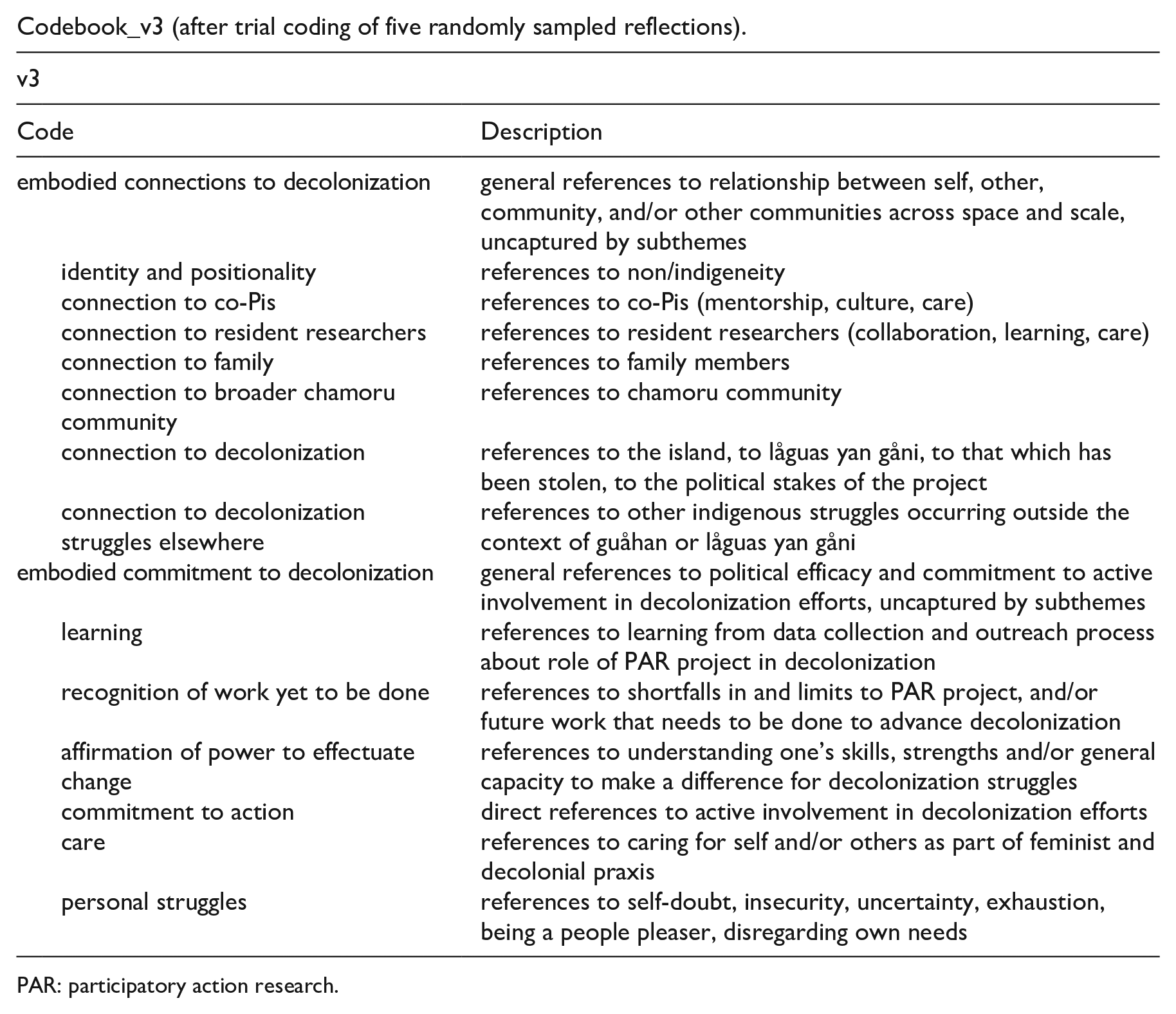
We systematically analyzed these reflections through a multi-stage, open, iterative coding process in ATLAS.ti, a qualitative coding and analysis software. First, following techniques of structural coding, we developed a preliminary codebook based on themes identified from our synthesis of the literature on subjectivities and decolonial PAR (MacQueen et al., 1998). Second, we used open coding techniques to capture emerging themes during preliminary scans of the reflections (Auerbach and Silverstein, 2003). Third, the preliminary codebook was tested on five randomly sampled reflections and subsequently modified to address duplicates, redundancies, and inadequacies. The final codebook was then applied to our universe of 18 total reflections. The three iteratively modified versions of the codebook are detailed in Tables A1, A2, and A3 in Appendix 1.
Findings
Drawing on our analysis of RR reflections, we find that two sets of personal transformations accompany the cultivation of decolonial subjectivities in decolonial PAR: (1) deepening embodied connection to decolonization through situating one’s role in decolonization within a broader set of familial and community relationships; and (2) deepening embodiment of role as decolonial researchers through affirming one’s expertise and power to effectuate change as a researcher supporting and facilitating the continued, ongoing struggle for Indigenous sovereignty. For purposes of transparency, citations of reflections are associated with the relevant RR co-authors’ initials and reflection number.
Embodied connections to decolonization
RRs uniformly expressed their embodied connection to decolonization through situating themselves within a broader set of relationships (especially with their families and local Chamoru communities), and increasingly communicating their evolving thoughts and emotions about decolonization through these relationships. They appreciated their relationships within our research team of a “growing network of brilliant, like-minded, emerging Chamoru scholars” (NF R1), as well as the co-PIs’ “considerate and supportive” (AP R4) approach to mutual care. However, the bulk of their reflections were spent discussing their relationships with their families and with local Chamoru communities.
As part of the outreach process, RRs started outreach by engaging their own families and personal networks. For some, these efforts were some of the first opportunities to engage in these conversations. For one Chamoru RR, such conversations “rarely happened among . . . family and friends since it was [sic] always heated with debate, disappointment and disagreement” (CQ R4). Survey outreach provided her with opportunities to learn more about the questions and thoughts that her family members had about Guåhan’s political future, which opened a space for both the RR and her family members to discuss decolonization and deepened her understanding of their viewpoints, however different from her own. In a particularly poignant experience of a family gathering, she recounted, At this point, most of my immediate family is here (some that took the survey, some that didn’t) and they were all talking about the survey. After I helped my cousin take the survey, we have a small circle of me and my family members talking about issues, concerns, and history of Guam. It was crazy (a good kind). I had never had conversations like these with my uncle and my cousin and mind you, we all have different views about the plebiscite. . . In that moment, I was so scared to push anyone’s buttons, but I was also relieved that I can finally have these kinds of conversations with my family. I feel that working on the survey outreach helped me in taking a step back and remembering to respect others’ views even if they did not match my own. . . If I had never been a part of this survey as an assistant, I would have never been able to be granted this conversation among my family and for that I am grateful. (CQ R3)
Here, the RR shares how her involvement in the project occasioned a shift in her family’s dynamics around issues of decolonization. While she had once been “scared to push anyone’s buttons,” she came to feel more comfortable holding respectful conversations with family members around the politics of the PAR project, even with those with whom she strongly disagreed. For this RR, involvement in the project not only deepened her understanding of the viewpoints of her family members, but also led to an embodied change in her relationships with them.
The Filipina RR also noted an embodied change in her relationship to the survey and decolonization. In her initial reflection, she wrote, “I understand I am not Chamoru by blood but I do call this island home and I want to help in any way that I can to better the community and progress towards a greater future” (AP R1). These somewhat abstract references to Guåhan (“I do call this island home”) and its Indigenous peoples (“the community”) contrast with the more intimate character of her penultimate reflection: For me one of my main “whys” [to be involved in the project] is mainly to help to build a better future for my nieces and nephews that are Chamoru and deserve to be equipped with tools of data to help to shape what they want to do and build a greater island community. (AP R3)
As this account indicates, her more abstract and less-embodied feelings about the project at its inception shifted to a more concrete and embodied account of her responsibilities to her Chamoru family members, who “deserve” to have access to knowledge and resources to shape their island’s decolonial future.
Above and beyond linking decolonization to their families, RRs’ relationships to local Chamoru communities featured more prominently across the board, over the course of the decolonial PAR process. In the initial reflection, RRs often employed impersonal, abstract language in speaking of “the Chamoru people” (NASA R1, NF R1, JM R1) and “the community” (AP R1). Over time, RRs increasingly referenced community through the intimate language of “my” (NF R4, JM R4) and “our” (AP R4, CQ R3, CQ R4, NF R4). Far from a simple semantic shift, this reveals a deepened intimacy in RRs’ relationships with Chamoru communities—or, as one RR puts it, “a stronger connection to my people” (NF R4).
This was in part because “most times the survey after its [administration to respondents] would often be accompanied by a story or two about [respondents’] experiences on the island” (JM R4). Such conversations often offered abundant opportunities to learn about the lives of specific people, who raised myriad concerns about self-determination, homelessness in Guam, lack of upholding Chamoru customs/aspects of the Chamoru culture, the state of Litekyan [a sacred site on the northern tip of the island, adjacent to the Andersen Air Force Base, where the US military is currently constructing a live-fire training range complex], and the military buildup. (NASA R4)
These unexpected and often memorable stories prompted some RRs to describe their specific encounters with strangers (NASA R2, JM R2) and to consider more deeply how the outreach process was working (or not) for specific subgroups such as veterans, members of the National Guard and Air Force (NASA R3), manåmko’ (elders), and manhoben (youth) (CQ R2, JM R4).
These encounters proved instructive and transformative in several ways. RRs celebrated the “wholehearted embrace” (NF R4) and the “abundance of support and feedback we have gained from our island community” (CQ R4). While community responses to the survey varied, all RRs observed a connecting thread between their outreach interactions and the cultivation of a more grounded, embodied sense of the Chamoru people as a whole. In the most sustained meditation on lessons learned from the intimacies of community ties, one RR shared, In conducting outreach and connecting with so many in our community, I grew inspired by the strong sense of pride and sense of self found among our people. My overall experience with connecting with our community proved to me that despite sometimes being concealed and overshadowed by outsider-imposed notions and standards, the Chamoru culture and its many pillars remain alive and well among Chamorus in Guåhan today. Moreover, Chamorus are actively resisting the colonial forces that seek to displace and erode the cultural values and practices that have sustained them for centuries. Despite the highly entangled nature of the Chamoru story, and naysayers that may argue otherwise, Chamorus have a unique and genuine identity. This sense of identity and belonging is especially important to the Chamoru people’s ongoing quest for self-determination and decolonization. . . (NF R4)
The experiences of speaking to diverse Chamorus across Guåhan helped RRs to identify and critique dominant colonial narratives (“outsider-imposed notions and standards”) about the Chamoru people. Instead, through specific encounters with family and community members, they increasingly recognized the continuity of Chamoru “identity” and “belonging,” and the everyday ways in which they are affirmed and defended by Chamorus across the island. Thus, in addition to cultivating a deeper understanding of individual Chamorus and their stories and views, the research process also enabled a rearticulation of the Chamoru community as a cohesive whole grounded in Chamoru culture rather than fragmented by political disagreements and ideological dissonance.
Embodiment of role as decolonial researchers
As RRs were precisely selected for their interest in and/or involvement in decolonization, initial reflections uniformly communicated the importance of the 2021 Guåhan Survey in shaping the “future” of Guåhan. Indeed, RRs participated in the PAR process already eager to “conduct similar research ourselves and continue to grow Guåhan’s overall capacity for research and community work” (NF R1), to spread the “mindset” of “Data is power. Power to the people” (NASA R1), to “gain a richer understanding of other’s understanding of identity and community at large” (JM R1), and to “give back to the community that has given so much to me” (AP R1). In a particularly poignant and hopeful account of her involvement in the project, one RR wrote, I have not seen or heard anything like this before. Never have I ever been asked “Well, what do you care about for your island and your people and what do you hope the future to be?” The closest thing to that kind of question is when the military says we have XX amount of days to send a letter to an email voicing our concerns of whatever kind of training or new construction they are trying to implement that will greatly affect our land, people, and/or culture. Even if they say we are to voice our concerns, it seems as if [our concerns] are never heard, since our land has been taken from us, destroyed, and turned into unfamiliar sites to help the progression of their efforts in “keeping us free.” Our ancestors just dug up and distributed, placed in paper bags, and hidden where no one knows whenever they want to, whenever they feel like. Even [our ancestors] cannot fully rest in their own grave without being ordered to be bothered by white men in uniform who have no ties here. So when we ask people to lift their voice, I truly hope they say what they feel and I hope that this data will in fact assure our policymakers that we do not want this or that. I hope it makes the military realize that maybe we don’t want them here at all. (CQ R1)
While this sustained meditation on the political stakes of the project was decidedly uncharacteristic of initial reflections, it nonetheless captures a sense of the pain and optimism driving RR participation in the project, and articulates their pre-existing decolonial commitments to Chamoru cultural resurgence, Chamoru sovereign control over our own land and ocean, and to ensuring peace for our ancestors’ remains.
Despite these pre-existing commitments, early stages of their involvement saw the RRs feeling “uncomfortable” (AP R1), “anxiety” (NASA R1), “very nervous” and “mamåhlao (embarrassed, shy) to go up to people” (CQ R2). In a particularly distressing case, one RR shared how he felt “fearful for risk of failure,” that he was “not pulling [his] weight,” and blames himself for not doing enough at an outreach event at a local farmer’s market (JM R2). As one RR points out, these negative emotions may have been exacerbated by the COVID-19 pandemic (NASA R4), and/or by how challenging public speaking can be for introverts (NASA R3). These initial sentiments reflect an overarching uncertainty about their specific role as researchers amid Chamoru decolonization struggles.
Learning about the ropes of the PAR process was central to addressing at least some of these feelings and cementing RRs’ embodied experience of themselves as key changemakers in advancing decolonization. In the immediate aftermath of the first weekly check-in, one RR shared some of the lessons from his newfound research expertise, by identifying specific issues with his outreach efforts and formulating corresponding solutions to address them: Thanks to our team meeting. . . I’ve been able to work on improving my personal outreach strategy through such things as strengthening my survey elevator pitch and limiting prejudging, as [AP] describes it. Following this week, I can definitely improve on outreach by always having a rack card [i.e. survey outreach brochure] on hand in case I run into a potential participant when I’m out and about and not necessarily doing survey outreach. (NF R2)
Far from being a mere exercise in lesson-drawing, this represents an early articulation of a deeper shift toward seeing himself as a researcher with expertise in PAR methodology and survey research. In this RR’s final reflection, he shared that he “not only learned the importance of collecting and using data in ways that are helpful and uplifting, but gained invaluable knowledge and skills that are sure to inform and benefit any future research projects [he] undertakes.” This transformation was certainly not unique to this RR and was indeed evident across the board.
Over time, RRs leaned powerfully into their newly affirmed expertise as researchers and offered salient methodological critiques of the project. One observed that technological barriers of the online survey and the small font size of the paper survey posed barriers to manåmko’, and suggested that future decolonial research adopt a “sit-down” interview-based format instead (CQ R2)—a sentiment echoed by another RR eager to properly document the myriad stories shared by Chamoru respondents during the outreach process (JM R4). Others recognized that the data collected are “critical and pertinent to understanding the atmosphere of the island” (JM R4), but nonetheless shared concerns about how the survey is “unrepresentative of the wide variety of CHamorus across the socioeconomic spectrum” (NF R2) and doesn’t tell the “whole story” (JM R4).
Importantly, not all RRs expressed their growing confidence as decolonial researchers in the same way, or in a linear fashion. As mentioned before, the survey outreach process involved various forms of engagement with a variety of audiences in multiple in-person venues and virtual platforms. One RR discusses her experience participating in a local news interview in the following way: After the interview, I think I just struggle with media in general. I still don’t think I’m knowledgeable or well-spoken enough to have my thoughts and opinions published in papers or said during interviews. I think I feel more intimidated with how public it is because I do feel more comfortable talking about it in private with someone who may have differing opinions or thoughts than in public. (NASA R3)
Here, she recognized her discomfort with doing media engagement, but nonetheless embraced how she is capable of conducting research in more “private” contexts, indicating a deeper understanding of how she might approach research on her own terms in the future. In that spirit, by her final reflection, she fully embraced her role as a decolonial researcher, asserting how she “plan[s] to personally use this data for any academic papers or projects in the future,” as part of her commitment to “amplifying CHamoru voices, opinions, and concerns” (NASA R4).
As the previous section discussed, many RRs felt that an embodied connection to their family or community enabled them to respect the political views of others on decolonization, even when it differed from their own. In addition, many also manifested an appreciation for how this kind of orientation can be cultivated. Recognizing that “everyone wants and deserves an opportunity to be heard,” some emphasized the importance of “not go[ing] in with any expectations, to allow for an open mind and genuine . . . conversation” (AP R4), while others learned how to “respectfully agree to disagree” (CQ R4). Mirroring themes discussed in the previous section, this indicates how RRs’ embodied and relational experiences of doing community outreach enabled them to gain a better sense of how to make others feel comfortable, how to be open and present in engaging others in conversation, and how to pitch research in ways that resonate with everyday people. As one RR notes, this is particularly important because poor and working-class Chamorus are often left out of the island-wide conversation on decolonization, yet “those who are not of higher academia are just as important of people to listen to and learn from” (NASA R4).
This section thus demonstrates another personal transformation at stake in decolonial PAR—wherein RRs shift from community residents learning the ropes of research, to seeing themselves as capable decolonial researchers with the capacity of both producing knowledge to advance decolonization and holding space for Indigenous residents to play a critical role in this collective process.
Conclusion
As the academic fields of geography and planning are renewing their investments in racial justice and decolonization, we need more research seeking to advance both of these causes. In Guåhan, our decolonization struggles certainly do not have the luxury of time. Enabled by Guåhan’s current political status and concomitant lack of robust bargaining mechanisms with the United States, the US military is making swift progress on the construction of a firing range in the sacred site of Litekyan (or Ritidian Point)—in spite of fierce Indigenous opposition, led by the grassroots group Prutehi Litekyan (Na’puti, 2019). Home to some of our island’s largest and oldest limestone forests, hundreds of endangered species, medicinal plants for suruhånu (traditional Chamoru healers), and ancient Chamoru relics (e.g. latte stones, pots), our land, waters, culture, other-than human flora and fauna relatives, and our sovereignty are at stake.
At this critical juncture, decolonial PAR can play a key role in connecting academic research to ongoing decolonization struggles in Guåhan and beyond, not least through cultivating decolonial subjectivities in RRs. However, far from offering an exhaustive characterization of decolonial subjectivities, this article leaves much room for future research. For instance, beyond dialogue journaling, how might other reflection tools more effectively capture the dynamic, embodied ways in which decolonial subjectivities shift over time? How might PAR design be better structured to more effectively cultivate decolonial subjectivities in RRs? How might decolonial subjectivities enable social change at broader scales—the island, archipelago, ocean, globe? How are these processes ultimately mediated by the geographically uneven articulations of empire and colonialism on one hand, and of decolonization movements on the other? Furthermore, while our focus on RRs is helpful in understanding how PAR connects to local social change, how might the decolonial subjectivities of professional researchers also change over time, and with what implications for the institutions and communities that they inhabit?
Importantly, such questions are only surfaced through fruitful cross-pollination between feminist and decolonial PAR praxis. Above all, this article highlights how feminist PAR—through centering relationality and care in PAR design, and through centering subjectivities in understanding conscientizaçao—can shed light on important pathways through which PAR contributes to local Indigenous sovereignty struggles. Moving forward, we thus call for more scholarship at the intersection of feminist and decolonial PAR, to more sensitively attend to the complex relationship between participatory research methodologies and the political project of decolonization writ large.
Footnotes
Appendix
Codebook_v3 (after trial coding of five randomly sampled reflections).
| v3 | ||
|---|---|---|
| Code | Description | |
| embodied connections to decolonization | general references to relationship between self, other, community, and/or other communities across space and scale, uncaptured by subthemes | |
| identity and positionality | references to non/indigeneity | |
| connection to co-Pis | references to co-Pis (mentorship, culture, care) | |
| connection to resident researchers | references to resident researchers (collaboration, learning, care) | |
| connection to family | references to family members | |
| connection to broader chamoru community | references to chamoru community | |
| connection to decolonization | references to the island, to låguas yan gåni, to that which has been stolen, to the political stakes of the project | |
| connection to decolonization struggles elsewhere | references to other indigenous struggles occurring outside the context of guåhan or låguas yan gåni | |
| embodied commitment to decolonization | general references to political efficacy and commitment to active involvement in decolonization efforts, uncaptured by subthemes | |
| learning | references to learning from data collection and outreach process about role of PAR project in decolonization | |
| recognition of work yet to be done | references to shortfalls in and limits to PAR project, and/or future work that needs to be done to advance decolonization | |
| affirmation of power to effectuate change | references to understanding one’s skills, strengths and/or general capacity to make a difference for decolonization struggles | |
| commitment to action | direct references to active involvement in decolonization efforts | |
| care | references to caring for self and/or others as part of feminist and decolonial praxis | |
| personal struggles | references to self-doubt, insecurity, uncertainty, exhaustion, being a people pleaser, disregarding own needs | |
PAR: participatory action research.
Acknowledgements
There are too many people—Chamorus and allies in Guåhan, the continental US and beyond—to whom we are indebted. Un dangkolo na saina ma’åse to the Chamoru communities of Guåhan for embracing our survey, to the two unnamed Chamoru sovereignty activists who made this work possible and improved it in every way, and to our families—Bobo Deso, Capili, Cruz Mesngon, Hilario Simon, Jai, Listo (Yo’ña), Pansy, Phan and Palaganas—for being some of the earliest champions of this project. Saina ma’åse’ lokkue’ to Josh Campbell for graciously and assiduously reviewing this manuscript at every turn, and to Catherine D’Ignazio for offering invaluable comments. All errors are our own.
Declaration of Conflicting Interests
The author(s) declared no potential conflicts of interest with respect to the research, authorship, and/or publication of this article.
Funding
The author(s) disclosed receipt of the following financial support for the research, authorship, and/or publication of this article: This project was generously funded by the MIT BCAP Fund, the MIT Center for International Studies and the MIT Priscilla King Gray Public Service Center.
Notes
 ) with over 1000 Hawaiian respondents. She attended the University of Arizona for undergraduate and earned her Ph.D. from Rice University.