



Abstract
This paper explores how collaborative ethnography can be part of building resilient coastal communities. It does so by way of a methodological reflection on a collaborative research project that was carried out by the first author together with a Mapuche Lafkenche political organization that is active in the coastal region of southern Chile and is in the process of applying for an Indigenous marine area called ECMPO Wadalafken. The Wadalafken ECMPO Association has been working together with professionals and researchers from different areas to realize diverse actions related to the request for an Indigenous coastal and marine area. Collaboration with actors inside and outside the territory is part of the Association’s strategy to transform social, environmental, and political power relations, restoring Indigenous coastal relations and constructing resilient coastal Indigenous communities. The first author was part of this process as a collaborative ethnographer. In this paper, we first elaborate on how collaborative ethnography was employed in this research project as a way to support the political process of the Wadalafken ECMPO Association. After that, we go on to present the lessons learned from this research project: (1) trust and time are crucial elements of collaborative ethnographic research designs, (2) local political relations and organization shape the options for doing collaborative ethnography, and (3) collaborative ethnographic research can be transformative on different levels. We conclude that collaborative ethnography is best understood as a collaborative space that continuously is under construction and can be both transformative for participating (Indigenous) communities and academic researchers.
Keywords
Introduction
In this article, we reflect on a collaborative ethnography project conducted with a Lafkenche Mapuche Indigenous political organization in Chile, asking: How can collaborative ethnography contribute to building resilient coastal communities? Collaborative ethnography has deep roots in participatory methodologies and encompasses a range of perspectives on what research collaboration entails. At its core, it involves the joint construction of research questions, objectives, methods, and conceptual frameworks by scholars and local researchers, a practice that has gained renewed prominence in interdisciplinary and multidisciplinary research. In the research on which we build in this article, collaborative ethnography, above all, embodies a vision of how ethnography can actively contribute to the political processes within the communities that we work with as researchers.
Collaborative ethnography allows Indigenous self-governance and knowledge to serve as starting points for research and, as such, for analyzing coastal marine issues through an integrated approach. This adds new perspectives to coastal and marine studies, a field of study that often prioritizes interdisciplinary research on governance, conservation, and resource management and has been criticized for its institutional focus and for being rooted in Western ways of doing science.
Our methodological reflection draws on the first author’s research experiences with the Lafkenche Mapuche people of the Wadalafken Mapu (Territory of the Waterbird) in the coastal Los Ríos Region in southern Chile. The Lafkenche Mapuche people began organizing politically during the transition to democracy at the end of the Pinochet dictatorship (1973–1990). Through social mobilization, they seek political and territorial recognition from the Chilean nation-state and self-governance within it. The first author has conducted fieldwork in the region since 2016, including PhD research on the political process of applying for an Indigenous coastal and marine area called Wadalafken ECMPO. The ECMPO law recognizes the right of Indigenous people in Chile to customary coastal and marine uses. The PhD fieldwork took place in 2022, 2023, and 2024 and used a collaborative research design.
During the field research, the first author faced several challenges of doing collaborative ethnography. At the same time, she experienced the value of this approach; it proved to be a way to become part of the social change that research participants aspire, as this way of doing research allows for the co-construction of knowledge and a focus on social change. In addition, long-standing ethnographic collaboration not only strengthened the relationship among the anthropologists involved in the project (including the first author of this article) and the Lafkenche Mapuche researchers; it also became a tool for producing Indigenous knowledge to defend self-governance in coastal peripheries.
Based on the first author’s fieldwork experiences and reflections, we argue that collaborative ethnography is best understood as a space under continuous construction. Constructing this space begins with jointly defining research objectives and continues throughout the research process: fieldwork, conceptualization, and writing. This process is fluid, flexible, and inherently political because it engages with local and organizational issues. Collaborative ethnography is not a structured methodology; it adapts to circumstances and is therefore a continuous learning process for both outside researchers (who might become insiders) and, in this case, Lafkenche Mapuche participants in the research. Through this process of mutual adaptation and learning, collaborative ethnographers can become part of Indigenous political and territorial processes and, in doing so, contribute to building resilient coastal communities.
The article proceeds as follows. First, we situate collaborative ethnography within the literature on research approaches that seek to move away from extractivist practices. We then introduce the ECMPO law and the specific case study that underpins this methodological reflection. In the fourth section, we discuss how collaborative research was conducted in the first author’s project and then explore three lessons learned from this experience. The article closes with final reflections on the transformative role of collaborative ethnography for Indigenous and academic researchers alike, and on how it contributes to building resilient communities.
Collaborative Ethnography: Radical Collaboration for the Future
The research, on which this article builds, was designed according to the principles of collaborative ethnography, reflecting an ethical commitment to co-creating knowledge aligned with local priorities, and combining Indigenous knowledge 1 and scholarly practices. 2 Collaborative ethnography, as a method, is shaped and inspired by other approaches that seek to horizontalize research in non-extractivist ways, such as participatory action research (PAR), engaged anthropology, and collaborative anthropology. In what follows, we first present our general approach to collaborative ethnography before we go on to discuss these approaches and situate our view of collaborative ethnography within this methodological discussion.
Collaborative ethnography emphasizes collaboration at every stage of the ethnographic process. The input of the various researchers and research participants involved in the project becomes an explicit part of the ethnographic text as it develops. In doing so, collaborative ethnography seeks to transform the traditional asymmetrical power relations between “the researcher” and “the researched” by establishing shared objectives, research questions, and aims. Researchers, together with research participants and other collaborating researchers, determine how research findings will be used. 3
Collaborative ethnography, in addition, is not only about collaboration among researchers and between researchers and local communities; it also involves collaboration among researchers with different disciplinary backgrounds, professionals, and artists, among others. As noted, these collaborations ideally take place across all phases of the research project. When research projects include collaboration with Indigenous people, researchers often seek to centre Indigenous perspectives and issues. This was also the case for the research under scope in this article, as we explain in the next section.
In terms of content, collaborative ethnography allows researchers to witness competing narratives and voices advocating for inclusion in territorial and political processes. 4 Recent studies have, for example, demonstrated that collaborative ethnography enables understanding how urban Indigenous groups have reappropriated urban spaces, addressed environmental conflicts, and advanced Indigenous political movements. 5
Collaborative ethnography has its roots in ethnography and is closely related to other methodological approaches that seek to challenge the colonial origins of anthropology and foster emancipatory methodologies that have been embraced by Marxist, feminist, postcolonial, and decolonial scholars. 6 We briefly discuss three approaches that have also shaped and informed this research project: Participatory action research (PAR), activist and engaged anthropology, and collaborative anthropology.
PAR emerged in the 1940s, notably in educational research in the United States. 7 In Latin America, PAR gained traction in the 1960s and 1970s, influenced by Paulo Freire’s 8 groundbreaking work in Brazil and by Orlando Fals Borda, 9 who began combining ethnography with PAR philosophy to advance more equitable participation in knowledge production. PAR focuses on developing community-based research processes that promote active participation in knowledge production and social transformation. 10 It challenges traditional ideas about who generates knowledge and for whose benefit research is conducted, emphasizing collaboration with marginalized or vulnerable communities as equal partners in the research process. 11
The use of PAR has produced multiple participatory tools and more abstract ideas about how to participate and what forms this can take. At the same time, participatory methods developed through PAR in community projects have faced significant criticism, particularly when employed in development projects by governmental and non-governmental institutions. These critiques highlight how participatory methods are often co-opted to further institutional agendas, prioritize individual reform over political struggle, obscure local power dynamics by idealizing local communities, and integrate marginalized populations of the Global South into an uncritical framework of capitalist modernization. Collaborative ethnography sought to address these challenges by prioritizing Indigenous perspectives on knowledge production, translation, and praxis. Still, collaborative ethnography also sometimes faces the risk of co-optation. This does not mean, however, that PAR and collaborative ethnography cannot contribute significantly to social change, as we will demonstrate in this article. Depending on the specific research design and its organization, they might be used in tandem and strengthen each other.
Another approach to transforming research relations and moving beyond extractivist ways of doing research that has shaped this research project, is engaged anthropology. Engaged anthropology seeks to support struggles against inequality and exclusion beyond the production of knowledge, 12 enabling an encounter between practice and theory. 13 Engaged scholars seek to participate in public and intellectual debates about injustice and marginalization. For Hale, 14 being an engaged scholar means moving away from extractivist research. This can be done using myriad methodologies and research designs that are not necessarily participatory or collaborative. 15
The last approach that has inspired this collaborative research project is what Boyer and Marcus 16 called collaborative anthropology. They identified seven modes of collaboration in anthropological research. These modes can briefly be summarized as: (1) dialogues between the researcher and research participants about the ethnographic project, (2) collaboration between scholars and participants through new communication channels, particularly on social media, (3) the use of research findings and the democratization of this information using digital platforms. Collaboration in such cases includes the democratization of data to be accessible for communities involved in the research, (4) communication between experts and a broader audience, (5) the creation of spaces for collaborative engagement with artists and other disciplines, (6) workshops that evolve over time across multiple shared projects, and finally, (7) collaboration with social movements, aiming to contribute to social change. These different forms of collaboration can be combined within one research project.
In sum, various methodological approaches seek to counteract Western ethnocentrism in knowledge production, 17 construct horizontal research relationships, and advocate for social justice. 18 In addition to these characteristics, collaborative ethnography focuses on constructing a collaborative space and transforming relationships among all collaborators in that space.
Context and Introduction to the Case
This methodological reflection builds on the fieldwork of the first author with a group of Lafkenche Mapuche that is in the process of applying for an ECMPO area. Collaboration between the first author and the Wadalafken ECMPO Association started in 2016 and has included several acts of resistance, bureaucratic endeavours, and legal processes related to land grabbing and the rise of real estate projects. The ECMPO law is a strategy to contest the marine and coastal dispossession, 19 providing an opportunity for Indigenous people to rebuild Indigenous self-governance. Its existence is best understood within the broader context of coastal livelihoods and Indigenous rights in Chile and Latin America.
Coastal Livelihoods in Chile and Latin America
The ECMPO law is not an isolated case, but part of, and shaped by, the broader experiences of Indigenous and non-Indigenous people in coastal and marine areas who face unequal decision-making procedures and have to navigate multiple non-Indigenous actors in the process of establishing Indigenous coastal and marine areas. 20 Worldwide, coastal populations have faced an increasing number of coastal, marine, and ocean agreements and regulations at national and international levels. These regulations often produce an unequal distribution of rights to fish and harvest, mostly affecting the already marginalized coastal communities inhabited by artisanal fishers and Indigenous people. 21 This unequal distribution of coastal and marine rights has led to the loss of access to coastal livelihoods for Indigenous peoples and artisanal fishers. Additionally, in Chile, the increase of Marine Protected Areas (MPA’s), 22 Benthic Resource Management Areas, and Salmon Farms Areas has produced an exacerbation of marine and coastal dispossession and the degradation of ecosystems.
This marginalization is further deepened by the underuse of Indigenous marine and coastal knowledge in marine governance and management. 23 The dominant forms of marine governance and management are embedded in Western scientific knowledge and governance. These approaches have fallen short in capturing the decline in communities’ well-being in relation to marine ecosystems. This has led Indigenous activists to present their own views on self-governance and political forms of organization, 24 resulting in, among others, the ECMPO law. The ECMPO law seeks to integrate different knowledge systems: Lafkenche Mapuche forms of knowledge and Western science.
The ECMPO Law
The ECMPO law is best understood in the context of the history of Indigenous rights in Chile and around the world. Chile ratified the UN Declaration on the Rights of Indigenous Peoples (UNRIP No. 61/295, 2007) and the 1989 ILO Convention 169 in 2008, following broader global recognition of Indigenous rights. The ratification of these treaties was part of Chile’s incorporation into international agreements following the long dictatorship of Augusto Pinochet, which lasted from 1973 to 1999. The Chilean Constitution (1980) recognizes ten Indigenous ethnicities, but this recognition does not include political representation in the democratic system. The Mapuche make up 80% of all Indigenous people in Chile.
The Mapuche have been demanding autonomy and land restitution since the “Pacification of Araucanía” (1868–1880). 25 During this period, the Chilean state annexed Mapuche territory, bringing it under Chilean sovereignty and relegating Mapuche communities to reductions on the peripheries of their ancestral lands. 26 In its efforts to assimilate Indigenous communities into the nation-state, Chile did not recognize legal pluralism in its Constitution. Since 2000, the Chilean state has implemented multicultural programs that target Indigenous communities across various territories. However, these initiatives primarily sought to integrate Indigenous peoples by introducing selective cultural elements into state governance, rather than addressing the core issues of land dispossession and self-determination. This approach has been described as a policy of el indio permitido, 27 limiting Indigenous recognition to forms that do not challenge state authority. To this day, the Chilean government has failed to engage with the fundamental demands of the Mapuche people: land restitution, territorial self-governance, and political recognition. 28
The ECMPO law, which became effective in 2008, protects Indigenous customary practices in Chile’s coastal and marine areas. The law is implemented in all of Chile’s coastal Indigenous territories, each with its own customary uses. The law does not protect customary land uses. The ECMPO law seeks to reverse the situation of fragmentation and exclusion generated by the Fisheries and Aquaculture General Act (FAGA N 18.893-1991). 29 The FAGA law had divided artisanal fishing sectors and regulated marine extraction by establishing fishing codes and quotas along the Chilean coast. It did not take into account the traditional uses and customs of Indigenous and peasant populations living along the coast and depending on these resources as part of their way of life. The regulations related to the FAGA law caused divisions and ruptures in the social fabric of coastal communities that depend on fishing and gathering for their livelihoods. 30
The Lafkenche Mapuche people played a pivotal role in the history of the ECMPO law, beginning with their 2002 petition to the Chilean State to seek recognition of their customary coastal and marine practices. To be protected by the ECMPO law, groups that inhabit a coastal territory need to apply for recognition as an ECMPO area. To do so, Mapuche people have created ECMPO associations. It is with one of these associations that the first author collaborated during her research.
The Case Study
The association with which the first author collaborated, the Wadalafken ECMPO Association, represents a collective of 13 Lafkenche and Kunko Mapuche lof (territorial, kinship-based collectives) that resides along the coast of the Los Ríos Region in southern Chile. They submitted their first ECMPO application with an urgent aim: to prevent the establishment of nine salmon farms along the coast in 2016. Salmon farms can cause ecological damage to the seabed, and salmon might escape from the farms, resulting in high mortality in wild fisheries. The Wadalafken ECMPO Association submitted a new application in 2018 to prevent new developments, such as an industrial port at the estuary of the Wadalafken River, which is referred to as the Valdivia River in Chilean state terminology. These projects were paused when the Wadalafken ECMPO Association started the application process. This sense of urgency led the communities to support the initiative despite their limited knowledge of the ECMPO law’s specific legal framework.
Various actors, such as fisherman unions, salmon farming companies, governmental and non-governmental project developers, and conservation NGOs, have criticized the ECMPO law and even engaged in conflicts over it. The main criticisms have been the excessive time required for an ECMPO application to be approved and the lack of a size limit for ECMPO areas. The latter has led some ECMPO associations to request larger areas than the Chilean government had expected. The Wadalafken ECMPO Association was hindered by different bureaucratic challenges related to the specifics of the ECMPO law. 31 Although regulations stipulate that ECMPO applications should be handled within two years, limited State funding has created a significant backlog of applications, compounded by an insufficient number of employees to manage the process effectively (personal communication with CONADI’s 32 employee). For instance, when the neighbouring ECMPO Mississippi application was approved in 2024, it had been under consideration for fourteen years. 33
Given the extensive criteria and requirements of an ECMPO application, as well as of the administration plan for the marine area that needs to be submitted as part of the application procedure, the Wadalafken ECMPO Association tasked the ECMPO Wadalafken coordinator, Silvio Pangihue, 34 with initiating a dialogue between the diverse Indigenous collectives and stakeholders in the territory, especially artisanal fisher unions. One of the aims of this collaboration with different stakeholders was to foster internal communication among the Association’s communities, while also promoting dialogue with other Indigenous and non-Indigenous groups. This is where the first author also became part of the process.
In sum, the ECMPO law is one of the strategies of Lafkenche Mapuche people to establish Indigenous self-governance in Indigenous coastal areas and to rebuild the coastal social fabric that was broken by the FAGA law. In the Lafkenche Mapuche case, this has brought scholars and Lafkenche Mapuche collectives together in a collaborative research project, constituting an opportunity for social science researchers to engage in Indigenous political processes.
Collaboration Towards Another Future: The Process
Below, we first discuss the different roles in the research project, before we go on to explore the collaborative spaces that were constructed during the research project and that became part of the political process of the Wadalafken ECMPO Association.
Different Roles in the Collaboration
Collaboration between Indigenous organizations and professionals is both common and essential in the context of the ECMPO law and the defence of territory, particularly when mediating interactions between the Lafkenche Mapuche and state institutions. The definition of collaboration, along with its objectives and priorities, is shaped within each specific context and jointly determined by the different actors involved. Below, we describe the different roles of Lafkenche Mapuche collectives and academics in starting the collaboration, defining the methodology, interpreting the outcomes, and navigating knowledge.
The Lafkenche Mapuche collectives of Wadalafken were the initiators of the ethnographic project; they asked for a collaboration with academics and actively invited professionals, scholars, and practitioners to develop the documents that were required for the ECMPO application and that would serve to contest development projects, such as salmon farms, industrial ports, real estate projects, and forest industry. During the development of the methodology, the roles changed. In the collaborative process, Lafkenche Mapuche participants from Wadalafken Mapu were trained by anthropologists in co-creating methodological tools, conducting semi-structured, in-depth interviews, and using audio recording devices. Over time, Lafkenche Mapuche researchers assumed active roles in analyzing interviews and constructing narratives, ensuring that the translations and interpretation of information were both meaningful and accurate. The anthropologists’ role was to guide the use of qualitative methods.
In terms of analysis, anthropologists, together with Lafkenche Mapuche researchers, developed a strategy that we have called “symmetrical supervision”. This strategy is part of the collaborative research process and builds on Indigenous and Western scientific knowledge to create a shared understanding of the research themes. In so doing, it seeks the cultural revitalization of the Wadalafken Lafkenche Mapuche communities by mobilizing Western scientific knowledge to support the Mapuche Lafkence goals of recovering coastal lands and self-government. Symmetrical supervision functions as a back-and-forth between the two sides of this conceptual translation, in which academics ensure the proper use of technical and theoretical concepts, while members of the Lafkenche Mapuche community contribute knowledge rooted in Lafkenche Mapuche knowledge systems. By working together, academics and Lafkenche Mapuche participants strive for accurate interpretations that respect and integrate both forms of knowledge.
The collaboration between professionals and the Wadalafken ECMPO Association was guided by anthropologists, geographers, and marine biologists. The pu kimche – the knowledgeable traditional authorities within the Mapuche community who possess specialized wisdom – controlled the final results of the research. They would check whether the social science concepts used (e.g. concepts such “material and immaterial heritage” and “customary uses”), actually represented what they wanted to say. They read the draft versions of the documents and had meetings with the academic researchers in which the translation of Mapuche knowledge into social science and institutional concepts, words, and structures was extensively discussed.
One concept that was worked and reworked through symmetrical supervision is “customary uses”. In the ECMPO law, “customary uses” are coastal and marine practices specific to Chilean Indigenous people’s livelihoods, mainly associated with the use of significant cultural or religious spaces, such as specific landscapes, and the extraction of marine plants and animals for production and consumption. However, Lafkenche Mapuche people describe customary uses as multidimensional relationships (spiritual, political, and practical) that involve reciprocal actions with different territorial collectives (human and non-human). Customary uses are then understood as emerging within a broader network of meanings, relations, and shared responsibilities, rather than as isolated phenomena. For example, the customary use of coastal and marine medicinal plants cannot be reduced to harvesting or preparing the plant for treatment. Such practices are embedded in systems of knowledge transmission, spiritual understandings of health, collective well-being, and long-standing relationships with non-human beings and the territory itself. However, technical reports and institutional frameworks frequently isolate these practices as merely functional or utilitarian, overlooking the collective ties that sustain them. Recognizing a customary practice, therefore, requires acknowledging the relational and territorial networks that shape it, rather than separating it from the social and cultural worlds in which it is lived. These reciprocal actions and spiritual/political relationalities differ from Western science and governmental policy management logic.
The descriptions and shared understandings that emerged from the workshops enabled the production of information required for legal processes and for documenting customary uses; accounts of these multidimensional collective relationships formed the basis for documents on customary uses submitted to CONADI, 35 as well as for other legal resources and actions. In this way, both researchers and Lafkenche Mapuche collaborators retained control over how Lafkenche Mapuche knowledge was translated into a language legible to Chilean state institutions.
Sometimes symmetrical supervision occurred on the spot during the project’s workshops. During one of the workshops where the ins and outs of the ECMPO law were explained, a Lafkenche Mapuche woman of the Wadalafken ECMPO Association, for example, pointed out: ‘We (Mapuche people) have a relationship, a spiritual connection with the territory that we live in’ (Leticia, Nütramkan project workshop, Curiñanco 2022). This spiritual connection within the territory that Leticia referred to is said to produce ties between the collectives of Wadalafken Mapu, as another Lafkenche Mapuche man continued to explain: ‘If one of our members is sick, this situation affects everyone, as a chain of threat to the territory’ (Pedro, Nütramkan project workshop. Curiñanco 2022). This conversation about the Lafkenche Mapuche understanding of customary uses and their relationship to the territory produced a shared understanding of customary uses through symmetrical supervision. In this process, the multidimensional nature of customary uses and practices of Lafkenche Mapuche and Kunko Mapuche people was centralized.
In summary, the role of anthropologists in collaborative ethnography allows for the co-production of knowledge. Collaborators in the research expressed the multidimensionality of customary uses in a way that acknowledged interrelated practices and collectives, as well as the varied uses of the territory, thereby avoiding a reductive discourse. In the next part, we discuss the collaborative spaces within which the above roles were shaped and made concrete.
Nütramkan in Wadalafken Mapu: A Collaborative Space
Lafkenche Mapuche worked together with professionals and anthropologists to complete the ECMPO application process and develop an administrative plan for the proposed ECMPO area. This specific collaboration was called the Nütramkan project. The Nütramkan project is a collaborative platform that seeks to facilitate horizontal relationships. The collaborative space of the Nütramkan project at the time of fieldwork combined workshops, participatory mapping, and a virtual space with a shared Drive archive, where the Wadalafken ECMPO Association and researchers shared documents and collaborated on analysis and knowledge production. The use of the information collected was agreed upon in an ethical protocol that is described below.
Academics and researchers jointly developed ethical protocols for the use of material collected in the Nütramkan project. Participants in the Nütramkan project research completed a consent form that authorized the use of the information and images produced, which were used to develop informative audiovisual material for the Wadalafken ECMPO Association. Through the ethical protocol and consent form, research participants and collaborating researchers also approved the presence of the first author at the workshops and the use of this information for her doctoral research project. The authors of this article are not Indigenous, nor are they representatives of these groups or organizations in Wadalafken.
The Nütramkan project’s methodology consisted of two components: one, workshops on the ECMPO law developed in collaboration with an anthropologist, and two, a collective mapping of the territory’s customary uses and customs. These activities were organized according to the principles of two forms of Mapuche gathering and communication called trawün and nütram. Trawün are ritualized assemblies held within communities. They serve as spaces for social relations that encompass history, spirituality, and collective decision-making. Nütram refers to meetings in which elders or family lineages share stories that convey norms and values. When these stories focus on territorial values and norms, they are called nütramkan or nütramkam. The key distinction between the two forms of encounter lies in their purpose: trawün refers to meetings in which participants discuss and make decisions on various territorial matters, such as neighbour disputes, the evaluation of development projects, and political decisions. In contrast, nütram focuses on teaching and learning values, norms, and cultural knowledge through storytelling and the interpretation of peuma (dreams). Stories and dreams convey essential values, past experiences, and lessons for the future. These insights often inform the norms and decision-making processes in trawün gatherings as well. The different parts of the project were not strictly separated; some conversations about local experiences, histories, issues, and personal reflections would arise during the ECMPO workshops, during the collective mapping, or after lunch.
The proposal for the Nütramkan project was developed collaboratively by two anthropologists (including the first author of this article) and members of the Wadalafken ECMPO Association. The anthropologists and the two leaders of the Association organized several meetings to outline objectives and to establish methodologies suitable for the territory. The collaborative team consisted of several Mapuche leaders who were part of the Wadalafken ECMPO Association and three anthropologists. After all collaborators had approved the project, it was submitted to the government’s “Fund for Strengthening Public Interest Organizations 2022” (Spanish acronym: FFOIP). Through the project, the Wadalafken ECMPO Association sought to (1) establish trust among diverse stakeholders of the Wadalafken ECMPO initiative, (2) explore the multiplicity of Lafkenche Mapuche and Kunko Mapuche customary uses in the territory, and finally, (3) identify opportunities for long-term collaboration between Indigenous collectives, governmental institutions, and the private sector.
As we showed in the subsection above, the Nütramkan project sought to integrate symmetrical supervision in both forms of encounter, creating a space for learning about the ECMPO law while sharing thoughts, dreams, and doubts. In some instances, this process materialized in collective mapping exercises, while in others, it involved returning to the lof (territorial communities) for reflection, followed by subsequent rounds of trawün to further deliberate on the implications of the ECMPO law. The primary objective of these activities was to establish a common base of knowledge about the ECMPO law, the possible effects of its application in the territory and the application process itself.
Nütramkan: Workshop Proceedings and Examples
Each gatherings organized in the context of the project served as a safe space for reflection on the ECMPO law and the Wadalafken ECMPO application, enabling participants to engage in deep discussions about these topics. Both the Lafkenche Mapuche and Kunko Mapuche collectives, whether part of the Wadalafken ECMPO Association or not, as well as artisanal fisher unions and governmental stakeholders, participated in these gatherings.
The trawün and nütram encounters that were used to facilitate workshops about the ECMPO law, would begin with introductions, starting from the left and proceeding in a circular order. Each participant would listen attentively and respond using words from the previous speaker, ensuring continuity in the conversation. After that, the first part of the workshop would be facilitated by the anthropologist who would also be an ECMPO expert. The main important aspects of the ECMPO law would be explained and the rumors that circulated in the media about the ECMPO law would be discussed (e.g. one of the rumours that was spread by the president of the Fisherman Federation’s was that the artisanal fishers would be banned from entering the sea by the ECMPO law if they would not pay taxes to the ECMPO association). The different steps of application process would also be explained. 36
As an example of how these gatherings proceeded, we will now describe parts of the Cave Bonifacio workshop in which the Wadalafken ECMPO Association met with Lafkenche Mapuche collectives consisting of fishers and gatherers from Indigenous communities.
The first part of the workshop at Cave Bonifacio covered the ECMPO law and the application process. The anthropologist, who led the first part of the meeting, was interrupted five times with questions about experiences with the ECMPO application process and particular circumstances related to it. Ten minutes after the workshop had started, a Lafkenche Mapuche woman already asked the first question: ‘How can Indigenous people from Bonifacio gain recognition of their customary uses in an extensive coastal area?’ (P1, Nutramkam Workshop. Cave Bonifacio, August 2022). This question produced a conversation about Lafkenche Mapuche territorial identity, and the historical political organization and rights of non-Indigenous people. It also led to a second question from another Lafkenche Mapuche woman: ‘How is the relationship between Indigenous communities and artisanal fishers’ unions in other territories? Because in this territory we do not make the difference between Indigenous people and non-Indigenous people, we are all the same, but some people do it’ (P2: Nutramkam Workshop in Bonifacio Cave. Wadalafken Mapu, August 2022). The first question that was asked opened the discussion about the different meanings of being Indigenous for Lafkenche Mapuche communities of Wadalafken on the one hand, and how the Chilean government approaches this on the other. The first part of the workshop, then, was dedicated to discussing Indigenous identity from the State’s point of view, as well as the collective territorial relationships and identifications of Lafkenche Mapuche communities. The production of a shared understanding regarding Indigenous identity among all participants in the Nutramkam project fostered trust within the collaborative space of the Nutramkam and deepened the social fabric among participants.
In the second part of each workshop, there would be time for participants to ask more questions and discuss various themes related to the law and the complexities of collectives that constantly interact with governmental and non-governmental institutions. In some cases, collective mapping would be employed as a methodological tool that provides a “space of engagement where social and spatial relations are reconfigured, and where representations of these relations assume diverse forms”. 37 Through collective mapping, Indigenous spatial knowledge can be translated into formats that are accessible to external stakeholders, including scientists, state actors, and development project developers.
Collective mapping (Figure 1) was an important method within the Nütramkan project because the Wadalafken ECMPO Association needed a map showing the customary uses and customs that form the basis of the Wadalafken ECMPO management plan, which will become effective if the ECMPO area is granted. The information provided on these maps shows how different spiritual activities and customary uses are related (Figure 1). In addition, this collective activity educated all the Wadalafken ECMPO-associated collectives about other knowledge related to customary uses in their territory.
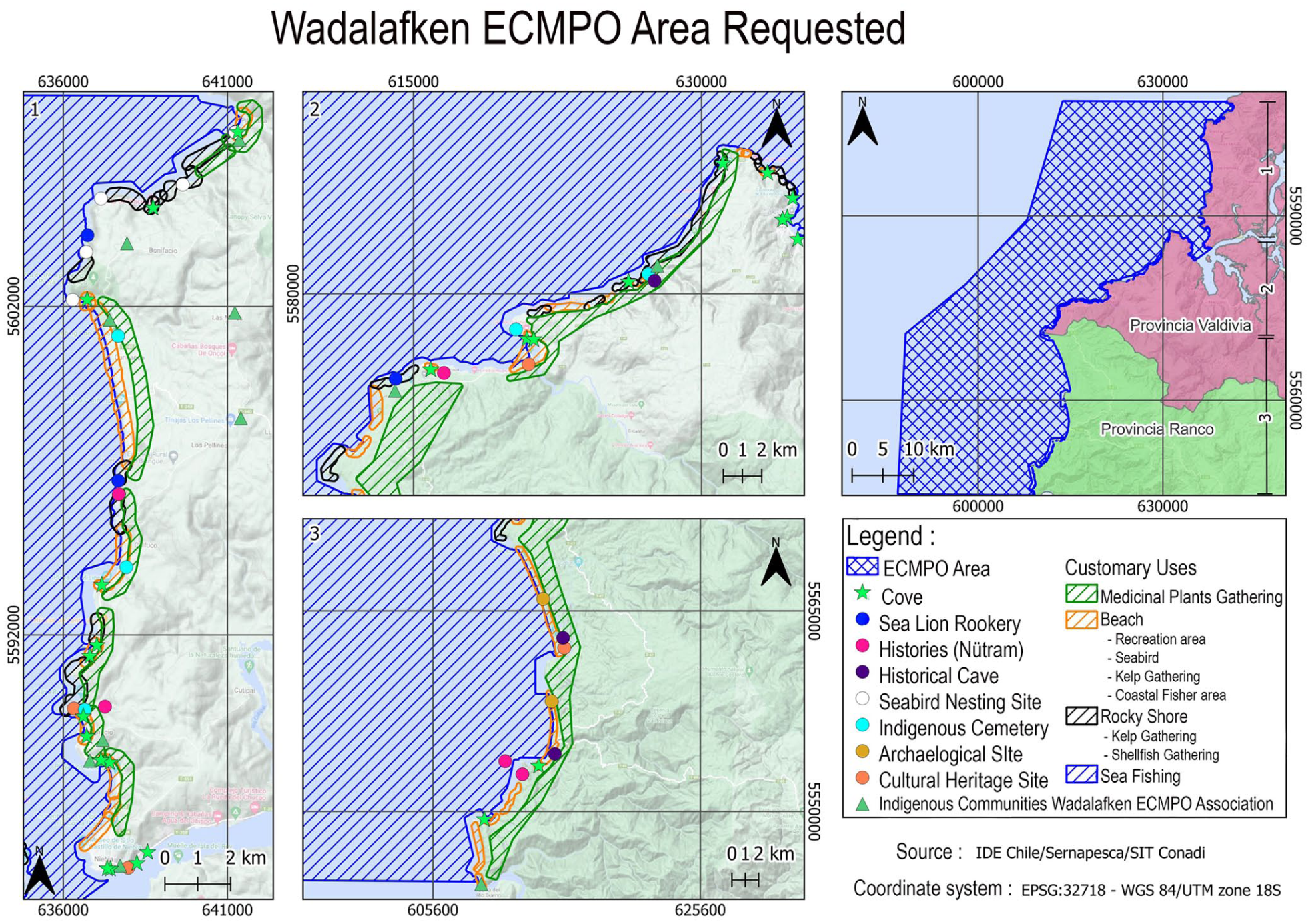
Wadalafken ECMPO application and customary uses map.
Although the seven workshops followed the same structure, the experiences and outcomes varied, likely because the participant groups differed across workshops. Sometimes government officials were present, or groups that were not necessarily prior allies of the Wadalafken ECMPO Association. In these workshops, it was not possible to conduct the collective mapping exercise, and the dynamics focused on building a shared basic understanding of the ECMPO law and its meaning in relation to each territory.
This was, for example, the case for the workshop organized in the town of Corral. Most attendees were representatives of local government institutions, with limited participation from Mapuche Lafkenche groups. The first part was interrupted only once (by the local representative of the Armed Forces) to explain the technical aspects of the ECMPO law in detail. Participatory mapping was not part of this workshop. However, the Wadalafken ECMPO Association encouraged attendees to ask and answer questions during an open discussion. The workshop focused more on specific technical aspects of the ECMPO application process and on the importance of institutional support for the Wadalafken ECMPO Association in achieving its work.
Lessons Learned
In this section, we reflect on the lessons that we take from key moments in the collaborative ethnographic process. Reflecting on these experiences is essential for gaining a deeper understanding of collaborative ethnography, how it transforms us, reshapes our perceptions of the social and political change we are part of, and shapes our positionality.
Trust and Time Are Crucial Elements of Collaborative Ethnographic Research Designs
The first lesson learned is that trust and, therefore, time are key in collaborative ethnography. In Mapuche society, relations with allies depend on trust; trust defines the boundary between being perceived as an “insider” and an “outsider.” For Mapuche Lafkenche collectives, the inside and the outside are not necessarily tied to who identifies as Indigenous but rather to who belongs to the social organization of the Mapuche collective. This can also include non-Indigenous people. Inside and outside are then defined by trust; trust is the boundary between Mapuche collectives and others outside this network. In our case, trust was a prerequisite for starting the research process. At the same time, trust was built through the process.
Trust and time can transform an outsider position into an insider position. Indigenous Mapuche collectives generally consider academics as outsiders. However, in this case, academics are perceived as insiders to Lafkenche Mapuche collectives due to long-standing relationships. One of the anthropologists, for example, has a son with a Lafkenche Mapuche and is therefore considered to belong to one of the collectives of the Wadalafken ECMPO Association. The second anthropologist is considered a wenuy (friend included in the Lafkenche Mapuche collective) because he raised his family in the territory. He has participated in various collaborations for over twenty years. The third anthropologist (and the first author of this article) has lived in Wadalafken since 2009 and, as pointed out earlier, began collaborating with this organization in 2016. As a result, the anthropologists came to be regarded as trusted insiders within Lafkenche Mapuche collectives linked to the ECMPO Association.
This was different for the Lafkenche Mapuche and Kunko Mapuche collectives that are not directly involved in the Wadalafken ECMPO Association and with whom the researchers had not been building trusting relations for such a long time. There were no family ties, no long-term collaborations, no prior friendships; only two days to get to know each other. The first day would be used to organize the event with the community president, and on the second day, all participants would meet. These collectives continued to perceive the anthropologists as outsiders and to view these collaborations with suspicion and curiosity, which hindered the research process.
Hence, collaborative ethnography requires taking the time to build the trust that is needed to establish meaningful research relations. It requires a different temporality – one that allows all collectives to fully participate in knowledge construction and political decision-making. Although the Nutramkam project was funded by the Ministry of the General Secretariat of the Government, it operated within a temporality and organizational structure different from those typically recognized by state institutions. It was this long-standing collaboration that enabled the realization of the Nütramkan project. However, it was not possible to develop the same level of trust with communities outside the ECMPO Association.
Local Political Relations and Organization Shape the Options for Doing Collaborative Ethnography
Insider-outsider relations are further complicated by local political dynamics that shape the options for collaborative research and with whom to work. Therefore – and this is the second lesson – collaborative researchers need to be attentive to local power relations to assess and adjust their positionality and research options accordingly. Collaborative ethnography offers a framework for doing so, allowing Indigenous communities to shape their own relational structures and decision-making processes, and for researchers to become part of this process.
In the case of the Nütramkan project, collaboration was directed by the following local constellations. 13 Indigenous Mapuche communities are part of the Wadalafken ECMPO Association. However, in the area covered by the ECMPO application, there are more than 45 Indigenous Mapuche communities. So not all communities in the territory are part of the ECMPO Association. Another complicating issue is that within the territory for which recognition as an ECMPO area is being applied for, there are also Kunko Mapuche and Lafkenche Mapuche collectives that resist the Chilean state and do not consider the ECMPO law a viable way to secure Indigenous rights because it is state-led.
Local political dynamics shape research and determine who can collaborate with whom. In the Nütramkan project, for example, the anthropologists began participating less directly in activities organized outside the Wadalafken ECMPO Association because of such local dynamics. The Wadalafken ECMPO coordinator made this decision after a Kunko Mapuche woman had expressed distrust in the anthropologists when the Wadalafken ECMPO Association began organizing gatherings with these Kunko Mapuche collectives. The Kunko Mapuche woman had asserted that Indigenous political processes should be led exclusively by Indigenous traditional authorities (and not guided by outsider anthropologists). Mapuche social organizations are holistic, with politics and spirituality deeply intertwined, making the presence of traditional authorities fundamental. For this reason, the involvement of traditional leaders and members of the coordinating Lof was crucial, and the professionals and anthropologists took a step back. In these cases, the Wadalafken ECMPO coordinator took the lead in organizing and facilitating the workshops. The number of anthropologists present was reduced to one, while more traditional authorities and their family members participated in the gatherings. Notwithstanding these changes, the gatherings always had a tense atmosphere.
In sum, the role of the anthropologists changed not only because of their relations with different collectives, but also because of differences within and between collectives and communities. The anthropologists became more like outsiders when the Kunko collectives that actively resist the Chilean government started to connect to the process.
Collaborative Ethnographic Research Can Be Transformative on Different Levels
The third lesson learned is that collaborative ethnographic research can be transformative on multiple levels. First, collaborative ethnography, to a greater extent than traditional ethnographic research, makes it possible to uncover histories and construct knowledge that may be important for social processes; second, the co-production of historical and traditional knowledge can be transformative for participating communities.
The processes that we explored above materialized in documents that offer narratives that shed light on the recent history of Wadalafken Mapu, like land grabbing by the powerful German landowner Prochelle in Lafkenche Mapuche lands, and the process of familiarization between Franciscan monks and Lafkenche Mapuche families, a history largely ignored in Chilean society. These documents are important for recognizing the Mapuche’s existence and for protecting their uses, customs, and practices as coastal Indigenous peoples. This is an important criterion in the ECMPO application process and provides necessary information for building legal cases related to environmental damage in Mapuche territories. Another relevant point these reports demonstrate is that land grabbing is the origin of current legal conflicts with logging companies and real estate projects, among others. Finally, these governmental and legal documents are used to claim Indigenous rights that were established in international agreements such as the UN Declaration on the Rights of the Indigenous Peoples (UNRIP No. 61/295, 2007) 38 and the 1989 ILO Convention No. 169 in 2008. 39
In terms of local transformative processes, gaining control over knowledge production has been transformative for the Lafkenche Mapuche collectives the first author worked with. This process involved reflecting on how oral histories and traditional knowledge, once written down and institutionalized, might influence Chilean institutions’ perceptions and policies toward Lafkenche Mapuche organizations. Equally important was recognizing the impact of this knowledge on the Mapuche Lafkenche communities. The experience was transformative because Lafkenche Mapuche researchers became more empowered through learning about social science tools and the contents of the documents they co-produced. Not only did they experience how they could be agents in the research process and through that process could learn about their own past and present, but also that such research can help gain control over a desired future, using these documents as a tool to contest the Chilean government.
Collaborative ethnography in Wadalafken Mapu has significantly reshaped the relationships between professionals, scholars, and the Wadalafken ECMPO Association. Through collaborative ethnography, research relations became more horizontal and reciprocal, and Lafkenche Mapuche gained control over the process of knowledge production. Whereas Mapuche participants guided the researchers towards the issues that were important for them in terms of content, the role of anthropologists in this process was also crucial – not only for gaining recognition from Chilean institutions but also for strengthening Lafkenche Mapuche collectives regarding how to use Indigenous knowledge as well as qualitative research methods. The process of constructing histories that contest injustice also opened avenues to explore past experiences that can inform the present and shape future aspirations, 40 a future more attuned to Mapuche identity.
Some Final Reflections
In this article, we reflected on a collaborative ethnography project with the Wadalafken ECMPO Association of the Lafkenche Mapuche in southern Chile. This reflection was based on the experiences and long-standing collaboration of the first author with the Lafkenche Mapuche people, who are now in the process of applying for an ECMPO area. The main points made can be summarized as follows.
First, collaborative ethnography allows researchers to participate in Indigenous coastal political processes and contribute to reclaiming Lafkenche Mapuche self-determination, reconstructing the social fabric of the Lafkenche Mapuche and Kunko Mapuche collectives that inhabit this coastal area. Second, collaborative ethnography, as a methodology, allows for more inclusive and horizontal relationships among the different actors involved in the research. Third, collaborative ethnography allows for empirically addressing tensions between Western environmental governance and Indigenous self-determination in coastal and marine areas. 41 This has the potential to amplify local voices in coastal and marine research, 42 adding an important perspective to maritime and coastal studies that continue to rely on Western science and institutions 43 and often fail to include local people’s self-governance and political forms of organization. And fourth, collaborative ethnography is not without its challenges: it requires trust and time and depends on local political and social constellations. Consequently, the researchers’ positionality as “insider” or “outsider” is constantly changing, requiring high levels of flexibility and adaptability.
These four main points all come together in our main conclusion that collaborative ethnography is best understood as a collaborative space that is continuously under construction and can be both transformative for participating (Indigenous) communities and academic researchers. In collaborative ethnography research designs, Indigenous communities can shape their own relational structures and decision-making processes. This not only allows academics to become part of, and contribute to the social change that these communities aspire, but also opens up avenues for decolonizing academic research practice. 44 In addition, the process of doing collaborative research also contributes to an embodied understanding of, in this case, Indigenous political and territorial processes, because, as collaborative ethnographers, we become part of these processes.
Doing collaborative ethnography is a continuous learning process through which both scholars and (Indigenous) community participants learn from each other about collaboration. Navigating the challenges of building horizontal relations is a constant learning process that encompasses not only the methodological challenges of collaborative research but also, in our case, the specifics of the social and political organization of Mapuche collectives and how they, in turn, relate to governmental and non-governmental organizations. Such learning processes constitute meaningful sources of inspiration that can foster dialogues about advancing collaborative research approaches.
Like the political organization of the Lafkenche Mapuche, collaborative ethnography is a process of continuous learning – one that is fluid, flexible, and inherently political. Within this process, collaborative ethnographers might become trusted allies or wenuy (foreign friends) and contribute to social change and desired futures by decolonizing their research practice. The inclusion of coastal Indigenous and non-Indigenous people in research through collaborative ethnography not only deepens knowledge of coastal and marine areas by building on Indigenous knowledge systems but also holds the potential to strengthen social fabric and self-governance within these territories.
Footnotes
Acknowledgements
We would like to acknowledge the support received from Becas Chile by The National Council of Research and Development of Chile (ANID) with the Doctoral funding to Mellado María Amalia.

Funding
The authors disclosed receipt of the following financial support for the research, authorship, and/or publication of this article: This funding has been vital to this research. Adding, we are grateful with the support of “Centro de Investigación Dinámica de Ecosistemas Marinos de Altas Latitudes, Fondap IDEAL No. 1515003, from Universidad Austral de Chile, Valdivia. Their investment in this Doctoral research has not only provided financial resources but has also validated the importance and potential impact of this research.
Declaration of Conflicting Interests
The authors declared no potential conflicts of interest with respect to the research, authorship, and/or publication of this article.