



Abstract
Founded in the Edwardian Age by international equestrian stars George Gilbert and Jennie O’Brien, and remarkably still working to this day, the Great Yarmouth Hippodrome circus is a heritage site of global significance. However, despite its ongoing meaning to our understanding of the social and cultural evolution of coastal entertainment, it has largely been overlooked by both seaside and circus studies—as has the broader topic of the development of seaside at the circus. This article recovers its neglected history, investigating the Hippodrome’s vital contribution to the shaping of this seaside resort. First, we look at how circus became integrated into the local community within a moment of tourist expansion in Great Yarmouth. Second, we explore the wider ramifications of this moment, as the Hippodrome connected the town to a global culture of performance, bringing travelling acts from around the world to establish the Hippodrome as a cosmopolitan presence on the British coast. While illuminating the pattern of circus mobility and the transmission of performance around the world, it also shows how the historical development of the English seaside resort, far from being the insular caricature often described in present-day nationalist nostalgia, was influenced in key ways by a diverse and global circus culture. In these ways, this article seeks to address the distinctive and neglected seaside-circus aspect of British seaside entertainment heritage.
Keywords
The Great Yarmouth Hippodrome, sitting on the seafront of a coastal town in the east of England, was constructed in 1903 as a purpose-built circus by married international equestrian stars George Gilbert and Jennie O’Brien. It remains, alongside the Blackpool Tower Circus, one of only two such venues in the United Kingdom still working as a circus in the twenty-first century. Constructed during what Vanessa Toulmin has termed “the final wave of circus buildings in the UK,” it is perhaps revealing that these two surviving links to such a vital moment of circus culture are located in seaside towns. 1 As Lynn Pearson has highlighted, circuses were frequently a key component of the development of seaside pleasure buildings during this period of evolution and expansion for British coastal tourism: “Most of the pleasure palaces included a circus in their design.” 2 John Walton, too, lists circuses as one of the many entertainments available to seaside holidaymakers at the turn of the twentieth century. 3 Nevertheless, despite the evidently important connection between circus and the seaside in this pivotal period for both those entertainment worlds—and the persistent significance of the circus for the culture and economies of some seaside towns today—little attention has been paid to what might be distinctive about the particular ways in which circus developed on the coast. The question of what it meant for circuses like the Hippodrome to take up permanent residence on the British seafront, and how that residency affected both elements of that relationship, has gone largely unasked and unanswered despite the recent explosion of scholarly interest in those separate fields. 4 Yet, the immediate relevance of this question is underlined by Duncan Light and Anya Chapman’s illumination of the “neglect” of the “distinctive heritage of the mass seaside holiday in England,” and their assertion that this heritage is an “asset which can be put to work within policies to promote economic renewal and enhance local civic pride in seaside towns.” 5 Similarly, it chimes with Chris Bull and Steve Hayler’s lament that popular “live entertainment” at the seaside, like circus, has received “scant attention”—and this despite the fact that “live entertainment has been part of the physical fabric and social construction of resorts from the outset,” and continues to be a key part of the seaside tourist economy. 6
This article, therefore, is an attempt to develop the idea of a distinctive seaside circus culture through a close examination of the foundation and first season of the Great Yarmouth Hippodrome in the early years of the twentieth century. Gilbert and O’Brien’s construction of a permanent circus on the coast required a series of negotiations that quickly came to define the establishment’s distinguishing presence on the seafront. Their circus conspicuously took up a civic role at the heart of a local community still deeply connected to the sea at the same time that it brought a transformative, cosmopolitan, global circus culture to the British seaside to entertain locals, tourists and seasonal workers alike. Charles Batson has made the case for circus to be understood as a quintessential subject for Area Studies, situated—like the Hippodrome itself—at the intersection of “the distinctly local and the avowedly global, providing potentially fruitful insights that take into account the multiplicities that make and mark peoples, performances and places.” 7 Similarly, the apparently “marginal” coast is increasingly being reinterpreted as (in the words of Nicholas Allen, Nick Groom and Jos Smith) a potent “region of exchange between land and sea, domestic and international space, where relationships and tensions between geography and culture are felt intensely and are played out dynamically.” 8 In 1903, the Great Yarmouth Hippodrome’s brand of seaside circus exemplified both of those formulations.
To help us illuminate this microcosmic moment in the life of a seaside circus, we have been able to draw on a rare, possibly unique, resource: the Tinkler and Williams’ Theatre Collection, housed at the University of East Anglia in the UK. Herbert Tinkler was a Norfolk resident who amassed a vast private collection of local theatrical memorabilia which included a wide array of Hippodrome-related material, including a detailed and comprehensive chronology of all the acts who played there from its pre-history in a temporary structure on the Great Yarmouth seafront until the middle years of the twentieth century. Because the Hippodrome was, from its inception, embedded within the community of Great Yarmouth and connected to the wider East Anglian region, we have also had a rich archive of local newspaper material to draw from in our attempt to reconstruct the world of seaside circus and its reception in this pivotal period—from the Hippodrome’s own advertisements to detailed descriptions and reviews of performances, outbursts of controversy, and accounts of moments when Gilbert and O’Brien’s circus engaged with local life in potentially unexpected ways. Remaining static means that circuses like the Hippodrome leave a much larger archival imprint than their itinerant, touring equivalents. In what follows, then, we have used those rich resources to recreate the moment of the Hippodrome’s foundations along two key lines of enquiry: how Gilbert and O’Brien brought a permanent, stable circus to the heart of the Great Yarmouth seaside community, and how they brought the wider world to Great Yarmouth through their cosmopolitan selection of acts in the first few months of its operation. To help us frame this moment of local significance in an international context, Gillian Arrighi’s focussed exploration of the ways in which the Australian FitzGerald Brothers’ Circus “articulated a variety of narratives concerning nation, identity, allegiance, and belonging at the turn of the twentieth century” has served as a scholarly model. As Arrighi says, in this period, the circus “mattered”—her emphasis—and so, this article is an attempt to see how and why—locally and globally, then and now—the seaside history of the Hippodrome also matters. 9
Making a seaside circus
Gilbert and O’Brien’s route to the Great Yarmouth Hippodrome followed a truly remarkable arc through the highs and lows of international Victorian circus culture, but fittingly their global story had local roots. George Gilbert was born in Norwich—Norfolk’s county town situated roughly twenty miles from Yarmouth—in 1855, “the son of a coach-smith in penurious circumstances” who was “brought up and educated in […] the streets”—according to a 1906 profile—before running away to join the circus at the age of eleven. 10 Jennie O’Brien, on the other hand, was born into a circus family and started performing early: in an interview with the Pall Mall Gazette in 1888 she remembered that her “career began when she was six, in her father’s circus at Norwich.” 11 Separately, Gilbert and O’Brien became renowned circus performers, famed for their acrobatic feats on horseback, working with the major names and in the premier venues of the period. In 1880, at Hengler’s Cirque in London in 1880, they were both booked on the same bill; they married three months later.
While they often performed together thereafter—as pictured on the front cover of illustrated magazine The Graphic during a Christmas season at Covent Garden (Figure 1)—it was O’Brien who was the bigger star. Labelled as “the première équestrienne of the world” by the Pall Mall Gazette at a time when performances of equestrian skill were still the heart of circus entertainment, she delighted audiences across the world.
12
She conquered Paris in the 1880s—“un succès colossal,” as one newspaper put it.
13
It was undoubtedly her celebrity profile that got the pair the biggest booking of their careers: in 1888, they toured across America with Barnum and Bailey’s Circus. “Jennie O’Brien made a great hit yesterday,” reported the New-York Tribune on April 17, 1888.
14
Despite this extraordinary degree of international success, both performers intimated a weariness with the demands of peripatetic circus life. Gilbert still carried the traumatic memories of his treatment as an itinerant circus boy: “they thought nothing of beating the lad; to be nearly drowned was a frequent incident.”
15
In 1888, at the peak of her fame, O’Brien admitted, “It is not a life to which I should exactly care to bring up a child of mine […] and I shall not be very sorry when I leave it.” She also made it clear that time was coming soon: “in a few years” she planned to “quit” performing in the circus ring “for ever.”
16
Soon, she would make good on that promise. Jennie O’Brien and George Gilbert performing their acrobatic equestrian feats at Covent Garden in 1886. Also pictured, Jennie O’Brien’s equally celebrated trained pigeons. The Graphic, January 9, 1886, front cover.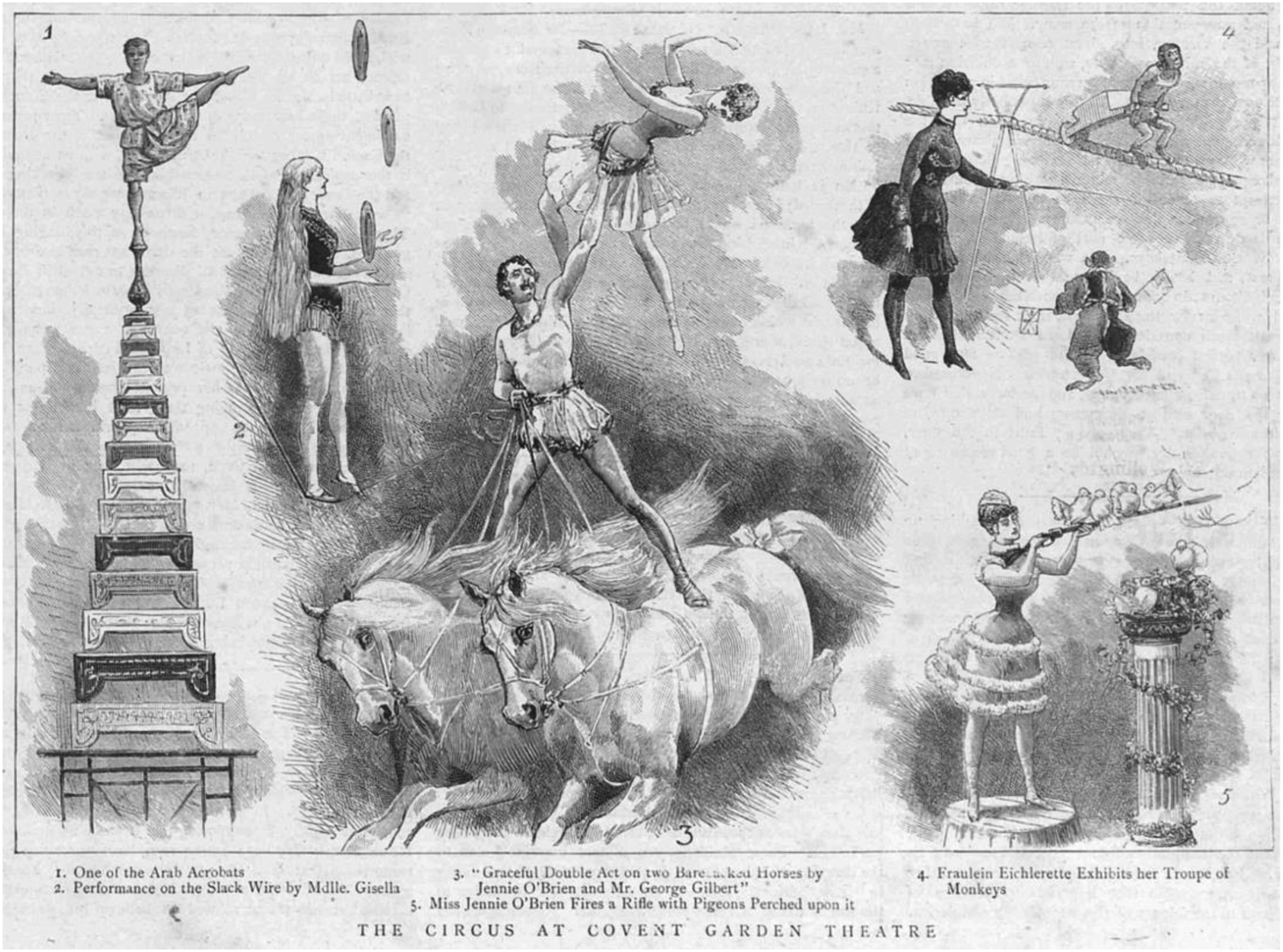
In 1889, touring with Hengler’s Circus, the couple made a return to the place where their careers had begun to an audience that clearly appreciated their homecoming: “Mr. G. Gilbert and Miss Jennie O’Brien were a great attraction, and their extraordinary performance evoked from the most enthusiastic of the admirers cries of ‘Well done old Norwich’.” 17 Perhaps this residency laid the seeds for what happened next: in 1893, the Norwich Mercury reported that Gilbert and O’Brien had again returned, this time with a new venture of their own: “After achieving an almost unrivalled fame, both at home and abroad, Mr. George Gilbert, a native of Norwich, whose equestrian successes, together with his wife, Miss Jenny O’Brien, are well known to the Norwich public, decided to pay the city of his birth a visit and conduct a circus on his own account.” 18 Based in the Norwich Agricultural Hall, the pair opened their own circus, an endeavour that swiftly became a winter fixture in the life of the city. This period of their lives involved at least one significant coup: Gilbert booked legendary tightrope walker Charles Blondin for an appearance in Norwich. 19 Success in the city over a number of years led to a new development. In 1898, Gilbert and O’Brien made plans to construct a temporary wooden building in the nearby seaside resort of Great Yarmouth to house a circus (not least, because “Yarmouth does not boast many of the larger kind of entertainments during the season.”) 20 It was this undertaking that would eventually develop into the permanent Hippodrome—and Gilbert’s own development into something akin to East Anglia’s own Barnum, a figure who combined entrepreneurialism and entertainment with a very public facing role as the embodiment of his circus within local and national networks. Indeed, the local press was keen to trumpet that Gilbert “travelled for a somewhat lengthy period with the far-famed BARNUM on some of his American tours, and has also performed all over Europe.” 21 That glamorous, international association was clearly a significant part of Gilbert’s brand, as it would be a trademark of the circus entertainment that he created in Yarmouth.
The local paper hailed the endeavour, and eagerly asserted that “the inhabitants of the town may be considered a circus-going people.” 22 Yet immediately, the construction of this space to house a circus on the seafront at Great Yarmouth was controversial. Gilbert was granted permission for the structure after some contentious debate amongst members of the Sanitary Commission in April 1898, but complaints from concerned residents soon flooded into local newspapers. Mainly, they addressed the question of safety. “What is our Council thinking about,” asked an enraged and anonymous “Ratepayer in Two Wards,” “to pass plans for a wooden building for a circus in a densely populated part of the town, joining a fried fish shop and other such inflammable property? When full of people what chance is there of all escaping should it catch fire? It might be a death trap to many.” An anonymous “Observer” declared flatly: “none of my children shall go under its roof.” Another anonymous correspondent, “Viator,” went as far as insinuating a degree of corruption, implying that Gilbert was simply the front man for speculations made by high-ranking members of the community: “Perhaps this building is for someone on the Council.” 23 Evidently, these rumours circulated sufficiently for Gilbert to address them directly: “the undertaking is entirely his own,” he told the local press, “and he desires us to say that the report abroad in the town that it is owned and will be carried on by Yarmouth gentlemen is entirely erroneous.” 24
Whatever means Gilbert used to get his wooden circus structure constructed in Great Yarmouth in the face of local opposition, he swiftly attempted to establish his new building as a stylish and respectable asset to the community that was endorsed by local dignitaries—tactics that he would later employ in relation to the Hippodrome. The first advertisement for “Gilbert’s Modern Circus”—modernity encoded in its very name—stressed the degree to which this was a contemporary establishment of some style, despite its ostensibly temporary nature: “Brilliantly illuminated throughout by electricity including hundreds of incandescent lamps. Beautifully upholstered, draped and decorated. Lovely floral devices and well-ventilated […] The most magnificent, cool and complete Palace of Amusement in the Eastern Counties.” Gilbert guaranteed his patrons “the greatest array of talent ever seen in Yarmouth.” For the opening evening on July 25th, 1898, he also trumpeted “the distinguished patronage and presence of the Mayor” and other local notables. 25 Within the confines of his wooden structure, he continued to innovate his circus offering in other ways. In 1900, he installed machinery to convert the circus ring into a water arena. The local press described the “big sensation”: “Huge tanks have been erected from which some 50,000 gallons of water will be shot into the ring in the course of a few seconds.” They predicted that it would “secure big business.” 26 He also dabbled with patriotic philanthropy: in December 1899, the venue was used for a “Grand Military Tournament in aid of Widows and Orphans of Sailors and Soldiers killed in the War in South Africa.” 27
In all of these aspects, Gilbert and O’Brien were exemplifying wider trends in circus life at the turn of the twentieth century. As Gillian Arrighi has argued, successful circuses in this period “demonstrated their possession of, and familiarity with, the latest technology” and thus “aligned their operations with aspirational values such as stability, reliability, wealth, and innovation […] contradicting perceptions of the circus as ephemeral, unstable, transitory, dangerous and socially marginal.” 28 Such traits were even more discernible when Gilbert and O’Brien’s ambitions for innovation and improvement, combined with the ongoing success of their entertainment enterprise, drove them to seek a permanent home for their circus. At the end of the summer in September 1902, the Eastern Daily Press reported that it had been a “record season” for the circus and announced that exciting plans were afoot: “Mr. Gilbert determined early in the season to enlarge his borders, and elaborated a scheme for the erection of a grand building to be called the Yarmouth Hippodrome, which has not its like outside of London, and will not only be a credit to its promoter, but, when completed, will add another to the permanent attractions of the town.” 29 Early in 1903, this project was given an informal blessing at a dinner given in Gilbert’s honour by “an influential company of Yarmouth gentlemen.” Toasting Gilbert’s efforts, one speaker celebrated “the enterprise he had displayed in erecting a new building in their town […] No one in Yarmouth had dared to invest capital in this way, and a debt of gratitude was due to Mr. Gilbert for his endeavour to provide amusement for the hosts who visited the town during the summer months.” 30
Undoubtedly, there were other contextual motivations behind Gilbert and O’Brien’s decision to construct their permanent Hippodrome at this precise moment in the life of Great Yarmouth. In 1902, the town was on the brink of change. By the late nineteenth century, Yarmouth had a reputation—to use Annie Berlyn’s condemnatory terms from 1894—for “cheap-day trips and vulgarity.” Yet behind this “paradise of excursionists” there was still discernible a “charming, quaint old seaport, picturesque in the highest degree,” Dickensian in its associations. 31 Which path would the town choose for its future? Business interests clearly favoured a vision of the town as a would-be Blackpool on the east coast, but by some measures the town was failing to thrive as a popular seaside destination. At one council meeting in April 1903, a councillor noted, “They were always being told that […] the town was fast becoming bankrupt.” 32 Transport links to the east coast resorts were also an issue: as a resident of Sheffield, one of the town’s target locations for holidaymakers, put it in 1901, “It’s so far away and we are so long getting there.” 33
As Gilbert and O’Brien fomented plans to make the circus a permanent fixture of life in Great Yarmouth, the town and its neighbouring seaside communities undertook a sustained campaign of development and expansion. This was a coordinated effort by the Great Yarmouth Corporation and the Great Eastern and the Midland & Great Northern Joint Railways to increase visitor numbers through new attractions and improved transport links. In 1903, for example, the new Wellington Pier and Pavilion opened to visitors, under the auspices of the Corporation, in the same month as the Hippodrome: “Boldly planned, finely furnished, and artistically decorated, this latest ‘civic pile’ is likely to attain enduring popularity,” according to local press reports.
34
That same year, the Corporation undertook another investment that it hoped would improve the town's tourist offering, especially outside of the summer season. In April 1903, it purchased second-hand from Torquay “a glass and iron building, now used […] as a winter garden.”
35
The Illustrated London News published a photograph when it was finally erected in 1904 and applauded the work of the Corporation of Yarmouth “to enhance the popularity of that already popular watering-place” (Figure 2).
36
“Yarmouth is nothing if not up-to-date, and the watchword of its civic policy is progress,” concluded the Eastern Daily Press.
37
Railway companies also played their part. In July 1903, a new railway line was opened between Yarmouth and Lowestoft with the goal of connecting the constellation of towns along that stretch of the east coast. These improved connections were combined with a number of new express services that were, as the Norwich Mercury put it, “calculated to attract to the Eastern Counties’ pleasure resorts an increasing number of visitors from the Midlands and North.”
38
The opening of the great Yarmouth winter garden, featured in the Illustrated London News, June 18, 1904, 930.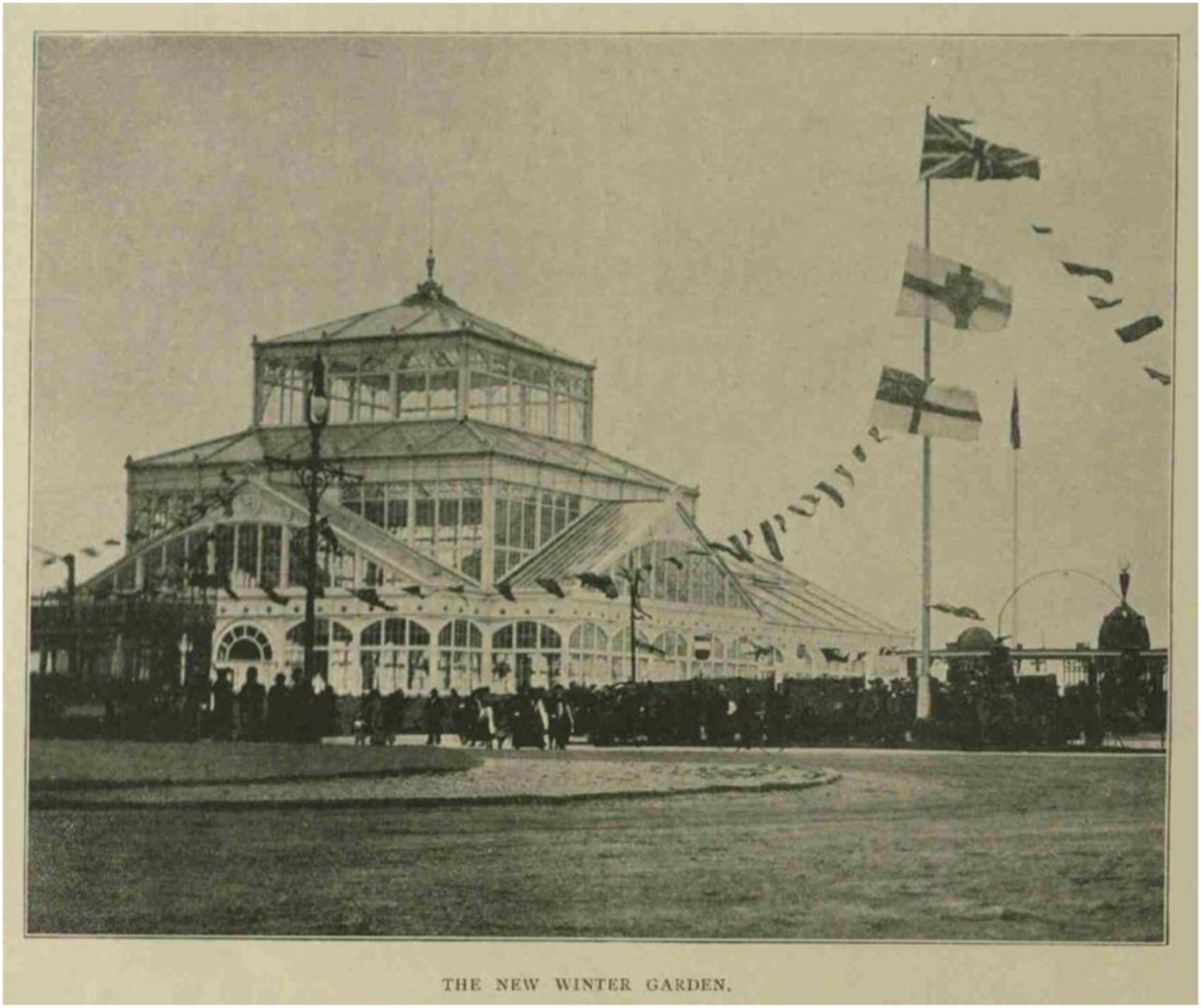
Yet if the opening of the Great Yarmouth Hippodrome in 1903 was absolutely in keeping with the town’s expansive mood, that does not mean that the establishment of a permanent circus on the seafront was entirely without opposition. That circuses could still be viewed with suspicion by communities in 1903 can be seen in the discussions surrounding how much the famous circus impresario Lord George Sanger should be charged to perform in the fellow East Anglian town of Saffron Walden. While some on the local council argued that it “was the only treat provided” for local residents “in the way of entertainment” and that it “caused a lot of money to be spent,” others argued that “it took a lot of money out of the town.” 39 As Karen Fricker and Hayley Malouin have asserted, the circus in its itinerant form was characterised by mobility and impermanence and, as such, was understood to be “inherently subversive”: “Moving from town to town, setting up tents under the cover of night, and leaving the way they came, nineteenth-century travelling circuses offered themselves up in alluring opposition to normative, sedentary society; the circus itself, as a living, moving network, provided a peeking glance at a seemingly vastly different system of socialization, at an ‘other’ way of life.” 40 But what happens to the circus when it stands still, fixed in a different kind of community network with its own demands and particular sense of place? Gilbert and O’Brien were not the only entertainment entrepreneurs grappling with that question in this period. As Brenda Assael has written, many similar establishments found themselves caught between the medium’s “perceived vagabond past and the demands of its industrial present.” Fixed in position, these new static spaces “implied a more complicated existence for the circus, driven by the pressures of commercial and legal demands as well as by productive needs”; in response, “its members often adopted the language and practice of respectability.” 41 Certainly, the performance of respectability and civic responsibility would be a key part of the Hippodrome’s activities in the period surrounding its foundation in 1903.
The official discussions around the Great Yarmouth Hippodrome’s licencing arrangements reveal the tensions surrounding the enterprise—between residents and pleasure seekers, between respectability and disorder (perceived or otherwise), and between visions of Yarmouth’s identity as a town. The first debate, in February 1903, was whether the Hippodrome should be allowed to serve alcohol. Gilbert’s legal representative at the licencing meeting was immediately informed that the move was opposed by the local Temperance Organisation and that no new alcohol licence had been granted in Great Yarmouth for four decades. Regardless, Gilbert’s brief made the case that “the new hippodrome would be a great addition to the attractions of Yarmouth.” Many of its patrons, “respectable people—rich and poor […] required drink and meant to have it.” Inevitably, this would mean that they would have to leave the Hippodrome to procure alcohol from neighbouring establishments during performance intervals—as was the case in Gilbert’s temporary building. Since Gilbert was “spending a very large amount of money” and “was thus benefitting Yarmouth […] why should not his patrons spend their money in the circus instead of going outside?” Moreover, granting the licence would actually cut down on issues of public nuisance: thirsty patrons leaving and reentering the Hippodrome throughout its performances would generate “noise” as well as “a certain amount of inconvenience caused by blocking the pavement.” Gilbert himself testified that, “He had never known a similar building in a watering place refused such a license.” Nevertheless, the licence was refused. 42
While Gilbert could operate a circus without an alcohol licence, he could not open the Hippodrome without a music licence. That was the next point of contention. Later in February 1903, Gilbert’s representatives made the case that the licence that Gilbert had held for his temporary circus structure should simply be transferred to the permanent building going up in its place. Not all council members agreed. Mr. J. W. de Caux, Chairman of the Licencing Committee—who claimed “He knew as much of a circus as any man in that room”—led the charge. According to de Caux, Gilbert’s temporary circus had been a long-running “public nuisance” for those who lived in the community: “Complaints were made to him continuously by residents in that particular part of the borough that it interfered with the comfort and convenience of their homes in every way.” Going further, he asserted to the room that, “Not a single gentleman amongst them would wish to have such a place against his own residence.” As it was their duty to “protect rate-payers in their rights and privileges,” and those rights and privileges included “comfort, convenience and quietude,” he would oppose outright any new music application that was made on behalf of the Hippodrome. 43 Any final decision would be dependent on a site visit of the completed circus. The Yarmouth Mercury, at least, judged that this objection seemed to “savour of the unreasonable in the extreme.” 44
In the end, the value of the Hippodrome as a new attraction at this pivotal moment in the town’s tourism trajectory evidently weighed more heavily than the concerns of local residents about noise and other public nuisances. When the Licencing Committee made their inspection tour of the building in July 1903, just before its projected opening date, even the circus-hating Mr. de Caux was completely won over by the splendour of Gilbert and O’Brien’s construction: “Yesterday I had the opportunity of inspecting the building,” he declared at the Licencing Committee in July 1903, “and I was extremely pleased with it […] It appears to me everything has been done in order to prevent the complaints, which were properly made with regard to the last building […] I trust Mr. Gilbert will be successful in the grand speculation he has undertaken.” 45 The music licence was granted, and the Hippodrome was free to open for its first summer season as a now-permanent fixture of Great Yarmouth life.
Local press coverage was laudatory as opening night approached: the Eastern Daily Press noted that it had been Gilbert’s intention to “provide Yarmouth with a building equal to any of its kind in the country, and surpassing anything to be found at any other sea-side resort with the exception only of Blackpool,”—always the town’s benchmark for success—“a building in which huge water carnivals and scenic displays can be carried out with ease and success.” He had clearly succeeded. Gilbert and O’Brien’s new building was, again, characterised by displays of modernity and technical innovation. It could boast a “sinking ring,” a mechanism that swiftly flooded the circus floor allowing for water-based entertainments—a device that could “be found elsewhere in England only at the Hippodrome in London and Blackpool.” Alongside luxurious interiors and full electrification, Gilbert was, as ever, looking to the future: the Hippodrome was set-up for “working bioscopic exhibitions”—early cinema screenings that Gilbert had already pioneered in earlier circus programmes. An illustration accompanied the lengthy description (Figure 3).
46
The Yarmouth Mercury was no less effusive and particularly lingered over the permanence of this new circus building and its significance for the town: “No ephemeral structure this, adapted to a fleeing prosperity, but an enduring tribute to the permanence of Yarmouth’s position in the affections of holiday makers, the wide kingdom over.” It was a “perpetual pledge” of Gilbert’s belief in “the assured and ever increasing popularity of our now famous town.”
47
Profoundly impressed by “this amazing palace of amusement,” the Mercury imagined that the Hippodrome made “oldest Yarmouth shake its head in a sort of wonder too great for even a grumble at the progressiveness of the times.”
48
The Yarmouth Independent, too, described it as “a great acquisition” for the town and hoped it would be a success for Gilbert, “who, we are sure, will do his best (and his best is very good indeed).”
49
National attention was also newly directed towards Yarmouth: the Music Hall and Theatre Review declared the Hippodrome to be “a sumptuous building.”
50
‘The Great Yarmouth Hippodrome,’ profiled in the Eastern Daily Press, July 13, 1903, 8.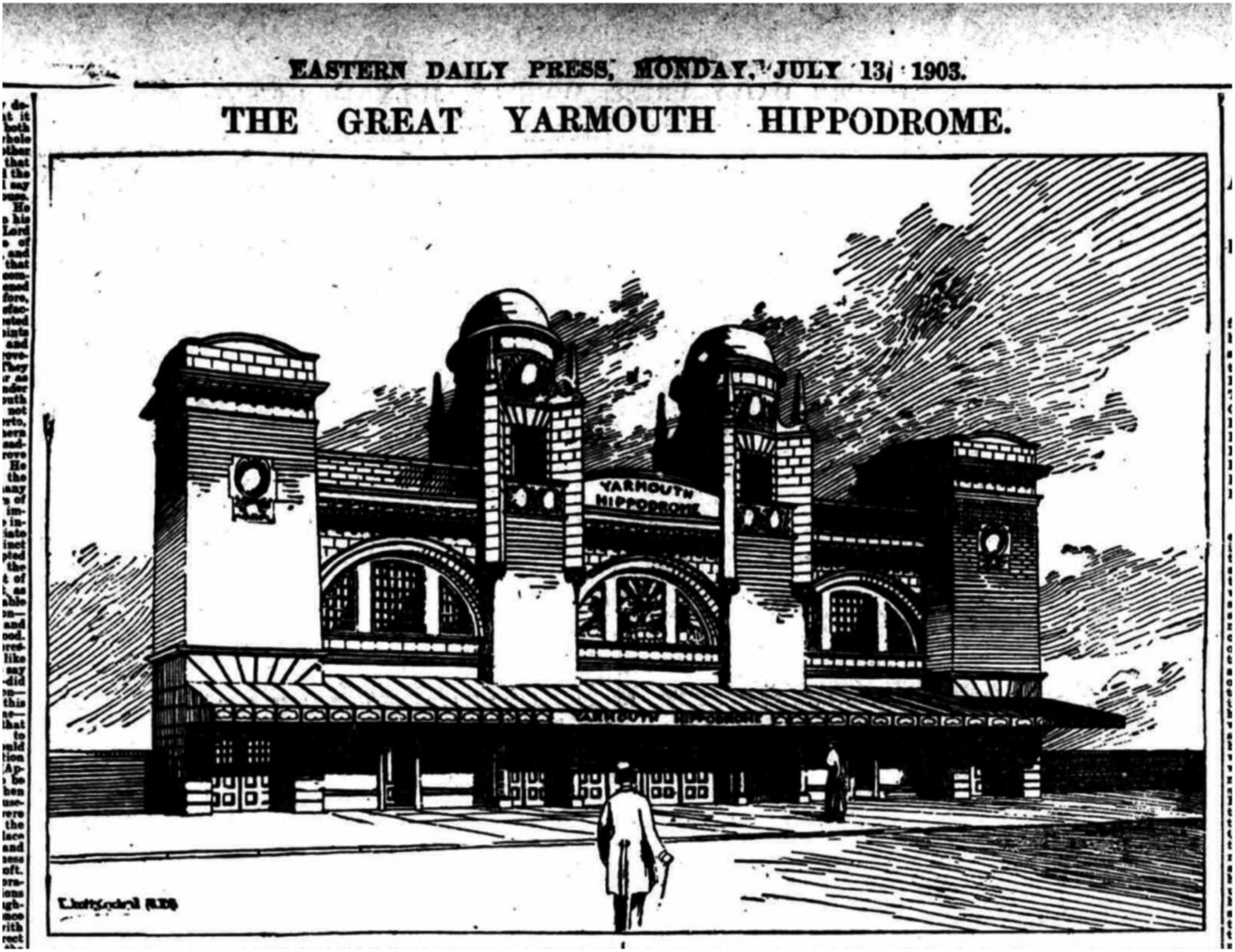
The grand opening night, on July 20, 1903, was carefully orchestrated to project official endorsement by the great and the good of Great Yarmouth. The Norfolk News highlighted that “this modern replica of the Coliseum was opened with considerable eclat, and in the presence of the Mayor and Mayoress and a large number of members of the Corporation, the magistracy, Guardians, and others.” As the National Anthem played, the Mayor—“who wore his chain of office”—entered the ring and lauded Gilbert’s “pluck and enterprise.” Miss Nellie Cockrill performed local anthem “The East Anglian Flag,” Gilbert handed “a lovely bouquet of white lilies” to the Mayoress, O’Brien came out of retirement to perform an inaugural equestrian act on “her favourite pony Spot”—and the Hippodrome was open for business. 51
Now Gilbert and O’Brien had their new permanent circus building, what would their seaside circus enterprise look like? In the three months of its opening season, the Hippodrome enacted a remarkable triangulation between the local and global, using circus to engage with the Yarmouth community while also bringing a wealth of cosmopolitan creatives to the east coast. Philanthropy was at the heart of the Hippodrome’s charm offensive, using the building’s permanent place in the town to tie together community and circus through charitable acts. Rather than simply extracting from a temporary host, the Hippodrome very visibly put resources back into Yarmouth as Gilbert and O’Brien publicly helped a litany of worthy causes throughout the season. But befitting their location on the coast, it was maritime causes that were most conspicuous in these charitable endeavours. The city’s long-standing connection to the sea was repeatedly celebrated and supported in the Hippodrome’s circus ring. In late July, for example, Gilbert hosted “members of the Caister lifeboat crew” for a special performance. 52 Then, on August 15th, he invited the widows and orphans of the men who had been killed in the infamous Caister Lifeboat disaster of 1901 to be “entertained at the Hippodrome”; apparently, they “greatly enjoyed the performance.” 53 Soon, Gilbert had solidified a popular reputation for being “ever to the front in assisting any deserving cause.” 54
One tragedy particularly catalyzed the leading role that Gilbert and O’Brien were clearly trying to carve out for the Hippodrome in Yarmouth life. On September 1st, 1903, the Yarmouth pleasure boat New Skylark was run down by a London steamer. “Terrible boat disaster at Yarmouth,” ran the headline in the Eastern Evening News. 55 The Yarmouth Mercury labelled it “one of the black days in the history of Yarmouth as a seaside resort.” 56 Six people drowned: three holiday makers and three crew members; all of the latter also helped to operate the Yarmouth lifeboat. Immediately, philanthropic gears started turning in the local community—and Gilbert and the Hippodrome were at the fore, firmly linking the circus to the town’s local maritime community through charity. Immediately, Gilbert put a plan into action: the Hippodrome would stage a benefit performance and all profits would be donated to the fund that had been set up to support the widows and orphans of the New Skylark’s crew members.
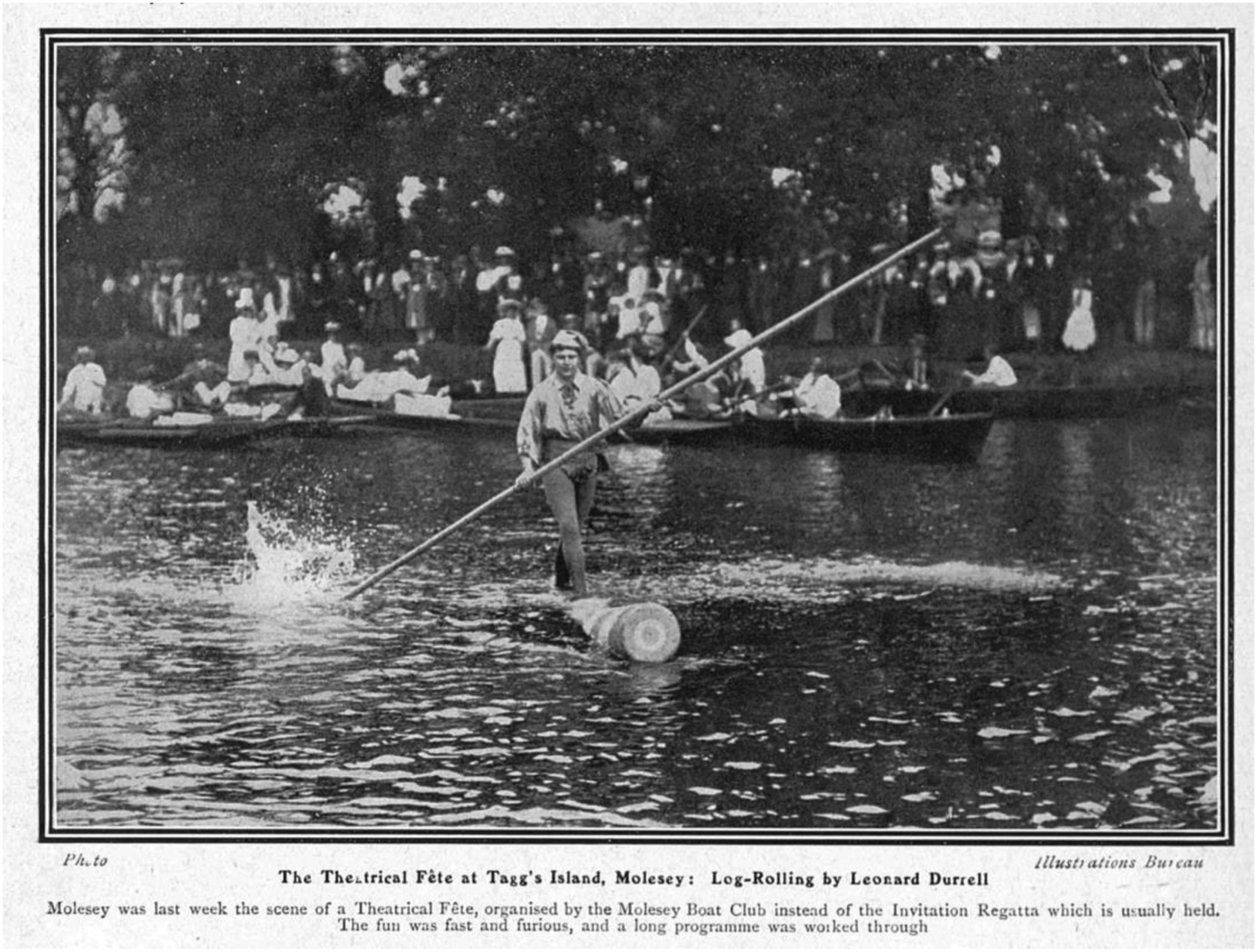
The event was a signal success that drew the community together. Even London newspapers noted the “great demonstration of sympathy, 4,000 persons being present and hundreds [...] unable to gain admission.” 57 The Mayor and Mayoress were conspicuously in attendance again, as were “the principal inhabitants of the town, magistrates, aldermen, councillors, guardians, and other representative people.” 58 At the heart of the benefit was a special spectacle—“undoubtedly [...] the event of the evening,” according to the Eastern Daily Press. 59 That week, Gilbert had booked Canadian log-roller Leonard F. Durrell to entertain audiences as part of the Hippodrome’s water programme. For the benefit performance, Gilbert undertook a wager of £5 with Mr. A. F. Clowes—“the well-known secretary for the Yarmouth lifeboat”—to see who could stay standing longest on Durrell’s log. Gilbert—or “‘Old George’, as the ‘Hippo’ frequenters persist in calling him”—emerged “rigged out in a white sailor suit [...] and was greeted with shouts of applause.” 60 While Gilbert was the winner, both men donated the sum of £5 to the benevolent fund. The next day, the local press reported that Gilbert delivered to the Mayor “a cheque for the sum of £111 3s. 10d.” 61 In return, the Mayor presented Gilbert with an open letter, which appeared in the same issue of the Eastern Daily Press: “Such generosity deserves its own reward; and in thanking you for your valuable donation, I may specially include the widows and children of our poor beachmen who lost their lives, and who I am sure will never forget your name.” 62 Little surprise that on September 18th the Music Hall and Theatre Review could announce without fear of contradiction that “Mr. Gilbert […] is extremely popular locally.” 63
Seaside circus cosmopolitanism
For all that its foundation was a hyper-local story dependent on the minutes of council meetings and the performance of civic respectability through charitable acts, there was a wide world waiting to be discovered behind the doors of the Yarmouth Hippodrome. As Arrighi has argued, circuses in this period could be profound “agents of transculturation” which “crossed geo-political borders” and explicitly and implicitly engaged in “international transference and exchange of culture.” 64 Circus artists themselves have always been “geographically mobile border crossers, enabled by their lack of dependence upon the spoken word for their performances, and driven by commercial necessity to always seek out new audiences.” 65
This was certainly true of the Hippodrome and its artists: for all that Gilbert and O’Brien created a fixed circus and strove to make it an institution that sat respectably at the heart of a local community, it was also inevitably still a place of flow and transience—a multicultural, transnational space in which the global and the local were in conversation, for an audience of locals and transitory tourists and seasonal workers alike. Movement still remained central to the enterprise, and while static life at the seaside might have changed the circus, the circus also clearly changed the seaside by bringing a constant flow of international performers to the ring of the Hippodrome.
From its opening season in the summer of 1903, acts came from all corners of the globe to perform in its circus ring, just as tourists came from all over the United Kingdom to watch them. Having worked for decades as both successful performers and circus impresarios, Gilbert and O’Brien were well connected to international entertainment circuits, and their efforts to book a constant flow of talent from across the globe were clearly understood to be a key part of their success as circus owners. When a local journalist visited Gilbert at home, for example, they marvelled that the walls of his office were “densely crowded with portraits of artistes of every description, from the stolid Russian to the sleek and inscrutable denizen of far off Cathay […] Mr. Gilbert has literally got the pick of the world’s acrobats, gymnasts, trick cyclists, swimmers, equestrians, and artistes of every possible description.” 66 As a growing seaside town, Yarmouth was part of the modern music hall and variety theatre circuit, and so Gilbert and O’Brien could reliably draw on the best international talent touring Great Britain in any given season. It also allowed them to open the ring to performers who crossed between circus and variety, something that marked the Hippodrome out as a distinctively modern operation. As Arrighi has argued, circus and variety “enjoyed an intricate relationship at this time and were not as separate as received histories have assumed.” 67 Certainly, this symbiosis was evident at the Hippodrome, as artists shuttled between Great Yarmouth and the likes of the Blackpool Alhambra and the London Coliseum via any number of Empires, Palaces, and Tivolis dotting the land.
Thus, appearing in the Hippodrome’s opening season were a series of prominent artists whose names alone evoked this national and global network of circus and music hall performance: Tilly Bébé, Paul Spadoni, the Elysian Toupe, the Mar-Ta-Fio Trio, the Azarahs, Zertho, Pablo Diaz, William Permane, Dartigan—and many more besides. They were acrobats and strongmen from the Near East, the Middle East, and the Caribbean; African American singers and musicians; animal tamers with Asiatic lions, Siberian bears, and Russian dogs. So significant were the aesthetics of diversity, difference and the exotic to the cosmopolitan culture of circus that many British acts also adopted ambiguously international stage personas and exotic stage names that confounded Edwardian expectations about national identity.
For locals and visitors alike, therefore, a trip to the seaside at Great Yarmouth now also offered the potential for imaginary journeys to far-flung destinations thanks to the showcase of exotic difference and cultural otherness within the walls of the Hippodrome. In itself, this must have intensified visitors’ broader experience of the built seaside environment which, in Fred Gray’s terms, was frequently “a fantasy architecture designed to transport users to alternative worlds” and “intimate other exotic and pleasurable places and times.”
68
When Yarmouth’s Wellington Pier and Pavilion opened in the same year as the Hippodrome, for example, it typified this transporting style: according to the Yarmouth Mercury, “Once scarce knows how to describe it […] it is of the mixed and modern style one sees in Paris exhibitions and Chicago world’s fair […] Its rounded roof is supported on rows of Moorish arches.”
69
Of course, this is not to suggest that the Hippodrome was a Utopian space. As Janet Davis has cautioned, within a US context, while “performers themselves embraced cultural diversity” within the “international, multiracial” space of the circus, its “celebration of diversity was often illusionary, because the circus used normative ideologies of gender, racial hierarchy, and individual mobility to explain social transformations and human difference.”
70
Vanessa Toulmin has also highlighted the ambiguities of race in the Victorian circus in Europe and the United Kingdom. Whilst the performances of Black circus stars were often viewed “through a lens of exotica or racial stereotyping,” circus could still “provide an arena where exceptional skill prevailed and flourished despite prevailing racist attitudes of the time [...] However, the degree to which the British circus was a racially integrated arena cannot be fully evaluated and even the success stories are nuanced within social norms and conventions which are fundamentally racist in their attitudes.”
71
What can be said with certainty is that whatever the inevitable ambiguities of engagement with these performances, contemporary audiences clearly responded to the novel international and multicultural dimensions of the Hippodrome’s circus ring, and singled out that element of its performance culture for comment and, indeed, praise. As the Eastern Daily Press marvelled on August 25th, 1903: Mr. Gilbert has scarcely made his Hippodrome large enough, judging from the immense crowd thronging the doors yesterday […] The programme this week is international in its character, and gives the public a good idea of the capabilities of artistes selected from all quarters of the globe. This week the visitors to the Hippodrome may see turns by erstwhile denizens of the deserts of Arabia, clever and versatile artistes from Servia, a troupe of real negro minstrels from the Southern States of America, a Russian, and representatives of other nationalities. For general interest, the programmes presented twice yesterday have never been excelled in Yarmouth, and the wonder is where all the performers come from.
72
As such testimonies make clear, the Hippodrome undoubtedly brought a new and very noticeable diversity to Yarmouth. But if such diversity was new, it was not entirely new. As a fishing community—in this period, the leading herring port in the world—the town had long welcomed visitors from far afield, from the Scottish fisherfolk who came to work the herring season to the Russian merchants who arrived to purchase cases of kippers and bloaters. 73 As a port of the British Empire, it was a town with maritime links far and wide, and this often made itself apparent to visitors at the turn of the century. To wander the rows by the quay, passing the homes of mariners was to be reminded of the town’s global connections. “The songs of tropical birds, the squeal of a parrot, the chattering of monkeys, and the twanging of a guitar or mandolin, floated out through many a yard to proclaim the voyages made by fathers and sons,” recalled American writer Anna Bowman Dodd of her stroll by the quay in the 1890s. 74 For other visiting travel writers, the town was reminiscent of those great Dutch ports with which it had historic trade links: Rotterdam, Antwerp, and Amsterdam. 75 As Catherine Barnard and Fiona Costello have rightly highlighted, Great Yarmouth has also “always been a town of migration.” 76 With its distinctive conjunction of seaside and international circus cultures, the Hippodrome amplified these existing global connections.
So what visions of the world were on offer in the opening season of the Great Yarmouth Hippodrome? With a wealth of experience of global circus culture in its most spectacular forms, Gilbert & O’Brien’s ambitions were clearly on display on the Hippodrome’s crucial opening night. They made sure their headlining act was a figure who was already making international waves: Tilly Bébé (or Baby Tilley), the famous girl lion tamer from Vienna (Figure 4). Tilly Bébé reworked an established circus tradition and found success by adopting the stage persona of a little girl. Although billed as “The Only Girl Lion Tamer in the World,” she was actually in her twenties by 1903, having earlier worked as a typist in Vienna when she still went by plain-old Matilda Bupp. As well as changing her name, she embellished her biography, claiming to come from an animal-taming family, and to have been encouraged by her father to work with snakes and hyenas before she graduated to lions.
77
‘Mlle. Tilly Bebe and some of her pet lions,’ Oakland Tribune, April 25, 1911, 12.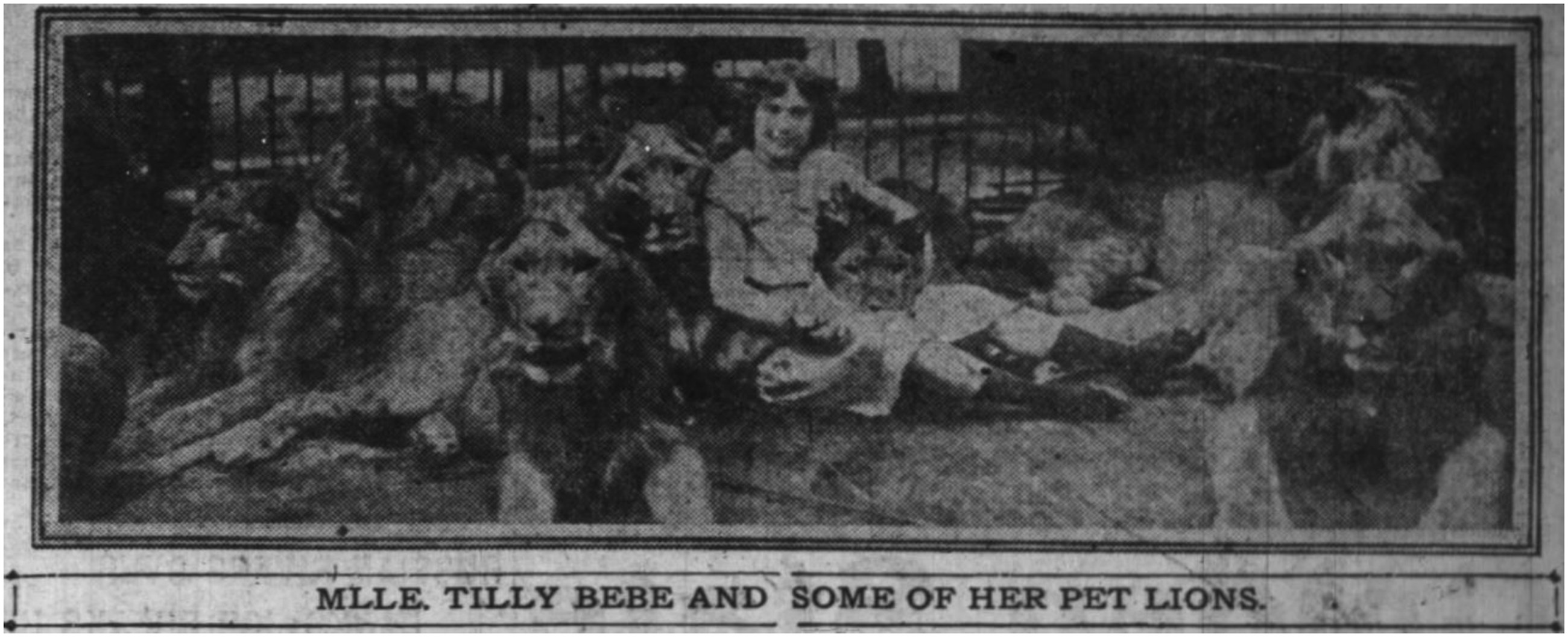
Embodying the modern turn in popular entertainment, she was among the truly international stars whose circus acts broke into the variety circuit around the turn of the century. Tilly’s time in Britain during 1902–1905 proved to be a particularly successful staging post in building that international career, before she went on to further success on the continent, including working in film. As she traversed Britain, she was received warmly by audiences and press critics, from the New Cross Empire in London in December 1902 (she had “a great reception”), west to Newport in Wales (a star turn, “one of the most wonderful ever witnessed”), back east to the Nottingham Empire (she was “chief amongst” the acts) and the Leicester Palace, (“First in the point of merit and novelty”), then north to Leeds in February 1903 (she was “the star turn” at The Palace). 78 In July 1903, she was at the Blackpool Alhambra as part of a tour with the company of celebrated showman and impresario Thomas Barrasford. By the time she came to Yarmouth later that same month, she was, in no uncertain terms, a rising star of variety theatre, reimagining a classic act for modern audiences. 79 The “lion queen” had been a circus staple since the 1850s, as Vanessa Toulmin has noted. 80 Tilly distinguished herself by doing what circus acts have long done and used her own body to shape a persona. Small in stature, she was able to inhabit the role of a child, and this opened an opportunity for her to develop an act that would be highly portable across national borders. British, European and American audiences could recognise the sentimental ideal of childhood innocence that she presented in the ring. The contrast between her small size and the muscular power of the lions created a sense of drama, but her success rested on the contrast between her sentimental innocence and their bestial ferocity. She claimed she had tamed her lions with kindness, and at various points she demonstrated her affection for the animals and had them nuzzle up to her, as though they were pet cats.
In Britain, the spectacle of a seemingly little girl entering a cage with twelve wild, “forest-bred” Asiatic lions in this way, lying down with them, or carrying them around in her arms, thrilled audiences and disarmed them at the same time. While the lions nuzzled her, and she made much of her affection for them, Tilly never let audiences lose sight of the danger. “At one moment they are amiable as kittens, at the next their claws are planted in your flesh,” she told The Daily Record and Mail. Still, while “Slight wounds and scratches are of almost daily occurrence,” they did not result in nearly as much pain as the time one of her lions closed its jaws on her while she still had her head in its mouth, she said. 81 Journalists also played up the sense of danger. Her “little rounded arms and bare neck are cruelly marked by the paws of her powerful pets,” The Leicester Daily Post reported in February 1903; “Tilly Bebe has had her arm ripped from shoulder to elbow” noted the Music Hall and Theatre Review in December 1904. 82 The Eastern Daily Press described Tilly Bébé’s opening performance at the Yarmouth Hippodrome in similar style: “It looks a daring thing when she holds a piece of meat by her teeth and allows a monster lion to take it in his massive jaws.” Accordingly, she received “a storm of applause.” 83 Adapting a classic circus act for the variety stage in this way, and establishing an international profile along the way, Tilly Bébé was a fitting headliner for the Yarmouth Hippodrome’s opening night. She typified the modern circus variety show that Gilbert and O’Brien were bringing forward.
In August, she was followed by Paul Spadoni, a German strongman and juggler whose act similarly updated traditional circus fare (Figure 5). He came to Britain after building a following across Europe, appearing in Paris in the 1890s before impressing audiences at the Blackpool Winter Gardens in the summer of 1900; his juggling “is all that can be desired,” one critical notice read.
84
By the time he appeared in Yarmouth at the end of August 1903, his act was world famous. There were elements of variety theatre, “gentleman juggling,” routines in which Spadoni would appearing on stage in a suit and work with familiar drawing-room objects: at Yarmouth, he juggled furniture and candelabras, matches and a cigar (which he was able to light in the air), and lifted a chair with his assistant sitting on it, before holding it above his head between his teeth, for example. He was best known for riding a horse and cart onto stage before proceeding to take it apart and juggle its wheels and chassis, a routine he included in his Yarmouth appearances. And yet there was an unmistakable connection to circus tradition. In fact, it was his cannon-ball juggling and cannon-ball catching that seems to have drawn the strongest reaction from the crowd at the Hippodrome. “The audience perceptibly shivered,” The Eastern Daily Press reported, “as these heavy weights threatened to crush Spadoni’s head.”
85
Music Hall and Theatre Review, September 9, 1904, 172.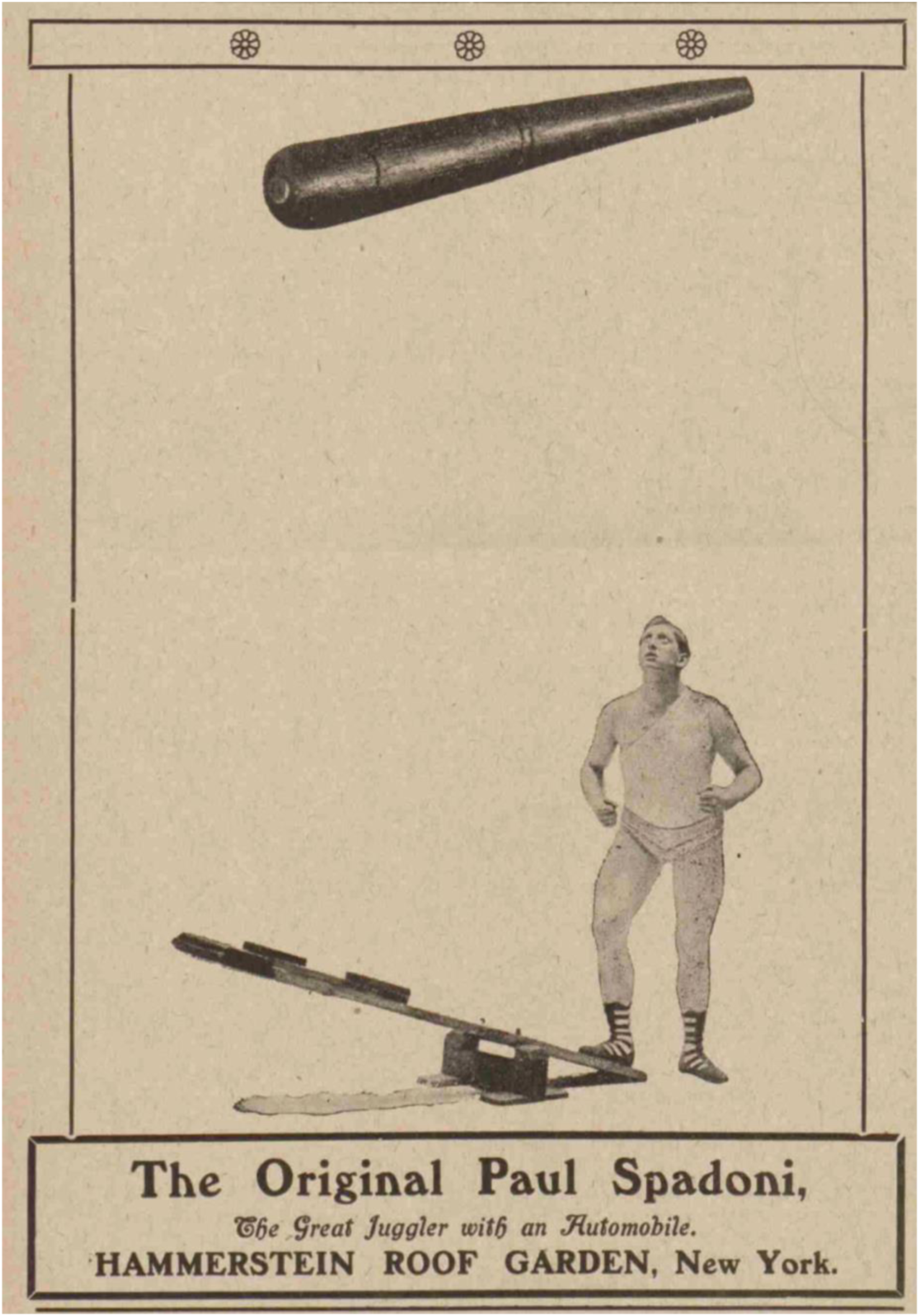
A different internationalism was brought to the Hippodrome by William Permane and his famous performing bears, one of the highlights of the Hippodrome’s opening season (Figure 6). While Permane had carved out a successful place in British circus and variety, he had earlier travelled widely across Europe, performing with some of the major stable circuses on the continent. By the 1890s, he had chalked up time at the Ciniselli Circus in St. Petersburg, the Circo Price in Madrid, and the Cirque d’Ete and d’Hiver in Paris.
86
There were many other examples of performers whose time on the British circuit punctuated tours overseas. Included among them, within the group of performers appearing at the Hippodrome in the summer of 1903, was Zertho the Clown and his performing dogs. A familiar face on the British variety circuit, he had long career that spanned continental Europe, Britain, and the USA.
87
The point is, these were international acts, part of a global culture, reshaping circus and variety, and meanwhile finding an outlet in Yarmouth, contributing to the reshaping of its identity as a seaside resort. William Permane’s performing bears in actions, The Sketch, January 4, 1899, 428.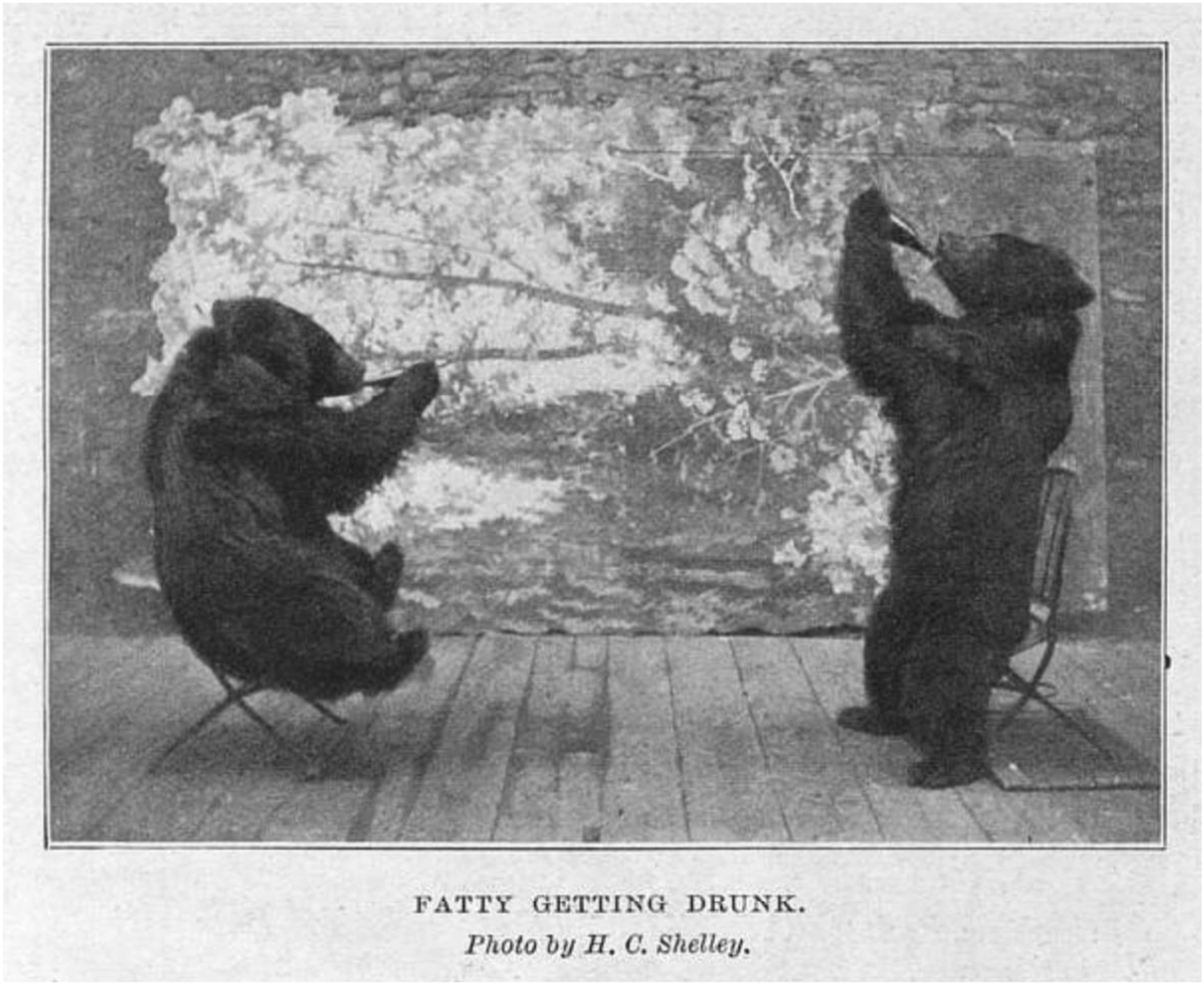
At the same time, there were other acts appearing at the Hippodrome that played up difference and ethnic otherness in order to appeal to audiences’ sense of curiosity about the exotic. As well as connecting Yarmouth to the international entertainment circuit, the Hippodrome presented audiences with performances that expressly represented different national or ethnic identities. The Mar-Ta-Fi troupe of Serbian acrobats, appearing at the Yarmouth Hippodrome in August 1903, had precisely this sort of appeal (Figure 7). Presenting as a father with his two sons, their act was by all accounts a fairly standard circus acrobatic routine, albeit one executed with notable skill and nerve. Still, they performed in national costume, or a jazzed-up version of it, with fez, embroidered waistcoat, and satin leggings. The Yarmouth Independent judged them to be “exceedingly clever, and their performance is well worth witnessing.”
88
The Yarmouth Mercury was certain “that nothing approaching it has ever before been seen in Yarmouth, and certainly should not be missed now that the opportunity is offered.”
89
Promotional postcard for the Mar-ta-fi acrobatic troupe, c1903.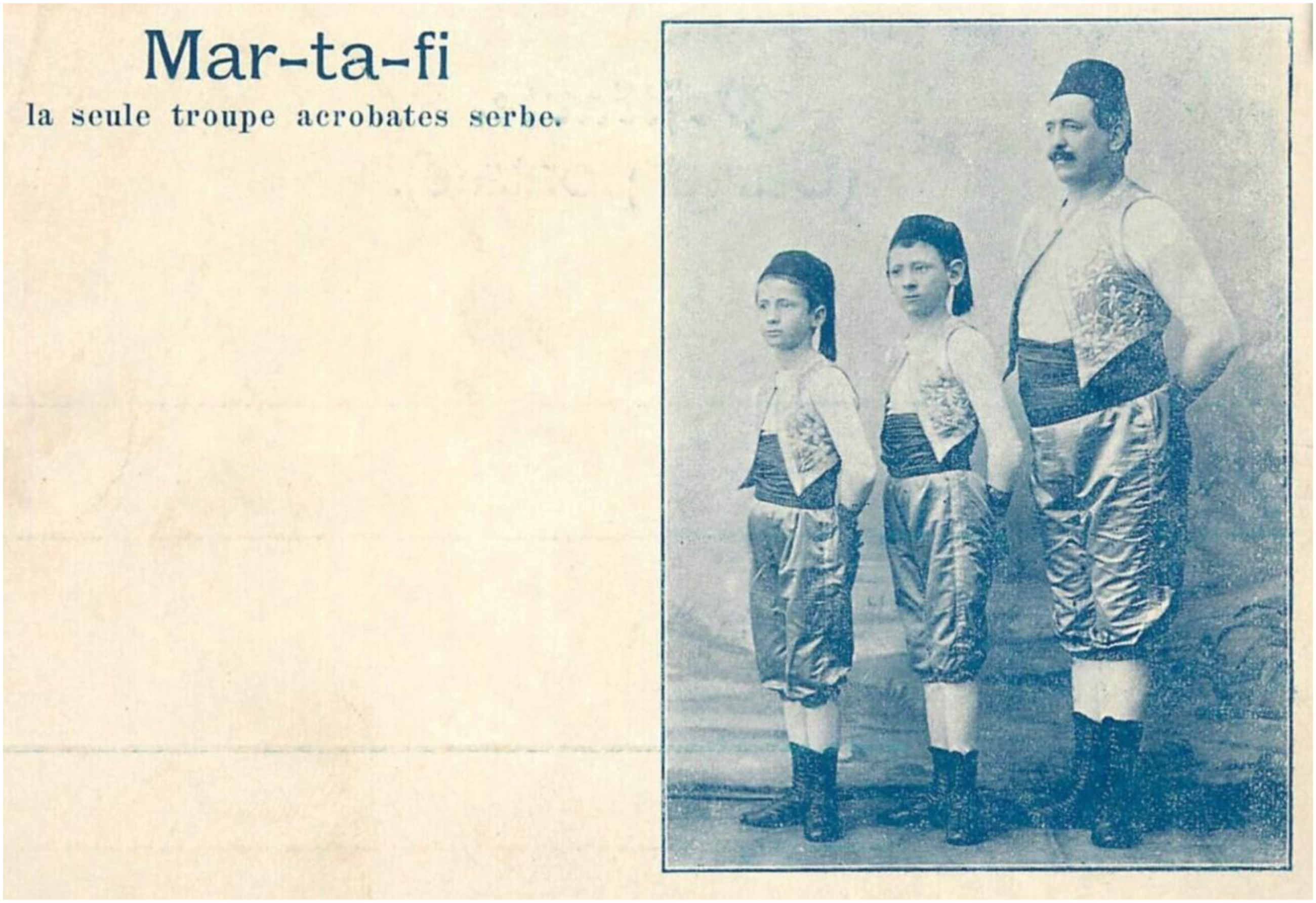
On the same bill, with similar exotic appeal, were the Azarahs, two acrobats billed as “Champion Arab Tumblers of the World” in the spring and summer of 1903 as they traced the British variety circuit; by the time they reached the Yarmouth Hippodrome in August, they appeared as “Sons of the Desert.” 90 Just as seaside architecture was often characterised by a “free embrace of Orientalism,” in Light and Chapman’s words, so too had circus and variety both long traded in exoticised ideas of “the Orient.” 91 As M. Keith Booker and Isra Daraiseh have argued, the orientalism of many acts was emblematic of “the global reach of the circus” and “played a key role in shaping audience tastes for the strange and the exotic and for categorizing certain cultures of the world as fitting in those categories.” 92 At the Hippodrome it seems the Azarahs were received as talented acrobats first and foremost. The Yarmouth Independent was again impressed, praising their “marvellous tricks” including “a kind of spinning movement that is entirely new in acrobatics, and was accomplished for the first time in Yarmouth.” 93 Still, alongside the impressive spectacle, audiences were clearly being enticed by the promise of something avowedly exotic and a fleeting glimpse of another culture. 94
Likewise, Pablo Diaz, a contortionist and aerialist, acquired his reputation in Britain as “The Cuban Wonder” (Figure 8). He made his name in New York in the 1890s before touring Europe and making his debut appearance in London at the Palace on Shaftesbury Avenue in March 1897. He was known then as “the Human Serpent” or “the Flying Serpent,” complete with a bodysuit that mimicked glittering scales; he seemed “perfectly boneless” according to one reviewer.
95
An emerging star of the variety stage, Pearson’s published an extensive photoshoot of his act in May 1897, showing Diaz in all sorts of improbable poses.
96
Audiences remained astounded by his extraordinary feats, but it apparently suited him to give his billing a slightly different emphasis, and by April 1897 he was trying out “the Cuban Wonder”—a name he would continue to use through to his appearance in Yarmouth 6 years later.
97
Pablo Diaz in Pearson’s Magazine, May 1897, 574.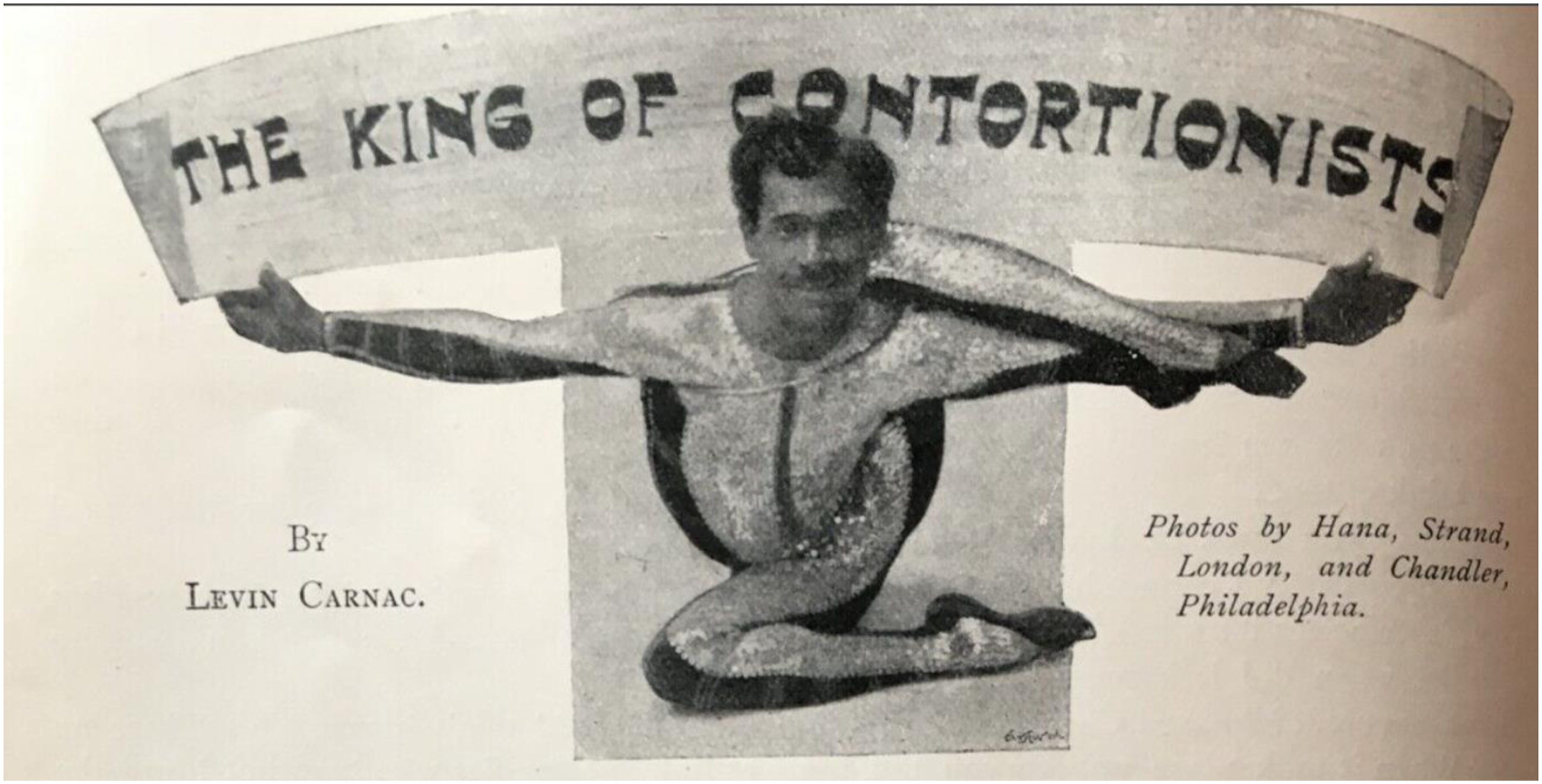
Of course, there were significant ambiguities to these performances of exotic otherness. As Malte Gasche and Laurence Prempain have argued: “Labelled as ‘exotic’, circus people’s performances, either authentic or fabricated, enabled them to open a window onto other cultures. While such show acts could initiate dreams or increase personal longings, circus performers and show acts also could unwittingly serve to substantiate existing prejudices and pejorative conceptions.” 98 Still, in their own way, these Hippodrome acts billed as exotic or given ethnic identifiers challenged Great Yarmouth audiences to reconcile their evident skill with the conventional tropes of British imperialism. Newspaper reviews typically emphasised their nerve, cleverness, skill, and discipline, the very qualities that were so often attributed vaingloriously to British national character. Even as a stable circus that pursued respectability, established as a seaside circus within the town community, the Hippodrome could be essentially subversive in this respect.
That subversive quality was perhaps best illustrated by another of the acts appearing in the opening season: the Elysian Troupe, a group that was unambiguously a crossover from the variety stage. Billed as a “coloured” quartet from the USA, the Elysian Troupe were part of a new wave of black entertainers breaking into the British variety circuit and overturning expectations about music, race, and seaside entertainment by reinterpreting the tradition of minstrelsy. Almost as soon as American blackface minstrelsy arrived in Britain in 1836, when Thomas Dartmouth Rice brought his Jim Crow character to the London stage, its peculiar grip on British popular culture was especially visible at the seaside. As Michael Pickering has described, “Blacked-up buskers and troupes had started taking to the sands from at least the 1860s. Even as early as 1840, a minstrel troupe appeared at Eastbourne […] Blackface minstrels and buskers remained a staple seaside item until the second World War.” 99 Great Yarmouth, in particular, had developed a particular reputation for minstrelsy by the 1880s, hosting a “Minstrel Ring” on the seafront near to the Hippodrome. 100 After touring East Anglia for his book Poppyland (1886), Clement Scott declared the town “the veritable home of music hall minstrelsy.” 101 Blackface performers made up a large part of the “ceaseless entertainments” on offer along the Yarmouth seafront, vying for trade with other “peripatetic vocalists, gipsies [sic], gymnasts, and conjurors” in the 1890s, according to Annie Berlyn. 102 Woven into the fabric of British entertainment culture at the seaside, minstrel shows regularly made it onto the Yarmouth Hippodrome’s bill at various points before World War I. 103 Their inclusion was indicative of the approach Gilbert and O’Brien took to programming, as they brought traditional circus, music hall, variety, and seaside entertainment acts together under one roof.
Yet, in their first season, they also booked the Elysian Troupe—“a quartette of American colored vocalists and musicians,” as they were described by the Music Hall and Theatre Review—and thus put Great Yarmouth at the cutting edge of an international popular music culture.
104
Before arriving at the Hippodrome, the Elysian Troupe had blazed a trail around Britain, as numerous press reports of their performances around the country recorded. In December 1902, they played in Edinburgh to positive reviews before going on tours nationwide.
105
For Lloyd’s Weekly News, they quickly won audiences over with an adaptation of the familiar, what it described as their “reproduction of an old darkie chorus,” in the minstrel tradition.
106
But the journey they were making from minstrelsy to something perhaps more recognisable to modern audiences was implied in the Dundee Evening Telegraph’s description of their act as “refined minstrelsy.” Incorporating guitar and mandolin among other instruments, they seem to have used only “touches of humour,” and otherwise won plaudits for their musicianship.
107
In fact, descriptions of their act very consistently referred to them in the respectful language of the time as “coloured” musicians, instrumentalists, and singers, distinguishing them from the minstrel shows more routinely described using racist epithets. Even before they appeared at the Yarmouth Hippodrome, they had gained an enthusiastic following across the country, and were in high demand. When the new Dundee Gaiety theatre opened its doors for the first time in April 1903, it was the Elysian Troupe who were asked to lead the 1,500-strong audience in the singing of the national anthem on the inaugural night under electric lights.
108
When they performed at the Hippodrome in late August, local reviewers singled them out for detailed praise, highlighting their popularity with Great Yarmouth audiences and providing a detailed sense of their diverse act: The Elysian troupe of coloured instrumentalists and humorists found it difficult to leave the ring at their first appearance yesterday, so emphatic was the encore following their turn. There are four genuine sons of the South in the troupe, all of them being good vocalists, and a quartet sung by them, descriptive of a scene “Down South,” was rapturously received. Their accomplishments are not limited to quartet singing, the troupe giving a beautiful performance on graduated tube-bells of organ-like quality, besides playing other instruments.
109
The Yarmouth Mercury was equally full of praise: “The singing of the quartette is extremely good, while their performances on tube bells are remarkably clever.” 110 As Thomas Riis has described, this was the moment that English audiences began to demonstrate a “recognition of the black entertainer as a new and special force on the world stage,” and, against the pejorative backdrop of Yarmouth’s minstrel scene, the Hippodrome provided a space where international Black artists could carve out a space for themselves to present an alternative musical culture—to much local acclaim. 111
Amid the patriotic jingoism of the Edwardian Age, it is perhaps especially significant that a good many British performers chose to adopt a stage identity that confused, confounded, or disavowed their national identity. Andrew Wisby from Hackney thus became Fred Attilla of the famous Attilla Brothers strongman act. Said to have “the physique of a gorilla,” he performed feats of weightlifting that so impressed Gilbert when they played at his circus show at Norwich Agricultural Hall in February 1903 that he booked them to return for the first season of the Yarmouth Hippodrome later in the year. Billed as “World-famed Athletes and Strongmen,” and at times “Modern Gladiators,” they began their act by posing to display their muscles, and often incorporated wrestling into the show. It was undoubtedly their weightlifting that most impressed, though. Working with 165lb barbells and a colossal 325lb spiked barbell, one brother would climb upon the other while lifting these weights. 112 Their stage identities obscured their origins, and The Dundee Evening Telegraph was content to take the bait. The brothers’ “statuesque performance gives an idea of the old Roman in their conquering days,” it declared. 113
For Ernest Beresford from Newcastle-under-Lyme, it was possible to find fame and fortune as Dartigan—rival to Diavolo, the American daredevil cyclist Robert B Vandervoort who made his name by doing a loop-the-loop on his bicycle. Beresford’s stage name vaguely implied he was French, perhaps, which was fitting for a bicycle act. That said, he was happy to leave the mystique of the name to stand by itself because he was billed as an expressly English act, in fact. He claimed to be “the only Englishman who has ever attempted this startling feat” of loop-the-loop. 114 He quickly established himself as a big attraction and came to the Yarmouth Hippodrome in September 1903 after a successful spell in Blackpool. 115 Sadly, the Yarmouth audience had to be content with just a glimpse of his daredevil routine, during which he was said to careen around the looping track at incredible speeds of up to 45 miles per hour. After a successful run on the Monday, he had a spectacular mishap on the Tuesday after the track gave way and he crashed to the ground, prompting shrieks from the audience. The Yarmouth Mercury reported that one shocked audience member called out in an “indignant and excited voice […] ‘Such things ought not to be allowed’.” 116 Although concussed, and carried from the arena with a bloodied face, The Yarmouth Independent was happy to report he recovered well, ascribing this to his wise precaution of wearing a padded cap. 117 In one sense Dartigan lived up to his billing as “Something Startling! Perilous! Daring!” 118 Still, Gilbert thought better of it and decided to discontinue the act, perhaps seeking to forestall potential complaints about issues of health and safety and the Hippodrome. 119 Dartigan resumed his antics shortly thereafter at other venues, suffering another spectacular smash at the Leeds Coliseum later in the year, although he suffered no serious injury and, apparently, did not let it dampen his enthusiasm. 120 A homegrown daredevil, Dartigan successfully developed a stage persona that both disavowed and embraced his Englishness. Circus had a place for ambiguity of this sort, of course. And in this regard, he was a significant addition to the programme for the opening season, even if he was unable to complete his full six-day run. In a changing Edwardian society, emerging from Victorian austerity, he encouraged a spirit of frivolous thrill-seeking, and announced that the English could be daredevils too. Perhaps more importantly, he signalled to audiences that English people could be part of this cosmopolitan, international community of circus performance—and that Englishness, like the Great Yarmouth seafront, could be indelibly altered by the presence of the circus. In this, seaside circus amplified what John Walton has described as the “liminal” quality of the seaside experience, “where the usual constraints on respectability and decorum in public behaviour might be pushed aside in the interests of holiday hedonism, and of carnivalesque escape from the petty restrictions of everyday life.” 121
Importantly, just as the Hippodrome connected Yarmouth to a global entertainment culture, so Gilbert and O’Brien remained meaningfully integrated into the local community of this port and fishing town. Their seaside circus looked both outward and inward, to Yarmouth’s future as a major tourist resort without losing sight of its maritime working life. One small moment exemplified the ways in which the international performance culture of the Hippodrome developed in its seaside setting. As part of Gilbert’s philanthropic campaign to help the victims of the New Skylark, Canadian log-roller Leonard F. Durrell broke out of the containment of the Hippodrome, blurring the lines between the local and the global (Figure 9). On the mornings of September 7 and 8, he transferred his log-rolling act directly into the sea for two charitable performances. “Thousands of people collected on the Jetty and along the shore to witness the event,” the Eastern Evening News reported, “and a liberal response was given to the collection on behalf of the Yarmouth Disaster Fund.”
122
Very literally, Durrell’s performance provided Great Yarmouth’s residents, whether local or temporary, with a display of international circus skill at the seaside that directly benefited the town’s maritime community. Leonard Durrell, one of the stars of the Hippodrome’s opening season, still log-rolling in 1907: The Bystander, August 28, 1907, 460.
123
Conclusion
When Gilbert and O’Brien’s extraordinarily successful debut season came to a close in October 1903, their seaside circus had already carved out an important role in civic life while bringing a distinctive international dimension to the town’s tourist offering. This was not inevitable. The Hippodrome had opened in a moment of multiple reinventions. Great Yarmouth, like many British coastal resorts at this time, was undergoing a vital phase of development at the turn of the twentieth century. There were new buildings, new transport links, and new civic ambitions. Meanwhile, the entertainment business was in transition. Circuses were in competition with music hall and variety theatre, and increasingly cinema too. Adapting to those multiple demands, George Gilbert and Jennie O’Brien managed to shape a circus that would sit at the heart of Great Yarmouth’s development as a coastal resort in the coming decades. George Gilbert died in 1915; Jennie O’Brien continued to manage the establishment until her death in 1924; but through years of change in both seaside and circus cultures, their legacy abides. Herbert Tinkler prefaced his pioneering, unpublished history of the Hippodrome with a wish that, to date, has been granted: “It is to be hoped that there will always be Circus as the Hippodrome.” 124
While very few seaside circuses have proved so resilient, it is nevertheless true that the Great Yarmouth Hippodrome, while exceptional in its longevity, is an exemplar of a much wider lost culture of circus at the British seaside—a neglected but clearly significant conjunction of entertainment forms. The Hippodrome is well served by excellent archival records documenting its history, including the UEA’s Tinkler and Williams Theatre Collection. But ranging across the British Isles, the rich lives of similarly distinctive seaside circus establishments can also be reconstructed through both specialist and regional press. Recovering that broader history may do much to shift our sense of the cultural heritage of these spaces. The British seaside, to use Madeleine Bunting’s term, has often been linked to “a felt sense of Englishness,” one that has frequently been used to foster nostalgic, hermetic and even xenophobic visions of national identity—both in the late nineteenth century and today. 125 As Bunting highlights, Great Yarmouth and other similarly “precarious edges” of the country returned “huge majorities in favour of Brexit” (as well witnessing ongoing moments of racial hostility direct towards a large and established immigrant community). 126 Yet as Daniel Burdsey has also powerfully highlighted: “Coastal spaces have been diverse and inclusive during distinct periods, historically and globally, but have then taken on, or been preceded by, a contrasting role within emergent politics and practices of racial segregation.” 127 Writing the Hippodrome’s early history back into our sense of Yarmouth as a place allows us to tell other seaside stories: ones in which Gilbert and O’Brien’s permanent circus brought a diverse cast of international artists to this apparently marginal and provincial town, carving out a deeply cosmopolitan, multicultural, carnivalesque space in the heart of a coastal space that was—and is—already far more global than nostalgic and parochial narratives of the English seaside’s past have often suggested.
At a time of economic challenge for seaside communities, marked by a sense of cultural disorientation that has found political expression in moments like Brexit, the Hippodrome’s local and transcultural heritage is therefore an important demonstration of the diverse histories that remain to be recovered at the seaside. Its rich story cuts across narrow visions of seaside life, then and now. And those legacies continue, too. International circus artists still travel to Great Yarmouth to perform at the Hippodrome, and the town’s international circus culture is burgeoning in other ways. Great Yarmouth is also home to Out There Arts, a circus and outdoor arts organisation who run community events and festivals while pursuing their goal of “developing the town as an International Centre of Excellence for circus and street arts creation, training and delivery.” 128 There are, therefore, profound contemporary connections to be made to the forgotten heritage of circuses, like the Hippodrome, that took a creative approach to the evolution of popular entertainment on the British coastline and combined local ambition with a global outlook to shape a circus for the seaside.
Footnotes
Declaration of conflicting interests
The author(s) declared no potential conflicts of interest with respect to the research, authorship, and/or publication of this article.
Funding
The author(s) received no financial support for the research, authorship, and/or publication of this article.
