



Abstract
Our paper contributes to the broader coastal studies literature, proposing a methodology and methods that can enhance young people’s participation in research and policymaking. Framed by the emerging concept of child-friendly blue urbanism and founded on principles of attentiveness and context-responsiveness it sets out a novel approach that foregrounds young people’s contributions as co-researchers, and their lives as embodied and intimately connected to the social and physical fabric of the coast. Drawing on our original research with young people in a small, English coastal town, we explore how a unique focus on children’s emplaced lives offers creative opportunities that can enhance young people’s participation. Logistical and ethical challenges about how to safely navigate and safeguard children in a spatially remote, seasonally reliant seaside location were particularly salient. We discuss how the resulting walking tours, intergenerational postcard exchange, animation and booklet emerged through this process of co-creation and solution building with young people, enabling them to express their views and influence community dialogue. In setting out our distinctive attentive, context-responsive approach we critically explore the unique challenges and creative opportunities emerging from researching with young people in coastal contexts and their potential to realise the ambitions of child-friendly blue urbanism.
Introduction
This paper critically reflects on our experiences as researchers engaged in participatory research with young people in a small coastal town in the East Midlands. We examine the material and cultural influence of place and the development of a participatory methodology for understanding young people’s experiences of growing up in a seaside town. Through this, we aim to augment Andal’s 1 concept of child-friendly blue urbanism, offering a methodology, methods and practical tools to mobilise young people’s voices within coastal communities. We emphasise the importance of aligning methods with the distinctive characteristics of coastal communities, providing examples from our research to illustrate the potential for meaningful engagement and shared sense of belonging that can benefit young people and the broader community.
The research was part of the Children’s Lives in Changing Places (CHiLL) study, a national project co-researching with young people in three economically disadvantaged neighbourhoods in England. 2 This national study aimed to understand what it meant for young people aged 10–15 to grow up in economically disadvantaged neighbourhoods through understanding their experiences of using public space and the extent to which they were able to participate in local decision-making in their communities. The research site of Mablethorpe, a small seaside town on the Lincolnshire coast in the East Midlands, is characterised by geographical isolation, limited public transport and economic dependence upon seasonal and declining tourism, necessitating an approach that is respectful and responsive to its distinct social and geographical context and heritage.
Our project sought to place young people at the centre of research to understand what matters to them about where they live, what factors support and challenge them to flourish and how they can be actively engaged in local decision-making. It is beyond the scope of this paper to fully articulate the substantive findings regarding these research objectives. Rather, this paper shares insights about how we researched with young people in contexts of coastal child poverty and disadvantage, spatial and intergenerational inequality and young people’s absence in regional and national policymaking. In doing so, we consider how our emerging understanding about the particularities of growing up in this specific coastal town was used to develop a bespoke and context-responsive set of research methods, and how the challenges of deploying these methods with young people in this coastal environment provided further opportunity to enhance our place-based understanding of their lives.
Building on Andal’s 3 advocacy for child-friendly blue urbanism which recognises the centrality of the coast in shaping the lives of young people and prioritises their universal rights to be included in local planning and decision-making, 4 we consider the methodology and methods needed to enable such an approach in order to address the participation deficit for young people. Framed by an “attentive” 5 and care-full participatory methodology our approach foregrounds young people’s contributions as co-researchers and change makers and their capabilities as social actors, invested in their communities. 6 It offers a framework for adapting and repurposing creative methods that are context-responsive 7 to reposition young people in coastal environments at the centre of knowledge generation, dialogue and change.
Following an outline of the research background and theoretical framework, the paper discusses our context-responsive methodology illustrated by two examples. The first showcases the use of mobile methods to explore young people’s place-based experiences whilst considering the implications of seasonal changes in coastal environments. The second explores how we responded to safeguarding issues arising from the coastal town’s tourist-reliant economy. Collectively, this paper provides a methodological framework to mobilise child-friendly blue urbanism from theory to practice and highlights the significance of context-responsive approaches to understanding the experiences of young people growing up in coastal communities while enabling them as changemakers to actively shape blue urban environments.
Background to the Research
Our study was undertaken from 2022 to 2024, a period which covered the final 2 years of a UK Conservative government, at the tail-end of the Covid-19 pandemic and the global economic crisis. This period saw increased child poverty 8 and widening socio-economic inequalities perpetuated by a hostile political economy. 9 The austerity agenda of 2010 resulted in over £30 billion in spending reductions to welfare payments, housing subsidies and social services, leaving poorer children and families at extreme vulnerability to financial stress and pushing more children into poverty. 10 This exacerbated existing regional inequalities along the English coast, 11 where decades of declining tourism, fishing and manufacturing 12 had already exposed these communities to multiple intersecting disadvantages. 13
We are keen to heed the cautions in the literature 14 not to homogenise coastal locations as deprived communities or as terrible places to grow up, given their considerable diversity (in size, geography, history, population demographics, economy, levels of affluence/deprivation, and local governance structures, for example) and we highlight the value of adopting a more contextualised, place-based approach. Local neighbourhoods are vital for young people’s quality of life and life chances, 15 with a sense of belonging and access to safe spaces in nature widely understood as markers of child-friendly neighbourhoods. 16 There is evidence of the potential physical and mental health benefits of exposure to outdoor blue spaces and living in proximity to the coast 17 as well as how the sea forms important, strong identities of place within the childhood memories of those growing up on the coast, even if they eventually move away.
Notwithstanding this, children and young people growing up in disadvantaged coastal communities in the UK are more likely to experience social and economic deprivation and exclusion as a consequence of seasonal labour markets, precarious and below average salaries, reduced social mobility, poor transport links, poor quality and lack of affordable housing and reduced access to education and public services. 18 They are overexposed to higher levels of poverty, experience lower educational attainment and poorer health outcomes than children from neighbouring settlements just a few miles inland within the same region. 19
The provision of dedicated services and the opportunities open to young people are also impacted by the spatial realities of living on the coast, as powerfully described by Reid and Westergaard: 20
Thus, whereas young people located within inner city areas have a 360 degree outlook, those in coastal towns are restricted to a 180 degree perspective, with the sea ahead – offering limited opportunities for employment – and the land behind (which is rural in nature).
English coastal towns tend to experience high in-migration of retirees, and out-migration of young people seeking opportunities, resulting in an ageing demography where children and young people constitute a small minority. Whilst further inland, services could be located to cater for children and young people from 360 degrees of communities around the service, coastal towns have access to only 180 degrees of communities around them, which impacts the viability of locating schools and other services along the coast, leaving children and young people more vulnerable to harms outside the home. 21 Coastal towns in the UK have become magnets for County Lines drug networks, the criminal exploitation of children, and their trafficking within the UK as part of the supply of substances from trap houses. 22
In policy terms therefore, coastal towns have been characterised as “left behind” and the target of national policies designed to catalyse economic growth and opportunity. The previous Conservative UK government’s “Levelling Up” agenda, launched in 2019 to re-distribute social and economic prosperity more evenly across the UK, 23 replaced a number of separate local development funding frameworks, including the High Street Fund and Coastal Communities Fund. 24 However, Levelling Up was widely criticised for its failure to engage with the root causes of regional inequality and to include local communities in planning and decision-making on the use of funds. 25 This is despite the Government’s own mission to radically improve policymaking through “people-centred” lived-experience informed policymaking. 26 Complex three-tier local governance structures have been identified as particularly unwieldy when it comes to channelling Levelling Up funding into addressing the complex overlapping and competing challenges present in coastal communities. 27 Levelling Up is nonetheless continued in the new Labour Government’s “Plan for Neighbourhoods,” a £1.5 billion programme, investing in seventy-five local authorities and communities to “ensure no one is left behind (and that) people can meet their full potential.” 28 While there have been commitments to end the “Hunger Games” style competition between local authorities for accessing the funding, 29 the details of how this is to be implemented including how communities, and young people, will be involved has, at the time of writing, yet to be realised.
Young people 30 remain overlooked in policymaking that impacts their lives and prospects. 31 Failure to include young people in decision-making ignores their capabilities, 32 reinforces their marginality and perpetuates intergenerational disadvantage – the systemic disparities in the distribution of economic resources and political power between adults and young people. 33 While young people are often positioned as disillusioned with formal party-political structures and systems, they remain engaged in everyday micro-politics and are motivated to contribute to local decision-making where they feel they have greater efficacy to effect change. 34 Yet, they frequently face structural barriers in the form of youth-unfriendly logistics. These include hierarchical decision-making structures, lack of training or support, adult-selected consultation topics, long timescales in policymaking, lack of recognition of young people’s hard work, 35 as well as tokenistic engagement with young people’s recommendations, which can lead them to feel that their views don’t count. 36 In the next section we present a framework for inclusive research and policy-engagement with young people in coastal communities, informed by a child-friendly blue urbanism.
Theoretical Framing: Child-Friendly Blue Urbanism, Children’s Rights and Care Ethics
Our approach is framed by Andal’s advocacy for child-friendly blue urbanism which recognises children’s rights to participate in policy and decision-making, foregrounding the uniqueness of their experiences and the particularities of growing up in coastal communities. This requires a complex understanding of “the layers of connection between children and blue spaces” 37 to fully appreciate how young people are rooted in place, the affordances and challenges of the coast for young people and how they themselves are involved in caring for coastal environments. As such, Kjørholt et al. 38 highlight how childhood identities in coastal settings are shaped relationally across generations and through encounters with natural and built landscapes. This dialectic between natural and non-natural features of the coast is central to discussions of place attachment, belonging and identity. Other studies also underline the role of young people as key contributors to sustaining coastal livelihoods, 39 while showing how their encounters with the coast carry moral, emotional and symbolic weight that shapes their sense of citizenship 40 and responsibility for safeguarding and shaping blue urban environments. 41
The “child-friendly” element of child-friendly blue urbanism provides a framework for the prioritisation of young people’ experiences of growing up in their communities, to map their needs and strengthen their capabilities as rights-bearing citizens. Andal, rightly, cautions against relying on “experts” to speak on behalf of young people and calls for young people’s voices to be centred within local decision-making. She argues that positioning young people as authorities on their own lives, bringing them into the processes of coastal planning and ocean governance, provides opportunities to consider how young people’s needs are/are not being met and to realign coastal resources to ensure their needs are duly considered.
Our work builds on this recognition of children’s universal rights to participate in decision-making, 42 deploying a “Capabilities Approach” 43 premised upon young people as active citizens, invested in their local area, and recognising their capabilities “to exercise reasoning about what they value and to express their point of view and priorities.” 44 Rather than seeing young people as “separate entities,” 45 they are valued for their capacity to positively influence their own lives and the lives of others around them. 46 However, whilst Andal advocates for the need to consider young people’s experiences and to bring them into dialogue with decision-makers, she does not explore the methodologies and methods required to achieve this. In this paper we attend to this, setting out a model, developed with young people, to enable them to be included as change-makers in coastal research and policymaking.
Designing for context-responsiveness requires attention to dynamically configured interactional situations, and deciding on tools, artefacts, processes and activities that can intervene meaningfully to spur the creation of new contexts and engender different patterns of response. 47 We deployed a context-responsive approach to guide the development of our methodology in response to our interactions with our young co-researchers, adult stakeholders and evolving local conditions, including the seasonal dynamics of the coastal site. This approach required us to remain critically attuned to how the specificities of the coastal context shaped young people’s perspectives and preferences, and the implementation of the project. Central to this process was our commitment to feminist care ethics, 48 which replaces more directive forms of data extraction done to young people with slower, care-full approaches, prioritising attentiveness to young people’s rhythms, pace and ways of being and knowing. 49 Being in place with young people opened up opportunities to notice the interdependence between young people and places, how they are intimately connected to, and care both for and about the social and physical landscape of the coast.
Whilst the concept of “care” is ambiguous and has been subject to diverse interpretations, we value the definition provided by Fisher et al.
50
for its emphasis on the interdependence of humans and their environments: On the most general level, we suggest that caring be viewed as a species activity that includes everything that we do to maintain, continue and repair our “world” so that we can live in it as well as possible. That world includes our bodies, ourselves, and our environment, all of which we seek to interweave into a complex, life-sustaining web.
The emerging blue urbanism literature has highlighted human interdependency with oceans and other bodies of water for life, 51 with blue spaces identified as landscapes of care, embedded with opportunities for relational connections which go beyond care for water environments and also involve “a process of becoming aware of oneself as well as (non)human others.” 52 Kullman’s 53 account of children’s “everyday pavements” frames children and young people as skilled urban carers, attentive to maintaining public spaces but also fostering relational connections within their communities. A child-friendly blue urbanism therefore must understand how young people are positioned within these landscapes (and seascapes) of care, their experiences within them, and their contributions to care-taking, not just being cared for. The following section offers our reflections on the research site, in response to which we developed and refined our contextually sensitive methods for the study.
Understanding Context: The Research Site
Mablethorpe is a small seaside town in the East Lindsey District Council area of Lincolnshire, known for its Blue Flag award-winning sandy beaches. 54 This image contrasts sharply with the lived reality of many residents as the town is considered among one of the 10% most deprived areas in England. 55 It has a reduced labour force with only 34% of its population classed as economically active compared to a national average of 75% 56 and a deeply embedded reliance on a seasonal tourism economy. The socio-economic vulnerabilities of towns like Mablethorpe were further exposed in the aftermath of the pandemic when, alongside neighbouring Skegness, they were identified as the most deprived towns in England due to the impact of Covid-19. 57
Mablethorpe’s geographical location outside national public transport infrastructure contributes to the town’s isolation and decline. The town lost its rail service in 1970 as part of the so-called “Beeching Axe” 58 during the restructuring of the nationalised railway services. It has since had limited public transport links to the nearest cities and better-connected towns. For young people, this structural isolation is exacerbated by the 2017 closure of the town’s secondary school, following declining enrolment and institutional underperformance. 59 Subsequently, young people have been dispersed across multiple secondary schools in surrounding towns, requiring a commute of around 90 minutes round trip, leaving them highly dependent upon the school bus service. This limits their capacity to participate in extracurricular activities at school and the time available for local peer-to-peer social and community activities.
Demographically, Mablethorpe reflects broader patterns of ageing in UK coastal towns. With over 39% of residents aged 65 and over, more than double the national average (19%), 60 and only 7% under the age of 18, the area has increasingly oriented policy and infrastructure toward its older population. Since 2019, the district has pursued an Age-Friendly Community agenda, aiming to create environments conducive to ageing well. 61 While this focus addresses a clear need, this overarching emphasis on ageing may contribute to limited engagement with young people, overlooking their needs for child and young person accessible services, infrastructure and spaces. This persists despite existing and emerging commendable efforts from community workers and grassroots organisations who support young people’s daily lives at the micro level. In addition to an age-friendly agenda, the prioritisation of the tourism-driven economy also curtails opportunities for young people’s access to spaces for socialisation and physical activity along the beach and seafront. Infrastructure and services are frequently designed for visitors rather than permanent residents, and young people’s informal presence in commercial spaces, such as arcades, has sometimes been reported as disruptive. Yet these spaces are among the few warm, safe, and illuminated places available to them after dark. As Andal 62 argues, the commercialisation of coastal or “blue” spaces frequently displaces children’s rights to occupy such space.
Against this socio-economic backdrop, the UK Government’s Towns Fund brought a promise of transformation. In 2021, Mablethorpe and Skegness were awarded a combined £48.4 million in Town Deal funding to “respond to local challenges with transformational projects.” 63 Projects included a new leisure and learning centre with a swimming pool, a health and wellbeing hub, high street renovations, and a planned Mobility Hub to improve local transport access. 64 Community engagement was a formal requirement of the award, offering a valuable opportunity to involve local residents, businesses, and organisations in shaping future developments. In Mablethorpe, engagement efforts included street-level consultations and the use of the online “My Town Portal.” 65 Whilst consultation targeted the community at large, young people in Mablethorpe were not specifically engaged or invited to contribute their perspectives, with tangible consequences. Early in our research, it became clear that young people felt excluded from the town’s development initiatives, lacked a sense of ownership over the projects and perceived the regeneration efforts as being primarily designed for older residents. One 11-year-old co-researcher reflected: “You couldn’t see children in the [building site promotional] banners—it’s not for us.”
Mablethorpe reflects the tensions inherent in coastal regeneration about how to address longstanding structural challenges in ways that are equitable for different demographics, needs and interests. The Towns Fund investment offered a moment of possibility for residents to shape the future of their town. However, the limited engagement with young people highlighted a broader trend in which young voices are undervalued in shaping the future of their communities. Despite vibrant, committed efforts at the community level, policy interventions remain largely adult-centric. A truly context-responsive approach to regeneration must centre young voices, to ensure that investments are inclusive and support young people in imagining and shaping futures within, and as part of their communities. Addressing such gaps requires methodological approaches that position young people as active participants in regeneration. This underscores the value of context-responsive participatory methods to recognise and respond to the relational nature of their lived experiences within coastal communities, which we now go on to explore.
Context-Responsive Participatory Methods
Our study draws on participatory approaches for researching children’s experiences of urban environments developed by Lynch 66 and more recent advances in Participatory Action Research (PAR), 67 Children’s Geographies 68 and Childhood and Youth Studies. 69 Our approach is premised on the active involvement of children and young people in documenting and reflecting on their experiences and identifying actions and priorities for change. It develops approaches that seek to centre children and young people through co-producing methods with them. Our approach is about more than being flexible and offering choice, it is a deeply relational practice that requires researchers to be attentive to young people’s ways of being, both within the research space and within their wider communities. It requires researchers to think carefully about the power dynamics that exist between children, young people, researchers and the wider hierarchical structures that shape their lives and opportunities. 70
Across the three research sites in the wider study, we engaged with fifty-four young people as co-researchers, deploying this attentive and context-responsive approach in order to collaboratively adapt and develop our suite of creative methods, leading to different and distinctive methods used in each site. The project was designed to unfold across three iterative phases of research activity, between September 2022 and October 2024:
Understanding young people’s experiences of place.
Researching peer and adult perspectives.
Community dialogue and mobilising local knowledge.
In this section, we reflect on our experiences of researching with children and young people in Mablethorpe to illustrate how they can be centred in co-production while being attentive to how their participation is shaped by the dynamic geographic and socio-economic conditions of their coastal community. We set out our context-responsive approach in which we developed a range of creative methods in direct response to the challenges arising out of the remote and isolated location, coastal climate and seasonality, and safeguarding issues unique to coastal communities. We also explore how our efforts to adapt our methods to the context provided further opportunities for reflection on the adaptations that young people make in their everyday lives growing up on the coast.
Accessing young people aged 10–15 proved challenging from the outset, and we were dependent upon local services as gatekeepers. With no secondary school in the town, and limited after-school activities or youth clubs, access to older age groups was even more difficult. Despite these constraints, we successfully engaged two distinct groups of young co-researchers, who are pseudonymised in this paper:
(1) Eleven year six pupils (aged 10–11) from a local primary school, with continued engagement following their transition to a secondary school located in a larger, inland town.
(2) Seven young people (aged 11–16) who regularly attended a Friday evening sports and activities club run by a local youth worker at the town’s sports centre (October to April only, excluding the summer season).
While the activities followed a broadly similar timeline with each group, each was adapted in response to the specific temporal and spatial contexts of young people’s lives. Our cascading array of flexible methods enabled young people to reflect on their relationship with the local neighbourhood. Arts-based methods, interviews (elicited and walking), focus groups, and creative workshops generated participatory spaces that empowered young people to take an active role and contribute to the generation of knowledge and social action.
Our project quickly recognised that place mattered to the young people in our study. 71 Our attentive approach allowed us to uncover the complexity and individuality of young people’s lives and experiences in place. Through these methods, young people could draw, map, photograph, record, and discuss where they meet, documenting where they feel safe and unsafe, how they navigate their neighbourhoods at different times of the day and how the coastal, seasonal and tourist-reliant context, permeated their lived experiences.
Around now (spring), there would be more people than (in) the winter, but there wouldn’t be as many (tourists) as (in) the summer. So, if you are not walking around some random field, you would be walking down the street to find an ice cream shop or something. There isn’t much to say about it.
Working over an extended period with young people and embedding ourselves in the town through frequent visits, enabled us to appreciate and actively respond to the particular challenges experienced by young people growing up in this spatially isolated seaside town. The following section sets out how we responded to these contingencies, developing a participatory approach that develops and supports child-friendly blue urbanism research and scholarship. Firstly, we discuss specific issues around accessing the research site and its young people. We focus on two specific methods to illustrate the context-responsiveness and attentiveness, required from the researchers: walking interviews and an intergenerational postcard exchange and exhibition. We describe how these methods contributed to the production of tangible resources to promote and support sustained dialogue between young people and decision-makers in local policy and planning arenas.
Responding to the Coastal Geographical Context: Accessing a Remote Isolated Case Study Site
One of the earliest challenges we encountered was simply travelling to the town of Mablethorpe to conduct the research, quickly realising that navigating these difficulties was providing us with an embodied experience of coastal rural isolation. We were based at a university located approximately 48 miles from the research site, the nearest higher education institution to the town. We were dependent upon public transport, the provision of which was very limited in the area, especially outside the tourist season, therefore, taxis were used for travel to the site, taking 1 to 1.5 hours each way (depending on time of day, tourism season, and traffic conditions). This limited opportunities for spontaneous engagement and demanded careful planning to align with young people’s availability and protect time/resource and wellbeing. Even if we had driven ourselves, especially at night on remote countryside roads, this would have introduced additional challenges related to fatigue and safety. This gave us first-hand experience of the relative isolation of young people living in the town and those who do not drive.
To minimise travel and cost, we scheduled sessions with both co-researcher groups on the same day with timings largely determined by our gatekeepers at the school (who preferred morning starts), the youth worker (who also travelled to the coast and arrived after 5:30 pm) and the young people travelling back from school and who, in the summer season, sometimes also worked in the service sector. This resulted in long fieldwork days (typically 8 am to 8 pm including travel), which over time proved physically and emotionally demanding. Following the transition of the school group to a secondary school in another town, the logistics became more complex with further travel required between the two sessions. Resource management required pre-packing art materials within what was feasible to carry and purchasing refreshments for the young people locally in the town. Once in the town, we travelled on foot between locations, which deepened our understanding of the everyday spacialities experienced by young people. We experienced first-hand the lack of accessible indoor spaces for leisure, shelter from adverse coastal weather, and for meeting and connecting with other young people after 4:00 pm. This had a temporal dimension, with many local businesses reducing opening hours during the winter tourist “off-season,” and like the young people we sometimes took advantage of informal venues – such as supermarkets and arcades – as places of shelter. Overall, as the following ethnographic fieldnote illustrates, fieldwork in this remote coastal context required not only detailed planning, but also flexibility and responsiveness to unforeseen challenges such as transport reliability, exposure to coastal weather conditions, the related risk of river and coastal flooding, and the fluctuating time availability and needs of the young co-researchers.
We just finished the session in the secondary school, and we are heading back to Lincoln. We decided to cancel this afternoon’s meeting with the evening sports club due to the unstoppable rain for the safety of us and our young co-researchers - we cannot imagine them walking to the session in this storm. Also, there are flooding warnings in and around the town. Some roads to Mablethorpe are already getting flooded. We didn’t want to risk getting stuck! (Field notes, October 22nd, 2023)
The challenges of living in an isolated coastal location became increasingly apparent and were reflected in our own (minimal by comparison) logistical challenges in conducting research in this seasonal seaside town.
Responding to Coastal Seasonality
A second, and related, feature of the coastal location that impacted our research in numerous ways was the emphasis on seasonality. We provide here two examples of how seasonal timings of the research had to be considered in adapting and refining our methods, and how this process furthered our understanding of the temporal dimensions of young people’s use of public space.
Walking Interviews: Dealing with Tourists and the Need for Daylight
The town’s small size and accessible layout provided an opportunity to conduct walking interviews with young people (in a way that is not always possible in large urban spaces, including the two other research sites in the wider study). This mobile method enabled us to accompany the young co-researchers as they navigated spaces that held personal significance, taking photos and recording videos and soundscapes. We were able to observe the moments and mechanisms through which particular places became and remained embedded in young people’s everyday experiences, for example:
a den built within a woodland area,
an urban legend of a dead animal in a ditch,
the end of the beach where you can play football away from tourists,
the arcades that provide light, warmth and a free toilet, and
the playground that was knocked down as part of the leisure centre development.
And exemplified in the following quotations from young people: This is our den . . .where we are going to put a tent. And then this is the tree where we all tried to carve out our names (Lily, female, aged 11, Mablethorpe). We like go out on the beach and just play football. . . but sometimes in the holidays when we want to do it the most, there are too many people parked-up and it’s busy (Ben, male, aged 11, Mablethorpe)
Walking and talking in outside spaces enabled an exploration of the relationship between young people and place within knowledge-producing encounters, offering time and space for the young co-researchers to document and reflect on what they photographed, filmed and recorded. However, the significant influence of seasonality on young people’s relationship with the coastal town shaped our research design and timing of these activities. These necessary adaptations offered further insight into the socio-economic and cultural context of the coast and how it shapes the experiences of young people growing up there.
For the primary school group, this meant conducting these walks during school hours when tourists occupy the beach and dunes and crowd the town’s pavements. To minimise health and safety risks, we conducted these walking interviews in spring during the quiet start to the tourist season. This allowed us to witness young people’s embodied experiences and relationships with natural and urban spaces in ways that would have otherwise been sacrificed in prioritising their safety. The activity was only authorised by the school because the influx of tourists was not yet at its peak, and it would not have been permitted later in the summer. By contrast, walking interviews with the evening youth club group could only take place in early summer when longer daylight hours made the activity feasible during the group’s evening meeting time. Sessions with this group began around 5:30 pm, by which time most tourists had left the area and local shops and services were mostly closed, making the town noticeably quieter despite it being peak season. Navigating the arrangements for these walking interviews further revealed how coastal economic seasonality, fluctuations in population, and weather impact young people’s experiences of place, requiring us to constantly reconsider how to creatively empower young people as knowledge producers and influencers to shape their communities in response to the challenges of the coastal context.
Asynchronous Intergenerational Postcard Exchange to Empower Young People While Navigating Safeguarding Issues
The next phase of our research was planned to enable the young co-researchers to engage in intergenerational discussions about their town through interviewing members of their community. However, as we moved into summer the influx of the tourist “other” 72 raised safeguarding concerns, and it was considered both impractical and risky to facilitate direct encounters between young and adult community members in public spaces at this time. The seascapes played a key role in stimulating an alternative, context-responsive research method to support young people’s participation and promote community dialogue. This took the form of an intergenerational postcard exchange, a methodological innovation which drew upon the community nostalgia surrounding Mablethorpe’s Victorian tourism heyday, and which was inspired by the young people’s expressed sense of positive connection with the seaside. Postcards provided a solution to facilitating asynchronous and safeguarded intergenerational conversations, enabling meaningful exchanges without the need for direct, in-person interaction. Shared pride in the town’s award-winning beach thus provided common ground to initiate distanced but shared connection across the generations. To achieve this, young people were each offered postcard kits to take home. These comprised bespoke art boxes (see Figure 1) containing a selection of high-quality art materials including five blank white postcards, watercolour pencils, felt tips, washi tape, coastal and nature themed stickers, scrapbooking paper, gem stickers, an eraser, scissors, glue stick and a notebook (for them to practice their postcard designs and messages).

Bespoke art boxes containing an array of materials.
We also produced a “Making Your Own Postcards” booklet providing guidance for our young researchers whilst encouraging creativity and personal expression, and opportunities to ask their own questions. To maintain anonymity, we suggested addressing the message to “Dear community member” (see Figure 2) and to sign their postcards from “A young community member.” We prompted them to reflect on two key questions in their messages to adults:
What do you like about living in Mablethorpe?
What do you think Mablethorpe needs to improve for young people?
Upon receiving these boxes, the young people were palpably excited by the possibility of expressing their views creatively and were eager to show us their cards when we returned on our next visit. In total, we collected forty-six postcards from fourteen young people, each with their own distinctive style, use of mediums, and personal messages about what mattered to them (see Figure 3).
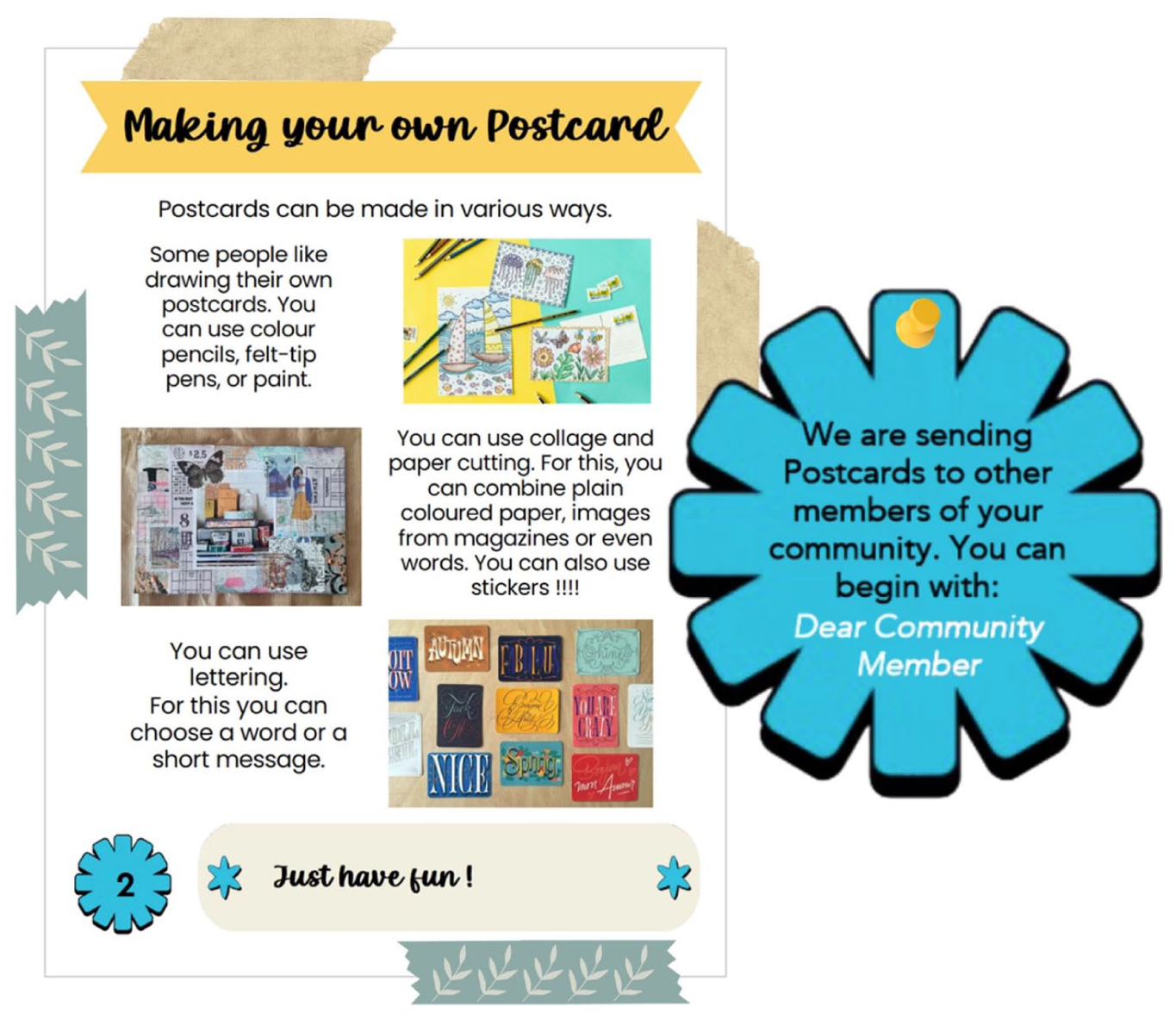
Extracts of booklet “create your own postcard” encouraging creativity and suggesting how to address the recipients.
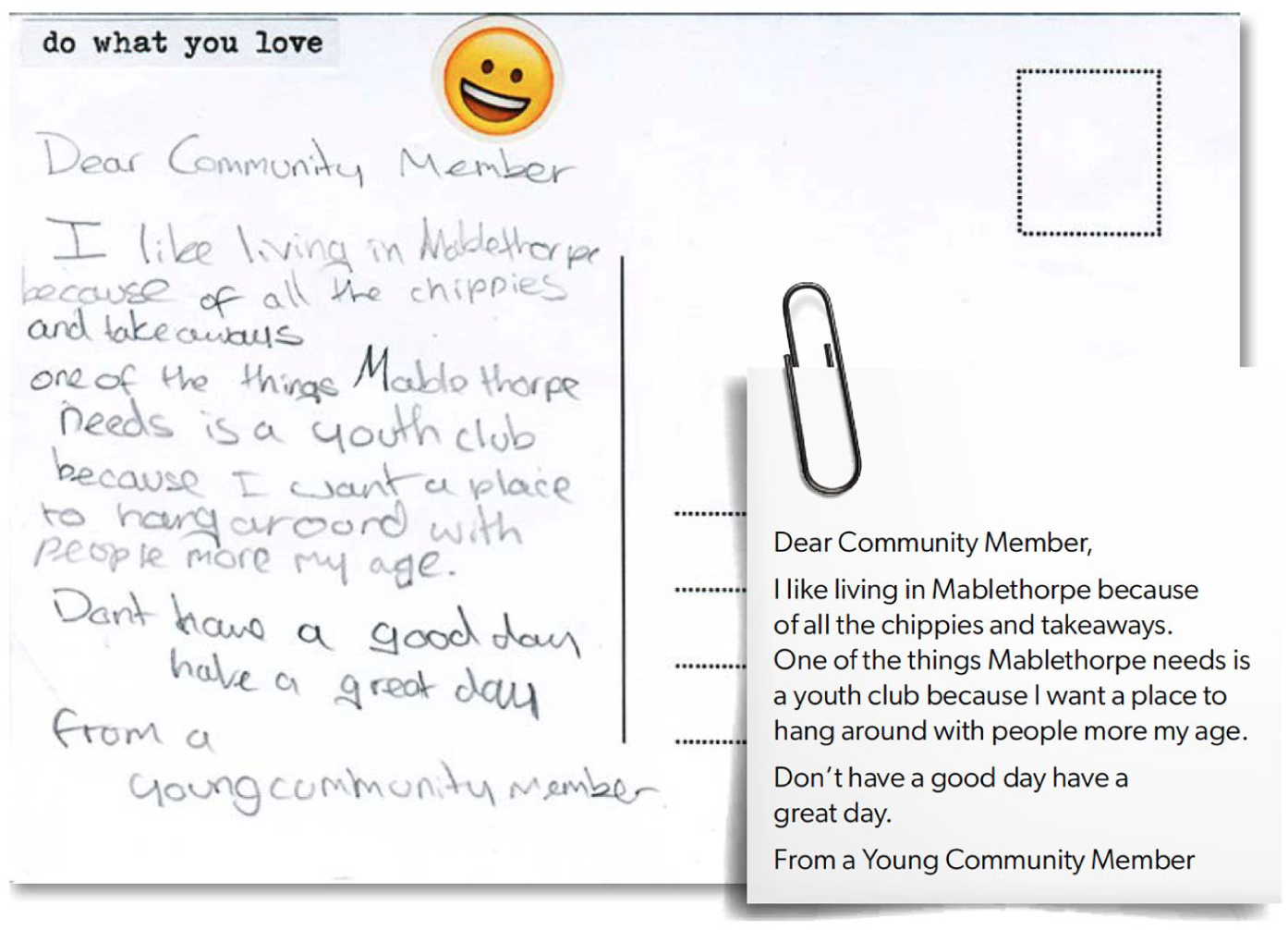
Postcard message written by a young co-researcher.
To promote intergenerational dialogue, we shared these postcards with adults in the community, inviting them to select a postcard message that resonated with them, and create their own postcard message in response. We directly approached some groups of adults, for example, at the primary school and local art group and organised a drop-in arts cafe session at the local library. In all cases, we provided blank postcards and art materials to inspire their creations. We received forty-nine postcards from adults, with written responses to the young people’s messages. The postcards were enlarged and displayed to reflect these young person-adult dialogues (see Figure 4), within an exhibition for local decision-makers and community members, reminding adults in the community that young people have needs that are not currently being met, and encouraging them to address this through young people’s social inclusion.
I just want them (the decision makers) to know that children are alive, that we exist. They know we are here, but they don’t think about us (Maisie, female, aged 10, Mablethorpe)
This asynchronous exchange of knowledge and experiences through art prompted conversations between young people and adults in the community that might not have been achieved through a different method (such as interviews), opening up shared connections to, and care for, the seascape. It offered important insights into shared concerns about the area (e.g. issues of policing, safety and litter) as well as the intergenerational inequalities that exist in Mablethorpe (e.g. young people’s lack of access to social spaces, clubs and activities that adults attend).
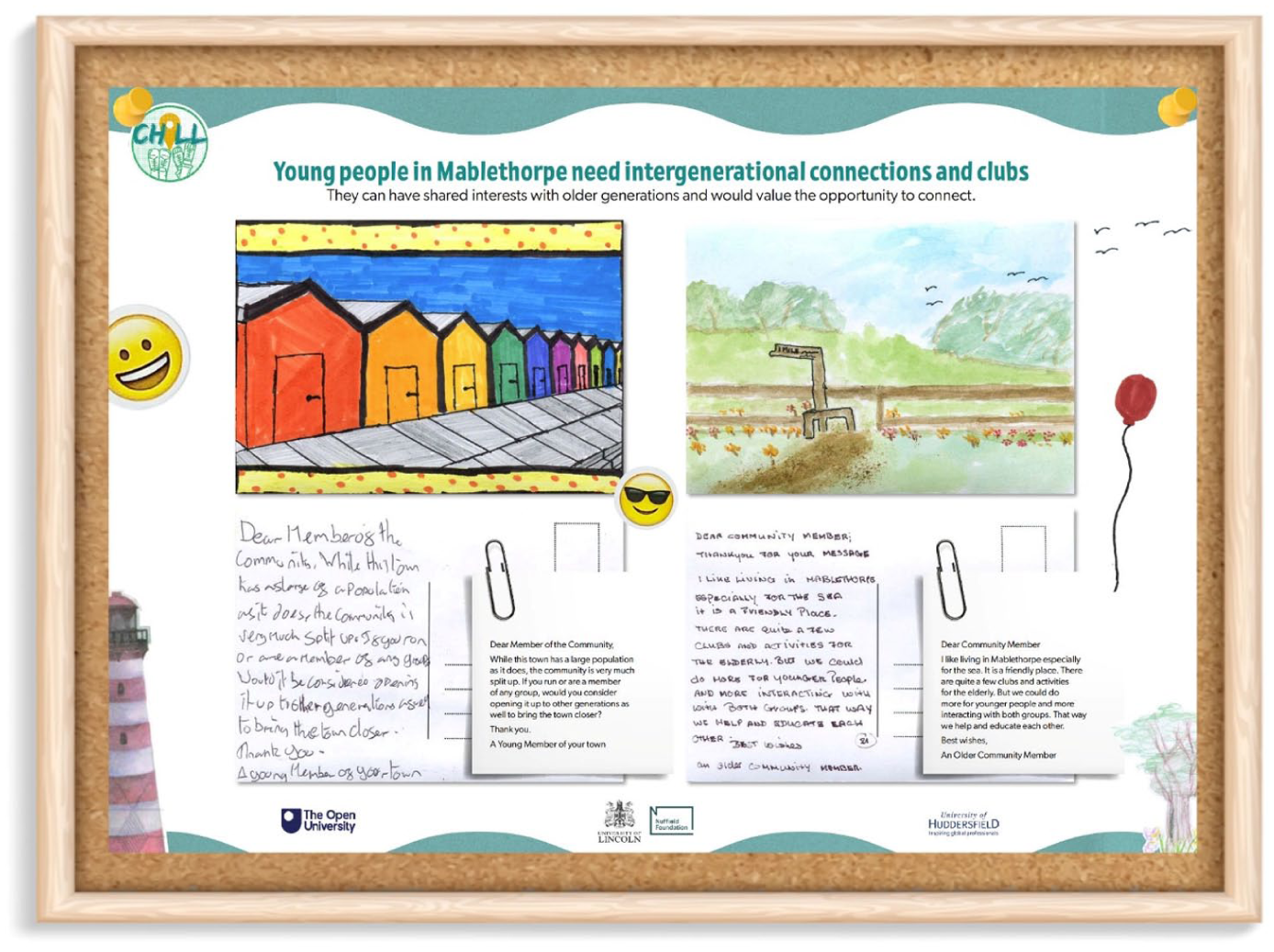
Example of a postcard exchange – young people’s postcard to the left and adult’s response to the right.
Generating Dialogue and Decision-Making
The young people’s postcards, videos and photographs also provided the content for an animation 73 and an accompanying booklet entitled “10 Things young people in Mablethorpe need from their town” 74 (see Figure 5). These included young people’s ideas about caring for and improving the social and physical infrastructure of the town through, for example, improved safety and policing, better environmental maintenance and activities to support community cohesion. The inclusion of young people’s artwork, voices and music captured and communicated their perspectives, emotional connections, 75 care for and lived experiences of the coastal town. Collectively, these creative outputs – postcards and animation – function as compelling mediums through which young people’s insights, aspirations, and care for their community are articulated and through which adults are invited to take notice and respond.
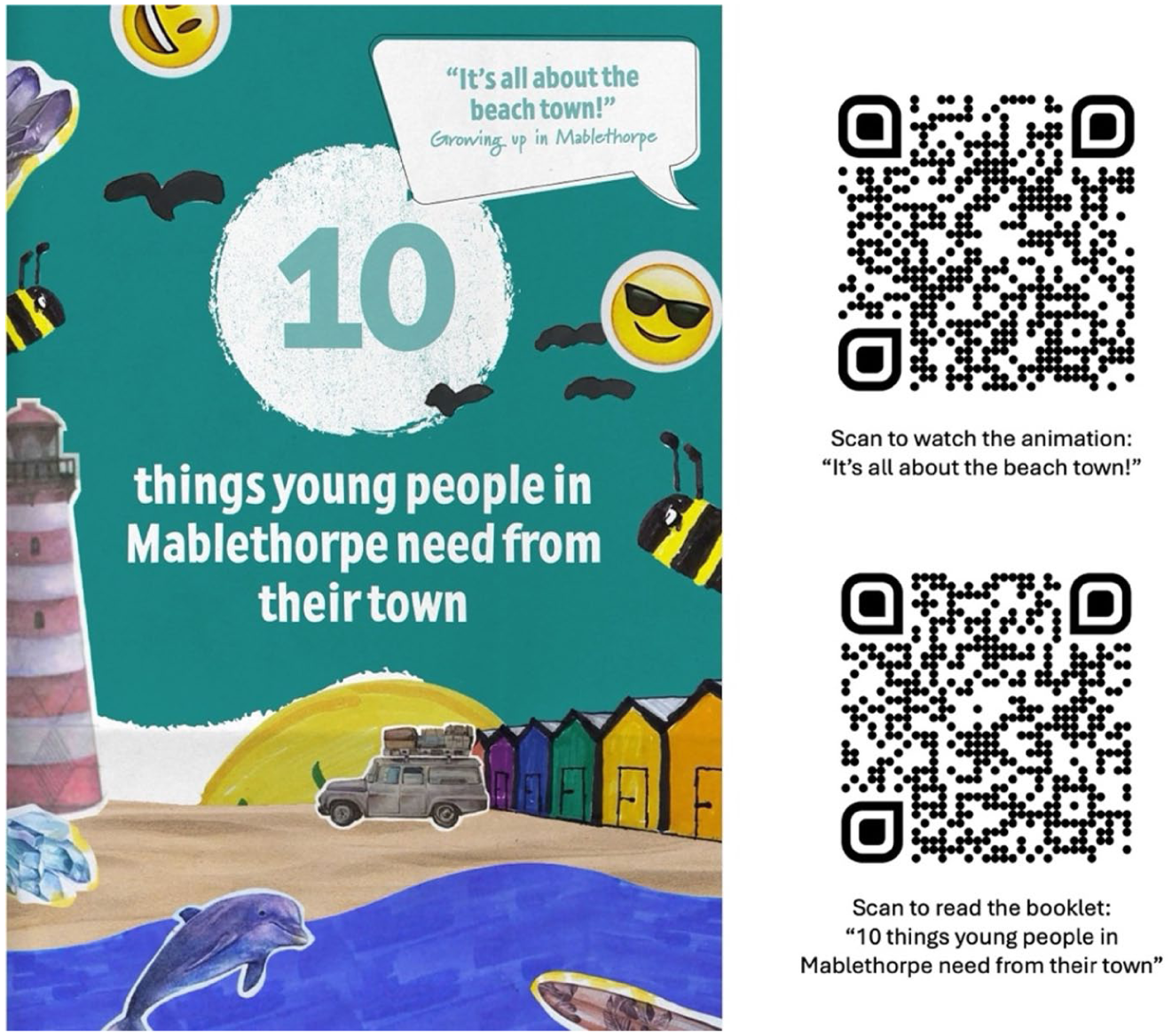
Booklet written and designed in consultation with young people.
Both outputs, along with the postcard exhibition, were presented to local decision-makers and the wider community at a Local Policy Dialogue Event organised to bring adults and young people into conversation. These resources acted as provocations to adults to take young people more seriously within local planning and decision-making, and which could be shared more widely within their organisations. By foregrounding young people’s views as the starting point for this community dialogue and using the postcard exchange to highlight the commonalities across generations, the project offered a practical approach to integrating young voices into community events that are typically geared toward adults and promoting a collective response to addressing issues of concern.
The project formally concluded in 2024. However, the impact of these methods on local planning and decision-making within the town remain tangible. A significant outcome of the research has been a collective will to find a solution to the lack of dedicated youth space in Mablethorpe. In response, East Lindsey District Council has recently granted Mablethorpe Area Partnership a 15 year lease of a former Ministry of Defence Air Training Corps hut, providing a long-awaited safe indoor space for young people, including weekly young people’s activities provided by Lincolnshire County Council. 76 The focus on intergenerational partnership fostered by the research was continued in an intergenerational renovation day, bringing members of the community of all ages together to prepare the space for use by young people.
In January 2025, the CCB hosted an exhibition at the new Leisure and Learning Centre to showcase the ongoing progress of initiatives supported by the town funds. As part of this event, specific activities were designed to engage young people, including a dedicated “crafts stand for young people” and a “postcard competition” inviting children to design postcards for Mablethorpe. 77 Meaningfully involving young people in decision-making processes requires deliberate effort and intentionality. While the choice to include young people is an important first step, it must be supported by appropriate tools and strategies to facilitate their democratic participation. Thus, we encourage local authorities to take a step further to capitalise not only on young people’s creativity but on their thoughts, visions and experiences. While the Towns Fund was a welcome investment, it could not hope to significantly improve embedded structural conditions in Mablethorpe, for either young people or adults. However, since the completion of the project, a further £20 million has been secured for the town through the Labour government’s Pride in Place fund, 78 providing further opportunities for regeneration efforts, and for local decision-makers to engage young people in Mablethorpe in planning what this should look like.
Discussion and Conclusion: Methodological Innovations in Child-Friendly Blue Urbanism
Vulnerable groups and those who are experts as a result of their experience, and children and young people must be brought into policymaking
79
I learnt to express my feelings freely and I will have my [voice] heard (Nicole, female, aged 11, Mablethorpe).
Our starting point in this article was to augment the important contribution of child-friendly blue urbanism, setting out a methodology, methods and tools that can enhance young people’s contribution to knowledge and action about their lives in coastal communities. Our research revealed that young people living in seaside towns in the UK face distinct socio-economic, spatial and environment challenges that are attributable to their coastal location. Yet their experiences, needs, views and ideas have frequently been overlooked by local decision-makers, who are often focused upon the economics of local tourism, and the needs of the dominant older, often retired, population. We have therefore explored a potential methodological approach that can support young people to be heard in research and policymaking, to contribute to local coastal planning, and to have greater influence over the development and enhancement of their coastal environment.
We have highlighted strategies for putting young people’s views at the heart of intergenerational conversations, as provocations for change, and to render more visible the convergence between young people’s and adults’ perspectives on a range of issues including safety and policing, environmental maintenance and community cohesion. Young people in our study emerged as capable social agents who enact care-full practices of everyday politics in their maintenance and enhancement of local green and blue spaces, and the people they encounter within them. This paper therefore makes an important contribution to the child-friendly blue urbanism model by setting out its methodological dimensions more fully, highlighting the significance of creative, participatory methods as a means to fully embrace children and young people as experts in their own lives. Our study has demonstrated the value in adopting creative, context-responsive and participatory research methods which position young people as co-researchers, who not only provide important answers, but are also capable of framing the questions and developing appropriate methods. Through this approach, we came to understand the 180 degrees of ocean space as a pivotal factor shaping the lives of children, their families and communities, and used this perspective to provoke intergenerational community conversations about the challenges and opportunities presented by life on the coast.
Our research has also highlighted some of the unique, methodological and ethical challenges in engaging in research with children in coastal towns, and how a context-responsive methodology was able to overcome these. These challenges included the ways in which seasonal local tourism and the absence of a secondary school impacted our access to young people and spaces in which we could work with them, as well as highlighting the particular safeguarding concerns for young people as co-researchers in public places occupied by the tourist “other.” The spatially disconnected nature of this coastal town, and its relative inaccessibility created logistical travel difficulties, and required us to spend extended periods of time in the town. We embraced this as providing us with ethnographically informed and embodied insights into the challenges faced by the young people in accessing opportunities beyond their town, including their lengthy daily bus commute to school, and in finding warm, sheltered and safe spaces to pass the time, especially after dark and in the winter. The process of adapting our methods to this context gave us insights into the adaptations that young people in Mablethorpe must make in their everyday lives.
The distinct context and creative stimulus of the seaside town setting was also instrumental in prompting innovative, context-responsive research instruments supporting young people’s voices, promoting community dialogue and empowering and advocating for active youth participation in planning and policy. Walking interviews provided insights into young people’s interactions with coastal urban environments, fostering their sense of belonging and pride; postcards inspired by the seasonal tourism facilitated asynchronous and “safe” intergenerational dialogues. Outputs from this research, including an animation and a booklet, were co-created with young people to provoke dialogue within the community and with policymakers, ultimately enhancing opportunities for young people to influence change.
The spatial isolation of the town is such that the ocean is a constant presence, impacting decisions about education provision, the economy and employment opportunities, local community development, and the priorities for regional development. It is, therefore, no surprise that the young people who we were privileged to work with as co-researchers feel that “It’s all about the beach town.” Whilst they clearly express their love of their award-winning sandy beach, the sea and local green spaces, they also call for greater attentiveness to their needs as valued citizens, their right to be considered within the services in their town, and the realisation of their ambitions through increased access to opportunities beyond those afforded by their blue urban space. We therefore argue that the development of a context-responsive research methodology is vital to fully appreciate how place shapes young people’s lives. This includes, how young people adapt to their environment, and in the case of coastal childhoods, how their experiences can be fed into “blue urban” planning and policymaking in ways that are attentive to the value young people place upon the coast as central to their growing up experience, as well as the support they need to overcome the challenges of coastal childhoods.
Footnotes
Acknowledgements
Thank you to the young people and adults who worked with us on this project and the members of the community, stakeholders and schools who provided support for this research. We would also like to thank the wider research team and local and national advisory groups for providing critical questions, suggestions and guidance. This project was originated by Barry Percy-Smith. Funding was secured from the Nuffield foundation (grant reference WEL/FR-000023447) by Barry Percy-Smith and Helen Lomax who were joint PIs on the project. Thank you to the Nuffield Foundation for granting us the award to undertake this study and for their continued support and advice.

Ethical Considerations
This study was approved by the University of Lincoln Research Ethics Committee (Approval No. UOL2023-9697) on 31 January 2023. All adult participants in the study provided written informed consent prior to participating. The children and young people under the age of 18 were asked to provide their assent to participate. Informed consent for their participation was obtained from their parent or carer prior to their participation. This included consent to publish their anonymised words and artwork in any research outputs.
Funding
The authors disclosed receipt of the following financial support for the research, authorship, and/or publication of this article: This work was supported by the Nuffield Foundation (Grant Number WEL/FR-000023447). The views expressed are those of the authors and not necessarily the Foundation.
Declaration of Conflicting Interests
The authors declared no potential conflicts of interest with respect to the research, authorship, and/or publication of this article.
Data Availability Statement
Data sharing is not applicable to this journal as the subject matter covered by the aims & scope does not necessitate the need for the use of empirical data, software, or code. As such, no datasets, software or code may be generated or analysed by the articles published in the journal.